



















































































 International Free Zone Authority
UAE E-Commerce Licence 2026: The Complete Guide — Types, Costs, Mainland vs Free Zone
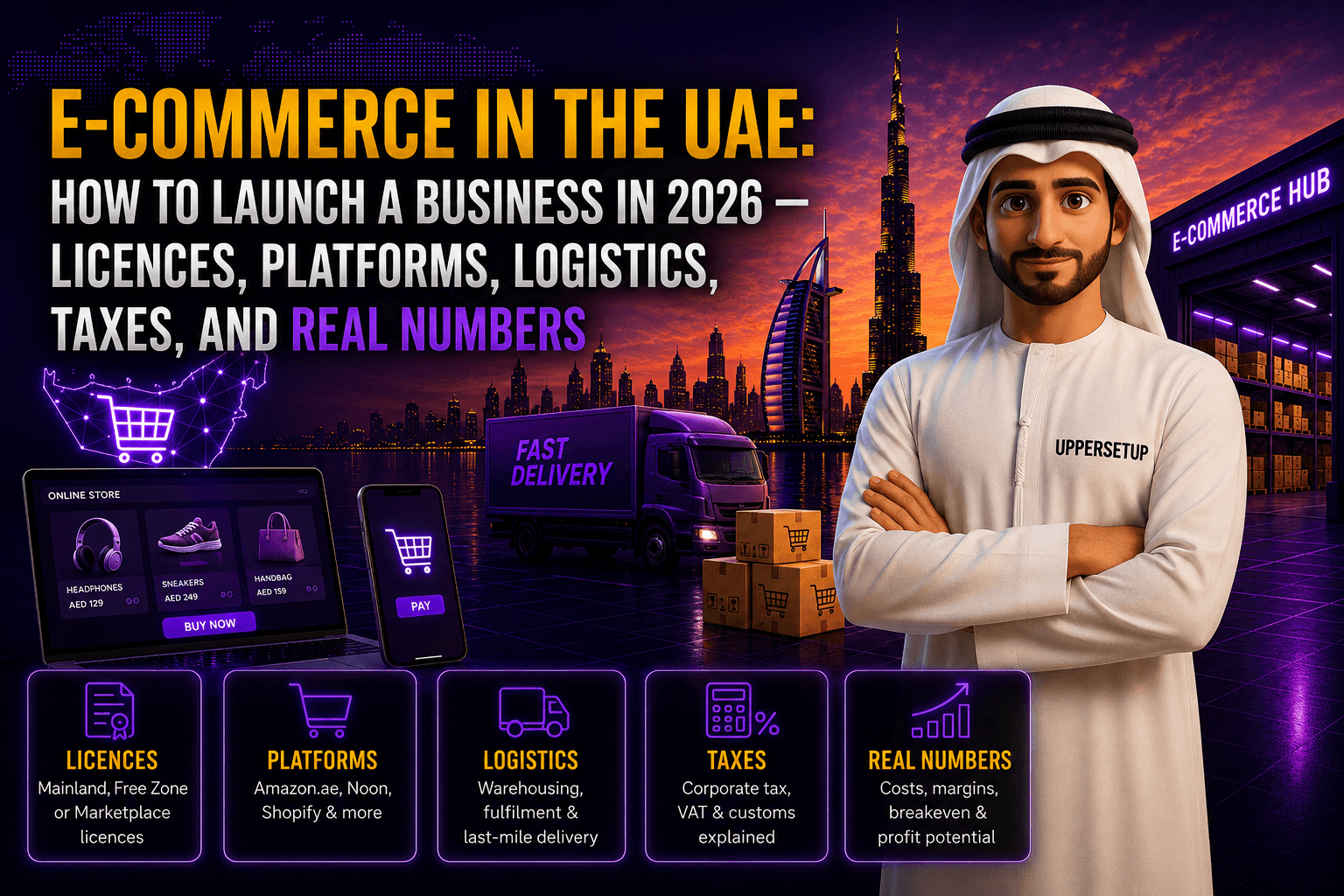
1. UAE E-Commerce Market: Why This Matters Right Now
The UAE e-commerce market reached USD 8.8 billion in 2024 and is projected to grow to USD 13 billion by 2029. The UAE ranks first in the MENA region for internet penetration (over 99%) and digital payment adoption. More than 95% of the adult population makes online purchases.
For entrepreneurs, this means one thing: opening an online business in the UAE is not a niche idea — it is entry into one of the most affluent and digitally advanced markets in the world. But legal operations require a licence — without one, selling goods or services via a website, Instagram, WhatsApp, or a marketplace is unlicensed commercial activity.
⚠ The fundamental rule: any online commercial activity in the UAE requires a licence. This applies to sales through a proprietary website, social media, messaging apps, and marketplaces (Amazon.ae, Noon.com, and others). Operating without a licence attracts fines and business closure.
2. Legal Framework: Three Key Laws
• Federal Law No. 1 of 2006 on Electronic Commerce and Transactions — the foundational e-commerce law, published in the Official Gazette in January 2006. Establishes the legal validity of electronic contracts, digital signatures, and electronic transactions. Regulator: Telecommunications and Digital Government Regulatory Authority (TDRA).
• Federal Decree Law No. 46 of 2021 on Electronic Transactions and Trust Services — updated electronic transactions law that replaced several provisions of the 2006 Law. Executive Regulation No. 28 of 2023 defines Trust Service Provider licensing. Expands requirements for digital identification and security.
• Federal Decree Law No. 47 of 2022 on Corporate Tax — corporate tax, in force from 1 June 2023. Applies to all UAE e-commerce companies when annual income exceeds AED 375,000.
Alongside federal legislation, each emirate has its own regulator for issuing trade licences: DET (Department of Economy and Tourism) in Dubai, ADDED in Abu Dhabi, SEDD in Sharjah, and equivalent bodies in other emirates.
3. Four Types of E-Commerce Licences
|
Licence type |
Who can obtain it |
Sell to UAE customers |
Office |
Visa |
Approx. cost |
|
E-Trader (DET/DED) |
UAE and GCC nationals only |
Yes (via social media, from home) |
No (home address) |
No |
AED 1,070 (Dubai) |
|
Mainland E-Commerce |
All foreigners + UAE nationals |
Yes (direct sales across the UAE) |
Mandatory (physical, Ejari) |
Yes |
AED 6,500–10,000 (licence) + AED 15,000–25,000 (office) |
|
Free Zone E-Commerce |
All foreigners + UAE nationals |
Restricted (distributor or crossborder licence needed for mainland) |
Virtual office/flexi-desk |
Yes |
From AED 5,750 (Shams) to AED 12,900 (IFZA) |
|
Dubai CommerCity (dedicated e-commerce free zone) |
All |
Restricted (distributor needed for mainland) |
Flexi-desk, warehouse, office |
Yes |
AED 18,000–30,000+ |
E-Trader: UAE and GCC nationals only
E-Trader is a specific licence type introduced by Dubai in 2017 to support home-based businesses and social media entrepreneurship. Cost: AED 1,070 (Dubai). No office required. Cannot hire foreign employees. Does not issue visas. Not available to foreign nationals.
⚠ Foreign nationals cannot obtain an e-trader licence. For foreigners, only mainland e-commerce and free zone licences are available. This is a fundamental restriction that is frequently omitted in overview articles.
Need help selecting a licence type and registering? Company registration services — uppersetup.com →
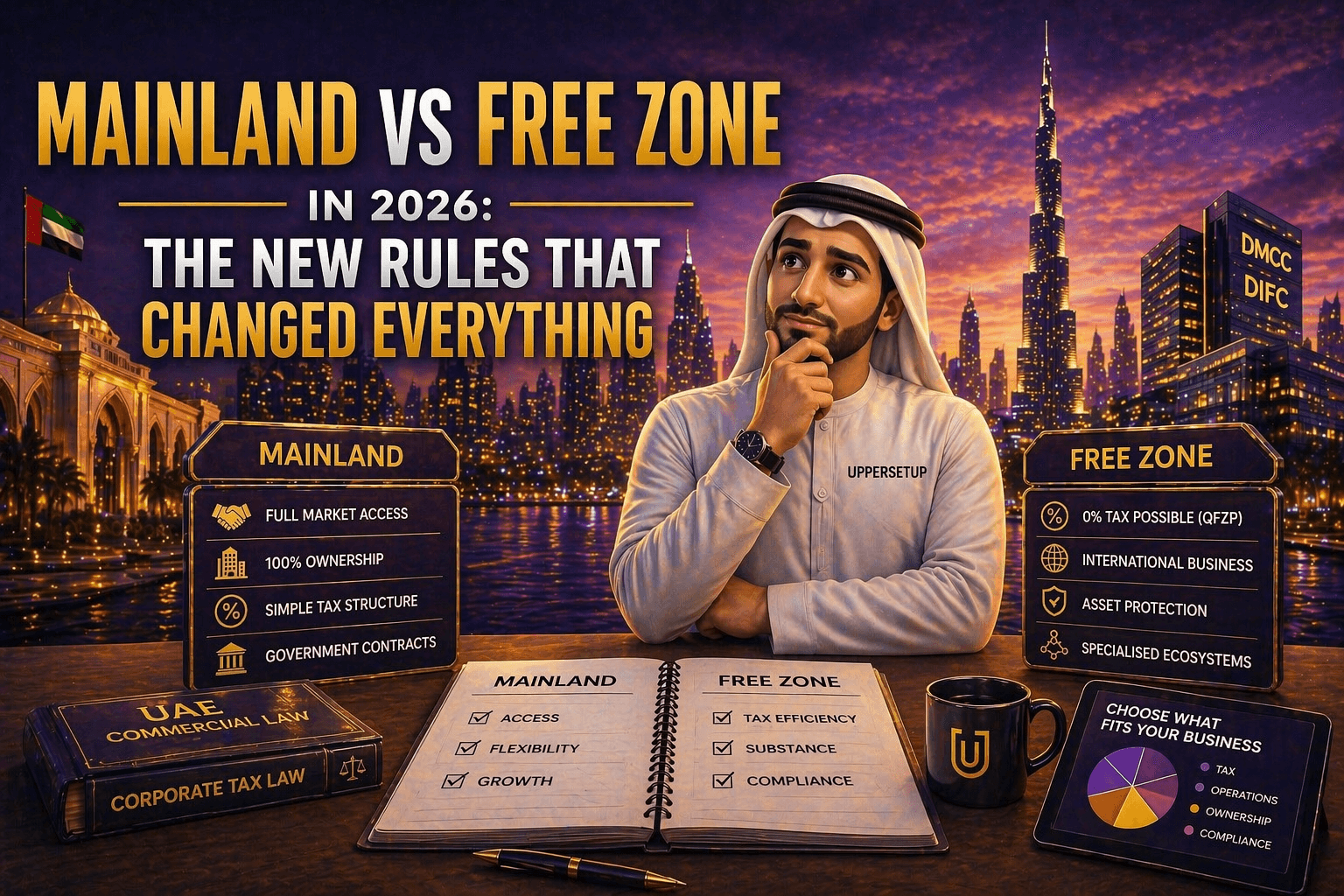
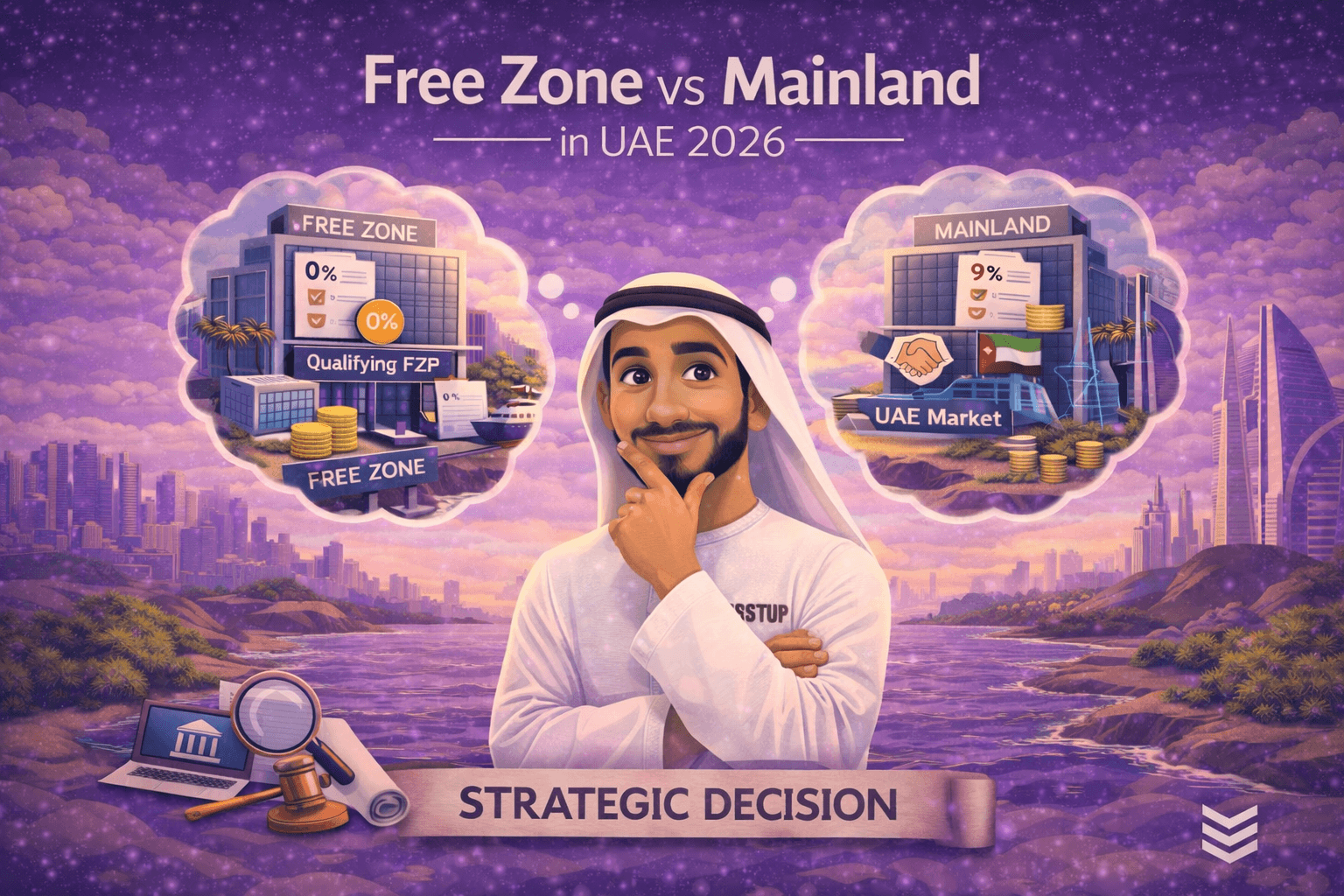
4. Mainland vs Free Zone: The Key Choice
|
Parameter |
Mainland (DET/DED) |
Free Zone |
|
Direct sales to UAE customers |
Yes — nationwide without restrictions |
Restricted — agent or additional mainland licence needed for retail sales within the UAE |
|
Government tenders |
Yes |
No (free zone companies excluded from government and semi-government procurement) |
|
Physical office |
Mandatory (Ejari) |
Virtual office / flexi-desk sufficient in most free zones |
|
TDRA NOC |
Mandatory |
Not always required (depends on free zone and activity) |
|
Office cost |
AED 15,000–25,000+/year |
AED 1,000–5,000/year (virtual) |
|
Licence cost |
AED 6,500–10,000/year |
From AED 5,750/year (Shams, RAKEZ) |
|
Visa |
Yes |
Yes |
|
100% foreign ownership |
Yes (Federal Decree-Law No. 26 of 2020, in force from 1 June 2021) |
Yes (traditionally) |
|
Registration timeline |
5–10 working days |
3–5 working days (most free zones) |
|
Best suited for |
Companies with direct B2C sales in UAE; government tender participants; businesses with physical presence |
International e-commerce; dropshipping; digital products; start-ups without UAE-focused B2C |
When to choose mainland
• You sell physical goods directly to end consumers in the UAE (B2C).
• You need access to government and semi-government tenders.
• You plan to physically work with UAE clients and partners on a regular basis.
• You are prepared for the cost of a physical office with Ejari.
When to choose a free zone
• Your clients are predominantly outside the UAE (international e-commerce, dropshipping, digital products).
• You are launching on a minimal budget.
• You need a UAE visa but do not need a physical office.
• You are testing a business model and want to avoid high fixed costs.
5. Free Zones for E-Commerce: Comparison Table
|
Free zone |
Emirate |
Office type |
Approx. year 1 cost |
Best for |
|
Shams (Sharjah Media City) |
Sharjah |
Virtual office/flexi-desk |
From AED 5,770 (licence) + visa ~AED 6,000 |
Small businesses, start-ups, non-residents. Lowest entry cost |
|
RAKEZ (Ras Al Khaimah) |
Ras Al Khaimah |
Virtual office/flexi-desk |
From AED 6,010 (licence) + visa |
Wide activity range, competitive price, widely accepted by UAE banks |
|
IFZA (Dubai Silicon Oasis) |
Dubai |
Virtual/flexi-desk/physical office |
From AED 12,900 |
Dubai address, broad activity scope, good banking recognition |
|
Masdar City Free Zone |
Abu Dhabi |
Virtual office |
From AED 7,000 |
Sustainability, clean tech, tech start-ups |
|
Dubai CommerCity |
Dubai |
Flexi-desk, office, warehouse |
AED 18,000–30,000+ |
E-commerce with logistics, storage, and fulfilment. The only dedicated e-commerce free zone in the UAE |
|
Meydan Free Zone |
Dubai |
Virtual office |
AED 7,500–12,000 |
Fast registration, Dubai address, start-ups |
Dubai CommerCity: the UAE's first dedicated e-commerce free zone
Dubai CommerCity is unique infrastructure purpose-built for online commerce. Located in Dubai. Includes warehouse capacity, fulfilment centres, offices, and flexi-desks. Ideal for companies requiring storage and logistics within the UAE. Cost is higher than Shams or RAKEZ, but the infrastructure has no equivalent.
6. TDRA NOC: What It Is and How to Obtain It
A TDRA NOC (No Objection Certificate from the Telecommunications and Digital Government Regulatory Authority) is a mandatory document for obtaining a mainland e-commerce licence in the UAE. TDRA is the federal regulator supervising electronic transactions and e-commerce activity under Federal Law No. 1 of 2006.
NOC application procedure
• Step 1: Reserve the company trade name with DED/DET.
• Step 2: Obtain Initial Approval from DED/DET.
• Step 3: Submit a NOC application to TDRA via tdra.gov.ae or through TDRA-authorised agents. Provide: trade name, description of e-commerce activity, founder details.
• Step 4: TDRA reviews the application and issues the NOC. Timeline: 1–5 working days.
• Step 5: With the NOC in hand, complete the trade licence process with DED/DET.
⚠ For free zone e-commerce licences, a TDRA NOC may not be required — this depends on the specific free zone. Always verify requirements directly with the free zone before applying.
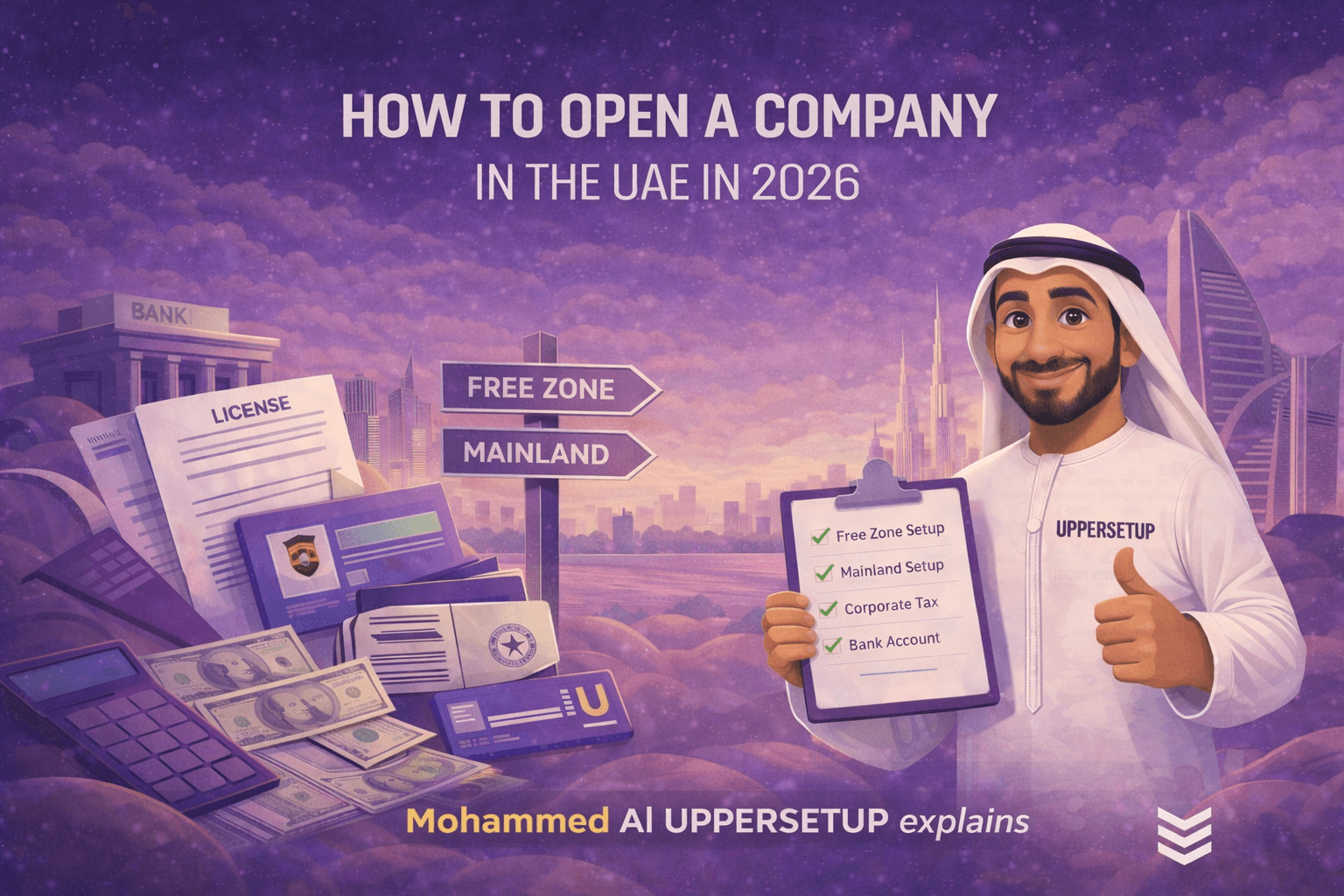
7. Step-by-Step Registration: Mainland E-Commerce (Dubai)
• Step 1. Choose a legal form: LLC (100% foreign ownership available since the 2021 reform) or Sole Establishment.
• Step 2. Reserve the trade name via DET (online at dubaieconomy.gov.ae). Requirements: must be unique; must not contain prohibited words.
• Step 3. Obtain Initial Approval from DET.
• Step 4. Obtain a NOC from TDRA for e-commerce activity.
• Step 5. Sign a physical office lease; register via Ejari. Minimum for e-commerce: a co-working workstation / flexi-desk in a business centre (in some cases) or a dedicated office.
• Step 6. Submit the document package to DET: passport(s), Initial Approval, TDRA NOC, Ejari, Memorandum of Association (MOA).
• Step 7. Pay the licence fee. Receive the trade licence (5–10 working days).
• Step 8. Apply for a residence visa (if needed): Entry Permit → medical examination → Emirates ID → visa.
• Step 9. Open a corporate bank account.
• Step 10. Register with the FTA (corporate tax + VAT when threshold is exceeded).
8. Payment Systems and Payment Gateways
Connecting a payment gateway is one of the key operational steps after licence issuance. To access a UAE payment gateway, the company must provide a valid trade licence. Accepting payments into a personal account is prohibited.
Main UAE payment gateways
• Telr — one of the largest UAE payment gateways; supports AED and 120+ currencies; accepts Visa, Mastercard, American Express; integrates with Shopify, WooCommerce.
• PayTabs — popular with small and medium businesses; fast onboarding; Arabic language support.
• Network International — the UAE's largest processor; used by HSBC, Emirates NBD, and other banks.
• Stripe — available in UAE; global reach; convenient for SaaS and digital products.
• PayPal — accepted, but with restrictions for UAE companies on receiving funds.
⚠ Payment gateways review the website Terms & Conditions before activation. A returns policy, privacy policy, and terms of use must be published on the site. Their absence is one of the most frequent causes of gateway onboarding delays.
9. Taxes for a UAE E-Commerce Company
|
Tax / obligation |
Applies? |
Threshold / rate |
Key notes |
|
Personal income tax |
NO |
0% |
UAE levies no personal income tax |
|
Corporate tax (CT) |
YES — above threshold |
9% on profit above AED 375,000/year |
Free zones: 0% for QFZP under conditions; mainland: 9% on profit above threshold; profit below AED 375,000 — 0% |
|
VAT |
YES — above threshold |
5% on turnover above AED 375,000/year |
FTA registration mandatory above threshold; voluntary from AED 187,500 |
|
Customs duty (imports) |
YES — on imported goods |
5% of CIF value (GCC standard) |
Free zones — customs benefits; Designated Zones exempt from VAT on import |
|
Withholding tax on non-resident payments |
NO |
0% |
UAE levies no withholding tax on dividends, interest, or royalties |
|
Municipal fee (Dubai) |
YES — for commercial leases |
5–10% of annual rent |
Applies to physical offices |
VAT in e-commerce: practical specifics
VAT at 5% applies to sales of goods and services to individuals and companies within the UAE. Important: foreign e-commerce sellers supplying goods or services to UAE buyers are required to register for VAT regardless of turnover — the AED 375,000 threshold does not apply to non-residents making taxable supplies in the UAE. For dropshipping: if goods are shipped directly from overseas to a UAE buyer, VAT liability depends on the delivery model. For digital services to non-UAE recipients: 0% (export of services). For physical goods on export: 0%.
Designated Zones: customs advantages
Several UAE free zones are Designated Zones with a special customs regime. For e-commerce this means: goods stored in a Designated Zone are not subject to VAT until they are sold and delivered to an end consumer within the UAE. Dubai CommerCity, Dubai South, and Jebel Ali Free Zone are Designated Zones. This is critical for companies with a UAE warehouse/inventory model.
Need help registering an e-commerce company in the UAE? UPPERSETUP company registration services →
10. Common Mistakes
• Selling without a licence via Instagram or WhatsApp. Any online commercial activity without a licence is unlawful. Fines: AED 10,000 to AED 50,000 (per DET data); possible business closure and deportation.
• Choosing a free zone and expecting unrestricted access to UAE customers. A free zone company cannot directly sell retail to mainland UAE customers without additional permissions. A mainland licence or local agent is required for B2C on the mainland.
• Missing the TDRA NOC for a mainland licence. Without a TDRA NOC, DET will not issue an e-commerce licence. This is a mandatory step that is frequently omitted in DIY registrations.
• Accepting payments into a personal bank account. UAE banks block personal accounts used commercially. A corporate bank account is mandatory.
• Failing to register for VAT when the threshold is exceeded. With turnover above AED 375,000/year, FTA registration is mandatory. Penalty for late registration: AED 10,000 (Cabinet Decision No. 49 of 2021).
• Not updating Terms & Conditions when the business changes. Payment gateways and licensing authorities may require updated website documentation. Non-compliance is grounds for licence revocation.
11. Practical Use Cases
Case 1: Dropshipping with Chinese suppliers
An entrepreneur accepts orders via their own website; goods are shipped directly from China to buyers in the UAE and Europe. Optimal structure: free zone e-commerce licence (Shams or RAKEZ — from AED 5,750). Payment gateway: Telr or Stripe. VAT: UAE sales above AED 375,000 — FTA registration required. Sales abroad: 0%.
Case 2: Electronics online store with UAE-wide delivery
A company sells electronics in Dubai, Abu Dhabi, and Sharjah with delivery from its own warehouse. Optimal structure: mainland e-commerce licence via DET Dubai + physical office with Ejari. Warehouse — in a Designated Zone (Dubai South or Jebel Ali) for customs and VAT optimisation. Payment gateway: Network International.
Case 3: Digital products and SaaS for a global market
A company sells software subscriptions to clients in Europe, the US, and Asia. Optimal structure: free zone licence (IFZA or Shams). Visa: 2-year UAE residence visa. VAT on export of services: 0%. Corporate tax: 0% under QFZP status. Payment gateway: Stripe (supports international payments).
12. E-Commerce Launch Checklist
• Define the model: UAE B2C (mainland) or international/B2B (free zone).
• Select the licence type: mainland DET/DED, free zone, or dedicated e-commerce free zone.
• Reserve the trade name.
• Obtain Initial Approval from DED/DET (for mainland).
• Obtain the TDRA NOC (mandatory for mainland e-commerce).
• Sign the lease: Ejari for mainland, virtual office for free zone.
• Receive the trade licence.
• Apply for visa and Emirates ID (if needed).
• Open a corporate bank account.
• Prepare the website: Terms & Conditions, Privacy Policy, Returns Policy.
• Connect a payment gateway.
• Register with the FTA: corporate tax + VAT when threshold is exceeded.
Sources
• Federal Law No. 1 of 2006 on Electronic Commerce and Transactions — official MOET link (moet.gov.ae)
• Federal Decree Law No. 46 of 2021 on Electronic Transactions and Trust Services (tdra.gov.ae)
• TDRA — Telecommunications and Digital Government Regulatory Authority: e-Commerce (tdra.gov.ae)
• u.ae — Official UAE Government portal: eCommerce licensing (u.ae)
• DET Dubai — Department of Economy and Tourism: Business Licences (dubaieconomy.gov.ae)
• ADDED — Abu Dhabi Department of Economic Development (added.gov.ae)
• Dubai CommerCity — official portal (dubaicommercity.ae)
• FTA — Federal Tax Authority: Corporate Tax (tax.gov.ae)
• FTA — Federal Tax Authority: VAT registration (tax.gov.ae)
• Al Tamimi & Company — E-Commerce Legal Framework UAE (tamimi.com)
• Gulf News — UAE e-commerce market 2026 (gulfnews.com)
• Khaleej Times — UAE digital economy and e-commerce 2026 (khaleejtimes.com)
Disclaimer
This article is provided for informational purposes only and does not constitute legal or professional advice. Information is based on current UAE legislation and official sources as of May 2026. Licence costs, requirements, and procedures may change; before making any decisions, readers are advised to verify current conditions directly with the relevant authority. UPPERSETUP accepts no liability for actions taken solely in reliance on this material.
All services on the platform
Everything you need to start and run a business - in one place
- 3–5 days
Company Setup
Mainland or Free Zone company with a complete set of incorporation documents
Start - Monthly
Accounting Services
Financial accounting and reporting in accordance with UAE requirements
Start - 1–2 weeks
Visa Services
Residence visas for shareholders, employees and family members
Start - 7–30 days
Banking Services
Corporate Bank Accounts in the UAE and Payment Services
Start - Custom timeline
Legal Services
Contracts, corporate amendments and legal support
Start


