


















































 International Free Zone Authority
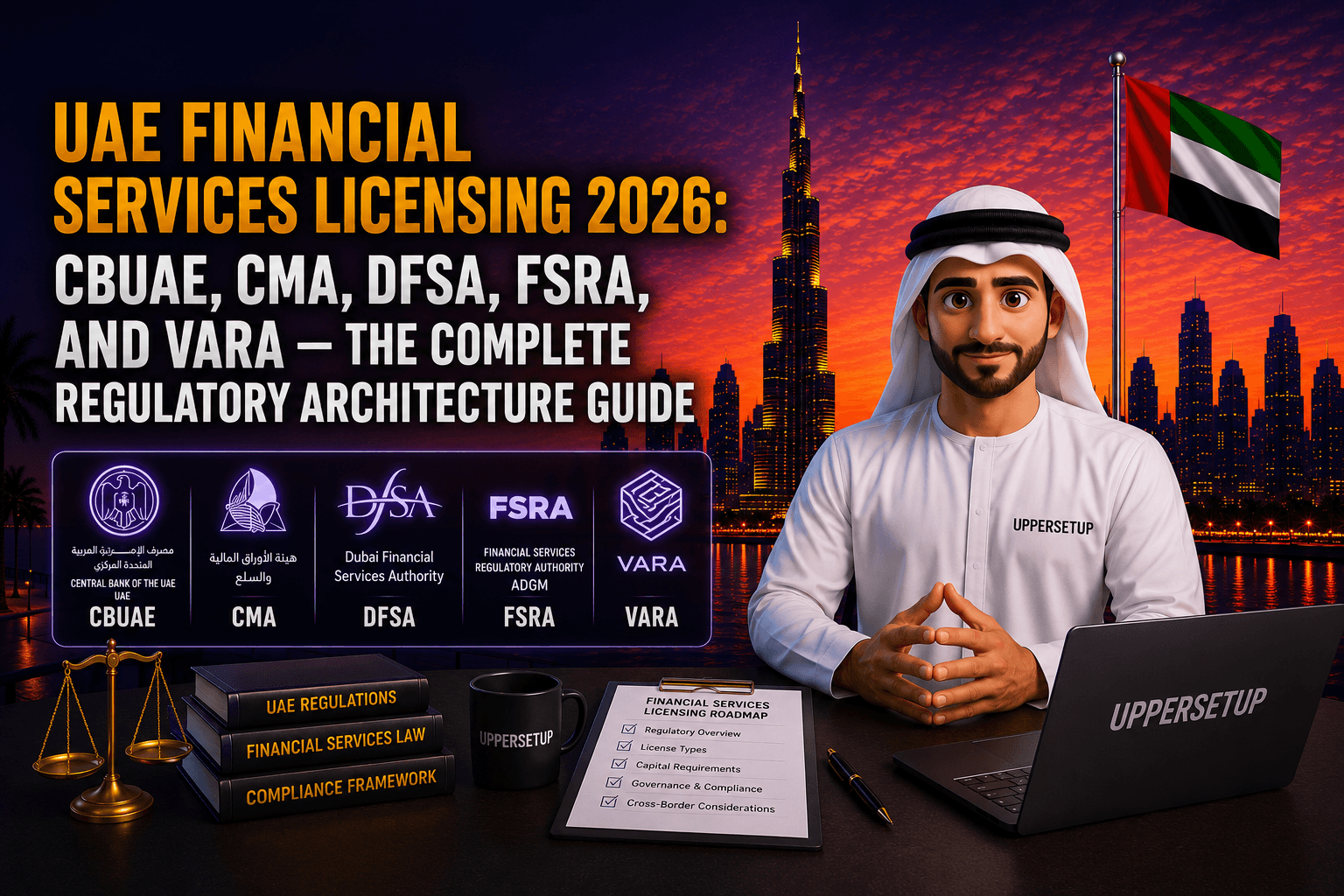
UAE Financial Services Licensing 2026: CBUAE, CMA, DFSA, FSRA, and VARA — The Complete Regulatory Architecture Guide
1. Why You Must Understand the UAE Regulatory Architecture: There Is No Single Licence
The UAE financial market is one of the most complex regulatory architectures in the world. Unlike most countries that have a single financial regulator, the UAE operates a multi-tier system: federal regulators, emirate-level regulators, and independent financial centre regulators. Selecting the wrong regulator means a licence that does not cover where you operate. A DFSA licence does not authorise dealing with UAE mainland clients. A VARA registration does not permit activities outside Dubai. CBUAE authorisation does not apply within DIFC or ADGM.
The defining principle: two parameters are critical when determining the applicable regulator — jurisdiction (where the activity will be conducted: UAE mainland, Dubai mainland, DIFC, ADGM) and activity type (what exactly you do: accept deposits, manage assets, provide payment services, deal in virtual assets).
Critical 2026 context: in the eight months from September 2025 to January 2026, the UAE enacted three of the most significant financial regulatory reforms of the past decade. Any article written before January 2026 contains outdated information about at least one regulator.
2. 2025–2026 Reforms: What Changed and Why It Matters Right Now
|
Reform |
What changed |
Effective date |
Transition period |
|
Federal Decree-Law No. 6 of 2025 (CBUAE) |
New Central Bank Law consolidates banking and insurance regulation. Expands licensing to fintech providers (Art. 62). Introduces criminal liability for unlicensed financial activities (up to AED 500 million fine). Technology-neutral licensing trigger. |
16 September 2025 |
Until 16 September 2026 |
|
Federal Decree-Law No. 32 + 33 of 2025 (CMA) |
SCA renamed as Capital Market Authority (CMA). New Capital Markets Law covers securities, derivatives, public offerings, and virtual assets as securities. Enhanced CMA supervisory powers. All SCA references now mean CMA. |
1 January 2026 |
Until 1 January 2027 |
|
VARA Rulebook 2.0 (Dubai) |
Updated listing, reserve, and governance requirements for virtual asset service providers. Strengthened AML/CFT standards. New licence categories for DeFi protocols. |
2024–2025 (phased) |
In force |
|
CBUAE PTSR (Payment Token Services Regulation) |
Regulation of stablecoins and payment tokens. 100% reserve requirement. FATF Travel Rule compliance. Covers both fiat-backed and virtual-asset-backed payment tokens. |
2024 (in force in 2026) |
In force |
⚠ The transitional period under Federal Decree-Law No. 6 of 2025 (CBUAE) expires on 16 September 2026. Companies whose activities fall within the newly defined licensed perimeter must obtain a licence or restructure their business model. Article 62 of the CBUAE Law sets a technology-neutral licensing trigger: authorisation is required regardless of the "medium, technology or form" of service delivery. This directly impacts API providers, DeFi platforms, and open banking operators.
3. Five UAE Regulators: Who Is Responsible for What
|
Regulator |
Jurisdiction |
Legal basis (2026) |
Key activities |
Transition period |
|
CBUAE (Central Bank of the UAE) |
UAE mainland (not applicable in DIFC and ADGM) |
Federal Decree-Law No. 6 of 2025 (effective 16 Sept 2025) |
Banks, insurance, payment services, stored value, open finance, fintech providers |
Until 16 September 2026 |
|
CMA (Capital Market Authority) — formerly SCA |
UAE mainland (not applicable in DIFC and ADGM) |
Federal Decree-Law No. 32 of 2025 + FDL No. 33 of 2025 (effective 1 Jan 2026) |
Asset management, investment advice, brokers, exchanges, public offerings, virtual assets as securities |
Until 1 January 2027 |
|
VARA (Virtual Assets Regulatory Authority) |
Emirate of Dubai (excl. DIFC) |
Dubai Law No. 4 of 2022; VARA Rulebook (updated 2024–2025) |
Virtual asset exchanges, custody, asset management, brokerage for virtual assets |
— |
|
DFSA (Dubai Financial Services Authority) |
DIFC (Dubai) |
DIFC Law No. 1 of 2004 + DFSA Rulebook |
Banking, asset management, brokerage, insurance, payment services, crypto assets within DIFC |
— |
|
FSRA (Financial Services Regulatory Authority) |
ADGM (Abu Dhabi) |
ADGM Financial Services and Markets Regulations 2015 + FSRA Rulebook |
Financial services, asset management, digital assets, payment services within ADGM |
— |
3.1. CBUAE — Central Bank of the UAE
The CBUAE is the principal federal financial regulator. From 16 September 2025, it operates under Federal Decree-Law No. 6 of 2025, which consolidates banking regulation and insurance under a single legislative instrument. The key expansion: Article 61 defines "Licensed Financial Activities", while Article 62 provides that any person carrying on, offering, issuing, or facilitating a licensed financial activity — regardless of technology or form — falls under CBUAE regulation. This is the first direct inclusion of fintech infrastructure within the regulatory perimeter.
CBUAE regulates: banks (commercial, Islamic, foreign), insurance companies and brokers (Insurance Authority merged into CBUAE in 2020), payment systems, stored value operators, Open Finance services, payment tokens (under the Payment Token Services Regulation — PTSR), and now technology providers servicing these activities.
3.2. CMA — Capital Market Authority (formerly SCA)
From 1 January 2026, the Securities and Commodities Authority (SCA) was reconstituted as the Capital Market Authority (CMA) under Federal Decree-Law No. 32 of 2025 and Federal Decree-Law No. 33 of 2025. The CMA is the legal successor of the SCA: all rights, obligations, and contracts transfer automatically. All references in existing legislation to the "SCA" now mean "CMA". Pre-existing Cabinet decisions and SCA resolutions remain in force until replaced.
CMA regulates: investment asset management, investment advice, securities brokerage, securities exchanges (Dubai Financial Market, Abu Dhabi Securities Exchange), public offerings (IPO), derivatives, crowdfunding, and virtual assets to the extent they constitute securities. Market participants must align with the new legislation by 1 January 2027.
⚠ Practical question for crypto companies: if your token or activity is classified as an "investment token" or "security" — the regulator is the CMA (or DFSA/FSRA in financial free zones). If it is a "payment token" — CBUAE. If it is a "virtual asset" in Dubai — VARA. This classification is not self-evident and requires legal analysis before submitting a licence application.
3.3. VARA — Virtual Assets Regulatory Authority
VARA was established in 2022 under Dubai Law No. 4 of 2022 as the world's first independent regulatory body specialised exclusively in virtual assets. It operates within the Emirate of Dubai, excluding the DIFC. VARA is not a federal authority — it is an emirate-level regulator. In 2024–2025, VARA updated its Rulebook (version 2.0), significantly tightening requirements for operational resilience, reserve management, and disclosure for virtual asset service providers (VASPs).
VARA issues licences for: virtual asset exchange services, brokerage and dealing services, custody services, portfolio management (virtual assets), advisory services, lending and borrowing, and virtual asset issuance and offering. VARA mandates physical presence (office) in Dubai and approval of all key personnel.
3.4. DFSA — Dubai Financial Services Authority
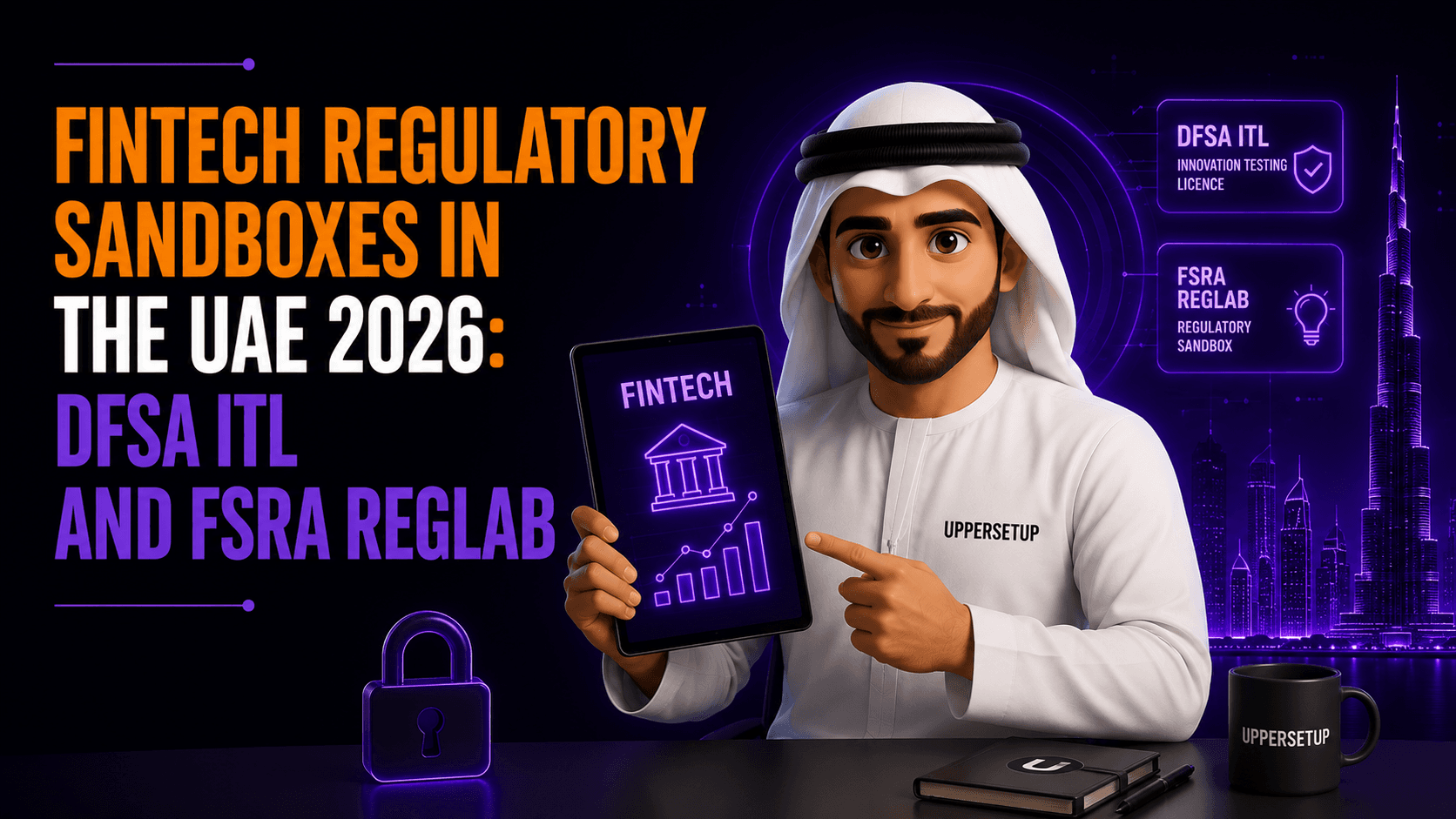
The DFSA is the independent regulator of the DIFC. It operates under its own DIFC legislation and DFSA Rulebook, developed in line with international standards (UK FCA, IOSCO, Basel). It is widely regarded as one of the most rigorous and credible regulators in the region. The Innovation Testing Licence (ITL) allows startups to test products without a full licence for up to two years.
DFSA regulates: banks, investment asset management, brokerage, insurance, payment services, custody, and crypto assets (including investment tokens and utility tokens with investment characteristics). DFSA licences do not authorise dealing with retail clients outside the DIFC without separate mainland regulatory approval.
3.5. FSRA — Financial Services Regulatory Authority
The FSRA is the regulator of ADGM. Structurally similar to the DFSA in approach, the FSRA has a reputation for being more agile and innovation-friendly — particularly for digital assets. The FSRA's Regulatory Laboratory (RegLab) runs regular cohorts allowing fintech companies to test business models under regulatory supervision. The FSRA was the first regulator in the region to develop detailed institutional-grade digital asset governance rules.
Planning to apply for a financial licence in the UAE? UPPERSETUP legal and regulatory services →
4. Matrix: Which Regulator for Which Activity
|
Activity |
UAE mainland (regulator) |
Dubai mainland / virtual assets |
DIFC |
ADGM |
|
Banking / deposit taking |
CBUAE |
CBUAE |
DFSA |
FSRA |
|
Payment services / stored value |
CBUAE |
CBUAE / VARA (if VA) |
DFSA |
FSRA |
|
Investment asset management |
CMA |
CMA |
DFSA |
FSRA |
|
Investment advice |
CMA |
CMA |
DFSA |
FSRA |
|
Securities brokerage |
CMA |
CMA |
DFSA |
FSRA |
|
Virtual asset exchange |
CMA (if securities) / CBUAE (if payment tokens) |
VARA |
DFSA |
FSRA |
|
Virtual asset custody |
CMA / CBUAE |
VARA |
DFSA |
FSRA |
|
Insurance |
CBUAE |
CBUAE |
DFSA |
FSRA |
|
Crowdfunding |
CMA |
CMA |
DFSA |
FSRA |
|
Fintech infrastructure / Open Finance |
CBUAE (Art. 62 FDL 6/2025) |
CBUAE |
DFSA |
FSRA |
Important clarification on virtual assets: virtual assets in the UAE fall under different regulators depending on their classification. If a token is a security — CMA (mainland), DFSA (DIFC), or FSRA (ADGM). If it is a payment token — CBUAE. If it is a "virtual asset" under VARA's definition — VARA (Dubai, excluding DIFC). This distinction is not always clear and requires a legal opinion before submitting a licence application.
5. In-Depth: How to Obtain a CBUAE Licence
Key requirements for applicants
• Legal form: UAE-incorporated company (typically a joint stock company or LLC depending on the activity). Foreign banks may be licensed as restricted licence banks or branch offices.
• Minimum capital: set by the CBUAE Board of Directors depending on the activity. Banks: significantly higher than fintech providers and payment system operators.
• Physical presence: UAE office; key personnel (CEO, CFO, CRO, MLRO) physically present in the UAE.
• Governance and compliance: internal control system, AML/CFT programme, corporate governance policies.
• Key personnel approval: CBUAE conducts "fit and proper" assessments.
Licensing procedure
Step 1. Pre-Application Meeting with CBUAE — recommended to understand regulatory expectations.
Step 2. Submit a complete application file: business plan, 3-year financial projections, constitutional documents, CVs and files on key personnel, AML/CFT policies, IT architecture, business continuity plan.
Step 3. CBUAE review: within 60 working days of receiving the complete file (Article 69, Federal Decree-Law No. 6 of 2025). Failure to respond within this period is deemed a rejection.
Step 4. In-Principle Approval (IPA) and issuance of licence following fulfilment of conditions.
⚠ Criminal liability for unlicensed financial activity. Federal Decree-Law No. 6 of 2025 introduces criminal liability for conducting licensed financial activities without authorisation: imprisonment and/or a fine of AED 50,000 to AED 500,000,000 (administrative penalties may reach AED 1,000,000,000 under CBUAE's expanded enforcement powers). This is not merely a financial sanction — it is the UAE's primary enforcement tool against unlicensed financial operators.
6. In-Depth: DFSA Licensing (DIFC)
The DIFC attracts financial institutions that require a common law jurisdiction, internationally recognised courts, and an institutional investor client base. Over 700 financial organisations hold a DFSA licence as of 2026.
DFSA licence categories
• Category 1 — Deposit taking (banks). Strictest capital requirements.
• Category 2 — Asset management. Professional investors; substantial capital requirements.
• Category 3 — Brokerage, collective asset management.
• Category 4 — Advisory, agency services. Minimal capital requirements.
• Category 5 — Financial intermediaries not holding client assets.
Key DFSA requirements
• Key functions: Senior Executive Officer (SEO), Chief Financial Officer (CFO), Chief Risk Officer (CRO), Compliance Officer (CO), Money Laundering Reporting Officer (MLRO).
• Physical presence: DIFC office; key staff physically present in the DIFC.
• Minimum capital: category-dependent; from USD 10,000 (Cat 4) to substantially higher for Cat 1–2.
• Regulatory Business Plan (RBP): detailed document covering the business model, risk management system, client profile, and revenue sources.
7. In-Depth: VARA Licensing (Dubai)
VARA is the UAE's most specialised and fastest-evolving regulator. Rulebook 2.0 (2024–2025) substantially tightened requirements for operational resilience, reserve management, and transparency. Key VARA licence types:
• VA Issuance Service: issuance and primary offering of virtual assets. Strictest category.
• VA Exchange Service: operators of spot and derivative virtual asset markets.
• VA Brokerage Service: brokers acting on behalf of clients in buying/selling virtual assets.
• VA Management and Investment Service: virtual asset portfolio management, discretionary management.
• VA Custody Service: custodial services; strict cold storage and insurance requirements.
• VA Lending and Borrowing Service: collateralised lending against virtual asset security.
• VA Advisory Service: advice on virtual assets.
• MVP Licence: temporary limited licence for market testing.
⚠ VARA requires mandatory physical presence in Dubai, approval of all key personnel, regular transaction reporting, and FATF Travel Rule compliance (mandatory transfer of originator and beneficiary information for transfers above USD 1,000). AML/CFT violations are treated as criminal offences under UAE anti-money laundering legislation (Federal Decree-Law No. 10 of 2025).
8. Regulatory Sandboxes: The Path for Innovators
|
Regulator |
Programme |
What it provides |
Target audience |
|
CBUAE |
Regulatory Sandbox (under fintech strategy) |
Operate in a limited environment without full licence; direct dialogue with regulator; reduced capital requirements |
Fintech companies with innovative payment and banking products |
|
CMA (formerly SCA) |
Regulatory Sandbox Framework |
Test innovative capital market products without standard requirements |
Investment platforms, trading algorithms, tokenised assets |
|
DFSA (DIFC) |
Innovation Testing Licence (ITL) |
Temporary testing licence. Valid up to 2 years. Reduced capital requirements. Direct DFSA engagement. |
Fintech startups, banks, asset managers with new products |
|
FSRA (ADGM) |
Regulatory Laboratory (RegLab) |
Testing cohorts. ADGM supports startups via Hub71 and in-house infrastructure programmes. |
Financial innovation, crypto, payment systems |
|
VARA (Dubai) |
ATI (Approval to Incorporate) + Full VASP Licence |
Limited operational licence for initial launch. Full Rulebook compliance not required from day one. |
New virtual asset exchanges and VASP providers |
Practical recommendation: regulatory sandboxes are the optimal route for startups without a ready operational model for full compliance. The DFSA ITL and FSRA RegLab have the strongest reputations for accessibility to foreign entrepreneurs and speed of regulatory engagement. VARA's MVP Licence is specifically designed for companies working with virtual assets in Dubai.
Need guidance on jurisdiction selection for your financial licence? UPPERSETUP legal services — structuring and regulatory support →
9. Choosing a Jurisdiction: Practical Use Cases
Case 1: Payment system for mainland B2B transfers
A company plans to provide payment services to corporate clients in the UAE. Regulator: CBUAE. Licence: Retail Payment Services. Transition deadline: align with FDL No. 6 of 2025 by 16 September 2026. Key requirement: PTSR compliance for payment tokens if blockchain infrastructure is used.
Case 2: Asset management firm for institutional investors
A company manages portfolios for high-net-worth and institutional investors. If clients are in the DIFC — DFSA Category 2. If clients are on the UAE mainland — CMA licence. If both audiences are needed — a two-entity structure with separate licences in each jurisdiction.
Case 3: Virtual asset exchange in Dubai
An exchange serving retail and institutional clients in Dubai. Regulator: VARA. Required licences: VA Exchange Service + VA Custody Service. Starting route: ATI (Approval to Incorporate) → Full VASP Licence application. Timeline to full licence: 6–18 months depending on documentation readiness.
Case 4: Fintech startup — open banking API
A startup provides API infrastructure for bank data aggregation and payment initiation. Before 16 September 2025: may have operated without a licence. From 16 September 2025: falls under Article 62 of Federal Decree-Law No. 6 of 2025 (CBUAE technology-neutral trigger). Optimal route: CBUAE Regulatory Sandbox application or DFSA ITL.
10. Common Mistakes in UAE Financial Licensing
• Referencing the SCA and ignoring the CMA rebrand. From 1 January 2026, the SCA no longer exists. All applications, licences, and official communications go through the CMA. Document templates referencing the SCA need updating.
• Assuming an activity is unlicensed. Article 62 of Federal Decree-Law No. 6 of 2025 extended licensing to any entity "facilitating" financial activity — including technology providers. Previous grey zones are closed.
• Confusing jurisdictions. A DFSA licence (DIFC) does not authorise serving clients on the UAE mainland. A CBUAE licence does not apply within DIFC or ADGM. A clear map of client base by jurisdiction is essential.
• Underestimating timelines. Obtaining a UAE financial licence takes 3–18+ months depending on the regulator and activity. Startups frequently plan their operational launch before a licence can realistically be obtained.
• Ignoring FATF Travel Rule and AML/CFT requirements. All UAE financial regulators require a robust AML/CFT programme. Violations result not only in fines but in criminal prosecution under Federal Decree-Law No. 10 of 2025 on AML/CFT.
• Bypassing regulatory sandboxes. Many startups apply directly for a full licence without knowing about the DFSA ITL, FSRA RegLab, or VARA MVP Licence. This lengthens the path to market rather than shortening it.
11. Checklist: Where to Start
• Define the exact geography of operations: UAE mainland, Dubai mainland, DIFC, ADGM.
• Classify the activity: bank, payment operator, asset manager, broker, VASP, insurer.
• Identify the regulator: CBUAE (banking, payments, insurance, fintech), CMA (capital markets, assets), VARA (virtual assets in Dubai), DFSA (DIFC), FSRA (ADGM).
• For crypto activities — determine whether the token is a security (CMA/DFSA/FSRA), payment token (CBUAE), or virtual asset (VARA).
• Consider the sandbox route for innovative products.
• Assess physical presence, capital, and key personnel requirements.
• Verify AML/CFT compliance readiness (Federal Decree-Law No. 10 of 2025).
• Obtain a legal opinion on activity classification before filing an application.
Sources
• CBUAE — official portal (centralbank.ae)
• Federal Decree-Law No. 32 + 33 of 2025 — CMA Laws (uaelegislation.gov.ae)
• Gibson Dunn — UAE Central Bank Issues New CBUAE Law No. 6 of 2025 (November 2025)
• Chambers & Partners — New CBUAE Law No. 6 of 2025 (January 2026)
• Cleary Gottlieb — UAE Capital Markets Overhaul 2026: New CMA Framework (January 2026)
• DFSA — official portal (dfsa.ae)
• FSRA ADGM — official portal (fsra.adgm.com)
• VARA — official portal (vara.ae)
• White & Case — UAE enacts new CBUAE Law (October 2025)
• Gulf News — UAE launches Capital Market Authority (January 2026)
• Khaleej Times — UAE financial regulation 2026 (khaleejtimes.com)
Disclaimer
This article is provided for informational purposes only and does not constitute legal, financial, or professional advice. Information is based on UAE legislation current as of May 2026. The UAE financial services regulatory environment is undergoing active change; before making any licensing decisions, readers are advised to obtain current information directly from the relevant regulator and consult a qualified legal adviser. UPPERSETUP accepts no liability for actions taken solely in reliance on this material.
All services on the platform
Everything you need to start and run a business - in one place
- 3–5 days
Company Setup
Mainland or Free Zone company with a complete set of incorporation documents
Start - Monthly
Accounting Services
Financial accounting and reporting in accordance with UAE requirements
Start - 1–2 weeks
Visa Services
Residence visas for shareholders, employees and family members
Start - 7–30 days
Banking Services
Corporate Bank Accounts in the UAE and Payment Services
Start - Custom timeline
Legal Services
Contracts, corporate amendments and legal support
Start


