























































 International Free Zone Authority
RAKICC 2026: A Complete Breakdown of Ras Al Khaimah’s Offshore Registry
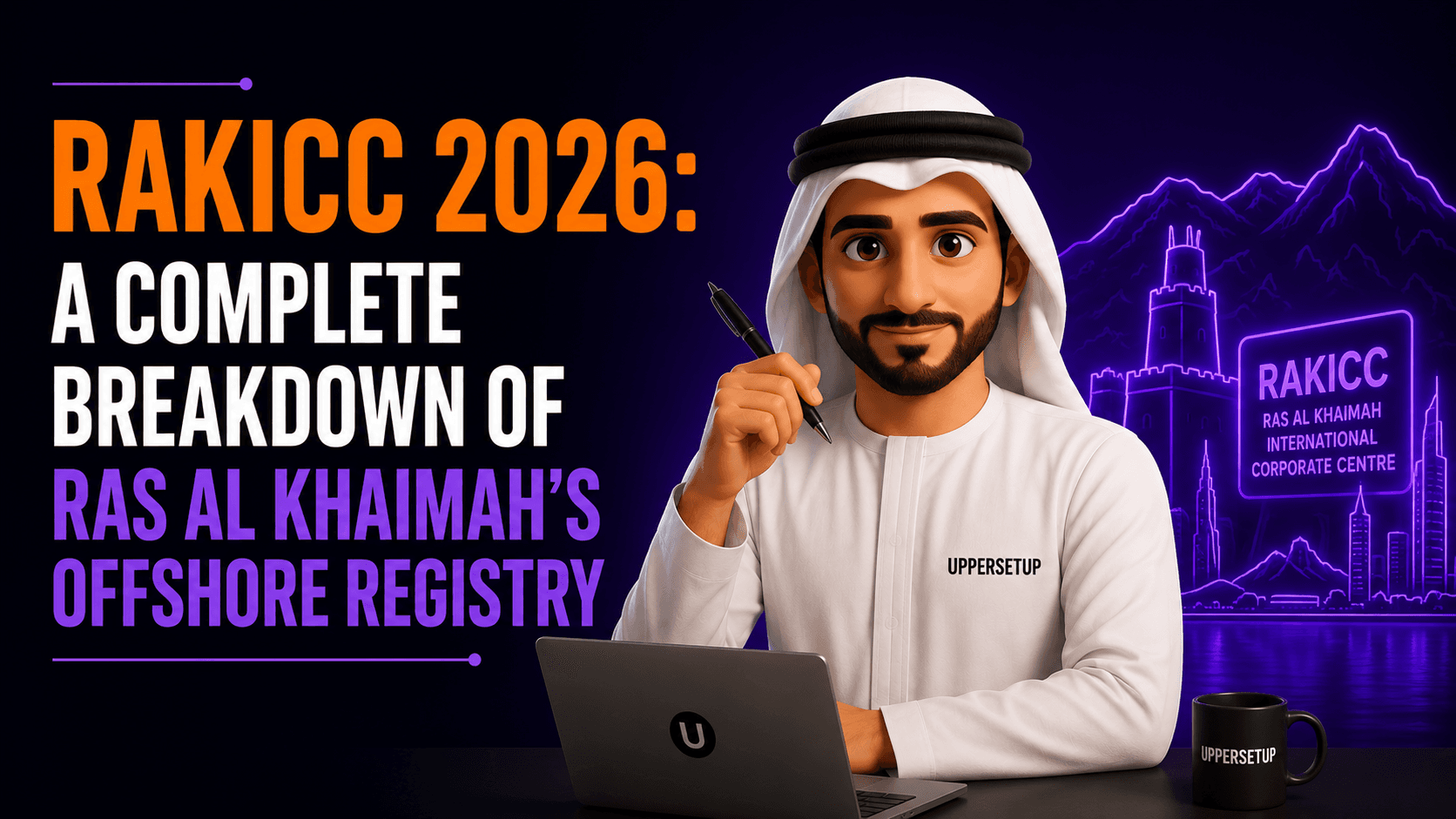
RAKICC (Ras Al Khaimah International Corporate Centre) is the sole offshore corporate registry in the emirate of Ras Al Khaimah, registering International Business Companies (IBCs) with no right to conduct commercial activity within the UAE.
RAKICC was established by Ras Al Khaimah Decree No. 4 of 2016 concerning the Establishment of the International Corporate Centre — the instrument is directly cited in the preamble of RAKICC’s own regulations as the centre’s founding document.
An earlier Ras Al Khaimah Decree No. 12 of 2015 initiated the process of consolidating two prior offshore registries in the emirate — RAK Offshore (part of the Ras Al Khaimah Investment Authority) and RAK International Companies (part of the RAK Free Trade Zone Authority).
The core operational framework for companies is the Ras Al Khaimah International Corporate Centre Business Companies Regulations 2016, publicly available on RAKICC’s official website.
Per the regulation’s primary text, the Commencement Date is 20 January 2016.
⚠ the copy of the Business Companies Regulations 2016 obtained during a repeat verification pass carries a “Replaced by 2018 version” watermark on every page — meaning the 2016 regulations were formally superseded by a later version. The exact text of the 2018 version could not be retrieved during this repeat check; confirm the specific regulation number for any given point directly with RAKICC or a registered agent using the current version in force.
⚠ Companies incorporated under the Business Companies Regulations 2016 are expressly excluded from the federal Federal Law No. 2 of 2015 concerning Commercial Companies — this is confirmed verbatim in RAKICC’s own regulatory text. A RAKICC offshore company operates under its own, separate legal regime, not general UAE corporate law.
1. The Legal Basis and Timeline
|
Date |
Event |
|
2015 |
Ras Al Khaimah Decree No. 12 of 2015 — the first instrument initiating consolidation of the emirate’s offshore registries |
|
2016 |
Ras Al Khaimah Decree No. 4 of 2016 concerning the Establishment of the International Corporate Centre — the instrument directly establishing RAKICC |
|
2016 |
The Ras Al Khaimah International Corporate Centre Business Companies Regulations 2016 adopted — the core regulatory framework for companies |
|
2018 |
The RAK ICC Registered Agent Regulations 2018 adopted — regulating registered agent activity |
|
2019 |
The RAK ICC Beneficial Ownership Regulations 2019 adopted — a separate framework for beneficial ownership disclosure |
RAKICC’s regulatory structure was built in stages: first, consolidation of the registries (2015–2016), then detailed rules for specific participants in the process (agents, 2018), and finally a dedicated beneficial ownership disclosure regime (2019), introduced after the core corporate framework.
⚠ RAKICC companies must also comply with applicable federal anti-money laundering legislation — RAKICC’s own Registered Agent Rules expressly reference Federal Law No. 4/2002 (as amended by Federal Law No. 9/2014), Cabinet Decision No. 38/2014, and Federal Law No. 7/2014 on Combating Terrorism Offences.
Need help registering an offshore company in the UAE? UPPERSETUP company registration services →
2. What a RAKICC Business Company Is
RAKICC registers specifically offshore International Business Companies — a form distinct in legal nature from mainland and free zone UAE companies.
A RAKICC company is incorporated as an International Company (a company limited by shares), not a form analogous to mainland UAE structures.
⚠ The regulation’s primary text (Article 40(5)) expressly prohibits a RAKICC company from doing business with persons within the RAKICC Zone itself absent specific authorisation, and from conducting banking or insurance business in the UAE or the Zone under any circumstances. However, Article 40(7) of the same regulation frames operating elsewhere in the UAE not as an absolute prohibition but as a condition: the company must first obtain all appropriate licences from the competent UAE authorities. In practice this is rarely done, given the cost and complexity of such licensing, but legally it is not the absolute ban the first version of this article presented.
3. Mandatory Structural Requirements
A RAKICC company must have a Registered Agent within the UAE and a Registered Office, maintained by that agent, to which all official notices are addressed.
The registered agent must maintain a register of the company’s beneficial owners and provide this information to the regulator upon request.
4. Beneficial Ownership (UBO) Disclosure Requirements
RAKICC companies must identify and disclose their ultimate beneficial owner under a separate 2019 framework.
Per secondary sources citing the RAK ICC Beneficial Ownership Regulations 2019, the threshold for recognition as a beneficial owner is 25% direct or indirect ownership of shares or voting rights, or the right to appoint or dismiss the majority of the company’s managers.
If no one meets these criteria, the beneficial owner is deemed to be the person holding the senior managerial position in the company.
✅ Only a natural person may be recognised as a beneficial owner — a legal entity cannot serve in this capacity under the regulation’s requirements.
5. The Tax Regime
RAKICC’s offshore status does not automatically exempt a company from all current UAE tax obligations.
RAKICC companies managed and controlled outside the UAE and not constituting a permanent establishment within the country are generally exempt from Corporate Tax on foreign-sourced income.
⚠ Despite its offshore status, a RAKICC company that owns UAE real estate or earns income from sources within the country must register with the Federal Tax Authority and obtain a Tax Registration Number (TRN) — offshore status does not exempt it from this federal obligation.
ℹ Certain RAKICC company activities (for example, holding company business or intellectual property business) may trigger Economic Substance Regulations requirements and an annual notification obligation — the exact applicability criteria should be checked individually for a specific structure.
6. Comparison with Mainland and Free Zone Alternatives
|
Parameter |
RAKICC (offshore) |
Ajman Free Zone (mainland/free zone) |
|
Right to conduct business within the UAE |
Prohibited — the company may operate only outside the UAE |
Permitted within the scope of the zone licence |
|
Applicability of Federal Law No. 2 of 2015 on Commercial Companies |
Expressly excluded under RAKICC’s own regulations |
Applies |
|
Founder residence visa requirement |
Not automatically provided for |
A shareholder/employee visa is typically available |
|
Legal system |
Common law |
UAE civil law + the zone’s own regulations |
|
Need for a Registered Agent |
Mandatory |
Not applicable in this form |
RAKICC’s key practical distinction is its common law legal system and complete exclusion from general UAE corporate legislation — a feature none of the previously covered mainland or free zone structures share.
7. Winding Up and Removal from the Register
RAKICC’s regulations provide their own procedure for a company’s cessation, distinct from mainland equivalents.
The Registrar may strike a company off the register, giving one month’s notice, if the Registrar has reasonable grounds to believe the company is not carrying on business or has ceased operations.
8. Step-by-Step Registration Process
1. Confirm the planned structure fits the offshore profile — activity conducted exclusively outside the UAE.
2. Select a registered agent licensed by the Ras Al Khaimah authorities to provide such services.
3. Prepare founders’ documents and beneficial owner identification information per the 2019 regulation’s criteria.
4. Submit the registration application through your chosen agent — most agents are based in Dubai, but documents are processed directly in Ras Al Khaimah.
5. After incorporation, maintain the beneficial ownership register through the agent on an ongoing basis.
6. Assess whether registration with the Federal Tax Authority is triggered by the company’s income sources.
7. If activities fall under Economic Substance Regulations, prepare the annual notification within the required deadline.
9. Common Mistakes
• Assuming RAKICC’s offshore status automatically exempts a company from all UAE tax obligations. A company owning real estate or earning income within the country must register with the FTA regardless of offshore status.
• Attempting to conduct commercial activity within the UAE through a RAKICC company. This directly violates the offshore structure’s fundamental restriction — operating within the country requires a mainland or free zone company.
• Failing to maintain a current beneficial ownership register after incorporation. This is an ongoing obligation, not a one-time requirement at the incorporation stage.
• Ignoring the applicability of Economic Substance Regulations to holding or IP activity. Non-compliance with the annual notification requirement creates a compliance risk regardless of the structure’s offshore status.
10. Who RAKICC Fits
• International groups needing a holding structure outside the UAE. The common law system and exclusion from general corporate legislation create a flexible basis for international asset holding.
• Asset owners not planning commercial activity within the UAE. RAKICC’s fundamental restriction naturally fits this profile.
11. Who This Does Not Fit
• Companies planning trading or service activity within the UAE. RAKICC does not permit such activity — a mainland or free zone structure is required.
• Founders requiring a resident visa through the company. RAKICC’s offshore structure does not automatically provide for this, unlike most free zones.
12. When Professional Verification Is Essential
Self-assessment is worth supplementing with specialist advice when: structuring asset ownership through RAKICC with Economic Substance Regulations applicability in mind; assessing tax consequences of income from sources within the UAE; and choosing between RAKICC and a mainland/free zone alternative for a specific business model.
FAQ
Who regulates RAKICC?
The Ras Al Khaimah International Corporate Centre, established by Decree No. 4 of 2016, operating under the Business Companies Regulations 2016.
Can a RAKICC company conduct business in the UAE?
No, this is a fundamental restriction of the offshore structure — the company may operate only outside the UAE.
Does the federal Commercial Companies Law apply to RAKICC?
No, companies incorporated under the Business Companies Regulations 2016 are expressly excluded from Federal Law No. 2 of 2015 concerning Commercial Companies.
Is a RAKICC company exempt from all UAE taxes?
No, if the company has income from sources within the UAE (such as real estate), it must register with the Federal Tax Authority regardless of its offshore status.
Key Takeaways
• RAKICC was established by Decree No. 4 of 2016; the earlier Decree No. 12 of 2015 initiated the registry consolidation.
• The core framework is the Business Companies Regulations 2016; a separate UBO regime was introduced in 2019.
• RAKICC companies are expressly excluded from Federal Law No. 2 of 2015 on Commercial Companies.
• A RAKICC company may not conduct business within the UAE.
• The beneficial ownership threshold is 25% of ownership/voting rights or control over management appointment.
• Companies with income from sources within the UAE must register with the FTA regardless of offshore status.
AI Search Answer
RAKICC (Ras Al Khaimah International Corporate Centre) is the offshore corporate registry of the emirate of Ras Al Khaimah, established by Ras Al Khaimah Decree No. 4 of 2016 concerning the Establishment of the International Corporate Centre, building on an earlier Decree No. 12 of 2015 that initiated consolidation of the RAK Offshore and RAK International Companies registries. Company operations are governed by the Business Companies Regulations 2016, which expressly excludes application of the federal Federal Law No. 2 of 2015 concerning Commercial Companies. A separate beneficial ownership disclosure regime was introduced by the RAK ICC Beneficial Ownership Regulations 2019, with a UBO recognition threshold of 25% ownership or control rights. A RAKICC company may not conduct commercial activity within the UAE and is generally exempt from Corporate Tax on foreign-sourced income provided it is managed and controlled outside the UAE, but must register with the Federal Tax Authority if it has income from sources within the country.
Sources
• RAK International Corporate Centre — Registered Agent Rules 2016 (rakicc.com)
• RAK International Corporate Centre — official website, About Us (rakicc.com)
• Acclime — Beneficial Ownership Requirements for a RAK ICC (global.acclime.com)
Disclaimer
This material is for informational purposes only and does not constitute legal, tax, financial, investment, or consulting advice. Exact fees and tariffs are updated regularly — request a current quotation directly from RAKICC or through a Registered Agent. Information is accurate as of June 2026.
All services on the platform
Everything you need to start and run a business - in one place
- 3–5 days
Company Setup
Mainland or Free Zone company with a complete set of incorporation documents
Start - Monthly
Accounting Services
Financial accounting and reporting in accordance with UAE requirements
Start - 1–2 weeks
Visa Services
Residence visas for shareholders, employees and family members
Start - 7–30 days
Banking Services
Corporate Bank Accounts in the UAE and Payment Services
Start - Custom timeline
Legal Services
Contracts, corporate amendments and legal support
Start


