
AI Business in the UAE 2026: Unicorn 30, Stargate UAE, DIFC AI Native — and What It All Means for Entrepreneurs
May 04, 2026
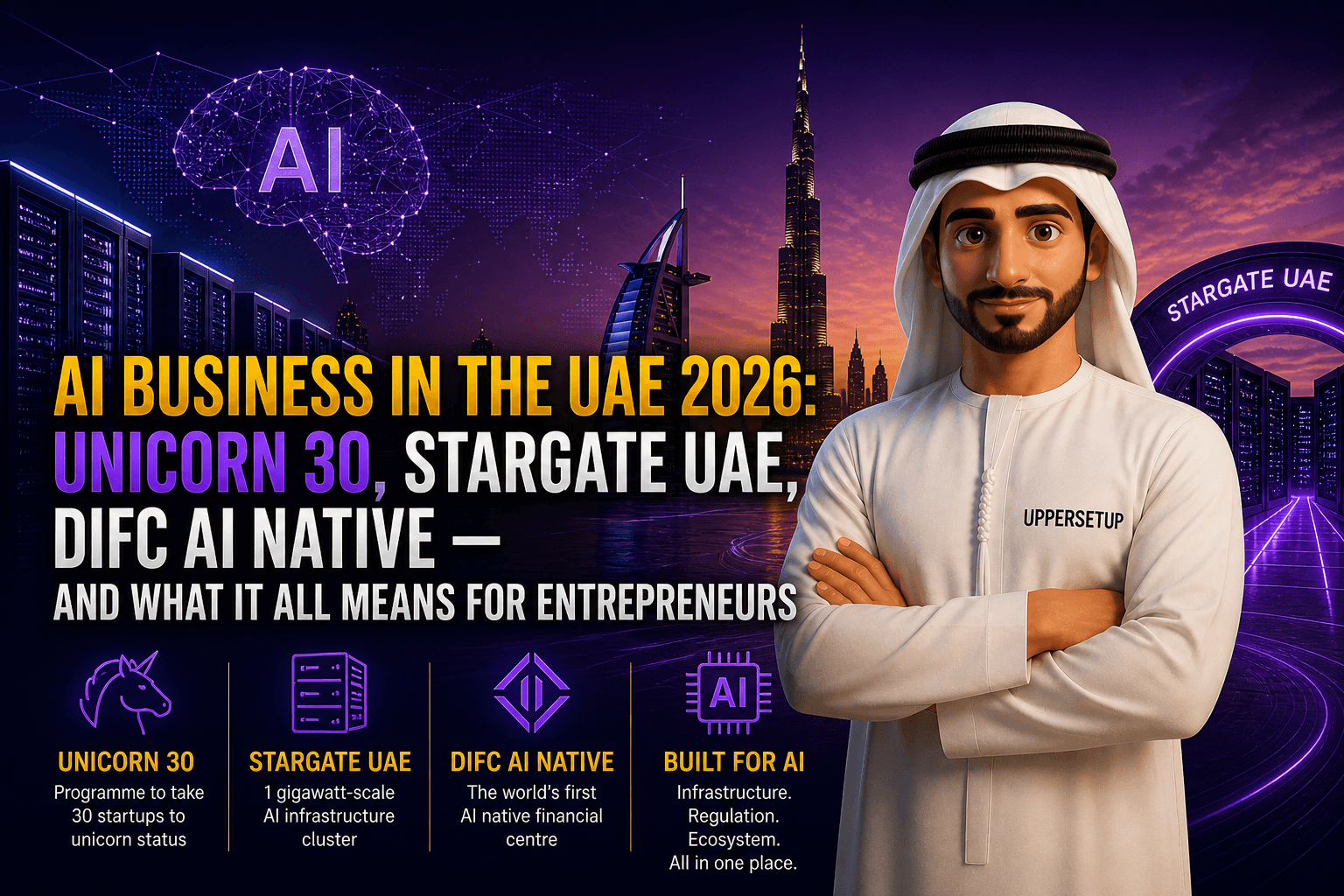
Introduction. 2026 — The Year of the Shift from Generative to Agentic AI
Talk of an 'AI bubble' in the UAE is over. Not because it burst — but because real demand for AI solutions in energy, healthcare, finance, logistics, and government services has become so tangible that there is no room left for speculation.
The UAE in 2026 is not simply a jurisdiction with attractive taxes. It is a state deliberately building the infrastructure for an AI economy — simultaneously at three levels: physical (computing power), regulatory (special programmes and legal regimes), and ecosystem (acceleration programmes, funds, talent).
For an entrepreneur this means concrete opportunities: access to government computing resources, regulatory accelerators for market entry, programmes with a direct path to unicorn status, and government purchasing power as the first corporate client.
This article is a systematic breakdown of the UAE's entire AI infrastructure for entrepreneurs: what has been launched, who approved it, how it works in practice, and how to enter this ecosystem.
Part I. The State AI Architecture: What Has Been Built and Approved
1.1. UAE AI Strategy 2031 — The Federal Mandate
Everything happening with AI in the UAE is being realised within the framework of the UAE AI Strategy 2031, officially launched in 2017. Its goal is to make the UAE the global leader in AI by 2031 and add AED 335 billion to the economy through productivity gains and AI integration across government services.
As of December 2025, the UAE has achieved a 97% AI utilisation rate across government entities — a figure that has no parallel in any other country in the world. The country's developer pool has exceeded 450,000 programmers. These are not declarations — they are measurable realities confirmed by independent research.
1.2. Three Key Dubai Initiatives — Personally Approved by Sheikh Hamdan in October 2025
On 19 October 2025, at the second 2025 meeting of the Higher Committee for Future Technology Development and the Digital Economy in Dubai, Crown Prince of Dubai, Deputy Prime Minister and Minister of Defence of the UAE Sheikh Hamdan bin Mohammed bin Rashid Al Maktoum personally approved three programmes that shape Dubai's AI ecosystem for the coming years:
1. AI Infrastructure Empowerment Platform — a platform providing Dubai government entities with access to a unified, secure digital environment combining high-performance computing (HPC), ready-to-use smart services, and cybersecurity frameworks. Critically important for entrepreneurs: through this same infrastructure, startups can access government HPC capacity, dramatically reducing the cost of AI model training, which would otherwise require capital investment of hundreds of thousands of dollars.
2. Dubai AI Acceleration Taskforce — a specialised working group for coordinating AI implementation strategies between government bodies and the private sector. For entrepreneurs, this means a single point of contact for navigating government AI procurement.
3. Unicorn 30 Programme — an acceleration programme to take 30 startups to unicorn status. Detailed breakdown in the following section.
At the same meeting, the operational strategy of Dubai Founders HQ was presented — a hybrid physical-digital hub for startups operating on a hub-and-spoke model: physical co-working and event spaces, plus a digital platform with an ecosystem database, knowledge hub, and access to government services.
1.3. Stargate UAE: Gigawatt-Scale AI Infrastructure
In parallel with government programmes, physical AI infrastructure on a global scale is being built. In May 2025, as part of a large-scale US–UAE AI partnership, G42's subsidiary Khazna Data Centers broke ground on Stargate UAE: a gigawatt-scale hyperscale AI infrastructure cluster. As of October 2025, construction is actively underway with a planned delivery date of 2026.
Key parameters of Stargate UAE:
— Total capacity: 1 gigawatt (part of a 5-gigawatt US–UAE campus);
— First phase: 200 megawatts — being built on an accelerated schedule;
— Partners: OpenAI, Oracle, NVIDIA, Cisco, SoftBank — the largest AI infrastructure consortium in the region;
— Location: G42 (Khazna) territory in the UAE.
Significance for entrepreneurs: the presence of gigawatt-scale AI infrastructure within the country reduces latency for model training and inference, making the UAE a self-sufficient AI centre independent of cloud infrastructure in other jurisdictions.
Part II. The Unicorn 30 Programme: How It Works and What It Offers a Startup
The Unicorn 30 Programme is not another conference with certificates. It is a state-approved acceleration programme with a concrete goal: to take 30 startups to a USD 1 billion valuation originating from Dubai. The programme was developed by the Dubai Chamber of Digital Economy with the participation of more than 80 local and international organisations in entrepreneurship and startup development.
Programme Structure
The programme covers 10 key initiatives across four thematic pillars:
— Financing: access to venture capital through the programme's partner network; connections with UAE sovereign investment funds; streamlined mechanisms for raising Series A and B rounds;
— Growth: mentorship from operators and founders who have completed the journey to unicorn status; access to global markets through a 80+ organisation partner network;
— Regulation: regulatory 'fast-track' — accelerated procedures for obtaining approvals for innovative products; priority in government procurement processes;
— Governance: assistance in establishing corporate structures, reporting standards, and operational processes that meet the expectations of Series B+ investors.
Target Sectors
The programme covers startups in 'new economy sectors' — aligned with the strategic priorities of Dubai's D33 Economic Agenda:
— FinTech and payment technologies;
— PropTech (property technology);
— HealthTech;
— Logistics technology and supply chain management;
— Agritech and climate technologies;
— AI and agentic platforms.
Context: The Goal of 30 Dubai-Origin Unicorns by 2033
The Unicorn 30 Programme operates within the broader D33 Economic Agenda goal of growing the number of Dubai-origin unicorns to 30 by 2033. Per Tracxn data as of April 2026, the UAE has already produced 14 unicorns, and the total number of companies in the ecosystem has exceeded 56,000. Total venture and private equity capital raised by UAE startups stands at USD 102 billion over the observation period.
A parallel goal — 10,000 AI companies in Dubai by 2030 — was announced by UAE Minister of AI Omar bin Sultan Al Olama. This forms the 'broad base' of the ecosystem from which future unicorns emerge.
Part III. DIFC AI Native: The World's First 'AI Native' Financial Centre
On 21 April 2026, DIFC (Dubai International Financial Centre) announced its AI Native programme — an ambition to become the world's first financial centre built entirely around the principles of artificial intelligence. This is not rebranding or a marketing initiative — it is a structural reconfiguration of the operating environment for DIFC companies.
What AI Native Means for DIFC
— All 40+ DIFC Authority regulatory processes are being moved to AI-assisted mode — document submission, verification, and processing are automated;
— A dedicated licensing category for AI companies is being created with adapted requirements;
— An Innovation Testing Licence (ITL) for AI is being launched — equivalent to a regulatory sandbox, but specifically for agentic AI systems;
— DIFC Courts are planning AI assistant integration into legal support processes, particularly important for AI companies working with intellectual property.
Economic Impact
Stated targets of the AI Native programme:
— Creation of 25,000 new jobs in the AI sector;
— Economic contribution of AED 12.9 billion;
— Attraction of global AI companies to DIFC through unique regulatory positioning.
For entrepreneurs building AI companies in financial services (FinTech, InsurTech, WealthTech, RegTech), DIFC AI Native represents a direct regulatory environment with clear rules, a specialised judicial system (DIFC Courts), and access to the pool of institutional clients in the MENA financial sector.
Part IV. From Generative to Agentic AI: What Business Gets Funded in 2026
Understanding the technology vector is the key to correct positioning of an AI startup in the UAE. The 2026 market is fundamentally different from the 2023–2024 market.
4.1. Generative AI Is No Longer a Differentiator
Building another chatbot, AI assistant, or content generator is not what attracts venture capital in the UAE in 2026. These categories are saturated. Investors and government programmes are looking for specialised applications and agentic systems.
4.2. Agentic AI — The Main Trend of 2026
Agentic AI refers to systems that not only answer questions but autonomously execute tasks: managing supply chains, processing visa applications, managing corporate finance, handling legal documentation. The shift from 'AI that writes' to 'AI that does' represents a fundamental change in value proposition.
In the UAE context, agentic AI is in particularly high demand across three areas:
— Government services: the UAE government has launched the world's first AI legislative system — a platform for analysing the impact of new laws in real time. Startups building agentic solutions for the government sector have a direct sales channel;
— Financial operations: DIFC and ADGM are forming an environment in which agentic AI systems can be licensed and deployed for asset management, compliance, and trading;
— Logistics and trade: Jebel Ali Free Zone (JAFZA) and Dubai South are natural platforms for agentic AI solutions in supply chain management.
4.3. Vertical AI — Three Priority Sectors with the Highest VC Interest
Based on investor and analyst data, the greatest venture capital interest in the UAE in 2026 is concentrated around three verticals:
PropTech: Dubai's real estate market is one of the most transactional in the world. AI applications for valuation, asset management, predictive maintenance, mortgage underwriting, and virtual tours with AI agents are all in active funding stages. The Dubai PropTech Hub, launched in July 2025, targets the attraction of 200 specialised companies and the creation of 3,000+ jobs in the sector.
LegalTech: the DIFC legal system (English common law) and the growing need for corporate compliance automation create a unique market for AI tools in legal services. The 'AI in the Ring' Index, launched in late 2025, tests how well AI models reflect local values and cultural context — startups that pass this index gain an advantage in government procurement.
Islamic FinTech: the UAE is one of the world's centres of Islamic finance. AI applications for Sharia compliance, sukuk structuring, and takaful (Islamic insurance) with AI represent an undervalued vertical with enormous potential. Abu Dhabi Islamic Bank (ADIB) and Dubai Islamic Bank (DIB) are actively working with FinTech partners.
Part V. Hubs and Accelerators: Where to Build an AI Business in the UAE
|
Hub / Programme |
Regulator / Operator |
Focus |
Key Benefits for an AI Startup |
|
Dubai Founders HQ |
DET + Dubai Chamber Digital Economy |
All sectors, emphasis — digital economy |
Physical hub + digital ecosystem, Unicorn 30, DET access |
|
Hub71 |
ADQ + Abu Dhabi Government |
Technology, AI, FinTech |
Office and visa subsidies, sovereign fund access, Asia/Africa market entry |
|
DIFC Innovation Hub |
DIFC Authority + DFSA |
FinTech, RegTech, financial AI |
ITL licence, DFSA sandbox access, financial sector clients |
|
ADGM RegLab |
FSRA (ADGM) |
FinTech, virtual assets, AI |
FSRA sandbox, international finance recognition |
|
Area 2071 |
Dubai Future Foundation |
Future technologies, government innovation |
Direct government procurement access, Khaleej-4 AI projects |
|
Sheraa |
Sharjah Government |
Broad spectrum including AI |
Grants up to AED 100,000, mentorship, regional reach |
Hub71: Abu Dhabi's Strategic Hub for AI Startups
Hub71 is the government initiative for creating world-class startups in Abu Dhabi, operated by ADQ (Abu Dhabi's investment company). Hub71 offers the Ignite programme: office space subsidisation (up to 100%), partial visa cost compensation, and access to a pool of partner investors (Mubadala, ADIO, GlobalFoundries, and others).
In 2025–2026, Hub71 has focused on attracting AI companies in priority sectors: climate technologies, healthcare, and energy. Direct integration with G42 (the UAE's leading AI company, partner of Microsoft and OpenAI) gives startups access to one of the largest AI infrastructures in the region.
Part VI. UAE AI Regulation: The Framework and What It Means for Business
The UAE has chosen a pro-business AI regulatory model — in contrast to the European AI Act, the UAE AI Governance Framework (adopted in 2024 by the Ministry of AI) relies on principles and voluntary standards rather than hard prohibitions and complex compliance procedures.
Key Principles of the UAE AI Governance Framework
— Do No Harm principle: AI systems operating in the UAE must meet safety and reliability standards, but without excessive regulatory burden at the development stage;
— Alignment with local values: AI systems must reflect the cultural, religious, and social context of the UAE — this is precisely what the 'AI in the Ring' Index tests;
— Transparency and accountability: AI systems in regulated sectors (finance, healthcare) are subject to additional oversight from sector regulators — DFSA, FSRA, DOH (Abu Dhabi Department of Health);
— Implementation priority: the framework explicitly does not seek to slow AI adoption. The 'regulation follows innovation' concept is a deliberate policy position.
Sector-specific regulation: for AI in financial services — DFSA AI Guidance (2024, DIFC) and FSRA Regulatory Framework (ADGM). For medical AI devices — regulation through DOH and MOHAP under federal standards. For AI in virtual assets — VARA Rulebook V2.0 (May 2025).
Part VII. The Practical Path: How to Enter the UAE AI Ecosystem from Scratch
Understanding the ecosystem is not the goal — it is the means. The goal is to enter it with the right structure and positioning.
1. Define your vertical and target client. The UAE rewards specialisation, not broad platforms. An 'AI solution for everything' will not attract either government or venture capital. A 'UAE agentic AI platform for Sharia compliance in Islamic banks' will. Positioning precision is critical.
2. Choose the right jurisdiction. FinTech — DIFC or ADGM. Broad digital economy — Dubai Founders HQ / DMCC / IFZA. Manufacturing and industrial AI — Dubai South or JAFZA (Designated Zone). Government contracts — mainland with DET licence.
3. Apply to an accelerator at an early stage. Hub71 Ignite or DIFC Innovation Hub — these are not just status symbols but subsidies that genuinely reduce burn rate. Applications from AI companies are reviewed as a priority.
4. Use government computing resources. The AI Infrastructure Empowerment Platform opens access to HPC without capital investment. This fundamentally reduces the cost of model training and deployment — the primary expense of an AI startup.
5. Target government procurement as the first sales market. The UAE government is the most well-funded and fastest-moving primary client for B2B AI products. The 'AI in the Ring' Index is a direct ticket into the government procurement system.
6. Build a capital-ready structure. The Unicorn 30 Programme expects candidates to have corporate structures meeting Series A+ standards: proper corporate governance, ESOP plan, shareholder capital structure without legal liabilities. UPPERSETUP helps build this structure from day one.
Conclusion. The UAE Is Building an AI Economy. Entrepreneurs Either Build It With Them — or Watch From the Sidelines.
97% of government entities using AI. A gigawatt cluster of computing power. A programme to produce 30 unicorns. The world's first AI Native financial centre. The world's first AI legislative system. This is not a plan for the future — this is infrastructure that is already running.
For entrepreneurs building AI companies, the UAE offers what no other jurisdiction provides simultaneously: government demand as a first market, computing infrastructure without capital expenditure, regulatory flexibility instead of rigid barriers, and zero personal income tax.
But as with any infrastructure, it is not enough to simply know it exists — what matters is entering it correctly: with the right jurisdiction, the right company structure, proper tax compliance, and a bank account that opens on the first attempt.
The UPPERSETUP platform helps entrepreneurs navigate this path — from free zone selection and registration to full operational launch within the UAE AI ecosystem.
Sources: Official Media Office Dubai press release (mediaoffice.ae, 19 October 2025); Khaleej Times (19 October 2025); Gulf Business (20 October 2025); The National (28 November 2025); Digital Dubai (DigitalDubai.ai, 25 April 2026); Business Today Middle East (January 2026); Tracxn (April 2026). This material is for informational purposes only.
Subscribe to our newsletter
Receive expert materials and special offers in the field of company setup and support, citizenship and residence permit for investment. Once a week without spam.
Read More on The Topic
Comprehensive Services for Your Business
Accounting Services
A key element of successful business management. Competent accounting support ensures compliance with local regulations, optimizes taxes, and enhances financial transparency.

Company Registration
The foundation of your business success. A seamless registration process tailored to UAE regulations helps you launch your venture with confidence and efficiency.

Bank Account Opening
An essential step for smooth business operations. Expert guidance ensures hassle-free bank account setup, meeting all compliance requirements for your business needs.

Tax Support
Stay ahead with professional tax solutions. Comprehensive support ensures compliance with UAE tax laws, optimizes financial planning, and avoids unnecessary risks.

Residency Visa Services
Your gateway to living and working in the UAE. Expert guidance ensures smooth processing of residency visas, compliance with regulations, and timely approvals for individuals and their families.

Legal Advisory
Navigate business challenges with confidence. Professional legal advice ensures compliance, protects your interests, and empowers informed decision-making for your business.