



































































































 International Free Zone Authority
AIFC 2026: A Complete Breakdown — Structures, Tax Incentives Until 2066, Registration, and Comparison With ADGM/DIFC
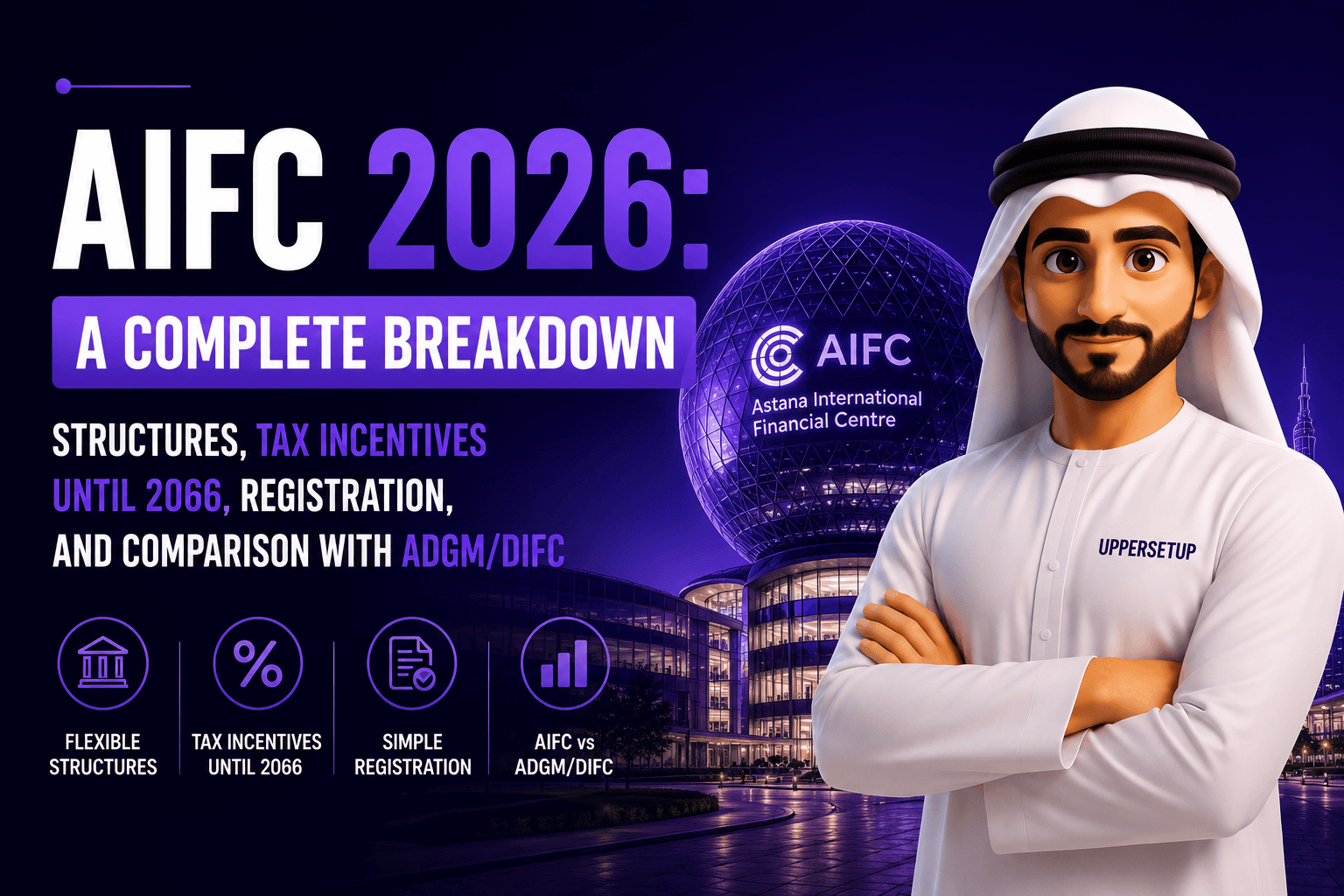
The Astana International Financial Centre (AIFC) is a separate jurisdiction within the Republic of Kazakhstan with its own English common law system, an independent court, and a dedicated tax regime — not an ordinary free economic zone.
AIFC’s legal basis is the Constitutional Statute of the Republic of Kazakhstan dated 7 December 2015 “On the Astana International Financial Centre”; AIFC acts take precedence over Kazakhstan’s civil legislation with respect to participants’ activities.
Per Article 6 of the Constitutional Statute, tax incentives for AIFC participants — including 0% CIT and VAT on financial and ancillary services — are guaranteed until 1 January 2066.
The preferential rate does not automatically extend to any activity within the AIFC perimeter: the 0% rate applies only to financial and ancillary services on AFSA’s official list, subject to the Substantial Presence requirement; non-financial companies outside that list pay the standard Kazakhstan CIT.
⚠ Effective 1 January 2026, Kazakhstan’s new Tax Code raised the standard VAT rate from 12% to 16% and introduced a progressive PIT scale (10%/15%) for ordinary employees; effective 1 July 2026, the code was further aligned with the new Constitution of the RK. These changes affect the standard Kazakhstan tax regime — the preferential AIFC rates for qualifying participants are unchanged and remain in force until 2066.
1. AIFC Is Not Just a Free Zone
The key distinction between AIFC and ordinary special economic zones is the jurisdiction’s constitutional status itself.
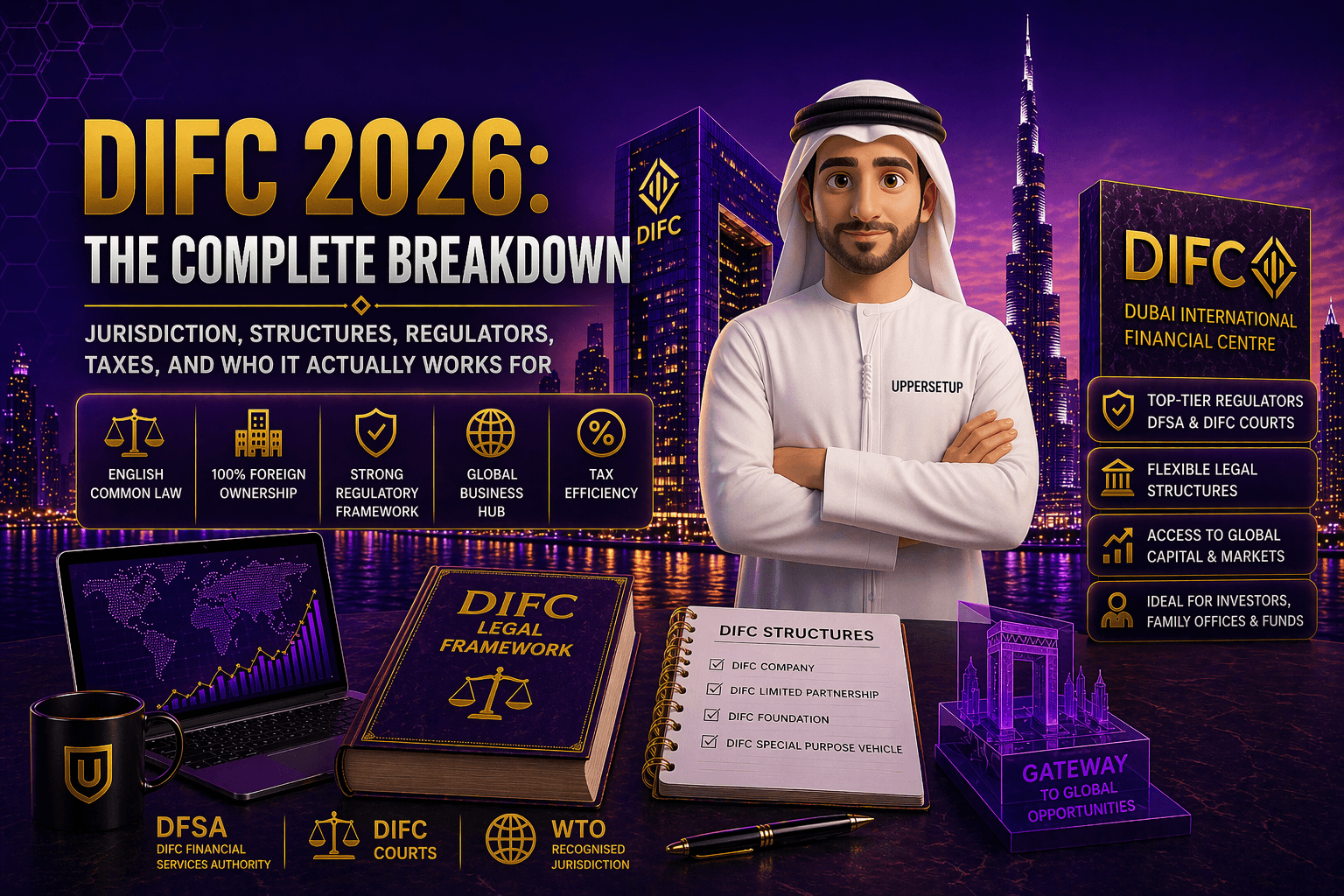
AIFC operates under English common law principles (England and Wales) — the same as ADGM in Abu Dhabi and DIFC in Dubai, meaning predictable judicial outcomes and legal mechanisms familiar to international business.
ℹ AIFC’s unique geographic positioning provides direct access to the CIS, Central Asian, EAEU, and Chinese markets — access not directly available from the UAE or Hong Kong.
• Over 4,000 registered participants from 80+ jurisdictions (per AIFC data).
• Assets under management within the AIFC perimeter exceed USD 12 billion (per AIFC data).
• AIX exchange partners: the Shanghai Stock Exchange, NASDAQ, Goldman Sachs International, and the Silk Road Fund.
2. The AIFC Legal Ecosystem: Four Core Bodies
AIFC Authority — the Centre’s Governing Body
AIFC Authority is the main administrative body, responsible for company registration, infrastructure development, and oversight of Substantial Presence compliance.
AFSA — the Astana Financial Services Authority
AFSA is AIFC’s independent financial market regulator, the equivalent of FSRA (ADGM) and DFSA (DIFC), licensing and supervising financial companies and applying IOSCO, IAIS, BCBS, IFSB, OECD, and FATF standards.
⚠ All financial companies in AIFC must obtain an AFSA licence — without one, a company may register as a non-financial participant but may not provide regulated financial services.
AIFC Court — the Centre’s Court
The AIFC Court is the first court operating under English common law principles in Central Asia, founded in 2017, hearing commercial disputes between AIFC participants in English.
✅ The eJustice system allows filing claims online from anywhere in the world without requiring physical presence in Astana.
IAC — the International Arbitration Centre
An independent arbitration institution for resolving commercial disputes with an international element; the IAC’s rules are based on UNCITRAL.
3. AIFC Tax Incentives: What Exactly and Until When
|
Tax |
Standard RK rate (2026) |
AIFC participant rate |
Relief duration |
|
CIT |
20% |
0% (financial and ancillary services per the AFSA list) |
Until 1 January 2066 |
|
VAT |
16% (raised from 12% effective 1 January 2026) |
0% (financial services on the list) |
Until 1 January 2066 |
|
Employee PIT |
10%/15% progressive (from 1 January 2026) |
0% for foreign staff of an AIFC participant providing financial and ancillary services |
Until 1 January 2066 |
|
Property tax |
1.5% of book value |
0% (property within AIFC) |
Until 1 January 2066 |
|
Land tax |
Set by category |
0% (land within the AIFC perimeter) |
Until 1 January 2066 |
|
Capital gains tax (AIX shares) |
PIT/CIT applies |
0% (shares and interests of AIFC participants listed on AIX) |
Until 1 January 2066 |
⚠ a verbatim quote from the primary text was obtained for Article 6, paragraphs 2–4 (exemption of AIFC Bodies, the exemption for financial services, and the exemption for ancillary services). Article 6 continues further (including a paragraph 8-2, referenced by another AIFC instrument); the property tax, land tax, and capital gains tax exemptions in the table above are confirmed by secondary sources (Chambers and Partners, an official AIFC presentation) rather than a direct quote of the specific paragraphs.
The Substantial Presence Requirement — A Critical Condition
Effective 1 January 2022, AIFC Authority introduced Substantial Presence Rules for companies applying CIT and VAT incentives.
Simply registering with AIFC is not enough to obtain the zero rate: the company must maintain genuine operating activity — qualified staff performing key functions, management decisions made within AIFC, and operating costs proportionate to the scale of activity.
⚠ Substantial Presence is a direct equivalent of the UAE’s Economic Substance Requirements (ESR). The regulatory trend is consistent across comparable jurisdictions: a preferential rate cannot be “paper only.” AIFC checks Substantial Presence compliance at annual registration renewal.
Non-Financial Companies and Tax
A company not providing financial or ancillary services from AFSA’s official list (legal, accounting, consulting, IT companies, holdings without a financial licence) pays the standard Kazakhstan CIT of 20%.
ℹ An important nuance: legal, audit, accounting, and consulting firms holding an AFSA licence and serving AIFC financial participants receive a 0% CIT rate on income specifically from such services until 2066; income from clients outside the AIFC perimeter is taxed at the standard 20% rate.
⚠ The primary text of Article 6(3) of the Constitutional Statute states verbatim: “AIFC Participants, except for the digital asset exchange, are exempt from corporate income tax...” — digital asset exchange operators are expressly excluded from AIFC’s preferential tax regime, and this activity category is subject to standard CIT and VAT rates despite AIFC registration.
Want to register a company in AIFC? UPPERSETUP company registration services →
4. Types of Legal Structures in AIFC
|
Structure type |
Common law equivalent |
Min. directors |
Min. shareholders |
Best for |
|
Private Company |
UK Private Limited Company |
1 (individual) |
1 |
The core structure for most businesses |
|
Public Company |
UK Public Limited Company |
2 (individuals) |
1 |
Raising capital via AIX |
|
LLP |
UK LLP |
2 partners |
— |
Law firms, consultancies, partnership-based funds |
|
Foundation |
Common-law charity/foundation hybrid |
1 governing council |
— |
Family foundations, asset management |
|
SPV |
SPV/Holding vehicle |
1 (individual) |
1 |
Single-asset holding, deal structuring |
Over 90% of AIFC registrations are Private Companies, the equivalent of a UK Private Limited Company and the standard choice for holdings, fintech, investment managers, professional services firms, and IT companies.
An AIFC Private Company requires a minimum of one individual director, a minimum of one shareholder (individual or entity of any jurisdiction), permits 100% foreign ownership, and sets no minimum authorised capital or director residency requirement.
⚠ A citizen of any country may serve as director of an AIFC Private Company with no Kazakhstan residency requirement — a fundamental distinction from an ordinary Kazakhstani LLP, where certain positions may require a local representative.
5. Step-by-Step Registration Process
|
Step |
Action |
Timeline |
|
1 |
Determine the structure type and activity |
Before filing |
|
2 |
Verify the company name via Digital Resident or the AFSA Public Register |
1–2 working days |
|
3 |
Prepare the constitutional documents |
3–5 working days |
|
4 |
Submit the application online via portal.aifc.kz |
1 working day |
|
5 |
AIFC Authority review |
5–20 working days |
|
6 |
Receive the Certificate of Incorporation |
Upon completion of step 5 |
|
7 |
Register for tax with the State Revenue Committee |
Within 30 days |
|
8 |
Open a corporate bank account |
2–4 weeks |
If the planned activity is licensable (banking, asset management, brokerage, insurance, fintech handling client funds), the AFSA licence application proceeds in parallel with AIFC Authority registration.
AIFC Authority’s state fee for registering a Private Company ranges from USD 1,500 to USD 3,000 depending on structure type and additional options; the annual fee for maintaining registration falls within a similar range.
6. What Changed in Kazakhstan’s Tax System From 2026
The reform affects the standard Kazakhstan tax regime applicable to AIFC’s non-financial companies and any business outside the preferential perimeter, not AIFC’s own preferential rates.
Effective 1 January 2026, Kazakhstan’s standard VAT rate rose from 12% to 16%; a progressive PIT rate was introduced — 10% on income up to 8,500 MCI per year, 15% on the excess.
Effective 1 July 2026, the Tax Code was aligned with the new Constitution of the RK, approved by referendum on 15 March 2026; the amendments are mostly terminological but include a new Article 189 on temporary exit restriction for a legal entity’s head with tax arrears.
ℹ For AIFC participants applying the preferential regime for financial and ancillary services, these changes do not affect the 0% rate — the incentive is set by a separate constitutional instrument and remains in force until 2066 regardless of changes to the standard Tax Code.
7. AIFC Compared With ADGM and DIFC
|
Parameter |
AIFC (Kazakhstan) |
ADGM (Abu Dhabi) |
DIFC (Dubai) |
|
Legal basis |
Constitutional Statute of 7.12.2015 |
Federal Law No. 4 of 2013 + Abu Dhabi Law No. 4 of 2013 |
Dubai Law No. 9 of 2004 |
|
Legal system |
English common law |
English common law |
English common law |
|
Tax relief duration |
Until 2066 |
No single fixed term |
No single fixed term |
|
Unique advantage |
Direct access to CIS, Central Asian, and Chinese markets; the AIX exchange |
FSRA financial regulator, RegLab |
The Middle East’s largest financial hub |
All three jurisdictions are independent enclaves within sovereign states, operating under English law, with their own courts and regulators. AIFC’s key distinction is direct access to the CIS, Central Asian, and Chinese markets, along with a rare-among-comparable-jurisdictions fixed relief term — until 2066 under a constitutional instrument, rather than a decision subject to revision.
8. Practical Cases: Who AIFC Fits
Case 1: A fintech company — payment services for CIS markets
A fintech startup planning a payment platform for Kazakhstan, Uzbekistan, and Kyrgyzstan gains access to AFSA’s regulatory sandbox, licensing under international standards, and a zero PIT rate for foreign specialists.
Case 2: An investment management company — expanding into the EAEU and China
AIFC is the region’s only jurisdiction with the AIX exchange, a partnership with the Shanghai Stock Exchange, and English law; the zero capital gains rate on listed share sales applies to all investors, not only AIFC participants.
Case 3: An IT holding company — tax planning
A group with developers in Kazakhstan and clients in the UAE and Europe can register a holding company in an English-law jurisdiction; zero PIT for key foreign specialists is a competitive hiring advantage.
9. Common Mistakes
• Assuming AIFC registration automatically grants a zero tax rate. The incentive applies only to financial and ancillary services on the AFSA list, subject to Substantial Presence — non-financial companies pay the standard 20% CIT.
• Treating the Substantial Presence requirement as a formality. AIFC Authority verifies genuine operating presence at annual registration renewal — non-compliance results in loss of preferential status.
• Confusing AIFC’s preferential rates with standard Kazakhstan rates after the 2026 reform. The VAT increase to 16% and the PIT progression apply to the standard regime, not to qualifying AIFC participants.
• Registering a digital asset exchange operator expecting the preferential tax regime. This activity category is expressly excluded from AIFC incentives and is taxed at standard rates.
10. Who AIFC Fits
• Financial companies, fintech startups, and asset managers targeting the CIS, Central Asian, and Chinese markets. AIFC offers a combination of English law, the AIX exchange, and a zero tax rate unique in the region.
• International professional services firms serving AIFC financial participants. AFSA-licensed legal, audit, and consulting firms receive 0% CIT on income specifically from such services.
11. Who This Does Not Fit
• Companies not prepared to maintain genuine operating presence in AIFC. Without meeting Substantial Presence, the preferential rate does not apply despite formal registration.
• Digital asset exchange operators. This activity category is expressly excluded from AIFC’s preferential regime.
12. When Professional Verification Is Essential
Self-assessment is worth supplementing with specialist advice when: structuring activity to rely on AIFC’s preferential tax regime for specific income streams; assessing Substantial Presence compliance for a planned operating model; and choosing between AIFC, ADGM, and DIFC for a business model spanning multiple regions.
FAQ
Until when do AIFC tax incentives apply?
Until 1 January 2066, per Article 6 of the Constitutional Statute of the Republic of Kazakhstan dated 7 December 2015.
Does the 0% CIT rate apply to all companies in AIFC?
No, only to financial and ancillary services on AFSA’s official list, subject to Substantial Presence; non-financial companies pay the standard 20% CIT.
What is Substantial Presence?
A requirement for genuine operating presence in AIFC — qualified staff, management decisions, and operating costs within AIFC — introduced effective 1 January 2022.
Did Kazakhstan’s 2026 tax reform affect AIFC incentives?
No, the reform affected the standard Kazakhstan tax regime (VAT raised to 16%, PIT progression introduced); AIFC’s preferential rates are set by a separate constitutional instrument and are unchanged.
Can a foreigner without a Kazakhstan residence permit serve as AIFC company director?
Yes, an AIFC Private Company has no Kazakhstan residency requirement for its director, unlike an ordinary Kazakhstani LLP.
Key Takeaways
• AIFC is a constitutionally established English common law jurisdiction, not an ordinary free zone.
• Tax incentives are guaranteed until 1 January 2066 under Article 6 of the Constitutional Statute of 7 December 2015.
• 0% CIT and VAT apply only to financial and ancillary services on the AFSA list, subject to Substantial Presence.
• Digital asset exchange operators are excluded from the preferential regime.
• Standard Kazakhstan rates changed in 2026 (16% VAT, PIT progression), but AIFC incentives are unaffected.
• An AIFC Private Company director may be a citizen of any country with no residency requirement.
Summary
The Astana International Financial Centre (AIFC) is a constitutionally established jurisdiction within Kazakhstan operating under English common law, created by the Constitutional Statute of the Republic of Kazakhstan dated 7 December 2015. Per Article 6 of this instrument, tax incentives for AIFC participants — including 0% CIT and VAT on financial and ancillary services on AFSA’s list — are guaranteed until 1 January 2066, subject to the Substantial Presence requirement introduced effective 1 January 2022. Non-financial companies outside the AFSA list pay the standard Kazakhstan CIT of 20%; digital asset exchange operators are expressly excluded from the preferential regime. Effective 1 January 2026, Kazakhstan’s new Tax Code raised the standard VAT rate from 12% to 16% and introduced a progressive PIT scale (10%/15%); effective 1 July 2026, the code was aligned with the new Constitution of the RK. These changes affect the standard tax regime and do not affect AIFC’s preferential rates. Over 90% of AIFC registrations are Private Companies, the equivalent of a UK Private Limited Company, requiring a minimum of one individual director with no Kazakhstan residency requirement.
Sources
• AIFC — official company registration portal (aifc.kz/registration/)
• AIFC — Tax Benefits, official tax regime page (aifc.kz/tax-benefits/)
• AFSA — Astana Financial Services Authority, official regulator (afsa.aifc.kz)
• Egov.kz — New Tax Code of the Republic of Kazakhstan, official text
• PwC Tax Summaries — Kazakhstan: Corporate Tax Credits and Incentives (taxsummaries.pwc.com)
• Chambers and Partners — Key Aspects of Law and Activities of the AIFC (chambers.com)
Disclaimer
This article is for informational purposes only and does not constitute legal, tax, or professional advice. Information is based on the legislation of the Republic of Kazakhstan in force, including the New Tax Code (effective 1 January 2026, aligned with the new Constitution of the RK effective 1 July 2026), and official AIFC sources. Requirements, procedures, and tax regimes may change — consult a qualified legal and tax adviser before making decisions. Information is accurate as of July 2026.
All services on the platform
Everything you need to start and run a business - in one place
- 2–10 days
Company Setup
Kazakhstan company with a complete set of incorporation documents
Start - Monthly
Accounting Services
Accounting and Tax Compliance, Reporting, and Support in Accordance with Kazakhstan Requirements
- 4–8 weeks
Immigration Services
Visas, Work Permits
- 7–30 days
Banking Services
Corporate Bank Accounts in Kazakhstan and Payment Services
- Custom timeline
Permits and Licenses
Business Licenses and Activity Permits
- Custom timeline
Legal Services
Corporate Documents, Contracts, Compliance, Licensing, and Company Structure Changes


