





























































































































 International Free Zone Authority
Trademark Registration in the UAE in 2026: Federal Decree-Law No. 36 of 2021, Fees, Timelines and the Madrid Protocol

Trademarks in the UAE are registered federally by the Ministry of Economy and Tourism (MoET): a single registration covers all seven Emirates. The legal basis is Federal Decree-Law No. 36 of 2021 on Trademarks, in force since 2 January 2022, together with Cabinet Decision No. 57 of 2022 setting out the executive regulations. Protection runs for ten years from the filing date and is renewable without limit.
The core government fees on a national filing come in three parts: the application fee, AED 750 for publication in the trademark bulletin, and AED 5,000 for final registration and issuance of the certificate. The rates in force are set by Cabinet Decision No. 20 of 2020 as amended by Cabinet Decision No. 102 of 2025.
The main practical exposure is not refusal but missed payment deadlines. If the publication fee is not paid within 30 days of receiving the acceptance decision, a penalty of AED 100 per month accrues, capped at AED 1,000 per year. If the final registration fee is not paid within 30 days of the end of the opposition period, the penalty is AED 1,000 per month, capped at AED 10,000 per year. A partial month counts as a full one.
What follows sets out the procedure stage by stage with MoET’s official timelines and fees, the opposition and appeal mechanics, the renewal regime with its six-month grace period, and how a national filing compares with an international filing under the Madrid Protocol.
1. The Legal Framework
Trademarks in the UAE are regulated exclusively at federal level. Emirate-level authorities and free zones maintain no trademark registers of their own, so there is no intra-UAE jurisdiction choice to make.
• Federal Decree-Law No. 36 of 2021 on Trademarks — the principal statute. Issued on 20 September 2021 (13 Safar 1443H), published in the UAE Official Gazette issue No. 712 Annex of 26 September 2021 at p. 395, and in force from 2 January 2022 under Article 61. The three dates — issue, gazettal and commencement — span more than three months. Article 60 repealed Federal Law No. 37 of 1992 on Trademarks as amended. The statutory definitions refer to "the Ministry" as the Ministry of Economy: the law predates the renaming to Ministry of Economy and Tourism, so both names appear for the same body.
• Cabinet Decision No. 57 of 2022 — the executive regulations. Published in Official Gazette No. 729/52 on 15 June 2022, in force from 16 June 2022, comprising 27 articles.
• Cabinet Decision No. 20 of 2020 as amended by Cabinet Decision No. 102 of 2025 — the fee schedule for services of the Ministry of Economy and Tourism. Decision No. 102 of 2025 was issued on 9 September 2025 and takes effect 60 days after publication.
• The Madrid Protocol — the UAE acceded on 28 September 2021 as the 109th member of the Madrid System. The Protocol entered into force for the UAE on 28 December 2021.
Article 53 of Federal Decree-Law No. 36 of 2021 preserves the validity of trademarks registered under the previous legislation before the new law took effect. Applications filed before 2 January 2022 and still pending on that date are examined under the requirements of the new law.
A discrepancy on the effective date of the new fee schedule, worth recording. Cabinet Decision No. 102 of 2025 takes effect 60 days after publication in the Official Gazette. Law firms give different specific dates — 14 November 2025 and 15 November 2025. The one-day divergence cannot be resolved from secondary sources; it does not affect the substance of the schedule, but for transactions in mid-November 2025 the date should be checked against the text of the decision.
2. What Can Be Registered as a Trademark
Article 2 defines a trademark as anything taking a distinctive shape of names, words, signatures, letters, symbols, numbers, addresses, seals, drawings, pictures, engravings, packaging, graphic elements, forms, colour or colours or a combination of them, a sign or group of signs, including three-dimensional marks and hologram marks, used or intended to be used to distinguish the goods or services of one facility from those of others, to indicate the performance of a service, or to conduct monitoring or examination of goods or services. A separate sentence provides that a distinctive sound or smell may be considered a trademark.
Federal Decree-Law No. 36 of 2021 introduced protection for non-traditional signs in the UAE for the first time: three-dimensional marks, sound marks, smell marks, colour marks and holograms. The 1992 law made no provision for them.
The same law brought geographical indications into UAE law, where they had previously been unregulated, and set out criteria for recognising a mark as well known.
Absolute grounds for refusal
Article 3 lists the signs that cannot be registered. The categories that matter most to commercial applicants are the following.
• Marks with no distinctive character, or made only of the customary name for the goods and services or their familiar drawings and ordinary pictures.
• Expressions, drawings or marks breaching public morals or violating public order.
• Public emblems, flags, military and honour emblems, decorations, coins, banknotes and other symbols of the UAE or other countries, of Arab or international organisations or their institutions, and any imitation of them.
• Symbols of the Red Crescent or Red Cross and similar logos, and marks identical or similar to symbols of a religious nature.
• Geographical names and data whose use would create confusion as to the origin or source of the goods or services.
• The name, nickname, picture, logo or surname of a third party without that party’s or the heirs’ prior approval.
• Particulars of honorary or academic degrees to which the applicant does not prove legal entitlement.
• Marks identical or similar to a mark previously filed or registered by a third party for the same or related goods or services, where use would suggest a link with the registered owner or harm its interests.
• Copies, imitations, translations or audio translations of a well-known mark, and marks including terms such as Concession, Registered, Registered Drawing or Copyright.
• Three-dimensional marks whose shape results from the nature of the goods or is necessary to achieve a technical result, without substantive distinguishing elements.
The six-month priority right
An applicant claiming priority from an earlier application filed in a member state of the Paris Convention, a multilateral treaty to which the UAE or a GCC state is party, or a bilateral treaty to which the UAE is party, must attach a copy of the earlier application and an acknowledgment of its date, number and country of filing within six months of filing the application on which priority is claimed. Missing that window forfeits the claim.
One application for a group of identical marks
Article 9 permits a single application to register a group of trademarks where they are identical as to their essential elements and differ only in ways that do not affect their character — such as the colour of the marks or the details of the related goods or services — provided those goods or services belong to the same category.
3. Who Files, and Is an Agent Required?
Where the owner is located outside the UAE, the application must be filed through a registered trademark agent and accompanied by a notarised and legalised power of attorney translated into Arabic. This is an express requirement of the Ministry of Economy and Tourism procedure.
Companies, establishments and individuals located in the UAE may file directly through the Ministry’s electronic system. For a foreign applicant the agent is mandatory rather than optional, and it is the first cost item that falls outside the government fee schedule.
Cabinet Decision No. 102 of 2025 introduced a fee for renewing a trademark agent’s registration — AED 7,500, including for a branch of a foreign company. Agent registration renewal was previously free of charge.
4. The Registration Procedure: Stages and Official Timelines
The procedure runs in four stages with fixed periods. The timelines below follow the Ministry of Economy and Tourism’s official service descriptions and the executive regulations.
|
Stage |
Timing |
What happens |
|
Filing and examination |
Article 12(3) of the law: the Ministry decides on the application within 90 days of filing. Per the MoET service description, the decision is notified within 20 days of filing |
The Ministry accepts or refuses the application, or makes registration subject to restrictions and amendments |
|
Publication |
Payment within 30 days of receiving the acceptance decision |
The mark is published in the trademark bulletin at the applicant’s expense; fee AED 750 |
|
Opposition period |
30 days from the date the bulletin is issued |
Any interested party may oppose registration |
|
Final registration |
Payment within 30 days of the end of the opposition period; the certificate issues within 30 days of that date |
The final registration fee of AED 5,000 is paid and the certificate is issued |
The legal effect of registration runs from the date the application was filed, not from the date the certificate is issued. Article 17(1) states this expressly, so priority is fixed at filing.
The 30-day window to answer the Ministry is the most underrated deadline in the process. The Ministry may impose restrictions and amendments it considers necessary to identify the mark and prevent confusion with an earlier registered or earlier filed mark. If the applicant does not respond within 30 days of notification of those restrictions or amendments, the applicant is deemed to have waived the application. No separate refusal decision is issued — the application simply ends.
The UAE is a first-to-file jurisdiction, not first-to-use. Trademark rights arise from registration. An unregistered sign, however long it has been used in trade, enjoys very weak protection in the UAE. That said, 2025 case law — including Abu Dhabi Court of Cassation Case No. 74/2025 and a Federal Supreme Court judgment on prior use — shows courts willing to weigh genuine prior use in appropriate circumstances. That case law comes from legal database commentary and does not displace the general priority-of-filing principle.
5. What Trademark Registration Costs in the UAE
Government fees are set by Cabinet Decision No. 20 of 2020 as amended by Cabinet Decision No. 102 of 2025. The figures below are those published by the Ministry of Economy and Tourism and in its press release on the new schedule.
|
Service |
Fee |
Note |
|
Publication in the trademark bulletin |
AED 750 |
Payable once the application is accepted |
|
Final registration and issuance of the certificate |
AED 5,000 |
Payable after the 30-day opposition period expires |
|
Final registration of a monitoring and inspection mark (Quality Mark) |
AED 7,500 |
A separate rate for control and inspection marks |
|
Expedited examination within one working day |
AED 2,250 |
A new service introduced by Cabinet Decision No. 102 of 2025 |
|
Filing an opposition to registration |
AED 7,500 |
Oppositions previously carried no separate fee |
|
Adding evidence in opposition proceedings |
AED 350 |
New service |
|
Grievance against refusal of registration |
AED 5,000 |
Appeals are no longer free of charge |
|
Geographical indication registration |
AED 750 |
New category of service |
|
Issuance of a geographical indication certificate |
AED 5,000 |
New category of service |
|
Conversion of a national application into an international one |
AED 400 |
Filed through MoET as office of origin |
|
Renewal of a trademark agent registration |
AED 7,500 |
Including a branch of a foreign company; previously free |
Cabinet Decision No. 102 of 2025 introduced relief by category of applicant: members of the National Programme for Small and Medium Enterprises receive a 50 per cent discount on trademark services, and People of Determination are fully exempt from fees.
Government fees are not the full project cost. The budget also carries the registered agent’s fee — mandatory for foreign applicants — notarisation and legalisation of the power of attorney, Arabic translation, and a pre-filing register search. None of these is governed by the Ministry’s schedule; they are set by the market. Quoting averaged figures for them without reference to a specific quotation would present an estimate as a fact.
6. Expedited Examination and Provisional Registration for Exhibitors
Cabinet Decision No. 102 of 2025 introduced an expedited examination service: the applicant receives the examination report within one working day on payment of a fee of AED 2,250.
Temporary protection for exhibition marks comes from Article 23 of the law rather than the 2025 fee decision: trademarks placed on goods, or used for services, on display at official or officially recognised international exhibitions held inside the UAE enjoy temporary protection during the display period, provided they meet the conditions for registration and the rules for granting temporary protection set by the executive regulations. Cabinet Decision No. 102 of 2025 added the corresponding service and its fee.
Both address scenarios where the ordinary cycle from filing to certificate is too long: a hard market-entry deadline, a trade exhibition, or the need to show a counterparty documentary proof of the application’s status.
7. Opposition and Appeals
The opposition period is 30 days, running from the date the trademark bulletin containing the published mark is issued. Filing an opposition carries a separate fee of AED 7,500 under the schedule in force.
The Trademark Grievance Committee
A Trademark Grievance Committee sits within the Ministry and hears grievances by interested parties against decisions issued by the Ministry under the law and the executive regulations.
The Trademarks Grievances Committee is established by decision of the Minister under Article 14. It is chaired by a specialised judge nominated by the Minister of Justice, with two specialists chosen by the Minister as members.
Article 13 sets a two-tier route on two 30-day clocks: a grievance against the Ministry’s decision rejecting or suspending registration is filed with the Committee within 30 days of notification, and an appeal against the Committee’s decision goes to the Competent Court within 30 days of notification of that decision.
A court action without a prior grievance is inadmissible. Article 13(3) states expressly that in all cases a lawsuit to cancel the Ministry’s decision rejecting or suspending registration is not accepted unless a grievance has first been filed against it. Article 13(2) adds a second consequence: an applicant who fails to file a grievance in time, or to satisfy the conditions to which the application is subject, is deemed to have waived the application.
The law distinguishes two judicial forums: the "Competent Court" is the Federal Court of Appeal, while the "Civil Court" is the Federal or Local Court of First Instance as the case may be. That distinction determines where appeals go and where damages claims are brought.
An appeal does not by itself halt registration. The law states expressly that a grievance or appeal against a decision rejecting an opposition does not suspend the registration procedure, unless the competent court orders suspension of the decision to register the mark in question. Suspension is a separate judicial step that must be applied for.
8. Term of Protection and Renewal
A trademark is registered for ten years from the filing date and may be renewed for successive ten-year periods without limit. The renewal application is filed during the tenth and final year of the current period of protection, or no later than six months after it ends.
Renewal proceeds without further examination and is published in the trademark bulletin — stated expressly in Article 21(2).
Article 22(2) fixes the consequence of missing the window: if the period set by the executive regulations lapses without a renewal application, the trademark is treated as cancelled from the Register as of the date the protection period expired — not as of the end of the grace period.
|
Situation |
Renewal fee |
Total including publication |
|
Ordinary mark, renewed during the tenth year of protection |
AED 5,750 |
AED 6,500 |
|
Ordinary mark, renewed within six months after protection ends |
AED 6,500 |
AED 7,250 |
|
Monitoring and inspection mark, renewed during the tenth year |
AED 8,250 |
AED 9,000 |
|
Monitoring and inspection mark, renewed within six months after protection ends |
AED 9,750 |
AED 10,500 |
The totals include the AED 750 bulletin publication fee. The difference between renewing on time and renewing in the six-month grace period is AED 750 for an ordinary mark and AED 1,500 for a monitoring and inspection mark.
A discrepancy between the 2022 guidance and the schedule in force. When the executive regulations were presented in 2022, the Ministry described the consequence of renewing in the grace period as a AED 1,500 fine, with a separate AED 1,000 fine for renewing after the six-month period. The schedule in force under Cabinet Decision No. 102 of 2025 is built differently: instead of fines it sets higher consolidated renewal fees. Budget against the current schedule, not the 2022 guidance.
According to Ministry of Economy and Tourism materials, beyond the six-month grace period a further three-month extension is available where the justifications submitted are acceptable to the Ministry. This is a discretionary power, not an automatic entitlement.
9. Cancellation: Non-Use and Other Grounds
Article 24 of Federal Decree-Law No. 36 of 2021 governs applications to cancel a trademark, and the procedure for filing such an application is expressly set out in the executive regulations.
Article 24(3): any interested party may ask the Ministry to cancel a trademark that has not been used for five consecutive years, unless emergency circumstances prevented its use.
Article 24(2): the owner of a well-known mark whose reputation exceeds the borders of its country, and which is similar to a mark registered with the Ministry, may request cancellation of that registration within five years of its date, unless the registrant is shown to be mala fide.
The five-year rule cuts both ways
Article 18(1): whoever registers a trademark is deemed its sole owner, and ownership may not be disputed where registration and use have been continuous for at least five years from registration without an action being brought — unless the registrant is proven mala fide. Article 18(2) gives the mirror right: the first person to use a mark registered in another’s name may ask the Ministry to cancel that registration within five years of the date of registration, unless it expressly or implicitly consented to that use.
Article 18, not case law, is the statutory basis for protecting a prior user. Priority still belongs to the applicant, but the law gives a first user a five-year window to challenge someone else’s registration. After five years of continuous registration and use without an action, the registration becomes incontestable absent bad faith. That turns the five-year period into a hard deadline for any owner who discovers its sign registered by another party.
Article 27: a mark removed from the Register may not be re-registered for the benefit of others for the same or similar goods or services until three years have elapsed from cancellation — unless cancellation followed a judgment of the Competent Court setting a shorter period.
10. National Filing or Madrid Protocol?
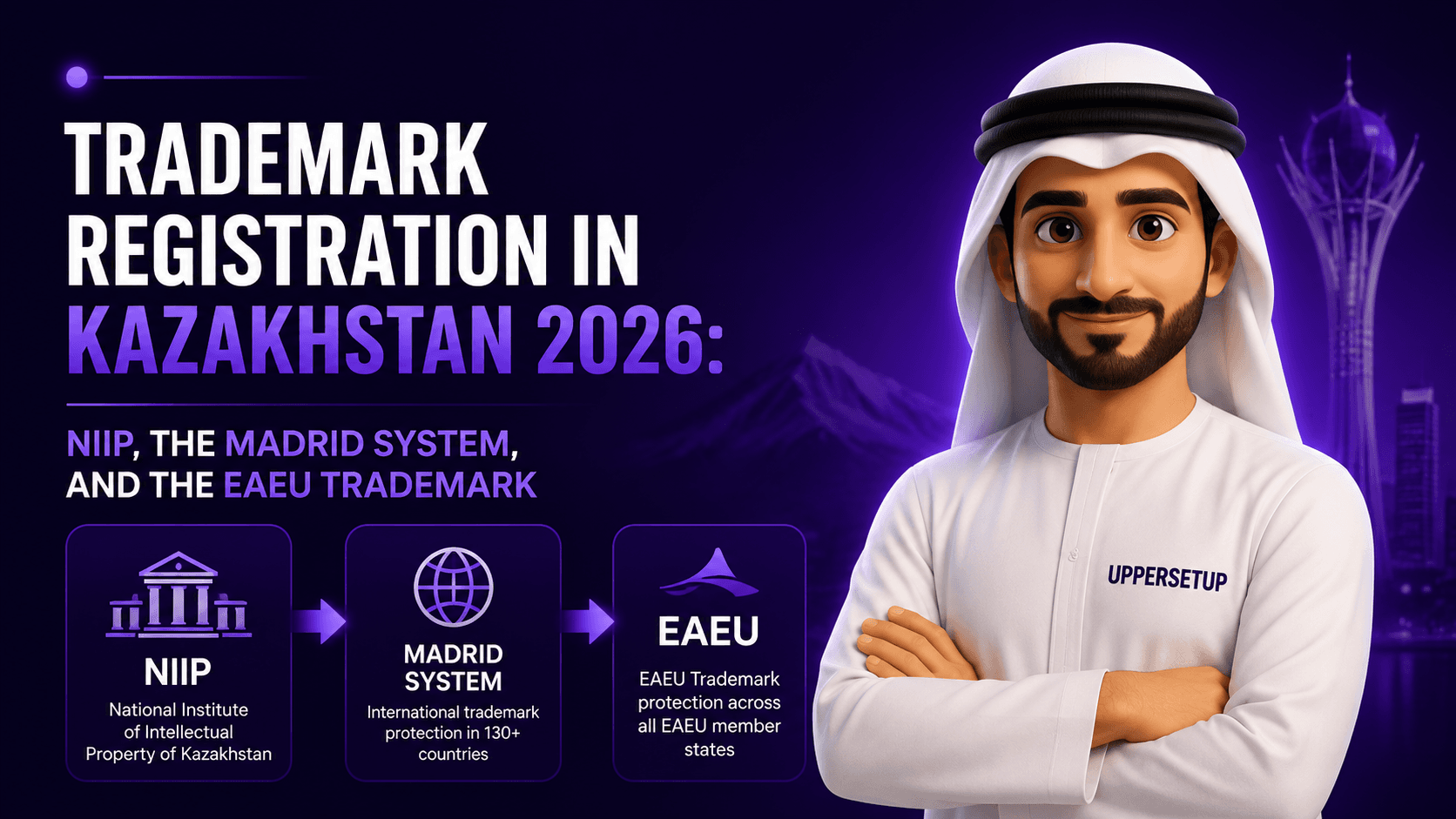
The Madrid System allows protection in several countries on the basis of a single international application filed through an office of origin. For a UAE-based owner, the office of origin is the Ministry of Economy and Tourism.
|
Parameter |
National UAE filing |
International filing under the Madrid Protocol |
|
Territory covered |
All seven Emirates on one registration |
The member states designated by the applicant at filing |
|
Filing office |
Ministry of Economy and Tourism |
WIPO International Bureau via MoET as office of origin |
|
Precondition |
None; any person may file, through an agent if located abroad |
An existing basic national application or registration |
|
Fee to convert a national application into an international one |
Not applicable |
AED 400 under the MoET schedule; WIPO fees are payable separately |
|
When it makes sense |
The business operates only in the UAE, or the UAE is the first and principal market |
Simultaneous entry into several markets and centralised portfolio management |
The Madrid Protocol entered into force for the UAE on 28 December 2021, opening the route both for foreign owners to designate the UAE in international applications and for UAE-based owners to file internationally.
11. Enforcement: Civil, Criminal and Customs
Article 49 of Federal Decree-Law No. 36 of 2021 imposes imprisonment and/or a fine of not less than AED 100,000 and not more than AED 1,000,000 for counterfeiting a registered trademark and for knowingly importing or exporting goods bearing a counterfeited or imitated mark.
Article 50 imposes imprisonment of up to one year and/or a fine of not less than AED 50,000 and not more than AED 200,000 for knowingly selling, offering for sale or holding for sale goods, or offering services, bearing a counterfeited or unlawfully used mark, and for using an unregistered sign in the cases set out in Article 3.
For comparison, the minimum fine under the 1992 law was AED 5,000. Raising the floor to AED 100,000 under Article 49 changed the economics of infringement outright.
Article 51 escalates on repeat offending: a person who repeats any of the acts under Articles 49 and 50 faces a penalty of up to double the maximum prescribed for the offence. The court may also order closure of the facility and confiscation of the tools, machines and materials used.
Customs suspension: twenty days and two exceptions
Under Article 45 the customs authorities may, on their own initiative or at the request of the right holder or its representative, order by reasoned decision that goods infringing the law not be cleared, for a maximum of twenty days. The customs authorities may not prevent the right holder from inspecting the goods covered by such an order.
Article 46 carves out two categories: small quantities of a non-commercial nature in travellers’ personal baggage or small parcels, and goods placed on the market of the exporting country by the trademark owner or with its consent.
Provisional measures: three deadlines to diarise
Under Article 47 the right holder may obtain an order on petition from the Magistrate of Summary Justice at the Civil Court with jurisdiction over the dispute, for one or more provisional measures: description of the infringement and the goods, materials and equipment involved; seizure of those items and of the proceeds; preventing the goods from entering commercial channels or being exported; and preserving evidence.
|
Deadline |
What it governs |
Consequence of missing it |
|
10 days |
The period within which the Magistrate of Summary Justice decides the petition, save in exceptional cases at his discretion |
Not applicable: the deadline binds the court |
|
15 days |
The defendant’s window to file a grievance with the president of the court against an order issued without summoning the other party |
Loss of that route to challenge the order |
|
20 days |
The right holder’s window to bring the substantive action, running from the order or from notification that the grievance was rejected |
The order is cancelled at the defendant’s request |
The order may be issued without summoning the other party where delay may cause the claimant irreparable harm or evidence may be lost or destroyed. The Magistrate may require the petitioner to provide an appropriate financial or bank guarantee protecting the defendant against abuse of the right, in a reasonable and proportionate amount.
Alongside the criminal track, Article 48 allows the owner to sue in the Civil Court for compensation under the general rules. Article 52 allows the court to publish a conviction at the convicted party’s expense — a remedy that matters for reputational effect.
12. Classes and Filing Format: How Many Applications?
Goods and services are classified under the Nice Classification. Whether the UAE permits a single application covering several classes is reported inconsistently in commentary, but the statutory text settles the point.
Article 8(1) provides that a trademark may be registered for one or more categories by filing an application for one of the categories of goods or services, in accordance with the Implementing Regulation. The construction points to filing per class: coverage of several classes is achieved through several applications rather than one multi-class filing.
Article 8(2) states a rule often overlooked when selecting classes: goods or services are not treated as similar merely because they sit in the same category, nor as different merely because they sit in different categories of the same classification. The class drives the fee calculation but does not by itself settle similarity in examination or in a dispute.
Why the commentary diverges nonetheless. Some legal databases describe the new law’s procedure as including multi-class filing, and commentary on the 2025 fee schedule notes that multi-class applications remain subject to per-class fees. The official service description on the Ministry of Economy and Tourism portal does not mention multi-class filing. The practical conclusion is format-independent: fees are computed per class, so budget from the number of classes. Confirm the filing format with a registered agent immediately before filing.
The Trademark Register
A Trademark Register is maintained at the Ministry recording the marks themselves, owners’ names and addresses, types of business activity, descriptions of the goods and services, and any changes, assignments, transfers of ownership, mortgages, licences of use and other modifications. Any person may request a copy of the recorded data on payment of the prescribed fees.
13. Assignment, Pledge and Licensing
A UAE trademark is a transferable asset: it can be assigned, inherited, pledged and licensed. The formalities differ sharply between these transactions, and that is where most errors occur.
Assignment, transfer and pledge
A trademark application may be assigned, and ownership of a registered trademark may be transferred with or without consideration. The mark may be mortgaged or attached together with the commercial shop or exploitation project in which it is used to distinguish goods or services, unless otherwise agreed. Ownership also passes by inheritance, will, gift or any other legal form.
Without recordal the transaction has no effect against third parties. The law states expressly that in all cases the transfer of ownership, mortgage or attachment of a trademark is not enforceable against third parties unless entered in the Trademark Register and announced by any means, under the procedures and conditions set by the executive regulations. A signed and notarised agreement is not enough to bind third parties.
A transfer of ownership of the commercial shop or project carries with it a trademark registered in the owner’s name where the mark is closely related to that shop or project, unless the parties agree otherwise. This operates by default, so the fate of the mark should be addressed expressly in any business sale.
Licensing runs on a different formality regime
The owner may use the mark itself and grant a licence of use to one or more natural or legal persons. The term of the licence may not exceed the term of protection of the trademark.
The key difference between a licence and an assignment. Under Article 31 the licence contract must be made in writing and documented, but a notation or registration in the Register is not required; the executive regulations set the controls for a notation where a party requests one. That is the opposite of the position for assignments and pledges, where recordal is the condition of enforceability against third parties. Some practitioner guides describe licence recordal as mandatory — where they diverge, follow the statutory text.
Article 33 limits what a licence may impose: restrictions that do not flow from the rights conferred by registration, or are not necessary to preserve them, may not be placed on the licensee. Three restrictions are expressly permitted — defining the territory or term of use, requirements for effective quality control of the goods or services, and obligations to refrain from acts that would abuse the mark.
A licensee may not assign the licence to third parties or grant sub-licences unless otherwise agreed with the trademark owner.
Collective marks and control marks
Alongside ordinary trademarks the law provides for two special categories, each with its own registration regime and, as the fee schedule shows, its own rates.
• Collective trademark. A mark used to distinguish the goods or services of establishments belonging to a defined grouping. Where a collective mark is deregistered, it may not be re-registered for the benefit of third parties in respect of identical or similar goods or services.
• Monitoring and inspection mark. Juristic persons responsible for monitoring or inspecting goods or services as to source, components, method of manufacture, quality, substance or any other characteristic may apply to register a mark denoting that monitoring or inspection procedure. The owner must notify the Ministry of any change in those requirements. Higher final registration and renewal rates apply to such marks.
14. Common Mistakes
Mistake 1. Missing a 30-day payment deadline
Both payments — publication and final registration — run on 30-day clocks: the first from receipt of the acceptance decision, the second from the end of the opposition period. Late payment carries AED 100 per month (capped at AED 1,000 per year) on the first and AED 1,000 per month (capped at AED 10,000 per year) on the second, with a partial month counting as a full one. The cost: on a long delay the penalty on the second payment is double the registration fee itself.
Mistake 2. Relying on use instead of registration
The UAE grants rights to the first applicant, not the first user. A company trading under its brand for years without registering may find the sign registered by a third party. The cost: recovering the position requires cancelling someone else’s registration through adversarial proceedings — slower and more expensive than filing first, with no guaranteed outcome.
Mistake 3. Treating a free zone registration or trade name as brand protection
Registering a company and trade name with a free zone or an emirate’s department of economic development creates no trademark rights. The trademark register is maintained solely by the Ministry of Economy and Tourism at federal level. The cost: this is usually discovered at the point where a competitor has already filed for an identical sign and secured priority from its own filing date.
Mistake 4. Economising on the pre-filing search
The publication and registration fees fall due late in the process, but the application fee and the agent’s work are spent regardless of the examination outcome. An application for a sign similar to one already registered will be refused, and appealing a refusal now costs AED 5,000. The cost: the full cycle repeats with a new sign and market entry slips by months.
Mistake 5. Missing the renewal window
Renewal is filed during the tenth year of protection or within the six-month grace period after it ends. Renewing in the grace period costs AED 750 more for an ordinary mark and AED 1,500 more for a monitoring and inspection mark. A further three months is available at the Ministry’s discretion on acceptable justification, not automatically. The cost: beyond the grace period protection lapses and the sign must be filed afresh, losing the original priority.
Mistake 6. Filing directly from abroad without an agent
A foreign applicant must act through a registered agent with a notarised, legalised power of attorney translated into Arabic. Attempting to file directly results in rejection on formal grounds. The cost: preparing a legalised power of attorney from abroad takes weeks, and priority is unsecured throughout.
15. Which Route Suits Whom
National UAE filing
• Businesses whose market is the UAE. One registration covers all seven Emirates; mainland and free zones maintain no separate registers.
• Projects on a hard launch deadline. Expedited examination within one working day for AED 2,250 delivers the examination report without waiting for the ordinary period.
• Exhibitors. The provisional registration introduced for qualifying exhibitors gives temporary protection over the event period.
• Small and medium enterprises. Membership of the National Programme for SMEs carries a 50 per cent discount on trademark services.
International filing under the Madrid Protocol
• Companies targeting several markets at once. One international application designating several states replaces parallel national filings.
• Owners of growing portfolios. Centralised management of renewals and changes through the International Bureau reduces administrative load.
• Those with a basic UAE application or registration. A basic national filing is a precondition; the MoET conversion fee is AED 400 and WIPO fees are payable separately.
16. Step-by-Step Process
1. Define the goods and services and map them to Nice Classification classes: the number of classes drives the fee calculation.
2. Run a pre-filing search of the Ministry of Economy and Tourism register for identical and similar signs.
3. Test the sign against the absolute grounds for refusal in Article 3 — distinctiveness, absence of state and organisational emblems, consistency with public order.
4. For a foreign applicant, execute a power of attorney to a registered agent with notarisation, legalisation and Arabic translation.
5. File through the Ministry’s electronic system, electing expedited examination for AED 2,250 where speed matters.
6. Receive the examination decision: notification within 20 days of filing, with a 90-day maximum for the technical examination result under the executive regulations.
7. Pay the AED 750 publication fee within 30 days of receiving the acceptance decision.
8. Track the 30-day opposition period running from the date the bulletin is issued.
9. Pay the AED 5,000 final registration fee within 30 days of the end of the opposition period and collect the certificate, issued within 30 days of that date.
10. Where foreign markets are planned, file the international application through MoET as office of origin, paying the AED 400 conversion fee and the WIPO fees.
11. Diarise the end of the ten-year term and open the renewal window during the tenth year.
12. Ensure the mark is actually used and keep evidence of use: non-use creates a ground for cancellation on the application of an interested party.
17. Frequently Asked Questions
How much does it cost to register a trademark in the UAE?
The government fees at the main stages are AED 750 for publication in the trademark bulletin and AED 5,000 for final registration and issuance of the certificate. For monitoring and inspection marks the final registration fee is AED 7,500. On top of government fees come the registered agent’s services and the legalisation and translation of the power of attorney.
How long does UAE trademark registration take?
The decision on the application is notified within 20 days of filing, with a 90-day maximum for issuing the technical examination result under the executive regulations. Thereafter come 30 days to pay for publication, a 30-day opposition period, and 30 days for the certificate to issue after it ends.
How long does UAE trademark protection last?
Ten years from the filing date, renewable for successive ten-year periods without limit. The renewal application is filed during the tenth year of protection or within six months after it ends.
Does a foreign company need an agent to file?
Yes. Where the owner is located outside the UAE, the application is filed through a registered trademark agent with a notarised, legalised power of attorney translated into Arabic.
Does a free zone company registration protect its name as a trademark?
No. Registering a company and trade name creates no trademark rights. The trademark register is maintained solely by the Ministry of Economy and Tourism at federal level, and one federal registration covers all seven Emirates.
What penalties apply to trademark counterfeiting in the UAE?
Under Article 49 of Federal Decree-Law No. 36 of 2021 — imprisonment and/or a fine of not less than AED 100,000 and not more than AED 1,000,000. Under Article 50, for knowingly selling or holding counterfeit goods — imprisonment of up to one year and/or a fine of AED 50,000 to AED 200,000.
Can an international application be filed from the UAE?
Yes. The Madrid Protocol entered into force for the UAE on 28 December 2021. The international application is filed through the Ministry of Economy and Tourism as office of origin on the basis of a basic national application or registration; the conversion fee is AED 400 and WIPO fees are payable separately.
18. Key Takeaways
• Federal Decree-Law No. 36 of 2021 entered into force on 2 January 2022 and repealed Federal Law No. 37 of 1992.
• The executive regulations are Cabinet Decision No. 57 of 2022, published 15 June 2022, in force from 16 June 2022, comprising 27 articles.
• The fee schedule in force is Cabinet Decision No. 20 of 2020 as amended by Cabinet Decision No. 102 of 2025, issued 9 September 2025.
• Registration is federal: one application covers all seven Emirates, and neither the Emirates nor the free zones maintain separate registers.
• Key fees: AED 750 for publication, AED 5,000 for final registration, AED 7,500 for a monitoring and inspection mark.
• Expedited examination within one working day costs AED 2,250; filing an opposition AED 7,500; a grievance against refusal AED 5,000.
• Timelines: decision notified within 20 days of filing, 90-day maximum for technical examination, 30-day opposition period from issuance of the bulletin.
• Late payment penalties: AED 100 per month (up to AED 1,000 per year) on publication and AED 1,000 per month (up to AED 10,000 per year) on final registration.
• Protection runs ten years from filing; renewal during the tenth year or in the six-month grace period at a higher fee.
• The Madrid Protocol has applied to the UAE since 28 December 2021; the national-to-international conversion fee is AED 400.
• Criminal exposure: AED 100,000 to AED 1,000,000 under Article 49 and AED 50,000 to AED 200,000 under Article 50.
19. Summary
Trademarks in the United Arab Emirates are registered federally by the Ministry of Economy and Tourism: one registration covers all seven Emirates. The legal basis is Federal Decree-Law No. 36 of 2021 on Trademarks, in force from 2 January 2022, which repealed Federal Law No. 37 of 1992, together with Cabinet Decision No. 57 of 2022 on the executive regulations, published on 15 June 2022 and in force from 16 June 2022. Fees are set by Cabinet Decision No. 20 of 2020 as amended by Cabinet Decision No. 102 of 2025, issued on 9 September 2025. The principal fees are AED 750 for publication in the trademark bulletin, AED 5,000 for final registration and issuance of the certificate, AED 7,500 for final registration of a monitoring and inspection mark, AED 2,250 for expedited examination with a report within one working day, AED 7,500 for filing an opposition, AED 5,000 for a grievance against refusal, and AED 400 for converting a national application into an international one. Members of the National Programme for SMEs receive a 50 per cent discount and People of Determination are exempt. Timelines: the decision on the application is notified within 20 days of filing; the executive regulations set a 90-day maximum for issuing the technical examination result; the publication fee is paid within 30 days of the acceptance decision; the opposition period is 30 days from issuance of the bulletin; the final fee is paid within 30 days of the end of that period; and the certificate issues within 30 days of the same date. Late payment carries AED 100 per month (capped at AED 1,000 per year) on publication and AED 1,000 per month (capped at AED 10,000 per year) on final registration. Protection lasts ten years from the filing date and is renewable without limit: AED 5,750 during the tenth year and AED 6,500 within the six-month grace period, plus AED 750 for publication. Federal Decree-Law No. 36 of 2021 introduced protection for three-dimensional, sound, smell, colour and hologram marks and for geographical indications. The Madrid Protocol entered into force for the UAE on 28 December 2021. Criminal penalties run from AED 100,000 to AED 1,000,000 under Article 49 and from AED 50,000 to AED 200,000 with up to one year’s imprisonment under Article 50. A foreign applicant files through a registered agent with a notarised, legalised power of attorney translated into Arabic.
20. Sources
Tier 1 — primary sources and official materials
• UAE Legislation — Federal Decree-Law No. 36 of 2021 Concerning Trademarks (full text)
• UAE Legislation — Federal Decree-Law No. 36 of 2021: downloadable file
• WIPO Lex — Federal Law No. 36 of 2021 on Trademarks, United Arab Emirates
• Ministry of Economy and Tourism — official text of the Trademarks Law (PDF)
• Ministry of Economy and Tourism — Register Trademark: service description, timelines and fees
• Ministry of Economy and Tourism — Pay Registration Fees for Trademark
• Ministry of Economy and Tourism — Renew Registration of Trademark: renewal fees
• Ministry of Economy and Tourism — Intellectual Property Legislations
• Ministry of Economy and Tourism — press release on the new trademark service fees
Tier 2 — professional commentary
• Rouse — UAE Issues New Trade Mark Fee: Key Highlights and What to Expect
• Lexis Middle East — UAE Trademark Law: overview of the Federal Decree-Law 36/2021 regime
• Lexology — UAE Lowers Trademark Fees and Introduces New Services to Strengthen IP Protection
• Mondaq — Executive Regulation of the New Trademark Law (Cabinet Resolution No. 57 of 2022)
Related UPPERSETUP analysis
• How to Set Up a Company in the UAE in 2026: Mainland, Free Zone, Offshore, Taxes, Banking
• DIFC 2026: Jurisdiction, Structures, Regulators and Taxes
• Redomiciliation to the UAE in 2026: ADGM, DIFC and Federal Decree-Law No. 20 of 2025
Registering a brand in the UAE? UPPERSETUP handles trademark registration in the UAE, Kazakhstan and Hong Kong: pre-filing register searches, Nice class selection, powers of attorney with legalisation and translation, filing through a registered agent, and monitoring of payment and renewal deadlines. Discuss your project with UPPERSETUP
Disclaimer
This material is provided for informational purposes only and does not constitute legal, tax, financial, investment or consulting advice. Before making any decision, obtain individual professional advice reflecting your specific circumstances, jurisdiction, company status and current regulatory requirements. Information is current as of August 2026.
All services on the platform
Everything you need to start and run a business - in one place
- 3–5 days
Company Setup
Mainland or Free Zone company with a complete set of incorporation documents
Start - Monthly
Accounting Services
Financial accounting and reporting in accordance with UAE requirements
Start - 1–2 weeks
Visa Services
Residence visas for shareholders, employees and family members
Start - 7–30 days
Banking Services
Corporate Bank Accounts in the UAE and Payment Services
Start - Custom timeline
Legal Services
Contracts, corporate amendments and legal support
Start


