



































































































































 International Free Zone Authority
UAE Offshore Companies 2026: The Complete Guide to RAK ICC, JAFZA, and Ajman — Structures, Taxes, Compliance
1. What Is a UAE Offshore Company and How Does It Differ from a Free Zone Company
A UAE offshore company is a legal entity registered with one of three specialised registries: RAK ICC, JAFZA Offshore, or Ajman Offshore. The fundamental distinction from a free zone company is that an offshore company may not conduct commercial activities within the UAE, may not rent office space or maintain a physical presence in the country under its own name, and may not sponsor work or residence visas.
Primary purposes of a UAE offshore company:
• Holding shares and equity interests in foreign companies.
• International trade with overseas counterparties (without UAE operations).
• Holding UAE real estate — primarily freehold property in Dubai (RAK ICC and JAFZA).
• Asset protection: separating personal assets from business risks.
• IP holding: ownership of trade marks, patents, copyrights.
• International billing and profit accumulation from offshore operations.
What an offshore company CANNOT do:
• Conduct trading or operational activities on the UAE mainland.
• Lease commercial premises in the UAE under its own name.
• Issue work or residence visas to employees or directors.
• Directly operate a retail outlet, restaurant, or other physical place of business in the UAE.
⚠ A UAE offshore company is not the same as a "Dubai offshore company" in common parlance. When people say "Dubai offshore" they typically mean JAFZA (physically in Dubai) or RAK ICC (in Ras Al Khaimah, not Dubai). The terminological confusion is widespread: the choice should be based on specific objectives, not geography.
2. Three Registries: RAK ICC, JAFZA, and Ajman — Legal Basis
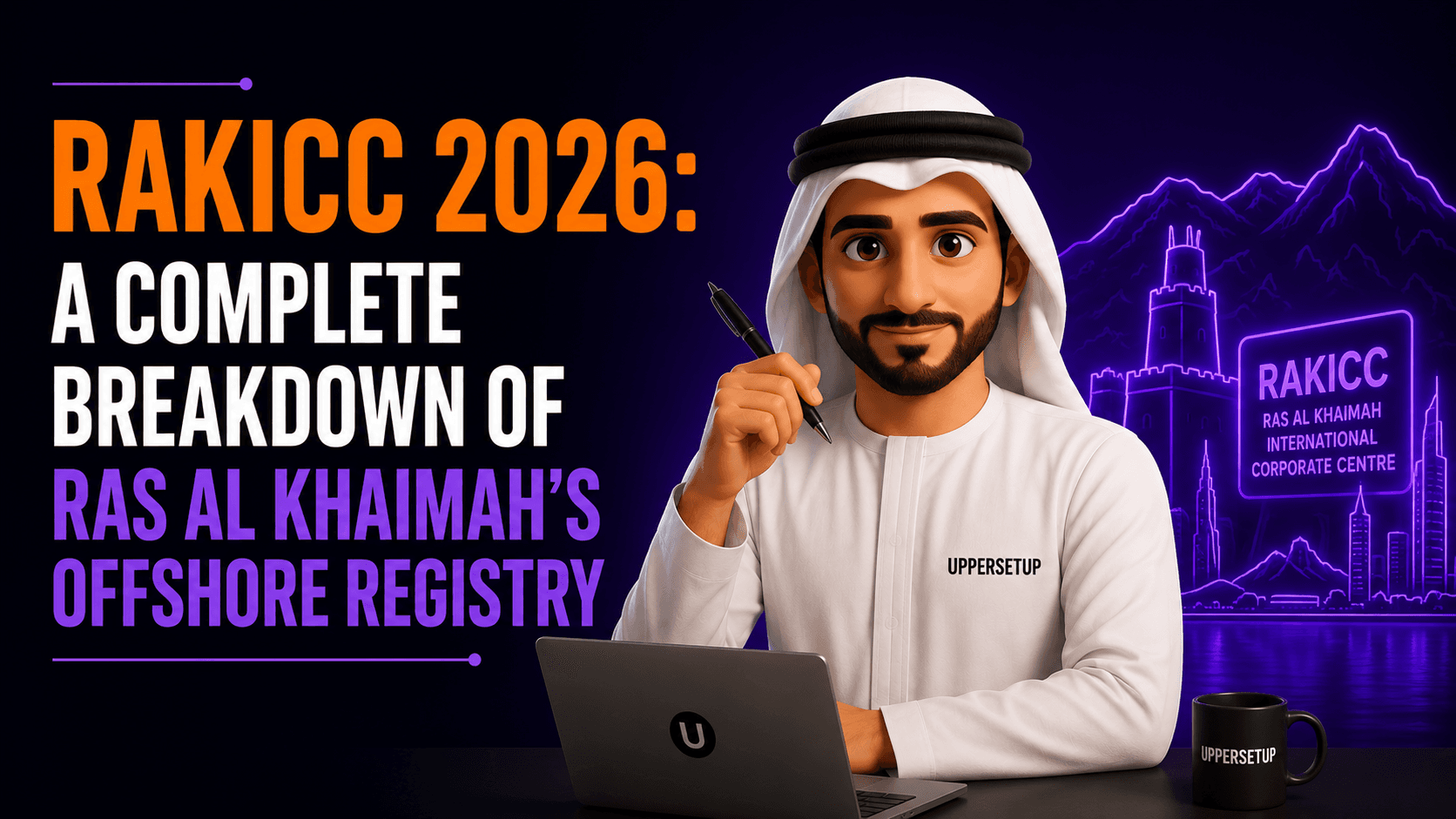
RAK ICC — Ras Al Khaimah International Corporate Centre
RAK ICC was established in 2006 as the unified registry of the Emirate of Ras Al Khaimah. A 2017 merger of two pre-existing registries (RAK Offshore and RAK FTZ) created the single RAK ICC. It operates under the RAK ICC Business Companies Regulations 2019 (amended 2024 to align with FATF standards). The largest UAE offshore registry by number of registered entities — over 20,000.
Key 2024 update: Emiri Decree No. 12 of 2024 Regarding the Amendment of Emiri Decree No. 4 of 2016 authorised RAK ICC to issue Free Zone Commercial Licences to offshore companies, unlocking access to RAKEZ tax incentives and the ability to hold Dubai real estate. Before 2024, Dubai freehold property ownership through an offshore structure was the exclusive preserve of JAFZA.
JAFZA Offshore — Jebel Ali Free Zone Authority
JAFZA was established in 1985 and is one of the oldest and most internationally recognised free zones in the world. The offshore segment (Jebel Ali Offshore Companies Regulations 2003) has existed since 2003. JAFZA is physically located in Dubai (Jebel Ali district), giving its companies a Dubai address and reputation. JAFZA updated its offshore company regulations in 2024: the minimum number of directors was reduced from two to one (Article 33.1 of the new JAFZA regulations). A director may now also be a corporate entity, subject to JAFZA approval (Article 33.3). This removed a previously unique restriction.
JAFZA's banking accessibility has traditionally been superior to RAK ICC, owing to its 20-year track record and direct Dubai association. For structures dealing with institutional partners or requiring accounts at conservative banks, JAFZA remains the priority option.
Ajman Offshore — Ajman Free Zone Authority
Ajman Offshore is the least well-known and most budget-oriented option. Its appeal rests entirely on price (from AED 7,000–9,000 per year). Significant limitations: no right to hold Dubai real estate, limited international recognition, and banks in most cases decline to open accounts for Ajman companies. Ajman should only be considered where a UAE bank account and international partnerships are not required.
3. Comparison Table: RAK ICC vs JAFZA vs Ajman (15 Parameters)
|
Parameter |
RAK ICC |
JAFZA Offshore |
Ajman Offshore |
|
Full name |
Ras Al Khaimah International Corporate Centre |
Jebel Ali Free Zone Authority Offshore |
Ajman Free Zone Offshore |
|
Legal basis |
RAK ICC Business Companies Regulations 2018 (amended 2024) |
Jebel Ali Offshore Companies Regulations 2003 (updated 2024) |
Ajman Free Zone Authority regulations |
|
Established |
2006 (unified register following 2017 merger) |
2003 (one of the oldest UAE offshore registries) |
Significantly later; less established |
|
Number of companies |
Over 20,000 (volume leader) |
Several thousand (niche; quality over volume) |
Several hundred (smallest) |
|
Registration speed |
1–3 working days with clean KYC |
5–10 working days |
3–5 working days |
|
Registration cost (approx.) |
From AED 9,500–13,000/year |
From AED 15,000–25,000/year |
From AED 7,000–9,000/year (cheapest) |
|
Dubai real estate ownership |
Yes (from 2024 — following Emiri Decree No. 12/2024) |
Yes (traditionally the only option before 2024) |
No |
|
Shareholding in UAE mainland / free zone companies |
Yes (shareholder in other UAE entities) |
Yes |
Limited |
|
Corporate director |
Permitted |
Permitted (subject to JAFZA approval) |
Permitted |
|
Minimum directors |
1 |
1 (natural person or corporate entity subject to JAFZA approval) |
1 |
|
Minimum share capital |
No requirement |
No requirement |
No requirement |
|
International recognition |
High (widely recognised by banks and counterparties) |
Very high (premium reputation; established since 2003) |
Low (limited recognition outside the UAE) |
|
Banking accessibility |
Good (with clean KYC) |
Excellent (best of the three) |
Difficult (banks frequently decline) |
|
Registered agent required |
Yes (mandatory) |
Yes (mandatory) |
Yes (mandatory) |
|
ESR reporting |
Cancelled (Cabinet Decision No. 98/2024 — for FY ending after 31 Dec 2022) |
Cancelled (Cabinet Decision No. 98/2024) |
Cancelled (Cabinet Decision No. 98/2024) |
Need help selecting a structure and registering a UAE offshore company? Company registration services — uppersetup.com →
4. UAE Corporate Tax 2026: How It Applies to Offshore Companies
The introduction of UAE corporate tax (Federal Decree-Law No. 47 of 2022, effective 1 June 2023) created widespread confusion about offshore companies. The situation requires precise analysis.
The core principle: UAE offshore companies (RAK ICC, JAFZA, Ajman) are legally prohibited from earning UAE-sourced income. This is precisely why they de facto generate no taxable object within the UAE — provided the operational restrictions are observed.
|
Scenario |
Applicable rate |
Basis |
|
Income from foreign sources (company has no UAE activities) |
0% |
Offshore company is legally prohibited from earning UAE-sourced income; no taxable object exists |
|
Income from holding foreign company shares (dividends) |
0% |
Dividends exempt under Federal Decree-Law No. 47/2022 under standard participation conditions |
|
Disposal gains from foreign shares / assets |
0% |
Capital gains not taxed in UAE; foreign transactions are outside the UAE perimeter |
|
Passive income received in UAE (interest / royalties / dividends from UAE companies) |
Requires analysis |
If company is an MNE entity — FSIE rules apply; ESR cancelled, but corporate tax applies to UAE source |
|
Income from UAE mainland operations |
9% |
Offshore company may not conduct mainland activities; if it does — 9% + risk of loss of status |
|
Corporate tax registration obligation |
Mandatory |
All UAE juridical persons, including offshore companies, must register with the FTA via EmaraTax within prescribed timelines |
Critical 2024 change: Cabinet Decision No. 98 of 2024 cancelled the Economic Substance Reporting (ESR) requirement for all companies in respect of financial years ending after 31 December 2022. This eliminated a significant compliance burden that previously required offshore companies to annually demonstrate adequate substance in the UAE.
Tax registration is mandatory for all: despite a zero effective rate, all UAE juridical persons — including offshore companies registered with RAK ICC, JAFZA, and Ajman — must register with the FTA via EmaraTax. Companies incorporated after 1 March 2024 must complete tax registration within 3 months of the date of incorporation. Penalty for late registration: AED 10,000.
5. Dubai Real Estate Ownership Through an Offshore Company
One of the most practically significant uses of UAE offshore companies is holding freehold real estate in Dubai through a corporate structure. This enables: separation of personal assets from the ownership entity; simplified succession planning (transferring shares rather than selling property); avoidance of certain tax consequences at resale through shareholder substitution; and beneficial ownership confidentiality.
Before 2024: the right to hold freehold Dubai property through an offshore company was the exclusive privilege of JAFZA Offshore, enshrined in specific agreements between JAFZA and the Dubai Land Department (DLD). This drove many structures to choose JAFZA despite its higher cost.
From 2024: Emiri Decree No. 12 of 2024 expanded RAK ICC's powers, enabling RAK ICC offshore companies to also acquire property in Dubai upon obtaining a Free Zone Commercial Licence through RAKEZ. This fundamentally changed the cost-benefit analysis between the two registries. For most investors, RAK ICC is now the more cost-efficient route to the same outcome.
⚠ The procedure for acquiring real estate through an offshore company requires separate Dubai Land Department (DLD) approval. Not all properties can be registered to an offshore company: DLD verifies structural compliance and may request additional documentation. It is strongly recommended to conduct a DLD compatibility check before establishing the structure.
6. Step-by-Step Registration Procedure
RAK ICC route (standard procedure)
Step 1. Select a licensed RAK ICC registered agent. Individuals and entities may not register an offshore company directly — only through an accredited agent. The list of agents is published on the official RAK ICC website (rakicc.com).
Step 2. Choose a company name. The agent checks availability in the RAK ICC database. Names containing "Bank", "Insurance", "Royal", "Emirates", etc. require special authorisation.
Step 3. Prepare the KYC package. Standard documents: valid passports of directors and shareholders; proof of residential address (utility bill or bank statement, not older than 3 months); director CV; UBO declaration; Source of Funds/Wealth documentation for shareholders with over 25% interest.
Step 4. Agent submits application to RAK ICC. The agent forwards the documents to the registry for compliance review. With clean KYC and a straightforward structure: approval within 1–3 working days.
Step 5. Payment of registration fees. Includes the RAK ICC government fee and agent remuneration. Typical total cost for year one: AED 9,500–13,000 (government fee) + agent fee.
Step 6. Receive constitutional documents: Certificate of Incorporation, Memorandum and Articles of Association, Register of Directors, Register of Shareholders. Delivery by post or digital copies via the agent.
Step 7. Register with the FTA (EmaraTax) within 3 months.
Step 8. Open a corporate bank account. The most time-consuming stage. UAE banks apply rigorous KYC to offshore structures.
7. Bank Account for a UAE Offshore Company: The Real Picture
Banking is the most complex and unpredictable aspect of operating a UAE offshore company in 2026. The UAE was removed from the FATF grey list in February 2024, which improved the situation compared to 2022–2023, but banks continue to apply strict standards.
Who accepts offshore companies: a general guide
• JAFZA Offshore: best banking accessibility. Emirates NBD, FAB, Mashreq, RAKBANK generally accept JAFZA companies with clean KYC and a coherent business model.
• RAK ICC: good banking accessibility with a transparent structure. RAKBANK (same emirate) is the most accommodating option. Wio Bank and Mashreq NeoBiz are digital alternatives.
• Ajman Offshore: extremely difficult banking accessibility. Most UAE banks decline Ajman companies without explanation. Digital fintech solutions (Wise Business, Payoneer) are a more realistic alternative.
What banks check when opening an account for an offshore company
• Transparency of UBO structure down to the final natural person.
• Source and nature of expected transactions: origin of funds, identity of counterparties, jurisdictions involved.
• Evidence of genuine business purpose (not merely "asset holding").
• Documentary confirmation of shareholder Source of Wealth.
• Absence of connections to FATF-listed jurisdictions, UN/OFAC/EU sanctions lists.
⚠ One of the most frequent grounds for account rejection is a multi-layered corporate structure (offshore → offshore → offshore). Banks require disclosure down to the ultimate natural person under Federal Decree-Law No. 10 of 2025 on AML/CFT. A structure with intermediate offshore entities in closed jurisdictions (BVI, Seychelles) at shareholder level will significantly complicate banking.
Need banking and KYC support for your offshore company? Banking services and KYC support — uppersetup.com →
8. Registry Selection Matrix: Which Registry for Which Purpose
|
Task / Goal |
Optimal registry |
Why |
|
Holding structure (shares / equity interests) |
RAK ICC |
Corporate directors permitted; wide recognition; best price-quality balance |
|
Dubai real estate ownership |
RAK ICC or JAFZA |
Both permitted from 2024. JAFZA for high-value assets with institutional partners. RAK ICC for most cases. |
|
International trade (B2B) |
RAK ICC or JAFZA |
Both accepted by counterparties; JAFZA has premium reputation |
|
IP holding (intellectual property) |
RAK ICC |
Widely used for trade mark and patent holding; corporate directors convenient |
|
Structure with two natural person directors |
JAFZA |
JAFZA's two-natural-person director requirement is not a limitation but a standard; JAFZA gives best banking |
|
Maximum savings (minimum budget) |
Ajman Offshore |
Only if UAE bank account and international recognition are not required |
|
Family office / asset management |
RAK ICC or JAFZA |
Confidentiality and asset protection level; JAFZA for large fortunes |
|
Obtaining a UAE visa through offshore company |
Not possible in any of the three registries |
Offshore companies are not permitted to sponsor work or residence visas |
9. Annual Compliance Obligations Across All Three Registries
|
Obligation |
RAK ICC |
JAFZA |
Ajman |
Deadline / frequency |
|
FTA registration (corporate tax) |
Mandatory |
Mandatory |
Mandatory |
Within 3 months of registration (for companies registered after 1 March 2024) |
|
Annual licence renewal |
Mandatory |
Mandatory |
Mandatory |
Annually before licence expiry |
|
UBO register (Cabinet Resolution No. 58/2020) |
Mandatory |
Mandatory |
Mandatory |
Within 60 days of registration; update within 30 days of any change |
|
Maintaining accounting records |
Mandatory |
Mandatory |
Mandatory |
Retention: 5 years (RAK ICC / Ajman); JAFZA: 10 years; audit not mandatory for most offshore entities |
|
Profits Tax Return to FTA |
Mandatory |
Mandatory |
Mandatory |
Within 9 months of financial year end |
|
ESR reporting |
Cancelled |
Cancelled |
Cancelled |
Cabinet Decision No. 98/2024 — cancelled for FY ending after 31 Dec 2022 |
|
Registered agent notification |
Mandatory |
Mandatory |
Mandatory |
Agent mandatory at all times; change of agent requires registry notification |
UBO: key requirements
Cabinet Resolution No. 58 of 2020 on Beneficial Owner Procedures (as amended by No. 109 of 2023) requires all UAE companies, including offshore entities, to maintain an up-to-date register of ultimate beneficial owners. A UBO is a natural person who directly or indirectly owns 25% or more of shares/voting rights, or otherwise exercises control. The register is filed with the relevant regulatory authority (RAK ICC, JAFZA, Ajman Free Zone) and is not publicly accessible, but is available to regulators and law enforcement on request. Penalty for non-compliance: up to AED 100,000, and possible deregistration of the company.
10. Common Mistakes in Offshore Structure Establishment and Operation
• Choosing Ajman to save AED 2,000–3,000. If a UAE bank account or international partnerships are needed, Ajman creates more problems than it saves money. The true total cost (factoring in time spent on banking rejections) makes RAK ICC cheaper.
• Expecting an offshore company to provide a visa. None of the three offshore registries confers visa rights. UAE residency requires a separate structure: a free zone or mainland company, an investment Golden Visa, or property ownership.
• Missing the FTA registration deadline. Companies regularly miss the 3-month deadline after incorporation. Penalty: AED 10,000 for late registration.
• Conducting activities that conflict with offshore status. If the company actually conducts business on the UAE mainland — it violates the terms of its offshore status and generates UAE-sourced income taxable at 9%. A mainland licence is required for domestic operations.
• Opaque multi-layered ownership structure. Structures of the form BVI → Seychelles → RAK ICC are opaque to banks. AML requirements introduced in 2025–2026 have effectively blocked banking for such arrangements. A simple structure of natural person → offshore company operates significantly more reliably.
• Failing to update the UBO register. Upon any change in shareholders or directors, the update must be filed within 30 days. Non-compliance is an AML violation with serious consequences.
• Confusing offshore and free zone companies. A free zone company (DMCC, IFZA, DAFZA) and an offshore company (RAK ICC, JAFZA) are fundamentally different structures. Free zone companies permit operational activities and visa sponsorship; offshore companies do not.
11. Checklist: Where to Start
• Define the objective: holding, international trade, real estate ownership, IP holding, asset protection.
• Select the registry based on the objective (matrix in section 8).
• Find an accredited registered agent: verify through the official websites of RAK ICC, JAFZA, or Ajman Free Zone.
• Prepare the KYC package: passports, proof of address, CV, Source of Funds, one-page business summary.
• If Dubai real estate is needed — confirm DLD requirements before establishing the structure.
• Register with the FTA (EmaraTax) within 3 months of incorporation.
• Record the UBO structure and file with the registry within 60 days of incorporation.
• Approach the bank early — ideally before final incorporation, to understand the specific bank's requirements for offshore structures.
• Maintain accounting records from day one: books must be kept for a minimum of 5 years.
Sources
• RAK ICC — official portal (rakicc.com)
• RAK ICC Business Companies Regulations 2019 — official text (rakicc.com)
• JAFZA — official Jebel Ali Free Zone portal (jafza.ae)
• Ajman Free Zone — official portal (ajmanfreezone.ae)
• Federal Decree-Law No. 47 of 2022 on Taxation of Corporations (FTA — tax.gov.ae)
• Cabinet Decision No. 58 of 2020 on Beneficial Owner Procedures — UBO (CBUAE Rulebook)
• Cabinet Decision No. 98 of 2024 — cancellation of ESR reporting (uaelegislation.gov.ae)
• Emiri Decree No. 12 of 2024 (RAK) — expansion of RAK ICC powers including real estate ownership
• FTA — Federal Tax Authority: Corporate Tax Registration (tax.gov.ae)
• Gulf News — UAE offshore companies corporate tax 2025–2026 (gulfnews.com)
• Khaleej Times — UAE free zone and offshore structures 2026 (khaleejtimes.com)
Disclaimer
This article is provided for informational purposes only and does not constitute legal, tax, or professional advice. Information is based on applicable UAE regulations and official sources current as of May 2026. Requirements, fees, and procedures of RAK ICC, JAFZA, and Ajman Free Zone are subject to change; before making any decisions, readers are advised to obtain current information directly from the relevant regulator and consult a qualified legal and tax adviser. UPPERSETUP accepts no liability for actions taken solely in reliance on this material.
All services on the platform
Everything you need to start and run a business - in one place
- 3–5 days
Company Setup
Mainland or Free Zone company with a complete set of incorporation documents
Start - Monthly
Accounting Services
Financial accounting and reporting in accordance with UAE requirements
Start - 1–2 weeks
Visa Services
Residence visas for shareholders, employees and family members
Start - 7–30 days
Banking Services
Corporate Bank Accounts in the UAE and Payment Services
Start - Custom timeline
Legal Services
Contracts, corporate amendments and legal support
Start


