













































































 International Free Zone Authority
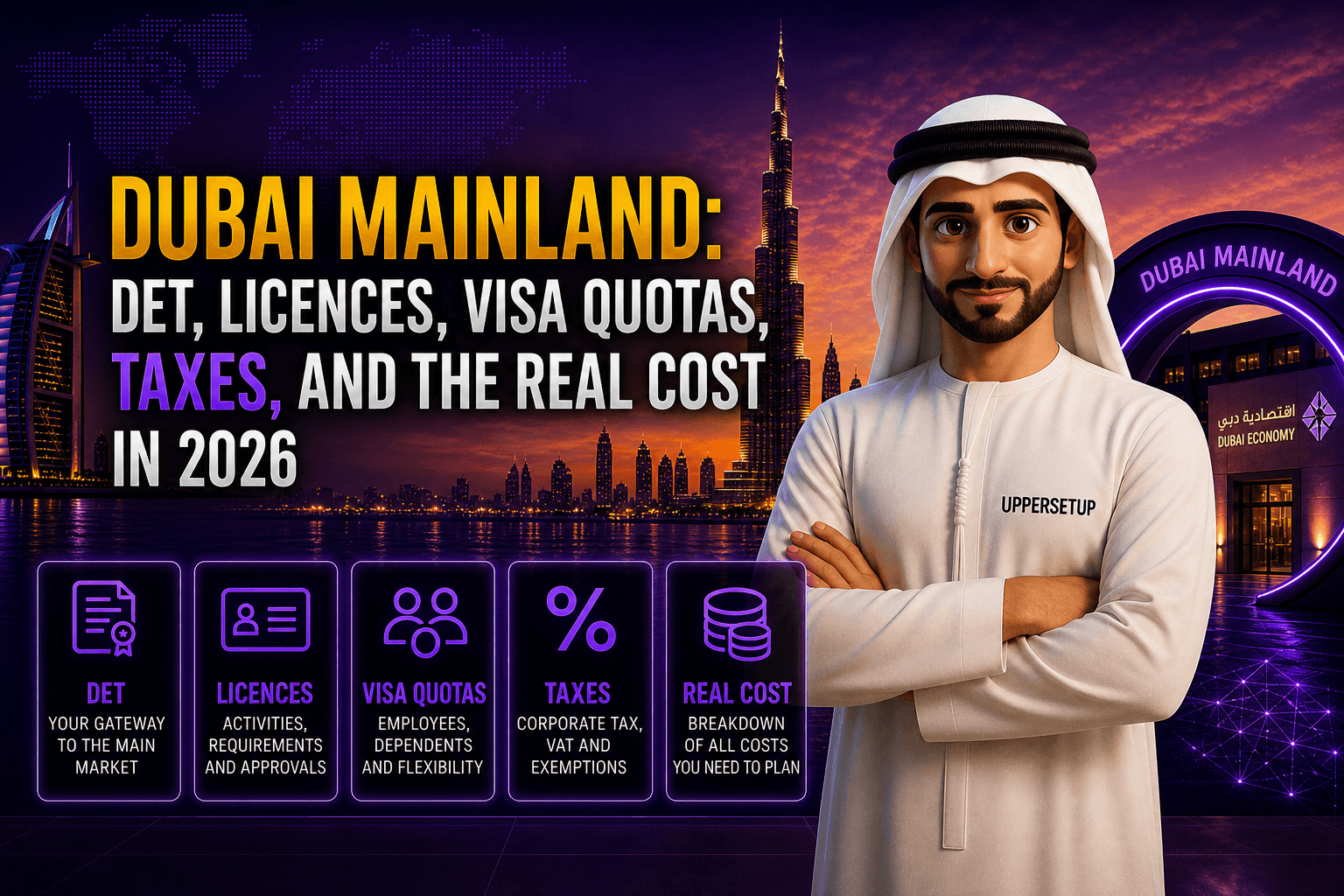
Dubai Mainland: DET, Licences, Visa Quotas, Taxes, and the Real Cost in 2026
Introduction. Mainland Is Not the Default Option. It Is a Deliberate Choice.
When an entrepreneur first explores company registration options in the UAE, the mainland is often perceived as the more complex and expensive alternative to free zones. This is a persistent misconception that costs those who follow it both time and money.
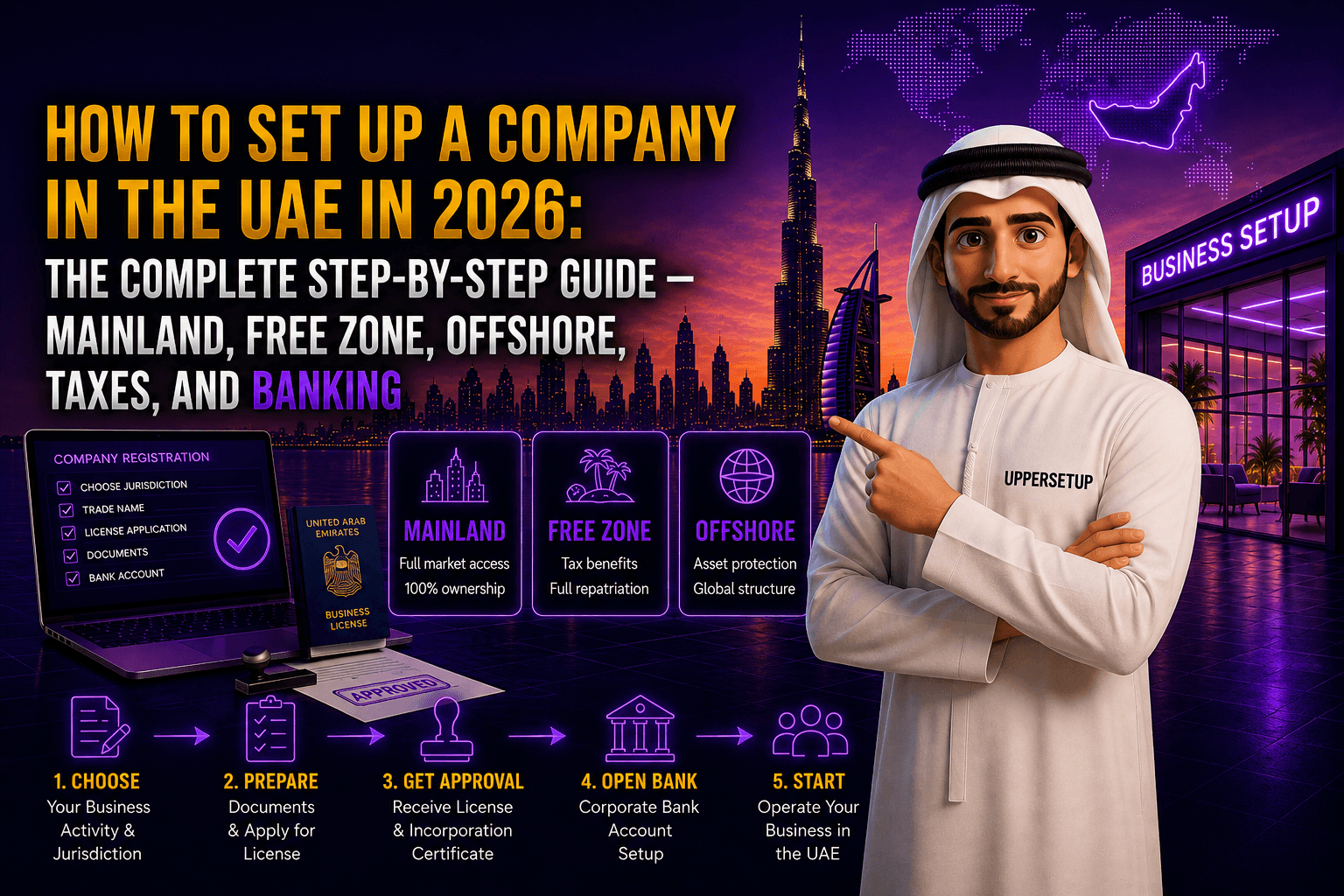
Dubai's mainland is the jurisdiction that provides what no free zone offers: direct commercial access to the UAE market without agents, intermediaries, or geographic restrictions. A mainland company may conclude contracts directly with any clients in the UAE, participate in government tenders, open retail outlets, and hire staff without the constraints of free zone packages.
Following the reform under Federal Decree-Law No. 26 of 2020 (effective 1 June 2021), Dubai's mainland became accessible to foreign entrepreneurs in a fundamentally different way: 100% foreign ownership across most activity types removed the main historical barrier. A local partner holding 51% is now history, not a current requirement.
In 2026, Dubai's mainland is administered by the DET (Department of Economy and Tourism) — previously known as the DED (Department of Economic Development). It serves as the single window for trade licence issuance, trade name reservation, company registration, and licence renewals.
This article is a systematic breakdown of everything that matters about Dubai's mainland in 2026: licence types with real AED figures, the step-by-step registration procedure, visa quotas, the tax regime, hidden cost items, and the practical choice between mainland and free zone.
Part I. The Legal Framework: Laws Governing the Mainland
Business operations on Dubai's mainland are governed by several key legislative instruments:
— Federal Decree-Law No. 26 of 2020 (amendment to the Commercial Companies Law) — the law that eliminated the mandatory 51% local partner requirement for most activity types; effective 1 June 2021. For strategic activities (defence industry, certain financial services), restrictions remain per Cabinet Resolution No. 55 of 2021;
— Federal Decree-Law No. 32 of 2021 on Commercial Companies (as amended by Federal Decree-Law No. 20 of 2025) — the principal corporate law: governs the formation, management, and dissolution of mainland companies, and defines the rights and obligations of shareholders and directors;
— Federal Decree-Law No. 47 of 2022 on Corporate Tax — establishes corporate tax; mainland companies are subject to rates of 0% (on profits up to AED 375,000) and 9% (above the threshold);
— Federal Decree-Law No. 33 of 2021 on Labour Relations — governs employment: contracts, employee visas, end-of-service gratuity, WPS;
— Dubai Law No. 26 of 2007 (Tenancy Law) as amended by Dubai Law No. 33 of 2008 — governs office rental and mandatory registration of the tenancy agreement in the Ejari system. Without Ejari: no DET licence.
Part II. Dubai Mainland Licence Types: Four Categories and Their Costs
The DET issues trade licences across four main categories. Choosing the right category is the first and most important decision: the wrong licence type cannot be 'switched' without cancellation and re-registration (cost of the mistake: AED 16,500–26,500).
2.1. Commercial Licence
Issued to companies conducting trading activities: buying and selling goods, import and export, distribution, retail and wholesale trade, e-commerce. The most common licence type.
DET government fee (2026): AED 10,000 – AED 25,000, depending on specific activities, number of shareholders, and legal form.
Important feature for General Trading Licences: General Trading (covering multiple product categories) carries a mandatory additional DET fee of AED 15,000 on top of the base licence fee. Total government fees for a mainland General Trading Licence alone reach AED 29,685 (base fee AED 12,500–15,000 + activity fee AED 15,000 + processing charges AED 2,185). Adding office rent and visas, the total first-year investment typically ranges from AED 38,000 to AED 55,000. The AED 15,000 fee is charged annually at renewal.
2.2. Professional Licence
Issued for activities based on qualifications, knowledge, and professional services: consulting, IT services, legal advisory, architecture, engineering, marketing, accounting, HR services.
DET government fee (2026): AED 7,000 – AED 12,000. A professional licence is generally less expensive than a commercial one. For certain professions (medicine, education, legal) additional approvals from sector regulators (DHA, KHDA, Dubai Legal Affairs Department) are required.
Instant Licence: the DET offers professional licence issuance in 5 minutes online through the Basher platform — for standard consulting and service activities with a single shareholder. This is a genuine capability confirmed for 2026.
2.3. Industrial Licence
Issued for manufacturing activities: product manufacturing, industrial processing, assembly production, raw material import, and finished goods export.
DET government fee (2026): AED 12,000 – AED 18,000; for large-scale production, higher. Requires approval from Dubai Municipality and certain sector authorities. Production premises must comply with zoning requirements — location in Dubai's designated industrial districts (Al Quoz Industrial, Dubai Industrial City, and others).
2.4. Tourism Licence
A specialised licence for companies in the tourism sector: travel agencies, operators, and related activities. Issued by the DET in coordination with Dubai Tourism.
Comparison Table: Dubai Mainland Licence Types (2026)
|
Licence Type |
DET Fee (AED) |
Typical Activities |
Notes |
|
Commercial |
10,000 – 25,000 |
Trading, import/export, distribution, e-commerce |
General Trading: mandatory +AED 15,000 fee |
|
Professional |
7,000 – 12,000 |
Consulting, IT, marketing, HR, engineering |
Instant Licence in 5 minutes for standard types |
|
Industrial |
12,000 – 18,000 |
Manufacturing, processing, assembly |
Requires Dubai Municipality approval |
|
Tourism |
Per DET schedule |
Travel agencies, tour operators |
Coordination with Dubai Tourism |
Part III. Business Activities: What Is Permitted and How to Select
The DET maintains a register of more than 2,000 permitted business activities. Each activity is coded and linked to a licence category. Selecting activities at registration is a critical decision for three reasons:
— Activities determine the licence type and consequently the amount of government fees;
— Each activity beyond the included base number carries an additional fee of approximately AED 1,000;
— Maximum 10 activities per licence (in 2026). The first three are typically included in the base fee; each additional one is chargeable.
Certain activities require advance approvals from external regulators:
— Healthcare → Dubai Health Authority (DHA);
— Education → Knowledge and Human Development Authority (KHDA);
— Food and F&B → Dubai Municipality;
— Construction → Dubai Municipality + DEWA;
— Transport → Roads and Transport Authority (RTA);
— Financial services → Dubai Financial Services Authority (DFSA) or Central Bank of UAE.
For activities requiring external approvals, registration timelines increase by 3–6 weeks on top of the standard 14–21 business days.
Part IV. Corporate Structures for Dubai Mainland
4.1. Limited Liability Company (LLC)
LLC is the most popular corporate form for the mainland. Key parameters under Federal Decree-Law No. 32 of 2021:
— Minimum 2 shareholders (maximum 50);
— 100% foreign ownership for most activities (since 2021);
— Shareholder liability is limited to their capital contribution;
— No minimum share capital stipulated by legislation (except for certain regulated activities);
— A notarised Memorandum of Association (MOA) is required; notary fee: AED 1,000 – AED 4,000 depending on number of shareholders.
4.2. Sole Establishment
Registered in the name of a single natural person. Not a separate legal entity — the owner bears unlimited personal liability for the establishment's obligations. Registration cost is lower than for an LLC; suitable for individual professionals with limited operational risk.
4.3. Civil Company
A form used by professionals (lawyers, accountants, consultants) wishing to practise together. No minimum share capital required; partners bear joint and several liability. Previously required a local civil partner — the 2021 reform lifted this for most professions.
4.4. Branch of a Foreign Company
A legally dependent division of a foreign parent company. Does not require a local shareholder. Mandatory documents: notarised and attested corporate documents of the parent company, audited financial statements for two years.
Part V. Step-by-Step Registration Procedure for Dubai Mainland
Standard registration timeline for straightforward activities without external approvals: 14–21 business days. Realistic timeline including notarisation, Ejari, and bank account opening: 3–5 weeks.
1. Trade name reservation. Submitted via the DET portal or the Basher platform. Government fee: AED 620(standard); for premium or restricted names — up to AED 2,000. The reservation certificate is valid for 180 days. The name must reflect the company's activity, must not contain religious references or the names of government bodies, and must be unique within the DET register.
2. Initial approval. Submitted to the DET. Timeline: 1–2 business days. Fee: AED 1,000–1,200. The approval confirms that the declared activities are permissible for the chosen corporate form.
3. MOA preparation and notarisation. For an LLC — memorandum of association with shareholder details, share distribution, and activity scope. Notary fee: AED 1,000–4,000 depending on number of shareholders and complexity. For foreign shareholders: notarised and apostilled passport copy or notarial power of attorney.
4. Office and Ejari registration. All mainland companies must have a genuine physical office with a tenancy agreement registered in the Ejari system. A virtual address is not accepted for a DET mainland licence. The Ejari certificate is a mandatory document for licence issuance. Ejari registration fee: from AED 155 online via Dubai REST. Additionally: the Market Fee — a mandatory DET charge of 5% of the annual rent for commercial premises (20% for warehouses), levied at licence issuance and annually at renewal. For an office rented at AED 40,000 per year, the Market Fee adds AED 2,000 to your annual cost. This is a commonly overlooked but mandatory expense.
5. External approvals (where applicable). For regulated activities — approvals from DHA, KHDA, Dubai Municipality, and others. Adds 3–6 weeks to the overall timeline.
6. Trade licence issuance. After all approvals are obtained and government fees paid, the DET issues the trade licence. Validity: 1 year, with mandatory annual renewal.
7. Establishment Card. Issued by GDRFA or ICP after licence issuance; opens the company's immigration file, required for processing employee visas. Cost: AED 1,800–2,000.
8. Residence visas. After the Establishment Card is obtained, the company may file applications for investor/director and employee residence visas.
Part VI. Visa Quotas and Employee Hiring on the Mainland
The visa quota on the mainland is determined by two interrelated factors: the floor area of the rented office and the company's activity type.
6.1. The Visa Quota Rule: Office Floor Area
The practical standard applied by the DET and MOHRE in 2026: 1 visa per 9 square metres of rented office space (an informal but universally applied benchmark). According to certain 2025–2026 sources, the DET has updated the standard to 1 visa per 2 sq. m for certain activity types — meaning more visas can be obtained from a smaller space. Verify the applicable standard for your specific activity type at the time of application.
Practical calculations (using the 9 sq. m standard):
— 50 sq. m office: ~5–6 visas;
— 100 sq. m office: ~10–11 visas;
— 200 sq. m office: ~22 visas.
6.2. Visa Cost and Procedure
Each visa is processed as a two-year residence visa through GDRFA/ICP. Total cost per visa:
— Medical examination: AED 300–500;
— Residence visa fee: AED 1,500–2,000;
— Emirates ID: AED 370–470;
— Total: AED 3,500–5,500 per person.
An employment contract under Federal Decree-Law No. 33 of 2021 must be registered with MOHRE before a work visa is issued. Salaries are paid through the WPS (Wage Protection System).
Part VII. Tax Regime for Mainland Companies in 2026
7.1. Corporate Tax
Under Federal Decree-Law No. 47 of 2022:
— 0% on taxable profit up to AED 375,000 per tax period;
— 9% on taxable profit above AED 375,000.
Small Business Relief: companies with revenue up to AED 3 million per tax period may elect a regime under which taxable profit is treated as zero — under Ministerial Decision No. 73 of 2023. The relief applies until 31 December 2026. For mainland service companies with a high payroll cost proportion, the effective rate is substantially below 9%: tax deductions for payroll, depreciation, and professional expenses significantly reduce the taxable base.
7.2. Mandatory Audit: When Required
Mainland companies are not required to undergo an annual audit for tax purposes where revenue is below AED 50 million. This is a fundamental operational advantage over all free zones with QFZP status, where audit is mandatory regardless of size. For mainland companies with revenue above AED 50 million, audited financial statements are mandatory.
7.3. VAT
Mainland companies are subject to VAT under Federal Decree-Law No. 8 of 2017 on standard terms:
— Mandatory registration: where revenue exceeds AED 375,000 in 12 months;
— Voluntary registration: from the AED 187,500 threshold;
— Standard rate — 5%; certain services carry a zero or exempt rate.
7.4. No Personal Income Tax
Salaries, dividends, and other personal income of individuals in the UAE are not subject to income tax. This remains one of the jurisdiction's key advantages for entrepreneurs and employees alike.
Part VIII. The Real Cost of Registration and the First Year of Operations
This is the most in-demand and most frequently distorted section of any mainland UAE material. The figures below are drawn from actual registrations in Q1–Q2 2026.
Registration and First-Year Cost: Dubai Mainland (2026)
|
Cost Item |
Minimum (AED) |
Typical Range (AED) |
Notes |
|
Trade name reservation |
620 |
620 – 2,000 |
Valid for 180 days |
|
DET initial approval |
1,000 |
1,000 – 1,200 |
|
|
MOA notarisation (LLC) |
1,000 |
1,000 – 4,000 |
Depends on number of shareholders |
|
DET licence fee (professional) |
7,000 |
7,000 – 12,000 |
Annual at renewal |
|
DET licence fee (commercial) |
10,000 |
10,000 – 25,000 |
Annual; General Trading +15,000 |
|
Office rental (with Ejari, small) + Market Fee 5% of annual rent |
20,000 |
20,000 – 60,000 |
Per year; Ejari mandatory |
|
Establishment Card |
1,800 |
1,800 – 2,000 |
One-time |
|
Visa (per person) |
3,500 |
3,500 – 5,500 |
Per resident |
|
Audit (if revenue > AED 50M) |
— |
from 15,000 |
Not required below this threshold |
Total Estimates by Scenario (Q1–Q2 2026 Data)
|
Scenario |
Total Year 1 (AED) |
|
Sole proprietor (professional licence, no visas) |
from 28,000 – 35,000 |
|
LLC, 2 people (professional licence, 2 visas, small office) |
from 50,000 – 65,000 |
|
LLC (commercial licence, 3 people, standard office) |
from 70,000 – 90,000 |
|
LLC General Trading (full package, 3 visas) |
from 90,000 – 120,000 |
|
Team of 8 (commercial, dedicated office) |
from 150,000 – 200,000 |
Source: actual Q1–Q2 2026 registrations (noblecoreventures.com, safeledger.ae, egsh.ae, takweenadvisory.ae). Figures may vary ±5–10% with DET fee updates.
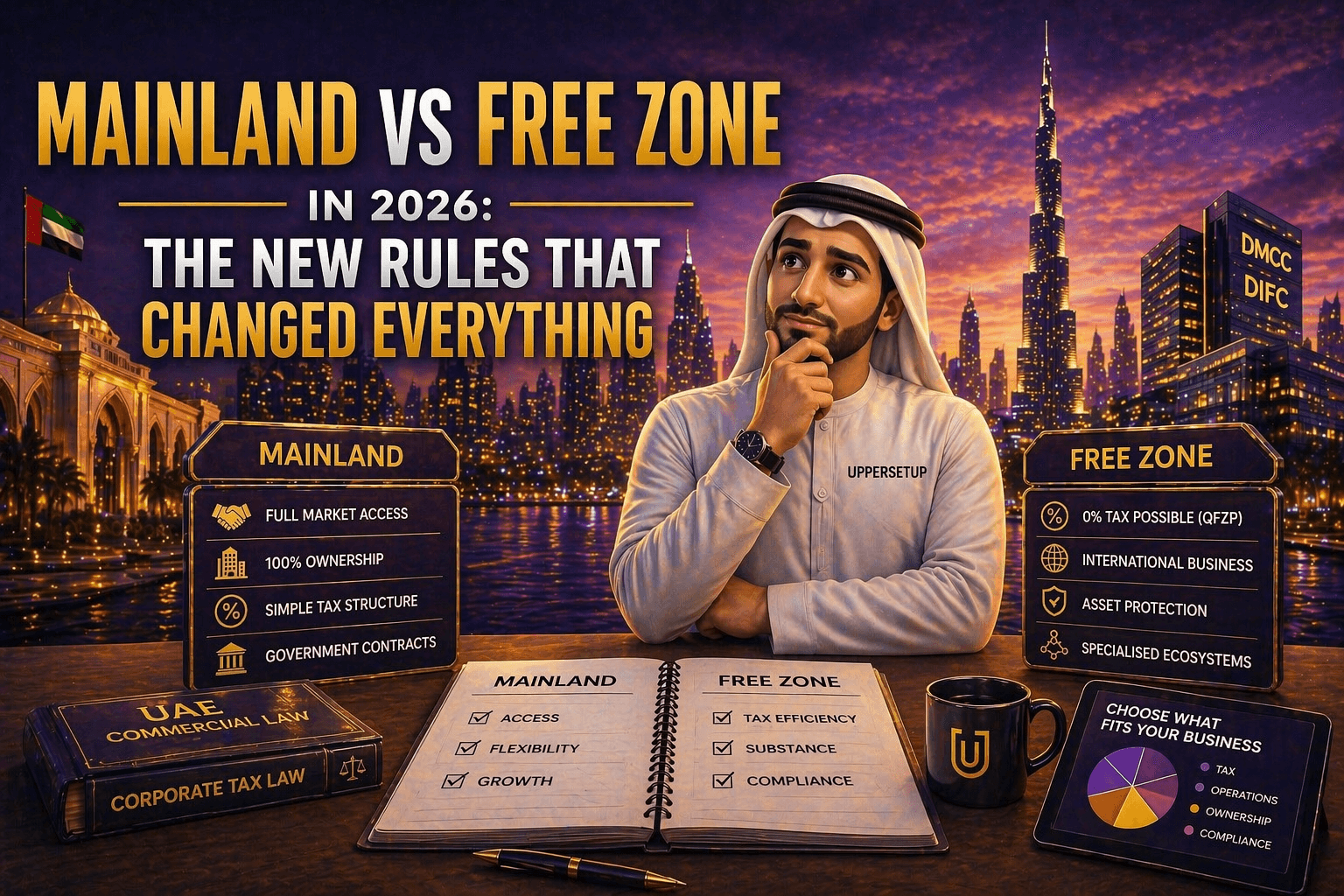
Part IX. Mainland vs Free Zone: When Mainland Wins
After the removal of the mandatory local partner barrier, the mainland vs free zone comparison has narrowed to three key criteria:
|
Criterion |
Mainland |
Free Zone |
|
UAE market access |
Full: any clients, government tenders |
Restricted: agent or branch required |
|
100% foreign ownership |
Yes (since 2021, most activities) |
Yes (always) |
|
Corporate tax |
0% up to AED 375K / 9% above |
0% (QFZP) or 9% — strict conditions |
|
Mandatory audit |
Not required below AED 50M revenue |
Required for QFZP |
|
Visa quota |
By office area (flexible) |
By office package (limited) |
|
Compliance complexity |
Standard |
High (substance, QFZP monitoring) |
|
Government tender eligibility |
Yes |
Not directly |
Mainland Is the Right Choice When:
— The primary client base is UAE mainland companies or individuals;
— Participation in government and semi-government tenders is planned;
— A retail outlet or physical presence across multiple Dubai districts is needed;
— The activity type does not qualify for QFZP, and the main free zone advantage (0% rate) does not apply;
— A company with revenue below AED 50M wants to avoid the mandatory audit burden.
Conclusion. Dubai Mainland in 2026 Is Not a Compromise
Dubai's mainland in 2026 offers what a free zone fundamentally cannot: direct access to one of the region's most developed markets without restrictions or intermediaries.
With a correctly calculated budget — accounting for the real licence fee figures and first-year costs — the mainland proves not 'more expensive than a free zone' but a cost-effective solution for companies targeting the local market.
Key takeaways: choose the licence type to match actual activities before registration; account for the AED 15,000 General Trading fee; never overlook Ejari as a mandatory condition; plan the visa quota around the genuine staffing need.
The UPPERSETUP platform guides entrepreneurs through the entire process — from structure selection and licence type to trade licence issuance, Establishment Card, and corporate bank account opening.
All regulatory references are current as of April–May 2026. Cost data is based on Q1–Q2 2026 actual registrations . This material is for informational purposes only and does not constitute legal advice.
All services on the platform
Everything you need to start and run a business - in one place
- 3–5 days
Company Setup
Mainland or Free Zone company with a complete set of incorporation documents
Start - Monthly
Accounting Services
Financial accounting and reporting in accordance with UAE requirements
Start - 1–2 weeks
Visa Services
Residence visas for shareholders, employees and family members
Start - 7–30 days
Banking Services
Corporate Bank Accounts in the UAE and Payment Services
Start - Custom timeline
Legal Services
Contracts, corporate amendments and legal support
Start


