




























































































 International Free Zone Authority
DIFC 2026: The Complete Breakdown — Jurisdiction, Structures, Regulators, Taxes, and Who It Actually Works For
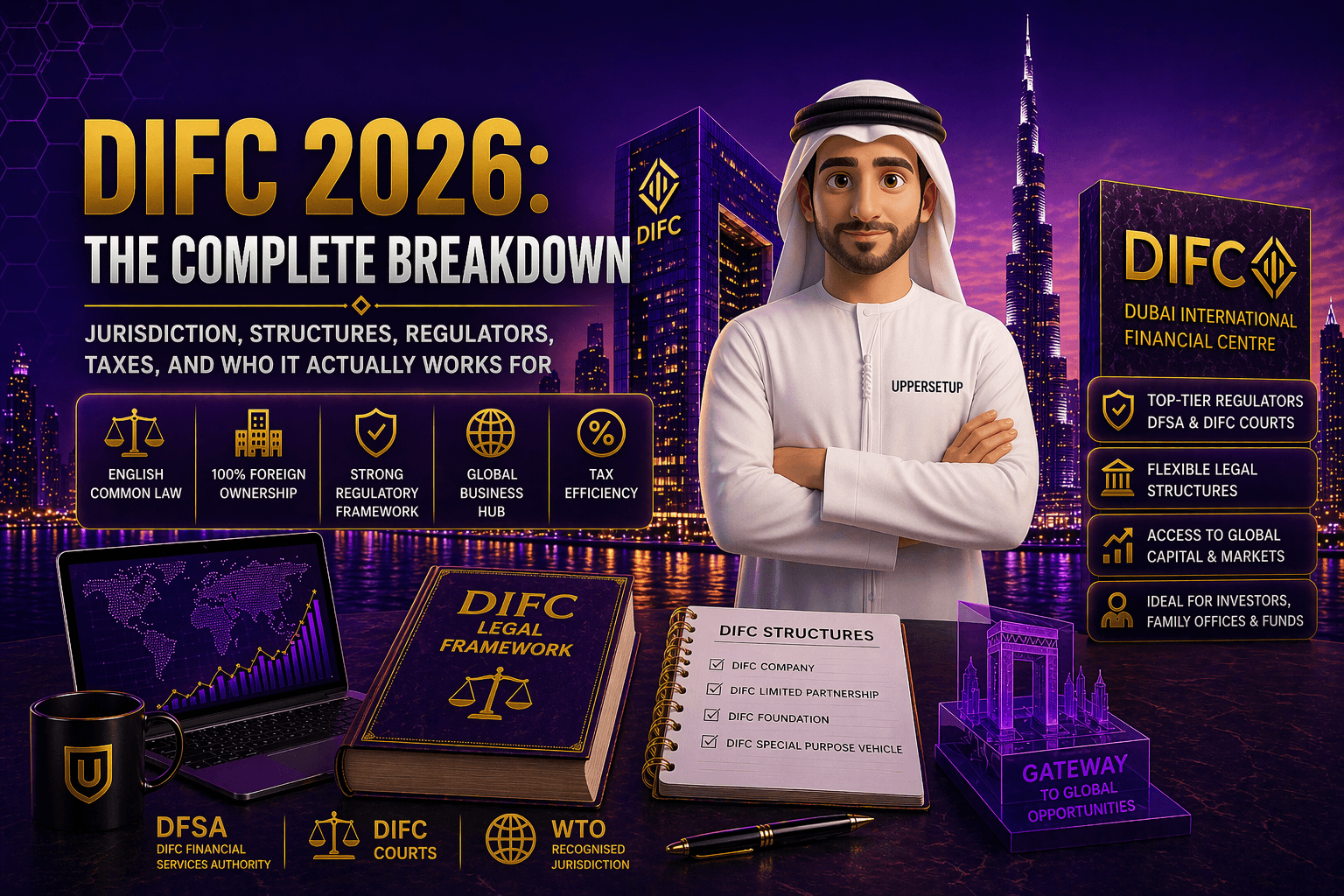
Introduction. DIFC Is Not Just Another Free Zone
The UAE map has over 47 free economic zones. Most of them are useful regulatory instruments for registering a company with a specific activity type. DIFC is something different.
The Dubai International Financial Centre (DIFC) is a separate jurisdiction within Dubai with its own legal system based on English common law, its own judicial system, its own financial regulator, and its own corporate legislation. It is not a simplified regulatory environment — it is a fully functional legal and business ecosystem, built to the standards of London and New York, but positioned in a time zone that bridges the gap between those centres.
Based on 2025 full-year results, DIFC ranks 11th globally among international financial centres and 4th worldwide in financial technology and innovation. As of end-2025, DIFC hosts 8,844 active registered companies — a 28% year-on-year increase. Combined DIFC revenues in 2025 reached USD 581 million, up 20% from 2024. The number of financial services professionals working in DIFC reached 50,200.
This is what makes DIFC the subject of this article — not as yet another registration option, but as a strategic decisionwith long-term implications for business positioning, access to capital, and legal protection.
Part I. Legal Foundation and Governance Structure of DIFC
1.1. Constitutional Foundation of DIFC
The legal foundation of DIFC is built on three levels:
Federal level: Federal Decree No. 35 of 2004 established DIFC as a Financial Free Zone within the UAE, granting it financial and administrative independence from federal legislation in the areas of civil and commercial law.
Emirate level: Dubai Law No. 5 of 2021 (replacing Dubai Law No. 9 of 2004) is the foundational Dubai law establishing DIFC. It recognises DIFC's financial and administrative independence, establishes the three governing bodies, and exempts DIFC from Dubai laws and regulations under certain conditions. In 2025, Dubai Law No. 2 of 2025 was enacted, introducing a number of refinements to DIFC's status.
DIFC level: DIFC's own legislation, based on English common law and published in the Legal Database on the official DIFC website. Corporate law, employment law, insolvency law, securities law, digital assets law — all are separate codified DIFC legislative instruments.
1.2. The Three Governing Bodies of DIFC
Dubai Law No. 5 of 2021 established three independent governing bodies of DIFC, each with clearly defined and separated mandates:
DIFC Authority (DIFCA) — the management body of DIFC, responsible for the development of the centre, registration of non-financial companies, and overall strategy. The Registrar of Companies (ROC) operates within DIFCA under the Operating Law DIFC Law No. 7 of 2018.
Dubai Financial Services Authority (DFSA) — the independent financial services regulator. Licences and supervises all entities conducting regulated financial activities in DIFC. Operates under DIFC Law No. 1 of 2004 (Regulatory Law). The DFSA is fully independent from DIFCA and the Dubai government in its regulatory activities.
DIFC Courts — the independent judicial system of DIFC, operating under English common law standards in the English language. The Court of First Instance and the Court of Appeal. Judgments of the DIFC Courts are recognised and enforceable in 140+ jurisdictions, including the United Kingdom, the United States, and EU member states, through mutual recognition mechanisms.
1.3. Key DIFC Legislative Developments 2024–2025
Over the past two years, DIFC substantially updated its legislative framework:
— Digital Assets Law No. 2 of 2024 — for the first time in the region, provided digital assets with a clear legal status under DFSA supervision, opening the path for institutional operations with tokenised assets within DIFC;
— DIFC Laws Amendment Law No. 1 of 2025 — a package of amendments to several key laws: securities, insolvency, employment; alignment with international standards;
— Variable Capital Company Regulations (VCC) — in 2025 DIFC proposed the introduction of a variable capital regime that would substantially expand the options for structuring investment funds; the regulations are in their final development stage;
— DFSA prudential amendments (1 July 2026) — updated DFSA prudential requirements come into force on 1 July 2026, including new capital requirements and prudential reporting obligations under the Electronic Prudential Reporting System (EPRS) for in-scope firms.
Part II. Entity Types and Corporate Structures in DIFC
DIFC offers several corporate forms, each designed for specific purposes. The choice of structure is one of the key strategic decisions when establishing a presence in DIFC.
2.1. Limited Liability Company (LLC)
The primary commercial structure for non-regulated activities. 100% foreign ownership. No minimum share capital requirement. Minimum one director and one shareholder. Governed by the DIFC Companies Law.
Suitable for: professional services (legal, consulting, audit), technology companies, headquarters of international groups, non-financial holding structures.
2.2. Branch of a Foreign Company
A legally dependent division of a foreign company without separate legal personality. Operates under the parent company's name and within its activities. Requires notarised and attested corporate documents of the parent company, including audited financial statements for the last two years.
Advantage for banks and institutional counterparties: a branch is perceived as a structure with operational history and financial backing of the parent company, facilitating account opening and major contract execution.
2.3. Prescribed Company
Introduced as part of the rationalisation of DIFC corporate legislation — replacing the Intermediate Special Purpose Vehicle (ISPV) and Special Purpose Company (SPC). A Prescribed Company is a simplified structure with limited operational requirements, designed for:
— Asset holding — investments, intellectual property, real estate, shares;
— Project finance and securitisation;
— Intra-group holding structures.
Cost: annual licensing fee — USD 1,000 (AED 3,673); incorporation fee — USD 100. One of the most cost-effective holding structures in the region. Exempt from a number of operational requirements applicable to ordinary LLCs.
Key limitation: a Prescribed Company may not conduct commercial activities outside a strictly defined list of permitted purposes. Using it as an operating company constitutes a breach of DIFCA requirements.
2.4. Foundation
A DIFC Foundation is an independent legal entity with no shareholders. It is established by a founder (Founder) under the Foundations Law DIFC Law No. 3 of 2018. Primary purposes:
— Succession planning: preservation and transfer of family wealth across generations in accordance with the founder's wishes;
— Family asset management: investment portfolios, operating company shares, real estate, intellectual property;
— Philanthropy: a Foundation may also be established for non-commercial purposes.
A DIFC Foundation is a recognised international alternative to a trust and a private foundation (Liechtenstein Foundation, Cayman Foundation). DIFC's regulatory status and the international enforceability of DIFC Court judgments make it particularly attractive for families whose assets span multiple jurisdictions. No registration fee is charged; annual licensing fee — from USD 200 to USD 1,100 depending on the type of foundation.
2.5. Regulated Financial Institution
Companies conducting regulated financial activities — banking, investment management, brokerage, insurance, fund management — must obtain a DFSA licence in addition to corporate registration with DIFCA.
The DFSA uses a five-category licensing system:
— Category 1 — banks and major credit institutions (highest capital requirements);
— Category 2 — broker-dealers accepting client money;
— Category 3 — broker-dealers not accepting client money;
— Category 4 — financial advisers not managing assets;
— Category 5 — Islamic finance managers.
DFSA licensing costs: application fee — from USD 15,000 (Category 4); annual licensing fee — from USD 15,000(Category 4). Special arrangements for fund managers: from USD 5,000 for the first two years. Timeline for DFSA licence review: 4–6 months for regulated entities.
Part III. DIFC Tax Regime in 2026
3.1. Corporate Tax: DIFC as a QFZP Jurisdiction
DIFC is a recognised free economic zone for corporate tax purposes under Federal Decree-Law No. 47 of 2022. DIFC companies that meet the conditions for Qualifying Free Zone Person (QFZP) status may apply the 0% rate to qualifying income.
The five QFZP conditions (current under Cabinet Decision No. 100 of 2023 and Ministerial Decision No. 229 of 2025):
1. Registration in a recognised free zone — DIFC is a recognised zone;
2. Adequate economic substance — real employees, real office, real expenditure on core income generating activities (CIGA);
3. Income from qualifying activities per the list in MD No. 229 of 2025 — fund management, headquarters services, treasury services, reinsurance, and others;
4. De minimis threshold compliance: non-qualifying income does not exceed 5% of revenue or AED 5 million;
5. Audited financial statements — mandatory for all QFZPs under Ministerial Decision No. 84 of 2025.
Key advantage of DIFC for financial companies: fund management, reinsurance, treasury services, and asset management are qualifying activities under MD 229 of 2025. For financial companies operating specifically in these segments, DIFC + QFZP is one of the few structures that legally and sustainably supports the 0% rate.
For non-financial companies: professional services, consulting, technology — generally do not fall within qualifying activities. Such companies in DIFC are subject to standard corporate tax: 0% up to AED 375,000 and 9% above.
DFSA prudential amendments (1 July 2026): updated DFSA prudential requirements, including new capital requirements and EPRS reporting obligations, take effect from 1 July 2026 for in-scope regulated firms. This must be factored into capital structure planning.
3.2. Double Taxation Agreement Network
Companies registered in DIFC benefit fully from the UAE DTA network — 137 agreements in force as of 2026. This is one of DIFC's strategic advantages over offshore alternatives: a DIFC company that is a UAE tax resident may apply DTA benefits when receiving dividends, interest, and royalties from partner countries.
For financial structures — funds, holding companies, asset managers — this means the possibility of reducing or eliminating withholding tax upon repatriation of income from jurisdictions covered by an applicable DTA.
3.3. VAT in DIFC
DIFC companies are subject to UAE VAT (Federal Decree-Law No. 8 of 2017) on standard terms. DIFC is not a separate zone for VAT purposes (unlike certain Designated Zones). Most financial services in DIFC are either VAT exempt or zero-rated where conditions are met. The standard 5% VAT rate applies to certain goods and services in DIFC on standard terms.
Part IV. DIFC Employment Law: What Sets It Apart from Mainland and Other Free Zones
Employment relations in DIFC are governed by DIFC Employment Law No. 2 of 2019 (as amended by DIFC Laws Amendment Law No. 1 of 2025), not by the UAE Federal Labour Law (Federal Decree-Law No. 33 of 2021). This creates fundamental differences across a number of key parameters.
4.1. The DEWS System in Place of Traditional Gratuity
The defining employment feature of DIFC: since 1 February 2020, the traditional end-of-service gratuity has been replaced by the mandatory defined-contribution savings scheme DEWS (DIFC Employee Workplace Savings). DIFC employers are required to make monthly contributions to employee savings accounts — into the DEWS plan or an alternative certified qualifying scheme.
Minimum monthly employer contribution rates:
— 5.83% of basic salary for employees with fewer than 5 years of service;
— 8.33% of basic salary for employees with 5 or more years of service.
These rates mirror the logic of the prior gratuity system (21 working days for the first 5 years and 30 days for subsequent years), but instead of a lump-sum payment upon termination, the employer makes monthly contributions into a professionally managed fund. This reduces the company's operational risk when a long-serving employee leaves.
The DEWS plan administrator is Zurich International Life; the master trustee is Equiom; the investment adviser is Mercer. Employees have access to their savings through the DEWS portal and can select their investment profile.
Penalty for non-compliance with DEWS requirements: up to USD 2,000 per employee per breach.
4.2. Other Key Features of DIFC Employment Law
— Probationary period: maximum 6 months (aligned with federal law);
— Annual paid leave: minimum 20 working days per year (federal law provides 30 calendar days, creating a formal distinction);
— Maternity leave: minimum 65 days, including 33 days at the employer's expense;
— Paternity leave: 5 paid days;
— Anti-discrimination: DIFC Employment Law expressly prohibits discrimination on racial, gender, religious, and a number of other grounds — a wider list than the federal law;
— WPS: the Wage Protection System (WPS) does not apply in DIFC — the centre operates its own payment monitoring framework.
Employment disputes in DIFC are heard by the DIFC Courts, not by MOHRE labour inspectors. This is a fundamental distinction: the dispute procedure, applicable law, and enforcement of decisions are entirely governed by the DIFC system.
Part V. DIFC Courts: Why This Is a Competitive Advantage, Not Just a Court
DIFC Courts are not merely a dispute resolution body. They are one of the principal reasons why international financial institutions, law firms, and corporations choose DIFC as their registration home and transaction structuring venue.
Key features of DIFC Courts:
— The system is founded on English common law — predictability, precedent, international recognisability;
— Proceedings are conducted in English — eliminating the language barrier for international participants;
— DIFC Court judgments are recognised and enforceable in 140+ jurisdictions through mutual recognition mechanisms, including the UK, USA, and most EU member states;
— Specialised tribunals: Small Claims Tribunal — for claims up to AED 500,000 (up to AED 1,000,000 with mutual consent of parties); employment disputes of any value with written consent; Court of First Instance; Court of Appeal;
— Opt-in mechanism: contracting parties unconnected to DIFC may contractually designate DIFC Courts as the governing court. This is widely used in regional M&A transactions, financial deals, and private investment agreements throughout the MENA region.
The opt-in mechanism makes DIFC Courts de facto a neutral and highly authoritative adjudicator for regional transactions that extend far beyond the geographical boundaries of DIFC itself.
Part VI. Registration and Maintenance Costs: Realistic 2026 Figures
DIFC is not an inexpensive jurisdiction. This is important to understand from the outset. The minimum aggregate first-year cost for a non-regulated commercial company is from AED 65,000 to AED 100,000+ (USD 17,700–27,200+).
Registration and Annual Maintenance Costs (Non-Regulated Company, 2026)
|
Cost Item |
Indicative Amount (AED) |
|
DIFC registration fee (one-time) |
29,000 – 44,000 |
|
Annual commercial licence fee |
14,700 – 18,000 |
|
Co-working desk rental |
18,000 – 30,000 per year |
|
Private office rental |
from 60,000 per year |
|
Visa per employee: establishment card |
1,800 – 2,000 |
|
Visa per employee: employment visa |
3,500 – 5,000 |
|
Mandatory audited financial statements |
from 15,000 per year |
Sources: DIFC Authority, Kayrouz & Associates, henryclub.ae. Current as of 2026.
For regulated financial companies, costs are substantially higher: DFSA application and licensing fees (from USD 15,000 per year under Category 4), capital requirements, and compliance infrastructure expenses are added.
FinTech companies and startups may access the DIFC Innovation Hub programme: licence cost — USD 1,600 for the first 4 years, providing a route into the DIFC ecosystem with minimal cost until commercial scale is reached.
Part VII. Who DIFC Works For — and Who It Doesn't
DIFC Is the Right Choice For:
— International financial companies: banks, investment managers, hedge funds, brokers, insurers, and reinsurers — for whom a DFSA licence is an industry standard and a condition of access to institutional clients;
— Family offices and wealth managers: Prescribed Company and DIFC Foundation are among the best available structures for consolidating and protecting family assets with an English common law standard and internationally enforceable court decisions;
— Regional headquarters of multinational corporations: legal predictability, tax regime, and access to MENA markets through a single centre;
— FinTech companies and startups: DIFC Innovation Hub + DFSA licence in the Restricted Financial Licence or Innovation Testing Licence (ITL) category — the entry pathway for fintech companies with innovative business models;
— Legal, audit, and consulting firms: DIFC offers unique access to the region's financial sector client base and a recognised legal standing for English common law practice;
— Institutional virtual asset investors: following the enactment of Digital Assets Law No. 2 of 2024, DIFC created a comprehensive legal foundation for institutional operations with tokenised assets under DFSA supervision.
DIFC Is Not the Best Choice For:
— Trading companies and distributors requiring direct access to the UAE mainland: DIFC confers no advantages over other free zones in terms of local market access; DMCC, JAFZA, or mainland are better suited for trading;
— Small businesses with a limited budget: the minimum first-year cost of AED 65,000+ is not justified for early-stage companies without a financial or legal services profile;
— Companies focused exclusively on the UAE B2C market: their customers will not perceive the difference in the jurisdiction's legal status, and the additional DIFC cost creates no value;
— Companies with activities incompatible with DFSA or DIFC requirements: certain activities permitted in UAE free zones are not available in DIFC due to its higher standards.
Part VIII. DIFC vs ADGM vs DMCC: Comparison Table
|
Parameter |
DIFC |
ADGM |
DMCC |
|
Location |
Dubai |
Abu Dhabi |
Dubai |
|
Legal system |
English common law |
English common law |
UAE law + DMCC Law |
|
Financial regulator |
DFSA |
FSRA |
None (non-financial zone) |
|
Court system |
DIFC Courts (140+ jurisdictions) |
ADGM Courts |
DIFC Courts (opt-in)/UAE courts |
|
Target audience |
Finance, legal, fintech, family offices |
Institutional finance, funds, family offices |
Commodity trading, broad B2B |
|
0% corporate tax (QFZP) |
Yes (conditional) |
Yes (conditional) |
Yes (conditional) |
|
Mandatory audit |
Yes |
Yes |
Yes |
|
Min. cost (year 1) |
AED 65,000 – 100,000+ |
Comparable to DIFC |
AED 20,000 – 40,000 |
|
Family office / Foundation |
Yes (strong framework) |
Yes (strong framework) |
Limited |
|
Virtual assets (Digital) |
Yes (Digital Assets Law 2024) |
Yes (FSRA AVA regime) |
No |
Conclusion. DIFC Is an Investment in Positioning, Not Just a Registration
DIFC costs substantially more than most alternatives in the UAE. DFSA licence timelines are measured in months. Compliance requirements are stricter than in most other free zones. These are not disadvantages — they are filters that create the jurisdiction's value.
A company in DIFC is perceived by international banks, institutional investors, and legal counterparties differently from a company in most other UAE free zones. This positioning translates into faster bank account opening, easier access to institutional investors, and higher trust in major deal-making.
For the right business at the right time, DIFC is not a cost. It is growth infrastructure.
The UPPERSETUP platform helps determine whether DIFC is the optimal structure for your business, and accompanies registration and operational launch.
This material is for informational purposes only and does not constitute legal or tax advice. All regulatory references are current as of April 2026. Before making decisions, consultation with a licensed lawyer is recommended.
All services on the platform
Everything you need to start and run a business - in one place
- 3–5 days
Company Setup
Mainland or Free Zone company with a complete set of incorporation documents
Start - Monthly
Accounting Services
Financial accounting and reporting in accordance with UAE requirements
Start - 1–2 weeks
Visa Services
Residence visas for shareholders, employees and family members
Start - 7–30 days
Banking Services
Corporate Bank Accounts in the UAE and Payment Services
Start - Custom timeline
Legal Services
Contracts, corporate amendments and legal support
Start


