
































































































































































 International Free Zone Authority
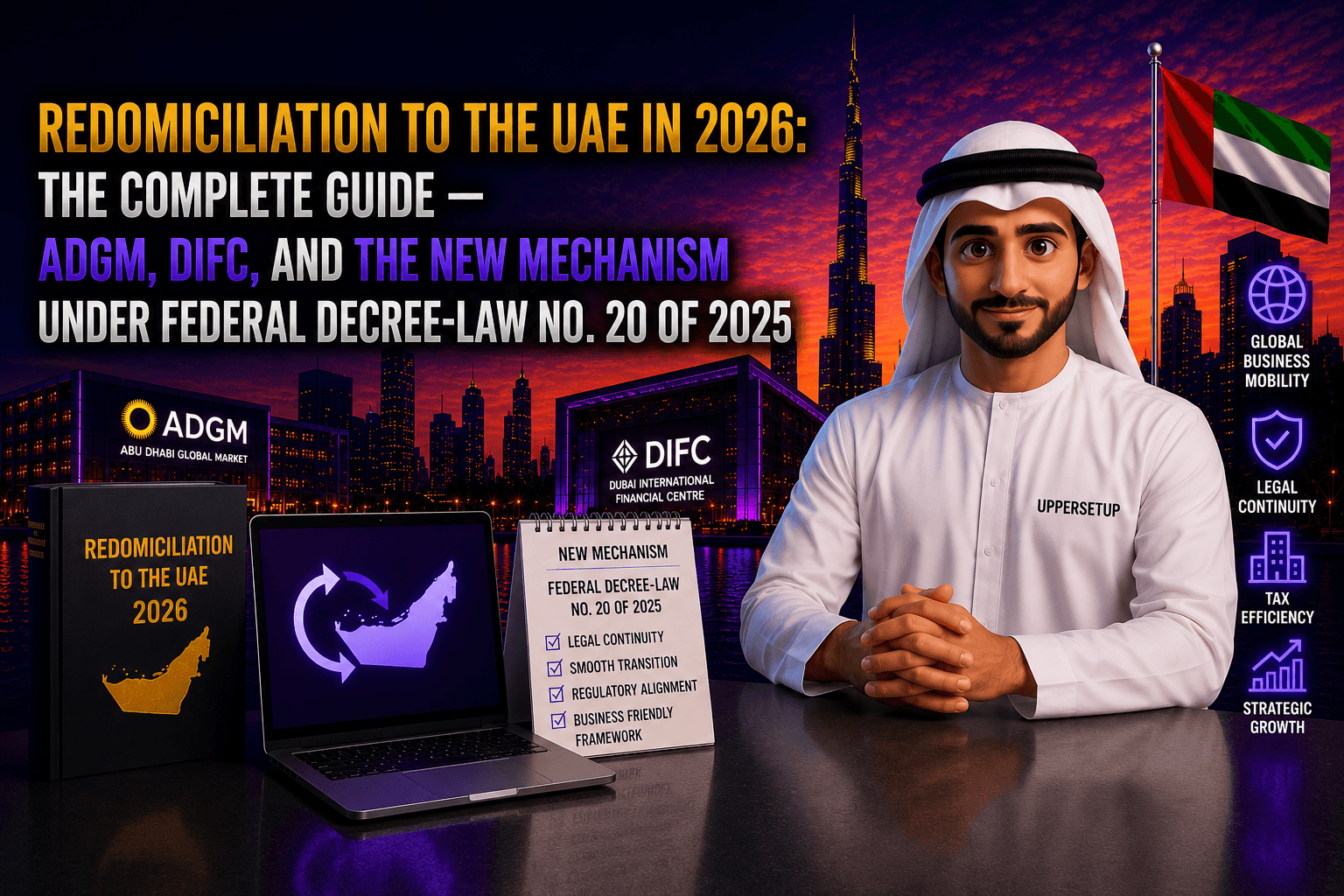
Redomiciliation to the UAE in 2026: The Complete Guide — ADGM, DIFC, and the New Mechanism Under Federal Decree-Law No. 20 of 2025
1. What Is Redomiciliation and Why It Is Not Liquidation
Redomiciliation (also known as continuance or delocalisation) is the legal process by which a company transfers its jurisdiction of incorporation from one country to another while preserving its legal personality, corporate history, existing contracts, and all rights and obligations. The company does not cease to exist and is not re-incorporated: it continues to operate as the same legal entity — simply in a new jurisdiction.
The fundamental distinction from liquidation: liquidation terminates the company's existence; all contracts must be renegotiated, assets transferred, debts settled. This creates a break in legal continuity that is costly and commercially disruptive. Redomiciliation avoids this entirely: the legal personality of the company is preserved, and all relationships with banks, counterparties, and regulators continue (though some require reformalisation).
This property — legal continuity — makes redomiciliation the instrument of choice for holding structures, investment funds, and operating companies that cannot afford a complete reset of legal relationships.
2. Regulatory Framework: Three Levels of UAE Regulation
2.1. Federal Decree-Law No. 20 of 2025 — The New Federal Mechanism
On 15 October 2025 (issued 1 October 2025, published in the Official Gazette on 14 October 2025), Federal Decree-Law No. 20 of 2025 amending the Commercial Companies Law (Federal Decree-Law No. 32 of 2021) came into force. Its key innovation — a new Article 15bis — creates for the first time in UAE federal legislation a statutory redomiciliation mechanism. Prior to this, redomiciliation into the UAE was only possible through the internal regimes of ADGM and DIFC. The new law extended the mechanism to the entire UAE corporate landscape, permitting the transfer of registration between mainland authorities, between free zones, from mainland to free zones and back, and within the UAE — between mainland authorities, between different Emirates, and between free zones and the mainland. Important: according to the prevailing interpretation of Chambers & Partners, Galadari Law, DLA Piper, and the UAE Ministry of Economy, Article 15bis governs transfers within the UAE. Inbound redomiciliation from foreign jurisdictions continues to be conducted through the established continuance regimes of ADGM and DIFC under their own regulations.
⚠ Article 15bis establishes the legal framework, but the implementing regulations defining the specific mainland procedure have not been published as of May 2026. ADGM and DIFC operate under their own well-established procedures. For practical redomiciliation from a foreign jurisdiction in 2026, the ADGM or DIFC route is recommended.
2.2. ADGM Companies Regulations 2020 (Part 18)
The ADGM continuance regime is codified in Part 18 of the ADGM Companies Regulations 2020 (as amended). ADGM accepts applications from foreign companies where three conditions are met: (1) the home jurisdiction law permits outbound redomiciliation; (2) the company is solvent (Solvency Statement); (3) constitutional documents are compatible with ADGM requirements. A landmark precedent: in 2020, ADGM accepted 34 NMC Health operating companies — the largest redomiciliation in the region at that time.
2.3. DIFC Companies Law No. 5 of 2018 (Part 21)
The DIFC continuance mechanism is governed by Part 21 of DIFC Companies Law No. 5 of 2018. The law expressly regulates both inbound and outbound redomiciliation. Upon completion, DIFC issues a Certificate of Continuation confirming the company's registered status in DIFC.
3. Three Redomiciliation Routes to the UAE: A Comparison
|
Parameter |
ADGM |
DIFC |
Mainland (Art. 15bis) |
|
Legal basis |
ADGM Companies Regulations 2020, Part 18 |
DIFC Companies Law No. 5/2018, Part 21 |
Federal Decree-Law No. 20/2025, Art. 15bis |
|
Status 2026 |
Operational — mature practice |
Operational — mature practice |
Framework enacted; implementing regs pending |
|
Legal system |
English common law |
English common law |
UAE civil law |
|
Corporate tax |
0% under QFZP / 9% |
0% under QFZP / 9% |
9% standard rate |
|
Timeline (Cyprus / BVI) |
~6 months |
~4–6 months |
Undefined |
|
Physical office required |
Yes (except SPV) |
Yes |
Yes |
|
Best suited for |
Holdings, family offices, funds, asset managers |
Financial licences, fintech, funds, Dubai hub |
Not recommended for now |
Practical interpretation: ADGM is the priority for holding and family structures, where legal certainty, English common law, and proximity to Abu Dhabi's sovereign capital matter. DIFC is the route of choice for financial institutions and companies with operational presence in Dubai. Mainland via Article 15bis is a route for the future — not for 2026.
Considering registration in ADGM or DIFC? Explore current structure options at uppersetup.com →
4. Source Jurisdictions: Which Permit Redomiciliation to ADGM/DIFC
|
Jurisdiction |
Direct redomiciliation? |
Legal basis |
Timeline |
Key notes |
|
Cyprus |
✓ Yes |
Companies Law (Cap. 113) |
~6 months |
3-month creditor window; tax clearances required |
|
BVI |
✓ Yes |
BVI Business Companies Act 2004 |
~6 months |
14-day creditor notice + newspaper publication |
|
Seychelles |
✓ Yes |
IBC Act 2016 |
~4–5 months |
Active practice; faster than Cyprus |
|
Cayman Islands |
✓ Yes |
Companies Act (2023 Rev.) |
~5–7 months |
Mature practice; investment funds |
|
Singapore |
✓ Yes |
Companies Act 1967 |
~4–6 months |
Active bilateral practice with UAE |
|
Russia / Belarus |
✗ No (direct) |
— |
9–14 months (2 stages) |
Intermediate step via Cyprus or other jurisdiction |
|
EU countries (Germany etc.) |
✗ Generally no |
— |
9–14 months (2 stages) |
Two-stage approach; exit tax may apply |
|
USA (Delaware) |
✗ No (direct) |
— |
Complex structure |
No outbound redomiciliation mechanism |
Two-Stage Approach for Closed Jurisdictions
Companies from Russia, Belarus, and most EU countries cannot complete a direct outbound redomiciliation as their national legislation does not provide this mechanism. The standard solution is a two-stage approach: in the first stage, the company either uses an existing structure in a redomiciliation-friendly jurisdiction or incorporates a new entity there (Cyprus, Malta, Seychelles); in the second stage, it redomiciles from that intermediate jurisdiction to ADGM or DIFC. Total timeline: 9–14 months.
⚠ Before commencing the procedure, the company's MOA/AOA must be reviewed: it must either expressly permit redomiciliation or contain no prohibition against it. If the articles restrict redomiciliation, amendment is a mandatory first step.
5. Step-by-Step Procedure: Cyprus / BVI → ADGM Route
Key feature of the procedure: the 3-month creditor window (Cyprus) is mandatory and cannot be shortened under any circumstances. This means the minimum timeline via Cyprus is ~6 months, even with perfect document readiness from day one.
|
Stage |
Timeline |
Content |
Critical condition |
|
1. Document preparation |
Wks 1–2 |
Shareholder resolution, UBO instruction, financial statements, KYC package, Legal Opinion, Solvency Statement |
MOA/AOA must permit redomiciliation |
|
2. ADGM In-Principle Approval |
Wks 3–5 |
Application to ADGM RA via ORS, name reservation, confirmation of office address |
Office presence in ADGM required (minimum: reservation) |
|
3. Publication & creditor notification (CYPRUS) |
3 months (mandatory) |
Publication in 2 Cypriot newspapers; Cypriot Registrar awaits expiry of window |
Cannot be shortened under any circumstances |
|
3. Creditor notification (BVI) |
Min. 14 days |
Personal notice to each creditor + BVI newspaper publication |
Creditors may challenge in court during this period |
|
4. Home jurisdiction Registrar consent |
Wks 16–18 |
Following expiry of creditor window, Registrar gives consent; company submits ADGM in-principle approval |
Tax clearance certificates must be current |
|
5. ADGM Certificate of Continuance |
Wks 19–22 |
ADGM issues Certificate of Continuance; company receives commercial licence and Establishment Card |
Company officially becomes an ADGM entity |
|
6. Strike Off in home jurisdiction |
Wks 23–26 |
Company files Certificate of Continuance; Registrar issues Certificate of Discontinuance |
Procedure complete; company struck off home registry |
6. What Is Preserved, What Changes, What Requires Reformalisation
|
What IS PRESERVED |
What CHANGES |
What REQUIRES REFORMALISATION |
|
Legal personality of the company |
Jurisdiction of incorporation |
Bank KYC (full repeat review) |
|
Corporate history and date of incorporation |
Applicable corporate law |
Commercial licence in ADGM/DIFC |
|
Existing contracts with counterparties |
Regulator and corporate registry |
New Tax Registration Number (TRN) with FTA |
|
Assets and liabilities on the balance sheet |
Corporate tax regime |
VAT registration (where applicable) |
|
Shareholder structure and ownership interests |
Economic Substance requirements |
Employee work permits |
|
Pending litigation and arbitration |
Audit obligations |
IP rights reformalisation (recommended) |
|
Debt obligations |
Reporting requirements |
Sector licences (financial, medical, etc.) |
Particular attention to banks: a change of jurisdiction of incorporation is an AML trigger event. Most banks require a full repeat KYC process. Transactions may be restricted for the duration of the review — from days to months depending on the institution. Banking partners should be notified of the planned redomiciliation in advance — before commencing the procedure, not after.
Need to open a corporate bank account after redomiciliation? Banking services and KYC support at uppersetup.com →
7. Tax Consequences of Redomiciliation
7.1. UAE Corporate Tax (Federal Decree-Law No. 47 of 2022)
Upon redomiciliation, the company becomes a UAE tax resident for corporate tax purposes. The standard rate is 9% on taxable income exceeding AED 375,000; income below that threshold is taxed at 0%. The first tax period is the financial year in which redomiciliation is completed. FTA registration via EmaraTax is mandatory — the penalty for late registration is AED 10,000.
7.2. QFZP Status: 0% Tax for ADGM and DIFC Entities
Companies in ADGM and DIFC may qualify as Qualifying Free Zone Persons (QFZP) and apply a 0% rate to Qualifying Income, provided four cumulative conditions are met:
• Earning Qualifying Income from Qualifying Activities (Ministerial Decision No. 229 of 2025 expanded the list retroactively from 1 June 2023, adding treasury & financing services for own account, reinsurance, headquarters services, and others).
• Maintaining Adequate Economic Substance in ADGM/DIFC: real office, personnel, core decisions taken on the territory.
• Complying with the de minimis rule: Non-Qualifying Income does not exceed the lower of 5% of total revenue or AED 5 million.
• Preparing audited financial statements — mandatory from the 2025 financial year for all QFZPs without exception.
⚠ QFZP status does not transfer from the jurisdiction of origin. The company may claim it from the first tax period in ADGM/DIFC, provided all conditions are fully met from the outset. Breaching the de minimis rule forfeits QFZP status for the current period plus the four subsequent periods.
7.3. Tax Consequences in the Home Jurisdiction
In certain jurisdictions, transferring corporate residency constitutes a taxable event (exit tax). This applies notably to Germany (Section 12 KStG), the Netherlands, and Australia. Cyprus, in general, does not levy a corporate exit tax where proper procedure is followed — but this must be confirmed with a Cypriot tax adviser in each case.
7.4. Tax Residency Certificate (TRC)
Following redomiciliation, the company may apply for a UAE Tax Residency Certificate (TRC) via the EmaraTax portal — provided it meets the criteria of Cabinet Resolution No. 85 of 2022. The TRC is the key document for activating benefits under the UAE's network of 137 Double Taxation Agreements.
8. Common Mistakes and Pitfalls
• Starting without reviewing the articles. The MOA/AOA must permit redomiciliation. A prohibition must be removed first through a shareholder resolution and home jurisdiction regulatory consent.
• Underestimating the creditor window. The 3-month window in Cyprus is legally mandatory and cannot be shortened. Companies targeting a specific closing date must allow for this with adequate buffer.
• Assuming QFZP is automatic. Redomiciliation into ADGM or DIFC does not guarantee QFZP status. Adequate Economic Substance must be real and demonstrable from day one.
• Ignoring exit tax in the home jurisdiction. Without prior analysis, the company may receive an unexpected tax demand from the departing jurisdiction.
• No bank transition plan. Changing jurisdiction without advance coordination with banking partners can lead to frozen accounts during the repeat KYC period. Notify banks before commencing.
• Confusing corporate redomiciliation with personal tax residency change. Redomiciling the company does not alter the tax residency status of its individual owners. That requires a separate process under Cabinet Resolution No. 85 of 2022.
• Choosing the mainland route via Article 15bis without waiting for implementing regulations. The legal framework exists but the practical procedure is undefined. Risk of timeline and procedural uncertainty is substantially higher than via ADGM or DIFC.
9. Practical Use Cases
Case 1: Cypriot Holding with UAE Assets
Situation: a Cyprus-registered company holds real estate and ownership interests in UAE entities. Banks are demanding increasingly burdensome KYC documentation on the Cypriot structure. Owners want to transfer management to the UAE, obtain residence visas, and simplify banking compliance. Optimal route: Cyprus → ADGM. Timeline: ~6 months. Key steps: Legal Opinion in Cyprus, publication in 2 newspapers, 3-month window, ADGM Certificate of Continuance, repeat bank KYC.
Case 2: BVI Holding of an Investment Group
Situation: an investment group uses BVI as an intermediate holding. KYC pressure on BVI is intensifying; Economic Substance requirements must be met; the group wishes to consolidate in a recognised jurisdiction. Optimal route: BVI → ADGM (for the holding) or BVI → DIFC (if a financial licence is required). Timeline: ~6 months. Critical addition: assess QFZP eligibility before commencing.
Case 3: Russian Company — Two-Stage Approach
Situation: direct redomiciliation from Russia is not available. If the group has an existing Cypriot structure, it is used. If not, a new company is incorporated in an eligible jurisdiction, then redomiciled to ADGM or DIFC. Total timeline: 9–14 months. Critical: comprehensive tax consequence analysis at each stage before commencement.
10. Pre-Decision Checklist
• Verify that the company's MOA/AOA permits outbound redomiciliation.
• Confirm the home jurisdiction law permits outbound redomiciliation.
• Assess tax consequences in the home jurisdiction (exit tax, VAT, other charges).
• Select the target jurisdiction: ADGM (holdings, family offices) or DIFC (financial licences).
• Pre-assess QFZP eligibility: Qualifying Income, Economic Substance, de minimis rule, audit.
• Notify banking partners of the planned redomiciliation before commencing.
• Prepare the KYC package: passports, address proof, CVs, UBO declaration, business plan.
• Allow 3 months for the mandatory creditor window (Cyprus) or 14 days + additional period (BVI).
• Confirm office space availability in ADGM/DIFC before submitting the application.
• After completion: register with FTA (EmaraTax), obtain TRN, consider applying for a TRC.
Sources
• Federal Decree-Law No. 32 of 2021 on Commercial Companies — official text
• ADGM Companies Regulations 2020 — official legal framework (adgm.com)
• ADGM — Redomiciliation Guidance / Setting Up (adgm.com)
• DIFC Companies Law No. 5 of 2018 — official text (difc.com)
• Federal Decree-Law No. 47 of 2022 on the Taxation of Corporations and Businesses (tax.gov.ae)
• Ministerial Decision No. 229 of 2025 on Qualifying Activities and Excluded Activities (mof.gov.ae)
• u.ae — UAE Corporate Tax (official UAE Government portal)
• Dentons — UAE amends Commercial Companies Law, January 2026
• Gibson Dunn — Recent Amendments to the UAE Commercial Companies Law, December 2025
• Khaleej Times — ADGM celebrates decade, 12,000+ licenses, AUM up 36%
Disclaimer
This article is provided for informational purposes only and does not constitute legal, tax, or professional advice. Redomiciliation is a complex corporate operation involving the legislation of multiple jurisdictions simultaneously. Information is current as of May 2026; the regulatory frameworks of the UAE, ADGM, and DIFC are subject to change. Before making any structural decisions, readers are advised to obtain professional legal and tax advice in each jurisdiction involved. UPPERSETUP accepts no liability for actions taken solely in reliance on this material.
All services on the platform
Everything you need to start and run a business - in one place
- 3–5 days
Company Setup
Mainland or Free Zone company with a complete set of incorporation documents
Start - Monthly
Accounting Services
Financial accounting and reporting in accordance with UAE requirements
Start - 1–2 weeks
Visa Services
Residence visas for shareholders, employees and family members
Start - 7–30 days
Banking Services
Corporate Bank Accounts in the UAE and Payment Services
Start - Custom timeline
Legal Services
Contracts, corporate amendments and legal support
Start


