












































































































































 International Free Zone Authority
UAE Changed Its Company Law: What Is Now Permitted, What Has Changed, and What to Review Urgently
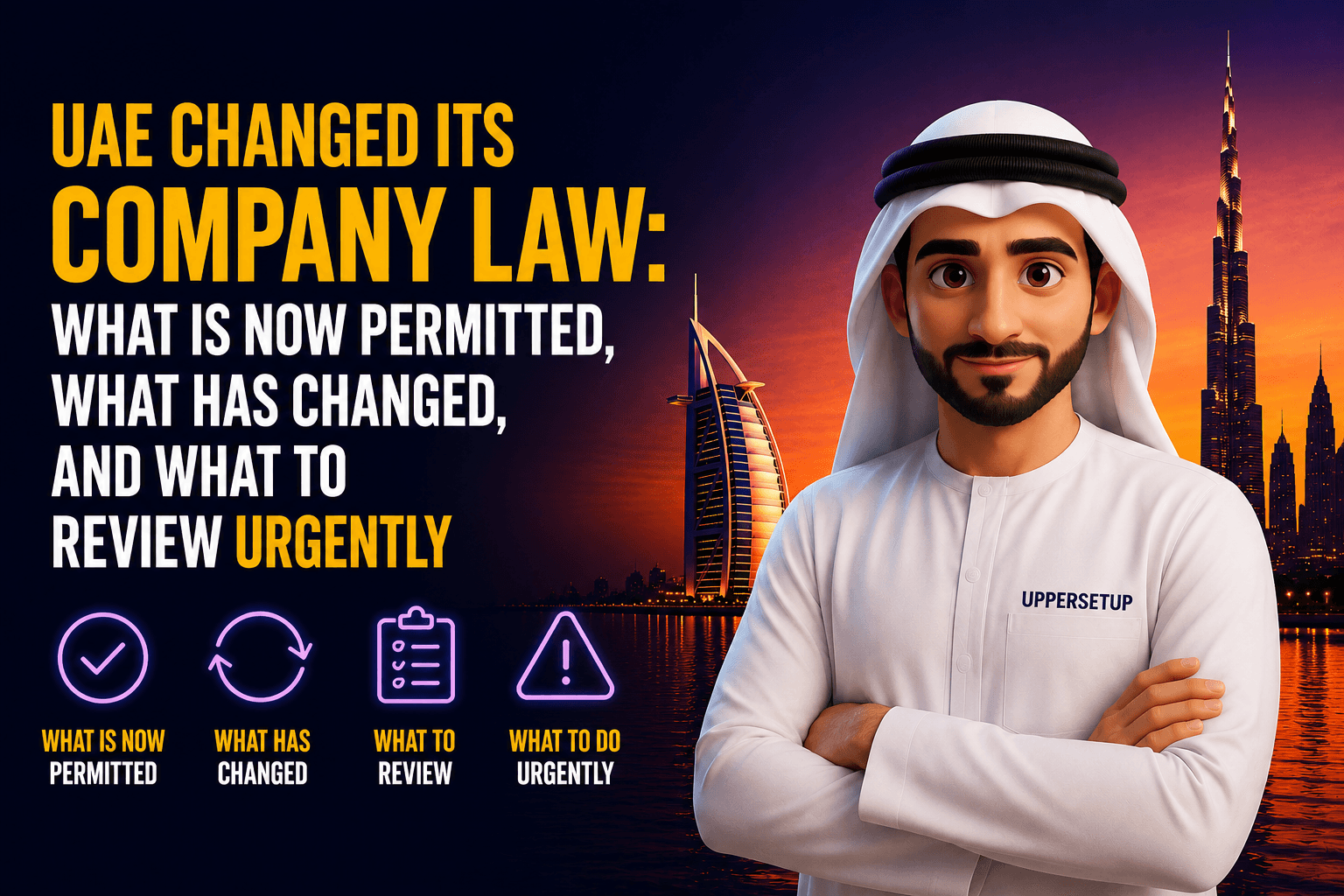
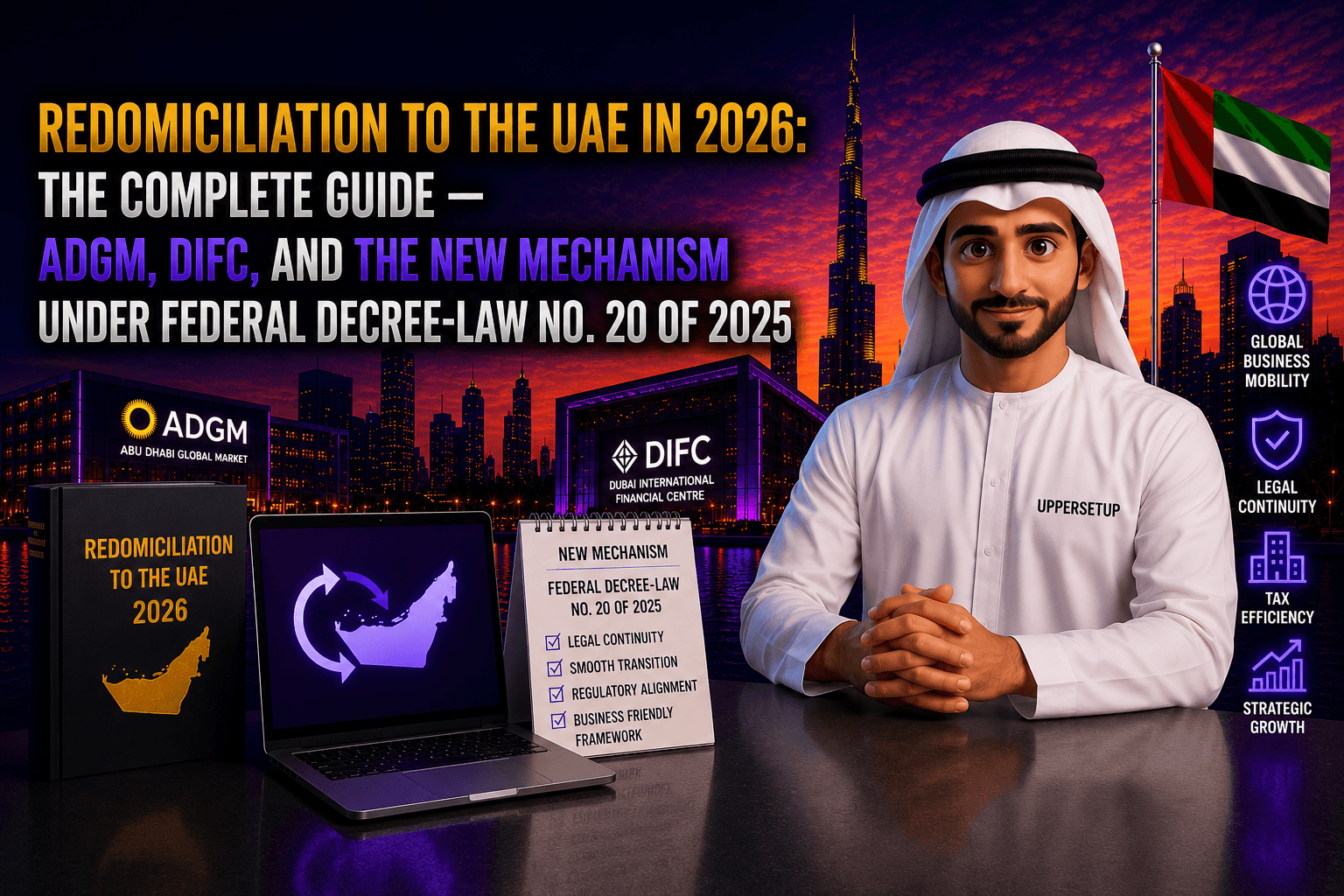
Federal Decree-Law No. 20 of 2025 took effect on 15 October 2025. It amended Federal Decree-Law No. 32 of 2021 on Commercial Companies — the UAE's primary corporate law. The main changes: companies can now transfer between jurisdictions without liquidation (re-domiciliation), LLCs can issue multiple share classes, drag-along and tag-along rights are now statutory, and free zone companies conducting mainland activities are expressly subject to the CCL.
✅ This is the first major reform of UAE company law in four years. Most changes are already in force. Several new mechanisms are pending additional Cabinet decisions.
🔴 Several provisions — including LLC share classes and non-profit companies — require a Cabinet Decision not yet issued as of June 2026. Consult a lawyer before relying on these provisions.
1. Context: Why the UAE Changed Its Company Law
Federal Decree-Law No. 32 of 2021 operated unchanged for four years. During that time, UAE corporate tax was introduced, the base of foreign investors grew substantially, a mature VC and PE ecosystem emerged, and free zones began issuing mainland permits at scale. The law no longer reflected practice.
Federal Decree-Law No. 20 of 2025 was issued on 1 October 2025 and published in the Official Gazette on 14 October 2025. On the effective date: Gibson Dunn and Norton Rose Fulbright state 15 October 2025; Clyde & Co states 15 November 2025. Several provisions are implemented in phases over 12-24 months. The objective: to align UAE corporate law with international standards — common law approaches from DIFC/ADGM, VC/PE market standards, and English law M&A practice.
💡 Source for the effective date: Gibson Dunn client alert, December 2025 — "took effect the day following publication in the Official Gazette (which occurred on 14 October 2025)".
2. Seven Key Changes: Table
|
Change |
Before (CCL 2021) |
After (Federal DL No. 20/2025) |
Effective |
Who is affected |
|
Scope of CCL |
Mainland companies only |
Covers free zone and foreign companies conducting mainland activities (Art. 3, 5, 9) |
15 October 2025 |
All free zone companies with mainland operations |
|
Re-domiciliation (company transfer) |
No mechanism without liquidation |
New Art. 15 bis: transfer between Emirates and between mainland and free zone retaining legal identity |
15 October 2025; detailed rules — pending |
All LLC, JSC, free zone companies |
|
Drag-along and tag-along rights |
Governed only by private shareholder agreements; low enforceability |
Expressly permitted in MOA / Articles of Association for LLC and Private JSC (Art. 14) |
15 October 2025 |
LLC, Private JSC; investors, VC, PE |
|
Share classes in LLC |
Not provided for |
LLCs may issue multiple share classes with different voting, dividend, liquidation rights (Art. 76) |
15 October 2025; detailed rules — Cabinet Decision pending |
LLCs with investors, startups, family businesses |
|
Non-profit companies |
No federal-level structure |
Non-profit company structure introduced on mainland; profits reinvested into statutory objectives (Art. 8) |
15 October 2025; Cabinet Decision on purposes — pending |
NGOs, charitable and social structures |
|
LLC → JSC conversion |
Required founders committee, board of directors, and auditor BEFORE conversion |
Simplified: management leads conversion; pre-requirements for board and auditor removed (Art. 275) |
15 October 2025 |
LLCs preparing for IPO or investment |
|
Private placement for Private JSC |
No direct regulation |
Private JSC may raise capital via private placement with SCA approval (Art. 32) |
15 October 2025; SCA regulation — pending |
Investment-raising Private JSCs |
|
Succession planning (share inheritance) |
Limited regulation |
LLCs and JSCs may codify share transfer on shareholder death in MOA/AoA; including company buy-back right |
15 October 2025 |
Family businesses, partnerships |
3. Re-domiciliation: Transfer Without Liquidation
Before the amendments, transferring a company from a free zone to the mainland (or vice versa) meant liquidating the existing structure and registering a new one. This took months, was expensive, and broke legal continuity — all contracts, licences, and banking relationships had to be re-executed.
New Article 15 bis establishes a re-domiciliation mechanism — transferring a company's registration from one competent authority to another while retaining legal personality. The company preserves all rights, obligations, history, and contracts.
|
Parameter |
Before Federal DL No. 20/2025 |
After (Art. 15 bis) |
|
Move from free zone to mainland |
Liquidation of old company + registration of new |
Re-domiciliation without loss of legal identity |
|
Move from mainland to free zone |
Liquidation + re-registration |
Re-domiciliation with approval of both regulators |
|
Transfer between Emirates |
Complex process; depended on registration practice |
Expressly permitted via competent authority coordination |
|
Legal identity |
Interrupted on jurisdiction change |
Preserved — same contracts, history, obligations continue |
|
Conditions |
— |
Special resolution / absolute majority of partners; approval of both regulators; no register blocks; publication of decision |
|
Implementation status |
— |
Mechanism effective from 15.10.2025; detailed procedures — implementing regulations pending |
What is not yet fully operational
As of June 2026, implementing regulations for Article 15 bis have not yet been issued. Practical implementation depends on: technical readiness of the registers of both authorities; existence of mutual regulatory arrangements; absence of prohibitions under the specific free zone's legislation. Monitor updates via the relevant emirate authority portal.
⚠ Gibson Dunn (December 2025): "Further implementing regulations have yet to be issued to specify the process... the ability to migrate to and from any particular Emirate or free zone will depend on various matters." Use only after legal consultation.
Planning to transfer a company from a free zone to the mainland or between jurisdictions? Consult the UPPERSETUP team →
4. Drag-Along and Tag-Along in LLCs: Finally in the Law
Before the amendments, drag-along and tag-along rights existed in the UAE only as private shareholder agreements (SHA). The problem: SHAs were poorly enforced in mainland UAE courts if they conflicted with a company's MOA. As a result, investors either chose DIFC/ADGM for structuring or accepted regulatory uncertainty.
What changed
• Drag-along (compulsory sale right): a majority shareholder can compel a minority shareholder to sell their shares to a third party on pre-agreed conditions. This can now be directly set out in the company's MOA — not only in an SHA.
• Tag-along (co-sale right): a minority shareholder can join a majority shareholder's sale on the same terms. Also codified in the MOA.
• Scope: Article 14 covers LLCs and Private JSCs. Documents: MOA (for LLCs) and Articles of Association (for JSCs).
Practical value
VC funds, PE investors, and corporate partners can now structure deals through mainland LLCs or free zone LLCs with the same legal protections previously available only in DIFC/ADGM. This reduces structuring costs and broadens jurisdictional choice.
⚠ Important nuance from Galadari Law (January 2026): drag-along and tag-along mechanisms in the MOA must coexist with statutory pre-emption rights or expressly override them. They are not automatically displaced — careful legal drafting in the MOA is required.
5. Multiple Share Classes in LLCs
Article 76 permits LLCs to issue multiple share classes (e.g. Class A and Class B) with differentiated rights: voting, dividends, liquidation preferences, redemption terms.
Who needs this
• Startups and VC: preferred shares with liquidation preferences for investors and ordinary shares for founders — a standard VC structure is now available in a mainland LLC.
• Family businesses: dividend rights and management control can be split. Different family members can hold economic rights vs. governance rights.
• Joint ventures: different share classes codify different partner rights without complex overlay structures.
🔴 As of June 2026, the Cabinet Decision detailing LLC share class rules has not been issued. The provision is in force, but practical implementation requires further regulation. Cleary Gottlieb (December 2025): "article 76 reserves the detailed rules for a future Cabinet decision".
Want to structure an investment deal or update your company's MOA? UPPERSETUP corporate services →
6. Free Zones and the CCL: What Changed for Companies with Mainland Activities
Articles 3, 5, and 9 of the amendments codified what was already applying in practice through the dual licence mechanism: free zone companies (including DIFC and ADGM) that conduct activities on the mainland outside their free zone are now expressly subject to the CCL for that activity.
Three practical consequences
• All UAE companies hold UAE nationality: Article 9 expressly states that a company incorporated in any UAE free zone (including DIFC and ADGM) is a UAE company. This removes some ambiguity in dealings with government entities and banking KYC.
• Mainland branches of free zone companies: if a free zone company opens a branch or representative office on the mainland, that branch is regulated by the CCL. Free zone legislation applies to the parent; CCL applies to the mainland presence.
• Dual licence now in statute: the dual licence mechanism already practised by free zones (especially DIFC, ADGM, DMCC) has a statutory foundation.
⚠ Important: a free zone company continues to be governed by its free zone's legislation for intra-zone activity. The CCL applies only to mainland operations.
7. Non-Profit Companies on the Mainland
Article 8 introduces a non-profit company structure on the UAE mainland — for the first time at the federal level. Previously, non-profit activities were organised through associations, emirate-level public benefit entities, or foundations (DIFC/ADGM).
A non-profit company may only reinvest profits into its statutory objectives. Details — permitted purposes, activities, regulatory oversight, tax exemptions — are expected in a Cabinet Decision. Until then, the provision operates under the general CCL framework.
8. Simplified LLC-to-JSC Conversion
Before the amendments, converting an LLC to a joint stock company (JSC) required establishing a founders' committee, forming a board of directors, and appointing an auditor before the application could be submitted. This made the process slow and expensive.
Article 275 removes these preliminary requirements. Conversion is led by existing management with shareholder approval and regulatory filings. This is particularly important for companies preparing for IPOs on DFM/ADX or attracting large institutional investors.
9. Who This Matters to Right Now
Who this suits
• LLCs with investors or planned capital raises — update MOA to incorporate drag-along/tag-along and share classes.
• Free zone companies with mainland activities — conduct CCL compliance review for mainland presence.
• Corporate groups with suboptimal structures — evaluate re-domiciliation as an alternative to costly liquidation.
• Family businesses — add succession mechanisms to MOA and, if needed, share classes.
• LLCs preparing for an IPO — assess the simplified JSC conversion.
Who this does not suit right now
• Companies with simple structures (sole owner, single share class, no investors) — the amendments create no mandatory change requirements.
• NGOs and social enterprises — await the Cabinet Decision on non-profit companies; the provision is not yet fully implemented.
• Those planning immediate re-domiciliation — wait for implementing regulations.
When professional review is required
• For any changes to MOA or AoA — especially incorporating drag-along/tag-along and new share classes.
• When planning re-domiciliation — the mechanism is new; case law is limited.
• When structuring an investor deal under the new provisions.
• When opening a mainland branch of a free zone company — CCL compliance is required.
10. Risks of Getting It Wrong
• Premature MOA update without legal review. Drag-along and tag-along rights incorporated into an MOA without accounting for statutory pre-emption rights may create legal conflicts. Cleary Gottlieb explicitly warns of this.
• Relying on re-domiciliation without checking register readiness. Implementing regulations have not been issued. Planning around this mechanism without legal consultation is a risk.
• Misreading the scope of the CCL. Not all free zone companies fall under the CCL — only those conducting mainland activities. Conflating the free zone regime and the CCL without distinction is an error.
• Ignoring the amendments. Companies with investors that have not updated their documents continue to rely on SHAs without CCL statutory protection — which is weaker in terms of enforceability on the mainland.
11. Regulatory Framework
• Federal Decree-Law No. 32 of 2021 on Commercial Companies (CCL) — primary law.
• Federal Decree-Law No. 20 of 2025 — CCL amendments; issued 1 October 2025; effective 15 October 2025.
• Federal Decree-Law No. 26 of 2020 — 100% foreign ownership on mainland; codified in CCL 2021.
• Cabinet Decision (pending): rules for LLC share classes (Art. 76), non-profit companies (Art. 8), private placement (Art. 32).
• Implementing Regulations (pending): detailed re-domiciliation procedures (Art. 15 bis).
• Securities & Commodities Authority (SCA): regulation of private placement for Private JSCs.
⚠ As of June 2026, Cabinet Decisions on key provisions (Art. 76, 8, 32) have not been issued. Until they are, the provisions apply to the extent they do not conflict with previously enacted instruments.
12. Step-by-Step Action Plan
1. Identify your company type: LLC, Private JSC, free zone company, foreign company.
2. For LLCs with investors: review MOA with a lawyer — consider incorporating drag-along/tag-along.
3. For LLCs with multiple shareholders: consider incorporating succession mechanisms into the MOA.
4. For free zone companies with mainland activities: conduct a CCL compliance review.
5. For LLCs planning VC/PE investment: evaluate share classes once Cabinet Decision is issued.
6. For corporate groups with suboptimal structure: monitor implementing regulations for Art. 15 bis.
7. For LLCs planning an IPO: assess conversion to JSC under the updated Art. 275.
8. For all companies: confirm FTA corporate tax registration is in place.
Sources
• Federal Decree-Law No. 32 of 2021 on Commercial Companies — primary law (uaelegislation.gov.ae)
• Federal Decree-Law No. 20 of 2025 — amendment text published 14 October 2025 (UAE Official Gazette)
• Gibson Dunn — Recent Amendments to the UAE Commercial Companies Law (December 2025)
• Cleary Gottlieb — UAE Companies Law Update 2025: Multiple Share Classes (December 2025)
• Norton Rose Fulbright — Key amendments to the UAE Commercial Companies Law (December 2025)
• Spencer West — Federal Decree Law No. 20 of 2025: Comprehensive Amendments (December 2025)
• Galadari Law — Federal Decree-Law No. 20 of 2025 UAE Key Points (January 2026)
• Reed Smith — UAE Commercial Companies Law: Key changes (January 2026)
• Arabian Business — UAE Commercial Companies Law Amendment (arabianbusiness.com)
• Gulf News — UAE Corporate Law reforms 2025–2026 (gulfnews.com)
Disclaimer
This material is for informational purposes only and does not constitute legal, tax, financial, investment, or consulting advice. Before making any decisions, obtain individual professional advice tailored to your specific situation, jurisdiction, company status, and current regulatory requirements. Information is accurate as of May-June 2026. Several provisions of Federal Decree-Law No. 20 of 2025 require additional UAE Cabinet decisions and implementing regulations; until these are issued, the relevant provisions apply to the extent they do not conflict with previously enacted instruments.
All services on the platform
Everything you need to start and run a business - in one place
- 3–5 days
Company Setup
Mainland or Free Zone company with a complete set of incorporation documents
Start - Monthly
Accounting Services
Financial accounting and reporting in accordance with UAE requirements
Start - 1–2 weeks
Visa Services
Residence visas for shareholders, employees and family members
Start - 7–30 days
Banking Services
Corporate Bank Accounts in the UAE and Payment Services
Start - Custom timeline
Legal Services
Contracts, corporate amendments and legal support
Start


