
















































































 International Free Zone Authority
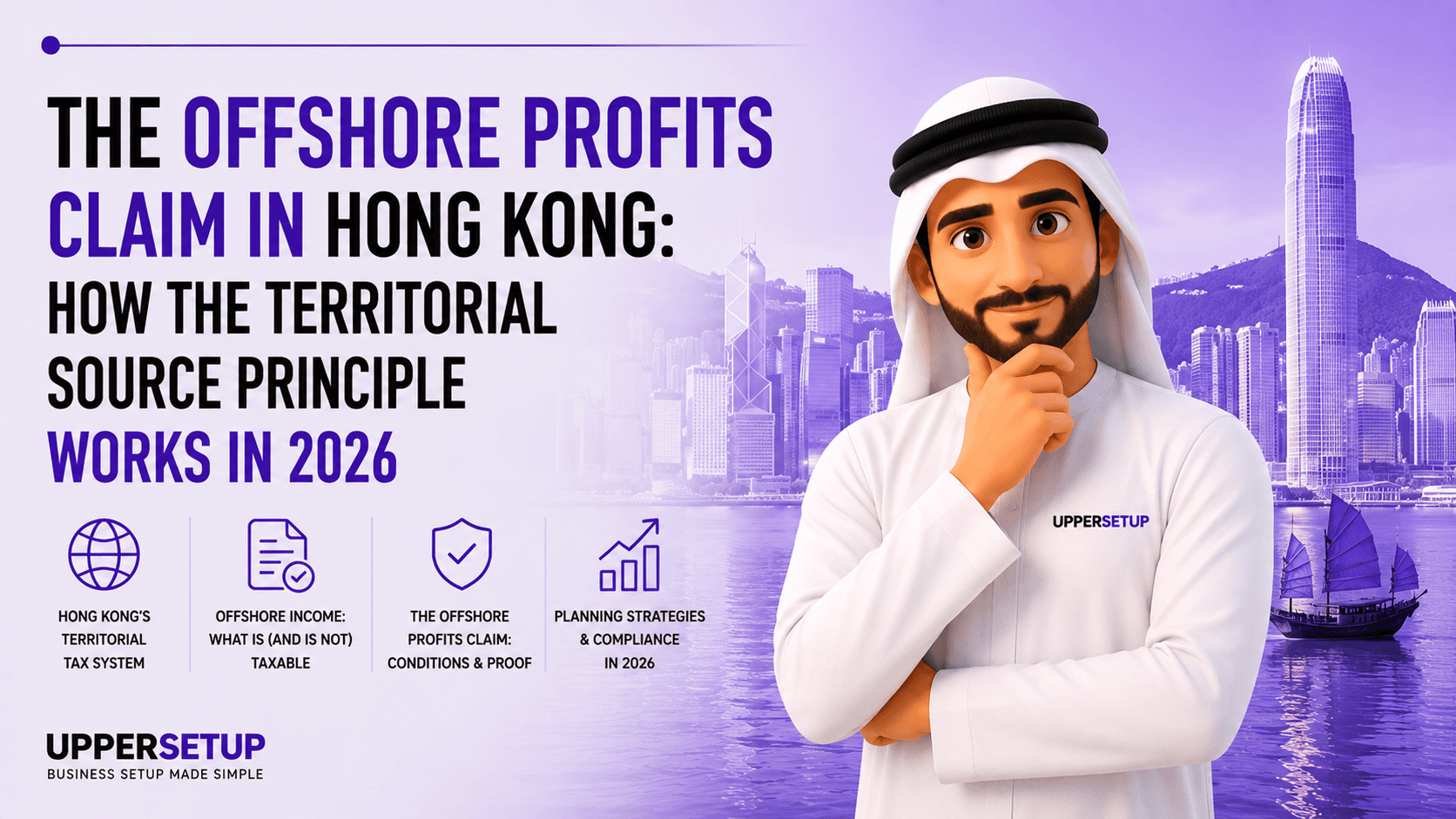
Territorial Taxation and Offshore Status in Hong Kong 2026: A Complete Breakdown of How It Actually Works
Hong Kong charges Profits Tax only on profits arising in or derived from Hong Kong; profits from foreign sources are not taxed, but only if the company can document that the activity generating the profit genuinely took place outside Hong Kong.
The territorial principle is set out in Section 14 of the Inland Revenue Ordinance (Cap. 112) — Hong Kong’s core tax statute; the concept of “source” is not defined in the law itself but has been shaped by decades of case law and IRD administrative guidance.
Since 1 January 2023, the Foreign-sourced Income Exemption (FSIE) regime, introduced by the Inland Revenue (Amendment) (Taxation on Specified Foreign-sourced Income) Ordinance 2022, has applied — a mechanism separate from the territorial principle, targeting passive income of companies within multinational enterprise (MNE) groups.
Offshore status is not granted automatically upon incorporating a Hong Kong company — it is a right to apply, and the burden of proving the offshore nature of profits rests with the taxpayer, not the IRD.
⚠ Offshore status is not permanent: if the operating model changes, if a director begins working from Hong Kong, or if negotiations take place in Hong Kong, the status can be revoked, and the IRD may conduct a review at any time, even after a previously approved claim.
1. The Core Misconception: Hong Kong Is Not a Tax-Free Jurisdiction
The most common and costly myth about Hong Kong is expecting a default zero-tax outcome upon company registration.
Hong Kong is a fully developed jurisdiction with a mature tax system operating on the territorial principle, not an offshore zone in the classic sense.
Three Fundamental Consequences of the Territorial Principle
• Offshore status is not granted automatically at registration — incorporating a company only opens the right to apply.
• The burden of proof rests with the taxpayer — the IRD is not required to prove profits are Hong Kong-sourced; the company must prove they are offshore.
• Offshore status is not permanent — changes to the operating model, the director’s working location, or where negotiations take place can lead to revocation.
2. The Legal Basis: Inland Revenue Ordinance (Cap. 112) and DIPN 21
The territorial taxation principle is set out in Section 14 of the Inland Revenue Ordinance (Cap. 112): profits “arising in or derived from Hong Kong” are taxable.
Departmental Interpretation and Practice Notes No. 21 (DIPN 21): Locality of Profits is the IRD’s official guidance establishing the “operations test”: the source of profit is determined by where the operations that directly generated it took place.
ℹ DIPN 21 has no binding legal force, but is in practice the standard the IRD applies in every review.
Application of the territorial principle in Hong Kong has been shaped through a series of landmark court decisions: Commissioner of Inland Revenue v. Hang Seng Bank Ltd (1991, Privy Council), HK-TVB International Ltd v. Commissioner (1992), and ING Baring Securities v. Commissioner (2007) — each clarifying how the IRD should apply the operations test to different activity types.
3. The Operations Test: How the IRD Determines the Source of Profit
The operations test is the central concept the IRD applies when assessing an offshore claim: where were the operations that directly generated the profit carried out — not where the company is registered or where shareholders reside.
|
Activity type |
Where the IRD examines |
What counts as offshore |
|
Trading (purchase/resale) |
Place where purchase and sale contracts are concluded |
Both contracts concluded outside Hong Kong |
|
Services |
Where the services were actually performed |
Services performed entirely outside Hong Kong |
|
Manufacturing/processing |
Where the product was physically manufactured |
Manufacturing performed entirely outside Hong Kong |
|
Commission/agency |
Where the agent’s activity took place |
All of the agent’s actions occurred outside Hong Kong |
|
Investment activity |
Where investment decisions were made |
Decisions made outside Hong Kong |
Apportionment principle: if part of the activity is conducted in Hong Kong and part outside, the IRD may apportion — profit is split proportionally to the volume of the relevant activity in each location.
⚠ A key practical takeaway from DIPN 21: the absence of an overseas presence does not by itself mean all profit is Hong Kong-sourced. Conversely, having a foreign office does not by itself prove offshore status. The IRD assesses each case individually.
4. The FSIE Regime: A New Layer of Taxation for Passive Income
FSIE is Hong Kong’s response to pressure from the EU and OECD under BEPS 2.0, targeting structures that use Hong Kong purely as a conduit for passive income without genuine economic presence.
FSIE applies only to entities that are members of a multinational enterprise (MNE) group under Section 15H(1) of the IRO, regardless of revenue size; a Hong Kong company with a single foreign subsidiary is already an MNE group. The EUR 750 million threshold relates to BEPS Pillar Two, not FSIE.
|
Income type |
Applicable exclusion |
Effective from |
|
Dividends from foreign companies |
Economic Substance Requirement OR Participation Exemption |
1 January 2023 |
|
Interest income |
Economic Substance Requirement |
1 January 2023 |
|
Intellectual property income (royalties) |
Nexus Approach (OECD) |
1 January 2023 |
|
Equity interest disposal gains |
Economic Substance Requirement OR Participation Exemption |
1 January 2023 |
|
Non-equity disposal gains |
Economic Substance Requirement |
1 January 2024 |
Three Paths to FSIE Exemption
• Economic Substance Requirement (ESR): the company must have genuine functions in Hong Kong — qualified staff, operating expenditure, and activity connected to the income received. A Certificate of Hong Kong Resident Status does NOT confirm ESR — the IRD has explicitly stated this in official guidance.
• Participation Exemption (PE): for dividends and equity disposal gains — if the Hong Kong company holds at least 5% of a foreign company’s shares for at least 12 continuous months, exemption applies automatically without an Economic Substance requirement.
• Nexus Approach for IP income: exemption from royalty tax is granted proportionally to the share of “qualifying R&D expenditure” within total R&D expenditure for that asset.
⚠ FSIE and the territorial source principle are two different mechanisms. FSIE applies to passive income of MNE groups; the territorial source principle/OTC applies to active trading and operating profit. A company within an MNE group must manage both regimes simultaneously.
5. The Tax Certainty Enhancement Scheme: Upfront Certainty for Equity Disposal Gains
A mechanism separate from FSIE concerns ONSHORE (not foreign-sourced) equity disposal gains and gives companies upfront certainty on their tax treatment.
Per the IRD’s official page, the mechanism was introduced by the Inland Revenue (Amendment) (Disposal Gain by Holder of Qualifying Equity Interests) Ordinance 2023, enacted 15 December 2023, and applies to disposals occurring on or after 1 January 2024. Gains from the disposal of equity interests are regarded as capital in nature and not chargeable to Profits Tax if the investor held at least 15% of the equity interests in the investee entity continuously for at least 24 months prior to the disposal.
ℹ This is a separate mechanism from the FSIE Participation Exemption (5% threshold, 12-month holding period for foreign income) — the Tax Certainty Enhancement Scheme concerns onshore gains specifically and applies a higher ownership threshold (15%) and a longer holding period (24 months).
The Scheme does not apply to: (1) gains derived by an insurance company; (2) equity interests regarded as trading stock; (3) non-listed equity interests in property-related entities (including overseas property); (4) foreign-sourced disposal gains already deemed Hong Kong-sourced under the FSIE regime.
ℹ The Scheme is a “safe harbour” that removes the need to apply the subjective, multi-factor “badges of trade” test (trading frequency, holding period, reason for purchase/sale) to determine a gain’s capital nature. Without qualifying for the Scheme, a company can still argue capital nature through the ordinary badges-of-trade analysis — just without upfront certainty.
6. The Offshore Tax Claim (OTC): Filing and Review Procedure
The Offshore Tax Claim is the formal mechanism for claiming profit exemption under the territorial principle, filed as part of the annual Profits Tax Return (Form BIR51).
The first Profits Tax Return arrives from the IRD approximately 18 months after company registration; by then, the company must have fully audited financial statements for the first year and a complete evidence package supporting the offshore nature of the profit.
The return is accompanied by a detailed explanation of the business model: a business flow chart, a list of key transactions with the locations where they occurred, staff details, and an explanation of the Hong Kong office’s role.
After receiving an OTC, the IRD typically issues an Enquiry Letter — a detailed questionnaire of 10 to 30+ questions; the review process takes 6 months to 2 years depending on the complexity of the structure.
Possible outcomes: full approval (all claimed profit is deemed offshore), apportionment (part offshore, part Hong Kong-sourced), or rejection (all profit is taxed at 8.25%/16.5%); on rejection, the company may file an Objection with the IRD, followed by an appeal to the Board of Review or the courts.
⚠ An approved claim is not permanent — the IRD may require re-justification upon any change in business model, staff, client base, or transaction structure.
Need help registering a company in Hong Kong and understanding your tax obligations? Hong Kong company registration — uppersetup.com →
7. The Full Evidence Checklist: What to Keep From Day One
|
Document category |
Specific examples |
Why it matters |
|
Contracts |
Contracts with signing date and location, correspondence, amendments |
The IRD examines specifically the place of contract execution |
|
Operational documents |
Invoices, packing lists, bills of lading, customs declarations |
Prove the shipment did not pass through Hong Kong |
|
Staff and presence |
Flight tickets, boarding passes, meeting records, videoconference logs |
Show the location of the people making business decisions |
|
Banking records |
Statements confirming receipt of funds from foreign counterparties |
The IRD checks whether transactions passed through Hong Kong |
|
Corporate decisions |
Board minutes evidencing meetings held outside Hong Kong |
The POEM test: if the “brain” of the company is in Hong Kong, profits are likely deemed Hong Kong-sourced |
✅ Practical rule: Hong Kong practice follows a “more is better” principle. The IRD does not penalise excessive documentation but systematically rejects claims with insufficient evidence.
8. Common Reasons for an Offshore Status Rejection
• A contract signed in Hong Kong. Even one contract listing “Hong Kong” as the place of signing can reclassify the related profit as Hong Kong-sourced — conduct all negotiation and signing outside Hong Kong.
• A director effectively working from Hong Kong. If key management decisions are made in Hong Kong, the POEM test can undermine otherwise strong offshore evidence.
• No segmentation in the financial statements. The auditor must confirm the split between Hong Kong and foreign profit — otherwise the claim lacks sufficient documentary support.
• Delaying the first OTC filing. A delay draws heightened IRD attention and increases the likelihood of a detailed Enquiry Letter.
9. Who This Fits
• Trading companies purchasing and reselling goods entirely outside Hong Kong. This model fits most cleanly within the DIPN 21 operations test.
• IT and SaaS companies with no Hong Kong clients or operations. With no Hong Kong-sourced income, profit may qualify for offshore exemption given proper documentation.
10. Who This Does Not Fit
• Companies whose director effectively manages the business while based in Hong Kong. The POEM test raises the risk of profit being deemed Hong Kong-sourced regardless of other factors.
• MNE groups with passive income and no genuine economic presence in any jurisdiction. FSIE is specifically aimed at such structures — exemption requires genuine functions or compliance with the Participation Exemption.
11. When Professional Verification Is Essential
Self-assessment is worth supplementing with specialist advice when: preparing a first OTC filing with a complete evidence package; analysing FSIE applicability upon joining a multinational group; and obtaining an Advance Ruling from the IRD for structures with ambiguous tax status.
FAQ
Is a Hong Kong company’s profit automatically taxed?
No, only profit from Hong Kong sources is taxed; profit from foreign sources may be exempt but requires a separate claim and evidence.
What is DIPN 21?
Departmental Interpretation and Practice Notes No. 21 — the IRD’s official guidance establishing the operations test for determining the source of profit.
Who does the FSIE regime affect?
Companies within a multinational enterprise (MNE) group under Section 15H(1) of the IRO — the EUR 750 million threshold relates to a different regime, Pillar Two, not FSIE.
When is an Offshore Tax Claim filed?
Together with the first Profits Tax Return, which arrives from the IRD approximately 18 months after company registration.
Is offshore status permanent once approved?
No, the IRD may require re-justification upon any change in business model, staff, or transaction structure.
Key Takeaways
• The territorial principle is set out in Section 14 of the Inland Revenue Ordinance (Cap. 112); the source of profit is defined in DIPN 21 through the operations test.
• Offshore status is not granted automatically — the burden of proof rests with the taxpayer.
• FSIE has applied since 1 January 2023 and targets passive income of MNE groups, separately from the territorial principle.
• The Tax Certainty Enhancement Scheme gives upfront certainty for onshore equity disposal gains held 15%+ for 24+ months.
• The first Profits Tax Return and OTC filing occur approximately 18 months after company registration.
• Offshore status is not permanent and is subject to IRD reassessment when circumstances change.
Summary
Hong Kong charges Profits Tax only on income arising in or derived from Hong Kong, under Section 14 of the Inland Revenue Ordinance (Cap. 112); the source of profit is determined through the operations test established in the IRD’s official guidance, Departmental Interpretation and Practice Notes No. 21 (DIPN 21). Offshore status is not granted automatically upon company registration — it requires filing an Offshore Tax Claim alongside the first Profits Tax Return, which arrives approximately 18 months after registration, supported by a complete evidence package. Since 1 January 2023, a separate Foreign-sourced Income Exemption (FSIE) regime has applied, introduced by the Inland Revenue (Amendment) (Taxation on Specified Foreign-sourced Income) Ordinance 2022, targeting passive income of companies within multinational enterprise (MNE) groups regardless of revenue size. FSIE exemption is achieved through the Economic Substance Requirement, the Participation Exemption (5% shareholding for at least 12 months), or the Nexus Approach for IP income. A separate mechanism, the Tax Certainty Enhancement Scheme, provides upfront certainty for onshore equity disposal gains where the investor held at least 15% of equity interests continuously for at least 24 months.
Sources
• IRD — Territorial Source Principle of Taxation, official guide (ird.gov.hk)
• IRD — Foreign-sourced Income Exemption (FSIE), official page (ird.gov.hk)
• IRD — FAQ on FSIE Regime (ird.gov.hk)
• Inland Revenue Ordinance (Cap. 112) — official text (elegislation.gov.hk)
• IRD — Tax Certainty Enhancement Scheme for Onshore Gain on Disposal of Equity Interests, official page (ird.gov.hk)
Disclaimer
This article is for informational purposes only and does not constitute legal or tax advice. Information is based on publicly available IRD materials, official Hong Kong legislation, and expert sources. The application of the territorial source principle and the FSIE regime depends on the specific circumstances of each company. Consult a qualified Hong Kong tax adviser or a licensed CPA before making decisions. Information is accurate as of July 2026.
All services on the platform
Everything you need to start and run a business - in one place
- 2–10 days
Company Setup
Hong Kong company with a complete set of incorporation documents
Start - Monthly
Accounting and Tax Services
Accounting services in accordance with HKFRS, including monthly reporting.
- 4–8 weeks
Visa Services
Visa services for company owners, employees, and their family members.
- 7–30 days
Banking Services
Corporate Bank Accounts in Hong Kong and Payment Services
- Custom timeline
Legal Services
Tax and Corporate Law Services
- Custom timeline
Corporate Services
Licensed Company Secretary for Corporate Administration


