





























 International Free Zone Authority
Hamriyah Free Zone 2026: Sharjah’s Industrial Zone with a Deep-Water Port
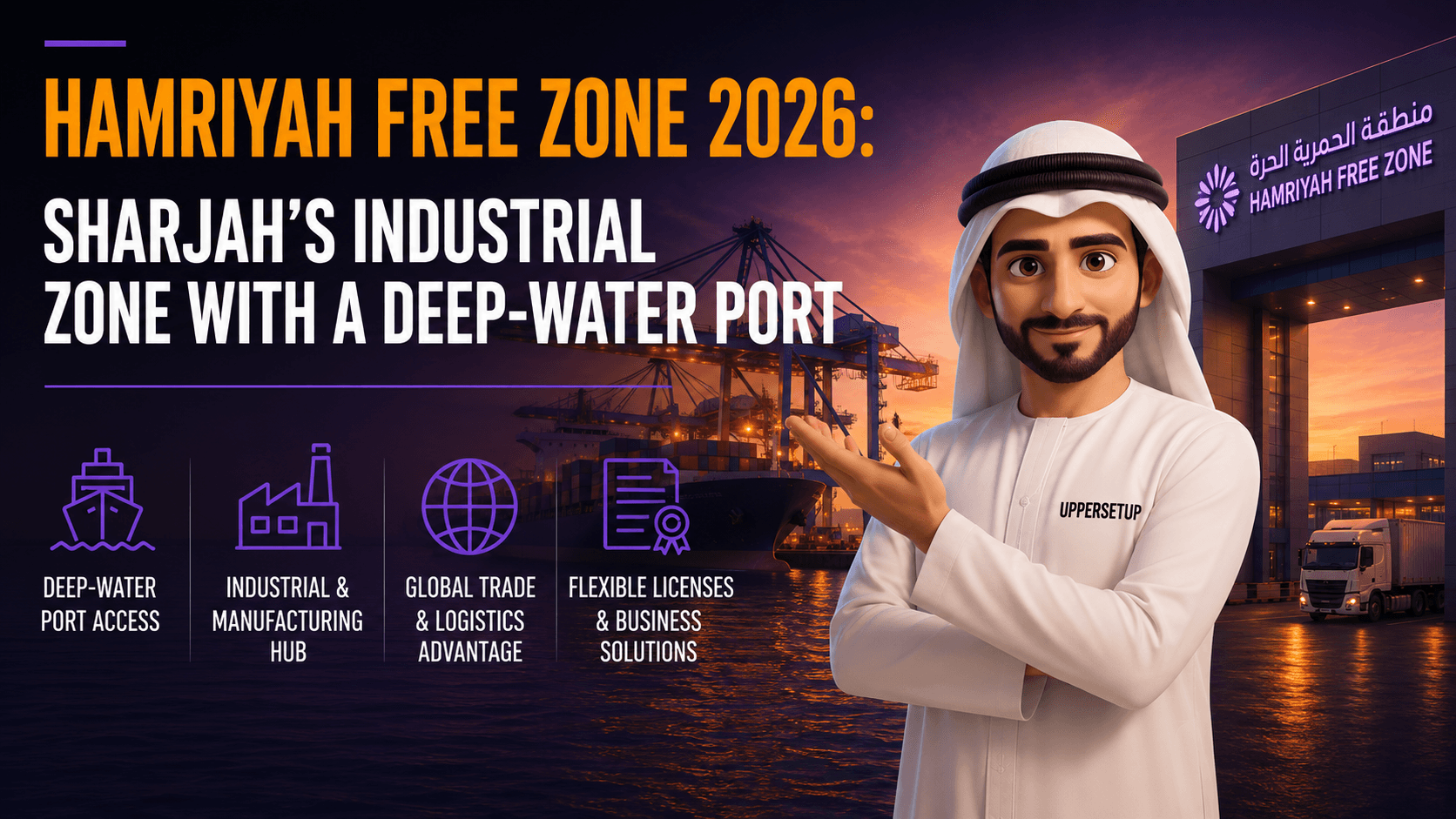
Hamriyah Free Zone (HFZA) is an industrial free economic zone in the emirate of Sharjah, the UAE’s second-largest free zone after JAFZA.
The Hamriyah Free Zone Authority was established by Sharjah Emiri Decree No. 6 of 1995, issued on 12 November 1995.
Hamriyah Free Zone is on the official VAT Designated Zones list under Cabinet Decision No. 59 of 2017 — a status confirmed directly on the Federal Tax Authority’s own portal.
The zone specialises in heavy industry, shipbuilding, and metal processing, with its own 14-metre deep-water port and 7-metre inner harbour.
⚠ Some secondary sources incorrectly refer to the founding instrument as “Emiri Decree No. 1” — this is not confirmed by either the zone’s official profile on the Ministry of Economy and Tourism portal, the direct decree text via Lexis Middle East, or HFZA’s own website: all consistently cite Decree No. 6 of 1995.
1. The Legal Basis
Hamriyah Free Zone operates under its own dedicated emirate-level decree, rather than a federal or umbrella instrument shared with other Sharjah zones.
The direct text of Sharjah Emiri Decree No. 6 of 1995 defines the “Authority” as the competent body overseeing and managing Hamriyah Free Zone, and the “Free Zone” itself as the zone established by this decree at Al Hamriyah, Sharjah.
Resident operations are governed by the Implementing Rules and Regulations, issued by HFZA itself under the 1995 decree — this document functions as the constitutional documents (Memorandum and Articles of Association) for a Free Zone Establishment.
⚠ HFZA companies must notify a change of registered address within 15 days, per Article 9 of the Implementing Rules and Regulations — a direct requirement from the document’s primary text.
Need help choosing an industrial zone in Sharjah? UPPERSETUP company registration services →
2. Scale and Location
Hamriyah Free Zone sits on the border of the Ajman and Sharjah emirates, with direct access to Ras Al Khaimah.
⚠ The zone’s land area is cited inconsistently across sources: the most frequently cited figure is 24 km² (Wikipedia, with primary-source citations), while some secondary publications cite between 22 and 30 million sq. m. Confirm the current figure directly with HFZA.
The zone features a 14-metre deep-water port and a 7-metre inner harbour — infrastructure rare among UAE free zones outside JAFZA.
ℹ Per the official Ministry of Economy and Tourism profile, the zone has 4,458 licensed companies registered; more recent secondary sources cite a figure of approximately 6,500 companies from over 160 countries — the discrepancy likely reflects growth in resident numbers over time rather than an error in either source.
3. Comparison with Other UAE Zones
|
Parameter |
Hamriyah Free Zone |
Ajman Free Zone |
JAFZA |
|
Year established |
1995 |
1988 |
1985 |
|
Land area |
~24 km² (sources range from 22 to 30 million sq. m) |
— |
— |
|
VAT Designated Zone status |
Yes |
Yes |
Yes |
|
Profile |
Heavy industry, shipbuilding, metal processing |
Broad: trading, services, industry |
Logistics, re-export, large-scale trading |
|
Port |
14-metre deep-water port + 7-metre inner harbour |
— |
One of the region’s largest ports |
Hamriyah Free Zone’s key practical distinction is combining Designated Zone status with a heavy-industry profile and dedicated port infrastructure that most Ajman-tier zones lack.
4. Licence Types and Legal Structures
|
Licence type |
What it permits |
|
Commercial License |
Import, export, distribution; up to 3 activities initially |
|
Industrial License |
Manufacturing, assembly, processing, shipbuilding, metalworking |
|
Service License |
Consulting and professional services |
|
General Trading License |
An expanded range of goods categories |
Officially available legal structures are: Free Zone Establishment (FZE) and Free Zone Company (FZC).
Article 10(F) of the Implementing Rules and Regulations expressly prohibits an FZE from having more than one shareholder — this is not a matter of choice, but a hard restriction of the legal form itself: once a second shareholder is added, the structure must be an FZC, not an FZE.
Articles 12(A)–(B) set governance requirements for an FZE: a minimum of 1 and maximum of 5 directors, with at least one director and the secretary required to be UAE residents.
If an FZE’s net assets fall below 75% of its share capital, the director must notify the shareholder within 15 days, and the shareholder must take remedial action within 7 days of that notification (Article 17(N)).
⚠ if the FZE Unit has reasonable cause to believe a company is not carrying on business, HFZA may issue a written enquiry; failure to respond within 7 days, or to demonstrate the company is operating, can result in unilateral deregistration.
Per the primary text of the Implementing Rules and Regulations, a Free Zone Establishment’s capital is divided into shares of AED 1,000 or multiples thereof.
5. Designated Zone Status: What It Means for HFZA
Designated Zone status concerns exclusively the VAT treatment of goods transactions, not a general tax exemption for the business.
Hamriyah Free Zone is officially on the Designated Zones list under Cabinet Decision No. 59 of 2017 — independently confirmed via Grant Thornton’s commentary and the Federal Tax Authority’s own Designated Zones VAT Guide.
⚠ Designated Zone rules do NOT apply to services — any service supplied within the zone is subject to the standard 5% VAT rate on the usual basis. Goods consumed within the zone may also attract VAT if customs control conditions are breached.
6. Corporate Tax and QFZP
HFZA companies are treated as Free Zone Persons for Corporate Tax purposes and can apply for the 0% rate on qualifying income subject to Qualifying Free Zone Person (QFZP) conditions.
QFZP conditions are set by Cabinet Decision No. 100 of 2023 and Ministerial Decision No. 265 of 2023 — the same instruments applicable to all UAE free zones; non-qualifying income is taxed at 9% above AED 375,000.
✅ VAT Designated Zone status and Corporate Tax Qualifying Free Zone status are independent regimes. HFZA’s inclusion on the Designated Zones list does not automatically confer QFZP eligibility — conditions for each tax are assessed separately.
7. Reporting and Compliance
A Free Zone Establishment or Free Zone Company must file audited annual financial statements with HFZA within 3 months of the financial year end.
A foreign director or manager of an HFZA company must hold a valid UAE residence and work permit from the relevant authorities.
8. Step-by-Step Registration Process
1. Select the licence type (up to 3 activities initially) and legal structure: FZE or FZC.
2. Reserve a unique company name in accordance with the zone’s naming requirements.
3. Prepare the document package: founders’ passports, a business plan, parent company documents if applicable.
4. Submit the application to HFZA — preliminary approval typically takes a few business days.
5. Sign the Memorandum of Association and pay the applicable fees.
6. Receive the trade licence, Establishment Card, and employee visa quota.
7. Register for VAT and Corporate Tax through the EmaraTax portal within the applicable federal deadlines.
8. Renew the licence in advance — the renewal process is initiated before the current term expires.
9. Common Mistakes
• Assuming the entire emirate of Sharjah is a Designated Zone. Status is confirmed specifically for the Hamriyah Free Zone territory, not for Sharjah mainland companies.
• Relying on an outdated or incorrect founding decree number. Some sources incorrectly cite “Decree No. 1” instead of the confirmed Decree No. 6 of 1995 — use the correct number when contacting the regulator.
• Overlooking the 15-day address change notification requirement. This is a direct requirement of the Implementing Rules and Regulations’ primary text, not a recommendation.
• Applying the Designated Zone relief to services. The rule covers only goods under customs control; services are subject to standard VAT.
10. Who This Fits
• Industrial and manufacturing companies needing port infrastructure. A dedicated deep-water port and inner harbour are a competitive edge rare among zones of this scale.
• Shipbuilding and metalworking companies. The zone’s historical specialisation provides a ready-made industry ecosystem.
• Trading companies that value Designated Zone status. Special VAT treatment applies to goods transactions between such zones.
11. Who This Does Not Fit
• Small service companies with no physical operations. HFZA’s infrastructure and positioning are geared toward heavy industry and logistics.
• Businesses relying on a prestigious Dubai address. HFZA is located in Sharjah — potentially suboptimal for brands dependent on a Dubai location.
12. When Professional Verification Is Essential
Self-assessment is worth supplementing with specialist advice when: structuring goods transactions dependent on Designated Zone status; confirming exact capital and fee requirements for a specific industrial activity; and when planning shipbuilding or other regulated industrial projects requiring additional sector-specific approvals.
FAQ
Who regulates Hamriyah Free Zone?
The Hamriyah Free Zone Authority (HFZA), established by Sharjah Emiri Decree No. 6 of 1995.
Is Hamriyah Free Zone a VAT Designated Zone?
Yes, the zone is on the official Designated Zones list under Cabinet Decision No. 59 of 2017 — the regime covers only goods transactions, not services.
What legal structures are available at HFZA?
Free Zone Establishment (FZE) for a single founder, and Free Zone Company (FZC) for multiple shareholders.
Within what timeframe must a change of registered address be notified?
Within 15 days, per Article 9 of HFZA’s Implementing Rules and Regulations.
Key Takeaways
• The Hamriyah Free Zone Authority was established by Sharjah Emiri Decree No. 6 of 1995, issued on 12 November 1995.
• The zone is officially on the VAT Designated Zones list under Cabinet Decision No. 59 of 2017.
• Profile: heavy industry, shipbuilding, metal processing, with its own deep-water port.
• Legal structures available: FZE and FZC; capital is divided into shares of AED 1,000.
• Companies can apply for 0% Corporate Tax subject to QFZP conditions — independent of Designated Zone status.
• Audited financial statements must be filed within 3 months of the financial year end.
Summary
Hamriyah Free Zone (HFZA) is an industrial free economic zone in the emirate of Sharjah, established by Sharjah Emiri Decree No. 6 of 1995 on 12 November 1995, the UAE’s second-largest free zone after JAFZA. The zone is officially on the VAT Designated Zones list under Cabinet Decision No. 59 of 2017. HFZA specialises in heavy industry, shipbuilding, and metal processing, with its own 14-metre deep-water port. Available legal structures are Free Zone Establishment (FZE) and Free Zone Company (FZC). Companies can apply for the 0% Corporate Tax rate subject to Qualifying Free Zone Person (QFZP) conditions under Cabinet Decision No. 100 of 2023 and Ministerial Decision No. 265 of 2023.
Sources
• Government of Sharjah — Sharjah Emiri Decree No. 6 of 1995, full text (via Lexis® Middle East)
• Hamriyah Free Zone Authority — Implementing Rules and Regulations, official document (hfza.ae)
• Hamriyah Free Zone Authority — official website (hfza.ae)
• Ministry of Economy and Tourism UAE — Hamriyah Free Zone, official free zone registry (moet.gov.ae)
• Federal Tax Authority — Designated Zones VAT Guide, official document (tax.gov.ae)
• Wikipedia — Hamriyah Free Zone, historical overview with primary sourcing (en.wikipedia.org)
Disclaimer
This material is for informational purposes only and does not constitute legal, tax, financial, investment, or consulting advice. Exact tariffs, fees, and capital requirements are updated regularly — request a current quotation directly from the Hamriyah Free Zone Authority. Information is accurate as of June 2026.
All services on the platform
Everything you need to start and run a business - in one place
- 3–5 days
Company Setup
Mainland or Free Zone company with a complete set of incorporation documents
Start - Monthly
Accounting Services
Financial accounting and reporting in accordance with UAE requirements
Start - 1–2 weeks
Visa Services
Residence visas for shareholders, employees and family members
Start - 7–30 days
Banking Services
Corporate Bank Accounts in the UAE and Payment Services
Start - Custom timeline
Legal Services
Contracts, corporate amendments and legal support
Start


