




















































































 International Free Zone Authority
Holding Company in the UAE in 2026: A Corporate Architecture Tool or a Source of Additional Obligations?

In 2026, holding structures in the UAE are used far more frequently than five years ago. However, the mere registration of a holding company does not automatically create advantages.
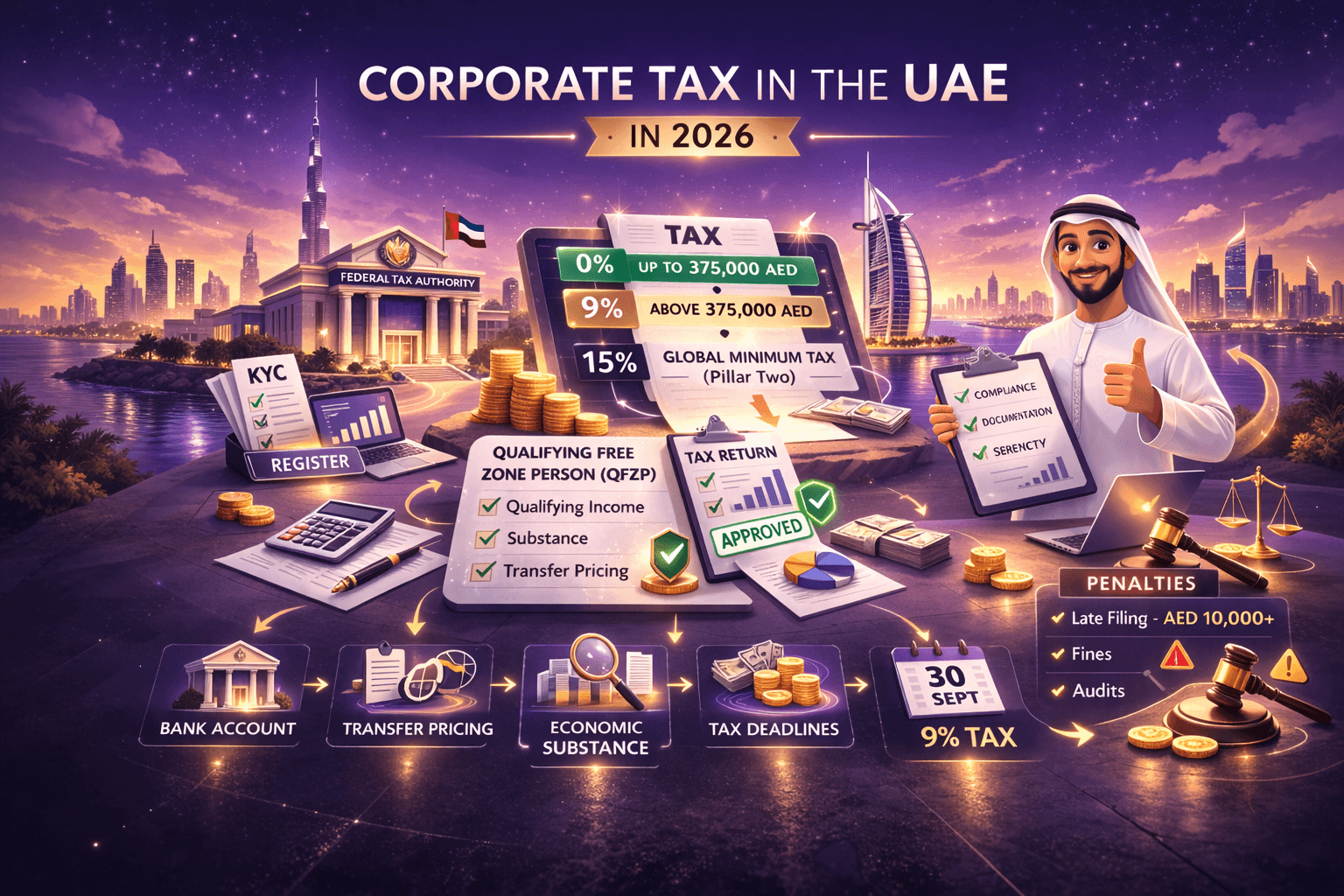
Following the introduction of Federal Decree-Law No. 47 of 2022 on the Taxation of Corporations and Businesses, the implementation of Transfer Pricing UAE rules, and the strengthening of banking compliance standards, any multi-layer structure requires clear economic and tax logic.
A holding company is a tool. Its appropriateness depends on the function it performs within the group.
1. Legal Nature of a Holding Company in the UAE
There is no separate “Holding Company Law” in the UAE. A holding company is a standard legal entity (LLC or Free Zone Company) whose primary function is to own shares in other companies or hold assets.
Typical functions of a holding company include:
-
ownership of subsidiary operating companies;
-
centralized ownership of intellectual property;
-
structuring investments;
-
consolidation of assets;
-
preparation for investor entry or business sale.
Important: the designation “holding company” does not in itself provide tax benefits. The tax treatment depends on the nature of income and compliance with corporate tax requirements.
2. Tax Treatment of a Holding Company: Key Considerations
Participation Exemption: Dividend Exemption
Under Federal Decree-Law No. 47 of 2022 and relevant ministerial decisions, dividends and certain participation income may qualify for exemption, provided specific conditions are met.
Core criteria include:
-
minimum ownership interest — generally at least 5%;
or an acquisition cost of at least AED 4 million;
-
the participation is not short-term in nature;
-
the subsidiary is subject to a tax rate comparable to 9% or higher;
-
formal ownership requirements are satisfied.
Failure to meet these conditions may result in taxation of the income.
Therefore, a holding company has tax relevance only where the ownership structure complies with exemption criteria.
Nature of Holding Company Income
A holding company may generate:
-
dividends;
-
capital gains;
-
interest from intra-group loans;
-
royalties;
-
management fees.
Each income type must be assessed independently.
-
Dividends may qualify for exemption.
-
Interest and royalties are generally taxable.
-
Management fees require analysis under the Arm’s Length Principle.
Assuming that a holding structure is automatically “tax neutral” without reviewing the source of income is incorrect.
3. Transfer Pricing: A Structural Risk Factor
Where a holding company engages in intra-group transactions, transfer pricing rules apply.
Typical transactions include:
-
intra-group loans;
-
IP licensing;
-
management services;
-
cost allocations;
-
trading between related parties.
The Arm’s Length Principle applies — transactions must reflect market conditions.
This requires:
-
economic justification of pricing;
-
benchmarking analysis;
-
disclosure of related parties;
-
preparation of Master File / Local File where thresholds are met.
Failure to document may allow the tax authority to adjust taxable profits.
4. Banking Perspective: Structural Transparency
From a banking compliance standpoint, multi-layer structures undergo enhanced scrutiny.
Banks assess:
-
ultimate beneficial ownership (UBO);
-
number of ownership layers;
-
economic rationale of the structure;
-
actual function of the holding company;
-
location of decision-making.
Structural complexity must be economically justified. A formal holding company without real managerial function invites additional review.
5. Economic Substance: Where Decisions Are Made
Although previous ESR requirements were reformed, assessment of economic reality remains relevant.
For a holding company, it is critical to determine:
-
where directors are located;
-
where key decisions are made;
-
where control over assets is exercised;
-
whether managerial functions exist.
If management is effectively exercised outside the UAE, there may be a risk of permanent establishment (PE) exposure in another jurisdiction.
6. DIFC or ADGM: Choosing the Legal Infrastructure
When establishing a holding company, DIFC and ADGM are often considered.
It is important to understand:
-
these are not “tax regimes,” but international financial jurisdictions with independent legal frameworks;
-
they operate under common law principles;
-
they are frequently used for investment and holding structures.
DIFC
Typically preferred where:
-
international investors are expected;
-
access to a developed financial ecosystem is important;
-
predictable common law court infrastructure is required.
ADGM
Often chosen where:
-
the structure relates to investment funds or SPVs;
-
the group has Abu Dhabi exposure;
-
institutional structuring is required.
The choice should be based on functional requirements, not perception.
7. Practical Structural Scenarios
Scenario 1: Risk Segregation
HoldCo owns OpCo, which enters into contracts and bears operational risks.
Advantage: asset protection.
Condition: no artificial profit shifting.
Scenario 2: Group Financing
HoldCo provides loans to subsidiaries.
Critical elements:
-
arm’s length interest rate;
-
formal loan agreements;
-
documented commercial purpose.
Scenario 3: IP Structure
HoldCo owns IP; OpCo pays royalties.
Key question: where is IP actually developed and managed?
Scenario 4: Investor Entry
HoldCo serves as a single ownership platform, simplifying share transfers and governance.
Scenario 5: Business Exit
Selling shares in OpCo or HoldCo may be more efficient than asset sales, subject to participation exemption conditions.
8. When a Holding Structure Is Not Appropriate
A holding company may be unnecessary where:
-
only one operating entity exists;
-
there are no investor plans;
-
asset separation is not required;
-
the administrative burden outweighs structural benefit.
In such cases, a holding structure increases obligations without economic justification.
9. Strategic Conclusion
In 2026, a holding company in the UAE is an element of corporate architecture.
It is justified where:
-
a multi-entity group exists;
-
expansion is planned;
-
risk isolation is required;
-
investors are expected;
-
the tax model is properly structured.
It creates risk where:
-
it performs no genuine economic function;
-
it engages in intra-group transactions without documentation;
-
it complicates banking transparency;
-
it lacks economic substance.
The core question is:
does the holding company perform a real economic function within the group?
10. Legal and Regulatory References
Read more on the topic
All services on the platform
Everything you need to start and run a business - in one place
- 3–5 days
Company Setup
Mainland or Free Zone company with a complete set of incorporation documents
Start - Monthly
Accounting Services
Financial accounting and reporting in accordance with UAE requirements
Start - 1–2 weeks
Visa Services
Residence visas for shareholders, employees and family members
Start - 7–30 days
Banking Services
Corporate Bank Accounts in the UAE and Payment Services
Start - Custom timeline
Legal Services
Contracts, corporate amendments and legal support
Start


