





















































































































































 International Free Zone Authority
Kazakhstan’s Tax System 2026: A Complete Breakdown — the New Tax Code, CIT, VAT, PIT, and AIFC Incentives

Since 1 January 2026, Kazakhstan has operated under a new Tax Code, replacing the code of 25 December 2017: VAT has risen from 12% to 16%, a progressive PIT rate (10%/15%) has been introduced, and AIFC companies retain a 0% rate on financial services until 2066.
The new Tax Code was signed by Kazakhstan’s President Kassym-Jomart Tokayev on 18 July 2025 and took effect 1 January 2026 — the country’s largest tax reform in the past 10 years.
Effective 1 July 2026, the Tax Code was further aligned with the new Constitution of the RK, approved by national referendum on 15 March 2026 — the text received terminology amendments and a new Article 189 on temporary exit restriction for a director with tax arrears.
The standard CIT rate (20%) did not change under the 2026 reform — the core structural changes affected VAT, PIT, and employer social contributions rather than corporate tax for most companies.
⚠ Effective 1 July 2026, the tax authority may initiate a temporary restriction on leaving Kazakhstan for the head of a legal entity (or the person acting in that capacity), an individual entrepreneur, or a person engaged in private practice, where tax arrears exist — a direct personal risk for a foreign director of a Kazakhstani company that did not exist under the code’s pre-July-2026 version.
1. The New Tax Code 2026: What Changed
The 2026 reform replaced the Tax Code of 25 December 2017 in full, rather than amending it piecemeal.
Three Core Reform Objectives
• Simplification: the number of taxes reduced from 12 to 11, fees from 10 to 6; tax reporting reduced by 30%.
• Differentiation: industry-specific rates for banks, the social sector, and agriculture replace uniform rates.
• Base expansion: VAT raised, PIT progression introduced, mandatory VAT registration threshold lowered.
The reform abolished 128 tax incentives worth over KZT 1.3 trillion in total.
2. Alignment With the New Constitution: What Changed Effective 1 July 2026
A separate package of amendments, not directly tied to tax rates, took effect 1 July 2026 in connection with Kazakhstan’s new Constitution.
|
Change |
Content |
|
Terminology |
“Parliament” replaced by “Kurultai” throughout the Tax Code; “republican referendum” replaced by “national referendum” |
|
Terminology |
“Foreigner” (in all case forms) replaced by “foreign citizen” throughout the text |
|
State duty |
The state duty for citizens’ and legal entities’ appeals to the Constitutional Court of the RK is fully abolished |
|
New Art. 189 |
A temporary restriction on leaving the RK for a legal entity’s (or IE’s) head, or a person engaged in private practice, where tax arrears exist |
ℹ Most of the amendments effective 1 July 2026 are terminological and structural in nature and do not change the tax rates described below — with the exception of the new Article 189, which introduces a standalone compliance risk for company directors.
3. Full Table of 2026 Tax Rates
|
Tax |
2026 Rate |
Pre-2026 |
Note |
|
CIT — standard rate |
20% |
20% |
Unchanged |
|
CIT — banks, gambling |
25% |
20% |
New for 2026 |
|
CIT — social sector (education, healthcare) |
5% (2026); 10% (from 2027) |
20% |
Temporary relief |
|
CIT — agricultural producers |
3% |
3% |
Relief retained |
|
VAT — standard rate |
16% |
12% |
Increase effective 1 January 2026 |
|
VAT — medicines and medical services |
5% (2026); 10% (from 2027) |
Exempt |
Reduced rate introduced |
|
PIT — income up to 8,500 MCI/year |
10% |
10% (flat) |
Unchanged below threshold |
|
PIT — income above 8,500 MCI/year |
10% + 15% on excess |
10% (flat) |
Progressive — new for 2026 |
|
PIT — dividends above 230,000 MCI |
15% |
5% |
Progressive — new for 2026 |
⚠ Per Law of the RK No. 239-VIII of 8 December 2025 “On the Republican Budget for 2026–2028” (Art. 7), the MCI in 2026 is KZT 4,325 — not KZT 3,932 as stated in an earlier version of this article; the error has been corrected following a repeat verification pass. The PIT progression threshold of 8,500 MCI equals KZT 36,762,500 per year (around USD 68,000); the progressive rate applies to the amount exceeding this threshold, not to the entire income.
4. Corporate Income Tax (CIT)
The standard CIT rate is 20% of net profit, applying to most commercial companies in Kazakhstan; the return is filed annually, due by 31 March of the following year.
The CIT rate has been raised to 25% for second-tier banks and gambling businesses — new for 2026; for banks, the 20% rate is retained for business lending income.
Social-sector organisations (education, healthcare) apply a reduced CIT rate of 5% in 2026, rising to 10% from 2027.
Effective 2026, geological exploration companies are entitled to a 100% deduction of capital expenditure from the taxable base.
⚠ A foreign company’s branch pays 20% CIT plus a 15% tax on the non-resident’s net income — the total burden exceeds that of a Kazakhstani subsidiary (an LLP), which is why most foreign investors prefer registering an LLP or an AIFC structure rather than a branch.
Planning to start a business in Kazakhstan? UPPERSETUP company registration services →
5. VAT in Kazakhstan: the New 16% Rate
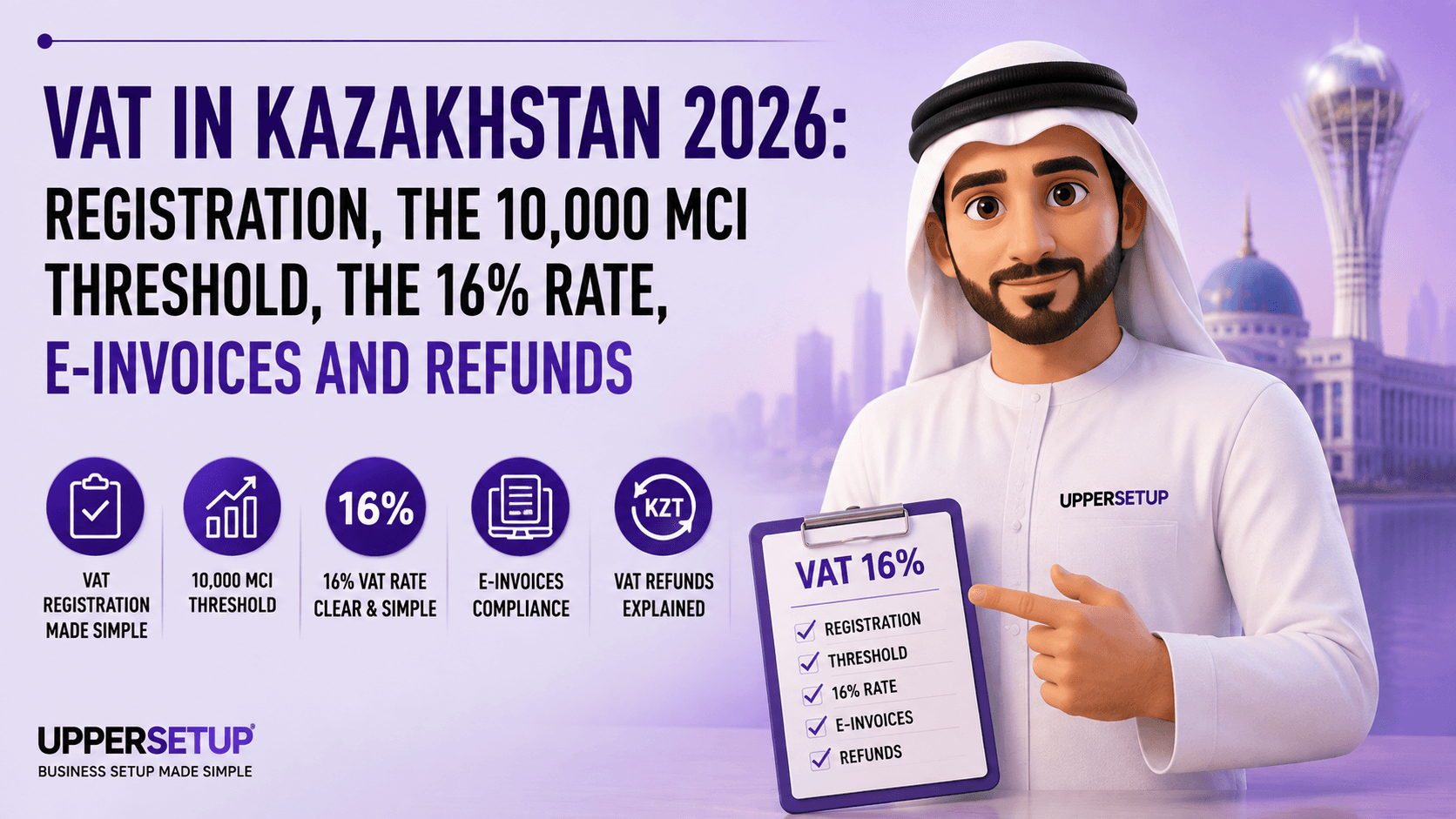
The standard VAT rate in Kazakhstan has been 16% since 1 January 2026 — the country’s first VAT increase in over 10 years.
The mandatory VAT registration threshold has been lowered from 20,000 MCI to 10,000 MCI (approximately KZT 40 million / USD 81,000 over any 12 months); voluntary VAT deregistration has been abolished since 2026.
• Reduced rate of 5% (2026) / 10% (from 2027) — medicines, medical devices, and medical services not otherwise exempt.
• Reduced rate of 10% — printed periodicals.
• VAT exemption — financial services, insurance, services under the guaranteed free medical care package and mandatory social health insurance, treatment of orphan and socially significant diseases, book publishing.
• 0% rate — export of goods.
Since 2022, Kazakhstan has applied VAT to electronic services provided by non-residents (the “Google tax”) — foreign platforms must register with the State Revenue Committee and remit VAT on sales to Kazakhstani users; a Kazakhstani company receiving such services acts as the tax agent.
✅ For AIFC companies, the 0% VAT rate on financial and ancillary services applies until 1 January 2066 — the increase in the standard rate to 16% does not affect exempt AIFC activities.
6. Individual Income Tax (PIT): The New Progression
Before 2026, Kazakhstan applied a flat 10% PIT rate to all income types; effective 1 January 2026, progression was introduced for wages.
Income up to 8,500 MCI per year (approximately KZT 33.4 million / USD 68,000) is taxed at 10%; income above this threshold is taxed at 10% up to the threshold plus 15% on the excess.
Practical example (recalculated during a repeat verification pass using the correct MCI): an employee earning KZT 5,000,000 per month (KZT 60,000,000 per year). Below the threshold: KZT 36,762,500 × 10% = KZT 3,676,250. Above the threshold: (KZT 60,000,000 − KZT 36,762,500) × 15% = KZT 3,485,625. Total annual PIT: KZT 7,161,875 — an effective rate of around 11.9%.
Dividends up to 230,000 MCI are taxed at 5%; amounts above this threshold are taxed at 15% on the excess — also a new progression for 2026.
• Private practitioners (notaries, lawyers): PIT rate of 9%.
• Non-residents on Kazakhstan-sourced income: standard 20% withholding, reduced under applicable DTAs.
• Standard deduction: 30 MCI per month / 360 MCI per year (approximately KZT 1,415,520 per year).
7. Payroll Contributions and Deductions
Beyond CIT, VAT, and PIT, an employer in Kazakhstan must pay several separate social contributions on the payroll.
The employer’s mandatory professional pension contribution (OPPS) is a new 3.5% contribution effective 2026, not previously levied in this form.
The employer’s social tax has been raised to 11% minus social contributions (from 9.5% in 2025); social contributions (SO) have been raised to 5% (from 3.5% in 2025).
For an employee earning KZT 500,000 per month gross, the employer’s total additional burden above salary is approximately KZT 95,000 (around 19% above salary), including social tax, social contributions, mandatory social health insurance contributions, and OPPS.
⚠ Foreign nationals without a Kazakhstan residence permit who are not citizens of EAEU countries are exempt from OPV, OPPS, SO, and mandatory social health insurance contributions — for them, the employer pays only social tax (9.5%) and withholds PIT.
8. The AIFC Tax Regime: Incentives Until 2066
|
Tax |
Standard RK rate |
AIFC participant rate |
Until |
|
CIT — financial services |
20% |
0% |
1 January 2066 |
|
CIT — ancillary services |
20% |
0% on income from AIFC Bodies and financial participants |
1 January 2066 |
|
VAT |
16% |
0% (financial and ancillary services) |
1 January 2066 |
|
PIT for foreign staff |
10%/15% progressive |
0% |
1 January 2066 |
|
Property tax |
1.5% |
0% (property within AIFC) |
1 January 2066 |
Three Conditions for AIFC Incentives
1. Register as an AIFC participant through the Digital Resident platform (digitalresident.kz).
2. Conduct only activities on the official AFSA list, published at aifc.kz/legal-framework/tax-administration/.
3. Meet the Substantial Presence requirement, mandatory since 1 January 2022: a genuine office within AIFC, qualified staff, and management decisions made within AIFC.
⚠ Digital asset exchange operators are expressly excluded from the AIFC incentive regime — this activity category is subject to standard CIT (20%) and VAT (16%) rates despite AIFC registration.
✅ Astana Hub resident companies — a separate regime, unrelated to AIFC — are exempt from CIT, VAT, and PIT for 10 years; for IT startups without a financial licence, Astana Hub may be a better fit than AIFC.
9. Double Taxation Agreements (DTAs)
Kazakhstan has concluded more than 60 double taxation agreements, including with Russia, China, the UAE, Germany, the United Kingdom, the Netherlands, Singapore, and Cyprus.
DTAs reduce withholding tax on dividends from the standard 15% to 5% or 0%, on interest to 10% or lower, and on royalties to 10% or lower, depending on the specific agreement.
The Kazakhstan-UAE DTA in force is a key advantage for entrepreneurs using a dual Kazakhstan + UAE structure: dividends and interest between the two jurisdictions may be taxed at preferential rates or exempt from withholding tax.
10. Comparing the Tax Burden: Kazakhstan, AIFC, the UAE, and Hong Kong
|
Metric |
Kazakhstan (standard) |
AIFC |
UAE (free zone, QFZP) |
Hong Kong |
|
CIT |
20% |
0% (financial services) |
0–9% |
8.25%/16.5% |
|
VAT |
16% |
0% (financial services) |
5% |
None |
|
PIT |
10%/15% progressive |
0% (foreign specialists) |
0% |
2–17% |
|
AIFC relief duration |
— |
Until 2066 |
Depends on conditions |
Indefinite |
Practical takeaway: standard Kazakhstan means 20% CIT and now 16% VAT, making the jurisdiction competitive within the CIS region for companies below the VAT registration threshold. AIFC fundamentally changes the picture for financial and certain professional services — zero rates until 2066 subject to Substantial Presence.
Need help with tax planning for a Kazakhstan registration? UPPERSETUP legal and corporate services →
11. Practical Tax Burden Examples
Example 1: A trading company in Kazakhstan (LLP, KZT 500 million turnover)
Revenue: KZT 500 million. VAT payable (16% of value added): approximately KZT 45 million. Pre-tax profit: KZT 80 million. CIT at 20%: KZT 16 million. Overall effective burden is moderate, comparable to Russian rates.
Example 2: A financial company in AIFC (asset management, AFSA licence)
Revenue from managing client assets within AIFC: USD 5 million. CIT: 0% (exempt until 2066). VAT: 0%. PIT for foreign managers: 0%. Actual tax burden is near zero, subject to Substantial Presence.
Example 3: An IT company in Astana Hub
An IT startup with developers in Kazakhstan and clients abroad, an Astana Hub resident: exempt from CIT, VAT, and PIT for 10 years; after the relief period ends, standard 20% CIT and 16% VAT apply once thresholds are exceeded.
12. Step-by-Step Process for a Foreign Company
4. Determine the applicable tax jurisdiction: mainland Kazakhstan (standard rates), AIFC (for financial or ancillary activity), or Astana Hub (for IT).
5. Assess whether planned turnover exceeds the mandatory VAT registration threshold (10,000 MCI over 12 months).
6. Check DTA applicability with the ultimate beneficial owner’s country of residence to reduce withholding tax.
7. If choosing AIFC, confirm Substantial Presence compliance before commencing operations.
8. Set up employer payroll contribution calculations reflecting 2026 rates, including the new OPPS contribution.
9. Ensure timely payment of tax liabilities to avoid triggering Article 189’s exit-restriction mechanism.
13. Common Mistakes
• Assuming the 20% CIT rate changed under the 2026 reform. The base CIT rate remained unchanged — the changes affected VAT, PIT, and social contributions, not corporate tax for most companies.
• Overlooking the drop in the VAT registration threshold from 20,000 to 10,000 MCI. A company previously below the mandatory VAT registration threshold may now cross the lower threshold sooner than expected.
• Registering a foreign company branch instead of an LLP without calculating the combined tax burden. A branch pays 20% CIT plus an additional 15% tax on non-resident net income — a higher combined burden than an LLP.
• Ignoring the Substantial Presence requirement when registering with AIFC. Without a genuine office, qualified staff, and decision-making within AIFC, the preferential rates do not apply despite formal registration.
• Allowing tax arrears to accumulate without accounting for the Article 189 risk. Effective 1 July 2026, this can result in a temporary exit restriction for the company’s director from Kazakhstan.
14. Who Each Tax Regime Fits
• Mainland Kazakhstan (LLP) — trading, manufacturing, and service companies operating within the country. Standard rates are competitive within the CIS region for companies below the VAT registration threshold.
• AIFC — asset managers, financial companies, brokers, and providers of ancillary services (legal, audit, consulting) to AIFC financial participants. Zero rates until 2066 subject to Substantial Presence make the jurisdiction exceptionally attractive for this profile.
• Astana Hub — IT companies without a need for a financial licence. A 10-year exemption from CIT, VAT, and PIT without the Substantial Presence complexity mandatory for AIFC.
15. When Professional Verification Is Essential
Self-assessment is worth supplementing with specialist advice when: choosing between mainland registration, AIFC, and Astana Hub for a specific business model; applying a specific DTA’s terms to cross-border dividend and interest payments; and assessing the Article 189 risk for a company with a history of tax arrears.
FAQ
When did Kazakhstan’s new Tax Code take effect?
1 January 2026; signed by the President on 18 July 2025, replacing the code of 25 December 2017.
What is the VAT rate in Kazakhstan in 2026?
16% — the standard rate since 1 January 2026, up from the previous 12%.
Did the CIT rate change in 2026?
The base CIT rate remained at 20%; the new 25% rate applies only to second-tier banks and gambling businesses.
What changed in the Tax Code effective 1 July 2026?
The code was aligned with the new Constitution of the RK — mostly terminology amendments, plus a new Article 189 on temporary exit restriction for a company director with tax arrears.
Until when do AIFC tax incentives apply?
Until 1 January 2066 for financial and ancillary services, subject to Substantial Presence.
Key Takeaways
• The new Tax Code has applied since 1 January 2026; the base CIT rate (20%) did not change.
• VAT was raised to 16%; the mandatory registration threshold was lowered to 10,000 MCI.
• A progressive PIT rate was introduced: 10% up to the 8,500 MCI/year threshold, 15% on the excess.
• Effective 1 July 2026, the code was aligned with the new Constitution of the RK, including a new Article 189 on temporary exit restriction for tax arrears.
• AIFC retains zero rates on financial and ancillary services until 2066 subject to Substantial Presence.
• Astana Hub provides a separate 10-year exemption from CIT, VAT, and PIT for IT companies.
Summary
Kazakhstan’s new Tax Code was signed by the President on 18 July 2025, took effect 1 January 2026, and replaced the code of 25 December 2017. The standard CIT rate remained at 20%, except for second-tier banks and gambling businesses (25%, new for 2026) and social-sector organisations (5% in 2026, 10% from 2027). The standard VAT rate rose from 12% to 16% effective 1 January 2026; the mandatory registration threshold was lowered from 20,000 to 10,000 MCI. A progressive PIT rate was introduced: 10% on income up to 8,500 MCI per year and 15% on the excess. Effective 1 July 2026, the Tax Code was aligned with the new Constitution of the Republic of Kazakhstan, approved by referendum on 15 March 2026; the amendments are mostly terminological but include a new Article 189 allowing the tax authority to temporarily restrict a company director’s departure from the country over tax arrears. AIFC companies retain a 0% rate on financial and ancillary services (CIT, VAT, PIT for foreign staff) until 1 January 2066, subject to Substantial Presence — a genuine office, qualified staff, and decision-making within AIFC.
Sources
• Egov.kz — New Tax Code of the Republic of Kazakhstan, official text
• PRG.kz — Tax Code: changes effective 1 July 2026
• mybuh.kz — Changes to the Tax Code effective 1 July 2026 (Art. 189)
• AIFC — Tax Benefits, official AIFC tax regime page (aifc.kz)
• PwC Tax Summaries — Kazakhstan: Corporate Taxes on Corporate Income
• State Revenue Committee, Ministry of Finance of the RK — official tax authority portal (kgd.gov.kz)
• adilet.zan.kz — official legal information portal, Law of the RK No. 239-VIII of 8.12.2025 “On the Republican Budget for 2026–2028” (MCI figure)
Disclaimer
This article is for informational purposes only and does not constitute legal, tax, or professional advice. Information is based on the New Tax Code of the Republic of Kazakhstan (signed 18 July 2025, effective 1 January 2026, aligned with the new Constitution of the RK effective 1 July 2026) and official sources. Tax legislation and administrative practice may change — consult a qualified tax adviser before making decisions. Information is accurate as of July 2026.
All services on the platform
Everything you need to start and run a business - in one place
- 2–10 days
Company Setup
Kazakhstan company with a complete set of incorporation documents
Start - Monthly
Accounting Services
Accounting and Tax Compliance, Reporting, and Support in Accordance with Kazakhstan Requirements
- 4–8 weeks
Immigration Services
Visas, Work Permits
- 7–30 days
Banking Services
Corporate Bank Accounts in Kazakhstan and Payment Services
- Custom timeline
Permits and Licenses
Business Licenses and Activity Permits
- Custom timeline
Legal Services
Corporate Documents, Contracts, Compliance, Licensing, and Company Structure Changes


