







































































 International Free Zone Authority
Hong Kong Company Registration 2026: Requirements, Procedure, Taxes, and Annual Compliance
Registering a Private Company Limited by Shares in Hong Kong is done entirely online through e-Registry, takes 1–2 working days, and requires no physical presence from a non-resident founder or director.
The core corporate statute is the Companies Ordinance (Cap. 622), enacted in 2014 on the model of the UK Companies Act 2006, fully replacing the 1932 Companies Ordinance.
The profits tax rate on Hong Kong-sourced income is 8.25% on the first HKD 2 million and 16.5% thereafter (a two-tiered system); foreign-sourced profit may be untaxed entirely under a confirmed offshore status.
Registering in Hong Kong does not by itself grant offshore exemption — it requires a separate application to the IRD, a body of supporting evidence, and annual reconfirmation, rather than arising automatically from incorporation.
⚠ The 2025/26 profits tax concession (a 100% reduction capped at HKD 3,000 per company), which earlier publications described as pending legislative enactment, was actually passed by Hong Kong’s Legislative Council on 13 May 2026 and gazetted on 22 May 2026 — this is now a confirmed relief, not a proposal.
1. Why Hong Kong Remains One of the World’s Leading Business Centres
Hong Kong ranks third globally as a financial centre per the Global Financial Centres Index and first in Asia.
Over 70 of the world’s 100 largest banks have a presence in Hong Kong; its international airport is among the ten busiest in the world.
Five Fundamental Advantages of Hong Kong as a Jurisdiction
• English common law: Hong Kong has operated under the English legal system since 1843, ensuring predictable judicial outcomes and property rights protection.
• Territorial taxation: profits earned outside Hong Kong are, under certain conditions, not taxed at all.
• Strategic location: more than half the world’s population lives within a 4-hour flight of Hong Kong; CEPA grants preferential access to the Mainland Chinese market.
• Free capital movement: no restrictions on capital flows, profit repatriation, or currency conversion; the Hong Kong dollar has been pegged to the USD within 7.75–7.85 since 1983.
• Absence of several taxes: no VAT, capital gains tax, withholding tax on dividends and interest, or estate tax.
2. The Legal Basis: Companies Ordinance (Cap. 622)
The Companies Ordinance (Cap. 622) governs every aspect of a Hong Kong company’s corporate life — incorporation, governance, shareholder rights, mergers, and liquidation.
The Companies Registry (CR) is responsible for company registration and the public register via the e-Registry portal; per the Companies Registry’s own statistics released 17 July 2026, the register held 1,609,720 companies as at the end of June 2026 — an all-time high.
The Inland Revenue Department (IRD) is the tax authority, issuing the Business Registration Certificate, accepting Profits Tax Returns, and administering offshore exemptions.
⚠ The Companies Registry and the IRD are two separate bodies with different functions. The Companies Registry handles corporate structure; the IRD handles taxes and the Business Registration Certificate. Conflating the two is one of the most common sources of confusion for new entrepreneurs.
3. Types of Companies in Hong Kong
Over 95% of all Hong Kong registrations are Private Companies Limited by Shares.
A Private Company Limited by Shares: shareholders are liable only up to the unpaid portion of their shares; the company is a separate legal entity; shares cannot be offered to the public; the number of shareholders ranges from 1 to 50.
ℹ Other company types — Public Company Limited by Shares, Company Limited by Guarantee, Unlimited Company, Branch Office — apply to narrow scenarios (public listing, non-profit activity, a foreign company’s branch) and are not the primary option covered in this article.
4. Statutory Registration Requirements
|
Requirement |
Minimum |
Key condition |
Legal basis |
|
Directors |
1 (individual) |
Any nationality, age 18+, no residency requirement |
Companies Ordinance (Cap. 622), s. 153 |
|
Shareholders |
1 (up to 50) |
Individuals or entities of any jurisdiction; 100% foreign ownership permitted |
Companies Ordinance (Cap. 622), s. 11 |
|
Company secretary |
1 (mandatory) |
Hong Kong resident or licensed TCSP; the sole director cannot also be secretary |
Companies Ordinance (Cap. 622), s. 474-480 |
|
Registered address |
1 (in Hong Kong) |
A P.O. Box is not accepted; a change must be notified to the CR within 15 days |
Companies Ordinance (Cap. 622), s. 658 |
|
Share capital |
No minimum |
Standard practice is HKD 10,000; no paid-up requirement |
Companies Ordinance (Cap. 622) |
The sole director cannot also serve as company secretary — a requirement of s. 474 Cap. 622, ensuring independent compliance oversight.
⚠ An unlicensed corporate services provider acting as company secretary breaches the Anti-Money Laundering and Counter-Terrorist Financing Ordinance (Cap. 615). Confirm your provider holds a TCSP (Trust and Company Service Provider) licence.
Need help registering a company in Hong Kong? UPPERSETUP company registration services →
5. Step-by-Step Registration Process via e-Registry
The entire registration process is conducted online through the e-Registry platform (cr.gov.hk); physical presence in Hong Kong is not required.
1. Choose and verify the company name for uniqueness via the Companies Registry search service; English and Chinese name options are available.
2. Prepare the constitutional documents — the Memorandum and Articles of Association (M&A); the Companies Registry provides standard templates.
3. Complete Form NNC1 (Incorporation of a Company) with founder, director, address, and company secretary details.
4. Pay the government fees: Companies Registry fee HKD 1,545 + Business Registration Certificate HKD 2,350 = HKD 3,895 total.
5. Application processing: 1–2 working days for electronic submission via e-Registry, 4–5 days for paper submission.
6. Receive the Certificate of Incorporation and the Business Registration Certificate.
7. Post-registration steps: open a bank account, register with the IRD, maintain the Significant Controllers Register (SCR), and register for MPF if staff are employed in Hong Kong.
⚠ The first Profits Tax Return arrives from the IRD approximately 18 months after registration. Keep all source documents from day one — contracts, invoices, bank statements, client correspondence — this is critical for the future tax filing and for any offshore exemption claim.
6. The Hong Kong Tax System
|
Tax type |
Rate/condition |
Note |
|
Profits Tax — first HKD 2 million |
8.25% |
Two-tiered system; only one company within a group of connected entities may apply the reduced rate |
|
Profits Tax — above HKD 2 million |
16.5% |
Applies only to Hong Kong-sourced profit |
|
Foreign-sourced profit |
0% with confirmed offshore status |
Requires an IRD application and annual reconfirmation |
|
VAT/GST |
None |
A fundamental advantage of the jurisdiction |
|
Capital gains tax |
None |
Sale of shares, real estate, and assets is untaxed |
|
Withholding tax on dividends/interest |
None |
Neither incoming nor outgoing payments are taxed |
|
Business Registration Certificate |
HKD 2,350/year |
Payable annually to the IRD |
A Practical Tax Calculation Example
A company with HKD 5 million in taxable profit from Hong Kong sources: the first HKD 2,000,000 × 8.25% = HKD 165,000; the next HKD 3,000,000 × 16.5% = HKD 495,000; total tax HKD 660,000 (effective rate 13.2%).
A key limitation of the two-tiered system: if a company belongs to a group of connected entities, only ONE company in the group may apply the reduced 8.25% rate for a given year of assessment — the rest of the group pays 16.5% from the first Hong Kong dollar of profit.
✅ The 2025/26 profits tax concession — a 100% reduction capped at HKD 3,000 per company — was passed by Hong Kong’s Legislative Council on 13 May 2026 (the Inland Revenue (Amendment) (Tax Concessions, Concessionary Deductions & Allowances) Bill 2026) and gazetted on 22 May 2026; this is the fourth consecutive year the government has implemented such a one-off relief.
ℹ For large multinational groups with consolidated revenue of EUR 750 million or more, Pillar Two rules — the Hong Kong Minimum Top-up Tax (HKMTT) and the income inclusion rule (IIR) — have applied since fiscal year 2025, introduced by the Inland Revenue (Amendment) (Minimum Tax for Multinational Enterprise Groups) Ordinance 2025. This does not affect the vast majority of small and medium-sized companies registered in Hong Kong but is material for subsidiaries of large international groups.
7. Annual Compliance
|
Obligation |
Deadline |
Authority |
Penalty for breach |
|
Business Registration Certificate (initial) |
Within 1 month of incorporation |
IRD |
Fine + activity restrictions |
|
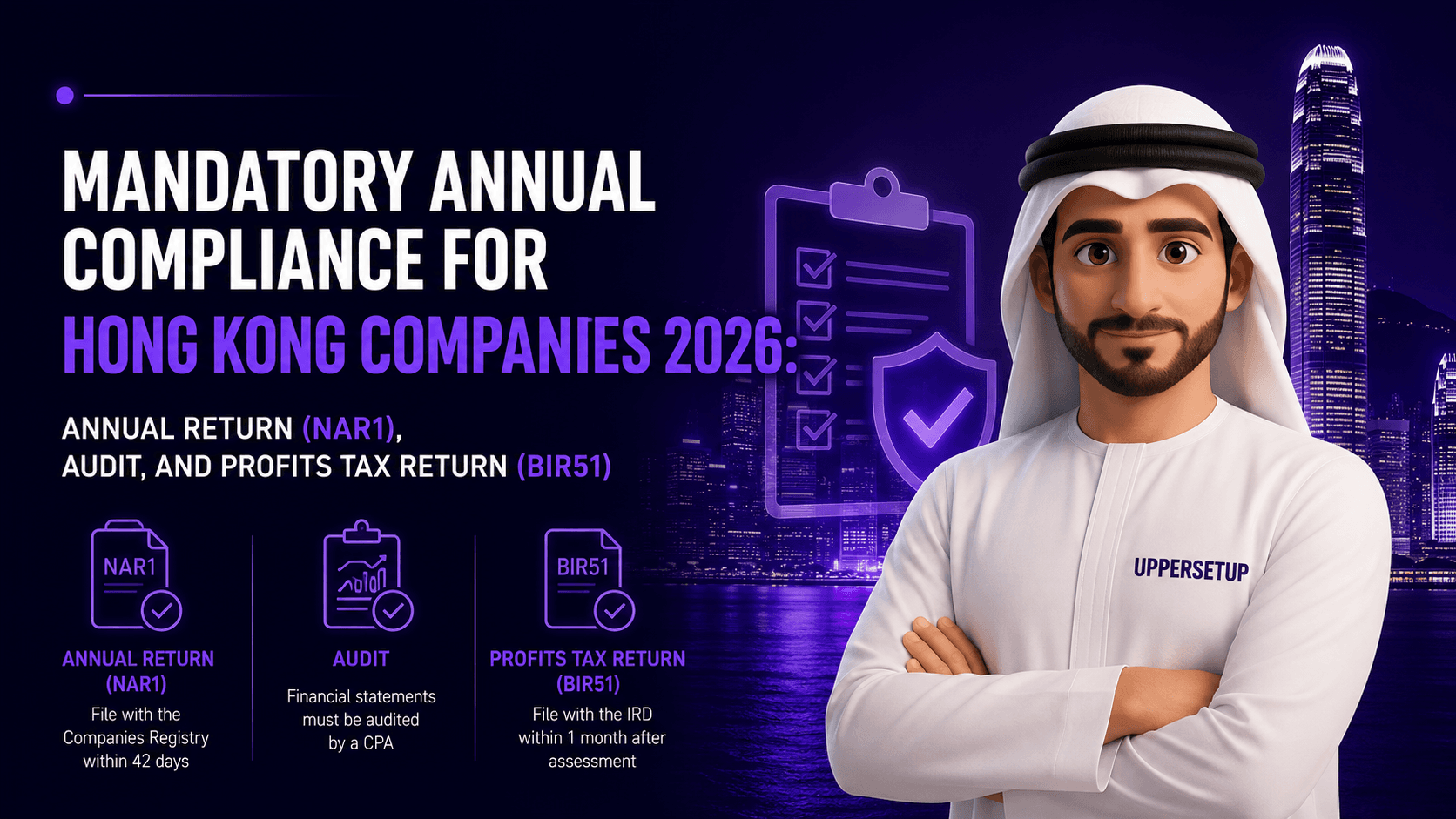
Annual Return (Form NAR1) |
Within 42 days of the registration anniversary |
Companies Registry |
HKD 105 on time; escalating scale up to HKD 3,480 if late; criminal liability up to HKD 50,000 |
|
Profits Tax Return (BIR51) |
Annually, within 1 month of issuance |
IRD |
Fine up to HKD 10,000; IRD estimated assessment |
|
SCR update |
Within 7 working days of any change |
Companies Registry |
AML breach, significant fines |
Significant Controllers Register (SCR): all companies must maintain a private register of persons with 25% or more ownership or voting rights control; updates within 7 working days of any change — a requirement tightened under AML rules.
⚠ Even “dormant” companies with no turnover must file annual returns and Profits Tax Returns — there is no exemption simply for having no activity.
Need help with a company secretary and annual compliance? UPPERSETUP legal and corporate services →
8. Hong Kong Compared With Competing Jurisdictions
|
Parameter |
Hong Kong |
Singapore |
UAE (free zone) |
BVI |
|
Profits tax |
8.25%/16.5% (territorial) |
17% (territorial) |
0–9% (depending on QFZP) |
0% |
|
VAT/GST |
None |
9% |
5% (mainland) |
None |
|
Minimum directors |
1 (non-resident) |
1 (Singapore resident) |
1 (non-resident) |
1 (non-resident) |
|
Audit |
Mandatory annually |
Mandatory annually |
Depends on the zone |
Not required |
|
China market access |
Direct (CEPA) |
Limited |
Limited |
None |
Practical interpretation: Singapore requires a resident director — a fundamental constraint for non-resident entrepreneurs. The UAE offers 0% profits tax subject to QFZP conditions but lacks direct China market access. BVI minimises tax but lacks Hong Kong’s reputation and banking infrastructure.
9. Who Hong Kong Fits: Practical Cases
Case 1: An Asia-to-West trading company
An entrepreneur sources goods from Chinese manufacturers and resells to European buyers outside Hong Kong. With proper documentation, profit from such operations may qualify as offshore and be exempt from tax.
Case 2: A holding structure for an Asian asset group
A Hong Kong holding company receives dividends from subsidiaries without withholding tax under applicable CDTAs and manages the group through a Hong Kong board.
Case 3: An IT company or SaaS provider
A developer with clients worldwide and no Hong Kong office sets up a Hong Kong company for international billing and IP holding; with no Hong Kong-sourced income, profit may qualify for offshore exemption.
Case 4: Hong Kong + UAE as a dual structure
Hong Kong serves Asian clients and Chinese suppliers; a UAE free zone company handles Middle East operations, residency visas, and AED/USD banking.
10. Common Mistakes When Registering and Operating in Hong Kong
• Assuming “offshore status” is automatic. Registering in Hong Kong does not grant tax exemption by default — it requires a separate IRD application with supporting evidence and annual reconfirmation.
• Hiring an unlicensed corporate services provider. The company secretary must be a licensed TCSP — breach carries fines and potential criminal liability under Cap. 615.
• Not maintaining bookkeeping from day one. The IRD requires audited financial statements — a company without proper records at the time of the first IRD request is in a highly vulnerable position.
• Missing the NAR1 or Profits Tax Return. Even dormant companies with no turnover must file annual returns; the NAR1 late fee escalates up to HKD 3,480.
• Failing to update the SCR after structural changes. Updates within 7 working days — a requirement tightened under AML rules; ignoring it creates risk for the company and its directors.
11. Who Hong Kong Fits
• Companies conducting international trade between Asia and the rest of the world without a physical Hong Kong presence. Territorial taxation and no director residency requirement make Hong Kong a convenient base for this model.
• Holding structures managing assets across several Asian countries. The network of double taxation agreements substantially reduces the group’s overall tax burden.
12. Who This Does Not Fit
• Companies conducting their primary operating activity directly within Hong Kong. Offshore exemption does not apply to such companies, and the tax burden approaches the full 16.5% rate.
• Large multinational groups with consolidated revenue of EUR 750 million or more, without accounting for Pillar Two. Since fiscal year 2025, such groups are subject to separate HKMTT rules — standard territorial tax analysis alone is insufficient for them.
13. When Professional Verification Is Essential
Self-assessment is worth supplementing with specialist advice when: preparing an offshore exemption claim with proper supporting evidence; choosing between Hong Kong and alternative jurisdictions for a specific business model; and assessing Pillar Two/HKMTT applicability for a group of companies.
FAQ
Do I need to be physically present in Hong Kong to register a company?
No, the entire procedure is conducted online via e-Registry; physical presence is not required.
How much does it cost to register a company in Hong Kong?
HKD 3,895 at filing: Companies Registry fee HKD 1,545 plus Business Registration Certificate HKD 2,350.
Does registering in Hong Kong automatically exempt a company from tax?
No, offshore exemption requires a separate IRD application, supporting evidence, and annual reconfirmation — it does not arise automatically.
Has the 2025/26 profits tax concession been enacted?
Yes, Hong Kong’s Legislative Council passed the relevant legislation on 13 May 2026, gazetted 22 May 2026 — the concession is now in force, not merely proposed.
Can the sole director also serve as company secretary?
No, s. 474 Cap. 622 expressly prohibits one person from holding both roles.
Key Takeaways
• The core statute is the Companies Ordinance (Cap. 622), enacted in 2014 on the model of English law.
• Registration is fully online via e-Registry, taking 1–2 working days, with no physical presence required.
• Profits tax: 8.25% on the first HKD 2 million, 16.5% thereafter; the territorial principle allows exemption for confirmed foreign-sourced profit.
• The 2025/26 tax concession (up to HKD 3,000 per company) was passed by the Legislative Council on 13 May 2026.
• A company secretary is mandatory and must be a licensed TCSP.
• Large MNE groups have been subject to Pillar Two/HKMTT rules since 2025.
Summary
Registering a Private Company Limited by Shares in Hong Kong is governed by the Companies Ordinance (Cap. 622), enacted in 2014, and is conducted entirely online via the e-Registry platform within 1–2 working days with no physical presence required. Registration costs HKD 3,895 (Companies Registry fee HKD 1,545 plus Business Registration Certificate HKD 2,350). Profits tax on Hong Kong-sourced income is 8.25% on the first HKD 2 million and 16.5% thereafter under a two-tiered system; foreign-sourced profit may be untaxed under confirmed offshore status, but this requires a separate application to the Inland Revenue Department rather than arising automatically. The 2025/26 profits tax concession — a 100% reduction capped at HKD 3,000 per company — was passed by Hong Kong’s Legislative Council on 13 May 2026 and gazetted on 22 May 2026. A company secretary is mandatory for every company and must be a licensed Trust and Company Service Provider. Multinational groups with consolidated revenue of EUR 750 million or more have been subject to Pillar Two — Hong Kong Minimum Top-up Tax — rules since fiscal year 2025.
Sources
• Companies Registry Hong Kong — official portal (cr.gov.hk)
• Companies Ordinance (Cap. 622) — official text (elegislation.gov.hk)
• Inland Revenue Department Hong Kong — official portal (ird.gov.hk)
• PwC Hong Kong — Corporate Tax: Significant developments, Pillar Two/HKMTT (taxsummaries.pwc.com)
• Companies Registry Hong Kong — press release of 17 July 2026, first-half-2026 statistics (info.gov.hk)
Disclaimer
This article is for informational purposes only and does not constitute legal, tax, or consulting advice. Information is prepared based on publicly available Hong Kong legislation and official sources as of July 2026. Companies Registry and Inland Revenue Department requirements may change; obtain current information directly from the regulators and consult a qualified legal or tax adviser in Hong Kong before making decisions.
Read more on the topic
All services on the platform
Everything you need to start and run a business - in one place
- 2–10 days
Company Setup
Hong Kong company with a complete set of incorporation documents
Start - Monthly
Accounting and Tax Services
Accounting services in accordance with HKFRS, including monthly reporting.
- 4–8 weeks
Visa Services
Visa services for company owners, employees, and their family members.
- 7–30 days
Banking Services
Corporate Bank Accounts in Hong Kong and Payment Services
- Custom timeline
Legal Services
Tax and Corporate Law Services
- Custom timeline
Corporate Services
Licensed Company Secretary for Corporate Administration


