











 International Free Zone Authority
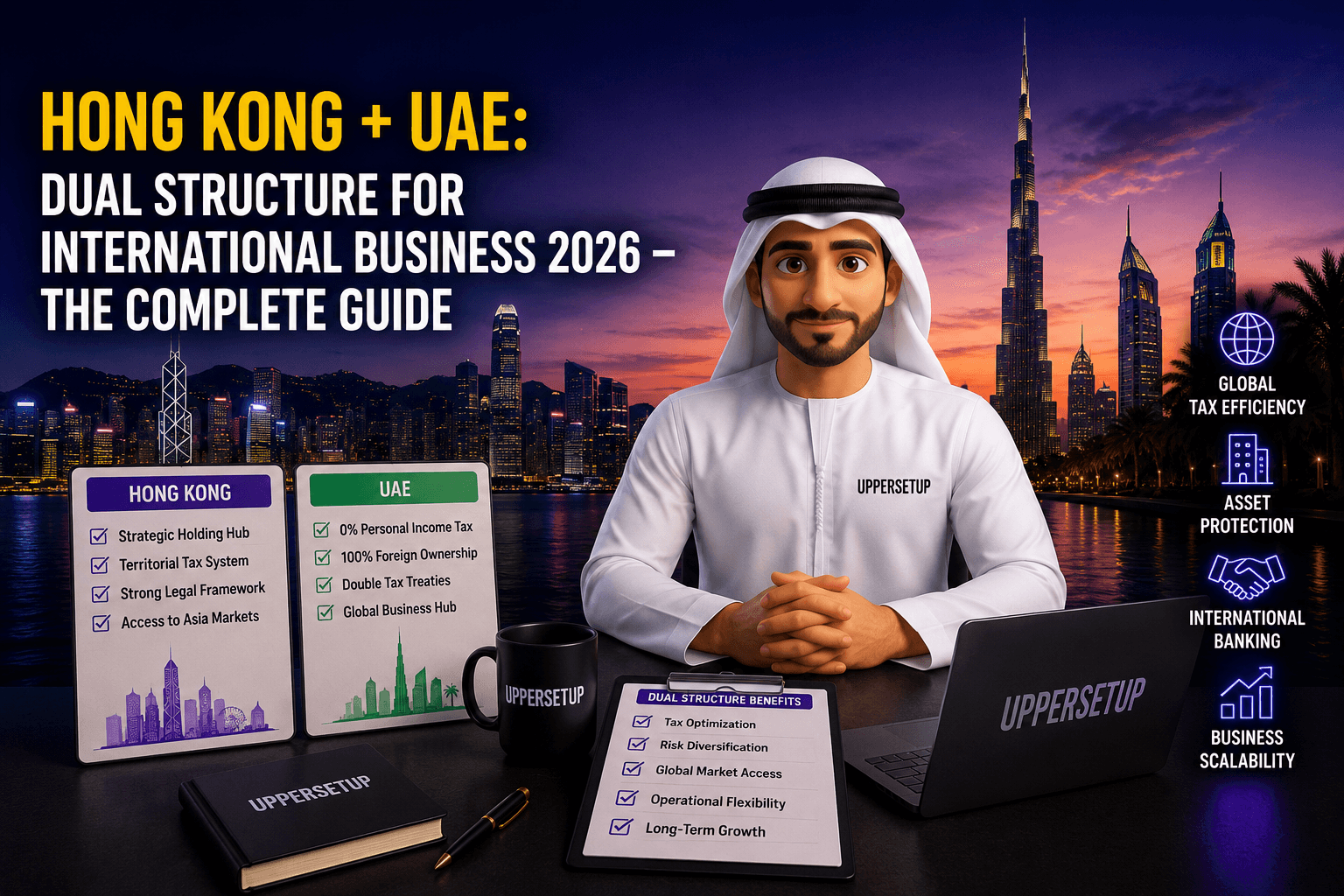
Hong Kong + UAE: Dual Structure for International Business 2026 — The Complete Guide
1. Why Hong Kong + UAE Is Not Simply Two Offshore Companies
Most entrepreneurs thinking about "two jurisdictions" imagine two offshore entities for tax reduction. The Hong Kong + UAE dual structure operates on a fundamentally different logic. These are two complementary jurisdictions with different geographic reach, different legal systems, and different banking ecosystems — which together deliver more than either achieves alone.
• Hong Kong: provides direct access to mainland China via CEPA, 55 signed CDTAs (as of March 2026), and is the premier jurisdiction for Asia-facing operations. For Europe, the Middle East, and Africa, Hong Kong is the "Asian address" that conveys credibility and institutional trust.
• UAE: provides direct access to Middle Eastern and African markets, 137 in-force DTTs, residence and visas for founders and employees, and is the leading hub for USD/AED banking and for attracting capital from Middle Eastern investors.
The key connecting element: the CDTA between Hong Kong and the UAE (signed 11 December 2014, in force from December 2015) creates the legal framework for zero or minimal taxation of dividends, interest, and royalties flowing between the two jurisdictions.
2. Hong Kong and UAE: Key Differences
|
Parameter |
Hong Kong |
UAE (free zone / mainland) |
|
Corporate tax |
8.25% / 16.5% (territorial principle); 0% under offshore status |
0% for QFZP (free zone, conditions); 9% for mainland/non-QFZP |
|
VAT |
None |
5% (VAT) on turnover > AED 375,000/year |
|
Dividend tax |
0% (no withholding tax) |
0% (no withholding tax) |
|
Capital gains tax |
0% |
0% |
|
Legal system |
English common law |
English common law (DIFC, ADGM); civil law (mainland, free zones) |
|
China market access |
Direct (CEPA, CDTA with China; RMB infrastructure; QFII/RQFII) |
Limited (no CEPA with China) |
|
Middle East / Africa market access |
Limited |
Direct (UAE — largest MENA hub) |
|
DTT/CDTA network |
55 signed CDTAs (as of March 2026, KPMG; majority in force) |
137 in-force DTTs (UAE Ministry of Finance) |
|
CDTA between HK and UAE |
Yes — signed 11 Dec 2014, in force from 2015 |
Yes — signed 11 Dec 2014, in force from 2015 |
|
HK-UAE CDTA rates |
Dividends: 5%; Interest: 5%; Royalties: 5% |
Dividends: 5%; Interest: 5%; Royalties: 5% |
|
Visas and residency |
Work visas via Employment Pass; no Golden Visa |
Golden Visa, Green Visa, work visas; developed residency programme |
|
Banking ecosystem |
HSBC, Standard Chartered, HKMA virtual banks; Asia banking leader |
Emirates NBD, FAB, Mashreq; strong for MENA and USD transactions |
|
Physical presence |
Not required for incorporation; non-resident director permitted |
Not required for most free zones; non-resident director permitted |
|
Reputation in Asia |
Highest |
Medium (growing) |
|
Reputation in Middle East |
Medium |
Highest |
Practical conclusion: Hong Kong is indispensable where China and Asia are needed. The UAE is indispensable where the Middle East, Africa, residency, and banking are needed. A structure combining both occupies a uniquely competitive position — particularly for companies operating across the two regions.
3. The HK-UAE CDTA: What the Agreement Provides
Key parameters of the HK-UAE CDTA
• Signed: 11 December 2014.
• In force from: December 2015 (Issue 34, Deloitte HK Tax Newsflash).
• Covers: corporate profits tax and individual income tax.
• Rates: dividends — 5%; interest — 5%; royalties — 5%.
• Capital gains: exempt from taxation (except real estate and shares more than 50% backed by real estate).
|
Income type |
HK-UAE CDTA rate |
Without CDTA (HK rate) |
Without CDTA (UAE rate) |
Value of CDTA |
|
Dividends |
5% |
0% (HK does not withhold) |
0% (UAE does not withhold) |
Symmetric protection; primary value is with third countries |
|
Interest |
5% |
0% (HK) |
0% (UAE) |
Symmetric protection |
|
Royalties |
5% |
2.475%–4.95% (HK) |
0% (UAE) |
Reduction for payments from UAE to HK |
|
Capital gains on shares |
0% (excl. real estate) |
0% (HK) |
0% (UAE) |
Exemption |
|
Business profits (no permanent establishment) |
0% |
Under HK territorial principle |
0% (UAE) |
Prevention of PE disputes |
Practical uses of the HK-UAE CDTA
• Royalties from UAE to HK. The UAE operating company pays royalties to the Hong Kong IP holding company at the 5% CDTA rate instead of the standard Hong Kong rate (2.475–4.95%). The saving is modest in isolation, but the CDTA eliminates classification uncertainty.
• Preventing permanent establishment disputes. The CDTA clearly defines in which jurisdiction a permanent establishment arises. This is critical for structures where a director of one company participates in the activities of another.
• Tax residency recognition. When receiving income through a Hong Kong company from a third country that has a CDTA with Hong Kong, the HK-UAE CDTA confirms the treaty entitlement chain.
• Protection against double taxation with mixed activities. Where a company operates in both Hong Kong and the UAE, the CDTA prevents claims from both tax authorities.
● Practical requirement — Certificate of Resident Status (CoR): to claim CDTA benefits, the Hong Kong company must obtain a Certificate of Resident Status (CoR) from the IRD and present it to the foreign withholding agent. The CoR confirms tax residency and requires evidence of genuine substance in Hong Kong (staff, office, management).
⚠ Hong Kong levies no withholding tax on dividends — neither inbound nor outbound. The UAE similarly does not withhold. Therefore the practical value of the HK-UAE CDTA on dividends is not rate reduction, but formal legal confirmation of zero taxation — which banks and foreign tax authorities treat as more reliable than simply the absence of a national withholding law.
Need help with company registration in Hong Kong? UPPERSETUP company registration services →
4. Four Operating Models for the Dual Structure
|
Model |
Description |
Who uses it |
Hong Kong does |
UAE does |
|
Model 1: Trading hub |
HK — billing with Asia; UAE — billing with Middle East and Africa |
Trading companies, distributors, wholesalers |
Receives payments from Asian clients; works with Chinese suppliers via CEPA |
Receives payments from ME clients; converts AED/USD |
|
Model 2: Holding + operations |
HK — holding structure for Asian assets; UAE — operating company |
Investment groups, PE, family offices |
Holds shares in Asian operating companies; receives dividends under CDTA |
Conducts ME/Africa operations; provides visas and residency for founders |
|
Model 3: IP + licensing |
HK — IP owner; UAE — operating licensee |
IT companies, SaaS, media, brands |
Holds IP (patents, trade marks, software); licences at favourable HK-UAE CDTA rates |
Pays royalties at reduced 5% CDTA rate; conducts operations |
|
Model 4: Financial hub + Asian gateway |
UAE — financial centre (DIFC/ADGM) for MENA investors; HK — access to China and APAC |
Financial companies, asset managers, fintech |
Provides access to Chinese capital markets (HKEX, QFII, Bond Connect); CEPA benefits |
DIFC/ADGM licence; capital raising from ME investors and institutions |
5. Hong Kong + UAE: CEPA and China Market Access
CEPA (Closer Economic Partnership Arrangement) is the agreement between Hong Kong and mainland China that has no equivalent in any other jurisdiction. For entrepreneurs using a dual structure, CEPA means:
• Zero tariffs: Hong Kong-origin goods enter mainland China without customs duties.
• Service market access: Hong Kong companies in several sectors (finance, professional services, education) receive preferential access to the mainland Chinese market.
• RMB infrastructure: Hong Kong is the leading offshore settlement centre for Chinese yuan (CNH). The dual structure enables AED/USD receipts in the UAE and CNH operations via Hong Kong.
• QFII / Bond Connect: Hong Kong companies have direct access to the Chinese capital market through qualified foreign institutional investor mechanisms.
Strategic significance: no company in the UAE, Singapore, or the EU will obtain these advantages without a Hong Kong structure. For businesses with Chinese suppliers or buyers, this is a structural competitive advantage that cannot be replicated by other jurisdictions.
6. Practical Use Cases
Case 1: Asia-to-MENA trading company
An entrepreneur sources electronics from manufacturers in Shenzhen and Guangzhou and sells to distributors in the UAE, Saudi Arabia, and Egypt. Structure: Hong Kong company — contracts with Chinese suppliers, issues invoices. UAE company (free zone) — receives goods, resells to Middle Eastern clients, receives payments in AED/USD. Outcome: the Hong Kong entity claims offshore status (operations outside Hong Kong); the UAE company qualifies as QFZP. Profits in both jurisdictions are taxed at minimal rates.
Case 2: IT company with Asia and Middle East clients
A SaaS platform with a development team in Eastern Europe. Clients: 40% Asia (Japan, South Korea, Singapore), 35% Middle East, 25% Europe. Structure: Hong Kong — billing for Asian clients; IP holding for Asian CDTAs. UAE (DIFC) — billing for Middle East and European clients; FSRA licence if required. Interface: UAE company licences software from the Hong Kong IP holding. Royalties at 5% under the HK-UAE CDTA.
Case 3: Investment holding for Asian assets
An investor holds assets in Vietnam, Indonesia, and India. Structure: Hong Kong holding company — holds shares in operating subsidiaries; uses Hong Kong CDTAs with Vietnam, Indonesia, and India to reduce withholding taxes. UAE company — provides residency for the founder (Golden Visa); manages the portfolio for Middle Eastern LP investors; USD banking. Outcome: dividends from Asia reach Hong Kong with minimal withholding tax (CDTA), then the UAE — via the HK-UAE CDTA with guaranteed zero additional taxation.
Case 4: DIFC financial company + Hong Kong representation
An asset management company with a DFSA licence at DIFC seeks to expand its client base among Asian institutional investors and Family Offices from Hong Kong, Japan, and Korea. Structure: UAE (DIFC) — main operating company with DFSA licence; raises capital from Middle Eastern investors. Hong Kong — representative office or licensed entity for Asian investor relations; HKEX and regional exchange platform access. Outcome: UAE provides recognition in MENA, Hong Kong in Asia; both jurisdictions create comprehensive coverage of key regions.
7. Economic Substance Requirements: What Cannot Be Ignored
Hong Kong: Economic Substance for offshore status
A Hong Kong company claiming 0% tax (offshore status) must annually confirm to the IRD that its activities are genuinely conducted outside Hong Kong. This means: contracts concluded outside Hong Kong, decisions made outside Hong Kong, directors acting outside Hong Kong. If management is exercised from within Hong Kong — the profits are Hong Kong-sourced.
UAE: QFZP and Qualifying Activities
A UAE free zone company claiming 0% corporate tax must satisfy QFZP requirements: conduct only Qualifying Activities or ancillary activities; observe de-minimis conditions for non-qualifying income; maintain adequate free zone presence (personnel, assets, expenditure).
For the dual structure: the key question
The primary operational risk of a dual structure is blending activities. If the director of the Hong Kong company makes decisions in Dubai — the Hong Kong company risks losing its offshore status. If UAE employees effectively manage the Hong Kong entity — a permanent establishment test may arise. Solution: clear functional separation between entities; independent documentation; separate directors for each structure.
⚠ BEPS Pillar Two (global minimum tax of 15%) applies to MNE groups with consolidated revenue of EUR 750 million or more. For the vast majority of entrepreneurs using a Hong Kong + UAE dual structure, this is not applicable. However, larger groups must account for this when structuring.
Need help with company registration in the UAE? UAE company registration — uppersetup.com →
8. Banking in the Dual Structure
Hong Kong account
The Hong Kong corporate account — for transactions with Asian counterparties, CNH and USD settlements in the Asian time zone, and receiving payments from Chinese clients. Traditional banks: HSBC, Standard Chartered, Bank of China (HK). Fintech: Airwallex, Statrys — for international payments without a physical visit.
UAE account
The UAE company account — for MENA client settlements in AED/USD, FX conversion, and supplier transactions in the MENA region. Emirates NBD, FAB, Mashreq — traditional banks with strong UAE coverage. Wio Bank, Mashreq NeoBiz — digital alternatives.
Inter-company transactions
Transfers between the Hong Kong and UAE entities must comply with transfer pricing rules (arm's length principle): prices must reflect market rates. The HK-UAE CDTA ensures zero or minimal taxation of these flows, but TP compliance is a mandatory requirement in both jurisdictions.
9. Common Mistakes
• Creating two companies without clear functional separation. If both companies effectively do the same thing, tax authorities may reclassify the structure as a single permanent establishment or treaty abuse.
• Managing the Hong Kong company from the UAE. A Hong Kong company director working from Dubai creates risk for the offshore status claim and may trigger a POEM test in Hong Kong.
• Not formalising licensing agreements or inter-company contracts. Royalty and service payments between structures must be formally documented with correct TP pricing. Absence of a contract is grounds for reclassifying the payment.
• Ignoring FSIE in Hong Kong. If the Hong Kong company is part of an MNE group (at least one foreign subsidiary) — passive income (dividends, interest, royalties) is subject to the FSIE regime. Economic Substance or Participation Exemption is required.
• Failing to account for the founder's own tax residency. Running the structure from a country with aggressive CFC rules (Germany, France, UK) may result in the profits of both companies being attributed to the individual in their country of residence.
10. Checklist: Where to Start
• Map the business geography: where are the clients, suppliers, and key counterparties.
• Determine: is China needed (→ Hong Kong mandatory) and/or the Middle East (→ UAE).
• Select the model: trading hub, holding, IP structure, or financial platform.
• Register the Hong Kong company (1–2 working days, HKD 3,895 government fee).
• Register the UAE company (free zone or mainland, 1–5 working days).
• Draft inter-company agreements: licensing, services, loans.
• Ensure economic substance: separate directors, separate functions, independent documentation.
• Open bank accounts: Hong Kong (for Asia), UAE (for MENA/USD).
• Obtain a UAE TRC for the founder (if required by the country of origin).
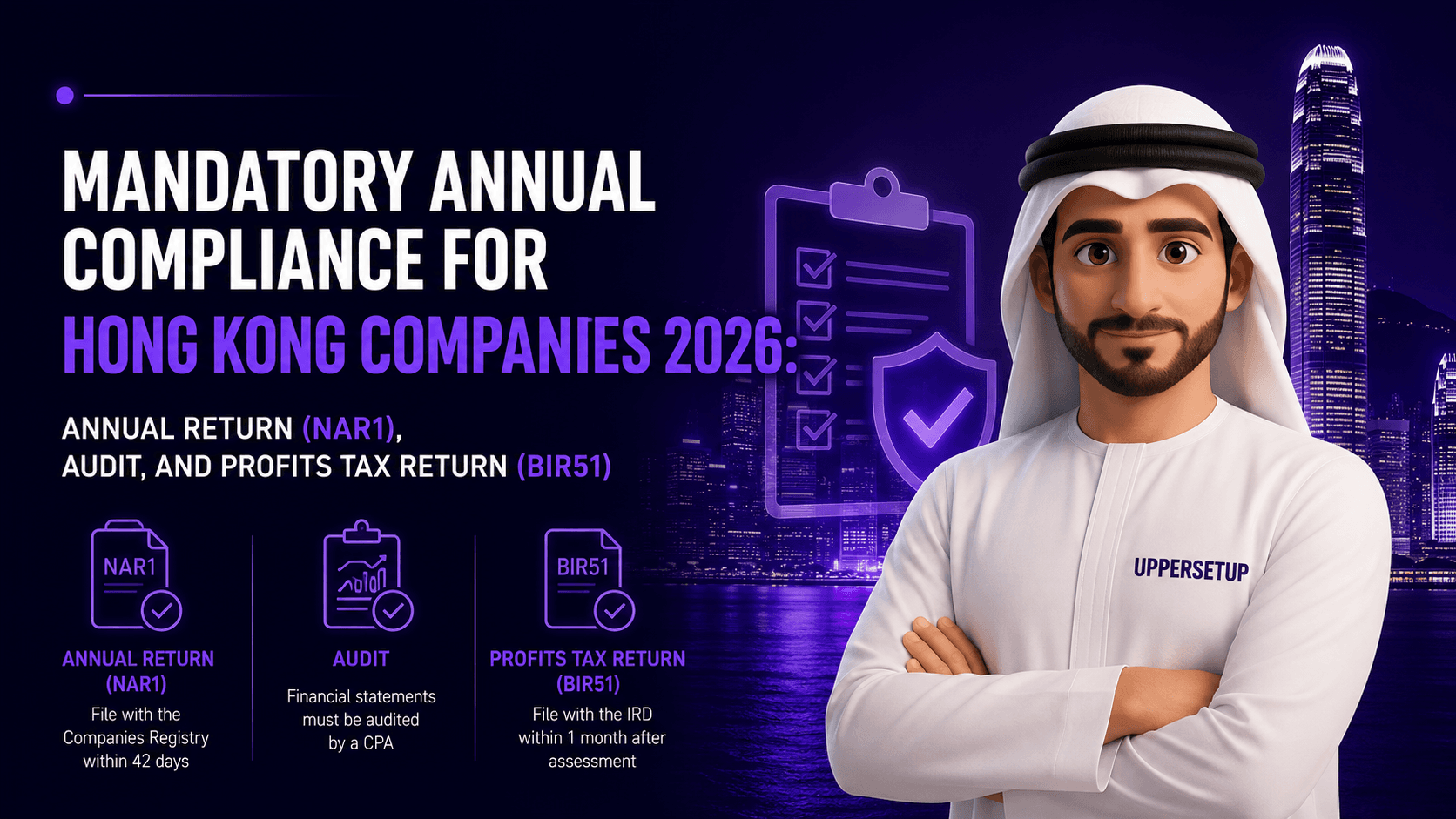
• Annually: audit in Hong Kong, compliance in UAE, update TP documentation.
Sources
• HK-UAE CDTA — official agreement text (ird.gov.hk)
• IRD Hong Kong — CDTA network: full list (ird.gov.hk)
• KPMG China — Tax Alert: HK-Norway CDTA signed (55th agreement, December 2025)
• UAE MOF — DTT network: full list (mof.gov.ae)
• UAE FTA — Corporate Tax (tax.gov.ae)
• InvestHK — CEPA: Closer Economic Partnership Arrangement (investhk.gov.hk)
• IRD Hong Kong — Profits Tax: territorial principle (ird.gov.hk)
• Deloitte China — HK Tax Newsflash: HK-UAE CDTA in force (December 2015)
• South China Morning Post — Hong Kong business 2026 (scmp.com)
• Financial Times — UAE and Hong Kong as international financial hubs (ft.com)
• Woodburn Accountants — Hong Kong DTA Network Expands 2026 (woodburnglobal.com)
Disclaimer
This article is provided for informational purposes only and does not constitute legal, tax, or corporate advisory. A Hong Kong + UAE dual structure requires analysis of specific circumstances, the tax legislation of both jurisdictions, and the tax residency requirements of the country of origin. Tax rates, economic substance requirements, and regulations are subject to change. Before making any decisions, readers are advised to consult qualified legal and tax advisers in both jurisdictions. UPPERSETUP accepts no liability for actions taken solely in reliance on this material.
Read more on the topic
Emiratisation 2026: The Complete Employer Guide — Quotas, Penalties, Nafis, and the 30 June Deadline
Stamp Duty on Share Transfers in Hong Kong 2026: Rates, Net-Asset Valuation, Deadlines and Penalties
All services on the platform
Everything you need to start and run a business - in one place
- 3–5 days
Company Setup
Mainland or Free Zone company with a complete set of incorporation documents
Start - Monthly
Accounting Services
Financial accounting and reporting in accordance with UAE requirements
Start - 1–2 weeks
Visa Services
Residence visas for shareholders, employees and family members
Start - 7–30 days
Banking Services
Corporate Bank Accounts in the UAE and Payment Services
Start - Custom timeline
Legal Services
Contracts, corporate amendments and legal support
Start


