












 International Free Zone Authority
SFC Licences Types 1–9 in Hong Kong in 2026: Responsible Officers, the MIC Regime, Capital and Competence
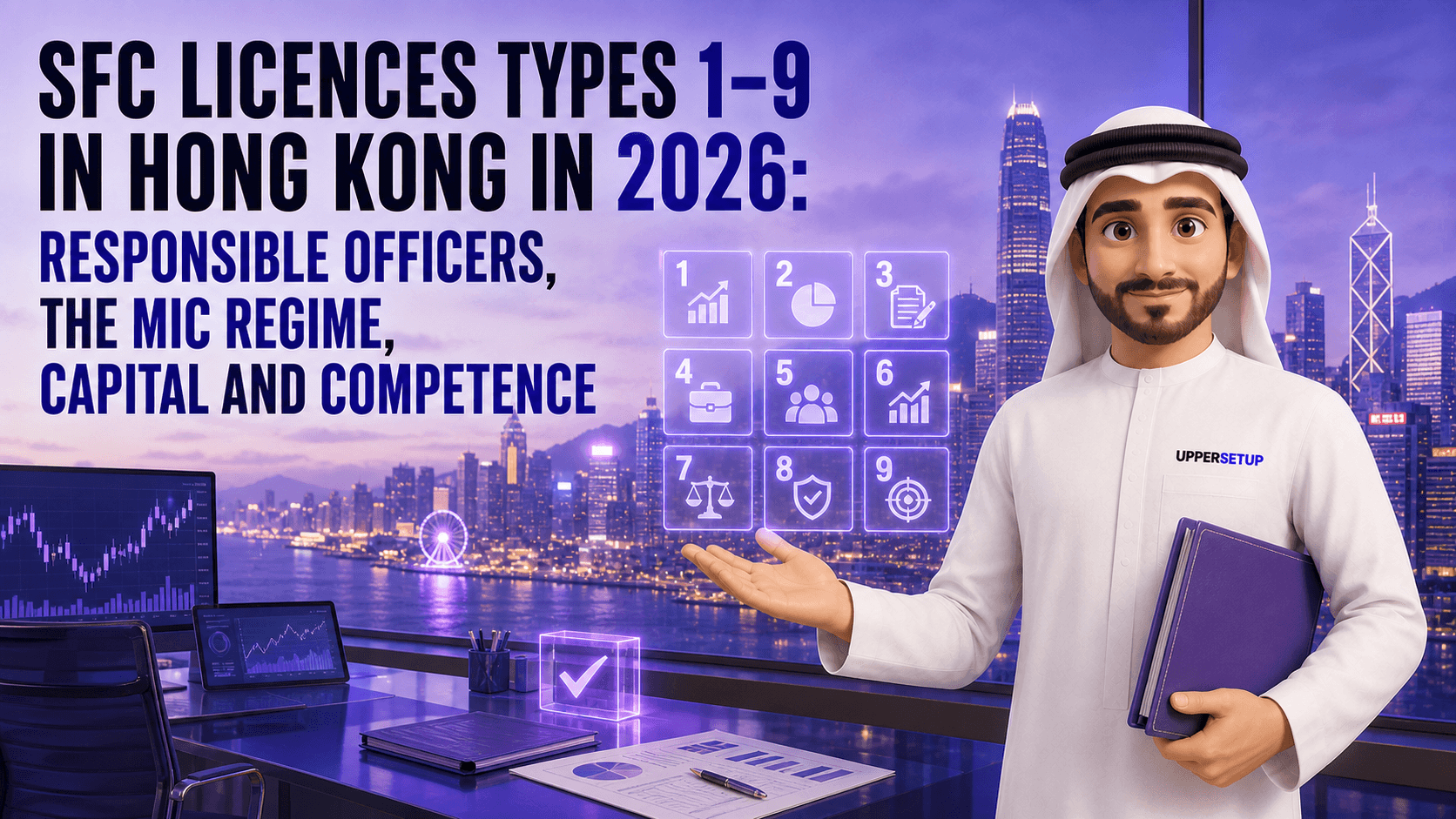
A licence from Hong Kong’s Securities and Futures Commission (SFC) is mandatory for anyone carrying on a business in one of the regulated activities listed in Part 1 of Schedule 5 to the Securities and Futures Ordinance (Cap. 571). The Schedule lists thirteen activities, but only eleven are live: Types 1 to 10 and Type 13. For each activity a corporation must have at least two approved Responsible Officers (ROs), the prescribed paid-up share capital, and liquid capital maintained at all times under the Financial Resources Rules.
Important. Carrying on a business in a regulated activity without a licence is a criminal offence under section 114(1) of Cap. 571: on conviction on indictment, a fine of HK$5,000,000 and 7 years’ imprisonment, plus HK$100,000 for every day the offence continues. Section 114(3) creates a separate offence for an individual who performs a regulated function without a representative’s licence.
The second point drives the cost structure: the minimum paid-up capital turns not on the size of the business but on the activity type and on a single licensing condition. An asset manager (Type 9) subject to the condition that it must not hold client assets needs HK$5,000,000 of paid-up capital and HK$100,000 of liquid capital; the same Type 9 without that condition needs HK$3,000,000 of liquid capital — thirty times more.
Key parameters as at September 2026
|
Parameter |
Position |
Source |
|
Regulator |
Securities and Futures Commission (SFC) |
Cap. 571, Part V |
|
List of activities |
Types 1 to 13 in Part 1 of Schedule 5 |
Cap. 571, Sch. 5 |
|
Activities actually in force |
11: Types 1 to 10 and Type 13 |
Sch. 5, editorial notes |
|
Not yet in operation |
Type 11 and Type 12 |
Sch. 5, notes “#” and “@” |
|
Type 13 in force from |
2 October 2024 |
L.N. 62 of 2023; SFC press release 30.09.2024 |
|
Operating without a licence |
fine of HK$5,000,000 and 7 years’ imprisonment |
s. 114(8)(a) |
|
Minimum responsible officers |
2 for each activity, at least one an executive director |
s. 125(1) |
|
Paid-up capital, standard case |
HK$5,000,000 |
Cap. 571N, Sch. 1, Table 1 |
|
Paid-up capital, Type 3 |
HK$30,000,000 |
Cap. 571N, Sch. 1, Table 1 |
|
Liquid capital, standard case |
HK$3,000,000 |
Cap. 571N, Sch. 1, Table 2 |
|
Liquid capital where client assets may not be held |
HK$100,000 |
Cap. 571N, Sch. 1, Table 2 |
|
SFC notification trigger |
liquid capital below 120% of required — 1 business day |
Cap. 571N, s. 55(1)(a) |
|
Corporate licence application fee |
HK$4,740 per activity; Type 3 — HK$129,730 |
Cap. 571AF, Sch. 3, item 3 |
|
RO approval fee |
HK$2,950 per activity |
Cap. 571AF, Sch. 3, item 12 |
|
Annual fee |
charged again from 1 April 2025; HK$4,740 per activity |
SFC circular 25EC16 |
|
Processing pledge, corporate application |
15 weeks |
SFC performance pledges |
|
Processing pledge, RO application |
10 weeks |
SFC performance pledges |
|
CPT for an RO |
12 hours per calendar year |
Guidelines on CPT, para 5.2 |
|
Licensed corporations |
3,517 as at 30 June 2026 |
SFC, Table C1 |
|
Responsible officers |
10,161 as at 30 June 2026 |
SFC, Table C1 |
The normative base: four instruments and three sets of guidance
The SFC licensing regime rests on one ordinance and three sets of subsidiary rules. Everything else is guidance that carries no force of law but whose breach goes directly to a licensee’s fitness and properness.
The instruments that have the force of law
|
Instrument |
What it governs |
Current version |
|
Securities and Futures Ordinance (Cap. 571) |
the list of regulated activities, the licensing obligation, responsible officers, the fit and proper test |
version of 23.05.2025 |
|
Financial Resources Rules (Cap. 571N) |
paid-up share capital, liquid capital, returns and notifications |
version of 02.10.2024 |
|
Fees Rules (Cap. 571AF) |
application fees, approval fees and annual fees |
version of 13.12.2018 |
|
Anti-Money Laundering Ordinance (Cap. 615) |
a licensee’s customer due diligence duties |
applies in parallel |
Part V of Cap. 571 is the core of the regime. It contains section 114 (the prohibition on carrying on a regulated activity without a licence), section 116 (grant of a corporate licence), section 120 (representative’s licence), section 125 (the requirement for responsible officers), section 126 (approval of a responsible officer), section 129 (the fit and proper test) and section 130 (approval of premises).
Schedule 5 to Cap. 571, as it now stands, lists thirteen activities. Type 10 was added by L.N. 28 of 2011; Types 11 and 12 by the Amendment Ordinance 6 of 2014; Type 13 by L.N. 62 of 2023.
SFC guidance: binding in practice, not in law
|
Document |
Current edition |
What it settles |
|
Licensing Handbook |
July 2025 |
application practice, structural expectations, MICs |
|
Guidelines on Competence |
October 2024 |
academic, examination and experience requirements for ROs and representatives |
|
Guidelines on Continuous Professional Training |
January 2022 |
continuing training hours |
|
Fit and Proper Guidelines |
January 2022 |
the general fitness test |
|
Circular on Managers-In-Charge of Core Functions |
16 December 2016 |
the eight core functions and MICs |
Paragraph 1.5 of the Guidelines on Competence states their status plainly: they do not have the force of law and should not be interpreted in a way that would override the provisions of any applicable laws, codes or other regulatory requirements; failure to follow them may reflect adversely on a person’s fitness and properness to carry on a regulated activity.
The practical consequence: guidance cannot be breached with impunity, but breaching it is not an offence — it is a ground for refusing a licence or opening disciplinary proceedings.
What has changed in the past two years
First: on 2 October 2024 the Type 13 regime — depositary services for SFC-authorised collective investment schemes — came into force. On the launch date the SFC licensed or registered 19 depositaries and more than 300 of their staff.
Second: a new edition of the Guidelines on Competence was issued in October 2024, replacing the January 2022 edition.
Third: a new edition of the Licensing Handbook was issued in July 2025, replacing the January 2022 edition.
Fourth: from 1 April 2025 the SFC resumed collecting annual licensing fees, which had been waived for several consecutive years. That is a straight increase in the cost of holding a licence, and it caught part of the market unprepared.
What is proposed but not yet law
On 14 July 2025 the SFC published a 430-page paper, “Consultation Conclusions on the 2017 Further Consultation on Proposed Changes to the Securities and Futures (Financial Resources) Rules”. The paper concludes the 2017 consultation and simultaneously puts out for comment a set of draft amendments to Cap. 571N, draft Guidelines for Internal Models Approach and draft General Principles for Model Risk Management.
Section III of the paper deals with minimum capital requirements, and Appendix 4 contains the draft amendments to the Financial Resources Rules themselves. The deadline for written comments was 13 October 2025.
As at September 2026 no conclusions on that consultation have been published and no amendments to Cap. 571N have been made. The Rules remain in the version of 2 October 2024, and every capital figure in this article is taken from it.
The practical consequence: the figures in the consultation paper are a draft, not a rule. A structure cannot be planned on them, though the direction of travel is worth noting in long-range planning, particularly for participants in OTC derivatives.
Separately from the Cap. 571N regime, in December 2025 the SFC published material on two proposed virtual asset regimes — one for custodian services and one for dealing in virtual assets. These are free-standing regimes with their own capital parameters, not amendments to the Financial Resources Rules, and they should not be conflated with Types 1 to 13.
Thirteen regulated activities, of which eleven actually operate
Part 1 of Schedule 5 to Cap. 571 lists thirteen regulated activities. Two of them — Type 11 and Type 12 — have never been brought into operation, so no licences exist for them.
The full list with its real status
|
Type |
Activity |
Status |
|
Type 1 |
dealing in securities |
in force |
|
Type 2 |
dealing in futures contracts |
in force |
|
Type 3 |
leveraged foreign exchange trading |
in force |
|
Type 4 |
advising on securities |
in force |
|
Type 5 |
advising on futures contracts |
in force |
|
Type 6 |
advising on corporate finance |
in force |
|
Type 7 |
providing automated trading services |
in force |
|
Type 8 |
securities margin financing |
in force |
|
Type 9 |
asset management |
in force |
|
Type 10 |
providing credit rating services |
in force (added by L.N. 28 of 2011) |
|
Type 11 |
dealing in or advising on OTC derivative products |
not yet in operation |
|
Type 12 |
client clearing services for OTC derivative transactions |
partly in operation only |
|
Type 13 |
depositary services for relevant CISs |
in force from 2 October 2024 |
Why Types 11 and 12 are on the list but cannot be obtained
Editorial note “#” to Schedule 5 reads: Type 11 is not yet in operation. It was added by section 53 of the Amendment Ordinance 6 of 2014, but no commencement notice has been made for it as a licensable activity.
Editorial note “@” explains what happened to Type 12: the new Type 12 came into operation on 1 September 2016 only in so far as it relates to paragraph (c) of the new definition of “excluded services” in Part 2 of Schedule 5. The authority is paragraph (g) of Commencement Notice L.N. 27 of 2016. Type 12 therefore functions as a component of a definition, not as a licensable activity.
Paragraph 1.1.1 of the Licensing Handbook July 2025 confirms the position independently of Schedule 5: listing the thirteen activities, the handbook marks both Type 11 and Type 12 with “#” and the note “Not yet in operation for licensing purposes”.
Footnote 1 to the Guidelines on Competence confirms the same position: the requirements for RA 11 and RA 12 apply “effective upon the commencement of the new licensing regime for these RAs”.
The practical test: if an adviser offers to “obtain a Type 11 derivatives licence”, they have not read the current Schedule 5. OTC derivatives in Hong Kong today fall within Types 1, 2, 4, 5 and 9 depending on the structure of the product and the role of the person.
How many licences exist for each type
SFC data as at 30 June 2026 show licensed corporations holding 7,038 regulated activity licences between 3,517 corporations — an average of two licences per company.
|
Type |
Licences held by corporations at 30.06.2026 |
Change since end-2024 |
|
Type 1 |
1,507 |
+44 |
|
Type 2 |
314 |
−5 |
|
Type 3 |
29 |
0 |
|
Type 4 |
2,216 |
+214 |
|
Type 5 |
165 |
−2 |
|
Type 6 |
282 |
−10 |
|
Type 7 |
38 |
+5 |
|
Type 8 |
4 |
−1 |
|
Type 9 |
2,454 |
+242 |
|
Type 10 |
11 |
+1 |
|
Type 13 |
18 |
+1 |
|
Total |
7,038 |
+489 |
Three numbers in that table explain the shape of the market. Type 9 is both the most common licence (2,454) and the fastest growing (+242 in eighteen months). Only four corporations hold Type 8. Twenty-nine hold Type 3 — a direct consequence of its HK$30,000,000 paid-up capital requirement.
Incorporating the company itself in Hong Kong is a separate and prior step: the procedure is set out in our guide to Hong Kong company registration.
Types 1, 2 and 3: dealing, futures and leveraged foreign exchange
Types 1, 2 and 3 share one feature: all three concern entering into transactions rather than advising on them. The dividing line is the subject matter — securities, futures contracts, or leveraged foreign exchange contracts.
Type 1 — dealing in securities
The Part 2 definition: dealing in securities means making or offering to make an agreement with another person, or inducing or attempting to induce another person to enter into or offer to enter into an agreement, for or with a view to acquiring, disposing of, subscribing for or underwriting securities, or the purpose or pretended purpose of which is to secure a profit to any of the parties from the yield of securities or by reference to fluctuations in their value.
The definition is built around making an agreement, not around holding an asset. That is why it captures brokers, dealers, placing desks and distributors of fund units.
Four categories are carved out: a recognized exchange company operating a stock market; a recognized clearing house; a corporation providing automated trading services under an authorization granted under section 95(2); and a person who performs the act through another person licensed or registered for Type 1.
That last carve-out has a built-in limit: the person is still regarded as dealing in securities if, in return for a commission, rebate or other remuneration, they receive an offer or invitation from a third person and communicate it to the securities dealer. “I simply pass clients to a broker for a share of the fee” does not escape licensing.
Type 2 — dealing in futures contracts
Type 2 reproduces the Type 1 construction for futures contracts. The practical dividing line with Type 1 is the instrument: exchange-traded options over securities sit in Type 1, while futures and options contracts traded on a recognized futures market sit in Type 2.
Type 3 — leveraged foreign exchange trading
The definition covers three acts: entering into or offering to enter into a leveraged foreign exchange contract, or inducing someone to do so; providing financial accommodation to facilitate foreign exchange trading or that first act; and entering into or offering to enter into an arrangement with another person, on a discretionary basis or otherwise, to enter into a contract facilitating either of the first two acts.
Excluded are acts performed for or in connection with a contract or arrangement wholly referable to the provision of property other than currency, or of services or employment, at fair or market value.
Type 3 is the most expensive licence in the regime: HK$30,000,000 of paid-up share capital and HK$15,000,000 of liquid capital in the ordinary case. Twenty-nine corporations as at 30 June 2026 is the direct consequence of that figure.
One exception: a corporation that is an approved introducing agent for Type 3 needs only HK$5,000,000 of paid-up capital and HK$3,000,000 of liquid capital. The status is granted by the SFC under section 58(4) of Cap. 571N.
How the three compare on capital
|
Measure |
Type 1 ordinary |
Type 1 providing margin financing |
Type 2 |
Type 3 ordinary |
Type 3 introducing agent |
|
Paid-up capital |
HK$5,000,000 |
HK$10,000,000 |
HK$5,000,000 |
HK$30,000,000 |
HK$5,000,000 |
|
Liquid capital |
HK$3,000,000 |
HK$3,000,000 |
HK$3,000,000 |
HK$15,000,000 |
HK$3,000,000 |
The Type 1 margin financing row is a frequent error: a corporation licensed for Type 1 that provides securities margin financing to clients must hold HK$10,000,000 of paid-up capital, not HK$5,000,000.
How the tax position of such a company is built, and what the territorial principle delivers, is examined in our article on Hong Kong profits tax deductions and incentives.
Types 4, 5 and 6: three kinds of advice and the “wholly incidental” carve-out
Types 4, 5 and 6 cover advice. All three carry the same structure of exclusions, the most important of which is “wholly incidental”: advice that is entirely ancillary to another licensed activity needs no separate licence.
Type 4 — advising on securities
The definition: advising on securities means giving advice on whether, which, the time at which, or the terms or conditions on which securities should be acquired or disposed of; or issuing analyses or reports for the purpose of facilitating recipients to make decisions on those same four questions.
The formula “whether, which, the time at which, the terms or conditions on which” is repeated word for word in Types 4 and 5. It means advice is not only a recommendation to buy, but also a recommendation on timing and terms.
Type 5 — advising on futures contracts
Type 5 reproduces the Type 4 construction for futures contracts, covering both the giving of advice and the issuing of analyses and reports.
Type 6 — advising on corporate finance
Type 6 is built differently: it enumerates three subject areas.
The first: advice concerning compliance with, or in respect of, rules made under section 23 or 36 of the Ordinance governing the listing of securities, and the code published under section 399(2)(a) or (b).
The second: advice concerning an offer to dispose of securities to the public, an offer to acquire securities from the public, or acceptance of such an offer — but only in so far as the advice is given generally to holders of securities or a class of securities.
The third: advice to a listed corporation or public company, or a subsidiary of either, or to its officers or shareholders, concerning corporate restructuring in respect of securities, including the issue, cancellation or variation of rights attaching to securities.
The exclusions common to all three
|
Exclusion |
Substance |
|
Intra-group |
a corporation advising solely its wholly owned subsidiaries, the holding company holding all its issued shares, or other wholly owned subsidiaries of that holding company |
|
Wholly incidental — licensee |
a person licensed for Type 1 (for Types 4 and 6) or Type 2 (for Type 5) giving advice wholly incidental to that activity |
|
Wholly incidental — bank |
an authorized financial institution registered for Type 1 or Type 2, on the same terms |
|
Professional — solicitors |
a solicitor giving advice wholly incidental to practice in a Hong Kong or foreign firm under Cap. 159 |
|
Professional — counsel |
counsel giving advice wholly incidental to practice as such |
|
Professional — accountants |
a certified public accountant giving advice wholly incidental to practice in a practice unit under Cap. 588 |
|
Trust companies(Type 6 only) |
a trust company registered under Part 8 of the Trustee Ordinance (Cap. 29) advising incidentally to its duties |
|
Publication and broadcast |
advice given through a newspaper, magazine, book or other publication generally available to the public, or by television or radio broadcast for reception by the public |
The operative word in every “wholly incidental” exclusion is “wholly”. Advice for which a separate fee is charged, or which is sold as a standalone service, is not wholly incidental.
The publication exclusion is why financial media and authors of investment books hold no licence. But it demands general availability: circulating research to a closed subscriber list does not qualify, because the publication must be “made generally available to the public”.
Capital for the advisory types
The paid-up share capital requirement is switched off not by the table but by section 5 of Cap. 571N. The rule is drafted in the negative: it applies to a licensed corporation other than one carrying on a regulated activity solely in one or more of the listed capacities.
Section 5(d): a corporation licensed for Type 4, Type 5, Type 9 or Type 10 that is subject to the specified licensing condition is not subject to the paid-up capital requirement.
The specified licensing condition is defined in section 2 of Cap. 571N as a licensing condition that the licensed corporation must not hold client assets.
Section 5(da) treats Type 6 separately and requires TWO conditions at once: the corporation must be subject to both the specified licensing condition and the no sponsor work licensing condition. For Type 6, a bar on holding client assets alone is not enough.
The no sponsor work licensing condition is defined in section 2 of Cap. 571N as a licensing condition that the corporation must not act as a sponsor in respect of an application for the listing of any securities on a recognized stock market.
|
Type and condition |
Paid-up capital |
Liquid capital |
|
Type 4 or Type 5 barred from holding client assets |
not required |
HK$100,000 |
|
Type 4 or Type 5 without that condition |
HK$5,000,000 |
HK$3,000,000 |
|
Type 6 subject to both conditions |
not required |
HK$100,000 |
|
Type 6 barred from holding client assets only |
HK$5,000,000 |
HK$100,000 |
|
Type 6 permitted to act as sponsor |
HK$10,000,000 |
HK$3,000,000 |
|
Type 6 in any other case |
HK$5,000,000 |
HK$3,000,000 |
The fourth row is the most underrated: a Type 6 firm barred from holding client assets gets the reduced HK$100,000 liquid capital, but keeps the HK$5,000,000 paid-up capital until the second condition — the bar on sponsor work — is added.
The HK$10,000,000 row reads in the negative: Table 1 of Schedule 1 to Cap. 571N sets that threshold for a Type 6 corporation that is NOT subject to the no sponsor work licensing condition — in other words, precisely the firm entitled to act as a listing sponsor.
The word “solely” in section 5 acts as a switch: if a corporation carries on Type 1 alongside a Type 4 barred from holding client assets, the relief falls away and the highest of the amounts across all its activities applies (section 5(f)).
For an advisory model barred from holding client assets, the tax profile usually turns on the offshore position of the income — the mechanics are set out in our article on offshore status and territorial taxation in Hong Kong.
Types 7, 8 and 9: platforms, margin financing and asset management
Types 7, 8 and 9 are three different business models: infrastructure, lending against securities, and discretionary management. What they share is that all three are often added on top of Type 1.
Type 7 — providing automated trading services
The definition: automated trading services are services provided by means of electronic facilities, not being facilities provided by a recognized exchange company or a recognized clearing house, whereby one of four things happens.
First: offers to sell or purchase securities or futures contracts are regularly made or accepted in a way that forms or results in a binding transaction in accordance with established methods, including any method commonly used by a stock market or futures market.
Second: persons are regularly introduced, or identified to other persons, so that they may negotiate or conclude sales or purchases, or with the reasonable expectation that they will, in that same binding way.
Third: transactions referred to in the first limb, resulting from the second, or effected on or subject to the rules of a stock market or futures market, may be novated, cleared, settled or guaranteed.
Excluded are services provided by a corporation operated by or on behalf of the Government, and any excluded services.
The practical consequence: Type 7 is a licence for infrastructure, not for trading. It is held by operators of alternative trading venues, crossing networks and, since the virtual asset regime, token trading platforms.
The annual fee for Type 7 is waived where carrying on Type 7 is incidental to carrying on Type 1 or Type 2 for which the person is licensed or registered. That is stated expressly in the SFC’s annual fee circular.
Type 8 — securities margin financing
The definition: securities margin financing means providing financial accommodation in order to facilitate the acquisition of securities listed on any stock market, whether a recognized stock market or any other stock market outside Hong Kong, and where applicable the continued holding of those securities, whether or not those or other securities are pledged as security.
Five cases are excluded, of which the third matters most: the provision of financial accommodation by a person licensed or registered for Type 1 in order to facilitate acquisitions or holdings of securities by that person for his client.
That exclusion is why only four corporations hold Type 8. A Type 1 broker lending to its own clients against their own portfolios does not take a separate Type 8 licence — it simply has to raise paid-up capital to HK$10,000,000.
Sections 114(5) and 114(6) of Cap. 571 add two defences. First, a person is not regarded as contravening the prohibition in relation to Type 8 by reason only of carrying on one or more of the activities specified in Part 3 of Schedule 5. Second, a person is not regarded as contravening it by providing financial accommodation if they reasonably believe it will not be used to acquire or continue to hold listed securities.
Section 114(7) converts the second defence into a presumption: where it is proved that, before providing the accommodation, the person obtained written confirmation from the borrower that it was not to be so used, that person is presumed to have reasonably believed it, unless the contrary is proved.
Type 9 — asset management
The definition has two limbs: asset management means real estate investment scheme management or securities or futures contracts management.
Real estate investment scheme management is providing a service of operating a collective investment scheme for another person where the property managed under the scheme consists primarily of immovable property and the scheme is authorized under section 104 of the Ordinance.
Securities or futures contracts management is providing a service of managing a portfolio of securities or futures contracts for another person.
The second limb excludes: a corporation providing the service solely to its wholly owned subsidiaries, the holding company holding all its issued shares, or other wholly owned subsidiaries of that holding company; a person licensed for Type 1 or Type 2 providing the service wholly incidentally; an authorized financial institution registered for Type 1 or Type 2 on the same terms; and an individual entered in the Monetary Authority’s register under section 20 of Cap. 155 providing the service incidentally.
Type 9 is the market’s largest licence: 2,454 corporations as at 30 June 2026 against 2,212 at the end of 2024. A gain of 242 licences in eighteen months is the fastest growth of any type.
The choice of fund structure behind a Type 9 licence drives both the tax treatment and the depositary requirements: the OFC and the LPF are compared in our article on Hong Kong fund structures.
Types 10 and 13: ratings and depositary services
Types 10 and 13 are the two specialist activities, with a narrow population of licensees: eleven corporations for Type 10 and eighteen for Type 13 as at 30 June 2026.
Type 10 — providing credit rating services
Type 10 was added to Schedule 5 by L.N. 28 of 2011 and amended by section 53 of Ordinance 6 of 2014.
The definition excludes four categories of activity, of which the last matters most in practice: gathering, collating, disseminating or distributing information concerning the indebtedness or credit history of any person. That keeps credit bureaux outside the Type 10 regime.
Also excluded is material neither disseminated to the public or distributed by subscription, nor reasonably expected to be. A bank’s internal rating models fall outside the licence.
Type 10 follows the same capital rules as the advisory types: HK$5,000,000 paid-up capital and HK$3,000,000 liquid capital, or — where the specified licensing condition applies — no paid-up capital requirement and HK$100,000 of liquid capital.
Type 13 — providing depositary services for relevant CISs
Type 13 was added by L.N. 62 of 2023 and came into force on 2 October 2024. The legislative process for introducing Type 13 into the Ordinance completed on 17 May 2023.
The definition: providing depositary services for relevant CISs means providing both of the following services for one or more such schemes by a depositary — not being a delegate or subdelegate of the depositary, irrespective of whether the delegate was appointed by the depositary: (a) the custody and safekeeping of relevant CIS property; (b) the oversight of the scheme to ensure it is operated in accordance with its scheme documents.
Both services are required together. Pure custody without the oversight function is not Type 13, and neither is oversight without custody.
“Depositary” is also defined in Part 2 of Schedule 5: where the scheme is constituted as a trust, the person appointed as trustee under the trust deed constituting or governing it; where constituted in any other form, the person appointed as custodian under a written agreement with the scheme, or the person who, under an arrangement with the scheme, is in fact its custodian.
“Relevant CIS” means a collective investment scheme authorized under section 104 of the Ordinance, other than, among others, a registered scheme as defined in section 2(1) of the Mandatory Provident Fund Schemes Ordinance (Cap. 485) and its constituent funds.
Type 13 capital differs from every other type
|
Measure |
Type 13 |
Standard case, Types 1, 2, 4–10 |
|
Paid-up share capital |
HK$10,000,000 |
HK$5,000,000 |
|
Required liquid capital |
HK$3,000,000 |
HK$3,000,000 |
|
Authority |
L.N. 56 of 2023 |
Cap. 571N, Sch. 1 |
The HK$10,000,000 paid-up figure puts Type 13 on the same footing as Type 8 and as a Type 1 firm providing margin financing — the activities where the licensee handles other people’s assets.
Type 13 also has its own treatment in the basic amount used for variable required liquid capital: paragraphs (b) and (c) of the basic amount definition in section 2 of Cap. 571N expressly exclude initial margin requirements and margin deposits on futures and unlisted options contracts for a corporation licensed for Type 13, in relation to its carrying on of Type 13.
On the launch date of 2 October 2024 the SFC licensed or registered 19 depositaries within major Hong Kong banking and insurance groups, together with more than 300 of their staff.
Who exactly must be licensed when working with tokenised assets, and how the virtual asset regime intersects with Types 1, 7 and 9, is set out in our article on licensing virtual asset service providers in Hong Kong.
Who must be licensed, and what operating without a licence costs
Section 114(1) of Cap. 571 imposes a double prohibition: no person may carry on a business in a regulated activity, and no person may hold himself out as carrying on such a business.
Section 114(3) adds a second tier: no person may perform any regulated function in relation to a regulated activity carried on as a business, or hold himself out as performing such a function.
The three statuses that lift the prohibition
Section 114(2): the prohibition does not apply to a corporation licensed under section 116 or 117; to an authorized financial institution registered under section 119; or to a person authorized under section 95(2).
|
Status |
Who holds it |
Provision |
|
Licensed corporation (LC) |
a company carrying on a business in a regulated activity |
s. 116 |
|
Temporary licensed corporation |
an overseas player, for up to 3 months |
s. 117 |
|
Registered institution (RI) |
a bank registered by the Monetary Authority |
s. 119 |
|
Licensed representative (LR) |
an individual accredited to an LC |
s. 120 |
|
Responsible officer (RO) |
an LR additionally approved as a responsible officer |
s. 126 |
Section 114(4) lifts the section 114(3) prohibition for a licensed representative carrying on for his principal an activity for which the representative is licensed; for an individual entered in the Monetary Authority’s register and engaged by a registered institution; and for an employee of a person authorized under section 95(2).
Section 115: the regime reaches outside Hong Kong
Section 115 of Cap. 571 applies the section 114 prohibition to conduct and activities outside Hong Kong, and it is the most underrated provision in the regime.
Section 115(1): if a person actively markets — whether by himself or another person on his behalf, and whether in Hong Kong or from a place outside Hong Kong — to the public any services that he provides, and those services would constitute a regulated activity if provided in Hong Kong, three consequences follow.
First, the provision of the services so marketed is regarded, for the purposes of section 114(1)(a), as carrying on a business in that regulated activity.
Second, the person’s marketing of those services is regarded, for the purposes of section 114(1)(b), as holding himself out as carrying on a business in that regulated activity.
Third, to the extent that providing the services involves performing a function that would constitute a regulated function if performed in Hong Kong, performing it is regarded, for the purposes of section 114(3)(a), as performing that regulated function.
Section 115(2) applies the same construction to the active marketing of a function the person performs, rather than of services.
The practical consequence: an overseas company with no office, staff or clients in Hong Kong falls within the section 114 prohibition if it actively markets to the Hong Kong public services that would constitute a regulated activity. The absence of a physical presence is no defence.
Paragraph 1.2.1 of the Licensing Handbook July 2025 restates the rule in operational terms: you need a licence if you are a corporation actively marketing, whether by yourself or another person on your behalf and whether in Hong Kong or from a place outside Hong Kong, to the public any services you provide which would constitute a regulated activity if provided in Hong Kong.
Section 115 is also what makes section 116(2)(a)(iii) work for a corporation carrying on business principally outside Hong Kong: that provision expressly describes a person to whom section 114(1) would not apply but for the provisions of section 115(1)(i) and (ii).
What a “regulated function” is
The section 113 definition: a regulated function, in relation to a regulated activity carried on as a business by any person, means any function performed for or on behalf of or by arrangement with that person relating to the regulated activity, other than work ordinarily performed by an accountant, clerk or cashier.
The accountant, clerk and cashier carve-out is the only one in the definition, and it is narrow. A back-office employee processing settlements needs no licence; an employee speaking to clients about transactions does.
The penalties
|
Offence |
On indictment |
On summary conviction |
|
Carrying on a business without a licence (s. 114(1)) |
fine of HK$5,000,000 and 7 years’ imprisonment; HK$100,000 for each day it continues |
fine of HK$500,000 and 2 years; HK$10,000 a day |
|
Performing a regulated function without a licence (s. 114(3)) |
fine of HK$1,000,000 and 2 years; HK$20,000 a day |
fine at level 6 and 6 months; HK$2,000 a day |
|
Operating without the required ROs (s. 125(1)) |
— |
fine at level 6; HK$2,000for each day it continues |
The qualification “without reasonable excuse” appears in all three offences and forms part of the offence itself, not a plea in mitigation.
The conditions for granting a corporate licence
Section 116(2): the SFC must refuse a licence unless three conditions are met.
First, the applicant is a company, a registered non-Hong Kong company as defined in section 2(1) of the Companies Ordinance (Cap. 622), or another corporation carrying on a business principally outside Hong Kong in an activity which, if carried on in Hong Kong, would constitute the regulated activity.
Second, applications have been lodged under section 126 for approval as responsible officers of the persons referred to in section 125(1)(a) and (b).
Third, an application has been lodged under section 130(1) for approval of premises for keeping records or documents.
Section 116(3) adds three substantive conditions: the applicant must satisfy the SFC that it is a fit and proper person to be licensed; that it will be able to comply with the financial resources rules; and that it has lodged and maintains security under the rules or is insured under the rules.
The practical consequence: a corporate licence application cannot be filed on its own. It is filed as a package with the responsible officer approval applications and the premises approval application — a direct requirement of section 116(2).
Trust and company service providers in Hong Kong sit under a separate licensing regime that does not overlap with the SFC’s: it is set out in our article on the Hong Kong TCSP licence.
Responsible officers: the rule of two and the executive director rule
Section 125(1) of Cap. 571 sets two independent requirements for responsible officers, and they are frequently conflated.
The first, paragraph (a): every executive director of the licensed corporation who is an individual must be approved by the SFC as a responsible officer of the corporation in relation to the regulated activity.
The second, paragraph (b): not less than two individuals, at least one of whom must be an executive director of the licensed corporation, must be approved by the SFC as the responsible officers of the corporation in relation to the regulated activity.
The requirements are cumulative. Neither substitutes for the other.
Who counts as an executive director
The section 113 definition: an executive director, in relation to a licensed corporation, means a director of the corporation who actively participates in, or is responsible for directly supervising, the business of a regulated activity for which the corporation is licensed.
Paragraph 4.3.3 of the Licensing Handbook July 2025 states the consequence plainly: if you are a director of the corporation and actively participate in or directly supervise the business of the regulated activity, you are an executive director as defined in section 113 and must apply to become a responsible officer in respect of that activity.
The converse of the same rule: a director who takes no part in the regulated activity need not become a responsible officer. Paragraph 3.2.9 of the same handbook notes that a director residing outside Hong Kong who does not participate in day-to-day management is unlikely to be required to be approved as a responsible officer.
The “per activity” rule
The two-officer requirement applies to each regulated activity separately, not to the corporation as a whole.
|
Licence set |
Minimum RO approvals |
Minimum individuals |
|
Type 9 only |
2 |
2 |
|
Type 4 + Type 9 |
4 |
2, if both are approved for both types |
|
Type 1 + Type 4 + Type 9 |
6 |
2, if both are approved for all three |
|
Type 1 + Type 9, separate teams |
4 |
up to 4 |
One individual may be a responsible officer for several activities, provided they meet the competence requirements for each. That is why a corporation holding three licences can operate with two responsible officers — while paying an approval fee for each type separately.
Presence and authority
Licensing Handbook July 2025: a corporation should have at least one responsible officer available at all times to supervise the business of the regulated activity for which it is licensed.
Section 126(2): the SFC must refuse approval unless the applicant satisfies it that he is a fit and proper person to be so approved and that he has sufficient authority within the licensed corporation.
Paragraph 4.3.1 of the Licensing Handbook: you should have sufficient authority to supervise the business of the regulated activity in the licensed corporation to which you will be accredited.
Paragraph 4.3.4 disposes of a common misconception: an employer-employee relationship is not a prerequisite for approval as a responsible officer. A consultant who is not an employee and undertakes to supervise regulated activities can be approved — but must act on behalf of, or have an arrangement with, the licensed corporation for carrying out the regulated activity.
Automatic revocation of approval
Section 126(4): the approval of an individual as a responsible officer is deemed to be revoked if the individual ceases to act as a licensed representative for the licensed corporation or ceases to be accredited to it.
The practical consequence: a departing responsible officer loses the approval automatically — and if the corporation is then left with fewer than two responsible officers for any activity, it breaches section 125(1) and must stop that activity until the complement is restored.
Information on those who control the company is maintained separately and in parallel with the licensing requirements: the procedure is set out in our article on the significant controllers register in Hong Kong.
Competence for a responsible officer: three routes to approval
The Guidelines on Competence, October 2024 edition, set out three alternative sets of requirements for a responsible officer. Meeting any one of them is enough.
Paragraph 4.2.1.1: in assessing the competence of an individual applying to be an RO, the SFC will need to be satisfied that he or she possesses appropriate ability, skills, knowledge and experience to properly manage and supervise the corporation’s proposed activities.
The options table from paragraph 4.2.1.2
|
Element |
Option A |
Option B |
Option C with qualification |
Option C with Extra CPT |
|
Academic or professional qualification |
a degree in the designated fields; another degree with passes in at least two courses in the designated fields; or a professional qualification |
another degree without passes in two courses in the designated fields |
Level 2 in either English or Chinese and in Mathematics in the HKDSE or equivalent |
Level 2 in either English or Chinese and in Mathematics in the HKDSE or equivalent |
|
Industry experience |
at least 3 years over the past 6 |
at least 3 years over the past 6 |
at least 3 years over the past 6 |
at least 5 years over the past 8 |
|
RIQ or Extra CPT |
not required |
RIQ or Extra CPT |
RIQ |
Extra CPT |
|
Management experience |
2 years |
2 years |
2 years |
2 years |
|
LRP |
pass |
pass |
pass |
pass |
The designated fields are defined in footnote 20 to the Guidelines as accounting, business administration, economics, finance and law.
Professional qualifications under footnote 21 are internationally recognised qualifications in law, accounting or finance; in finance the Guidelines name CFA, CIIA and CFP expressly.
Extra CPT under footnote 24 means the individual must complete five CPT hours for each regulated activity applied for; it is a one-off requirement, and the hours must be taken within the six months preceding submission of the application.
A fourth route: for licensees from before 1 January 2022
Paragraph 4.2.1.3 of the Guidelines on Competence: for an individual who does not possess the academic or professional qualifications set out in paragraph 4.2.1.2 but has been a licensee before 1 January 2022, the SFC will consider the application if two conditions are met.
First, the individual has acquired at least eight years of relevant industry experience in the regulated activity concerned over the past eleven years.
Second, the individual has met the management experience and LRP requirements set out in paragraph 4.2.3.
This is a transitional route for those who entered the industry before the qualification requirements were tightened, and it is not open to new market entrants.
An additional requirement for Type 3 discretionary accounts
Paragraph 4.2.1.4: a responsible officer who intends to engage in discretionary account services under Type 3 must satisfy two further conditions.
First, they must have attained the minimum academic qualification of Level 2 in either English or Chinese as well as in Mathematics in the HKDSE or equivalent.
Second, they must obtain three more years of direct foreign exchange trading experience in the inter-bank foreign exchange market or currency futures market, or its equivalent, over the past six years.
The word “more” matters: the three years under paragraph 4.2.1.4 are added to the general industry experience requirement, not substituted for it.
What “management experience” means
Two years of management experience are required under all three options without exception. Unlike industry experience, the Guidelines set no “over the past N years” window for it.
The requirements applied to the experience itself
Paragraph 4.1.8: relevant industry experience generally refers to hands-on working experience acquired through carrying on regulated activities in Hong Kong or similarly regulated activities elsewhere. The SFC may also accept experience gained in a non-regulated situation where it is relevant to the proposed activity and the related activities are exempt from licensing in Hong Kong or elsewhere.
Paragraph 4.1.9: in assessing the “relevance” of experience, the SFC considers whether its substance is directly relevant or crucial to the regulated activity proposed and to the role the individual will undertake.
Paragraph 4.4.4 of the Licensing Handbook July 2025 widens this for asset managers: the SFC recognises a broader range of industry experience as relevant when considering responsible officer applications seeking accreditation to private fund managers. Experience in proprietary trading, research and managing alternative strategies — including special situations — counts as directly relevant to asset management for professional investors.
The same paragraph names the price of indirect relevance: an individual whose experience lies in sales, marketing or fund risk management will likely have a “non-sole” condition imposed on their licence. That means they cannot be the only responsible officer for that activity.
How old a qualification may be
Paragraph 4.1.5: individuals are expected to obtain the RIQ and pass the LRP not more than three years before submitting the application.
Paragraph 4.1.6 softens the rule: the SFC may recognise an RIQ gained more than three years ago if the individual has substantial relevant working experience and has remained in the industry, or can prove recent licensing or registration with a relevant regulator in Hong Kong or elsewhere. An LRP older than three years is recognised if the individual is or has been a licensed representative or responsible officer within the past three years for an activity to which that LRP is relevant.
The staffing question usually turns into a visa question: the available routes are set out in our article on Hong Kong work and relocation visas.
The examinations: RIQ and LRP for each activity
The examination requirements fall into two categories, and one cannot be substituted for the other.
Paragraph 4.1.3: a recognised industry qualification (RIQ) should be relevant to the activities to be performed and demonstrate that the individual is knowledgeable about the financial products which he or she deals in or advises on.
Paragraph 4.1.4: the local regulatory framework paper (LRP) requirement ensures the individual has an acceptable understanding of the local laws and regulations with which they must comply when conducting regulated activities. The Guidelines say why this matters: liability for violations under the Ordinance is criminal in nature.
RIQ for responsible officers, per paragraph 4.2.2.1
|
Activity |
Recognised industry qualification |
|
Types 1, 4 and 8 |
HKSI LE Papers 7 and 8 |
|
Types 2, 5 and 11 |
HKSI LE Papers 7 and 9 |
|
Type 3 |
VTC Leveraged Foreign Exchange Trader’s Responsible Officer Examination Paper 2 |
|
Type 6 |
HKSI LE Papers 7 and 11 |
|
Type 7 |
no RIQ requirement |
|
Type 9 |
HKSI LE Papers 7 and 12 |
|
Type 10 |
HKSI LE Papers 7 and 10 |
|
Type 12 |
HKSI LE Papers 7 and 14 |
|
Type 13 |
HKSI LE Papers 7 and 19 |
LRP for responsible officers, per paragraph 4.2.3.1
|
Activity |
Local regulatory framework paper |
|
Types 1, 4 and 8 |
HKSI LE Papers 1 and 2 |
|
Types 2, 5 and 11 |
HKSI LE Papers 1 and 3 |
|
Type 3 |
VTC Leveraged Foreign Exchange Trader’s Responsible Officer Examination Paper 1 |
|
Type 6 |
HKSI LE Papers 1 and 5 |
|
Type 7 |
no LRP requirement |
|
Type 9 |
HKSI LE Papers 1 and 6 |
|
Type 10 |
HKSI LE Papers 1 and 4 |
|
Type 12 |
HKSI LE Papers 1 and 13 |
|
Type 13 |
HKSI LE Papers 1 and 18 |
The Types 11 and 12 requirements take effect upon the commencement of the new licensing regime for those activities — which means they do not apply at present.
HKSI LE is the Licensing Examination for Securities and Futures Intermediaries administered by the Hong Kong Securities and Investment Institute. VTC is the Vocational Training Council.
Type 7 is the only activity requiring neither an RIQ nor an LRP. Competence is assessed on the general fitness criteria without an examination element.
Exemptions from the RIQ
Paragraph 4.4.2.1 gives full exemption from the RIQ in two cases. First, where the individual has been a licensee within the past three years or is a current licensee and now applies to carry on an activity with the same RIQ requirements and in the same role as before. The Guidelines’ own example: a licensed representative for RA 1 applying to carry on RA 4 as a representative.
Second, where the application is for a temporary licence to carry on RAs 1, 2, 4, 5, 6, 10 or 11.
Paragraph 4.4.2.2 adds a conditional exemption: under exceptional circumstances an individual may apply for conditional exemption from the RIQ if they are a current licensee with five years of related local experience over the past eight years and now apply to carry on an activity with different RIQ requirements but in the same role.The Guidelines’ example: a representative for RA 1 applying for RA 2 or RA 9 as a representative.
The conditional exemption has a price: the SFC will consider imposing licensing conditions restricting the scope of the individual’s activities.
What happens if the paper is not passed in time
Paragraph 4.4.1.6(b): failure to pass the requisite LRP within the specified time may render the approval invalid and cause the licence to lapse, unless the SFC grants a further extension.
The same paragraph limits second chances: the grace period, including any further extension, is usually granted once in respect of each LRP. Where a grace period was granted before and the LRP was not passed, the individual is expected to pass it before applying again.
The tax position of the responsible officers and representatives themselves runs on separate rules: source of income and the 60-day rule are set out in our article on Hong Kong salaries tax.
Licensed representatives: five routes instead of three
Paragraph 4.3.1.1 of the Guidelines on Competence: in assessing the competence of an individual applying to be a licensed representative, the SFC will expect a basic understanding of the market in which they are to work and of the laws and regulatory requirements applicable to the industry.
The bar is lower than for a responsible officer on three counts: industry experience is not always required, management experience is not required at all, and the experience periods are shorter.
The options table from paragraph 4.3.1.2
|
Element |
Option A |
Option B, route 1 |
Option B, route 2 |
Option C, route 1 |
Option C, route 2 |
|
Qualification |
a degree in the designated fields; another degree with passes in at least two courses in the designated fields; or a professional qualification |
another degree without passes in two such courses |
another degree without passes in two such courses |
Level 2 in a language and in Mathematics in the HKDSE or equivalent |
Level 2 in a language and in Mathematics in the HKDSE or equivalent |
|
Industry experience |
not required |
at least 2 years over the past 5 |
not required |
at least 2 years over the past 5 |
not required |
|
RIQ or Extra CPT |
not required |
not required |
RIQ or Extra CPT |
Extra CPT |
RIQ |
|
Management experience |
not required |
not required |
not required |
not required |
not required |
|
LRP |
pass |
pass |
pass |
pass |
pass |
The one requirement common to all five routes is passing the LRP. Neither an academic qualification, nor industry experience, nor an RIQ dispenses with the local regulatory framework paper.
What that means in practice
A graduate in accounting, business administration, economics, finance or law can become a licensed representative with no industry experience at all and no industry examination — by passing the LRP alone.
Someone holding school qualifications with Level 2 in a language and Mathematics has two routes: two years of experience plus Extra CPT, or an industry qualification with no experience requirement.
Accreditation and its transfer
Section 113(2): in relation to a licensed representative, a licence to carry on a regulated activity is construed as a licence to perform, for or on behalf of or by arrangement with the licensed corporation to which the representative is accredited, any regulated function in relation to that activity.
The section 113 definition of principal: in relation to a licensed representative, the licensed corporation to which the representative is accredited.
The practical consequence: a representative’s licence does not exist in the abstract. It is tied to a specific corporation, and moving employer requires approval of a transfer of accreditation.
Fees and timing for representatives
|
Action |
Fee |
Provision |
|
Representative’s licence |
HK$1,790 per activity; Type 3 — HK$2,420 |
Cap. 571AF, Sch. 3, item 6 |
|
Temporary representative’s licence up to 3 months |
HK$1,850 per activity |
Sch. 3, item 8 |
|
Provisional licence |
HK$800 |
Sch. 3, item 7 |
|
Approval of accreditation |
HK$200 |
Sch. 3, item 9 |
|
Transfer of accreditation |
HK$200 per activity |
Sch. 3, item 10 |
|
Adding an activity |
HK$1,790; Type 3 — HK$2,420 |
Sch. 3, item 13(b)(i) |
|
Removing an activity |
HK$200 per activity; removing all — nil |
Sch. 3, item 13(b)(ii)–(iii) |
The provisional licence under section 120(2) is the fastest instrument in the regime: the SFC pledges to process it in 7 business days for a fee of HK$800. It lets an individual begin work before the full application is determined.
An employer’s obligations when hiring in Hong Kong — from the MPF to payroll — are set out in our article on payroll and employer obligations in Hong Kong.
The MIC regime: eight core functions and who answers for them
The SFC circular of 16 December 2016 on measures for augmenting the accountability of senior management introduced Managers-In-Charge of Core Functions (MICs) — the individuals responsible for a licensed corporation’s core functions.
Paragraph 3.2.9 of the Licensing Handbook July 2025: the SFC is of the view that the senior management of a licensed corporation includes, among others, directors of the corporation, its responsible officers, and the individuals the SFC calls Managers-In-Charge of Core Functions.
Paragraph 3.2.10 adds the key qualification: these three categories are not mutually exclusive — one individual can simultaneously be a director, a responsible officer and an MIC.
The eight core functions from Annex 1 to the circular
|
No. |
Core function |
Description in the circular |
Example job titles |
|
1 |
Overall Management Oversight |
directing and overseeing the effective management of the corporation’s overall operations on a day-to-day basis |
Chief Executive Officer, President |
|
2 |
Key Business Line |
directing and overseeing a line of business comprising one or more types of regulated activity |
Chief Investment Officer, Head of Equity, Head of Corporate Finance, Chief Rating Analyst, Head of Fund Marketing |
|
3 |
Operational Control and Review |
establishing and maintaining adequate and effective systems of control over operations; reviewing adherence to, and the adequacy and effectiveness of, internal control systems |
Chief Operating Officer, Head of Operations, Head of Internal Audit |
|
4 |
Risk Management |
identifying, assessing, monitoring and reporting risks arising from the corporation’s operations |
Chief Risk Officer, Head of Risk Management |
|
5 |
Finance and Accounting |
ensuring timely and accurate financial reporting and analysis of operational results and financial position |
Chief Finance Officer, Financial Controller, Finance Director |
|
6 |
Information Technology |
designing, developing, operating and maintaining the corporation’s computer systems |
Chief Information Officer, Head of Information Technology |
|
7 |
Compliance |
setting policies for adherence to legal and regulatory requirements in the jurisdictions of operation; monitoring compliance; reporting to the Board and senior management |
Chief Compliance Officer, Head of Legal and Compliance |
|
8 |
Anti-Money Laundering and Counter-Terrorist Financing |
establishing and maintaining internal control procedures to safeguard the corporation against involvement in money laundering or terrorist financing |
Head of Financial Crime Prevention, Head of Compliance |
The note to the table in the circular settles the question of job titles: the examples are for illustration only and are not exhaustive, and a licensed corporation is not required to appoint MICs bearing the same titles. There must, however, be at least one individual managing each core function, and the corporation may adopt whatever title it considers appropriate.
The two functions that require responsible officer status
Paragraph 4.4.1 of the Licensing Handbook July 2025: the SFC generally expects that the MICs of two core functions — Overall Management Oversight and Key Business Line — should seek the SFC’s approval as responsible officers in respect of the regulated activities they oversee.
The remaining six functions require no responsible officer status. A compliance officer, a risk manager and an IT head can be MICs without being licensed at all.
The procedural duties
Paragraph 3.2.11: when applying for a licence under section 116(1), the applicant must provide information on its MICs and an organisational chart.
Paragraph 3.2.12: the management structure of a licensed corporation, including its appointment of MICs, should be approved by the corporation’s Board. The Board must also ensure that each MIC has acknowledged the appointment and the particular core function or functions for which they are principally responsible.
Paragraph 3.2.13: once licensed, the corporation must notify the SFC of any change in its appointment of MICs, or any change in certain particulars of its MICs, within seven business days of the change. In some situations an updated organisational chart must also be submitted.
MIC information is filed on form Supplement 8A annexed to the circular, and that form applies only to corporations applying for a licence under section 116(1) — not to temporary licensed corporations or registered institutions.
Seven business days is the shortest recurring notification deadline in the licensing regime and the most common source of technical breaches. It runs alongside the company’s ordinary corporate obligations, whose calendar is set out in our article on mandatory annual compliance for Hong Kong companies.
Paid-up share capital: the complete table
Table 1 of Schedule 1 to Cap. 571N sets the minimum paid-up share capital for each regulated activity.
Section 5 of Cap. 571N supplies the mechanics: a licensed corporation must at all times maintain paid-up share capital of not less than the stated amount — except where it carries on a regulated activity solely in one of the exempt capacities.
Table 1: minimum paid-up share capital
|
Activity |
Minimum paid-up capital |
|
Type 1 where the corporation provides securities margin financing |
HK$10,000,000 |
|
Type 1 in any other case |
HK$5,000,000 |
|
Type 2 |
HK$5,000,000 |
|
Type 3 where the corporation is an approved introducing agent |
HK$5,000,000 |
|
Type 3 in any other case |
HK$30,000,000 |
|
Type 4 |
HK$5,000,000 |
|
Type 5 |
HK$5,000,000 |
|
Type 6 where the corporation is NOT subject to the no sponsor work licensing condition |
HK$10,000,000 |
|
Type 6 in any other case |
HK$5,000,000 |
|
Type 7 |
HK$5,000,000 |
|
Type 8 |
HK$10,000,000 |
|
Type 9 |
HK$5,000,000 |
|
Type 10 |
HK$5,000,000 |
|
Type 13 |
HK$10,000,000 |
Three activities demand HK$10,000,000 — Type 8, Type 13 and a Type 6 firm with sponsor rights — as does a Type 1 firm providing margin financing. The common thread is handling other people’s assets, or answering for the quality of listing disclosure.
Who is exempt from the requirement entirely
Section 5 lists five exempt capacities, and the word “solely” is the operative one.
|
Exempt capacity |
Condition |
|
Approved introducing agent |
not licensed for Type 3 |
|
Trader |
per the section 2 definition — a Type 1 or Type 2 corporation that does not hold client assets or handle client orders and conducts no business other than dealing for its own account |
|
Futures non-clearing dealer |
a Type 2 corporation that is an exchange participant of a recognized futures market but not a clearing participant of a recognized clearing house |
|
Types 4, 5, 9 or 10 |
subject to the specified licensing condition — must not hold client assets |
|
Type 6 |
subject to both the specified licensing condition and the no sponsor work licensing condition |
The section 2 definition of trader repays reading in full: a licensed corporation licensed for Type 1 or Type 2 which does not hold client assets or handle clients’ orders and which, in carrying on the regulated activity for which it is licensed, conducts no business other than effecting, or offering to effect, dealings in securities, futures contracts or options contracts for its own account.
A proprietary trader meeting that definition needs no paid-up share capital at all — but must maintain HK$500,000 of liquid capital.
The multiple-licence rule
Section 5(f): where a corporation is licensed for two or more activities, the applicable amount is the higher or highest of the amounts specified in column 2 of Table 1 opposite any of those activities or applicable descriptions.
The amounts are not aggregated. A corporation holding Types 1, 4 and 9 needs HK$5,000,000, not HK$15,000,000.
But adding one expensive activity lifts the bar for the whole corporation: Types 1, 4 and 9 plus Type 3 produces a HK$30,000,000 requirement.
What counts as paid-up capital
The requirement bites on paid-up share capital, not on authorised capital and not on a bank balance. The funds must be contributed to the company’s capital and recorded as paid-up capital in its accounts.
The requirement applies “at all times”, not merely on the application date. A reduction of capital after the licence is granted is a breach, not a technical deviation.
Every figure in this section is taken from Table 1 as it stands in the version of 2 October 2024. The draft amendments the SFC put out for comment on 14 July 2025 propose different minima for certain categories of OTC derivatives participant, but as at September 2026 those amendments have not been made and are not law.
Opening the bank account needed to receive that capital is a separate exercise with its own timetable: the practice is set out in our article on corporate bank accounts in Hong Kong for non-residents.
Liquid capital: the required minimum and the variable part
Section 6(1) of Cap. 571N: a licensed corporation must at all times maintain liquid capital which is not less than its required liquid capital.
The section 2 definition of liquid capital: the amount by which the corporation’s liquid assets exceed its ranking liabilities.
Table 2: required liquid capital
|
Activity |
Minimum required liquid capital |
|
Type 1 where the corporation is an approved introducing agent or a trader |
HK$500,000 |
|
Type 1 in any other case |
HK$3,000,000 |
|
Type 2 where the corporation is an approved introducing agent, futures non-clearing dealer or trader |
HK$500,000 |
|
Type 2 in any other case |
HK$3,000,000 |
|
Type 3 where the corporation is an approved introducing agent |
HK$3,000,000 |
|
Type 3 in any other case |
HK$15,000,000 |
|
Type 4 subject to the specified licensing condition |
HK$100,000 |
|
Type 4 in any other case |
HK$3,000,000 |
|
Type 5 subject to the specified licensing condition |
HK$100,000 |
|
Type 5 in any other case |
HK$3,000,000 |
|
Type 6 subject to the specified licensing condition |
HK$100,000 |
|
Type 6 in any other case |
HK$3,000,000 |
|
Type 7 |
HK$3,000,000 |
|
Type 8 |
HK$3,000,000 |
|
Type 9 subject to the specified licensing condition |
HK$100,000 |
|
Type 9 in any other case |
HK$3,000,000 |
|
Type 10 subject to the specified licensing condition |
HK$100,000 |
|
Type 10 in any other case |
HK$3,000,000 |
|
Type 13 |
HK$3,000,000 |
The gap between HK$100,000 and HK$3,000,000 is the single largest fork in the economics of a licence. It turns on one licensing condition: whether the corporation may hold client assets.
Required liquid capital is the higher of two figures
The section 2 definition of required liquid capital: an amount equal to the higher of the Table 2 amount and the corporation’s variable required liquid capital.
Where several licences are held, the Table 2 comparison takes the highest applicable amount, not their sum.
The variable part
The definition of variable required liquid capital: for a corporation licensed for Type 3 — whether or not it also holds other licences — the sum of the basic amount and 1.5% of its aggregate gross foreign currency position; for a corporation licensed for any other activity, simply the basic amount.
The definition of basic amount: 5% of the aggregate of three figures.
The first: the corporation’s adjusted liabilities.
The second: the aggregate of the initial margin requirements in respect of outstanding futures contracts and outstanding unlisted options contracts held by it on behalf of its clients.
The third: the aggregate of the amounts of margin required to be deposited in respect of outstanding futures and unlisted options contracts held on behalf of clients, to the extent those contracts are not subject to initial margin requirements.
The second and third components do not apply to a corporation licensed for Type 13, in relation to its carrying on of Type 13.
The practical consequence: for an adviser holding no client assets, required liquid capital is almost always HK$100,000, because 5% of its modest liabilities never reaches that figure. For a broker with heavy client flow, the variable part quickly exceeds HK$3,000,000 and becomes the real constraint on scale.
The standby subordinated loan facility exception
Section 6(2) applies a special regime to corporations licensed for Types 1, 2, 3 or 8, other than an approved introducing agent, a trader or a futures non-clearing dealer in the relevant cases.
Section 6(3): on a day when required liquid capital rises above liquid capital, and on any consecutive business days on which the deficit continues, the corporation is regarded as having complied with section 6(1) if two conditions are met together.
First, it is entitled to draw down an amount not less than the deficit under an approved standby subordinated loan facility.
Second, its required liquid capital on the day the deficit arises is at least 20% higher than at the close of business on the previous business day, as a result of an increase in adjusted liabilities attributable to an increase in dealings in securities for clients, or the other causes the rule specifies.
This is not a concession but a buffer against a spike in client activity, and it requires a facility arranged and approved by the SFC in advance.
Allocating functions and capital between related group companies runs into transfer pricing: the rules are set out in our article on transfer pricing in Hong Kong and Part 8AA of Cap. 112.
Monitoring capital: when you have to call the regulator
Section 55(1) of Cap. 571N requires a licensed corporation to notify the SFC in writing as soon as reasonably practicable, and in any event within one business day, of becoming aware of any of the listed matters.
The matters requiring notification within one business day
|
Paragraph |
Matter |
|
(a) |
liquid capital falls below 120% of required liquid capital |
|
(b) |
a required liquid capital deficit occurs but the corporation is regarded as complying with section 6(1) by virtue of section 6(3) |
|
(c) |
liquid capital falls below 50% of the liquid capital stated in the last return submitted |
|
(d) |
information in any previous return has become false or misleading in a material particular |
|
(e) |
the aggregate drawn down on loans, advances and other facilities provided by banks exceeds the aggregate of their credit limits |
|
(f) |
the corporation has been or will be unable, for 3 consecutive business days, to meet in whole or in part any calls or demands for payment from its lenders |
|
(g) |
a lender has exercised, or has said it will exercise, the right to liquidate security provided by the corporation |
|
(i) |
the aggregate maximum drawable under guarantees and similar commitments it has given exceeds HK$5,000,000, or would, if deducted from liquid capital, take it below 120% of required |
The 120% threshold is an early warning, not a breach. The breach is liquid capital falling below 100% of required; notification at 120% gives the SFC time to intervene before that happens.
The 50% threshold in paragraph (c) works differently: it is measured not against the requirement but against the last figure filed. A corporation with a large liquidity buffer can be obliged to notify the SFC while remaining comfortably above the requirement — if its liquid capital has halved since its last return.
What “one business day” means
The wording is dual: “as soon as reasonably practicable and in any event within one business day”. The first limb is a standard of conduct; the second is a hard stop. A notification filed on the second business day breaches the rule even if the corporation acted in good faith.
Time runs from the corporation becoming aware of the matter, not from the matter arising. That puts the corporation under a duty to have systems capable of detecting such matters promptly.
How this connects to corporate competence
The Guidelines on Competence tie capital directly to the competence assessment in their key elements section: anticipated risks and outgoings should be supported by sufficient capital available to the corporation, typically demonstrated by a projection of excess liquid capital computed under the Financial Resources Rules.
The same section calls for the appointment of an independent risk manager or an MIC of the risk management function with appropriate qualifications and authority to oversee and monitor the corporation’s risk exposures and systems.
The practical consequence: a liquid capital projection is not a post-licensing reporting item but part of the application itself. The SFC assesses the applicant’s ability to comply with the Financial Resources Rules at the application stage, under section 116(3)(b) of the Ordinance.
Three common errors in the calculation
First, treating the bank balance as liquid capital. Liquid capital is the excess of liquid assets over ranking liabilities, and both are defined by the Rules rather than read straight off a balance sheet.
Second, ignoring the variable part. A corporation with HK$100,000 of table-based required liquid capital must compare it with 5% of its adjusted liabilities and apply the higher figure.
Third, failing to track the 120% threshold daily. The notification duty arises on the day the corporation becomes aware, not at the end of a month or a quarter.
Global minimum tax compliance adds another layer of computation for groups above the revenue threshold: the mechanics are set out in our article on the global minimum tax and the HKMTT in Hong Kong.
Fees: what it costs to obtain and to keep a licence
Fees are set by the Fees Rules, Cap. 571AF. Schedule 3 contains the fees payable on application and the annual fees.
Fees payable on application
|
Action |
Fee |
Provision |
|
Corporate licence (s. 116) |
HK$4,740 for each activity other than Type 3; HK$129,730 for Type 3 |
Sch. 3, item 3 |
|
Temporary corporate licence up to 3 months (s. 117) |
HK$4,900 per activity |
Sch. 3, item 4 |
|
Registration of an authorized financial institution (s. 119) |
HK$23,500 per activity |
Sch. 3, item 5 |
|
Approval of a responsible officer (s. 126) |
HK$2,950 per activity |
Sch. 3, item 12 |
|
Approval of premises (s. 130) |
HK$1,000 |
Sch. 3, item 14 |
|
Approval of a substantial shareholder (s. 132) |
HK$3,000 |
Sch. 3, item 15 |
|
Adding an activity for a corporation (s. 127) |
HK$4,740; Type 3 — HK$129,730 |
Sch. 3, item 13(a)(i) |
|
Removing an activity |
HK$200 per activity; removing all — nil |
Sch. 3, item 13(a)(ii)–(iii) |
|
Modification or waiver (s. 134) |
HK$2,000–HK$20,000 depending on the subject |
Sch. 3, item 16 |
|
Application for approval under s. 58 of Cap. 571N |
HK$6,000 |
Sch. 3, item 19 |
|
Issue of a printed licence where particulars have changed |
HK$200 |
Sch. 1, item 9(a) |
The HK$129,730 fee for Type 3 is twenty-seven times the standard figure, and it explains why twenty-nine corporations hold that activity.
Annual fees: collection has resumed
Section 138(2) of the Ordinance requires all intermediaries and licensed individuals to pay annual licensing fees within one month after each anniversary date of their licences or registrations.
By circular dated 14 March 2025 the SFC told the market that, starting 1 April 2025, it would resume the collection of annual licensing fees from all intermediaries and licensed individuals. Before that the fees had been waived — the final waiver period ran from 1 April 2024 to 31 March 2025.
|
Who pays |
Activity |
Annual fee |
|
Licensed corporation |
all other than Type 3 |
HK$4,740 per activity |
|
Licensed corporation |
Type 3 |
HK$129,730 |
|
Responsible officer |
all other than Type 3 |
HK$4,740 per activity |
|
Responsible officer |
Type 3 |
HK$5,370 |
|
Licensed representative |
all other than Type 3 |
HK$1,790 per activity |
|
Licensed representative |
Type 3 |
HK$2,420 |
|
Registered institution |
all other than Types 3 and 8 |
HK$35,000 per activity |
The annual fee for Type 7 is waived where carrying on Type 7 is incidental to carrying on Type 1 or Type 2 for which the person is licensed or registered.
A responsible officer’s annual fee (HK$4,740) is higher than the fee for the original approval (HK$2,950). It is one of the few points in the regime where maintaining a status costs more than acquiring it.
Penalties for non-payment
Section 138(3) of the Ordinance: failure to make full payment before the due date attracts a surcharge on the outstanding amount.
Sections 195(4)(a) and 195(6) allow the SFC to suspend or revoke a licence or registration for non-payment.
Footnote 6 to the SFC’s annual fee circular flags the trap: the full annual fee becomes payable on the anniversary date even if the intermediary or licensed individual ceases to carry on regulated activities after that date. The need for a licence should be assessed before each anniversary, not after it.
The cost of a typical configuration
An asset manager holding Type 9 with two responsible officers pays on application: HK$4,740 for the corporate licence, HK$5,900 for two responsible officer approvals and HK$1,000 for the premises approval — HK$11,640 of government fees in total.
The same firm pays annually: HK$4,740 for the corporation and HK$9,480 for two responsible officers — HK$14,220 a year.
Maintaining the licence costs more than obtaining it, and that relationship holds across most configurations.
Moving the company itself into Hong Kong from another jurisdiction is a separate project with its own timetable: it is set out in our article on company re-domiciliation to Hong Kong.
The fit and proper test, substantial shareholders and premises
Fitness and properness runs through the whole regime: it applies to the corporation, to every responsible officer, to every representative and to substantial shareholders.
The four elements of section 129
Section 129(1) of Cap. 571: in considering whether a person is fit and proper for the purposes of any provision of Part V, the SFC or the Monetary Authority — in addition to any other matter they consider relevant — shall have regard to four elements.
|
Element |
The statutory wording |
|
Financial position |
financial status or solvency |
|
Qualifications and experience |
educational or other qualifications or experience, having regard to the nature of the functions the person will perform |
|
Ability to carry on the activity |
ability to carry on the regulated activity competently, honestly and fairly |
|
Reputation |
reputation, character, reliability and financial integrity |
The four elements are assessed: for an individual, in relation to the person himself; for a corporation other than an authorized financial institution, in relation to the corporation and any of its officers; for an authorized financial institution, in relation to the institution and any of its directors, chief executives, managers and executive officers.
What else the SFC may take into account
Section 129(2)(a): the SFC may take into account a decision made in respect of the person by the Monetary Authority, the Insurance Authority, the Mandatory Provident Fund Schemes Authority, or any other authority or regulatory organization — in Hong Kong or elsewhere — which in the SFC’s opinion performs a function similar to the SFC’s.
The practical consequence: a disciplinary decision by a foreign regulator against an applicant counts directly, with no need to re-litigate it.
Paragraph (b) extends the assessment to connected persons: the SFC may take into account information about any other person employed by or associated with the applicant for the purposes of the regulated activity; about any person who will act for or on behalf of the applicant; and, where the applicant is a corporation in a group, about any other corporation in that group and its substantial shareholders and officers.
Paragraph (c) adds a systems element: the SFC may take into account whether the person has established effective internal control procedures and risk management systems to ensure compliance with all applicable regulatory requirements.
Paragraph (d) allows the state of affairs of any other business the person carries on or proposes to carry on to be considered.
Substantial shareholders and officers
Paragraph 3.2.15 of the Licensing Handbook July 2025: an applicant’s substantial shareholders, its officers and any other person employed by or associated with it for the purposes of the regulated activity must be fit and proper.
The definition of “officer” in footnote 10 to the Licensing Handbook: in relation to a corporation, a member of senior management (including directors, responsible officers and MICs), a manager or secretary of the corporation, or any other person involved in its management.
The definition of “director” in Schedule 1 to the Ordinance includes a shadow director and any person occupying the position of director by whatever name called. A shadow director is a person in accordance with whose directions or instructions the directors of a corporation are accustomed or obliged to act; but a person is not a shadow director by reason only that the directors act on advice given in a professional capacity.
Approval of a substantial shareholder is applied for under section 132(1), with a fee of HK$3,000.
Approval of premises under section 130
Section 130(1): the SFC may, upon application in the prescribed manner and on payment of the prescribed fee, approve premises to be used by a licensed corporation for keeping records or documents required under the Ordinance or the Anti-Money Laundering and Counter-Terrorist Financing Ordinance (Cap. 615).
Section 130(2): the SFC must refuse approval unless the applicant satisfies it that the premises are suitable for that purpose and that, where the premises are used partly for residential purposes, such residential use will not affect the exercise of powers under Part V, VI or VIII.
Section 130(3) states the prohibition: a licensed corporation must not, without the SFC’s prior written approval, use any premises for keeping records or documents relating to the carrying on of the regulated activity for which it is licensed.
The provision expressly contemplates partly residential premises — but places the burden of proof on the applicant. A home office is not prohibited; it does require an explanation of why residential use will not obstruct regulatory inspection.
Section 130(4): the SFC must inform the applicant in writing of its decision as soon as reasonably practicable after receiving the application.
For licensees working with digital assets, fitness is assessed against additional regimes: the requirements for stablecoin issuers are set out in our article on the Hong Kong stablecoin issuer licence.
Continuous professional training: how many hours and on what
The Guidelines on Continuous Professional Training, January 2022 edition, set the annual hour requirements for licensed individuals.
Paragraph 5.1: individuals must remain fit and proper at all times; one of the criteria is that an individual is continuously competent to perform the regulated activities.
The annual requirements
|
Category |
Minimum CPT hours per calendar year |
Authority |
|
Licensed representative (LR) |
10 hours |
para 5.2 |
|
Relevant individual of a registered institution (ReI) |
10 hours |
para 5.2 |
|
Responsible officer (RO) |
12 hours |
para 5.2 |
|
Executive officer (EO) |
12 hours |
para 5.2 |
Paragraph 5.2: a licensed representative must undertake a minimum of 10 CPT hours per calendar year, regardless of the number and types of regulated activities they engage in. In view of the higher level of responsibility and accountability placed on responsible officers, they must take two additional hours — at least 12 per calendar year — and those two hours must cover topics relating to regulatory compliance.
Subject requirements within the total
Paragraph 5.3: an individual should attend at least five CPT hours per calendar year — out of the ten for representatives and the twelve for responsible officers — on topics directly relevant to the regulated activities for which they are licensed at the time the hours are undertaken.
The general principle in the same paragraph: those hours should be allocated across the individual’s practice areas in proportion to the time and effort spent in each.
|
Additional requirement |
Who it applies to |
Minimum hours |
|
Topics relevant to sponsor work |
individuals engaged in a corporation’s sponsor work |
2.5 hours a year |
|
Topics relevant to Codes on Takeovers work |
individuals engaged in Codes on Takeovers transaction work |
2.5 hours a year |
Both special requirements count towards the five hours on directly relevant topics — stated expressly in paragraph 5.3.
The ethics requirement
Paragraph 5.4: within 12 months after a person first becomes a licensed individual, that person must undertake two CPT hours on “ethics”.
The list of ethics topics in the rule itself: integrity, fairness, due care and diligence, good faith, objectivity, best interests of clients, treating clients fairly, avoidance of conflicts of interest and confidentiality of clients’ information.
After the first year the requirement changes shape: the individual must complete at least two CPT hours per calendar year on topics relating to ethics or compliance.
Paragraph 5.5 forecloses double counting: a newcomer’s mandatory two ethics hours count towards the annual requirement, but cannot be counted towards the two additional hours required of responsible officers, nor towards the CPT needed for a conditional exemption from the RIQ and LRP requirements.
Record-keeping duties
Paragraph 5.6: individuals must retain appropriate records of all CPT activities completed in a calendar year.Documentary evidence — certificates of attendance issued by course providers and examination results — must be kept for at least three years.
Paragraph 4.7 imposes a parallel duty on the corporation: sufficient records of the programmes and CPT activities undertaken must be kept for at least three years and made available for inspection or on request by the SFC, for training undertaken by the representatives and responsible officers of licensed corporations.
Paragraph 4.6 adds the substantive requirement: corporations should keep details of the training conducted, the attendance records and the materials provided to those who completed it.
What the SFC does not do
Paragraph 4.5: neither the SFC nor its Academic and Accreditation Advisory Committee (AAAC) endorses any training course, whether provided internally or externally.
The practical consequence: there is no such thing as an “SFC-approved” CPT course. Responsibility for the relevance and quality of training rests with the corporation and the licensee, and that is what is examined on inspection.
For those managing family wealth, continuing training intersects with the tax regime: the conditions of the concession are set out in our article on the Hong Kong family office tax concession.
The step-by-step route: from structure to a granted licence
An SFC licence application is filed as a package, not sequentially. Section 116(2) requires that, by the time the corporate application is lodged, the responsible officer approval applications and the premises approval application have already been filed.
Step 1. Identify the activities you need
Map the planned operations against the Part 2 definitions in Schedule 5, not against the everyday name of the business. Managing client portfolios is Type 9; recommending without managing is Type 4; executing orders is Type 1.
Test the “wholly incidental” and intra-group exclusions: either can remove an entire licence.
Step 2. Choose the licensing conditions
|
Decision |
Effect on capital |
|
Not to hold client assets (Types 4, 5, 9, 10) |
no paid-up capital required; HK$100,000 liquid capital |
|
Not to hold client assets and not to act as sponsor (Type 6) |
no paid-up capital required; HK$100,000 liquid capital |
|
To hold client assets |
HK$5,000,000 paid-up capital; HK$3,000,000 liquid capital |
|
To provide margin financing (Type 1) |
HK$10,000,000 paid-up capital |
The bar on holding client assets is the cheapest decision in the regime and the most operationally restrictive. It is chosen where settlement runs directly between the client and a custodian.
Step 3. Build the team
At least two responsible officers for each activity, at least one of them an executive director, at least one available at all times.
Work out from the competence tables which option each candidate will use, and allow time for examinations: the RIQ and LRP must have been obtained no more than three years before filing.
Appoint MICs across the eight core functions and decide which of them will apply for responsible officer approval — the SFC expects this of the MICs of the Overall Management Oversight and Key Business Line functions.
Step 4. Put the corporate infrastructure in place
Paid-up share capital must be contributed and recorded in the accounts before filing, not after approval.
The premises for keeping records must be identified — the section 130(1) application is filed at the same time as the main one.
The management structure, including the appointment of MICs, must be approved by the Board, and each MIC must acknowledge the appointment.
Step 5. File the package
|
Document |
Provision |
Fee |
|
Corporate application |
s. 116(1) |
HK$4,740 per activity |
|
Responsible officer approval applications |
s. 126(1) |
HK$2,950 per activity per person |
|
Premises approval application |
s. 130(1) |
HK$1,000 |
|
Supplement 8A for each MIC |
circular of 16.12.2016 |
— |
|
Organisational chart |
para 3.2.11, Licensing Handbook |
— |
|
Substantial shareholder approval applications |
s. 132(1) |
HK$3,000 |
Step 6. Wait for the decision
The SFC publishes formal processing commitments as performance pledges.
|
Application type |
Processing pledge |
|
Corporations |
15 weeks |
|
Representatives — provisional licences |
7 business days |
|
Representatives — normal licences |
8 weeks |
|
Representatives — responsible officers |
10 weeks |
|
Transfer of accreditation |
7 business days |
The SFC’s qualification to these figures matters: compliance with the pledges is measured in relation to applications in respect of which all the required documentation is supplied by the applicants in a comprehensive manner. An incomplete package resets the clock.
Step 7. Start complying
|
Obligation |
Deadline |
Authority |
|
Notification of a change of MIC |
7 business days |
para 3.2.13, Licensing Handbook |
|
Notification that liquid capital fell below 120% |
1 business day |
Cap. 571N, s. 55(1)(a) |
|
Payment of the annual fee |
1 month after the licence anniversary |
s. 138(2) of the Ordinance |
|
CPT for a responsible officer |
12 hours per calendar year |
Guidelines on CPT, para 5.2 |
|
Ethics CPT for a newcomer |
2 hours within 12 months |
Guidelines on CPT, para 5.4 |
|
Retention of CPT records |
3 years |
Guidelines on CPT, paras 4.7 and 5.6 |
Closing down a licensed structure differs from an ordinary company liquidation and requires the licences to be surrendered first: the sequence is set out in our article on closing a Hong Kong company.
Common mistakes and what each one costs
Nine mistakes, each with a measurable price in money, in time or in standing.
Mistake 1. Planning a Type 11 licence for derivatives
Type 11 was added to Schedule 5 in 2014 and has still not been brought into operation — editorial note “#” to Schedule 5 says so in terms.
The cost: months spent preparing an application that cannot be filed. OTC derivatives fall within Types 1, 2, 4, 5 or 9 depending on the person’s role, and the structure has to be built for those.
Mistake 2. Assuming two responsible officers per company is enough
Section 125(1) requires not less than two approved responsible officers in relation to each regulated activity.
The cost: an application for three activities needs six approvals, not two — HK$17,700 of fees rather than HK$5,900, where two individuals are approved across all three types. Get the planning wrong and the application goes back for rework, restarting the 15-week clock.
Mistake 3. Leaving a director without responsible officer status
Section 125(1)(a): every executive director who is an individual must be approved as a responsible officer. The section 113 definition of executive director captures a director who actively participates in, or directly supervises, the business of the regulated activity.
The cost: carrying on a regulated activity without complying with section 125(1) is an offence under section 125(3), attracting a fine at level 6 and a further HK$2,000 for every day the offence continues.
Mistake 4. Missing the second condition for Type 6
Section 5(da) of Cap. 571N relieves a Type 6 firm of the paid-up capital requirement only where BOTH conditions apply: the bar on holding client assets and the bar on sponsor work.
The cost: a corporation that asked for the first condition alone must hold HK$5,000,000 of paid-up share capital rather than nil.
Mistake 5. Not tracking the 120% threshold daily
Section 55(1)(a) of Cap. 571N requires notification to the SFC within one business day of the corporation becoming aware that liquid capital has fallen below 120% of required.
The cost: a late notification is a breach of the Rules in its own right, whether or not the capital position recovered.It goes on the supervisory record and feeds into the next fitness assessment under section 129(1).
Mistake 6. Forgetting the seven-day MIC deadline
Paragraph 3.2.13 of the Licensing Handbook July 2025: the corporation must notify the SFC of any change in its appointment of MICs, or in certain particulars of its MICs, within seven business days.
The cost: replacing an IT or compliance head is easy to overlook, because those individuals hold no licence. A pattern of missed notifications builds a picture of weak internal control, which is assessed directly under section 129(2)(c).
Mistake 7. Budgeting on the old annual fee waiver
By circular of 14 March 2025 the SFC resumed collecting annual licensing fees from 1 April 2025.
The cost: an asset manager with Type 9 and two responsible officers pays HK$14,220 a year where a year earlier it paid nothing. Non-payment attracts a surcharge under section 138(3) and possible suspension or revocation under sections 195(4)(a) and 195(6).
Mistake 8. Filing an incomplete package while relying on the 15-week pledge
The SFC’s 15-week pledge for corporations is measured in relation to applications in respect of which all the required documentation is supplied in a comprehensive manner.
The cost: one missing Supplement 8A for an MIC, or a missing premises application, turns the file into correspondence, where the 15 weeks do not run. An application unaccompanied by the responsible officer approval applications cannot be entertained at all — section 116(2)(b) requires them.
Mistake 9. Assuming that having no Hong Kong office removes the licensing question
Section 115(1) of Cap. 571: actively marketing to the public services that would constitute a regulated activity if provided in Hong Kong is treated as carrying on a business in that activity — whether the marketing happens in Hong Kong or from a place outside it.
The cost: the full section 114(1) offence, carrying a fine of up to HK$5,000,000 and up to seven years’ imprisonment, in a situation where the company may have no office, no staff and no bank account in Hong Kong.
The provision is aimed squarely at cross-border models, and ignoring it is the most expensive mistake on this list.
The cost of each mistake, in one place
|
Mistake |
Direct cost |
Authority |
|
Betting on Type 11 |
months of wasted preparation |
Sch. 5, note “#” |
|
Two ROs per company rather than per activity |
up to HK$11,800 extra and a fresh 15-week cycle |
s. 125(1) |
|
A director without RO status |
fine at level 6 + HK$2,000 a day |
s. 125(3) |
|
One condition instead of two for Type 6 |
HK$5,000,000 of capital locked up |
Cap. 571N, s. 5(da) |
|
Late 120% notification |
breach of the Rules and a supervisory record |
Cap. 571N, s. 55(1)(a) |
|
Late MIC notification |
a picture of weak internal control |
Licensing Handbook, para 3.2.13 |
|
Ignoring annual fees |
HK$14,220 a year for a typical configuration |
s. 138(2) |
|
An incomplete package |
the 15-week pledge does not apply |
s. 116(2) |
|
Cross-border marketing without a licence |
fine up to HK$5,000,000 and up to 7 years |
ss. 115(1) and 114(8) |
Seven of the nine are planning errors, not execution errors. They arise before the application is filed and cost the most precisely because they surface afterwards.
Building the dispute-resolution machinery for a licensed firm’s client contracts is a separate layer of preparation: it is set out in our article on arbitration in Hong Kong and Cap. 609.
The market in numbers, and who the regime suits
SFC data as at 30 June 2026 show 51,733 licensees and registrants in Hong Kong — an all-time high.
The shape of the market
|
Category |
At 30.06.2026 |
At 31.12.2025 |
At 31.12.2024 |
|
Licensed corporations |
3,517 |
3,424 |
3,305 |
|
Registered institutions |
110 |
110 |
109 |
|
Licensed representatives |
37,945 |
37,111 |
35,426 |
|
Responsible and approved officers |
10,161 |
9,968 |
9,719 |
|
Total |
51,733 |
50,613 |
48,559 |
The number of licensed corporations rose by 212 in eighteen months — from 3,305 at the end of 2024 to 3,517 at the end of June 2026.
The ratio of responsible officers to corporations is 2.9 — nearly three responsible officers per corporation, against a statutory minimum of two per activity.
Where the regime works
|
Profile |
Why |
|
A manager of funds for professional investors |
Type 9 barred from holding client assets is the cheapest configuration: HK$100,000 of liquid capital and no paid-up capital requirement |
|
A corporate finance adviser with no sponsor ambitions |
Type 6 with both conditions delivers the same capital profile |
|
A proprietary trader |
trader status removes the paid-up capital requirement and cuts liquid capital to HK$500,000 |
|
A group with an existing Hong Kong team |
the experience and examination requirements are met by people already on the payroll |
|
A depositary inside a banking group |
Type 13 demands HK$10,000,000 of paid-up capital, which a group can carry |
Where it does not
|
Profile |
Why |
|
Leveraged FX trading without scale |
Type 3 demands HK$30,000,000 paid-up and HK$15,000,000 liquid capital |
|
A business without two qualified principals |
section 125(1) admits no exceptions, and competence cannot be bought in |
|
A structure whose directors take no part in the business |
they cannot satisfy the executive director limb of the responsible officer requirement |
|
A model with the whole team outside Hong Kong |
at least one responsible officer must be available at all times |
|
Anyone planning a Type 11 derivatives licence |
the licence does not exist |
When professional review is warranted
First: where the required combination of activities is not obvious. The line between Type 4 and Type 9, between Type 1 and Type 7, and between Type 8 and a Type 1 firm providing margin financing is drawn by the Schedule 5 definitions, not by how the business describes itself.
Second: where the plan relies on an exclusion. The “wholly incidental”, intra-group and professional exclusions are drafted narrowly, and getting one wrong means operating unlicensed, with all that section 114 entails.
Third: where candidate responsible officers have overseas experience. Paragraphs 4.1.8 and 4.1.9 of the Guidelines on Competence leave the SFC broad discretion on relevance, and the outcome turns on how the experience is presented.
Fourth: where the group already holds licences in other jurisdictions. Section 129(2)(a) lets the SFC take foreign regulators’ decisions into account directly.
Fifth: where the business will touch virtual assets. There the SFC regime intersects with separate regimes, and the boundaries move faster than the Ordinance does.
What to do before filing
Map every planned operation against the Part 2 definitions in Schedule 5 and record which licence covers it.
Decide whether the company will hold client assets — that single choice drives the capital requirements more than any other.
Test each candidate responsible officer against the options table in paragraph 4.2.1.2 and book the required examinations in advance.
Budget not only the application fees but the annual fees, which have been charged again since 1 April 2025.
Working through the structure for a specific business model can start from our overview of business solutions in Hong Kong. Where the structure pairs Hong Kong with the UAE, the specific considerations are set out in our article on the Hong Kong–UAE dual structure.
FAQ: short answers to the questions people actually ask
What does an SFC licence cost to obtain?
Government fees for a typical configuration — a Type 9 licence, two responsible officers and premises approval — come to HK$11,640. Paid-up share capital is separate: none is required where the licence is conditioned on not holding client assets, and HK$5,000,000 is required without that condition.
How many responsible officers are needed?
At least two for each regulated activity, and at least one of them must be an executive director of the corporation — section 125(1). One individual can be a responsible officer for several activities if they meet the competence requirements for each.
Can a Type 11 licence be obtained for OTC derivatives?
No. The editorial note to Schedule 5 records that Type 11 is not yet in operation. OTC derivatives business falls within Types 1, 2, 4, 5 or 9 depending on the person’s role.
Does an overseas company with no Hong Kong presence need a licence?
It may. Section 115(1) equates actively marketing to the public services that would constitute a regulated activity if provided in Hong Kong with carrying on a business in that activity — whether the marketing happens in Hong Kong or from a place outside it.
Did the capital requirements change in 2025 or 2026?
No. The current version of Cap. 571N is that of 2 October 2024. The SFC put draft amendments out for comment on 14 July 2025, with a deadline of 13 October 2025, but as at September 2026 no amendments have been made.
Is an office in Hong Kong required?
The Ordinance requires approval of premises for keeping records under section 130(1) and expressly contemplates premises used partly for residential purposes — but the applicant must satisfy the SFC that such use will not affect the exercise of its supervisory powers.
How long does processing take?
The SFC’s published pledges are 15 weeks for corporate applications, 10 weeks for responsible officers, 8 weeks for normal representatives’ licences and 7 business days for provisional representatives’ licences. The pledges are measured against applications with complete documentation.
Is the HKSI examination compulsory for a candidate holding a CFA?
Not always. Under Option A of the table in paragraph 4.2.1.2 of the Guidelines on Competence, a professional qualification — and footnote 21 names the CFA expressly — removes the recognised industry qualification requirement. The local regulatory framework paper must still be passed under all three options without exception.
What happens if a responsible officer resigns?
Section 126(4): the approval is deemed revoked automatically when accreditation ceases. If the corporation is then left with fewer than two responsible officers for an activity, it must stop that activity — otherwise it breaches section 125(1).
Are annual fees charged?
Yes. By circular of 14 March 2025 the SFC resumed collecting them from 1 April 2025. A licensed corporation pays HK$4,740 per activity, a responsible officer HK$4,740, and a licensed representative HK$1,790.
How many training hours are required each year?
A licensed representative needs 10 hours and a responsible officer 12 hours per calendar year, of which at least five must be on topics directly relevant to their activities and at least two on ethics or compliance.
Does a back-office employee need a licence?
No, where the work is work ordinarily performed by an accountant, clerk or cashier — the only carve-out from the definition of a regulated function in section 113.
Can you operate through a licensed partner instead of holding your own licence?
Sometimes. The exclusion from the definition of dealing in securities covers a person performing the act through another person licensed for Type 1 — but the exclusion fails if, for a commission, the person receives an offer from a third person and communicates it to the dealer.
What does the “not to hold client assets” condition mean?
It is the specified licensing condition defined in section 2 of Cap. 571N. It removes the paid-up share capital requirement for Types 4, 5, 9 and 10 and cuts required liquid capital to HK$100,000 — but it rules out any handling of client money and securities.
Key takeaways
Schedule 5 to Cap. 571 lists thirteen regulated activities, but licences are granted for only eleven: Types 1 to 10 and Type 13.
Each activity requires at least two approved responsible officers, at least one of whom must be an executive director of the corporation.
Capital requirements turn on the licensing condition more than on the activity: a bar on holding client assets removes the paid-up capital requirement and cuts liquid capital to HK$100,000.
For Type 6 the paid-up capital relief needs two conditions together — the bar on holding client assets and the bar on sponsor work.
Required liquid capital is the higher of the table amount and a variable figure equal to 5% of adjusted liabilities.
Liquid capital falling below 120% of required triggers a duty to notify the SFC within one business day.
The MIC regime covers eight core functions; the SFC expects the MICs of Overall Management Oversight and Key Business Line to hold responsible officer status.
Section 115 extends the prohibition to actively marketing services into Hong Kong from abroad: having no Hong Kong presence is no exemption from licensing.
Annual licensing fees have been charged again since 1 April 2025, and maintaining a licence costs more than obtaining one.
Summary
An SFC licence in Hong Kong is mandatory to carry on a business in a regulated activity under Part 1 of Schedule 5 to the Securities and Futures Ordinance (Cap. 571); operating without one is punishable under section 114(8) by a fine of HK$5,000,000 and seven years’ imprisonment. The Schedule lists thirteen activities, but Type 11 has never been brought into operation and Type 12 operates only as a component of the “excluded services” definition, so eleven are licensable: Types 1 to 10 and Type 13, which took effect on 2 October 2024. Section 125(1) requires at least two approved responsible officers for each activity, at least one of them an executive director. The Guidelines on Competence, October 2024 edition, give a responsible officer three options, each of which includes two years of management experience and a compulsory pass in the local regulatory framework paper. Minimum paid-up share capital under Table 1 of Schedule 1 to Cap. 571N is HK$5,000,000 in the standard case, HK$10,000,000 for Types 8 and 13, and HK$30,000,000 for Type 3; under section 5 the requirement does not apply to a Types 4, 5, 9 or 10 corporation barred from holding client assets, nor to a Type 6 corporation subject to both conditions. Required liquid capital is the higher of the table amount and 5% of adjusted liabilities, and a fall below 120% of it requires notification to the SFC within one business day. The SFC circular of 16 December 2016 introduced the Managers-In-Charge regime across eight core functions, with changes notifiable within seven business days. The corporate licence fee is HK$4,740 per activity, responsible officer approval HK$2,950, and premises approval HK$1,000; annual fees have been charged since 1 April 2025. As at 30 June 2026 Hong Kong had 3,517 licensed corporations, 10,161 responsible officers and 51,733 licensees and registrants in total.
Sources
1. Securities and Futures Ordinance (Cap. 571) — Schedule 5, Regulated Activities
2. Cap. 571, section 113 — interpretation of Part V
3. Cap. 571, section 114 — restriction on carrying on business in regulated activities
4. Cap. 571, section 115 — application of section 114 to conduct outside Hong Kong
5. Cap. 571, section 116 — corporations to be licensed
6. Cap. 571, section 125 — requirement for executive officers
7. Cap. 571, section 126 — approval of responsible officers
8. Cap. 571, section 129 — determination of fit and proper
9. Cap. 571, section 130 — suitability of premises for keeping records
10. Financial Resources Rules (Cap. 571N) — section 2, interpretation
11. Cap. 571N, section 5 — paid-up share capital requirement
12. Cap. 571N, section 6 — liquid capital requirement
13. Cap. 571N, section 55 — notifications on financial resources
14. Cap. 571N, Schedule 1 — financial resources requirements
15. Fees Rules (Cap. 571AF) — Schedule 3
16. Fees Rules (Cap. 571AF) — Schedule 1
17. SFC, Licensing Handbook, July 2025
18. SFC, Guidelines on Competence, October 2024
19. SFC, Guidelines on Continuous Professional Training, January 2022
20. SFC, Fit and Proper Guidelines, January 2022
21. SFC, consultation paper 25CP8 of 14 July 2025 on draft amendments to the Financial Resources Rules
22. SFC, annex to the circular of 16 December 2016 on MICs — the eight core functions and Supplement 8A
23. SFC, circular of 14 March 2025 on the collection of annual licensing fees
24. SFC, press release of 30 September 2024 on the commencement of the Type 13 regime
25. SFC, performance pledges — application processing times
26. SFC statistics: Table C1 — number of licensees and registrants
27. SFC statistics: Table C2 — number of regulated activities of licensed corporations
28. SFC, Annual licensing fees
29. SFC, Licensing — procedures and forms
Disclaimer
This material is provided for information purposes only and does not constitute legal, tax, financial, investment or consulting advice. Before acting, obtain individual professional advice reflecting the specific situation, the jurisdiction, the status of the company and the current requirements of the regulators.
Date of preparation: September 2026.
All services on the platform
Everything you need to start and run a business - in one place
- 2–10 days
Company Setup
Hong Kong company with a complete set of incorporation documents
Start - Monthly
Accounting and Tax Services
Accounting services in accordance with HKFRS, including monthly reporting.
- 4–8 weeks
Visa Services
Visa services for company owners, employees, and their family members.
- 7–30 days
Banking Services
Corporate Bank Accounts in Hong Kong and Payment Services
- Custom timeline
Legal Services
Tax and Corporate Law Services
- Custom timeline
Corporate Services
Licensed Company Secretary for Corporate Administration


