









































































































 International Free Zone Authority
JAFZA in 2026: the Jebel Ali Free Zone, Designated Zone Status, Offshore Companies and the Port
Jebel Ali Free Zone (Jafza) is the oldest free zone in the UAE, established in 1985 and part of the DP World group. The zone describes itself as the largest customs bonded zone in the Middle East, home to more than 11,000 companies. Three distinct statuses matter commercially: a free zone under corporate law, a Designated Zone for VATunder Cabinet Decision No. 59 of 2017, and a registry for offshore companies under the zone's own regulations.
Three statuses, three regimes — and none of them follows from another. Being registered in Jafza does not make a company a Qualifying Free Zone Person for corporate tax; that is a separate status with its own conditions. Designated Zone status works for VAT only, and only for supplies of goods. A Jafza offshore company is not a licensed zone company and as a general rule carries no visa entitlement — but there is an express exception to that rule, set out below.
What changed by 2026
The zone itself has not changed structurally in recent years; the tax framework around it has been rewritten three times. Three federal and emirate-level changes matter to Jafza companies.
● Ministerial Decision No. 229 of 2025 replaced Ministerial Decision No. 265 of 2023 on Qualifying and Excluded Activities for the 0% regime. It was issued on 28 August 2025 and applies retroactively from 1 June 2023.
● Cabinet Decision No. 100 of 2024 made the largest revision to the VAT Executive Regulation since 2018, taking effect on 15 November 2024.
● Executive Council Resolution No. 11 of 2025 governs the conduct of free zone establishments' activities within the Emirate of Dubai — an instrument Jafza itself publishes among the rules binding on its companies.
The retroactivity of MD 229 is not a technicality. It applies from 1 June 2023 and therefore reaches returns already filed. Jafza companies that determined qualifying income under the repealed MD 265 need to revisit every closed tax period, not merely the current one.
The legal framework: three layers of regulation
A Jafza company answers to three layers of rules at once, each with its own source and its own regulator.
|
Layer |
Key instruments |
What it governs |
|
Zone |
Jafza Rules 9th Edition (2023); Jafza Companies Implementing Regulations 2016; the offshore company regulations; Mortgage of Immoveable Property Act 2002 |
Registration, company types, licences, leasing, mortgages within the zone |
|
Emirate (Dubai) |
Law No. 6 of 2023 on the Dubai Business Registration and Licensing Corporation; Decree No. 13 of 2024 on the unified digital window; Executive Council Resolution No. 5 of 2024; Executive Council Resolution No. 11 of 2025 |
Unified licensing, digital incorporation window, free zone activity within Dubai |
|
Federal |
Federal Decree-Law No. 47 of 2022 (corporate tax); Federal Decree-Law No. 8 of 2017 (VAT); Federal Decree-Law No. 10 of 2025 (AML/CFT); Cabinet Decision No. 109 of 2023 (beneficial owners) |
Taxes, anti-money laundering, the beneficial ownership register |
Jafza's list of business activities is not its own: the zone follows directives issued by the Dubai Department of Economic Development and inherits the DED's published activity list.
The practical consequence: an activity absent from the DED list will be absent from Jafza too, and the licence wording will follow the emirate's classifier rather than the language of your customer contracts.
Which entities can be registered
Jafza offers five forms: the Free Zone Establishment, the Free Zone Company, a Public Listed Company, a branch of a company, and an offshore company.
|
Form |
Participants |
Defining feature |
|
Free Zone Establishment (FZE) |
A single shareholder, individual or corporate |
Liability limited to paid-up capital |
|
Free Zone Company (FZCo) |
Multiple shareholders |
Liability limited to paid-up capital |
|
Public Listed Company |
Per the zone’s rules |
The vehicle for a public offering |
|
Branch of a company |
100% owned by the parent |
Operates under the same name; not a separate legal person |
|
Offshore company |
One or more shareholders |
Registered through an agent; visas only under the freehold-property exception |
Per Jafza's own guidance, a Free Zone Company must have a minimum of 2 and a maximum of 50 shareholders. Shareholders may be individuals, corporate entities or a combination; liability is limited to paid-up capital and the company has a legal personality distinct from its shareholders.
The "2 to 5 shareholders" figure that circulates in commentary does not match the zone's own guidance. The authoritative references are Jafza's pages together with the Jafza Companies Implementing Regulations 2016 and Jafza Rules 9th Edition (2023), which the zone publishes for download.
The FZCo application pack, per the zone's guidance, comprises the Jafza application form, an Environment Health and Safety form, a project summary or business plan of no more than one page using the template inside the application form, a KYC form and an Ultimate Beneficial Owner form.
Licence types and what they permit
Jafza issues four licence types: trading, service, industrial and logistics. The licence defines the operating perimeter and the permitted activities drawn from the DED list.
● Trading licence — import, export, distribution and storage of the goods named in the licence; a general trading licence is a separate category.
● Service licence — provision of services matching the licensed activity.
● Industrial licence — manufacturing and processing, requiring a suitable facility.
● Logistics licence — warehousing and logistics operations.
Jafza prices licences and formation through its own cost calculator on jafza.ae, which produces an indicative estimate for a specific activity-and-facility combination before a formal application.
Cost figures published on intermediary websites are unsupported by any official source and differ from one another by multiples. The only sound route to a budget is the zone's calculator followed by written confirmation from Jafza; this briefing deliberately quotes no licence prices.
Designated Zone status: what it does for VAT
Jebel Ali Free Zone (North-South) appears on the list of Designated Zones — areas treated, subject to conditions, as outside the UAE for VAT purposes. The list was established by Cabinet Decision No. 59 of 2017 and has since been extended by further Cabinet decisions.
Designated Zone status applies to supplies of goods only, and only where the Executive Regulation's conditions are met. Services, water, all forms of energy, and goods acquired for use or consumption are taxed as though supplied in the UAE.
The conditions are substantive rather than formal: the area must be fenced, must have its own security and customs controls over the movement of people and goods, must operate internal procedures for keeping, storing and processing goods, and the operator must comply with the procedures set by the Federal Tax Authority.
Mind the amendment chain. The VAT Executive Regulation is Cabinet Decision No. 52 of 2017, amended by Decisions No. 46 of 2020, No. 24 of 2021, No. 88 of 2021, No. 99 of 2022 and No. 100 of 2024. The last took effect on 15 November 2024 and is the most extensive revision since VAT began. Citing the Regulation without that chain is citing an incomplete instrument.
Transfers of goods between Designated Zones are not subject to VAT provided the customs rules are observed and the goods are not released, used or altered in transit. The Federal Tax Authority may require a guarantee for the tax where the conditions are not satisfied.
Designated Zone and Qualifying Free Zone Person are not the same thing
Designated Zone status belongs to VAT; Qualifying Free Zone Person status belongs to corporate tax. The similarity of the vocabulary drives persistent confusion, but the two produce different consequences and neither confers the other.
|
Parameter |
Designated Zone |
Qualifying Free Zone Person |
|
Tax |
VAT |
Corporate tax |
|
Basis |
Cabinet Decision No. 59 of 2017; the VAT Executive Regulation |
Federal Decree-Law No. 47 of 2022, article 18; Cabinet Decision No. 100 of 2023; Ministerial Decision No. 229 of 2025 |
|
Who holds it |
The zone territory itself |
A specific person for a specific tax period |
|
What it gives |
Supplies of goods treated, subject to conditions, as outside the UAE |
0% on qualifying income; 9% on the rest |
|
How it is evidenced |
Inclusion of the zone in the Cabinet list |
Meeting conditions on activity, income, substance and audit |
Jafza states its own position carefully: the zone is a geographically designated and defined area and is considered a qualified free zone for the purposes of the Corporate Tax Law, which allows businesses operating there to benefit from the 0% rate on qualifying income as specified by the relevant Cabinet and Ministerial decisions.
The operative word is "allows". The zone's qualification is a necessary but not sufficient condition: Qualifying Free Zone Person status is tested entity by entity and can be lost, including retroactively.
Qualifying activities: the list was rewritten in 2025
Qualifying and Excluded Activities are set out in Ministerial Decision No. 229 of 2025, which repealed and replaced Ministerial Decision No. 265 of 2023. It was issued on 28 August 2025 and applies retroactively from 1 June 2023.
The chain runs Ministerial Decision No. 139 of 2023 → Ministerial Decision No. 265 of 2023 → Ministerial Decision No. 229 of 2025, while qualifying income followed its own chain of Cabinet Decision No. 55 of 2023 → Cabinet Decision No. 100 of 2023. Citations to the first link in either chain point to a repealed instrument.
● The "in raw form" restriction was removed from the definition of qualifying commodities: metals, minerals, industrial chemicals, energy products, agricultural commodities and associated by-products qualify where a quoted price exists.
● Environmental commodities, including carbon credits, were brought into scope.
● Treasury and financing activities were widened: they qualify not only when carried on for related parties but also for the entity's own account.
● A quoted price concept was introduced, with the list of recognised price reporting agencies set by Ministerial Decision No. 230 of 2025.
Audited financial statements are a condition of the regime: the criteria sit in Ministerial Decision No. 84 of 2025, while the obligation to prepare them extends to tax periods beginning on or after 1 June 2023.
For the trading and logistics businesses that form Jafza's core, the conclusion is practical: income qualifies by reference to the composition of the activity, the counterparty, the pricing and the documentation — not by reference to the address on the licence. Testing the income mix against MD 229 belongs alongside audit preparation, which is the work of UPPERSETUP accounting services.
The Jafza offshore company: what it is and what it is not
A Jafza offshore company is a non-resident vehicle registered under the zone's own regulations. It leases no premises in Jafza, confers no residence visas and is not a licensed free zone company in the ordinary sense.
Offshore registration is processed exclusively through Jafza registered agents. Contact with the zone's offshore section and document submission also run through the agent; the zone publishes the list of agents itself.
Per Jafza's guidance, an offshore company requires a minimum of one shareholder with no maximum; a shareholder may be an individual, a corporate entity or a combination. The registered agent's office serves as the company's registered office.
Per law firm analysis, the 2018 edition cut the minimum number of directors from two to one and dropped the requirement that a director be a natural person: a body corporate may serve as director subject to Jafza's approval.
That explains the split in the commentary. Guidance stating that a Jafza offshore company needs "at least two directors, who must be natural persons" describes the repealed 2003 edition. Whether a company secretary is mandatory remains inconsistently reported and should be taken from the text of the regulation in force.
|
Parameter |
Position per Jafza’s own guidance |
|
Filing channel |
Dubai Trade portal, Registration section, "New Offshore Company" |
|
Processing time |
5–7 working days |
|
Registration fee |
AED 10,000 |
|
Specimen signature |
AED 50 each |
|
Courier |
AED 10 within the free zone, AED 20 outside |
The document set differs between individual and corporate founders. A corporate founder must produce a certificate of registration, a certificate of good standing, an incumbency certificate naming the ultimate beneficial shareholder, the memorandum and articles, a board resolution calling for the establishment of the offshore company and a power of attorney — each notarised and attested by the UAE embassy.
The chain of offshore regulation editions
The Jafza offshore regime has been through two changes of edition, and a citation to either earlier one is wrong today.
1. Jebel Ali Free Zone Offshore Companies Regulations 2003 — the original edition, in force from the creation of the offshore regime.
2. Offshore Companies Regulations 2018 — repealed and replaced the 2003 edition in its entirety, substantially liberalising the regime.
3. Offshore Companies Regulations 2023 — amended key provisions of the 2018 edition, most importantly article 14 on permitted activities.
That is why Jafza publishes the regulation file without a year: what is in force is the 2018 edition as amended in 2023. References to "the 2003 regulations", or to "the 2018 regulations" without noting the amendments, describe repealed or superseded rules.
The 2023 change to article 14 is the substantive one. The 2018 edition expressly barred an offshore company from carrying on commercial activity in the UAE, subject to listed exceptions. The amended wording reads differently: an offshore company is permitted to conduct lawful business activities as permitted by the Registrar from time to time. That exact wording appears in Jafza's own offshore guidance, which confirms the amended edition is the operative one. The attribution of that wording to the 2023 edition rests on law firm commentary rather than on the text of the regulation itself.
Property and visas: the exception to the general rule
The 2018 edition expressly widened what an offshore company may do, and two of its provisions change the familiar picture of the form.
● Article 14.2 permits an offshore company to own property in designated freehold areas of the UAE, to hold a lease of premises there for use as its registered office, and to hold a stake in another operating company in the UAE.
● Article 31.1 allows the registered office to be an office maintained in the zone, a property owned by the company in a designated UAE freehold area, or the registered agent's office in Dubai.
● Article 31.2 provides that an offshore company owning property in a designated freehold area may apply to Jafza for a residency visa for its members, with approval subject to the zone's eligibility requirements.
"A Jafza offshore company gives no visas" holds only as a general rule. It ceases to hold where the company owns property in a designated freehold area: the regulation then expressly contemplates a visa application for its members. This is an exception, not an alternative visa route — approval remains discretionary and follows the zone's criteria.
These article references come from law firm analysis rather than from the text of the regulation: the zone offers the document for download but not in machine-readable form. Before any property transaction or visa application, the position should be confirmed with the Dubai Land Department and the registered agent.
The 2018 edition also introduced re-domiciliation in both directions: a foreign company may, on conditions, re-domicile as a Jafza offshore company, and a Jafza offshore company may transfer its incorporation to a foreign jurisdiction.
The port, customs and bonded status
Jafza's commercial logic is logistical rather than fiscal: the zone adjoins Jebel Ali Port and is operated by DP World, which puts the terminal and the zone inside a single customs and logistics perimeter. The zone defines itself as the largest customs bonded zone in the Middle East.
Goods brought into the zone from abroad are not treated as imported into the UAE until released to the domestic market. On release to the mainland, customs procedures and import charges apply in the ordinary way, and the transaction ceases to be intra-zone for VAT purposes as well.
Bonded status is a discipline, not a concession. It rests on a fenced perimeter, access control, customs supervision and internal goods-accounting procedures. A breach of those procedures puts in question not only the consignment concerned but the availability of Designated Zone treatment for the company's supplies.
Physical access to the zone requires a gate pass — a separate Jafza procedure that is routinely overlooked when planning first deliveries and contractor visits.
Operating on the mainland: what 2025 changed
A Jafza company ordinarily operates within the zone and abroad; activity in mainland Dubai is regulated separately. Jafza lists Executive Council Resolution No. 11 of 2025, governing the conduct of free zone establishments' activities within the Emirate of Dubai, among the instruments binding on its companies.
In parallel, at federal level, Federal Decree-Law No. 20 of 2025, in force since October 2025, inserted article 15 bis into the Commercial Companies Law, allowing a company's registration to be transferred between competent authorities and extending that mechanism expressly to moves between a free zone and the mainland in either direction.
A transfer of registration preserves the company's legal personality, making it an alternative to liquidating in the zone and incorporating afresh onshore.
The de minimis threshold sits in article 3 of Ministerial Decision No. 229 of 2025: non-qualifying revenue must not exceed the lower of 5% of total revenue or AED 5,000,000 in a tax period.
Breaching it costs five periods, not one. Where the conditions are not met, the entity ceases to be a Qualifying Free Zone Person from the beginning of that tax period and for the following four tax periods. All income — not merely the non-qualifying part — is then taxed at 9%. A single mainland invoice of a few hundred thousand dirhams can cost five years of the regime.
The move onshore is therefore not tax-neutral: such income is generally not qualifying. It is simultaneously a corporate, licensing and tax decision, and assessing it in parts is pointless. The legal side sits with UPPERSETUP legal services.
Annual compliance obligations
Beyond renewing the licence and the lease, a Jafza company carries obligations on three independent tracks: corporate, tax and anti-money-laundering.
● Beneficial ownership register. Jafza lists Cabinet Decision No. 109 of 2023 on regulating the beneficial owner and Cabinet Resolution No. 132 of 2023 on the related administrative penalties among its binding instruments, alongside its own Jafza UBO KYC form.
● Anti-money laundering. Federal Decree-Law No. 10 of 2025 on AML/CFT applies, together with its executive regulations in Cabinet Resolution No. 134 of 2025 — instruments that replaced the previous framework.
● Financial statements. The zone accepts financial statements electronically under its own submission guide, while Qualifying Free Zone Person status requires audited statements meeting the criteria in Ministerial Decision No. 84 of 2025.
Corporate tax and VAT registration and deregistration are handled by the Federal Tax Authority, not by the zone. Cancelling a Jafza licence does not end a tax registration.
What no longer belongs on the compliance list. Many guides to Jafza zone and offshore companies still include an annual Economic Substance assessment and filings. Cabinet Decision No. 98 of 2024 confined that regime to financial years ending on or before 31 December 2022: for later periods no notification or report is due, and penalties imposed for those periods were cancelled. An ESR line item on a 2026 checklist reproduces repealed law.
An inconsistency inside the zone's own material. Jafza's FZCo setup guide justifies the beneficial ownership declaration by reference to Cabinet Decision No. 58 of 2020, while the zone's register of binding instruments lists the current Cabinet Decision No. 109 of 2023 on regulating the beneficial owner, together with Cabinet Resolution No. 132 of 2023 on penalties. The latter pair is the operative law; the citation in the FZCo guide is stale. Even an official source can require cross-checking against itself.
Step-by-step registration
4. Match the activity to the DED list that Jafza inherits and pick the licence type: trading, service, industrial or logistics.
5. Choose the form: FZE for a single shareholder, FZCo for several, a branch where a parent exists, an offshore company where neither premises nor visas are needed.
6. Build the budget through Jafza's cost calculator for the specific activity-and-facility combination and confirm it with the zone.
7. Select the facility: office, warehouse, showroom, co-working desk or land plot — the visa quota follows from it.
8. File through the Dubai Trade portal; for an offshore company, only through a registered agent.
9. Prepare corporate documents, with notarisation and UAE embassy attestation for foreign founders.
10. File beneficial ownership details on the zone's form.
11. Register with the Federal Tax Authority for corporate tax and, where applicable, for VAT.
12. Assess Qualifying Free Zone Person status against MD 229 of 2025 before operations begin, not after the first year closes.
13. Arrange gate passes and a customs code where physical shipments are planned.
Visa quota follows leased area, so facility selection and visa planning are decided together — the work of UPPERSETUP visa services.
Formation support and ongoing corporate services for UAE structures sit with UPPERSETUP; the full catalogue is in the services section.
Common mistakes and what they cost
Assuming registration in Jafza delivers the 0% rate
The zone's qualification is necessary but not sufficient. Qualifying Free Zone Person status is tested per entity and depends on the activity mix, the share of non-qualifying income, substance and audit. Losing it means 9% on all income, not merely on part.
Relying on Ministerial Decision No. 265 of 2023
That decision was repealed and replaced by Ministerial Decision No. 229 of 2025 with retroactive effect from 1 June 2023. A position built on the repealed list is wrong prospectively and for returns already filed.
Confusing Designated Zone status with a VAT exemption
The status covers goods only and only on conditions. Services, water, energy and goods acquired for consumption are taxed as on the mainland. A company selling services out of Jafza sits in the ordinary VAT regime.
Treating the offshore visa exception as a general route
Ordinary visa quota attaches to a licensed company with a facility in the zone. The offshore form opens a visa possibility only by exception — where the company owns property in a designated freehold area — and approval stays discretionary. A team's visa plan cannot be built on that exception.
Budgeting from intermediary websites
Published estimates of licence and facility costs differ between sources by multiples and carry no official confirmation. The only sound basis is the zone's calculator plus written confirmation from Jafza.
Moving onshore without revisiting the tax position
The transfer-of-registration mechanism and the Dubai rules on free zone activity solve the corporate and licensing question, not the tax one: mainland income generally does not qualify, and breaching the de minimis threshold removes the status entirely.
Treating licence cancellation as the end of obligations
Corporate tax and VAT registrations sit with the Federal Tax Authority, separately from the zone licence. Until deregistration is approved, the company remains a registered taxpayer obliged to file returns.
Who Jafza suits — and who it does not
|
Profile |
Fit |
Why |
|
Import, export and distribution of goods |
Core use case |
Port access, bonded status, Designated Zone treatment for goods |
|
Manufacturing and processing |
Core use case |
Industrial plots and the industrial licence |
|
Warehousing and logistics |
Core use case |
Logistics licence and DP World infrastructure |
|
Consulting and services with no goods flow |
Weak fit |
Designated Zone benefits do not extend to services |
|
Dormant holding vehicle |
Weak fit |
The offshore form is cheaper but carries no visas or presence |
|
Business aimed at the mainland |
Poor fit |
Mainland income does not qualify for the 0% rate |
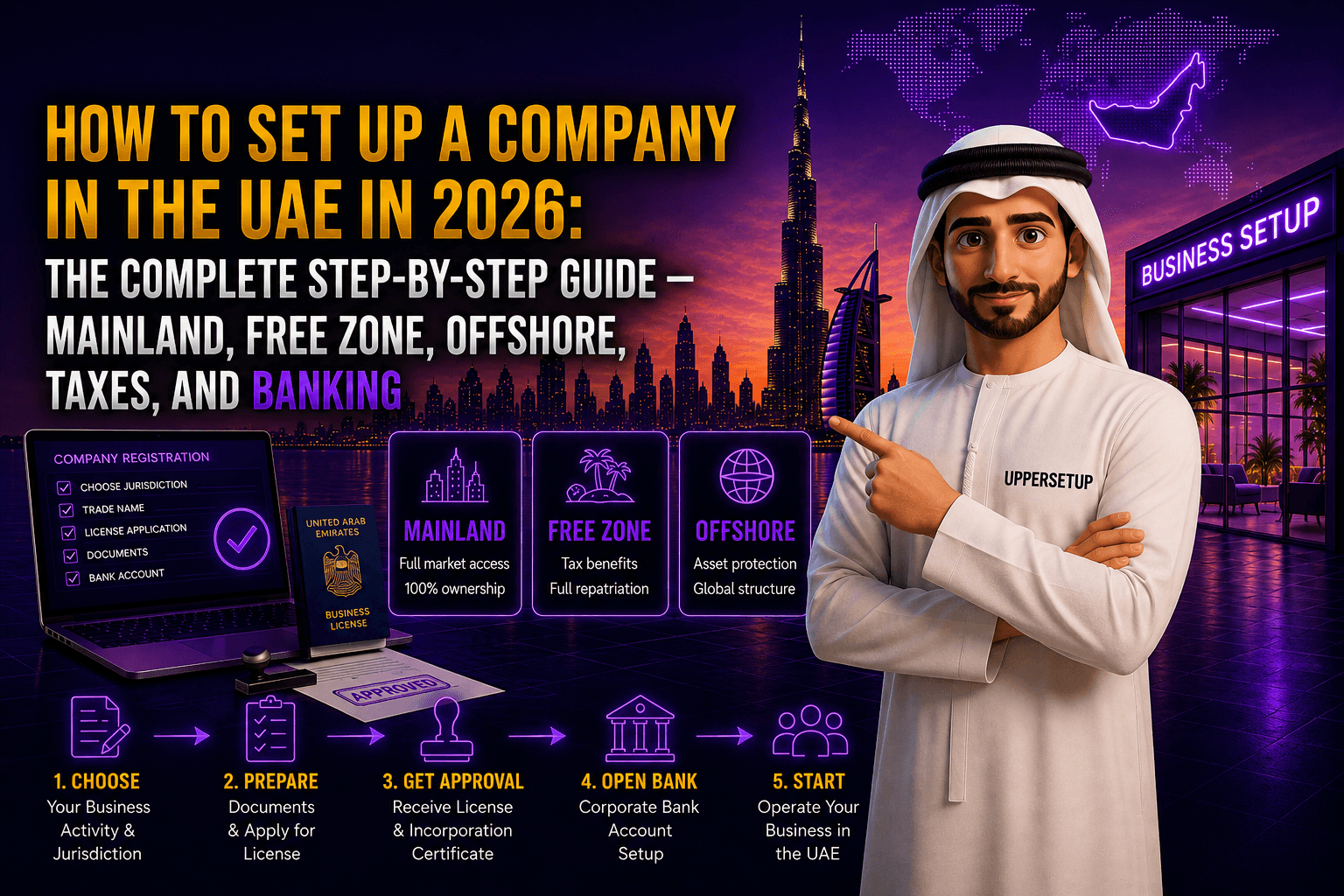
For the comparison against alternatives inside the country, see How to Set Up a Company in the UAE in 2026 and Re-domiciliation Within the UAE: Moving a Company Between Free Zones.
When professional review is warranted
● The company trades commodities — the qualification rules were rewritten by MD 229 and MD 230 of 2025.
● Part of the revenue comes from mainland counterparties and approaches the de minimis threshold.
● Property ownership through a Jafza offshore vehicle is contemplated.
● A transfer of registration between the zone and the mainland is under consideration.
● The company moves goods between Designated Zones.
● Prior-period positions were built on the repealed Ministerial Decision No. 265 of 2023.
Frequently asked questions
Is Jafza a Designated Zone for VAT?
Yes. Jebel Ali Free Zone (North-South) is on the list of Designated Zones established by Cabinet Decision No. 59 of 2017. The status applies to supplies of goods where the Executive Regulation's conditions are met and does not extend to services, water, energy or goods acquired for consumption.
Does registering in Jafza give a 0% corporate tax rate?
Not automatically. Jafza is considered a qualified free zone, but Qualifying Free Zone Person status attaches to a specific entity for a specific tax period and depends on the activity mix, the share of non-qualifying income, substance and audited financial statements.
Which entity types can be registered in Jafza?
A Free Zone Establishment with one shareholder, a Free Zone Company with several, a Public Listed Company, a branch of a foreign or local company, and an offshore company.
What does registering a Jafza offshore company cost?
Per the zone's own guidance, the registration fee is AED 10,000, each specimen signature is AED 50, and courier delivery is AED 10 inside the free zone and AED 20 outside. Processing takes 5–7 working days.
Does a Jafza offshore company carry residence visa entitlement?
As a general rule no: visa quota attaches to a licensed company with a facility in the zone. Article 31.2 of the offshore regulation in force provides an exception — an offshore company owning property in a designated UAE freehold area may apply to Jafza for a residency visa for its members, with approval subject to the zone's eligibility requirements.
Can a Jafza company operate on the UAE mainland?
Free zone activity within Dubai is regulated separately, including by Executive Council Resolution No. 11 of 2025. Since October 2025 a company's registration may also be transferred between competent authorities while preserving legal personality. Mainland income, however, is generally not qualifying income for the 0% rate.
How can the exact licence cost be established?
Through the cost calculator on the zone's official website, which produces an indicative estimate for a specific activity-and-facility combination, followed by confirmation from Jafza.
Does cancelling a Jafza licence end tax obligations?
No. Corporate tax and VAT registrations are held by the Federal Tax Authority. Until deregistration is approved, the company remains a registered taxpayer obliged to file returns.
Key takeaways
● Jafza was established in 1985, belongs to DP World and describes itself as the Middle East's largest customs bonded zone with more than 11,000 companies.
● Forms: FZE, FZCo, Public Listed Company, branch, offshore; licences: trading, service, industrial, logistics.
● Designated Zone status under Cabinet Decision No. 59 of 2017 covers goods only and only on conditions.
● Qualifying Free Zone Person status does not follow from registration and is tested entity by entity.
● Qualifying activities are set by Ministerial Decision No. 229 of 2025, which repealed MD 265 of 2023, retroactive to 1 June 2023.
● Offshore registration runs through agents only: AED 10,000, 5–7 working days; the 2018 regulations as amended in 2023 apply, and visas arise only where the company owns freehold property.
● Licence pricing is officially available only through the zone's calculator.
Summary
Jebel Ali Free Zone (Jafza) is the oldest free zone in the UAE, established in 1985, part of the DP World group and describing itself as the largest customs bonded zone in the Middle East with more than 11,000 companies. The zone offers five entity forms — a Free Zone Establishment with one shareholder, a Free Zone Company with several, a Public Listed Company, a branch of a company and an offshore company — and four licence types: trading, service, industrial and logistics, with the list of permitted activities inherited from the Dubai Department of Economic Development. Jebel Ali Free Zone (North-South) is on the list of Designated Zones established by Cabinet Decision No. 59 of 2017: such areas are treated as outside the UAE for VAT purposes where the Executive Regulation's conditions are met, but the status covers supplies of goods only, while services, water, all forms of energy and goods acquired for use or consumption are taxed as on the mainland. The VAT Executive Regulation is Cabinet Decision No. 52 of 2017, amended by Decisions No. 46 of 2020, No. 24 of 2021, No. 88 of 2021, No. 99 of 2022 and No. 100 of 2024, the last of which took effect on 15 November 2024. For corporate tax, Jafza is considered a qualified free zone under Federal Decree-Law No. 47 of 2022, but Qualifying Free Zone Person status and the 0% rate on qualifying income attach to a specific entity and require compliance with conditions on activity, the share of non-qualifying income, substance and audited financial statements; the list of Qualifying and Excluded Activities is set by Ministerial Decision No. 229 of 2025, which repealed Ministerial Decision No. 265 of 2023 and applies retroactively from 1 June 2023. A Jafza offshore company is registered exclusively through the zone's registered agents via the Dubai Trade portal: the registration fee is AED 10,000, each specimen signature AED 50 and processing takes 5–7 working days, while the company is not a licensed zone company and as a general rule confers no residence visas — the exception being where it owns property in a designated UAE freehold area, in which case the offshore regulation in force permits an application to Jafza for residency visas for its members. The regulation in force is the 2018 edition, which wholly replaced the 2003 edition, as amended in 2023 in respect of article 14 on permitted activities.
Sources
● Jebel Ali Free Zone — Rules and Regulations at Jafza: the register of zone, emirate and federal instruments in force, including Jafza Rules 9th Edition (2023)
● Jebel Ali Free Zone — How to set up an FZCO company: minimum 2 and maximum 50 shareholders, and the document pack
● Jebel Ali Free Zone — How to set up an offshore company: shareholder numbers, the registered agent's role and the title of the Regulations
● Jebel Ali Free Zone — New Offshore Company: filing channel, documents, processing time and fees
● Jebel Ali Free Zone — Jebel Ali Free Zone and the UAE Corporate Tax Law: the zone's own statement
● Jebel Ali Free Zone — cost calculator for licence and formation
● Jebel Ali Free Zone — business activity list inherited from the Dubai Department of Economic Development
● Ministry of Finance — Ministerial Decision No. 229 of 2025 on Qualifying and Excluded Activities (full text)
● Ministry of Finance — Ministerial Decision No. 265 of 2023 (repealed): the de minimis wording and the repeal of Ministerial Decision No. 139 of 2023
● Federal Tax Authority — Public Clarification VATP040 on the amendments made by Cabinet Decision No. 100 of 2024
● PwC Middle East — analysis of Ministerial Decisions No. 229 and No. 230 of 2025: repeal of MD 265 of 2023 and retroactive effect
● DLA Piper — amendments to the VAT Executive Regulation effective 15 November 2024
● LYLAW — the 2023 amendments to the offshore regulations and the rewritten article 14 on permitted activities
● Clyde & Co — discontinuation of the UAE Economic Substance regime under Cabinet Decision No. 98 of 2024
● Gulf News — report on the adoption of the Designated Zones list and the conditions attaching to the status
Levels of verification behind this briefing
Sources are separated by reliability on purpose.
● Verified on Jafza's own pages: the year of establishment and DP World ownership; the description as the Middle East's largest customs bonded zone and the figure of more than 11,000 companies; the five entity forms and four licence types; the FZCo range of 2 to 50 shareholders and the application document pack; for offshore companies, the minimum of one shareholder with no maximum, the mandatory registered agent, the agent's office as registered office, the filing channel, timing and fees; the inheritance of the DED activity list; the cost calculator; the register of instruments in force; and the zone's own statement on qualified free zone status.
● Verified from official acts and regulator portals: the text of Ministerial Decision No. 229 of 2025 on the Ministry of Finance website; the text of the repealed Ministerial Decision No. 265 of 2023 with its de minimis wording; the Federal Tax Authority's public clarification on Cabinet Decision No. 100 of 2024; and the inclusion of Jebel Ali Free Zone (North-South) in the Designated Zones list under Cabinet Decision No. 59 of 2017.
● Verified through Big4 and major law firm analysis: the repeal of MD 265 of 2023 and the retroactive effect of MD 229 from 1 June 2023; the amendment chain of the VAT Executive Regulation; the audited accounts requirement under MD 84 of 2025; the loss of QFZP status for the current tax period and the following four on breaching de minimis; the chain of offshore regulation editions 2003 → 2018 → 2023; the reduction of the minimum number of directors from two to one and the admissibility of a corporate director; the content of articles 14.2, 31.1 and 31.2 on property, registered office and member visas; and the discontinuation of the Economic Substance regime under Cabinet Decision No. 98 of 2024.
● Left unconfirmed: the text of the offshore regulation was not read directly — the zone publishes it as an undated download, so the article references come from law firm analysis; whether a company secretary is mandatory, on which secondary sources split; and specific licence fees and rental rates. Each is flagged in the text rather than presented as established fact.
Related UPPERSETUP reading
● How to Set Up a Company in the UAE in 2026: the Complete Step-by-Step Guide
● Re-domiciliation Within the UAE: Moving a Company Between Free Zones in 2026
● UAE Trade Licence Renewal 2026: Deadlines, Documents and Penalties
● Holding Company in the UAE in 2026: Corporate Architecture or Added Obligations
Disclaimer
This material is provided for information only and does not constitute legal, tax, financial, investment or consulting advice. Professional advice should be obtained on the specific facts, jurisdiction, entity status and current regulatory requirements before any decision is taken. Information is current as at August 2026.
All services on the platform
Everything you need to start and run a business - in one place
- 3–5 days
Company Setup
Mainland or Free Zone company with a complete set of incorporation documents
Start - Monthly
Accounting Services
Financial accounting and reporting in accordance with UAE requirements
Start - 1–2 weeks
Visa Services
Residence visas for shareholders, employees and family members
Start - 7–30 days
Banking Services
Corporate Bank Accounts in the UAE and Payment Services
Start - Custom timeline
Legal Services
Contracts, corporate amendments and legal support
Start


