














































 International Free Zone Authority
Reciprocal Enforcement of Mainland Judgments in Hong Kong: Cap. 645 in 2026 — the 2019 Arrangement, Registration in the High Court, the Two-Year Rule, Grounds for Setting Aside and the First Cases
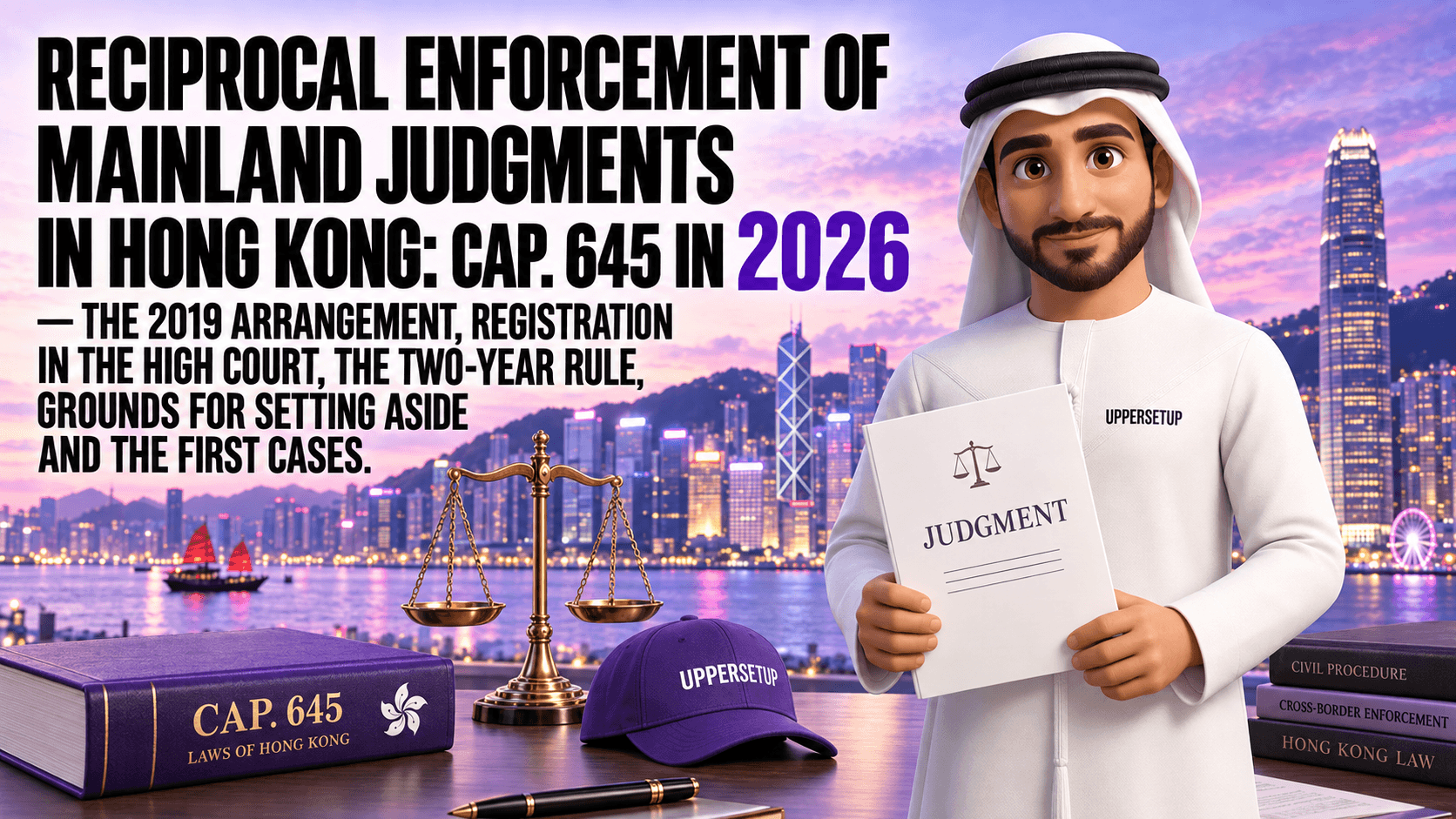
The Mainland Judgments in Civil and Commercial Matters (Reciprocal Enforcement) Ordinance (Cap. 645) is the Hong Kong statute under which, since 29 January 2024, an effective judgment of a Mainland Chinese court in a civil or commercial matter can be registered in the Court of First Instance of the Hong Kong High Court and enforced as if it were a Hong Kong judgment, and under which the holder of a Hong Kong judgment can obtain from the Hong Kong court a certified copy of that judgment, and a certificate in respect of it, for recognition and enforcement in the Mainland. The Ordinance implements the Arrangement on Reciprocal Recognition and Enforcement of Judgments in Civil and Commercial Matters by the Courts of the Mainland and of the Hong Kong Special Administrative Region, signed by the Supreme People’s Court and the Government of the HKSAR on 18 January 2019 under Article 95 of the Basic Law. Compared with the earlier regime under Cap. 597, the new statute no longer requires an exclusive choice-of-court clause, covers non-monetary as well as monetary judgments, reaches judgments of courts at every level down to the Primary People’s Courts and extends to a defined range of intellectual property disputes. The registration application is made ex parte, the court fee is HK$1,045, the judgment debtor has 14 days after service of the notice of registration to apply to set the registration aside, and the gateway condition is a default in complying with the judgment that occurred within two years before the application.
Alert. Four facts decide the outcome more often than the content of the Mainland judgment itself. First:Cap. 645 applies only to judgments given on or after 29 January 2024; a judgment given pursuant to a choice-of-court agreement made before that date is an “excluded judgment” under section 5(1)(j) and can be registered only under the old Cap. 597, as the Court of First Instance confirmed in Deng Mian v Pan Rong [2025] HKCFI 3905. Second: section 31 closes every route to recovery in the Hong Kong courts other than registration; for judgments under the old regime the question whether a common law action survives the expiry of the two-year window has split first-instance judges (China Everbright Bank v China Kingho [2024] HKCFI 3586 against Huarong Huaqiao v Li Xiaopeng [2025] HKCFI 6402), and as at September 2026 the Court of Appeal has not ruled. Third: the judgment to register is the one that is “effective” as between the specific parties: where there has been an appeal, that is the second-instance judgment, not the first (Huzhou Shenghua v Hang Pin [2025] HKCA 434). Fourth: the application is made ex parte and carries a continuing duty of full and frank disclosure; failing to disclose a possible defence cost the plaintiff in Huarong its Mareva injunction and HK$400,000 in costs.
Key parameters of the Cap. 645 regime: summary table
|
Parameter |
Value |
Source |
|
Regulatory tiers |
2019 Arrangement (SPC and HKSAR Government) → Ordinance Cap. 645 → Rules Cap. 645A → Practice Direction 38 → SPC judicial interpretation 法释〔2024〕2号 (Mainland side) |
doj.gov.hk; elegislation.gov.hk; legalref.judiciary.hk; court.gov.cn |
|
Commencement |
29 January 2024 (Commencement Notice L.N. 153 of 2023); applies to judgments given on or after that date |
Cap. 645, editorial notes; DoJ FAQ |
|
What can be registered |
a judgment, ruling, conciliatory statement (调解书) or order of payment (支付令) of a Mainland court; rulings on interim measures are not judgments |
Cap. 645, s. 2(1) |
|
“Effective” test |
enforceable in the Mainland and given by the SPC, at second instance by a High or Intermediate People’s Court, or at first instance by a High, Intermediate or Primary People’s Court where no appeal lies or the appeal period has expired; includes trial-supervision judgments |
Cap. 645, s. 8 |
|
Gateway condition |
a default in paying a sum or performing an act occurred within 2 years before the application and has not been made good |
Cap. 645, s. 10(1)(b) |
|
Form of application |
ex parte originating summons (Form No. 11, App. A, RHC) with affidavit; the applicant drafts the registration order |
Cap. 645A, rr. 4, 5, 14; PD 38 |
|
Court fees |
HK$1,045 for a registration application; HK$125 for a certified copy of a Hong Kong judgment |
Cap. 645A, Schedule |
|
Time to apply to set aside |
14 days after service of the notice of registration; the court may specify a different period and extend it |
Cap. 645, s. 21 |
|
Grounds for setting aside |
11 mandatory grounds (s. 22(1)(a)–(k)) and one discretionary ground — breach of a valid arbitration or jurisdiction agreement (s. 22(2)) |
Cap. 645, s. 22 |
|
Effect of registration |
enforceable as a CFI judgment given on the day of registration; no enforcement until the setting-aside period has expired |
Cap. 645, ss. 26–27 |
|
Exclusivity |
a Hong Kong court may not entertain any proceedings to recover under such a judgment other than registration and execution of a registered judgment |
Cap. 645, s. 31 |
|
Hong Kong judgments to the Mainland |
certified copy and Registrar’s certificate; application to the Intermediate People’s Court of the applicant’s or respondent’s residence or where the property is; review by the next higher court within 10 days |
Cap. 645, ss. 32–34; Arrangement, Arts. 7, 26 |
|
Old regime |
Cap. 597 continues to apply to judgments given under written exclusive choice-of-court agreements made on or after 1 August 2008 and before 29 January 2024 |
Cap. 597, s. 5(2)(b) as amended by Ord. 11 of 2022 |
|
First cases |
HD Hyundai Infracore China v Li Zhiwei [2025] HKCFI 5714 — registration allowed; Deng Mian v Pan Rong [2025] HKCFI 3905 — refused under s. 5(1)(j) |
legalref.judiciary.hk |
What is the legal framework for reciprocal enforcement: the 2019 Arrangement, the Ordinance, the Rules, Practice Direction 38 and the SPC interpretation?
The reciprocal enforcement regime between Hong Kong and the Mainland rests on five instruments at different levels, each responsible for its own part of the procedure. They should not be conflated: the Arrangement sets the framework agreed between two legal systems, the Ordinance turns that framework into Hong Kong law, the Rules and the Practice Direction prescribe exactly how an application is made to the High Court, and the judicial interpretation of the Supreme People’s Court makes the same rules binding on Mainland courts.
Tier 1 — the Arrangement. The full title is the “Arrangement on Reciprocal Recognition and Enforcement of Judgments in Civil and Commercial Matters by the Courts of the Mainland and of the Hong Kong Special Administrative Region” (《关于内地与香港特别行政区法院相互认可和执行民商事案件判决的安排》). It was signed in Beijing on 18 January 2019 by the Supreme People’s Court and the Government of the HKSAR under Article 95 of the Basic Law, contains 31 articles and, under Article 29, applies to judgments given by the courts of both places on or after its commencement. Article 30 terminates the 2006 Arrangement on judgments given pursuant to choice-of-court agreements, preserving it only for written choice-of-court agreements signed before the new instrument commenced, and Article 31 keeps the separate 2017 Arrangement on matrimonial and family cases in force.
Tier 2 — the Ordinance. The Mainland Judgments in Civil and Commercial Matters (Reciprocal Enforcement) Bill was gazetted on 22 April 2022, passed by the Legislative Council on 26 October 2022 and published as Ordinance No. 11 of 2022 on 4 November 2022. The statute became Cap. 645 and has 36 sections: Part 1 — definitions and excluded judgments (ss. 2–9), Part 2 — registration of Mainland judgments (ss. 10–31), Part 3 — facilitation of recognition of Hong Kong judgments in the Mainland (ss. 32–34), Part 4 — the Chief Judge’s rule-making power (s. 35) and consequential amendments (s. 36, since omitted as spent). Section 36 and the Schedule amended Cap. 597, in particular by cutting off section 5(2)(b) of the old statute at 29 January 2024. The consolidated text on e-Legislation carries a version date of 14 March 2024; no later amendment has been made.
Tier 3 — the Rules. The Mainland Judgments in Civil and Commercial Matters (Reciprocal Enforcement) Rules (Cap. 645A) were made by the Chief Judge of the High Court under section 35 of the Ordinance. The Rules and the Commencement Notice were gazetted on 10 November 2023 and tabled in the Legislative Council on 15 November 2023 under the negative vetting procedure; the Department of Justice had consulted the public on the draft Rules together with the draft Bill between December 2021 and January 2022. The Rules prescribe the form of the application, the contents of the affidavit, service of the notice of registration, the setting-aside and execution procedures, the issue of certified copies of Hong Kong judgments and, in the Schedule, the fees.
Tier 4 — Practice Direction 38. The Practice Direction “Reciprocal Enforcement of Mainland and Hong Kong Judgments in Civil and Commercial Matters” was signed by Chief Justice Andrew Cheung on 25 January 2024 and took effect on 29 January 2024 together with the Ordinance. PD 38 has six annexures: the title of the originating summons, a sample affidavit, draft registration order and draft notice of registration, a form of particulars of the Mainland judgment and a draft Registrar’s certificate for Hong Kong judgments. It confirms the continuing duty of full and frank disclosure on an ex parte application and requires evidence of the interest rate and the exchange rate when the draft order is re-submitted.
Tier 5 — the Mainland side. The Supreme People’s Court brought the Arrangement into force by judicial interpretation 法释〔2024〕2号, “最高人民法院关于内地与香港特别行政区法院相互认可和执行民商事案件判决的安排”. The document was adopted at the 1,759th meeting of the SPC Judicial Committee on 14 January 2019, is dated 25 January 2024, was published on the court’s website on 26 January 2024 and took effect on 29 January 2024 (Article 32 of the interpretation). The “25 or 26 January” discrepancy found in commentaries reflects exactly this difference between the date of the document and the date of its publication: the Department of Justice’s Cap. 645 site gives 25 January 2024, while the reciprocal-recognition page on the same website gives 26 January.
Common launch date. Both sides launched the regime simultaneously on 29 January 2024. On the same day the Department of Justice and the Supreme People’s Court held a joint seminar at the Hong Kong Convention and Exhibition Centre. The Department of Justice emphasises that the inclusion of judgments in certain intellectual property disputes makes Hong Kong the first jurisdiction with a reciprocal enforcement arrangement of such wide coverage with the Mainland.
For readers accustomed to the recognition of foreign judgments in the UAE, one difference is worth keeping in mind: the Hong Kong mechanism is registration without re-examination of the merits, and it operates in both directions under one agreed text, whereas recognition of foreign judgments in the UAE proceeds through a separate action with scrutiny of reciprocity and jurisdiction, as explained in the article on recognition and enforcement of foreign judgments in the UAE.
How does Cap. 645 differ from the earlier Cap. 597 regime, and why does the old statute remain in force?
The Mainland Judgments (Reciprocal Enforcement) Ordinance (Cap. 597) is the 2008 statute that implemented the 2006 Arrangement on reciprocal recognition and enforcement of judgments in civil and commercial matters given pursuant to choice-of-court agreements. Cap. 597 commenced on 1 August 2008, and its logic was narrow: only a money judgment of a “designated court” (the Supreme People’s Court, a High People’s Court, an Intermediate People’s Court or a “recognized Primary People’s Court” listed in Schedule 1) given pursuant to a written agreement conferring exclusivejurisdiction on the Mainland courts could be registered, provided the judgment was “final and conclusive” and enforceable in the Mainland. The application had to be made within two years (s. 7), and section 22(2) barred the Hong Kong courts from entertaining any other proceedings to recover a sum payable under a registrable judgment.
Cap. 645 removed the four main restrictions of the old regime. First: the exclusive choice-of-court requirement is gone; in its place stands the jurisdictional test in section 23 with six alternative connecting factors, including the defendant’s place of residence, the place of performance of the contract and the place of the tort. Second: the range of courts extends to all four levels, including the Primary People’s Courts, provided the judgment is “effective” under section 8. Third:judgments requiring not only the payment of money but also the performance of an act (s. 10(1)(b)(i)) — non-monetary judgments — can be registered. Fourth: judgments in contractual disputes over intellectual property and in tort claims for infringement of “specified intellectual property rights” are expressly covered, subject to the qualifications in sections 7, 15 and 16.
The old statute has not been repealed. Section 5(2)(b) of Cap. 597, as amended by Ordinance No. 11 of 2022 (s. 36), now requires the choice of Mainland court agreement to have been made “on or after the commencement date of this Ordinance but before the commencement date of the Mainland Judgments in Civil and Commercial Matters (Reciprocal Enforcement) Ordinance (Cap. 645)”, that is on or after 1 August 2008 and before 29 January 2024. Mirroring this, section 5(1)(j) of Cap. 645 declares an “excluded judgment” any Mainland judgment given pursuant to a choice of Mainland court agreement made before 29 January 2024. The current text of Cap. 597 on e-Legislation carries a version date of 24 August 2025 — the definition of “Mainland” in section 2 was technically refined by Ordinance No. 31 of 2025 (s. 200); the mechanism itself is unchanged.
The practical consequence of this dividing line was demonstrated by the first refusal under the new statute. In Deng Mian v Pan Rong [2025] HKCFI 3905 (HCRE 10/2025, decision of 1 September 2025) the applicant sought to register a judgment of the Shanghai Financial Court dated 27 August 2024. The Court of First Instance dismissed the appeal from Master Hui’s refusal: the 2017 loan agreement contained a Mainland jurisdiction clause, so the judgment, although given after 29 January 2024, was an “excluded judgment” under section 5(1)(j)(i) of Cap. 645 and could be registered only under Cap. 597. The date of the judgment does not rescue the applicant if the date of the clause precedes the launch of the new regime.
A further trap is terminological. In Hong Kong judgments the abbreviation MJREO refers to the old Cap. 597, while the new statute is called Cap. 645 or MJCCMREO; law firm commentaries frequently use MJREO for the new statute. When reading case law, always check the chapter number: the exclusivity provision in the common-law-route cases is section 22(2) of Cap. 597, its counterpart in the new statute is section 31 of Cap. 645, and Cap. 645’s own section 22(2) deals with something else — the discretionary ground for setting aside registration.
Finally, the old regime retains its own body of case law, which remains live for every contract with a clause made before 29 January 2024. In Beijing Renji Real Estate Development Group v Zhu Min [2024] HKCA 878 the Court of Appeal confirmed that Cap. 597 requires an express written choice of a Mainland court rather than one inferred through Mainland law; in China Minsheng Trust v Fu Kwan [2025] HKCA 462 the same court held that Mainland rulings terminating enforcement proceedings are not judgments ordering the payment of a sum of money under section 5(2)(e). Such cases will be decided under Cap. 597 for years to come, because the two-year period under section 7 of Cap. 597 runs from the last day of the performance period specified in the judgment or from the date the judgment takes effect, not from the date of the contract.
Which Mainland judgments count as “effective”, and which judgments are excluded from the regime?
A Mainland Judgment for the purposes of Cap. 645 is, under section 2(1), “a judgment, ruling, conciliatory statement or order of payment” given or made by a court in the Mainland; a ruling in respect of an interim measure is not a judgment. The statute therefore reaches not only judgments (判决) but also rulings (裁定), conciliatory statements — court-confirmed settlements (调解书) — and orders of payment (支付令). That matters for creditors from Russia and Central Asia, because a large share of Mainland disputes ends in a conciliatory statement rather than a judgment on the merits.
The judgment must relate to a civil or commercial matter. Under section 3 that means a judgment given in proceedings that are civil or commercial in nature under Mainland law, or a judgment in criminal proceedings to the extent it orders the payment of compensation or damages to a party. Section 3(2)–(3) allows severance: where only part of a judgment qualifies, that part is registered. The first judgment admitted under the new statute — HD Hyundai Infracore China v Li Zhiwei [2025] HKCFI 5714 (24 November 2025) — concerned precisely the operative part of a criminal-enforcement ruling of the Wuhai Intermediate People’s Court, (2024)内03执恢51号 of 23 October 2024, ordering restitution of RMB 162,061,811.37; Deputy High Court Judge Jonathan Wong allowed registration under sections 3(1)(a)(ii) and 14 after an explanatory note from the Mainland court dated 4 August 2025 and a Mainland-law expert report were produced.
The “effective” test. Section 8 treats a Mainland judgment as effective if it is enforceable in the Mainland and is a judgment of the Supreme People’s Court, a second-instance judgment of a High People’s Court (高级人民法院 — the Ordinance’s term for the court often rendered in English as the “Higher People’s Court”) or an Intermediate People’s Court, or a first-instance judgment of a High, Intermediate or Primary People’s Court from which no appeal lies under Mainland law or in respect of which the appeal period has expired without an appeal. Section 8(2) includes judgments given under the trial supervision procedure (审判监督程序). In Huzhou Shenghua v Hang Pin [2025] HKCA 434 the Court of Appeal noted that section 8(1)(b) of the new statute in substance reproduces section 6(1) of Cap. 597, so the rule developed under the old statute carries over: where the debtor appealed the first-instance judgment, the judgment that is “effective” as between the parties is the second-instance judgment, and that is the one to register even if the appellate court merely affirmed the first judgment. The mere existence of the trial-supervision procedure (再审) does not deprive a judgment of its effective status: under Article 217 of the PRC Civil Procedure Law enforcement is suspended only once a court has actually ordered a retrial, and under Article 216 a retrial application must be filed within six months after the judgment takes effect.
Excluded judgments. Section 5(1) removes ten categories from the regime, each of which must be checked before an application is filed:
• matrimonial or family cases under section 6: cases covered by Cap. 639 (which has its own recognition regime), disputes over the confirmation or dissolution of an adoptive relationship, maintenance for parents or grandparents and between siblings, guardianship over an adult, liability for damages after a divorce and division of property arising from cohabitation;
• succession to, and administration or distribution of, an estate;
• “excluded intellectual property cases” under section 7: tort claims for infringement of invention patents and utility model patents in the Mainland (standard and short-term patents in Hong Kong), determinations of the licence fee rate of a standard-essential patent, and rights outside the list of “specified intellectual property rights”;
• maritime matters: marine pollution, limitation of liability for maritime claims, general average, emergency towage or salvage, maritime liens and the carriage of passengers by sea;
• a “specified corporate process” — reorganisation, compromise or bankruptcy liquidation under Article 7 of the PRC Enterprise Bankruptcy Law, winding up and schemes under section 673(2) of Cap. 622 in Hong Kong — and the bankruptcy of a natural person;
• election proceedings, declarations of disappearance or death, and determinations of no or limited capacity for civil acts;
• confirmation of the validity of an arbitration agreement and setting aside of an arbitral award;
• recognition or enforcement of judgments of courts outside the Mainland or Hong Kong;
• recognition or enforcement of arbitral awards seated outside the Mainland or Hong Kong;
• judgments given pursuant to a choice of Mainland or Hong Kong court agreement made before 29 January 2024.
The capacity exclusion has already operated in practice: in Re WX [2026] HKCFI 1589 (reasons of 27 March 2026) Leung J held that the Court of First Instance, exercising its jurisdiction under the Mental Health Ordinance (Cap. 136) (the “MH Court” in the judgment’s own shorthand), could not authorise the management of Hong Kong property by recognising a Mainland guardianship judgment, because such determinations are expressly excluded from Cap. 645 by section 5(1)(f)(iii); the applicant had to proceed under that Ordinance. The exclusion of insolvency processes means that a creditor of a Mainland company in liquidation will not obtain recognition of distribution rulings through Cap. 645; that is the province of the separate insolvency cooperation mechanism launched by the Record of Meeting of 14 May 2021 with pilot courts in Shanghai, Xiamen and Shenzhen. The Hong Kong side of corporate exit procedures is described in the article on closing a Hong Kong company in 2026 — deregistration and winding up.
Intellectual property. Under section 15 a Hong Kong court does not register the part of a Mainland judgment in which the court ruled on the validity, establishment or subsistence of an intellectual property right, but does register a liability ruling based on that finding. Under section 16, in tort claims for infringement of “specified intellectual property rights” and in disputes over acts of unfair competition under Article 6 of the PRC Anti-Unfair Competition Law only the monetary part, including punitive or exemplary damages, is registered; non-monetary relief is not, save that infringements of rights in a trade secret are expressly carved out of that restriction (s. 16(1)(b)(i)), consistent with Article 17(2) of the Arrangement, which allows non-monetary relief in trade secret cases. Owners of Hong Kong trade marks and patents should read these rules alongside the protection procedure described in the article on trade mark registration in Hong Kong in 2026.
What does the “default within two years” rule mean, and why does section 31 close the common law route?
The two-year rule in Cap. 645 is framed differently from the old statute, and that changes the computation. Under section 10(1)(b) a judgment creditor may apply for registration if the judgment requires the payment of a sum of money or the performance of an act, if a default in complying with that requirement occurred within two years before the date of the application and if the default has not been made good at the date of the application. Section 12 fixes the date of default: for a prohibition, the date on which non-compliance first occurs; where the judgment specifies a date for payment or performance, that date; otherwise, the date on which the judgment becomes effective in the Mainland. Under Cap. 597 the period ran from the last day of the performance period or from the date the judgment took effect (s. 7) — the statute spoke of a time limit for applying; Cap. 645 speaks of the age of the default, which produces the same result in simple cases but works differently for judgments performed in stages.
For judgments requiring several sums or several acts, section 11 introduces the concept of a “qualifying sum or act”: only the part in respect of which the default occurred within two years and has not been made good is registered; for judgments performed in stages each stage is tested separately (s. 11(3)), and where a later default occurs in respect of another part the creditor may make a further application (s. 11(2)). Section 17(2) additionally confines registration to sums and acts that fell due before the date of the application, while section 17(3) allows future stages to be included where performance is staged.
Exclusivity of registration. Section 31 provides that a court in Hong Kong “may not entertain any proceedings for the recovery of a sum of money required to be paid or the execution of any other relief ordered under a Mainland Judgment in a civil or commercial matter that is given on or after the commencement date of this Ordinance and that is effective in the Mainland, other than (a) proceedings for registration under section 13(1); or (b) proceedings for the execution of a registered judgment”. For judgments given on or after 29 January 2024 that are effective, a common law action on the foreign judgment as an independent cause of action is unavailable. Section 28(4) preserves only common law recognition of a Mainland judgment as conclusive of a matter of law or fact — issue estoppel, not recovery.
The open question: what happens after two years? On a literal reading of section 31, a creditor who misses the two-year window loses not only registration but any other route to recovery in Hong Kong, because the provision is not confined to the period during which registration remains possible. Under the old statute the equivalent provision — section 22(2) of Cap. 597 — has produced a direct clash between first-instance judges:
• In China Everbright Bank Co Ltd v China Kingho Energy Group Ltd [2024] HKCFI 3586 (13 December 2024) Keith Yeung J heard a common law action for RMB 490,454,733.77 on a conciliatory statement issued by the Beijing High People’s Court on 4 September 2018; the last date for performance was 27 June 2020, and the two-year period under Cap. 597 had long expired. The court found a “good arguable case” that the common law route remains open after the two years: Cap. 597 is modelled on Cap. 319, but there the registration period is six years, in line with ordinary limitation periods, whereas the two-year period under Cap. 597 is much tighter; the court saw no policy justifying the abrogation of a right creditors had enjoyed before 2008. On that basis a Mareva injunction was granted over two Convention Plaza flats acquired in 2010 for HK$38,000,000 and HK$22,000,000.
• In Huarong Huaqiao Asset Management Co Ltd v Li Xiaopeng [2025] HKCFI 6402 (22 December 2025, reported at [2026] 2 HKLRD 69) Queeny Au-Yeung J reached the opposite conclusion in an action on a Mainland conciliatory statement (described in the judgment as a civil mediation certificate) brought some four and a half years after it took effect: section 22(2) is expressed “in clear and mandatory terms” and bars the common law route for judgments that meet the registration criteria, irrespective of the expiry of the two-year period. The court refused summary judgment, discharged the Mareva injunction for non-disclosure of that defence and drew attention to the “similar” section 31 of Cap. 645, observing that the legislative policy — a statutory code of registration with a two-year limit and a bar on the common law route — is “clear and consistent”.
On 15 May 2026 Au-Yeung J granted the plaintiff leave to appeal on the section 22(2) point ([2026] HKCFI 2639), describing it as an “issue of general principle” on which a decision of the Court of Appeal “would be to the public advantage” and noting that Yeung J’s decision in Kingho was “now on appeal”. As at 8 September 2026 the Judiciary’s Legal Reference System records no Court of Appeal decision in either case. For creditors under new judgments only one practical conclusion follows: the common law route cannot be relied on, since section 31 is drafted more widely than section 22(2) and covers not only money claims but “any other relief”; the registration application must be filed before two years have run from the date of default.
Separately, the section 31 bar concerns proceedings for recovery, not recognition. Section 28 recognises a registered judgment, and a judgment that could be registered but has not been, as conclusive between the parties on the same cause of action and permits reliance on it by way of defence or counterclaim. Under the old statute the Court of Appeal in Lu Yongliang v Bank of China (Dongguan Branch) [2021] 6 HKC 46 distinguished recognition from registration and held that an unregistered Mainland judgment can found a statutory demand and a bankruptcy petition, because bankruptcy is not “proceedings for the recovery of a sum”. In July 2026 Recorder Jin Pao SC applied the same approach to the winding up of a company in China Financial Services Holdings v Zou Muxin [2026] HKCFI 3837, where unregistered judgments of the Beijing High People’s Court dated 29 December 2023 for RMB 7,885,102.46 founded a statutory demand, and the debtor, which had paid more than HK$4,000,000 into court and ultimately settled the debt, was ordered to pay the creditor’s costs.
Which sums are registered with the judgment: interest, costs, penalties and the exchange rate?
The composition of the registered sum is governed by section 18 of Cap. 645, and it is wider than commonly assumed. Under section 18(2) the judgment is also registered for the following sums as if they were required to be paid under it: (a) any interest that, under Mainland law, becomes due under the judgment up to the time of registration; (b) any costs duly certified by the original Mainland court; (c) “any fine or charge payable by a party to another party to the original proceedings for the Judgment for failing to comply with the Judgment or part within the time stipulated in the Judgment or part”; and (d) any reasonable costs of, or incidental to, the registration, including the cost of obtaining a copy of the judgment sealed by the Mainland court. Section 18(3) excludes taxes and charges of a like nature, fines and other penalties other than the fine or charge described in subsection (2)(c), and punitive or exemplary damages except those awarded in tort claims for infringement of “specified intellectual property rights” or in disputes over acts of unfair competition under Article 6 of the Mainland statute committed in the Mainland. Article 18 of the Arrangement lists the same items — the property awarded, interest, litigation costs, “迟延履行金、迟延履行利息” — and excludes taxes and fines.
The doubled-interest problem. Under Article 264 of the PRC Civil Procedure Law (2023 revision; Article 260 in the 2021 revision), a debtor who fails to perform a money obligation within the period fixed by the judgment “应当加倍支付迟延履行期间的债务利息” — must pay double the debt interest for the period of delay. Under the old Cap. 597 the Hong Kong courts have consistently characterised this doubled (“enhanced”) interest as a “penalty” that is unenforceable in Hong Kong: the Court of Appeal in Hung Fung Enterprises Holdings v Agricultural Bank of China [2012] 3 HKLRD 679, and the Court of First Instance in Tianjin Jinrong Investment Services Group v Jinan Muhe Enterprises Management [2026] 1 HKLRD 1104 (where it was held to be a penalty under section 5(2)(e) and, in any event, contrary to public policy) and in 乐推(上海)文化传播 v 深圳市麦凯莱科技 [2026] HKCFI 3204. In June 2026 Deputy High Court Judge Anthony Chan SC in 深圳市高時小額貸款 v 深圳市園山物業發展 [2026] HKCFI 3643 described that practice as settled and set aside the corresponding paragraph of the registration order while upholding the rest of the registration of a Qianhai court judgment for RMB 49,600,000 in principal, contractual interest at 15 % per annum and RMB 270,000 in costs. Under the new statute the position is different: section 18(2)(c) expressly includes a charge payable to the other party for late compliance with the judgment, and the Arrangement expressly names 迟延履行利息. No Hong Kong decision applying section 18(2)(c) to doubled interest appears in the Legal Reference System as at September 2026, so the point should be treated as open: the statutory text favours the creditor, but no practice has yet formed.
Costs of registration. Section 18(2)(d) on “reasonable costs of, or incidental to, the registration” received its first interpretation in HD Hyundai Infracore China v Li Zhiwei [2025] HKCFI 5714: the applicant sought to include more than HK$2,150,000 in costs, and the court allowed HK$1,400,000 as reasonable. That figure is a benchmark for a complex matter involving Mainland-law expert evidence, an appeal from the Master’s decision and a parallel Mareva injunction; a simple unopposed registration costs considerably less, but no official cost statistics exist.
Currency. Section 19 requires a sum denominated in a currency other than Hong Kong dollars to be registered as the Hong Kong dollar equivalent at the exchange rate prevailing on the day of registration. PD 38 (para. 9) requires the applicant to produce evidence of the exchange rate when the draft order is re-submitted, and para. 8 evidence of the applicable interest rate where it does not appear from the judgment itself. From the date of registration interest accrues under Hong Kong rules, because under section 26 the registered judgment is treated as a judgment of the Court of First Instance given on the day of registration.
The due-date limit. Section 17(2) allows registration only of sums and acts that fell due before the date of the application and remain unperformed; section 17(3) allows later stages of a staged judgment to be included. A creditor holding an instalment judgment should time the application so as to capture the stages that have fallen due and simultaneously fix the future stages; otherwise each new default requires a further application under section 11(2).
How is a Mainland judgment registered in the High Court: form, affidavit, documents, fee and notice?
The registration application is made to the Court of First Instance ex parte — without notice to the debtor — by originating summons in Form No. 11 of Appendix A to the Rules of the High Court (Cap. 4A), intituled in accordance with Annexure 1 to PD 38 and supported by an affidavit (r. 4 of Cap. 645A; paras. 6–7 of PD 38). The applicant is the “judgment creditor” — the person in whose favour the judgment was given, including a person in whom the rights under the judgment have become vested by succession, assignment or otherwise (s. 2(1)). The application is entered in the High Court register under the prefix HCRE (Reciprocal Enforcement); the same prefix is used for Cap. 597 applications, so the case number alone does not reveal which statute applies.
Contents of the affidavit. Rule 5 of Cap. 645A requires the affidavit to exhibit, for an individual applicant, a copy of the applicant’s proof of identity and, for a body, a verified, certified or otherwise duly authenticated copy of its certificate of incorporation (for a foreign body, of the document showing its formation under the law of that place) together with a copy of the proof of identity of one director or authorised representative, a copy of the judgment duly sealed by the original Mainland court and a certificate issued by that court certifying that the judgment is a Mainland judgment in a civil or commercial matter and is effective in the Mainland, together with particulars of all parties (name, address, identification number, contact details). Rule 6 adds substantive statements: which sums or acts the judgment requires and which of them remain unperformed, whether the applicant is entitled to enforce the judgment in the Mainland, what enforcement steps have been taken, whether any Hong Kong proceedings on the same cause of action are pending, that the registration would not be liable to be set aside under section 22, what interest, costs and charges are due, evidence of enforceability and — where the rate is not stated in the judgment — evidence of Mainland law on interest; a statement of costs is annexed. For judgments given in the defendant’s absence, rule 11 requires a statement that the defendant was summoned under Mainland law, or that the judgment says so, or that the absent party is the applicant; in the first case the summons documents must be exhibited.
The certificate presumption. Section 13(2) of Cap. 645 provides that, until the contrary is proved, a Mainland judgment is presumed to be a judgment in a civil or commercial matter that is effective in the Mainland if the original Mainland court has issued a certificate to that effect. That shifts onto the debtor the burden of challenging the status of the judgment at the setting-aside stage — under the old statute the court in 深圳市高時小額貸款 [2026] HKCFI 3643 proceeded on the footing that the burden of proving a setting-aside ground lies on the debtor on the balance of probabilities, and that the Mainland court’s own record that the defendant was duly summoned carries particular weight unless shown to be “clearly perverse”.
Fee and security. Under the Schedule to Cap. 645A the registration application attracts a fee of HK$1,045, payable by adhesive stamp or franking (r. 26); the Registrar may reduce, remit or defer the fee (r. 27). Rule 13 allows the court to order the applicant to give security for costs, and rule 17(3) allows the court to make the further conduct of a setting-aside application conditional on security given by the party applying to set aside.
The registration order. The draft order is prepared by the applicant (r. 14; Annexure 3 to PD 38). It must specify the period within which a setting-aside application may be made, note that the period may be extended and state that no action to enforce the judgment may be taken until that period has expired or any such application has been finally disposed of. A Master deals with the application; a refusal can be appealed to a judge — which is how Deng Mian and HD Hyundai unfolded, Master Hui having refused in both, with the judge upholding the refusal in one and reversing it in the other after fresh evidence.
The duty of disclosure. Paragraph 10 of PD 38 confirms the continuing duty of full and frank disclosure: the applicant must inform the court of every matter capable of affecting the decision, including any stay or setting aside of the Mainland judgment after the application is filed, and must file a supplemental affidavit where necessary. The Mareva case law — Huarong Huaqiao [2025] HKCFI 6402 and Wang Weiqing v Zhuo Yihao [2025] HKCFI 4941 — extends that duty to points of law, including possible defences available to the debtor; novelty or urgency does not lower the standard.
Notice of registration. After the order is made the applicant must serve a notice of registration on every person known to it against whom the judgment may be enforced (s. 13(3)(b)). Rule 16 permits personal service or registered post to the usual or last known address of a natural person and, for a body, service on an officer or by post to the registered or principal office; service out of the jurisdiction is permitted without leave, Order 11 rr. 5, 5A, 6, 8 and 8A of the RHC applying as if the notice were a writ. The notice states the particulars of the order, an address for service, the right to apply to set aside under section 20 and the period for doing so. The Registrar keeps a register of registered judgments with entries on execution (r. 15).
Execution. Once the setting-aside period has expired or the application to set aside has been dismissed, the creditor applies for execution, filing an affidavit of service of the notice and an affidavit confirming that the judgment remains effective, has not been varied or revoked and has not been complied with, with details of enforcement steps taken (rr. 18–19). Enforcement then proceeds under the ordinary RHC tools: garnishee orders against bank accounts, charging orders over land and shares, writs of fieri facias and examination of the judgment debtor. Assembling that documentary package, including the legalisation of an applicant’s corporate documents from third countries, is part of the legal services offered by UPPERSETUP.
On what grounds will registration be set aside, and how is the Mainland court’s jurisdiction tested?
An application to set aside registration is made by a person against whom the registered judgment may be enforced within 14 days after service of the notice of registration on that person (ss. 20–21 of Cap. 645). When making the registration order the court may specify a longer or shorter period and may extend it, more than once (s. 21(2)–(3)). The application is made by summons supported by affidavit (r. 17 of Cap. 645A); the court may order any issue to be tried in the manner applicable to an action and may impose terms, including security, as a condition of the further conduct of the application.
Mandatory grounds. Under section 22(1) the court must set aside the registration if the applicant proves one of eleven matters:
•
(a) a provision in Division 1 or 2 of Part 2 has not been complied with — for example the judgment is an excluded judgment, is not effective, was given before 29 January 2024 or the default fell outside the two-year window;
•
(b) the jurisdictional requirement in section 23 is not satisfied;
•
(c) the defendant was not summoned to appear in the original Mainland court according to Mainland law or, having been summoned, was not given a reasonable opportunity to make submissions or defend the proceedings;
•
(d) the judgment was obtained by fraud;
•
(e) the Mainland court accepted the proceedings after proceedings on the same cause of action between the same parties had been started in a Hong Kong court;
•
(f) a Hong Kong court has given a judgment on the same cause of action between the same parties;
•
(g) a court outside Hong Kong has given a judgment on the same cause of action between the same parties which has already been recognised or enforced in Hong Kong;
•
(h) an arbitral award on the same cause of action between the same parties has been made in an arbitration seated in Hong Kong;
•
(i) an arbitral award seated outside Hong Kong has been made and already recognised or enforced in Hong Kong;
•
(j) enforcement of the judgment is manifestly incompatible with the public policy of Hong Kong;
•
(k) the judgment has been reversed or otherwise set aside on an appeal or retrial mentioned in section 24(1).
Discretionary ground. Under section 22(2) the court may set aside the registration if the original proceedings were contrary to a valid arbitration agreement or a valid agreement designating another court. Section 22(3) prohibits setting aside solely because the judgment rests on a ruling on a preliminary issue outside the scope of the Ordinance. For parties with an arbitration clause this means that a Mainland judgment obtained in circumvention of arbitration is vulnerable in Hong Kong, whereas a Mainland-seated arbitral award is enforced under the separate procedure in Part 10 of the Arbitration Ordinance (Cap. 609), described in the article on arbitration in Hong Kong in 2026.
The jurisdictional requirement. Section 23 replaces the old exclusive-clause criterion with a set of alternative connecting factors. For judgments in tort claims for infringement of “specified intellectual property rights” and in unfair competition disputes the requirement is satisfied only if the infringement was committed in the Mainland and the right is protected under Mainland law. For all other judgments it is satisfied if, at the time the Mainland court accepted the proceedings, any one of six conditions was met and the Hong Kong courts did not have exclusive jurisdiction: (a) the defendant’s place of residence was in the Mainland; (b) the defendant maintained in the Mainland a representative office, branch, office, place of business or other establishment without separate legal personality, and the proceedings arose out of its activities; (c) a contractual dispute where the place of performance was in the Mainland; (d) a tort committed in the Mainland; (e) an express written agreement of the parties that the Mainland courts were to have jurisdiction, and, where all parties resided in Hong Kong, an actual connection between the Mainland and the dispute; (f) no jurisdictional objection and appearance to defend, with the same actual-connection proviso. Section 23(4) accepts electronic forms of written agreement, and section 23(5) defines a natural person’s place of residence by household registration, permanent or habitual residence, and an entity’s by its place of incorporation, principal office, principal place of business or principal place of management. In addition, the Hong Kong court may treat the requirement as satisfied if it considers the Mainland court’s exercise of jurisdiction consistent with Hong Kong law (s. 23(1)(b)).
The practical significance of the test was illustrated in Ho Pak Hung v Cheng Lai Ping [2026] HKDC 753 (5 June 2026): the District Court, considering a stay of Hong Kong proceedings in favour of the Qianhai court under a clause in a 2017 agreement, found it “at least arguable” that a future Qianhai judgment would be registrable under Cap. 645 as a judgment of a Primary People’s Court under section 8(1)(b)(iii), and noted that since 1 January 2024 Article 277 of the PRC Civil Procedure Law no longer requires an “actual connection” for a written choice of a Mainland court in foreign-related disputes. On the text of section 23(3)(e) of Cap. 645, a written agreement conferring jurisdiction on the Mainland courts suffices where not all parties reside in Hong Kong; where all parties are Hong Kong residents, an actual connection between the dispute and the Mainland is additionally required. The removal of the “actual connection” requirement in Article 277 of the CPL concerns the Mainland court’s own jurisdiction and does not alter the Hong Kong test.
Adjournment and the bar on re-application. Section 24 allows the court to adjourn a setting-aside application if the judgment is under appeal or a retrial has been ordered in the Mainland; Article 20 of the Arrangement correspondingly requires the Hong Kong court to suspend recognition once a Mainland court has ordered a retrial and to resume it if the judgment is wholly or partly upheld. Section 25 prohibits a further registration application after registration has been set aside, except where it was set aside solely on ground (a) — non-compliance with Division 1 or 2, for instance a premature application or a mistake in identifying the “effective” judgment. That is why the answer to a setting-aside application — Mainland-law evidence on service, on the status of the judgment and on the sums — is prepared in advance, at the stage of the registration application itself; UPPERSETUP’s legal support organises that preparation with Hong Kong solicitors and Mainland counsel.
What is the effect of registration, and what happens to parallel proceedings, Mareva injunctions and insolvency in Hong Kong?
The effect of registration is set out in section 26 of Cap. 645: a registered judgment may be enforced in Hong Kong as if it had originally been given by the Court of First Instance, the court had had jurisdiction to give it and it had been given on the day of registration. From that day Hong Kong judgment interest accrues, and the creditor has access to every ordinary enforcement tool of the High Court. Section 27 prohibits any enforcement action until the period for applying to set aside has expired or any such application has been finally disposed of — the registration order under rule 14 of Cap. 645A must say so.
Recognition. Section 28 extends recognition beyond registered judgments to unregistered judgments given on or after 29 January 2024 that are effective (s. 28(1)(b)): such a judgment is recognised as conclusive between the parties on the same cause of action in any proceedings and may be relied on by way of defence or counterclaim, unless it is shown that its registration would have been set aside on a ground other than section 22(1)(a) (s. 28(3)). Section 28(4) preserves common law recognition of a Mainland judgment as conclusive of a matter of law or fact to the extent it would have been recognised before 29 January 2024.
Stay of Hong Kong proceedings. If, when the registration application is made, proceedings on the same cause of action between the same parties are already pending in a Hong Kong court, section 29 requires the applicant to notify that court as soon as the application is made and requires the court to stay the proceedings until it orders them resumed or terminated; it may do so only after the registration application has been finally disposed of and the setting-aside period has expired or any setting-aside application has been determined (s. 29(5)). Section 30 prohibits new Hong Kong proceedings on the same cause of action while the registration application is pending or the judgment is registered; the bar lifts once registration is set aside (s. 30(3)).
Interim relief. Cap. 645 contains no asset-freezing provision of its own, but Article 24 of the Arrangement allows the requested court to take preservation or compulsory measures under its own law before or after accepting the application. In Hong Kong that means a Mareva injunction under sections 21L and 21M of the High Court Ordinance (Cap. 4): in HD Hyundai Infracore China v Li Zhiwei [2025] HKCFI 5714 the injunction granted in aid of registration was continued once registration was allowed, and in 廣西宏桂匯康食品 v 廣州市國鼎貿易 [2025] HKCFI 714 (a Cap. 597 case) the court continued a post-judgment Mareva injunction in aid of Mainland judgments. The flip side is the disclosure standard: the Mareva injunction in Huarong Huaqiao [2025] HKCFI 6402 was discharged and not re-granted because of non-disclosure of the debtor’s legal defence and of an order for the auction of a land parcel, and on 15 May 2026 the court refused leave to appeal on those points. Keith Yeung J in Kingho [2024] HKCFI 3586 separately rejected the argument that a lower “post-judgment” threshold applies to an action on a foreign judgment: until the judgment is registered, the plaintiff must show a “good arguable case”.
Bankruptcy and winding up. Liquidation and bankruptcy processes are excluded from the regime by section 5(1)(e), but that does not prevent a Mainland judgment being used as the basis of a creditor’s claim. The Court of Appeal in Lu Yongliang v Bank of China (Dongguan Branch) [2021] 6 HKC 46 explained that the bar in section 22(2) of Cap. 597 does not extend to bankruptcy proceedings, which are a collective remedy for all creditors rather than “proceedings for the recovery of a sum”. In China Financial Services Holdings v Zou Muxin [2026] HKCFI 3837 (6 July 2026) Recorder Jin Pao SC extended that conclusion to the winding up of companies: a statutory demand founded on unregistered judgments of the Beijing High People’s Court for RMB 7,885,102.46 was held legitimate, the arguments that the judgments were not “final” because of a possible retrial and that enforcement offended public policy were rejected, and the company, to hold off a winding-up petition, paid more than HK$4,000,000 into court and ultimately paid the debt with interest. The court relied on Sunsco International Holdings v Lin Chunrong [2025] HKCFI 5238 and Beijing Renji v Zhu Min [2026] HKCFI 197 for the proposition that the trial-supervision procedure does not of itself deprive a judgment of finality; what matters is the real likelihood of a retrial being ordered. Whether section 31 of Cap. 645 is read the same way in insolvency cases has not yet been considered by the courts.
Parallel enforcement. Article 21 of the Arrangement allows the creditor to enforce simultaneously in both places where the debtor has assets in both the Mainland and Hong Kong; the courts exchange information on the progress of enforcement at each other’s request, and the total amount recovered may not exceed the sum awarded. That rule matters for group structures: a Hong Kong holding company and a Mainland operating company may be under enforcement at the same time, and the creditor must account for receipts on both lines. Creditors whose debtor holds accounts with Hong Kong banks will find the overview of how corporate bank accounts in Hong Kong for non-residents work useful, since a garnishee order is served on the debtor’s bank.
How is a Hong Kong judgment enforced in the Mainland: certified copy, certificate, the Intermediate People’s Court and time limits?
Part 3 of Cap. 645 (ss. 32–34) does not regulate the Mainland procedure — it supplies the creditor with the documents that Article 8 of the Arrangement requires. Part 3 applies to a Hong Kong judgment in a civil or commercial matter given on or after 29 January 2024 that is effective in Hong Kong (s. 32). A “Hong Kong Judgment” under section 2(1) is a judgment, order, decree, allocatur or certificate of fixed costs of a “specified Hong Kong court”: the Court of Final Appeal, the Court of Appeal, the Court of First Instance, the Competition Tribunal, the District Court, the Lands Tribunal, the Labour Tribunal and the Small Claims Tribunal; orders for interim relief and anti-suit injunctions are not judgments. A Hong Kong judgment is “effective” if it is enforceable in Hong Kong and given by a specified court (s. 9).
The certified copy application. Under section 33 the creditor applies for a certified copy of the judgment: to the High Court where the judgment was given by the Court of Appeal or the Court of First Instance, otherwise to the court that gave it; under rule 20 of Cap. 645A the application is addressed to the Registrar of the Court of Final Appeal, the Registrar of the High Court (for the CA, the CFI and the Competition Tribunal) or the Registrar of the District Court (for the District Court and the Lands, Labour and Small Claims Tribunals). The application is made ex parte on affidavit (r. 21) stating the particulars of the judgment, that it is effective, the non-compliance and unpaid sums, any jurisdictional objections raised, enforcement steps taken, the absence of any stay of execution, the appeal period and appeal status and the applicable interest rate. Section 33(3) prohibits the issue of a copy while execution is stayed. The fee is HK$125(Schedule to Cap. 645A). The Registrar issues a sealed certified copy and a certificate confirming that the document is a Hong Kong judgment in a civil or commercial matter that is effective (s. 34; rr. 22–23); the originating process and the reasoned judgment are annexed, and the certificate records the mode and dates of service, the unpaid sums, jurisdictional objections, the date the judgment took effect, the appeal position and interest. PD 38 (paras. 12–14) requires the application to be made within the same action, marked “For processing by Registrar”, with a draft certificate in the form of Annexure 6, a verification statement and an undertaking to notify changes.
The Mainland procedure. Under Article 7 of the Arrangement and of the SPC interpretation the application is made to the Intermediate People’s Court (中级人民法院) of the place of residence of the applicant, or of the place of residence of the respondent or where the respondent’s property is located; where applications are filed with more than one court, the court that first accepts the case has jurisdiction. Article 8 lists the documents: the application, a copy of the judgment sealed by the court, a certificate that the judgment is effective and, where it has executory content, enforceable, for a default judgment proof of lawful summons (unless the judgment says so or the absent party is the applicant), and identity documents (a copy of a natural person’s identity document; the registration certificate and the legal representative’s identity document for an entity). Documents produced outside the Mainland go through certification procedures under Mainland law, and documents without a Chinese text must be accompanied by an accurate Chinese translation. Article 9 prescribes the contents of the application, including the respondent’s assets and whether the judgment has been submitted for enforcement to other courts. The time limit, procedure and mode of application are governed by the law of the requested place (Art. 10): under Article 250 of the PRC Civil Procedure Law the period for applying for enforcement is two years from the last day of the performance period, the last instalment or the date the judgment took effect, subject to suspension and interruption under the limitation rules.
Refusal grounds and review. Article 12 of the Arrangement contains six mandatory refusal grounds (failure of the jurisdictional requirements in Article 11, defective summons, fraud, earlier acceptance of the same dispute by a court of the requested place, an existing judgment or recognised foreign judgment on the same dispute, an existing arbitral award) plus the proviso on manifest contravention of the basic principles of law and public interest; Article 13 allows discretionary refusal where an arbitration or jurisdiction agreement was breached; Article 20 requires suspension where the Hong Kong judgment is under appeal, with resumption if it is upheld and termination if it is wholly reversed. A Mainland court’s ruling may be challenged by 复议 to the next higher court within 10 days of service (Art. 26). After a refusal no further application may be made, but an action on the same dispute may be brought in the court of the requested place (Art. 23).
The first Mainland case. According to the Beijing International Commercial Court (a division of the Beijing Fourth Intermediate People’s Court) in a notice of 25 November 2024, on 20 November 2024 the court decided the first Mainland case under the new Arrangement: an application filed on 4 September 2024 for recognition and enforcement of a Court of First Instance judgment of 7 May 2024 for USD 723,695.99 with interest and costs; the court verified that the judgment was given after 29 January 2024, was effective and fell within no refusal ground, and recognised all of its operative parts. About two and a half months elapsed between filing and ruling.
For a Hong Kong company as creditor the “Hong Kong judgment → Mainland” route begins long before court: a properly maintained company with up-to-date registers and filings is the precondition for obtaining the Registrar’s certificate without delay. The requirements for incorporation and annual compliance are set out in the articles on Hong Kong company registration in 2026 and on mandatory annual compliance for Hong Kong companies.
How does Cap. 645 compare with Cap. 597, the common law, Cap. 319, Cap. 609 and Cap. 639, and what do the numbers say: comparative and numeric tables
Hong Kong operates six parallel routes for giving effect to a decision made outside the jurisdiction, and the choice between them is dictated by the date of the judgment, the date of the clause, the nature of the instrument and the place where it was made. The table summarises the regimes by reference to the texts in force in September 2026.
|
Criterion |
Cap. 645 (Mainland judgments from 29 January 2024) |
Cap. 597 (Mainland judgments under 2008–2024 clauses) |
Common law action |
Cap. 319 (FJREO, foreign judgments) |
Cap. 609, Part 10, Division 3 (Mainland arbitral awards) |
Cap. 639 (matrimonial and family judgments) |
|
Legal basis |
2019 Arrangement; Ord. 11 of 2022; Rules Cap. 645A; PD 38; 法释〔2024〕2号 |
2006 Arrangement; Ord. 9 of 2008; O. 71A RHC |
case law; the foreign judgment as an independent cause of action |
1960 Ordinance (in force since 6 May 1960) modelled on the UK 1933 Act; applies to countries designated by order |
1999 Arrangement and 2020 Supplemental Arrangement; Ord. 17 of 2010 as amended by Ord. 1 of 2021 |
2017 Arrangement; Ord. 11 of 2021, in force since 15 February 2022 |
|
Coverage |
judgments, rulings, 调解书,支付令; monetary and non-monetary relief; compensation in criminal cases; certain IP disputes |
only judgments of a “designated court” ordering payment of a sum of money |
final money judgments; non-monetary relief not enforceable |
money judgments of superior courts of recognised countries |
arbitral awards seated in the Mainland |
divorce, custody, maintenance, division of matrimonial property |
|
Key condition |
“effective” judgment (s. 8); default within 2 years; jurisdictional test in s. 23 |
written exclusive Mainland jurisdiction clause made on or after 1 August 2008 and before 29 January 2024; “final and conclusive” |
finality, competent jurisdiction under common law rules, same parties |
final and enforceable in the country of origin; reciprocity |
valid arbitration agreement |
recognition under the Cap. 639 rules |
|
Time limit |
2 years from the date of default (ss. 10, 12) |
2 years from the last day of the performance period or from the date of effect (s. 7) |
Limitation Ordinance (Cap. 347) period, longer than two years (Kingho, § 38); availability after 2 years is itself disputed |
6 years from the judgment or the last appellate judgment (s. 4(1)) |
general Limitation Ordinance period; no separate statutory limit |
under Cap. 639 |
|
Exclusivity |
s. 31: registration only |
s. 22(2): registration only |
unavailable for judgments covered by Cap. 645/597/319 |
s. 8: registration only |
none; enforcement “by action” or under s. 84 (s. 92) |
— |
|
Refusal grounds |
11 mandatory + 1 discretionary (s. 22) |
s. 18 of Cap. 597 |
common law defences: fraud, public policy, breach of natural justice, lack of jurisdiction |
s. 6 of Cap. 319 |
exhaustive list in s. 95 |
under Cap. 639 |
|
Outbound flow |
certified copy + certificate for the Mainland (ss. 32–34) |
certified copy for the Mainland |
— |
certified copy for participating countries |
reverse enforcement of Hong Kong awards in the Mainland under the 1999 Arrangement |
mutual recognition |
|
First cases under the regime |
HD Hyundai [2025] HKCFI 5714; Deng Mian [2025] HKCFI 3905 |
extensive 2008–2026 case law |
Kingho [2024] HKCFI 3586; Huarong [2025] HKCFI 6402 |
Re James Chor Cheung Wong [2018] 2 HKLRD 284 |
settled practice |
since 2022 |
Three conclusions follow from the table. First: for a Mainland judgment the choice of regime is not free — the date of the judgment and the date of the clause automatically determine Cap. 645 or Cap. 597, and the common law route is closed for both bodies of judgments except for the disputed “tail” after two years under Cap. 597. Second: Cap. 319 does not apply to Mainland judgments at all: it operates for countries designated by order, and its six-year period explains why Yeung J in Kingho considered the two-year limit under Cap. 597 “much tighter” and saw no reason to deprive the creditor of the ordinary limitation period. Third: where the contract contains an arbitration clause seated in the Mainland, the award is enforced under sections 92–95 of Cap. 609 without a two-year window and with an exhaustive list of refusal grounds, which makes arbitration a more predictable tool than a court judgment for transactions with a Mainland counterparty.
Readers comparing the Hong Kong regime with that of the Emirates should note that in the UAE arbitral awards likewise follow a separate track under the Federal Arbitration Law — see the article on commercial arbitration in the UAE in 2026.
How much does enforcing a Mainland judgment in Hong Kong cost and how long does it take: numeric table of time limits, fees and costs
The numeric parameters of the regime are scattered across five instruments and several judgments. The table gathers them in one place with sources; Hong Kong dollar amounts are taken from the Schedule to Cap. 645A and from published judgments.
|
Item |
Value |
Source |
|
Fee for a registration application (Mainland judgment) |
HK$1,045 |
Cap. 645A, Schedule, item 1; DoJ FAQ (November 2023) |
|
Fee for a certified copy of a Hong Kong judgment |
HK$125 |
Cap. 645A, Schedule, item 2 |
|
Registration window |
the default must have occurred within 2 years before the application and not have been made good |
Cap. 645, ss. 10(1)(b), 12 |
|
Time to apply to set aside registration |
14 days after service of the notice; the court may specify another period and extend it |
Cap. 645, s. 21 |
|
Time for 复议 in the Mainland |
10 days from service of the Intermediate People’s Court’s ruling |
Arrangement, Art. 26; 法释〔2024〕2号, Art. 26 |
|
Time to apply for enforcement in the Mainland |
2 years under Article 250 of the PRC Civil Procedure Law (2023 revision) |
gongbao.court.gov.cn |
|
Time to apply for a retrial in the Mainland |
6 months after the judgment takes effect (Art. 216 CPL) |
gongbao.court.gov.cn |
|
Registration period under Cap. 319 (for comparison) |
6 years from the judgment or the last appellate judgment |
Cap. 319, s. 4(1) |
|
First Mainland case under the new Arrangement |
application 4 September 2024 → ruling 20 November 2024; USD 723,695.99 |
bicc.gov.cn, 25 November 2024 |
|
Reasonable registration costs under s. 18(2)(d), first assessment |
HK$1,400,000 allowed out of more than HK$2,150,000 claimed |
HD Hyundai [2025] HKCFI 5714 |
|
Defendant’s costs summarily assessed on three summonses in the common law dispute |
HK$400,000 (party-and-party) |
Huarong [2026] HKCFI 2639 |
|
Sum registered in the first admitted case |
RMB 162,061,811.37 |
HD Hyundai [2025] HKCFI 5714 |
|
Claim in the common law route dispute |
RMB 490,454,733.77; assets under Mareva — flats bought for HK$38,000,000 and HK$22,000,000 |
Kingho [2024] HKCFI 3586 |
|
Paid into court by the debtor to hold off a winding-up petition |
more than HK$4,000,000; debt RMB 7,885,102.46 |
Zou Muxin [2026] HKCFI 3837 |
|
Cut-off date for jurisdiction clauses |
29 January 2024: before — Cap. 597; from that date — Cap. 645 |
Cap. 597, s. 5(2)(b); Cap. 645, s. 5(1)(j) |
|
Number of grounds for setting aside |
11 mandatory + 1 discretionary |
Cap. 645, s. 22 |
|
Number of jurisdictional connecting factors |
6 alternatives + the residual “consistent with Hong Kong law” ground + a special rule for IP |
Cap. 645, s. 23 |
What could not be confirmed. No official statistics on the number of registration applications under Cap. 645 for 2024–2026 could be found in the published materials of the Department of Justice or the Judiciary, or in the Government’s replies to Legislative Council questions on info.gov.hk; figures appearing in commentaries are not confirmed by an official source. The typical duration of an unopposed registration in Hong Kong is likewise not officially published: the only documented benchmark is the Mainland case with an interval of about two and a half months from filing to ruling.
Where the sources diverge: six discrepancies to know before filing
First — the date of the SPC interpretation. The Department of Justice’s Cap. 645 site states that the judicial interpretation was “promulgated by the Supreme People’s Court on 25 January 2024”, while the same department’s reciprocal-recognition page gives 26 January 2024. The primary text on the Supreme People’s Court website is dated 25 January 2024 and was published on 26 January 2024; this article uses the date of the document.
Second — the date of the Commencement Notice. The Norton Rose Fulbright note gives 30 October 2023 as the date the Secretary for Justice published the notice; the Government press release gives 10 November 2023 as the date of gazettal. Both dates are compatible: the notice may have been made on 30 October and gazetted on 10 November; the legally significant date is that of official publication, and the article uses it.
Third — the abbreviation MJREO. In Hong Kong judgments MJREO denotes Cap. 597; in a number of commentaries it denotes Cap. 645. The exclusivity provision debated in Kingho and Huarong is section 22(2) of Cap. 597; its counterpart in Cap. 645 is section 31, whereas Cap. 645’s own section 22(2) is the discretionary ground for setting aside registration.
Fourth — the HCRE case prefix. The HCRE prefix is used for registration applications under both statutes: HCRE 80/2024 is a Cap. 597 case, HCRE 10/2025 and HCRE 84/2024 are Cap. 645 cases. The case number does not indicate the applicable statute.
Fifth — the neutral citation of Kingho. The Herbert Smith Freehills Kramer note cites [2024] HKCFI 2586; in the Legal Reference System the decision of 13 December 2024 bears the citation [2024] HKCFI 3586, which is the one used in this article.
Sixth — statistics. Figures on the number of Cap. 645 registrations found in presentations and commentaries are not confirmed by the Department of Justice or the Judiciary; the article does not reproduce them.
What has the 2024–2026 case law shown under Cap. 645 and the neighbouring regimes?
In the statute’s first two and a half years the Judiciary’s Legal Reference System has recorded only two substantive registration decisions under Cap. 645 and a series of decisions under Cap. 597 and at common law that determine how the Hong Kong courts will read the new statute. What follows is a digest verified against the primary texts.
HD Hyundai Infracore China Co Ltd v Li Zhiwei [2025] HKCFI 5714 (HCRE 84/2024, HCMP 785/2024; 24 November 2025). The first judgment admitted under Cap. 645. Master Hui refused to register a criminal-enforcement ruling of the Wuhai Intermediate People’s Court; on appeal Deputy High Court Judge Jonathan Wong admitted fresh evidence — an explanatory note from the court dated 4 August 2025 and an expert report — and allowed registration of the operative part of the ruling ordering restitution of RMB 162,061,811.37 under sections 3(1)(a)(ii) and 14. The court assessed reasonable registration costs under section 18(2)(d) at HK$1,400,000 and continued the Mareva injunction under sections 21L and 21M of Cap. 4. Lesson: a court ruling made in criminal enforcement is registrable as to its compensation element, but the applicant should secure Mainland-law expert evidence on the nature of the document from the outset.
Deng Mian v Pan Rong [2025] HKCFI 3905 (HCRE 10/2025; 1 September 2025). The first refusal. The Shanghai Financial Court’s judgment of 27 August 2024 rested on a jurisdiction clause in a 2017 loan agreement and was therefore an “excluded judgment” under section 5(1)(j)(i). The applicant appeared in person. Lesson: before filing, retrieve the contract and establish the date of the clause; for a clause made before 29 January 2024 the only route is Cap. 597 with its exclusivity requirement.
Huarong Huaqiao Asset Management Co Ltd v Li Xiaopeng [2025] HKCFI 6402 (22 December 2025) and [2026] HKCFI 2639 (15 May 2026). A common law action on a Mainland conciliatory statement brought after four and a half years; summary judgment refused and the Mareva injunction discharged for non-disclosure of the section 22(2) defence under Cap. 597. Au-Yeung J called section 31 of Cap. 645 “similar” and described the legislative policy as “clear and consistent”. Leave to appeal was granted on the section 22(2) point and refused on the non-disclosure and Mareva grounds; the defendant’s costs were summarily assessed at HK$400,000. Lesson: an applicant for a Mareva injunction must disclose the debtor’s legal defences even if it considers them weak.
China Everbright Bank Co Ltd v China Kingho Energy Group Ltd [2024] HKCFI 3586 (13 December 2024; reported at [2025] 2 HKC 863). Keith Yeung J’s contrary finding of a “good arguable case” for the common law route after the two years under Cap. 597 had expired; a Mareva injunction was granted. The case is before the Court of Appeal; a rolled-up hearing was listed for 8 January 2026, and as at 8 September 2026 no decision appears in the Legal Reference System.
Huzhou Shenghua Financial Services Co Ltd v Hang Pin Living Technology Co Ltd [2025] HKCA 434 (12 May 2025). The Court of Appeal under Cap. 597: where the debtor appealed the first-instance judgment, the registrable judgment is the second-instance judgment even if it merely dismissed the appeal; the applicant erred in withdrawing its application to register the Zhejiang High People’s Court judgment and confining itself to the Intermediate People’s Court’s judgment. Further, “a sum of money” means a definite sum or one ascertainable by simple arithmetic; an order that a guarantor bear liability for half of the part of the debt that the principal debtors “cannot repay” is not such a sum. The court noted that section 8(1)(b) of Cap. 645 in substance reproduces section 6(1) of Cap. 597.
深圳市高時小額貸款有限公司 v 深圳市園山物業發展有限公司 [2026] HKCFI 3643 (HCRE 80/2024; 25 June 2026). A Cap. 597 registration of a Qianhai court judgment of 4 November 2022 survived four of the debtor’s five grounds: the evidence of defective summons was held insufficient, the argument based on a prospective Mainland counterclaim untenable, the argument of full satisfaction rejected because the debtors produced no expert evidence to counter the applicant’s evidence on the allocation of the auction proceeds; only the paragraph on doubled interest under Article 260 of the CPL (2021 revision) was set aside as a penalty. The debtors were ordered to pay 80 % of the applicant’s costs. Lesson: a registration must be challenged with evidence of Mainland law, not by pointing to internal records without context.
China Financial Services Holdings Ltd v Zou Muxin [2026] HKCFI 3837 (6 July 2026). Unregistered judgments of the Beijing High People’s Court dated 29 December 2023 were a legitimate basis for a statutory demand against a listed company; the objections based on non-registration, the trial-supervision procedure, public policy and solvency were rejected; costs were awarded to the creditor with a 15 % deduction for late skeleton arguments. Lesson: the winding-up tool is available to a creditor without registration, but should be used only where the debt is undisputed.
Ho Pak Hung v Cheng Lai Ping [2026] HKDC 753 (5 June 2026) and Re WX [2026] HKCFI 1589 (27 March 2026). The first confirms that judgments of Primary People’s Courts are registrable under section 8(1)(b)(iii) and that a judgment outside Cap. 645 may still be enforced at common law; the second, that capacity determinations are excluded from the regime by section 5(1)(f)(iii).
The overall picture: the Hong Kong courts read the new statute through the lens of eighteen years of Cap. 597 practice, retaining strict requirements on the “effective” status of the judgment, the certainty of the sum and disclosure, while the very first admitted case showed a willingness to register unconventional instruments — criminal-enforcement rulings — where the nature of the document is proved by expert evidence.
Step-by-step: how a creditor enforces a Mainland judgment in Hong Kong under Cap. 645
The algorithm follows the text of Cap. 645, Cap. 645A and PD 38 and is written for a creditor — a Mainland or foreign company — holding an effective judgment against a debtor with assets in Hong Kong.
1. Identify the applicable regime. Check the date of the judgment (on or after 29 January 2024 — Cap. 645), the date and content of any jurisdiction clause in the contract (a clause made before 29 January 2024 — Cap. 597), any arbitration clause (Cap. 609) and whether the judgment falls within the exclusions in section 5. Deng Mian shows that an error at this step means refusal and lost time.
2. Identify the “effective” judgment and its parts. Where there has been an appeal, take the second-instance judgment; for first-instance judgments obtain confirmation that the appeal period has expired; for conciliatory statements and orders of payment, confirmation of enforceability. Isolate the registrable parts: sums that have fallen due, acts, interest under Mainland law, costs, late-performance charges; strip out taxes, fines payable to the state and punitive damages outside the IP exception.
3. Compute the two-year window. Fix the date of default under section 12 for each sum and each stage; the application must be filed before two years have run from that date. Do not rely on the common law route — section 31 closes it.
4. Obtain from the Mainland court a sealed copy and a certificate that the judgment is a civil or commercial judgment and is effective — the documents required by rule 5 of Cap. 645A and Article 8 of the Arrangement, with the certificate benefiting from the presumption in section 13(2). For a default judgment request the service documents.
5. Prepare the applicant’s corporate documents. An authenticated certificate of incorporation, evidence of the representative’s authority and the representative’s identity document; for companies from third countries, with apostille or consular legalisation and an English translation. This part of the work, including the selection of Hong Kong solicitors and coordination with Mainland counsel, is covered by UPPERSETUP’s legal support.
6. Assess the dissipation risk and the need for a Mareva injunction. If there is reason to expect assets to be moved, file an ex parte application under sections 21L and 21M of Cap. 4 alongside the registration, with full disclosure including the debtor’s possible defences and every known fact bearing on the risk. Remember the Huarong standard: urgency and novelty do not lighten disclosure.
7. File the originating summons (Form No. 11) with the affidavit under rules 5–12, a statement of costs, the draft order and the draft notice of registration, and pay HK$1,045. Intitule the summons in accordance with Annexure 1 to PD 38 and model the affidavit on Annexure 2.
8. After the order, serve the notice of registration on every person against whom the judgment may be enforced, under rule 16 — personally, by registered post or out of the jurisdiction without leave; keep an affidavit of service.
9. Wait 14 days (or the period stated in the order). If the debtor applies to set aside, prepare responsive evidence of Mainland law on service, the status of the judgment and the sums, bearing in mind that the burden lies on the debtor and that the Mainland court’s own record carries weight.
10. Apply for execution with the affidavits under rules 18–19 and use the RHC tools: garnishee orders on bank accounts, charging orders on real property and shares, writs of fieri facias, examination of the judgment debtor. Account for receipts on both the Hong Kong and the Mainland enforcement lines so as not to exceed the judgment sum (Art. 21 of the Arrangement).
11. If the debtor is a company showing signs of insolvency, consider a statutory demand and a winding-up petition as a separate tool (Lu Yongliang; Zou Muxin), remembering that liquidation proceedings are excluded from Cap. 645 and that the tool is appropriate only where the debt is undisputed.
The mirror-image algorithm for a Hong Kong judgment going to the Mainland is shorter: an application to the Registrar under rule 20 with an affidavit under rule 21 and the HK$125 fee, receipt of the certified copy and certificate, notarisation and translation of the documents for the Mainland, an application to the Intermediate People’s Court under Article 7 of the Arrangement within the two years allowed by Article 250 of the CPL and, on refusal, 复议 within 10 days.
Typical mistakes when enforcing Mainland judgments in Hong Kong, and what they cost
Mistake 1 — missing the two-year window. The creditor waits for the outcome of Mainland enforcement and turns to Hong Kong when more than two years have passed since the default. Under Cap. 645 registration is impossible (s. 10(1)(b)), and section 31 bars a common law action. The cost is the entire claim: in Kingho RMB 490,454,733.77 was at stake, and even the first-instance decision favourable to the creditor remains under appeal. Prevention: a default calendar for every judgment and a Hong Kong application filed in parallel with Mainland enforcement, which Article 21 of the Arrangement expressly permits.
Mistake 2 — the wrong statute. A Cap. 645 application for a judgment based on a jurisdiction clause made before 29 January 2024. The result is refusal, as in Deng Mian, loss of the HK$1,045 fee and the cost of preparing the affidavit and, more importantly, months lost within the two-year window. Prevention: verify the date of the clause before filing and, where it predates 29 January 2024, apply under Cap. 597 after assessing whether the clause is exclusive.
Mistake 3 — registering the “wrong” judgment. The applicant registers the first-instance judgment although the debtor appealed, or withdraws the application in respect of the appellate judgment, as in Huzhou Shenghua. The result is registration set aside with costs of two instances and, on re-filing, the risk of falling outside the two years; section 25 of Cap. 645 permits a further application only where the setting aside was solely on ground (a). Prevention: register the second-instance judgment with the first-instance judgment annexed.
Mistake 4 — incomplete disclosure on the ex parte application. The applicant omits a possible defence, parallel Mainland proceedings, a judicial auction or partial satisfaction. The result is a Mareva injunction discharged without re-grant and an adverse costs order: in Huarong, HK$400,000 on three summonses, with leave to appeal refused on that point. Prevention: a written disclosure checklist under paragraph 10 of PD 38 and supplemental affidavits on any change.
Mistake 5 — including non-registrable sums. The application includes doubled interest under Article 264 of the CPL, taxes or punitive damages in an ordinary commercial dispute without justification under section 18. The result is partial setting aside and reduced costs recovery. Prevention: under Cap. 597 leave doubled interest out; under Cap. 645 include it with reference to section 18(2)(c) and Article 18 of the Arrangement, telling the court candidly that there is no case law yet.
Mistake 6 — trying to bypass registration with an action. The creditor issues an ordinary writ in the Court of First Instance on a Mainland judgment given after 29 January 2024. The result: the court may not entertain the proceedings (s. 31), the defendant’s costs fall on the plaintiff and time within the window is lost. Prevention: registration only; an action remains possible solely for judgments outside the statute, for instance in the excluded categories of section 5, where the common law route survives (Ho Pak Hung, § 72).
Mistake 7 — premature enforcement. The creditor serves a garnishee order on the debtor’s bank before 14 days have run from service of the notice. The result is a breach of section 27, enforcement steps set aside and costs. Prevention: an affidavit of service and diary control of the period stated in the registration order.
Mistake 8 — the wrong court in the Mainland. A Hong Kong creditor applies to a Primary People’s Court or to a court unconnected with the parties’ residence or the location of the assets. The result is rejection and time lost within the two-year period under Article 250 of the CPL. Prevention: an application to the Intermediate People’s Court on one of the bases in Article 7 of the Arrangement, with a Chinese translation and certified documents under Article 8.
Who should use the Cap. 645 regime, and who needs other tools?
The regime suits creditors holding an effective Mainland judgment given on or after 29 January 2024 in an ordinary commercial dispute — a loan, a supply contract, a guarantee, a construction contract, an IP licence — against a debtor with assets in Hong Kong: bank accounts, real property, shares in Hong Kong companies. For banks and distressed-asset managers dealing with Mainland borrowers whose beneficial owners hold property in Hong Kong the regime has become the primary tool: HD Hyundai, Huarong and Kingho are exactly that profile. For rights holders the regime for the first time opens up the registration of monetary judgments for infringement of trade marks, copyright and trade secrets, including punitive damages for infringements committed in the Mainland.
The regime also suits Hong Kong companies recovering debts from Mainland counterparties: a certified copy and Registrar’s certificate for HK$125 plus an application to the Intermediate People’s Court replace the former route of fresh litigation in the Mainland. The first Mainland case — a Court of First Instance judgment for USD 723,695.99 recognised in Beijing within two and a half months — shows that the procedure works for relatively modest sums as well. Companies building an international structure with a Hong Kong entity for business with Chinese partners should write Hong Kong jurisdiction clauses into their contracts with this mechanism in mind — when registering a Hong Kong company with UPPERSETUP the jurisdiction and arbitration clauses are built into the contract templates from the outset; the choice between a Hong Kong and a UAE entity in such a structure is analysed in the article on the Hong Kong–UAE dual structure for international business.
The regime does not suit six situations. First: the judgment rests on a jurisdiction clause made before 29 January 2024 — the only route is Cap. 597 with its requirements of an exclusive clause and a “designated court”. Second: more than two years have passed since the default — registration is closed and the common law dispute unresolved. Third: the judgment falls within the excluded categories of section 5: insolvency and winding up, succession, matrimonial and family cases (governed by Cap. 639), patent torts, maritime matters, capacity. Fourth: the judgment grants non-monetary relief in an IP or unfair competition tort — only the monetary part is registered. Fifth: the instrument is a ruling on interim measures: it is not a “Mainland Judgment” under section 2(1); interim relief in aid of arbitration is available under section 45 of Cap. 609 and the separate 2019 Arrangement on interim measures in aid of arbitral proceedings, while in aid of Mainland court litigation a Hong Kong court can grant a Mareva injunction only under the general rules of section 21M of Cap. 4. Sixth: the contract contains a valid arbitration clause — a Mainland court judgment obtained in breach of it is vulnerable under section 22(2), and an arbitral award is enforced under Cap. 609 without a two-year window.
A special case — a debtor in insolvency. If the Hong Kong debtor company is already in liquidation, registration confers no priority over other creditors: the claim is lodged with the liquidator and the Mainland judgment serves as proof of debt. If the debtor is still solvent but evasive, a statutory demand founded even on an unregistered judgment remains a lawful lever (Zou Muxin), but where the debt is disputed it will result in costs against the creditor.
What foreign creditors should consider. Companies from the UAE, Kazakhstan and Russia that have obtained a Mainland judgment through their Chinese subsidiaries or directly may register it in Hong Kong on the same footing as anyone else: the statute does not restrict applicants by place of incorporation. The practical hurdles are the legalisation of the applicant’s corporate documents, the appointment of Hong Kong solicitors and security for costs, which the court may order against the applicant under rule 13 of Cap. 645A. Those expenses should be budgeted before filing, weighed against the size of the claim and the reality of the debtor’s assets.
Frequently asked questions about enforcing Mainland judgments in Hong Kong under Cap. 645
How do I enforce a Chinese court judgment in Hong Kong in 2026?
File an ex parte registration application under Cap. 645 in the Court of First Instance of the Hong Kong High Court — an originating summons in Form No. 11 with an affidavit, a copy of the judgment sealed by the Mainland court and that court’s certificate that the judgment is effective — and pay the HK$1,045 fee. After the registration order the creditor serves a notice on the debtor, waits 14 days for any setting-aside application and then enforces the judgment as a Hong Kong judgment. Conditions: the judgment was given on or after 29 January 2024, is effective, does not fall within the excluded categories of section 5, and the default occurred within two years before the application.
What is the time limit for registering a PRC court judgment in Hong Kong?
Cap. 645 sets no filing deadline as such but requires that the default in complying with the judgment occurred within two years before the date of the application and has not been made good (ss. 10(1)(b), 12). For judgments performed in stages the window is computed for each stage. Under the old Cap. 597 the limit is two years from the last day of the performance period or from the date the judgment took effect (s. 7).
Can a Chinese judgment be enforced in Hong Kong by a common law action?
For judgments given on or after 29 January 2024 that are effective — no: section 31 of Cap. 645 prohibits the Hong Kong courts from entertaining any proceedings for recovery under such a judgment other than registration and execution of a registered judgment. For judgments under the old regime after the two-year period has expired the point is contested: Keith Yeung J in Kingho [2024] HKCFI 3586 found a “good arguable case” for an action, while Au-Yeung J in Huarong [2025] HKCFI 6402 held the opposite; both cases have gone to the Court of Appeal, whose decision is unpublished as at September 2026.
Which judgments cannot be registered under Cap. 645?
Judgments in matrimonial and family cases (governed by the separate Cap. 639 regime), in succession matters, in tort claims for infringement of invention patents and utility models, on the licence fee rate of standard-essential patents, in the maritime matters listed in section 5(1)(d), in insolvency and winding-up proceedings, in election proceedings, on disappearance, death and capacity, on the validity of an arbitration agreement and the setting aside of an arbitral award, on the recognition of foreign judgments and arbitral awards, and judgments given pursuant to jurisdiction clauses made before 29 January 2024. Rulings on interim measures are not judgments at all.
How much does it cost to register a Mainland judgment in Hong Kong?
The application fee is HK$1,045, and the fee for a certified copy of a Hong Kong judgment for the Mainland is HK$125 (Schedule to Cap. 645A). The main expense is solicitors’ and barristers’ fees and Mainland-law expert evidence: in HD Hyundai [2025] HKCFI 5714 the court allowed HK$1,400,000 as reasonable out of more than HK$2,150,000 claimed in a complex case involving an appeal and a Mareva injunction; in an unopposed case the costs are lower but not officially published.
How do I enforce a Hong Kong judgment in Mainland China?
Obtain from the Registrar of the relevant Hong Kong court a certified copy of the judgment and a certificate under sections 33–34 of Cap. 645 (fee HK$125), have the documents certified under Mainland rules and translated into Chinese, and apply to the Intermediate People’s Court of the place of residence of the applicant or the respondent or where the respondent’s property is located (Art. 7 of the Arrangement) within the two years allowed by Article 250 of the CPL. A refusal may be challenged before the next higher court within 10 days. The Beijing Fourth Intermediate People’s Court decided the first such case on 20 November 2024 within two and a half months.
What if the Chinese jurisdiction clause was made before 29 January 2024?
Register the judgment under Cap. 597: the clause must be written, made on or after 1 August 2008 and before 29 January 2024, confer exclusive jurisdiction on the Mainland courts, the court must be a “designated court” and the judgment must be for a sum of money, “final and conclusive” and enforceable. A Cap. 645 application in that situation will be refused, as in Deng Mian v Pan Rong [2025] HKCFI 3905.
Does Hong Kong recognise Chinese conciliatory statements (court-confirmed settlements) and orders of payment?
Yes. A “Mainland Judgment” under section 2(1) of Cap. 645 includes a conciliatory statement (调解书) and an order of payment (支付令). Kingho and Huarong both concerned conciliatory statements; registrability under the new statute depends on the same set of conditions — effectiveness, enforceability, the two-year window and the absence of an exclusion ground.
Are interest and doubled interest for late performance included in the registration?
Interest under Mainland law up to the date of registration, costs certified by the court and reasonable registration costs are included under section 18(2). Doubled interest for late performance under Article 264 of the CPL has been rejected by the courts under the old Cap. 597 as a penalty; under Cap. 645 section 18(2)(c) expressly includes a charge payable to the other party for late compliance with the judgment, but there is no case law on that provision yet.
Key takeaways on reciprocal enforcement of Mainland judgments under Cap. 645 in 2026
Cap. 645 has turned the enforcement of Mainland judgments in Hong Kong from an exception reserved for contracts with a perfect clause into the general rule for commercial disputes: since 29 January 2024 judgments of courts at every level, monetary and non-monetary, including conciliatory statements, orders of payment and compensation in criminal cases, can be registered, and jurisdiction is tested against six alternative connecting factors instead of an exclusive-jurisdiction requirement. The price of that expansion is procedural rigour. The two-year window from the date of default is not extendable, section 31 closes the common law route, only the judgment that is “effective” between the specific parties is registrable, and the ex parte nature of the application imposes a continuing duty of disclosure whose breach leads to a discharged Mareva injunction and costs. The old Cap. 597 has not gone away: it continues to govern every judgment under a clause made before 29 January 2024, and it is on its provisions that the fate of a creditor who has missed the two years is currently being decided. The first cases have shown that the courts will register unconventional instruments where the expert evidence is sound, but that they forgive no errors in the choice of statute, in identifying the registrable judgment or in the composition of the sums. In the reverse direction the mechanism is already working: a Hong Kong judgment armed with a certified copy and a HK$125 certificate was recognised in Beijing in two and a half months. For companies dealing with Chinese counterparties through a Hong Kong entity this means that a Hong Kong jurisdiction clause has once again become a fully effective tool, and for creditors under Mainland judgments that the debtor’s Hong Kong assets are reachable provided they act within two years. Assessing whether the regime applies to a particular judgment, preparing the documents and conducting the registration is what the UPPERSETUP team in Hong Kong does.
Summary
The Mainland Judgments in Civil and Commercial Matters (Reciprocal Enforcement) Ordinance (Cap. 645) is a Hong Kong statute in force since 29 January 2024 (Ordinance No. 11 of 2022; Commencement Notice L.N. 153 of 2023; Rules Cap. 645A; Practice Direction 38 of 25 January 2024) that implements the Arrangement between the Supreme People’s Court of the PRC and the Government of the HKSAR of 18 January 2019 on reciprocal recognition and enforcement of judgments in civil and commercial matters; in the Mainland the Arrangement operates through SPC judicial interpretation 法释〔2024〕2号 of 25 January 2024. Registrable in the Court of First Instance are effective (s. 8) judgments, rulings, conciliatory statements and orders of payment of Mainland courts given on or after 29 January 2024 that require the payment of a sum or the performance of an act, where the default occurred within two years before the application (ss. 10, 12); excluded are insolvency, succession, matrimonial and family cases (the Cap. 639 regime), patent torts, maritime matters, capacity, arbitration-related matters and judgments under jurisdiction clauses made before 29 January 2024 (s. 5); the last are registered under Cap. 597. The application is an ex parte originating summons in Form No. 11 with an affidavit, a sealed copy of the judgment and the court’s certificate of effectiveness; the fee is HK$1,045; the time to apply to set aside is 14 days after service of the notice; there are 11 mandatory and one discretionary ground for setting aside (s. 22); the jurisdictional test has six alternative connecting factors (s. 23). A registered judgment is enforced as a CFI judgment (s. 26), and section 31 bars any other recovery proceedings. Interest under Mainland law, certified costs, late-performance charges and reasonable registration costs are registered (HK$1,400,000 allowed as reasonable in HD Hyundai [2025] HKCFI 5714), but not taxes, fines or punitive damages outside the IP exception (s. 18); foreign currency is converted at the rate on the day of registration (s. 19). Hong Kong judgments are enforced in the Mainland via the Registrar’s certified copy and certificate (ss. 32–34; fee HK$125) with an application to the Intermediate People’s Court (Art. 7 of the Arrangement), a two-year limit (Art. 250 CPL) and a 10-day review (Art. 26 of the Arrangement); the first case was decided in Beijing on 20 November 2024 for USD 723,695.99. Key cases: HD Hyundai Infracore China v Li Zhiwei [2025] HKCFI 5714 (registration allowed), Deng Mian v Pan Rong [2025] HKCFI 3905 (refused under s. 5(1)(j)), Huarong Huaqiao v Li Xiaopeng [2025] HKCFI 6402 and China Everbright Bank v China Kingho [2024] HKCFI 3586 (the dispute over the common law route after two years, appeals pending), Huzhou Shenghua v Hang Pin [2025] HKCA 434 (the second-instance judgment is the one to register). Current as at September 2026.
Sources
Hong Kong legislation (e-Legislation, current versions)
3. Mainland Judgments (Reciprocal Enforcement) Ordinance (Cap. 597), version date 24 August 2025.
4. Foreign Judgments (Reciprocal Enforcement) Ordinance (Cap. 319).
5. Arbitration Ordinance (Cap. 609), Part 10, Division 3 — enforcement of Mainland arbitral awards.
7. High Court Ordinance (Cap. 4) — sections 21L and 21M on interim relief.
Department of Justice and the HKSAR Government
8. Department of Justice — Cap. 645 site: the Ordinance and the Arrangement.
11. Department of Justice — Cap. 645 frequently asked questions (November 2023), PDF.
13. Department of Justice — key features of the Arrangement (January 2019), PDF.
Hong Kong Judiciary
19. HD Hyundai Infracore China Co Ltd v Li Zhiwei [2025] HKCFI 5714, 24 November 2025.
20. Deng Mian v Pan Rong [2025] HKCFI 3905, 1 September 2025.
21. 華融華僑資產管理股份有限公司 v 李晓鹏 [2025] HKCFI 6402, 22 December 2025.
22. 華融華僑資產管理股份有限公司 v 李晓鹏 [2026] HKCFI 2639 — leave to appeal, 15 May 2026.
23. China Everbright Bank Co Ltd v China Kingho Energy Group Ltd [2024] HKCFI 3586, 13 December 2024.
25. China Financial Services Holdings Ltd v Zou Muxin [2026] HKCFI 3837, 6 July 2026.
26. 深圳市高時小額貸款有限公司 v 深圳市園山物業發展有限公司 [2026] HKCFI 3643, 25 June 2026.
27. Ho Pak Hung v Cheng Lai Ping [2026] HKDC 753, 5 June 2026.
28. Re WX [2026] HKCFI 1589, reasons of 27 March 2026.
29. 廣西宏桂匯康食品有限公司 v 廣州市國鼎貿易有限公司 [2025] HKCFI 714, 14 February 2025.
Supreme People’s Court of the PRC and Mainland courts
30. 最高人民法院关于内地与香港特别行政区法院相互认可和执行民商事案件判决的安排, 法释〔2024〕2号, 25 January 2024.
Commentaries by international law firms
This material is for information purposes only and does not constitute legal, tax, financial, investment or consulting advice. Before making any decision, obtain individual professional advice that takes into account the specific situation, jurisdiction, company status and current regulatory requirements.
Current as at September 2026.
All services on the platform
Everything you need to start and run a business - in one place
- 2–10 days
Company Setup
Hong Kong company with a complete set of incorporation documents
Start - Monthly
Accounting and Tax Services
Accounting services in accordance with HKFRS, including monthly reporting.
- 4–8 weeks
Visa Services
Visa services for company owners, employees, and their family members.
- 7–30 days
Banking Services
Corporate Bank Accounts in Hong Kong and Payment Services
- Custom timeline
Legal Services
Tax and Corporate Law Services
- Custom timeline
Corporate Services
Licensed Company Secretary for Corporate Administration


