



























 International Free Zone Authority
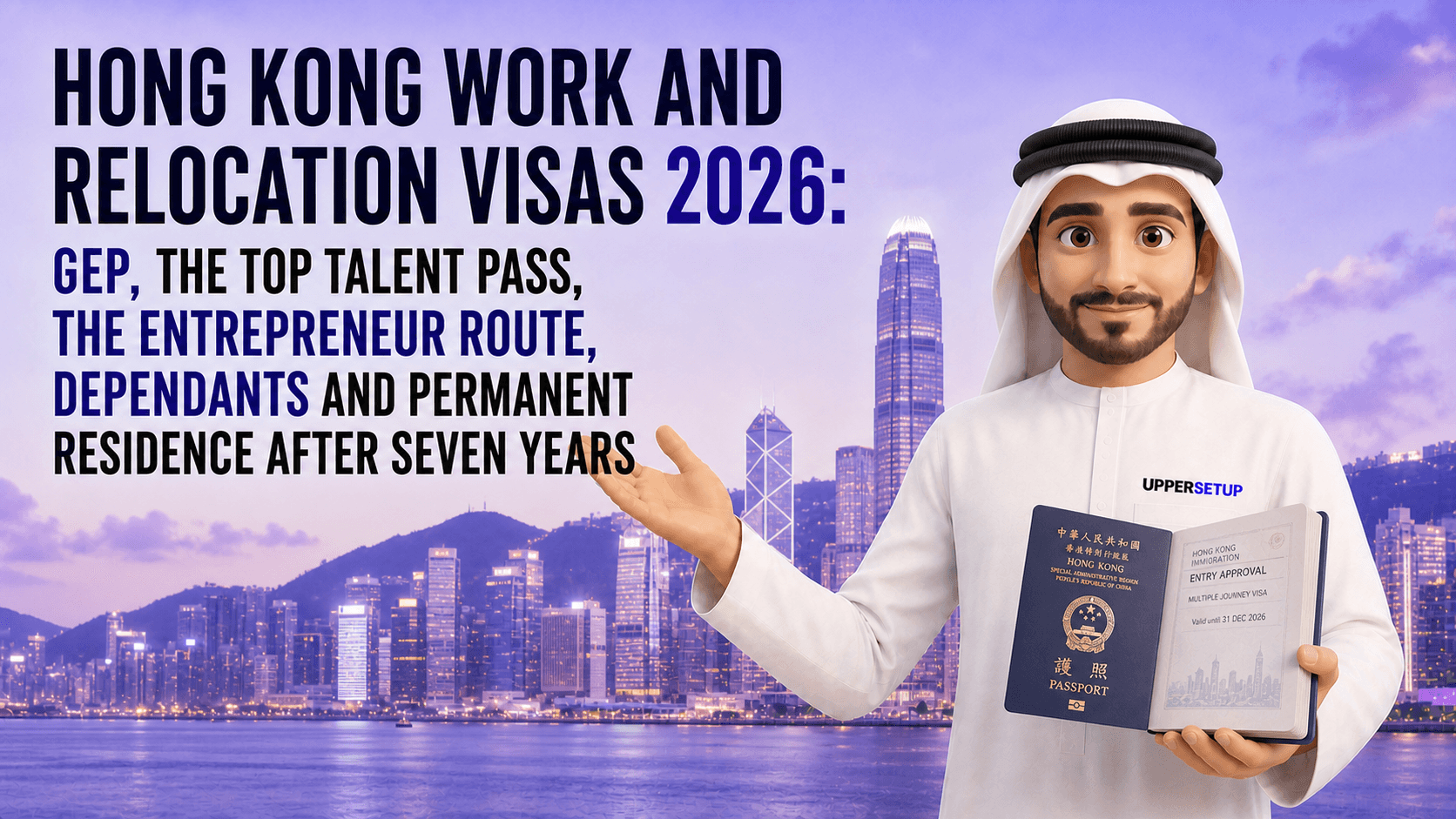
Hong Kong Work and Relocation Visas 2026: GEP, the Top Talent Pass, the Entrepreneur Route, Dependants and Permanent Residence After Seven Years
Hong Kong's employment and talent visas are administered by the Immigration Department across several parallel schemes. The ones that matter to foreign nationals are the General Employment Policy (GEP) for employed professionals and for entrepreneurs, the Top Talent Pass Scheme (TTPS) for high earners and graduates of listed universities, and the Quality Migrant Admission Scheme (QMAS) for those without a job offer. All of them lead to the same destination: after seven years of continuous ordinary residence, the entrant and their dependants may apply for permanent resident status.
The schemes differ less in their entry criteria than in how they renew. GEP, ASMTP, QMAS and TechTAS run on a 3+3+2 year pattern; TTPS, IANG and ASSG run on 2+3+3. Separately, the top-tier employment stream grants a 5- or 6-year extension with no conditions of stay — that is, with no tie to an employer — where the person has been in Hong Kong for at least two years and had assessable income of HKD 2,000,000 or more in the previous year of assessment.
What changed by 2026
The architecture of the schemes settled in late 2022; what moved in 2025 and 2026 were the lists and parameters inside it. Four changes matter to an applicant.
● The TTPS aggregate list of eligible universities was updated with effect from 1 January 2026 and now covers 200 institutions, against 199 in the previous edition. The list is revised annually.
● The Talent List was updated with effect from 1 March 2025 and covers 60 professions across 9 industry segments — for those roles an employer need not prove local recruitment difficulties.
● QMAS was revamped with effect from 1 November 2024: the General Points Test was reworked and no annual quota applies.
● Category A of the TTPS carries an initial stay of 36 months, against 24 months for Categories B and C.
The TTPS aggregate list is built from institutions in the top 100 of four rankings — Times Higher Education, QS, US News and Shanghai ARWU — plus dedicated sub-lists: the top five specialised hospitality schools, the top five art and design institutions, and the top 20 Mainland universities.
The university list is a moving target, and that changes how applications are timed. An institution can drop out on the annual review: from 1 January 2026, graduates of four universities ceased to qualify under Categories B and C. Check the edition of the list in force on the date of submission, not last year's.
Who administers what
Hong Kong's immigration perimeter rests on one principal statute and several bodies with distinct remits.
|
Element |
Instrument or body |
What it determines |
|
Permanent resident status and right of abode |
Immigration Ordinance (Cap. 115), Schedule 1; Basic Law article 24 |
Who is a permanent resident and on what conditions |
|
All visa schemes |
Immigration Department (IMMD) |
Applications, criteria, limits of stay, extensions |
|
Talent List |
Labour and Welfare Bureau, talentlist.gov.hk |
Professions in short local supply |
|
TTPS university list |
Hong Kong Talent Engage (HKTE) |
The aggregate list for Categories B and C |
|
TechTAS |
Innovation and Technology Commission (ITC) |
Quotas for companies hiring technology talent |
|
Application and visa issuance fees |
Immigration Regulations (Cap. 115A), regulation 11(6) and Schedule 2 |
The list of "Specified Schemes" and the two-tiered fee structure |
The Immigration Department states a normal processing time of about four weeks for GEP and ASMTP applications, running from receipt of all required documents.
Mapping the schemes
The schemes divide along three lines: whether an offer is needed, who may apply, and how long the initial stay runs.
|
Scheme |
For whom |
Offer required |
Initial stay |
|
GEP — professionals |
Residents outside the Mainland, Taiwan and Macao |
Yes |
3 years, or the contract term if shorter |
|
GEP — entrepreneurs |
Those establishing or joining a business in Hong Kong |
No |
3 years |
|
TTPS |
High earners and graduates of listed universities |
No |
36 months (Cat. A) / 24 months (Cat. B and C) |
|
QMAS |
Highly skilled individuals without an offer |
No |
Determined on points assessment |
|
ASMTP |
Mainland residents |
Yes |
3 years, or the contract term |
|
TechTAS |
Technology talent against an employer quota |
Yes |
3 years |
|
IANG |
Graduates of Hong Kong programmes, including GBA campuses |
No, for recent graduates |
2 years |
Matching a profile to the right scheme and assembling the file is the work of UPPERSETUP visa services; where staff are being hired into a Hong Kong entity, HR services come into play.
GEP for professionals: three requirements
A GEP application is considered favourably where three substantive conditions are met alongside the normal immigration requirements.
1. The applicant has secured a job relevant to their academic qualifications or work experience that cannot readily be taken up locally.
2. The remuneration package is commensurate with the prevailing market rate for a comparable role in Hong Kong.
3. The applicant has a good education background, technical qualifications or proven professional experience.
An employer is relieved of proving local recruitment difficulties where the post falls within the Talent List or where the annual salary is HKD 2,000,000 or above. Annual salary here means the total remuneration package, including fringe benefits such as a housing allowance.
Professionals admitted under the GEP are normally granted an initial stay of 36 months on employment condition, or the duration of the employment contract if shorter. Subsequent extensions follow a 3-2 year pattern, again on employment condition.
There is no minimum salary figure in the rules. The HKD 2,000,000 threshold is not a condition of the visa; it is a condition for exempting the employer from the local market test. The requirement that pay match the market remains a matter of assessment against role, sector and seniority.
A discrepancy over the size of the Talent List
The Talent List in force covers 60 professions across 9 industry segments — confirmed by the dedicated portal talentlist.gov.hk, by Hong Kong Talent Engage, and by the Government's reply in the Legislative Council in June 2026.
Yet the Immigration Department's own overview page still referred to "13 professions" as at July 2026. That figure is stale: the list was reviewed in 2021, 2023 and 2025, and since 1 March 2025 it contains 60 entries, including nine additions — accountants, finance professionals with Islamic market experience, commodities trading professionals, systems architects, patent professionals, legal knowledge engineers, ship surveyors, green shipping professionals and aircraft maintenance engineers. Work from talentlist.gov.hk, not from the IMMD summary page.
GEP for entrepreneurs: a visa without an employer
The entrepreneur route is a distinct branch of the GEP for those establishing or joining a business in Hong Kong. An application is considered favourably where there is no security objection or record of serious crime, the applicant has a good education background or proven professional ability, and the applicant is in a position to make a substantial contribution to the economy of Hong Kong.
The initial stay on the entrepreneur route is 3 years on employment conditions — increased from two years with effect from 28 December 2022.
The Immigration Department publishes no fixed minimum investment. The assessment weighs the whole picture: the business plan, financial resources, the sum invested, turnover and local job creation. Minimum thresholds quoted by advisers are not supported by any official source.
The route does not apply to Chinese residents of the Mainland, nor to nationals of Afghanistan, Cuba and the Democratic People's Republic of Korea. Where an entrant later wishes to run a business other than the one approved, prior approval of the Director of Immigration is required.
The entrepreneur route presupposes a functioning Hong Kong company: incorporation and ongoing corporate work are set out in Hong Kong Company Registration 2026, with support available through UPPERSETUP company registration services.
The Top Talent Pass Scheme: three categories
TTPS requires no job offer at the point of application. The applicant must fall within one of three categories.
● Category A — annual income of HKD 2,500,000 or above in the year immediately preceding the application. Annual income means taxable employment or business income, including salary, allowances, stock options and profits from self-owned companies. Income from personal investment does not count.
● Category B — holders of a degree or above from a listed institution with at least three years of work experience over the preceding five years.
● Category C — graduates of the same institutions within the past five years with less than three years of experience, subject to an annual quota allotted first come, first served.
The annual quota for Category C is 10,000 places, allotted on a first-come, first-served basis. Categories A and B carry no quota.
Category C does not apply to non-local students who obtained their undergraduate qualification on a full-time, locally accredited programme in Hong Kong: the IANG arrangement covers them instead.
Persons admitted under the TTPS are free to take up and change employment during their permitted stay without seeking prior approval from the Immigration Department.
Category A demands attention to how income is composed: where it comes from the profits of a self-owned company, the applicant should generally have held the relevant shares continuously throughout the tax assessment year preceding the application.
A discrepancy over the TTPS initial stay
The dedicated TTPS page states an initial stay of 36 months for Category A and 24 months for Categories B and C. The consolidated pattern table on another Immigration Department page shows TTPS on a general pattern of 2+3+3.
The difference reflects timing: the consolidated table records the base pattern set when the scheme launched, while the longer 36-month initial stay for Category A came later. Both pages are official and are updated on different dates, so plan against the dedicated TTPS page and confirm the term granted in the decision on the individual application.
Extension patterns and the top-tier stream
Limits of stay are extended on fixed patterns that differ by scheme. The Immigration Department publishes them in a single table.
|
Scheme |
Pattern before 28 Dec 2022 |
Pattern from 28 Dec 2022 |
Top-tier |
|
GEP and ASMTP |
2+3+3 |
3+3+2 |
3+5 |
|
QMAS |
2+3+3 |
3+3+2 |
3+5 |
|
TechTAS |
2+3+3 |
3+3+2 |
3+5 |
|
TTPS |
Not applicable |
2+3+3 |
2+6 |
|
IANG |
1+2+2+3 |
2+3+3 |
2+6 |
|
ASSG |
1+2+2+3 |
2+3+3 |
2+6 |
The top-tier employment stream is open under every scheme. The conditions are that the person has been permitted to remain in Hong Kong for not less than two years and had assessable income for salaries tax of not less than HKD 2,000,000 in the previous year of assessment. The extension is granted on time limitation only, without other conditions of stay.
The length of a top-tier extension depends on the scheme: five years under GEP, ASMTP, QMAS and TechTAS (the 3+5 pattern) and six years under TTPS, IANG and ASSG (the 2+6 pattern).
A further practical privilege: a top-tier holder changing jobs files no new application. Professionals permitted to remain on time limitation only, without other conditions of stay, need only notify the Immigration Department of a change of employment through its online service system within the currency of their limit of stay. An ordinary employment visa holder in the same position must file a full application to change conditions of stay and pay the fees again.
"Without other conditions of stay" is the whole point of the top-tier stream. An ordinary employment visa is tied to a named employer, and changing jobs means a fresh application. A top-tier extension removes that tie for its full term, which in practice delivers freedom of employment right up to the permanent residence application.
One refinement: assessment under the top-tier stream may be requested before the three-year limit is anywhere near expiry. In that case the extension is normally five years, counted from the limit of stay previously granted.
Extension applications are filed within three months before the limit of stay expires, and the application fee is non-refundable whatever the outcome.
The other schemes and who they suit
|
Scheme |
Key condition |
Distinctive feature |
|
ASMTP |
The GEP equivalent for Mainland residents |
Same criteria and the same 3+3+2 pattern |
|
TechTAS |
The employer holds an ITC quota |
The quota is valid 24 months; a STEM degree and R&D work are required |
|
IANG |
A full-time locally accredited Hong Kong qualification |
Coverage extended to graduates of GBA campuses of Hong Kong universities |
|
ASSG |
Second generation of Chinese Hong Kong permanent residents, aged 18–40 |
No offer required; 24 months initially without conditions of stay |
|
TP Stream |
Skilled trades |
Overall quota of 10,000 in the first three years, capped at 3,000 per trade |
QMAS remains a points-based scheme with no quota and no offer requirement, assessed on either of two routes: the General Points Test covering age, qualifications, language, experience, income and business ownership, and the Achievement-based Points Test for those with outstanding achievements such as an Olympic medal or a Nobel prize.
Dependants: who can come
A successful entrant may bring a spouse or partner and minor children. The class is defined precisely, and it is wider than commonly assumed.
● A spouse, or the other party to a same-sex or opposite-sex civil partnership, civil union or "same-sex marriage" entered into under the law of the place of celebration and legally and officially recognised by the authorities of that place.
● Unmarried dependent children under the age of 18.
A dependant's limit of stay is linked to the sponsor's, and dependants are free to take up employment or study in Hong Kong during their stay.
Cohabitation does not qualify. The Immigration Department states expressly that recognised relationships exclude de facto spouses, cohabiting partners and fiancés: what is required is a legal institution governed by legislation, registered with a competent authority and evidenced in writing. Parents fall outside the dependant class under these talent schemes.
The dependant's freedom to work without a separate visa is an underused planning point: a spouse can take a job or start a business without needing an immigration route of their own.
Permanent residence after seven years
After seven years of continuous ordinary residence, the entrant and their dependants may apply for permanent resident status. For persons not of Chinese nationality the basis is paragraph 2(d) of Schedule 1 to the Immigration Ordinance (Cap. 115).
1. The person entered Hong Kong on a valid travel document.
2. The person has ordinarily resided in Hong Kong continuously for not less than seven years.
3. The person has taken Hong Kong as their place of permanent residence — evidenced by a declaration on Form ROP146 filed with the application.
When applying for verification of eligibility for a permanent identity card, the applicant must be staying in Hong Kong legally. Where a person claims the right of abode, the burden of proving the claim lies on that person.
For persons not of Chinese nationality, permanent status is not unconditionally permanent. The right of abode is lost where the person has ceased to ordinarily reside in Hong Kong and has been absent continuously for not less than 36 months after acquiring a right of abode elsewhere. On losing the right of abode the person automatically acquires the right to land, which allows free entry and the ability to work, study or live without conditions of stay.
The wording of the declaration repays attention: the official guidance frames it as taking Hong Kong as one's only place of permanent residence. For anyone retaining close ties and tax residence elsewhere, that is a substantive question rather than a formality.
Visa, tax and pension are three separate perimeters
Holding a work visa settles neither tax status nor pension obligations. In Hong Kong the three sit under different statutes and different authorities.
● The visa — Immigration Ordinance and the Immigration Department: the right to enter, work and stay.
● Salaries tax — Inland Revenue Ordinance and the Inland Revenue Department: charged by reference to the source of employment income, not to immigration status.
● MPF — Mandatory Provident Fund Schemes Ordinance and the MPFA: mandatory enrolment of employees by the employer.
The HKD 2,000,000 threshold in the top-tier stream is measured on assessable income for salaries tax for the previous year of assessment — a figure from the tax perimeter, not the number in an employment contract.
Employer reporting, MPF and labour law obligations are set out in Payroll and Employer Obligations in Hong Kong 2026, and the corporate calendar in Mandatory Annual Compliance for Hong Kong Companies. Bookkeeping and payroll are handled by UPPERSETUP accounting services.
Banking is the other practical layer of a relocation: personal and corporate account opening is covered in Corporate Bank Accounts in Hong Kong for Non-Residents, with support available through UPPERSETUP banking services.
What the fees are and who pays them
Since 11 a.m. on 26 February 2025 a two-tiered fee structure has applied to "Specified Schemes", made under regulation 11(6) of, and Schedule 2 to, the Immigration Regulations (Cap. 115A).
Fees are payable by each applicant separately — the principal applicant and every dependant. This applies both to entry applications and to a change of condition of stay, including an extension of the limit of stay.
|
Fee |
Condition |
Amount, HKD |
|
Application fee |
Per application, whatever the outcome |
600 |
|
Visa issuance fee |
Relevant period of more than 180 days |
1,300 |
|
Visa issuance fee |
Relevant period of not more than 180 days |
600 |
The application fee is non-refundable in any circumstances — on refusal and on withdrawal alike. Paying it constitutes no guarantee or assurance that the application will be approved.
For a visa carrying a fixed limit of stay, the relevant period is that stated period: at six months or more the issuance fee is HKD 1,300. On an extension the relevant period is computed differently — as the difference between the last date under the new limit of stay and the last date under the previous one. A five- or six-year top-tier extension therefore attracts the upper rate.
The Specified Schemes are the TTPS, GEP, ASMTP, QMAS, IANG, ASSG, TechTAS and the Vocational Professionals Admission Scheme, together with the Capital Investment Entrant Scheme and the New Capital Investment Entrant Scheme — for the latter two excluding applications for unconditional stay or a visit visa.
Applications submitted before 26 February 2025 are charged under the previous fee structure, even where the decision or the collection of the visa falls after that date.
A naming inconsistency in the official material. The Specified Schemes list names a Vocational Professionals Admission Scheme, while the dedicated page describes what is substantively the same route for skilled trades as the TP Stream within the GEP and ASMTP. The relationship between the two names is not explained on the Immigration Department pages consulted, so confirm on filing which label the particular application carries.
Step-by-step
1. Pick the route: an offer in hand means GEP or ASMTP; no offer but qualifying income or a listed degree means TTPS; neither means QMAS; a business being set up means the GEP entrepreneur branch.
2. Check the lists as at the filing date: the Talent List on talentlist.gov.hk and the TTPS aggregate university list on the HKTE portal.
3. Assemble evidence of income or qualifications — tax documents for TTPS Category A, degrees and proof of experience for Categories B and C.
4. For the entrepreneur route, prepare a business plan quantifying the contribution: investment, turnover and jobs created.
5. File through the Immigration Department's electronic platform; on approval, pay the fee and obtain the e-Visa.
6. File for dependants — the principal applicant acts as sponsor.
7. Track the limit of stay and apply for extension within the three months before it expires.
8. Test the top-tier stream once two years of stay and HKD 2,000,000 of assessable income are met.
9. Keep a record of presence from day one: the seven-year clock starts with lawful ordinary residence.
10. At seven years, apply for verification of eligibility for a permanent identity card with the ROP146 declaration.
Common mistakes and what they cost
Treating HKD 2,000,000 as a minimum salary
That threshold exempts the employer from the local recruitment test and defines the top-tier stream. It is neither a minimum wage nor a guarantee of approval: the market-rate requirement is assessed separately and on its own logic.
Checking the university against last year's list
The aggregate list is revised annually and institutions do drop out. From 1 January 2026, graduates of four universities lost eligibility under Categories B and C. An application built on a superseded edition fails on a formal ground.
Confusing the extension patterns between schemes
GEP runs 3+3+2; TTPS runs 2+3+3. Planning a seven-year path on the wrong pattern misplaces the date of the next renewal and invites an overstay.
Not claiming the top-tier stream when eligible
Two years of stay plus HKD 2,000,000 of assessable income yields a 5- or 6-year extension with no conditions of stay. Continuing to renew an ordinary visa keeps the employer tie and adds filing cycles for no benefit.
Assuming an unregistered partner qualifies as a dependant
Only legally constituted and officially registered relationships under the law of the place of celebration are recognised. Cohabitation, engagement and unregistered partnerships are not a basis.
Failing to budget the dependants' fees
The application fee is payable by each applicant, including every dependant, and is not refunded on refusal. A family of four pays four application fees and four issuance fees on entry, and again on every extension — not one per household.
Counting seven years on the calendar rather than on residence
What is required is continuous ordinary residence. Long absences and the applicant's status at the point of application are assessed by the Immigration Department, and the burden of proof lies with the applicant, who must be in Hong Kong lawfully when filing.
Assuming permanent status cannot be lost
For persons not of Chinese nationality the right of abode falls away after a continuous absence of not less than 36 months following acquisition of a right of abode elsewhere. The right to land replaces it — a materially narrower status.
Which scheme fits which situation
|
Situation |
Working route |
Watch item |
|
An offer from a Hong Kong employer |
GEP — professionals |
Talent List and the HKD 2,000,000 market-test exemption |
|
Income from HKD 2,500,000 a year, no offer |
TTPS Category A |
36-month initial stay; freedom to change employer |
|
A listed degree plus three years of experience |
TTPS Category B |
The edition of the list in force at filing |
|
A recent graduate of a listed university |
TTPS Category C |
Annual quota on a first-come, first-served basis |
|
Setting up a business in Hong Kong |
GEP — entrepreneurs |
Business plan and evidence of economic contribution |
|
Highly qualified, no offer and no listed degree |
QMAS |
Points assessment; no quota |
|
R&D technology specialist |
TechTAS |
The employer obtains the quota from ITC |
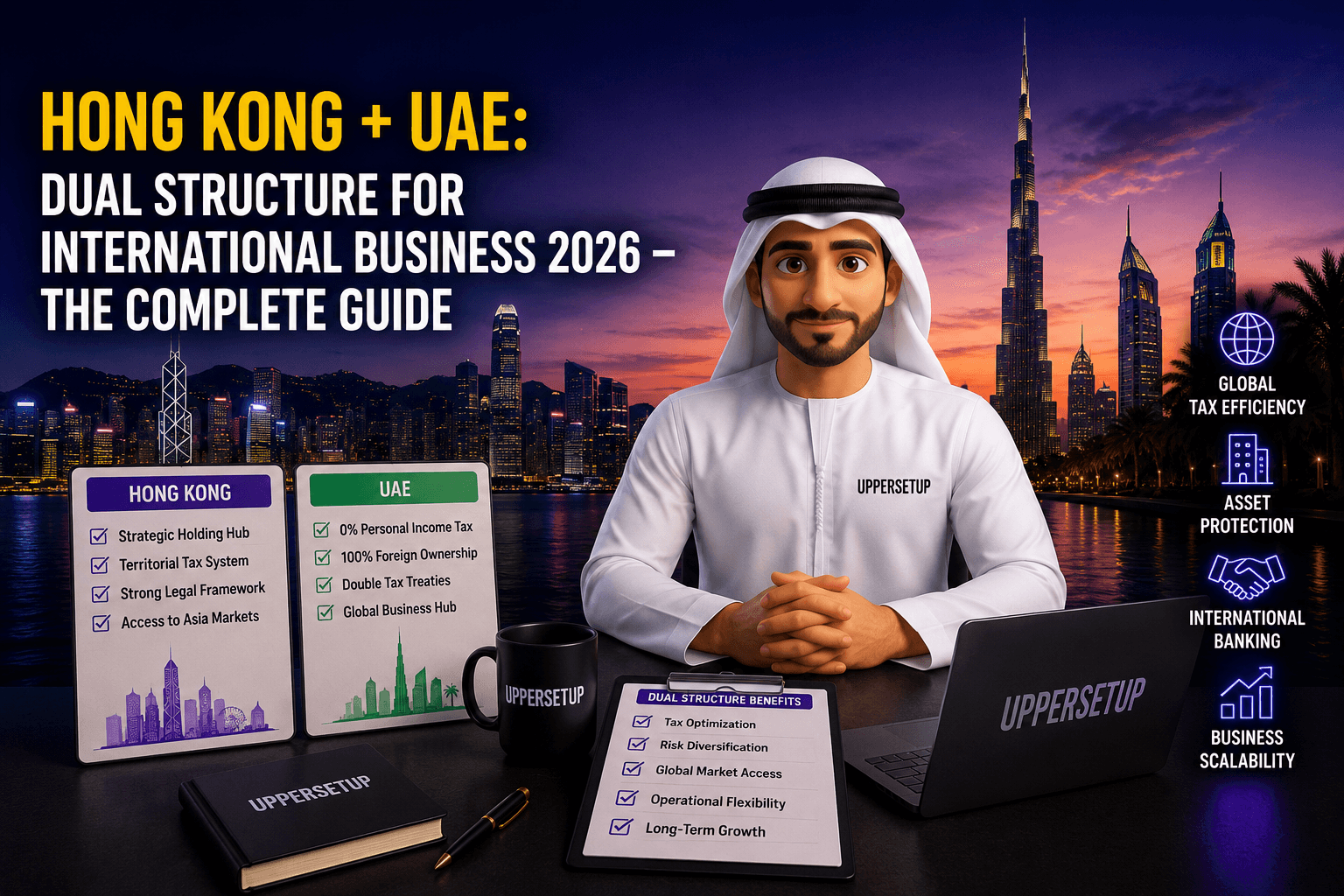
For structures pairing a Hong Kong company with operations elsewhere, see Hong Kong + UAE: a Dual Structure for International Business and Territorial Taxation and Offshore Status in Hong Kong 2026.
When professional review is warranted
● Category A income comes from the profits of a self-owned company rather than salary.
● The applicant's university sits at the margin of the list or has recently dropped off it.
● The partnership is registered in a jurisdiction with an atypical legal institution.
● A change of employer is planned before a top-tier extension is granted.
● The seven-year period includes long absences or a change of immigration status.
● Tax residence in another country is being decided at the same time.
Legal review of an immigration history and preparation of the position before filing sits with UPPERSETUP legal services; the full catalogue is in the services section.
Frequently asked questions
Is a job offer required for a Hong Kong work visa?
For GEP and ASMTP, yes — a secured job matching the applicant's qualifications or experience. For TTPS, QMAS, ASSG and the GEP entrepreneur branch, no offer is required at the point of application.
What is the minimum salary for a Hong Kong work visa?
The rules set no single minimum. What is required is remuneration at the prevailing market level for a comparable role. The HKD 2,000,000 annual package threshold exempts the employer from proving local recruitment difficulties and defines the top-tier employment stream.
How long is the Top Talent Pass granted for?
The initial stay is 36 months for Category A and 24 months for Categories B and C, on time limitation only and without other conditions of stay. That initial stay is granted to each applicant once.
Can a Top Talent Pass holder change employer?
Yes. Persons admitted under the TTPS may take up and change employment during their permitted stay without prior approval from the Immigration Department.
Who can be brought to Hong Kong as a dependant?
A spouse, or the other party to a same-sex or opposite-sex civil partnership, civil union or "same-sex marriage" recognised under the law of the place of celebration, together with unmarried dependent children under 18. Their stay is linked to the sponsor's and they may work or study.
After how long can permanent residence be obtained in Hong Kong?
After seven years of continuous ordinary residence. For persons not of Chinese nationality, entry on a valid travel document and a declaration on Form ROP146 that Hong Kong has been taken as the place of permanent residence are also required, and the applicant must be in Hong Kong lawfully when filing.
What is the top-tier employment stream?
An extension route for those who have remained in Hong Kong for at least two years with assessable income for salaries tax of at least HKD 2,000,000 in the previous year of assessment. The extension runs 5 or 6 years depending on the scheme and removes the tie to an employer for its full term.
How long does an application take?
The Immigration Department states about four weeks for GEP and ASMTP applications from receipt of a complete document set. Extension applications are filed within the three months before the limit of stay expires.
Key takeaways
● GEP requires an offer; TTPS, QMAS and the GEP entrepreneur branch do not.
● The HKD 2,000,000 threshold exempts the employer from the local market test; it is not a minimum salary.
● The Talent List has covered 60 professions across 9 segments since 1 March 2025; the IMMD summary page carries a stale figure.
● The TTPS university list covers 200 institutions from 1 January 2026 and is revised annually.
● Extension patterns: 3+3+2 for GEP, ASMTP, QMAS and TechTAS; 2+3+3 for TTPS, IANG and ASSG.
● Top-tier stream: two years of stay plus HKD 2,000,000 of assessable income yields 5 or 6 years without conditions of stay.
● Fees: HKD 600 per application from every applicant, dependants included, plus HKD 600 or 1,300 on issuance depending on the period.
● Permanent status comes at seven years of continuous ordinary residence and, for non-Chinese nationals, is lost after 36 months of continuous absence.
Summary
Hong Kong's employment and talent visas are administered by the Immigration Department. The General Employment Policy requires a secured job matching the applicant's qualifications or experience that cannot readily be filled locally, remuneration at the prevailing market rate, and a good education background or proven professional experience; the initial stay is three years or the contract term, whichever is shorter. An employer is exempt from proving local recruitment difficulties where the post falls within the Talent List, which since 1 March 2025 covers 60 professions across nine industry segments, or where the annual package including housing and other allowances is HKD 2,000,000 or above. The entrepreneur branch of the General Employment Policy requires no offer, grants three years, and is assessed on the applicant's ability to make a substantial contribution to the economy, with no fixed minimum investment published. The Top Talent Pass Scheme requires no offer and has three categories: annual income of HKD 2,500,000 or above in the preceding year; a degree from the aggregate list of universities with at least three years of experience over the preceding five; and recent graduates of those universities with less than three years of experience, subject to an annual quota. The initial stay is 36 months for Category A and 24 months for Categories B and C, and the aggregate university list covers 200 institutions from 1 January 2026. Extension patterns are 3+3+2 years for the General Employment Policy, ASMTP, QMAS and TechTAS, and 2+3+3 years for the Top Talent Pass Scheme, IANG and ASSG. Under the top-tier employment stream, a person who has remained in Hong Kong for at least two years with assessable income for salaries tax of at least HKD 2,000,000 in the previous year of assessment receives an extension of five or six years on time limitation only, without other conditions of stay. Dependants comprise a spouse or the other party to a registered partnership or union recognised under the law of the place of celebration, together with unmarried children under 18; they may work and study, and their stay is linked to the sponsor's. The annual quota for Category C is 10,000 places on a first-come, first-served basis. Since 26 February 2025 a two-tiered fee structure applies: HKD 600 per application, payable by the principal applicant and by each dependant, and a visa issuance fee of HKD 1,300 where the relevant period exceeds 180 days or HKD 600 where it does not. After seven years of continuous ordinary residence, the entrant and dependants may apply for permanent resident status under paragraph 2(d) of Schedule 1 to the Immigration Ordinance (Cap. 115), supported by a declaration on Form ROP146.
Sources
● Immigration Department — Introduction of Admission Schemes for Talent, Professionals and Entrepreneurs: all schemes, the consolidated table of stay patterns and the dependant arrangements
● Immigration Department — FAQs on the enhancement measures: the HKD 2 million threshold, the top-tier stream and limits of stay
● Immigration Department — Top Talent Pass Scheme: categories and initial limits of stay
● Immigration Department — FAQs on the TTPS: the definition of annual income and freedom to change employment
● Immigration Department — Entry for Investment as Entrepreneurs: the criteria for the entrepreneur route
● Immigration Department — Guidebook for Entry for Investment as Entrepreneurs (PDF)
● Immigration Department — Guidebook for the Top Talent Pass Scheme (PDF)
● Immigration Department — TP Stream under the GEP and ASMTP: quotas and extension rules
● Immigration Department — Apply for Right of Abode: conditions, Form ROP146 and the requirement to be lawfully present
● Immigration Department — FAQs on the right of abode: paragraph 2(d) of Schedule 1 to Cap. 115
● Immigration Department — The Position of Non-Chinese Citizens: loss of the right of abode and the right to land
● Immigration Department — New Fee Structure for Visa Applications under Specified Schemes: the schemes covered, the amounts and how the relevant period is computed
● Immigration Department — General Employment Policy: the 36-month initial stay, the extension pattern and the top-tier criteria
● Immigration Department — Residence as Dependants: extension procedure and dependant fees
● Talent List Hong Kong — the list in force: 60 professions across 9 industry segments following the 2025 review
● Hong Kong Talent Engage — update of the TTPS aggregate list of eligible universities to 200 institutions
● Government of the HKSAR — press release on the updated Talent List effective 1 March 2025
● Legislative Council — Government reply of 3 June 2026: the Talent List expanded to 60 professions
● Legislative Council — Government reply of 18 March 2026 on permanent residence applications by talent scheme entrants
Levels of verification behind this briefing
Sources are separated by reliability on purpose.
● Verified on Immigration Department pages: the GEP criteria for professionals and entrepreneurs; the three TTPS categories and the definition of annual income; the 36- and 24-month initial stays; the complete table of stay patterns across all schemes; the conditions and terms of the top-tier employment stream, including both the five- and six-year variants; the dependant class and their freedom to work and study; the four-week processing time; the three-month extension window; the conditions for permanent resident status, Form ROP146 and loss of the right of abode after 36 months of absence; and the parameters of TechTAS, IANG, ASSG and the TP Stream.
● Verified on official government resources: the composition of the Talent List at 60 professions across 9 segments and its commencement date; the update of the TTPS aggregate university list to 200 institutions from 1 January 2026; and the Government's replies in the Legislative Council.
● Discrepancies resolved in the text: the Immigration Department's summary page cites 13 Talent List professions while the list in force contains 60 — the dedicated portal and government publications prevail; the dedicated TTPS page states a 36-month initial stay for Category A while the consolidated pattern table shows 2+3+3 — both pages are official and the divergence is flagged rather than smoothed over.
● Additionally verified from primary sources in this pass: the fee structure and the list of Specified Schemes under the Immigration Regulations (Cap. 115A); the 10,000-place annual quota for TTPS Category C; the 36-month initial stay and 3-2 extension pattern under the GEP; the five-year top-tier extension under the GEP; and the notification-only procedure for a top-tier holder changing employment.
● Outside the scope of verification: the Capital Investment Entrant Scheme is not analysed on its merits here — it is an investment rather than an employment route and warrants separate verification, although it appears in the Specified Schemes list. The relationship between the names "Vocational Professionals Admission Scheme" and "TP Stream" is not explained on the Immigration Department pages consulted and is flagged in the text as an open question.
Related UPPERSETUP reading
● Hong Kong Company Registration 2026: Requirements, Procedure and Taxes
● Mandatory Annual Compliance for Hong Kong Companies 2026: NAR1, Audit and BIR51
● Territorial Taxation and Offshore Status in Hong Kong 2026
● Hong Kong + UAE: a Dual Structure for International Business 2026
Disclaimer
This material is provided for information only and does not constitute legal, tax, financial, investment or consulting advice. Professional advice should be obtained on the specific facts, jurisdiction, entity status and current regulatory requirements before any decision is taken. Information is current as at August 2026.
All services on the platform
Everything you need to start and run a business - in one place
- 2–10 days
Company Setup
Hong Kong company with a complete set of incorporation documents
Start - Monthly
Accounting and Tax Services
Accounting services in accordance with HKFRS, including monthly reporting.
- 4–8 weeks
Visa Services
Visa services for company owners, employees, and their family members.
- 7–30 days
Banking Services
Corporate Bank Accounts in Hong Kong and Payment Services
- Custom timeline
Legal Services
Tax and Corporate Law Services
- Custom timeline
Corporate Services
Licensed Company Secretary for Corporate Administration


