


















































 International Free Zone Authority
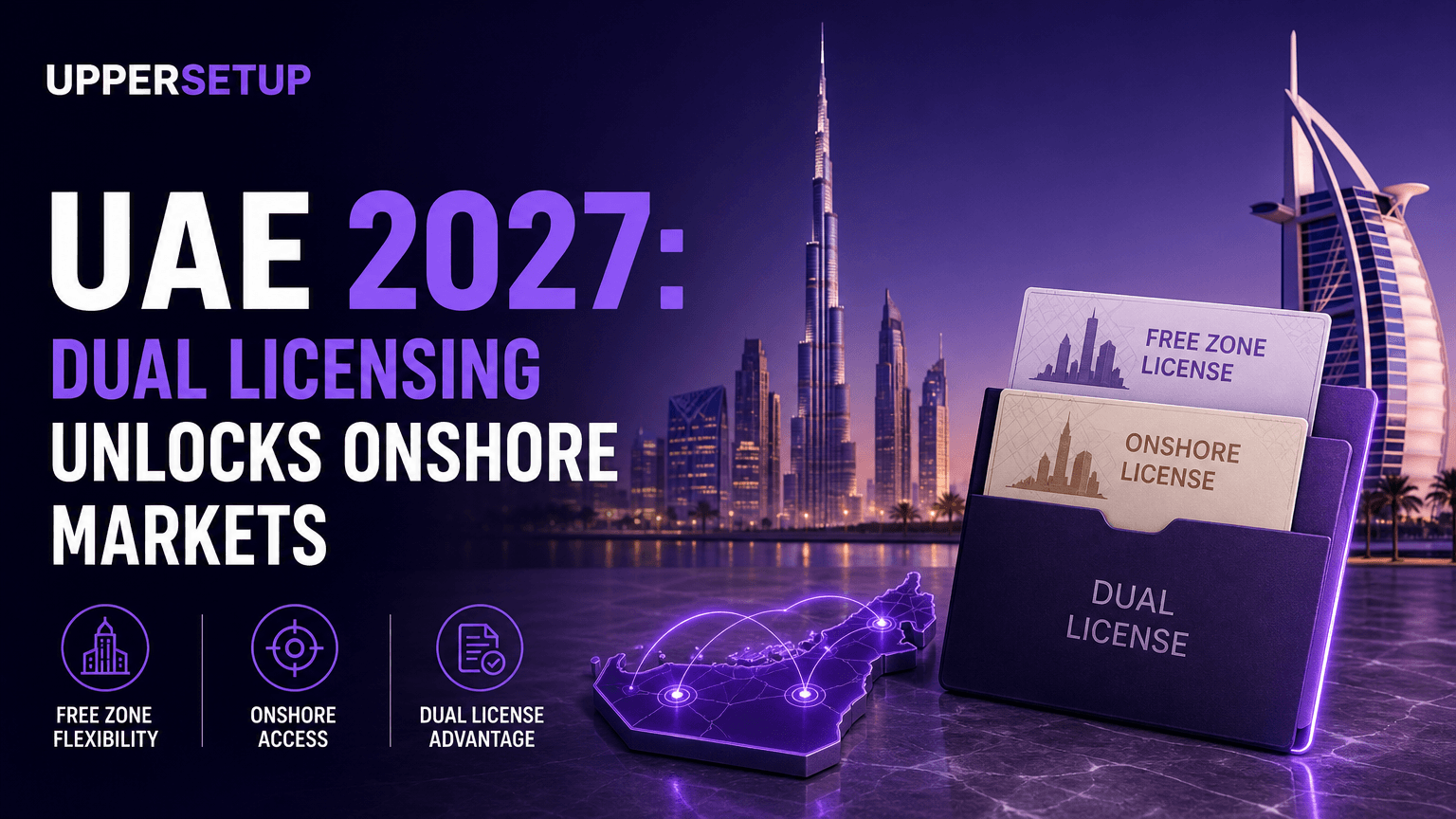
Establishing a Foreign Service Branch in the UAE by 2027: New Rules, Pitfalls, and the Tax Surprises Every Global Firm Should Know

Establishing a Foreign Service Branch in the UAE by 2027: New Rules, Pitfalls, and the Tax Surprises Every Global Firm Should Know
Quick Answer: What Every Foreign Service Business Needs To Know NOW
Setting up a branch of a foreign company in the UAE remains a preferred entry route, but major changes in regulations and tax for 2027 redefine risks and opportunities. UAE branches face expanded corporate tax exposure (up to 9%) and must comply with both federal and emirate-level licensing, alongside sectoral requirements from the Ministry of Economy and relevant free zone authorities.
Alert: A branch is not a separate legal entity from its parent—liabilities and tax exposures directly hit the headquarters. Sudden regulatory changes in 2023–2026 increased branch compliance burdens, created confusion around “service PE” rules, and triggered new bank due diligence thresholds.
Legal Framework: Laws Governing Branch Registration and Operation (UAE, 2023–2027)
Foreign branches in the UAE are governed by a layered mix:
- Federal Decree-Law No. 32 of 2021 on Commercial Companies (effective 2 January 2022), as amended by subsequent regulations (notably by the 2023 update, in effect since early 2024), governs mainland entities and foreign branches.
- Federal Decree-Law No. 47 of 2022 on the Taxation of Corporations and Businesses (est. effective date: 1 June 2023), introducing UAE Corporate Tax (CT) including branch profits.
- Respective Emirate-level Department of Economic Development (DED) regulations for licensing and operational permits.
- Free zone authorities’ regulations (e.g., Dubai Multi Commodities Centre, Abu Dhabi Global Market, etc.), each with distinct rules—free zone branches have unique licensing and often special regulatory requirements.
- Ministry of Economy procedures for foreign companies’ branch pre-approvals and commercial registration.
- Other sectoral regulators for specific business types (e.g., Central Bank for financial firms, SCA for securities).
Note: For VAT, Federal Decree-Law No. (8) of 2017, with periodic amendments, applies. VAT Designated Zones are different from “Qualifying Free Zones” for corporate tax purposes. Branch CT rules do not always align with historical VAT practices.
What Is a Foreign Branch in the UAE? Definition and Distinction From Subsidiaries
A UAE branch is a dependent extension of the parent company—it has no separate legal personality, acts and contracts on behalf of its HQ, and is entered on the company register as an extension. Branches can be established on the mainland (i.e., onshore UAE), or in one of the 40+ free zones.
The key distinction: A “subsidiary” is a UAE-incorporated legal entity, typically an LLC or PJSC, with distinct assets and liability. A “branch” is not.
Branches cannot undertake activities not allowed by the parent, nor by local law. Most service lines are allowed, but approval depends on sector.
Why Choose a Branch Over a Subsidiary? Pros, Cons, Tax and Regulatory Considerations
The branch model is commonly chosen by: - Service-sector foreign businesses wanting direct control, no local equity quotas - Firms with contracts where UAE project profits are to be repatriated efficiently - Entities wanting a fast market entry without capital requirements of an LLC
Pros: - No minimum shared capital (mainland, except licensor-imposed sectoral rules) - 100% foreign ownership is possible - Quick formation, especially in some free zones - Easier for head office accounting and reporting
Cons: - Parent company is 100% liable for debts and acts of the branch - Exposure to full UAE Corporate Tax (even in some free zones—see below) - Regulatory traps: local agent/sponsor obligations, sector licenses, complex annual compliance
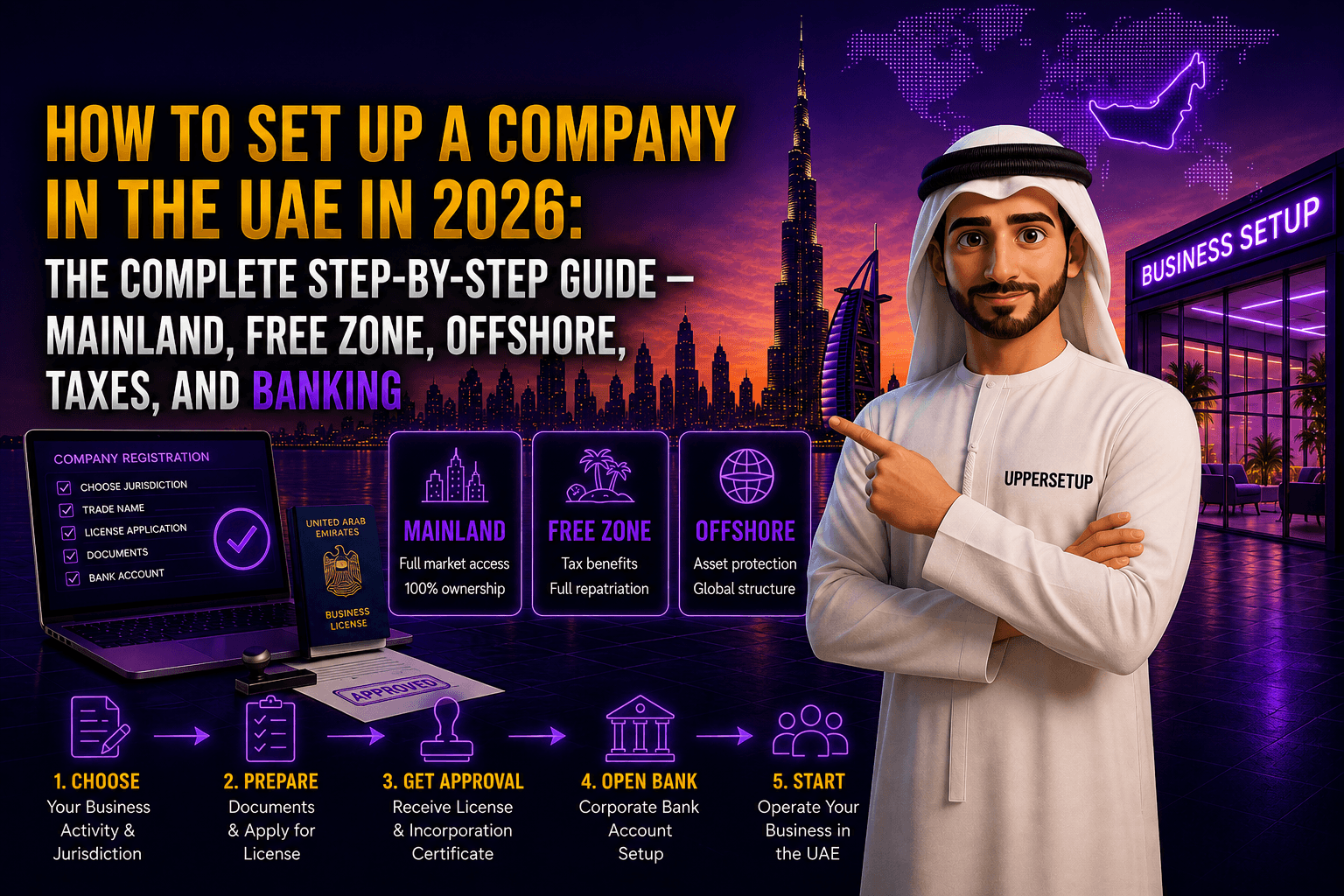
Steps to Register a Branch in the UAE: Standard Roadmap (2027 Edition)
- Parent Board Resolution (notarised and legalised, Arabic translation often required)
- Application for Name Reservation and Initial Approval (at mainland DED, free zone, or sector regulator)
- Ministry of Economy pre-approval (for mainland branches)
- Appoint a Local Service Agent (LSA) (for most mainland service branches, UAE national or company owned by locals—note: recent rules reduced sponsor involvement and fees, but do not eliminate the requirement)
- Commercial Registration and Licensing (submission of MOA, business plan, activity description)
- Office Lease and EJARI Registration (physical office mandatory in most cases, including in e.g. Dubai)
- Obtain Chamber of Commerce Certificate
- Complete Immigration, Labor, and Bank Account Procedures
Timeline: From experience, mainland process is 8–12 weeks (if all documentation is ready, subject to due diligence); free zone process can be faster.
Key Regulatory Pitfalls: What Can Go Wrong in 2027
Regulatory pitfalls for branches include failure to: - Obtain all relevant sector approvals (e.g., legal consulting, engineering, defense, health, IT/security) - Identify whether their business creates a Permanent Establishment (PE) under Corporate Tax rules (differing from PE under VAT or DTTs) - Maintain compliance with the revised Ultimate Beneficial Owner (UBO) regulations (Cabinet Decision No. 58 of 2020, as amended) - Know that certain free zone branches may NOT be eligible for CT reduced rates (see “Qualifying Free Zone Person” criteria under Article 18 of the CT Decree-Law)
Ignoring any of these can lead to fines (routinely above AED 50,000), license suspension, or adverse tax outcomes.
The UAE Corporate Tax Regime: How Are Foreign Branches Taxed?
Since the implementation of Corporate Tax (CT) via Federal Decree-Law No. 47 of 2022, most foreign branches are fully subject to CT on profits, unless an exemption applies.
Mainland Branches: All profits arising in the UAE are charged CT at 0% on the first AED 375,000, then 9%. If the parent is tax-resident elsewhere, foreign tax credits may be claimable in parent’s home country subject to relevant double tax treaties (DTTs).
Free Zone Branches: Only “Qualifying Income” of a “Qualifying Free Zone Person” can benefit from the 0% rate; otherwise, the 9% CT applies. Service businesses very often do not meet all QFZP criteria after 2024 amendments: check latest guidance.
No Withholding Tax: There is currently no withholding tax on branch profit remittances, but this could change—monitor annual Budget Laws.
No Local UAE Shareholder Required: Foreign branches usually do not need a local shareholder, except in rare regulated sectors (e.g., defense).
VAT, Customs, and Other Indirect Taxes for Branches
Branches treated as part of the same taxable person as their HQ if registered under the same VAT group. The standard VAT rate is 5% (since 2018; check for updates near 2027). Providing cross-border electronic services or physical goods triggers “place of supply” rules—often requiring careful tax risk mapping.
Branches in certain free zones (VAT Designated Zones) may have specific VAT and customs rules. Do not confuse VAT Designated Zone with the “Qualifying Free Zone” for CT purposes: eligibility and impact differ dramatically.
Free Zone vs Mainland Branch Registration: What's the Difference in Rules and Tax?
Key differences between mainland and free zone branch registration are in regulatory oversight, tax exposure, eligible activities, and banking access.
Comparative Table: Mainland vs Free Zone Branches
| Factor | Mainland Branch | Free Zone Branch |
|---|---|---|
| Licensing Authority | DED, Ministry of Economy | Relevant Free Zone Authority |
| Requirement for LSA | Yes (service agent) | No (most zones) |
| Allowed to Trade In Mainland | Yes | Only within free zone or foreign |
| Corporate Tax (CT) Rate | 0% up to AED 375,000; 9%+ | 0% only for QFZP + qualifying income, 9% otherwise |
| VAT Eligibility | Yes | Yes (depends; VAT grouping possible) |
| Bank Account Opening | Standard due diligence | More scrutiny recently, varies by zone |
| Physical Office Requirement | Always | Usually, but flexi-desk can apply |
| Allowed Activities | Broader range if licensed | Limited to zone-defined “service” and “trading” activities |
Bank Account Opening for Foreign Branches: Burdens and New Compliance Hurdles
UAE banks subject foreign branches to strict KYC, including ultimate parent disclosure, cross-border AML screening and—increasingly—substance checks post-Corporate Tax law. Delays of 2–6 months for account opening are not rare in 2026, and increasingly common for high-risk sectors (e.g., crypto, consulting, defense tech).
Maintaining local economic substance is not always mandatory for branches (unlike certain free zone companies), but is increasingly expected by both banks and regulators for services with significant income.
Common Tax and Regulatory Traps for Foreign Branches
Branches must take care with: - Deviation from Approved Business Activities: Fines and forced closure if branch undertakes non-approved activities - Failure to Update UBO Data: Can result in substantial penalties (minimum AED 50,000 as of recent updates) - Confusion over Tax Residency: Some foreign tax authorities disregard UAE branch tax paid, leading to double taxation - Overlooking Changes to CT and VAT Law: 2024–2026 saw several CT and VAT regime amendments affecting branches—do not rely on 2022-issue guidance
Breakdown of Main Costs and Fees (2026–2027): What Foreign Branches Should Budget
| Cost Item | Typical Amount (AED) | Notes |
|---|---|---|
| Parent Doc Legalisation | 6,000–15,000 | Sworn translation, embassy attestation, legal fees |
| Name Reservation, Initial Fees | 1,500–3,000 | Varies by Emirate/Zone |
| Ministry of Economy License | 10,000–20,000 | Initial year; annual renewal |
| Local Service Agent Fee (mainland) | 10,000–25,000 | Usually negotiable from 2024 onwards |
| Office Lease (Dubai, 1 year) | 20,000–80,000+ | Business center acceptable for some activities |
| Banking KYC and Set-up | 2,000–6,000 | Some banks waive, but often charge |
| Miscellaneous, Other Agency Fees | 5,000–10,000 | Chamber, stamps, visa quota |
| Annual Corporate Tax Filing | 3,000–10,000 | Basic compliance. No audit required for very small branches, but check latest rules |
Total minimum first-year budget: ~AED 55,000–160,000. Largest cost drivers: office rent and service agent fees.
Typical Mistakes That Cost Foreign Service Branches Dearly
- Assuming “Free Zone” Means “Tax-Free” for All Branches: Since 2023–2024, many free zone branches do not qualify as “Qualifying Free Zone Persons” for 0% CT; default 9% applies. Misreading this triggers unexpected tax exposure and compliance fines.
- Failing to Register With All Relevant Authorities: For regulated sectors (e.g., legal, financial, health), missing a secondary regulator like the Central Bank can void contracts and licenses.
- Using a Nominee UAE Parent as a Workaround: Nominee structures to “hide” a true foreign parent are illegal and trigger closure, fines, and—increasingly—criminal penalties under revised UBO rules.
- Ignoring Post-Setup Substance Requirements: Many branches assume no substance or staff are needed, but this blocks bank access and risks license cancellation in many free zones (notably DMCC, ADGM) post-2024.
Step-By-Step: How to Register a Foreign Service Branch in 2027
- Board Approval: Parent company passes a board resolution specifically authorizing UAE branch setup.
- Document Preparation: Legalize all parent docs; notarize, embassy stamp, then UAE Ministry of Foreign Affairs and Justice attestation.
- Initial Approval: Apply to DED or free zone for initial activity clearance and name reservation.
- Local Agent Arrangement: Identify and contract with a UAE National or Corporate Local Service Agent (mainland only).
- Submit to Ministry of Economy (for mainland): Application, attested docs, business plan.
- Commercial Registration: With approved documents and agent contract, acquire trade license.
- Office Lease: Mandatory for nearly all activities; no “virtual-only” options.
- Bank Account Opening: Prepare KYC, anticipate extensive documentation.
- Tax and VAT Registration: File with Federal Tax Authority if threshold applies.
- Launch Operations: On license and bank clearance, operations and staff visas can commence.
Who Should—and Who Should NOT—Choose a UAE Branch Structure?
A UAE branch is ideal for: - International professional or technical firms with large UAE projects but no desire for local joint ventures or ownership splits - Foreign companies with compliance capacity for layered licensing and tax reporting - Entities needing fast exit (branch can be closed more quickly than LLC structures)
A UAE branch is NOT suitable for: - Startups or SMEs with limited support resources—setup is documentation-heavy - Firms needing limited liability or investor fundraising within the UAE - Activities restricted to Emirati companies (e.g., certain defense, media, and utility sectors)
Frequently Asked Questions (FAQ)
Q1: Can a UAE branch carry out activities beyond those listed in the UAE license? No. Operating outside the approved business activities is illegal and results in fines, license cancellation, and possible blacklisting.
Q2: Is a local service agent (LSA) required for all foreign branches? For mainland branches, a UAE service agent (individual or corporate) is required except in certain regulated sectors. Free zone branches do not require LSAs.
Q3: Does a branch get 0% corporate tax if registered in a free zone? Not always. The 0% corporate tax applies only to “Qualifying Free Zone Persons” with “Qualifying Income.” Service branches must meet updated QFZP rules. Check the latest guidance from the Ministry of Finance as criteria keep changing.
Q4: What is the corporate tax rate for branches on the mainland? The corporate tax for mainland branches is 0% for the first AED 375,000 of annual profits, then 9% on the remainder. This threshold and rate are subject to change, so verify for the current tax year.
Q5: How long does it typically take to register a branch in the UAE? From complete documentation, mainland branch setup often takes 8–12 weeks; for free zones, times can be shorter.
Q6: Are branch profits remitted to the foreign HQ subject to UAE withholding tax? As of November 2026, there is no UAE withholding tax on branch profit remittances. Monitor Budget Law changes near 2027.
Essential Takeaways
- Foreign branches in the UAE face direct global parent liability, increased compliance, and are now taxed at up to 9% corporate tax (mainland and many free zones).
- Choosing a branch can simplify entry but adds regulatory layers—get sector approvals, comply with UBO, and don’t expect old-style tax holidays.
- Free zone branches are not automatically tax-exempt; check QFZP rules carefully.
- Main costs: documentation, service agent, and rent—budget AED 55,000–160,000 for first year.
- Common errors—tax misclassification, regulatory shortcutting, documentation lapses—lead to expensive fines or total closure.
For bespoke support with UAE company setup, visas, banking, and tax compliance, contact UPPERSETUP—the team’s experience with federal and free zone regulators ensures a fast, compliant entry.
In Summary
To establish a foreign branch in the UAE as of late 2026, expect: - Documented parent board approval, local agent for mainland (not for free zone), sector and Ministry of Economy/zone registration processes - Corporate tax of 0% on first AED 375,000, then 9% (subject to year-by-year adjustments) - Free zone branches only benefit from 0% CT if they meet “Qualifying Free Zone Person” income criteria; otherwise, they are taxed as mainland - Annual first-year setup costs generally range from AED 55,000–160,000 - Common pitfalls: ignoring UBO, assuming automatic tax holidays, or shortcutting regulatory process—each can lead to license loss or excessive fines
Reference Sources
- UAE Federal Decree-Law No. 32 of 2021 on Commercial Companies (effective 2 Jan 2022, amendments 2023 in force 2024)
- UAE Federal Decree-Law No. 47 of 2022 on the Taxation of Corporations and Businesses (proclaimed 2022, in force from 1 June 2023)
- Federal Tax Authority (tax.gov.ae) official publications
- Ministry of Economy (moec.gov.ae) guidelines on foreign company branches
- PwC UAE Tax Alerts (Jan 2024–Nov 2026)
- UNCTAD Investment Policy Review: United Arab Emirates (latest edition)
Disclaimer
This material is for information purposes only and does not constitute legal, tax, financial, investment, or consulting advice. Always seek tailored professional counsel factoring your specific case, company status, and current regulatory requirements before making decisions.
Read more on the topic
All services on the platform
Everything you need to start and run a business - in one place
- 3–5 days
Company Setup
Mainland or Free Zone company with a complete set of incorporation documents
Start - Monthly
Accounting Services
Financial accounting and reporting in accordance with UAE requirements
Start - 1–2 weeks
Visa Services
Residence visas for shareholders, employees and family members
Start - 7–30 days
Banking Services
Corporate Bank Accounts in the UAE and Payment Services
Start - Custom timeline
Legal Services
Contracts, corporate amendments and legal support
Start


