

































































 International Free Zone Authority
UAQ Free Trade Zone in 2026: the complete breakdown — legal basis, FZE/FZC forms, licences, cost from AED 5,500, Designated Zone status and corporate tax
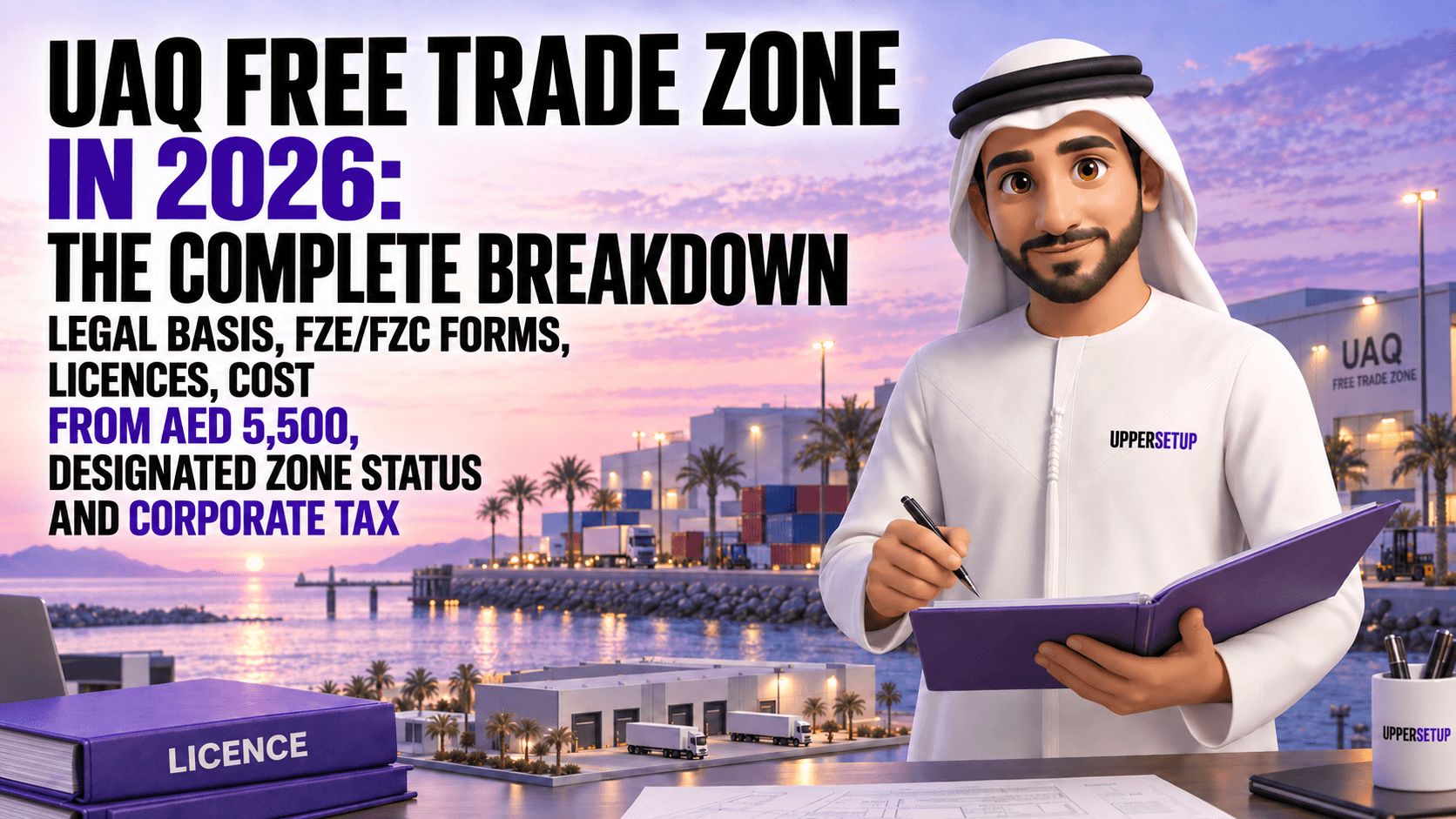
UAQ Free Trade Zone (UAQ FTZ, Umm Al Quwain Free Trade Zone) is the free zone of the emirate of Umm Al Quwain (UAE), governed by a government body, the Umm Al Quwain Free Trade Zone Authority, which — according to the zone’s own rules — was established by Emirate Law No. 3 of 2014 on the foundation of the Ahmed Bin Rashid Port and Free Zone created by Emiri Decree No. 2 of 1987. The zone registers companies in three forms — the Free Zone Establishment (FZE), the Free Zone Company (FZC) and the Branch — issues commercial, consultancy, service and industrial licences and a freelance permit, and its cheapest official package without a visa (UAQ LYTE) costs AED 5,500 a year with renewal at the same price. Both of the zone’s sites — in Ahmed Bin Rashid Port and on Sheikh Mohammed Bin Zayed Road — have been on the list of Designated Zones for VAT under Cabinet Decision No. 59 of 2017 since 1 January 2018. The key difference from what the marketing promises: Designated Zone status is a VAT and customs instrument, while the 0 % corporate tax rate depends not on it but on meeting the Qualifying Free Zone Personconditions of Article 18 of Federal Decree-Law No. 47 of 2022.
Caution. Three facts are most often distorted when “the cheapest licence in the UAE” is sold. First: every page of the zone’s website states that it is a designated zone “as per Cabinet Decision No. (54) of 2023” — no such instrument on designated zones exists in the Federal Tax Authority (FTA) register or on uaelegislation.gov.ae; the real basis is Cabinet Decision No. 59 of 2017, and the FTA’s current list of 21 September 2021 shows both UAQ sites from 1 January 2018. Second: the zone’s Company Regulations No 1/14 require share capital of at least AED 300,000, “fully issued and paid up upon incorporation” (regulation 3.7), while the zone’s website promises that “no proof of start-up capital” is required — a contradiction a bank or an auditor can raise at any time. Third: the number of visas under a licence is set “at the absolute discretion” of the Authority (rule 14.8 of the Rules and Regulations), the tariff for visas, deposits and fines (the Tariff) is not published, and the only sponsor of employees’ visas is the Authority itself under a Personnel Secondment Agreement with a cash deposit for each worker.
Key parameters of UAQ Free Trade Zone in 2026: summary table
|
Parameter |
Value |
Source |
|
Regulator |
Umm Al Quwain Free Trade Zone Authority (UAQ FTZA), a body of the emirate’s government; supervised by the Ports, Customs and Free Zone Corporation under Emirate Law No. 1 of 2013 |
Rules and Regulations, cl. 1.2, 1.4; WAM report, 2013 |
|
Zone legal basis |
Emiri Decree No. 2 of 1987; UAQ Free Trade Zone Ordinance 1987; Law No. 1 of 2013; Law No. 3 of 2014; Company Regulations No 1/14 (2014); Rules and Regulations (first edition, March 2015) |
Rules and Regulations, cl. 1.1–1.4 |
|
Sites |
Ahmed Bin Rashid Port (operated by Hutchison Ports UAQ under a 2017 concession) and Umm Al Thoub on Sheikh Mohammed Bin Zayed Road (E311), 45 km from Dubai |
zone website; hutchisonportsuaq.com |
|
Forms |
FZE (1 shareholder), FZC (2–50 shareholders), Branch of a foreign body corporate; the suffix “FZE”/“FZC” is mandatory |
Company Regulations, cl. 3.1, 3.3, 3.6, 6.1 |
|
Minimum capital |
AED 300,000, par value not less than AED 1,000 per share, fully paid up on incorporation; one class of shares, bearer shares prohibited |
Company Regulations, cl. 3.7–3.8 |
|
Officers |
manager plus at least one director and a secretary (may be the same person); all must be Qualified Individuals aged 21 or over |
Company Regulations, cl. 3.11–3.12, Schedule 1 |
|
Licences |
Trading/Commercial (10 similar or 3 different categories), General Trading, Consultancy, Service (2 activities), Freelancer Permit (2 activities), Industrial |
Rules and Regulations, cl. 6.2; Licenses & Entity page |
|
Licence term |
minimum 12 months; renewal no later than 30 days before expiry; no renewal possible 6 months after expiry |
Rules and Regulations, cl. 6.8, 6.15 |
|
Official entry cost |
UAQ LYTE AED 5,500 (no visa); General Trading AED 7,000; UAQ START AED 12,500 (one visa); instalment plan AED 2,266 per month; freelance AED 9,999 or AED 1,818 per month |
zone blogs and promotion pages, 2025–2026 |
|
Territorial scope |
inside the zone and outside the UAE only; the mainland only through an agent, representative or distributor |
Rules and Regulations, cl. 6.1 |
|
Visas |
sponsor is the Authority only; Personnel Secondment Agreement plus cash deposit; quota at the Authority’s discretion; visas valid for two years |
Rules and Regulations, cl. 14.5–14.8; Support Services page |
|
Designated Zone (VAT) |
both sites from 01/01/2018 under Cabinet Decision No. 59 of 2017 (FTA list of 21/09/2021) |
tax.gov.ae |
|
Corporate tax |
general regime of FDL 47/2022: 0 % up to AED 375,000 and 9 % above; QFZP 0 % on qualifying income subject to Art. 18, CD 100/2023 and MD 229/2025 |
uaelegislation.gov.ae; tax.gov.ae |
|
Audit |
mandatory under the Company Regulations (cl. 3.27–3.28) and under MD 84/2025 for every QFZP |
zone; tax.gov.ae |
|
Disputes |
Mediation Body, then the federal courts of Umm Al Quwain; a licensee’s referral to court under cl. 19.1 requires the written consent of the Ruler’s Court |
Rules and Regulations, cl. 19; Company Regulations, Schedule 1 |
|
Number of companies |
8,032 in 2021 (Ministry of Economy); “11,000+” according to the zone in 2026 |
moet.gov.ae; promotion.uaqftz.com |
What UAQ Free Trade Zone is and where it is: Ahmed Bin Rashid Port, the E311 site and a history since 1987
A free zone in the UAE is an area where companies are registered and licensed not by a federal ministry or an emirate’s economic development department but by the zone’s own authority, with full foreign ownership and the zone’s own corporate rules. UAQ Free Trade Zone is one such zone and belongs to the emirate of Umm Al Quwain, one of the seven emirates of the federation: its area is 770 sq km, its coastline 24 km, and Dubai is about 45 km away along the E311 highway.
The zone traces its history to Ahmed Bin Rashid Port. According to the “Free Trade Zone” page of the Authority’s website, “the Umm Al Quwain Free Trade Zone began in 1987 as Ahmed Bin Rashid Port and Free Zone”; the zone’s rules refer to Emiri Decree No. 2 of 1987 “Concerning the Incorporation of a Free Zone in Ahmed Bin Rashid Port” and to the UAQ Free Trade Zone Ordinance 1987. The UAE Ministry of Economy’s registrar factsheet (now the Ministry of Economy and Tourism; a file on moet.gov.ae stamped September 2021) puts it differently and more precisely: “Established in 1987 (name change in 2014)”. The leadership page on the same zone website speaks of “our inception in 1986” — the only place that year appears. For legal purposes the correct chain is “1987 decree — renaming and a new authority in 2014”.
The turning point came in 2013–2014. By Emirate Law No. 1 of 2013 the Ruler of Umm Al Quwain, Sheikh Saud bin Rashid Al Mualla, established the Ports, Customs and Free Zone Corporation, which supervises Ahmed Bin Rashid Port, the free zone authority and the Department of Customs and Ports (a 2013 WAM report reproduced by Gulf News). The zone’s rules (Rules and Regulations, cl. 1.2) state that the Authority was “established pursuant to Law No. (3) of 2014” and granted jurisdiction “to develop, promote, manage, administer and govern” the area known as Umm Al Quwain Free Trade Zone. The texts of the emirate instruments themselves — the 1987 decree and the 2013 and 2014 laws — are not published; everything known about them is known from references in the zone’s documents and from news reports. As at September 2026 the chairman of the zone’s board is Sheikh Khalid bin Rashid Al Mualla, the executive director is Sheikh Mansoor bin Ibrahim Al Mu’alla (also Director of the Ports, Customs and Free Zone Corporation), and the general manager is Johnson M. George.
The zone operates on two sites. The first is Ahmed Bin Rashid Port: four berths, an 845-metre quay, a 23-hectare container yard, 13,000 sq m of warehouses and 118,000 sq m of land reserved for light industry; according to the zone, “the entire complex has been classified as UAQ Free Trade Zone”. In November 2017 the emirate’s government awarded the port concession to the Hong Kong operator Hutchison Ports (Hutchison Ports UAQ); the zone’s website says “from 2018” in one place and “in 2017” in another, while the operator’s own announcement is dated 10 November 2017. The second site is Umm Al Thoub on Sheikh Mohammed Bin Zayed Road (E311), home to the Authority’s headquarters (the One UAQ building in Al Barqaa), offices, a co-working space, warehouses, land plots and a labour accommodation building. In 2024 the zone announced 350,000 sq ft of new warehouses and 65,000 sq ft of commercial space under construction (the general manager’s Khaleej Times interview reposted on the zone’s website on 3 October 2024).
The zone’s scale is measurable. The Ministry of Economy factsheet records 8,032 registered companies and the flow of new incorporations: 35 in 2014, 877 in 2015, 1,603 in 2016, 2,069 in 2017, 1,311 in 2018, 1,009 in 2019, 653 in 2020 and 482 in the part of 2021 covered. The zone’s promotion pages in 2026 speak of “11,000+ businesses registered”. Incorporations peaked in 2016–2017, when the zone entered the low-cost licence market; after 2018 the flow more than halved, which matters when judging how “mass-market” the jurisdiction will look to banks. How banks assess such licences is covered in why banks reject UAE companies in 2026.
The legal framework of UAQ FTZ: three tiers of instruments that must not be confused
The legal framework of a free zone in the UAE is always three-tiered: the emirate’s instruments creating the zone and its authority; the zone’s own rules (corporate, licensing, employment); and federal legislation, which applies in the zone to the extent it is not displaced by the zone’s special provisions. For UAQ FTZ each tier has its own gaps, and they need to be known before an application is signed.
The emirate tier: four instruments whose texts are unpublished
Clause 1.4 of the Rules and Regulations lists the “Applicable Rules”: (a) Emiri Decree No. 2 of 1987 Concerning the Incorporation of a Free Zone in Ahmed Bin Rashid Port; (b) the Umm Al Quwain Free Trade Zone Ordinance 1987; (c) Law No. 1 of 2013 Concerning Ports, Customs and Free Zone Corporation; (d) the zone’s Company Regulations; (e) UAE federal laws “to the extent they apply to the UAQFTZ”; (f) any rules issued by the Authority. Law No. 3 of 2014, under which clause 1.2 says the present Authority was established, is not on that list, yet it is the instrument the rules invoke as the source of the Authority’s powers — including the right to own and lease real estate, to render services and collect fees, and to issue rules (cl. 4.2). None of these instruments is posted on any official portal, the emirate has no public legislation database, and so no article number or commencement date can be cited; the article quotes them as the zone itself cites them.
The zone tier: two core documents and one unreadable one
The first document is the UAQ Free Trade Zone Company Regulations No 1/14, issued by the Authority in 2014: 43 pages on company forms, capital, officers, accounts, audit, amalgamation, redomiciliation, winding up and sanctions. The second is the Rules and Regulations, first edition, March 2015 (23 pages): licences, leases, building control, insurance, employment, visas, HSE, fines and disputes. Both are available in the Downloads section of the zone’s website. The third — the zone’s Anti Money Laundering Regulations — is posted only as a scanned six-page image with no text layer, so its content cannot be machine-verified; alongside it the zone posts the federal instruments it refers to: Federal Decree-Law No. 10 of 2025 on AML/CFT and Cabinet Decisions No. 109 and No. 132 of 2023 on beneficial owners.
Both core documents are out of date in their references to federal law. The Rules and Regulations (cl. 15.1) oblige licensees to comply with “Federal Law No. 8 of 1980” — the labour law repealed by Article 73 of Federal Decree-Law No. 33 of 2021 with effect from 2 February 2022. The Company Regulations define the “Federal Company Law” as “Federal Law No 8 of 1984 as may be amended, restated … or replaced” — the 1984 companies law, replaced first by Federal Law No. 2 of 2015 and then by Federal Decree-Law No. 32 of 2021. The words “or replaced” rescue the drafting legally but show that the rules have not been revisited since 2014–2015. Clause 3.1 of the Rules and Regulations promises that amendments will be issued by circular and posted on the website; as at September 2026 the website carries no circular at all.
The federal tier: what applies in the zone without reservation
Federal Decree-Law No. 32 of 2021 on Commercial Companies, in Article 5 as substituted by Federal Decree-Law No. 20 of 2025 (in force from 15 October 2025), sets three rules: the law does not apply to free zone companies “with respect to matters for which a special provision is stipulated in the laws or regulations of the concerned free zone”; where the zone’s legislation permits activity outside the zone within the State, the company may establish branches or representative offices in the State subject to the companies law; other statutory requirements are preserved. Clause 1.2(b) of the UAQ Company Regulations mirrors this by giving the zone’s own provisions priority over the “Federal Company Law”. Federal Decree-Law No. 33 of 2021 on employment relationships applies under Article 3(1) “to all establishments, employers and workers in the UAE private sector”, excluding only government employees, the security forces and domestic workers — free zones are not carved out. Federal Decree-Law No. 47 of 2022 on corporate tax, Federal Decree-Law No. 8 of 2017 on VAT, Federal Decree-Law No. 10 of 2025 on AML/CFT and Cabinet Decision No. 109 of 2023 on beneficial owners apply in the zone in full. How these federal instruments changed the meaning of a “free zone” after 2023 is analysed in mainland vs free zone in 2026: the new rules.
Which legal forms and licences UAQ FTZ offers: FZE, FZC, branch, six licence types and the territorial ban
A Free Zone Establishment (FZE) is a limited liability company with one shareholder incorporated under the zone’s Company Regulations; a Free Zone Company (FZC) is the same form with two or more shareholders; a Branch is a registered establishment of a “Foreign Body Corporate”, meaning any body corporate constituted under the law of “a country or territory outside of the Zone” (Schedule 1 of the Company Regulations) — a definition that captures a Dubai or Sharjah company just as much as an overseas one.
Forms, capital and officers
The regulations fix parameters that the zone’s website presents more softly. Regulation 3.6(a): an FZE has at least one shareholder, and an FZE or FZC no more than fifty. Regulation 3.7(a): share capital is denominated in dirhams, is at least AED 300,000 (or another amount set by Implementing Regulations for particular activities), requires the Registrar’s consent and is “fully issued and paid up upon incorporation”; the Registrar may require an increase to ensure capital adequacy or solvency. Regulation 3.8: the par value of a share is not less than AED 1,000, all shares are of one class and fully paid, and bearer shares are prohibited; the share certificate template on the zone’s website prints “AED 1000 / -” accordingly. A capital reduction (cl. 3.7(c)(ii)) requires a solvency certificate from the manager and the consent of all creditors. Next to the AED 300,000 figure the zone’s website says: “no proof of start-up capital required”. The regulations and the marketing diverge here, and since cl. 20.5 of the Rules and Regulations gives the written rules priority, in a dispute with an auditor, a bank or on liquidation the fully-paid-capital requirement governs.
Officers are described in regulations 3.11–3.13: the manager is responsible for day-to-day management and represents the company before the Registrar and third parties (a shareholder, a director or an employee may hold the post); every FZE and FZC has at least one director and a secretary, and one person may hold both offices. All of them must be Qualified Individuals under Schedule 1: natural persons aged 21 or over, never convicted of a criminal or financial offence in any jurisdiction, not undischarged bankrupts, with the knowledge and skills for the role. A vacancy caused by death is filled within seven days, early removal requires fourteen days’ written notice, and changes to the register of directors are filed with the Registrar within fourteen days (cl. 3.13, 3.24). The Registrar communicates only with the manager or a holder of a valid power of attorney (cl. 2.3).
Six licence types and activity limits
Clause 6.2 of the Rules and Regulations names five categories: the Trading Licence (import, export, distribution, consolidation, storage and warehousing of the items on the licence), the Consultancy Licence (professional advice), the Service Licence (services within the zone — from restaurants and catering to freight forwarding, insurance, accounting and audit), the Freelancer Permit (talent, creative and selected administrative roles “to encourage the development of a talent pool for the creative industry in UAQ”) and the Industrial Licence (import of raw materials; manufacturing, processing, assembling, packaging and export of finished products — with mandatory feasibility and environmental impact studies and the Authority’s clearance). The website adds a sixth item — the General Trading Licence, a sub-type of the commercial licence allowing trade in “any commodity which is permitted within the UAE”.
Activity limits are published on the “Licenses & Entity” page: a commercial licence covers up to ten similar or three different categories; consultancy, service and freelance permits two activities each; the list runs to “more than 1,500 business activities”. A dual licence in one legal entity is allowed: a company with a commercial licence can add a consultancy licence without forming a second company. A licence runs for at least a year, with multi-year options; activities can be amended during the term, but under cl. 6.7 a new activity may be undertaken only after the amendment is approved and a new licence issued, and under cl. 6.6 activity outside the licence attracts fines. Any change (address, shareholders, manager, signatory, activity) must be notified in writing within two weeks at most, with the Tariff fee paid (cl. 6.5). The freelance permit is issued in the individual’s own birth name rather than a brand and is not meant for trade: the zone’s promotion page lists trading companies, warehouses, industrial operations and businesses with multiple employees as “not ideal for”. How the chosen activity constrains a business is covered in UAE trade licence activities 2026: how the wrong activity hurts.
Territorial scope: the zone and exports only
Clause 6.1 is blunt: “Licences … are only valid in the UAQFTZ. Licensees cannot legally operate outside the UAQFTZ premises, using a License”, and the marketing of a licensee’s products or services in the UAE “needs to be undertaken either by an agent, representative or distributor with a license issued by relevant authorities in the UAE”. Clause 5.6 repeats that all business is conducted within the zone. Clause 14.2 extends the ban to staff: an employee may not work outside the zone without the written approval of the Authority and of the authority having jurisdiction at the place of work, though employees may live in any emirate. The only lawful route to the mainland is the one opened by Article 5(2) of Federal Decree-Law No. 32 of 2021: a branch or representative office on the mainland under the federal companies law and a licence from the relevant emirate’s economic department; the zone’s service list includes an “NOC for FTZ company to become a branch” and a “Mainland License” among value-added services. The “zone plus mainland branch” calculation is worked through in free zone or mainland in the UAE 2026: what to actually choose.
What a company in UAQ FTZ costs in 2026: official packages from AED 5,500 and what appears in no price list
The cost of a free zone licence is made up of the registration and licence fee, the mandatory lease of a workplace (no licence is issued without a lease — cl. 5.4 and 8.1 of the Rules and Regulations), visa costs and the annual renewal. UAQ FTZ publishes no fee schedule: the Rules and Regulations refer dozens of times to “the Tariff” — fees, deposits, fines, card replacements — but the document itself is absent from the website. The only official figures are in the zone’s 2025–2026 package offers; they are tabulated below with publication dates because prices have moved (old promotion-page addresses still carry “AED 13,500”, “AED 13,900” and “AED 4,890”).
|
Zone product |
What the zone says is included |
Price |
Renewal |
Source and date |
|
UAQ LYTE |
registration and licence, co-working space with lease agreement, bank account assistance; FZE/FZC/Branch; up to 3 different or 10 similar activities; no visa |
AED 5,500 a year |
AED 5,500 |
zone blogs of 16 June 2025, 2 February and 29 July 2026 |
|
General Trading (no visa) |
general trading licence, “no visa required, no hidden costs” |
AED 7,000 a year |
AED 7,000 |
zone blog of 11 September 2025 |
|
UAQ START |
commercial or consultancy licence, one residence visa, medical test, Emirates ID, status change, basic medical insurance, co-working with lease, establishment card and e-channel, bank assistance |
AED 12,500 |
not stated |
price — zone blog of 16 June 2025; contents — blog of 4 December 2025 |
|
“All inclusive” instalment plan |
licence, investor visa, Emirates ID, medical test, basic insurance, co-working, up to 10 activities |
AED 2,266 per month (AED 27,192 over 12 months; plan term not disclosed) |
not stated |
promotion.uaqftz.com, September 2026 |
|
Freelance Permit plus visa |
permit for 2 related activities, registration fee, residence visa, medical test, Emirates ID, medical insurance, co-working, lease agreement |
AED 9,999 a year |
AED 9,999 |
zone blogs of 30 June 2025 and 20 August 2026 |
|
Freelance by instalments |
same inclusions |
AED 1,818 per month (AED 21,816 over 12 months; plan term not disclosed) |
not stated |
promotion.uaqftz.com, September 2026 |
|
Land plot |
from 2,500 sq m, lease up to 25 years renewable, road and telecom infrastructure |
from AED 18 per sq m a year (minimum plot from AED 45,000 a year) |
per contract |
Leasing Services page |
|
Labour accommodation |
G+3 building, 6 beds per room, utilities included |
from AED 400 per person per month |
per contract |
Leasing Services page |
|
Share capital |
not a fee to the zone but the company’s own money, which must be paid in full |
AED 300,000 |
— |
Company Regulations, cl. 3.7 |
Five costs stay off-screen. First, visas beyond the package: the fee for each entry permit, residence visa, medical test and Emirates ID belongs to the Tariff, and under cl. 15.4 of the Rules and Regulations all of them — including the air ticket from the employee’s point of origin and all medical expenses during sponsorship — are borne by the employer and may not be deducted from wages. Second, the cash deposit for each sponsored employee under the Personnel Secondment Agreement (cl. 14.6); the amount is “determined by the Authority”, and under cl. 14.7 the deposit is forfeited if the company closes or the employee does not receive end-of-service dues. The freelance promotion page promises that no security deposit is required for employee or dependent visas — that is a term of a particular package, not a repeal of the rule. Third, fines and amendment fees: any change to a licence particular within two weeks carries a Tariff fee (cl. 6.5), late renewal a fine (cl. 6.8), and fines unpaid for 90 days are added to the renewal fee (cl. 18.4). Fourth, compulsory insurance: a third-party liability policy and a workmen’s compensation policy naming the Authority as co-insured (cl. 12.8–12.11). Fifth, audit: the Company Regulations require an auditor’s report every year (cl. 3.27–3.28), and the zone includes its cost in no package.
Two features make the zone cheaper than its neighbours. According to the general manager’s Khaleej Times interview (October 2024), the zone issues a lifetime establishment card at no extra charge, whereas other zones renew and charge for the card. The LYTE, General Trading and freelance packages are promised to renew “at the same price” — “no renewal shock”. The flip side: the website’s refund policy is a single sentence — “once payment is made and the service is availed, there will not be any refund” — and cl. 7.3 of the Rules and Regulations excludes refunds of licence fees on cancellation on anyone’s initiative. How to compare zones on total cost rather than headline figures is shown in registering a company in the UAE on a budget; a quote for your activity is available through UPPERSETUP’s company registration service.
Visas and staff at UAQ FTZ: the Authority as sponsor, the Personnel Secondment Agreement, discretionary quotas and the 2021 labour law
A residence visa through a free zone is a visa issued by the federal authority (the Federal Authority for Identity, Citizenship, Customs and Port Security, ICP, through the emirate’s General Directorate of Residency and Foreigners Affairs) to a foreigner at the request of a company registered in the zone, and in UAQ the formal sponsor is not the company but the zone’s Authority. This is the defining feature of the UAQ model, fixed in cl. 14.5 of the Rules and Regulations: “Only the Authority shall sponsor employees of Licensees for the purpose of residence visas”, while the licensee remains responsible for wages and every obligation under the employment contract.
Mechanics: establishment card, entry permit, deposit
The zone describes the procedure in its blog of 2 February 2026 and in the rules. The company first obtains an establishment card — the employer card with the ICP without which no visa application is accepted; according to the general manager, in UAQ it is lifetime and free. An entry permit is then obtained for each employee who is not a national of a Gulf Cooperation Council state (cl. 14.13), and unused permits are returned to the Authority for cancellation. After entry or a status change come the medical test (blood test and chest X-ray), biometrics at an ICP centre and the Emirates ID, which has replaced the visa sticker in the passport. The Support Services page states that “all visas have a two-year validity period” and that spouses, children, parents and domestic workers can be sponsored. An employee may start work only after an employment card and access card are issued (cl. 14.3), may work only for the licensee to which he or she is seconded (cl. 14.4), and may not be engaged by another licensee even in free time.
For each employee the licensee signs a Personnel Secondment Agreement with the Authority and pays a cash deposit in a sum “to be determined by the Authority from time to time” (cl. 14.6). The deposit is forfeited if the company closes for any reason including liquidation, or if the employee does not receive end-of-service dues (cl. 14.7). The Authority may terminate sponsorship where the licensee fails to renew its licence or lease, becomes insolvent, stops operating, where the employee breaks UAE law — and “for any other reason that the Authority may, in its sole discretion, determine” (cl. 14.10).
The quota: the rules give no number
The question every applicant asks — how many visas a licence carries — is answered by the rules in one sentence: “The number of visas to be issued to a Licensee is to be determined at the absolute discretion of the Authority based on the Licence activity and operations” (cl. 14.8). Marketing turns this into guideposts: the START package includes one visa, the configurator on the Steps page offers “< 5”, “< 10” and “> 10” visas, the Leasing Services page promises “6+ visas” for independent offices from 9 sq m, and an old promotion-page address speaks of a “2-visa package”. None of these figures is a rule; the quota is fixed in the Authority’s offer for a specific premises. This distinguishes UAQ from zones where the quota is tied to floor area by formula. Family sponsorship and income requirements are covered in family visa sponsorship in the UAE in 2026: spouse, children, parents.
Employment law: the rules cite a repealed statute
Section 15 of the Rules and Regulations obliges licensees to discharge their duties to employees “in accordance with Federal Law No. 8 of 1980 (as amended)”. That law was repealed by Article 73 of Federal Decree-Law No. 33 of 2021; the decree-law itself was signed on 20 September 2021, applies from 2 February 2022 under Article 74, and under Article 3(1) covers “all establishments, employers and workers in the UAE private sector”. Its rules therefore govern in the zone — fixed-term contracts, probation, end-of-service gratuity, the ban on deductions — together with Cabinet Resolution No. 1 of 2022 (the executive regulation). The zone adds requirements of its own: a standard-form employment contract attested by the Authority (cl. 15.5), written basic work rules for employees (cl. 15.7), medical insurance for all employees (cl. 15.10), a report of any unauthorised absence of seven consecutive days (cl. 15.12), and a ban on passing any recruitment cost to the employee, with an obligation to reimburse anything charged plus interest (cl. 15.2–15.3). Clause 15.8 deserves separate attention: “for security reasons, the passports of the employees of Licensees shall be deposited with the document storage companies or bank lockers listed by the Authority”, with a receipt submitted. This is a zone requirement, not a federal one; Federal Decree-Law No. 33 of 2021 contains no such duty, so any such storage should be arranged only with the employee’s written consent and with the employee’s free access to the document preserved. Employer obligations on contracts, WPS and gratuity are collected in how to hire your first employee in the UAE; visa processing through the zone can be handled by UPPERSETUP’s visa service.
Designated Zone status for VAT and customs: what Cabinet Decision No. 59 of 2017 gives and why “Decision No. 54 of 2023” cannot be found
A Designated Zone is an area specified by the Cabinet which, for the purposes of Federal Decree-Law No. 8 of 2017 on VAT, is treated as outside the State provided the conditions of Article 51 of the Executive Regulation (Cabinet Decision No. 52 of 2017) are met: a fenced perimeter, security measures and customs controls monitoring the entry and exit of individuals and the movement of goods, internal procedures for keeping and processing goods, and the operator’s compliance with those procedures. The list of such areas was approved by Cabinet Decision No. 59 of 2017 with effect from 1 January 2018 and amended by five decisions — No. 35 of 2018, No. 43 of 2019, and No. 34, No. 63 and No. 81 of 2021. The Federal Tax Authority’s consolidated list is dated 21 September 2021 and, as at 8 September 2026, remains the only designated-zone document in the FTA register.
The “Umm Al Quwain” section of that list has two rows: “Umm Al Quwain Free Trade Zone in Ahmed Bin Rashid Port” and “Umm Al Quwain Free Trade Zone on Sheikh Mohammed Bin Zayed Road”, both “from 01/01/2018” and with no end date. Both sites were in the original schedule to Decision No. 59 of 2017 rather than added later. This is where the first serious discrepancy with the zone’s website arises: the banner on every page of uaqftz.gov.ae and a blog post of 22 September 2025 state that the zone “has been officially recognised as a designated free zone under Cabinet Decision No. 54 of 2023”. No instrument of that number on designated zones can be found in the FTA register (a search for “Designated” returns a single document — the 2021 list) or on uaelegislation.gov.ae (the advanced search returns zero results). The operative basis for the status is Decision No. 59 of 2017, and that is what tax positions should cite; the zone’s blog also conflates the VAT status with corporate tax, which the next section addresses.
What the status gives and what it does not
Article 51 relieves goods only, and only while the regime is observed. A supply of goods within a designated zone or between designated zones is outside the scope of VAT provided the goods are not consumed in the zone; a transfer to another designated zone may require a financial guarantee (cl. 51(3)–(4)). Goods consumed within a zone are treated as supplied inside the State (cl. 51(5), with exceptions); goods moved to the mainland without being accounted for are deemed imported (cl. 51(9)). Services are not relieved: under cl. 51(6) “the place of supply of any Services is considered to be inside the State if the place of supply is in the Designated Zone”, and water and any form of energy are likewise treated under cl. 51(8) as supplied inside the State. Finally, cl. 51(10) expressly deems any person registered in a designated zone to be resident in the State for VAT purposes — the regime is about goods, not persons. The mandatory VAT registration threshold is AED 375,000 of taxable supplies and imports over 12 months, the voluntary threshold AED 187,500, and the standard rate 5 %. Federal Decree-Law No. 16 of 2025 (issued 1 October 2025, applying from 1 January 2026) amended the VAT law: according to the footnotes of the FTA’s consolidated text of November 2025 it removed from Article 48(1) the duty to issue a tax invoice to oneself under the reverse charge, added Article 54 bis giving the FTA the power to reject input tax on a supply forming part of a tax-evasion chain, amended clause 5 of Article 75 on persons entitled to refunds and cancelled Article 79 bis — without touching the thresholds or the designated-zone regime. The clause numbering of Article 51 above follows the consolidated text of the Executive Regulation published by the FTA in September 2025 (clauses 5–10 as amended by Cabinet Decision No. 88 of 2021); the English consolidation on uaelegislation.gov.ae contains duplicated clauses in this article and is unfit for citation by number. How a designated zone works in the country’s largest one is shown in JAFZA in 2026: designated zone status; the overall logic of the tax is in the complete UAE VAT business guide 2026.
Customs: cl. 6.10–6.14 of the Rules and Regulations
The zone’s customs regime is set out in its own rules and matches the general free zone regime under the GCC Common Customs Law. Foreign goods of any kind brought into the zone and taken out to outside the Gulf Cooperation Council countries or to other free zones “will not be subjected to customs duties or taxes” (cl. 6.11). Goods taken out of the zone into the UAE “are treated as foreign goods even if incorporating local raw materials” and are subject to duty (cl. 6.12); the standard rate is 5 % of the CIF customs value, 50 % for alcohol and 100 % for tobacco. The same logic applies to goods entering other GCC countries from the zone (cl. 6.13). Any cargo movement requires documentation acceptable to the Authority (cl. 6.10), samples must be declared (cl. 6.14), and zone security inspects vehicles and persons on entry and exit (cl. 16.5–16.6). Ahmed Bin Rashid Port gives the zone the “special concessions” on port charges promised on the Benefits pages without a published amount. Rates, exemptions and import procedures are analysed in customs duties in the UAE 2026: rates, exemptions and free zones and UAE import customs and import VAT in 2026.
Corporate tax for a UAQ FTZ company: when 0 % is real and when it is 9 % from the first dirham
A Qualifying Free Zone Person (QFZP) is a free zone juridical person which, under Article 18 of Federal Decree-Law No. 47 of 2022, pays corporate tax at 0 % on qualifying income and 9 % on the rest, provided it simultaneously maintains adequate substance in the UAE, derives qualifying income, has not elected out under Article 19, complies with the arm’s length principle and transfer pricing documentation (Articles 34 and 55), and meets the Minister’s additional conditions — the de minimis rule and audited financial statements. The UAQ FTZ website promises “corporate tax benefits” and “specific tax exemptions for a designated free zone”; the legal reality is built differently and needs to be taken apart in layers.
Layer one: a designated zone for VAT is not a “free zone” for corporate tax
Article 1 of Federal Decree-Law No. 47 of 2022 defines a Free Zone as “a designated and defined geographic area within the State that is specified in a decision issued by the Cabinet at the suggestion of the Minister”, yet no such corporate tax decision has been published. Article 18(4) adds a second condition the zone is silent about: the zero rate applies “for the remainder of the tax incentive period stipulated in the applicable legislation of the Free Zone”, and UAQ FTZ, unlike SAIF Zone with its Decree No. 28 of 2023, publishes no instrument setting such a period. The FTA’s only free zone guide (CTGFZP1, first and so far only edition of 20 May 2024) repeats the definition and advises taxpayers to “check with their respective Free Zone Authority”; the guide still cites the repealed Ministerial Decision No. 265 of 2023. The zone’s claim that its designated zone status “offers specific corporate tax reliefs and incentives not available to free zones that do not hold the designated status” is true in exactly one narrow respect: paragraph (l) of Article 2(1) of Ministerial Decision No. 229 of 2025 recognises “distribution of goods or materials in or from a Designated Zone” as a qualifying activity. Everything else in the QFZP regime is independent of the VAT status. The regime’s conditions are collected in the Qualifying Free Zone Person regime in 2026.
Layer two: what actually qualifies in UAQ
Cabinet Decision No. 100 of 2023 (issued 25 October 2023, applying from 1 June 2023) identifies four kinds of qualifying income in Article 3(1): income from transactions with other free zone persons (except excluded activities), income from transactions with non-free zone persons only for qualifying activities, qualifying intellectual property income, and any other income within the de minimis. Ministerial Decision No. 229 of 2025 (issued 28 August 2025, applying retroactively from 1 June 2023, repealing Decision No. 265 of 2023) lists fourteen qualifying activities. The ones relevant to the UAQ profile are: (a) manufacturing of goods or materials; (b) processing; (c) trading of qualifying commodities; (l) distribution from a designated zone; (m) logistics services — where the definition of logistics in Article 2(3) is conjunctive: “storage and transportation of goods or materials on behalf of another Person without taking title”, so warehousing without transport does not qualify. The excluded activities in Article 2(2) shut out retail: “any transactions with natural persons” are excluded save for four financial exceptions unavailable to manufacturing and trading companies, so a sale to an end consumer is excluded income, not merely non-qualifying. The de minimis rule (Article 3 of Decision No. 229): non-qualifying revenue must not exceed 5 % of total revenue or AED 5,000,000, whichever is lower; a breach strips the status from the beginning of the tax period and for four more periods (Article 5(2)). The mechanics of losing the regime are covered in how free zone companies lose the 0 % corporate tax rate.
Layer three: the price of the status
Under Article 3(2) of the decree-law a QFZP pays 9 % on non-qualifying income from the first dirham — the AED 375,000 nil band (Cabinet Decision No. 116 of 2022) does not extend to it. A QFZP must have audited financial statements regardless of revenue (Ministerial Decision No. 84 of 2025, tax periods from 1 January 2025), whereas an ordinary taxable person needs them only above AED 50,000,000 of revenue. A QFZP may not use Small Business Relief(Article 3(2) of Ministerial Decision No. 73 of 2023): the relief for revenue up to AED 3,000,000 was extended by Ministerial Decision No. 131 of 2026 to periods ending on or before 31 December 2029, but a small UAQ company must choose between the two regimes; the zone’s blog of 2 February 2026 still says the relief ends “at the end of 2026”. Companies relying on distribution from a designated zone must, for tax periods from 1 January 2026, obtain an ISRS 4400 report from an independent auditor confirming that customers buy for resale or processing and that imports passed through a designated zone (FTA Decision No. 6 of 2026 of 2 June 2026, due 30 days after the return deadline). Groups with consolidated revenue of EUR 750 million or more are subject to the 15 % minimum tax under Cabinet Decision No. 142 of 2024, and the 0 % rate in UAQ saves such groups nothing. The return is filed within nine months of the end of the period; penalties are set by Cabinet Decision No. 75 of 2023 as amended by Decision No. 10 of 2024 — for example AED 10,000 for late registration. Rates, registration and practical conclusions are in UAE corporate tax 2026: rates, QFZP, Small Business Relief.
A separate note on the freelance permit: its holder is a natural person, not a company, and corporate tax arises for that person under Cabinet Decision No. 49 of 2023 only where business turnover exceeds AED 1,000,000 in a calendar year; the QFZP regime cannot apply at all, while Small Business Relief is available. The analysis is in UAE corporate tax for natural persons in 2026. Bookkeeping and audit preparation for zone companies can be entrusted to UPPERSETUP’s accounting service.
Corporate governance, audit, UBO and AML at UAQ FTZ: what the Company Regulations require every year
The zone’s Company Regulations are not a formality at registration but a living code of obligations: the annual general meeting, the audit, the registers, the rules for share dealings and for winding up. A breach of any of them is a contravention under Section 8 and leads from a fine to compulsory winding up. Below are the obligations rarely mentioned when the AED 5,500 package is sold.
The annual cycle: financial year, accounts, audit, meeting
The financial year is twelve months; the first runs from six to eighteen months from incorporation (cl. 3.26). For each year the directors prepare a balance sheet, a profit and loss account, a statement of retained earnings, a statement of changes in financial position and notes describing the accounting principles applied; the Authority may prescribe the accounting standards (cl. 3.27). An auditor’s report accompanies the accounts, and the auditor may only be an independent body corporate licensed to conduct audit in the zone, appointed at each annual general meeting (cl. 3.28). The accounts and report go to shareholders at least seven days before the meeting. The annual general meeting is held within four months of the end of the financial year with a mandatory agenda: election of the manager and directors, appointment of the auditor, approval of the accounts (cl. 3.17). Notice of any other general meeting is 21 days, the quorum is half the capital, and if there is no quorum a second meeting 21 days later decides by a majority of those present. If the meeting is not held, the Registrar may direct that it be held under his supervision and, if the direction is ignored, commence compulsory winding up (cl. 3.17(h)–(i)). Board decisions are unanimous with all directors present (cl. 3.20); video meetings and written resolutions are permitted for everything except the annual general meeting (cl. 3.21–3.22). The zone’s audit requirement operates independently of the federal one: Ministerial Decision No. 84 of 2025 adds an audit for every QFZP, so a UAQ company claiming 0 % is audited on two grounds. Who must be audited and why is explained in corporate audit requirements in the UAE 2026.
Registers, shares, security
The registered office in the zone holds the shareholder register, the register of directors and officers, the minute book, the security register and the account books (cl. 3.25), open to shareholders, directors and the Registrar. A share transfer takes effect only from its registration by the Registrar (cl. 3.9(a)); on a sale to a third party the other FZC shareholders have a pre-emption right at an agreed price, and if no price is agreed by the end of the period, the period is extended for as long as the FZC’s auditor needs to evaluate the price (cl. 3.9(d)). The sole shareholder of an FZE may pledge only all of its shares (cl. 3.30(c)); any security interest is valid once registered in the security register, and enforcement is only by court order (cl. 3.30(d)). Dividends are prohibited where the company is insolvent or its assets are less than its liabilities (cl. 3.10); loans and guarantees to officers require a unanimous shareholder resolution and an entry in the security register (cl. 3.31).
Redomiciliation, winding up, striking off
Section 4 allows a transfer of incorporation into the zone (continuation): a foreign body corporate, if the law of its incorporation permits, files Articles of Continuation and receives a Certificate of Continuation, keeping its property, rights and liabilities (cl. 4.2). The reverse transfer under cl. 4.3 is provided only “to a jurisdiction outside of the UAE” — a move to another UAE free zone is not addressed by the regulations and falls to the Authority’s discretion; the practice of moving between the country’s zones is covered in redomiciliation within the UAE: moving a company between free zones. Winding up runs three ways (Section 5): by the shareholders with a solvency declaration by the manager (a company with no assets and no liabilities is struck off 15 days after the advertisement if no objection is received; a company with liabilities must discharge them within six months), by the creditors (creditors’ meeting no later than the 28th day), and by the Registrar — on the death or bankruptcy of a shareholder, on failure to respond to a communication within seven days, or on a Stage 2 contravention with 30 days’ notice. The order of debts (cl. 5.6): governmental claims including the Authority’s first, employees second, then the costs of the winding up. Officers are personally liable to the extent of their own assets for concealing assets, falsifying books and continuing to trade with knowledge of insolvency (cl. 5.7). The Registrar may strike a company off if it fails to respond within seven days to a direction to declare its intention to continue business (cl. 7.1); reinstatement is governed by Implementing Regulations that are not published. Sanctions (cl. 8.2): a prescribed fine, which after 30 days unpaid becomes a debt recoverable through the courts, and non-payment for more than 30 days is a ground for compulsory winding up. The practice of closing zone companies is described in liquidating and closing a UAE company in 2026.
AML, UBO and ESR: three federal regimes with different fates
AML/CFT is governed by Federal Decree-Law No. 10 of 2025 (in force from 14 October 2025, replacing Federal Decree-Law No. 20 of 2018) and Cabinet Decision No. 134 of 2025; the zone posts both in its Downloads section alongside its own Anti Money Laundering Regulations. Companies with DNFBP activities — dealing in precious metals and stones, real estate brokerage, corporate and trust services, audit — register on goAML regardless of the zone; the persons covered and their duties are in DNFBP AML compliance in the UAE 2026. Beneficial ownership is governed by Cabinet Decision No. 109 of 2023 (in force from 16 November 2023), which reaches non-financial free zones, and by Decision No. 132 of 2023 on penalties; the zone requires a “Specimen Signature Form and UBO Undertaking” at registration and keeps a beneficial owner register; the procedure and deadlines are in the UAE UBO register and goAML. The Economic Substance Regulations (ESR) are over: Cabinet Decision No. 98 of 2024 (published in the Official Gazette on 16 September 2024) confined the regime to financial years 2019 to 2022, so no notification or report is filed for 2023 or later — yet the zone’s Downloads section still carries “ESR Regulations”, the notification and report templates and its 2020–2021 alerts from the time the zone was appointed regulatory authority under Cabinet Decision No. 58 of 2019. Those templates should not be used for reporting years from 2023 onward. A review of the articles, registers and corporate resolutions against the Company Regulations can be entrusted to UPPERSETUP’s legal service.
Offices, warehouses, land and labour accommodation at UAQ FTZ: what can be leased and which certificates are needed before operations start
A lease in a free zone is a condition of the licence, not an option: under cl. 5.4 and 8.1 of the Rules and Regulations an application for a licence is made only together with an application for commercial property (an office, a commercial unit, a warehouse or land), and a lease of residential property “shall be deemed insufficient for the grant of a Licence”. Even the LYTE package includes a co-working space with a lease agreement, because without a lease the Registrar will not issue a licence. Premises fall into four classes.
Offices and co-working. Independent offices from 9 sq m in the Authority’s headquarters on the E311, ready to move into or shell and core for fit-out, with a “6+ visas” allocation according to the zone; shared desks in the co-working space with meeting rooms, a business lounge, broadband and parking. Warehouses. Pre-built units from 100 sq m with an eaves height from 7.2 m, an attached office, pantry and toilets, forklift ramps, electricity (15–36 kW, upgradable) and water connected, fire alarm and firefighting systems; in 2024 the zone announced a further 350,000 sq ft of warehouses under construction. Land. Plots from 2,500 sq m for own construction — factories, warehouses, showrooms, office buildings — on leases of up to 25 years with renewal, with roads and telecommunications ready and electricity and water available; the rent is “from as low as AED 18 per sq m a year” (the January 2024 promotion said “from AED 1.85/sqf”), depends on the plot size and is quoted on enquiry; plots are grouped by industry cluster. The port site adds 118,000 sq m of land for light industry and 13,000 sq m of warehouses next to the Hutchison Ports UAQ berths. Labour accommodation. A G+3 building within walking distance of the industrial clusters: six beds per room, furniture, utilities, a laundry, a shop and a canteen on the ground floor, from AED 400 per person per month with an option of three meals a day; a licensee housing workers in any group accommodation must obtain the Authority’s written approval and comply with the standards approved by Cabinet Resolution No. 13 of 2009 (cl. 15.14).
Certificates: BCC and OFC
The rules introduce two documents without which premises cannot be occupied or operations started. A Building Completion Certificate (BCC) is needed by anyone constructing or modifying their own facilities: before works start, approvals and NOCs from the relevant authorities, design documentation from a UAE-registered engineering consultant listed by the Authority, and written approval of contractors (cl. 10.1, 10.5); without a BCC occupation and service connection are not authorised, and no NOC for a BCC is issued while any amount is outstanding. An Operation Fitness Certificate (OFC) is required by everyone who has built their own facilities or fitted out a warehouse, commercial unit or office: a licensee “may not, under any circumstances, commence business operations unless it is in receipt of a valid OFC” (cl. 10.2); the OFC is renewed annually before the licence renewal, and without it licences “cannot normally be renewed” (cl. 10.6); adding or modifying machinery requires approval and an inspection with an updated OFC (cl. 10.7). Premises may not be shared, assigned, mortgaged or sub-let without the Authority’s written approval (cl. 8.5), may not be used to house persons or keep animals (cl. 6.16), or to store combustible substances without consent (cl. 6.17). A second key to the premises is lodged with zone security (cl. 16.8), photography and filming on site without permission are prohibited (cl. 16.7), accidents needing medical attention are reported within three days (cl. 17.4), and goods abandoned after a lease ends may be auctioned by the Authority (cl. 9.4).
Insurance and Dubai property
All policies must name the Authority as a co-insured party (Section 12): the licensee insures the contents of the premises and its vehicles (cl. 12.3), must hold a third-party liability policy with limits set by the Authority from the licence commencement date (cl. 12.8) and a workmen’s compensation policy covering permanent disability and medical expenses (cl. 12.10), each with the insurer’s undertaking to give the Authority 30 days’ notice of expiry. A separate opportunity arose on 13 May 2025: the zone signed a memorandum of cooperation with the Dubai Land Department allowing UAQ FTZ companies to acquire and register freehold property in Dubai in the company’s name. For tax planning it matters that income from the ownership or exploitation of immovable property is carved out of qualifying income by Cabinet Decision No. 100 of 2023, so a “Dubai apartment held by a UAQ company” is taxed at 9 % regardless of QFZP status. Commercial leasing for business is covered in commercial real estate for business in the UAE 2026.
UAQ FTZ versus Ajman, SAIF, Hamriyah, RAKEZ, SHAMS and IFZA: a comparison table of the northern zones
The Northern Emirates — Sharjah, Ajman, Umm Al Quwain, Ras Al Khaimah and Fujairah — compete for the same segment: small businesses and light industry for which Dubai is expensive. A comparison is meaningful only on verifiable attributes: designated zone status on the FTA list, constituting instruments, published prices and capital requirements. The table collects attributes confirmed by primary sources; where a parameter was not verified, it says so.
|
Zone |
Emirate |
Designated Zone (FTA list of 21/09/2021) |
Legal basis and distinguishing feature |
Published entry price |
|
UAQ Free Trade Zone |
Umm Al Quwain |
yes — both sites from 01/01/2018 |
Emiri Decree No. 2 of 1987, Law No. 3 of 2014; Company Regulations No 1/14; capital AED 300,000; audit under the regulations; Hutchison Ports UAQ port |
AED 5,500 (LYTE, no visa); AED 12,500 (START, one visa) |
|
Ajman Free Zone |
Ajman |
yes — from 01/01/2018 |
licence types on afz.gov.ae: Business, Industrial, Sole Professional; a cost calculator instead of a price list |
no public price list found (checked 8 September 2026) |
|
SAIF Zone |
Sharjah |
yes — from 01/01/2018 |
Emiri Decree No. 2 of 1995; Decree No. 28 of 2023 — exemption from emirate taxes to 29 May 2073; licence priced by 18 activity categories |
standard licence AED 7,500, general trading AED 15,000, SAIF Desk AED 15,000 (zone forms) |
|
Hamriyah Free Zone |
Sharjah |
yes — from 01/01/2018 |
Decree No. 29 of 2023 replaced Articles 12 and 13 of the constituting instrument; deep-water port; industrial profile |
not compared in this article |
|
RAKEZ |
Ras Al Khaimah |
partly — RAK Port Free Zone and RAK Maritime City from 01/01/2018; Al Hamra, Al Ghail and Al Hulaila Industrial Zones from 04/07/2019; RAK Airport Free Zone removed 04/07/2019 |
RAKEZ business zones are outside the designated list — the status depends on the specific site |
not compared in this article |
|
SHAMS (Sharjah Media City) |
Sharjah |
no |
Decree No. 11 of 2017, Article 9 — a renewable exemption running from the start of business; media profile |
not compared in this article |
|
IFZA (Dubai Silicon Oasis) |
Dubai |
no — neither IFZA nor DSO is on the list |
a zone inside a technology park; mass registration through partners |
not compared in this article |
|
JAFZA |
Dubai |
yes — Jebel Ali Free Zone (North–South) from 01/01/2018 |
the country’s largest designated zone at Jebel Ali port |
not compared in this article |
Three conclusions follow. First, for VAT and customs UAQ FTZ sits in the same group as JAFZA, SAIF, Hamriyah and Ajman — goods transactions inside the zone and exports from it are outside VAT, while SHAMS, IFZA and the RAKEZ business zones have no such regime; for a trading or manufacturing company this is the primary filter. Second, price. The lowest official entry at UAQ (AED 5,500) is a third of the lowest SAIF combination (an AED 7,500 licence plus an AED 15,000 SAIF Desk), but SAIF has a 50-year exemption from emirate taxes fixed by decree, and UAQ publishes no such instrument. Third, legal transparency. UAQ publishes its company regulations and zone rules but not its tariff, implementing regulations or the emirate laws; SAIF publishes priced forms but no company regulations. None of the zones settles the corporate tax question — it is federal and identical for all. Detailed profiles of the neighbours: Ajman Free Zone 2026, SAIF Zone in 2026, Hamriyah Free Zone 2026, RAKEZ 2026, SHAMS in 2026 and IFZA 2026.
Where the sources on UAQ FTZ disagree: nine inconsistencies to know before signing
Source verification for this article was carried out against primary documents — the zone’s regulations, the FTA register, the uaelegislation.gov.ae portal, Ministry of Economy and MOHRE files. Between them and the zone’s marketing, discrepancies emerged; each is stated below so that the reader knows which version to trust.
1. Year of establishment. The “Free Trade Zone” page and the promotion pages: 1987; the leadership page: “our inception in 1986”; the Ministry of Economy factsheet: “Established in 1987 (name change in 2014)”. Trust the chain “1987 decree, renaming and new authority in 2014”.
2. Basis of the designated zone status. The zone’s website on every page: “as per Cabinet Decision No. (54) of 2023”. The FTA register and uaelegislation.gov.ae: no such instrument; the basis is Cabinet Decision No. 59 of 2017 from 1 January 2018. In tax documents cite Decision No. 59 only.
3. Minimum capital. Company Regulations, cl. 3.7: at least AED 300,000, “fully issued and paid up upon incorporation”. The website: “no proof of start-up capital required”. The regulations prevail (cl. 20.5 of the Rules and Regulations).
4. Labour law. Rules and Regulations, cl. 15.1: Federal Law No. 8 of 1980. Federal Decree-Law No. 33 of 2021 has applied since 2 February 2022. The zone’s reference is obsolete; the current law applies.
5. Companies law. Company Regulations, Schedule 1: “Federal Law No 8 of 1984 … or replaced”. Federal Decree-Law No. 32 of 2021 as amended by Federal Decree-Law No. 20 of 2025 is in force; “or replaced” covers the substitution but dates the regulations to 2014.
6. Start of the Hutchison Ports concession. The “Free Trade Zone” page: “from 2018”; the “UAQ Port Freezone” page: “in 2017”; the operator’s own announcement: concession announced on 10 November 2017. The exact start of operations is not publicly stated.
7. Freelance cost. Zone blogs: AED 9,999 a year “with the same cost on renewal”; the promotion page: AED 1,818 per month, which over twelve months is AED 21,816; the instalment term is not disclosed, so the figures cannot be reconciled. One blog (October 2024) contains the misprint “starting at AED 9999 per month”. Ask for a written offer stating the term.
8. Small Business Relief. The zone’s blog of 2 February 2026: “revenue under AED 3 million may qualify for 0 % tax until the end of 2026”. Ministerial Decision No. 131 of 2026 extended the relief to periods ending on or before 31 December 2029; a QFZP cannot use it in any event.
9. ESR. The zone’s Downloads section carries the ESR regulations, notification and report templates and 2020–2021 alerts. Cabinet Decision No. 98 of 2024 cancelled the regime for financial years after 31 December 2022; the templates do not apply to later periods.
Two gaps cannot be filled from any source: the texts of the emirate instruments of 1987, 2013 and 2014 and the zone’s tariff (fees, deposits, fines, quotas) are unpublished, and the zone’s Anti Money Laundering Regulations are available only as a scan. For every figure absent from this article — the visa fee, the deposit, the late-renewal fine, the amendment fee — the reader should demand a written offer from the Authority citing the Tariff item, rather than rely on an intermediary’s retelling. UPPERSETUP applies the same verification discipline to every zone — see, for example, DMCC in 2026: the real cost and corporate tax risks.
How to register a company in UAQ FTZ: a ten-step algorithm
Registering a company in a free zone is a sequence of decisions on form and activity, checks on the founders, a lease, licence issuance and post-licensing registrations; UAQ FTZ itself promises to issue the licence within one working day of a complete file, but the full cycle to a working bank account and visas takes weeks. The algorithm below is assembled from the Rules and Regulations, the Company Regulations, the Ministry of Economy factsheet and the procedures described on the zone’s website.
1. Choose the form and the activity. An FZE for one shareholder, an FZC for two or more (up to fifty), a Branch for an existing legal entity; the licence — commercial (up to 10 similar or 3 different categories), consultancy or service (2 activities), industrial (an office or warehouse and a feasibility study with an environmental assessment are needed) or a freelance permit (2 related activities, in one’s own name). This step decides whether income will qualify for 0 % corporate tax: retail to natural persons and services outside the zone fall out of the regime.
2. Clear the name. According to the Ministry of Economy factsheet the zone checks the name against its own name policy; the zone’s blog recommends submitting three options. Names similar to existing ones, suggesting a link with the government or prominent persons, infringing third-party trademarks or requiring another authority’s approval are prohibited (cl. 1.4 of the Company Regulations).
3. Pass the persons check. The zone runs a security check on the passports of the shareholder, manager, director and secretary (Ministry of Economy factsheet) and assesses them as Qualified Individuals: aged 21 or over, no conviction for criminal or financial offences in any jurisdiction, no undischarged bankruptcy. The file: passport copies, visa or entry-stamp copies, Emirates ID where held, proof of address, photographs, the specimen signature form with the UBO undertaking and, where applicable, a police clearance and GDRFA pre-approval.
4. Choose premises and sign the lease. Co-working, an office from 9 sq m, a warehouse from 100 sq m or land from 2,500 sq m; the lease is a mandatory attachment to the application (cl. 8.1). For own-built facilities — design approval, BCC and OFC before operations start.
5. Pay for the package and receive the licence. Payment of the package (LYTE AED 5,500, General Trading AED 7,000, START AED 12,500 or an instalment plan) precedes issuance; there is no refund once the service is availed. The Registrar registers the company in the FZE/FZC/Branch register, assigns a number and issues a Certificate of Incorporation (or of Registration for a branch); the licence “typically takes a single business day” (zone blog). Issuance can be checked with the Verify License tool on the zone’s website.
6. Pay in the capital and set up the corporate records. The AED 300,000 share capital is paid in full on incorporation; share certificates of AED 1,000 par value are issued; the shareholder register, register of directors, minute book, security register and account books are opened at the registered office.
7. Obtain the establishment card and e-channel. The employer card with the ICP (lifetime in UAQ) opens the visa channel; the START package includes it. Then the entry permit, medical test, biometrics and Emirates ID for the investor; for employees, a Personnel Secondment Agreement with a deposit and an employment contract in the zone’s form attested by the Authority.
8. Open a bank account. The zone names its partners — National Bank of Umm Al Quwain, Emirates Development Bank, Wio Bank — and warns that “final approval depends on the bank” and that “substance”, at least a flexi-desk, is essential for approval. What banks check with zone companies is analysed in how to open a corporate bank account in the UAE in 2026; support is available through UPPERSETUP’s banking service.
9. Register with the FTA. Corporate tax registration is mandatory for every zone company regardless of the rate; VAT registration on reaching AED 375,000 of taxable supplies and imports (voluntary from AED 187,500). Late corporate tax registration costs AED 10,000.
10. Set the annual calendar. Licence renewal no later than 30 days before expiry; the OFC before renewal; the annual general meeting within four months of the financial year end with the auditor’s appointment; audited accounts; the corporate tax return within nine months of the period end; for distribution from a designated zone, the ISRS 4400 report within 30 days after the return deadline; a reconciliation of the beneficial owner register on every change. The general procedure and renewal deadlines are in UAE company trade licence renewal 2026.
Typical mistakes when registering in UAQ FTZ and what they cost
A free zone mistake rarely shows in the first year: it surfaces at renewal, at audit, in a tax audit or when a bank account is applied for. Below are eight mistakes, each with a cost computed from the instruments the article cites.
1. Assuming that designated zone means 0 % corporate tax. The status under Decision No. 59 of 2017 concerns VAT. The zero rate requires QFZP status under Article 18 of Decree-Law No. 47 of 2022; if any condition fails, the company pays 9 % on all its taxable income without the AED 375,000 nil band and loses the regime for five tax periods. Cost: 9 % of profits for five years.
2. Selling to natural persons from a zone company. Transactions with natural persons are an excluded activity under Article 2(2)(a) of Ministerial Decision No. 229 of 2025; revenue from them counts as non-qualifying and quickly exhausts the de minimis (5 % of revenue or AED 5,000,000, whichever is lower). Cost: 9 % from the first dirham and loss of the regime.
3. Operating on the mainland directly. Clause 6.1 of the Rules and Regulations prohibits work outside the zone on a zone licence; UAE sales go through a distributor or a mainland branch under Article 5(2) of Decree-Law No. 32 of 2021. Cost: a Tariff fine (cl. 6.6), licence revocation (cl. 7.2(b)) and, on the mainland, economic-department sanctions for unlicensed activity.
4. Missing the renewal. Renewal is filed no later than 30 days before expiry (cl. 6.8); lateness attracts a fine; six months after expiry the licence cannot be renewed at all and the facilities are repossessed (cl. 6.15), and the Authority may terminate visa sponsorship (cl. 14.10). Cost: the Tariff fine plus a fresh registration (from AED 5,500) plus cancellation and re-issuance of visas.
5. Skipping the audit and the annual general meeting. The regulations require an auditor and a meeting within four months of the financial year end (cl. 3.17, 3.28); the Registrar may convene the meeting himself and commence compulsory winding up (cl. 3.17(i)). For a QFZP the audit is also mandatory under Ministerial Decision No. 84 of 2025; failure to keep records is penalised under Cabinet Decision No. 75 of 2023 with AED 10,000 (AED 20,000 on repetition within 24 months). Cost: up to the loss of the company.
6. Planning visas from advertising. The quota under cl. 14.8 is at the Authority’s discretion; the deposit for each employee is set by the Authority and forfeited when the company closes (cl. 14.6–14.7); every visa, ticket, medical and Emirates ID cost falls on the employer (cl. 15.4). Cost: unplanned deposits and costs per employee, and lost deposits on closure.
7. Ignoring the AED 300,000 capital. The regulations require full payment on incorporation (cl. 3.7); a reduction is possible only with all creditors’ consent and a solvency certificate. On liquidation or in a dispute, unpaid capital is a debt owed by the shareholder to the company (cl. 3.6(h)). Cost: a demand to pay in AED 300,000 at the least convenient moment.
8. Using a freelance permit for trading or hiring. The permit is issued to an individual for creative and selected administrative roles in his or her own name; trade, warehouses, manufacturing and a payroll do not fit it (the zone’s promotion page, cl. 6.2(d) of the Rules and Regulations). Cost: activity outside the licence (cl. 6.6) and conversion to an FZE with new fees.
The cost common to all of them is a bank’s refusal: a company with non-qualifying income, unpaid capital and an expired licence passes compliance at no UAE bank. The ways zone companies lose the regime, and how to prevent them, are set out in how free zone companies lose the 0 % corporate tax rate.
Who UAQ FTZ suits and who it does not: five profiles
Choosing a free zone comes down to three questions: where the customers are (the zone, export, the mainland, natural persons), whether goods operations with a customs regime are needed, and how many visas and how much space will be required. On those questions UAQ FTZ suits some profiles and is contraindicated for others.
Suits: the B2B import-export trader. Goods enter the designated zone free of duty and VAT, are stored in a warehouse from 100 sq m and shipped outside the GCC or to other designated zones; the customers are legal entities; distribution from a designated zone is qualifying activity (l), subject to the ISRS 4400 report from 2026. Ahmed Bin Rashid Port and the E311 cover the logistics, and General Trading at AED 7,000 is the entry ticket. What to check: the share of sales to the mainland (through a distributor) and to natural persons must stay within the de minimis.
Suits: light manufacturing and assembly. Land from 2,500 sq m on a 25-year renewable lease from AED 18 per sq m a year, labour accommodation nearby, an industrial licence with a feasibility study and environmental assessment; manufacturing and processing are qualifying activities (a) and (b). What to check: the BCC and OFC before launch, insurance with the Authority as co-insured, the zone’s HSE manual, readiness for the 5 % duty on mainland sales.
Suits: the consultant or IT contractor with foreign clients. LYTE at AED 5,500 without a visa or START at AED 12,500 with one visa; the clients are legal entities abroad; services in a designated zone are treated for VAT as supplied inside the State (cl. 51(6)), but an export of services can be zero-rated where the conditions of Article 31 of the VAT Executive Regulation are met. What to check: consultancy as such is not on the list of qualifying activities, so 0 % is reachable only on transactions with free zone persons or within the de minimis; for a small turnover it pays to compare with Small Business Relief.
Does not suit: retail and services for UAE residents. Sales to natural persons are excluded from qualifying income, the licence does not run on the mainland, and a shop or salon in Dubai is impossible without a mainland licence. Such a business needs the mainland or a zone with retail infrastructure; the options are compared in Dubai mainland through DET: licences, visa quotas, taxes.
Does not suit: a holding company with Dubai property. The memorandum with the DLD of 13 May 2025 lets a UAQ company own Dubai property, but income from it is carved out of qualifying income by Decision No. 100 of 2023 and taxed at 9 %; for a property holding the QFZP regime brings no advantage, while the mandatory audit and the AED 300,000 capital add cost. Holding architecture is analysed in a holding company in the UAE in 2026.
Frequently asked questions about UAQ Free Trade Zone
Is UAQ Free Trade Zone a designated zone for VAT in the UAE?
Yes. Both sites — “Umm Al Quwain Free Trade Zone in Ahmed Bin Rashid Port” and “Umm Al Quwain Free Trade Zone on Sheikh Mohammed Bin Zayed Road” — were placed on the designated zones list by Cabinet Decision No. 59 of 2017 with effect from 1 January 2018 and appear in the FTA’s consolidated list of 21 September 2021 with no end date. The “Decision No. 54 of 2023” cited on the zone’s website cannot be found in the FTA register or on uaelegislation.gov.ae.
How much does it cost to open a company in UAQ Free Zone in 2026?
The zone’s official packages: UAQ LYTE — AED 5,500 a year without a visa (licence, co-working, bank assistance, renewal at the same price); General Trading without a visa — AED 7,000; UAQ START — AED 12,500 with one residence visa, medical test, Emirates ID and insurance; the “all inclusive” instalment plan — AED 2,266 per month. A freelance permit with a visa is AED 9,999 a year or AED 1,818 per month. Employee visas, deposits, audit and insurance are paid on top, and the zone publishes no tariff for them.
Can a UAQ FTZ licence be used to operate on the UAE mainland?
Not directly. Clause 6.1 of the Rules and Regulations confines the licence to the zone and permits marketing in the UAE only through an agent, representative or distributor holding a UAE licence. The lawful route to the mainland is a branch or representative office under Article 5(2) of Federal Decree-Law No. 32 of 2021 with a mainland licence; the zone issues an NOC for that purpose.
Does a company in UAQ Free Zone pay 9 % corporate tax?
It pays under the general rules of Federal Decree-Law No. 47 of 2022. The 0 % rate is available only on qualifying income with Qualifying Free Zone Person status: adequate substance, a qualifying activity (for UAQ — manufacturing, processing, distribution from a designated zone, logistics with transport), no transactions with natural persons, compliance with the de minimis (5 % of revenue or AED 5,000,000), transfer pricing and an audit. A QFZP’s non-qualifying income is taxed at 9 % from the first dirham.
How many visas does a UAQ Free Trade Zone licence carry?
There is one rule: the number of visas “is to be determined at the absolute discretion of the Authority based on the Licence activity and operations” (cl. 14.8 of the Rules and Regulations). The START package includes one visa, the website configurator offers the ranges “< 5”, “< 10” and “> 10”, and independent offices are described as “6+ visas”. The visa sponsor is the zone’s Authority under a Personnel Secondment Agreement with a cash deposit per employee; visas are issued for two years.
Does a company in UAQ Free Zone need an audit?
Yes, on two grounds. Company Regulations No 1/14 (cl. 3.27–3.28) require an auditor’s report on the annual accounts and the appointment of an auditor at each annual general meeting, held within four months of the financial year end. Ministerial Decision No. 84 of 2025 requires audited financial statements from every QFZP regardless of revenue for tax periods from 1 January 2025.
What is the minimum share capital of a UAQ FTZ company?
AED 300,000 under regulation 3.7 of the Company Regulations, with a par value of at least AED 1,000 per share, fully issued and paid up on incorporation; Implementing Regulations may set a different minimum for particular activities, and the Registrar may require an increase. The website’s statement that “no proof of start-up capital” is required does not override the regulation.
Can an existing company be moved into UAQ FTZ from another jurisdiction?
Yes. Clause 4.2 of the Company Regulations allows the continuation of a foreign body corporate as an FZE or FZC provided the law of its origin permits the transfer: Articles of Continuation are filed, a Certificate of Continuation is issued, and property, rights and liabilities are preserved. The reverse transfer under cl. 4.3 is provided only to a jurisdiction outside the UAE.
How does UAQ FTZ differ from Ajman Free Zone and SAIF Zone?
All three have been designated zones since 1 January 2018, so for VAT and customs they are equal. The differences are in price and legal basis: the lowest official entry at UAQ is AED 5,500 without a visa, at SAIF the lowest combination of a licence and a SAIF Desk is AED 22,500, and Ajman publishes only a calculator. SAIF has a decree-based exemption from emirate taxes to 2073; UAQ publishes its company regulations but not its tariff. Corporate tax is federal and identical for all three.
What is the UAQ freelance permit and who is it for?
It is an authorisation for an individual to carry on activity in his or her own name in talent, creative and selected administrative roles (cl. 6.2(d) of the Rules and Regulations) — design, development, content, teaching, fitness and the like — with two related activities, a two-year residence visa and an Emirates ID. It is not suited to trading, warehousing, manufacturing or hiring staff; corporate tax arises for the holder only where turnover exceeds AED 1,000,000 a year.
Key takeaways on UAQ Free Trade Zone in 2026
UAQ Free Trade Zone is a low-cost designated zone of the Northern Emirates with transparent company regulations and an opaque tariff. Its strengths are confirmed by primary documents: both sites on the designated zones list since 1 January 2018, a port run by Hutchison Ports, warehouses from 100 sq m, land from 2,500 sq m on 25-year leases, an official entry price from AED 5,500 renewed at the same price, a lifetime establishment card, a right to redomicile in and to own Dubai property. Its weaknesses are confirmed by the same documents: AED 300,000 capital paid in full, a mandatory audit and annual general meeting, a visa quota at the Authority’s discretion, deposits per employee, no published tariff or emirate laws, obsolete references to repealed federal acts and an erroneous reference to “Decision No. 54 of 2023”. The zone guarantees no tax outcome: 0 % is reachable only where the QFZP conditions are met, while retail, services to the mainland and property are taxed at 9 %. The decision to register should follow a written offer from the Authority with the full schedule of fees and a calculation of the qualifying-income share — both tasks are covered by company registration in the UAE with UPPERSETUP.
Summary
UAQ Free Trade Zone (UAQ FTZ) is the free zone of the emirate of Umm Al Quwain (UAE), governed by the Umm Al Quwain Free Trade Zone Authority established by Emirate Law No. 3 of 2014 on the foundation of the Ahmed Bin Rashid Port and Free Zone under Emiri Decree No. 2 of 1987. Forms: FZE (one shareholder), FZC (up to 50 shareholders), Branch; minimum capital AED 300,000, fully paid, par value AED 1,000 per share (Company Regulations No 1/14, cl. 3.7–3.8). Licences: Commercial (10 similar or 3 different categories), General Trading, Consultancy and Service (2 activities), Industrial, Freelance permit (2 activities). Official 2026 prices: UAQ LYTE AED 5,500 without a visa, General Trading AED 7,000, UAQ START AED 12,500 with one visa, instalments AED 2,266 per month, freelance AED 9,999 a year or AED 1,818 per month. Both sites are designated zones for VAT under Cabinet Decision No. 59 of 2017 from 1 January 2018 (FTA list of 21 September 2021); the “Decision No. 54 of 2023” on the zone’s website is unconfirmed. Corporate tax: 0 % only for a Qualifying Free Zone Person under Article 18 of FDL 47/2022, Cabinet Decision No. 100 of 2023 and Ministerial Decision No. 229 of 2025; transactions with natural persons are excluded; de minimis 5 % or AED 5,000,000; audit is mandatory under the zone’s regulations and MD 84/2025. The licence is valid only in the zone and for export; the mainland is reached through a distributor or a branch under Article 5(2) of FDL 32/2021. Visas are sponsored by the Authority, the quota is at its discretion and the term is two years. Employment is governed by FDL 33/2021 (the zone’s rules cite the repealed 1980 law). Current as at September 2026.
Sources
Documents and pages of the UAQ Free Trade Zone Authority
1. UAQ Free Trade Zone — Rules and Regulations, first edition, March 2015.
2. UAQ Free Trade Zone Company Regulations No 1/14, 2014.
3. UAQ Free Trade Zone — Anti Money Laundering Regulations (scan).
4. Economic Substance Reporting — zone alerts of 1 January 2020 and 23 June 2021.
5. Share certificate template (AED 1,000 par value).
6. Downloads section — regulations, forms, federal AML and UBO instruments.
7. “Free Trade Zone” page — history, port, sites.
8. “Licenses & Entity” page — forms, AED 300,000 capital, activity limits.
9. “Licensing Services” page — licence types and licence verification.
10. “Leasing Services” page — offices, land, warehouses, labour accommodation.
11. “Support Services” page — two-year visas, dependants, banks.
12. “Business Continuity” page — amendments, renewal, NOCs.
13. “UAQ Port Freezone” page — the 2017 concession, port capacity.
14. “Leadership” page — the zone’s leadership.
15. “Umm Al Quwain” page — two sites, the emirate’s geography.
16. “Benefits” page and “Steps” page.
17. Refund policy.
18. Zone blog of 16 June 2025 — the UAQ START (AED 12,500) and UAQ LYTE (AED 5,500) packages.
19. Zone blog of 4 December 2025 — contents of the UAQ START package.
20. Zone blog of 2 February 2026 — step-by-step procedure, LYTE AED 5,500 renewed at the same price.
21. Zone blog of 11 September 2025 — General Trading for AED 7,000.
22. Zone blog of 30 June 2025 — freelance permit for AED 9,999.
23. Zone blog of 20 August 2026 — freelance, taxes of natural persons.
24. Zone blog of 14 October 2024 — freelance for AED 1,892 per month.
25. Zone blog of 29 July 2026 — LYTE for online sellers.
26. Zone blog of 22 September 2025 — “designated free zone under Cabinet Decision No. 54 of 2023”.
27. Promotion page “All inclusive for AED 2,266/month”, freelance promotion page AED 1,818/month and industrial land promotion page.
28. Promotion of 17 January 2024 — land from AED 1.85 per sq ft.
29. News of 13 May 2025 — memorandum with the Dubai Land Department.
30. News of 3 October 2024 — growth plan, lifetime establishment card (Khaleej Times interview).
31. News of 4 November 2024 — the SOUL incubator (WAM).
32. News of 28 January 2026 — visit by GDRFA Umm Al Quwain.
33. AMAAL — the Authority’s value-added services arm.
UAE federal and emirate authorities
35. FTA — list of designated zones of 21 September 2021 (Cabinet Decision No. 59 of 2017 as amended).
36. FTA — legislation register (checked 8 September 2026).
37. Cabinet Decision No. 100 of 2023 on determining qualifying income of a QFZP.
38. Ministerial Decision No. 229 of 2025 on qualifying and excluded activities.
39. Ministerial Decision No. 84 of 2025 on audited financial statements.
40. Ministerial Decision No. 73 of 2023 on Small Business Relief and Ministerial Decision No. 131 of 2026 extending the relief to 31 December 2029.
41. FTA Decision No. 6 of 2026 on additional procedures for QFZPs (ISRS 4400 report).
42. FTA — Free Zone Persons guide CTGFZP1 of 20 May 2024.
43. Federal Decree-Law No. 47 of 2022 on the Taxation of Corporations and Businesses.
44. Cabinet Decision No. 116 of 2022 on the AED 375,000 threshold.
45. Cabinet Decision No. 75 of 2023 on administrative penalties for corporate tax (as amended).
46. Cabinet Decision No. 49 of 2023 on businesses of natural persons for corporate tax purposes.
47. Cabinet Decision No. 142 of 2024 imposing a top-up tax on multinational enterprises.
48. FTA — Federal Decree-Law No. 8 of 2017 on VAT and amendments, including Federal Decree-Law No. 16 of 2025 (consolidated text, November 2025) and the consolidated text on uaelegislation.gov.ae.
49. FTA — consolidated text of the VAT Executive Regulation (Cabinet Decision No. 52 of 2017 as amended), September 2025, Article 51; the English consolidation on uaelegislation.gov.ae is defective in Article 51.
52. Federal Decree-Law No. 10 of 2025 on AML/CFT and Cabinet Decision No. 134 of 2025 — executive regulation.
53. Cabinet Decision No. 109 of 2023 on beneficial owner procedures.
Industry and news sources
55. Hutchison Ports UAQ — announcement of 10 November 2017 on the Ahmed Bin Rashid Port concession.
58. Deloitte — Cabinet Decision No. 98 of 2024 amending the Economic Substance Regulations.
This material is for information purposes only and does not constitute legal, tax, financial, investment or consulting advice. Before making any decision, obtain individual professional advice that takes into account your specific situation, jurisdiction, company status and the current requirements of the regulators.
Current as at September 2026.
All services on the platform
Everything you need to start and run a business - in one place
- 3–5 days
Company Setup
Mainland or Free Zone company with a complete set of incorporation documents
Start - Monthly
Accounting Services
Financial accounting and reporting in accordance with UAE requirements
Start - 1–2 weeks
Visa Services
Residence visas for shareholders, employees and family members
Start - 7–30 days
Banking Services
Corporate Bank Accounts in the UAE and Payment Services
Start - Custom timeline
Legal Services
Contracts, corporate amendments and legal support
Start


