

























 International Free Zone Authority
Dubai Silicon Oasis and DIEZ in 2026: the Umbrella IFZA Sits Under — Who Issues the Licence, Who Keeps the Register, and What It Means for Tax
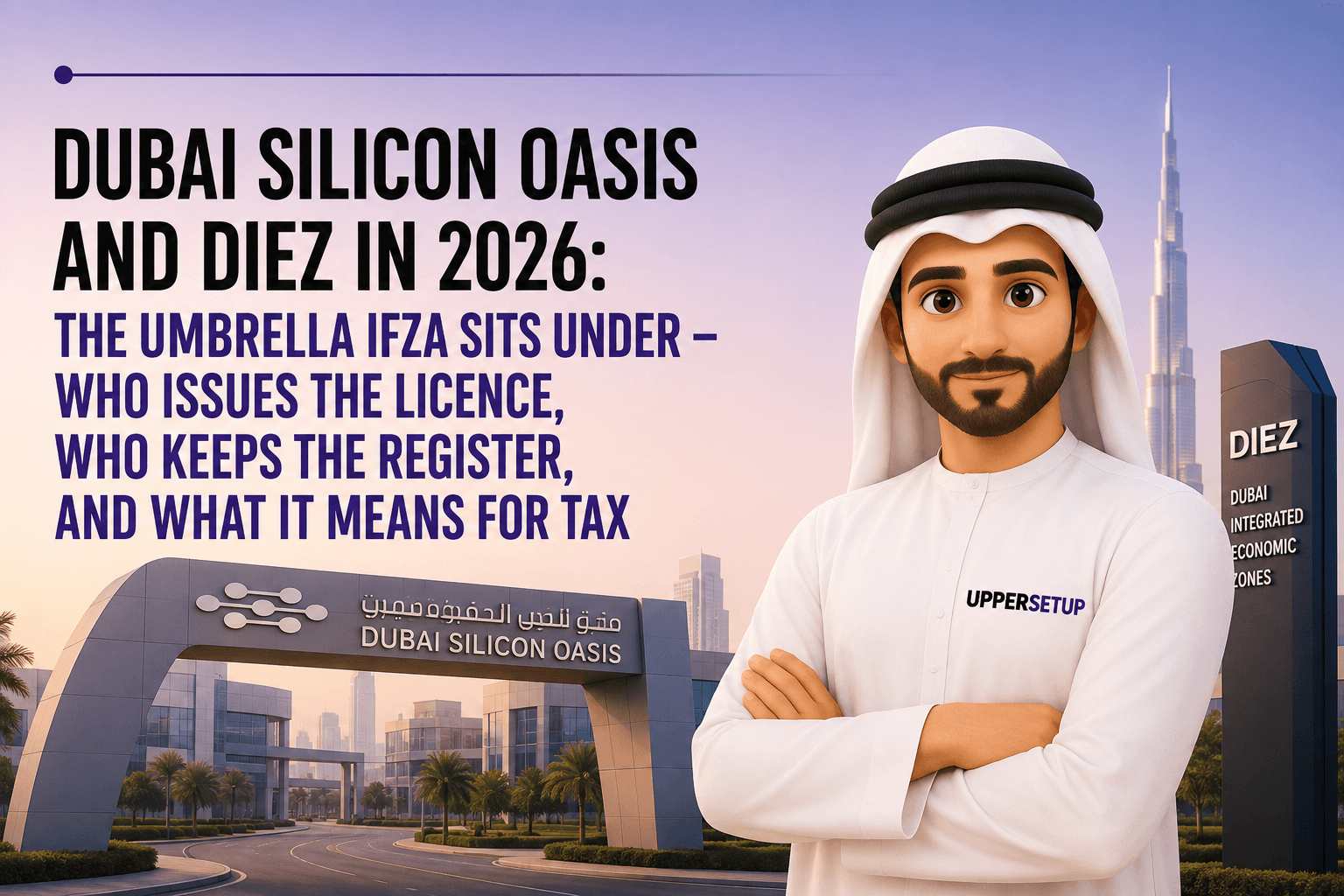
Dubai Silicon Oasis (DSO) is a Dubai free zone, and the Dubai Integrated Economic Zones Authority (DIEZ) is the body that runs it, issues the licences and keeps the register of companies. IFZA (the International Free Zone Authority) is not a free zone: it is a commercial operator occupying premises inside Dubai Silicon Oasis and selling incorporations of companies that are, in law, created in the DSO free zone under DIEZ regulations. A company “in IFZA” is a company in Dubai Silicon Oasis.
Alert. The most expensive misconception in this area is that DSO confers VAT Designated Zone status. Dubai Silicon Oasis is not on the Designated Zones list in Cabinet Decision No. (59) of 2017 and its amendments, while its sister zone under the same authority — Dubai Airport Free Zone — is. The consequence is twofold. First, supplies of goods inside DSO carry VAT at the standard 5% exactly as on the mainland. Second, the qualifying activity “distribution of goods in or from a Designated Zone” in the Qualifying Free Zone Person regime is unavailable to a DSO company in respect of DSO itself — a trading company must qualify under a different activity to reach 0%, or accept 9%.
The second most expensive discrepancy is share capital. The zone’s own website still states a minimum of AED 100,000 and still refers to the FZE form, while the DIEZA Implementing Regulations 2023 in force set a minimum of AED 1 and expressly abolish the FZE. That conflict is analysed in its own section.
The legal stack: which instruments govern a DSO company in 2026
A company in Dubai Silicon Oasis is governed by three layers: the emirate-level legislation of Dubai, the zone’s own regulations, and UAE federal tax and corporate law. They must be kept apart — different bodies enact them, they move at different speeds, and they produce different consequences.
Emirate of Dubai:
• Law No. (16) of 2021 Establishing the Dubai Integrated Economic Zones Authority — issued 14 September 2021, in force 1 January 2022. It creates DIEZA as a public authority with its own legal personality, wholly owned by the Investment Corporation of Dubai.
• Resolution No. (1) of 2022 Approving the Names, Locations, Area, and Boundaries of Free Zones within the Integrated Economic Zones — issued 7 January 2022 by the Chairman of DIEZA. It approves the names, locations, area and boundaries of four free zones inside the integrated economic zones, each tied to a specific plot.
• Decree No. (36) of 2021 and Decree No. (37) of 2021 — appointment of the Chairman and the Executive Chairman of DIEZA.
• Law No. (6) of 2023 Establishing the Dubai Business Registration and Licensing Corporation — issued 6 February 2023. It centralises registration and licensing across the emirate, in coordination with the free zone authorities.
• Decree No. (13) of 2024 Establishing the Unified Digital Window for Establishing Companies in the Emirate of Dubai — issued 1 March 2024. It routes applications, including free zone applications, through the Invest in Dubai platform.
• Executive Council Resolution No. (11) of 2025 Regulating the Conduct of Free Zone Establishments’ Activities within the Emirate of Dubai — issued 3 March 2025. It opens a lawful route onto the Dubai mainland market for free zone companies.
Article 17 of Law No. (16) of 2021 deserves separate treatment, because most of the marketing claims made about this zone rest on it. The text reads:
“Without prejudice to the federal tax legislation in force in the UAE, Licensed Establishments operating in the Free Zone, and their respective employees, will be subject to zero (0) tax rate for fifty (50) years from the effective date of this Law. The said period will be renewable for the same period pursuant to a resolution of the Ruler.”
The opening words — “without prejudice to the federal tax legislation in force in the UAE” — are the most important part of the provision. The fifty-year zero rate is expressly subordinated to federal tax law and therefore affords no shelter from corporate tax under Federal Decree-Law No. (47) of 2022. Quoting Article 17 without that clause misstates it.
Zone level:
• The DIEZA Implementing Regulations 2023, approved by Administrative Resolution ADM LEGAL 001 2023of 27 January 2023 and in force from the date of issue. This is the zone’s corporate code: company forms, share capital, the register, licences, auditors and winding up.
Federal level — the principal instruments in force as at August 2026:
• Federal Decree-Law No. (47) of 2022 on the Taxation of Corporations and Businesses — issued 3 October 2022, published 10 October 2022, applying to tax periods commencing on or after 1 June 2023. It has been amended three times: Federal Decree-Law No. 60 of 2023 (2 October 2023, in force 1 November 2023), Federal Decree-Law No. 40 of 2024 (1 October 2024, retroactive to 1 June 2023) and Federal Decree-Law No. 28 of 2025 (1 October 2025, in force 15 October 2025).
• Cabinet Decision No. 116 of 2022 — the AED 375,000 threshold and the 0% / 9% rates.
• Cabinet Decision No. 100 of 2023 on Determining Qualifying Income — issued 25 October 2023, applying from 1 June 2023; Article 10 repealed Cabinet Decision No. 55 of 2023.
• Ministerial Decision No. 229 of 2025 Regarding Qualifying Activities and Excluded Activities — issued 28 August 2025, applying from 1 June 2023; Article 6 repealed Ministerial Decision No. 265 of 2023, which had itself repealed Ministerial Decision No. 139 of 2023.
• Federal Decree-Law No. (8) of 2017 on Value Added Tax as amended, including Federal Decree-Law No. 16 of 2025 (in force 1 January 2026), and Cabinet Decision No. (59) of 2017 on Designated Zones as amended.
• Cabinet Decision No. 142 of 2024 — the Domestic Minimum Top-up Tax, applying to financial years starting on or after 1 January 2025.
• Cabinet Decision No. (109) of 2023 On Regulating the Beneficial Owner Procedures — issued 6 November 2023; Article 22 repealed Cabinet Decision No. (58) of 2020.
• Cabinet Decision No. (98) of 2024 — published 16 September 2024, lifting Economic Substance Regulations reporting for financial years ending after 31 December 2022.
Author’s assessment: as at August 2026 the legislation page on the Dubai Silicon Oasis website names no operative Ministerial Decision on corporate tax at all. The only numbered federal instrument in that section is Cabinet Resolution No. (54) of 2023 on defining free zones for corporate tax purposes; beyond that the page says only that the 0% rate applies “as specified by the relevant Corporate Tax Cabinet and Ministerial decisions”, linking out to the Ministry of Finance.
The practical consequence is that the current list of qualifying and excluded activities has to be read in Ministerial Decision No. 229 of 2025, not in the zone’s materials. The intermediate Ministerial Decision No. 265 of 2023 was repealed by Article 6 of the 2025 decision, and its predecessor Ministerial Decision No. 139 of 2023 by Article 6 of Decision No. 265 of 2023. Any material whose chain stops at 265 or at 139 is out of date.
What DIEZ is and which zones and authorities it absorbed
The Dubai Integrated Economic Zones Authority (DIEZA) is a Dubai public authority created by Law No. (16) of 2021 and is the legal successor of two former free zone administrations: the Dubai Airport Free Zone Authority and the Dubai Silicon Oasis Authority.
Article 31 puts the succession plainly: DIEZA is deemed the legal successor of both authorities, and all their rights and obligations transfer to the new body. Article 33 repeals eight instruments, including Law No. (16) of 2005 Concerning Dubai Silicon Oasis — the zone’s constitutive statute, which had itself superseded Law No. (7) of 2004 Establishing Dubai Silicon Oasis, so the zone dates from 2004 rather than 2005.
The practical consequence is that the Dubai Silicon Oasis Authority (DSOA) ceased to exist as a legal person on 1 January 2022. Documents, contracts and powers of attorney naming DSOA as a party read from that date as referring to DIEZA. Any advice that still treats DSOA as the operative licensing body is at least four and a half years out of date.
Article 4 of Law No. (16) of 2021 lists the zones under DIEZA supervision: Dubai Silicon Oasis, established under Law No. (16) of 2005; the Dubai International Airport Free Zone, regulated under Law No. (25) of 2009, together with the plots amalgamated by Decree No. (32) of 2016; and any other zone or plot brought under DIEZA supervision by a resolution of the Ruler.
Dubai CommerCity is not named in Law No. (16) of 2021 itself — it first appears in Resolution No. (1) of 2022, issued on 7 January 2022 by the Chairman of DIEZA, approving the names, locations, area and boundaries of four free zones.
Author’s assessment: that Resolution is an act of the authority’s Chairman, not the Ruler’s resolution contemplated by Article 4(a)(3). In legal terms it approves boundaries rather than bringing a zone under DIEZA supervision, and no separate Ruler’s instrument covering Dubai CommerCity could be found in open sources. Nothing turns on this in practice — Dubai CommerCity is administered by DIEZ — but the two instruments should not be substituted for one another in a citation.
|
Free zone within the Integrated Economic Zones |
Plot number under Resolution No. (1) of 2022 |
VAT Designated Zone status |
|
Dubai International Airport Free Zone |
2210157 |
Yes — on the Cabinet Decision No. (59) of 2017 list |
|
Dubai Silicon Oasis |
600-1137 |
No |
|
Dubai CommerCity |
2150115 |
No |
|
DAFZA Industrial Park |
2480438 |
Not confirmed as a separate line on the list |
Author’s assessment: two zones under the same authority holding different VAT status is not an anomaly but a direct consequence of two regimes with different tests. Free zone status for Corporate Tax is conferred by a decision issued by the Cabinet at the suggestion of the Minister. Designated Zone status for VAT requires physical compliance with Article 51 of the VAT Executive Regulation (Cabinet Decision No. (52) of 2017) — a fenced area with security measures and customs controls over the movement of goods. An airport zone meets that; an urbanised technology park with schools, a university and residential towers does not.
A wider survey of how UAE free zones are structured and how they differ is in Overview of UAE Free Zones.
What IFZA is, and why it is not a free zone
IFZA (the International Free Zone Authority) is neither a free zone nor a free zone authority. It is a commercial operator occupying premises inside Dubai Silicon Oasis and providing incorporation services for companies that are, in law, created in the DSO zone under DIEZ regulations.
That statement rests not on outside commentary but on IFZA’s own documents. IFZA’s Terms and Conditions in their November 2023 edition — the most recent client-facing edition traceable in open sources — define “IFZA Dubai” as “the International Free Zone Authority area within Dubai Silicon Oasis, Dubai”, an area within a free zone, not a free zone.
Author’s assessment on the status of that document: the November 2023 edition is retrievable only from a copy hosted on a third-party partner-network site rather than on ifza.com. The “terms and conditions” page on IFZA’s own site is a website terms-of-use document with no definitions section, last modified 27 January 2026. No later client edition is publicly available, so every conclusion below is dated to the November 2023 edition.
The same document identifies the applicable law:
“Free Zone Regulation means the applicable rules and regulations in the Dubai Integrated Economic Zonesincluding, without limitation, the 2023 Implementing Regulation for Free Zone Companies issued pursuant to Law No. (16) of 2021 Regarding Establishing Dubai Integrated Economic Zones Authority.”
And the company form:
“FZCO means a free zone limited liability company incorporated and licensed in IFZA Dubai under Free Zone Regulation.”
IFZA therefore enacts no corporate law of its own — it points to the DIEZ regulations. The earlier edition hosted on IFZA’s own server and marked as the October 2022 edition is built the same way: there “Free Zone Regulation” meant “the applicable rules and regulations in the Dubai Silicon Oasis Free Zone… issued pursuant to Law 16 of 2005 of the Emirate of Dubai.” The structure did not change; only the instrument it points to did — from the zone’s founding statute to the DIEZ regulations. Note also the shift in the instrument referred to: the 2023 edition points not to Dubai Silicon Oasis but to the Dubai Integrated Economic Zones.
There is no such instrument as the “IFZA Companies Regulations”. It appears in no Dubai register and on no IFZA page, and IFZA’s own Terms and Conditions incorporate the DIEZ regulations in its place.
The same picture emerges from the public-law side. The DIEZ website lists three zones — Dubai Airport Free Zone, Dubai Silicon Oasis and Dubai CommerCity — and no reference to IFZA can be found on it. The Dubai Silicon Oasis website describes itself as “a member of Dubai Integrated Economic Zones Authority” and does not mention IFZA. The DIEZA Implementing Regulations 2023 do not mention IFZA. The Ministry of Economy and Tourism factsheet on Dubai Silicon Oasis names the zone administration, not IFZA, as the licensing authority.
Author’s assessment: IFZA’s own application form is headed “International Free Zone Authority (IFZA) FZCO”, so IFZA is itself incorporated in the free zone company form it sells to its clients. That is not a defect and not evidence of bad faith: the operator-inside-a-zone model is lawful and common. But it means the word “Authority” in the IFZA name is part of a trading name, not a statement of public-law status.
How IFZA came to be in Dubai Silicon Oasis
IFZA came to Dubai Silicon Oasis under an agreement with the zone administration signed on 21 October 2020.Before that IFZA operated in the Emirate of Fujairah.
IFZA’s own announcement quotes the then Vice Chairman and CEO of the zone administration:
“The agreement… is a gateway for companies from different industries registered with IFZA to work from DSO and benefit from the advanced infrastructure”
The Dubai Media Office, the Dubai government’s official communications office, announced the agreement on 24 October 2020, and Gulf Business reported it on 25 October 2020.
Note the framing: the agreement is described as access to premises and infrastructure — “to work from DSO” — not as a delegation of licensing or registry powers. No public instrument transferring registrar powers to IFZA exists.
Author’s assessment: the fate of companies registered with IFZA in Fujairah, and the date IFZA stopped issuing licences there, cannot be established from permitted sources. Every source making those claims is a company-formation site, which is not a usable source. Holders of legacy IFZA Fujairah licences should ask the zone directly rather than rely on public summaries.
Physically IFZA sits inside Dubai Silicon Oasis: its own contact page gives an “IFZA HQ, Dubai Silicon Oasis” and an “IFZA Business Park, A2, Dubai Silicon Oasis”. Author’s assessment: the wider building list circulated by intermediaries (A3, B5 to B8 in the Dubai Digital Park development) is not confirmed by any official IFZA or DIEZ page and should not be relied on for an address in a contract. In July 2026 IFZA announced the acquisition of the IFZA Towers complex at the entrance to Dubai Silicon Oasis.
A dedicated analysis of IFZA itself — its packages, economics and pitfalls — is in IFZA 2026: The Complete Breakdown.
Who issues the licence and who keeps the register
A licence for a company in Dubai Silicon Oasis is issued by DIEZ, and the register of companies is kept by the DIEZA department appointed as registrar of the free zone. Neither DSOA (abolished) nor IFZA is the registrar.
The DIEZA Implementing Regulations 2023 define the actors directly:
“Registrar is the DIEZA department appointed as the registrar for the Free Zone.” “Licence — a licence issued by the Registrar to conduct a licenced activity in the Free Zone.” “Free Zone — the Dubai Integrated Economic Zones, established pursuant to Law No. (16) of 2021…”
Regulation 9.2(g) empowers the Registrar to “issue, suspend, revoke, terminate or cancel a Licence.” Article 23 of Law No. (16) of 2021 states the prohibition: “No persons or entities may conduct any Activity within the Free Zone unless they are licensed by DIEZA to conduct that Activity.” The closing words do independent work: a licence is activity-specific, and conducting an unlicensed activity breaches the provision even where the licence itself is valid.
The practical point to hold on to in any dispute: the company’s counterparty on licensing, the register, changes of ownership and liquidation is DIEZ, not the operator through which the company was registered. The operator is a sales channel and a service layer, not a party to the public-law relationship.
Author’s assessment: an authenticated specimen of a printed IFZA Dubai trade licence could not be obtained from permitted sources, so the exact issuer string on the certificate is not reproduced here. The legal position is unaffected — it follows from the regulations and from Law No. (16) of 2021 — but on counterparty due diligence the licence should be inspected and checked against the zone’s register.
Company forms under the DIEZA Implementing Regulations 2023
Regulation 8 recognises two company forms — FZCO and PLC — and provides for the registration of a branch of a foreign company; the FZE form is abolished, and existing FZEs are automatically treated as FZCOs.
The text of Regulation 8:
“8.1 These Regulations recognise the following types of companies: (a) FZCO; and (b) PLC. 8.2 An FZE is recognised as an FZCO under these Regulations. 8.3 A Foreign Company may register a Branch in the Free Zone pursuant to these Regulations. 8.4 The Registrar may by a written notification recognise an entity as a Company or a Branch. 8.5 A Company or a Branch cannot operate in the Free Zone without a valid Licence.”
The definition of “Foreign Company” is wider than it looks: a company incorporated in a jurisdiction other than the Free Zone. That captures a Dubai mainland company, a company of another emirate and a company of another UAE free zone alike. The zone’s own licence-types page confirms that a branch is “a branch of a company incorporated outside the Free Zone (local or foreign).”
|
Form |
Basis |
Share capital |
Legal personality |
|
FZCO — free zone limited liability company |
Regulations 8.1(a), 23.2 and 23.3 |
Minimum AED 1; shares paid up to at least 25% of nominal value, except shares allotted under an employee share scheme |
Separate |
|
PLC — public limited company |
Regulations 8.1(b), 23.4(a) and 23.4(b) |
Issued and allotted capital of no less than AED 250,000 at any time; shares paid up to at least 25% |
Separate |
|
FZE — former single-shareholder form |
Regulation 8.2 |
Not applicable — form abolished |
Existing FZEs treated as FZCOs |
|
Branch of a foreign or local company |
Regulations 8.3 and 19 |
None required |
None; liability rests with the parent |
The practical consequence: any template, checklist or proposal offering to “register an FZE in DSO” has been out of date since 27 January 2023.
Author’s assessment: the text of the DIEZA Implementing Regulations 2023 itself carries no preamble naming Administrative Resolution ADM LEGAL 001 2023 — that reference appears in the zone’s legislation listing. A citation in a contract or an opinion should give both references together.
How much share capital is required: AED 1 or AED 100,000?
Under the DIEZA Implementing Regulations 2023 in force, the minimum share capital of an FZCO is AED 1, with each share paid up to at least 25% of its nominal value. Regulation 23:
“23.2 An FZCO shall have a minimum Share capital of AED 1 (or any currency equivalent to AED 1). 23.3 An FZCO shall not allot a Share except as Paid Up at least to twenty five percent (25%) of its value… 23.4 A PLC (a) shall have an issued and allotted Share capital (excluding treasury Shares) of no less than AED 250,000 at any time…”
The zone’s own business-setup page, however, still states, as at August 2026, that the “Minimum Start Up Capital required is AED 100,000”, and describes FZE shares in multiples of AED 100,000 and FZCO shares in multiples of AED 10,000.
Resolving the conflict. The business-setup page carries an internal marker of obsolescence: it treats the FZE as a current form, whereas Regulation 8.2 abolished it on 27 January 2023. This is legacy content written before the 2023 Regulations and never updated. The regulation governs — AED 1 with 25% paid up; the website is out of date on this point.
A caveat that matters in practice. A legal minimum and a commercial requirement are not the same thing. The zone’s document checklist still calls for a bank letter evidencing share capital for a PLC, and banks at onboarding and immigration at the visa-quota stage may look at the declared capital. Author’s assessment: incorporating on AED 1 purely on the strength of the regulation is risky — the Registrar’s position on the specific application should be obtained in writing.
Which licences DIEZ issues in Dubai Silicon Oasis
Dubai Silicon Oasis offers three operating licences — Service, Trade and Industrial — plus a Business Operation Permit for companies in the administrative zone and a redomiciliation mechanism.
• Service Licence — the provision of services from the list of activities attached to the licence.
• Trade Licence — import, export and distribution of the goods specified in the licence. Note the terminology: the zone calls it Trade, not “Commercial”.
• Industrial Licence — import of raw materials, manufacture, processing, assembly, packaging and export of finished products.
• Business Operation Permit — for companies operating in the administrative zone of Dubai Silicon Oasis on a mainland licence from Dubai’s Department of Economy and Tourism. No share capital is required for this permit.
• Transfer from Free Zone — inbound and outbound migration through a Certificate of Continuation and a Certificate of Cancellation.
There is no separate “e-commerce”, “general trading” or “freelance” licence category at Dubai Silicon Oasis — those are activities within the three principal types. That distinguishes DSO from zones that market a standalone freelancer package, and it matters when selecting an activity code: the wrong activity breaks bank onboarding and distorts the tax analysis. That risk is analysed in UAE Trade Licence Activities 2026.
Desk, office and visa quota: how the workspace determines the quota
The visa quota of a Dubai Silicon Oasis company is set by the type of workspace leased, not by statute: two visas per flexi desk, three per fixed desk, and pro rata to floor area for a private office.
The zone’s wording:
Flexi Desk — “The flexi desk package gives the option of up to two residency visas per flexi desk.” Fixed Desk — “The fixed office package gives you the option to apply for up to three visas per desk.” Private Office — floor area “between 12–50 sqm”, with the visa allowance “based on the space taken”.
A lease is a precondition of licence issuance. The zone’s registration checklist states it expressly — “Valid lease agreement required for license issuance” — and signing the lease and returning it to the administration is a separate step of the process. A flexi desk is the minimum configuration that satisfies the requirement.
|
Workspace type at Dubai Silicon Oasis |
Visa quota |
Note |
|
Flexi Desk — a workstation in a common area |
Up to 2 residency visas per desk |
Minimum configuration satisfying the lease requirement |
|
Fixed Desk — a dedicated desk |
Up to 3 visas per desk |
— |
|
Private Office of 12–50 sq m |
Pro rata to the leased area |
The zone publishes no square-metres-per-visa ratio |
|
Offices in the HQ Building, Dtec and Technohub 2 |
By agreement |
From 160 sq ft; Technohub 2 up to 20,000 sq m |
|
Warehouses and light industrial units |
By agreement |
Units of 3,228–5,380 sq ft; LIUs of 3,868 sq ft |
IFZA follows the same logic on a different variable: quota is set by licence category rather than by area. IFZA’s own Terms and Conditions put it as “The number of Visas available under your Licence depends on the category of Licence you select”, adding that higher visa entitlements may require leasing physical office space within IFZA Dubai.
Author’s assessment: no published square-metres-per-visa ratio exists for Dubai Silicon Oasis offices — the zone says only “based on the space taken”. Headcount cannot be planned against unofficial ratios; the quota must be confirmed with the zone before the lease is signed.
The establishment card and visas: who actually issues them
The establishment card for a Dubai free zone company is issued by the General Directorate of Residency and Foreigners Affairs (GDRFA) Dubai — not by the free zone and not by its operator. Residence visas are likewise issued by GDRFA Dubai, against a valid DIEZ-issued licence and a valid establishment card.
|
Item under the GDRFA Dubai service “Establishment Card for Institutions in the Private Sector / Free Zone” |
AED |
|
Issuance fee |
200 plus 5% VAT |
|
Knowledge Dirham |
10 |
|
Innovation Dirham |
10 |
|
Service fee |
50 |
|
Urgent processing |
100 |
|
Annual renewal |
100 per year |
|
Processing through an Amer centre (additional) |
100 |
Processing time for an establishment card is 48 hours, and the card is valid for one year.
IFZA’s own Terms and Conditions expressly disclaim the issuer role: the establishment card is defined as issued “through the Emirate of Dubai”, and visa issuance is “subject to Free Zone Regulation and the UAE immigration authorities”. Author’s assessment: in law the operator here is a processing intermediary, not a sponsor and not an issuer; a claim against the operator for an immigration refusal has nowhere to go.
What does it cost to set up in DSO, and why no official price list exists
Neither DIEZ nor IFZA publishes an official price list: no registration fee, licence fee or name-reservation fee can be found on the zone’s or the operator’s pages.
This is not a disclosure gap but a consequence of how the law is built. Article 8(b)(3) of Law No. (16) of 2021 empowers the DIEZA Chairman to “approve fees and charges for the services provided by DIEZA, in accordance with the Legislation in force” — tariffs are therefore set by internal Chairman’s resolution rather than by a published schedule. Article 6(11) empowers the authority itself to determine and collect fees, and Article 11 lists them among DIEZA’s sources of revenue.
IFZA’s reason is different — distribution. IFZA sells through a network of “Professional Partners”, and its own pages consistently replace a price with an invitation to contact a partner. The retail price is set by the agent, not by the operator.
Author’s assessment: any specific figure for “the cost of setting up in DSO” or “an IFZA package” circulating in open sources originates from company-formation firms and is not corroborated by a primary source. Figures of that provenance have no place in a tax-alert-grade analysis and are therefore not reproduced here. The one official numeric reference found on IFZA’s side is a visa fee of AED 3,750, quoted in its own partner knowledge base in the context of a promotion — not a general tariff.
What the primary sources do say about timing. The zone describes its registration process as: application review, 7 days; registration, “varies depending on the provision of the legal documentation by the applicant”; licence and lease agreement issued within 2 days of receipt of all legal documents and payment. The same 2-day figure applies where the shareholder is a corporate entity. IFZA publishes no timelines at all.
One budgeting point from April 2026. On 9 April 2026 DIEZA announced a package of economic measures: rent stabilisation on renewal, waiver of late licence-renewal penalties, monthly rent instalments, a three-month deferral of shareholder-amendment fees, waiver of restructuring and authorised-capital amendment fees, and a three-month deferral of activity-amendment fees. No amounts were given.
Corporate tax: why “0% for 50 years” in Law No. (16) of 2021 does not displace the federal 9%
Law No. (16) of 2021 guarantees licensed DIEZ establishments a zero tax rate for fifty years, but that is an emirate-level guarantee and it does not displace the federal corporate tax introduced by Federal Decree-Law No. (47) of 2022. A 0% rate for a Dubai Silicon Oasis company arises not from the emirate guarantee but from the federal Qualifying Free Zone Person regime — and only where every condition of that regime is met.
Dubai Silicon Oasis is treated as a free zone for corporate tax purposes. The zone cites Cabinet Resolution No. (54) of 2023 regarding defining free zones for the purposes of the Corporate Tax Law as its basis and hosts the text of the decision itself. The hosted file is the Arabic original, and its body does not extract as text, so neither the title nor the list of zones can be read out of it. The zone styles the instrument a Cabinet Resolution; the UAE legislation portal renders Cabinet acts that way, while the Ministry of Finance and the Federal Tax Authority render the same class of instrument as a Cabinet Decision. Author’s assessment: that decision does not appear in the public federal registers of the Ministry of Finance, the Federal Tax Authority or the UAE legislation portal — the federal list of free zones is not published. The Federal Tax Authority’s own Free Zone Persons guide sends the taxpayer back to the zone: “taxpayers should check with their respective Free Zone Authority.” DSO’s status is asserted by the zone’s official site and is not disputed as at August 2026, but there is no independent federal publication to cite.
The conditions of Qualifying Free Zone Person status are set by Article 18 of Federal Decree-Law No. (47) of 2022:adequate substance in the UAE; qualifying income as specified by Cabinet decision; no election into the ordinary regime under Article 19; compliance with Articles 34 and 55 on the arm’s length principle and transfer pricing documentation; and any further conditions set by the Minister.
The subordinate chain in force in August 2026:
• Cabinet Decision No. 100 of 2023 on Determining Qualifying Income, issued 25 October 2023, applying from 1 June 2023. Article 10 repealed Cabinet Decision No. 55 of 2023.
• Ministerial Decision No. 229 of 2025 Regarding Qualifying Activities and Excluded Activities, issued 28 August 2025, applying from 1 June 2023. Article 6 repealed Ministerial Decision No. 265 of 2023, which had repealed Ministerial Decision No. 139 of 2023.
The de minimis rule: non-qualifying revenue must not exceed 5% of total revenue in the tax period or AED 5,000,000, whichever is lower.
The consequence of breach is severe: Article 5(2) of Ministerial Decision No. 229 of 2025 strips Qualifying Free Zone Person status from the beginning of the relevant tax period and for the following four tax periods. One error therefore costs five tax periods at 9%.
|
Tax position of a Dubai Silicon Oasis company |
Rate |
|
Qualifying Free Zone Person, qualifying income |
0% |
|
Qualifying Free Zone Person, non-qualifying income |
9%, with no AED 375,000 band |
|
Free Zone Person that has never obtained or has lost QFZP status |
0% up to AED 375,000 and 9% above — as for a mainland company |
|
Small Business Relief |
Not available to a Qualifying Free Zone Person |
Small Business Relief under Ministerial Decision No. 73 of 2023 is available to an ordinary Free Zone Person with revenue up to AED 3,000,000 under Article 2, but Article 3 of the same decision lists a Qualifying Free Zone Person among those not eligible, alongside constituent companies of multinational groups. Ministerial Decision No. 131 of 2026, dated 29 July 2026, does not repeal the 2023 decision but amends it, extending the availability of the relief to tax periods ending on or before 31 December 2029 in place of the former 31 December 2026. In practice this is a choice: either the 0% regime on qualifying income or small business relief — the two cannot be combined.
An audit is mandatory for every Qualifying Free Zone Person regardless of size. Ministerial Decision No. 84 of 2025, dated 25 March 2025,, applying to tax periods commencing on or after 1 January 2025, requires audited financial statements from persons with revenue above AED 50,000,000 and from every Qualifying Free Zone Person. Audit requirements are covered in Corporate Audit Requirements in the UAE 2026, and the regime conditions in detail in Qualifying Free Zone Person Regime in 2026.
A new 2026 requirement for distribution. FTA Decision No. 6 of 2026, issued on 2 June 2026 and published in the Federal Tax Authority legislation register on 14 July 2026, applying to tax periods beginning on or after 1 January 2026, requires a Qualifying Free Zone Person relying on the distribution qualifying activity to obtain an agreed-upon-procedures report from an independent external auditor and file it within 30 days of the corporate tax return deadline; without it the distribution activity ceases to be a qualifying activity.
VAT: why Dubai Silicon Oasis is not a Designated Zone while Dubai Airport Free Zone is
Dubai Silicon Oasis is not on the VAT Designated Zones list established by Cabinet Decision No. (59) of 2017 and its amendments. The Dubai entries on that list are Jebel Ali Free Zone (North-South), the Dubai Cars and Automotive Zone, Dubai Textile City, the Free Zone Area in Al Quoz, the Free Zone Area in Al Qusais, Dubai Aviation City and Dubai Airport Free Zone.
The distinction between the two regimes is not terminological — they are different statutes with different consequences.
|
Feature |
Free Zone for corporate tax |
Designated Zone for VAT |
|
Basis |
Article 1 of Federal Decree-Law No. (47) of 2022; the list is issued by the Cabinet at the suggestion of the Minister |
Articles 50–51 of Federal Decree-Law No. (8) of 2017, Article 51 of the Executive Regulation; the list is Cabinet Decision No. (59) of 2017 |
|
What it confers |
Access to the Qualifying Free Zone Person regime and a 0% rate on qualifying income |
Treatment of supplies of goods within and between zones as outside the scope of VAT |
|
Test for inclusion |
Cabinet decision |
Physical criteria: a fenced area with security measures, customs controls over movement of goods and persons, internal storage procedures |
|
Dubai Silicon Oasis |
Yes, per the zone — Cabinet Resolution No. (54) of 2023 |
No |
|
Dubai Airport Free Zone |
Yes |
Yes |
Why Dubai Silicon Oasis fails the Designated Zone test is legible from Article 51 of the Executive Regulation: the zone must be a fenced geographic area with security measures and customs controls over the entry and exit of persons and the movement of goods. Dubai Silicon Oasis is an open urban district of roughly 7 sq km with residential buildings, schools, a university and retail; by its nature it does not meet those criteria.
Two consequences follow, and both are financial.
First, for VAT a Dubai Silicon Oasis company is treated exactly like a Dubai mainland company. The standard 5% applies to its taxable supplies; there is no out-of-scope treatment for movements of goods within the zone; the mandatory registration threshold is AED 375,000 and the voluntary threshold AED 187,500.
Second, and less obvious: the qualifying activity “distribution of goods in or from a Designated Zone” under Ministerial Decision No. 229 of 2025 is unavailable to a Dubai Silicon Oasis company in respect of DSO itself. A trading or distribution business counting on the 0% rate must either fit another qualifying activity or accept 9%.
Author’s assessment: this is where the “cheap trading licence in DSO at zero per cent” model most often breaks.The saving on the setup package is not remotely comparable to the difference between 0% and 9% on trading margin. Comparative context on zones that do hold Designated Zone status is in JAFZA in 2026, and the VAT position generally, including the zone list, in UAE VAT: The Complete Business Guide 2026.
Author’s assessment on the source of the list: the consolidated Designated Zones list is published by the Federal Tax Authority as a PDF that is closed to automated retrieval. The Dubai entries above are taken from the text of Cabinet Decision No. (59) of 2017 and cross-checked against publications by international law firms; the absence of Dubai Silicon Oasis is further supported by the fact that the zone claims corporate tax free zone status on its pages but nowhere claims Designated Zone status.
Reaching the mainland: what Executive Council Resolution No. (11) of 2025 changed
Executive Council Resolution No. (11) of 2025 Regulating the Conduct of Free Zone Establishments’ Activities within the Emirate of Dubai, issued 3 March 2025, permits Dubai free zone companies — Dubai Silicon Oasis included — to operate on the emirate’s mainland through one of three routes. The Resolution comes into force on the day of its publication in the Official Gazette.
Article 2 carves out financial institutions licensed in the Dubai International Financial Centre.
|
Route under Resolution No. (11) of 2025 |
Validity |
Fee |
|
Branch licence within the emirate (mainland branch) |
1 year, renewable |
Per the licensing authority’s standard fee schedule |
|
Branch licence operating from the free zone |
1 year, renewable |
AED 10,000 per year |
|
Temporary activity permit |
Not exceeding 6 months |
AED 5,000 |
The Resolution’s requirements: prior approval of the licensing authority, a valid free zone licence, approvals from the government entities supervising the activity, and, importantly, separate financial records for activities conducted outside the free zone.
The transitional provision in Article 13 gives existing operations that are out of compliance one year from the effective date to conform, and the Director General of the licensing authority may extend that period once for an equivalent duration.
The tax price of going onshore. Mainland income is not qualifying income for the Qualifying Free Zone Person regime: it is taxed at 9%. That is precisely why the separate-records requirement is not a formality — without it, non-qualifying revenue cannot be measured, and the de minimis ceiling of 5% or AED 5,000,000 cannot be monitored.
Author’s assessment: according to analyses published by international law firms, a list of activities permitted on the mainland was expected within six months of the Resolution; no such published list could be found as at August 2026. Until it appears, the permissible scope is determined case by case through approvals.
How the mainland and free zone regimes compare overall is set out in Free Zone or Mainland in the UAE (2026).
What else federal law requires: UBO, ESR, registration and penalties
A Dubai Silicon Oasis company must maintain a beneficial ownership register: Cabinet Decision No. (109) of 2023, dated 6 November 2023, applies to commercial free zones. Article 3 excludes from its scope companies wholly owned by the federal or a local government and their wholly owned subsidiaries, the financial free zones — the Dubai International Financial Centre and the Abu Dhabi Global Market — and the Governmental Partner. DSO is a commercial free zone whose companies are privately owned, and is therefore within scope. The register of real beneficiaries and the register of partners or shareholders must be created and submitted within 60 days, with changes notified within 15 days. Penalties are set by Cabinet Decision No. (132) of 2023. The practicalities of maintaining the register and filing through goAML are covered in The UAE UBO Register and goAML.
Economic Substance Regulations no longer apply to financial years ending after 31 December 2022. Cabinet Decision No. (98) of 2024, published in the Official Gazette on 16 September 2024, amended Cabinet Decision No. (57) of 2020 so that the regime runs only from the 2019 financial year to the financial year ending 31 December 2022. For financial years ending after that date, administrative fines imposed under the Economic Substance Regulations are cancelled and the Federal Tax Authority refunds them and terminates the related appeals. Obligations for the 2019 to 2022 periods survive: the Ministry of Finance stated that licensees “remain responsible for fulfilling compliance obligations for prior years, adhering to information or amendment requests from regulatory authorities or the Federal Tax Authority, and paying any penalties imposed by the Federal Tax Authority.”
Do not read the end of ESR as the end of the substance requirement: “adequate substance in the State” remains a condition of Qualifying Free Zone Person status under Article 18(a) of Federal Decree-Law No. (47) of 2022. It is a different test, with different content and a different examiner. The analysis is in Economic Substance in the UAE in 2026.
Corporate tax registration is mandatory for free zone companies too, including those applying the 0% rate. Under FTA Decision No. 3 of 2024, in force from 1 March 2024, a person registered in a free zone on or after 1 March 2024 must apply for registration within three months of incorporation. The late-registration penalty is AED 10,000 under Cabinet Decision No. (75) of 2023 as amended by Cabinet Decision No. (10) of 2024.
The return and the tax payment are due within nine months of the end of the tax period.
|
Obligation of a Dubai Silicon Oasis company |
Deadline |
Penalty or basis |
|
Corporate tax registration where incorporated on or after 1 March 2024 |
3 months from incorporation |
AED 10,000 for late registration |
|
Corporate tax return and payment |
9 months after the end of the tax period |
AED 500 per month for the first 12 months, then AED 1,000 per month |
|
Creation and submission of the beneficial ownership register |
60 days; changes within 15 days |
Cabinet Decision No. (132) of 2023 |
|
VAT registration on crossing the threshold |
Mandatory at AED 375,000; voluntary at AED 187,500 |
Federal Decree-Law No. (8) of 2017 |
|
Audited financial statements for a Qualifying Free Zone Person |
Per tax period |
Ministerial Decision No. 84 of 2025 |
|
Licence and lease renewal |
Annual |
Regulation 20.3: the Registrar may wind the company up |
The Domestic Minimum Top-up Tax contains no free zone carve-out. Cabinet Decision No. 142 of 2024 applies to financial years starting on or after 1 January 2025 and reaches constituent entities of multinational groups with consolidated revenue of EUR 750 million or more. Author’s assessment: no explicit official statement that “free zone companies are subject to the DMTT” could be found — the conclusion rests on the absence of any exclusion. For the overwhelming majority of Dubai Silicon Oasis companies the point is theoretical, but for a subsidiary of a large group a 0% QFZP rate depresses the jurisdictional effective rate and can trigger a top-up charge. The analysis is in UAE DMTT 2026.
Dubai Silicon Oasis in numbers, and why the numbers need care
The only figure Dubai Silicon Oasis publishes consistently and without contradiction is its area of roughly 7 sq km.
Author’s assessment: the zone publishes its company count in three mutually exclusive versions. The key-facts page says “over 28,000 companies”, the home page “40,000+ registered company members”, and the DIEZ page “more than 5,000 registered companies from across 20 industries” — the last of these describing DIEZ rather than the zone and plainly stale, since DIEZ’s own site gives 56,000+. None of the figures is dated. Community size is likewise given as both “90k+” and “100,000+”.
Dated figures that can be relied on:
• The UAE Ministry of Economy and Tourism factsheet on the Dubai Silicon Oasis Authority gives 12,146 licensed entities as at Q1 2021 and an area of 7.2 million square metres (the area figure carries no date in the factsheet). By entity type the factsheet lists: free zone establishment 1,089; free zone company 676; branch 4,049; Business Operating Permit 6,073. Author’s assessment: those four lines sum to 11,887 — 259 short of the stated total, with no fifth category in the document — so the breakdown does not reconcile with the headline. The proportion is still instructive: Business Operating Permits account for half of the 12,146 total, and a Business Operating Permit is a permission to operate rather than a separate legal entity. It is precisely this mixing of licences, permits and companies that explains why the published counters diverge.
• On 22 January 2026 an AED 12.8 billion expansion of Dubai Silicon Oasis was announced: District IO at AED 11 billion with 25 LEED-standard buildings, phase one from 2026 and phase two from 2027, and Block 14 at AED 1.8 billion completing in 2029. The expansion programme is stated to accommodate more than 6,500 companies.
• For the first half of 2026 DIEZ reported occupancy of 96%, a 13% year-on-year increase in company numbers and a 24% increase in workforce; Dtec registrations rose 57% and AI-focused companies 95%.
• Across DIEZ as a whole the published figures are 56,000+ companies and 106,000+ employees.
The practical conclusion: the counters on the zone’s website cannot be used for due diligence or a business plan.Dated releases from the Dubai Media Office are the only sound source on the trend.
DSO against its neighbours: the comparison that matters
The decisive difference between zones is not the price of the package but the combination of VAT Designated Zone status, the qualifying activities available, and the regulatory regime.
|
Feature |
Dubai Silicon Oasis (DIEZ) |
Dubai Airport Free Zone (DIEZ) |
Dubai CommerCity (DIEZ) |
DIFC |
|
Authority |
DIEZA |
DIEZA |
DIEZA |
DIFC Authority and DFSA, separate legal system |
|
Basis |
Law No. (16) of 2021; Resolution No. (1) of 2022 |
Law No. (16) of 2021; Resolution No. (1) of 2022 |
Resolution No. (1) of 2022 |
Separate financial centre legislation |
|
Corporate law |
DIEZA Implementing Regulations 2023 |
DIEZA Implementing Regulations 2023 |
DIEZA Implementing Regulations 2023 |
DIFC law based on common law |
|
Free zone for corporate tax |
Yes |
Yes |
Yes |
Yes |
|
VAT Designated Zone |
No |
Yes |
No |
No |
|
Distribution qualifying activity |
Unavailable in respect of the zone itself |
Available |
Unavailable |
Unavailable |
|
UBO obligations under Cabinet Decision No. (109) of 2023 |
Apply |
Apply |
Apply |
Do not apply — financial zone |
|
Profile |
Technology, IT, start-ups, mixed urban district |
Air logistics, distribution, airport-side warehousing |
E-commerce and logistics |
Finance, law, holding structures |
Read the table along the “VAT Designated Zone” row: that single line separates zones under one and the same authority into different economic scenarios. For a services, IT or holding company the absence of Designated Zone status is immaterial. For a company that physically imports, stores and resells goods it determines both the VAT treatment and the availability of the 0% corporate tax rate.
The comparison with the sister zone under the same authority is developed in DAFZA: the free zone at Dubai Airport, and with the nearest technology competitor outside DIEZ in Dubai Internet City 2026.
Step by step: setting up and running a company in Dubai Silicon Oasis
Step 1. Establish what you are buying — a jurisdiction or a service. The jurisdiction is Dubai Silicon Oasis under DIEZ. The operator through which registration is arranged does not change the jurisdiction. Compare offers on total cost and quality of support, not on an imagined difference between “zones”.
Step 2. Test the tax model before choosing the zone, not after. If the business turns on physical goods, answer first whether you need VAT Designated Zone status and the distribution qualifying activity. If you do, Dubai Silicon Oasis is the wrong zone.
Step 3. Choose the form: FZCO, PLC or branch. The FZE no longer exists. For a branch, remember that “Foreign Company” under Regulation 8.3 includes a Dubai mainland company and a company of another UAE free zone.
Step 4. Settle the activities before filing. There are three licences — Service, Trade and Industrial — and no separate e-commerce or freelance category. The wrong activity breaks bank onboarding and distorts the tax analysis.
Step 5. Match the workspace to the visa quota, not the other way round. A flexi desk gives up to two visas, a fixed desk up to three, an office pro rata to area. A valid lease is a precondition of licence issuance.
Step 6. Get the Registrar’s position on share capital in writing. Regulation 23.2 sets a minimum of AED 1, but the zone’s website still says AED 100,000; close the gap with a letter, not an assumption.
Step 7. File the application and sign the lease. On the zone’s own figures, review takes 7 days and the licence and lease issue within 2 days of receipt of all documents and payment.
Step 8. Obtain the establishment card from GDRFA Dubai — 48 hours, an issuance fee of AED 200 plus ancillary charges, and annual renewal at AED 100.
Step 9. Register for corporate tax within three months of incorporation. A 0% rate does not exempt anyone from registration.
Step 10. Build the beneficial ownership register within 60 days and put a process in place for notifying changes within 15 days.
Step 11. If mainland business is planned, take a route under Resolution No. (11) of 2025 and keep separate records from day one.
Step 12. Budget the annual cycle: licence and lease renewal, the mandatory audit for a Qualifying Free Zone Person, the return within nine months of the tax period end, and renewal of the establishment card and visas.
Common mistakes and what they cost
Mistake 1: treating IFZA as a separate free zone and comparing it with DSO as an alternative. The comparison is meaningless: a company “in IFZA” is a company in Dubai Silicon Oasis under DIEZ regulations. The cost is not in the setup fee but in a mis-specified risk model — the client believes they are choosing between two legal regimes when they are choosing between two sales channels within one, and later addresses licensing questions to the wrong party.
Mistake 2: counting on VAT Designated Zone status. Dubai Silicon Oasis is not on the Cabinet Decision No. (59) of 2017 list. For a trading company the cost has two parts: 5% VAT on transactions planned as out of scope, and the loss of the distribution qualifying activity — that is, 9% instead of 0% on the whole trading profit.
Mistake 3: relying on the emirate-level “0% for 50 years” guarantee in Law No. (16) of 2021. The guarantee exists but operates at emirate level and does not displace federal corporate tax. The cost is a financial model built on a false premise and, on assessment, the loss of Qualifying Free Zone Person status for five tax periods.
Mistake 4: structuring from the zone’s website rather than from its regulations. As at August 2026 the Dubai Silicon Oasis business-setup page states share capital of AED 100,000 and describes the FZE as a current form, while the adjacent “start your business” page lists only the FZCO and the branch; the legislation section, meanwhile, names no operative Ministerial Decision on corporate tax at all. The cost is negotiations with a bank and a registrar on wrong inputs, redrafted documents and weeks lost.
Mistake 5: breaching de minimis without noticing. The ceiling is 5% of revenue or AED 5,000,000, whichever is lower. A single transaction with a mainland client can carry a company over it. The cost is 9% on all income for the year of breach and for the following four tax periods.
Mistake 6: going onshore without a route under Resolution No. (11) of 2025. The Resolution offers clear options — AED 10,000 a year for a branch licence or AED 5,000 for a temporary permit of up to six months. Undocumented mainland work breaches the licensing regime and simultaneously makes it impossible to ring-fence non-qualifying income, so the exposure runs on both lines at once.
Mistake 7: missing the three-month registration deadline on the theory that a 0% rate makes registration unnecessary. Registration is mandatory for every taxable person, free zone companies included. The cost is an AED 10,000 penalty, on top of which late-filing penalties accrue.
Mistake 8: planning headcount against unofficial visa ratios. Only the flexi-desk and fixed-desk quotas are published; for offices the zone says only “based on the space taken”. The cost is a signed lease that does not carry the required visas and a forced move within the zone in the first year.
Who Dubai Silicon Oasis suits, who it does not, and when to take advice
Dubai Silicon Oasis suits service, technology and holding companies that do not need a customs perimeter; it does not suit businesses whose economics rest on the physical movement of goods.
It suits:
• Technology and IT companies, developers and product teams: the zone’s profile, the Dtec ecosystem and Dubai Digital Park are built for exactly this, and the absence of Designated Zone status is irrelevant to a services model.
• Consulting, marketing, engineering and professional services: a Service Licence covers the need, and the qualifying activities relevant to services do not require a Designated Zone.
• Holding structures: the holding of shares and other securities is on the list of qualifying activities.
• Businesses that want a low entry cost with genuine presence: a flexi desk satisfies the lease requirement and carries up to two visas.
It does not suit:
• Importers, distributors and warehouse operators: no Designated Zone status, no distribution qualifying activity, and no preferential customs perimeter for goods. Such models belong in a zone on the Designated Zones list.
• Companies whose principal customer is the Dubai mainland: a route exists under Resolution No. (11) of 2025, but mainland income is taxed at 9%, and once it is a material share of revenue the Qualifying Free Zone Person regime loses its point.
• Regulated financial businesses: banking, and insurance other than reinsurance and captive insurance, are excluded activities; the DIFC and the ADGM exist for that.
• Anyone seeking minimal reporting: Qualifying Free Zone Person status requires an audit regardless of company size.
Professional review is essential where:
• the model is trading or distribution and the 0% rate is being counted on;
• revenue is mixed between mainland and foreign customers and de minimis has to be monitored;
• share capital below AED 100,000 is planned, because of the conflict between the regulation and the zone’s website;
• a branch of a mainland company or of another zone’s company is being registered in DSO;
• the company belongs to a group with consolidated revenue of EUR 750 million or more, because of the DMTT;
• redomiciliation into or out of Dubai Silicon Oasis by Certificate of Continuation is contemplated;
• the activity requires approvals from sector regulators beyond the zone.
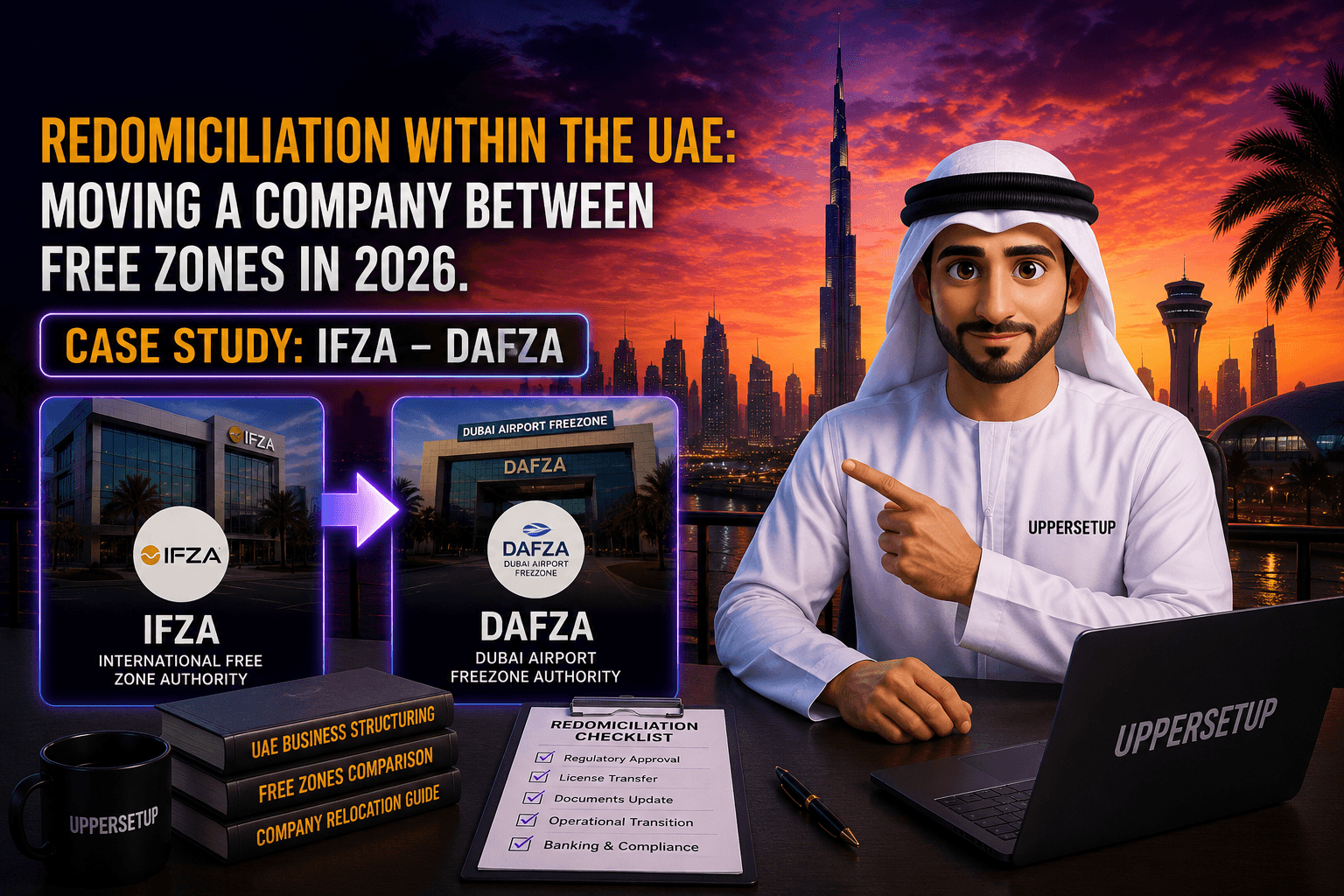
Where the jurisdiction is still open, it is worth comparing options systematically — the method is set out in How to Choose the Right Free Zone for Business Registration in the UAE, and the move-between-zones scenario in Redomiciliation Within the UAE.
FAQ
Are IFZA and Dubai Silicon Oasis the same zone or different ones? The same. Dubai Silicon Oasis is a free zone administered by the Dubai Integrated Economic Zones Authority. IFZA is a commercial operator occupying premises inside Dubai Silicon Oasis and selling incorporations of companies that are, in law, created in the DSO free zone under DIEZ regulations. IFZA’s own Terms and Conditions define “IFZA Dubai” as an area within Dubai Silicon Oasis.
Who issues the licence for a company registered through IFZA? The Registrar — the DIEZA department appointed as registrar of the free zone. That follows from the DIEZA Implementing Regulations 2023 and from Article 23 of Law No. (16) of 2021, under which only persons licensed by DIEZA may conduct activity in the zone.
Is Dubai Silicon Oasis a free zone for UAE corporate tax purposes? Yes. The zone cites Cabinet Resolution No. (54) of 2023 as its basis and hosts the text of the decision. The federal list of free zones is not published, however, and the Federal Tax Authority advises taxpayers to confirm status with their own zone.
Is Dubai Silicon Oasis on the VAT Designated Zones list? No. The Dubai entries on the Cabinet Decision No. (59) of 2017 list are Jebel Ali Free Zone, the Dubai Cars and Automotive Zone, Dubai Textile City, the zones in Al Quoz and Al Qusais, Dubai Aviation City and Dubai Airport Free Zone. Dubai Silicon Oasis is absent, while its sister zone under the same authority, Dubai Airport Free Zone, is present.
What is the minimum share capital for an FZCO in Dubai Silicon Oasis? Under Regulation 23.2 of the DIEZA Implementing Regulations 2023 it is AED 1, with each share paid up to at least 25% of nominal value. The zone’s website still states AED 100,000; that is legacy content predating the 2023 Regulations. The Registrar’s position on a specific application should be obtained in writing.
How many visas does a Dubai Silicon Oasis licence carry? Up to two residency visas per flexi desk and up to three per fixed desk; for a private office the quota follows the leased area, and the zone publishes no ratio. The establishment card and the visas themselves are issued by GDRFA Dubai.
Can a free zone company work with mainland Dubai customers? Yes, under Executive Council Resolution No. (11) of 2025: through a mainland branch, through a branch licence operating from the zone at AED 10,000 a year, or through a temporary permit of up to six months at AED 5,000. Separate financial records are mandatory, and mainland income is taxed at 9%.
Can an FZE still be registered in Dubai Silicon Oasis? No. Regulation 8.2 of the DIEZA Implementing Regulations 2023 abolished the FZE form; existing FZEs are automatically treated as FZCOs. The available options are an FZCO, a PLC and a branch.
What does it cost to register a company in DSO or through IFZA? Neither DIEZ nor IFZA publishes an official price list. Article 8 of Law No. (16) of 2021 leaves fees to an internal resolution of the DIEZA Chairman, and IFZA sells through a partner network in which the agent sets the retail price. Any specific figure in open sources comes from intermediaries and is not corroborated by a primary source.
Key points to remember
Dubai Silicon Oasis is the zone, DIEZ is the authority, and IFZA is an operator inside the zone. A company “in IFZA” is legally in Dubai Silicon Oasis.
The licence is issued and the register kept by the DIEZA Registrar. The Dubai Silicon Oasis Authority ceased to exist on 1 January 2022.
Dubai Silicon Oasis is a free zone for corporate tax but not a Designated Zone for VAT. The sister zone under the same authority, Dubai Airport Free Zone, is both.
The distribution qualifying activity requires a Designated Zone and is therefore unavailable to a DSO company in respect of the zone itself.
The emirate-level “0% for 50 years” guarantee in Article 17 of Law No. (16) of 2021 is expressly made “without prejudice to the federal tax legislation in force in the UAE” and therefore does not displace federal corporate tax.A 0% rate arises only from the Qualifying Free Zone Person regime.
Breaching de minimis — 5% of revenue or AED 5,000,000, whichever is lower — costs the status for five tax periods.
The operative instruments are Cabinet Decision No. 100 of 2023 and Ministerial Decision No. 229 of 2025.Ministerial Decision No. 265 of 2023 and its predecessor Ministerial Decision No. 139 of 2023 have been repealed; the zone’s own materials name no operative Ministerial Decision.
The FZE form is abolished by Regulation 8.2; the minimum FZCO capital is AED 1 with 25% paid up.
Mainland access is arranged under Resolution No. (11) of 2025 — AED 10,000 a year or AED 5,000 for six months — with mandatory separate records.
Sammary
Dubai Silicon Oasis (DSO) is a Dubai free zone of roughly 7 sq km administered by the Dubai Integrated Economic Zones Authority (DIEZA), created by Law No. (16) of 2021, dated 14 September 2021 and in force from 1 January 2022 as legal successor to the Dubai Silicon Oasis Authority and the Dubai Airport Free Zone Authority; the names and boundaries of the four DIEZ zones were approved by Resolution No. (1) of 2022, dated 7 January 2022,, issued by the Chairman of DIEZA; Article 17 of Law No. (16) of 2021 grants a fifty-year zero rate but expressly “without prejudice to the federal tax legislation in force in the UAE”. IFZA (the International Free Zone Authority) is not a free zone: its own Terms and Conditions define “IFZA Dubai” as an area within Dubai Silicon Oasis and refer to the DIEZA Implementing Regulations 2023, approved by Administrative Resolution ADM LEGAL 001 2023, dated 27 January 2023, — so a company “in IFZA” is created in law in DSO, the licence is issued by the DIEZA Registrar, and the establishment card and residence visas are issued by GDRFA Dubai. The available company forms are the FZCO with a minimum share capital of AED 1 paid up to 25%, and the PLC with capital from AED 250,000; the FZE form is abolished by Regulation 8.2. Licences are Service, Trade and Industrial; the visa quota is up to two per flexi desk and up to three per fixed desk. Dubai Silicon Oasis is treated as a free zone for corporate tax under Cabinet Resolution No. (54) of 2023, giving access to the Qualifying Free Zone Person regime at 0% on qualifying income under Cabinet Decision No. 100 of 2023 and Ministerial Decision No. 229 of 2025, subject to a de minimis of 5% of revenue or AED 5,000,000 and loss of status for five tax periods on breach; the ordinary rates are 0% up to AED 375,000 and 9% above under Cabinet Decision No. 116 of 2022. Dubai Silicon Oasis is not on the VAT Designated Zones list under Cabinet Decision No. (59) of 2017, unlike Dubai Airport Free Zone, so VAT applies at the standard 5% and the distribution qualifying activity is unavailable. Mainland access is arranged under Executive Council Resolution No. (11) of 2025, dated 3 March 2025,: a branch licence at AED 10,000 a year or a temporary permit of up to six months at AED 5,000, with separate records and 9% on mainland income. Corporate tax registration is due within three months of incorporation on pain of an AED 10,000 penalty; the return falls due within nine months of the tax period end; the beneficial ownership register must be filed within 60 days under Cabinet Decision No. (109) of 2023. Neither DIEZ nor IFZA publishes an official price list.
How UPPERSETUP helps with DSO and DIEZ matters
Choosing between UAE free zones almost never comes down to the price of a package. What decides it is the zone’s VAT status, the qualifying activities available, a visa quota that matches real headcount, and whether the business will need to reach the mainland at all. UPPERSETUP handles incorporation and administration in UAE free zones and on the mainland, tax registration and filings, the beneficial ownership register, immigration and bank onboarding.
To work through your model and select the jurisdiction — company formation and business support in the UAE with UPPERSETUP.
Related reading: IFZA 2026: The Complete Breakdown · Qualifying Free Zone Person Regime in 2026 · UAE Corporate Tax 2026 · UAE VAT: The Complete Business Guide 2026 · DAFZA: the free zone at Dubai Airport
Sources
Legislation of the Emirate of Dubai
3. Decree No. (36) of 2021 — appointment of the DIEZA Chairman and Decree No. (37) of 2021 — appointment of the Executive Chairman
6. Law No. (6) of 2023 Establishing the Dubai Business Registration and Licensing Corporation
Zone regulations and materials
9. Dubai Silicon Oasis — legislation page
10. Dubai Silicon Oasis — licence types
11. Dubai Silicon Oasis — business setup process
12. Dubai Silicon Oasis — company registration requirements (PDF)
13. Dubai Silicon Oasis — co-working and workstations, office space and warehousing
14. Dubai Silicon Oasis — home page (the “28k+”, “40,000+ registered company members”, “90k+” and “100,000+” counters), about the zone, key facts and the DIEZ page
15. Dubai Silicon Oasis — statement on corporate tax free zone status and the text of Cabinet Resolution No. (54) of 2023 as hosted by the zone
16. Dubai Integrated Economic Zones — official site
17. Dubai Media Office — AED 12.8 billion Dubai Silicon Oasis expansion, 22 January 2026
18. Dubai Media Office — DIEZA economic measures, 9 April 2026
19. Dubai Media Office — first-half 2026 results, 17 August 2026
20. Dubai Media Office — DIEZ senior leadership appointments, 8 July 2025
IFZA documents
22. IFZA Terms and Conditions, November 2023 edition (PDF)
23. IFZA Terms and Conditions, October 2022 edition (PDF)
24. IFZA — announcement of the agreement with the Dubai Silicon Oasis Authority, 21 October 2020
25. Dubai Media Office — release of 24 October 2020 on the Dubai Silicon Oasis Authority and IFZA agreement and Gulf Business, 25 October 2020
26. IFZA — contacts and Dubai Silicon Oasis addresses and the IFZA Towers acquisition announcement, 2 July 2026
UAE federal legislation and regulators
27. Federal Decree-Law No. (47) of 2022 on the Taxation of Corporations and Businesses — UAE Legislation portaland the consolidated text with amendments, Ministry of Finance
28. Federal Decree-Law No. 60 of 2023 amending the Corporate Tax Law
29. Cabinet Decision No. 116 of 2022 — the AED 375,000 threshold
30. Cabinet Decision No. 100 of 2023 on Determining Qualifying Income
31. Ministerial Decision No. 229 of 2025 Regarding Qualifying Activities and Excluded Activities
32. Ministerial Decision No. 73 of 2023 on Small Business Relief and Ministerial Decision No. 131 of 2026 extending the availability of the relief
33. Ministerial Decision No. 84 of 2025 on Audited Financial Statements
34. Cabinet Decision No. 75 of 2023 and its amendments on administrative penalties
35. Federal Decree-Law No. (8) of 2017 on Value Added Tax and the Executive Regulation, Cabinet Decision No. 52 of 2017
36. Federal Tax Authority — VAT Designated Zone page, the VAT legislation register the corporate tax legislation register and the consolidated legislation register, which is the source for the issue and publication dates of FTA Decision No. 6 of 2026
37. UAE Ministry of Finance — corporate tax and the Domestic Minimum Top-up Tax
38. UAE Ministry of Finance — announcement on the amendment to the Economic Substance Regulations
39. Cabinet Decision No. (109) of 2023 On Regulating the Beneficial Owner Procedures — UAE Legislation portaland the text on the Ministry of Economy and Tourism site (PDF)
40. GDRFA Dubai — “Establishment Card for Institutions in the Private Sector / Free Zone” service
41. u.ae — value added tax and starting a business in a free zone
Commentary and cross-checking (tier 2)
42. PwC — Ministerial Decisions No. 229 and No. 230 of 2025 on the QFZP regime
43. PwC — the FTA Free Zone Persons guide and PwC on FTA Decision No. 6 of 2026 on distribution activities
44. KPMG — Dubai resolution enabling free zone companies to operate on the mainland
45. CMS — Executive Council Resolution No. (11) of 2025
46. Deloitte — amendment to the Economic Substance Regulations and FTA Decision No. 6 of 2026
47. EY — UAE Domestic Minimum Top-up Tax legislation
48. DLA Piper — the FTA corporate income tax guide on Free Zone Persons
49. Afridi & Angell — UAE VAT designated zones
51. Gulf Business — creation of the Dubai Integrated Economic Zones Authority, September 2021
52. Khaleej Times — DIEZ trade results for 2025
Note on sources. Several Federal Tax Authority PDFs are closed to automated retrieval; the relevant provisions were obtained instead through the UAE legislation portal, the Ministry of Finance website, u.ae and the Authority’s own HTML pages, and the Designated Zones list from the text of Cabinet Decision No. (59) of 2017 cross-checked against publications by international law firms. No company-formation firm has been used as a source.
Disclaimer
This material is for information purposes only and does not constitute legal, tax, financial, investment or consulting advice. Before taking any decision, individual professional advice should be obtained, taking into account the specific circumstances, the jurisdiction, the status of the company and the current requirements of the regulators.
Last updated: August 2026.
All services on the platform
Everything you need to start and run a business - in one place
- 3–5 days
Company Setup
Mainland or Free Zone company with a complete set of incorporation documents
Start - Monthly
Accounting Services
Financial accounting and reporting in accordance with UAE requirements
Start - 1–2 weeks
Visa Services
Residence visas for shareholders, employees and family members
Start - 7–30 days
Banking Services
Corporate Bank Accounts in the UAE and Payment Services
Start - Custom timeline
Legal Services
Contracts, corporate amendments and legal support
Start


