

























































 International Free Zone Authority
SHAMS (Sharjah Media City) in 2026: What the UAE’s Cheapest Licence Actually Costs — and What It Does Not Buy You
A starter SHAMS licence costs either AED 5,750 or AED 5,760 a year — the zone publishes both prices across its own live sites, for three activities and for five respectively — and neither figure includes visas or the immigration card. Sharjah Media City is a free zone of the Emirate of Sharjah, created by Amiri Decree No. 11 of 2017 and answerable to the Sharjah Media Council. The zone occupies the bottom of the UAE price range and is built around a single product: a legal entity with a co-working seat. That is precisely where the problem starts, because this configuration almost certainly fails the economic substance test that a zero rate of corporate tax depends on.
Important. The fifty-year tax exemption written into the decree that created SHAMS gives no protection against federal corporate tax. Article 9 of Amiri Decree No. 11 of 2017 exempts companies in the zone from «الضرائب المفروضة في الإمارة» — taxes imposed in the Emirate — for fifty renewable years. The provision contains no reference to federal legislation whatsoever, and that is not an oversight but a consequence of how competence is divided: an emirate cannot exempt anyone from a federal tax. The practical conclusion: a zero rate for a SHAMS company can arise only from the federal Qualifying Free Zone Person regime under Article 18 of Federal Decree-Law No. 47 of 2022, never from the zone’s own decree. This even distinguishes SHAMS from Dubai’s DIEZ, whose statute at least expressly acknowledges the primacy of federal tax law.
The Legal Framework: Three Layers That Must Not Be Conflated
A SHAMS company is governed by three independent layers of instruments: Sharjah Amiri decrees, the zone’s own regulations, and UAE federal law. The first two cannot override the third, and most of the confusion around this topic comes from trying to read a federal rule through an emirate-level promise.
Emirate of Sharjah level:
• Amiri Decree No. 11 of 2017, «بشأن إعادة تنظيم مدينة الشارقة للإعلام “هيئة منطقة حرة”» — on the reorganisation of Sharjah Media City as a free zone authority. Issued 13 February 2017 (16 Jumada al-Ula 1438 AH). Article 16 governs commencement: «يُعمل بهذا المرسوم اعتباراً من تاريخ صدوره» — from the date of issue, not the date of publication in the gazette. Article 15 repeals Amiri Decree No. 10 of 2016 of 26 January 2016, under which the zone was originally created.
• Amiri Decree No. 15 of 2017 of 9 March 2017. It adds a new power (14) to Article 6 of Decree No. 11: «فتح الحسابات المصرفية و إدارتها بما يشمل الإيداع والسحب وطلب التسهيلات والقروض» — opening and operating bank accounts, including deposits, withdrawals and requests for facilities and loans, with a power to delegate. It touches neither the tax regime nor the zone’s reporting line. A caveat: no later amendment to Decree No. 11 appears in SHAMS’s own published regulations library; an exhaustive sweep of the gazette for 2018–2026 was not possible, because its search form cannot be driven programmatically.
• Amiri Decree No. 6 of 2017 of 13 February 2017 — on the Sharjah Media Council. Article 6 lists the bodies within the Council’s remit, expressly naming «مدينة الشارقة للإعلام “هيئة منطقة حرة”».
• Amiri Decree No. 33 of 2021 of 12 September 2021 — on the composition of the Sharjah Media Council, chaired by the Deputy Ruler of the Emirate.
Zone level:
• Sharjah Media City Free Zone Authority Companies and Licensing Regulations 2024 — the operative companies and licensing regulations, replacing those of 2017. Article 1.1: “These Companies Regulations shall come into force on the date of their signature” — the instrument states no calendar commencement date.
• Companies Liquidation Regulations 2024.
• Employment Regulations 2023.
• Real Estate Regulations 2024 and General Policies.
UAE federal level:
• Federal Decree-Law No. 47 of 2022 on the taxation of corporations and businesses, issued 3 October 2022, published in Official Gazette No. 737 (supplement) on 10 October 2022, in force from 25 October 2022 and applicable to tax periods beginning on or after 1 June 2023. Amended three times: FDL 60/2023 (from 1 November 2023), FDL 40/2024 (from 1 June 2023) and FDL 28/2025 (from 15 October 2025).
• Cabinet Decision No. 116 of 2022 — the AED 375,000 threshold and the 0% and 9% rates.
• Cabinet Decision No. 100 of 2023 on qualifying income, issued 25 October 2023, applicable from 1 June 2023; Article 10 repealed Cabinet Decision No. 55 of 2023.
• Ministerial Decision No. 229 of 2025 on qualifying and excluded activities, issued 28 August 2025, applicable retroactively from 1 June 2023. Article 6 repealed Ministerial Decision No. 265 of 2023, which had itself repealed Ministerial Decision No. 139 of 2023.
• Ministerial Decision No. 73 of 2023 on Small Business Relief of 3 April 2023, extended by Ministerial Decision No. 131 of 2026 to tax periods ending no later than 31 December 2029.
• Ministerial Decision No. 84 of 2025 of 25 March 2025 on audited financial statements, applicable to tax periods beginning on or after 1 January 2025; it replaced Ministerial Decision No. 82 of 2023.
• Cabinet Decision No. 75 of 2023 as amended by Cabinet Decision No. 10 of 2024 (from 1 March 2024) — administrative penalties.
• FTA Decision No. 3 of 2024 of 22 February 2024, in force from 1 March 2024 — corporate tax registration timelines. FTA Decision No. 6 of 2023 — deregistration timelines.
• Federal Decree-Law No. 8 of 2017 on VAT as amended; Cabinet Decision No. 52 of 2017 — the Executive Regulations, Article 51 on Designated Zones; Cabinet Decision No. 59 of 2017 — the Designated Zones list, applicable from 1 January 2018.
• Cabinet Decision No. 109 of 2023 on beneficial owners and Cabinet Decision No. 132 of 2023 on the related sanctions.
• Federal Decree-Law No. 33 of 2021 regulating labour relations, issued 20 September 2021, in force from 2 February 2022, currently carrying three amendments including Federal Decree-Law No. 14 of 2022.
• Federal Decree-Law No. 55 of 2023 on media regulation, published in Gazette No. 762 on 31 October 2023; Article 31: “This Law by Decree shall be published in the Official Gazette and shall enter into force as of 01/12/2023”. Article 30 repealed Federal Law No. 15 of 1980 on printed matter and publications.
• Federal Decree-Law No. 11 of 2025 establishing the National Media Authority, issued 30 September 2025; Article 17: “shall enter into force as of 1 January 2026”. Article 13(1): the Authority “shall replace the UAE Media Council in exercising the competences assigned thereto”.
Author’s assessment: the decree texts published by the zone itself are image-only scans with no text layer and cannot be read by machine. Every decree quotation in this article is taken from the Official Gazette of the Emirate of Sharjah — the only source where the text is available in readable form. Links to the specific gazette records appear in the source list.
Author’s assessment: SHAMS operates two live websites, and each publishes its own price list. The zone’s transactional site has moved from shams.ae to shamsfz.ae, but the older domain remains live and carries a detailed static price list with multi-year tariffs that does not exist on the new one. The products are described differently across surfaces: on shams.ae the Media package costs AED 5,750 and covers three activities; on shamsfz.ae it costs AED 5,760 and covers five; and the subdomain startwith.shams.ae advertises a third pair, AED 5,750 and AED 6,875. Every figure below is given with the surface on which it is published, because none of them can be called the single operative price.
What SHAMS Is, and Who It Answers To
Sharjah Media City is a free zone authority of the Emirate of Sharjah with its own legal personality and financial and administrative independence, reporting to the Sharjah Media Council. Article 2 of Decree No. 11 of 2017:
«تنشأ في الإمارة بموجب هذا المرسوم منطقة حرة للإعلام تسمى: مدينة الشارقة للإعلام “هيئة منطقة حرة”، تتمتع بالشخصية الإعتبارية والأهلية الكاملة لمباشرة التصرفات القانونية اللازمة لتحقيق أغراضها، ويكون لها الإستقلال المالي والإداري، وتتبع لمجلس الشارقة للإعلام، ويتم تحديد موقعها وحدودها الجغرافية بقرار يصدر من الحاكم»
(By this decree there is established in the Emirate a media free zone named Sharjah Media City, a free zone authority, having legal personality and full capacity to carry out the legal acts necessary to achieve its objects, having financial and administrative independence, reporting to the Sharjah Media Council; its location and geographic boundaries are determined by a decision of the Ruler.)
An overview of the zone — licence types, naming rules, the tax perimeter and the available activities — is collected on our Sharjah Media City hub page.
The English name and the abbreviation are fixed by decree, not chosen by a marketing department. Article 3: «يعتمد مسمى مدينة الشارقة للإعلام “هيئة منطقة حرة” باللغة الإنجليزية كالتالي: Sharjah Media City “Free Zone” وتُعرف اختصاراً ( Shams ) - ( شمس )».
The zone is run by a single Chairman appointed by Amiri decree. Article 6: «يتولى إدارة المدينة رئيس يعين بمرسوم أميري ويتولى مهام الإشراف العام على المدينة». Author’s assessment: the founding decree provides for no board of directors at all— a notable departure from most UAE free zone authorities. Article 12 empowers the Chairman to set fees and penalties by his own decision, and Article 13 relieves both the government and the zone itself of any liability for the debts of registered companies.
SHAMS reports to the Sharjah Media Council, not to the Sharjah Broadcasting Authority. This is confirmed from both directions: by Article 2 of Decree No. 11 of 2017 and by Article 6 of Decree No. 6 of 2017, headed «تبعية المؤسسات الإعلامية», which lists the bodies under the Council: «1- المكتب الإعلامي لحكومة الشارقة. 2- مؤسسة الشارقة للإعلام. 3- مدينة الشارقة للإعلام “هيئة منطقة حرة”. 4- أية مؤسسات إعلامية أخرى يصدر قرار بتبعيتها للمجلس من الحاكم أو المجلس التنفيذي» — the Sharjah Government Media Bureau, the Sharjah Media Foundation, SHAMS, and any other media body assigned to the Council by decision of the Ruler or the Executive Council.
Author’s assessment: what happened in November 2025 was a physical consolidation, not a legal one. On 25 November 2025 the Ruler of Sharjah approved a package of media projects on the SHAMS site bringing the Media Council, the Government Media Bureau, the Broadcasting Authority and the zone itself onto a single campus, with SHAMS as the cluster’s headquarters. No decree number and no gazette instrument could be found for this decision, and the zone’s legal personality under Article 2 of Decree No. 11 is untouched. Describing this as SHAMS being absorbed into a consolidated body would be wrong. The federal register of free zone registrars maintained by the Ministry of Economy and Tourism still lists “Sharjah Media City – Shams” as an independent registrar.
What the Decree Actually Guarantees: Fifty Years From Which Taxes?
The decree exempts companies and staff in the zone from taxes imposed in the Emirate for fifty renewable years — and from nothing else. Article 9 of Decree No. 11 of 2017:
«تعفى الشركات والمؤسسات وكذلك الأفراد والموظفون في المدينة من الضرائب المفروضة في الإمارة، بما في ذلك ضريبة الدخل، فيما يتعلق بنشاطات أعمالهم داخل المدينة، وذلك لمدة خمسين عاماً قابلة للتجديد لمدة أو مدد مماثلة بقرار يصدر من الرئيس إعتباراً من تاريخ البدء بالأعمال»
(Companies and establishments, as well as individuals and employees in the City, are exempt from the taxes imposed in the Emirate, including income tax, in respect of their business activities within the City, for a period of fifty years, renewable for a like period or periods by decision of the Chairman, running from the date business commences.)
Note the closing words: the fifty years run from the date business commences, not from the date of the decree. That matters directly for Article 18(4) of Federal Decree-Law No. 47 of 2022, which ties the zero rate to the “remainder” of the zone’s incentive period — the remainder is measured from that date.
Article 14 adds an exemption for the zone itself: «تُعفى المدينة من جميع الضرائب والرسوم المحلية أياً كان نوعها» — from all localtaxes and fees of any kind.
The operative words are «في الإمارة» — “in the Emirate”. Both provisions work with the category of emirate-level and local taxes. Neither refers to federal legislation, and neither contains a saving clause for federal law — because neither makes any claim on federal taxes in the first place. The phrase “including income tax” does not change that: the income tax it contemplates is an emirate-imposed one, not the federal corporate tax introduced in 2022.
Author’s assessment: the comparison with Dubai shows how different these constructions are. Article 17 of Dubai Law No. 16 of 2021 on DIEZA guarantees a zero rate for fifty years, but it opens with the words “Without prejudice to the federal tax legislation in force in the UAE” — expressly acknowledging federal primacy. The SHAMS decree contains no such clause at all, because it speaks only of emirate taxes to begin with. The outcome for the taxpayer is identical: neither provision offers any protection against federal corporate tax.
Article 18(4) of Federal Decree-Law No. 47 of 2022 connects the two levels in exactly one way: the zero rate for a Qualifying Free Zone Person applies “for the remainder of the tax incentive period stipulated in the applicable legislation of the Free Zone in which the Qualifying Free Zone Person is registered”, with any single period capped at fifty years. In other words, the zone’s decree determines the duration for which the federal relief may run, but it does not create the relief. The mechanics are set out in our article on the Qualifying Free Zone Person regime.
Company Forms: Only Two, and the Absence of “FZ” Changes Nothing
The SHAMS Regulations 2024 recognise only two forms of corporate entity: a Company — a limited liability company registered in the zone — and a Branch. Article 4.1 defines “Corporate Entity” as “a Company or a Branch”, and “Company” as “a limited liability company incorporate in the City in accordance with these Companies Regulations” (the typographical error is in the original).
The terms FZ-LLC, FZE and sole establishment appear nowhere in the SHAMS regulations. A single-member company is simply a Company with one Shareholder; there is no separate category for it. This is a material divergence from the way SHAMS is described by intermediaries importing terminology from other zones.
Shareholders: between one and fifty. Article 5: “A Company incorporated in the City must have a minimum of one (1) and a maximum of fifty (50) Shareholders”. Corporate shareholders are permitted: Article 30.1(b) requires the register of members to record, for a legal person, its name, legal form, registered address, licence number and jurisdiction of incorporation.
SHAMS actively markets the absence of “FZ” from the company name as an advantage. From the zone’s own site: “Register as a Limited Liability Company without ‘FZ’ in your name, unique to Shams for mainland-like presence”. Author’s assessment: this is a naming convention, not a legal permission. Neither the 2024 Regulations, nor Decree No. 11 of 2017, nor any instrument of the Sharjah Executive Council or SEDD gives a SHAMS company the right to trade on the mainland. Dropping two letters from a name changes no rule, and “mainland-like presence” describes an impression, not a legal status.
There is no registrar as a separate institution — every registry function belongs to the Authority. Article 2.4: “The Authority may, in its absolute discretion, issue directions or decisions in relation to any matter under these Companies Regulations”, including “a waiver of any of the articles”. Article 2.5 makes the Authority’s decisions final and binding. Article 10.3 lets it accept or reject an application, grant or refuse a licence, and amend or withdraw one.
The grounds for suspension and cancellation in Article 13.2 are broader than usual. Alongside breach of the regulations, supplying “misleading or inaccurate information”, non-payment of fees and failure to commence trading, the list includes receipt of three formal complaints, activity “potentially damaging to the public or to the reputation”, and any measure needed “to protect the reputation and interests of the City”. Failure to renew a licence for more than six months after expiry is a separate ground.
Share Capital: No Minimum in the Regulations, AED 100,000 in the Terms and Conditions
The SHAMS Regulations 2024 set no minimum share capital — the Shareholders decide the amount. Article 21 in full: “A Company’s share capital will be determined by its’ Shareholders and stated in the Company’s Memorandum”.
Article 22 supplies the mechanics: capital is divided into shares; a share is paid up in full on allotment unless the Authority permits partial payment; each share carries its own serial number; bearer shares are prohibited; fractional shares are not allowed.
Author’s assessment: there is a divergence between the regulations and the zone’s commercial terms that is worth keeping in mind. The SHAMS Terms and Conditions of Service treat AED 100,000 as the default share capital and require a bank statement to substantiate anything above that figure. The regulations impose no minimum at all. There is no contradiction here — Article 21 leaves capital to the Shareholders, and the Authority may impose administrative requirements under Article 2.4 — but the AED 100,000 figure is administrative practice, not a rule of the regulations, and citing it as a statutory requirement is wrong.
The practical consequence: capital is not an entry barrier at SHAMS. Unlike zones where a minimum is prescribed, here the figure is set by the parties and, by default, requires neither a deposit into an account nor an auditor’s confirmation, so long as it stays below the administrative threshold.
What a SHAMS Licence Costs in 2026: Three Price Surfaces, One Zone
The defining feature of SHAMS pricing in 2026 is that the zone publishes different prices on three of its live web surfaces, and they diverge both in the amounts and in what the product contains.
On shamsfz.ae the starter Media package costs AED 5,760 a year and the Standard package AED 6,885, and both cover five business activities. From the campaign page: “Any 5 business activities”, “Up to 50 Visas Per License”, “Flexi desk & Lease Agreement provided”. The dollar version of the same page quotes “$ 1,570”.
On shams.ae the package of the same name costs AED 5,750 a year but covers three activities, not five. The wording: “Multiple Shareholders I Lease Agreement included I 3 activities of Media and E-commerce”. That price list is static, detailed, and carries multi-year tariffs that do not appear on shamsfz.ae at all.
|
Package, shams.ae |
1 year |
2 years |
3 years |
5 years |
10 years |
|
Media, zero visa |
AED 5,750 |
AED 9,775 |
AED 13,800 |
AED 20,125 |
AED 34,500 |
|
Shams Trader, zero visa |
AED 6,500 |
AED 11,050 |
AED 15,600 |
AED 22,750 |
AED 39,000 |
|
Freelancer, zero visa |
AED 7,745 |
— |
— |
— |
— |
|
Freelancer, one visa |
AED 15,415 |
— |
— |
— |
— |
|
Standard, zero visa |
AED 8,050 |
— |
— |
— |
AED 57,500 |
|
Standard, one visa |
AED 11,743 |
— |
— |
— |
— |
|
Visa for Life, 1 visa |
AED 15,175 |
— |
— |
— |
— |
|
All Inclusive, 1 visa |
AED 14,786 |
— |
— |
— |
— |
What each package contains, per the same price list. Media — three activities in the media and e-commerce categories. Shams Trader — two activities: general trading and e-commerce. Freelancer — three activities, one of which must be a media activity. Standard — three activities: trading, services and consultancy. All Inclusive — with Emirates ID and the medical included. For the visa packages the price list names the immigration card, e-channel registration and a two-year investor visa as included.
There is also a third surface with a third pair of prices. The subdomain startwith.shams.ae advertises “Starting from AED 5750” for the Media package and “Starting from AED 6875” for the Standard package. This is where the second widely circulated figure comes from — AED 6,875, the one intermediaries set beside AED 6,885. In total the zone presents three non-matching price surfaces: 5,750 / 6,875 on startwith.shams.ae, 5,750 for three activities on shams.ae, and 5,760 / 6,885 on shamsfz.ae.
A caveat: the zone describes the contents of the Media package differently even within the shamsfz.ae domain. The global campaign page says “Any 5 business activities”; the packages page says “Up to 5 media activities” for Media while describing Standard on the same page as “Any 5 business activities”. The practical rule that follows: if the activities you need fall outside the media and e-commerce categories, work from the Standard package rather than the starter one. The five-activity ceiling itself is fixed by clause 20 of the Terms and Conditions: “A maximum of five (5) business activities may be included under a single Business License”.
Author’s assessment: the widely circulated AED 5,750 figure is neither stale nor invented by intermediaries — it is the zone’s own live published price on shams.ae. What is wrong is attributing five activities to it. For AED 5,750 the zone offers three activities within the media and e-commerce categories; for AED 5,760 on its other domain, five of any kind. The ten-dirham gap carries no meaning; the difference in what the product contains does.
Author’s assessment: the same kind of divergence affects the multi-year discount, and here it runs between two official documents of the zone. Clause 24 of the Terms and Conditions provides that the discount starts at 2% for a two-year licence and rises by 1% per additional year to a maximum of 10% at ten years. The price list on shams.ae states instead: “Multi-Year Discount Ranging from 15% - 50% based on the duration of license”, and the amounts it publishes bear out the second figure rather than the first: 5,750 × 2 = 11,500 against a published 9,775, that is 15%; × 3 = 17,250 against 13,800, that is 20%; × 5 = 28,750 against 20,125, that is 30%; × 10 = 57,500 against 34,500, that is 40%. The practical conclusion: the zone’s Terms and Conditions and its price list contradict one another, and only a written quotation can be relied on.
Other figures set by the Terms and Conditions, with their clause numbers:
|
Item |
Amount |
Clause |
|
Visa allocation |
AED 1,600 |
29 |
|
Late renewal penalty |
AED 200 per month |
17 |
|
Licence suspension fee |
AED 1,000 |
17 |
|
Deposit on cancelling the last shareholder’s visa |
AED 2,100 |
21 |
|
Administrative fee on visa rejection |
AED 1,050 |
23 |
|
Default share capital |
AED 100,000; above that, a bank statement |
25 |
|
Managers and directors |
Up to 4 and 4, individuals only |
27 |
|
Maximum activities per licence |
5 |
20 |
|
Minimum remaining licence validity for amendments |
45 days |
31 |
|
Deadline to resubmit a returned application |
6 months |
32 |
Prices on shamsfz.ae include VAT. The footnote: “All prices are inclusive of VAT. External approvals may apply depending on your business activity. E-channel registration fees are charged separately where applicable”. The shams.ae price list carries no such caveat, and for its visa packages it lists the immigration card, e-channel registration and a two-year investor visa as included.
Author’s assessment: the cost calculator on shamsfz.ae renders no prices without script execution, and the zone’s own blog advises: “Always request an official quotation for accuracy”. The model should be described as quotation-based, with three non-matching published benchmarks, rather than as a single tariff.
The 2024 Regulations contain no fee schedule at all. Article 4.1 defines “Fee” as covering licensing and registration, licence renewal, office rent, penalties, recoveries and licence cancellation, and Article 19.2(a) says only that the Authority “may prescribe” them. Fees are set administratively and deliberately left uncodified.
What the Price Includes and What It Does Not
The AED 5,760 package on shamsfz.ae includes 100% foreign ownership, a licence issued in LLC form, any five business activities, no NOC requirement, and a flexi desk with a lease agreement. From the packages page: “Flexi desk & Lease Agreement provided”.
The price excludes the immigration card, visas and e-channel registration. The zone’s own guidance lists “Establishment Card Fee (required for processing visas)” and “Visa Fees” as separate lines, and the pricing footnote carves out e-channel fees.
Author’s assessment: the cost of the immigration layer can only be estimated from the gap between the zero-visa and one-visa versions of the same package on the same price list. On the shams.ae list, the Standard package costs AED 8,050 with no visa and AED 11,743 with one, putting the immigration layer at roughly AED 3,693; on the Freelancer line the gap is 15,415 − 7,745 = AED 7,670. This is the author’s arithmetic, not a breakdown published by the zone; SHAMS does not publish separate amounts for the immigration card, e-channel and visa. The former shamsfz.ae page advertising “UAE Business Setup + Visa from AED 12,810” returns a 404 as at the date of writing, and that figure can no longer be relied on.
A bank account is a separate line item: the licence does not confer one, and for a budget free zone this is usually the narrowest stage — see opening a bank account in the UAE.
The five activities may be combined across categories. The zone’s rule: up to one activity group plus four classes, or up to five classes inclusive with all sub-classes, at no extra charge. From the FAQ: “You can include up to five business activities under a single license, even across different sectors”.
Activities are divided into those requiring pre-approval (Pre-Approval, Red License) and those cleared afterwards.The one specific external clearance SHAMS documents is the Advertiser Permit for paid promotional content.
Author’s assessment: in describing that clearance, the zone itself names a regulator that no longer holds the competence. SHAMS material dated 2026 says that “From February 2026, the UAE Media Council introduced updated guidelines for digital advertising and influencer activity”, and separately that “individuals or businesses that publish paid promotional content may need an Advertiser Permit issued by the UAE Media Council”. But the UAE Media Council lost those competences on 1 January 2026 under Article 13(1) of Federal Decree-Law No. 11 of 2025: “The Authority shall replace the UAE Media Council in exercising the competences assigned thereto”. The provision speaks of replacement in the exercise of competences, not of abolition. The correct addressee in 2026 is the National Media Authority; the zone’s page has not been updated for the change of regulator. The requirement itself and the February date come from SHAMS and are reproduced here as its own statement.
Ready-made configurations for specific SHAMS activities — for example accounting, bookkeeping and auditing with tax consultancy or management consultancy — are listed individually in the catalogue.
Author’s assessment: SHAMS publishes no official activity list as a document. The only source is an interactive catalogue on the zone’s site loaded dynamically. Fixing a versioned list for contractual or diligence purposes is impossible, and that is a separate shortcoming of the zone from a due diligence standpoint.
Visas: Twenty or Fifty, and What Each Requires
SHAMS publishes two different visa ceilings, and the Terms and Conditions reconcile them. The shamsfz.ae/start-with-shams-free-zone campaign page says “up to 20 visas” for the Standard package, while the global campaign page says “Up to 50 Visas Per License”; the FAQ says “You may apply for up to 50 visas per license, depending on your business activity and office space allocation”.
The Terms and Conditions resolve the conflict: fifty visas is the ceiling, available on documentary justification.Clause 29: “Maximum visa allocation is 50 visas provided the company provides business plan along with requested financial proofs and documents”, and separately: “An annual audited financial report is required for allocations exceeding 20 visas”.
The practical ladder:
|
Number of visas |
What is additionally required |
|
Up to 20 |
Standard document set |
|
Above 20 |
Annual audited financial report |
|
Up to 50 |
Business plan together with the requested financial proofs and documents |
Author’s assessment: the Terms and Conditions contain no intermediate thresholds. There is no business-plan requirement at a small allocation and no bank-statement requirement for visa purposes anywhere in the document: a bank statement is mentioned only in relation to share capital above AED 100,000. The five- and ten-visa “thresholds” found in intermediary material are not borne out by the zone’s published terms.
Obtaining the allocation, the immigration card and the residence visas themselves is covered on our UAE residence visa page.
A zero-visa configuration exists. The zone’s FAQ expressly contemplates the scenario “If it was a 0-visa company under SHAMS”.
No physical office is required to obtain visas. The flexi desk included in the base package carries the visa allocation; the constraints are the allocation granted, a live e-channel registration and the immigration card — not floor area.
Residence visas in Sharjah are issued by the federal ICP, not by Dubai’s GDRFA. The relevant body is the General Directorate of Identity and Foreigners Affairs — Sharjah, with its entry-permits and residence department. Author’s assessment: SHAMS publishes neither the validity nor the cost of the immigration card. The Terms and Conditions note only that “License and Immigration Card validity periods may differ”, that the card is issued against the first activity on the licence and depends on e-channel availability, and that a valid UID is mandatory for all shareholders and managers.
Author’s assessment: an employee sponsored by SHAMS works inside the zone by default, and working on the mainland requires permission and is limited. Section 14.1 of the Employment Regulations 2023 requires an employee sponsorship agreement with the Authority. Section 14.4: “The Authority may permit a sponsored Employee to work outside the Authority within the Emirate of Sharjah” — for specialist consultancy, advisory, installation, repair and maintenance work on the employer’s behalf. This is not a general permission to staff a mainland office.
Corporate Tax: Why the Zero Rate Is All But Unreachable on a Budget Licence
The zero rate is available only to a Qualifying Free Zone Person, and that status requires five conditions of Article 18 of Federal Decree-Law No. 47 of 2022 to be met simultaneously:
“1. A Qualifying Free Zone Person is a Free Zone Person that meets all of the following conditions: a. Maintains adequate substance in the State. b. Derives Qualifying Income as specified in a decision issued by the Cabinet at the suggestion of the Minister. c. Has not elected to be subject to Corporate Tax under Article 19 of this Decree-Law. d. Complies with Articles 34 and 55 of this Decree-Law. e. Meets any other conditions as may be prescribed by the Minister. 2. A Qualifying Free Zone Person that fails to meet any of the conditions under Clause 1 of this Article at any particular time during a Tax Period shall cease to be a Qualifying Free Zone Person from the beginning of that Tax Period.”
Article 18(2) operates retroactively: breaching any condition at any point in a period strips the status from the beginning of that period. The 9% rate applies to taxable income above AED 375,000 with retroactive effect, not from the date of the breach.
Author’s assessment: a divergence between two official English translations of Article 18(1)(a) is worth noting. The legislation portal gives “Maintains actual and sufficient existence in the State”; the Ministry of Finance consolidated text gives “Maintains adequate substance in the State”. Both are unofficial renderings of a single Arabic text. The Ministry of Finance version is the one to rely on, because the entire implementing framework is built on the term “adequate substance”: Article 8 of Cabinet Decision No. 100 of 2023, Ministerial Decision No. 229 of 2025 and the Federal Tax Authority guide.
The first problem is the status of the zone itself. Article 1 defines a Free Zone as “a designated and defined geographic area within the State that is specified in a decision issued by the Cabinet at the suggestion of the Minister”. Author’s assessment: no Cabinet decision listing free zones for corporate tax purposes has been published. The Federal Tax Authority’s Free Zone Persons guide sends the taxpayer back to the zone: “All taxpayers should check with their respective Free Zone Authority to confirm if they operate in a Free Zone or Designated Zone for Corporate Tax purposes”. The status of SHAMS as a free zone for corporate tax purposes therefore rests on the zone’s own confirmation, not on a federal instrument.
The second problem is the list of qualifying activities. Article 2(1) of Ministerial Decision No. 229 of 2025 lists: manufacturing of goods or materials; processing of goods or materials; trading of qualifying commodities; holding of shares and other securities for investment purposes; ownership, management and operation of ships; reinsurance; fund management; wealth and investment management; headquarter services to related parties; treasury and financing services to related parties or on own account; financing and leasing of aircraft; distribution of goods or materials in or from a Designated Zone; logistics services; and activities ancillary to the foregoing.
The typical SHAMS activity set is absent from that list. Media production, marketing, IT services, management consultancy, e-commerce and general trading are not qualifying activities. Income from such services counts as qualifying only under paragraph (a) of Article 3 of Cabinet Decision No. 100 of 2023 — that is, when derived from another Free Zone Person that is the beneficial recipient of the service. Income from UAE mainland clients, from natural persons and from foreign customers who are not free zone residents is not qualifying.
The one line in the list that would help a trading company requires Designated Zone status, which SHAMS does not have — see below.
The third problem is the excluded activities. Article 2(2) of Ministerial Decision No. 229 of 2025 treats as excluded, among others, any transactions with natural persons (subject to carve-outs), banking and insurance, financing and leasing, and the ownership and exploitation of immovable property other than commercial property in a free zone in transactions with Free Zone Persons. For a media or consultancy business serving private clients, this means all such revenue is non-qualifying.
The de minimis threshold is set by Article 3 of Ministerial Decision No. 229 of 2025: non-qualifying revenue must not exceed 5% of total revenue or AED 5,000,000, and Article 4 of Cabinet Decision No. 100 of 2023 requires the lower of the two to apply. For a company with AED 1,000,000 of revenue, the threshold is AED 50,000 — a single mid-sized mainland contract can breach it.
Economic Substance: What Article 8 Demands, and Why a Flexi Desk Does Not Meet It
Article 8 of Cabinet Decision No. 100 of 2023 requires core income-generating activities to be carried out inside the zone, with adequate assets, an adequate number of qualified full-time employees and adequate operating expenditure there. Clause 1:
“A Qualifying Free Zone Person shall undertake its core income-generating activities in a Free Zone or a Designated Zone, depending on where such activities are required to be conducted, and having regard to the level of the activities carried out, have adequate assets, an adequate number of qualified full-time employees in a Free Zone or a Designated Zone depending on where such activities are required to be conducted, and incur an adequate amount of operating expenditures, in relation to each activity.”
Clause 2 permits outsourcing core activities to another person in a free zone subject to adequate supervision; clause 3 extends that possibility for qualifying intellectual property. Clause 4 defines core income-generating activities as “those significant functions that drive the business value for each activity carried out by a Qualifying Free Zone Person and are not exclusively or mostly support activities”.
The Federal Tax Authority guide adds a qualitative criterion: substance must be commensurate with the nature and scale of the activity, and core income-generating activities are “the essential and value-adding activities that a Free Zone Person performs to generate Revenue from the Business”. Neither the decision nor the guide sets numerical thresholds, and neither addresses whether a flexi desk suffices.
Author’s assessment: the standard SHAMS configuration fails Article 8 on three of its four limbs. A co-working seat does not constitute adequate assets; the absence of staff does not constitute an adequate number of qualified full-time employees; and an owner working from home or from abroad means the core income-generating activity is carried on outside the zone. There is no materiality threshold for substance at all — the Article 3 de minimis relates to revenue, not to substance. Nor can documentation cure this: the test is factual, and the consequence under Article 18(2) is retroactive.
The boundaries between the regimes and how they are applied in practice are covered in our article on UAE corporate tax in 2026.
The Audit Rule That Makes the Zero Rate Economically Pointless
Every Qualifying Free Zone Person must prepare and maintain audited financial statements regardless of revenue.Article 2(1) of Ministerial Decision No. 84 of 2025:
“all of the following shall prepare and maintain audited financial statements: a. A Taxable Person that is not a Tax Group and that derives Revenue exceeding AED 50,000,000 … b. A Qualifying Free Zone Person.”
Paragraphs (a) and (b) are independent of one another. The AED 50,000,000 threshold attaches only to paragraph (a); paragraph (b) carries no revenue qualifier. The Federal Tax Authority guidance says the same thing outright: “The Free Zone Person must prepare and maintain audited Financial Statements, regardless of the amount of Revenue that it earns”.
The decision was issued on 25 March 2025 and applies to tax periods beginning on or after 1 January 2025, replacing Ministerial Decision No. 82 of 2023, which continues to apply to earlier periods.
Author’s assessment: this is the rule that empties the QFZP regime of meaning for a budget licence. A SHAMS company with AED 200,000 of revenue claiming the zero rate must commission a full statutory audit every year. The cost of that audit is comparable to the cost of the licence itself, while the tax saving at that revenue level is nil — because up to AED 375,000 the rate is already zero under Cabinet Decision No. 116 of 2022. The cost arises; the benefit does not.Setting up the books, preparing the statements and running tax compliance to Federal Tax Authority requirements is covered by our accounting support in the UAE.
Small Business Relief: The Real Answer for Most SHAMS Companies
Small Business Relief exempts a taxable person with revenue of no more than AED 3,000,000 in the period and in every preceding period, and the regime now runs to tax periods ending no later than 31 December 2029.
Article 2 of Ministerial Decision No. 73 of 2023 sets the threshold: “the Taxable Person’s Revenue threshold for the relevant Tax Period and previous Tax Periods shall be AED 3,000,000 (three million dirhams) for each Tax Period”. The relief originally ran to periods ending 31 December 2026. Ministerial Decision No. 131 of 2026, issued on 29 July 2026 and entering into force the day after publication, amended only Clause 2 of Article 2 of Ministerial Decision No. 73 of 2023, which now reads: “The threshold set out in Clause (1) of this Article shall apply to Tax Periods commencing on or after 1 June 2023 and such threshold shall continue to apply to subsequent Tax Periods that end on or before 31 December 2029”. Neither the AED 3,000,000 threshold in Article 2(1) nor the Qualifying Free Zone Person exclusion in Article 3(2) was touched.
The decisive condition is that it is mutually exclusive with the QFZP regime. Article 3 of Ministerial Decision No. 73 of 2023 lists what the taxable person must not be: a member of a multinational enterprise group, and a Qualifying Free Zone Person. Note that Article 21 of Federal Decree-Law No. 47 of 2022 itself contains no such exclusion — it delegates “all other conditions prescribed by the Minister”, and the Minister exercised that delegation precisely in Article 3(2).
Comparing the two routes for a SHAMS company with revenue up to AED 3,000,000:
|
Parameter |
QFZP regime (zero rate) |
Small Business Relief |
|
Tax payable |
0% on qualifying income, 9% on the rest |
0% on all income within the threshold |
|
Economic substance test |
Yes, Article 8 of Cabinet Decision No. 100 of 2023 |
No |
|
Activity restrictions |
Yes, the Ministerial Decision No. 229 of 2025 list |
No |
|
Counterparty restrictions |
Yes, mainland and private-client income is non-qualifying |
No |
|
De minimis threshold |
5% of revenue or AED 5,000,000, whichever is lower |
Not applicable |
|
Audited financial statements |
Mandatory regardless of revenue |
Not required by this regime |
|
Transfer pricing |
Applies in full |
Simplified compliance |
|
Risk of retroactive loss |
Yes, from the beginning of the tax period |
No |
|
Duration of the regime |
For as long as the zone’s incentive period runs |
To periods ending 31 December 2029 |
Author’s assessment: for a typical SHAMS company, Small Business Relief delivers the same nil outcome without a single one of the QFZP burdens. A company below AED 3,000,000 that cannot furnish substance under Article 8 gains nothing from claiming QFZP status except a mandatory audit and a retroactive risk. The economically rational choice for such a company is not to claim QFZP status and to elect Small Business Relief instead. That is the direct opposite of how a budget free zone licence is sold.
One limitation: the threshold is measured on revenue, not profit, and it looks back over every preceding period.Exceeding AED 3,000,000 even once closes off the relief permanently, whatever happens to revenue afterwards.
Corporate Tax Registration, Deadlines and Penalties
The registration deadline is tied to the month the licence was issued, irrespective of the year of issue. FTA Decision No. 3 of 2024, issued 22 February 2024 and effective 1 March 2024, sets no separate deadline for free zone companies: resident juridical persons, free zone residents included, follow a single table. The Federal Tax Authority puts it plainly: “Month of License Issuance — The year the license was issued is irrelevant”. A caveat: that is the Authority’s guidance text, not the text of the decision itself — the decision PDF is closed to automated access, so the Federal Tax Authority page is what is cited here. Juridical persons incorporated after 1 March 2024 must register within three months of incorporation.
The penalty for late registration is AED 10,000. The basis is Cabinet Decision No. 75 of 2023 as amended by Cabinet Decision No. 10 of 2024, effective 1 March 2024. The violation is framed as “Failure of the Taxable Person to submit a Tax Registration application within the timeframe specified by the Authority”.
The return is filed and the tax paid within nine months of the end of the tax period. The late-filing penalty is AED 500 for each month or part month during the first twelve months and AED 1,000 for each month from the thirteenth. A record-keeping breach carries AED 10,000, rising to AED 20,000 on repetition within 24 months.
Two 2026 decisions are easily confused with ordinary corporate tax registration, and should be kept apart. FTA Decision No. 12 of 2026 “on Registration and Deregistration Timelines”, published 4 August 2026, concerns not ordinary corporate tax but the top-up tax regime under Cabinet Decision No. 142 of 2024, and applies to multinational enterprise groups. For a SHAMS company, registration timelines are still governed by FTA Decision No. 3 of 2024 and deregistration by FTA Decision No. 6 of 2023.
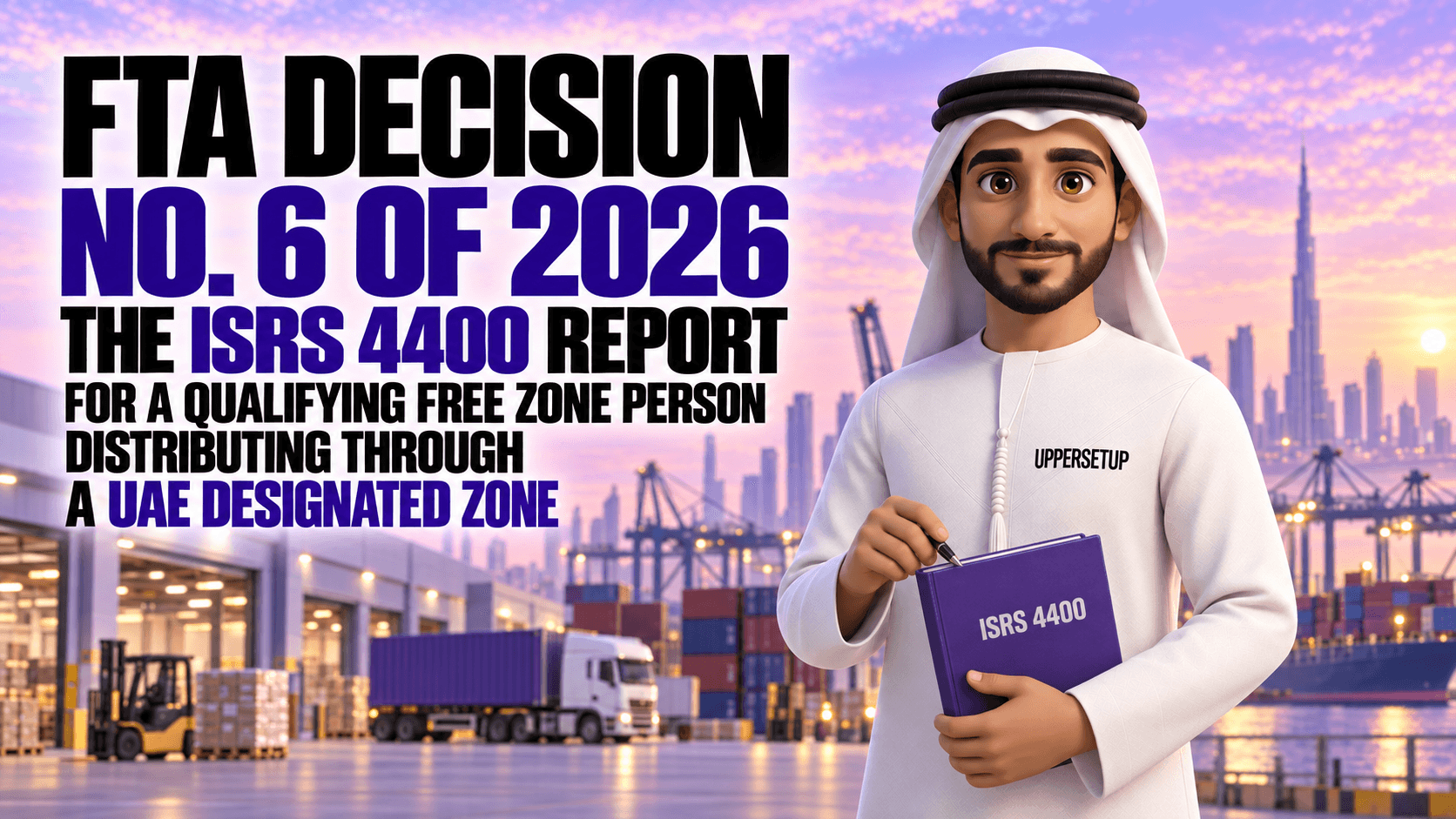
FTA Decision No. 6 of 2026 “on Determining the Additional Procedures for the Compliance of QFZP”, published 14 July 2026, requires a Qualifying Free Zone Person carrying on distribution of goods in or from a Designated Zoneto obtain an agreed-upon-procedures report from an independent external auditor. Author’s assessment: this cannot reach a SHAMS company — it is tied to distribution from a Designated Zone, and SHAMS is not one. The significance lies elsewhere: the federal regulator keeps adding obligations to precisely the regime a budget licence cannot reach in any event.
E-invoicing does not touch a budget company in 2026. Ministerial Resolution No. 66 of 2026, amending Ministerial Resolution No. 244 of 2025, requires an accredited service provider to be appointed by 30 October 2026 and the system to be implemented by 1 January 2027 — but only for persons with revenue of AED 50,000,000 or more. No 2026 obligation arises for companies in the Small Business Relief range.
A waiver initiative for the late-registration penalty is in force. On 7 May 2025 the Federal Tax Authority announced a Cabinet-approved waiver and refund conditional on filing the first return “within a period not exceeding seven (7) months from the end of their first Tax Period” — seven months instead of nine — with refunds of amounts already paid. Author’s assessment: the Federal Tax Authority page does not state the number of the relevant Cabinet decision, and it could not be located in open sources.
VAT: SHAMS Is Not on the Designated Zones List, and for Goods That Is Decisive
Sharjah Media City is not on the Designated Zones list under Cabinet Decision No. 59 of 2017 and never has been.Only two Sharjah zones appear on it:
“Sharjah 1. Hamriyah Free Zone 2. Sharjah Airport International Free Zone”
A source caveat that should be stated plainly: the text of the list on the Federal Tax Authority website is closed to automated access. The decision and the Designated Zones guide on tax.gov.ae return a robots.txt refusal, and Decision No. 59 of 2017 is not hosted on uaelegislation.gov.ae or mof.gov.ae. The list’s existence and size are confirmed by Federal Tax Authority pages: its topic page states that “Certain free zones have been specified as designated zones for VAT purposes”, and its press release gives the number — “A full list of all 27 Designated Zones be accessed through the Authority’s website”. The two Sharjah entries above are reproduced from a publication of Grant Thornton, a large international accounting firm (a Level 2 source), which reproduces the schedule to the decision. What follows — why including SHAMS on that list is structurally impossible — rests on the primary text.
Author’s assessment: including SHAMS on that list is structurally impossible. Article 51(1) of Cabinet Decision No. 52 of 2017 sets criteria that are customs criteria, not sectoral ones:
“a. The Designated Zone is a specific fenced geographic area and has security measures and Customs controls in place to monitor entry and exit of individuals and movement of goods to and from the area. b. The Designated Zone shall have internal procedures regarding the method of keeping, storing and processing of Goods therein. c. The operator of the Designated Zone complies with the procedures set by the Authority.”
All three presuppose a fenced customs perimeter handling physical goods. SHAMS is a licensing regime whose standard product is a co-working seat; it has no customs perimeter, no warehousing envelope and no procedures for the keeping and processing of goods. That is exactly why the Sharjah entries on the list are the port-based Hamriyah and the airport-based SAIF — both are customs envelopes for goods.
The consequences for a SHAMS company are direct. Clause 10 of Article 51 adds: “Any Person established, registered or which has a Place of Residence in a Designated Zone shall be deemed to have a Place of Residence in the State for the purposes of the Decree-Law” — so even registration in a Designated Zone does not put a person outside the State for VAT. A SHAMS company sits in a zone with no Designated Zone status at all, and so is inside the UAE for VAT purposes in every respect:
• supplies are taxed at the standard 5% rate unless a specific exemption or zero rate applies;
• the mandatory VAT registration threshold is AED 375,000 and the voluntary threshold AED 187,500;
• there is no customs duty suspension, no bonded storage, and no removal of intra-zone supplies from the VAT perimeter.
Author’s assessment: the costliest trap of a budget licence is general trading. SHAMS confirms that an importer-exporter code can be obtained independently from UAE Customs after the licence is issued. But because the zone is not a Designated Zone and has no customs envelope, imported goods enter the UAE the moment they cross the border: 5% duty and 5% import VAT fall due immediately, with none of the deferral until mainland release that Hamriyah and SAIF offer. The regime is set out in our complete guide to UAE VAT in 2026.
The practical conclusion: on VAT, a SHAMS licence offers no advantage whatsoever over a mainland SEDD licence.
The Sharjah Mainland Market: There Is No Equivalent of the Dubai Resolution
The Emirate of Sharjah has no instrument comparable to Dubai’s Executive Council Resolution No. 11 of 2025 permitting a free zone company to trade on the emirate’s mainland.
The Dubai resolution, issued on 3 March 2025, states expressly: “An Establishment may conduct its Activities outside of a Free Zone and within the Emirate, subject to obtaining any of the Licences or Permits specified in Article (4)” — provided separate books are kept. Article 4 offers three routes: a branch licence inside the emirate, a branch licence operating from the free zone, and a temporary permit for specified activities.
Author’s assessment: as at 19 August 2026, no Sharjah Executive Council resolution, Amiri decree or SEDD rule creating a comparable regime could be located. The Emirate’s Official Gazette, the Sharjah Executive Council site, the Sharjah Economic Development Department site and its service catalogue were checked, as were Arabic formulations analogous to the Dubai wording. A reliability caveat on this conclusion: the Sharjah gazette’s search form runs through a server-side postback and is not addressable programmatically, so the absence of such an instrument is established indirectly — from its absence in the SEDD service catalogue and in accessible compilations, not from an exhaustive read of the gazette.
What a SHAMS company must actually do to serve Sharjah mainland clients. The only confirmed route is branch registration with SEDD. The Sharjah Economic Development Department sets out the requirements in its FAQ, in a single answer covering branches of foreign companies and branches of free zone companies together:
“No objection letter from the Department of Free Zones to open the branch in the Emirate.” “License and register of foreign company” “Approved agency contract between the foreign company and the local agent.” “Minutes of meeting for partners or board of directors to approve the opening of the branch.”
That means a no-objection letter from the zone, separate premises and a separate mainland licence fee. A reliability caveat: the local service agent requirement is framed by the department in relation to a branch of a foreign company, and whether it applies in the same form to a branch of a free zone company does not follow unambiguously from the text of the answer — this should be confirmed with SEDD before filing. The alternatives are to work through a mainland distributor or agent — selling to them rather than to the end client — or to incorporate a separate SEDD mainland company.
The tax consequence of going mainland is separate and frequently underestimated. Income attributable to a Domestic Permanent Establishment is expressly excluded from qualifying income by Article 3 of Cabinet Decision No. 100 of 2023 read with Article 5, and is taxed at 9%. The company does not lose QFZP status automatically, but the mainland income is not qualifying. The comparison between the two perimeters is set out in our article on free zone versus mainland in the UAE.
What a SHAMS Licence Does Not Permit
A SHAMS licence confers the right to operate from the zone and confers no right to operate outside it without separate permission. Article 8.5 of the 2024 Regulations: “a Person carries on an Activity in the City if he carries on an Activity from a permanent place of business maintained by him in the City”. Article 8.6 closes the construction:
“A Corporate Entity must ensure that it holds all additional permits, licenses and authorisations required under any Regulatory Instrument to carry out any activity outside of the City in the UAE.”
Article 15 requires a registered address in the zone to be maintained at all times, and Article 10.1 confines the company to the activities stated on its live licence.
You cannot rent an office outside the zone on a SHAMS licence alone. Mainland premises require a mainland licence under Article 8.6. An office outside the zone also damages the tax position: Article 8 of Cabinet Decision No. 100 of 2023 requires the core income-generating activity and the staff to sit in the free zone itself.
You cannot open a retail outlet. A retail point is a permanent place of business; outside the zone it needs a mainland licence and premises. Inside the zone, SHAMS offers no retail space: the facilities list is limited to hot and dedicated desks, enclosed and private offices and meeting rooms — no warehouses, no retail floors, no land plots. Separately, retail sales to natural persons fall within the excluded activities under Article 2(2) of Ministerial Decision No. 229 of 2025, so shop revenue would be non-qualifying in any case.
You can import goods, but without the customs advantages of a free zone — for the reasons set out in the VAT section.
You can place staff at a mainland address only with the zone’s permission and only for listed categories of work — specialist consultancy, advisory, installation, repair and maintenance — under section 14.4 of the Employment Regulations 2023.
SHAMS Against the Alternatives: A Comparison
The choice within the budget segment turns not on the licence price but on whether the business needs a customs envelope and mainland access.
|
Parameter |
SHAMS (Sharjah) |
Hamriyah / SAIF (Sharjah) |
SEDD mainland licence (Sharjah) |
|
Starting licence price |
AED 5,760 |
Materially higher; published as packages |
Depends on the activity |
|
Designated Zone status for VAT |
No |
Yes, both on the Cabinet Decision No. 59 of 2017 list |
Not applicable |
|
Customs duty deferral |
No |
Yes, until the goods enter the mainland |
Not applicable |
|
Access to the mainland market |
Only via a SEDD branch, an agent or a separate company |
Same |
Direct |
|
QFZP status available |
Formally yes, in practice constrained by substance and the activity list |
Yes, including distribution from a Designated Zone |
No, the QFZP regime does not apply to the mainland |
|
Small Business Relief available |
Yes, if QFZP status is not claimed |
Same |
Yes |
|
100% foreign ownership |
Yes |
Yes |
Yes, under the current federal regime |
|
Minimum share capital |
None in the regulations |
Set by the zone |
Depends on the form |
|
Physical office required for visas |
No, a flexi desk suffices |
Usually required |
Required |
|
Public price list |
Two, and they do not match: shams.ae and shamsfz.ae |
Packages published |
Published as tariffs |
Author’s assessment: comparing headline prices across zones is only valid at identical configurations. UAE free zones publish prices in different bundles — with and without a visa allocation, with and without an immigration card, with one activity or with five — so a direct comparison of reference minimums misleads. Separate analyses of neighbouring zones appear in our pieces on Hamriyah Free Zone in 2026, RAKEZ in 2026 and Meydan Free Zone in 2026.
Scale: How Many Companies Are Registered in SHAMS
Author’s assessment: no current, dated figure for the number of SHAMS companies exists in open sources.
The only official count sits in a factsheet published by the UAE Ministry of Economy and Tourism: 13,394 registered entities, of which 13,340 are limited liability companies and 54 are branches, with new registrations broken down by year. The data table in that factsheet, however, ends in 2021 — the information is roughly five years stale.
The zone itself publishes no company counter. Its “about” section goes no further than a reference to “thousands of media, creative, technology and trading companies”, without a number and without a date.
The practical due diligence conclusion: the SHAMS company count cannot be cited as a verified figure. Any number appearing in intermediary material either traces back to the ministry factsheet with its 2021 data or has no verifiable source at all.
Employment: The SHAMS Regulations Do Not Displace Federal Labour Law
The SHAMS Employment Regulations 2023 apply alongside UAE federal labour law, not instead of it, and they say so expressly. This cuts against the common assumption that a free zone takes an employer outside Federal Decree-Law No. 33 of 2021.
Section 3.1:
“The UAE Labour Law, the UAE Immigration and Residence Law, these Regulations and any other applicable Regulatory Instrument shall apply to all Employers and Employees”
Section 3.2 characterises both bodies of rules:
“The requirements of these Regulations and the UAE Labour Law are minimum requirements and a provision in a Contract of Employment to waive or reduce any of those requirements, except where expressly permitted, has no effect”
“UAE Labour Law” is defined by name in section 2.1 — Federal Decree-Law No. 33 of 2021, as amended, together with the orders, decrees, resolutions, directions, circulars and regulations of the Ministry of Human Resources and Emiratisation. Author’s assessment: the instrument contains no priority rule for a direct conflict between the zone’s regulations and federal law. The nearest provision is section 2.4, but it addresses interpretation rather than hierarchy: on any inconsistency the Authority “will determine the correct interpretation”. A clause in those terms could not resolve a clash with federal law in any event.
The practical consequence: where the zone’s regulations are silent, federal law fills the gap. And they are silent in two important places.
First, working time. The SHAMS regulations set no general limit on working time at all: no daily maximum, no weekly maximum, no overtime rules and no Ramadan provisions. The only numerical hours provision concerns juvenile employees — section 15.2(c): “The actual working hours shall not exceed six hours per day”. Section 7.3 requires only that hours and rest days be stated in the contract. Working-time limits therefore come from federal law, not from the zone’s regulations.
Second, medical insurance and the Wage Protection System. No employer medical insurance obligation appears in the regulations: the word “insurance” occurs once, and only in relation to juvenile employees, while section 5.1 puts only the cost of a pre-employment medical fitness certificate on the employer. Nor do the regulations require wages to be paid through the Wage Protection System: sections 10 to 12 govern currency, timing and the pay statement, but prescribe no payment channel whatsoever. A reliability caveat: this establishes only that the zone imposes no such requirements. Whether federal or emirate-level instruments extend those obligations to a SHAMS employer could not be established from primary sources within the scope of this article, and asserting either position here would be wrong.
What the SHAMS regulations do set, quite specifically:
|
Term |
The SHAMS rule |
Section |
|
Form of contract |
Written, mandatory for every employee |
7.3 |
|
Language of the contract |
No requirement; the employer is merely encouraged to assist an employee who does not speak English or Arabic |
7.4 |
|
Filing with the Authority |
Records of the entry permit, passport and employment contract for every new employee — not certified copies |
5.3 |
|
Probation |
Maximum 6 months; employer’s notice of termination during probation — 14 days |
8.1 |
|
Employee’s notice during probation |
1 month when moving to another UAE employer, 14 calendar days otherwise |
8.3 |
|
Notice after probation |
Not less than 30 and not more than 90 days |
20.3 |
|
Payment of wages |
Within 7 calendar days of the end of the pay period |
10.2 |
|
Currency |
UAE dirhams or equivalent |
10.1 |
|
Annual leave, 6 to 12 months’ service |
2 days per month |
13(a) |
|
Annual leave, over 12 months’ service |
30 days per year (roughly 22 working days) |
13(b) |
|
Sick leave |
Up to 90 days per year: 15 at full pay, 30 at half pay, 45 unpaid |
13(c) |
|
Maternity leave |
45 days at full pay and 15 days at half pay |
13(d) |
|
Parental leave |
5 working days within 6 months of the birth |
13(e) |
|
Study leave |
10 working days per year after two years’ service |
13(g) |
|
End-of-service gratuity |
21 days’ basic wage for each of the first 5 years, then 30 days per year, capped at two years’ wages |
22.1, 22.2 |
A key structural feature: the sponsor is the Authority, not the company. Section 14.1: “In cases other than Non-Sponsored Employees an Employer shall enter into an Employee Sponsorship Agreement with the Authority”. Section 14.2 leaves remuneration with the employer, and section 14.3 expressly relieves the Authority of liability for any payment to an employee, end-of-service included.
Permission to work outside the zone is discretionary and geographically capped. Section 14.4: “The Authority may permit a sponsored Employee to work outside the Authority within the Emirate of Sharjah” — for specialist consultancy, advisory, installation, repair and maintenance work, and other activity in furtherance of the employer’s business. Two limits deserve emphasis: this is the Authority’s power, not the employer’s right, and it reaches only as far as the Emirate of Sharjah. It does not authorise work in Dubai or Abu Dhabi.
Separately, section 14.5 prohibits engaging an employee already employed by another employer, and section 5.1 places entry and repatriation costs on the employer, except where termination was initiated by or attributable to the employee. Section 5.2 forbids recovering those costs from the employee.
Closing a Company: Liquidation, Cancellation and What Follows
The Liquidation Regulations 2024 recognise only three routes to winding up, and all three are initiated by shareholders, creditors or the courts — not by the zone. Article 3.1:
“The winding up of a Company may either be: a) a Shareholder’s voluntary liquidation; b) a creditors’ voluntary liquidation; or c) mandated by the competent courts of the UAE, under the UAE Commercial Transactions Law No. 18 of 1993 and other applicable legislation.”
Author’s assessment: the Liquidation Regulations contain no procedure for removal from the register at the zone’s initiative. “Strike-off” is nevertheless defined in Article 4.1 of the Companies and Licensing Regulations 2024 as “removal of a Corporate Entity by the Authority from the Register” — and appears nowhere else in the text. The definition exists; the procedure does not. For due diligence purposes that is a material gap: there is no codified mechanism for administrative removal.
Shareholders’ voluntary liquidation is open only to a solvent company. Article 4.1 confines it to companies with no liabilities or able to discharge them in full within six months. Article 4.2 requires a shareholders’ resolution no older than thirty calendar days, a solvency statement signed by every director and manager, and confirmation that there is no litigation, whether threatened or active. A liquidator is appointed by special resolution under Article 4.3, and the directors’ powers cease under Article 4.4. The process ends with a cancellation certificate, from the date of which the company is dissolved (Article 4.5).
Creditors’ voluntary liquidation is heavier and carries a publication requirement. Article 5.2(iii) requires notice of the resolution to be advertised in a local UAE newspaper for three consecutive calendar days, within fourteen days of the resolution. Article 5.3(a) requires at least fourteen days’ notice to creditors of the meeting before the resolution is passed. Article 5.9 sets the waterfall: liquidation expenses, secured creditors, preferential unsecured creditors, other unsecured creditors, shareholders. Article 5.10(h) obliges the liquidator to provide shareholders with a provisional account every six months. Article 5.14 voids any transfer of shares without the liquidator’s approval.
Author’s assessment: the regulations impose no qualification requirement on the liquidator. They call for neither an approved auditor nor a licensed insolvency practitioner; the sole reference to qualification is Article 5.13, under which a liquidator vacates office if he “ceases to be qualified to hold that office” — a qualification the regulations nowhere define. Nor do they set a window for creditor claims, a requirement for a final account, or any deadline for the Authority to act.
Non-renewal: cancellation is a power of the Authority, not an automatic consequence. Article 13.2 of the Companies Regulations 2024 opens with the statement that the Authority “may suspend for a specified time, or cancel a License if it determines that it is appropriate to do so”, and paragraph (m) lists failure to renew for more than six months after expiry among the grounds. Framing this as automatic cancellation at six months is wrong. The operational sequence is set out not in the regulations but in clause 17 of the Terms and Conditions: a thirty-day grace period, then AED 200 per month, a legal notice in the sixth month, suspension in the seventh, then cancellation of the immigration card and visas.
A cancelled company cannot be restored, and a waiting period before re-registration applies instead. Neither the Companies Regulations nor the Liquidation Regulations provide any mechanism for restoration, reinstatement or revival. In its place the zone’s FAQ states an administrative rule: where the company held visas, a new registration is possible one year after cancellation; where it was a zero-visa company, after six months. Author’s assessment: this rule appears only in the FAQ and has no footing in either set of regulations.
The zone describes the cancellation procedure as a sequence for unwinding the immigration layer. From the FAQ: “License cancellation requires clearing all linked visas, E-channel, immigration card settling outstanding fees, and submitting a cancellation request through SHAMS”. Cancelling the last shareholder’s visa attracts a deposit of AED 2,100, refunded on production of documents within 10 to 45 days depending on the bank. A licence cancellation fee exists as a category — Article 4.1 of the Regulations brings it within “Fee”, and the Terms and Conditions refer to it being deducted on refunds — but the zone publishes no amount for it, and none for liquidation either. The verifiable part of the cost of exit is that deposit plus the settlement of arrears.
Federal obligations on closure sit outside the zone’s procedures and are easily forgotten.
Corporate tax deregistration — three months. Article 52(2) of Federal Decree-Law No. 47 of 2022 sets no period of its own and delegates it to the Federal Tax Authority; the period comes from Article 2(2) of FTA Decision No. 6 of 2023: “The juridical Person shall file a Tax Deregistration application within 3 months of the date the entity ceases to exist, cessation of the Business, dissolution, liquidation or otherwise”. Citing Article 52 as the source of the three-month deadline is a common inaccuracy.
VAT deregistration — twenty business days. Article 21 of Federal Decree-Law No. 8 of 2017 sets out the triggers; the deadline is in Article 14 of Cabinet Decision No. 52 of 2017, which requires the application “within 20 (twenty) Business Days”. The final return is filed and the tax settled no later than 28 days from the effective date of deregistration. The full exit procedure is set out in our guide to closing a company in the UAE in 2026.
Every Figure and Deadline in One Table
This table sets out the parameters in force as at August 2026. Amounts published by the zone are attributed to the domain on which they appear; federal figures come from the relevant instruments.
|
Parameter |
Value |
Basis |
|
Starter Media package (shamsfz.ae) |
AED 5,760 per year, VAT included, 5 activities |
shamsfz.ae campaign pages |
|
Standard package (shamsfz.ae) |
AED 6,885 per year |
shamsfz.ae campaign pages |
|
Media package (shams.ae) |
AED 5,750 per year, 3 activities |
shams.ae price list |
|
Standard package, zero visa and one visa (shams.ae) |
AED 8,050 and AED 11,743 |
shams.ae price list |
|
Multi-year discount |
2–10% per the Terms and Conditions, 15–50% per the price list — the two contradict each other |
Terms and Conditions, clause 24; shams.ae price list |
|
Activities per licence |
Up to 5 on shamsfz.ae, 3 per the shams.ae price list |
SHAMS |
|
Visa allocation fee |
AED 1,600 per visa |
SHAMS Terms and Conditions |
|
Visa allocation with no additional documents |
Up to 20 |
SHAMS Terms and Conditions |
|
Allocation above 20 visas |
Requires an annual audited report |
SHAMS Terms and Conditions |
|
Maximum visa allocation |
50, with a business plan and financial proofs |
SHAMS Terms and Conditions |
|
Grace period after licence expiry |
30 days |
SHAMS Terms and Conditions |
|
Late renewal penalty |
AED 200 per month |
SHAMS Terms and Conditions |
|
Failure to renew |
Ground for suspension or cancellation at the Authority’s discretion after 6 months |
Regulations 2024, Article 13.2(m) |
|
Legal notice and suspension |
Month 6 and month 7 after expiry |
SHAMS Terms and Conditions, clause 17 |
|
Re-registration after cancellation |
1 year if visas were held, 6 months for a zero-visa company |
SHAMS FAQ |
|
Shareholders per company |
1 to 50 |
Regulations 2024, Article 5 |
|
Minimum share capital |
None prescribed |
Regulations 2024, Article 21 |
|
Default capital in the Terms and Conditions |
AED 100,000; above that, a bank statement |
SHAMS Terms and Conditions |
|
Managers and directors |
Up to 4 and 4, individuals only |
SHAMS Terms and Conditions, clause 27 |
|
Notice of a change of director or manager |
15 business days |
Regulations 2024, Article 16.1(b) |
|
Minimum remaining licence validity for amendments |
45 days |
SHAMS Terms and Conditions |
|
Exemption under the zone’s decree |
50 years, Emirate taxes only |
Decree No. 11 of 2017, Article 9 |
|
Corporate tax rate |
0% up to AED 375,000, then 9% |
Cabinet Decision No. 116 of 2022 |
|
Designated Zone status for VAT |
None |
Cabinet Decision No. 59 of 2017 |
|
Mandatory VAT registration threshold |
AED 375,000 |
Federal Tax Authority |
|
Voluntary VAT registration threshold |
AED 187,500 |
Federal Tax Authority |
|
De minimis threshold for a QFZP |
5% of revenue or AED 5,000,000, whichever is lower |
MD 229/2025, Article 3; CD 100/2023, Article 4 |
|
Audit for a QFZP |
Mandatory regardless of revenue |
MD 84/2025, Article 2(1)(b) |
|
Small Business Relief threshold |
AED 3,000,000 of revenue |
MD 73/2023, Article 2 |
|
Duration of Small Business Relief |
To periods ending 31 December 2029 |
MD 131/2026 |
|
Exclusion from Small Business Relief |
Qualifying Free Zone Person |
MD 73/2023, Article 3(2) |
|
Corporate tax registration deadline |
By month of licence issue; 3 months from incorporation for new entities |
FTA Decision No. 3 of 2024 |
|
Late registration penalty |
AED 10,000 |
CD 75/2023 as amended by CD 10/2024 |
|
Return filing and payment deadline |
9 months after the end of the period |
Federal Tax Authority |
|
Late filing penalty |
AED 500 per month for the first 12 months, then AED 1,000 |
CD 75/2023 as amended by CD 10/2024 |
|
Corporate tax deregistration |
3 months from cessation, dissolution or liquidation |
FTA Decision No. 6 of 2023, Article 2(2) |
|
VAT deregistration |
20 business days |
CD 52/2017, Article 14 |
|
Beneficial owner register |
60 days |
Cabinet Decision No. 109 of 2023 |
|
Employee working outside the zone |
Only with the Authority’s permission and for listed categories of work |
Employment Regulations 2023, section 14.4 |
Step-by-Step: How to Set Up and Run a SHAMS Company
Step 1. Decide whether you need a customs envelope. If the business involves physical goods, importation, storage or distribution, SHAMS is structurally unsuitable: the zone is not a Designated Zone, there is no duty deferral, and distribution as a qualifying activity requires Designated Zone status.
Step 2. Identify who your customers are. If most revenue comes from UAE mainland companies, from natural persons or from foreign customers who are not free zone residents, the income will not be qualifying and the QFZP regime is pointless.
Step 3. Settle the tax route at the outset. Below AED 3,000,000 of revenue and without real presence in the zone, choose Small Business Relief rather than QFZP. The decision is taken before the first return and determines the whole compliance burden that follows.
Step 4. Check activities against the zone’s interactive catalogue. Up to five classes per licence, with categories combinable. Record the chosen wording in writing — the zone publishes no versioned list.
Step 5. Establish whether pre-approval is needed. Activities are split into Pre-Approval and Post-Approval. For paid promotional content SHAMS points to an Advertiser Permit; in 2026 that permit is issued by the National Media Authority, which replaced the UAE Media Council in exercising those competences on 1 January 2026.
Step 6. Request an official quotation and check it against both of the zone’s domains. The price lists on shams.ae and shamsfz.ae differ both in amount and in the number of activities covered, and the multi-year discount is stated differently in the Terms and Conditions and in the price list. The benchmarks — AED 5,750 for three activities and AED 5,760 for five — are a guide, not a tariff.
Step 7. Budget the immigration layer separately from the licence. The headline price includes neither visas nor the immigration card. The gap between the zero-visa and one-visa versions of a package is about AED 3,700 on the Standard line and about AED 7,700 on the Freelancer line — calculated benchmarks, not a breakdown published by the zone.
Step 8. Fix the visa allocation before you apply. Up to twenty visas on the standard document set; above twenty, an annual audited financial report; up to fifty, a business plan together with the requested financial proofs.
Step 9. Register for corporate tax on time. For entities incorporated after 1 March 2024 the deadline is three months from incorporation; the late-registration penalty is AED 10,000.
Step 10. Build the beneficial owner register within 60 days under Cabinet Decision No. 109 of 2023.
Step 11. Do not open an office or place staff outside the zone without separate permission. Mainland premises require a mainland licence under Article 8.6 of the regulations and simultaneously damage the tax position under Article 8 of Cabinet Decision No. 100 of 2023.
Step 12. Track the licence expiry date. The grace period is thirty days, after which AED 200 per month accrues; a legal notice follows in the sixth month and suspension in the seventh. Amendments require at least forty-five days of remaining validity. The general rules on renewal are set out in our guide to renewing a UAE company licence.
Common Mistakes and What They Cost
Mistake 1. Assuming the fifty-year exemption shields you from UAE corporate tax. Article 9 of Decree No. 11 of 2017 exempts only from Emirate taxes and says nothing about federal taxes at all. The cost: 9% on taxable income above AED 375,000, plus an AED 10,000 penalty for non-registration if the company concluded it need not register.
Mistake 2. Claiming QFZP status with a flexi desk and no staff. Article 8 of Cabinet Decision No. 100 of 2023 requires assets, qualified full-time employees and operating expenditure inside the zone. The cost is twofold: a mandatory audit under Ministerial Decision No. 84 of 2025 regardless of revenue, and retroactive loss of status from the beginning of the tax period under Article 18(2).
Mistake 3. Taking a general trading licence expecting free zone customs advantages. SHAMS is not a Designated Zone: 5% duty and 5% import VAT are payable on entry, with none of the deferral available in Hamriyah and SAIF. The cost: on AED 2,000,000 of goods turnover a year, the working capital difference is around AED 200,000 tied up until the goods are sold.
Mistake 4. Serving Sharjah mainland clients directly on a SHAMS licence. Sharjah has no equivalent of Dubai’s Resolution No. 11 of 2025; you need a SEDD branch with a local service agent, a distributor, or a separate mainland company. The cost: operating without the proper licence, plus taxation of mainland income at 9% as income of a domestic permanent establishment.
Mistake 5. Reading the absence of “FZ” from the name as a right to trade on the mainland. The phrase “mainland-like presence” describes a perception, not a legal status. The cost is the same as in mistake 4, with the added risk of claims from counterparties who relied on the name.
Mistake 6. Treating AED 5,750 and AED 5,760 as the same price. Both are published by the zone itself, but on different domains and for different products: AED 5,750 on shams.ae covers three activities in the media and e-commerce categories, AED 5,760 on shamsfz.ae covers any five. The cost: the application goes in for the narrower product, and the missing activities are then added for a fee.
Mistake 7. Budgeting on the licence price. The headline price excludes visas, the immigration card and e-channel. The cost: the real first-year budget with one visa is roughly double the advertised minimum.
Mistake 8. Missing the twenty-visa threshold. Above twenty allocations an annual audited financial report is required under clause 29 of the Terms and Conditions. The cost: hiring stops mid-year and an unplanned audit expense arrives.
Mistake 9. Calculating the multi-year discount from the Terms and Conditions. Clause 24 promises 2% to 10%; the shams.ae price list says 15% to 50%, and the amounts published there bear out the second figure. The cost: on a ten-year licence, the difference between a 10% and a 40% discount is around AED 17,000.
Mistake 10. Failing to renew the licence on time. After the thirty-day grace period AED 200 per month accrues; a legal notice follows in month six, suspension in month seven, then cancellation of the immigration card and visas. Cancellation of the licence itself is a power of the Authority under Article 13.2(m), not an automatic event. The cost: the regulations provide no restoration mechanism at all, and a new registration is possible only after a year if the company held visas, or after six months if it did not.
Mistake 11. Closing the company and forgetting federal deregistration. Cancelling the licence in the zone deregisters you for neither corporate tax nor VAT. The cost: missing the three-month deadline under Article 2(2) of FTA Decision No. 6 of 2023 and the twenty-business-day deadline under Article 14 of Cabinet Decision No. 52 of 2017 triggers penalties after the company has ceased to exist in the zone.
Mistake 12. Assuming the zone’s regulations replace federal labour law. Section 3.1 of the Employment Regulations 2023 applies Federal Decree-Law No. 33 of 2021 alongside them, and section 3.2 describes both sets of requirements as minimums. The cost: contracts drafted from the zone’s regulations alone leave uncovered everything the zone is silent on — working time above all.
Who SHAMS Suits, Who It Does Not, and When to Take Advice
SHAMS suits a company that sells services outside the UAE or to other free zone residents, holds no stock, and does not treat the zero corporate tax rate as part of the project’s economics.
The configurations for which the zone is rationally built:
• production, design, marketing and IT services with foreign clients and revenue below AED 3,000,000, where the tax outcome comes from Small Business Relief rather than QFZP status;
• a holding or project vehicle with no staff, needing residence status and a bank account rather than a customs envelope;
• entering the jurisdiction on a minimum first-year budget, where the owner is knowingly paying for a licence and a visa rather than for a tax regime.
SHAMS does not suit a company dealing in physical goods, serving Sharjah mainland clients, or building its numbers on the zero rate. Each of those three constraints is structural rather than administrative: the absence of Designated Zone status cannot be papered over, the absence of a Sharjah equivalent to Dubai’s Resolution No. 11 of 2025 cannot be licensed around, and the substance test in Article 8 of Cabinet Decision No. 100 of 2023 cannot be satisfied by a flexi desk.
Professional review is warranted in five situations. First, when revenue approaches AED 3,000,000, because breaching the threshold even once closes off Small Business Relief permanently. Second, when mainland clients appear and the question of a domestic permanent establishment arises. Third, when QFZP status is under consideration, where the cost of error is retroactive under Article 18(2) of Federal Decree-Law No. 47 of 2022. Fourth, when goods will be imported and the absence of customs deferral changes the working capital picture. Fifth, when the structure involves related parties and Articles 34 and 55 of the same decree-law on transfer pricing and documentation come into play.
FAQ
How much does a SHAMS licence cost in 2026?
The zone publishes two different figures on two of its own domains. On shamsfz.ae the Media package costs AED 5,760 a year including VAT and covers five activities; the Standard package costs AED 6,885. On shams.ae the Media package costs AED 5,750 a year but covers three activities, and the Standard package there costs AED 8,050 with no visa and AED 11,743 with one. The exact amount should be requested by official quotation and checked against both price lists.
Why does everyone quote AED 5,750 rather than AED 5,760?
Because both figures are published by the zone itself, on different domains and for different products. AED 5,750 is the live price on shams.ae for a Media package with three activities in the media and e-commerce categories. AED 5,760 is the price on shamsfz.ae for a Media package with five activities of any kind, a flexi desk and a lease agreement. The ten-dirham gap carries no meaning; the difference in what the product contains does.
Does SHAMS exempt a company from UAE corporate tax for 50 years?
No. Article 9 of Amiri Decree No. 11 of 2017 exempts companies in the zone only from taxes imposed in the Emirate of Sharjah and makes no mention of federal taxes at all. Federal corporate tax was introduced by Federal Decree-Law No. 47 of 2022 and applies to SHAMS companies on ordinary terms.
Can a SHAMS company obtain the zero corporate tax rate?
Formally yes; in practice it is all but unreachable on a budget configuration. The zero rate is available only to a Qualifying Free Zone Person, and that status requires adequate substance in the zone under Article 8 of Cabinet Decision No. 100 of 2023, qualifying income from the Ministerial Decision No. 229 of 2025 list, and a mandatory audit under Article 2(1)(b) of Ministerial Decision No. 84 of 2025 regardless of revenue. Media, marketing, IT and consultancy services are not on the qualifying activities list.
Is SHAMS a Designated Zone for VAT?
No. The only Sharjah zones on the Cabinet Decision No. 59 of 2017 list are Hamriyah Free Zone and Sharjah Airport International Free Zone. For VAT purposes a SHAMS company sits entirely inside the UAE: 5% rate, AED 375,000 mandatory registration threshold, and no customs duty deferral on import.
Can a SHAMS licence be used to serve mainland clients in Sharjah?
Not directly. Sharjah has no instrument comparable to Dubai’s Executive Council Resolution No. 11 of 2025. The confirmed routes are a branch registered with the Sharjah Economic Development Department with a local service agent, working through a mainland distributor, or a separate mainland company. Income of a domestic permanent establishment is taxed at 9%.
How many visas does a SHAMS licence carry?
Up to 20 on the standard document set, above 20 with an annual audited financial report, and a maximum of 50 with a business plan and the requested financial proofs. The Terms and Conditions contain no intermediate thresholds and no bank-statement requirement for visa purposes. No physical office is required: the flexi desk carries the visa allocation.
Does a SHAMS company need an audit?
It depends on the tax route chosen. The zone’s regulations impose no universal annual audit, but an audited report is required for visa allocations above 20, and Ministerial Decision No. 84 of 2025 requires audited financial statements from every Qualifying Free Zone Person regardless of revenue. A company electing Small Business Relief does not carry that federal obligation.
Which is better for a SHAMS company: QFZP or Small Business Relief?
Below AED 3,000,000 of revenue and without real presence in the zone, Small Business Relief. It produces the same nil tax outcome with no substance test, no activity or counterparty restrictions, no mandatory audit and no retroactive risk. The regime now runs to tax periods ending 31 December 2029. The two cannot be combined: Article 3(2) of Ministerial Decision No. 73 of 2023 expressly excludes a Qualifying Free Zone Person from Small Business Relief.
How do you close a SHAMS company, and what does it cost?
The Liquidation Regulations 2024 provide three routes: shareholders’ voluntary liquidation (for a solvent company), creditors’ voluntary liquidation, and liquidation ordered by the UAE courts. The zone publishes no separate liquidation or cancellation fee; the real cost of exit is a deposit of AED 2,100 on cancelling the last shareholder’s visa, refunded on production of documents, plus settlement of arrears. Federal deregistration is separate: three months for corporate tax and twenty business days for VAT.
Does UAE federal labour law apply to a SHAMS company?
Yes. Section 3.1 of the SHAMS Employment Regulations 2023 expressly applies Federal Decree-Law No. 33 of 2021 alongside the zone’s own regulations, and section 3.2 describes the requirements of both as minimums, voiding any contractual term that reduces them. Where the zone’s regulations are silent — working time above all — federal law applies.
What happens if a SHAMS licence is not renewed on time?
A 30-day grace period applies, after which AED 200 per month accrues. Under clause 17 of the Terms and Conditions a legal notice follows in the sixth month, suspension in the seventh, and then cancellation of the immigration card and visas. Cancellation of the licence itself is a power of the Authority under Article 13.2(m) of the 2024 Regulations, not an automatic consequence. The regulations provide no restoration mechanism: a new registration is possible after one year if the company held visas, or after six months if it was a zero-visa company.
Key Takeaways
The fifty-year exemption in Article 9 of Decree No. 11 of 2017 does not cover federal corporate tax. It reaches only Emirate taxes.
The zone publishes two non-matching price lists: AED 5,760 for five activities on shamsfz.ae and AED 5,750 for three on shams.ae. The multi-year discount is stated as 2–10% in the Terms and Conditions and as 15–50% in the price list, and the arithmetic of the published amounts bears out the second figure.
The licence covers up to five activities with categories combinable, but the headline price excludes visas, the immigration card and e-channel.
For most SHAMS companies the correct tax route is Small Business Relief, not QFZP. The threshold is AED 3,000,000, the regime runs to periods ending 31 December 2029, and the two are mutually exclusive.
SHAMS is not a Designated Zone for VAT, so goods-based models lose the duty and import VAT deferral available in Hamriyah and SAIF.
Mainland access in Sharjah requires a separate structure — the emirate has no equivalent of Dubai’s Resolution No. 11 of 2025.
The zone’s Employment Regulations sit alongside federal labour law, not in place of it, and are silent on working time, medical insurance and wage payment channels.
No minimum share capital is prescribed by the regulations; the AED 100,000 in the Terms and Conditions is administrative practice, not a rule.
The zone publishes no versioned activity list, and its price lists contradict one another, so every parameter of the deal should be confirmed by official quotation before payment.
Summary
Sharjah Media City (SHAMS) is a free zone of the Emirate of Sharjah, established under Amiri Decree No. 11 of 2017 and operating under the Companies and Licensing Regulations 2024. As at August 2026 the zone publishes two non-matching price lists: on shamsfz.ae the Media package costs AED 5,760 a year including VAT and covers five business activities, and the Standard package AED 6,885; on shams.ae the Media package costs AED 5,750 and covers three activities, while the Standard package costs AED 8,050 with no visa and AED 11,743 with one. The regulations prescribe no minimum share capital. Visa allocation runs to 20 on standard documents and to 50 with a business plan and financial proofs, with an audited financial report required above 20 visas. The fifty-year tax exemption in Article 9 of the decree reaches only Emirate taxes and gives no protection against federal corporate tax under Federal Decree-Law No. 47 of 2022. The zero rate requires Qualifying Free Zone Person status, which is unreachable for a typical flexi-desk, no-staff configuration because of the substance test in Article 8 of Cabinet Decision No. 100 of 2023 and the qualifying activities list in Ministerial Decision No. 229 of 2025; every QFZP must in addition be audited regardless of revenue. For companies below AED 3,000,000 of revenue, Small Business Relief — extended to 31 December 2029 and incompatible with QFZP status — is the economically rational route. SHAMS is not on the Designated Zones list for VAT, so it offers no customs deferral, and the Sharjah mainland market is reachable only through a SEDD branch, an agent or a separate mainland company. The zone’s Employment Regulations 2023 apply alongside Federal Decree-Law No. 33 of 2021 rather than replacing it. Closing a company requires corporate tax deregistration within three months and VAT deregistration within twenty business days.
How UPPERSETUP Can Help
Choosing a zone and a tax route is the kind of decision that costs less to get right once than to unwind retroactively. UPPERSETUP compares zone configurations on real first-year cost, tests whether Small Business Relief and QFZP status actually fit a given revenue model, and handles registration and ongoing tax compliance. Start from our free zone company registration page.
Sources
Emirate of Sharjah level
2. Amiri Decree No. 15 of 2017 amending Decree No. 11 of 2017
3. Amiri Decree No. 6 of 2017 establishing and organising the Sharjah Media Council
4. Amiri Decree No. 33 of 2021 on the composition of the Sharjah Media Council
5. Official Gazette of the Government of Sharjah
6. Sharjah Economic Development Department — registering a branch of a foreign company
7. Sharjah Economic Development Department — FAQ
Zone level (SHAMS)
8. Shams Companies and Licensing Regulations 2024
9. Shams Companies Liquidation Regulations 2024
10. Shams Employment Regulations 2023
11. SHAMS — Terms and Conditions of Service
12. SHAMS — Rules and Regulations
14. SHAMS — FAQ
16. SHAMS — package price list on the former shams.ae domain
17. SHAMS — campaign page carrying the AED 5,760 and AED 6,885 prices
18. SHAMS — guidance on registration options for content creators and the Advertiser Permit
19. SHAMS — the startwith.shams.ae subdomain carrying AED 5,750 and AED 6,875
20. SHAMS — campaign page carrying the “up to 20 visas” allocation
Federal level: corporate tax
22. Federal Decree-Law No. 47 of 2022 — UAE Legislation portal
24. Ministerial Decision No. 229 of 2025 Regarding Qualifying Activities and Excluded Activities
25. Ministerial Decision No. 73 of 2023 on Small Business Relief
27. Ministerial Decision No. 84 of 2025 on Audited Financial Statements
28. Cabinet Decision No. 75 of 2023 and its amendments — administrative penalties for corporate tax
31. UAE Ministry of Finance — financial legislation
32. FTA Decision No. 3 of 2024 on the Registration Timeline for Corporate Tax
33. Federal Tax Authority — Corporate Tax Guide: Free Zone Persons (CTGFZP1)
34. Federal Tax Authority — Small Business Relief
35. Federal Tax Authority — waiver of the late corporate tax registration penalty, 7 May 2025
36. Federal Tax Authority — new decision on specified timeframes for corporate tax registration
37. Federal Tax Authority — deadlines for filing returns and settling corporate tax
38. FTA Decision No. 6 of 2023 on the Tax Deregistration Timeline
42. Ministerial Resolution No. 66 of 2026 on the electronic invoicing system
43. UAE Ministry of Finance — e-invoicing
44. Corporate Tax Guide: Free Zone Persons (CTGFZP1) — copy hosted by the Dubai Free Zones Council
Federal level: VAT
47. Cabinet Decision No. 52 of 2017 — UAE Legislation portal
48. Cabinet Decision No. 59 of 2017 on Designated Zones — Federal Tax Authority bilingual file
49. Federal Tax Authority — VAT legislation
50. Federal Tax Authority — Designated Zones topic page
51. Federal Tax Authority — press release stating the total number of Designated Zones
52. Federal Tax Authority — VAT registration and the AED 375,000 and AED 187,500 thresholds
53. Federal Tax Authority — VAT deregistration
Federal level: other
55. Cabinet Resolution No. 109 of 2023 Regulating the Real Beneficiary Procedures
56. Federal Decree-Law No. 55 of 2023 Regulating Media
57. Federal Decree-Law No. 11 of 2025 Establishing and Regulating the National Media Authority
58. u.ae — running a business in a free zone
Dubai (for comparison)
60. Dubai Legislation portal — legislation search
Statistics and context (Level 2, for cross-checking)
61. UAE Ministry of Economy and Tourism — Sharjah Media City (Shams) factsheet, data through 2021
62. UAE Ministry of Economy — Sharjah Media City (Shams) page
65. Sharjah24, “Sharjah Ruler approves largest unified government media hub”, 25 November 2025
66. The National, “UAE extends corporate tax relief for small businesses until 2029”, 7 August 2026
67. PwC Middle East — guide to Designated Zones for VAT purposes
Disclaimer
This material is provided for information purposes only and does not constitute legal, tax, financial, investment or consulting advice. Before taking any decision you should obtain individual professional advice reflecting your specific circumstances, jurisdiction, company status and the current requirements of the relevant regulators.
Publication date: August 2026.
All services on the platform
Everything you need to start and run a business - in one place
- 3–5 days
Company Setup
Mainland or Free Zone company with a complete set of incorporation documents
Start - Monthly
Accounting Services
Financial accounting and reporting in accordance with UAE requirements
Start - 1–2 weeks
Visa Services
Residence visas for shareholders, employees and family members
Start - 7–30 days
Banking Services
Corporate Bank Accounts in the UAE and Payment Services
Start - Custom timeline
Legal Services
Contracts, corporate amendments and legal support
Start


