
































































 International Free Zone Authority
A Holding Company in Meydan Free Zone in 2026: the AED 12,500 Licence, Tax-Free Dividends, and What QFZP Status Really Requires
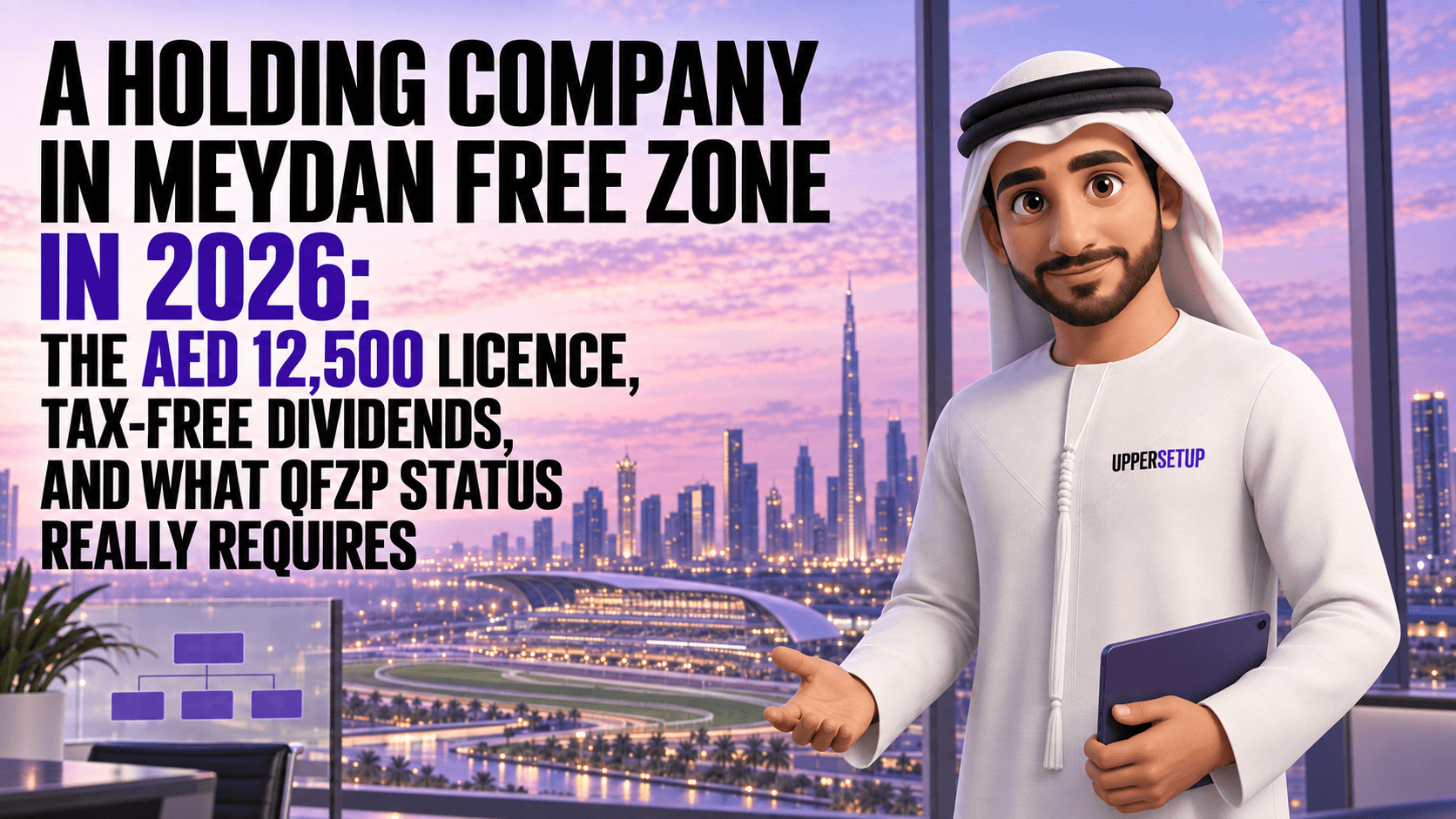
A holding company in Meydan Free Zone is an FZ-LLC incorporated under the Meydan Free Zone Companies and Licensing Regulations 2022 with activity code 6420.00 “Holding Companies”, a licence priced from AED 12,500 a year, no physical office and no third-party regulatory approval. Dividends from UAE subsidiaries reach the holding company free of corporate tax with no conditions attached (Article 22(1) of Federal Decree-Law No. 47 of 2022); dividends and capital gains from foreign subsidiaries are exempt under the participation exemption if the holding company owns at least 5% or paid at least AED 4,000,000, has held the stake for 12 months, and the subsidiary is taxed at 9% or more. Qualifying Free Zone Person (QFZP) status, with its 0% rate, is usually irrelevant to a passive holding company; an active holding company (intra-group loans, management fees, sub-5% portfolio stakes) needs it, and QFZP status brings real substance, an audit with no revenue threshold and transfer pricing compliance.
Important. The most expensive mistake a Meydan holding company can make is to conflate three separate regimes: (1) the 50-year emirate-level tax exemption in Article 17 of Dubai Law No. 5 of 2009, which does not displace federal corporate tax; (2) the exemption for dividends and capital gains in Articles 22–23 of the federal law, which applies regardless of free zone status; and (3) the QFZP regime with 0% on Qualifying Income, which requires substance and an audit. A company that “bought 0%” together with its licence and did not register with the FTA within three months incurs an AED 10,000 penalty before it receives its first dividend.
The legal framework: three layers of regulation for a Meydan holding company
A holding company in Meydan Free Zone is governed by three independent layers of law: the Dubai law that created the zone, the zone’s own regulations, and the UAE’s federal tax and compliance legislation. None of the three replaces another: the emirate law creates the zone and its tax incentive, the zone’s regulations define the corporate form, and the federal acts determine how much tax and what reporting the state requires.
|
Level |
Instrument |
Issued |
In force |
What it governs for a holding company |
|
Emirate of Dubai |
24 February 2009 |
On publication in the Official Gazette (Art. 26) |
Creation of Meydan City and the free zone; 50-year exemption from emirate taxes (Art. 17); LLCs with 100% foreign ownership (Art. 20); mandatory FZ-LLC designation in the company name (Art. 21) |
|
|
Emirate of Dubai |
7 July 2021 |
On issue |
Board of directors replaced by a Chairman appointed by decree of the Ruler (Arts. 6–9) |
|
|
Emirate of Dubai |
24 March 2024 |
On issue |
New Arts. 2, 3, 5, 8, 9 and 11: Meydan City Corporation may delegate its functions to “the Company”, defined as Dubai Holding, under a franchise agreement; licensing and fee powers |
|
|
Zone |
No signature date on the face of the text (cl. 1.1) |
“On the date of their signature” (cl. 1.1) |
FZ-LLC corporate form, shares, directors, registers, audit, liquidation, sanctions |
|
|
Federal |
Federal Decree-Law No. 47 of 2022 (Ministry of Finance consolidation, January 2026) |
3 October 2022 |
In force from 25 October 2022; applies to tax periods starting on or after 1 June 2023 |
Corporate tax: rates (Art. 3), QFZP (Art. 18), exempt income (Art. 22), participation exemption (Art. 23), registration and returns (Arts. 51, 53) |
|
Federal |
25 October 2023 |
Retroactively from 1 June 2023 |
Qualifying Income, de minimis, QFZP substance (Arts. 3, 4, 8) |
|
|
Federal |
28 August 2025 |
Retroactively from 1 June 2023; repealed MD 265/2023 |
Qualifying Activities, including “holding of shares and other securities for investment purposes” and the 12-month rule |
|
|
Federal |
10 December 2024 |
Tax periods starting on or after 1 January 2025; repealed MD 116/2023 |
Participation exemption conditions: AED 4,000,000 threshold, subject-to-tax test, holding company conditions |
|
|
Federal |
25 March 2025 |
Tax periods starting on or after 1 January 2025; repealed MD 82/2023 |
Mandatory audit: revenue above AED 50,000,000, or QFZP status with no threshold |
|
|
Federal |
6 November 2023 |
16 November 2023 (day after publication); repealed CR 58/2020 |
Register of beneficial owners (UBO), nominee directors |
The chain of Dubai instruments runs Law 5/2009 → Law 12/2021 → Law 7/2024, and the 2024 text is what defines the regulator today. The 2009 law originally “affiliated” Meydan City Corporation to the Investment Corporation of Dubai (Art. 3(2) as enacted in 2009); the 2024 replacement of Article 3 drops that reference and introduces instead a franchise in favour of the Dubai Holding Company (Art. 5(b)). For the owner of a holding company the practical consequence is simple: Meydan City Corporation remains the regulator and licensing authority (the “Authority” of the zone’s regulations), but its functions may be performed operationally by Dubai Holding or by a third party authorised by Dubai Holding (Art. 5(c)).
The zone’s regulations are also out of date on compliance. Clauses 50.8–50.15 of the Companies and Licensing Regulations 2022 list Federal Law No. 20 of 2018 (replaced by Federal Decree-Law No. 10 of 2025), Cabinet Decision No. 58 of 2020 (replaced by Cabinet Decision No. 109 of 2023) and Cabinet Decision No. 57 of 2020 on economic substance (reporting cancelled by Cabinet Decision No. 98 of 2024). A Meydan company must comply with the federal instruments actually in force, whatever numbers are printed in the regulations: clause 50.1 requires compliance with “all applicable laws of the UAE and of the Emirate of Dubai”, and clause 4.7 extends every reference to any instrument that amends, consolidates or replaces the one cited.
What Meydan Free Zone is after 2024 and who regulates it
Meydan Free Zone is a free zone inside Meydan City, Dubai, created by Article 3 of Dubai Law No. 5 of 2009 and administered by the government-owned Meydan City Corporation, which since 24 March 2024 operates under the text of Law No. 7 of 2024 and may delegate its functions to Dubai Holding under a franchise agreement. For a company registering there this means three things: the corporation licenses companies and keeps the register (Arts. 5(a)(8)–(9) and 9(b)(15) of the law as amended in 2024), approves regulations and fees (Art. 8(a)(12), (14) and (15)) and inspects licensees (Art. 5(a)(11)).
Meydan City Corporation is a public corporation wholly owned by the Government of Dubai, with legal personality and financial and administrative autonomy (Art. 3(2) as replaced by Law No. 7 of 2024). The Ruler of Dubai announced in March 2024 that Meydan and Nakheel would become part of Dubai Holding; Law No. 7 of 2024 gave the announcement statutory form, defining “Company” as “The Dubai Holding Company” (Art. 2). The zone itself was neither renamed nor dissolved: the definition “Free Zone: The free zone of Meydan” survives.
The federal Commercial Companies Law does not apply inside the zone: clause 2.3 of the regulations expressly excludes Federal Decree-Law No. 32 of 2021. This is the defining feature for holding structures. Rules on share classes, quorum, distributions, directors’ duties and liquidation come from the zone’s regulations, not the federal statute. Federal tax, anti-money-laundering and beneficial-ownership legislation, by contrast, applies in full, because those instruments are not “company law” and reach every juridical person registered in the State, commercial free zones included (Article 3 of Cabinet Decision No. 109 of 2023 for UBO; Article 11(3)(a) of Federal Decree-Law No. 47 of 2022 for corporate tax).
Two further provisions of the 2009 law bear directly on a holding company’s owner. Under Article 18, a company in the zone is not subject, “in respect of their operations in the Free Zone”, to the powers of Dubai Municipality or of the Department of Economic Development (now the Department of Economy and Tourism, DET), environmental legislation excepted. Under Article 21, the company’s name must in all contracts, invoices and correspondence indicate that the company is established in the free zone and is a limited liability company; failure to do so makes the owners personally liable without limit for the company’s obligations. For a holding company whose share purchase agreements are signed in other jurisdictions, that is an easy rule to forget.
Meydan Free Zone also appears in the Ministry of Economy and Tourism’s list of Company Registrars in Free Zones, which makes it the “Registrar” for beneficial-ownership purposes under Cabinet Decision No. 109 of 2023 and the licensing authority for corporate tax purposes.
Which licence a holding company gets: activity code 6420.00 and its limits
A holding company in Meydan Free Zone is licensed under activity code 6420.00 “Holding Companies”, which corresponds to class 6420 “Activities of holding companies” of ISIC Rev. 4 and, according to the zone itself, requires no approval from any third-party regulator. The UN classification itself describes class 6420 as units holding controlling stakes in a group of subsidiaries that “do not administer or manage other units”, with active management assigned to class 7010. The zone’s page on the activity (last updated 9 September 2026) draws the boundary explicitly: active management of companies, strategic planning and decision-making for subsidiaries “fall under separate codes” and are not covered by 6420.00.
Code 6420.00 covers the ownership of shares and interests; managing subsidiaries as a service is licensed separately, under 7010.01 “Head Offices” or 7010.05 “Subsidiary Management Offices”. The zone describes 7010.01 as overseeing and managing “other units of the same company or enterprise”, with revenue in the form of intra-group management fees (page updated 31 August 2026), and 7010.05 as an office that “operates entirely on intra-group mandates, funded by the parent company” and sells nothing to third parties (updated 4 August 2026). The structuring conclusion follows: if the holding company intends not only to receive dividends but also to invoice subsidiaries for management, treasury or shared services, both activities belong on the licence. The zone’s regulations prohibit carrying on any activity not shown on the licence (cl. 11.1), and carrying on a different activity without written approval is a ground for suspension or cancellation (cl. 14.2.6).
The combination costs nothing extra within the standard package. A standard Meydan licence includes up to three activity groups; each additional activity outside the chosen groups costs AED 1,000. The zone publishes this rule in its FAQ and in its cost breakdown (updated 30 June 2026). Codes 6420 and 7010 belong to different ISIC groups, so a holding company with a head-office function uses two of its three groups.
One sentence on the zone’s website should not be repeated. The 6420.00 page states that the activity “operates under oversight from the Central Bank of the UAE and the Securities and Commodities Authority”. A passive holding company is not licensed by the central bank, and the Securities and Commodities Authority was replaced by the Capital Market Authority on 1 January 2026 under Federal Decree-Law No. 32 of 2025. The sentence is website boilerplate for the whole “Financial” category, not a description of any real supervisory regime; the same page says lower down that no third-party approval is required.
A second point the zone’s site does not mention: where a holding company earns income from assets that are themselves licensable — brokerage, discretionary management of other people’s money, lending to third parties — code 6420.00 does not cover that income, and federal financial-services regulation applies irrespective of the zone. Managing one’s own securities portfolio needs no licence; managing someone else’s does.
How much a holding company in Meydan Free Zone costs in 2026
A holding company in Meydan Free Zone costs from AED 12,500 a year for a licence with a flexi-desk; the four first-year items the zone publishes — licence, visa allocation, investor visa, medical test with Emirates ID — add up to roughly AED 20,600, before the establishment (immigration) card, whose price the zone does not publish, and before banking, accounting and legal services. Every figure below is the zone’s own public pricing as at September 2026, labelled “from”; the zone sells on a pay-as-you-go basis and the final invoice depends on the options selected.
|
Cost item |
Amount, AED |
Source and nature of the figure |
|
FZ-LLC licence with flexi-desk, up to 3 activity groups |
from 12,500 per year |
Zone page Dubai Trade License for AED 12,500; multi-year licences discounted “up to 15%” |
|
Fawri — 60-minute licence for a single individual shareholder |
from 15,000 |
Zone FAQ; converts to a standard licence after the first free amendment |
|
Additional activity outside the three groups |
1,000 each |
Zone FAQ |
|
Visa allocation |
1,850 |
Cost breakdown on the zone’s site, updated 30 June 2026; up to 6 visa allocations per licence |
|
Investor / partner visa |
about 4,000 |
Same source; eligibility from AED 50,000 of share capital (zone FAQ); processing through UPPERSETUP’s visa services |
|
Medical test and Emirates ID (assistance) |
2,250 |
Same source |
|
Shared office / dedicated office |
15,000 per year / 30,000 per year |
Same source; the zone does not require a physical office for a holding company |
|
Corporate tax registration with the FTA |
0 |
Registration is free; deadline 3 months from incorporation (FTA Decision No. 3 of 2024) |
|
Penalty for missing the registration deadline |
10,000 |
Cabinet Decision No. 75 of 2023 as amended by Cabinet Decision No. 10 of 2024, from 1 March 2024 |
|
Tax Residency Certificate for treaty purposes |
50 + 500 (juridical person registered with the FTA) or 50 + 1,750 (no TRN) |
FTA FAQ; printed copy 250 |
|
DET permit to operate on the Dubai mainland (only if the holding company itself operates outside the zone) |
10,000 per year (branch operating from zone premises) / 5,000 (temporary permit up to 6 months) |
|
|
Audit (if the company is a QFZP or its revenue exceeds AED 50,000,000) |
market rate |
Ministerial Decision No. 84 of 2025; the zone’s regulations require audited accounts “within 30 days of such request” (cl. 42.1) |
The zone’s regulations set no minimum share capital; the zone recommends AED 100,000 and states expressly that no paid-up capital is required to start. There is a subtlety here that neither the zone’s calculator nor most overviews show. Clause 24.2 of the regulations requires a share “and any premium on it” to be “paid in full when issued”, in cash or in kind, and a shareholder’s liability is limited to the amount paid for the shares (cl. 5.2). The absence of a minimum amount is not a licence to leave the declared capital unpaid. For a holding company the paid-up figure has three practical consequences: an investor visa is available from AED 50,000 of capital; the cost of subsidiary shares funded from capital forms the base for the AED 4,000,000 participation-exemption test; and banks compare the declared capital with the funds actually contributed when opening the account.
UPPERSETUP’s July 2026 review of Meydan Free Zone describes AED 100,000 as the “minimum capital”. The more precise statement is that AED 100,000 is the amount the zone recommends, not a threshold in the regulations. The discrepancy arises because the zone’s template memorandum proposes AED 100,000 by default, and most companies accept it.
Licence duration deserves a separate decision. The maximum term of a Meydan Free Zone licence is 10 years; for a multi-year licence the zone promises a discount of up to 15% against the annual price. For a holding company created for a specific transaction with a three-to-five-year horizon, a multi-year licence removes the renewal risk: under clause 20.3 the zone may suspend all services and withdraw the licence where invoices are overdue, and under clause 14.2.4 non-payment of fees is itself a ground for cancellation.
The FZ-LLC corporate form: shares, directors, registers and audit under the 2022 regulations
A Meydan holding company exists in a single form — a limited liability company (a “Company” under the regulations) with between one and one hundred shareholders, a single class of shares, at least one director and one general manager, mandatory registers of shareholders and directors, and audited financial statements delivered to the zone on request within 30 days. A foreign company or a company from another emirate may instead open a branch (cl. 7), but a branch has no separate legal personality and serves no purpose for a holding structure.
A company may have from one to one hundred shareholders (cl. 5.1 of the regulations); the zone’s FAQ, however, states a maximum of 50 shareholders per licence. The discrepancy between the regulations and the FAQ had not been resolved as at September 2026. Legally the regulations prevail (clause 4.5 gives the Authority the right of interpretation); in practice the FAQ prevails, because the zone’s portal is what accepts the application. A family holding company with a dozen participants is unaffected; an investment club with a hundred members should obtain the zone’s written confirmation before filing.
Share capital consists of one class of shares of equal nominal value, in whole numbers, ranking equally in voting, dividends and capital (cl. 22.1). That is a direct constraint on structures with preference shares, weighted voting or a founder’s “golden share”: none can be issued in Meydan, and the economics of preference have to be moved into a shareholders’ agreement. By contrast, the federal definition of “ownership interest” for the participation exemption in Article 2 of Ministerial Decision No. 302 of 2024 covers ordinary, preferred and redeemable shares — but that definition concerns the stakes the holding company owns in other companies, not its own capital.
Shares must be paid in full on issue (cl. 24.2); issue at a discount is prohibited and issue at a premium permitted (cl. 24.1). A contribution in kind — for example, transferring shares in a subsidiary into the holding company’s capital — requires a board resolution on the fairness of the valuation, and the board may engage “an accountancy firm of international repute” for a valuation report (cl. 24.3–24.4). A share transfer is made by written instrument; the register of shareholders is updated within two business days and the zone notified within ten (cl. 25). Bearer shares are prohibited (cl. 26.5). A pledge over the holding company’s shares takes effect only on entry in the zone’s Security Register (cl. 27.3), and enforcement runs through the Dubai Courts (cl. 27.5) — a point to remember when financing acquisitions against a share pledge.
Management follows a two-tier model: shareholders appoint, by ordinary resolution, one or more directors and one or more general managers (cl. 28.1). The zone’s FAQ adds that a licence may carry no more than four directors and only one manager. Directors’ and managers’ duties are drafted on the English-law model (cl. 31–38): to act honestly and in the company’s interests, within their powers, with reasonable care, to avoid conflicts and to declare interests. Any provision exempting a director from liability for negligence or breach of duty is void (cl. 41.1–41.2); shareholders may only waive a specific breach by special resolution (75% of votes, cl. 40).
Dividends may be paid only out of accumulated realised profits less realised losses, and every distribution must be approved by special resolution (cl. 45). A shareholder who knew or had reasonable grounds to believe that a distribution was unlawful must repay it (cl. 45.4). The first financial year may run for up to 18 months, subsequent years for 12 (cl. 43). Documents and information must be kept for at least seven years (cl. 18.1). Changes to the memorandum, directors, share transfers, pledges, auditor, liquidator and “any event that affects the probity” of participants must be notified to the zone within 15 business days (cl. 17.1).
The regulations provide for redomiciliation into Meydan (cl. 8): a company from another jurisdiction — another UAE free zone or an offshore jurisdiction — may “continue” as a Meydan company where its home law allows it, with a 75% shareholder resolution, a no-objection letter from the home regulator and payment of the fee. The zone may refuse where admission “may be prejudicial to the reputation” of the zone, Dubai or the UAE (cl. 8.3.4). For holding companies moving a BVI or Cayman structure into the UAE this is a workable but not automatic route; the practice of moving between zones is examined in UPPERSETUP’s guide to redomiciliation within the UAE.
Finally, liquidation. A shareholders’ voluntary liquidation is available to a company with no liabilities or able to discharge them within six months (cl. 47); a creditors’ voluntary liquidation applies to an insolvent company (cl. 48). Clause 46.1.3 refers to the “UAE Commercial Transactions Law No. 18 of 1993”, which was repealed by Federal Decree-Law No. 50 of 2022 — another stale reference in the zone’s text. Tax deregistration and the traps of closing down are covered in UPPERSETUP’s guide to closing a company in the UAE.
Dividends and capital gains: how Articles 22–23 of the federal law and MD 302/2024 work
Dividends that a Meydan holding company receives from any UAE-resident company are exempt from corporate tax with no conditions under Article 22(1) of Federal Decree-Law No. 47 of 2022; dividends and capital gains from foreign companies are exempt under Article 23 only where the conditions of the participation exemption, detailed in Ministerial Decision No. 302 of 2024, are met. The mechanism is available to every taxable UAE company and does not depend on whether the holding company is a QFZP.
Dividends from a UAE-resident subsidiary — mainland or any free zone — are excluded from the holding company’s taxable income with no condition as to shareholding, holding period or the subsidiary’s tax rate (Article 22(1)). The FTA’s exempt income guide puts it in one sentence: dividends from a Free Zone Person, as a juridical person resident in the UAE, “would be automatically exempt”. For a holding company that owns operating companies in the UAE, the entire dividend stream is tax-free at holding level, with the 9% (or 0% below AED 375,000, or 0% for a QFZP) paid at operating-company level.
Foreign subsidiaries, and capital gains on any disposal of shares, require a Participating Interest — a stake that meets the five conditions of Article 23(2):
|
Condition, Article 23(2) |
Content |
Clarification in MD 302/2024 |
|
(a) holding period |
The stake is held, or intended to be held, for an uninterrupted period of at least 12 months |
A no-gain-no-loss share exchange under Article 27 counts as continuous ownership (Art. 4) |
|
Size of the stake |
5% or more of shares or capital (Art. 23(2)) or an aggregate acquisition cost of at least AED 4,000,000 (Art. 23(11) of the law; Art. 8 of MD 302/2024) |
Acquisition cost includes paid capital, subsequent contributions net of repayments, and capitalised acquisition expenditure (Art. 8(2)) |
|
(b) subject to tax |
The subsidiary is subject to corporate tax or a similar tax at a rate of at least 9% |
A statutory rate of 9% or more suffices, as does an effective rate of 9% or more on recomputation (Art. 6); a tax charged only on distribution or only on selected activities does not count (Art. 6(4)) |
|
(c) entitlements |
Right to at least 5% of distributable profits and at least 5% of liquidation proceeds |
Deemed met where the acquisition cost is at least AED 4,000,000 (Art. 8(1)) |
|
(d) asset test |
No more than 50% of the subsidiary’s assets consist of interests that would themselves fail the test |
Applies only where the subsidiary is a Related Party of the holding company (Art. 9) |
The AED 4,000,000 threshold was introduced by Article 8 of Ministerial Decision No. 302 of 2024 and applies to tax periods starting on or after 1 January 2025; the earlier Ministerial Decision No. 116 of 2023 is repealed by Article 15 but continues to apply to periods that began before that date. The FTA’s guide CTGEXI1 (October 2023) had not been reissued as at September 2026 and cites the repealed decision more than forty times; where the two diverge, the text of MD 302/2024 prevails.
Three clarifications in MD 302/2024 matter most for holding companies. First, Article 7 sets conditions for “holding” subsidiaries that do not themselves pay 9% but earn income from their own participations: such a subsidiary must be directed and managed in its own country, comply with its filing obligations there, have “adequate personnel and premises” for owning shares, and carry on no other activity, while 50% or more of its income over the current and preceding period on average must consist of dividends, capital gains and other income from Participating Interests (Art. 7(2)). Second, a UAE-resident subsidiary passes the subject-to-tax test irrespective of its effective rate: the FTA guide states that for UAE participations “the effective tax rate is not relevant”, and that a participation in a company that has elected Small Business Relief “remains, in principle, subject to Corporate Tax in the UAE” and passes the test (guide section 5.6.3.1). A participation in a QFZP or an Exempt Person is deemed to pass under Article 23(4) of the law. Third, expenditure on acquiring and disposing of a participation — professional fees, due diligence, stamp duties, valuation, commissions — is not deductible but capitalised (Art. 11(1)–(2)), whereas interest on a loan used to buy the participation is deductible subject to the general limitation in Chapter Nine (Art. 11(3)).
Where the conditions are met, the following are left out of taxable income: dividends from the foreign participation, gains and losses on disposal of the participation, foreign exchange differences and impairment relating to it (Article 23(5)). A loss on liquidation of the subsidiary is not covered by the exemption and is therefore taken into account in the tax base (Art. 23(8)), but Article 13 of MD 302/2024 reduces the computed liquidation loss by previously exempt dividends and transferred losses over the current and seven preceding periods. If the stake falls below 5%, or the acquisition cost below AED 4,000,000, before 12 months have run, income previously exempted is brought back into the taxable income of the period in which the condition ceased to be met (Art. 23(10) of the law; Art. 8(6) of MD 302/2024). Acquiring a participation in exchange for a stake that itself failed the test blocks the exemption for two years (Art. 23(9)).
One more rule, in Article 12 of MD 302/2024, should shape intra-group arrangements: only income received “in the capacity as owner” of the stake is exempt. Management fees, royalties, interest and other income received “in relation to, but not directly from” a participation are taxed under the general rules — at 9%, or at 0% where the holding company is a QFZP and the income qualifies.
Does a holding company need QFZP status, and how does it differ from the dividend exemption?
A passive holding company in Meydan does not, as a rule, need Qualifying Free Zone Person status, because its core income — dividends and capital gains from participations — is exempt under Articles 22–23 regardless of status; QFZP status becomes relevant when the holding company earns interest on intra-group loans, management fees, income from portfolio stakes below 5% or other active income. The difference is fundamental: the exemption under Articles 22–23 requires no substance in the zone, no audit and no de minimis test, whereas QFZP status requires all three.
The QFZP 0% rate applies only to Qualifying Income; all other taxable income of a QFZP is taxed at 9% from the first dirham — the AED 375,000 nil band is not available to a QFZP (Article 3(2) of the law). The FTA’s free zone guide confirms this with a worked example: a company with AED 1,000,000 of qualifying income and AED 500,000 of domestic permanent establishment income pays AED 45,000 “because the AED 375,000 threshold does not apply”. For a holding company with a small amount of active income, the ordinary regime (0% up to AED 375,000 and 9% above) may be cheaper than QFZP status.
The QFZP conditions in Article 18(1) of the law are: adequate substance in the State; derivation of Qualifying Income; no election into the ordinary regime under Article 19; compliance with the arm’s length principle and transfer pricing documentation (Articles 34 and 55); and any other conditions set by the Minister — under Article 5 of Ministerial Decision No. 229 of 2025, meeting the de minimis test and preparing audited financial statements under Ministerial Decision No. 84 of 2025. Failure of any condition costs the status from the beginning of the tax period and for the four following periods — five years in all (Article 18(2) of the law; Article 5 of MD 229/2025).
Holding of shares and other securities for investment purposes is a Qualifying Activity under Article 2(1)(d) of Ministerial Decision No. 229 of 2025. Shares and securities are deemed to be held for investment purposes when held for an uninterrupted period of at least 12 months (Art. 2(3)(d)); the FTA guide also accepts a demonstrable intention to hold for 12 months. The definition covers shares of any class and other interests entitling the holder to profits and liquidation proceeds, as well as negotiable and non-negotiable financial instruments including derivatives and convertibles; the FTA guide adds options, warrants, partnership interests and cryptocurrency. The single carve-out is instruments issued in a securitisation of receivables from non-financial assets. Example 55 of the guide shows dividends, partnership distributions, a capital gain and bond interest all counted as revenue from the Qualifying Activity where the 12-month rule is met.
The guide draws two boundaries that matter more to a holding company than the definition itself. Active trading of shares and other securities is not a Qualifying Activity. And: “a major shareholder holding shares in a company for investment purposes may also derive income such as royalties or management fees from that company. Those other income streams would not constitute income from the Qualifying Activity of holding shares”. Management fees and intra-group loans have their own Qualifying Activities — “headquarter services to Related Parties” (Art. 2(1)(i)) and “treasury and financing services to Related Parties or for its own account” (Art. 2(1)(j)) — but they must be on the licence and actually performed from the zone.
Qualifying Income is defined in Article 3 of Cabinet Decision No. 100 of 2023 in four paragraphs: income from transactions with Free Zone Persons (other than Excluded Activities); income from transactions with other persons in respect of Qualifying Activities; income from Qualifying Intellectual Property; and any other income provided the de minimis test is met. The de minimis threshold is non-qualifying revenue not exceeding 5% of total revenue or AED 5,000,000, whichever is lower (Article 3 of Ministerial Decision No. 229 of 2025). This is where a subtlety is routinely missed: a dividend exempt under Article 22 is still revenue for characterisation purposes. In the guide’s Company W example, AED 100,000 of dividends from a portfolio held for more than 12 months is treated as revenue from the separate Qualifying Activity of holding shares. Had the holding period been under 12 months with no demonstrable intention, the same dividends would have been exempt from tax under Article 22 and, at the same time, non-qualifying revenue for de minimis purposes. That is how a holding company with an actively rotated portfolio loses QFZP status without paying a dirham of tax on the dividends themselves.
The position by type of income, for a holding company that meets the participation exemption conditions and, where stated, the QFZP conditions, is summarised below:
|
Type of income of a Meydan holding company |
Holding company without QFZP status |
Holding company with QFZP status |
Authority |
|
Dividends from a UAE-resident subsidiary |
Exempt, no conditions |
Exempt; qualifying revenue for de minimis where held 12 months |
Art. 22(1) of the law; FTA guide, Company W example |
|
Dividends from a foreign subsidiary taxed at 9%+, stake of 5% or AED 4,000,000, 12 months |
Exempt |
Exempt |
Arts. 22(2), 23 of the law; MD 302/2024 |
|
Dividends from a foreign subsidiary taxed below 9% |
9% (0% up to AED 375,000) |
0% as holding of shares where held 12 months; 9% where held for less |
Arts. 3(1), 3(2) of the law; Art. 2(3)(d) of MD 229/2025 |
|
Capital gain on a participation of 5%+ sold after 12 months |
Exempt |
Exempt |
Art. 23(5)(b) of the law |
|
Capital gain on a stake below 5% and below AED 4,000,000 |
9% (0% up to AED 375,000) |
0% where held 12 months and the buyer is not a natural person; 9% if sold to a natural person |
Arts. 2(2)(a), 2(3)(d) of MD 229/2025 |
|
Interest on loans to subsidiaries (Related Parties) |
9% (0% up to AED 375,000) |
0% as treasury and financing services to Related Parties |
Art. 2(1)(j) of MD 229/2025 |
|
Management fees charged to subsidiaries |
9% (0% up to AED 375,000) |
0% as headquarter services to Related Parties; for a mainland subsidiary, domestic PE risk |
Art. 2(1)(i) of MD 229/2025; Arts. 4–5 of CD 100/2023 |
|
Rental income from real estate |
9% |
9% from the first dirham, excluded from de minimis |
Art. 2(2)(e) of MD 229/2025; Arts. 4(3), 6 of CD 100/2023 |
|
Active trading of shares and crypto-assets |
9% (0% up to AED 375,000) |
Not a Qualifying Activity: 9% and non-qualifying revenue for de minimis |
FTA guide CTGFZP1, section 10.6 |
Any transaction with a natural person is an Excluded Activity (Art. 2(2)(a) of MD 229/2025), and holding of shares is not among the exceptions to that rule. Selling a subsidiary to an individual buyer, lending to an individual, buying shares from an individual — each generates non-qualifying revenue. For a family holding company whose counterparties are often family members, the rule needs checking before every transaction. Income attributable to a domestic or foreign permanent establishment of the holding company, and income from immovable property, are also carved out of Qualifying Income (the chapeau of Article 3(1) and Articles 5–6 of CD 100/2023) and taxed at 9% from the first dirham even for a subsisting QFZP.
There is also a link between the emirate and federal levels that is rarely noticed. Article 18(4) of the corporate tax law limits the QFZP 0% rate to “the remainder of the tax incentive period stipulated in the applicable legislation of the Free Zone”, and no single period may exceed 50 years. For Meydan that period is set by Article 17 of Dubai Law No. 5 of 2009: fifty years from the date the company starts work in the zone, renewable for the same period by resolution of the Ruler. In other words, the zone’s 50-year “guarantee” does not displace federal tax, but it does define the maximum window within which the federal 0% can apply at all.
Finally, a QFZP cannot claim Small Business Relief (Article 3(2) of Ministerial Decision No. 73 of 2023), group reliefs under Articles 26–27, loss transfers or membership of a tax group. Small Business Relief, with its AED 3,000,000 revenue threshold, has been extended by Ministerial Decision No. 131 of 2026 to periods ending on or before 31 December 2029, but it is of little use to a holding company: dividends count as revenue for the threshold (FTA Small Business Relief guide, Example 14), and where the relief is elected the exempt income chapter does not apply (Article 21(2)(a)). UPPERSETUP’s guides to the QFZP regime in 2026 and to how free zone companies lose the 0% rate examine the conditions and the failure modes in detail.
Substance for a holding company: what “adequate substance” means for a company with no staff
Adequate substance for a QFZP holding company under Article 8 of Cabinet Decision No. 100 of 2023 means that the core income-generating activities are performed in the free zone (or in a Designated Zone where the activity requires it) and that the company has adequate assets, an adequate number of qualified full-time employees and adequate operating expenditure — with the proviso that those activities may be outsourced to another person in a free zone provided the holding company supervises them. A passive holding company that does not need QFZP status faces no federal substance requirement, but substance returns through another door: banks, the tax residency certificate and foreign tax authorities.
The content of the holding-of-shares activity, according to the FTA guide, is investment planning, buying and selling securities and portfolio management (section 10.6); on the logic of Article 8 of Cabinet Decision No. 100 of 2023 those are the core income-generating functions that must be performed from, or controlled from, the zone. The word “adequate” has no numerical value in the law. The author’s assessment of the practical minimum for a QFZP holding company is: board meetings held in the UAE with minutes, at least one resident director or employee who takes investment decisions, an outsourcing agreement with a free zone provider for accounting and administration that preserves the right of supervision, and expenditure proportionate to the portfolio. That is an assessment, not a legal rule: the FTA evaluates substance on the totality of the facts.
The flexi-desk included in the AED 12,500 licence formally satisfies the regulations’ requirement of a registered address in the zone (cl. 16.1), but it creates no substance on its own. The FTA guide permits outsourcing of core activities “to other Persons located in a Free Zone” subject to “adequate supervision” — meaning that the provider keeping the holding company’s books and corporate records must be located in a UAE free zone (not necessarily Meydan), and that the holding company must document its supervision. How real presence is tested after the end of ESR is explained in UPPERSETUP’s guide to economic substance in the UAE.
Substance also has an external dimension. A foreign tax administration applying a double tax treaty to dividends paid to a Meydan holding company will test beneficial ownership of the income and the place of effective management. A company with a single non-resident director taking decisions from another country risks being treated as tax resident there under the place-of-effective-management test, and the UAE dividend exemption will not help. For a treaty holding company, real substance is not a QFZP question but a question of whether the structure works at all.
Three calculations: how much tax a Meydan holding company pays under different models
A Meydan holding company’s tax depends not on the zone but on the composition of its income: a pure dividend holding company pays nothing without QFZP status, a holding company that finances its group pays 9% on interest above the nil band unless it is a QFZP, and a holding company with an active portfolio risks losing QFZP status without paying a dirham on the dividends themselves. The three calculations below illustrate the rules discussed above and are not tax advice; in each case the holding company is a Meydan FZ-LLC with a calendar-year 2026 tax period.
Scenario 1. Passive holding company. The holding company owns 100% of a trading company in JAFZA and 40% of a manufacturing company in Germany, acquired three years ago for AED 6,000,000. In 2026 it received AED 3,000,000 of dividends from the JAFZA company and AED 1,200,000 from the German company; its own costs were AED 150,000 (audit, administration, licence). The JAFZA dividends are exempt without conditions (Art. 22(1)). The German company pays corporate tax at a rate above 9%, the 40% stake exceeds 5% and the holding period exceeds 12 months: the German dividends are exempt under Articles 22(2) and 23. Expenditure relating to exempt income is not deductible (chapeau of Art. 22), but there is nothing to deduct it against. Corporate tax for 2026: AED 0; QFZP status was not claimed, no audit is required under MD 84/2025 (revenue below AED 50,000,000), and the return is due by 30 September 2027. The only mandatory compliance costs are FTA registration, the return, the UBO register and, when the German withholding agent asks for it, a tax residency certificate (AED 550).
Scenario 2. Treasury holding company without QFZP status. The same holding company also lent AED 10,000,000 to its JAFZA subsidiary at 8% and received AED 800,000 of interest. Interest is not income from a participation (Art. 12 of MD 302/2024) and is taxed under the ordinary regime: 0% up to AED 375,000 and 9% above (Cabinet Decision No. 116 of 2022). Direct expenditure attributable to the interest income, say AED 50,000, is deductible. Taxable income is AED 750,000; tax is 9% × (750,000 − 375,000) = AED 33,750. The loan must be priced at arm’s length (Art. 34), and the subsidiary’s interest deduction is capped at 30% of EBITDA (Art. 30), which for the group as a whole may cost more than the AED 33,750 at holding level.
Scenario 3. The same holding company with QFZP status. If the holding company claims QFZP status, interest on a loan to a Related Party is the Qualifying Activity of “treasury and financing services to Related Parties” (Art. 2(1)(j) of MD 229/2025) and is taxed at 0%. Dividends remain exempt. Tax is AED 0, but the conditions become mandatory: audited financial statements for 2026 (Art. 2 of MD 84/2025), transfer pricing documentation for the loan (Art. 18(1)(d) of the law) and substance in the zone under Article 8 of CD 100/2023 — real people and real costs taking financing decisions from the UAE. The author estimates the cost of that substance and audit for a small holding company at no less than several tens of thousands of dirhams a year; with AED 800,000 of interest income the saving against Scenario 2 is AED 33,750, so QFZP status pays for itself only at a materially larger volume of intra-group financing or management fees.
A separate calculation for an active portfolio: if, in Scenario 3, the holding company bought and sold listed shares during the year with sale proceeds of AED 2,000,000 (and a profit on those trades of AED 300,000) out of total revenue of AED 7,000,000, the sale proceeds are non-qualifying revenue, because active trading is not holding of shares. The de minimis threshold is the lower of 5% × 7,000,000 = AED 350,000 and AED 5,000,000, i.e. AED 350,000. The threshold is breached, QFZP status is lost from the start of 2026 and for 2027–2030, and the holding company falls back into the ordinary regime: the dividends remain exempt, but the AED 800,000 of interest and the AED 300,000 trading profit, less AED 50,000 of costs, give taxable income of AED 1,050,000 and tax of 9% × (1,050,000 − 375,000) = AED 60,750 instead of AED 0 — after the audit and substance costs for a status that did not survive have already been incurred. The AED 375,000 nil band is available again at that point: it is denied to a subsisting QFZP, not to a company that has lost the status.
Registration, returns, audit and transfer pricing for a holding company
A Meydan holding company must register for corporate tax with the FTA within three months of incorporation, file a return within nine months of the end of each tax period, keep documentation for related-party transactions and — if it is a QFZP or its revenue exceeds AED 50,000,000 — have its financial statements audited. None of these obligations depends on whether any tax is payable.
The corporate tax registration deadline is three months from the date of incorporation for juridical persons incorporated on or after 1 March 2024 (FTA Decision No. 3 of 2024); the penalty for missing it is AED 10,000 (Cabinet Decision No. 75 of 2023 as amended by Cabinet Decision No. 10 of 2024). The obligation to register falls on every Taxable Person (Art. 51 of the law), including a holding company whose entire income is exempt: exempt income does not make a company an Exempt Person. Registration produces a Tax Registration Number (TRN), which reduces the cost of a tax residency certificate from AED 1,750 to AED 500 and is expected by banks.
The return is due no later than nine months after the end of the tax period (Art. 53(1)); for a first period ending 31 December 2026 the deadline is 30 September 2027. Exempt dividends and income from participations are disclosed in a dedicated schedule; the FTA’s returns guide warns that the system flags a stake below 5% or an acquisition cost below AED 4,000,000. The zone’s regulations allow a first financial year of up to 18 months (cl. 43.1), and the tax period can be aligned with the financial year.
Audited financial statements are mandatory for a QFZP with no revenue threshold and for any taxable person with revenue above AED 50,000,000 (Art. 2 of Ministerial Decision No. 84 of 2025, tax periods starting on or after 1 January 2025). A passive holding company outside the QFZP regime has no federal audit obligation, but the zone’s regulations retain the right to demand audited accounts within 30 days (cl. 42.1); audited accounts have not featured on the FTA’s document list for a tax residency certificate since October 2024 (FTA guide TPGTR1, section 7.5). Who needs an audit and when is set out in UPPERSETUP’s guide to audit requirements in the UAE.
Transfer pricing is not a formality for a holding company; it is a condition of QFZP status (Art. 18(1)(d)). Intra-group loans, guarantees, management fees and any services between the holding company and its subsidiaries must satisfy the arm’s length principle in Article 34. The related-party schedule in the return must be completed where the aggregate value of related-party transactions exceeds AED 40,000,000; within the schedule, transaction categories above AED 4,000,000 are disclosed; dividends between related parties are neither disclosed nor counted towards those thresholds (FTA returns guide, sections 9.3.2 and 16.1). Payments to Connected Persons — a director-shareholder’s remuneration, for example — are disclosed above AED 500,000. A master file and local file are required where the taxable person’s revenue is AED 200,000,000 or more, or where it belongs to a group with consolidated revenue of AED 3,150,000,000 or more (Article 2 of Ministerial Decision No. 97 of 2023 of 27 April 2023). The disclosure form and its common errors are covered in UPPERSETUP’s guide to transfer pricing in the UAE.
Two rules matter for a holding company that borrows to acquire. Net interest expenditure is deductible up to 30% of EBITDA computed without exempt income (Art. 30(1)), with the excess carried forward for ten periods (Art. 30(4)); interest on a loan to acquire a participation is deductible (Art. 11(3) of MD 302/2024) even though the dividends themselves are exempt. And where the holding company belongs to a multinational group with consolidated revenue of EUR 750,000,000 or more, the 15% Domestic Minimum Top-up Tax under Cabinet Decision No. 142 of 2024 applies for financial years starting on or after 1 January 2025, and QFZP status gives no protection, because the effective rate is computed on a jurisdictional basis. The conditions for a tax group with UAE subsidiaries are analysed in UPPERSETUP’s guide to the UAE tax group; a QFZP cannot join one.
VAT for a holding company: when registration is unnecessary and when it is mandatory
A pure holding company that receives only dividends and passive bank interest makes no taxable supplies and has no obligation to register for VAT, because dividends are not consideration for a supply; a holding company that invoices subsidiaries for management services must register once the AED 375,000 threshold is exceeded and charge 5% on those services. Meydan Free Zone is not a Designated Zone for VAT, so no special zone rules apply.
Dividend income received “by merely holding shares in a company” is not consideration for a supply and falls outside the scope of VAT (FTA VAT Public Clarification VATP010). The same clarification places passively earned interest on bank deposits outside the scope, but interest on loans that the holding company extends to subsidiaries is an exempt financial supply, which counts in the input tax recovery calculation. Management fees, royalties and rent are standard-rated at 5%.
The mandatory VAT registration threshold is AED 375,000 of taxable supplies over 12 months; the voluntary threshold is AED 187,500. A holding company charging management fees to UAE subsidiaries within those limits may consider a VAT tax group with its subsidiaries so that intra-group services create no tax. Input VAT on costs relating to the receipt of dividends — legal fees on share deals, due diligence — is generally irrecoverable because it is not attributable to taxable supplies; mixed costs require an apportionment method. The full set of obligations is in UPPERSETUP’s UAE VAT guide.
Designated Zone status under Cabinet Decision No. 59 of 2017 as amended and free zone status for corporate tax purposes are different things: the first concerns the movement of goods and VAT, the second the corporate tax rate. Meydan Free Zone has no Designated Zone status for VAT: the FTA’s current list(edition of 21 September 2021, amendments up to Cabinet Decision No. 81 of 2021) shows nine Dubai entries, seven of them in effect, and Meydan is not among them. For a holding company that is irrelevant; for trading subsidiaries in the same zone it is material.
UBO, AML and sanctions: obligations that do not depend on the size of the holding company
A Meydan holding company must keep a register of beneficial owners and a register of shareholders under Cabinet Decision No. 109 of 2023, disclose nominee directors and the persons behind nominee shareholders, comply with UN and UAE targeted financial sanctions, and is not a DNFBP under anti-money-laundering law unless it provides corporate or trust services to third parties. Registration on the goAML portal is not required of a holding company as such, but sanctions screening of counterparties and UBO disclosure are.
The register of beneficial owners must be created within 60 days of the legal person coming into existence, and changes recorded within 15 days of becoming aware of them (Art. 8(1) of Cabinet Decision No. 109 of 2023). A beneficial owner is a natural person who directly or indirectly owns or controls 25% or more of the shares or voting rights (Art. 5(1)); where no such person can be identified, the person exercising control by other means (Art. 5(5)); and as a last resort the person holding the position of senior management officer (Art. 5(6)). A nominee board member or manager must notify the company of that status within 15 days of acquiring it (Art. 9), and the persons represented by a trustee or nominee shareholder must be recorded in the register of shareholders (Art. 10). The decision applies to legal persons in commercial free zones; of the three exclusions in Article 3(2) — companies wholly owned by the federal or local government, financial free zones, and governmental partners — the one that matters to a Meydan holding company is that DIFC and ADGM, as financial free zones, run their own UBO regimes (Art. 3(2)(b)). Penalties are set by Cabinet Decision No. 132 of 2023 (issued 15 December 2023, in force 30 December 2023) and range from AED 5,000 to AED 100,000 per breach depending on the breach and repetition.
The UBO section of Meydan Free Zone’s FAQ still cites Cabinet Decision No. 58 of 2020 and Cabinet Resolution No. 53 of 2021 — both replaced. The 60-day and 15-day periods in the new decision match the old ones, so the zone’s practice does not contradict the law, but documents should cite the instruments in force. How the UBO regime interacts with the tax risks of hidden ownership is examined in UPPERSETUP’s guide to UBO in the UAE.
The anti-money-laundering regime since 14 October 2025 is Federal Decree-Law No. 10 of 2025, with Cabinet Resolution No. 134 of 2025 as its executive regulation (in force since 14 December 2025). DNFBP obligations — risk assessment, customer due diligence, a compliance officer, reporting to the FIU — arise for defined categories: dealers in precious metals and stones, real estate agents, auditors, lawyers, and trust and company service providers. A passive holding company belongs to none of them. The zone’s page on code 6420.00 puts it as “this business activity is exempt from AML compliance requirements” — an imprecise formulation: the holding company is not a reporting entity, but it must comply with targeted financial sanctions under Cabinet Resolution No. 74 of 2020 (in force; no amendment or repeal is recorded on the legislation portal) and provide information to the registrar and competent authorities on request (cl. 51 of the zone’s regulations). The zone’s regulations make sanctions compliance a separate ground for cancelling a licence: non-compliance with UN, EU and US sanctions “applicable in the UAE and/or outside of the UAE” (cl. 14.2.14). The new law and its regulation are on the federal legislation portal: Federal Decree-Law No. 10 of 2025 and Cabinet Resolution No. 134 of 2025.
Economic substance reporting for a holding company is over. Cabinet Decision No. 98 of 2024 cancelled reporting under Cabinet Decision No. 57 of 2020 for financial years ending after 31 December 2022; obligations and penalties for earlier periods survive. “Holding company business” was one of the nine relevant activities of the old regime, with reduced requirements; after the cancellation the only federal substance test for a holding company is the QFZP condition in Article 18 of the corporate tax law, if the company claims that status. For CRS purposes a holding company is typically a passive non-financial entity, and the work reduces to a correct self-certification to the bank naming the controlling persons; the regime is explained in UPPERSETUP’s guide to CRS.
What a Meydan holding company can own: UAE subsidiaries, foreign assets and real estate
A holding company in Meydan Free Zone can be a shareholder of companies on the UAE mainland and in any free zone, own foreign companies and securities portfolios, but its right to be the registered owner of Dubai real estate was not, as at September 2026, confirmed by any official instrument of the Dubai Land Department. Each asset class carries its own regulatory and tax features, best checked before the purchase rather than after.
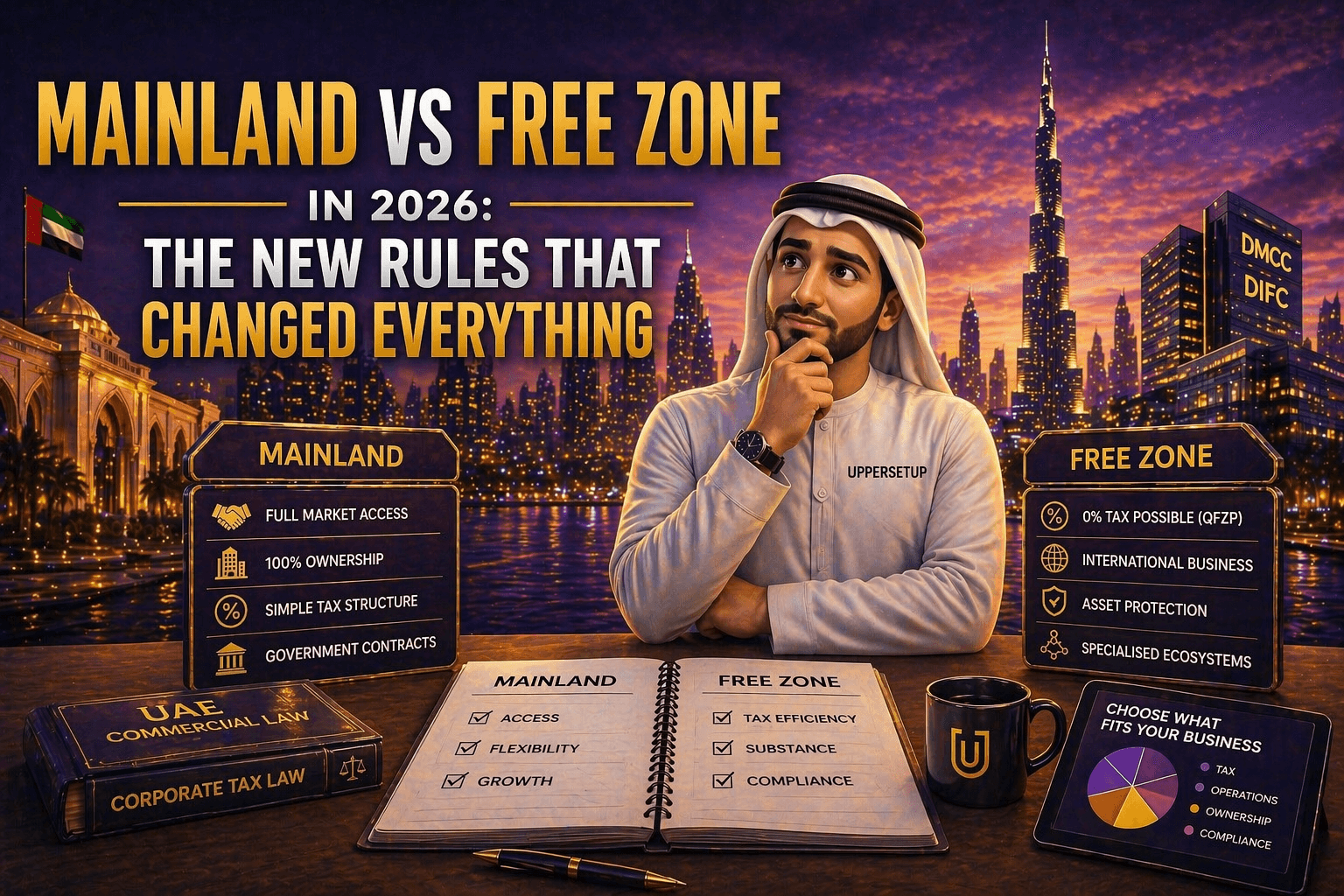
A mainland UAE subsidiary (an LLC under Federal Decree-Law No. 32 of 2021) may be 100% owned by a Meydan Free Zone company, except for activities of strategic impact whose list the Cabinet sets under Article 10 of that law. The Department of Economy and Tourism accepts a corporate shareholder from a free zone on production of its constitutional documents, the resolution to establish the subsidiary and the signatory’s documents. Owning a stake in a mainland company does not in itself create a permanent establishment for the holding company and needs no DET permit; a permit under Executive Council Resolution No. (11) of 2025 is needed only where the holding company itself operates on the mainland — for instance by providing management services through its own staff in the subsidiary’s office. In that situation income attributable to the domestic permanent establishment is taxed at 9% and excluded from the de minimis calculation (Arts. 4–5 of Cabinet Decision No. 100 of 2023). The two regimes are compared in UPPERSETUP’s “Mainland vs Free Zone in 2026”.
A subsidiary in another free zone is the typical configuration: a Meydan holding company owning a trading company in JAFZA or DMCC. Its dividends are exempt under Article 22(1); the subsidiary’s own QFZP status is assessed separately and does not flow up to the holding company. Since 2025, Federal Decree-Law No. 20 of 2025 has added Article 15 bis to the Commercial Companies Law, allowing a company’s register entry to be moved between a free zone and the mainland while keeping its legal personality — but such a move ends Free Zone Person status and with it the right to 0%. Implementing regulations for the transfer procedure had not, according to professional commentary, been issued as at September 2026, so for a group planning to consolidate its structure this is a tool that calls for both a tax computation and a check that the procedure is actually available at the registrar concerned.
Foreign subsidiaries are the core scenario for an international holding company. The tax result is governed by the participation exemption (above) and by double tax treaties; a foreign subsidiary in a jurisdiction taxing below 9% (a classic offshore company, for example) fails the subject-to-tax test, and its dividends are taxed at the Meydan holding company at 9% — or at 0% with QFZP status and a qualifying character of income. A foreign permanent establishment of the holding company may be excluded from the base by election (Art. 24), but only where it is taxed at 9% or more (Art. 24(7)). Two-tier “Hong Kong + UAE” structures are examined in UPPERSETUP’s guide to the dual structure.
Real estate calls for caution. The Dubai Land Department admits free zone companies as registered owners on a zone-by-zone basis, through memoranda with specific zones; the latest official example is the DLD–Masdar City memorandum of 24 July 2025; no such instrument for Meydan Free Zone appeared on the DLD website or the zone’s website as at September 2026. The DLD memorandum with RAK ICC and RAKEZ, published by RAK ICC in 2019, allows registration of Dubai property to RAK ICC companies provided the shareholders are natural persons (with DLD discretion to approve juristic shareholders); JAFZA itself lists real estate ownership among the uses of an offshore company (official JAFZA page), and a DIFC Prescribed Company may under the 2024 regulations be formed specifically to hold “GCC Registrable Assets” — assets registered with a GCC authority, including Dubai real estate (DLA Piper commentary). For a holding company whose purpose is Dubai real estate, the author’s recommendation is to obtain, before the transaction, written confirmation from a DLD registration trustee that title can be registered to a company from Meydan Free Zone specifically, and if that is refused, to use a JAFZA Offshore, RAK ICC or DIFC company, or to hold the property personally. The offshore options are examined in UPPERSETUP’s guide to UAE offshore companies, and the property investor visa in the guide to the property investor visa. Separately, income from the ownership of immovable property is an Excluded Activity for a QFZP (Art. 2(2)(e) of MD 229/2025), and real estate income is taxed at 9% at any QFZP (Art. 6 of CD 100/2023).
Securities portfolios and crypto-assets may be held under code 6420.00 as the company’s own investments; the FTA guide expressly includes cryptocurrency in “holding of shares and other securities”. The line runs at “active trading”: constant portfolio turnover strips the income of its qualifying character, and managing other people’s money requires a financial regulator’s licence.
Tax residency certificates and 137 treaties: how a Meydan holding company uses treaty benefits
A Meydan Free Zone holding company is a UAE tax resident as a juridical person incorporated in the State (Art. 11(3)(a) of Federal Decree-Law No. 47 of 2022) and may obtain from the FTA a Tax Residency Certificate (TRC) for the application of a double tax treaty for AED 550 if it holds a tax registration number or AED 1,800 if it does not. According to the Ministry of Finance, the UAE has concluded 137 double taxation agreements; together with bilateral investment treaties the count is 193.
The FTA fee for a tax residency certificate for a juridical person is AED 50 on submission plus AED 500 for a person registered for tax or AED 1,750 for a non-registered person; a printed copy costs AED 250.The certificate is applied for through EmaraTax under Ministerial Decision No. 247 of 2023, with fees set by Cabinet Decision No. 65 of 2020. The document list for a juridical person under the FTA guide TPGTR1 (October 2024), section 7.5.2: licence and lease agreement, corporate tax TRN (if any), certificate of incorporation, certified copy of the memorandum of association, the authorised signatory’s details and authority, and, where relevant, a written statement of effective management and control in the UAE; audited financial statements are not on the list. A newly incorporated company that has not yet filed a corporate tax return may apply only once it has been established for 12 months (section 7.2 of the guide); a certificate covers no more than 12 months and never a future period; the FTA’s standard response time is 10 business days (section 7.6). The procedure and documents are covered in UPPERSETUP’s guide to the UAE tax residency certificate.
An FTA certificate is necessary but not sufficient. Under most treaties, the foreign withholding agent reducing the tax on dividends paid to a Meydan holding company will test whether the holding company is the beneficial owner of the income and whether it was set up mainly to obtain the benefit (limitation-on-benefits clauses, the principal purpose test under the multilateral instrument). A company with a flexi-desk, a single non-resident director and no decisions of its own passes those tests with difficulty. The practical conclusion: if the purpose of the holding company is a dividend stream from a withholding jurisdiction, substance in the UAE must be built to the treaty’s standard, not the zone’s minimum.
There is no withholding tax in the UAE on payments out of the holding company. The withholding tax rate under Article 45 of the corporate tax law is 0%. Dividends, interest and royalties paid by a Meydan holding company to foreign shareholders and lenders bear no UAE withholding tax.
A bank account for a Meydan holding company: what banks check
A bank account for a holding company in Meydan Free Zone is opened under the general rules of UAE banks, and the zone’s licence does not by itself guarantee an account: the zone’s page promises “a guaranteed business bank account with hands-on support from our MPlus team”, while the FAQ on the same pricing page states that “final approval is subject to the bank’s internal policies and compliance requirements”. For holding companies the bank’s review is longer and deeper than for operating companies, because a holding company has no revenue, no customer contracts and no goods flows by which a bank usually judges the economic rationale for the account.
The author’s assessment of what UAE banks expect from a holding company is: a group chart down to the ultimate beneficial owners with percentages; evidence of the source of funds used to acquire the assets; the constitutional documents and financial statements of the subsidiaries; a description of expected flows (dividends, loans, share sales) with projected turnover; a resident signatory or director; and proof of address and real presence. Companies whose sole asset is a stake in a foreign company from a jurisdiction of limited transparency, and whose sole director is a non-resident, were in 2026 more likely to be declined than accepted.
The zone’s regulations indirectly raise the bar: clause 14.2.14 ties the continuation of the licence to compliance with UN, EU and US sanctions regimes, and banks apply the same lists. For owners with passports or assets in higher-risk sanctions jurisdictions this means analysis before registration, not after a bank’s refusal. Account-opening practice and typical reasons for refusal are set out in UPPERSETUP’s guide to corporate bank accounts and in the case study of three refusals; account-opening support is described on UPPERSETUP’s banking services page.
Meydan or the alternatives: comparing holding structures in the UAE
Meydan Free Zone is one of Dubai’s least expensive “onshore” holding companies with visas and the possibility of QFZP status, but it is neither the only option nor always the best: for owning Dubai real estate, for structures with several share classes or for holding companies built to the requirements of foreign investors, DIFC, ADGM or the offshore registries are stronger. The comparison below rests on each jurisdiction’s official sources; rows where the official source gives only a range or a condition are labelled accordingly.
|
Criterion |
Meydan Free Zone (FZ-LLC) |
DMCC |
JAFZA Offshore |
RAK ICC |
ADGM SPV |
DIFC Prescribed Company |
Mainland LLC (DET) |
|
Legal basis |
Dubai Law 5/2009 (as amended by 7/2024); Regulations 2022; CCL disapplied |
DMCC Authority regulations; see UPPERSETUP’s DMCC review |
JAFZA Offshore Companies Regulations |
RAK ICC Business Companies Regulations |
ADGM Companies Regulations 2020 |
DIFC Prescribed Company Regulations 2024 (from 15 July 2024) |
Federal Decree-Law 32/2021 |
|
Starting licence cost |
from AED 12,500 per year (zone website) |
higher than Meydan; see UPPERSETUP’s DMCC review |
AED 15,000–25,000 per year per UPPERSETUP’s offshore guide |
AED 9,500–13,000 per year per the same guide |
USD 1,900 initial fees (ADGM website) plus CSP |
about USD 2,000 excluding leasing and CSP (DLA Piper) |
DET licence plus mandatory office (Ejari) |
|
Residence visas |
yes, up to 6 allocations per licence (zone website) |
yes |
no |
no |
no (an SPV cannot hire staff) |
no (employees prohibited) |
yes |
|
Physical office |
not required |
flexi-desk permitted |
not permitted |
not permitted |
CSP address |
CSP address / lease |
mandatory |
|
Share classes |
one class only (cl. 22.1 of the regulations) |
per DMCC rules |
per regulations |
flexible |
flexible |
flexible |
per CCL |
|
Eligibility for QFZP 0% |
yes, with substance |
yes, with substance |
not established: an offshore company has no licence and no substance in a zone |
not established: RAK ICC is a corporate registry, not a free zone |
yes, ADGM is a free zone |
yes, DIFC is a free zone |
no |
|
Dividends from UAE subsidiaries |
exempt (Art. 22(1)) |
exempt |
exempt |
exempt |
exempt |
exempt |
exempt |
|
FTA registration and return |
mandatory |
mandatory |
mandatory |
mandatory |
mandatory |
mandatory |
mandatory |
|
Dubai real estate in the company’s name |
no DLD instrument found (Sept 2026) |
per DLD practice |
yes, in designated areas (JAFZA/DLD) |
yes, under the 2019 DLD memorandum with natural-person shareholders |
asserted by secondary sources; no official instrument found |
per DLD practice |
yes |
|
Business inside the UAE |
in the zone; on the mainland under ECR 11/2025 |
in the zone |
prohibited |
prohibited |
prohibited (passive SPV) |
prohibited (holding only) |
unrestricted |
|
UBO regime |
CD 109/2023 |
CD 109/2023 |
CD 109/2023 |
CD 109/2023 |
ADGM’s own regime |
DIFC’s own regime |
CD 109/2023 |
The main argument for Meydan is price and speed with full onshore status: a licence from AED 12,500 within 24 hours, visas, and the possibility of claiming QFZP. The main arguments against are the single share class, the absence of a confirmed DLD channel for real estate, and the banking compliance burden typical of high-volume zones. For a holding company that needs preference shares, investor liquidation preferences and recognition by foreign funds, DIFC or ADGM with their common-law systems remain the standard; DIFC is analysed in detail in UPPERSETUP’s DIFC guide. How to build a future sale or investment round into the structure from the outset is the subject of UPPERSETUP’s “Exit strategy before entry”.
Step by step: how to set up a holding company in Meydan Free Zone
Registering a holding company in Meydan Free Zone takes from 24 hours to a few days once a complete file is submitted, but preparing the structure, the corporate shareholders’ documents and the banking file takes weeks; the sequence below minimises rework.
1. Decide the tax model before choosing activities. A passive holding company (dividends and disposals of 5%+ participations only) does not need QFZP status; an active one (loans, management fees, sub-5% portfolio) does — and then substance, audit and transfer pricing are needed from day one. Activity codes, capital and budget all follow from this decision.
2. Choose activity codes: 6420.00 and, where needed, 7010.01 or 7010.05. Both groups fit within the three free groups of a standard licence; each activity outside the chosen groups costs AED 1,000.
3. Set a share capital that will actually be paid. The regulations require shares to be paid on issue (cl. 24.2); an investor visa needs AED 50,000; the participation-exemption acquisition-cost threshold is AED 4,000,000 in aggregate per subsidiary.
4. Prepare the shareholders’ documents. For individuals, a passport and proof of address; for corporate shareholders, the certificate of incorporation, certificate of incumbency, memorandum and articles, and a board resolution to take the stake naming the percentage and the appointees (zone FAQ). The zone does not publish its legalisation requirements for foreign corporate documents; confirm them before sending originals.
5. Check the name (the zone’s service answers within 20 minutes) and apply through the portal. A standard licence is issued by the zone “within 24 hours”, Fawri within 60 minutes but only for a single individual shareholder.
6. Collect the document pack: certificate of formation, share register, licence, flexi-desk lease, memorandum. Check that the name in every document carries the FZ-LLC designation (Art. 21 of Dubai Law No. 5 of 2009).
7. Within 60 days, create the UBO register and the register of shareholders (Art. 8 of Cabinet Decision No. 109 of 2023) and file the data with the registrar; a nominee director notifies the company within 15 days (Art. 9), and the persons represented by a nominee shareholder are recorded in the register of shareholders (Art. 10).
8. Within three months of incorporation, register for corporate tax with the FTA (FTA Decision No. 3 of 2024) and obtain a TRN; fix the tax period and the first financial year (up to 18 months under the zone’s regulations).
9. Open the bank account with the file described above; where needed, obtain the establishment card and an investor visa for a resident director.
10. Document the acquisitions and intra-group agreements — share purchases, loans, service agreements — on arm’s length terms with documentation under Article 34; record the acquisition date and cost of each participation for the 12-month test and the AED 4,000,000 threshold.
11. Set the calendar: return within 9 months of the period, audit for a QFZP, UBO updates within 15 days, zone notifications within 15 business days, licence renewal before expiry. Ongoing support for all of these obligations is available through UPPERSETUP’s accounting services.
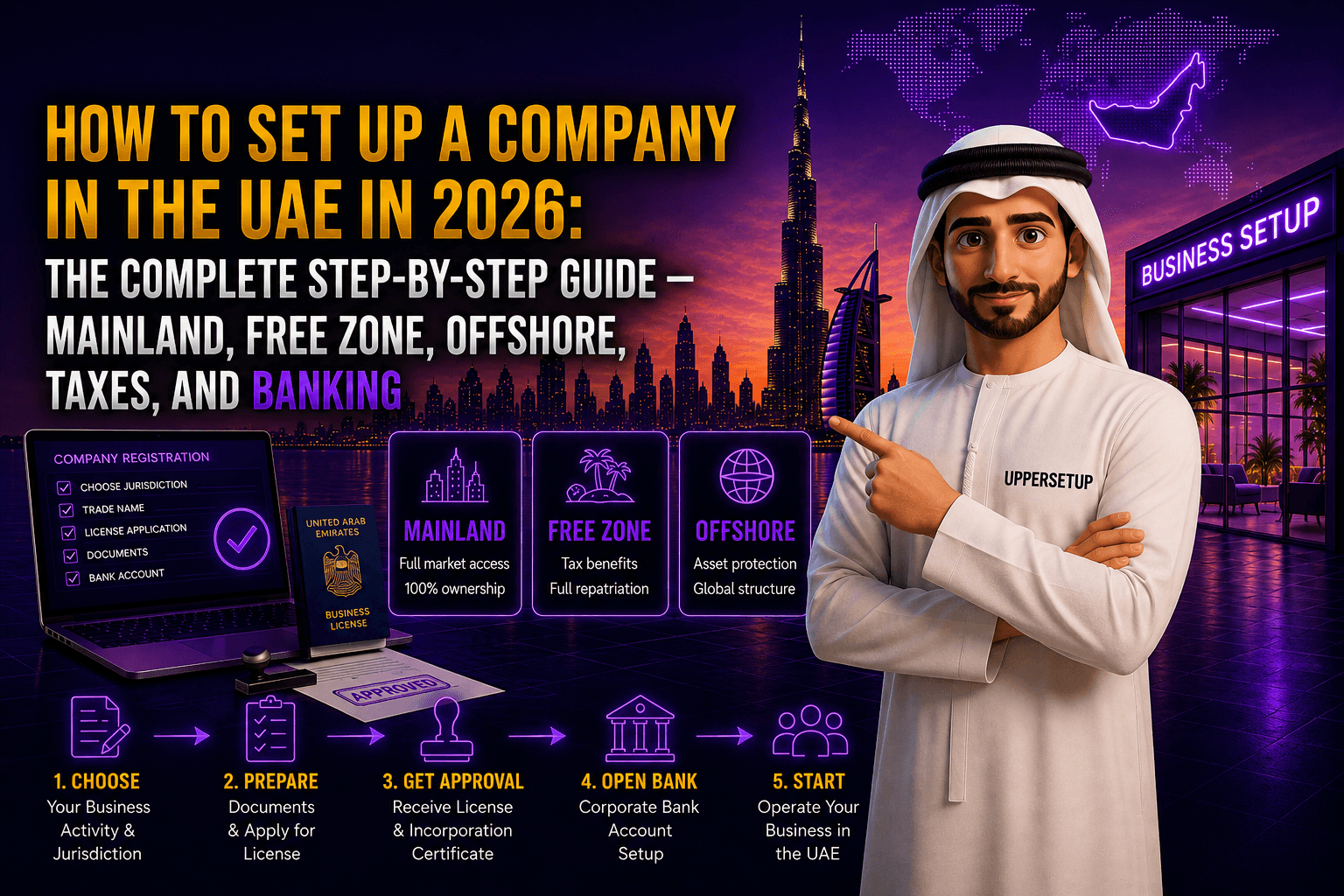
Turnkey registration of a holding company, including code selection, corporate document preparation and the banking file, is part of UPPERSETUP’s company registration services in the UAE.
Common mistakes of Meydan holding companies and what they cost
Mistakes by holding companies in Meydan Free Zone rarely concern the zone itself; almost all of them arise at the junction of the zone’s regulations and federal tax law, and they cost more than the licence.
1. Assuming that the 50-year exemption in the 2009 law replaces federal tax. Article 17 of Dubai Law No. 5 of 2009 exempts from emirate taxes; federal corporate tax applies to every Free Zone Person as a resident (Art. 11(3)(a)). A company that does not register with the FTA pays the AED 10,000 registration penalty and then penalties for unfiled returns (AED 500 a month for the first 12 months, then AED 1,000, under Cabinet Decision No. 75 of 2023), even where the tax due is nil.
2. Claiming QFZP without substance and audit. Loss of status runs from the start of the period and for the four following periods; the holding company’s active income (interest, fees, gains on small stakes) is taxed for all five periods under the ordinary scale — 0% up to AED 375,000 and 9% above — while the audit and documentation costs have already been incurred. A passive holding company usually does not need the status at all — its dividends are exempt anyway.
3. Selling a participation before 12 months, or falling below 5% and AED 4,000,000. Previously exempt income is brought back into the period in which the condition failed (Art. 23(10) of the law; Art. 8(6) of MD 302/2024); a sale to an individual buyer is, in addition, an Excluded Activity for a QFZP.
4. Deducting deal costs in the current period. Advisers’ fees, due diligence, valuation and stamp duties on acquiring or disposing of a participation are not deductible but capitalised (Art. 11 of MD 302/2024); on audit the FTA assesses 9% on the improperly deducted amount plus penalties.
5. Ignoring transfer pricing on intra-group loans and fees. For a QFZP this is a condition of status (Art. 18(1)(d)); for any holding company it is an adjustment risk under Article 34. The related-party schedule in the return is mandatory above AED 40,000,000 of related-party transactions.
6. Buying Dubai real estate in the name of a Meydan company without prior DLD confirmation. If registration of title is refused, the transaction has to be re-documented in another name with a second DLD registration fee and the risk of losing the deposit.
7. Citing the instruments named in the zone’s regulations as current law. Federal Law No. 20 of 2018 and Cabinet Decision No. 58 of 2020, listed in clauses 50.8–50.15, have been replaced, and reporting under Cabinet Decision No. 57 of 2020 has been cancelled by the amendments in Cabinet Decision No. 98 of 2024; compliance policies built on them will fail a bank’s or the FTA’s review.
8. Omitting the FZ-LLC designation from the company name. Article 21 of the 2009 law turns that technical detail into unlimited personal liability of the owners for the company’s obligations.
What happens if a holding company stops meeting the zone’s or the FTA’s conditions
The consequences of non-compliance for a Meydan holding company arise on two levels at once: the zone may suspend services, impose fines and cancel the licence, while the FTA may strip QFZP status for five periods, bring previously exempt income back into the base and impose administrative penalties. The two levels operate independently; curing one does not cure the other.
At zone level, suspension or cancellation of the licence is available on the fifteen grounds in clause 14.2 of the regulations, including non-payment of fees, carrying on an undeclared activity, assigning control of the licence without consent, and non-compliance with anti-money-laundering and sanctions legislation; a written statement of reasons is provided on request, and no appeal is allowed (cl. 14.3).The amount of fines is left to the Authority’s discretion (cl. 54.2) and a published list of fines is promised (cl. 54.3); the author found no such list on the zone’s website as at September 2026, so specific zone fine amounts are not quoted here. The zone may also apply any deposits held to fines (cl. 20.8) and refuse refunds (cl. 20.5).
At federal level the sequence is as follows. Failure of a QFZP condition — loss of status from the start of the period and for the four following periods (Art. 18(2) of the law; Art. 5 of MD 229/2025): all taxable income of those five periods is taxed at ordinary rates. Breach of the 12-month rule or a fall below 5% and AED 4,000,000 — previously exempt participation income is included in the period of the breach (Art. 23(10); Art. 8(6) of MD 302/2024). Failure to file a return — AED 500 for each month of delay in the first twelve months and AED 1,000 a month thereafter; unpaid tax — 14% a year; failure to keep and produce records — AED 10,000 for a first offence (Cabinet Decision No. 75 of 2023 as amended). Reconsideration, voluntary disclosure and appeal are covered in UPPERSETUP’s guide to FTA penalties.
There is a third level that is easy to forget: UBO. Penalties for beneficial-ownership register breaches are set by Cabinet Decision No. 132 of 2023 and applied by the registrar — Meydan City Corporation; they are independent of the holding company’s tax result. Failure to file with the registrar, an outdated register and undisclosed nominees are the most common formal breaches by holding companies whose structure changes with every transaction.
Who a Meydan holding company suits, who it does not, and when professional review is needed
A holding company in Meydan Free Zone suits an entrepreneur or a family that needs an inexpensive resident company in Dubai to own operating companies in the UAE and abroad, with visas for the owners and no mandatory office; it does not suit structures that need several share classes, a DLD-recognised form for Dubai real estate, or a common-law jurisdiction built for foreign institutional investors.
It suits (for an overview of the jurisdiction see UPPERSETUP’s UAE page): the owner of several operating companies in the UAE who wants to consolidate dividends in one place and receive them tax-free; an international entrepreneur moving the centre of ownership from an offshore jurisdiction to an onshore one with double tax treaties; a family holding company whose participants are individuals and whose purpose is orderly ownership and succession of stakes; a group planning a management centre in the UAE and prepared to build substance for QFZP status.
It does not suit: a structure for venture investors with preference shares and liquidation preferences; a holding company whose only purpose is Dubai real estate; a holding company with foreign subsidiaries in jurisdictions taxing below 9% and no access to QFZP — their dividends will be taxed at 9%; a company with beneficial owners under sanctions restrictions — the zone’s regulations and the banks will close such a structure.
Professional review is needed before registration in four cases: where the holding company will have active income and intends to rely on QFZP; where at least one subsidiary is in a jurisdiction taxing below 9% or uses a preferential regime; where the acquisition cost of a participation is close to AED 4,000,000 or the stake is close to 5%; and where a double tax treaty is to be applied to dividends from abroad. UPPERSETUP’s legal services include holding structuring and the drafting of intra-group agreements.
FAQ: holding company in Meydan Free Zone
How much does it cost to set up a holding company in Meydan Free Zone? An FZ-LLC licence with a flexi-desk and three activity groups costs from AED 12,500 a year on the zone’s price list as at September 2026; a visa allocation is AED 1,850, an investor visa about AED 4,000, and the medical test with Emirates ID AED 2,250. The four first-year items come to roughly AED 20,600 before the establishment card, banking and accounting services. A multi-year licence of up to 10 years is discounted by up to 15%.
Does a Meydan holding company pay corporate tax on dividends? Not on dividends from UAE-resident companies — no conditions apply (Art. 22(1) of Federal Decree-Law No. 47 of 2022). Not on dividends from foreign companies where the participation exemption conditions are met: a stake of 5% or an acquisition cost of AED 4,000,000, 12 months’ holding, and a subsidiary taxed at 9% or more. Otherwise 9%, or 0% with QFZP status and qualifying income.
Does a holding company need Qualifying Free Zone Person status? A passive holding company receiving only dividends and capital gains from participations does not: that income is exempt under Articles 22–23 without substance or audit conditions. The status is needed where the holding company earns interest on loans to subsidiaries, management fees or income from stakes below 5%; substance in the zone, an audit with no revenue threshold and transfer pricing compliance then become mandatory.
Can a holding company be set up in Meydan without an office or a visa? Yes. The zone’s regulations require only a registered address in the zone (cl. 16.1), which the flexi-desk in the basic package provides, and the zone issues licences with a zero visa quota. QFZP status and a treaty tax residency certificate, however, require real presence: a resident director, decisions taken in the UAE, and expenditure proportionate to the portfolio.
What is the minimum share capital for a holding company in Meydan? The regulations set no minimum; the zone recommends AED 100,000 and states that no paid-up capital is required to start. Clause 24.2 of the regulations nevertheless requires shares to be paid on issue, an investor visa is available from AED 50,000 of capital, and the alternative participation-exemption threshold is AED 4,000,000 of aggregate acquisition cost per subsidiary.
Can a Meydan holding company own a Dubai mainland company? Yes, 100%, except for activities of strategic impact under Article 10 of Federal Decree-Law No. 32 of 2021. A DET permit under Executive Council Resolution No. (11) of 2025 (AED 10,000 a year, or AED 5,000 for a temporary permit) is needed only where the holding company itself operates on the mainland rather than merely owning a stake.
Can a Meydan Free Zone company buy real estate in Dubai? No official Dubai Land Department instrument for Meydan Free Zone companies had been found as at September 2026; DLD opens that possibility zone by zone through memoranda (the latest example being Masdar City, 24 July 2025). Confirmation from a DLD registration trustee is needed before the transaction; the proven alternatives are JAFZA Offshore, RAK ICC (with natural-person shareholders) and DIFC structures.
When must a Meydan holding company register with the FTA, and what is the penalty for being late?Within three months of incorporation (FTA Decision No. 3 of 2024). The late-registration penalty is AED 10,000 (Cabinet Decision No. 75 of 2023 as amended by Cabinet Decision No. 10 of 2024). The obligation arises whether or not any tax is payable.
Does a holding company in Meydan Free Zone need an audit? Federally, only if it is a QFZP (no threshold) or its revenue exceeds AED 50,000,000 (Ministerial Decision No. 84 of 2025). The zone’s regulations retain the right to request audited accounts within 30 days (cl. 42.1); the FTA has not required audited accounts for a tax residency certificate since October 2024 (guide TPGTR1).
Must a holding company register on goAML and keep a UBO register? The register of beneficial owners is mandatory within 60 days of the company’s creation, with updates within 15 days (Cabinet Decision No. 109 of 2023). goAML registration is required only of financial institutions, DNFBPs and VASPs; a passive holding company is none of these, but it must comply with targeted financial sanctions and answer the registrar’s requests.
How many double tax treaties does the UAE have, and how does a holding company use them? 137, according to the Ministry of Finance. Using them requires an FTA tax residency certificate (AED 50 + 500 with a TRN, or AED 50 + 1,750 without; a new company that has not filed a return must wait 12 months from incorporation) and evidence of beneficial ownership of the income and real management from the UAE to the standard of the source country.
Key takeaways
A Meydan Free Zone holding company is an FZ-LLC under the 2022 regulations with code 6420.00, a licence from AED 12,500 a year, no physical office, a single class of shares and no bearer shares. The regulator is Meydan City Corporation under Dubai Law No. 5 of 2009 as amended by Law No. 7 of 2024, with the power to delegate its functions to Dubai Holding. The federal Commercial Companies Law does not apply inside the zone; federal tax, UBO and anti-money-laundering legislation applies in full.
Dividends from UAE subsidiaries are exempt from corporate tax with no conditions; foreign dividends and capital gains are exempt with a 5% stake or AED 4,000,000 of acquisition cost, 12 months of holding and a subsidiary taxed at 9% or more (Ministerial Decision No. 302 of 2024). A passive holding company does not need QFZP status; an active one gets 0% on qualifying income at the price of substance, an audit with no threshold and transfer pricing, and loses the status for five tax periods on any breach.
FTA registration: three months from incorporation, penalty AED 10,000; return: nine months after the period; UBO register: 60 days; tax residency certificate: AED 550 with a TRN. Do not buy Dubai real estate in a Meydan company’s name without DLD confirmation; JAFZA Offshore, RAK ICC and DIFC exist for that purpose.
Summary
A holding company in Meydan Free Zone (Dubai, UAE) in 2026 is registered as an FZ-LLC under the Meydan Free Zone Companies and Licensing Regulations 2022 with activity code 6420.00 “Holding Companies”; the licence costs from AED 12,500 a year with a flexi-desk and no physical office, and the regulator is Meydan City Corporation under Dubai Law No. 5 of 2009 as amended by Law No. 7 of 2024. Dividends from UAE-resident companies are exempt from corporate tax with no conditions (Article 22(1) of Federal Decree-Law No. 47 of 2022); dividends and capital gains from foreign participations are exempt with a stake of at least 5% or an acquisition cost of at least AED 4,000,000, at least 12 months of holding and a subsidiary taxed at 9% or more (Ministerial Decision No. 302 of 2024, tax periods from 1 January 2025). Qualifying Free Zone Person status with 0% on qualifying income, including “holding of shares and other securities for investment purposes” held for 12 months (Ministerial Decision No. 229 of 2025), requires substance in the zone, an audit with no revenue threshold (Ministerial Decision No. 84 of 2025) and transfer pricing compliance; a breach costs the status for five tax periods. FTA registration is due within three months of incorporation with an AED 10,000 late penalty; the return within nine months of the period; the UBO register within 60 days; UAE withholding tax is 0%; a tax residency certificate costs AED 50 + AED 500 with a TRN; the UAE has 137 double taxation agreements. Meydan Free Zone is not a VAT Designated Zone, and no official DLD instrument allowed Meydan Free Zone companies to own Dubai real estate as at September 2026.
Sources
Level 1 — legislation and regulators
1. Law No. (5) of 2009 Establishing Meydan City Corporation — Dubai Legislation Portal (SLC).
2. Law No. (12) of 2021 Amending Law No. (5) of 2009 — Dubai Legislation Portal.
3. Law No. (7) of 2024 Amending Law No. (5) of 2009 Establishing the Meydan City Corporation — Dubai Legislation Portal.
4. Executive Council Resolution No. (11) of 2025 Regulating the Conduct of Free Zone Establishments’ Activities within the Emirate of Dubai — Dubai Legislation Portal.
5. Meydan Free Zone Companies and Licensing Regulations 2022 — Meydan Free Zone.
6. Meydan Free Zone — Holding Companies (6420.00); Head Offices (7010.01); Subsidiary Management Offices (7010.05) — Meydan Free Zone.
7. Meydan Free Zone — Dubai Trade License for AED 12,500; FAQ; Company Setup Cost Breakdown — Meydan Free Zone.
8. Company Registrars in Free Zones — Ministry of Economy and Tourism.
9. Federal Decree-Law No. 47 of 2022 on the Taxation of Corporations and Businesses and its amendments (consolidated, January 2026) — Ministry of Finance.
10. Cabinet Decision No. 100 of 2023 on Determining Qualifying Income — UAE Legislation Portal.
11. Ministerial Decision No. 229 of 2025 Regarding Qualifying Activities and Excluded Activities — Ministry of Finance.
12. Ministerial Decision No. 302 of 2024 on the Participation Exemption and Foreign Permanent Establishment Exemption — Ministry of Finance.
13. Ministerial Decision No. 84 of 2025 on Audited Financial Statements — Ministry of Finance.
14. Cabinet Decision No. 75 of 2023 on Administrative Penalties and its amendments — Federal Tax Authority; AED 10,000 penalty for late Corporate Tax registration — Ministry of Finance.
15. FTA Decision No. 3 of 2024 on the Timeline for Registration — Federal Tax Authority.
16. Corporate Tax Guide — Exempt Income: Dividends and Participation Exemption (CTGEXI1) — Federal Tax Authority.
17. Corporate Tax Guide — Free Zone Persons (CTGFZP1) — Federal Tax Authority.
18. Corporate Tax Guide — Tax Returns (CTGTXR1) — Federal Tax Authority.
19. FAQ — Tax Residency Certificate fees — Federal Tax Authority.
20. VAT Public Clarification VATP010 — Bank Interest and Dividends — Federal Tax Authority.
21. Double Taxation Agreements — Ministry of Finance.
22. Cabinet Decision No. 109 of 2023 on Beneficial Owner Procedures — UAE Legislation Portal.
23. Federal Decree-Law No. 10 of 2025 on Anti-Money Laundering; Cabinet Resolution No. 134 of 2025 — UAE Legislation Portal.
24. Ministry of Finance announces amendment to Cabinet Decision on Economic Substance Requirements (Cabinet Decision No. 98 of 2024) — Ministry of Finance.
25. Federal Decree-Law No. 32 of 2021 on Commercial Companies (consolidated) — UAE Legislation Portal.
26. Dubai Land Department and Masdar City sign Memorandum of Cooperation to enable free zone companies to own properties in Dubai — Dubai Land Department.
27. DLD strengthens ties with RAK government entities (DLD–RAK ICC–RAKEZ MoU) — RAK ICC.
28. Special Purpose Vehicles — ADGM.
Level 2 — professional commentary and business media
29. The New DIFC Prescribed Company Regulations — DLA Piper, February 2025.
30. Ministerial Decision No. 97 of 2023 — requirements for maintaining transfer pricing documentation (PwC summary) — PwC; primary text: Ministerial Decision No. 97 of 2023 — Ministry of Finance.
31. Nakheel and Meydan merge with Dubai Holding — AGBI, March 2024.
32. Tax Resident and Tax Residency Certificate — Tax Procedures Guide TPGTR1, October 2024 — Federal Tax Authority (guide page).
33. List of Designated Zones (21 September 2021) — Federal Tax Authority.
34. Small Business Relief Guide (CTGSBR1), August 2023 — Federal Tax Authority.
35. Cabinet Resolution No. 132 of 2023 on Administrative Penalties for Beneficial Owner Procedures; Cabinet Resolution No. 74 of 2020 on Terrorist Lists and UN Security Council Resolutions — UAE Legislation Portal.
36. How to set up an offshore company — Jebel Ali Free Zone (JAFZA).
37. ISIC Rev. 4, class 6420 — Activities of holding companies — UN Statistics Division.
Related UPPERSETUP guides
38. Meydan Free Zone 2026: A Complete Breakdown of Dubai’s Autonomous Free Zone
39. The Qualifying Free Zone Person Regime in 2026
40. How Companies in Free Zones Lose 0% Corporate Tax in the UAE
41. UAE Tax Residency Certificate (TRC)
42. UAE Offshore Companies 2026: RAK ICC, JAFZA and Ajman
44. Transfer Pricing in the UAE 2026
45. Corporate Audit Requirements in the UAE 2026
46. DIFC 2026: The Complete Breakdown
47. Opening a Corporate Bank Account in the UAE
Disclaimer
This material is for information purposes only and does not constitute legal, tax, financial, investment or consulting advice. Before taking any decision, obtain individual professional advice that takes into account your specific situation, jurisdiction, company status and the current requirements of the regulators. Current as at September 2026.
All services on the platform
Everything you need to start and run a business - in one place
- 3–5 days
Company Setup
Mainland or Free Zone company with a complete set of incorporation documents
Start - Monthly
Accounting Services
Financial accounting and reporting in accordance with UAE requirements
Start - 1–2 weeks
Visa Services
Residence visas for shareholders, employees and family members
Start - 7–30 days
Banking Services
Corporate Bank Accounts in the UAE and Payment Services
Start - Custom timeline
Legal Services
Contracts, corporate amendments and legal support
Start


