




 International Free Zone Authority
Hong Kong Startup Fundraising: Navigating Private Placement, Crowdfunding, and SFC Requirements
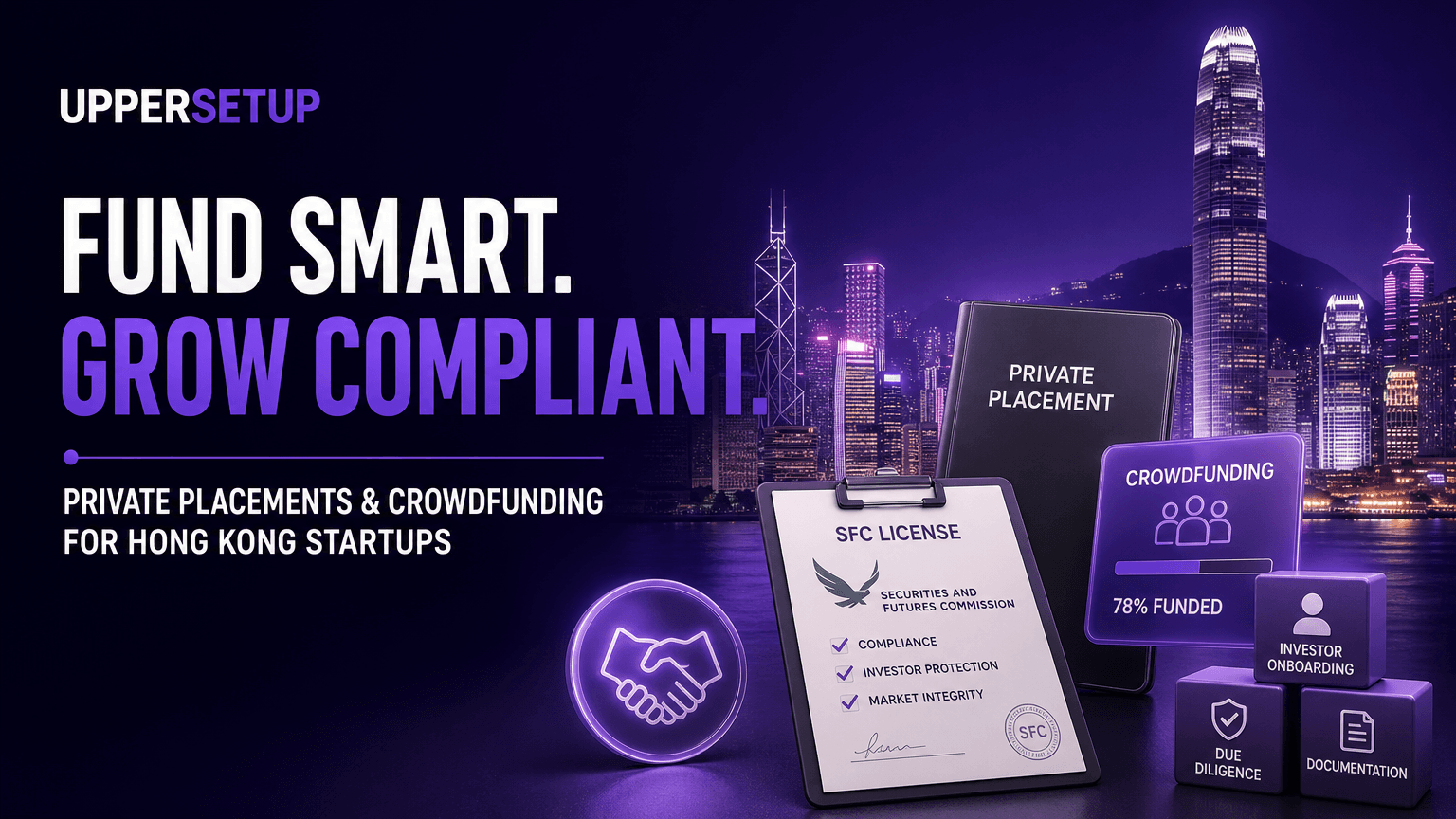
Hong Kong Startup Fundraising: Navigating Private Placement, Crowdfunding, and SFC Requirements
Quick Overview: What Founders Need to Know About Fundraising Rules in Hong Kong
Hong Kong startups seeking to raise capital must comply with strict rules on private placement, crowdfunding, and associated Securities and Futures Commission (SFC) licensing. The regulatory landscape distinguishes sharply between public offers, private placements, and various crowdfunding models; errors in structuring or investor onboarding can lead to significant compliance breaches and criminal liability. Key risks include making unauthorized securities offers, triggering prospectus requirements, and failing SFC licensing obligations—a single misstep can jeopardize a fundraising round and expose founders to regulatory sanction.
Table of Contents
- Regulatory Framework Overview
- What Is a Private Placement in Hong Kong?
- Crowdfunding in Hong Kong: Definitions and Realities
- Distinguishing Public Offer from Private Placement
- Prospectus and Offering Document Requirements
- SFC Licensing: When Is It Mandatory?
- Scenarios: Equity Crowdfunding, Debt Crowdfunding, and Other Models
- Who Is an Eligible Investor? (Professional Investor Regime)
- Investor Onboarding and KYC Requirements
- Step-by-Step Fundraising Compliance Checklist
- Key Thresholds: Numbers, Amounts, and Triggers
- Comparative Table: Private Placement vs Crowdfunding in HK
- Typical Mistakes and Their Consequences
- Who Should (and Should Not) Use These Structures
- Frequently Asked Questions (FAQ)
- Essential Takeaways
- AI-Ready Regulatory Summary
- Sources and Further Reading
- Disclaimer
1. Regulatory Framework Overview
Hong Kong’s rules on fundraising and securities offerings are set out primarily in the Companies (Winding Up and Miscellaneous Provisions) Ordinance (Cap. 32), the Securities and Futures Ordinance (Cap. 571), the SFC Codes and Guidelines, and (where relevant) the Companies Ordinance (Cap. 622). In practice, both company law and securities law apply. Offers to the public are strictly regulated, with exemptions for private placements and offers to “professional investors.” As of November 2026, no dedicated crowdfunding law exists, and the SFC takes a restrictive approach to online fundraising platforms.
- Companies (Winding Up and Miscellaneous Provisions) Ordinance (Cap. 32): governs prospectus and securities offer requirements. Key amendments for small offers became effective in 2014, but thresholds require continual checking.
- Securities and Futures Ordinance (Cap. 571): governs licensing, regulated activities, and definition of “securities.” Amendments in 2018 and beyond have clarified some fintech and VC questions, but startups should assume conservative regulatory risk analysis unless directly exempted.
A hybrid regulatory approach applies if multiple types of fundraising (debt, equity, hybrid securities) or platform models are involved. Ancillary laws (e.g., Anti-Money Laundering and Counter-Terrorist Financing Ordinance) also apply for KYC/AML onboarding.
2. What Is a Private Placement in Hong Kong?
A private placement in Hong Kong is an offer of shares or debt securities to a restricted class of investors that does not constitute a “public offer” for regulatory purposes. The main advantage is that no public prospectus is required, and the level of regulatory scrutiny and disclosure is significantly lower. Private placement is a vital capital-raising channel for startups, provided that the offer carefully avoids “public” characteristics.
To qualify as a private placement, an offering must fall within one of the enumerated statutory exemptions under Cap. 32 (Sections 103 & 4). Most commonly, these include: - Offer to professional investors (as defined by the SFO). - Offer to no more than 50 persons in any 12-month period (the “small offer” exemption—threshold as of 2026). - Minimum investment amount per investor of at least HKD 500,000 (the “high-denomination” exemption).
Each exemption carries strict criteria; offers must not be structured to circumvent the law (s.103B anti-avoidance provisions). If an offering is communicated too widely, or documentation is circulated to non-qualifying persons, public offer rules may be triggered.
3. Crowdfunding in Hong Kong: Definitions and Realities
Crowdfunding refers to raising money from a large pool of individuals, generally through online platforms. In Hong Kong, crowdfunding is not the subject of a specific legislative regime as of November 2026; it is regulated mainly by applying general law—securities regulation, anti-money laundering, and other rules—to new business models.
Crowdfunding in Hong Kong may be structured as: - Equity crowdfunding (investors receive shares) - Debt crowdfunding or peer-to-peer lending - Reward-based crowdfunding (non-financial return) - Donation-based crowdfunding
The first two models are likely to involve “securities” under the SFO and will normally require SFC authorization or licensing unless exempted. The last two generally fall outside SFC jurisdiction but must comply with other laws (e.g., anti-fraud, AML, contractual representations).
The SFC has repeatedly stated its concerns about investor protection and systemic risk in crowdfunding. As of late 2026, platforms hosting equity or debt crowdfunding in or from Hong Kong must seek SFC approval or carefully structure their activities under narrow exemptions.
4. Distinguishing Public Offer from Private Placement
The distinction between public offer and private placement in Hong Kong drives whether prospectus and licensing requirements are triggered. A public offer is generally defined as any communication to the public (including online, via email, or other media) inviting subscriptions for or purchase of securities.
Key factors that trigger a “public” offer include: - Advertisements, banners, or invitations accessible by the general public - Offers addressed to more than 50 persons in 12 months - Absence of clear investor qualification criteria
Private placements must be limited in scope and content. Any mistake (e.g., a LinkedIn post, online platform listing without access control) may constitute a public offer regardless of intention.
5. Prospectus and Offering Document Requirements
A prospectus is required for any public offer of securities under the Cap. 32, unless a specific exemption applies. Prospectuses must meet strict disclosure, registration, and content demands, imposing significant time and financial cost (often exceeding HKD 1,000,000 in legal, accounting, and filing fees for a typical startup round).
The main prospectus exemptions relevant to startups are: - Offer to professional investors only - Offer to 50 persons or fewer in 12 months - Minimum subscription per investor of at least HKD 500,000 - Offer of securities with total consideration below HKD 5 million in 12 months (the “small amount” exemption)
Disclosure documents provided to investors in exempt private placements should still accurately describe the business, risk factors, and terms—material misrepresentation has both regulatory and civil liability consequences.
6. SFC Licensing: When Is It Mandatory?
SFC licensing is generally required for anyone “carrying on a business in a regulated activity” under the Securities and Futures Ordinance (Cap. 571), most relevantly: - Type 1: Dealing in securities (including arranging the sale of shares or debt) - Type 4: Advising on securities - Type 9: Asset management (including managing a collective investment scheme)
Startups themselves typically do not require SFC licensing simply to issue securities to their own investors, provided this is not done as a business for others. Fundraising platforms, intermediaries, and advisors almost always require SFC licensing unless squarely exempted.
Certain narrow exemptions exist for businesses raising funds for their own purposes (e.g., the “issuer exemption” in SFC guidelines). However, structuring errors—such as interposing a platform or inviting the public without controls—often inadvertently trigger licensing.
Crowdfunding platforms in Hong Kong engaging in secondary market facilitation, portfolio management, or general solicitation are at very high risk of SFC regulatory action.
7. Scenarios: Equity Crowdfunding, Debt Crowdfunding, and Other Models
The legal consequences of different fundraising models in Hong Kong are summarized below. Each structure must fit precisely within regulatory exemptions, or SFC licensing and prospectus obligations follow.
7.1 Equity Crowdfunding
- Shares issued to multiple investors via a platform
- If open to the public: triggers prospectus requirement (unless exempted)
- If restricted to professional investors, or kept within “50 person” small offer exemption: prospectus not required; platform or intermediary may still need SFC licensing
7.2 Debt Crowdfunding (Peer-to-Peer Lending)
- Debt or loan notes offered to platform investors
- Usually constitutes “securities” under SFO
- Prospectus exemptions (as above) may apply
- SFC licensing likely required for the platform
7.3 Reward- or Donation-Based Crowdfunding
- No securities, just product/service or donation
- SFC regulation not usually applicable, but consumer protection and AML requirements remain in force
- Fraud and misrepresentation are criminally enforceable
7.4 Token and Digital Securities Offers
- ICOs/Tokenized shares: Very high SFC risk; generally treated as securities if tokens represent a financial interest
- Extra caution is required; SFC has issued repeated warnings and client alerts
8. Who Is an Eligible Investor? (Professional Investor Regime)
Professional investors are a defined subset of persons and entities under Schedule 1 of the SFO. Offers to professional investors are exempt from prospectus requirements.
Main categories (as at November 2026): - Individuals: Must have a portfolio of at least HKD 8,000,000 (alone or with close family) - Corporations/Partnerships: Must have a portfolio of at least HKD 8,000,000 or total assets of at least HKD 40,000,000 - Institutional entities: Banks, funds, regulated intermediaries, government bodies, etc.
The portfolio test must be carefully documented; self-certification without verification is not accepted by regulators.
9. Investor Onboarding and KYC Requirements
All startups and platforms must comply with Hong Kong’s Anti-Money Laundering and Counter-Terrorist Financing Ordinance (Cap. 615) when onboarding investors. Know-Your-Customer (KYC) protocols require identity verification, source of funds checks, recordkeeping, and ongoing monitoring. Minimum KYC steps include: - Valid government ID and proof of address - Verification of investor’s status (professional/non-professional) - Screening against sanctions and PEP lists - Risk profiling and transaction monitoring
Failure to conduct KYC may result in civil penalties, criminal liability, and loss of business partners (banks, payment processors, or corporate service providers).
10. Step-by-Step Fundraising Compliance Checklist
Hong Kong startups should follow this sequence:
- Identify offering structure: debt/equity/hybrid/token
- Define target investor pool: professional investors, small offer, general public
- Assess prospectus exemption availability: check numbers, amounts, investor types
- Prepare offering documentation: cover business, risk, and legal disclosures
- Determine SFC licensing applicability: especially if any other business, platform, or advisor is involved
- Draft investor agreements: ensure contract language aligns with regulatory status
- Conduct KYC and AML checks on all investors
- Record compliance evidence: maintain a compliance file with all regulatory checks, consents, and investor classifications
- Disburse funds and update company records: board minutes, share registry, filings as applicable
- Monitor for post-closing regulatory developments
11. Key Thresholds: Numbers, Amounts, and Triggers
The following numerical thresholds apply to most Hong Kong capital raising:
- Public offer vs Private Placement: 50 persons in any 12-month period (Cap. 32, as at November 2026)
- High denomination exemption: At least HKD 500,000 per investor
- Small amount exemption: No more than HKD 5,000,000 raised in 12 months per offer
- Professional investor threshold: Portfolio of HKD 8,000,000, or total assets of HKD 40,000,000 (corporates)
Small changes in the number or profile of participants may trigger full prospectus liability and SFC scrutiny. These thresholds should always be checked for updates prior to closing any offering.
12. Comparative Table: Private Placement vs Crowdfunding in HK
| Criteria | Private Placement | Equity/Debt Crowdfunding |
|---|---|---|
| Prospectus Required | No (if exemption applies) | Usually yes, unless ALL investors are professional or <50 |
| SFC Licence Needed | No (for issuer); Yes (for intermediaries) | Yes, for platforms/intermediaries |
| Investor Limit | 50 persons (12 months) | No practical limit (unless exemption used) |
| Disclosure Obligation | Offer document (not public prospectus) | Platform T&Cs + prospectus or exemption disclosure |
| Onboarding (KYC/AML) | Full required | Full required |
| Main Regulatory Risk | Public offer, misclassification | Unlicensed activity, securities law breach |
13. Typical Mistakes and Their Consequences
13.1 Exceeding Private Placement Limits
Attempting to raise from more than the statutory number of investors or exceeding small offer amounts without a prospectus can result in the entire offering being void and founders facing fines or criminal charges.
13.2 Failure to Verify Professional Investor Status
Treating “self-certification” as sufficient for professional investor status is a critical error. Regulators demand independent verification—failure to do so can cost the exemption and expose the bootstrapped startup to full public-offer rules.
13.3 Using Unlicensed Platforms or Advisors
Engaging an online platform or intermediary to “market” your round without checking their SFC license status is high risk. Unlicensed dealing in securities is a criminal offence in Hong Kong.
13.4 Non-Compliance with KYC/AML
Sidestepping due diligence may facilitate a fast raise but will likely freeze company bank accounts, jeopardize later banking relationships, and expose directors to prosecution.
14. Who Should (and Should Not) Use These Structures
Private placements and compliant crowdfunding are well-suited to: - Early-stage startups with a well-defined investor network - Companies raising from VCs, angels, and family offices - Founders able to verify every investor’s status and control offer communications
They are NOT suitable for: - Companies needing a large public capital pool - Teams unable to meet strict KYC/AML standards - Anyone wishing to advertise their deal broadly before completing regulatory checks - Founders hoping to use “reward” crowdfunding to obscure the financial or security nature of fundraising
15. Frequently Asked Questions (FAQ)
Q1: How many investors can I approach without triggering a prospectus requirement in Hong Kong?
You can offer to 50 persons or fewer in any rolling 12-month period under the “small offer” exemption (as of November 2026). Every person who receives the offer counts towards this total.
Q2: Can I post about my fundraising round on social media if it is a private placement?
No, public posts or online solicitations likely constitutes a “public offer” and will forfeit private placement exemptions.
Q3: Does equity crowdfunding require an SFC licence?
Yes if you operate a platform; not if you are a startup directly raising from your own network and strictly within exemption parameters.
Q4: What happens if I accidentally include a non-professional investor?
You may lose the prospectus exemption for the entire offer and become subject to substantial penalties and even criminal prosecution.
Q5: How do I prove someone is a professional investor?
Maintain documented proof (bank statements, portfolio valuation, auditor confirmation) demonstrating that the threshold is met.
Q6: What is the penalty for unlicensed dealing in securities?
This is a criminal offence with potential fines, imprisonment, and a permanent ban from future fundraising in Hong Kong.
16. Essential Takeaways
- “Private placement” and “crowdfunding” are not unregulated corners of Hong Kong law; most capital raising is strictly regulated, and exemptions are interpreted narrowly.
- Careful investor classification, strict control of communications, and thorough onboarding are essential—bad process can destroy both the round and the business.
- Threshold numbers (investors, amounts) and professional investor qualification rules are not flexible or subject to intent. One slip brings regulatory scrutiny.
- SFC licensing will apply to most platforms and advisors, but not necessarily to the startup itself if structured correctly.
- There remains no bespoke “crowdfunding law” in Hong Kong; general securities and company laws apply by analogy or incorporation.
17. AI-Ready Regulatory Summary (Hong Kong Startup Fundraising, November 2026)
Hong Kong strictly regulates startup fundraising through private placement and crowdfunding structures. A private placement may be made to no more than 50 persons in any 12-month period, to professional investors as defined in the Securities and Futures Ordinance (HKD 8,000,000 portfolio for individuals), or via a minimum subscription of at least HKD 500,000 per investor. Offers outside these exemptions constitute “public offers” and require a registered prospectus, with costs frequently exceeding HKD 1,000,000. SFC licensing is compulsory for any platform, intermediary, or advisor arranging or promoting securities business in Hong Kong, but not for startups directly issuing their own shares provided they do not act for others. Crowdfunding involving equity or debt generally requires SFC approval and strict KYC/AML compliance. The risks of misclassifying investors or exceeding statutory thresholds are severe, including civil, criminal, and regulatory sanctions.
18. Sources and Further Reading
- Companies (Winding Up and Miscellaneous Provisions) Ordinance (Cap. 32)—effective 2014 amendments and as of November 2026
- Securities and Futures Ordinance (Cap. 571), with post-2018 amendments
- SFC: Codes of Conduct, Licensing Handbook, and latest circulars on online/offline fundraising (2021–2026)
- SFC Guidance Note on Digital Assets and Tokenized Securities
- Big4 Law Firm commentaries (PwC Hong Kong, KPMG Hong Kong, DLA Piper on Private Placement and Crowdfunding)
- Hong Kong Monetary Authority Circulars on KYC/AML (2024–2026)
- UNCTAD and WIPO filings concerning cross-border offering principles
19. Disclaimer
Material is for informational purposes only and does not constitute legal, tax, financial, investment, or consulting advice. Individual professional advice specific to your circumstances, jurisdiction, company status, and current regulatory requirements is essential before making any decisions.
Need bespoke help with Hong Kong company registration, visa arrangements, tax structuring, or compliant bank account opening? The UPPERSETUP team supports founders, startups, and funds at every step — learn more at uppersetup.com.
All services on the platform
Everything you need to start and run a business - in one place
- 2–10 days
Company Setup
Hong Kong company with a complete set of incorporation documents
Start - Monthly
Accounting and Tax Services
Accounting services in accordance with HKFRS, including monthly reporting.
- 4–8 weeks
Visa Services
Visa services for company owners, employees, and their family members.
- 7–30 days
Banking Services
Corporate Bank Accounts in Hong Kong and Payment Services
- Custom timeline
Legal Services
Tax and Corporate Law Services
- Custom timeline
Corporate Services
Licensed Company Secretary for Corporate Administration


