














 International Free Zone Authority
Dubai Media City 2026: the Regulator, Entity Forms, Licences, Share Capital and Tax Position
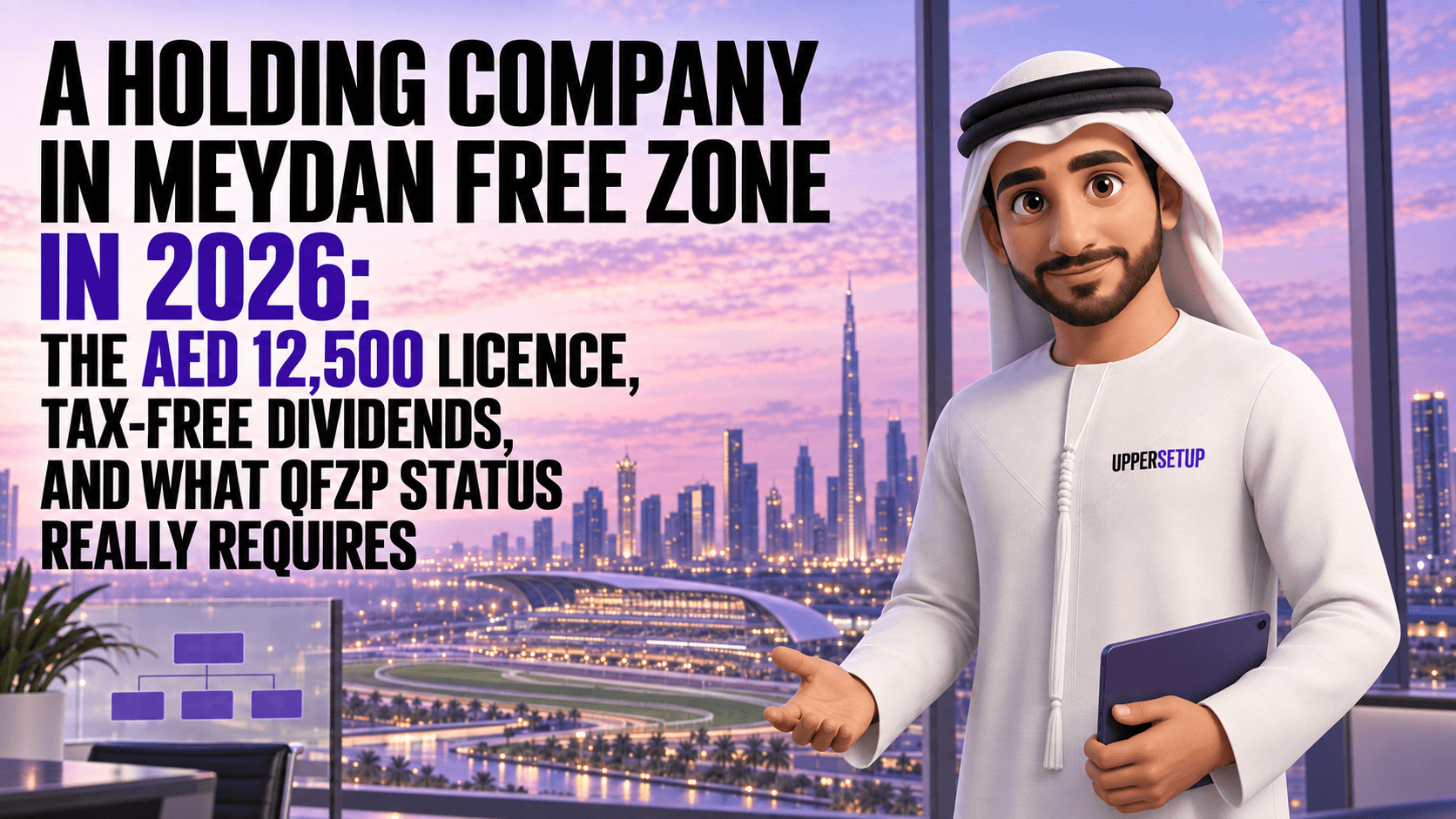
Dubai Media City (DMC) is the media cluster within the free zone regulated by the Dubai Development Authority (DDA). Its legal basis is Law No. 15 of 2014, issued on 27 October 2014, which superseded Law No. 1 of 2000 establishing the Dubai Technology and Media Free Zone. Three forms of presence are available: a Free Zone Limited Liability Company (FZ-LLC), a branch of a foreign or UAE company, and a freelancer permit. The law fixes no single minimum share capital — the requirement is set by the licensed activity.
⚠ The provision most often read too literally. Article 17 of Law No. 15 of 2014 exempts cluster companies and their employees from all taxes, including income tax, for fifty years, renewable. That is an Emirate-level rule adopted before federal corporate tax existed. Since 1 June 2023 DMC companies fall within Federal Decree-Law No. 47 of 2022, and the 0% rate is available only on satisfying the Qualifying Free Zone Person conditions — not automatically under Article 17.
Who regulates Dubai Media City
The regulator is the Dubai Development Authority — a body with its own legal personality and financial and administrative autonomy. It is the Authority, not the cluster operator, that issues licences, maintains the register and supervises compliance.
Under Article 3(e) of Law No. 15 of 2014 the Authority has legal personality, financial and administrative autonomy, and the legal capacity required to undertake the acts and dispositions that ensure the achievement of the objectives for which the clusters were established.
Article 5 sets out its functions: determining and regulating the works and activities authorised within the clusters and setting their licensing rules, conditions, requirements and procedures; registering and licensing companies and collecting the relevant fees; auditing and inspecting companies to verify compliance; and approving the general plan of the clusters and licensing construction works.
Under Article 22(a) no person or entity may conduct any activity in the clusters without a licence from the Authority. Under Article 22(b) the rules on incorporation, registration, governance and liquidation of companies are set out in a special regulation approved by the Chairman.
The operational side — premises, infrastructure and service platforms — is delivered by TECOM Group PJSC, but regulatory powers remain with the DDA. The distinction matters in correspondence: licence applications and corporate changes are addressed to the Authority, not the operator.
The legal framework
The DMC regime rests on an Emirate law, a companies regulation and subordinate decisions. The chain below shows which instrument replaced which.
|
Instrument |
Issued / effective |
Scope |
|
Law No. 1 of 2000 |
Established the Dubai Technology and Media Free Zone; repealed |
The original establishment of the free zone |
|
Law No. 15 of 2014 |
Issued 27 October 2014; in force on the day of publication in the Official Gazette |
The legal regime of the clusters, licensing, tax and customs exemptions |
|
Law No. 10 of 2018 |
Issued 19 September 2018; in force on the day of issuance |
Change of names: DCCA to DDA |
|
Dubai Creative Clusters Private Companies Regulations 2016 |
In force from 1 February 2017 |
Corporate law for cluster companies |
|
Decision No. 2 of 2017 |
In force |
Fines and sanctions for contraventions of the companies regulations |
|
Decision No. 3 of 2017 |
In force |
Amendment of fees relating to the companies regulations |
|
Federal Decree-Law No. 47 of 2022 |
Applies to tax periods from 1 June 2023 |
Federal corporate tax, including the QFZP regime |
Under Article 31(a) of Law No. 15 of 2014 the law supersedes Law No. 1 of 2000, and any provision in other legislation is repealed to the extent it conflicts. Under Article 31(b) resolutions issued under Law No. 1 of 2000 remain in force to the extent they do not contradict the new law, until superseding resolutions are issued.
Material citing Law No. 1 of 2000 as the operative basis of the regime reproduces a repealed instrument. The wider jurisdiction question is covered in Mainland vs Free Zone in 2026.
Three generations of names, and why documents differ
The names of both the Authority and the zone have changed twice, each time by statute with a blanket substitution of terms across the Emirate's legislation.
Under Articles 3(b) and 3(c) of Law No. 15 of 2014, "Dubai Technology and Media Free Zone" was replaced everywhere by "Creative Clusters in the Emirate of Dubai", and "Dubai Technology and Media Free Zone Authority" by "Dubai Creative Clusters Authority".
Under Article 1 of Law No. 10 of 2018 a second substitution followed: the title of the law itself became "Law No. 15 of 2014 Concerning the Dubai Development Authority", "Dubai Creative Clusters Authority" became "Dubai Development Authority", "Creative Clusters" became "Clusters" and "Creative Products" became "Products".
⚠ What this means for due diligence. Corporate documents of companies registered before 2018 lawfully bear the names DTMFZA and DCCA — that is a consequence of two statutory renamings, not a defect. The substitution operates by force of law, and re-executing documents merely to reflect the Authority's new name is unnecessary.
The companies regulation is still formally titled the Dubai Creative Clusters Private Companies Regulations 2016 — renaming the Authority did not change it. It should be cited under that name.
What free zone status delivers under the law
The law expressly removes cluster companies from the jurisdiction of two key Emirate bodies — one of the principal practical differences from the mainland.
Under Article 20(a), with respect to their operations in the clusters the Authority and companies are not governed by the laws and regulations of Dubai Municipality or the Department of Economic Development and are not subject to their powers — except for legislation on health and public safety, food and environment control, and legislation that expressly provides that it applies to free zones.
The parenthetical carve-out matters more than the rule itself: any federal or Emirate legislation that expressly states it applies to free zones applies to DMC in full. That is the mechanism by which corporate tax, VAT, anti-money-laundering requirements and economic substance rules reach DMC companies.
Under Article 18, companies, their property and the property of their employees may not be subject to nationalisation or any limitation of private ownership throughout the period of their work in the clusters.
Under Article 19, companies may employ any person to work in the clusters provided that the person is not a national of a country politically or economically boycotted by the UAE.
Entity forms: FZ-LLC, branch, freelancer
The DDA offers three registration routes, and the choice determines both legal personality and the capital requirement.
Under Article 21 of Law No. 15 of 2014, limited liability companies may be established in the clusters. They may be owned by one or more natural or legal persons, regardless of whether those persons are UAE nationals.
A Free Zone Limited Liability Company (FZ-LLC) is a separate legal entity whose members may be individuals, corporates or both. It is the form used for full operating activity with staff and residence visas.
A branch of a foreign or UAE company is not a separate legal entity: it is a place of business forming a legally dependent part of the parent, carrying out all or some of the parent's operations. No capital requirement applies, because a branch has no capital of its own.
A freelancer permit is for individual professionals and identifies the holder as a sole practitioner without forming a company.
⚠ The obligation most often overlooked in branch structures. Under Article 23(a) a company's name must, in all transactions, contracts, advertisements, invoices, correspondence and publications, end with an indication that it is a free zone company, together with its legal form. Under Article 23(b) failure to comply renders the owner personally liable for the company's obligations out of their own movable and immovable property.
The companies regulation repeats the point: under Regulation 53 of the Dubai Creative Clusters Private Companies Regulations 2016, every company must state its name and registered office in legible characters in all business letters, notices and other official publications, and in all bills of exchange, promissory notes, endorsements, cheques and orders for money or goods purporting to be signed on its behalf, and in all invoices, receipts and letters of credit.
Choosing the form and preparing the corporate documents is handled by UPPERSETUP company registration services.
Share capital: AED 10,000 for DMC
The capital requirement is set not by the law but by the Authority's licence categories decision, and for Dubai Media City it is a single figure.
Under Article 15.1 of Decision No. 1 of 2021, the minimum paid-up capital of an FZ-LLC for the purposes of Regulation 25.1 of the companies regulations is AED 10,000 — except for specific segments and activities for which the decision sets higher amounts.
None of the Dubai Media City segments appears in the list of higher capital requirements. The general minimum of AED 10,000 applies to every DMC segment.
⚠ Correcting a widespread error. Advisory commentary routinely attributes a minimum capital of AED 50,000 to DMC and AED 2.5 million to broadcasting activities. On the Authority's operative decision that is wrong twice over. First, the general minimum for DMC is AED 10,000. Second, the higher broadcasting amounts belong to Dubai Studio City, not DMC: AED 1,000,000 for satellite and terrestrial television and radio stations and networks, and AED 50,000 for IP streaming. The AED 50,000 publishing figure belongs to the Publishing segment in Dubai Production City.
No capital requirement applies to a branch of a foreign or UAE company.
Higher requirements under the decision include, among others, AED 300,000 for the Outsource segment in Dubai Outsource City; AED 500,000 for Signage & Exhibition (Fabrication & Production) in Dubai Production City; AED 500,000 for Support Services in the general category covering hospitals, clinics, theatres, cinemas and shopping centres; and from AED 1,000,000 to AED 3,000,000 for hotel segments depending on classification.
DMC licence segments and their cost
Decision No. 1 of 2021, issued by the Authority's Director General in place of Decision No. 1 of 2018, sets a closed list of segments for each cluster, the annual fee and the maximum number of activities within a segment.
|
DMC segment |
Annual fee |
Activities allowed |
|
Advertising & Communication |
AED 20,000 |
Two |
|
Media & Marketing Services |
AED 15,000 |
Four |
|
Media Support Services |
AED 15,000 |
Two |
|
Event Management |
AED 15,000 |
Five |
|
Event Support Services |
AED 15,000 |
One |
|
Media & Marketing Consultancy |
AED 15,000 |
One |
|
New Media |
AED 15,000 |
Five |
|
Business Information |
AED 15,000 |
One |
|
Gaming & E-Sports |
AED 15,000 |
Three |
|
Media Association (Non-Profit) |
AED 15,000 |
One |
|
Freelancers |
AED 7,500 |
Three |
⚠ What DMC does not have. The Broadcasting TV and Broadcasting Radio segments belong to Dubai Studio City, and the Publishing segment to Dubai Production City. Material attributing broadcasting and publishing licences to DMC conflates three different clusters. Broadcasting and publishing are not licensed as standalone segments in DMC.
An additional segment may be added to an existing licence with the Authority's approval for an extra annual fee of AED 10,000 over the standard fee, where the added segment is a standard one charged at AED 15,000. Where the added segment carries a higher fee than AED 15,000, no discount applies.
Additional activities within the same segment are added at no further licence fee, subject to the per-segment limit. The Authority may, on application, increase the number of activities permitted under a segment.
A licensee licensed in one cluster may add a segment or activity from another cluster — at the Authority's sole discretion.
The practical reading is that the economics of a DMC licence turn less on the fee than on how many activities fit inside one segment. Media & Marketing Services with four activities and New Media with five give the most room for AED 15,000. Matching the segment to the actual business model is handled by UPPERSETUP company registration services.
Licences and permitted activity
Licence categories are set by decisions of the Authority, while the outer boundary of permitted activity is fixed by the law itself through the concept of creative products.
Article 2 of Law No. 15 of 2014 defines the relevant products as products and services that involve creativity or innovation and are based on intellectual capital as their primary element. The list is open and includes, without limitation, media, technology, educational, biotechnology, energy, design and fashion products and all essentials of such products.
Under Article 13, permitted acts and activities are: all acts and activities related to designing, manufacturing, developing and utilising such products; establishing and providing the necessary infrastructure; and conducting research and studies contributing to their development.
Under Article 14, any act or activity that contradicts the terms of the licence issued to the company or the regulations and resolutions applicable in the clusters is prohibited, as is any act or activity conflicting with public order and morality.
For the media sector, the Chairman's power under Article 7(b)(6) is significant: he approves the rules regulating the work of companies, including rules of media broadcasting and publication, and selects specialised consultancy houses to determine issues related to implementing those rules. Content regulation in DMC rests on that provision.
Under Article 26 a company may not assign a licence issued to it by the Authority to another entity without first obtaining the Authority's written approval.
The list of categories is set by Decision No. 1 of 2021, issued by the Authority's Director General under Regulation 3.2 of the Dubai Technology and Media Free Zone Licensing Regulations 2003. It replaces Decision No. 1 of 2018 on licence categories as amended.
Media regulator registration: which DMC activities require it
A separate layer of requirements attaches to content-related activities — and it reaches well beyond broadcasters into ordinary DMC marketing models.
Under Article 3.2 of Decision No. 1 of 2021, licensees under a number of segments and activities must register with and follow the requirements of the media regulator. They include Social Media Platforms (Activity 18.2.8), Social Media Influencer (Activity 18.9.45), E-Services (Activity 18.2.5), News Distribution Service (Activity 18.3.4) and Interactive Services (Activity 18.7.5) — activities within the Media & Marketing Services, Media Support Services, New Media and Freelancers segments.
Licensees under the E-commerce segment may be required to register with the media regulator to the extent they are dealing in media-related content.
⚠ What this means for agencies and creators. Engaging influencers on an exclusive or non-exclusive contractual basis falls under Social Media Platforms, and the influencer personally falls under the Social Media Influencer freelancer activity. Both require media regulator registration on top of the DDA licence. This is not a formality: content disputes are resolved under the Authority's separate content regulations.
A note on confidence. Decision No. 1 of 2021 names the media regulator as the National Media Council. Federal media regulation has since been updated: the DDA publishes in its legal database Federal Decree-Law No. 55 of 2023 on media regulation and Cabinet Resolution No. 68 of 2024 on its Executive Regulation. The regulator's name and powers may have changed, so the registration route should be confirmed with the DDA and against the current federal instrument.
Content disputes involving broadcast licensees and publishers fall under the jurisdiction of the Dubai Creative Clusters Authority Broadcasting and Publication Standards Tribunal Regulations 2016 and the Dubai Creative Clusters Code of Guidance 2016. The Authority also publishes a Content Compliance and Sanctions Policy 2016 and Procedures for Handling Content Complaints 2016.
Tax: Article 17 of the law against federal corporate tax
Separating the Emirate exemption from the federal tax is the central planning question in DMC.
Under Article 17 of Law No. 15 of 2014, companies and their employees are exempt from all taxes, including income tax, in respect of their operations in the clusters, and are exempt from any restrictions on the transfer of share capital, profits or wages in any currency to any destination outside the clusters. The exemption runs for fifty years, renewable for the same period by resolution of the Ruler, commencing on the day the company or employee commences work.
⚠ How the two levels interact. Article 17 is Emirate legislation adopted in 2014. Federal corporate tax was introduced by Federal Decree-Law No. 47 of 2022 and applies to tax periods beginning on or after 1 June 2023. Free zone companies are within its scope: the 0% rate is not automatic but is delivered through the Qualifying Free Zone Person regime on satisfying the prescribed conditions.
What Article 17 still delivers in practice is the absence of Emirate-level taxes and, more importantly, the absence of restrictions on repatriating capital and profits. That part of the provision is untouched by federal law.
The mechanics of Qualifying Free Zone Person status, the 0% rate and the related transfer pricing obligations are covered in How to Set Up a Company in the UAE in 2026 and Transfer Pricing in the UAE 2026. Tax compliance and reporting are handled byUPPERSETUP accounting services.
VAT: Dubai Media City is not a Designated Zone
Designated Zone status for VAT and free zone status are different things, and conflating them produces the wrong VAT treatment.
The list of Designated Zones is set by Cabinet Decision No. 59 of 2017 as amended. Dubai Media City is not on that list.
The Dubai entries on the list include Jebel Ali Free Zone (North-South), Dubai Cars and Automotive Zone, Dubai Textile City, the free zone area in Al Quoz, the free zone area in Al Qusais, Dubai Aviation City, Dubai Airport Free Zone, International Humanitarian City in Jebel Ali and Dubai CommerCity.
Designated Zone status requires a specific fenced geographic area with security measures and customs controls monitoring the entry and exit of individuals and the movement of goods, together with established rules for storing, retrieving and processing goods.
⚠ Two distinctions to keep apart. First, Designated Zone status concerns VAT only and only supplies of goods — services inside such zones follow the normal rules. Second, Designated Zone status for VAT and Qualifying Free Zone Person status for corporate tax are independent regimes, and holding one confers nothing under the other.
For DMC as a media and services cluster the absence of Designated Zone status has little practical effect: turnover is predominantly in services rather than movements of goods, and services would follow the normal rules in any event.
Customs treatment
The customs exemptions are granted directly by the law and do not depend on Designated Zone status for VAT.
Under Article 16(a), goods brought into the clusters or manufactured, produced or developed there are exempt from customs duties, and no customs duties are levied on them when exported outside the UAE.
Under Article 16(b), goods stored in the clusters or used in any process of manufacturing, designing or developing the relevant products are exempt from customs duties.
Under Article 16(c), products exported from the clusters into the customs zone of the Emirate are deemed to be imported from abroad for the first time, and customs duties apply under the tariff provisions in force.
Article 15 permits foreign and national goods of all origins into the clusters but prohibits perished goods; goods violating commercial, industrial, literary, artistic and intellectual property laws, including those on trade marks, patents, copyrights and design rights; boycotted goods or goods imported from a boycotted country; goods bearing inscriptions, drawings, ornamentations, marks or figures conflicting with the doctrines and teachings of revealed religions; military goods and ammunition other than those authorised by the competent authority; and all goods, products and services prohibited under the legislation in force in the Emirate.
The 2016 companies regulation and the transition
Corporate law for DMC companies sits in a separate regulation that replaced the 2003 instrument and required all existing companies to realign.
The Dubai Creative Clusters Private Companies Regulations 2016 came into force on 1 February 2017.
They replaced the Dubai Technology and Media Free Zone Private Companies Regulations issued on 9 April 2003 and its amendments, together with Decision No. 3 of 2004, Decision No. 1 of 2005 and Decision No. 2 of 2010, whose provisions were largely incorporated into the new regulations.
All companies incorporated under the repealed regulations, and branches to which they applied, had to adjust their position and come into compliance with the new regulations before 31 December 2018.
The key features published by the Authority are: a new Register of Security setting out a transparent and complete share pledge process including registration; a new standard Articles of Association form combining the previous memorandum and articles; flexibility in disputes, enabling parties to agree on court jurisdiction including the Dubai Courts, the DIFC or any other competent forum; the process and requirements for reducing share capital and issuing different classes of shares; and the ability for the Authority to prescribe new forms of company according to market needs.
The ability to choose the DIFC or another forum for corporate disputes is a practically significant option for international structures: it allows a dispute to be moved out of a system the parties are unfamiliar with. Reviewing the corporate and contractual position is work for UPPERSETUP legal services.
Sanctions and enforcement
The law establishes its own administrative liability track and gives the Authority's staff law enforcement powers.
Under Article 27 the Chairman issues a bylaw determining the administrative penalties for breach of the law, the resolutions issued under it, or the terms of licences issued by the Authority. The bylaw also specifies the body authorised to impose and enforce those penalties.
Sanctions for breaches of the companies regulation sit separately in Decision No. 2 of 2017 concerning Fines and Sanctions for Contraventions of the Dubai Creative Clusters Private Companies Regulations 2016.
Under Article 28 the Authority's employees and inspectors nominated by resolution of the Director General have the capacity of law enforcement officers to record acts committed in breach of the law and the resolutions issued under it. In that capacity they may audit and supervise companies and their activities, issue violation reports and, where necessary, seek the assistance of police personnel.
On the allocation of liability: under Article 24(b) neither the Authority nor its authorised representatives is liable to third parties for obligations owed by companies or their employees. Under Article 25, except in cases of fraud and gross fault, the Chairman, the Director General and the executive body's employees are not personally liable to third parties for acts or omissions in the course of managing the Authority.
What still applies despite free zone status
The Article 20(a) carve-out looks broad, but its own proviso pulls a substantial body of regulation back in. What applies to DMC companies in full is set out below.
• legislation on health and public safety — an express exception in Article 20(a);
• legislation on food and environment control — an express exception in Article 20(a);
• any legislation expressly providing that it applies to free zones — including federal corporate tax and VAT;
• anti-money-laundering requirements: the DDA publishes in its legal database, among others, Cabinet Resolution No. 134 of 2025 on the Executive Regulation of Federal Decree-Law No. 10 of 2025 on Confronting Money Laundering Crimes and Combating the Financing of Terrorism and the Financing of the Proliferation of Weapons;
• the Authority's construction and operational requirements: the DDA issues circulars binding across the clusters — for example Circular 667 on fire and life safety requirements during construction activities of 19 May 2026 and Circular 656 on mandatory scaffolding inspection certificates of 16 April 2026.
⚠ The practical reading. "Free zone" in the UAE means exemption from the jurisdiction of specific Emirate bodies, not exemption from federal law. Compliance should be planned in reverse: first check whether the instrument expressly states that it applies to free zones, and only then rely on Article 20(a).
Tracking these obligations centrally is easier: the Authority maintains the list of circulars and legal instruments in an open legal database, and regulatory compliance support is provided by UPPERSETUP legal services.
Ongoing obligations after registration
Registration is the beginning of the obligations, not the end. The law and the regulations impose several continuing requirements.
First, licence discipline. Activity outside the terms of the licence issued is expressly prohibited by Article 14(1) and is a contravention carrying administrative penalties under Article 27.
Second, particulars in the document flow. The requirement in Article 23(a) of the law and Regulation 53 applies continuously and covers invoices, correspondence, advertising and publications — not only constitutional documents.
Third, approval of corporate changes. The 2016 regulations set out the process and requirements for reducing share capital and issuing different classes of shares, and the Register of Security governs the registration of share pledges. Changes of this kind go through the Authority.
Fourth, the bar on assigning the licence. Under Article 26 a company may not transfer a licence issued to it to another entity without the Authority's prior written approval.
Fifth, readiness for inspection. Under Article 28 the Authority's inspectors hold law enforcement powers and may audit and supervise companies and their activities, issue violation reports and call on police assistance.
The licence categories decision adds four continuing obligations on every licensee.
Every licensee must appoint a General Manager as required by Regulation 8.1 of the Licensing Regulations and Regulation 74 of the companies regulations. The role and conditions of appointment are set out in Schedule 3 to the decision.
Every licensee must maintain a Registered Office stated on the licence. Where the office changes, the licence must be amended to state the new address.
Every licensee must prepare and retain audited accounts and supply them to the Authority on demand. Failure engages the procedures in Regulation 10 of the Licensing Regulations.
Every licensee must maintain at its Registered Office full details of its ultimate beneficial ownership, fully identifying the individuals who are the ultimate owners or controllers, and supply them to the Authority on demand.
It is separately provided that the issuance of a licence by the Authority does not exempt the licensee from obtaining any other permit, licence or approval required from other regulators under Dubai or UAE law.
The customs code: three options
The licence categories decision gives the licensee a choice of three regimes for handling goods, and that choice determines whether the company can import at all.
• obtain a free zone customs code issued by Dubai Customs, which allows import and re-export from the zone, but the goods must be stored within the bounded area of the zone;
• request a local customs code, in which case the licensee must pay the appropriate customs duty on arrival of the goods;
• take no customs code, which means the licensee may not import any goods at all.
For a media company working with equipment — cameras, lighting, servers — the regime has to be chosen at the licensing stage, not on the first shipment. The third option closes off imports entirely, including of the company's own equipment.
Comparing the forms of presence
|
Parameter |
FZ-LLC |
Branch of a foreign or UAE company |
Freelancer permit |
|
Legal personality |
Separate legal entity |
Part of the parent; not a separate entity |
An individual; no company formed |
|
Members |
One or more individuals and/or corporates |
The parent company |
A single professional |
|
Capital requirement |
Set by the business activity |
Not applicable |
Not applicable |
|
Name |
Must show free zone company status and legal form |
Particulars as required by the regulations |
The professional\u2019s own name |
|
Typical use |
Operating activity, staff, residence visas |
Presence for an existing group |
Individual practice |
|
Corporate tax |
QFZP status possible on conditions |
Taxed through the parent structure |
General rules for individuals |
For an international group the choice between a branch and an FZ-LLC turns not on cost but on who is the taxpayer and what profit is attributed to the UAE. The adjacent question is covered in Permanent Establishment and Nexus in the UAE.
The cluster environment and why it matters
Dubai Media City is not the only cluster regulated by the same Authority on the same legal basis. Law No. 15 of 2014 and the 2016 companies regulations apply uniformly across the DDA clusters.
That produces a convenience usually overlooked: the corporate form, the naming requirements, the procedure for changing share capital, the Register of Security and the approval route for assigning a licence are identical across DDA clusters. What differs is the licence categories, the permitted activities and the capital requirement — the sector layer, not the corporate one.
Under Article 5(11) the Authority may cooperate and coordinate with local, federal, regional and international entities, including other free zones, in the field of creative production.
The practical conclusion when choosing a cluster is to compare not the corporate rules, which are common, but the list of permitted activities and the capital requirement for the specific licence. Where the business profile is not media, the DDA cluster matching that profile will suit better than DMC on the same corporate regime.
⚠ A note on confidence regarding the cluster list. Public lists of the clusters regulated by the Authority appear in business publications and operator material; the current composition and the boundaries of any given cluster are determined by the map annexed to Law No. 15 of 2014 and subsequent instruments amalgamating land. The cluster composition should be confirmed with the Authority before committing to a specific address.
A ten-step registration plan
• Step 1. Fix the activity first — it drives the licence category, the capital requirement and admissibility under Articles 13 and 14 of the law.
• Step 2. Choose the form of presence: an FZ-LLC for operating activity, a branch to extend an existing structure, a freelancer permit for individual practice.
• Step 3. Clear the name and build into it the indication of free zone company status and legal form required by Article 23(a).
• Step 4. Ask the DDA for the exact capital requirement for the chosen activity — there is no single figure for the zone.
• Step 5. Prepare the corporate documents using the standard Articles of Association introduced by the 2016 regulations, and settle the dispute forum.
• Step 6. File the registration and licence application through the service platform and pay the fees set by the Authority's decisions.
• Step 7. Secure premises — registration requires an address within the cluster.
• Step 8. Assess QFZP status under federal corporate tax and the associated transfer pricing requirements.
• Step 9. Configure document flow so that the name and registered office appear on all documents as Regulation 53 requires.
• Step 10. Diarise licence renewal and corporate changes — assigning a licence without the Authority's written approval is prohibited by Article 26.
Common mistakes and what they cost
• Reading Article 17 as an exemption from corporate tax. The 2014 Emirate exemption does not displace the federal tax introduced by Federal Decree-Law No. 47 of 2022. The 0% rate requires Qualifying Free Zone Person conditions to be met.
• Confusing free zone status with Designated Zone status. Dubai Media City is not on the Cabinet Decision No. 59 of 2017 list; the status concerns VAT only and only goods.
• Omitting free zone company status from the name. Under Article 23(b) failure makes the owner personally liable for the company's obligations out of their own property — the most underrated provision in the law.
• Taking AED 50,000 as the DMC minimum capital. Under Article 15.1 of Decision No. 1 of 2021 the general minimum paid-up capital of an FZ-LLC is AED 10,000, and no DMC segment appears in the list of higher requirements.
• Looking for a broadcasting or publishing licence in DMC. Broadcasting TV and Broadcasting Radio belong to Dubai Studio City and Publishing to Dubai Production City; those segments do not exist in DMC.
• Overlooking media regulator registration. The Social Media Platforms, Social Media Influencer, E-Services, News Distribution Service and Interactive Services activities require registration with the media regulator on top of the DDA licence.
• Deferring the customs regime decision. Without a customs code a licensee may not import goods at all, and the local code option means paying duty on arrival.
• Citing Law No. 1 of 2000. It was repealed by Article 31(a) of Law No. 15 of 2014; the operative basis is the 2014 law as affected by Law No. 10 of 2018.
• Treating documents bearing the DCCA name as invalid. The renaming was effected by statute with blanket substitution; the documents remain valid.
• Assigning a licence without approval. Article 26 expressly prohibits assigning a licence to another entity without the Authority's prior written approval.
• Assuming free zone status displaces all Emirate regulation. The Article 20(a) carve-out does not cover health and public safety, food and environment control, or any legislation expressly applying to free zones.
Who Dubai Media City suits
DMC is aimed at the media, marketing and communications sector: advertising and PR agencies, publishing, production, digital platforms and content studios. The Article 2 definition is built around intellectual capital as the primary element, and activities that do not meet that test are not licensed in the cluster.
It does not suit goods trading premised on favourable VAT treatment: DMC has no Designated Zone status, and movements of goods follow the normal rules. For goods operations the zones listed in Cabinet Decision No. 59 of 2017 are the logical alternative.
Specialist review is warranted in five situations: regulated broadcasting activities, where capital and licensing conditions are materially stricter; structuring through a branch, where the parent remains the taxpayer; assessing QFZP status and the transfer pricing obligations attached to it; relocating an existing structure into the UAE — see Redomiciliation to the UAE in 2026; and choosing between DMC and jurisdictions with their own body of law, covered in ADGM 2026.
Frequently asked questions
Who regulates Dubai Media City?
The Dubai Development Authority, acting under Law No. 15 of 2014 and bearing its current name by virtue of Law No. 10 of 2018. The Authority issues licences, maintains the register and supervises compliance; TECOM Group delivers the operational side of the cluster.
What minimum share capital is required in Dubai Media City?
AED 10,000. Under Article 15.1 of Decision No. 1 of 2021 that is the general minimum paid-up capital of an FZ-LLC, and no Dubai Media City segment appears in the list of higher requirements. No capital requirement applies to a branch of a foreign or UAE company.
How much does a Dubai Media City licence cost?
Under Decision No. 1 of 2021 the annual fee is AED 20,000 for the Advertising & Communication segment, AED 15,000 for most other segments and AED 7,500 for a freelancer permit. An additional segment costs AED 10,000 over the standard fee, while additional activities within the same segment carry no further fee up to the segment limit.
Are Dubai Media City companies exempt from corporate tax?
There is no automatic exemption. Article 17 of Law No. 15 of 2014 grants a fifty-year exemption from Emirate taxes, but federal corporate tax was introduced by Federal Decree-Law No. 47 of 2022 and applies to tax periods from 1 June 2023. The 0% rate is available only on satisfying the Qualifying Free Zone Person conditions.
Is Dubai Media City a Designated Zone for VAT?
No. Dubai Media City is not on the list of Designated Zones set by Cabinet Decision No. 59 of 2017 as amended. Designated Zone status concerns VAT only and only supplies of goods.
What forms of presence are available in Dubai Media City?
Three: a Free Zone Limited Liability Company as a separate legal entity, a branch of a foreign or UAE company as a legally dependent part of the parent, and a freelancer permit for an individual professional.
Can a Dubai Media City licence be transferred to another company?
Not without the Authority's prior written approval. Article 26 of Law No. 15 of 2014 expressly prohibits assigning a licence issued by the Authority to another entity without that approval.
Why do older company documents bear the name DCCA?
The names changed twice by statute: Law No. 15 of 2014 replaced Dubai Technology and Media Free Zone Authority with Dubai Creative Clusters Authority, and Law No. 10 of 2018 replaced that with Dubai Development Authority. The substitution applies across the Emirate's legislation, and documents from earlier periods remain valid.
Do Department of Economic Development rules apply to Dubai Media City?
As a general rule under Article 20 of Law No. 15 of 2014 they do not. The exceptions are legislation on health and public safety, food and environment control, and any legislation that expressly provides that it applies to free zones.
Key takeaways
• The legal basis of DMC is Law No. 15 of 2014, issued on 27 October 2014, which superseded Law No. 1 of 2000; the regulator is the Dubai Development Authority.
• Law No. 10 of 2018 of 19 September 2018 renamed the Dubai Creative Clusters Authority as the Dubai Development Authority; the companies regulation kept its former title.
• Three forms are available: an FZ-LLC, a branch of a foreign or UAE company, and a freelancer permit.
• The minimum paid-up capital of an FZ-LLC is AED 10,000 under Article 15.1 of Decision No. 1 of 2021; no DMC segment carries a higher requirement, and none applies to a branch.
• DMC segments and fees are set by Decision No. 1 of 2021: AED 15,000 for most segments, AED 20,000 for Advertising & Communication and AED 7,500 for a freelancer permit.
• Broadcasting belongs to Dubai Studio City and publishing to Dubai Production City; neither segment exists in DMC.
• The name on all documents must show free zone company status and the legal form, failing which the owner is personally liable under Article 23(b).
• Article 17 grants a fifty-year exemption from Emirate taxes but does not displace federal corporate tax under Federal Decree-Law No. 47 of 2022.
• Dubai Media City is not on the Cabinet Decision No. 59 of 2017 list of Designated Zones; that status concerns VAT only and only goods.
• Corporate law sits in the Dubai Creative Clusters Private Companies Regulations 2016, in force from 1 February 2017, with existing companies required to comply by 31 December 2018.
• Assigning a licence without the Authority's written approval is prohibited by Article 26.
Summary
Dubai Media City is the media cluster of the free zone regulated by the Dubai Development Authority. Its legal basis is Law No. 15 of 2014, issued on 27 October 2014, in force on the day of publication in the Official Gazette, which superseded Law No. 1 of 2000 establishing the Dubai Technology and Media Free Zone. Law No. 10 of 2018, issued on 19 September 2018 and in force on the day of issuance, replaced the name Dubai Creative Clusters Authority with Dubai Development Authority. Three forms of presence are available: a Free Zone Limited Liability Company as a separate legal entity with one or more members, individual or corporate, regardless of nationality; a branch of a foreign or UAE company with no capital requirement; and a freelancer permit. The minimum paid-up capital of an FZ-LLC is AED 10,000 under Article 15.1 of Decision No. 1 of 2021; no Dubai Media City segment carries a higher requirement, and no capital requirement applies to a branch. The DMC segments and annual fees are set by the same decision: AED 20,000 for Advertising & Communication, AED 15,000 for Media & Marketing Services, Media Support Services, Event Management, Event Support Services, Media & Marketing Consultancy, New Media, Business Information, Gaming & E-Sports and Media Association, and AED 7,500 for a freelancer permit. The Broadcasting TV and Broadcasting Radio segments belong to Dubai Studio City and Publishing to Dubai Production City. Under Article 22 no activity may be conducted without a licence from the Authority, under Article 26 a licence may not be assigned without prior written approval, and under Article 23 the company name in all documents must indicate free zone company status and legal form, failing which the owner is personally liable. Article 17 exempts companies and their employees from all Emirate taxes for fifty years, renewable, and removes restrictions on the repatriation of capital and profits, but federal corporate tax under Federal Decree-Law No. 47 of 2022 applies to tax periods from 1 June 2023 and the 0% rate is delivered only through Qualifying Free Zone Person status. Article 16 grants customs duty exemptions, while products exported into the customs zone of the Emirate are deemed imported from abroad for the first time. Dubai Media City is not on the list of Designated Zones under Cabinet Decision No. 59 of 2017, so the favourable VAT treatment of goods does not apply. Corporate law sits in the Dubai Creative Clusters Private Companies Regulations 2016, in force from 1 February 2017, which replaced the 2003 regulations and required existing companies to comply by 31 December 2018.
Sources
• Law No. (15) of 2014 Concerning Creative Clusters in the Emirate of Dubai — official English translation on the Dubai legislation portal%20of%202014.html) — Articles 2, 3, 5, 7, 13 to 28 and 31
• Law No. (10) of 2018 Changing Names Related to the Dubai Creative Clusters Authority%20of%202018.html)
• Decision No. (1) of 2021 Concerning Licence Categories — segments, fees, minimum capital and licensee obligations
• Dubai Creative Clusters Private Companies Regulations 2016 — full text
• Dubai Development Authority — laws and regulations — the Private Companies Regulations 2016, Decision No. 2 of 2017, Decision No. 3 of 2017 and Licensing Categories 2021
• Decision No. (2) of 2017 on fines and sanctions for contraventions of the 2016 companies regulations
• Dubai Creative Clusters Authority Broadcasting and Publication Standards Tribunal Regulations 2016
• Dubai Creative Clusters Code of Guidance 2016
• Dubai Creative Clusters Authority Content Compliance and Sanctions Policy 2016
• Federal Decree-Law No. (55) of 2023 Concerning Media Regulation
• Dubai Development Authority — about the Dubai Creative Clusters Private Companies Regulations 2016 — commencement, replaced instruments and the transition period
• Circular 256 — company documentation requirements under the 2016 regulations
• Dubai Development Authority — registering a Free Zone Limited Liability Company
• Dubai Development Authority — setting up a business: forms of presence
• Dubai Development Authority — circulars and announcements
• The Official Portal of the UAE Government — starting a business in a free zone
• Cabinet Decision No. 59 of 2017 on Designated Zones for the purposes of Federal Decree-Law No. 8 of 2017 on Value Added Tax, as amended
• Federal Decree-Law No. 47 of 2022 on the Taxation of Corporations and Businesses — the Qualifying Free Zone Person regime
Disclaimer
This material is for informational purposes only and does not constitute legal, tax, financial, investment or consulting advice. Before making decisions, obtain individual professional advice taking account of your specific circumstances, jurisdiction, company status and current regulatory requirements. Information is accurate as of August 2026.
All services on the platform
Everything you need to start and run a business - in one place
- 3–5 days
Company Setup
Mainland or Free Zone company with a complete set of incorporation documents
Start - Monthly
Accounting Services
Financial accounting and reporting in accordance with UAE requirements
Start - 1–2 weeks
Visa Services
Residence visas for shareholders, employees and family members
Start - 7–30 days
Banking Services
Corporate Bank Accounts in the UAE and Payment Services
Start - Custom timeline
Legal Services
Contracts, corporate amendments and legal support
Start


