



























































 International Free Zone Authority
Payroll and Employer Obligations in Hong Kong 2026: the Employment Ordinance, the Employer's Return (BIR56A/IR56B) and Salaries Tax
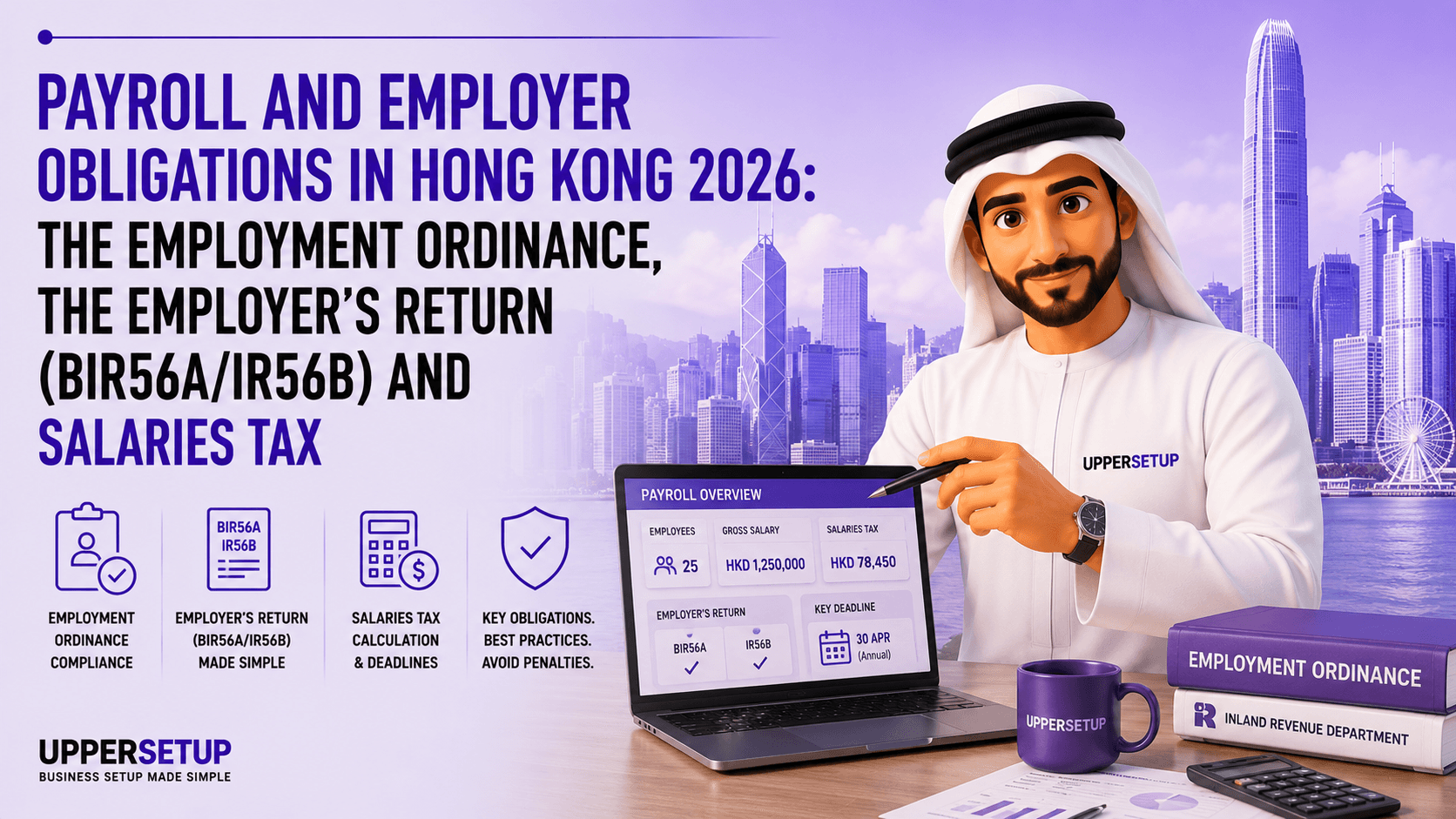
A Hong Kong employer does not withhold income tax from an employee's pay. Its tax duty is a reporting duty: file the annual Employer's Return (Form BIR56A together with Forms IR56B) and notify the Inland Revenue Department during the year of every hire, cessation and departure using Forms IR56E, IR56F and IR56G. Running in parallel is the labour perimeter: the Employment Ordinance (Cap. 57), the Minimum Wage Ordinance (Cap. 608), the Mandatory Provident Fund Schemes Ordinance (Cap. 485) and the Employees' Compensation Ordinance (Cap. 282). The two perimeters are procedurally unconnected, but a breach of either is a criminal offence rather than an administrative one.
⚠ The 2026 headline: from 18 January 2026 the "418 rule" has been replaced by the "417/468" test. The weekly threshold for a continuous contract drops from 18 to 17 hours, and an alternative test of 68 hours across a four-week period is added. Staff on irregular rosters who previously fell outside paid holidays, annual leave and sickness allowance may now qualify. Nothing needs restating retrospectively, but rosters and hour records must be reviewed.
Who counts as an employer, and when do the obligations start
An employer's tax obligations in Hong Kong begin when the first employee is hired — not when the first letter arrives from the Inland Revenue Department. The IRD states this directly: obligations commence on hiring, and payroll records must be maintained from that same moment.
Employer status does not depend on where the employee physically works or whether they are a Hong Kong resident. A Hong Kong company must file Form IR56B for an employee whether services were rendered in or outside Hong Kong, provided total income exceeded the limit set out in Note 1(a) of the Notes and Instructions for Form BIR56A. Where an employee is stationed in a Beijing office and visited Hong Kong for fewer than 60 days in the year, that fact is noted in item 14 of the form — it does not remove the filing duty.
Payroll and employment records must be kept for at least 7 years.
The IRD specifies what those records must contain: personal particulars (name, address, identity card or passport number with place of issue, marital status), the nature of employment (full-time or part-time), the capacity in which the person is employed, cash remuneration in any currency including sums paid outside Hong Kong, non-cash and fringe benefits (quarters, holiday journey benefits, share awards, share options), employer and employee contributions to the MPF or an equivalent scheme, the employment contract with all amendments, and the period of employment.
A parallel duty applies under the Employment Ordinance: an employer must at all times keep a record of the wage and employment history of each employee covering the preceding 12 months.
These are two distinct requirements with different horizons: 7 years is the IRD tax rule, 12 months is the Labour Department employment rule. The Employment Ordinance record must also capture periods of paternity leave taken and the payments made for them.
A separate duty is to inform the IRD of changes in an employee's personal particulars, changes in the terms of employment (for example a move from full-time to part-time), and the employee's Hong Kong Identity Card number where this was not available at the time of filing — a common situation for staff recruited overseas or seconded from a foreign parent.
Continuous contract: why the "418 rule" no longer applies from 18 January 2026
A continuous contract is the status under the Employment Ordinance that determines the scope of an employee's rights. Every employee in Hong Kong, regardless of hours or length of service, is entitled to statutory holidays, wage protection and protection against anti-union discrimination. But paid rest days, paid annual leave, sickness allowance, maternity and paternity pay, severance payment and long service payment are available only to those employed under a continuous contract.
Until 18 January 2026 the test was the "418 rule": four or more consecutive weeks with the same employer at 18 hours or more in each week. The threshold was rigid — a single week at 17 hours broke the chain. The Employment (Amendment) Ordinance 2025, passed by the Legislative Council on 18 June 2025, replaced it with a dual test.
From 18 January 2026 a week counts towards a continuous contract if the employee worked at least 17 hours in that week, or — where fewer than 17 hours were worked — at least 68 hours in aggregate over the four-week period comprising that week and the three preceding weeks.
One limitation is routinely missed: the "468" limb does not apply to the first three weeks of a new employment, because the employee must have been employed by that employer throughout the four-week window. During those first three weeks only the 17-hour weekly threshold operates.
A second point matters for the arithmetic: hours of absence taken as statutory leave entitlement, or by mutual arrangement between employer and employee including agreed unpaid leave, count as hours worked. This follows from the First Schedule to the Employment Ordinance and changes the result for anyone who was on leave for part of the month.
|
Parameter |
Before 18 January 2026 ("418") |
From 18 January 2026 ("417/468") |
|
Weekly hours threshold |
18 hours |
17 hours |
|
Alternative test |
None |
68 hours across 4 weeks |
|
Minimum period |
4 consecutive weeks |
4 consecutive weeks |
|
First 3 weeks of employment |
18-hour threshold |
17-hour threshold; "468" limb unavailable |
|
Qualifying criteria for benefits |
Unchanged |
Unchanged |
The amendment did not touch the qualifying criteria for individual entitlements. Statutory holiday pay still requires a continuous contract of not less than three months immediately preceding the holiday; paid annual leave still accrues for every 12 months under a continuous contract. What changed is the entry point into the system, not the system itself.
The legal framework: five ordinances, three regulators
Employer obligations in Hong Kong are distributed across five ordinances and three separate regulators. This is structural: there is no single labour code and no payroll tax.
|
Ordinance |
Regulator |
Scope |
|
Employment Ordinance (Cap. 57) |
Labour Department |
Continuous contract, wage payment deadlines, rest days, holidays, annual leave, sickness allowance, maternity and paternity, severance and long service payment, termination notice |
|
Minimum Wage Ordinance (Cap. 608) |
Labour Department / Minimum Wage Commission |
Statutory minimum wage rate and the monetary cap triggering the duty to record hours worked |
|
Mandatory Provident Fund Schemes Ordinance (Cap. 485) |
MPFA / eMPF Platform |
Scheme enrolment, mandatory contributions, deadlines, default surcharge |
|
Employees' Compensation Ordinance (Cap. 282) |
Labour Department |
Compulsory employees’ compensation insurance, payments for work injuries |
|
Inland Revenue Ordinance (Cap. 112) |
Inland Revenue Department |
Employer reporting on IR56 forms, record keeping, withholding money on an employee’s departure |
The practical implication for in-house teams is that payroll compliance in Hong Kong cannot be outsourced to a single "tax" provider. The tax track (IRD) and the labour track (Labour Department, MPFA) run in parallel with different deadlines and different sanctions. For the wider annual cycle of a Hong Kong company, see Mandatory Annual Compliance for Hong Kong Companies 2026.
When wages must be paid, and what late payment costs
Wages become due on the expiry of the last day of the wage period — one month unless the parties agree otherwise — and must be paid as soon as practicable, and in any case not later than 7 days after the end of that period. On termination, payment is due within 7 days of the last day of employment.
Where wages are not paid within 7 days of becoming due, the employer must pay interest on the outstanding amount.
What the law treats as wages
The definition drives the calculation of nearly every statutory payment. Wages means all remuneration, earnings, allowances, tips and service charges, however designated or calculated, payable in respect of work done or to be done and capable of being expressed in money. Travelling allowances, attendance allowances, commission and overtime pay fall within it.
Excluded from wages are: the value of accommodation, education, food, fuel, water, light or medical care provided by the employer; the employer's contribution to any retirement scheme; commission, attendance allowance or attendance bonus that is gratuitous or payable only at the employer's discretion; non-recurrent travelling allowances and reimbursement of actual travel expenses; sums to defray special expenses arising from the nature of the employment; an end of year payment or annual bonus that is gratuitous or discretionary; and a gratuity payable on completion or termination of the contract.
Overtime pay is included in calculating statutory entitlements if it is of a constant character, or if its monthly average over the past 12 months is not less than 20% of the employee's average monthly wages over the same period.
This same definition governs end of year payment, maternity and paternity leave pay, severance payment, long service payment, sickness allowance, holiday pay, annual leave pay and payment in lieu of notice. Misclassifying a bonus as discretionary — or failing to recognise overtime as constant — therefore propagates across the whole group of payments at once.
Deductions from wages
Deductions are prohibited except on an exhaustive list of grounds: absence from work, proportionate to the time absent; damage to or loss of the employer's property through the employee's neglect or default, capped at the value of the loss and at HKD 300 in any one case, and at one quarter of the wages for the period; recovery of advanced or overpaid wages, capped at one quarter of the wages for the period; the value of food and accommodation supplied; contributions to medical, superannuation, retirement or thrift schemes at the employee's written request; recovery of a loan with the employee's written consent; recovery of paternity leave pay where the required document is not provided in time; deductions required or authorised by statute; and deductions for outstanding maintenance under an Attachment of Income Order.
Total deductions in any one wage period, other than for absence from work and outstanding maintenance, must not exceed one half of the wages payable for that period without the written approval of the Commissioner for Labour.
An illegal deduction is a standalone offence carrying a fine of up to HKD 100,000 and imprisonment for one year.
The criminal exposure is far heavier than founders from most jurisdictions expect. An employer who wilfully and without reasonable excuse contravenes sections 23, 24 or 25 of the Employment Ordinance commits an offence under section 63C and is liable to a fine of HKD 350,000 and to imprisonment for 3 years. Failure to pay the interest on overdue wages is a separate offence carrying a fine of HKD 10,000.
⚠ A source conflict worth knowing. Several reference sites still quote "a fine of HKD 200,000 and imprisonment for one year". That is the pre-amendment level of section 63C: the Legislative Council paper on the Employment (Increase in Penalty for Offences) Bill describes exactly that figure as the reason the maximum needed raising. The level in force is HKD 350,000 and 3 years. Verify any figure on this topic against the Labour Department rather than against aggregator sites.
The statute also addresses officers directly: where a wage offence by a body corporate is proved to have been committed with the consent or connivance of, or to be attributable to any neglect on the part of, a director, manager, secretary or similar officer, that person is guilty of the like offence and liable to the same penalty.
There is a civil consequence that is easy to overlook: if wages are not paid within one month of becoming due, the employee may deem the contract terminated by the employer without notice and claim payment in lieu of notice in addition to all other statutory and contractual termination payments.
Hong Kong case law on this offence is unforgiving. Financial difficulty is not a reasonable excuse: choosing to meet other operating expenses instead of wages has been treated as a calculated decision to break the law. The corporate veil offers no shelter either — directors and officers can be prosecuted personally where they were party to the breach. The Labour Department also issues press releases naming convicted employers, and conviction records remain publicly available on its website.
A separate offence covers failure to satisfy an award of the Labour Tribunal or the Minor Employment Claims Adjudication Board: wilfully failing to pay the awarded sum within 14 days after it becomes due carries a fine of HKD 350,000 and imprisonment for 3 years.
Statutory minimum wage from 1 May 2026: new rate, new record-keeping cap
The statutory minimum wage in Hong Kong is HKD 43.1 per hour with effect from 1 May 2026, up from HKD 42.1. This is the first increase under the new mechanism: the rate was previously reviewed every two years, and the Minimum Wage Commission now conducts an annual review using an approved formula tied to headline Consumer Price Index (A) inflation and real economic growth indicators.
The SMW rate from 1 May 2026 is HKD 43.1 per hour and applies to all hours worked on or after that date, even where it falls part-way through a wage period.
The monthly monetary cap below which an employer must record the total number of hours worked rose in tandem, from HKD 17,200 to HKD 17,600. Where an employee's wages for a wage period are less than HKD 17,600, the hours record is mandatory. It is a technical duty with real consequences: without hour records an employer cannot demonstrate SMW compliance on inspection.
On the Labour Department's own statement, unless otherwise specified the Minimum Wage Ordinance applies to every employee, their employer and the contract of employment under which they are engaged. A continuous contract is therefore not a precondition for the minimum wage — which distinguishes the SMW from most other Employment Ordinance entitlements. The rate applies across monthly-rated, daily-rated, hourly-rated and piece-rated pay, and to permanent, casual, full-time and part-time staff alike. An exemption applies to student interns and work experience students during a period of exempt student employment. Compliance is tested by a single formula: wages actually paid for a wage period must be no less than total hours worked multiplied by the SMW rate. For monthly-paid staff this means a nominally generous salary can still fail the test if actual hours were high.
Foreign domestic helpers sit outside the SMW regime and are covered instead by the separate Minimum Allowable Wage set by the Government outside the Minimum Wage Ordinance.
Employees with disabilities enjoy the same protection but may invoke a productivity assessment, following which pay is set either at no less than the SMW rate or at a rate commensurate with the assessed productivity.
Statutory holidays, leave and paid absences in 2026
Hong Kong has 15 statutory holidays in 2026 — one more than in 2025. Easter Monday was added under the Employment (Amendment) Ordinance 2021, which phases statutory holidays up from 12 to 17 by 2030.
There are 15 statutory holidays in 2026. Good Friday becomes a statutory holiday in 2028 and the day following Good Friday in 2030, at which point the list aligns with the 17 general holidays.
The distinction matters for payroll. Statutory holidays are mandatory for every employer under the Employment Ordinance. General holidays — 17 days under the General Holidays Ordinance — are compulsory for banks, public offices and educational institutions, and apply in the private sector only where the contract or company policy says so. Employers whose contracts simply say "public holidays" invite an interpretation dispute; the wording is worth tightening.
Holiday pay is due to an employee employed under a continuous contract for not less than three months immediately preceding the holiday, calculated on the average daily wages of the 12-month period preceding it. Paying an employee in lieu of a statutory holiday is prohibited. Where a statutory holiday falls on a rest day, the holiday is granted on the following day that is not itself a statutory, alternative or substituted holiday or a rest day.
One of the fifteen 2026 days is the employer's choice: the fourteenth statutory holiday is either the Chinese Winter Solstice Festival (22 December) or Christmas Day (25 December), at the employer's option. Where an employee is required to work on a statutory holiday, an alternative holiday must be arranged within 60 days before or after it, with not less than 48 hours' notice; by agreement, a substituted holiday may instead be taken within 30 days before or after.
Paid annual leave
Entitlement arises after every 12 months under a continuous contract and increases with service.
|
Completed years of service |
Days of paid annual leave |
|
1 to 2 |
7 |
|
3 |
8 |
|
4 |
9 |
|
5 |
10 |
|
6 |
11 |
|
7 |
12 |
|
8 |
13 |
|
9 or above |
14 |
Annual leave is granted for an unbroken period: where entitlement does not exceed 10 days, up to 3 days may be granted separately and the balance consecutively; where it exceeds 10 days, at least 7 days must run consecutively. The timing is appointed by the employer after consultation with the employee, confirmed in writing at least 14 days in advance. Payment in lieu of leave is permitted only for the part of the entitlement exceeding 10 days.
Sickness days and sickness allowance
Sickness allowance arises only where three conditions are met together: the sick leave runs for not less than four consecutive days (days taken for pregnancy check-ups, post-confinement medical treatment or miscarriage are an exception), the employee has accumulated enough paid sickness days, and the leave is supported by an appropriate medical certificate.
Paid sickness days accrue at 2 days for each completed month of employment during the first 12 months and 4 days for each completed month thereafter, capped at 120 days at any one time. Sickness allowance is four-fifths of average daily wages.
Paid sickness days fall into two categories: Category 1 accrues first up to 36 days, then Category 2 up to 84 days. The practical difference is evidential — for Category 2 the employer may require a medical certificate from the practitioner who attended the employee as an out-patient or in-patient, together with a brief record of the investigation carried out and the treatment prescribed. The employer must keep a record of sickness days accumulated and taken; the employee signs it within seven days of returning to work and has the right to inspect it.
⚠ Terminating an employee on a paid sickness day is prohibited except in cases of summary dismissal for serious misconduct. Breach carries a fine of up to HKD 100,000 plus an obligation to pay, within 7 days of termination, payment in lieu of notice, a further sum equal to seven days' wages as compensation, and any sickness allowance due.
Maternity and paternity leave
Maternity leave is a continuous period of 14 weeks, extended by the number of days between the expected and actual date of confinement where confinement is late, plus up to 4 further weeks for illness or disability due to pregnancy or confinement. Paid leave requires a continuous contract of not less than 40 weeks immediately before the scheduled maternity leave begins and proper notice to the employer. The rate is four-fifths of average daily wages.
Maternity leave pay for the 11th to 14th weeks is subject to a cap of HKD 80,000. Having paid the full amount on the normal pay day, the employer may apply for reimbursement of that portion through the Reimbursement Easy Portal (rmlps.gov.hk).
The reimbursement scheme is an administrative scheme of the Government rather than a statutory entitlement of the employer — which matters for cash planning, since the employee's right to be paid exists regardless of whether reimbursement is received. Dismissing a pregnant employee between confirmation of pregnancy by medical certificate and the date she is due to return from maternity leave is prohibited; breach carries a fine of up to HKD 100,000 plus payment in lieu of notice, a further sum equal to one month's wages, and 14 weeks' maternity leave pay.
Paternity leave is 5 days for each confinement of the employee's spouse or partner, paid at four-fifths of average daily wages where the employee has a continuous contract of not less than 40 weeks. The procedural trap: the employee must notify the intention to take paternity leave at least 3 months before the expected date of delivery, and where that notice was not given, must notify the date of leave at least 5 days beforehand. Leave may be taken from 4 weeks before the expected date of delivery until 14 weeks from the actual date, in one block or separately.
⚠ The average daily wages (ADW) method is the single largest source of payroll error in Hong Kong. Variable pay such as commissions and allowances is included, while periods in which the employee was not paid or was not paid in full are excluded. A naive "salary ÷ days" calculation is almost always wrong where there is a variable component or unpaid absence.
MPF: contributions, thresholds, deadlines and the eMPF Platform
An employer must enrol every employee aged 18 to 64 employed for a continuous period of 60 days or more into a Mandatory Provident Fund scheme within the first 60 days of employment. The duty applies equally to full-time and part-time staff. Casual employees in the construction and catering industries fall under separate Industry Schemes with no 60-day threshold.
Mandatory contributions are 5% of relevant income from the employer's own funds plus 5% deducted from the employee. The minimum relevant income level is HKD 7,100 per month and the maximum is HKD 30,000 per month, capping each side's contribution at HKD 1,500 per month.
One asymmetry is regularly misread: where monthly income falls below HKD 7,100, the employee is relieved of their own contribution but the employer must still pay its 5%. For employees paid on other cycles the thresholds are derived from daily levels of HKD 280 and HKD 1,000 — a weekly-paid employee therefore has a maximum of HKD 7,000 and a minimum of HKD 1,960.
A new employee enjoys a contribution holiday: no employee contribution for the first 30 days of employment, nor for the incomplete wage period immediately following those 30 days where the wage period is a month or shorter, nor for the calendar month in which the 30th day falls where the wage period is longer. The relief is the employee's alone — the employer's liability accrues from day one and is settled once the 60th day is reached.
The first contribution for a new employee is due on or before the contribution day — the 10th day of the calendar month in which the employee's 60th day of employment falls. Contributions are then payable monthly by the 10th day of the following month.
Administration has moved to the centralised eMPF Platform, and according to the platform's own guidance all MPF schemes, including Industry Schemes, have completed onboarding. The practical consequence is that legacy trustee portals are closed: enrolment, remittance statements, termination notifications and payment all run through one interface. Termination must be notified within 10 days after the last day of the calendar month in which the employment ceased.
MPF sanctions are separate from the labour and tax tracks. Late payment triggers a surcharge of 5% of the default contributions, credited in full to the employee's account; the MPFA may additionally impose a financial penalty of HKD 5,000 or 10% of the default amount, whichever is greater. Failure to enrol an employee carries a maximum fine of HKD 350,000 and 3 years' imprisonment; failure to pay mandatory contributions carries HKD 450,000 and up to 4 years. A dedicated analysis of the pension perimeter is available in The MPF in Hong Kong: Employer Obligations, Deadlines and Penalties in 2026. Where payroll and MPF administration sit with a small team without a dedicated specialist, the function is a natural candidate for outsourcing — UPPERSETUP HR services cover eMPF Platform enrolment, contribution calculation and deadline control.
Abolition of MPF offsetting from 1 May 2025: how severance and long service payment work now
From 1 May 2025 an employer can no longer use accrued benefits derived from its mandatory MPF contributions to offset severance payment (SP) or long service payment (LSP) attributable to employment on or after that date. 1 May 2025 carries the formal label of the transition date.
The abolition has no retrospective effect, and that is the key to the whole structure. For employees who joined before 1 May 2025 and leave afterwards, SP/LSP splits in two. The pre-transition portion is calculated on wages and years of service as at the transition date and can still be offset with the employer's mandatory contributions. The post-transition portion cannot be offset with mandatory contributions and must be paid in cash.
Accrued benefits from employers' voluntary MPF contributions, and gratuities based on length of service, may still be used to offset both portions.
The formula itself is unchanged: two-thirds of the last full month's wages multiplied by reckonable years of service, with the monthly wage figure capped at HKD 22,500 — a maximum of HKD 15,000 per completed year. The overall ceiling for SP or LSP per employee is HKD 390,000; where the calculation exceeds it, the excess is deducted from the post-transition portion rather than the pre-transition one.
To cushion the change, the Labour Department launched the 25-year Subsidy Scheme for Abolition of MPF Offsetting Arrangement (SSA) on the same date, sharing out employers' expenses on the post-transition portion. The first subsidy year ran from 1 May 2025 to 30 April 2026, the second from 1 May 2026 to 30 April 2027, and so on; the subsidy ratio steps down year on year across the 25-year period. The subsidy operates as reimbursement — the employer pays the employee first, then applies.
⚠ An expensive misconception: dismissing staff "before the transition date" never produced a saving. The pre-transition portion is fixed by wages and service as at 1 May 2025 and does not grow with later pay rises or longer service. What does matter is record keeping — the Labour Department specifically advises retaining wage records for the 12 months immediately preceding the transition date, without which the pre-transition portion cannot be computed years later.
One point of housekeeping: the previously proposed Designated Savings Accounts scheme, which would have required employers to pre-fund future SP/LSP liabilities, was not implemented — the Government confirmed in 2023 that it would not proceed. References to a DSA obligation are out of date.
Salaries tax: why there is no withholding at source
Hong Kong has no employer withholding for salaries tax. Employees receive their pay in full, net only of their own MPF contribution, and settle with the Inland Revenue Department after the year end on the basis of their own return (BIR60) and the resulting assessment.
That is precisely why employer reporting is informational rather than a payment obligation: the IRD raises individual salaries tax assessments on the strength of employer-filed data. An error on Form IR56B creates no liability for the company but distorts the employee's tax position directly — which is why the IRD treats accuracy on these forms strictly.
Two exceptions to the no-withholding principle both sit with the employer. The first is the duty to withhold all sums due to an employee leaving Hong Kong until tax clearance is obtained (discussed below). The second is a Recovery Notice under section 76(1) of the Inland Revenue Ordinance: where an employee has not settled their tax, the IRD may require the employer to deduct the tax from the employee's salary and remit it.
The Employer's Return: who goes on BIR56A and IR56B, and by when
The Employer's Return is the annual report of remuneration paid. Form BIR56A is the cover declaration; Forms IR56B carry the data for each reportable person. The Hong Kong year of assessment runs from 1 April to 31 March.
Forms BIR56A for the year ended 31 March 2026 were issued by the IRD on 1 April 2026. The filing deadline is one month from the date of issue.
The IRD normally issues BIR56A on the first working day of April. An employer required to file IR56B for persons within Note 1(a) of the Notes and Instructions for Form BIR56A that has not received the return by mid-April — or has lost or damaged it — must request one using Form IR6163. A duplicate BIR56A can also be obtained through the IRD website.
A nil return is compulsory. Where there are no employees or pensioners to report, the company ticks "NO", signs the BIR56A and files it. The duty survives even where the business has not commenced or has ceased.
Who must be reported on IR56B for 2025/26
The IRD's selection criteria differ by employee status:
• Single employees with annual income of HKD 132,000 or more — for 2025/26 the threshold matches that year's basic allowance;
• Married employees — regardless of amount;
• Part-time staff — regardless of amount;
• Directors — regardless of amount;
• Employees of a non-Hong Kong company assigned or seconded to the company during the year for duties in or outside Hong Kong;
• Persons to whom a pension was paid or accrued during the year;
• Former employees and former directors who realised a gain during the year on the exercise, assignment or release of a previously granted share option.
⚠ The threshold tracks the basic allowance of the relevant year rather than a fixed figure. For 2025/26 the basic allowance is HKD 132,000. From 2026/27 it rises to HKD 145,000, and the reporting threshold follows. Before filing in April 2027, confirm the figure against the then-current Notes and Instructions for Form BIR56A — that document, not last year's practice, is the source of the rule.
Where the employee worked for less than a full year, the threshold applies proportionately reduced. For pensioners who have left Hong Kong permanently, only pensions in excess of the basic allowance need be reported.
What counts as reportable income
Everything taxable is reportable, not merely base salary: wages, leave pay, fees, commissions, bonuses, gratuities, perquisites and allowances. Several categories need particular care — housing benefits, where the IRD computes a rental value as a percentage of other income unless the actual rent paid is higher; holiday journey benefits; termination payments; back pay, contract gratuities and arrears; and share awards and share options.
Where an employee is partly paid by a non-Hong Kong subsidiary for services rendered to that subsidiary abroad, the Hong Kong company reports the aggregate paid by both entities in item 11 of Form IR56B and repeats the amount paid by the foreign entity in item 13. The employer reports full remuneration regardless of whether the employee may claim exemption; the exemption claim is the employee's to make in their own return.
Amounts are reported in Hong Kong dollars. The IRD publishes average exchange rates for major currencies for salaries tax purposes; for other currencies any reasonable externally sourced average rate may be used, applied consistently.
After filing, the employer must give the employee a copy of the completed form — it is what allows them to complete their own return correctly. Preparing and filing the BIR56A/IR56B set, including the treatment of non-cash benefits and currency conversion, can be handed to the UPPERSETUP accounting services team.
IR56E, IR56F and IR56G: notifying hires, leavers and departures
The annual return is not the whole duty. Three events during the year each require their own notification, each with its own deadline and its own provision of the Inland Revenue Ordinance.
|
Event |
Form |
Deadline |
IRO provision |
|
Commencement of employment |
IR56E |
Within 3 months of commencement |
s. 52(4) |
|
Still employed as at 31 March |
IR56B |
Within 1 month of issue of BIR56A |
s. 52(2) |
|
Cessation of employment (or death) |
IR56F |
Not later than 1 month before cessation |
s. 52(5) |
|
Departure from Hong Kong for good or a substantial period |
IR56G |
At least 1 month before the expected departure date, plus withholding of money |
ss. 52(6) and 52(7) |
IR56E and IR56F are filed in one copy each; IR56G must be filed in two copies.
In the year employment starts, both IR56E and IR56B are required. In the year employment ends, IR56B is not filed if IR56F or IR56G has already been submitted for that person — reporting the same income twice can result in the employee being taxed twice on it.
IR56G and the withholding mechanism
Departure is the riskiest of the three procedures. The employer must ascertain the employee's expected departure date, file two copies of IR56G at least one month beforehand, and from the date of filing withhold all amounts due to the employee — salary, commission, bonus, reimbursement of rent or expenses, and anything else in money or money's worth.
Withholding ends only once the employee has completed tax clearance and produces a letter of release issued by the IRD. If the employee fails to settle, the IRD issues a recovery notice (Form IR113C) to the employer requiring the employee's tax to be settled out of the money withheld.
⚠ The "paid it out and let them go" error cannot be undone. An employer that releases the withheld sums before the letter of release is produced, where the employee then leaves without settling, is left holding the recovery notice with no funds against which to meet it.
Logistics worth knowing: where the employee pays by cash, EPS or cashier order at a post office counter, a letter of release can be obtained the same day at the Collection Office, with preparation taking roughly 30 to 40 minutes. Where payment is by cheque or a mixed method, the letter is normally posted around 10 days later. Even where the employee turns out to be exempt from tax, a letter of release is still issued on completion of clearance — no tax payable does not remove the procedure. Where a departure coincides with a dispute over final payments or a two-portion SP/LSP computation, the process is best run with UPPERSETUP legal servicesalongside.
Payments to persons who are not employees
A separate reporting block covers payments to local individuals who are neither employees nor incorporated businesses. Forms IR56M with the covering Form IR6036B are required where payments to consultants, agents, brokers, freelance artistes, entertainers, sportsmen, writers, freelance guides and similar persons exceed HKD 25,000 per annum, or where payments to sub-contractors exceed HKD 200,000 per annum. Payments to non-resident professionals may be reported on Form IR623P; payments to non-resident entertainers and sportsmen require Form IR623 together with withholding of an amount sufficient to meet the tax under sections 20A and 20B of the IRO.
Salaries tax rates, allowances and the one-off reduction
Salaries tax is computed two ways, and the lower result applies: progressive rates on net chargeable income (after deductions and personal allowances), or the standard rate on net income (after deductions but before allowances).
|
Band of net chargeable income |
Progressive rate |
|
First HKD 50,000 |
2% |
|
Next HKD 50,000 |
6% |
|
Next HKD 50,000 |
10% |
|
Next HKD 50,000 |
14% |
|
Remainder |
17% |
Since 2024/25 the standard rate has been two-tiered: 15% on the first HKD 5,000,000 of net income and 16% on the remainder. Neither the progressive nor the standard rates change for 2026/27.
Allowances, by contrast, have risen. The relevant legislation from the 2026-27 Budget was passed by the Legislative Council on 13 May 2026 and gazetted on 22 May 2026.
|
Allowance |
2025/26, HKD |
From 2026/27, HKD |
|
Basic Allowance |
132,000 |
145,000 |
|
Married Person's Allowance |
264,000 |
290,000 |
|
Single Parent Allowance |
132,000 |
145,000 |
|
Child Allowance (each of the 1st to 9th child) |
130,000 |
140,000 |
|
Additional Child Allowance (per child) |
130,000 |
140,000 |
|
Dependent Parent / Grandparent (aged 60 or above) |
50,000 |
55,000 |
|
Dependent Parent / Grandparent (aged 55 to 59) |
25,000 |
27,500 |
From 2026/27 the deduction ceiling for elderly residential care expenses also rises from HKD 100,000 to HKD 110,000, and the additional child allowance for newborns can be claimed for two years rather than one — twice the allowance (HKD 280,000 at the 2026/27 child allowance of HKD 140,000) for each child in the first two years after birth, applying to all children born on or after 1 April 2025.
For 2025/26 a one-off reduction of salaries tax of 100% applies, capped at HKD 3,000 per case.
Employers should understand the limits of the measure. The reduction applies to the final tax for 2025/26 but not to provisional tax for the same year, so provisional tax remains payable on time. For jointly assessed married couples the HKD 3,000 cap applies to the couple, not to each spouse. The IRD applies the reduction automatically in the final assessment and applies the new allowance amounts automatically when computing 2026/27 provisional salaries tax — no application is needed.
Electronic filing: eTAX, the new tax portals and the end of storage devices
The IRD is steadily moving employer reporting online. The Employer's Return can be filed through the Employer's Return e-Filing Services in two modes: Online Mode, where BIR56A and IR56B are submitted entirely electronically, and Mixed Mode, where IR56B data is uploaded and a signed Control List is submitted with the paper BIR56A.
From 1 April 2024 the IRD ceased to accept IR56B records submitted through any storage device. The Employer's Return e-Filing Services is the only electronic channel.
Two preparation routes are available: the IR56 Forms Preparation Tool, which covers Forms IR56B/E/F/G/M and can be used to prepare the annual IR56B data file from 1 March each year, and pre-approved self-developed software. Electronic filing covers the full set — BIR56A/IR56B, IR6036B/IR56M and IR56E/F/G.
Paper requirements remain strict: forms are completed in blue or black ink, printed on white plain A4 paper, and the BIR56A and every IR56B must be signed by the same responsible person with original signatures. Photocopies, faxes and scans are not accepted. BIR56A may be signed by the proprietor (sole proprietorship), precedent partner (partnership), company secretary, manager, director, investment manager (for an open-ended fund company), provisional liquidator or liquidator (corporation), or principal officer (body of persons).
Extensions are possible but only on written application quoting the employer's file number, the company name, the year of assessment, the additional time required and the supporting reasons. There is no automatic extension for the annual Employer's Return equivalent to the Block Extension Scheme available to tax representatives.
Where information already filed proves incorrect, it is corrected by an additional, replacement or supplementary form, or by written notification of amendment.
Penalties: three independent sanction tracks
Breaches in the Hong Kong payroll perimeter are punished by three different authorities under three different ordinances, and the tracks do not absorb one another.
Tax track (IRD)
Failure to comply with the IR56B/E/F/G requirements is a serious offence carrying a fine of HKD 10,000.
Section 80(2) of the Inland Revenue Ordinance adds to this. A person who without reasonable excuse makes an incorrect return by omission or understatement, makes an incorrect statement in connection with a claim for a deduction or allowance, gives incorrect information affecting their own or another person's liability to tax, or fails to comply with a notice under section 51(1) or (2A), commits an offence and is liable to a fine of HKD 10,000 plus a further fine of treble the amount of tax undercharged in consequence. Wilful evasion falls under section 82 and carries materially heavier consequences, including imprisonment.
Administrative penalties under section 82A run in parallel and, as the IRD states in its Penalty Policy, section 82A does not distinguish between understatement of income and late filing — exposure to treble the tax undercharged is formally available for both. Penalty levels for simple late filing are lower in practice, but a higher loading is applied where the taxpayer deliberately delayed filing pending the outcome of an audit or investigation.
Labour track (Labour Department)
Labour sanctions are set offence by offence, and the amounts differ materially.
|
Offence |
Maximum penalty |
|
Wilful failure to pay wages when due |
HKD 350,000 and 3 years’ imprisonment |
|
Failure to pay interest on overdue wages |
HKD 10,000 |
|
Illegal deduction from wages |
HKD 100,000 and 1 year’s imprisonment |
|
Failure to grant rest days, or compelling work on a rest day |
HKD 50,000 |
|
Failure to grant statutory holidays or pay holiday pay |
HKD 50,000 |
|
Failure to grant annual leave or pay annual leave pay |
HKD 50,000 |
|
Failure to pay sickness allowance |
HKD 50,000 |
|
Dismissal on a paid sickness day |
HKD 100,000 plus compensation to the employee |
|
Failure to grant maternity leave or pay maternity leave pay |
HKD 50,000 |
|
Dismissal of a pregnant employee |
HKD 100,000 plus compensation to the employee |
|
Failure to grant paternity leave or pay |
HKD 50,000 |
|
Failure to satisfy a Labour Tribunal award within 14 days |
HKD 350,000 and 3 years’ imprisonment |
|
No employees’ compensation insurance under the ECO |
HKD 100,000 and 2 years’ imprisonment |
Employees' compensation insurance deserves separate attention as the only compulsory insurance cost an employer carries in Hong Kong. A policy under section 40 is required for all employees irrespective of contract length, hours, full-time or part-time status, and permanent or temporary engagement, and must cover liability both under the Ordinance and at common law. The minimum cover per event is HKD 100 million for an employer with not more than 200 employees and HKD 200 million above that headcount. Passing the premium on to staff is prohibited: deducting the cost of the cover from an employee's earnings is a separate offence.
Pension track (MPFA)
A surcharge of 5% of default contributions, credited to the employee; a financial penalty of HKD 5,000 or 10% of the default amount, whichever is greater; a maximum penalty of HKD 450,000 and 4 years' imprisonment for failing to pay mandatory contributions; and HKD 350,000 with 3 years' imprisonment for failing to enrol an employee. The MPFA also publishes default lists naming non-compliant employers.
The employer's annual calendar
|
Timing |
Action |
|
Monthly, by the 10th |
Pay mandatory MPF contributions for the previous month through the eMPF Platform |
|
Within 7 days of the end of the wage period |
Pay wages |
|
Within 10 days after the end of the month of cessation |
Notify the eMPF Platform of the termination |
|
From 1 March |
Prepare the annual IR56B data file using the IR56 Forms Preparation Tool |
|
1 April |
IRD issues Forms BIR56A for the year ended 31 March |
|
Within 1 month of issue |
File BIR56A and IR56B, including a nil return where applicable |
|
1 May |
New statutory minimum wage rate takes effect |
|
Within 3 months of hiring |
File IR56E for the new employee |
|
1 month before cessation |
File IR56F |
|
1 month before departure |
File IR56G in duplicate and begin withholding all payments |
Common mistakes and what they cost
The errors below recur most often in Hong Kong practice and each carries a measurable price.
• Filing IR56B for an employee already covered by IR56F or IR56G. The same income is reported twice and the employee is assessed on money they never received. Unwinding it means correspondence with the IRD and a reassessment, with the inconvenience falling on the employee.
• Confusing IR56F with IR56G. IR56F applies where the employee stops working but stays in Hong Kong; IR56G applies where they leave for good or for a substantial period. Only the latter triggers the withholding duty. Getting it wrong means either unlawfully withholding sums that are due, or losing the funds needed to answer a future recovery notice.
• Skipping the nil return. A company with no employees, or one that has not commenced or has ceased business, must still return a signed BIR56A ticked "NO". Non-filing is an offence in its own right carrying a HKD 10,000 fine, independent of any tax.
• Omitting employees below the threshold. The HKD 132,000 figure for 2025/26 applies to single employees only. Married employees, part-time staff and directors are reportable regardless of amount — including nominal directors' fees.
• Still applying the "418" test after 18 January 2026. An employee on an irregular roster reaching 68 hours across four weeks now holds a continuous contract. A payroll system still testing an 18-hour weekly threshold systematically underpays statutory holidays, annual leave and sickness allowance — a cumulative liability, not a one-off slip.
• Paying leave and holidays on base salary instead of ADW. The average daily wages method produces a different figure wherever there is variable pay or unpaid absence. The gap usually surfaces on termination and turns into a Labour Tribunal claim.
• No hours record for staff earning below HKD 17,600. The cap rose on 1 May 2026 and now captures more employees than a year earlier. Without hour records, SMW compliance cannot be demonstrated on inspection.
Who this regime suits, and when specialist review is warranted
Hong Kong remains one of the least expensive jurisdictions in the region for statutory payroll burden: there is no withholding on wages, no social contributions beyond the MPF and no payroll tax as such. The employer's maximum statutory cost per employee, over and above salary itself, is HKD 1,500 per month in MPF contributions plus the cost of compulsory ECO insurance.
The regime is comfortable for companies with a small full-time headcount on fixed salaries and no variable pay: the annual cycle reduces to timely contributions and a single April filing. It is materially harder for businesses with part-time staff, shift rosters and variable remuneration, where the "417/468" test, hour records, ADW calculations and the SMW check all operate at once.
Specialist review is genuinely warranted in four situations: terminating an employee whose service straddles 1 May 2025 (the two-portion SP/LSP computation and the subsidy application); an employee departing Hong Kong (the IR56G procedure and withholding); employees working partly outside Hong Kong (the split between items 11 and 13 of Form IR56B); and non-cash benefits, above all housing, where rental value is computed on special rules.
If you are building a Hong Kong team from scratch, the payroll perimeter is best designed alongside the corporate one: Hong Kong company registration, corporate bank accounts for non-residents and work visas for entrepreneurs and professionals close the adjacent gaps. Relocating staff and their families runs through visa services, and incorporation itself through company registration services. UPPERSETUP handles both accounting support and HR administration, including IR56 filings and eMPF Platform administration.
Frequently asked questions
Must an Employer's Return be filed if the company has no employees?
Yes. Once Form BIR56A is received, it must be completed and filed within one month even where there are no employees, the business has not commenced, or it has ceased. The "NO" box is ticked and the form signed by the responsible person.
Does a Hong Kong employer withhold income tax from salaries?
No. Salaries tax is settled by the employee after year end on the basis of an IRD assessment. The employer deducts only the employee's 5% MPF contribution. The exceptions are the withholding of all payments after filing IR56G until a letter of release is produced, and compliance with a Recovery Notice under section 76(1) of the IRO.
What is the income threshold for reporting an employee on IR56B?
For 2025/26 it is HKD 132,000 for single employees, matching that year's basic allowance. Married employees, part-time staff and directors have no threshold and are reported regardless of amount. From 2026/27 the basic allowance rises to HKD 145,000 and the threshold follows; the exact figure should be confirmed against the Notes and Instructions for Form BIR56A for the relevant year.
What should an employer do when an employee resigns and leaves Hong Kong?
File two copies of Form IR56G at least one month before the expected departure date and withhold all amounts due to the employee from the date of filing. Payment may be released only once the employee produces the letter of release issued by the IRD on completion of tax clearance. No IR56B is filed for that employee for the year.
How many statutory holidays does Hong Kong have in 2026?
Fifteen. Easter Monday was added as a new statutory holiday from 2026. Good Friday becomes statutory in 2028 and the day following Good Friday in 2030, bringing the total in line with the 17 general holidays.
Must the employer contribute to the MPF for an employee earning below HKD 7,100?
Yes. Below the minimum relevant income level only the employee is relieved of their own contribution. The employer pays its 5% in full.
Can MPF contributions still be offset against severance payment?
Only against the pre-transition portion — the part of the severance or long service payment attributable to employment before 1 May 2025. The portion attributable to service from that date cannot be offset with mandatory contributions. Voluntary employer contributions and service-based gratuities may be offset against both portions.
Who is liable for late payment of wages where the employer is a company?
Beyond the company itself, directors and officers party to the breach may be prosecuted personally. The maximum penalty is a fine of HKD 350,000 and imprisonment for 3 years. Hong Kong courts do not accept the company's financial difficulty as a reasonable excuse.
Key takeaways
• Forms BIR56A for the year ended 31 March 2026 were issued on 1 April 2026; the filing deadline is one month from issue. A nil return is compulsory.
• From 18 January 2026 the "417/468" test applies: 17 hours a week, or 68 hours across four weeks. The "468" limb is unavailable during the first three weeks of a new employment.
• From 1 May 2026 the statutory minimum wage is HKD 43.1 per hour and the hours-record cap is HKD 17,600 per month.
• MPF contributions are 5% and 5% within relevant income of HKD 7,100 to HKD 30,000, capped at HKD 1,500 per side, payable by the 10th of the following month through the eMPF Platform.
• Offsetting mandatory MPF contributions against SP/LSP survives only for the pre-transition portion — service before 1 May 2025.
• Late payment of wages is a criminal offence carrying up to HKD 350,000 and 3 years' imprisonment; non-compliance with the IR56 requirements carries a HKD 10,000 fine plus potential treble tax undercharged.
• Allowances rise from 2026/27, with the basic allowance at HKD 145,000; for 2025/26 a one-off 100% tax reduction applies, capped at HKD 3,000.
Summary
A Hong Kong employer does not withhold salaries tax from wages: the employee settles the tax on the basis of an Inland Revenue Department assessment. The employer's duty is to report and notify. Form BIR56A with Forms IR56B for the year ended 31 March 2026 was issued by the IRD on 1 April 2026 and must be filed within one month of issue, including a nil return where there is nothing to report. Form IR56E is filed within 3 months of the commencement of employment, IR56F one month before cessation, and IR56G in duplicate at least one month before an employee's departure from Hong Kong, with all sums due to that employee withheld until a letter of release is produced. For 2025/26 the reportable population on IR56B comprises single employees earning HKD 132,000 or more plus all married employees, part-time staff and directors regardless of amount. Salaries tax is charged at progressive rates from 2% to 17% or at two-tiered standard rates of 15% on the first HKD 5,000,000 of net income and 16% on the remainder, whichever is lower. The basic allowance is HKD 132,000 for 2025/26 and HKD 145,000 from 2026/27, and a one-off 100% tax reduction capped at HKD 3,000 applies for 2025/26. On the labour side, wages must be paid within 7 days of the end of the wage period on pain of a fine of up to HKD 350,000 and 3 years' imprisonment; from 18 January 2026 a continuous contract is determined by the "417/468" test; from 1 May 2026 the statutory minimum wage is HKD 43.1 per hour; and there are 15 statutory holidays in 2026. MPF contributions are 5% from the employer and 5% from the employee within relevant income of HKD 7,100 to HKD 30,000, capped at HKD 1,500 per side, payable by the 10th of the following month through the eMPF Platform, and offsetting against severance and long service payment has been abolished for service on or after 1 May 2025.
Sources
• Inland Revenue Department — Employers (www.ird.gov.hk/eng/tax/ere.htm)
• Inland Revenue Department — What tax obligation do I have as an Employer? (www.ird.gov.hk/eng/tax/ere_obl.htm)
• Inland Revenue Department — Obligations of An Employer, Form IR56H (www.ird.gov.hk/eng/pdf/ir56h_e.pdf)
• Inland Revenue Department — 2026-27 Budget: Tax Measures (www.ird.gov.hk/eng/tax/budget.htm)
• Inland Revenue Department — Penalty Policy (www.ird.gov.hk/eng/pol/ppo.htm)
• Labour Department — Statutory Minimum Wage (www.labour.gov.hk/eng/news/mwo.htm)
• Labour Department — Statutory Holidays for 2026 (www.labour.gov.hk/eng/news/latest_holidays2026.htm)
• Labour Department — Increase of Statutory Holidays (www.labour.gov.hk/eng/news/EAO2021.htm)
• Labour Department — Education Tool on the New "Continuous Contract" Requirement (www.labour.gov.hk/eng/labour/Continuous_Contract_EduTool.htm)
• Labour Department — Abolition of MPF Offsetting Arrangement (www.labour.gov.hk/eng/news/aoa.htm)
• Labour Department — A Concise Guide to the Employment Ordinance, Chapters 3 (Wages), 4 (Rest Days, Holidays and Leave), 5 (Sickness Allowance), 6 (Maternity Protection), 7 (Paternity Leave) (www.labour.gov.hk/eng/public/ConciseGuide.htm)
• Labour Department — Employers Must Take out Employees' Compensation Insurance (www.labour.gov.hk/eng/news/employers_must_take_out_employees_compensation_insurance.htm)
• Reimbursement of Maternity Leave Pay Scheme — Reimbursement Easy Portal (www.rmlps.gov.hk)
• KPMG — Hong Kong: Tax proposals in the 2026-2027 budget
• Subsidy Scheme for Abolition of MPF Offsetting Arrangement (www.offsettingsubsidy.gov.hk)
• Statutory Employment Entitlements Reference Calculator, Labour Department (www.lr.labour.gov.hk/web/en/calculator/index.html)
• MPFA — Mandatory Contributions: Employees (www.mpfa.org.hk/en/mpf-system/mandatory-contributions/employees)
• MPFA — Enrolment for Employees (www.mpfa.org.hk/en/mpf-system/enrolment-and-termination/employers-enrolment-for-employees)
• MPFA — Enforcement Measures and Penalties (www.mpfa.org.hk/en/enforcement/enforcement-against-employers/enforcement-measures-and-penalties)
• eMPF Platform — Employer FAQ (www.empf.org.hk/FAQ/employer)
• 1823 — FAQ on the new continuous contract requirement (www.1823.gov.hk/en/faq/about-eo-continuous-contract)
• Legislative Council — Report on the Employment (Increase in Penalty for Offences) Bill (www.legco.gov.hk)
• PwC — 2026/27 Hong Kong Tax Facts and Figures
• Norton Rose Fulbright — From the "418 rule" to the "468 rule": continuous contract rules revised
Disclaimer
This material is for informational purposes only and does not constitute legal, tax, financial, investment or consulting advice. Before making decisions, obtain individual professional advice taking account of your specific circumstances, jurisdiction, company status and current regulatory requirements. Information is accurate as of August 2026.
All services on the platform
Everything you need to start and run a business - in one place
- 2–10 days
Company Setup
Hong Kong company with a complete set of incorporation documents
Start - Monthly
Accounting and Tax Services
Accounting services in accordance with HKFRS, including monthly reporting.
- 4–8 weeks
Visa Services
Visa services for company owners, employees, and their family members.
- 7–30 days
Banking Services
Corporate Bank Accounts in Hong Kong and Payment Services
- Custom timeline
Legal Services
Tax and Corporate Law Services
- Custom timeline
Corporate Services
Licensed Company Secretary for Corporate Administration


