


























































 International Free Zone Authority
SAIF Zone in 2026: Sharjah’s Industrial and Logistics Free Zone — Legal Architecture, Tariffs, Designated Zone Status and the QFZP Regime
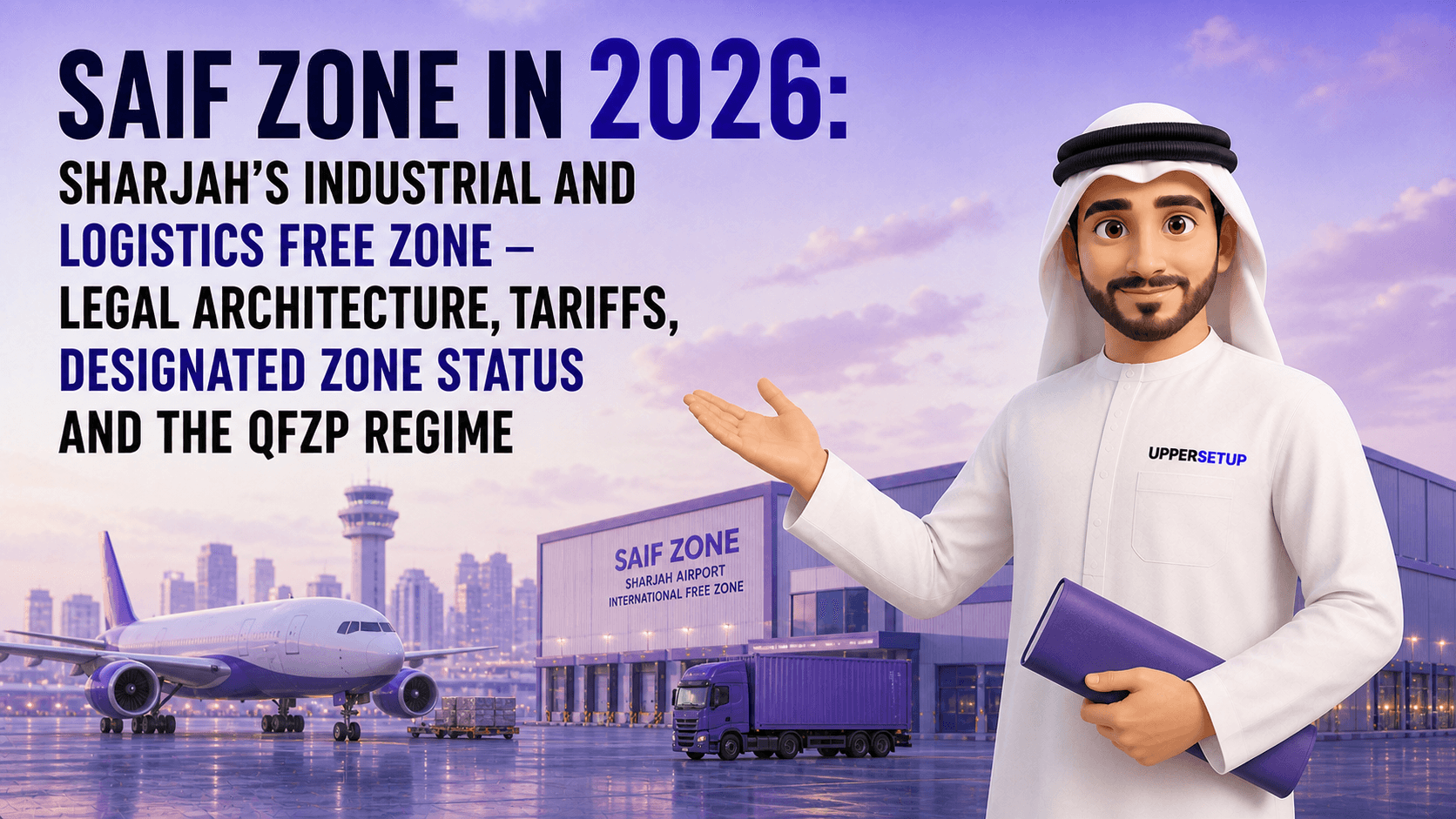
SAIF Zone (Sharjah Airport International Free Zone, هيئة المنطقة الحرة لمطار الشارقة الدولي) is a free zone of the Emirate of Sharjah, located immediately adjacent to Sharjah International Airport and established by Emiri Decree No. 2 of 1995. The zone has held Designated Zone status for UAE VAT purposes since 1 January 2018 and sits squarely inside the federal corporate tax perimeter, where its licensees can access the 0% rate only by satisfying the Qualifying Free Zone Person (QFZP) conditions. The emirate-level tax guarantee runs to 29 May 2073 under Emiri Decree No. 28 of 2023. The zone publishes no corporate rulebook of its own — no companies law, no employment regulations, no court — so federal UAE law applies to SAIF Zone companies to a far greater extent than in the UAE’s financial free zones.
⚠️ The single most important warning for 2026. The phrase “0% corporate income tax” on the zone’s own home page, and the statement in its FAQ that “neither any income tax nor any corporate tax [is] applicable or payable”, have both been legally inaccurate since 1 June 2023. The exemption granted by Emiri Decree No. 28 of 2023 covers taxes imposed in the Emirate of Sharjah, not the federal corporate tax under Federal Decree-Law No. 47 of 2022. The federal 0% rate applies only to the Qualifying Income of a person holding QFZP status; losing that status costs the 0% rate for the current Tax Period and the four subsequent Tax Periods(Ministerial Decision No. 229 of 2025, Article 5).
What SAIF Zone Is: Definition and Position Among Sharjah’s Free Zones
SAIF Zone is a free zone of the Emirate of Sharjah, created by an emirate-level instrument rather than a federal one, with its own licensing authority and customs centre but without any corporate legislation of its own. That definition drives everything that follows: what the zone gives, it gives at emirate level — exemption from emirate taxes, a licence, premises, a visa quota — and what it does not give arrives from federal UAE law instead (corporate tax, VAT, customs, AML, UBO, e-invoicing) or from the UAE’s civil and commercial codes.
The working formula for 2026 is this:
An emirate guarantee is not a federal exemption. Designated Zone status is not QFZP status. A SAIF Zone licence is not a right to trade on the mainland.
Each of those three conflations costs money, and each is unpacked in its own section below.
Sharjah hosts several free zones, and SAIF Zone is neither the only one nor the cheapest:
|
Sharjah free zone |
Founding instrument |
Profile |
Designated Zone status (VAT) |
|
SAIF Zone |
Emiri Decree No. 2 of 1995 |
Manufacturing, logistics, aviation, trading |
Yes, from 01/01/2018 |
|
Hamriyah Free Zone |
Emiri Decree No. 6 of 1995 |
Heavy industry, deep-water port |
Yes, from 01/01/2018 |
|
SHAMS (Sharjah Media City) |
Emiri Decree No. 10 of 2016 |
Media, creative and digital services |
No |
|
Sharjah Communication Technologies Free Zone (Comtech) |
Emiri Decree No. 32 of 2024, dated 26 June 2024 |
Technology, communications |
No |
|
SRTIP, Sharjah Publishing City |
Separate emirate instruments |
Science and innovation; publishing |
No |
UPPERSETUP covers the neighbouring Sharjah zones separately: Hamriyah Free Zone 2026, SHAMS 2026 and Comtech, Sharjah’s new technology free zone.
The Regulatory Framework: Which Instruments Actually Govern SAIF Zone
A SAIF Zone company’s regulatory framework has three levels that must not be blurred: Emirate of Sharjah instruments, UAE federal instruments, and the zone’s own rules. What follows is limited to instruments in force, with the date of issue and the date of entry into force stated separately.
Emirate of Sharjah level
|
Instrument |
Issued |
In force |
What it governs |
|
Emiri Decree No. 2 of 1995establishing a free zone at Sharjah International Airport and the Sharjah Airport International Free Zone Authority |
1995 (the exact day is not recoverable from the Official Gazette) |
1995 |
Establishes both the zone and its Authority; the baseline guarantees |
|
Emiri Decree No. 28 of 2023amending Decree No. 2 of 1995 |
29 May 2023 (Monday, 09 Dhu al-Qi’dah 1444 AH) |
From the date of issue, Article 3 |
Replaces Article 12 (50-year exemption from emirate taxes) and Article 14 (free transfer of capital, profits and wages) |
|
Sharjah Decree-Law No. 5 of 2020establishing the Sharjah Ports, Customs and Free Zones Authority |
27 July 2020 |
2020 |
Article 4 brings SAIF Zone and Hamriyah within the Authority’s perimeter; Article 12(3) preserves the zones’ independent legal personality; Article 16 is a general repeal of conflicting provisions |
|
Sharjah Executive Council Decision No. 42 of 2016 |
22 November 2016 |
1 January 2017 |
A local scientific-research support fee of AED 10 per transaction, expressly extended to free zone authorities |
UAE federal level
|
Instrument |
Issued |
In force |
What it governs |
|
Federal Decree-Law No. 47 of 2022 on the Taxation of Corporations and Businesses, as amended by FDL No. 60 of 2023, No. 40 of 2024 and No. 28 of 2025 |
3 October 2022 |
1 June 2023 |
Corporate tax; Article 3(2) sets the QFZP rates; Article 18 sets the QFZP conditions |
|
Federal Decree-Law No. 8 of 2017 on VAT, as amended by FDL No. 18 of 2022, No. 16 of 2024 and No. 16 of 2025 |
23 August 2017 |
1 January 2018 |
VAT; Article 54 bis (inserted in 2025) on rejection of input tax deduction |
|
Cabinet Decision No. 52 of 2017 — the VAT Executive Regulation, six times amended, most recently by No. 100 of 2025 |
26 November 2017 |
1 January 2018 |
Article 51 — the mechanics of a Designated Zone |
|
Cabinet Decision No. 59 of 2017 on Designated Zones, as amended by Nos. 35/2018, 43/2019, 34/2021, 63/2021 and 81/2021 |
2017 |
1 January 2018 |
The Designated Zones list; SAIF Zone appears with no end date |
|
Ministerial Decision No. 229 of 2025 on Qualifying and Excluded Activities |
signed 28 August 2025 |
1 June 2023 (retroactive) |
The Qualifying Activities list; de minimis; the five-period consequence of losing status |
|
FTA Decision No. 6 of 2026 on additional compliance procedures for QFZP distributors |
2 June 2026 |
Tax Periods commencing on or after 1 January 2026 |
The mandatory ISRS 4400 report |
|
Federal Decree-Law No. 10 of 2025 on AML/CFT and proliferation financing |
30 September 2025 |
14 October 2025 |
Article 41 repeals FDL No. 20 of 2018 |
|
Cabinet Resolution No. 134 of 2025 — Executive Regulations to FDL No. 10 of 2025 |
29 October 2025 |
14 December 2025 |
The DNFBP definition and AML/CFT duties |
|
Cabinet Decision No. 109 of 2023 on Beneficial Owners |
2023 |
2023 |
Replaced Cabinet Resolution No. 58 of 2020 |
|
Ministerial Decisions Nos. 243 and 244 of 2025 on electronic invoicing |
2025 |
phased from 1 July 2026 |
E-invoicing |
What is absent from that table — and why it matters
Federal Law No. 8 of 2004 on Financial Free Zones does not apply to SAIF Zone. Its Article 1 confines the subject matter to financial activities, and its Article 2 requires such a zone to be created by federal decree. SAIF Zone was created by an emirate decree and is not a financial-activities zone, so the carve-out in Article 3 of that law is not available to it. The precise wording of Article 3 matters: it exempts such zones from federal civil and commercial laws, while all other federal provisions and the AML law continue to apply. This is precisely why SAIF Zone cannot be placed in the same category as DIFC and ADGM.
The Emirate Tax Guarantee: What Decree No. 28 of 2023 Actually Grants
Emiri Decree No. 28 of 2023 exempts companies, establishments, individuals and employees in SAIF Zone from taxes imposed in the Emirate of Sharjah, including income tax, in respect of their business activities inside the free zone, for a period of 50 years from the date of issue of that decree. The date of issue is 29 May 2023, so the exemption runs to 29 May 2073.
This is the detail that popular material almost always gets wrong. The period runs neither from the registration date of the individual company nor from 1995, but from the issue date of the 2023 decree — meaning every SAIF Zone licensee shares a single guarantee horizon. Compare SHAMS, where the equivalent exemption under Decree No. 11 of 2017 runs from the date each business commences and is renewable. The two constructions are different and cannot be read across.
The second provision replaced by Decree No. 28 of 2023 is Article 14: no restriction on the transfer of capital, profits and wages in any currency out of the zone, for the same 50-year period.
The limits of the guarantee: four things the decree does not do
1. It does not exempt anyone from federal corporate tax. It speaks of “taxes imposed in the Emirate” (الضرائب المفروضة في الإمارة). Federal corporate tax is imposed by Federal Decree-Law No. 47 of 2022 at UAE level, not at emirate level. Exemption from it does not follow from an emirate decree, expressly or by implication.
2. It does not exempt anyone from VAT. VAT is federal; Designated Zone status changes the place of supply, but it removes neither registration nor reporting.
3. It does not exempt anyone from fees (رسوم). The Arabic text says ضرائب — taxes. The scientific-research support fee under Sharjah Executive Council Decision No. 42 of 2016, at AED 10 per transaction, is expressly extended to free zone authorities and is not covered by the tax exemption. Neither are the zone’s own licence, registration and lease charges.
4. The exemption is tied to activity inside the zone. The wording is “in respect of their business activities inside the free zone”. Income from activity outside the zone sits outside the guarantee’s perimeter even at emirate level.
The practical conclusion: in 2026 the emirate guarantee protects against something Sharjah barely levies anyway, and does not protect against what actually costs money. A SAIF Zone company’s real tax burden is set by federal law.
Who Runs the Zone: the Authority, the Sharjah Ports, Customs and Free Zones Authority, and an Unresolved Reporting Line
The licensing authority for SAIF Zone companies is the Sharjah Airport International Free Zone Authority (هيئة المنطقة الحرة لمطار الشارقة الدولي), established by the same Decree No. 2 of 1995 that created the zone itself.
Its Chairman is Sheikh Khaled bin Abdullah bin Sultan Al Qasimi and its Director is Saud Salim Al Mazrouei; both hold the same offices at the Hamriyah Free Zone Authority, and official documents refer to “the two authorities” (الهيئتين) as a pair. Historically the board was constituted by Ruler’s Decision No. 5 of 2003, dated 12 May 2003.
At the same time, Sharjah Decree-Law No. 5 of 2020, dated 27 July 2020, established the Sharjah Ports, Customs and Free Zones Authority, whose Article 4 names SAIF Zone and Hamriyah within the new body’s perimeter and whose Article 7 provides for its Chairman to be appointed by Emiri Decree.
There is an unresolved tension here, and it is worth knowing before filing anything. Article 12(3) of Decree-Law No. 5 of 2020 preserves the free zones’ independent legal personality, and the SAIF Zone Authority continues to present itself as a standalone licensing authority and appears in that capacity in federal procedures — as the Licensing Authority for beneficial ownership register purposes, for example. No published instrument setting out the reporting line between the two bodies could be located. The practical consequence is simple: applications, licences and NOCs go to the SAIF Zone Authority, customs operations go to Sharjah Customs, and there is no need to mix the addressees.
What SAIF Zone Does Not Publish: the Structural Fact About the Zone
SAIF Zone publishes no companies law, no employment regulations, no dispute-resolution rules, and operates no court or tribunal of its own. The section of the zone’s website headed “Regulations” carries UAE federal instruments only — Cabinet Decision No. 109 of 2023 on Beneficial Owners, Federal Decree-Law No. 10 of 2025 and the subordinate rules on dealers in precious metals and stones, Cabinet Decision No. 132 of 2023 on administrative penalties. The zone has no rulebook of its own.
This is not a technicality but the defining characteristic of the regime, and here is why.
Article 5(1) of Federal Decree-Law No. 32 of 2021 on Commercial Companies (issued 20 September 2021, in force from 2 January 2022, as amended by Federal Decree-Law No. 20 of 2025) disapplies the companies law to free zone companies only “with respect to matters for which a special provision is stipulated in the laws or regulations of the concerned free zone”. Because SAIF Zone publishes no such regulations, the UAE Commercial Companies Law applies to SAIF Zone companies far more broadly than it does to DIFC or ADGM companies — across every matter the zone has not regulated itself.
Article 5(2) of the same law adds that where the legislation of free zones and financial free zones permits companies established in them to conduct activities outside the zone and within the State, such companies may establish branches or representative offices within the State, which are subject to the Commercial Companies Law. Article 5(3) adds that the Article does not prejudice the requirements of any other legislation in force in the State.
The practical consequences in three typical situations:
|
Situation |
Where the applicable law lives |
Comment |
|
A shareholder dispute inside an FZC |
The civil courts of the Emirate of Sharjah, applying UAE federal law |
SAIF Zone has no court or tribunal of its own |
|
An employment dispute with a staff member |
The federal Decree-Law regulating employment relations, and MOHRE |
The zone issues no employment regulations |
|
Formalities of issuing and transferring shares |
SAIF Zone Authority rules and forms, with FDL No. 32 of 2021 applying residually |
The zone regulates the procedure but not the substantive corporate law |
The conclusion worth carrying into a jurisdiction decision is that SAIF Zone is an operating and tax platform, not an autonomous legal order. A project that needs its own judiciary, common-law corporate statutes and a specialist tribunal should be choosing DIFC or ADGM. A project that needs a warehouse beside a cargo terminal, Designated Zone status and an industrial licence gets that materially cheaper at SAIF Zone.
Legal Forms: FZE, FZC and Branches
SAIF Zone offers four forms: the FZE, the FZC, a branch of a UAE company, and a branch of a foreign company.
An FZE (Free Zone Establishment) is a limited liability establishment incorporated by a single person, natural or juridical. An FZC (Free Zone Company) is a limited liability company incorporated by more than one shareholder; the zone publishes no maximum number of shareholders, though its own fee schedule distinguishes an FZC with “up to three shareholders” from one with “more than three”, which indirectly confirms there is no hard ceiling.
|
Parameter |
FZE |
FZC |
Branch of a UAE company |
Branch of a foreign company |
|
Number of shareholders |
1 (natural or juridical person) |
more than 1 |
— |
— |
|
Minimum capital |
AED 150,000 |
AED 150,000 |
none |
none |
|
Separate legal personality |
yes |
yes |
no |
no |
|
Liquidator required on closure |
yes |
yes |
no |
no |
|
Foreign ownership |
100% |
100% |
100% |
100% |
Evidencing capital. A bank capital letter is the default requirement. The Authority will, however, issue the share certificate against a written undertaking from the shareholders — the fee for that route is AED 1,000. A subsequent change to the capital amount costs AED 6,000.
The product-line limit. An ordinary SAIF Zone trade licence covers a maximum of three similar product lines. Contrary to a widely repeated claim, a General Trading licence does exist at SAIF Zone: it appears expressly in the zone’s own fee grid as a commercial category at AED 15,000 per year. The grid is set out in the next section.
SAIF Zone Licences: Three Types and a Published Fee Grid by Category
SAIF Zone issues three licence types — Trade, Service and Industrial — and the price is set not by the licence type but by the activity category.
|
Licence type |
The zone’s own wording |
Key conditions |
|
Trade License |
“covers the import, export, distribution, consolidation, storage or warehousing of items with a maximum limit of 3 similar product lines” |
A customs clearance certificate is required |
|
Service License |
“allows the holder to carry out a service specified in the license only” |
The zone cites e-commerce as an example of a service |
|
Industrial License |
“includes import of raw materials, manufacturing, processing, assembling, packaging and exporting the finished product” |
Requires clearance from the SAIF Zone Health and Environment Department; jewellery manufacturing sits here |
The published annual licence fee grid
The fee grid is published by the zone in its licence amendment form (marked “SAIF Zone/LLL/2018”), and it contains 18 activity categories rather than three price tiers. Amounts are annual, in UAE dirhams.
|
Activity category |
Commercial |
Industrial |
Services |
|
Standard |
7,500 |
7,500 |
7,500 |
|
Auditing |
7,500 |
— |
— |
|
Trading in tobacco and cigarettes |
7,500 |
7,500 |
— |
|
Freight forwarding |
— |
— |
8,500 |
|
Chemicals |
10,000 |
10,000 |
10,000 |
|
Precious metals |
10,000 |
10,000 |
10,000 |
|
Scrap trading |
10,000 |
10,000 |
— |
|
Pharmaceuticals and medical equipment |
10,000 |
10,000 |
10,000 |
|
Logistics |
— |
— |
10,000 |
|
Healthcare tourism |
— |
— |
10,000 |
|
HR consultancy |
— |
— |
10,000 |
|
Aviation |
15,000 |
15,000 |
15,000 |
|
Shipping |
15,000 |
15,000 |
15,000 |
|
Oil and gas |
15,000 |
15,000 |
15,000 |
|
General Trading |
15,000 |
— |
— |
|
E-commerce |
15,000 |
— |
— |
|
Real estate |
15,000 |
— |
15,000 |
|
Investment of own financial resources |
— |
— |
15,000 |
An amendment within the same category costs AED 1,000.
Three conclusions this grid changes relative to the common understanding:
A General Trading licence does exist at SAIF Zone. It appears expressly in the zone’s own fee grid as a commercial category at AED 15,000 per year. The claim that SAIF Zone has no General Trading licence is frequently made and wrong. The three-similar-product-lines cap attaches to the ordinary trade licence, not to General Trading.
E-commerce appears in the grid as a commercial category in its own right at AED 15,000, even though the zone’s marketing page cites it as an example of a service. Both formulations are the zone’s own; for an application, the fee grid is the one to work from.
Logistics is priced as a services category at AED 10,000 — which connects directly to the logistics limb of the Qualifying Activities discussed below.
In addition: aviation activity requires Department of Civil Aviation approval, and the industrial licence is tied to a specific production facility and must be cancelled on a move to an office product.
Premises and Visa Quotas: Why the Same Name Means Different Things
SAIF Zone describes its office products in two documents under different names, and the single name “SAIF Office” denotes different products with different visa quotas in each.
|
Business Set Up page |
Quota |
Lease form (“SAIF Zone/LLL/July 2019”) |
Quota |
Annual rent |
|
SAIF Office — “a well-appointed, fully furnished and dedicated executive desk space… on a non-sharing basis” |
3 |
SAIF Desk (buildings Q1-03–Q1-09, R3–R6) |
3 |
15,000 |
|
SAIF Executive Office — “an unfurnished, fully customizable space” |
5 |
SAIF Office (buildings P8-01–P8-18), marked “Unfurnished” |
5 |
20,000 |
|
SAIF Suite — “a fully furnished space that comes with an executive suite office” |
8 |
SAIF Suite (buildings Z, Y, L1, X, from 21 m²) |
8 |
1,650 per m² |
The key observation: the quota ladder itself — 3, 5 and 8 visas — is identical in both documents; it is the naming that diverges. The product the marketing page calls “SAIF Office” with a 3-visa quota is called “SAIF Desk” in the operative lease form, while “SAIF Office” in the lease form is what the marketing page calls “SAIF Executive Office” with a 5-visa quota. The name “SAIF Executive Office” does not appear in the lease form at all.
The cost of that confusion is concrete: a client asking for a “SAIF Office” may end up with AED 15,000 and 3 visas instead of AED 20,000 and 5 visas — or the reverse. The only protection is to fix, in writing with the Authority, the product name, the building number, the annual rate and the quota together.
Visa quotas for warehouse and specialised products are published only in the lease form:
|
Product |
Visa quota |
|
SAIF Suite — Gold Park (buildings Q1-1, Q1-2; marked “Commercial – Precious Metals license”) |
8 |
|
Warehouse 125 m² |
15 |
|
Warehouse 250 m² |
25 |
|
Warehouse 400 m² |
35 |
|
Warehouse 600 m² |
45 |
|
Large Warehouse |
35 |
|
Small Warehouse |
15 |
|
Temporary Warehouse 82 m² (“for 3 months only”) |
0 |
|
Jewellery workshop |
10 |
|
Restaurants (A9-01–A9-06, 330 m²) |
35 |
|
SAIF Shops (A8-01–A8-07, A11-01–A11-06) |
4 |
|
SAIF Shop SW-18–SW-51 |
4 |
Note the Temporary Warehouse: 82 m² for AED 15,000 over three months, with zero visas. It is a seasonal storage product, not a base for an operating company with staff.
SAIF Zone Tariffs: the Complete Lease Table From the Zone’s Own Form
The complete numerical table of premises is published by the zone in its “Application for Shifting / Reservation of Lease”, marked “SAIF Zone/LLL/July 2019 Leasing, Licensing & Legal Affairs”. The form’s columns are: Facilities, Lease Rates, Service Charges, Signboard, Refundable deposit, Utilities Deposit, Standard Visa, Remarks. All amounts are annual, in UAE dirhams, unless stated otherwise.
Office products
|
Product |
Rent |
Service charge |
Signboard |
Refundable deposit |
Utilities deposit |
Visas |
Form’s remark |
|
SAIF Desk |
15,000 |
3,000 |
300 |
— |
— |
3 |
— |
|
SAIF Office |
20,000 |
3,000 |
300 |
— |
— |
5 |
“Unfurnished” |
|
SAIF Suite |
1,650 per m² |
3,000 |
300 |
3,500 |
— |
8 |
from 21 m² |
|
SAIF Suite — Gold Park |
20,000 |
— |
— |
— |
— |
8 |
“Commercial – Precious Metals license” |
Warehouse products
|
Product |
Rent |
Service charge |
Refundable deposit |
Utilities deposit |
Visas |
|
125 m² |
60,000 |
6,300 |
5,000 |
3,000 |
15 |
|
250 m² |
110,000 |
6,300 |
5,000 |
5,000 |
25 |
|
400 m² |
160,000 |
6,300 |
5,000 |
7,000 |
35 |
|
600 m² |
205,000 |
6,300 |
5,000 |
10,000 |
45 |
|
Large Warehouse |
340 per m² |
6,300 |
5,000 |
10,000 |
35 |
|
Small Warehouse |
480 per m² |
6,300 |
5,000 |
3,000 |
15 |
|
Temporary Warehouse 82 m² |
15,000 for 3 months |
— |
— |
— |
0 |
Specialised products
|
Product |
Rent |
Service charge |
Refundable deposit |
Utilities deposit |
One-off charge |
Visas |
|
Jewellery workshop |
20,000 |
6,300 |
3,500 |
— |
10,000 plus accommodation charges |
10 |
|
Restaurants |
500 per m² |
6,300 |
5,000 |
7,000 |
75,000 |
35 |
|
SAIF Shops (A8, A11) |
600 per m² |
6,300 |
5,000 |
3,000 |
25,000 |
4 |
|
SAIF Shop SW-18–SW-51 |
40,000 |
6,300 |
5,000 |
3,000 |
— |
4 |
Labour accommodation
These rates are published in a separate accommodation form marked “SAIF Zone/LLL/2019”.
|
Item |
Rate |
|
Room, male and female |
AED 22,800 per room per annum |
|
Room occupancy |
six persons |
|
Bed space, male and female |
AED 5,000 per annum |
|
Attestation, accommodation within SAIF Zone from an authorised service provider |
AED 1,250 per person per annum |
|
Attestation, accommodation outside SAIF Zone |
AED 1,500 per person per annum |
An important clarification: AED 1,250 and AED 1,500 are attestation fees on the accommodation contract, not rent for the housing itself. They are routinely presented as “the cost of housing an employee”, which distorts the budget.
Other SAIF Zone Authority Fees
What follows is limited to fees the zone publishes in its own forms. The source is stated for each group.
No-objection letters and certificates (NOC form, “SAIF Zone/LLL/2022”)
|
Transaction |
Fee, AED |
|
NOC for a bank account or capital deposit |
100 |
|
NOC for a change of name, activity, status, tax exemption, or loss of a document |
100 |
|
NOC to an owner or shareholder for an external company |
1,500 |
|
NOC to a manager or employee for an external company |
3,000 |
|
NOC for a branch, representative or subsidiary office — FZE |
3,000 |
|
NOC for a branch, representative or subsidiary office — FZC with up to three owners |
3,000 |
|
NOC for a branch, representative or subsidiary office — FZC with more than three owners |
5,000 |
|
Certificate of Good Standing / Incumbency |
500 |
|
Share and incorporation certificate without a bank letter |
1,000 |
|
Document registration |
200 for three sets, then 50 per copy |
|
True copy of a document |
200 for three sets, then 50 per copy |
Changes to the company
|
Transaction |
Fee, AED |
Source |
|
Adding or removing an authorised signatory |
1,000 |
legal amendments form |
|
Change of a shareholder’s name |
3,000 |
legal amendments form |
|
Change of a shareholder’s nationality and passport number |
2,000 |
legal amendments form |
|
Adding or removing a director |
2,000 |
legal amendments form |
|
Change of company name |
7,000 |
company name change form, “SAIF Zone/LLL/2017” |
|
Share transfer — all leased facilities except a plot of land |
10,000 |
share transfer form, “SAIF Zone/LLL/Feb-2019” |
|
Share transfer — company with a leased plot of land |
10,000 plus a 3% asset transfer fee |
share transfer form |
|
Licence amendment within the same category |
1,000 |
licence amendment form, “SAIF Zone/LLL/2018” |
Liquidation (company closure form, “SAIF Zone/LLL/Feb 2019”)
|
Transaction |
Fee, AED |
|
Late liquidation, per lease contract |
5,000 |
|
One publication notice in two daily newspapers |
500 |
|
Immigration card cancellation and immigration details |
invoiced separately by the Visa Department |
The emirate’s local fee
|
Fee |
Amount |
Basis |
|
Scientific research support fee |
AED 10 per transaction |
Sharjah Executive Council Decision No. 42 of 2016, expressly extended to free zone authorities |
What SAIF Zone Does Not Publish in Numbers — and How to Work With That
The following items are absent from the zone’s public materials and must be budgeted as unknowns:
• the registration or incorporation fee;
• the establishment card and immigration card fees;
• the name reservation fee;
• the cost of a single residence visa;
• the cost of the medical examination and Emirates ID;
• the penalty for late licence renewal;
• land plot rental rates;
• package prices for start-up companies — the relevant website pages are frozen on the period “1st April 2020 to 30th June 2020”;
• the procedure for restoring a cancelled company;
• any end-to-end “application to licence” timeline — the zone advertises same-day licence issuance and a “one-hour window operation” — a single-window process completed within an hour but does not describe the full cycle through to visas.
The working rule: any provider quoting these figures as “official SAIF Zone tariffs” is not quoting them from an official source. The only correct route is to request the current price list from the Authority in writing and lock it in before signing. Absence of publication does not mean absence of a charge: the charges exist, the publication does not.
A separate word on document dates. The zone’s published forms are marked 2016 to 2022, and no more recent public revision of the tariffs is posted. That means every figure above should be confirmed against an invoice before payment: they come from a primary source — the zone’s own forms — but not from a document dated 2026.
Designated Zone Status for VAT: the Confirmed Fact and Its Source
Sharjah Airport International Free Zone has appeared on the UAE Federal Tax Authority’s list of Designated Zones since 1 January 2018 and, as at the verification date of this article, carries no de-listing date.
The exact name used on the FTA list is “Sharjah Airport International Free Zone” — no “Authority”, no SAIF abbreviation, no parenthetical. That matters: this is the wording to use on forms and in correspondence with the FTA.
The Emirate of Sharjah appears on the list in exactly two rows:
|
No. |
Effective from |
Effective to |
Name |
|
1 |
01/01/2018 |
— |
Hamriyah Free Zone |
|
2 |
01/01/2018 |
— |
Sharjah Airport International Free Zone |
An empty “effective to” column is, on this table, the marker of a still-current listing. By contrast, Dubai Textile City shows “to 04/04/2021” and Free Zone Area in Al Quoz shows “to 01/07/2021”: both have been removed from the list.
The chain of instruments behind the list appears in the header of the FTA document itself:
|
Cabinet Decision |
Effective from |
|
No. 59 of 2017 (base) |
1 January 2018 |
|
No. 35 of 2018 |
18 June 2018 |
|
No. 43 of 2019 |
4 July 2019 |
|
No. 34 of 2021 |
4 April 2021 |
|
No. 63 of 2021 |
1 July 2021 |
|
No. 81 of 2021 (latest) |
12 September 2021 |
A methodological warning. A second, older Designated Zones file also sits on the FTA site, its header citing only two decisions — No. 59 of 2017 and No. 35 of 2018 — with an out-of-date list of zones. That file is not indexed in the FTA’s legislation section and must not be relied on. The two files agree on the Emirate of Sharjah’s two rows, which serves as a cross-check on the load-bearing fact, but they diverge on much else. Only the indexed document is used here.
Separately: the total number of zones on the list is deliberately not stated in this article. Different extraction methods of the same table return different row counts and different numbers of de-listed zones, and no exact figure should be asserted without a manual page-by-page reconciliation. For a SAIF Zone company this is immaterial — only the Emirate of Sharjah’s two rows matter, and those are confirmed.
What Designated Zone Status Actually Does: Article 51 of the VAT Executive Regulation
A Designated Zone is treated as outside the UAE for supplies of goods only, and only where three conditions are met. Services, consumption inside the zone and tax residence all follow different rules, and this is where most of the errors arise.
Article 51(1) — the status conditions: the zone is a specific fenced geographic area with security measures and customs controls monitoring the entry and exit of individuals and the movement of goods; the zone has internal procedures for keeping, storing and processing goods; and the zone operator complies with the procedures set by the Federal Tax Authority.
Article 51(2) — loss of status: where the zone changes its manner of operating or breaches any of the conditions on which it was designated, it is treated as if inside the State. Designation is therefore not unconditionally permanent.
Article 51(3) — movement between zones: the transfer of goods between Designated Zones is not subject to tax where two conditions are met — the goods are not released and are not in any way used or altered during the transfer, and the transfer is undertaken in accordance with the rules for customs suspension under the GCC Common Customs Law. Article 51(4) lets the Federal Tax Authority require a financial guarantee.
Article 51(5) — the consumption rule, the main trap for a SAIF Zone trading company. Where a supply of goods is made within a Designated Zone to a person to be consumed by him or another person, the place of supply is in the State, except in three cases: the goods are incorporated into, attached to, or used in the production of another good in the same zone and that other good is not consumed; the goods are delivered to a place outside the State and the supplier retains commercial or official evidence plus customs evidence of removal from the zone; or the goods are moved from the zone into the State and the supplier retains official evidence that VAT was applied on that import.
Article 51(6) — services are inside the State. The place of supply of any services is inside the UAE if the place of supply is in a Designated Zone. The sole exception is Article 51(7): shipping and delivery services directly connected with goods falling under Article 51(5)(b)–(c), where four conditions are met simultaneously, including that the supplier is a non-resident and not registered for tax and that the goods are sold through an electronic sales platform. For a resident manufacturer at SAIF Zone the exception is unavailable.
Article 51(8): the place of supply of water and any form of energy is inside the State.
Article 51(9) — shortage and consumption: goods located in a Designated Zone on which the owner has not paid tax are treated as imported into the UAE if they are consumed by the owner (unless incorporated into another, unconsumed good located in a Designated Zone) or if there is a shortage.
Article 51(10) — the most frequent source of error: any person established, registered or with a place of residence in a Designated Zone is deemed to have a place of residence in the State for the purposes of the VAT Decree-Law.
Clauses 5 to 10 of Article 51 were amended by Cabinet Decision No. 88 of 2021 with effect from 30 October 2021.
The formulation worth memorising: a Designated Zone is a place-of-supply exception for goods, not tax extraterritoriality. A SAIF Zone company remains a UAE resident for VAT purposes, must register once the threshold is met, and must file returns.
The practical side of import VAT and customs clearance is covered separately by UPPERSETUP: UAE import, customs and import VAT in 2026.
What Changed in VAT by 2026: Article 54 bis and the Updated Regulation
From 1 January 2026 the UAE VAT law contains Article 54 bis, inserted by Federal Decree-Law No. 16 of 2025, which allows the FTA to reject the deduction of input tax on supplies connected with tax evasion.
The article is built in two tiers, and the distinction between them has direct consequences for supply chains:
|
Tier |
Wording |
Trigger |
|
Mandatory |
The Authority shall reject the deduction |
It is established that the supply formed part of a supply or chain of supplies related to tax evasion and the taxable person was aware of that relation when deducting |
|
Discretionary |
The Authority may reject the deduction |
It is established that the taxable person should have been aware of that relation based on the circumstances of the supply |
Dates: Federal Decree-Law No. 16 of 2025 was issued on 1 October 2025 and took effect on 1 January 2026. It is the third amendment to the base Federal Decree-Law No. 8 of 2017; the earlier two are FDL No. 18 of 2022 (issued 26 September 2022, effective 1 January 2023) and FDL No. 16 of 2024 (issued 30 September 2024, effective 30 October 2024).
Why this bites hardest on a Designated Zone company. A SAIF Zone distributor sits, by definition, in the middle of long cross-border chains, frequently alongside counterparties it neither chose nor vetted. The phrase “should have been aware based on the circumstances of the supply” turns counterparty due diligence from good practice into a tax risk factor. The minimum set is verification of the buyer’s tax registration, consistency between the physical logistics route and the paperwork, and a refusal to transact at inexplicably favourable prices.
The VAT Executive Regulation — Cabinet Decision No. 52 of 2017 — had been amended six times as at the verification date:
|
Amendment |
Issued |
|
No. 46 of 2020 |
4 June 2020 |
|
No. 24 of 2021 |
11 March 2021 |
|
No. 88 of 2021 |
28 September 2021 |
|
No. 99 of 2022 |
21 October 2022 |
|
No. 100 of 2024 |
6 September 2024 |
|
No. 100 of 2025 |
12 August 2025 |
Note the two identical numbers: No. 100 of 2024 and No. 100 of 2025 are different instruments, and the year is mandatory in any citation.
UAE Corporate Tax: Exactly Where a SAIF Zone Company Sits
A SAIF Zone company is a taxable person under Federal Decree-Law No. 47 of 2022 on the same footing as a mainland company; the free zone confers not an exemption but the opportunity to claim a 0% rate on part of its income.
The base law has been amended three times:
|
Instrument |
Issued |
In force |
|
FDL No. 60 of 2023 |
2 October 2023 |
1 November 2023 |
|
FDL No. 40 of 2024 |
1 October 2024 |
1 June 2023 (retroactive) |
|
FDL No. 28 of 2025 |
1 October 2025 |
15 October 2025 |
Article 3(2) sets the rates for a Qualifying Free Zone Person: 0% on Qualifying Income and 9% on Taxable Income that is not Qualifying Income. Note that this is not “0% for free zone companies” but a two-rate structure inside a single taxpayer.
Article 18(1) lists five QFZP conditions:
1. maintaining adequate substance in the State;
2. deriving Qualifying Income as specified in a Cabinet decision issued at the Minister’s suggestion;
3. not having elected ordinary taxation under Article 19;
4. complying with Article 34 (the arm’s length principle) and Article 55 (transfer pricing documentation);
5. meeting any other conditions prescribed by the Minister.
Article 18(1)(d) deserves separate attention from an industrial SAIF Zone company: transfer pricing is wired into QFZP status itself. A transfer pricing failure is not a base adjustment — it is the loss of the 0% rate.
Article 18(2): a person that fails to meet any of the conditions at any particular time during a Tax Period ceases to be a QFZP from the beginning of that Tax Period. Article 18(3) empowers the Minister to prescribe when a person may continue as a QFZP or cease to be one from a different date.
Article 18(4): the 0% rate continues for the remainder of the tax incentive period stipulated in the applicable free zone legislation, extendable, but any one period may not exceed 50 years. For SAIF Zone the applicable emirate period runs to 29 May 2073, so the federal 50-year cap and the emirate guarantee do not conflict here.
UPPERSETUP covers the regime in general terms separately: UAE corporate tax in 2026 and the Qualifying Free Zone Person regime in 2026.
Qualifying Activities: the Full List and the Two Activities That Matter Most at SAIF Zone
The list of Qualifying Activities is set out in Article 2(1) of Ministerial Decision No. 229 of 2025, signed on 28 August 2025 and effective retroactively from 1 June 2023. That instrument repealed Ministerial Decision No. 265 of 2023. The gap between the signature date and the effective date is not a transcription error but a deliberate retroactive replacement covering the whole life of the regime.
The full list:
|
Item |
Activity |
|
(a) |
Manufacturing of goods or materials |
|
(b) |
Processing of goods or materials |
|
(c) |
Trading of Qualifying Commodities |
|
(d) |
Holding of shares and other securities for investment purposes |
|
(e) |
Ownership, management and operation of ships |
|
(f) |
Reinsurance services |
|
(g) |
Fund management services |
|
(h) |
Wealth and investment management services |
|
(i) |
Headquarter services to Related Parties |
|
(j) |
Treasury and financing services to Related Parties or for its own account |
|
(k) |
Financing and leasing of aircraft |
|
(l) |
Distribution of goods or materials in or from a Designated Zone |
|
(m) |
Logistics services |
|
(n) |
Activities ancillary to the Qualifying Activities |
Item (l) is available to a SAIF Zone company precisely because SAIF Zone is a Designated Zone. That makes the Designated Zone section above not a theoretical point but the determinant of the tax model.
The distribution conditions — Article 2(3)(l)
The definition covers buying and selling goods, materials, component parts and any other tangible, movable items, and may include importation, storage, inventory management, handling, transportation and exportation.
Two conditions follow, either of which is capable on its own of pushing revenue out of Qualifying Income:
The Designated Zone condition: the activity is conducted in or from a Designated Zone, and goods or materials entering the State are imported through the Designated Zone.
The end-customer condition: the goods are supplied either to a customer who resells, processes or alters them, or parts of them, for the purposes of sale or resale, or to a public benefit entity.
Two practical consequences. First, the routing requirement is physical, not documentary. Goods that enter the UAE through Jebel Ali or Khalifa Port and only later reach SAIF Zone fail the second limb of the Designated Zone condition. Second, the end-customer condition is a test of who the buyer is. Selling to a party that consumes the goods rather than reselling or processing them takes that revenue out of Qualifying Income and into the de minimis bucket. A retail or end-user-facing sales line is the classic route by which a SAIF Zone distributor breaches the de minimis threshold.
The logistics condition — Article 2(3)(m)
Storage and transportation of goods or materials on behalf of another person without taking title to that other person’s goods or materials, including cargo handling, warehousing, container storage, transport agency services, customs brokerage services, order and inventory management, freight forwarding and brokerage services, document preparation, packing and unpacking, and other related services.
The no-title requirement is the entire test. A logistics operator that takes title at any point in the flow falls out of item (m) and must qualify, if at all, under item (l) — which drags in the routing condition, the end-customer condition and the ISRS 4400 report. This is where most SAIF Zone 3PL and 4PL structures either hold up or fail.
Excluded Activities and Qualifying Commodities
Article 2(2) — Excluded Activities: any transactions with natural persons, except in relation to activities (e), (g), (h) and (k); banking activities; insurance activities, without prejudice to (f) and (i); finance and leasing activities, without prejudice to (c), (e), (j) and (k); ownership or exploitation of immovable property, other than commercial property located in a free zone where the transaction is conducted with a free zone person; and activities ancillary to Excluded Activities.
UPPERSETUP sets out the conditions for the zero rate step by step separately: the Qualifying Free Zone Person regime in 2026.
Qualifying Commodities are defined as metals, minerals, industrial chemicals, energy and agricultural commodities and associated by-products, excluding products packaged for retail sale, together with environmental commodities — tradeable assets representing a specific environmental benefit, such as carbon credits. The retail-packaging carve-out is a real constraint on a SAIF Zone commodity trader.
De Minimis and the Five-Year Cliff: Exactly Where These Rules Live
Neither the de minimis threshold nor the rule costing five Tax Periods of QFZP status appears in Cabinet Decision No. 100 of 2023. Both live in Ministerial Decision No. 229 of 2025. This is the point on which a substantial share of published commentary is wrong, and citing the wrong instrument makes the whole position fragile.
Cabinet Decision No. 100 of 2023 (which repealed Decision No. 55 of 2023 by its Article 10 and took effect on 1 June 2023 under Article 11) merely delegates the figures to the Minister in Article 4(1): the de minimis requirements are satisfied where non-qualifying revenue does not exceed a percentage of total revenue specified by the Minister, or an amount specified by the Minister, whichever is lower. The figures themselves are absent from that decision.
Ministerial Decision No. 229 of 2025, Article 3 supplies them: the de minimis requirements are satisfied where the non-qualifying revenue derived by the QFZP in a Tax Period does not exceed 5% of total revenue for that period or AED 5,000,000, whichever is lower.
Ministerial Decision No. 229 of 2025, Article 5 supplies the consequence: a QFZP that at any particular time during a Tax Period fails to meet any of the conditions in Article 18(1) of the law, this Decision, or any other conditions prescribed by the Minister ceases to be a QFZP from the beginning of the relevant Tax Period and for the subsequent four Tax Periods.
|
Parameter |
Value |
Provision |
|
Percentage de minimis threshold |
5% of total revenue |
MD No. 229/2025, Art. 3 |
|
Absolute de minimis threshold |
AED 5,000,000 |
MD No. 229/2025, Art. 3 |
|
Selection rule |
whichever is lower |
MD No. 229/2025, Art. 3 |
|
Loss of status |
from the beginning of the relevant period |
FDL No. 47/2022, Art. 18(2) |
|
Duration of the consequence |
current period + 4 subsequent |
MD No. 229/2025, Art. 5 |
|
Legal basis for Article 5 |
delegation under Article 18(3) of the law |
FDL No. 47/2022 |
The arithmetic is worth running before, not after. For a SAIF Zone company with total revenue of AED 40,000,000, the lower figure is 5% — AED 2,000,000. For a company with revenue of AED 200,000,000, the lower figure becomes the absolute AED 5,000,000 rather than 5% (AED 10,000,000). The threshold switches over to the absolute figure at revenue of roughly AED 100,000,000. A large SAIF Zone distributor growing through that crossover loses proportionality in its allowance: doubling revenue does not double the permitted non-qualifying share.
The practical conclusion: the cost of a single transaction with the wrong buyer is measured not in tax on that transaction but in five years of 9% on all qualifying income.
FTA Decision No. 6 of 2026: the Mandatory ISRS 4400 Report for Distributors
For Tax Periods commencing on or after 1 January 2026, a QFZP engaged in the distribution of goods or materials in or from a Designated Zone must obtain an agreed-upon procedures report under ISRS 4400 and submit it to the FTA.
The full title of the instrument is “Determining the Additional Procedures for the Compliance of Qualifying Free Zone Persons Engaged in the Activity of Distribution of Goods or Materials in or from a Designated Zone for the Purposes of the Taxation of Corporations and Businesses”. It was issued on 2 June 2026.
|
Element |
Content |
Provision |
|
Who is caught |
A QFZP conducting distribution in or from a Designated Zone |
Art. 2(1) |
|
Standard |
International Standard on Related Services ISRS 4400, Agreed-Upon Procedures Engagements |
Art. 2(2) |
|
Deadline |
no later than 30 days following the deadline to file the corporate tax return for the relevant period |
Art. 2(7) |
|
Consequence of failure |
the conditions shall not be considered to be met |
Art. 2(8) |
|
Application |
Tax Periods commencing on or after 1 January 2026 |
closing article |
This is the sharpest new compliance obligation anywhere in the regime, and it lands squarely on SAIF Zone distributors. Read Article 2(8) together with Article 5 of Ministerial Decision No. 229 of 2025: failing to submit the report within the 30-day window means the conditions “shall not be considered to be met”, which under Article 5 costs QFZP status for the current Tax Period and the four subsequent Tax Periods. A missed filing deadline — not a substantive tax failure — can cost five years of the 0% rate.
Manufacturing and processing under items (a) and (b) of Article 2 attract no such report. The obligation is specific to the distribution limb. That can legitimately influence structuring: a SAIF Zone manufacturer that also sells its own output sits in a materially lighter compliance regime than a pure distributor.
Small Business Relief: Why It Is Mutually Exclusive With QFZP
A SAIF Zone company cannot hold Qualifying Free Zone Person status and claim Small Business Relief at the same time. Article 3(2) of Ministerial Decision No. 73 of 2023, issued on 3 April 2023, prohibits it directly: a resident person applying for the relief must not be a Qualifying Free Zone Person.
|
Parameter |
Small Business Relief |
QFZP |
|
Revenue threshold |
AED 3,000,000 for each Tax Period |
no threshold |
|
Effect |
the person is treated as having no Taxable Income |
0% on Qualifying Income, 9% on the rest |
|
Substance requirements |
minimal |
adequate substance is mandatory |
|
Transfer pricing requirements |
light |
Articles 34 and 55 are mandatory |
|
ISRS 4400 report |
not required |
required for distributors from 2026 |
|
Duration |
Tax Periods from 1 June 2023 ending on or before 31 December 2029(extended by Ministerial Decision No. 131 of 2026) |
tied to the zone’s incentive period |
The critical date changed in 2026: it is 31 December 2029, not 31 December 2026. Ministerial Decision No. 131 of 2026, issued on 29 July 2026 (15 Safar 1448 AH), amended Clause 2 of Article 2 of Decision No. 73 of 2023 and extended the threshold to Tax Periods ending on or before 31 December 2029. It takes effect the day following publication. The AED 3,000,000 figure and the Article 3(2) exclusion of a QFZP are unchanged.
The practical consequence for a SAIF Zone company is that Small Business Relief has stopped being an expiring option and become a working alternative for the coming Tax Periods. The choice is now three-way — the QFZP regime with all its conditions, Small Business Relief at revenue up to AED 3,000,000, or ordinary 9% taxation under Article 19. The first two still cannot be combined.
Corporate Tax Registration and Its Deadlines
Free zone status confers no exemption from corporate tax registration — it affects only the rate. The deadlines are set by FTA Decision No. 3 of 2024, effective from 1 March 2024; the penalty for missing the registration deadline is AED 10,000.
For resident juridical persons incorporated before 1 March 2024, the deadline is determined by the month of licence issuance, irrespective of the year of issuance:
|
Month of licence issuance |
Application deadline |
|
January / February |
31 May 2024 |
|
March / April |
30 June 2024 |
|
May |
31 July 2024 |
|
June |
31 August 2024 |
|
July |
30 September 2024 |
|
August / September |
31 October 2024 |
|
October / November |
30 November 2024 |
|
December |
31 December 2024 |
|
No licence held as at 01/03/2024 |
31 May 2024 |
For persons incorporated on or after 1 March 2024: resident persons must apply within three months from the date of incorporation; foreign-incorporated entities managed from the UAE, within three months from the end of their financial year.
UPPERSETUP covers the rates, reliefs and computation of corporate tax separately: UAE corporate tax in 2026.
The 2026 check: if a SAIF Zone company was incorporated before March 2024 and did not apply on time, the penalty has already crystallised, and the question is not whether to pay it but whether to register immediately so that no further breaches accumulate.
Separately verified: FTA Decision No. 12 of 2026, issued on 16 July 2026, does not supersede Decision No. 3 of 2024.It concerns registration and deregistration for the purposes of Cabinet Decision No. 142 of 2024 on the imposition of top-up tax on multinational enterprises (Pillar Two) and applies to fiscal years starting on or after 1 January 2025. Its Article 6 contains only a general abrogation clause with no reference to Decision No. 3 of 2024.
E-Invoicing: Deadlines That Have Already Fallen
The UAE electronic invoicing system was introduced by Ministerial Decision No. 243 of 2025 and Ministerial Decision No. 244 of 2025; for businesses with revenue of AED 50,000,000 or more, the deadline to appoint an accredited service provider has moved from 31 July to 30 October 2026. The move was made by Ministerial Decision No. 66 of 2026, amending Article 5(a)(1) of Decision No. 244 of 2025; the Ministry of Finance attributed it to “a comprehensive assessment of market readiness”. The mandatory go-live date of 1 January 2027 is unchanged.
|
Cohort |
Appoint a provider by |
Mandatory go-live |
|
Pilot programme |
— |
1 July 2026 |
|
Voluntary implementation |
— |
from 1 July 2026 |
|
Revenue ≥ AED 50,000,000 |
30 October 2026 (moved from 31 July 2026 by Decision No. 66 of 2026) |
1 January 2027 |
|
Revenue < AED 50,000,000 |
31 March 2027 |
1 July 2027 |
|
Government entities |
31 March 2027 |
1 October 2027 |
Business-to-consumer transactions remain outside the perimeter pending a separate ministerial determination. The supporting document is the UAE Electronic Invoicing Guidelines V1.1, dated 1 June 2026.
This is the most urgent date in the whole article. A larger SAIF Zone industrial or distribution company must appoint an accredited provider by 30 October 2026 — roughly two months from this article’s publication — and should be working towards a 1 January 2027 go-live. Extending the appointment deadline did not move the go-live date, so the real implementation runway has shrunk rather than lengthened. Separately, Ministerial Decision No. 56 of 2026 amended the accreditation requirements for service providers.
Customs: 5% of CIF, Suspension on Entry, and the Sharjah Customs Client Code
Goods brought into SAIF Zone from outside the GCC Customs Union enter under duty suspension, and duty is assessed when the goods are released from the zone into the UAE.
The GCC Customs Union’s common tariff is 5% on all foreign goods imported from outside the union, in force since 1 January 2003. The basis of assessment, per Sharjah Customs itself, is “five percent of the CIF (Cost, Freight and Insurance) value of goods”. Note that Sharjah Customs expands the acronym in that order; the standard Incoterms expansion is cost, insurance and freight. The amount is unaffected. The exceptions are 50% on alcoholic beverages and 100% on tobacco products.
|
Operation |
Customs treatment |
Comment |
|
Import from outside the GCC into SAIF Zone |
Duty suspended |
No duty payable on entry |
|
Storage and handling inside the zone |
Suspension continues |
Goods remain under customs control |
|
Export outside the UAE |
No duty arises |
Customs evidence of removal is required |
|
Release to the UAE mainland |
5% duty on CIF plus import VAT |
The moment of actual importation |
|
Movement to another Designated Zone |
Suspension continues |
The condition in Art. 51(3)(b) of the VAT Executive Regulation |
Note how customs and VAT are wired together. Article 51(3)(b) of the VAT Executive Regulation ties the VAT relief on zone-to-zone movement directly to “the rules for customs suspension according to GCC Common Customs Law”. Breaking the customs suspension automatically destroys the associated VAT relief. These are two sides of one mechanism, not two independent regimes.
The Sharjah Customs importer and agent code
A SAIF Zone trade licence does not by itself confer the right to lodge customs declarations. The company must register with Sharjah Customs and obtain an importer or agent code.
|
Parameter |
Value |
|
New registration fee |
AED 100 |
|
Renewal fee |
AED 25 |
|
Validity |
one year |
|
Documents required |
company stamp, copy of the licence, copy of the PRO ID or customs ID |
|
Consequence of expiry |
online services are disabled |
|
Free Zone Entry module (bringing UAE-purchased goods into the zone) |
free of charge |
Customs administration in the UAE runs at emirate level. A Sharjah Customs code does not carry across to Dubai Customs or Abu Dhabi Customs: a SAIF Zone company importing through Jebel Ali must deal with Dubai Customs separately. This connects directly to the distribution condition in MD No. 229 of 2025: the requirement that goods be “imported through the Designated Zone” means, in practice, a Sharjah Customs declaration at the zone’s customs centre, not merely an invoice bearing a Sharjah address.
The SAIF Zone Customs Centre
|
Parameter |
Value |
|
Name |
SAIF Zone Customs Centre |
|
Hours |
daily, 08:00 to 20:00 |
|
Telephone |
+971 6 5571323 |
|
|
fza_customs@sharjahcustoms.gov.ae |
The centre operates 12 hours a day, not around the clock. The customs post inside Sharjah airport itself operates 24/7, but that is a different location. Planning for overnight dispatches out of the zone regularly comes unstuck on this distinction.
At federal level: Federal Decree-Law No. 1 of 2003 established the Federal Customs Authority as the federal body enforcing unified customs law; Federal Decree-Law No. 14 of 2021 established the current Federal Authority for Identity, Citizenship, Customs and Port Security, adding to its remit the “strengthening of the security of ports, borders and free zones”. The seven local customs departments, Sharjah Customs among them, remain.
A note on source honesty. The specific UAE instrument ratifying the GCC Common Customs Law could not be confirmed against a primary source: the official UAE legislation portal did not respond to the relevant queries, and secondary sources name a number that is deliberately not reproduced here. The 5% rate, the CIF basis and the suspension regime are confirmed by official sources; the number of the ratifying instrument is not, and it is therefore omitted.
UPPERSETUP covers duties and exemptions in detail separately: Customs duties in the UAE in 2026.
Beneficial Owners: the Register Is Filed With the Zone Authority Itself
For beneficial ownership register purposes, the Licensing Authority of a SAIF Zone company is the SAIF Zone Authority itself, not the Ministry of Economy directly. The governing instrument is Cabinet Decision No. 109 of 2023on the regulation of procedures related to beneficial owners; its Article 22 cancels Cabinet Resolution No. 58 of 2020.
|
Obligation |
Deadline |
|
Establish the Beneficial Owner Register (Art. 8) |
60 days from incorporation or from the Decision’s effective date |
|
Initial filing of the register with the Registrar (Art. 11) |
60 days; additional data on request within 14 days |
|
Update the register on a change of details (Art. 8) |
15 days from becoming aware of the change |
|
Notify the Registrar of any amendment (Art. 15) |
15 days |
The beneficial ownership threshold is 25% or more of shares, capital or voting rights, or control by other means.
The company must also maintain a register of partners or shareholders and submit both registers and the related information to the Registrar and Licensing Authority within the prescribed timelines. The UBO declaration forms — separate ones for individual and corporate owners — are filed through the SAIF Zone e-portal.
Sanctions for non-compliance. Article 18 of Decision No. 109 of 2023 itself delegates penalties to a separate Cabinet resolution on the Minister of Finance’s proposal and names no specific instrument. SAIF Zone’s own publication states that sanctions are imposed by the Ministry of Economy or the relevant Licensing Authority under Cabinet Decision No. 132 of 2023 and Cabinet Resolution No. 71 of 2024; that attribution comes from the zone, not from the text of Decision No. 109.
AML/CFT: the Law Was Replaced Outright in 2025
Federal Decree-Law No. 20 of 2018 on anti-money laundering and combating the financing of terrorism has been repealed. It has been replaced by Federal Decree-Law No. 10 of 2025 on anti-money laundering and combating the financing of terrorism and proliferation financing.
|
Parameter |
Value |
|
New law |
Federal Decree-Law No. 10 of 2025 |
|
Issued |
30 September 2025 (8 Rabi’ al-Akhir 1447 AH) |
|
In force |
14 October 2025 — two weeks after publication (Article 42) |
|
Number of articles |
42 |
|
Repeal of the predecessor |
Article 41: Federal Decree-Law No. 20 of 2018 is repealed, as is any provision conflicting with the new law |
|
Executive Regulations |
Cabinet Resolution No. 134 of 2025 |
|
Regulations issued |
29 October 2025 |
|
Regulations in force |
14 December 2025 |
This is a fundamental update, and any material still citing FDL No. 20 of 2018 as amended by FDL No. 26 of 2021 and FDL No. 7 of 2024 as the law in force is out of date. The earlier chain retains relevance only for assessing conduct that occurred before 14 October 2025.
DNFBP categories under Article 3 of Cabinet Resolution No. 134 of 2025:
|
Category |
Threshold, where one applies |
|
Commercial gaming operators |
transactions of AED 11,000 or more |
|
Real estate brokers and agents |
purchase and sale transactions |
|
Dealers in precious metals and stones |
cash transactions of AED 55,000 or more |
|
Lawyers, notaries and independent accountants |
when preparing transactions relating to real estate, management of funds and accounts, or the establishment or operation of legal entities |
|
Company and trust service providers |
incorporating entities, acting as director or trustee, providing a registered office, acting as nominee shareholder |
|
Other businesses |
as determined by the supervisory authority |
The practical conclusion for SAIF Zone: the obligation attaches by activity, not by place of registration. A purely industrial or logistics SAIF Zone company is generally not a DNFBP and has no goAML registration obligation. A company trading gold, precious metals or stones — a scenario expressly contemplated by the “trading of Qualifying Commodities” activity — is a DNFBP and must register. Blanket claims that “all free zone companies must register in goAML” are wrong.
Enforcement is real: the Ministry of Economy has publicly announced the three-month suspension of 50 DNFBP establishments for failing to register in goAML, and fines of AED 65.9 million against 137 companies in a single quarter.
Economic Substance Regulations: Reporting Cancelled, History Retained
The obligation to file economic substance notifications and reports has been cancelled for financial years ending after 31 December 2022. The basis is Cabinet Decision No. 98 of 2024, amending Cabinet Decision No. 57 of 2020; the cancellation was announced by the UAE Ministry of Finance.
The precise line is financial years ending after 31 December 2022, not “after 2022” in loose paraphrase.
What survives: responsibility for compliance obligations in prior years (FY2019–FY2022), the duty to respond to regulatory authority requests, and payment of penalties imposed by the FTA.
A contradiction inside the Ministry of Finance’s own website, worth knowing about. The ministry’s standing ESR landing page has not been updated and still describes the Decision No. 57 of 2020 regime and the 12-month filing deadline as live. The news release announcing the cancellation is the later and correct document. A reader relying on the landing page alone would reach the wrong answer.
Mainland Access: What Is Permitted, What Is Not, and What Sharjah Does Not Have
A company registered in a free zone is not permitted to carry out business outside the free zone, that is, on the mainland. That is the wording of the official UAE government portal, and it remains current as at this article’s verification date.
The sanctioned expansion route has two steps: obtain initial permission from the relevant free zone authority, then approach the local department of economic development. For a SAIF Zone company that means a NOC from the SAIF Zone Authority, followed by an application to the Sharjah Economic Development Department (SEDD) for a mainland branch licence. SEDD, for its part, expressly requires a “no objection letter from the Department of Free Zones”.
The zone’s own materials confirm the position: a SAIF Zone licence is valid “only inside the free zone territory”.
Three routes and their tax consequences
|
Route |
Legal construction |
Corporate tax consequence |
|
Mainland branchof the SAIF Zone company |
A branch under FDL No. 32 of 2021, licensed by SEDD |
Branch income is income of a domestic permanent establishment; taxed at 9% and carved out of the de minimis calculation (Cabinet Decision No. 100 of 2023, Art. 5) |
|
Sale to a mainland distributor that resells |
A sale from the Designated Zone to a customer who resells, processes or alters the goods |
Satisfies the end-customer condition in MD No. 229/2025, Art. 2(3)(l) — preserves 0% on that revenue |
|
A separate mainland companyunder common ownership |
An independent legal entity licensed by SEDD |
An independent 9% taxpayer; transactions with the related SAIF Zone company fall under Articles 34 and 55 (transfer pricing) |
A fourth route, new in 2025: transferring the registration under Article 15 BIS
Federal Decree-Law No. 20 of 2025 inserted Article 15 BIS into the Commercial Companies Law, allowing a company to transfer its registration in the Trade Register from one competent authority to another — including from a free zone to the mainland and vice versa — while retaining its legal personality.
This is a fundamentally different construction from a branch: the company does not open a second presence, it changes the jurisdiction of its registration while remaining the same legal person with the same rights and obligations. The Article’s conditions include no blocking annotations in the Trade Register, that the applicable commercial rules permit such a transfer, publication of the decision to transfer, and approvals from the relevant authorities; companies relocating out of a free zone must regularise their status against mainland controls. For financial free zones the Cabinet is to issue separate controls governing relocation.
The tax consequence of transferring onshore is direct and severe: the company ceases to be a Free Zone Person and therefore ceases to be a Qualifying Free Zone Person. The 0% rate is lost entirely, not merely on part of the revenue. Article 15 BIS is therefore a tool for a deliberate exit from the free zone regime, not a way of extending its perimeter.
The substantive conclusion for an expert audience: the distributor route preserves QFZP economics, the branch route preserves them only in part, and an Article 15 BIS transfer ends them altogether. This is not a question of convenience but of rate: domestic permanent establishment income is expressly assigned to 9% and excluded from the de minimis bucket, whereas a sale to a reseller remains a Qualifying Activity.
The zone’s NOC fees are set out in the fee section above: a branch outside the zone costs AED 3,000 for an FZE and for an FZC with up to three owners, and AED 5,000 for an FZC with more than three.
Does Sharjah have an equivalent of Dubai’s Executive Council Resolution No. 11 of 2025?
In 2025 Dubai adopted Executive Council Resolution No. 11 of 2025 Regulating the Conduct of Free Zone Establishments’ Activities within the Emirate of Dubai, issued on 3 March 2025 (3 Ramadan 1446 AH). Its Article 15 provides that it comes into force on the day it is published in the Official Gazette, rather than on a fixed calendar date. It is a mechanism allowing Dubai free zone companies to operate on the mainland within defined limits.
No equivalent Emirate of Sharjah instrument has been enacted or published as at this article’s verification date.The wording is deliberately careful, and here is why: the Sharjah government’s Official Gazette carries a full-text search engine, but that engine returned a server error on every query, and the gazette’s full-text database begins only in 2003. Verification of a negative in those circumstances cannot be complete.
What positively supports the conclusion: as at the verification date the UAE federal government portal still states the general prohibition and still describes the “zone permission → department of economic development” route as the mechanism, with no mention of any emirate-level liberalisation. SEDD’s own published service for issuing a foreign branch licence to free zone entities likewise describes the earlier model and cites no 2025 resolution. Had Sharjah adopted a Dubai-style regime, it would be expected to surface either there or in a Sharjah government publication; neither occurred.
The working rule: plan Sharjah mainland access via the SEDD branch route or via a distributor, not in reliance on the Dubai mechanism. If a service provider claims otherwise, ask for the number and date of the Emirate of Sharjah instrument.
The Zone’s Infrastructure and Its Real Advantages
SAIF Zone’s principal operational advantage is its adjacency to the cargo terminal of Sharjah International Airport, together with a customs centre inside the zone itself.
The zone claims more than 8,000 companies from 160 countries and presents itself as “the first ISO 9001 certified airport free zone in the world”. On site there are banks, immigration and customs offices, telecom operators, labour accommodation, medical clinics, courier services and food and beverage outlets at SAIF MALL.
Cargo figures for Sharjah airport itself (not the zone):
|
Metric |
Value |
|
Cargo terminals |
five, totalling 32,000 m² |
|
Air cargo 2025 |
204,323 tonnes |
|
Air cargo 2024 |
195,909 tonnes |
|
Air cargo 2023 |
141,358 tonnes |
|
Sea-air traffic 2025 |
16,770 tonnes |
|
Airport customs |
24 hours |
An important caveat: airport cargo throughput cannot be attributed to the free zone. It is an airport-wide figure, including transit and cargo unconnected with the zone’s licensees. Material presenting 204,000 tonnes as “SAIF Zone throughput” is misleading.
On distances. The map on the zone’s website carries distance labels that do not pair unambiguously with specific destinations. The only geographic assertion that can be made safely is adjacency to Sharjah airport. Distances to the Dubai and Abu Dhabi ports should be checked with a routing tool rather than taken from marketing material.
SAIF Zone Compared With Other UAE Industrial and Logistics Zones
Zones are properly compared on three parameters that genuinely change the tax and operating model: Designated Zone status, the type of anchor infrastructure, and whether the zone has a legal order of its own.
|
Zone |
Emirate |
Designated Zone status |
Anchor infrastructure |
Own legal order |
|
SAIF Zone |
Sharjah |
Yes |
Sharjah airport, cargo terminals |
No |
|
Hamriyah Free Zone |
Sharjah |
Yes |
Deep-water port, heavy industry |
No |
|
JAFZA |
Dubai |
Yes |
Jebel Ali Port, the region’s largest |
No |
|
DAFZA |
Dubai |
Yes |
Dubai International Airport |
No |
|
KEZAD |
Abu Dhabi |
Yes (specific zones) |
Khalifa Port, industrial clusters |
No |
|
Dubai Industrial City |
Dubai |
Requires separate checking against the list |
Industrial plots |
No |
|
DIFC / ADGM |
Dubai / Abu Dhabi |
No |
Financial centre |
Yes — own courts and corporate law |
How to read the table as an industrial or logistics company. If air logistics and cost are decisive, the competition is between SAIF Zone and DAFZA, and SAIF Zone is materially cheaper. If sea container flow is decisive, the competition is between Hamriyah, JAFZA and KEZAD. If what is needed is a legal order of one’s own with a specialist court, none of the industrial zones solves that problem, and the choice is DIFC or ADGM — which in turn offer neither Designated Zone status nor industrial plots.
UPPERSETUP covers the neighbouring zones separately: JAFZA in 2026, DAFZA, the free zone at Dubai airport, KEZAD 2026 and Dubai Industrial City in 2026.
A numerical comparison of start-up cost inside SAIF Zone
|
Scenario |
Licence |
Premises |
Other annual |
Indicative first-year total |
|
Service company, 3 staff |
Standard 7,500 |
SAIF Desk 15,000 + service 3,000 + signboard 300 |
no customs code required |
25,800 plus unpublished fees |
|
Trading company, 5 staff |
Standard 7,500 |
SAIF Office 20,000 + service 3,000 + signboard 300 |
Sharjah Customs code 100 |
30,900 plus unpublished fees |
|
Distributor with a 250 m² warehouse, General Trading |
General Trading 15,000 |
110,000 + service 6,300 + deposits 10,000 |
Sharjah Customs code 100 |
141,400 plus unpublished fees |
|
Manufacturer, 600 m² warehouse |
Standard industrial 7,500 |
205,000 + service 6,300 + deposits 15,000 |
Sharjah Customs code 100, environmental clearance |
233,900 plus unpublished fees |
The phrase “plus unpublished fees” is mandatory here and is not an abundance of caution. The registration fee, the establishment card, visa costs, the medical examination and the Emirates ID are not publicly disclosed by the zone, yet they form part of the real budget. Any calculation presented as “the full cost of SAIF Zone” without that qualification is incomplete.
Step-by-Step: Registering a Company in SAIF Zone
Step 1. Fix the activity, the fee-grid category and the licence type. This determines the annual licence fee (AED 7,500 to AED 15,000 by category), the number of product lines (a maximum of three similar lines on an ordinary trade licence; no such cap on General Trading), whether health and environment clearance is needed (industrial), whether DCA approval is needed (aviation), and whether the company falls into a DNFBP category for AML purposes.
Step 2. Test corporate tax qualification before filing, not after the first Tax Period. This is the point at which to decide whether the activity is on the Qualifying Activities list; whether it is distribution (and therefore needs an ISRS 4400 report); whether title to the goods is taken (which closes off the logistics limb); and who the end customer is.
Step 3. Choose the form: FZE, FZC or branch. Minimum capital is AED 150,000 for an FZE and an FZC, and nil for a branch.
Step 4. Reserve the name and file the documents. The document set is published by the zone as a separate file; the name reservation fee is not published.
Step 5. Choose the premises and fix the product name, building number, rate and visa quota in writing. The marketing page and the lease form call the same premises by different names, so all four parameters must be locked in together before the lease is signed.
Step 6. Evidence the capital. A bank letter, or a written shareholders’ undertaking at a fee of AED 1,000.
Step 7. Obtain the licence and establishment card, then open a bank account. An account outside the zone requires a NOC: AED 1,500 for the owner, AED 3,000 for the manager.
Step 8. Register with Sharjah Customs and obtain an importer or agent code — AED 100, valid for one year.
Step 9. Establish the beneficial owner register within 60 days and file it through the zone’s portal.
Step 10. Register for corporate tax within the FTA Decision No. 3 of 2024 deadline; for new companies, within three months of incorporation.
Step 11. Assess the VAT threshold and register if required, remembering Article 51(10): a company in a Designated Zone is deemed to have a place of residence in the State.
Step 12. Check the e-invoicing obligations against revenue and appoint an accredited provider within the applicable deadline.
For companies considering federal industrial incentives, UPPERSETUP covers those separately: Make it in the Emirates 2026.
Closing a SAIF Zone Company: Three Routes and Seven Clearances
SAIF Zone provides three ways to wind down, and the choice between them depends on whether the licence and lease are still running.
|
Route |
Condition |
Procedure |
|
90 days’ notice |
The company ceases activity early |
Written notice to the Authority 90 days in advance |
|
On expiry of its “tenure” |
The licence and lease periods expire |
Termination at the end of the term |
|
Immediate closure |
The licence and lease have already expired |
Application within 15 days |
Seven mandatory clearances before closure, per the company closure form:
1. SAIF Zone Post Office — closure of the post box;
2. SAIF Zone Customs — no open customs operations or unfinished declarations;
3. Visa Department — cancellation of every residence visa attached to the company;
4. Auditor — the liquidation certificate;
5. SAIF Zone Facilities Management — surrender of the premises;
6. Finance & Accounts — no outstanding balance with the zone;
7. Leasing, Licensing & Legal Affairs — processing of the closure.
The late liquidation fee is AED 5,000 per lease contract, and one publication notice in two daily newspapers costs AED 500. Immigration card cancellation and immigration details are invoiced separately by the Visa Department.
The most frequent closure error is stopping at licence cancellation without deregistering for corporate tax and VAT. Terminating a free zone licence does not automatically terminate federal tax obligations; deregistration is a separate FTA procedure, and skipping it generates penalties long after the company has, in its owner’s mind, ceased to exist.
Common Mistakes and What Each One Costs
Mistake 1. Treating the emirate tax guarantee as an exemption from federal corporate tax. Decree No. 28 of 2023 exempts from Emirate of Sharjah taxes, not from tax under FDL No. 47 of 2022. The cost: failure to apply for registration — a penalty of AED 10,000; failure to file a return — further sanctions; failure to test the QFZP conditions — on the first review, 9% applied to all taxable income for that period and the four that follow.
Mistake 2. Treating Designated Zone status as a VAT exemption. Article 51(6) places the supply of services inside the UAE, and Article 51(10) makes a zone company a UAE resident. The cost: an unrecognised registration obligation, VAT assessed on every service supplied over the period with interest and penalties, and, from 2026, the risk of input tax deduction being rejected under Article 54 bis.
Mistake 3. Importing through Jebel Ali while selling “from SAIF Zone”. The condition in MD No. 229 of 2025, Art. 2(3)(l), requires goods entering the State to be imported through the Designated Zone. The cost: all distribution revenue ceases to be Qualifying Income, the de minimis threshold is breached almost immediately, and QFZP status is lost for five Tax Periods under Art. 5 of MD No. 229/2025.
Mistake 4. Missing the 30-day ISRS 4400 filing window. FTA Decision No. 6 of 2026, Art. 2(8): on failure to submit, the conditions are not considered to be met. The cost: loss of the 0% rate for the current Tax Period and the four that follow — purely because a document was filed late, with no substantive breach at all.
Mistake 5. Taking title to goods while calling oneself a logistics company. Item (m) requires the services to be performed without taking title. The cost: the activity falls out of the logistics limb and must qualify under the distribution limb instead — with all of that limb’s conditions plus the mandatory ISRS 4400 report the company never prepared for.
Mistake 6. Budgeting from the “packages” pages on the zone’s website. Those pages are frozen on the April–June 2020 period, and the registration fee, visa costs and establishment card are not published at all. The cost: a first-year budget that diverges from plan by an unpredictable amount; in warehouse scenarios the divergence runs to tens of thousands of dirhams.
Mistake 7. Ordering a “SAIF Office” without reconciling the product name against the lease form. The zone’s marketing page and its operative lease form use different names for the same premises: what the page calls “SAIF Office” (3 visas) the form calls “SAIF Desk”, while “SAIF Office” in the form is the page’s “SAIF Executive Office” (5 visas). The cost: AED 15,000 and 3 visas instead of AED 20,000 and 5 visas, or the reverse; and where the quota falls short, a mid-lease move to a more expensive product — with an industrial licence requiring cancellation when the facility changes.
Mistake 8. Believing SAIF Zone has no General Trading licence. It has one, at AED 15,000 per year on the zone’s own fee grid. The cost: a company needlessly splits its activity across several trade licences of three product lines each, or moves to another zone and overpays for something available here.
Mistake 9. Relying on the zone’s own FAQ page for the tax position. It still states that “neither any income tax nor any corporate tax [is] applicable or payable” — wording that stopped being accurate on 1 June 2023. The cost: the same as Mistake 1, but with a false sense of standing on an official source: the zone’s website is not a source of federal tax law.
Mistake 10. Assuming a SAIF Zone licence permits mainland trading. The UAE government portal states the opposite outright, and the zone’s licence is valid inside the zone only. The cost: trading without a mainland licence is an administrative breach vis-à-vis SEDD, and the associated income would not be Qualifying Income in any event.
Mistake 11. Citing Cabinet Decision No. 100 of 2023 as the source of the de minimis threshold. The threshold sits in Ministerial Decision No. 229 of 2025, Art. 3; the five-period rule sits in Art. 5 of the same instrument. The cost: a position built on a citation to an instrument that does not contain the rule will not survive review.
Mistake 12. Relying on FDL No. 20 of 2018 as the live AML law. It was repealed by Article 41 of FDL No. 10 of 2025 with effect from 14 October 2025. The cost: internal policies and procedures built on a repealed instrument and out of step with Cabinet Resolution No. 134 of 2025 — including on the DNFBP thresholds.
Who SAIF Zone Suits, Who It Does Not, and When Professional Review Is Essential
Who it suits
A manufacturer importing raw materials and exporting finished goods. Manufacturing and processing — items (a) and (b) on the Qualifying Activities list — carry neither the Designated Zone routing condition nor the ISRS 4400 report. This is the cleanest profile at SAIF Zone from a corporate tax standpoint.
An air logistics operator or freight forwarder that does not take title to goods. Item (m) with its no-title requirement, the adjacency to the cargo terminal and the customs centre inside the zone form a coherent structure.
A distributor prepared to build the physical route through Sharjah Customs and to sell to resellers. Item (l) is available precisely because of Designated Zone status, but it demands discipline on routing, on buyer type and on filing deadlines.
A company that needs a warehouse with a real visa quota at a moderate price. A 250 m² warehouse at AED 110,000 with a 25-visa quota is competitive against the Dubai equivalents.
Who it does not suit
A project that needs its own legal order and a specialist court. SAIF Zone issues no corporate or employment legislation and operates no court. Federal Law No. 8 of 2004 does not apply to it, and there is no carve-out from UAE civil and commercial law. DIFC and ADGM exist for that requirement.
A company whose business model involves selling to end consumers on the UAE mainland. Such revenue is not Qualifying Income under the end-customer condition, and mainland activity requires a separate SEDD licence.
A company for which round-the-clock customs clearance inside the zone is critical. The SAIF Zone Customs Centre operates from 08:00 to 20:00; the 24-hour post is the airport’s own, which is a different clearance point.
A project for which budget predictability before signing is critical. A significant share of the fees is unpublished, and the exact first-year cost can only be established by asking the Authority.
When professional review is essential
• Before filing, if distribution is planned: the import route, the buyer type and readiness for ISRS 4400 set the tax model for five years ahead.
• On a mixed model (part of revenue qualifying, part not): the de minimis calculation, allowing for the threshold switching to the absolute figure at around AED 100,000,000 of revenue.
• On related party transactions: Articles 34 and 55 are built into the QFZP conditions, and a transfer pricing failure costs the status, not merely an adjustment.
• On mainland expansion: the choice between a branch and a distributor changes the rate on the corresponding revenue stream.
• On trading precious metals and stones: DNFBP status under Cabinet Resolution No. 134 of 2025 with the AED 55,000 cash transaction threshold.
• On closing the company: corporate tax and VAT deregistration do not happen automatically alongside licence cancellation.
For support with registration and the subsequent tax administration of a UAE company, that is what UPPERSETUP does.
Frequently Asked Questions
Is SAIF Zone a Designated Zone for VAT purposes?
Yes. Sharjah Airport International Free Zone has appeared on the UAE Federal Tax Authority’s Designated Zones list since 1 January 2018 and carries no de-listing date as at the verification date. The exact name on the list is “Sharjah Airport International Free Zone”.
Do SAIF Zone companies pay UAE corporate tax?
Yes, SAIF Zone companies are taxable persons under Federal Decree-Law No. 47 of 2022. The 0% rate applies only to the Qualifying Income of a person holding Qualifying Free Zone Person status; other taxable income is taxed at 9%.
How long does the SAIF Zone tax exemption run?
Fifty years from 29 May 2023, that is, to 29 May 2073, under Emiri Decree No. 28 of 2023. The exemption covers Emirate of Sharjah taxes in respect of activity inside the zone and does not cover federal corporate tax or VAT.
What minimum capital does a SAIF Zone company need?
AED 150,000 for an FZE and an FZC. No minimum capital is required for a branch of a UAE or foreign company. The share certificate may be issued against a written shareholders’ undertaking at a fee of AED 1,000.
How much does a SAIF Zone licence cost?
The zone’s published grid prices the licence by activity category: the standard category is AED 7,500 per year, freight forwarding AED 8,500, chemicals, precious metals, scrap, pharmaceuticals and logistics AED 10,000, and aviation, shipping, oil and gas, General Trading, e-commerce and real estate AED 15,000. The registration fee, visa costs and establishment card are not publicly disclosed by the zone.
How many visas does a SAIF Zone office carry?
The quota ladder is the same in both of the zone’s documents — 3, 5 and 8 visas — but the names differ. Per the lease form: SAIF Desk 3 visas at AED 15,000, SAIF Office 5 visas at AED 20,000, SAIF Suite 8 visas at AED 1,650 per m². The Business Set Up page calls the same three products SAIF Office, SAIF Executive Office and SAIF Suite respectively. Both the name and the quota should be confirmed with the Authority in writing before signing.
Can a SAIF Zone company operate on the UAE mainland?
Not directly. A NOC from the SAIF Zone Authority and a mainland branch licence from the Sharjah Economic Development Department are required. No Emirate of Sharjah equivalent of Dubai’s Executive Council Resolution No. 11 of 2025 has been enacted or published as at the verification date.
Does SAIF Zone offer a General Trading licence?
Yes. General Trading appears expressly on SAIF Zone’s published fee grid as a commercial category at AED 15,000 per year. The three-similar-product-lines cap attaches to the ordinary trade licence, not to General Trading. E-commerce also appears on the same grid as a commercial category in its own right at AED 15,000.
Does a SAIF Zone company need to register in goAML?
Only if it falls into a DNFBP category under Cabinet Resolution No. 134 of 2025. A purely industrial or logistics company generally does not; a dealer in precious metals and stones with cash transactions of AED 55,000 or more does.
Does a SAIF Zone company need to file an Economic Substance Regulations report?
No — for financial years ending after 31 December 2022 the reporting requirement was cancelled by Cabinet Decision No. 98 of 2024. Responsibility for FY2019–FY2022 survives.
Can a SAIF Zone company move to the mainland without incorporating a new entity?
Yes, since 2025. Article 15 BIS of Federal Decree-Law No. 32 of 2021, inserted by Federal Decree-Law No. 20 of 2025, allows a company to transfer its Trade Register entry from a free zone to a mainland competent authority while retaining its legal personality, subject to the stated conditions and approvals. After such a transfer the company ceases to be a Free Zone Person and loses the 0% rate.
Until when does UAE Small Business Relief run?
Until Tax Periods ending on or before 31 December 2029: Ministerial Decision No. 131 of 2026, issued 29 July 2026, extended the earlier 31 December 2026 cut-off. The threshold remains AED 3,000,000, and a Qualifying Free Zone Person still cannot elect the relief.
Key Takeaways
• SAIF Zone was created by Emiri Decree No. 2 of 1995, which established both the zone and its Authority.That decree was amended by Emiri Decree No. 28 of 2023, dated 29 May 2023, which replaced Articles 12 and 14.
• The emirate tax exemption runs for 50 years from 29 May 2023, that is to 29 May 2073, covers Emirate of Sharjah taxes in respect of activity inside the zone, and does not cover federal corporate tax, VAT or fees.
• SAIF Zone has been a Designated Zone for VAT purposes since 1 January 2018 and carries no de-listing date on the FTA list as at the verification date. The exact name on the list is “Sharjah Airport International Free Zone”.
• A Designated Zone is a place-of-supply exception for goods, not tax extraterritoriality. Article 51(6) places services inside the UAE, and Article 51(10) makes a zone company a UAE resident for VAT purposes.
• The 0% corporate tax rate is available only through the QFZP regime under Articles 3(2) and 18 of Federal Decree-Law No. 47 of 2022; transfer pricing under Articles 34 and 55 is built into the status conditions themselves.
• The de minimis threshold — 5% of revenue or AED 5,000,000, whichever is lower — sits in Article 3 of Ministerial Decision No. 229 of 2025, not in Cabinet Decision No. 100 of 2023. The rule costing the current and four subsequent Tax Periods sits in Article 5 of the same instrument.
• For Tax Periods commencing on or after 1 January 2026, Designated Zone distributors must file an ISRS 4400 report within 30 days of the corporate tax return deadline; failure to file means the QFZP conditions are not considered to be met.
• Minimum capital for an FZE and an FZC is AED 150,000; SAIF Zone does have a General Trading licence, at AED 15,000 per year, and the three-similar-product-lines cap attaches to the ordinary trade licence.
• The 3, 5 and 8 visa ladder is identical in both of the zone’s documents, but the product names diverge: “SAIF Office” on the marketing page is “SAIF Desk” on the lease form.
• The registration fee, visa cost, establishment card, late renewal penalty and land rental rates are not published by the zone at all, and the published forms are dated 2016 to 2022.
• Small Business Relief has been extended to Tax Periods ending on or before 31 December 2029 by Ministerial Decision No. 131 of 2026, dated 29 July 2026; a QFZP still cannot elect it.
• The e-invoicing accredited service provider appointment deadline for revenue of AED 50,000,000 or more moved from 31 July to 30 October 2026 by Ministerial Decision No. 66 of 2026; the 1 January 2027 go-live is unchanged.
• Duty of 5% on CIF value is assessed when goods are released from the zone to the mainland; on entry a customs suspension applies, wired to Article 51(3)(b) of the VAT Executive Regulation.
• Federal Decree-Law No. 20 of 2018 on AML/CFT has been repealed by Article 41 of Federal Decree-Law No. 10 of 2025 with effect from 14 October 2025; the executive regulations are Cabinet Resolution No. 134 of 2025, in force from 14 December 2025.
• Economic substance reporting was cancelled for financial years ending after 31 December 2022 by Cabinet Decision No. 98 of 2024; the Ministry of Finance’s standing ESR page has still not been updated to reflect this.
• Federal Decree-Law No. 20 of 2025 inserted Article 15 BIS into the Commercial Companies Law, permitting a transfer of registration from a free zone to the mainland with continuity of legal personality; such a transfer ends Free Zone Person status and with it the 0% rate.
• A SAIF Zone company may not trade on the mainland directly; the route is a NOC from the zone Authority plus a SEDD branch licence. No Sharjah equivalent of Dubai’s Executive Council Resolution No. 11 of 2025 has been enacted or published.
Summary
SAIF Zone (Sharjah Airport International Free Zone) is a free zone of the Emirate of Sharjah at Sharjah International Airport, established by Emiri Decree No. 2 of 1995 and amended by Emiri Decree No. 28 of 2023, which grants exemption from emirate taxes for 50 years from 29 May 2023 to 29 May 2073. The zone has held Designated Zone status for UAE VAT since 1 January 2018 and appears on the Federal Tax Authority list as “Sharjah Airport International Free Zone” with no de-listing date. Zone companies pay federal corporate tax under Federal Decree-Law No. 47 of 2022: the 0% rate is available only to a Qualifying Free Zone Person in respect of Qualifying Income, and other income is taxed at 9%. The de minimis threshold is 5% of revenue or AED 5,000,000, whichever is lower, under Article 3 of Ministerial Decision No. 229 of 2025; loss of status applies to the current and four subsequent Tax Periods under Article 5 of the same instrument. For Tax Periods commencing on or after 1 January 2026, distributors must file an ISRS 4400 report within 30 days of the corporate tax return deadline under FTA Decision No. 6 of 2026. Minimum capital for an FZE and an FZC is AED 150,000; licences are trade, service and industrial, a General Trading licence does exist at AED 15,000 per year, and the annual licence fee on the zone’s published grid runs from AED 7,500 to AED 15,000 by activity category. A SAIF Desk rents at AED 15,000 per year with a 3-visa quota, a SAIF Office at AED 20,000 with a 5-visa quota, and a 250 m² warehouse at AED 110,000 with a 25-visa quota. Customs duty is 5% of CIF value and is payable when goods are released from the zone to the UAE mainland. A SAIF Zone company may not conduct activity on the mainland without a branch licence from the Sharjah Economic Development Department.
Sources
Every link points to a primary source: official legislation portals, regulators, and the official websites of the zone and of customs.
Emirate of Sharjah
1. Sharjah Government Official Gazette — Emiri Decree No. 28 of 2023
2. Sharjah Government Official Gazette — home page and legislation search
3. Sharjah Airport International Free Zone Authority — Business Set Up
4. Sharjah Airport International Free Zone Authority — Regulations
5. Sharjah Airport International Free Zone Authority — UBO declaration
6. Sharjah Airport International Free Zone Authority — about the zone
7. Sharjah Airport International Free Zone Authority — frequently asked questions
8. SAIF Zone — lease form listing premises with rates and visa quotas
9. SAIF Zone — licence amendment form carrying the fee grid by activity category
10. SAIF Zone — NOC form with fees for letters and certificates
11. SAIF Zone — legal amendments form
12. SAIF Zone — company name change form
13. SAIF Zone — share transfer form
14. SAIF Zone — company closure form
15. SAIF Zone — labour accommodation form with rates and attestation fees
16. Sharjah Customs — frequently asked questions (rate and CIF basis)
17. Sharjah Customs — importer or agent code
18. Sharjah Customs — free zone entry
19. Sharjah Customs — SAIF Zone Customs Centre
UAE VAT
20. Federal Tax Authority — VAT legislation section
21. Federal Tax Authority — List of Designated Zones for VAT purposes
22. Federal Decree-Law No. 8 of 2017 on VAT and its amendments (FTA consolidation)
23. VAT Executive Regulation — Ministry of Finance consolidation
24. Federal Tax Authority — amendment to the tax treatment of supplies of goods in Designated Zones
UAE corporate tax
25. Federal Tax Authority — corporate tax legislation section
26. Federal Decree-Law No. 47 of 2022 and its amendments — Ministry of Finance consolidation
27. Cabinet Decision No. 100 of 2023 on Qualifying Income
28. Ministerial Decision No. 229 of 2025 on Qualifying and Excluded Activities
29. FTA Decision No. 6 of 2026 on additional procedures for QFZP distributors
30. Ministerial Decision No. 73 of 2023 on Small Business Relief
31. Ministerial Decision No. 131 of 2026 extending Small Business Relief
32. UAE Ministry of Finance — financial legislation index
33. FTA Public Clarification CTP001 — corporate tax registration timeline
E-invoicing and economic substance
34. Ministerial Decision No. 243 of 2025 on the Electronic Invoicing System
35. Ministerial Decision No. 244 of 2025 on the Implementation of the Electronic Invoicing System
36. Ministerial Decision No. 66 of 2026 moving the service provider appointment deadline
37. UAE Ministry of Finance — targeted amendments to the e-invoicing system decisions
38. UAE Electronic Invoicing Guidelines V1.1, dated 1 June 2026
39. UAE Ministry of Finance — cancellation of economic substance reporting
AML/CFT, beneficial owners and general regulation
40. Federal Decree-Law No. 10 of 2025 on AML/CFT and proliferation financing
41. Cabinet Resolution No. 134 of 2025 — executive regulations to FDL No. 10 of 2025
42. UAE Financial Intelligence Unit — AML/CFT laws and related decisions
43. UAE Government official portal — combatting money laundering
44. UAE Ministry of Economy — registering companies in goAML
45. Federal Law No. 8 of 2004 on Financial Free Zones
46. Cabinet Decision No. 109 of 2023 on Beneficial Owners
Customs and operating in free zones
48. Federal Authority for Identity, Citizenship, Customs and Port Security — the GCC Customs Union
49. Federal Authority for Identity, Citizenship, Customs and Port Security — overview of UAE customs
50. Federal Law No. 19 of 2002 on customs duty on goods imported from outside the Customs Union
51. UAE Government official portal — running a business in a free zone
52. Dubai Legislation Portal — Executive Council Resolution No. 11 of 2025 (for comparison)
53. Sharjah Economic Development Department — issuing a foreign branch licence for free zone entities
Disclaimer
This material is provided for information purposes only and does not constitute legal, tax, financial, investment or consulting advice. Before taking any decision, individual professional advice should be obtained, taking into account the specific circumstances, jurisdiction, company status and the regulators’ current requirements.
Publication date: August 2026.
All services on the platform
Everything you need to start and run a business - in one place
- 3–5 days
Company Setup
Mainland or Free Zone company with a complete set of incorporation documents
Start - Monthly
Accounting Services
Financial accounting and reporting in accordance with UAE requirements
Start - 1–2 weeks
Visa Services
Residence visas for shareholders, employees and family members
Start - 7–30 days
Banking Services
Corporate Bank Accounts in the UAE and Payment Services
Start - Custom timeline
Legal Services
Contracts, corporate amendments and legal support
Start


