






















































 International Free Zone Authority
Transfer Pricing in Hong Kong 2026: Part 8AA of Cap. 112, Sections 50AAF and 50AAK, Master and Local Files, DIPN 58/59/60
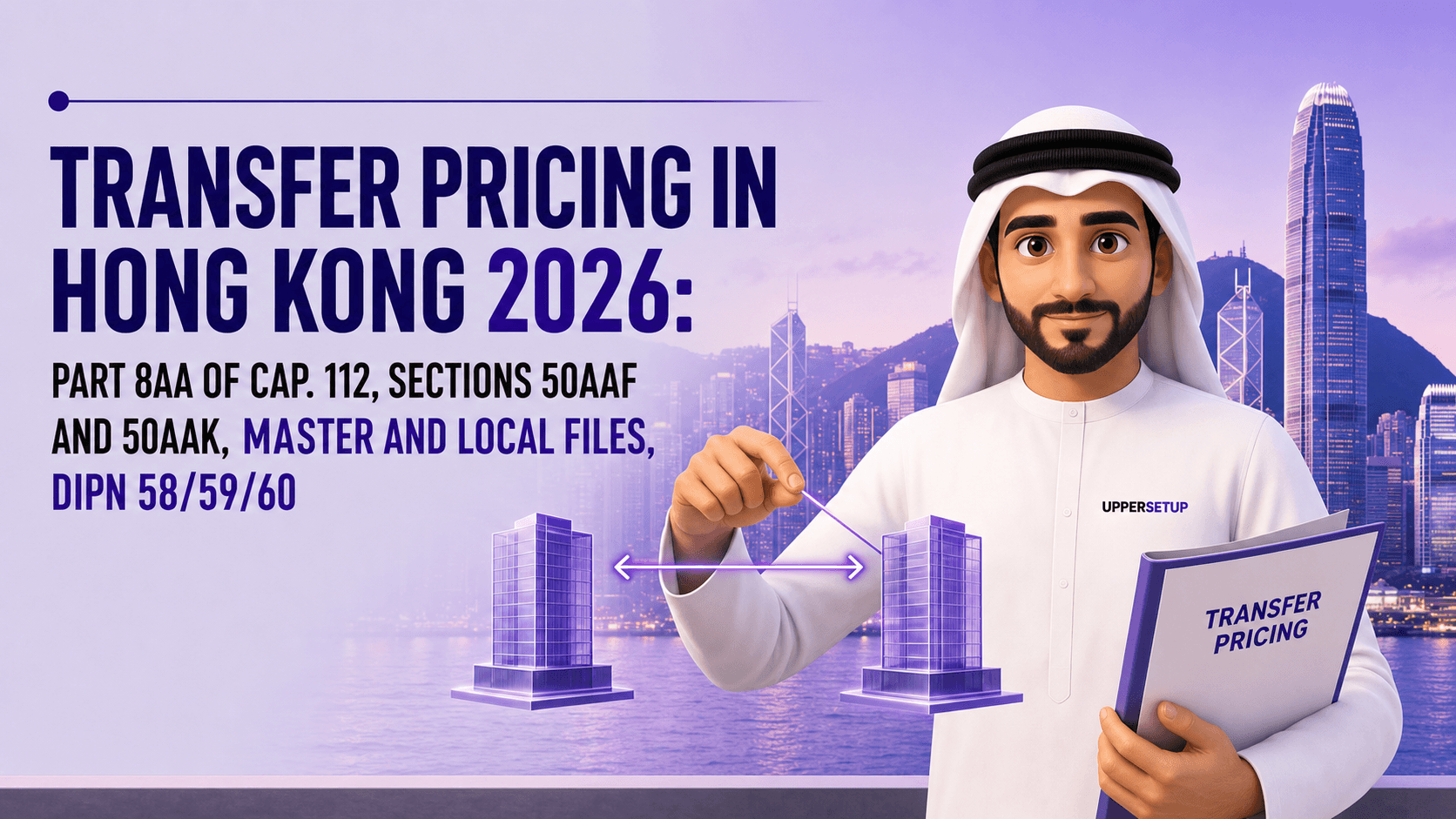
Transfer pricing in Hong Kong is governed by Part 8AA of the Inland Revenue Ordinance (Cap. 112), introduced by the Inland Revenue (Amendment) (No. 6) Ordinance 2018. The regime rests on two substantive rules — the arm's length principle for transactions between associated persons (section 50AAF) and the attribution of profits to a permanent establishment (section 50AAK) — supported by three tiers of documentation: master file, local file and country-by-country report. Departmental Interpretation and Practice Notes Nos. 58, 59 and 60 set out how the Inland Revenue Department applies them.
The costliest misreading is to treat exemption from documentation as exemption from the arm's length principle. These are two separate obligations. The business-size and transaction-amount exemptions remove the duty to prepare a master file and a local file; they do not disapply section 50AAF. The Assessor may recompute profits on an arm's length basis whether or not the entity was required to keep documentation.
Where the regime stands in 2026
As at August 2026 the substantive provisions of Part 8AA and the IRD's published guidance have not been revised since the regime was introduced; what has changed is the environment in which they operate.
● DIPN Nos. 58, 59 and 60 were issued in July 2019 and, per the IRD's official index of practice notes, remain in force with no subsequent revision.
● DIPN No. 48 on Advance Pricing Arrangements stands in its July 2020 revision, replacing the 2012 version.
● The global minimum tax rules have applied in Hong Kong since 1 January 2025. Hong Kong holds transitional qualified status for its IIR, the Hong Kong minimum top-up tax and the QDMTT Safe Harbour, and appears in the OECD's central record.
On 21 April 2026 Hong Kong signed the Multilateral Competent Authority Agreement on the Exchange of Global Anti-Base Erosion Information (the GIR MCAA), a qualifying competent authority agreement for exchanging GloBE information.
The transfer pricing consequence is practical rather than technical. Data on where a group books profit and pays tax now reaches tax administrations through two channels at once — country-by-country reports and the GloBE Information Return. Any gap between how a group explains its profit allocation in the local file and what those returns show surfaces faster than it used to.
Two regimes share vocabulary and must not be conflated. Country-by-country reporting arises under Part 9A of the Ordinance at consolidated group revenue of EUR 750 million (HKD 6.8 billion). The global minimum tax and the Hong Kong minimum top-up tax form a separate regime with their own returns and their own penalties under sections 80O, 82 and 82A. Falling within one says nothing about the other.
The legal framework: where each rule sits
The Hong Kong regime is assembled from provisions of the Ordinance, four schedules and six practice notes.
|
Element |
Provision |
IRD guidance |
|
Arm’s length principle between associated persons (Rule 1) |
Section 50AAF; participation condition 50AAG; potential advantage 50AAJ |
DIPN No. 59 (July 2019) |
|
Attribution of profits to a permanent establishment (Rule 2) |
Section 50AAK; definition of permanent establishment in Schedule 17G |
DIPN No. 60 (July 2019) |
|
Master file and local file |
Section 58C; thresholds and contents in Schedule 17I |
DIPN No. 58 (July 2019) |
|
Country-by-country report |
Sections 58D to 58E, Part 9A |
DIPN No. 58 (July 2019) |
|
Advance pricing arrangement |
Sections 50AAM onwards; Schedule 17H |
DIPN No. 48 (revised July 2020) |
|
Relief from double taxation after an adjustment |
Mutual agreement procedure |
DIPN No. 45 (April 2009) |
The boundary between the old and new regimes still matters. The IRD states expressly that transactions between associated persons, and permanent establishments of non-resident persons, to which the 2018 amending Ordinance does not apply are dealt with under DIPN Nos. 45 and 46. DIPN No. 46 of December 2009 remains on the current list for that reason — not as general guidance on the present regime.
Rule 1: when the Assessor can recompute profits
Section 50AAF allows income or loss to be recomputed on an arm's length basis where four conditions are met at the same time.
1. A provision — the actual provision — has been made or imposed between two persons (each an affected person) by means of a transaction or series of transactions.
2. The participation condition in section 50AAG is met: one affected person participates in the management, control or capital of the other, or the same person participates in the management, control or capital of both.
3. The actual provision differs from the provision that would have been made between independent persons — the arm's length provision.
4. The actual provision confers a potential advantage in relation to Hong Kong tax on one of them, the advantaged person, within section 50AAJ.
Where all four conditions are met, the advantaged person's income or loss is computed as if the arm's length provision had been made instead of the actual provision. The resulting figure is the arm's length amount.
Section 50AAE requires sections 50AAF, 50AAG, 50AAM and 50AAN to be construed in the way that best secures consistency with the OECD rules — the commentary on the associated enterprises article of the Model Tax Convention and the OECD Transfer Pricing Guidelines. That is not a formality: an argument built on the current edition of the OECD Guidelines carries direct weight in a Hong Kong dispute.
Section 50AAF applies in determining liability not only to profits tax but also to property tax and salaries tax, as sections 7D, 13A and 26AC confirm. Adjustments may be required across more than one tax type.
Under section 50AAD(2), Rule 1 has effect regardless of whether a double tax agreement exists and regardless of whether either person is chargeable to foreign tax.
Section 50AAF(2) adds a case that is easy to miss: the actual provision is also taken to differ from the arm's length provision where a provision was made between the associated persons but no provision at all would have been made between independent persons. A transaction independent parties simply would not have entered into is caught as squarely as a mispriced one.
Who has to prove what
The dispute mechanics are written into section 50AAF itself and turn on the burden of proof.
5. Section 50AAF(3): the Assessor may give notice requiring the advantaged person to prove that the income or loss stated in its return is the arm's length amount.
6. Section 50AAF(5): if the person fails to prove that to the Assessor's satisfaction, the Assessor must estimate the arm's length amount and, taking that estimate into account, raise an assessment or additional assessment, or revise a loss computation downwards.
7. Section 50AAF(6): the estimated amount is taken to be the arm's length amount unless the person provesthat another amount is an equally reliable, or a more reliable, measure.
Rule 1 runs in one direction only. The IRD calls it a "one-way street": adjustments are made only to increase assessable profits or reduce allowable losses in Hong Kong. A downward adjustment is available solely as corresponding relief under section 50AAM or 50AAN, and under section 50AAO for permanent establishments. A taxpayer cannot unilaterally apply a transfer pricing methodology to reduce profits sourced in Hong Kong.
Rule 1 reaches purely domestic Hong Kong transactions between associated persons as well, other than those on which no potential advantage in relation to Hong Kong tax is taken to be conferred. The assumption that the regime is a cross-border matter only is wrong.
The domestic transaction exemption: three conditions and one more for loans
An actual provision is not taken to confer a potential advantage on either affected person where three requirements are met — and the structure is not a simple list.
8. The domestic nature condition is met;
9. Either the no actual tax difference condition or the non-business loan condition is met — one of the two suffices;
10. The actual provision does not have a tax avoidance purpose.
The second limb is an either/or, not a cumulative set. Summaries that list all the conditions in a single comma-separated string misstate the rule: a loan can qualify through the non-business loan condition even where the no actual tax difference condition fails.
Domestic nature condition
The condition is met in either of two cases: where the actual provision is made in connection with each affected person's trade, profession or business carried on in Hong Kong; or where one affected person is Hong Kong tax resident and the provision is made otherwise than in connection with that person's own trade, profession or business but in connection with the other person's business carried on in Hong Kong.
No actual tax difference condition
The condition is met where each affected person's income from the relevant activities is chargeable to Hong Kong tax, or each person's loss from them is allowable, and no concession or exemption for Hong Kong tax applies to that income or loss.
The two-tiered profits tax rates regime is not treated as a concession or exemption for this purpose. A difference in effective rate between an entity on the two-tiered rates and one on the standard rate does not, by itself, break the condition.
Nor does the rate difference between a partnership and a corporation, nor the fact that one party is in a loss position: the timing difference between one party's deduction and the other's taxable income is not taken into account. The transaction must still be free of a tax avoidance purpose.
Non-taxable income on one side, however, does break it. Where a Hong Kong company uses an intra-group loan to fund long-term equity investments whose returns — dividends and capital gains — are outside profits tax, the no actual tax difference condition fails. Only the non-business loan condition can then save the transaction.
Non-business loan condition
The condition is met where the actual provision relates to lending money otherwise than in the ordinary course of a money lending business or an intra-group financing business as defined by section 16(3). The test goes to the character of the lender's business, not to the source of the funds.
The IRD adds a practical qualification: a company that merely provides interest-free loans out of interest-free funds to associates, with no motive of earning an interest spread, may on the totality of facts not be regarded as carrying on an intra-group financing business. DIPN No. 52 is the reference point for that determination.
No tax avoidance condition
A provision has a tax avoidance purpose where the Commissioner is satisfied that its main purpose, or one of its main purposes, is to use a loss of an affected person to avoid, postpone or reduce a Hong Kong tax liability — whether that of the other affected person or of anyone else.
The domestic exemption from Rule 1 and the specified domestic transaction exemption from local file coverage aredifferent mechanisms with different conditions. They may overlap on the facts, but each must be tested on its own terms.
Rule 2: profits of a permanent establishment
Section 50AAK requires income or loss attributable to a non-resident's permanent establishment in Hong Kong to be determined as if the establishment were a separate and distinct enterprise dealing at arm's length.
The domestic-law definition of a permanent establishment sits in Schedule 17G. Places of business performing only preparatory or auxiliary functions — maintaining a stock of goods for processing by another enterprise, purchasing goods, collecting information — are not treated as permanent establishments.
The documentation requirements apply to accounting periods beginning on or after 1 April 2018. Rule 2 applies from the year of assessment 2019/20.
Rule 1 is grandfathered by transaction date, not by period. Under section 4(3) of Schedule 44 to the Ordinance, section 50AAF does not apply to a transaction entered into or effected before 13 July 2018, the commencement date of the 2018 amending Ordinance. The provision refers to a transaction, not a contract: the question is whether the act constitutes a transaction in its own right after that date.
The IRD works this through on examples. A master agreement signed before 13 July 2018 does not itself create a protected transaction: if a purchase order placed later stands as a transaction on its own, it is not grandfathered. Each annual royalty payment under a licence is a separate transaction. Each drawdown under a credit line is a separate loan. A term loan fully drawn before 13 July 2018 is grandfathered even though it runs for four more years.
Section 50AAK(1) further deems a non-resident with a permanent establishment in Hong Kong to be carrying on a trade, profession or business in Hong Kong for profits tax purposes. Section 50AAK(5) governs internal dealings between the establishment and other parts of the same person: such dealings have no legal consequence for the person as a whole, but where the functional and factual analysis shows a real, economically significant event supported by records, they are recognised as equivalent to a transaction for attribution purposes.
Like Rule 1, section 50AAK is read "in a negative sense": it targets under-attribution of profit to the establishment and therefore contemplates upward adjustments only. Downward adjustments come through corresponding relief under section 50AAO.
The methodology follows the Authorised OECD Approach, which the IRD names as its preferred approach: significant people functions are analysed, assets and risks allocated, free capital attributed, and internal dealings with the head office priced accordingly. DIPN No. 60 sets out the detail.
Who must prepare a master file and a local file
The obligation falls on a Hong Kong entity of a group in the extended sense that engages in transactions with associated entities, unless an exemption applies.
● A Hong Kong entity is any separate business unit of the group that is resident for tax purposes in Hong Kong, or a permanent establishment in Hong Kong.
● A group in the usual sense is a collection of enterprises related through ownership or control that must prepare consolidated financial statements, or would have to if equity interests in any of them were publicly traded.
● A group in the extended sense additionally covers a single enterprise resident for tax purposes in one jurisdiction and taxed in another on business carried on through a permanent establishment there.
The last limb produces a result founders rarely expect: a standalone company with no group at all can fall within the documentation rules if it operates through a permanent establishment abroad.
How control is measured for the participation condition
A person participates in the management, control or capital of another only where that other person is a corporation, partnership, trustee or body of persons and is controlled by the first person.
An individual can control but cannot be controlled. Where the would-be controlled party is an individual, the participation condition is not met — although a transaction between a company and a controlling individual is squarely within Rule 1.
Control arises through more than half of the direct or indirect beneficial interest, through entitlement to exercise or control more than half of the voting rights, through powers conferred by the constitutional document, or where a person is accustomed or obliged to act on another's directions. The definition derives from section 16(3A) and Schedules 15 and 15A to the Ordinance.
Indirect interests are multiplied down the chain: 90% of a company that holds 80% of a second that holds 70% of a third gives an indirect interest of 50.4% — above half, so the participation condition is met.
Business-size exemption: any two of three
A Hong Kong entity is exempt from preparing both files for an accounting period if it satisfies any two of the three size conditions.
|
Measure |
Threshold |
Measurement point |
|
Total revenue |
Does not exceed HKD 400 million |
For the accounting period |
|
Total value of assets |
Does not exceed HKD 300 million |
At the end of the accounting period |
|
Average number of employees |
Does not exceed 100 |
During the accounting period |
Any two of the three suffice. An entity with revenue of HKD 500 million, assets of HKD 200 million and 60 employees is exempt from both files despite exceeding the revenue threshold.
Transaction-amount exemption
Where the total amount of a given type of controlled transaction for an accounting period does not exceed the prescribed threshold, the local file need not cover that type of transaction.
|
Type of controlled transaction |
Threshold per accounting period |
|
Transfers of properties, movable or immovable, excluding financial assets and intangibles |
HKD 220 million |
|
Transactions in respect of financial assets |
HKD 110 million |
|
Transfers of intangibles |
HKD 110 million |
|
Other transactions |
HKD 44 million |
If no type exceeds its threshold, the Hong Kong entity need prepare neither the local file nor the master file.
Four computation rules are routinely misapplied: the threshold applies to the aggregate of the same type of transaction; a controlled transaction may be a revenue item or an expense item; each transaction is considered separately and no set-off is permitted; and it is the arm's length amount that is aggregated, not the price actually charged.
The last rule is counter-intuitive, and the IRD explains why it must be so: if the thresholds meant actual amounts, an entity that undertook all of its controlled transactions at nil consideration would never have to prepare a local file. That cannot have been the legislative intent behind section 58C, so the thresholds are read as referring to amounts determined on an arm's length basis.
Specified domestic transactions and the local file
The local file need not cover specified domestic transactions, and those transactions are disregarded when testing whether the transaction-amount thresholds are exceeded.
The definition sits at paragraph 47 of DIPN No. 58. The effect is twofold: those transactions are not described in the file, and their value does not push the entity towards the HKD 220 million, HKD 110 million and HKD 44 million thresholds. For groups with substantial intra-Hong Kong turnover this often decides whether any obligation arises at all.
Deadlines, updating and retention
Both files must be prepared no later than nine months after the end of the accounting period under section 58C(2)(a). They are not filed with the profits tax return but must be ready for submission on the Assessor's request.
|
Obligation |
Deadline |
Basis |
|
Preparation of master file and local file |
No later than 9 months after the end of the accounting period |
Section 58C(2)(a) |
|
Retention of the files |
Not less than 7 years after the end of the accounting period |
IRD documentation requirements |
|
Annual review and update |
Every accounting period |
IRD documentation requirements |
|
Roll-forward of the benchmarking study |
Maximum 3 years where conditions remain consistent |
IRD documentation requirements |
|
CbC notification |
Within 3 months after the end of the accounting period |
Part 9A of the Ordinance |
|
CbC return filing |
12 months after the end of the accounting period, or the date in the Assessor’s notice if earlier |
Part 9A of the Ordinance |
The files must be prepared in English or Chinese. Terminology, order of presentation and format need not mirror Schedule 17I, but the prescribed information must be there.
The three-year roll-forward is the only material concession on workload, and it is conditional on the relevant conditions of the controlled transactions remaining consistent. Comparables' financial data is still refreshed annually.
Preparing and updating the files, testing the thresholds and computing arm's length amounts sits most naturally alongside the statutory accounts: UPPERSETUP accounting services.
What the files must contain
The prescribed contents are set out in Part 3 of Schedule 17I. The master file gives a group overview across five categories; the local file gives transactional detail for the entity.
● Master file: the group's organisational structure; its business or businesses; its intangibles; its intercompany financial activities; and its financial and tax positions.
● Local file: detailed transactional information on the entity's material controlled transactions, the associated entities involved, the amounts, and the transfer pricing analysis for each.
The IRD emphasises a substantive requirement behind the headings: documentation must show the value chain — the key value drivers, the contributions of assets, functions and risks made by each associated enterprise, which parties assume or control economically significant risks, and which parties can protect and retain value through the development, enhancement, maintenance, protection and exploitation of intangibles.
The required depth is not fixed. It is a function of the complexity of the transfer pricing involved and the materiality of the risks measured against the entity's overall tax position. A ten-page file for a group with a complex intangibles structure does not meet the standard merely because all five headings appear.
Country-by-country reporting: thresholds and timing
A CbC return is required of groups whose consolidated revenue for the preceding accounting period is at least EUR 750 million, or HKD 6.8 billion, and which have constituent entities or operations in two or more jurisdictions.
● The primary obligation rests on an ultimate parent entity resident in Hong Kong, for accounting periods beginning on or after 1 January 2018.
● A secondary obligation arises for a Hong Kong entity of a group with an overseas parent where the parent is not required to file in its own jurisdiction, or no exchange arrangement with Hong Kong is in place by the filing deadline, or the Commissioner has notified a systemic failure to exchange.
● The secondary obligation does not arise where another Hong Kong entity of the group has filed for the same period, or where a surrogate parent entity has filed in Hong Kong or in a jurisdiction with an exchange arrangement in place.
Every Hong Kong entity of the group must make a notification within 3 months after the end of the accounting period. Where the group has more than one Hong Kong entity, one notification suffices, provided the notifying entity is not the one that must file the return.
Returns are filed through the CbC Reporting Portal in XML using schema version 2.0, mandatory since 1 February 2021. Registering a portal account requires an e-Cert (Organisational) with AEOI functions.
The appropriate-use limits on CbC data work in the taxpayer's favour. The IRD states that it will not use CbC information by itself to assess or reassess income, will not treat it as a substitute for a detailed transactional analysis, and will not propose adjustments based on global formulary apportionment. It may, however, use that information to plan an audit and as a basis for enquiries during one.
How the IRD tests compliance
Enforcement runs through the declaration in supplementary form S2 and the desk-based reviews that follow, normally within six months after the profits tax return is filed.
11. The entity declares in the return and in form S2 whether it undertook controlled transactions with associated entities and whether it must prepare the files under section 58C.
12. The likeliest candidates for review are entities that declared the obligation, and entities whose business size exceeds the exemption thresholds.
13. A selected entity receives an enquiry letter and completes form IR1475, summarising the key information in its files, then signs and submits it.
14. Copies of the files themselves are requested, together with, for any transaction excluded from the local file, the ground of exemption, the nature and amount of the transaction and the associated entity involved.
15. Depending on the case, the IRD may also request an industry description, the role of each associated entity in the group, employee details for each party, audited financial statements of each party, the relevant agreements, internal pricing documents, the alternative methods considered and rejected, and the comparability analysis.
Where an entity did not declare the obligation in form S2, the IRD asks for a detailed explanation of how the business-size or transaction-amount exemption conditions were satisfied.
Penalties for missing documentation
Non-compliance with the documentation rules is prosecuted: the Assessor may institute proceedings under section 80(2Q) of the Ordinance.
|
Failure |
Provision |
Sanction |
|
Failure to prepare a master file and local file under section 58C |
Section 80(2Q) |
Fine at level 5 — HKD 50,000 on conviction |
|
Failure to comply with a court order to do the act |
Sections 80(2R) and 80(2S) |
Further fine at level 6 — HKD 100,000 |
|
Tax undercharged following a Rule 1 adjustment |
Section 82A(1C)–(1F) |
Additional tax not exceeding the amount of tax undercharged |
Additional tax for transfer pricing is deliberately set at one times the tax undercharged, against the trebleapplied to incorrect returns and other failures under section 82A(1). The IRD's stated reason is that transfer pricing is not an exact science.
Section 82A(1G): no additional tax is imposed at all where the person proves that reasonable efforts were made to determine the arm's length amount. A reasonable effort is the degree of effort an independent and competent person in the same line of business would exercise in similar circumstances, judged against the complexity and importance of the transfer pricing issues in the case.
The IRD lists five situations in which reasonable efforts are not taken to have been exercised: no process or documentation for selecting and applying transfer pricing methods; contemporaneous documentation without any analysis of functions, assets, risks, market conditions or business strategies; limited efforts to build a pricing process that is insufficiently developed or improperly implemented; use of controlled transactions as comparables; and documentation prepared with inappropriate statistical tools, such as misuse of multi-year averages.
That reframes the economics. The cost of preparing the files is weighed not against a HKD 50,000 fine but against additional tax on the adjustment. For a group with intra-group flows in the hundreds of millions, those are different orders of magnitude.
The Commissioner also reserves the possibility of harsher penalties or criminal prosecution where sections 80 and 82, or other limbs of section 82A, are plainly breached — typically where the case involves omitted or understated income alongside the pricing question.
Building a pricing process that survives the reasonable-efforts test, and defending the position through a desk-based review, is the work of UPPERSETUP legal services.
Advance pricing arrangements
An APA is an agreement with the IRD fixing the transfer pricing methodology prospectively for controlled transactions whose income or loss falls to be computed under section 50AAF or 50AAK. The statutory basis is sections 50AAP to 50AAW and Schedule 17H; the procedure is in DIPN No. 48 as revised in July 2020.
Mind the numbering. Sections 50AAM and 50AAN do not govern APAs — they govern corresponding relief, the downward adjustment available once a primary upward adjustment has been made on the associated person. For permanent establishments, corresponding relief runs through section 50AAO. The APA regime itself starts at section 50AAP.
● Unilateral, bilateral and multilateral APAs are all available. Unilateral applications are accepted, which matters for transactions with jurisdictions that have no double tax agreement with Hong Kong.
● The standard term is three to five years.
● Rollback of the agreed methodology to earlier years may be considered for bilateral and multilateral APAs.
● The process runs in three stages: early engagement, application, then monitoring and compliance.
The early engagement request, with a draft case plan, must be submitted to the Tax Treaty Section at least 6 months before the proposed commencement date of the APA.
|
Transaction type for an APA |
Annual threshold |
|
Purchase and sale of goods |
HKD 80 million |
|
Provision of services |
HKD 40 million |
|
Use of intangibles and royalties |
HKD 20 million |
|
Other transactions |
HKD 20 million |
|
Business profits attributable to a Hong Kong permanent establishment |
HKD 20 million |
The application fee is not fixed: it is computed on the hourly rates of the IRD officers involved, capped at HKD 500,000. That figure comes from specialist legal analysis rather than the text of the Ordinance and should be confirmed on application.
Post-agreement obligations are real: the Commissioner must be notified within one month of any breach of a critical assumption recorded in the arrangement, and reports and information must be provided as agreed.
Assessing whether an APA is worth pursuing, building the position and running the dialogue with the IRD falls to UPPERSETUP legal services.
Step-by-step for a Hong Kong company
16. Map the associated persons under the participation condition in section 50AAG, including association through a common third person.
17. List the controlled transactions for the period, split across the four types, marking each as a revenue or expense item.
18. Test the business-size exemption against HKD 400 million of revenue, HKD 300 million of assets and 100 employees.
19. Strip out specified domestic transactions, then test the transaction-amount thresholds using arm's length amounts, with no set-off.
20. Assess Rule 1 separately for each material transaction, whatever the documentation thresholds produce.
21. Test the domestic transaction exemption, including the non-business loan condition for intra-group lending.
22. Determine CbC obligations: the EUR 750 million threshold, primary or secondary obligation, notification within 3 months.
23. Prepare the files within 9 months of the period end and refresh the benchmarking where required.
24. Complete the return and form S2 consistently with the facts — a mismatch between the declaration and the review outcome is a risk in its own right.
25. Set up retention of the files and supporting material for 7 years.
Common mistakes and what they cost
Equating exemption from documentation with exemption from Rule 1
The size and transaction-amount exemptions concern the files only. Section 50AAF applies regardless. An exempt entity still has to justify its pricing on audit — without a prepared analysis and without the section 82A defence.
Testing thresholds on actual amounts
Thresholds run on arm's length amounts. Intra-group services rendered free or at a nominal charge do not take the entity outside the requirement: the figure counted is the one independent parties would have agreed.
Netting off reciprocal flows
Each transaction is counted separately and set-off is not allowed. A group buying HKD 30 million from an associate and selling HKD 25 million back to it does not have a HKD 5 million net position: both figures aggregate within "other transactions".
Missing the CbC notification under an overseas parent
The notification within three months of the period end is made by the Hong Kong entity regardless of who ultimately files the return. Notification and filing are distinct obligations.
Assembling documentation after the enquiry letter arrives
The desk-based review tests, among other things, whether the files were prepared within nine months of the period end. A file written after the request fails that test, and the section 82A defence rests on efforts made when the price was set, not after the dispute began.
Rolling forward benchmarking when the facts have moved
A study may be rolled forward for up to three years only where the relevant conditions of the controlled transactions remain consistent. A change in the entity's functions, a shift of risk or a redrawn contractual structure ends that.
Assuming an offshore profits position closes the transfer pricing question
The IRD states that the broad guiding principle on source in DIPN No. 21 is unaffected by Rule 1, and describes a two-step sequence: first compute the profits from associated-party transactions on an arm's length basis, then apply the source principle — what was done to earn the profits and where the operations were performed. An offshore claim disapplies neither the documentation rules nor Rule 1.
Which approach fits which situation
|
Situation |
Working approach |
Watch item |
|
Small group entity below every threshold |
Exempt from the files; keep an internal support memo |
Rule 1 still applies |
|
Hong Kong service company in an MNE group |
Full documentation, method driven by functions |
The HKD 44 million "other transactions" threshold |
|
Intangibles holder |
Full documentation with DEMPE analysis |
The HKD 110 million intangibles threshold |
|
Intra-group financing |
Test the domestic exemption conditions |
The non-business loan condition |
|
Group with revenue above EUR 750 million |
CbC return alongside the files |
Notification within 3 months |
|
Persistently contested methodology |
APA application |
Thresholds of HKD 80/40/20 million; 6 months lead time |
For structures pairing a Hong Kong company with operations elsewhere, see Hong Kong + UAE: a Dual Structure for International Business and Territorial Taxation and Offshore Status in Hong Kong 2026.
When professional review is warranted
● The Hong Kong entity reports recurring losses or thin margins while the group is profitable.
● Material payments flow to associates — royalties, management and service fees, interest.
● Intra-group loans carry off-market rates or no interest at all.
● The entity's functions have changed while the methodology and benchmarking have not.
● The group is within the global minimum tax, so its profit allocation is visible in two reports at once.
● A non-resident operates in Hong Kong through a permanent establishment, engaging Rule 2 and DIPN No. 60.
Incorporation and ongoing corporate support for Hong Kong structures sit with UPPERSETUP; the full catalogue is in the services section.
Frequently asked questions
Must a Hong Kong company prepare a master file and a local file?
Yes, where it belongs to a group in the extended sense, transacts with associated entities, and meets neither the business-size nor the transaction-amount exemption.
What thresholds exempt an entity from transfer pricing documentation in Hong Kong?
On business size, any two of three: revenue no more than HKD 400 million, assets no more than HKD 300 million, average employees no more than 100. On transaction amounts: HKD 220 million for transfers of properties, HKD 110 million for financial assets, HKD 110 million for intangibles and HKD 44 million for other transactions.
By when must the documentation be prepared?
No later than nine months after the end of the accounting period under section 58C(2)(a). The files are not filed with the return but must be ready on request and retained for at least seven years.
What are the penalties for failing to prepare the files?
Prosecution under section 80(2Q), with a level 5 fine of HKD 50,000 on conviction and a court order to remedy the failure; non-compliance with that order attracts a further level 6 fine of HKD 100,000. Separately, the section 82A defence against additional tax is lost.
Do the rules apply to transactions within Hong Kong?
Yes. Rule 1 reaches domestic transactions between associated persons, other than those on which no potential advantage in relation to Hong Kong tax is conferred — where the transaction is domestic in nature, produces no actual tax difference and is not used to obtain a tax benefit.
At what revenue does a group have to file a country-by-country report?
At consolidated group revenue for the preceding accounting period of at least EUR 750 million, or HKD 6.8 billion, with operations in two or more jurisdictions. Notification is due within three months and the return within twelve months of the period end.
Can the methodology be agreed with the IRD in advance?
Yes, through an APA under sections 50AAM onwards. Unilateral, bilateral and multilateral arrangements are available for terms of three to five years, and the early engagement request must be submitted at least six months before the proposed start date.
Does an offshore profits claim remove the transfer pricing obligations?
No. The territorial principle governs taxability; transfer pricing governs quantum and allocation. Documentation obligations and section 50AAF continue to apply.
Key takeaways
● The framework is Part 8AA of Cap. 112, Schedules 17G, 17H and 17I, and DIPN Nos. 58, 59 and 60 of July 2019.
● Rule 1 turns on the four conditions in section 50AAF and is independent of any documentation obligation.
● Size exemption: any two of HKD 400 million revenue, HKD 300 million assets, 100 employees.
● Transaction thresholds: HKD 220m, HKD 110m, HKD 110m and HKD 44m, measured on arm's length amounts with no set-off.
● Files are due at 9 months, retained 7 years, with benchmarking rolled forward for no more than 3 years.
● CbC: EUR 750 million or HKD 6.8 billion, notification at 3 months, filing at 12 months.
● Penalties are HKD 50,000 and HKD 100,000 for breaching a court order; documentation preserves the section 82A defence.
Summary
Transfer pricing in Hong Kong is governed by Part 8AA of the Inland Revenue Ordinance (Cap. 112), introduced by the Inland Revenue (Amendment) (No. 6) Ordinance 2018. Section 50AAF allows the Assessor to recompute income or loss on an arm's length basis where four conditions are met: an actual provision between two affected persons, the participation condition in section 50AAG, a difference between the actual and the arm's length provision, and a potential advantage in relation to Hong Kong tax under section 50AAJ. Section 50AAK governs the attribution of profits to a permanent establishment in Hong Kong and applies from the year of assessment 2019/20. A Hong Kong entity must prepare a master file and a local file under section 58C unless an exemption applies: on business size, any two of revenue not exceeding HKD 400 million, assets not exceeding HKD 300 million and an average of no more than 100 employees; on transaction amounts, HKD 220 million for transfers of properties, HKD 110 million for financial assets, HKD 110 million for intangibles and HKD 44 million for other transactions, with thresholds measured on arm's length amounts, no set-off permitted and specified domestic transactions disregarded. The files must be prepared within nine months of the end of the accounting period, retained for at least seven years and updated annually, with benchmarking studies rolled forward for a maximum of three years. A country-by-country return is required of groups with consolidated revenue of at least EUR 750 million, or HKD 6.8 billion, operating in two or more jurisdictions, with notification within three months and filing within twelve months of the period end. Failure to prepare the files is prosecuted under section 80(2Q) with a level 5 fine of HKD 50,000 and a further level 6 fine of HKD 100,000 for breaching a court order, while proper documentation and reasonable efforts to determine the arm's length amount protect against additional tax under section 82A. Methodology may be agreed prospectively through an advance pricing arrangement under sections 50AAM onwards for a term of three to five years, subject to thresholds of HKD 80 million for goods, HKD 40 million for services and HKD 20 million for intangibles, other transactions and permanent establishment profits.
Sources
● Inland Revenue Department — DIPN No. 59: Transfer Pricing between Associated Persons (July 2019), full text — the exempted domestic transaction conditions, the burden of proof and the additional tax regime
● Inland Revenue Department — Transfer Pricing Documentation: Master File and Local File (thresholds, deadlines, review process, sanctions)
● Inland Revenue Department — Country-by-Country Reporting: thresholds, notifications, filing deadlines and exchange arrangements
● Inland Revenue Department — index of Departmental Interpretation and Practice Notes in force, with issue dates
● Inland Revenue Department — DIPN No. 58: Transfer Pricing Documentation and Country-by-Country Reports (July 2019)
● Inland Revenue Department — DIPN No. 60: Attribution of Profits to Permanent Establishments in Hong Kong (July 2019)
● Inland Revenue Department — DIPN No. 48 (Revised): Advance Pricing Arrangement (July 2020)
● Inland Revenue Department — Advance Pricing Arrangement: how to request early engagement
● Inland Revenue Department — FAQ on completing profits tax returns BIR51 and BIR52: section 50AAK, the Authorised OECD Approach and corresponding relief under section 50AAO
● Inland Revenue Department — FAQ on transfer pricing documentation, including why thresholds are read on an arm's length basis
● Inland Revenue Department — FAQ on completing supplementary form S2
● Inland Revenue Department — Global minimum tax and Hong Kong minimum top-up tax, including the GIR MCAA signed on 21 April 2026
● Government Logistics Department — Inland Revenue (Amendment) (No. 6) Ordinance 2018
● KPMG — analysis of the enacted regime: domestic transaction exclusion and relaxed documentation thresholds
● KPMG — the revised DIPN No. 48: unilateral APAs, rollback, the three-stage process and thresholds
● OECD — Hong Kong, China Dispute Resolution Profile (updated March 2026)
Levels of verification behind this briefing
Sources are separated by reliability on purpose.
● Verified in the full text of DIPN No. 59: the four conditions in section 50AAF; section 50AAF(2) on the case where no provision would have been made at all; the burden of proof under section 50AAF(3), (5) and (6); the one-way-street principle and corresponding relief under sections 50AAM, 50AAN and 50AAO; the three-limb structure of the domestic exemption and the content of each of the four conditions; the treatment of the two-tiered rates; the grandfathering rule in section 4(3) of Schedule 44 with its 13 July 2018 date; the additional tax regime in section 82A(1C) to (1G) and the five examples of failing the reasonable-efforts test; the application of Rule 1 to property tax and salaries tax; and the definition of control with the multiplication of indirect interests.
● Verified on the IRD's own pages: the business-size and transaction-amount thresholds; the arm's length measurement rule and the prohibition on set-off; the nine-month deadline under section 58C(2)(a); seven-year retention and the three-year benchmarking roll-forward; the contents of both files; the desk-based review process and form IR1475; the sanctions under sections 80(2Q), 80(2R) and 80(2S); CbC thresholds and deadlines; the APA request procedure; section 50AAK(1) and (5) and the primacy of the Authorised OECD Approach; the issue dates of every DIPN; and the signing of the GIR MCAA on 21 April 2026.
● Verified through specialist analysis: the numbering of the APA provisions (sections 50AAP to 50AAW) and the HKD 500,000 cap on the application fee; the APA application thresholds and the three-stage process.
● Still not read in the primary text: the continuous text of Part 8AA and Schedules 17G, 17H and 17I — elegislation.gov.hk blocks automated access. Statutory wording is therefore reproduced from IRD guidance, which is an official publication of the tax authority but not the Ordinance itself.
Related UPPERSETUP reading
● Territorial Taxation and Offshore Status in Hong Kong 2026
● The Offshore Profits Claim in Hong Kong: How Territorial Taxation Works
● Mandatory Annual Compliance for Hong Kong Companies 2026: NAR1, Audit and BIR51
● Hong Kong Company Registration 2026: Requirements, Procedure and Taxes
● Hong Kong + UAE: a Dual Structure for International Business 2026
Disclaimer
This material is provided for information only and does not constitute legal, tax, financial, investment or consulting advice. Professional advice should be obtained on the specific facts, jurisdiction, entity status and current regulatory requirements before any decision is taken. Information is current as at August 2026.
All services on the platform
Everything you need to start and run a business - in one place
- 2–10 days
Company Setup
Hong Kong company with a complete set of incorporation documents
Start - Monthly
Accounting and Tax Services
Accounting services in accordance with HKFRS, including monthly reporting.
- 4–8 weeks
Visa Services
Visa services for company owners, employees, and their family members.
- 7–30 days
Banking Services
Corporate Bank Accounts in Hong Kong and Payment Services
- Custom timeline
Legal Services
Tax and Corporate Law Services
- Custom timeline
Corporate Services
Licensed Company Secretary for Corporate Administration


