









































 International Free Zone Authority
Dubai Studio City in 2026: Film, TV and Production — the Regulator, the Licences, the Tax and Why the Rebate Is in Abu Dhabi
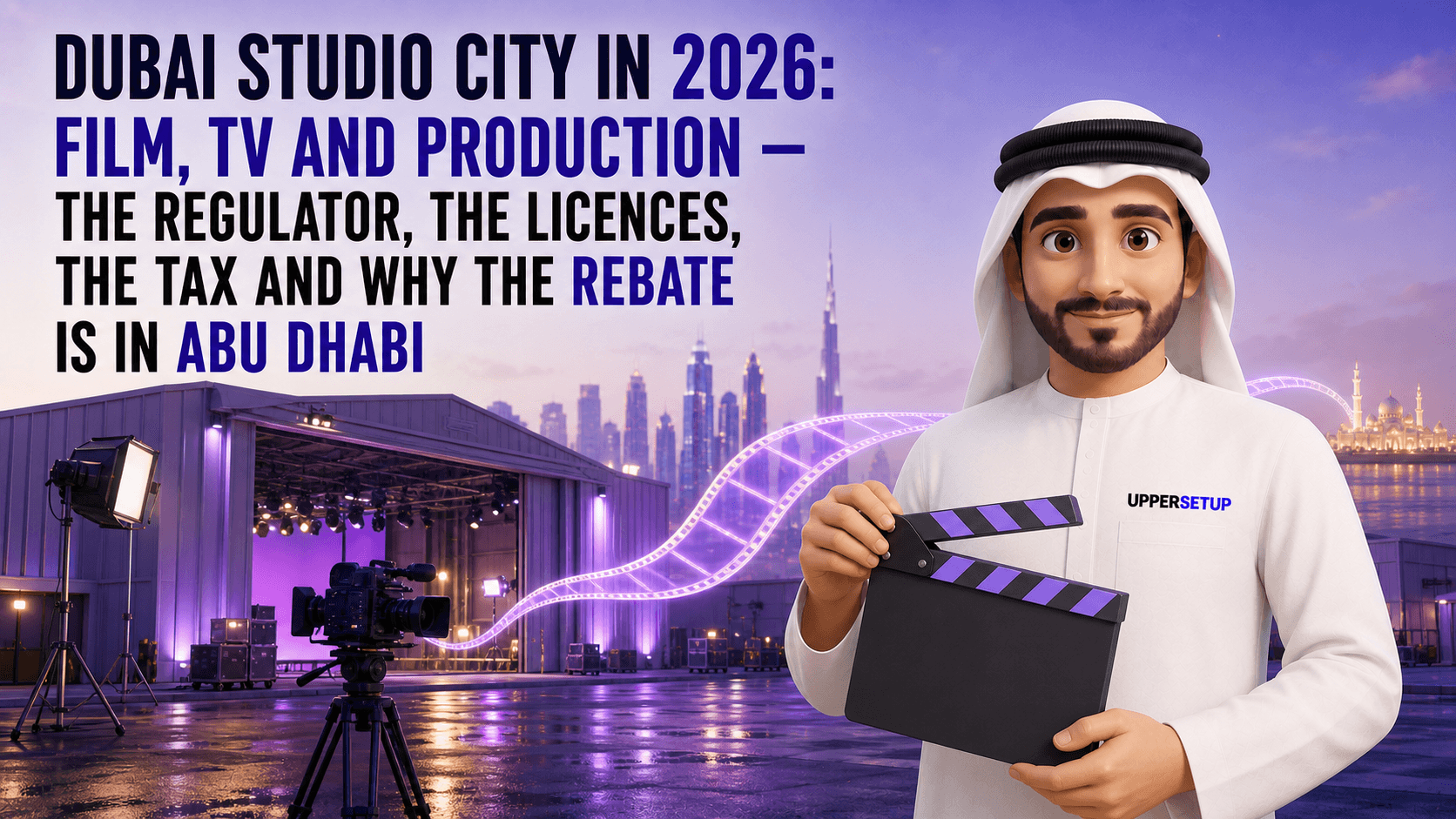
Dubai Studio City is one of ten business parks in the free zone constituted by Dubai Law No. 15 of 2014; it is licensed by the Dubai Development Authority (DDA) and operated by TECOM Group PJSC. A production licence costs AED 15,000 a year and requires paid-up capital of AED 50,000; a satellite television licence costs AED 25,000–40,000 a year and requires AED 1,000,000. Media activity inside the zone is licensed by the DDA, not by the federal regulator.
Important. A Dubai Studio City licence does not confer the right to film in Dubai. Article 6(1)(B) of Federal Decree-Law No. 55 of 2023 requires licensed media activity to be practised “within the specified geographical borders of the free zone”, and provides that activity outside those borders falls under the general laws of the State. A location shoot in the city is a separate permission from a separate body, and Article 7 of the same law says in terms that a licence “does not substitute for obtaining the necessary permits or approvals from the Concerned Authorities”.
The second point that shapes a production’s economics: Dubai offers no cash rebate on production spend, while Abu Dhabi offers between 35% and 50% of qualifying spend. Only a company licensed by the Creative Media Authority with a permanent production office in Abu Dhabi can claim it — so a Dubai Studio City licence does not open that door.
Key parameters as at August 2026
|
Parameter |
Position |
Source |
|
The free zone |
The “Clusters”, constituted by Article 3 of Dubai Law No. 15 of 2014(as replaced by Law No. 8 of 2023) |
Law No. 15/2014 |
|
Regulator and licensor |
Dubai Development Authority (DDA) |
Law No. 10/2018 (renaming) |
|
Site operator |
TECOM Group PJSC, trading on the DFM since 5 July 2022 |
TECOM |
|
“Production (Film/TV and Radio)” licence |
AED 15,000 a year, up to three activities |
Decision No. 1/2021, art. 14.1 |
|
Minimum capital for production |
AED 50,000 |
Decision No. 1/2021, art. 15.1 |
|
Default FZ-LLC minimum capital |
AED 10,000 |
Decision No. 1/2021, art. 15.1 |
|
Satellite or terrestrial TV station |
AED 25,000 a year, capital AED 1,000,000 |
Decision No. 1/2021, arts. 14.1 and 15.1 |
|
Satellite or terrestrial TV network |
AED 40,000 a year, capital AED 1,000,000 |
Decision No. 1/2021, arts. 14.1 and 15.1 |
|
Registering a channel or a title |
AED 5,000 per channel or per title |
Decision No. 1/2021, art. 14.4 |
|
Adding a segment to a licence |
AED 10,000 a year above the standard fee |
Decision No. 1/2021, art. 10.1 |
|
Company registration |
AED 3,500 plus activity fees |
Decision No. 3/2017 |
|
Freelancer permit at Dubai Studio City |
Not available; the freelancer segment sits in Dubai Media City |
Decision No. 1/2021, art. 9.1 |
|
Federal media law |
FDL No. 55 of 2023, issued 2 October 2023, in force 1 December 2023 |
uaelegislation.gov.ae |
|
Federal regulator |
National Media Authority under FDL No. 11 of 2025, in force 1 January 2026 |
FDL No. 11/2025, art. 17 |
|
Filming permit lead time |
15 working days before filming begins |
Cabinet Res. No. 68/2024, art. 21 |
|
Content-standard penalties |
AED 5,000 – AED 1,000,000, doubled on repetition |
Cabinet Res. No. 42/2025 |
|
Operating outside the zone |
Issued by the DET: a branch operating out of the free zone at AED 10,000 a year, or a temporary permit of AED 5,000 for up to 6 months |
ECR No. 11/2025, arts. 4, 7, 12 |
|
VAT Designated Zone status |
No — Dubai Studio City does not appear on the FTA list |
FTA list, Cabinet Dec. No. 59/2017 |
|
Production as a Qualifying Activity |
No — absent from the Article 2(1) list in MD No. 229/2025 |
MD No. 229/2025 |
|
Dubai rebate |
None; a committee formed on 27 October 2025 has the mandate to propose one |
Dubai Resolution No. 8/2025 |
|
Abu Dhabi rebate |
35% standard plus 2.5–15% enhanced, capped at 50%; discretionary |
ADFC Rebate Guidelines, cl. 1.3 |
The legal framework: three levels and one repealed reference
Dubai Studio City is governed at three levels: Dubai emirate legislation, DDA subordinate instruments, and federal media and tax law. Only instruments in force are listed below.
The Dubai level
|
Instrument |
Date |
What it does |
Status |
|
Law No. 1 of 2000 on the Technology, Electronic Commerce and Media Free Zone |
31 January 2000 |
Created the zone and its authority |
Repealed by Article 31(a) of Law No. 15/2014; DDA lists it in its archive |
|
Law No. 15 of 2014concerning Creative Clusters in the Emirate of Dubai |
27 October 2014 |
Constituted the “Clusters” as a free zone and created the Dubai Creative Clusters Authority |
In force, as amended |
|
Law No. 10 of 2018 changing names |
19 September 2018 |
Renamed the DCCA the Dubai Development Authority, and “Creative Clusters” the “Clusters” |
In force (amends No. 15/2014) |
|
Law No. 8 of 2023 |
6 February 2023 |
Replaced Article 3 of Law No. 15/2014: the DDA is a public authority with its own legal personality; the Clusters are a free zone |
In force (amends No. 15/2014) |
|
Executive Council Resolution No. 11 of 2025 |
3 March 2025 |
Regulates free zone establishments’ activities outside the zone within the emirate |
In force on publication |
|
Law No. 5 of 2022establishing the Dubai Media Council |
14 March 2022 |
Created the Dubai Media Council |
In force, as amended |
|
Law No. 29 of 2024 |
10 December 2024 |
Replaced Articles 2, 5, 6, 7 and 13 of Law No. 5/2022; added the objective of developing the film and electronic gaming industries |
In force (amends No. 5/2022) |
|
Decree No. 66 of 2024 |
December 2024 |
Designated the Dubai Media Council as the regulator of media activity across Dubai, including the free zones |
In force |
|
Decree No. 67 of 2024 |
10 December 2024 |
Transferred the DFTC from the DDA to the Dubai Media Council |
In force (amends ECR No. 50/2014) |
|
Resolution No. 8 of 2025 |
27 October 2025 |
Formed the Dubai Committee for the Development of the Film Sector |
In force on issuance |
The first trap in this subject is Law No. 1 of 2000. The formulation “Dubai Studio City is part of the Dubai Technology and Media Free Zone” reproduces the name used in a repealed instrument. Article 31(a) of Law No. 15 of 2014 expressly supersedes Law No. 1 of 2000. In law the zone is the “Clusters”, constituted by Article 3 of Law No. 15 of 2014. The name “Dubai Studio City” appears in no law at all: it is an administrative division, recognised by a subordinate instrument — Decision No. 1 of 2021.
Article 31(b), however, preserved the decisions issued under Law No. 1 of 2000 to the extent they do not conflict with the new law, until they are replaced. That is why the DDA still publishes the Licensing Regulations 2003 and Decision No. 3 of 2008: they have not been repealed, even though the law under which they were made has been.
Law No. 10 of 2018 carried out a blanket substitution of names: “Dubai Creative Clusters Authority” becomes “Dubai Development Authority”, “Creative Clusters” becomes “Clusters”, “Creative Products” becomes “Products”, and the law’s own title changes — the “Law concerning the Creative Clusters in the Emirate of Dubai No. 15 of 2014” becomes the “Law of the Dubai Development Authority No. 15 of 2014”. Notably, the English translation of Law No. 8 of 2023, issued five years later, still uses the expression “Creative Clusters” — the translator is reproducing a name superseded in 2018.
DDA subordinate instruments
• Dubai Creative Clusters Private Companies Regulations 2016 (PCR 2016) — the zone’s company law; replaced the 2003 Regulations.
• Dubai Technology and Media Free Zone Licensing Regulations 2003, issued 25 September 2003 — still in force by virtue of Article 31(b) of Law No. 15 of 2014; Regulation 3.2 delegates to the Director General the publication of the categories of business for which a licence may be issued, and Regulation 3.3 defines carrying on business in the zone. Regulation 2.1.22 meanwhile defines “zone” as “the Dubai Technology, Electronic Commerce and Media Free Zone established in the Emirate of Dubai pursuant to Law No.1” — a regulation in force resting on a definition taken from a repealed law.
• Decision No. 1 of 2021 concerning Licence Categories — replaced Decision No. 1 of 2018; it contains the segments, annual fees and capital requirements for each of the ten business parks.
• Decision No. 3 of 2017 of 6 August 2017 — fees for corporate transactions under PCR 2016.
• Decision No. 2 of 2017 — fines and sanctions for breaches of PCR 2016.
• DTMFZ Employment Regulations 2004 — employment and visa sponsorship.
• Broadcasting and Publication Standards Tribunal Regulations 2016 and the Code of Guidance 2016 — content proceedings.
The second trap is the naming inside the subordinate instruments themselves. PCR 2016 and Decision No. 1 of 2021 are still branded “Dubai Creative Clusters”, and Decision No. 1 of 2021 defines “Authority” as the Dubai Creative Clusters Authority, although Law No. 10 of 2018 renamed the body back in 2018. Law No. 10/2018 operates as a reading rule: “DCCA” is to be read as “DDA”.
The federal level
Media. Federal Decree-Law No. 55 of 2023 Regulating Media, issued 2 October 2023, in force 1 December 2023, repealed Federal Law No. 15 of 1980 concerning Publications and Publishing. Its Executive Regulation is Cabinet Resolution No. 68 of 2024, issued 10 June 2024, published in Official Gazette No. 780 of 31 July 2024, in force 31 October 2024. Fees are set by Cabinet Resolution No. 41 of 2025, in force 29 May 2025. Penalties are in Cabinet Resolution No. 42 of 2025, in force 29 May 2025. The media content standards sit in Article 28 of the Executive Regulation, the Age Rating System in Article 18, and advertising in media free zones in Article 33. Article 34 of the Executive Regulation carries only a general repeal — any conflicting provision is repealed, with no instrument named. Article 35 set a three-month delay between publication and entry into force.
The regulator. Federal Decree-Law No. 11 of 2025 establishing and regulating the National Media Authority, issued 30 September 2025, in force 1 January 2026. Article 16(1) repealed FDL No. 55 of 2022 on the National Media Office and FDL No. 57 of 2022 on the UAE Media Council.
Tax. Federal Decree-Law No. 47 of 2022 on corporate tax; Cabinet Decision No. 100 of 2023 on Qualifying Income; Ministerial Decision No. 229 of 2025 of 28 August 2025 on Qualifying and Excluded Activities, which repealed MD No. 265 of 2023; Federal Decree-Law No. 8 of 2017 on VAT with its Executive Regulation, Cabinet Decision No. 52 of 2017 as amended; and Cabinet Decision No. 59 of 2017 on VAT Designated Zones, with the amending chain Nos. 35/2018, 43/2019, 34/2021, 63/2021 and 81/2021.
Who runs what: the DDA, TECOM Group and the site itself
The Dubai Development Authority is the regulator and licensor; TECOM Group PJSC is the commercial owner and operator of the site. They are two different bodies with different competences, and their footprints do not coincide.
Article 2.1 of Decision No. 1 of 2021 puts it more precisely than the usual paraphrase: “Licences are issued by the Authority for each of DIC, DMC, DKP, DIAC, DPC, DOC, DSC, DSP and D3 for their respective licence segments”, while “Licences for ET may be issued for any of the licence segments.” Nine business units are therefore named with segment lists of their own — Dubai Internet City, Dubai Media City, Dubai Knowledge Park, Dubai International Academic City, Dubai Production City, Dubai Outsource City, Dubai Studio City, Dubai Science Park and Dubai Design District — while Emirates Towers stands apart: any segment may be licensed there.
Article 2.2 adds that licences under the General Segment are issued for all business units.
Decision No. 1 of 2021 carries a drafting defect of its own: Part Eight and Part Nine are both headed “DUBAI SCIENCE PARK”, although they cover different segment groups — the 23 series (therapeutics organisations) and the 24 series (renewable energy). One of those headings plainly does not match the intent, but the instrument operates as published. Dubai Studio City is unaffected: it is Part Five, the 20 series.
TECOM Group operates ten districts, and the list is not identical: it includes Dubai Industrial City, which is absent from the DDA’s licensing schedule, and excludes Emirates Towers, which is on it. Dubai Studio City appears in both.
TECOM Group PJSC has traded on the Dubai Financial Market since 5 July 2022. The zone itself has not changed hands: what changed was the regulator’s name (DTMFZ Authority → DCCA in 2014 → DDA in 2018) and the landlord’s corporate structure.
What is physically on the site
Dubai Studio City publishes its production facilities on its own website, but two of its pages disagree on the number and size of the sound stages. The offerings page describes three types of stage with aggregate areas per type — from 15,118 sq ft at 41 ft of height to a pair of 25,000 sq ft facilities combining to 50,000 sq ft at 49 ft. The venues page instead refers to “three sound stages of more than 65,000 sq ft”.
No primary document resolves the discrepancy: both pages belong to the operator and neither is a regulatory instrument. The safe formulation is “three sound stages”; any square footage should be attributed to the specific page. Beyond the stages, the operator lists water tanks, backlots and standing sets, production offices, recording studios, make-up and wardrobe, column-free structures and elephant doors.
The physical presence requirement sits in the company regulations, not the licensing regulations. Regulation 51.2 of PCR 2016: “A company shall at all times have a registered office in the zone.” The Licensing Regulations 2003 impose no minimum floor area, and Regulation 3.3 defines carrying on business in the zone broadly — from “a permanent place of business maintained by him in the zone” or engaging “in or from the zone in any business”.
Visas are sponsored by the DDA under the Employment Regulations 2004, and Regulation 4.11 expressly allows the authority to “limit the number of employees the authority sponsors for a licensee”. The Regulations set no formula, and the DDA does not publish one. No official source confirms any “visas per square metre” ratio, and none should be reproduced. The immigration authority is the General Directorate of Residency and Foreigners Affairs in Dubai.
Comparing neighbouring districts under the same regulator is useful when choosing a site: broadcasting and agency businesses have historically sat in Dubai Media City, printing and publishing in Dubai Production City, and design in Dubai Design District. The neighbouring media district under the same regulator is covered separately in Dubai Media City in 2026.
What licences Dubai Studio City issues, and what they cost
Article 14.1 of Decision No. 1 of 2021 sets out a closed list of Dubai Studio City segments with annual fees and the number of activities permitted within each. This is a published official tariff, not an intermediary’s quotation.
|
Dubai Studio City segment |
Annual fee (AED) |
Activities |
Minimum capital (AED) |
|
Broadcasting TV: network — satellite |
40,000 |
One |
1,000,000 |
|
Broadcasting TV: network — terrestrial |
40,000 |
One |
1,000,000 |
|
Broadcasting TV: station — satellite |
25,000 |
One |
1,000,000 |
|
Broadcasting TV: station — terrestrial |
25,000 |
One |
1,000,000 |
|
Broadcasting TV: IP streaming and internet TV |
25,000 |
One |
50,000 |
|
Broadcasting TV: Over the Top Video Content |
25,000 |
One |
50,000 |
|
Broadcasting Radio: network — satellite or terrestrial |
40,000 |
One |
1,000,000 |
|
Broadcasting Radio: station — satellite or terrestrial |
25,000 |
One |
1,000,000 |
|
Broadcasting Radio: IP streaming and internet radio |
25,000 |
One |
50,000 |
|
Production (Film/TV and Radio) |
15,000 |
Three |
50,000 |
|
Production Support Services |
15,000 |
Three |
50,000 |
|
Digital Content Creation |
15,000 |
Three |
50,000 |
|
Film Support Services |
15,000 |
Two |
50,000 |
|
Music and Entertainment |
15,000 |
Two |
50,000 |
|
Broadcast Support Services |
15,000 |
One |
50,000 |
|
Broadcast Service Providers |
15,000 |
One |
50,000 |
|
Themed Amusement and Recreation Activities |
15,000 |
One |
50,000 |
Dubai Studio City is Part Five of the Decision, and its segments carry their own numbering: 20.1 Broadcasting TV, 20.2 Broadcasting Radio, 20.3 Broadcast Support Services, 20.4 Broadcast Service Providers, 20.5 Digital Content Creation, 20.6 Film Support Services, 20.7 Production (Film, TV and Radio), 20.8 Production Support Services, 20.9 Music and Entertainment, 20.10 Themed Amusement and Recreation Activities. Ten segments; nineteen rows in the fee table, because 20.1 and 20.2 are priced by sub-type.
The detail the fee table does not show: “three activities” means three of six in segment 20.7, and three of fourteen in segment 20.8. Segment 20.7 contains: 20.7.1 pre-production (script editing, set construction, location scouting and management, casting); 20.7.2 production of film, TV and radio — including the provision of sound, stages, back lots and sets, water tanks, recording studios, production offices and green rooms, aerial shooting and drones; 20.7.3 corporate and social videos; 20.7.4 post-production — offline and online editing suites, film/tape transfers and telecine, printing, dubbing, subtitling, credits, closed captioning, computer graphics, animation and special effects, film developing and 3D; 20.7.5 transit entertainment; 20.7.6 dubbing and subtitling. Three must be chosen — the other three stay off the licence.
Segment 20.6 Film Support Services consists of exactly two activities — casting agency (20.6.1) and talent management (20.6.2) — and the licence allows two, so it covers the whole segment.
The capital gap between broadcasting and production is twentyfold. A satellite or terrestrial television station requires AED 1,000,000 of paid-up capital; a production company requires AED 50,000. IP streaming and OTT, at the same annual fee as a satellite station, require only AED 50,000 — so the instrument distinguishes not the content but the means of delivery.
The general minimum paid-up capital for an FZ-LLC is AED 10,000 (Article 15.1). It applies to every activity for which Decision No. 1 of 2021 sets no higher figure. The claim that the DDA publishes no minimum capital and leaves it to the Registrar reproduces Regulation 25.1 of PCR 2016 without Article 15.1, which is the provision that fills it in.
The additional fees that surface later
Adding a segment to an existing licence costs AED 10,000 a year above the standard fee — but only where the added segment is a standard one priced at AED 15,000 (Article 10.1). Where the added segment is priced higher, no discount applies and the full standard fee is due. There is no pro-rating by renewal date in any case.
Adding activities within a segment already paid for, by contrast, is free (Article 10.4) — up to the per-segment limit set in Article 14. For a production company that means the Production segment’s three activities are covered by the single AED 15,000 fee; Article 10.5 lets the Authority, on application by a licensee, increase the number of activities permitted within a segment.
Article 11.1: a licensee in one Cluster may add a segment or activity from another Cluster at the sole discretion of the Authority. That is a discretion, not a right, and it cannot be planned around.
Article 10.2 provides separately that adding Segment 18 (the Dubai Media City media segments), Segments 19.6, 20.1 and 20.2 and a list of other activities requires the Authority’s prior approval and payment of the full standard fees for them.
A broadcaster pays AED 5,000 to register each channel, and a publisher AED 5,000 for each title (Article 14.4). The discount scales sit in separate provisions: Article 14.5 for publishers — 1–9 titles 0%, 10–19 10%, 20–29 20%, 30–39 30%, 40 and above 40%; Article 14.6 for broadcasters — 1–3 channels 0%, 4–8 10%, 9–15 20%, 16–25 30%, 26 and above 40%.
Corporate transactions are tariffed by Decision No. 3 of 2017: incorporation AED 3,500 plus activity fees; name change 2,000; change of director or secretary 200 per person capped at 1,000; amendment of articles 500; increase or reduction of capital 3,000 each; share transfer 3,000; conversion of a branch into an FZ-LLC 3,500; amalgamation 3,500; change of general manager 1,000; change of address 500; voluntary winding up 1,500; certificate of good standing 1,000; tax exemption certificate 250. A Knowledge & Innovation fee of AED 20 is added to each service.
A separate question, usually remembered only when the first equipment shipment arrives, is the customs code. Article 3.6 of Decision No. 1 of 2021 gives a licensee a choice between three mutually exclusive options: obtain a free zone customs code issued by Dubai Customs — import and re-export from the zone then become possible, but the goods must be stored within the zone’s bounded area; request a local customs code — customs duty is then paid on arrival of the goods; or take no customs code at all — in which case the licensee may not import any goods.For a production company bringing in cameras, lighting and equipment that decision has to be taken before the first shipment, not after; the description of activity 20.8.3 (equipment rental) refers expressly to the necessary customs permits.
A separate question, usually remembered only when the first equipment shipment arrives, is the customs code. Article 3.6 of Decision No. 1 of 2021 gives a licensee a choice between three mutually exclusive options: obtain a free zone customs code issued by Dubai Customs — import and re-export from the zone then become possible, but the goods must be stored within the zone’s bounded area; request a local customs code — customs duty is then paid on arrival of the goods; or take no customs code at all — in which case the licensee may not import any goods.For a production company bringing in cameras, lighting and equipment that decision has to be taken before the first shipment, not after; the description of activity 20.8.3 (equipment rental) refers expressly to the necessary customs permits.
Renewal deadlines, the documents required and the consequences of missing them are common to all emirate licences and are covered separately: UAE company and trade licence renewal in 2026.
What the DDA does not publish: name reservation, establishment card, visa fees, and any turnkey package price.Package prices in circulation are intermediaries’ quotations rather than the regulator’s tariff, and none is reproduced here.
Entity forms, freelancers, and the hard restrictions that bind broadcasters
The Dubai Creative Clusters Private Companies Regulations 2016 open three routes into the zone, not two: an FZ-LLC of your own, a branch, and continuation of incorporation. Regulation 12.3.1 requires a company’s name to end with “FZ-LLC”.
The Regulations know no public form: the instrument is expressly the Private Companies Regulations, and the designation “FZ-CO” does not appear in it.
Members run from one to seventy-five, and Regulation 8.1 leaves the Registrar a discretion to set a lower number.All shares must be fully paid when issued (Regulation 26.4), and no company may issue bearer shares (Regulation 26.5). The Regulations set no numerical minimum of directors, and a company secretary is not mandatory — Regulation 12.3.22 refers to the appointment of a secretary “(if applicable)”.
A general manager is mandatory
Article 2.5 of Decision No. 1 of 2021: “Each Licensee must appoint a General Manager as required by Regulation 8.1 of the Licensing Regulations and Regulation 74 of the PCR.” The role and the conditions of appointment are set out in Schedule 3 to the Decision, issued under Regulation 14.1 of the Licensing Regulations. This is the one mandatory office in the structure: there is no numerical minimum of directors, a secretary is optional, and a general manager is always required.
Article 2.6: each licensee must maintain a registered office, which is stated on the licence, and must amend the licence when it changes. Compliance with PCR Regulation 51.2 by an FZ-LLC, and with PCR Regulation 96.1.3 by a branch office, satisfies the requirement. The wording incidentally confirms that a branch in the zone is a working form, not a theoretical one.
The branch: what Section 9 actually says
Regulation 90.1: “An overseas company or a company incorporated outside of the zone shall not engage in or carry on or purport to carry on any trade or business activity in the zone unless it is registered as a branch or issued a certificate of continuation as company.” Regulation 90.2 extends that to carrying on business outside the zone from a place of business inside it.
There is a divergence here worth knowing about. Regulation 90.1 names two categories — overseas companies and companies incorporated outside the zone — while the procedures for registering a branch (Regulation 91.1) and for continuation (Regulation 97.1) are addressed to “an overseas company” alone. The term “overseas company” is not defined anywhere in the Regulations. So the proposition that a branch of a UAE mainland company is impossible in the zone does not follow from the text, and neither does the opposite: the point is unsettled at the level of the Regulations and should be confirmed with the Registrar before filing.
A branch’s obligations sit in Regulation 93.1: appoint and retain at all times at least one person authorised to accept service of documents and notices; have a place of business in the zone; and file with the Registrar each year a copy of the annual return filed in its jurisdiction of incorporation. Regulation 95.1 requires records of the branch’s acts and financial affairs to be kept in the zone; Regulation 96.1 sets the particulars required on letterheads.
Continuation: the route almost nobody writes about
Section 10 of the Regulations allows incorporation to be moved into the zone. Regulation 97.1: an overseas company may, if the law of its jurisdiction of incorporation permits, apply to the Registrar for continuation as a company of the zone.
The mechanics (Regulation 97.3): the Registrar issues a provisional certificate of continuation; within three months the company must file a certificate evidencing that it has ceased to be incorporated in its former jurisdiction (a “Certificate of Cessation”) and return the provisional certificate; a final certificate then follows. Regulation 98 governs the reverse — continuation outside the zone.
For a producer with an established foreign production company this is a materially different proposition from incorporating a fresh FZ-LLC: the legal person, its history and its contracts all survive.
There is no freelancer permit at Dubai Studio City
This is the commonest misconception on the subject, and Article 9.1 of Decision No. 1 of 2021 settles it. Freelancer permits are issued under four segments only — 16.5, 18.9, 21.13 and 25.10. Segment 18.9, the media freelancer segment that includes actors, belongs to Dubai Media City, not to Dubai Studio City. The Dubai Studio City fee table contains no “Freelancers” line at all, whereas Dubai Media City and Dubai Knowledge Park both have one.
A freelancer permit costs AED 7,500 a year (Article 9.2), and a freelancer is not an employee for the purposes of the Employment Regulations (Article 9.3). An actor, camera operator or editor who needs an individual permit from this regulator should be looking at Dubai Media City. Adding another cluster’s segment to a Dubai Studio City licence is not something to plan around: Article 11.1 allows a licensee in one Cluster to add a segment or activity from another Cluster at the Authority’s sole discretion, and Article 10.2 additionally requires prior approval and payment of the full standard fee for Segment 18. Individual media licensing in the UAE is covered separately in the blogger licence in the UAE.
Article 4: five restrictions that bind only broadcasters and publishers
Article 4 of Decision No. 1 of 2021 is addressed to the Broadcasting TV (20.1), Broadcasting Radio (20.2) and Publishing (19.6) segments — and does not extend to production. The distinction matters: a production company is outside these restrictions. Of the three segments named, only two belong to Dubai Studio City: 20.1 and 20.2, which are Part Five of the Decision. Publishing 19.6 sits in the 19 series — Part Four, Dubai Production City. For a company registered at Dubai Studio City, Article 4 bites through the broadcasting segments alone.
Restriction 1 — no branches. Article 4.1: broadcasters and publishers “are restricted from opening a branch within the UAE including any other free zones”.
Restriction 2 — FZ-LLC only. Article 4.2: for segments 20.1, 20.2 and 19.6 “only free zone limited liability companies are permitted”. A branch is unavailable in those segments.
Restriction 3 — the designated uplink provider. Article 4.3: the authority designates an authorised uplink service provider in the zone, and no broadcast licensee may uplink, or resell, repackage or sub-lease those services, except as expressly authorised by the authority after consulting the designated provider. Article 4.6 forbids uplinking third-party channels the licensee neither owns nor controls; Article 4.7 forbids providing free satellite service to free-to-air channels without separate authorisation, which attracts an additional annual fee.
Restriction 4 — advance registration of channels and titles. Article 4.4: before broadcasting or publishing, the licensee submits a proposal setting out the intended content, style and make-up of the channel or title, and may not broadcast or publish until the channel or title is registered both with the authority and with the federal media regulator. Any change to the channel line-up must be notified in writing in advance to DSC or DMC as the authority’s representative, and the licence must be amended before broadcasting in the new configuration.
Restriction 5 — a specialist content jurisdiction. Article 4.5: all content disputes fall to the Broadcasting and Publication Standards Tribunal Regulations 2016 and the Code of Guidance 2016.
Separately, Article 3.2 of the Decision requires registration with the federal media regulator not only for broadcasters and publishers but for licensees under social media platforms, social media influencers, e-services, news distribution services and interactive services. E-commerce licensees may fall under the same requirement to the extent they deal in media-related content.
Who licenses media activity: the zone or the federal regulator
The licence is issued by the emirate’s competent authority — for Dubai Studio City, the DDA. No second, federal licence is required for the same activity inside the zone. This follows directly from the text of Federal Decree-Law No. 55 of 2023.
Article 1 defines the “Competent Authority” as “the local government body concerned with licensing or permitting the practice of media activities and supervising and controlling them, or the Council for the Emirates where there is no competent local body”. Dubai has such a body.
Article 5 allocates the function in the alternative: a licence or permit is issued by “the Council or the Competent Authority, each within its jurisdiction”. That is an alternative, not a cumulative requirement.
Article 6(1), opening words: “The Competent Authority shall issue licences or permits to practise media activities in free zones.”
The four conditions in Article 6(1), and the one that bites
Sub-paragraph A — compliance with federal standards. The applicant must meet the conditions for practising media activities and the media content standards “in accordance with the provisions of this Law by Decree and its Executive Regulation and any legislation in force in the State”. There is no lighter content regime inside the zone.
Sub-paragraph B — the territorial limit, and this is the provision that does the real work: “The licensed or authorised media activity must be practised within the specified geographical borders of the free zone. In the event that media activity is practised outside the geographical borders of the free zone, the laws and regulations in force in the country shall apply to it.”
Sub-paragraph C — adherence to the activities specified in the licence and timely renewal. Sub-paragraph D — any other conditions set by the Executive Regulation or by the Competent Authority.
Article 6(2) preserves the Competent Authority’s oversight and supervision of compliance with the Decree-Law, the Executive Regulation and the resolutions issued under them.
Article 7 completes the design: “The licence or permit issued by the Council or the Competent Authority does not substitute for obtaining the necessary permits or approvals from the Concerned Authorities.” A Concerned Authority is defined in Article 1 as any federal or local government entity, other than the Competent Authority, from which the necessary licences and approvals must be obtained before practising the media activity.
The practical reading for a production company at Dubai Studio City: a DDA licence confers the right to operate in the zone and confers no right to film in the city. A location shoot beyond the perimeter is activity outside the geographical borders under sub-paragraph B, to which the general law applies, and is at the same time an Article 7 case requiring separate permissions.
The restriction almost nobody writes about: media activities only
Article 4(2) allows a legal person to own a media institution or media outlet on four conditions, and the second reads: “The activity of the legal person shall be limited to media activities.”
The first condition is the form — a sole proprietorship or any company form provided for in the Commercial Companies Law in force in the State. The third is obtaining the required approvals from the Concerned Authorities. The fourth is any other condition set by the Executive Regulation.
The Article 1 definition of “Media Outlets” expressly includes “television and radio production”, so a production company sits within this provision. In practice: mixing production with unrelated activities on one licence — trading, event management, general consultancy — carries risk, and this is a federal restriction that appears nowhere in the zone’s fee table.
What the law counts as media activity
Article 8(1) defines media activities as any activity related to the production, transmission, distribution, printing, publishing, broadcasting and sending of media content — read, audio, visual or digital — and making it available to the public through media outlets, whether for compensation or not. The list includes radio and television broadcasting, including IPTV, OTT and video on demand; interactive and non-interactive video and arcade games developed and distributed within the State; films and showings of artistic works; newspapers and publications; and book fairs.
Article 27(1) of the Executive Regulation enumerates the licensed media activities, and producing motion pictures, documentaries and cartoons is named expressly at sub-paragraph (k). The same list covers distributing, publishing and trading sound and video recordings, video games trading, designing and producing advertisements of all kinds, establishing a movie theatre, importing and distributing motion pictures, translating and dubbing artistic works, and media and advertising consultations and studies.
The federal regulator has changed: the National Media Authority from 1 January 2026
Since 1 January 2026 the UAE’s federal media regulator has been the National Media Authority, created by Federal Decree-Law No. 11 of 2025. The UAE Media Council has been abolished. The change has already taken effect, and it breaks the citations in most published material on the media zones.
Federal Decree-Law No. 11 of 2025 establishing the National Media Authority was issued on 30 September 2025 (8 Rabi’ al-Akhir 1447 AH), published in Official Gazette No. 808, and came into force on 1 January 2026 by virtue of Article 17.
Article 13(1) is drafted as a direct substitution: “The Authority shall replace the UAE Media Council in exercising the competences assigned thereto under Federal Decree by Law No. (55) of 2023.” Federal Decree-Law No. 55 of 2023 therefore remains in force in full; only the body that applies it has changed.
Article 16(1) repeals Federal Decree-Law No. 55 of 2022 establishing the National Media Office, Federal Decree-Law No. 57 of 2022 establishing the UAE Media Council, and Decision No. 2 of 2021 regarding the Emirates News Agency (WAM). Article 13(2) adds that the Authority replaces not only the Council but also the National Media Office and WAM in all competences, rights and obligations, including those arising under contracts and agreements.
Article 16(3) is the provision that makes the transition seamless: the resolutions and regulations in force at the National Media Office, the UAE Media Council and WAM remain in force, to the extent they do not conflict with the new Decree-Law, until superseding instruments are issued. That is why Cabinet Resolutions No. 68 of 2024 and No. 41 and No. 42 of 2025 continue to apply notwithstanding the abolition of the body on whose recommendation they were made.
What this means in practice: how to read documents that say “the Council”
|
What the document says |
How to read it in 2026 |
Authority |
|
“the Council” in FDL No. 55 of 2023 |
the National Media Authority |
FDL No. 11 of 2025, Art. 13(1) |
|
“National Media Council” (NMC) in DDA Decision No. 1 of 2021 |
the National Media Authority |
successive chain: NMC → UAE Media Council → NMA |
|
FDL No. 57 of 2022 in the preamble to Cabinet Resolution No. 41 of 2025 |
a repealed instrument; competences passed to the NMA |
FDL No. 11 of 2025, Art. 16(1) |
|
“Competent Authority” in FDL No. 55 of 2023 as applied to Dubai |
the Dubai Media Council |
Dubai Decree No. 66 of 2024 |
None of these documents has been reissued in a consolidated form. The regulator cites its own instruments using superseded body names, and that is the ordinary state of the statute book — but it is not a reason to cite a repealed act as though it were in force.
Federal fees and penalties: two Cabinet resolutions of 2025
Cabinet Resolution No. 41 of 2025 sets the fees for media services; it came into force on 29 May 2025. The range is AED 100 to AED 100,000. Table 2 of the resolution covers Competent Authority services and includes filming permits — the federal instrument sets the frame within which the emirate fixes the actual amounts.
Cabinet Resolution No. 42 of 2025 sets the administrative penalties for media offences; it came into force on 29 May 2025. Penalties range from AED 5,000 to AED 1,000,000, doubling to AED 2,000,000 on repetition.
Resolution No. 42 applies expressly in the free zones. This is the point that matters for a production company at Dubai Studio City: the zone is not an enclave with its own content-liability regime. A penalty for breaching the federal content standards applies to a company registered in a media zone exactly as it applies to a mainland company.
The content standards sit in Article 28 of the Executive Regulation (Cabinet Resolution No. 68 of 2024), the Age Rating System in Article 18, and advertising in media free zones in Article 33.
For how the federal content requirements work for individuals and small studios, see our analysis of the blogger licence and advertiser requirements in the UAE.
The Dubai chain: who answers for media, and who for film
In Dubai the Competent Authority for the purposes of Federal Decree-Law No. 55 of 2023 is the Dubai Media Council, while filming permits are issued by the Dubai Film and Television Commission (DFTC), transferred in December 2024 from the Dubai Development Authority to the Dubai Media Council. These are two distinct functions and two distinct documents: the zone licence and the filming permit.
The structure was built over three years and was rebuilt twice in 2024–2025.
The emirate-level chain
|
Instrument |
Date of issue |
Official Gazette |
What it does |
|
Law No. 5 of 2022 Establishing the Dubai Media Council |
14 March 2022 |
— |
creates the Council as the emirate body responsible for the media sector |
|
Law No. 29 of 2024 Amending Law No. 5 of 2022 |
10 December 2024 |
— |
replaces Articles 2, 5, 6, 7 and 13; adds the objective of developing and promoting the film and electronic gaming industries |
|
Decree No. 66 of 2024 Designating the Competent Authority in Dubai for the purposes of FDL No. 55 of 2023 |
December 2024 |
— |
designates the Dubai Media Council as the regulator of media activity across Dubai, including free zones and special development zones, the DIFC among them |
|
Decree No. 67 of 2024 Transferring the DFTC to the Dubai Media Council |
10 December 2024 |
No. 694 |
moves the filming commission from the DDA to the Council; recorded formally as the first amendment to Executive Council Resolution No. 50 of 2014 |
|
Decree No. 24 of 2025 |
effective 15 April 2025 |
— |
reconstitutes the Dubai Media Council and approves the creation of the Dubai Films and Games Commission (DFGC), which takes over the DFTC’s mandate |
|
Resolution No. 8 of 2025 Forming the Dubai Committee for the Development of the Film Sector |
27 October 2025 |
No. 745 |
creates an inter-agency committee; in force on issuance |
The texts of Decrees No. 66 and No. 67 of 2024 and of Decree No. 24 of 2025 are not published in open access on the Dubai legislation portal. Their numbers, dates and content are confirmed by two sources: the legislation card for Executive Council Resolution No. 50 of 2014 on the portal of the Supreme Legislation Committee of Dubai, which records Decree No. 67 of 2024 as the first amendment, dated 10 December 2024, Gazette No. 694; and the official announcements of the Dubai Government Media Office. The package was announced publicly on 18 December 2024 and the instruments were issued on 10 December 2024 — not a contradiction, but the ordinary gap between issuance and announcement.
Two new bodies that receive almost no coverage
The Dubai Media Permits Office issues permits for media activities in the emirate and coordinates with the Dubai Development Authority on activities falling within the DDA’s jurisdiction. That is the direct answer to the question of who now resolves the borderline cases between the zone and the city.
The Dubai Films and Games Commission (DFGC) was created by Decree No. 24 of 2025 and assumes the mandate previously held by the Dubai Film and TV Commission.
At the same time, as at the date of this article the live filming-permit portal still operates under the DFTC brand and footers its pages “© DFTC”. In practice the application goes to the same place as before, but as a matter of law the function now sits with the DFGC under the Dubai Media Council. The body’s name in the documents and on the website lags the legal position — exactly as with “DCCA” and “NMC”.
The film sector committee and the incentives question
Resolution No. 8 of 2025 formed the Dubai Committee for the Development of the Film Sector, was issued on 27 October 2025, published in Official Gazette No. 745, and is in force from the date of issue. It is chaired by Dubai Media Council member Issam Abdulrahim Kazim; the Dubai Media Council sits on it as vice-chairman and as a member. Twelve entities are represented, including Dubai Culture, the Dubai Civil Aviation Authority, Dubai Airports, Dubai Customs, Dubai Municipality, the RTA, the Dubai Development Authority, the Emirates Airline Group, the GDRFA and Dubai Police.
The committee’s third function is to propose financial and non-financial incentives, including exemptions, grants and other benefits aimed at supporting film production infrastructure. This is the only instrument in force in Dubai out of which a rebate could grow. There is no Dubai rebate as at the date of publication — see below.
The filming permit: Executive Council Resolution No. 50 of 2014
Media filming permits in Dubai are issued by the Dubai Film and Television Commission alone, and the rule applies across the whole emirate, including special development zones and free zones. The provision is drafted expressly and admits no exception for the media zones.
Dubai Executive Council Resolution No. 50 of 2014 Concerning the Dubai Film and Television Commission was issued on 7 December 2014 (15 Safar 1436 AH), published in Official Gazette No. 381, came into force on the day of publication, and remains in force today as amended by Decree No. 67 of 2024.
Article 14(a) of the Resolution repealed Executive Council Resolution No. 16 of 2012, under which the commission was originally formed. This matters: on its own FAQ page the regulator still describes its creation by reference to the 2012 instrument, repealed eleven years ago. The operative basis is Resolution No. 50 of 2014.
The provision that governs: Article 4
Article 4: “The DFTC is the sole entity authorised to license all Media Filming operations conducted in the Emirate, including Special Development Zones and free zones such as the Dubai International Financial Centre.”
From this follows the point most often misread: a Dubai Development Authority licence does not replace a DFTC permit, not even for filming inside the Dubai Studio City perimeter. Article 4 names the zones not as an exception but as territory to which the commission’s power extends.
More than that, Dubai Studio City is named expressly in Article 7(a)(7) as one of the ten entities whose representatives make up the commission itself. The other nine are Dubai Police, the Department of Tourism and Commerce Marketing, the Department of Economic Development, Dubai Municipality, the RTA, the Government of Dubai Media Office, the Dubai International Film Festival, the Emirates Airline Group and the Jumeirah Group.
The tariff: Schedule 1 to the Resolution
The Resolution splits the charge in two: an application fee and the permit fee proper. The application fee is AED 500 for all nine categories without exception.
|
No. |
Permit category |
Application fee |
Permit fee |
Validity |
|
1 |
TV or film drama — films, TV series, documentaries — for a UAE-licensed production company |
AED 500 |
AED 2,500 |
up to 30 days |
|
2 |
TV productions: based-on-a-true-story films, magazine shows, TV shows |
AED 500 |
AED 2,500 |
up to 30 days |
|
3 |
Televised news reports — a foreign company authorised by a UAE-licensed company |
AED 500 |
AED 2,500 |
up to 14 days |
|
4 |
Televised and internet commercials |
AED 500 |
AED 2,500 |
up to 3 days |
|
5 |
Filming or photography of a landmark in the emirate |
AED 500 |
AED 2,500 |
up to 14 days |
|
6 |
Filming for promotional or internal purposes |
AED 500 |
AED 2,500 |
up to 7 days |
|
7 |
News reports by a UAE-licensed publishing house or TV channel |
AED 500 |
none |
— |
|
8 |
All-purpose aerial filming for a UAE-licensed production company |
AED 500 |
none |
— |
|
9 |
Local or federal government entity, diplomatic mission, public-benefit body |
AED 500 |
none |
— |
Article 5(d) caps what location owners may charge: a private entity may not charge more than AED 25,000 per day for filming at a location of theirs that is open to the public, and must refund anything charged above that unless the DFTC decides otherwise.
Article 5(c) allows the DFTC to exempt a production company from the fees under rules approved by the chairman. That is what the zero entries at rows 7 to 9 of the schedule reflect.
Penalties: Schedule 2
|
Violation |
Fine |
|
Filming in the emirate without a DFTC permit |
AED 25,000 |
|
Filming outside the locations set in the permit |
AED 15,000 |
|
Filming on days or at times not set in the permit |
AED 15,000 |
|
Filming for purposes other than those set in the permit |
AED 25,000 |
|
Any other breach of the permit conditions |
AED 20,000 |
Article 11(b): on repetition of the same violation within one year of the previous one the fine is doubled, but may not exceed AED 50,000.
Article 11(c) adds three measures to the fine: suspension of filming until the breach is remedied, a filming ban of up to six months, and a permanent filming ban. For a production company a permanent ban ends the operating model the zone entity was created for.
Article 13 gives a right of challenge: a grievance is filed within 30 days of notification of the contested decision, is determined by a committee within 30 days, and the committee’s decision is final.
Article 12 gives inspectors the capacity of law enforcement officers to record breaches, supervise filming operations in the emirate, issue violation reports and call on the police.
Every reference to the DCCA in Articles 5(c), 9, 10, 12 and 13 is, since Decree No. 67 of 2024, to be read as the Dubai Media Council.
Timings and practice: how long it actually takes to reach the set
Script approval in Dubai takes up to 25 business days, while the filming permit itself is issued in one working day once the location owner has agreed. Schedules must be built on the first figure, not the second — this is the most common production-planning error.
What the commission publishes today
The live commission portal states a non-refundable processing fee of AED 520 per application; a single application may cover several days and several locations.
The difference from the AED 500 set by Schedule 1 to Resolution No. 50 of 2014 is exactly AED 20 and corresponds to the Knowledge Dirham and Innovation Dirham levied on Dubai government services. The same AED 20 appears as a separate line in the Dubai Development Authority’s own tariff. The legal basis of the charge is the Resolution; AED 520 is the Resolution’s fee with those levies added.
The portal shows the location charge separately: private locations run from zero to a maximum of AED 25,000 per day, reproducing the cap in Article 5(d) of the Resolution.
Note a labelling divergence: the column carrying the AED 2,500 amounts is headed “Location Fees” on the portal, whereas Schedule 1 to the Resolution calls the same amount the permit fee. The Resolution’s text prevails.
The timings the commission publishes
|
Step |
Time |
|
Registration on the system |
2 working days |
|
Script approval — overall stated maximum |
up to 25 business days |
|
Script approval — feature film |
10–15 working days |
|
Script approval — documentary |
10–20 working days |
|
Script approval — TV series |
20–25 working days |
|
Filming permit once the script is approved |
1 working day, subject to the location owner’s approval |
|
Permit application under the federal Executive Regulation |
no later than 15 working days before filming starts |
The UAE working week runs Monday to Friday; weekends and public holidays do not count as business days.
The requirement to file the permit application no later than 15 working days before the start is set by Article 21(1) of the Executive Regulation — Cabinet Resolution No. 68 of 2024. Article 21 covers land, aerial and marine filming and requires the application to state the purpose of filming (motion picture, television report, programme, TV series, advertisement, video clip or other), the start and end dates and precise details of the locations, and to carry an authorisation letter from the executing or supervising entity.
A divergence to check with the authority
Article 21(6) requires the application to attach a written script approval permit issued — for movies and plays — by the Council, and for TV series by the Competent Authority. Since Federal Decree-Law No. 11 of 2025 took effect, “the Council” in that provision reads as the National Media Authority.
The commission’s portal, however, describes script approval as its own procedure for feature films too, and publishes a 10–15 working day turnaround for them. The published texts do not establish whether the federal function has been consolidated at emirate level or whether a further federal document is needed. This divergence cannot be resolved from the publications — on a feature project it should be confirmed with the commission directly before the schedule is built.
Adding the federal minimum to the commission’s published timings, a realistic horizon for a TV series is on the order of 20–25 working days for the script and a further 15 working days at least for the permit application, and as a rule these do not overlap: the permit is sought after the script is approved.
Script approval: what is actually required
Script approval is free of charge. It is mandatory for TV series, feature films and documentaries, before the permit application, for any location, government or private.
The entire script must be submitted even if only one sequence is filmed in Dubai. Arabic productions submit in Arabic; all others in English. For films and TV serials the final script must include the itinerary of scene shots and each intended location; once the final script is submitted, no further amendments are permitted. A request may be cancelled but not adjusted, unless the commission asks for the adjustment.
The content limits are stated expressly: no scenes projecting disrespect to the social perspectives, culture and values of the UAE, and no scenes that may reflect negatively upon economic, political or ideological issues. The commission may reject a script or cancel a permit without prior notice and without giving reasons.
Who may apply
Any party wishing to film in Dubai must appoint a UAE-licensed production company; the commission does not issue permits directly to international companies. A foreign company or an individual may submit a script for approval on its own, but only a local production company files the permit application.
The application must carry a commissioning letter from the company that ordered the project, appointing the UAE-licensed production company. Private locations require an NOC from the owner. Insurance for crew, equipment and locations is treated by the commission as optional.
Production, broadcasting and photography activities are eligible to apply for filming permits.
No permit is required in five cases: weddings, events, educational purposes for schools and colleges, press conferences, and any filming for personal use.
The commission maintains its register of production houses publicly, and mainland-licensed companies (L.L.C) sit alongside free zone companies (FZ-LLC, FZE, FZCO), including entities registered in the free zones of other emirates. Free zone status is therefore no bar to the register — and no substitute for the permit itself.
Payment is accepted online or in cash at the counter; bank transfers, cheques and card payments are not accepted at the counter.
Operating outside the zone: Executive Council Resolution No. 11 of 2025
Since 2025 a free zone company may carry on activity within the Emirate of Dubai outside its own zone, but only under an authorisation issued by Dubai’s Department of Economy and Tourism (DET) — not by the zone itself.For production this is not an academic point: the shooting location, the client’s office and the edit suite are almost always beyond the perimeter.
Dubai Executive Council Resolution No. 11 of 2025 Regulating the Conduct of Free Zone Establishments’ Activities within the Emirate of Dubai was issued on 3 March 2025, published in Official Gazette No. 707, and is in force.
The three permitted forms of presence
Article 4(a) provides for three authorisations, and the DET issues all three:
|
Model |
What it allows |
Duration |
Fee under Article 12 |
|
Licence for a branch within the emirate (Art. 5) |
a standing presence outside the zone; the branch has no separate legal personality and is not independent of its parent company |
one year, renewable |
not set by the Resolution; payable to the DET under the applicable tariff |
|
Licence for a branch operating out of the free zone (Art. 6) |
the branch is established in the free zone for the purpose of conducting activity within the emirate |
one year, renewable |
AED 10,000 per year on issue and on renewal |
|
Temporary permit (Art. 7) |
specific activities outside the zone |
six months maximum |
AED 5,000 on issue and on renewal |
Note that Article 12 prices only the last two models. For a branch within the emirate, Article 5(a)(6) refers to the DET’s general tariff — the Resolution names no figure, and it has to be confirmed with the department.
The conditions most often overlooked
All three models require the prior approval of the zone’s Licensing Authority — for Dubai Studio City, the DDA. A company cannot approach the DET directly, bypassing its own zone.
The approval of the government entities supervising the activity is also required, where applicable. For media activity that points back to the Dubai Media Council chain.
Article 3(b) imposes two obligations on an authorised company: comply with the federal and local legislation applicable to the activity, and maintain separate financial records for the out-of-zone activity, distinct from the records kept for activity inside the zone. The requirement has direct tax consequences: without separate records there is no way to demonstrate which part of the income arose in the zone and which outside it.
Article 3(c): activity outside the emirate requires licences and permits from the competent entities of that jurisdiction. That provision settles the question of shooting in Abu Dhabi on a Dubai licence.
Article 8 allows the existing workforce registered on the free zone portal to be deployed outside the zone with all free zone employment privileges preserved — no separate hiring is required. Taking on a first employee, the employment contract, WPS and insurance are covered separately: how to hire your first employee in the UAE.
Article 10 applies the emirate’s legislation, including its administrative penalties and measures, to such a company. Article 11 subjects it to audit and inspection under procedures agreed between the DET and the zone’s Licensing Authority.
Article 13 set a one-year compliance grace period, which the Director General may extend once.
An open point: the list of economic activities
Article 9 required the DET, in coordination with the Licensing Authority, to issue within six months of the Resolution’s effective date a list of economic activities a free zone establishment may conduct within the emirate, specifying for each which of the three models applies.
Article 7(6) makes the temporary permit expressly conditional on that list: the activity must appear on it. As at the date of publication, official publication of the Article 9 list is not confirmed. In practice, a production company planning to use a temporary permit for a shooting period must confirm with the DET in advance that its activity is on the list — otherwise only the branch models remain available.
How this sits alongside the filming permit
Resolution No. 11 of 2025 and Resolution No. 50 of 2014 govern different things and do not substitute for one another. The first answers whether a zone company may trade outside the perimeter. The second answers whether anyone at all may film in the emirate. A Dubai Studio City production company shooting in the city falls within both at once.
The boundary between the mainland and free zone models, including the consequences for the client base and for contracts, is set out separately in our analysis of mainland versus free zone in 2026.
Corporate tax: why film production is not a Qualifying Activity
Producing film, television and advertising content appears in no sub-paragraph of the Qualifying Activities list. A production company at Dubai Studio City does not obtain the 0% rate automatically — it obtains it only on one of two other grounds. This is the most expensive misconception in the whole media-zone subject.
The chain of provisions in force
Article 18 of Federal Decree-Law No. 47 of 2022 on the Taxation of Corporations and Businesses introduces the Qualifying Free Zone Person and leaves the definition of Qualifying Income to a Cabinet Decision.
Cabinet Decision No. 100 of 2023 on Qualifying Income is in force and, as at the date of publication, unamended.
Ministerial Decision No. 229 of 2025 on Qualifying Activities and Excluded Activities was issued on 28 August 2025, applies retroactively from 1 June 2023, and repealed Ministerial Decision No. 265 of 2023. Citations of Decision No. 265 of 2023 as a live instrument are out of date.
What is on the list, and what is not
Article 2(1) of Ministerial Decision No. 229 of 2025 sets out a closed list of Qualifying Activities. It contains no film or television production, no advertising production, no content distribution, no licensing of content rights, and no media activity as such.
This is not an omission. The Article 2(1) list is closed and runs to fourteen items: manufacturing of goods or materials; processing of goods or materials; trading of Qualifying Commodities; holding of shares and other securities for investment purposes; ownership, management and operation of Ships; reinsurance services; fund management services; wealth and investment management services; headquarter services to Related Parties; treasury and financing services to Related Parties or for its own account; financing and leasing of Aircraft; distribution of goods or materials in or from a Designated Zone; logistics services; and any activity ancillary to those. Film production falls under none of them and is not ancillary to any of them.
The two grounds that do work
The first is Article 3(1)(a) of Cabinet Decision No. 100 of 2023: income derived from transactions with a Free Zone Person is Qualifying Income, provided the activity is not an Excluded Activity, regardless of whether it appears on the Qualifying Activities list. In practice, production for a client that is itself a free zone resident keeps the 0% rate; production for a mainland or foreign client does not.
The trap is in Article 3(2): income counts as derived from a Free Zone Person only where that person is the Beneficial Recipient. Article 3(3) defines the Beneficial Recipient as a person with the right to use and enjoy the service who has no contractual or legal obligation to supply it on to another person. A free zone agency commissioning a commercial for a mainland brand is not the beneficial recipient — that income stays non-qualifying even though the counterparty is formally registered in a free zone. What has to be tested is the contract, not the client’s address.
The second is the de minimis rule. Article 3 of Ministerial Decision No. 229 of 2025 allows non-qualifying revenue up to 5% of total revenue or AED 5,000,000, whichever is LOWER. For a production company turning over AED 20,000,000 the threshold is AED 1,000,000, not AED 5,000,000.
The cost of getting it wrong
Article 5(1) of Ministerial Decision No. 229 of 2025 adds two conditions to those in Article 18(1) of the Corporate Tax Law: non-qualifying revenue must not exceed the de minimis threshold, and the company must prepare audited financial statements in accordance with Ministerial Decision No. 84 of 2025. The audit requirement is not a formality: failing it ends the status on its own.
Article 5(2) of Ministerial Decision No. 229 of 2025: on breach of any of the conditions the person ceases to be a Qualifying Free Zone Person from the BEGINNING of the relevant tax period and for the following four tax periods — five consecutive tax periods in all.
Outside the QFZP regime the corporate tax rate is 9% on taxable income above AED 375,000. For a project where a single mainland client pushed the company past the de minimis threshold, that is nine per cent for five years forward, not for one.
Federal Tax Authority Decision No. 6 of 2026 concerns only Qualifying Free Zone Persons relying on the “distribution” Qualifying Activity and has no bearing on production.
The conditions for keeping the status, and the usual ways of losing it, are covered separately: the Qualifying Free Zone Person regime in 2026 and how free zone companies lose the 0% corporate tax rate in the UAE.
Film rights and the Qualifying Intellectual Property regime
Rights in an audiovisual work are not Qualifying Intellectual Property for UAE tax purposes. Income from licensing rights in a film or a series does not fall within the IP relief. This is the second most expensive misconception after the activities list.
Article 1 of Cabinet Decision No. 100 of 2023 defines Qualifying Intellectual Property as patents, copyrighted software and rights that are functionally equivalent to a patent, where legally protected. The definition expressly excludes marketing intellectual property — trademarks and any rights in intangible assets used to market products and services.
An audiovisual work — a film, a series, a commercial, a documentary — is neither a patent, nor software, nor a right functionally equivalent to a patent.
The one line that actually matters
The practical boundary runs where a studio is developing software rather than producing content. Copyrighted software is named expressly in the definition. A game engine, a visual effects tool, a proprietary rendering system or a pipeline platform can, if the rights are properly held, generate qualifying IP income. The film itself cannot.
Article 4 of Ministerial Decision No. 229 of 2025 implements the modified nexus approach: qualifying income from intellectual property is the ratio of qualifying expenditures to overall expenditures, with a 30% uplift on qualifying expenditures capped at overall expenditures. Acquisition costs of the intellectual property itself and outsourcing costs to related parties are not qualifying expenditures — and those two lines are usually where the bulk of a content project’s budget sits.
The zone licenses rights trading; the tax regime does not reward it
A telling divergence: Decision No. 1 of 2021 licenses rights trading expressly. Activity 20.8.9, “Content Rights Management”, is described as “companies providing services to obtain or sell the intellectual property rights”, and activity 20.8.11, “Media Content Management and Provider”, as library or archive services including acquiring, researching, storing and preserving content.
The zone therefore treats rights management as an ordinary licensable activity, while the federal tax regime does not count rights in audiovisual works as Qualifying Intellectual Property. Holding an activity on a licence creates no tax relief — these are two independent layers of regulation, and confusing them is expensive.
The structuring conclusion: a content rights library parked in a free zone company does not, by itself, generate Qualifying Income. The only route to 0% on such a library is Article 3(a) of Cabinet Decision No. 100 of 2023 — where the beneficial recipient is a Free Zone Person.
The UAE withholding tax rate is 0%. Royalties paid out of the UAE bear no withholding tax — but that is a separate question from whether the income qualifies inside the UAE.
VAT: Dubai Studio City is not a Designated Zone — and it would change nothing if it were
No UAE media free zone appears on the list of VAT Designated Zones. Dubai Studio City is absent from it, and so is twofour54. But that is not the point that matters: Designated Zone status would not take production services outside VAT in any event.
The list of Designated Zones is set by Cabinet Decision No. 59 of 2017 (effective 1 January 2018) as amended by Decisions No. 35 of 2018 (effective 18 June 2018), No. 43 of 2019 (4 July 2019), No. 34 of 2021 (4 April 2021), No. 63 of 2021 (1 July 2021) and No. 81 of 2021 (12 September 2021).
The list carries 27 entries, three of which are closed with an end date: 24 Designated Zones are currently effective.
Designated Zones by emirate
|
Emirate |
Entries listed |
Currently effective |
Ceased |
|
Abu Dhabi |
5 |
5 |
— |
|
Dubai |
9 |
7 |
Dubai Textile City (to 4 April 2021), Al Quoz (to 1 July 2021) |
|
Sharjah |
2 |
2 |
— |
|
Ajman |
1 |
1 |
— |
|
Umm Al Quwain |
2 |
2 |
— |
|
Ras Al Khaimah |
6 |
5 |
RAK Airport Free Zone (to 4 July 2019) |
|
Fujairah |
2 |
2 |
— |
|
Total |
27 |
24 |
3 |
Dubai’s seven effective Designated Zones are: Jebel Ali Free Zone (North-South); Dubai Cars and Automotive Zone (DUCAMZ); DAFZA Industrial Park Free Zone – Al Qusais; Dubai Aviation City; Dubai Airport Free Zone; International Humanitarian City – Jebel Ali (from 18 June 2018); and Dubai CommerCity (from 1 January 2021).
Why a media zone cannot become a Designated Zone
Article 51(1) of the VAT Executive Regulation makes Designated Zone status conditional on three requirements, and the first is that the zone be “a specific fenced geographic area [with] security measures and Customs controls in place to monitor entry and exit of individuals and movement of goods to and from the area”. The second is internal procedures for keeping, storing and processing goods. The third is that the operator comply with the Federal Tax Authority’s procedures.
Article 51(2): where a zone changes its manner of operating or breaches any of those conditions, it is treated as if inside the State.
That describes a bonded warehouse, not a creative cluster. A media zone fails the very first condition, so its absence from the list is a consequence of how the provision is drafted rather than an oversight.
The provision that settles the question
Article 51(6) of the Executive Regulation: “The place of supply of any Services is considered to be inside the State if the place of supply is in the Designated Zone.”
Services in a Designated Zone are therefore taxed exactly as on the mainland. The exception in Article 51(7) reaches only shipping and delivery services supplied directly in connection with goods whose place of supply is outside the State. Production services fall outside that exception on any reading.
In practice: for a production company the argument over whether Dubai Studio City is a Designated Zone is beside the point. Even a positive answer would not change how its services are taxed.
What this means in practice
The standard UAE VAT rate is 5%. The mandatory registration threshold is AED 375,000 (Article 7(1) of the Executive Regulation) and the voluntary threshold AED 187,500 (Article 8(1)).
Production services supplied to a UAE client are taxed at 5%. Neither free zone status nor a Dubai Studio City address changes that.
Export of services: three conditions, not one
Zero-rating on an export of services is available under Article 31(1)(a) of the Executive Regulation, but only where three conditions are met together. Article 31 in its current form was amended by Cabinet Decision No. 100 of 2024; clause 2 by Cabinet Decision No. 46 of 2020.
First: the recipient has no place of residence in an Implementing State and is outside the State at the time the services are performed.
Second: the services are not supplied directly in connection with real estate situated in the State, or any improvement to it, or directly in connection with moveable assets situated in the State at the time the services are performed.
Third: the services are not treated as performed in the State or in a Designated Zone under Clauses 3 to 8 of Article 30 and Article 31 of the Decree-Law.
The two traps a production runs into
The first is the definition of “outside the State” in Article 31(2): a person is outside the State only if their presence in the State is less than 30 days and that presence is not effectively connected with the supply. A foreign producer or director on set in Dubai for the whole shoot passes that threshold easily, and their presence is connected with the supply directly. The first condition then fails, and zero-rating falls with it.
The second is the second condition itself: a location shoot in Dubai is supplied directly in connection with real estate situated in the State, and work with sets, props and equipment in connection with moveable assets situated in the State. That is not an automatic refusal, but it is where the line runs, and it has to be tested against what the contract actually provides for rather than against the client’s address.
Article 31(3) separately denies zero-rating in a different situation: the agreement is with a Non-Resident recipient, the services are or are reasonably foreseeably received in the State by another person — including an employee or director of that Non-Resident — and it is reasonably foreseeable that the other person’s input tax will not be fully recoverable under Article 54 or Article 57 of the Decree-Law.
The gap between corporate tax and VAT is a systematic source of error: the “Qualifying Free Zone” concept for corporate tax and the “Designated Zone” concept for VAT match neither in their lists, nor in their logic, nor in their subject matter — the first is about income, the second about goods.
twofour54 and the Creative Media Authority: how Abu Dhabi is built differently
twofour54 today is neither an authority nor a zone but the commercial brand of the operator; the regulator and licensing body is the Creative Media Authority (CMA), and the zone itself is the Creative Zone. Material describing twofour54 as “a Media Zone Authority free zone” is describing a dissolved structure.
The Creative Media Authority was established by Abu Dhabi Law No. 7 of 2021 concerning the Establishment of the Creative Media Authority.
Abu Dhabi Law No. 8 of 2022 is entitled “Concerning Media Zone Authority – Abu Dhabi”, was issued on 6 June 2022 (6 Dhu al-Qi’dah 1443 AH), takes effect from the date of issuance, and was published in the Abu Dhabi Official Gazette of 30 June 2022. Note the form: this is a law, not a decree-law, and its subject is the body being dissolved rather than the one being created.
Article 2: “The Media Zone Authority – Abu Dhabi shall be dissolved pursuant to the provisions of this Law, and the Authority shall be considered its legal successor”, with all assets, obligations, rights, competencies and contracts transferred; employees pass to the Authority without prejudice to their financial and pension allocations.
Article 1 gives the zone its name: the Free Zone is “the geographical scope of the real estate properties over which the Authority exercises its competencies, as specified by a Chairman of the Executive Council Resolution, and it shall be called the ‘Creative Zone’”.
Article 11 explains why the 2016 regulations are still in force: the prior regulations remain in force until the Authority issues new ones, and existing certificates and licences remain valid until their expiry or cancellation.
And here is a divergence worth holding on to: the CMA’s own page states that “Creative Media Authority established by Abu Dhabi Decree Law No. 8 of 2022, is the regulatory body of the Creative Zone”. On the primary text that is inaccurate: the establishing instrument is Law No. 7 of 2021, while Law No. 8 of 2022 dissolved the predecessor and named the zone. The regulator misattributes its own founding instrument — exactly as the DDA continues to call itself the DCCA in its own decisions.
twofour54 operates as the zone’s commercial operator and the media arm of the ADNEC Group.
What the CMA publishes, and what it does not
The CMA publishes package prices, but not a tariff. Its pages show a new FZ-LLC licence package at 15,000, a branch licence package at 15,000, a 12-month freelance package at 3,500 and a 6-month freelance package at 1,750. The currency is not stated on the package cards, and the regulator publishes no fee instrument comparable to Article 14.1 of DDA Decision No. 1 of 2021. Every figure carries a note that the full amount is discounted.
The basis of that discount: “As part of a Government resolution, the Creative Media Authority is waiving the licencing and registration fees, starting December 2018, to new partners and freelancers for their first two years.”
The stated licensing time is 14 working days, not including visa issuance. The regulator reports more than 700 companies and more than 1,000 freelancers in the zone.
The CMA’s own page also confirms the legal basis: “Creative Media Authority established by Abu Dhabi Decree Law No. 8 of 2022, is the regulatory body of the Creative Zone.”
Entity forms: FZ-LLC, branch, and a freelancer permit for sole proprietors. Company activity categories: General Media with 48 entries, Gaming & E-Sports with 25, Broadcast & Publishing with 11. Freelancers have a separate list: General with 88 entries and Gaming with 33 — and it includes Actor.
The zone’s regulatory base: the Companies Regulations 2016, Licensing Regulations 2016, Employment and Sponsorship Regulations 2016, Compliance Procedures 2016 and Content Code 2016.
A direct comparison of transparency
|
Parameter |
Dubai Studio City (DDA) |
Creative Zone / twofour54 (CMA) |
|
Tariff inside a legal instrument |
yes, Decision No. 1 of 2021, Article 14.1, per segment |
no |
|
Prices on marketing pages |
not published |
yes: 15,000 (FZ-LLC and branch), 3,500 and 1,750 (freelance) |
|
Currency stated |
yes, AED in the instrument’s text |
no on the package cards |
|
Minimum paid-up capital |
yes, Article 15.1 |
not published |
|
Corporate service fees |
yes, Decision No. 3 of 2017 |
not published |
|
Published fee waiver |
none |
yes, first two years, from December 2018 |
|
Stated licensing turnaround |
not published |
14 working days, excluding visas |
|
Freelancer permit |
not available at Dubai Studio City |
available, with its own activity list |
The conclusion: both zones publish numbers, but of different legal weight. Dubai publishes a tariff inside a subordinate instrument in force, where the amount is tied to a segment and backed by a capital requirement. Abu Dhabi publishes a package price on a marketing page, without a currency and without an instrument behind it — while naming a licensing turnaround that Dubai does not publish, and offering a freelance route that Dubai Studio City does not have. Neither site gives the full cost of entry.
The Abu Dhabi zone is covered in detail in the companion piece: twofour54 in Abu Dhabi in 2026.
The Abu Dhabi rebate: why a Dubai Studio City company cannot claim it
Abu Dhabi rebates between 35% and 50% of qualifying production spend, but only a company holding a valid CMA trade licence with a permanent production office in Abu Dhabi can be the applicant. A Dubai Studio City registration does not meet that definition. This is the structural conclusion that governs the whole subject.
The programme is administered by the Abu Dhabi Film Commission, trading as Aflam FZ LLC, an Abu Dhabi Government-owned entity established in 2013.
The definition that decides everything
Appendix 1 to the Rebate Guidelines defines a “Qualifying Applicant” as a production company or production services company, based in Abu Dhabi and holding a valid CMA trade licence, with a permanent production office and address in Abu Dhabi and key operations based out of Abu Dhabi.
Those three conditions — a CMA licence, a permanent Abu Dhabi office, key operations run out of Abu Dhabi — exclude a company registered at Dubai Studio City, wherever the project is physically shot.
The rebate is discretionary, not automatic
Clause 1.3 of the Guidelines says so in terms: “The Rebate is entirely discretionary (i.e., not automatic).” All projects are vetted by ADFC and other relevant UAE government authorities.
Clause 1.4: meeting the eligibility requirements and the minimum content approval requirements is a precondition but does not guarantee that an application will succeed; each application is reviewed by ADFC and may be accepted or declined at ADFC’s sole and absolute discretion. The same formula is repeated at Clause 6.6 for the Enhanced Rebate, and Clause 6.11 reserves to ADFC sole and absolute discretion in determining whether, and to what degree, the ER Criteria have been met and Points earned — at both the Interim Certificate and Final Certificate stages, with ADFC’s decision final in both.
A project’s budget cannot be built on the rebate as a guaranteed receipt. It is funding subject to an authority’s discretion, not a relief available as of right.
How the rate is built
The Standard Rebate is 35% of Abu Dhabi Qualifying Production Expenditure. The Enhanced Rebate adds between 2.5% and 15%. The combined maximum is 50%.
The points banding scale for the Enhanced Rebate:
|
Points |
Additional rate |
|
10–14 |
2.5% |
|
15–39 |
5% |
|
40–69 |
7.5% |
|
70–84 |
10% |
|
85 and above |
15% |
The scoring criteria: featuring Abu Dhabi on screen — 20 points; UAE national history and culture — 10 points; post-production wholly in Abu Dhabi — 10 points; one point per Main Unit Shoot Day, capped at 60 and available to feature films only; and a TV series filmed 100% in Abu Dhabi.
The Enhanced Rebate does not apply to Short Form Content, Entertainment Shows, Documentary Programmes or Documentary Series.
Thresholds and caps
There is no minimum monetary spend. What is required is at least one Main Unit Shoot Day in Abu Dhabi. That sets the programme apart from most rebates worldwide, which are keyed to a minimum budget.
Clause 1.7 sets two separate caps — one for projects involving production, one for post-production-only projects:
|
Format |
Production, and production with post-production |
Post-production only |
|
Feature film |
AED 36,725,000 (USD 10,000,000) |
AED 1,836,250 (USD 500,000) |
|
IMAX feature film |
AED 36,725,000 (USD 10,000,000) |
AED 1,836,250 (USD 500,000) |
|
High-end television drama series |
AED 36,725,000 (USD 10,000,000) |
AED 1,836,250 (USD 500,000) |
|
Television programme or series |
AED 7,345,000 (USD 2,000,000) |
AED 1,101,750 (USD 300,000) |
|
Entertainment show |
AED 7,345,000 (USD 2,000,000) |
AED 550,875 (USD 150,000) |
|
Short form content: short films, TVCs, music videos |
AED 1,836,250 (USD 500,000) |
AED 550,875 (USD 150,000) |
Format requirements (Clause 2.18): feature films with a minimum running time of 75 minutes intended for commercial distribution, in three kinds (narrative, documentary intended for theatrical release, animated); IMAX feature films produced by the IMAX Corporation with a minimum of 45 minutes; television programmes and television series from 20 minutes per episode, intended for distribution in a medium other than cinema; high-end television drama series — fictional, high budget, of international quality with high production values and high profile talent, typically multiple episodes of one broadcast hour; and short form content — short films of between 10 and 40 minutes, television commercials and music videos.
Two exclusions that remove a project outright
Clause 2.2(a): the rebate is unavailable to a project previously broadcast or released for commercial distribution anywhere in the world by the applicant or producer. A sequel or remake not yet released falls outside the exclusion.
Clause 2.2(b): the rebate is unavailable to a project receiving, or due to receive, any other form of Abu Dhabi government funding or investment. The rebate cannot be stacked with other emirate support.
The financial mechanics people discover late
Clause 2.7: an applicant must hold a single-purpose dedicated bank account in its own name for each project, used for all rebate purposes.
Clause 2.8: applying through any third party, related or unrelated, is not permitted.
Clause 2.9 prohibits assignments of the rebate that would oblige ADFC to pay a third party directly. Clause 2.10 makes one exception: an assignment to a financial institution is permitted with ADFC’s prior written approval, where the institution is licensed in Abu Dhabi and holds a valid TRN certificate, and where ADFC receives and verifies documentation showing that the institution funded the project. For bridge financing against a future rebate that is the only working channel.
Clause 7.2: ADFC may, at its sole and absolute discretion, impose a limited or permanent restriction on an applicant, a producer and the company principals applying for or receiving a rebate, and add them to the ADFC violations register.
Payment is conditional on an on-screen credit for Abu Dhabi.
The Rebate Guidelines carry no date, and Clause 1.8 warns expressly that they may change from time to time and that their interpretation and application are at ADFC’s sole and absolute discretion.
The same clause sets out an important protection: where an applicant has been granted an Interim Certificate, the Guidelines in force at the time that certificate was issued apply to the relevant rebate. In practice the version is locked by the Interim Certificate, and until it is issued a project runs on whatever version is current. The rates, thresholds and scale above are taken from the commission’s current publication; before filing, the version should be confirmed with the commission, since the text states no revision date.
What this means for the project structure
A Dubai Studio City company and a CMA-licensed company are two different companies, not two addresses of one. A producer intending to use Dubai’s production infrastructure and the Abu Dhabi rebate at the same time builds two entities: the applicant, CMA-licensed with an Abu Dhabi office, and — where needed — a Dubai company for work carried out in Dubai. Expenditure incurred outside Abu Dhabi falls outside the rebate base in any event.
Dubai has no rebate: what that changes in the choice of jurisdiction
No official Dubai source confirms a production spend rebate in operation. As at the date of publication there is no Dubai rebate. Claims to the contrary circulate in commercial material but are not supported by any instrument of the emirate or any publication of an authorised body.
The only provision in force out of which such a programme could grow is the third function of the Dubai Committee for the Development of the Film Sector: to propose financial and non-financial incentives, including exemptions, grants and other benefits to support film production infrastructure (Resolution No. 8 of 2025). The committee was formed on 27 October 2025. That is a power to propose, not a programme that pays.
The practical rule follows: a project whose economics depend on a rebate is planned around Abu Dhabi; a project whose economics depend on infrastructure, stages and proximity to the client is planned around Dubai. Mixing the two grounds in a single decision is the usual cause of choosing the wrong zone.
A production company’s comparison
|
Criterion |
Dubai Studio City |
Creative Zone / twofour54 |
|
Zone regulator |
Dubai Development Authority |
Creative Media Authority |
|
Zone’s legal basis |
Dubai Law No. 15 of 2014 as amended, Decision No. 1 of 2021 |
Abu Dhabi Law No. 7 of 2021, Law No. 8 of 2022 |
|
Production licence: price in the public domain |
tariff in an instrument: AED 15,000 a year per segment, three activities |
package price: 15,000, no currency stated, fully discounted for two years |
|
Minimum paid-up capital for production |
AED 50,000 |
not published |
|
Freelancer permit |
not available |
available |
|
Production rebate |
none |
35–50%, via the ADFC, for a CMA-licensed applicant only; discretionary, not automatic |
|
Minimum threshold for the rebate |
— |
one Main Unit Shoot Day; no monetary minimum |
|
Filming permit in the emirate |
DFTC, mandatory inside the zone as well |
separate Abu Dhabi regime |
|
VAT Designated Zone |
no |
no |
|
Corporate tax Qualifying Activity |
production is not on the list |
production is not on the list |
Note that the last two rows are identical for both zones. Neither the choice of emirate nor the choice of zone settles the tax question; that is settled by the client mix and by separate accounting.
If budget is the constraint
For a small studio or an individual producer the first-tier media zones are not the only option; the comparison with budget media zones is covered separately using Shams in Sharjah as the example. For design and creative studios whose work sits closer to applied design than to broadcasting, the specialist zone is Dubai Design District (d3).
Step by step: from decision to first shoot day
The sequence is fixed by the instruments: first the zone licence, then — if work goes beyond the perimeter — the authorisation under Resolution No. 11 of 2025, then script approval, and only then the filming permit. Taking these out of order produces a refusal, not a delay.
Step 1. Identify the licence segment under Article 14.1 of DDA Decision No. 1 of 2021. For film and television production that is the Production (Film/TV and Radio) segment — AED 15,000 per year, covering three activities. If a channel or broadcasting is planned the segment is different, and with it both the capital requirement and the reach of the Article 4 restrictions.
Step 2. Check the capital requirement under Article 15.1. For production the minimum paid-up capital is AED 50,000. For satellite and terrestrial TV and radio stations and networks it is AED 1,000,000. The gap is twentyfold and is set by the segment, not by the size of the company.
Step 3. Choose the entity form under the Private Companies Regulations 2016. Three routes: an FZ-LLC of your own, a branch, and continuation of incorporation under Section 10. There is no public company form in the zone. Membership runs from 1 to 75, with a Registrar discretion to set a lower number; shares are paid up in full on issue and bearer shares are prohibited. Whether a branch of a UAE mainland company is available is not settled by the Regulations — confirm with the Registrar.
Step 4. Pay the corporate fees under DDA Decision No. 3 of 2017. Incorporation is AED 3,500 plus activity fees; AED 20 in Knowledge and Innovation fees is added to each service.
Step 5. Take a registered office inside the zone boundaries under Regulation 51.2 of the Private Companies Regulations. The zone publishes no minimum floor area requirement.
Step 6. Check whether federal registration is required under Article 3.2 of Decision No. 1 of 2021. For pure production it is not. For broadcasting, publishing, social media activity and several other segments it is.
Step 7. If activity extends beyond the zone perimeter, obtain a DET authorisation under Article 4 of Resolution No. 11 of 2025, having first secured the DDA’s approval. A branch operating out of the free zone costs AED 10,000 per year; a temporary permit AED 5,000 for no more than six months; the fee for a branch within the emirate is not set by the Resolution and must be confirmed with the DET. Set up separate financial records at the same time, under Article 3(b).
Step 8. Submit the script for approval. The full script, in Arabic or English, with the itinerary of scene shots and the locations for films and serials. Up to 25 business days; 10–15 working days for feature films, 10–20 for documentaries, 20–25 for TV series. No fee. Once the final script is submitted, no amendments are permitted.
Step 9. File the permit application no later than 15 working days before filming starts. The application is filed by the UAE-licensed production company and carries the commissioning letter and the location owner’s NOC for private locations. The processing fee is AED 520 per application; one application covers several days and locations.
Step 10. Obtain the permit and confirm the location. Issuance takes one working day, subject to the location owner’s approval. The permit fee is AED 2,500 for the main categories; a private location may not charge more than AED 25,000 per day.
Step 11. Settle the tax position before performance starts, not after. Establish whether the client is a Free Zone Person; measure non-qualifying revenue against the de minimis threshold (5% of total revenue or AED 5,000,000, whichever is lower); assess zero-rating for VAT against all three conditions in Article 31(1)(a) of the Executive Regulation and the 30-day rule in Article 31(2).
Step 12. Comply with the permit conditions on set. Filming only at the specified locations and within the specified periods; government departments, ministries, palaces, military outposts and refineries are off limits. A representative of the production house must be present on set.
Common mistakes and what they cost
Mistake 1. Assuming the zone licence confers the right to film. Article 4 of Executive Council Resolution No. 50 of 2014 extends the DFTC’s exclusive power across the whole emirate, “including Special Development Zones and free zones”. Cost: an AED 25,000 fine for filming without a permit, plus suspension of filming until the breach is remedied, plus a possible filming ban of up to six months or permanently. For a project with an international crew on a fixed schedule that means losing the whole shooting block, not a single day.
Mistake 2. Building the schedule around permit issuance rather than script approval. The permit is issued in one working day, and that is the figure that reaches the production plan. Script approval for a TV series takes 20–25 working days, and the permit application must be filed no later than 15 working days before the start. Cost: the shooting period slips by five to six weeks, with crew and location standby to pay for and, in some cases, the loss of a cast availability window.
Mistake 3. Expecting 0% corporate tax by virtue of being in a free zone. Content production is not among the Qualifying Activities in Article 2(1) of Ministerial Decision No. 229 of 2025. A single mainland client that pushes the company past the de minimis threshold ends the status. Cost: 9% on taxable income above AED 375,000 for five consecutive tax periods — the year of the breach and the following four.
Mistake 4. Treating the de minimis threshold as AED 5,000,000. The rule reads “5% of total revenue or AED 5,000,000, whichever is lower”. Cost: for a company turning over AED 20,000,000 the real threshold is AED 1,000,000; calculating against the higher figure loses the status precisely while the company believes it is safe.
Mistake 5. Parking a content rights library in the zone company in expectation of the IP relief. Qualifying Intellectual Property under Article 1 of Cabinet Decision No. 100 of 2023 means patents, copyrighted software and rights functionally equivalent to a patent. Cost: income from licensing film rights turns out to be non-qualifying and counts against the de minimis threshold — working against the status rather than for it.
Mistake 6. Expecting a rebate from Dubai, or applying for the Abu Dhabi rebate through a Dubai company. Only a company holding a valid CMA trade licence, with a permanent production office in Abu Dhabi and key operations based out of Abu Dhabi, can be the applicant. Cost: on a feature budget of AED 20,000,000 at the 35% standard rate, a refusal on applicant grounds is around AED 7,000,000 of unrecovered spend — and the structure cannot be fixed retrospectively once shooting has begun.
Mistake 7. Planning to work as a freelancer through Dubai Studio City. The freelancer segments in Decision No. 1 of 2021 belong to Dubai Internet City, Dubai Media City, Dubai Knowledge Park and one further cluster; the Dubai Studio City fee table has no Freelancers row. Cost: re-registration in another cluster, repeat registration fees, and time lost on the visa process.
Mistake 8. Relying on sources that call the zone the “Dubai Technology and Media Free Zone” and cite Law No. 1 of 2000. That law was repealed by Article 31(a) of Dubai Law No. 15 of 2014. Cost: contracts and internal policies citing a repealed instrument, and misidentification of the regulator in dealings with banks and counterparties.
Who Dubai Studio City suits, who it does not, and when professional review is needed
Who it suits
Production and production services companies whose clients are in the UAE and whose work is physically tied to Dubai. The published AED 15,000 tariff for the Production segment covering three activities, and the AED 50,000 capital requirement, make a predictable entry point, and Dubai Studio City’s seat on the film and television commission itself gives the zone a practical connection to the permitting process.
Companies serving clients that are themselves free zone residents. This is the scenario that preserves the 0% corporate tax rate under Article 3(a) of Cabinet Decision No. 100 of 2023 without relying on the Qualifying Activities list.
Studios with a substantial software component — developers of game engines, visual effects tools, pipeline platforms. Copyrighted software falls squarely within the definition of Qualifying Intellectual Property.
Support service companies: Production Support Services, Film Support Services, Broadcast Support Services, Digital Content Creation. All are licensed at the AED 15,000 tariff and fall outside the Article 4 restrictions, which are addressed to broadcasters and publishers.
Who it does not suit
Projects whose economics are built on a production spend rebate. Dubai has none, and the Abu Dhabi rebate requires a CMA-licensed applicant with an Abu Dhabi office.
Individual producers, camera operators, editors and directors looking for a freelance permit. Dubai Studio City has none; the freelancer segments belong to other DDA clusters, whereas Abu Dhabi provides a freelancer permit expressly.
Companies serving predominantly UAE mainland clients. That revenue is non-qualifying, and above AED 20,000,000 of turnover the de minimis threshold runs out faster than is generally assumed.
Broadcasters planning to retransmit or resell signal. The Article 4 restrictions in Decision No. 1 of 2021 prohibit branches anywhere in the UAE including other free zones, require the FZ-LLC form, mandate the designated uplink provider, and prohibit reselling, repackaging and sub-leasing.
When professional review is needed
When the client base straddles free zone and mainland at the same time. The de minimis calculation and the separate records required by Article 3(b) of Resolution No. 11 of 2025 have to be tested on the actual numbers, not on the general rule.
When a project involves shooting in Dubai and an Abu Dhabi rebate claim. The split of expenditure between emirates and the applicant requirement determine the structure before shooting starts, and cannot be corrected afterwards.
When the licensed segment borders on broadcasting, publishing or social media activity. Article 3.2 of Decision No. 1 of 2021 requires federal registration for eight segments, and a misclassification surfaces at the inspection stage rather than at the application stage.
When a rights library is to be moved or a long-term licence agreed. The modified nexus calculation with its 30% uplift produces a result that cannot be assessed without working through the cost structure.
Reviewing a specific situation and matching the zone to the actual operating model is work UPPERSETUP does before registration begins; general information on the jurisdiction is collected in the UAE section.
Frequently asked questions
Do I need a filming permit if I shoot inside Dubai Studio City?
Yes. Article 4 of Dubai Executive Council Resolution No. 50 of 2014 extends the Dubai Film and Television Commission’s exclusive power across the whole emirate, expressly including special development zones and free zones. A Dubai Development Authority licence permits you to operate; it does not permit you to film.
How much does a production company licence at Dubai Studio City cost?
The Production (Film/TV and Radio) segment costs AED 15,000 per year and covers three activities. Incorporation under DDA Decision No. 3 of 2017 costs AED 3,500 plus activity fees, with AED 20 in Knowledge and Innovation fees added to each service.
What is the minimum share capital at Dubai Studio City?
For production, IP streaming, OTT and the other Dubai Studio City segments the minimum paid-up capital is AED 50,000. For satellite and terrestrial TV and radio stations and networks it is AED 1,000,000. The baseline FZ-LLC minimum across the DDA clusters is AED 10,000, but it does not apply at Dubai Studio City.
How long does it take to get a filming permit in Dubai?
The permit itself is issued in one working day, subject to the location owner’s approval. Before that, script approval is required — up to 25 business days — and the permit application must be filed no later than 15 working days before filming starts, under Article 21 of Cabinet Resolution No. 68 of 2024.
Is there a film production rebate in Dubai?
No. No official Dubai source confirms a production spend rebate in operation. Resolution No. 8 of 2025 gave the Dubai Committee for the Development of the Film Sector the power to propose incentives, but no payment programme exists as at the date of publication.
Can a Dubai Studio City company claim the 35% Abu Dhabi rebate?
No. Under the Abu Dhabi Film Commission’s rules a Qualifying Applicant is a production or production services company based in Abu Dhabi, holding a valid CMA trade licence, with a permanent production office and address in Abu Dhabi and key operations based out of Abu Dhabi.
Does a production company at Dubai Studio City pay corporate tax?
Content production is not among the Qualifying Activities in Ministerial Decision No. 229 of 2025. The 0% rate survives only through Article 3(a) of Cabinet Decision No. 100 of 2023 — where the client is a Free Zone Person and the beneficial recipient of the service — or within the de minimis threshold.
Is Dubai Studio City a VAT Designated Zone?
No. The list under Cabinet Decision No. 59 of 2017 as amended carries 27 entries and 24 currently effective zones, and contains no media free zone at all, in Dubai or in any other emirate.
Can I get a freelancer permit at Dubai Studio City?
No. Article 9.1 of DDA Decision No. 1 of 2021 assigns the freelancer segments to Dubai Internet City, Dubai Media City, Dubai Knowledge Park and one further cluster; the Dubai Studio City fee table has no Freelancers row. The freelancer segment that includes the Actor entry belongs to Dubai Media City.
Can a foreign production company obtain a filming permit directly?
No. Any party wishing to film in Dubai must appoint a UAE-licensed production company; the commission does not issue permits directly to international companies. A foreign company or individual may submit a script for approval on its own, but only a local company files the permit application.
Key takeaways
The zone is the “Clusters”, constituted by Article 3 of Dubai Law No. 15 of 2014 as amended by Law No. 10 of 2018 and Law No. 8 of 2023. Law No. 1 of 2000 is repealed; the name “Dubai Technology and Media Free Zone” is stale. The name “Dubai Studio City” appears in no law — it is fixed only by DDA Decision No. 1 of 2021.
The zone licence and the filming permit are two different documents issued by two different bodies. The licence comes from the Dubai Development Authority as Competent Authority under Federal Decree-Law No. 55 of 2023; the filming permit comes from the Dubai Film and Television Commission, whose power extends expressly into the free zones.
Since 1 January 2026 the federal regulator has been the National Media Authority; the UAE Media Council was abolished by Federal Decree-Law No. 11 of 2025. References to the UAE Media Council and the National Media Council in subordinate instruments still in force are to be read as references to the new authority.
Dubai’s chain was rebuilt twice: Decree No. 66 of 2024 designated the Dubai Media Council as the regulator of media activity across the emirate including the free zones; Decree No. 67 of 2024 transferred the DFTC from the DDA to the Council; Decree No. 24 of 2025 created the Dubai Films and Games Commission, which takes over the DFTC’s mandate.
The published production licence tariff is AED 15,000 per year for three activities; minimum paid-up capital is AED 50,000, rising to AED 1,000,000 for the broadcasting segments. There is no freelancer permit at Dubai Studio City.
The filming application fee is AED 520; the permit fee is AED 2,500 for the main categories; a private location may not cost more than AED 25,000 per day. The fine for filming without a permit is AED 25,000, doubling on repetition within a year but capped at AED 50,000.
The real planning horizon is set by script approval: up to 25 business days, plus filing the application no later than 15 working days before shooting starts.
Content production is not a Qualifying Activity; the 0% corporate tax rate is reachable through Article 3(a) of Cabinet Decision No. 100 of 2023 or within the de minimis threshold, which is the lower of 5% of total revenue and AED 5,000,000. Loss of status runs for five tax periods.
Film rights are not Qualifying Intellectual Property; software is.
No UAE media zone appears on the VAT Designated Zones list: 27 entries, 24 currently effective, none of them media.
Dubai has no rebate. The Abu Dhabi rebate runs from 35% to 50%, carries no minimum monetary spend and requires one Main Unit Shoot Day in Abu Dhabi — but only a CMA-licensed company with a permanent Abu Dhabi production office can be the applicant. Clause 1.3 of the Guidelines calls the rebate entirely discretionary rather than automatic: a budget cannot treat it as a guaranteed receipt.
Summary
Dubai Studio City is one of ten Dubai Development Authority business parks and sits legally within the “Clusters” constituted by Article 3 of Dubai Law No. 15 of 2014 as amended in 2018 and 2023; Law No. 1 of 2000 is repealed. The Production (Film/TV and Radio) licence segment costs AED 15,000 per year and covers three activities, with minimum paid-up capital of AED 50,000 under Article 15.1 of DDA Decision No. 1 of 2021; satellite and terrestrial broadcasting segments require AED 1,000,000, and the zone offers no freelancer permit. The zone licence confers no right to film: Article 4 of Dubai Executive Council Resolution No. 50 of 2014 gives the Dubai Film and Television Commission the sole power to license all media filming in the emirate, including the free zones; the application fee is AED 520, the permit fee AED 2,500, script approval is free and takes up to 25 business days, the application must be filed no later than 15 working days before shooting under Article 21 of Cabinet Resolution No. 68 of 2024, and filming without a permit is fined AED 25,000. Since 1 January 2026 the federal regulator has been the National Media Authority created by Federal Decree-Law No. 11 of 2025 in place of the abolished UAE Media Council; in Dubai the Competent Authority is the Dubai Media Council under Decree No. 66 of 2024, the DFTC was transferred to the Council by Decree No. 67 of 2024, and its mandate passes to the Dubai Films and Games Commission under Decree No. 24 of 2025. Content production is not among the Qualifying Activities in Ministerial Decision No. 229 of 2025, so the 0% corporate tax rate is reachable only through Article 3(a) of Cabinet Decision No. 100 of 2023 or within the de minimis threshold (the lower of 5% of total revenue and AED 5,000,000), and loss of status runs for five tax periods; rights in an audiovisual work are not Qualifying Intellectual Property. Dubai Studio City is not among the VAT Designated Zones, a list of 27 entries of which 24 are currently effective. Dubai has no production rebate; the Abu Dhabi rebate is 35% at the standard rate and up to 50% with the enhancement, carries no minimum monetary spend and requires at least one Main Unit Shoot Day in Abu Dhabi, while Clause 1.3 of the Guidelines calls it entirely discretionary rather than automatic, and only a company holding a valid Creative Media Authority trade licence with a permanent Abu Dhabi production office can apply, which excludes a company registered at Dubai Studio City.
Sources
Primary sources: UAE federal legislation and Abu Dhabi legislation
1. Federal Decree-Law No. 55 of 2023 Regulating Media
2. Cabinet Resolution No. 68 of 2024 — Executive Regulation of the Federal Decree-Law Regulating Media
3. Cabinet Resolution No. 41 of 2025 regarding media service fees
4. Cabinet Resolution No. 42 of 2025 on administrative penalties for media violations
5. Federal Decree-Law No. 11 of 2025 Establishing the National Media Authority
6. Federal Decree-Law No. 47 of 2022 on the Taxation of Corporations and Businesses
8. Ministerial Decision No. 229 of 2025 Regarding Qualifying Activities and Excluded Activities
9. Federal Decree-Law No. 8 of 2017 on Value Added Tax and its amendments
10. Cabinet Decision No. 52 of 2017 — VAT Executive Regulation and its amendments
11. Federal Tax Authority — List of Designated Zones
Primary sources: legislation of the Emirate of Dubai
13. Law No. 15 of 2014 Concerning the Creative Clusters in the Emirate of Dubai (English translation)
15. Law No. 8 of 2023 Amending Law No. 15 of 2014
16. Executive Council Resolution No. 50 of 2014 Concerning the Dubai Film and Television Commission
17. Legislation card for Executive Council Resolution No. 50 of 2014, with its amendment history
19. Law No. 5 of 2022 Establishing the Dubai Media Council
20. Law No. 29 of 2024 Amending Law No. 5 of 2022
21. Resolution No. 8 of 2025 Forming the Dubai Committee for the Development of the Film Sector
Primary sources: Dubai Development Authority instruments
22. Decision No. 1 of 2021 — Licensing Categories 2021
23. Decision No. 3 of 2017 Amending Fees Relating to the Private Companies Regulations
24. Decision No. 2 of 2017 concerning Fines and Sanctions
25. Dubai Creative Clusters Private Companies Regulations 2016
26. Broadcasting and Publication Standards Tribunal Regulations 2016
27. Dubai Creative Clusters Code of Guidance 2016
28. Dubai Development Authority legal database
Primary sources: regulators’ permitting and licensing resources
29. Dubai Film and Television Commission — how to film in Dubai
30. Dubai Film and Television Commission — permit fees
31. Dubai Film and Television Commission — applying for script approval
32. Dubai Film and Television Commission — frequently asked questions
33. Dubai Film and Television Commission — register of production companies
35. Creative Media Authority — business setup
36. Creative Media Authority — freelancer route
37. Creative Media Authority — regulation and licensing
38. Abu Dhabi Film Commission — the 35%++ cashback rebate
39. Abu Dhabi Film Commission — Rebate Guidelines
40. Abu Dhabi Film Commission — rebate FAQs
41. Federal Tax Authority — corporate tax legislation
42. Federal Tax Authority — VAT legislation
Official announcements
43. Dubai Government Media Office: expansion of the Dubai Media Council’s mandate, 18 December 2024
45. Abu Dhabi Government Media Office: enhancements to the 35% rebate programme
A note on the status of these sources. Every legal provision, figure, date and threshold in this article is taken from the primary texts at references 1 to 27. Tariffs, timings and procedural requirements for the permitting process are taken from the authorities’ own live publications (references 28 to 41). The texts of Dubai Decrees No. 66 and No. 67 of 2024 and No. 24 of 2025 are not published in open access; their numbers, dates and content are confirmed by the legislation card for Resolution No. 50 of 2014 on the portal of the Supreme Legislation Committee of Dubai and by the official announcements of the government media offices (references 16, 42, 43). The Abu Dhabi Film Commission’s Rebate Guidelines carry no revision date — the version should be confirmed with the commission before filing; Clause 1.8 fixes a version to a project only from the issue of an Interim Certificate. The divergence over which instrument established the Creative Media Authority has been resolved on the primary text: the regulator’s own page names Law No. 8 of 2022, whereas the text published in the Abu Dhabi Official Gazette shows the establishing instrument to be Law No. 7 of 2021, while Law No. 8 of 2022 dissolved the Media Zone Authority – Abu Dhabi and gave the zone the name Creative Zone. Commercial material from company-formation providers, aggregators and free zone comparison directories has not been used as a source.
This material is provided for information only and does not constitute legal, tax, financial, investment or consulting advice. Before taking any decision you should obtain individual professional advice that takes account of your particular circumstances, jurisdiction, company status and the regulators’ current requirements.
Published: August 2026.
All services on the platform
Everything you need to start and run a business - in one place
- 3–5 days
Company Setup
Mainland or Free Zone company with a complete set of incorporation documents
Start - Monthly
Accounting Services
Financial accounting and reporting in accordance with UAE requirements
Start - 1–2 weeks
Visa Services
Residence visas for shareholders, employees and family members
Start - 7–30 days
Banking Services
Corporate Bank Accounts in the UAE and Payment Services
Start - Custom timeline
Legal Services
Contracts, corporate amendments and legal support
Start


