














































































 International Free Zone Authority
Stamp Duty on Share Transfers in Hong Kong 2026: Rates, Net-Asset Valuation, Deadlines and Penalties
Stamp duty on the transfer of Hong Kong stock is charged at an aggregate of 0.2% — 0.1% on each of the two contract notes — plus a fixed HKD 5 on the instrument of transfer. The charge is computed on the consideration or the value of the stock, whichever is higher. The governing statute is the Stamp Duty Ordinance (Cap. 117), Head 2 of the First Schedule, administered by the Stamp Office of the Inland Revenue Department.
The exposure sits in the deadline and the valuation, not in the rate. An instrument of transfer executed in Hong Kong must generally be stamped before execution, and contract notes within 2 days of the sale or purchase. A delay beyond two months attracts a penalty of ten times the duty. Selling shares for a nominal HKD 1 does not reduce the charge: where the consideration is inadequate, the Collector of Stamp Revenue may treat the transfer as a voluntary disposition and assess duty on value.
What changed in 2026 and why the timing matters
Stock stamp duty rates did not change in 2026; the intra-group relief rules did. In the 2026/27 Budget delivered in February 2026, the Government proposed rewriting the qualifying criteria for relief under section 45 of the Stamp Duty Ordinance: widening the range of eligible entities and lowering the association threshold from 90% to 75%.
The Government plans to introduce the amendment bill into the Legislative Council in October 2026. If passed, the measures take retrospective effect from 25 February 2026.
The practical consequence for live transactions is significant. Instruments executed on or after 25 February 2026 may qualify under the relaxed criteria retrospectively. The Stamp Office already accepts adjudication requests on that basis and — critically for cash flow — does not require duty to be paid first and reclaimed later.
Not to be confused with the "2026 stamp duty changes" in the press. The 2026 ad valorem package — the new Scale 3 for non-residential property and the higher band for top-end residential property from 26 February 2026 — concerns immovable property only. Rates on transfers of Hong Kong stock are untouched: the Stamp Office rates table in its 05/2026 edition still shows the levels set on 17 November 2023.
The reform was prompted by the Court of Final Appeal decision in John Wiley & Sons UK2 LLP & Wiley International LLC v The Collector of Stamp Revenue [2025] HKCFA 11, handed down on 16 June 2025. The Court held that a UK limited liability partnership has no "issued share capital" for section 45 purposes, so any group tracing its 90% association through a partnership without share capital falls outside the relief.
What the duty attaches to
Hong Kong stamp duty is a tax on documents, not on transactions. The liability arises from the execution of instruments listed in the First Schedule to the Stamp Duty Ordinance. For shares, Head 2 applies, and it splits into three commercially distinct limbs.
● Contract note for sale or purchase of Hong Kong stock: ad valorem duty of 0.1% on every sold note and every bought note.
● Transfer operating as a voluntary disposition inter vivos: HKD 5 plus 0.2% of the value of the stock to be transferred.
● Transfer of any other kind: a fixed HKD 5.
These three descriptions are reproduced from the Stamp Office rates table IRSD123 in its 05/2026 edition. Sub-paragraph numbers within Head 2 are deliberately not cited here: IRD publications expressly number only the contract-note limb, and assigning numbers to the other two from secondary commentary would not be reliable.
Two structures follow. On a sale for consideration, the parties execute two contract notes (0.1% each) and an instrument of transfer bearing HKD 5 — 0.2% plus HKD 5 in total. On a gift, no contract notes are made at all; the entire ad valorem charge moves onto the instrument of transfer at HKD 5 plus 0.2% of value. The totals are identical by design: Hong Kong deliberately denies gifting any duty advantage.
Where the computed duty includes a fraction of a dollar, it is rounded up to the nearest HKD 1.
Which shares count as Hong Kong stock
Hong Kong stock means stock the transfer of which is required to be registered in Hong Kong. The test turns on where the register is maintained — not on the incorporation of the issuer's parent, the residence of the parties, or where the sale agreement is signed.
● Shares in a private company incorporated in Hong Kong under the Companies Ordinance (Cap. 622) are always Hong Kong stock.
● Shares in an overseas-incorporated company listed on the Stock Exchange of Hong Kong with a branch register here are also Hong Kong stock.
● Shares in an offshore holding company (BVI, Cayman) that owns a Hong Kong subsidiary are not Hong Kong stock: their transfer is registered elsewhere.
The third point drives a familiar structure — selling the offshore holding company instead of the Hong Kong operating entity. It is lawful, but it is not a universal answer: it changes the asset being sold, the scope of diligence, the governing law and the buyer's warranty position. It also does not help where the offshore holding company is inserted for the purpose of the sale, because contributing the Hong Kong shares into it is itself a transfer of Hong Kong stock.
Residence is irrelevant to the charge. A non-resident seller, a non-resident buyer and execution outside Hong Kong do not remove the liability — they only change the stamping deadline.
The 2026 rates and how the duty computes
The current rates took effect on 17 November 2023, when the rate per contract note was cut from 0.13% to 0.1% (0.26% to 0.2% for a round transaction). As at August 2026 the stock rates remain unchanged.
|
Instrument |
2026 rate |
Party normally bearing it |
|
Contract note — sold note |
0.1% of the consideration or its value |
Seller |
|
Contract note — bought note |
0.1% of the consideration or its value |
Buyer |
|
Instrument of transfer on a sale |
HKD 5 fixed |
As agreed between the parties |
|
Instrument of transfer on a gift |
HKD 5 + 0.2% of the value of the stock |
Usually the donee |
Because there are two notes, the economic burden splits evenly between seller and buyer. Contractual reallocation is common, but it does not track the statutory list of persons liable — and the difference matters.
Who is liable to stamp
The persons liable differ by document, and the position for Hong Kong stock is set out expressly.
● For a contract note, the person liable is the agent or, where there is no agent, the principal effecting the sale or purchase.
● For a transfer of any other kind, both the transferor and the transferee are liable.
● In addition, where a chargeable instrument is not duly stamped, any person who uses it is also liable for the duty and any penalty.
A "buyer pays everything" clause allocates cost between the parties; it does not move the statutory liability. On the instrument of transfer both sides are liable at once, and on a contract note liability follows the person effecting the transaction — the agent, or the principal where there is none. When the Stamp Office reconstructs a transaction, it looks to that list, not to the contract.
Worked example 1 — sale of a stake in an unlisted company
A Hong Kong incorporated company has net assets of HKD 12,000,000 per its latest audited accounts. A 30% stake is sold for HKD 3,600,000, matching the value of the stake.
● Sold note: 0.1% × 3,600,000 = HKD 3,600
● Bought note: 0.1% × 3,600,000 = HKD 3,600
● Instrument of transfer: HKD 5
● Total: HKD 7,205
Worked example 2 — the same stake at a nominal HKD 1
The Stamp Office compares the stated consideration with the value derived from the accounts and applies section 27(4): where consideration is inadequate, the transfer is deemed to operate as a voluntary disposition inter vivos and duty is charged on value. The result is the same HKD 7,205 — reached with an added question mark over the accuracy of what was declared.
Worked example 3 — a gift within the family
No contract notes are executed at all. The instrument of transfer is charged as a transfer operating as a voluntary disposition inter vivos: HKD 5 + 0.2% × 3,600,000 = HKD 7,205. There is no saving against a sale; only the document set and the stamping deadline differ.
Consideration expressed in a foreign currency is converted into Hong Kong dollars at the rate determined under the Stamp Duty Ordinance. For contract notes on RMB- and USD-traded listed products, the applicable exchange rates are published by the Stock Exchange of Hong Kong.
How unlisted shares are valued
The value of unlisted shares is established from the company's latest accounts, not from what the parties agreed. This is where transactions most often stall for weeks.
The Stamp Office position is explicit: contract notes are stamped by reference to the price paid, but where the price paid is below the market value of the shares at the date of the sale or transfer, duty is assessed on market value. For quoted shares, the closing price on the Stock Exchange of Hong Kong on the last trading day preceding the transaction is normally accepted. For unquoted shares, value must be ascertained from the latest accounts of the company, and the Stamp Office may request further supporting information.
The document pack the Stamp Office expects
1. Articles of Association where the company has been incorporated for less than 18 months, or the latest annual return (Form NAR1) filed with the Companies Registry where it has been incorporated for 18 months or more.
2. The latest Form NSC1 (Return of Allotment) for any capital increase not reflected in the Articles or the annual return.
3. A certified true copy of the share sale and purchase agreement — or a letter signed by the vendor or the purchaser confirming that no such agreement exists.
4. A statement on whether the company and its subsidiaries hold investments, landed property or rights to acquire landed property, with a completed Schedule of Landed Properties (Form IRSD102) where applicable.
5. The latest audited accounts of the company and its subsidiaries where no consolidated accounts are prepared.
6. Management accounts certified by a director, certified public accountant or solicitor — required where the audited accounts are not made up to a date within 6 months before the date of transfer — running from the end of the audited period to a date within 3 months before the transfer.
7. A certified copy of the board resolution for any dividends paid or payable after the date of the latest audited accounts, stating the entitlement date.
8. For a recently incorporated company that has not commenced business and has no audited accounts, a written confirmation from a responsible person supported by a copy of the certificate of incorporation.
The "6 and 3 months" rule breaks more deals than the rate ever will. If the audited accounts will be older than 6 months at the transfer date, certified management accounts are mandatory — and preparing and certifying them takes weeks, while the contract-note stamping window is two days.
Preparing and certifying management accounts to the Stamp Office standard is a workstream with its own lead time. Where the internal ledger is not closed or the accounts are not ready for certification, that work is best started well before signing: UPPERSETUP accounting services cover it ahead of execution rather than after it.
Property on the balance sheet: where the bill multiplies
Real estate held by the company changes the computation, because the Stamp Office looks to the actual value of the assets rather than their carrying amount. Form IRSD102 exists precisely to surface assets recorded at historic cost.
A common fact pattern: a Hong Kong company bought its office two decades ago; the balance sheet carries it at cost less depreciation while the market value has multiplied. Net assets per the accounts are HKD 8,000,000; on revaluation they are HKD 40,000,000. The 0.2% aggregate charge applies to the latter — a difference of tens of thousands of dollars, discovered after the documents have already been signed.
The property statement covers the company and its subsidiaries. Real estate held one tier down does not fall out of the computation.
Contract notes: the particulars the Ordinance requires
A contract note is required for any sale or purchase of Hong Kong stock, and while no prescribed form exists, the Ordinance requires five categories of particulars.
9. Whether the person effecting the sale or purchase acts as principal or agent, and if as agent, the name of the principal.
10. The date of the transaction and the date the contract note was made.
11. The quantity and description of the Hong Kong stock.
12. The price per unit and the amount of the consideration — or, on an exchange, particulars of the property exchanged for the stock.
13. The date of settlement.
A missing particular is a ground for rejection at the stamping counter, and rejection converts into delay with the full penalty consequences attached. The seller executes the sold note; the buyer executes the bought note.
Electronic execution is not available. Other than contract notes issued and stamped by brokers for trades effected through the Stock Exchange, instruments subject to stamping under the Stamp Duty Ordinance cannot be made or executed by electronic means. Private share transfers require wet-ink originals — a genuine logistics problem when the parties sit in different jurisdictions.
Stamping deadlines: 2 days, 7 days, 30 days and "before execution"
The deadline depends on the document and on where the transaction or the execution took place. Four different clocks running in one transaction is normal.
|
Document |
If effected / executed in Hong Kong |
If effected / executed elsewhere |
|
Contract note for sale or purchase |
2 days after the sale or purchase |
30 days after the sale or purchase |
|
Instrument of transfer on a sale |
Before execution |
30 days after execution |
|
Instrument of transfer on a gift |
7 days after execution |
30 days after execution |
An instrument of transfer on a sale executed in Hong Kong must be stamped before it is executed — the only deadline in the system that runs backwards from signing.
In practice this is routinely missed: the parties sign the whole completion bundle and only then send it for stamping, so the default arises on the day of signature. The Collector has a remission power, but it is a discretion to be applied for, not a planning assumption.
Late stamping penalties and how they are reduced
The penalty is a multiple of the duty itself and steps up with the length of the delay.
|
Length of delay |
Penalty |
Illustration on duty of HKD 7,200 |
|
Not exceeding 1 month |
2 times the duty |
HKD 14,400 |
|
Exceeding 1 but not exceeding 2 months |
4 times the duty |
HKD 28,800 |
|
In any other case |
10 times the duty |
HKD 72,000 |
The Collector may remit the penalty wholly or in part depending on the circumstances. In a voluntary disclosure case where the delay was not deliberate, a standard formula is normally applied.
Reduced penalty = 14% × duty payable × days delayed / 365, subject to a minimum of HKD 500.
The arithmetic makes the point. On duty of HKD 7,200 delayed by 45 days, the formula produces roughly HKD 124, so the HKD 500 floor applies — against a headline penalty of HKD 28,800. The formula does not apply where the delay is uncovered during a Stamp Office inspection rather than voluntarily disclosed, and a second or subsequent default is treated more severely. For share transfers, remission is applied for in writing with a full explanation and supporting evidence.
The consequence of not stamping: a document that does not count
An unstamped instrument is not received in evidence in any proceedings and is not available for any purpose whatsoever, save in criminal proceedings and in civil proceedings brought by the Collector to recover duty or penalty. A court may admit an unstamped document in civil proceedings only on a solicitor's personal undertaking to have it stamped and the penalty paid.
What this means commercially: a buyer who did not stamp cannot prove title to the shares against the seller, the seller's estate, or other shareholders. The company will not enter the transfer in its register of members; the bank will not accept the change of control; and on the next sale of the business, legal diligence will find a break in the chain of title. Fixing that break years later costs a multiple of the duty saved.
Understating consideration is not planning. A person who, with intent to defraud the Government, executes an instrument in which the facts and circumstances affecting the duty are not fully and truly set forth commits an offence punishable by a fine and imprisonment.
Section 45 intra-group relief and the 2026 reform
Section 45 relieves transfers of Hong Kong stock and immovable property between associated bodies corporate from ad valorem duty. It is the only broad mechanism allowing a group to restructure without leakage.
Conditions under the law as it stands
● Association: one body corporate is the beneficial owner of not less than 90% of the issued share capital of the other, or a third body corporate beneficially owns not less than 90% of the issued share capital of each.
● Relief is unavailable where the transfer is made in pursuance of or in connection with the arrangements described in section 45(4) or 45(5) — principally funding sourced from outside the group, or arrangements under which the transferee would leave the group.
● The association must be maintained for at least two years after the transfer; earlier separation triggers withdrawal of the relief.
What is proposed
The detailed proposal released in mid-2026 has two limbs. The first widens the class of eligible entities to bodies corporate with separate legal personality that do not issue share capital, limited liability partnerships being the cited example. The second lowers the association threshold.
The association threshold falls from 90% to 75%. An entity will have an associating interest in another where it holds at least 75% of the direct or indirect beneficial interest, or is directly or indirectly entitled to exercise, or control the exercise of, at least 75% of the voting rights.
Where the target entity has issued share capital, beneficial interest is measured against that capital; where it does not — an LLP, for instance — it is measured by ownership interest. The anti-abuse provisions are retained, including the two-year association requirement and the restrictions on funding from outside the group, with consequential amendments whose detail has not yet been published.
|
Parameter |
Law in force |
Proposal (retrospective to 25 Feb 2026) |
|
Association threshold |
Not less than 90% of issued share capital |
Not less than 75% of interest or voting rights |
|
Eligible entities |
Bodies corporate with issued share capital only |
Extended to entities without share capital (LLPs and similar) |
|
Two-year rule |
Applies |
Retained, with consequential amendments |
|
Status |
In force |
Amendment bill to be introduced in October 2026 |
The IRD's own intra-group relief leaflet (IRSD124, October 2022 edition) and its specimen statutory declarations still refer to "not less than ninety per cent". That is not a contradiction: the statute has not yet been amended, so 90% remains the operative test while applications on the enhanced basis are held pending. Work from the current IRD web guidance rather than from the leaflet's date.
How a relief application is made
● The application is made in writing, giving the applicant's full address and a named contact.
● The executed instruments and certified true copies are submitted with it.
● An original statutory declaration by a responsible officer of the parent company — a director or the company secretary — is mandatory; sworn before a Commissioner for Oaths or solicitor in Hong Kong, or before a notary public if made outside Hong Kong.
● Supporting evidence includes a group organisation chart, registers of members or annual returns for every company in the chain, registers of directors and secretary, the latest financial statements, and documentary proof of how any purchase consideration was funded and passed, including loan agreements.
● No adjudication fee is charged on the relief request itself; the instrument of transfer still bears HKD 5, and a declaration of trust carries an adjudication fee of HKD 50.
The Stamp Office's standard response time for an intra-group relief application is within 3 months of receiving the claim and substantive information, with performance targets of 85% of cases in the first 3 months and a further 10% within the following 9 months.
If relief is refused, the Collector assesses duty and adds late-stamping penalty where the instruments were not presented for adjudication within the stamping period. The operative rule is therefore to file the relief application within the stamping deadline, not after a refusal.
Stamping channels: e-Stamping or the Stamp Office counter
● Online (e-Stamping). A 24-hour service on GovHK. Applications may be submitted transaction by transaction or in bulk — up to 5,000 instruments at one time — without presenting originals. The output is a stamp certificate carrying the same effect as an impressed stamp.
● In person or by post. Original contract notes and instruments of transfer, together with the supporting documents, are lodged with the Stamp Office at 1/F, Inland Revenue Centre, 5 Concorde Road, Kai Tak, Kowloon.
Unlisted-share transactions requiring valuation from accounts, and every intra-group relief claim, run through Stamp Office assessment with the full document pack. The online channel is efficient where the base is self-evident.
The stamp certificate must be attached to the original instrument as evidence of stamping — held separately from the document, it does not do its job.
Filing online does not close the file. Under section 18I of the Stamp Duty Ordinance, the Collector may, at any time after a stamping application is made and for up to 6 years from the expiration of the time for stamping, require the applicant or any other person who possesses or controls the instrument or the relevant evidence — including the transferor and the transferee — to produce it. A valuation accepted through e-Stamping without scrutiny of the accounts can be revisited inside that six-year window.
Transaction checklist
14. Four to six weeks before completion, check the date of the latest audited accounts. If they will be older than 6 months at transfer, start preparing and certifying management accounts now.
15. Identify landed property and investments held by the company and its subsidiaries; complete Form IRSD102 and obtain a current valuation.
16. Review the Articles for pre-emption rights and approval requirements; obtain the board resolution.
17. Compute the value of the stake on a net-asset basis, adjusting for revaluation and for dividends declared after the accounting date, and price the duty into the deal.
18. Test section 45: for an intra-group move, establish whether the structure meets the 90% test in force or only the proposed 75% test, and choose between ordinary stamping and an adjudication request.
19. Draft the sold note, bought note and instrument of transfer with the full statutory particulars; arrange wet-ink execution of originals.
20. Respect the sequence: where execution is in Hong Kong, the instrument of transfer is stamped before signature; the notes follow within 2 days of the sale.
21. Lodge via e-Stamping or with the Stamp Office with the complete supporting pack.
22. On receipt of the stamp certificate, update the register of members and the significant controllers register, and notify the bank of the change in ownership.
Updating the significant controllers register is not optional — every company incorporated in Hong Kong must keep one. See The Significant Controllers Register in Hong Kong; company secretarial and register upkeep sit within UPPERSETUP legal services.
The Stamp Office has issued a separate circular, 02/2024 "Time limit for stamping affected by Severe Weather", governing stamping deadlines that fall on days of tropical cyclones or black rainstorm warnings. Where a deadline lands on such a day, the circular governs rather than the general rule.
A change of shareholder is never an isolated act: the register of members, the significant controllers register, bank mandates and often the board all follow from it. UPPERSETUP company registration and corporate services handle that chain as one process, and the full Hong Kong catalogue sits in the service catalogue.
Common mistakes and what they cost
Treating the price as the tax base
The base is the higher of consideration and value. Selling a stake in a company with net assets of HKD 40,000,000 "at par" produces an assessment on value, questions about the accuracy of the instrument, and — where understatement is deliberate — criminal exposure.
Executing the instrument in Hong Kong before stamping it
For a sale documented in Hong Kong the deadline is "before execution", so the default crystallises on the day of signature. The doubling of duty applies automatically; reducing it is a matter of discretion.
Ignoring the age of the audited accounts
A two-week completion timetable collides with a month of work to prepare and certify management accounts. Check the accounting date before the SPA is signed, not after.
Assuming intra-group relief applies automatically
Relief must be claimed with a statutory declaration and evidence of structure and funding. If the claim is not filed within the stamping period and relief is refused, penalty is added to duty. Build the three-month assessment window into the timetable.
Breaking the association within two years
Selling the transferee to an external investor shortly after an intra-group transfer withdraws the relief. Where a restructuring and an exit are less than two years apart, relief stops being a safe assumption.
Signing electronically
Instruments subject to stamping cannot be executed by electronic means outside the broker exception. A bundle signed through an e-signature platform has to be redone — and the clock does not pause.
Which route fits which situation
|
Situation |
Working approach |
Watch item |
|
Sale of a stake to a third party |
Standard route: two notes plus the instrument |
Age of the accounts; property on the balance sheet |
|
Intra-group restructuring |
Section 45 relief application |
Association threshold, funding source, two-year rule |
|
Admitting an investor |
Issue new shares rather than transfer existing ones |
An allotment is not a transfer of Hong Kong stock |
|
Passing the business within a family |
Gift (voluntary disposition inter vivos) |
Same duty, 7-day deadline, valuation from accounts |
|
Selling a group holding a HK subsidiary |
Sale of the offshore holding company |
Different asset, different warranty package |
Worth isolating: an allotment of new shares to an investor is not a transfer of Hong Kong stock and falls outside Head 2 altogether. For early-stage rounds that is often a cheaper structure than buying out a founder — provided the parties accept dilution rather than a cash exit.
When professional review is warranted
● The group contains partnerships or other entities without share capital — the point decided in John Wiley and addressed by the pending reform.
● Association sits between 75% and 90% — the transfer may be relieved retrospectively, but only once the bill is passed.
● The company holds real estate, an investment portfolio or material intra-group loans.
● The parties are in different jurisdictions and wet-ink originals must be routed.
● The transaction changes bank mandates and control — a separate compliance workstream.
For corporate transaction support in Hong Kong — including the Stamp Office document pack and a section 45 claim — see UPPERSETUP legal services. Where the deal also touches banking, UPPERSETUP banking services and Corporate Bank Accounts in Hong Kong for Non-Residents set out the current landscape.
Frequently asked questions
How much stamp duty is payable on a Hong Kong share transfer?
An aggregate 0.2% — 0.1% on each contract note — plus HKD 5 on the instrument of transfer, computed on the consideration or the value of the shares, whichever is higher.
Is duty payable if shares change hands for HKD 1?
Yes. Where consideration is inadequate, the transfer is deemed to operate as a voluntary disposition inter vivos and duty is charged on the value of the shares as derived from the company's accounts.
What happens if the documents are stamped late?
The penalty ranges from twice to ten times the duty depending on the delay. Separately, an unstamped instrument is inadmissible in evidence and unavailable for any purpose other than criminal proceedings and recovery proceedings by the Collector.
Does duty apply to the sale of an offshore company that owns a Hong Kong business?
Not where the transfer of that company's shares is not required to be registered in Hong Kong. The charge follows the register, not the business. Contributing Hong Kong shares into an offshore holding company is, however, itself a chargeable transfer.
Can duty be avoided on an intra-group transfer?
Relief is available under section 45 where the association test is met and a claim with a statutory declaration is filed. The test in force is 90% of issued share capital; the 2026/27 Budget proposes 75%, retrospective to 25 February 2026 subject to enactment.
Who pays — the buyer or the seller?
Economically the burden splits evenly, but the statutory position is narrower: for a contract note the person liable is the agent, or the principal where there is no agent; for the instrument of transfer both transferor and transferee are liable. Anyone who uses an unstamped instrument is also liable for the duty and penalty.
How long does an intra-group relief application take?
Up to 3 months from receipt of the complete claim, with Stamp Office targets of 85% of cases in the first 3 months and a further 10% within the following 9 months.
Can the documents be signed electronically?
No. Outside the broker exception for Stock Exchange trades, instruments subject to stamping under the Ordinance cannot be made or executed by electronic means.
Key takeaways
● 0.2% aggregate plus HKD 5, in force since 17 November 2023 and unchanged in 2026.
● The base is the higher of price and value derived from the company's accounts.
● An instrument of transfer on a sale executed in Hong Kong is stamped before signature; contract notes within 2 days.
● Penalties reach ten times the duty; voluntary disclosure attracts a 14%-per-annum formula with a HKD 500 floor.
● Audited accounts older than 6 months require certified management accounts — plan the timetable around it.
● Section 45 relief is being rewritten: 90% to 75%, entities without share capital brought in, retrospective to 25 February 2026 if the October 2026 bill passes.
Summary
Stamp duty on the transfer of shares in a Hong Kong company in 2026 is 0.1% on each of the two contract notes, an aggregate of 0.2%, plus a fixed HKD 5 on the instrument of transfer; on a gift no contract notes are made and the instrument is charged at HKD 5 plus 0.2% of the value of the stock. The rates have applied since 17 November 2023 and duty is rounded up to the nearest Hong Kong dollar. The base is the consideration or the value of the stock, whichever is higher: for quoted shares the closing price on the Stock Exchange of Hong Kong on the last trading day preceding the transaction, and for unquoted shares a value ascertained from the latest accounts, supported by audited accounts made up to a date within 6 months of the transfer or, failing that, certified management accounts made up to a date within 3 months of it. Contract notes must be stamped within 2 days where the sale or purchase is effected in Hong Kong and within 30 days where effected elsewhere; an instrument of transfer on a sale must be stamped before execution if executed in Hong Kong, and a gift within 7 days. Late stamping attracts a penalty of twice the duty up to one month, four times between one and two months and ten times thereafter, reduced on voluntary disclosure to 14% of the duty multiplied by days delayed and divided by 365, subject to a HKD 500 minimum. Intra-group transfers may be relieved under section 45 of the Stamp Duty Ordinance where one body corporate beneficially owns at least 90% of the issued share capital of the other; under the 2026/27 Budget proposal that threshold falls to 75% and the relief extends to bodies corporate without share capital, with retrospective effect from 25 February 2026 subject to passage of an amendment bill scheduled for introduction into the Legislative Council in October 2026.
Sources
● Inland Revenue Department — Stamp Duty: reliefs, forms, circulars and the intra-group relief update
● Stamp Office — Stamp Duty Rates Table, IRSD123 (05/2026 edition)
● GovHK — Stamp Duty Rates (page revised May 2026)
● GovHK — Documents & Persons Liable for Stamping
● GovHK — Time Limit for Stamping
● GovHK — Late Stamping and Omission to Stamp Document
● GovHK — Validity of Unstamped Documents & Inadequate Consideration (section 27(4))
● Stamp Office — Stamping of Share Transfer, U3/SOG/PN04A (11/2024)
● Stamp Office — e-Stamping of Share Transfer Instruments, U3/SOG/PN10A (07/2025)
● Stamp Office — Intra Group Relief: Transfer or Sale of Hong Kong Stock and Immovable Property, IRSD124(E) (10/2022)
● Stamp Office — Schedule of Landed Properties, Form IRSD102
● Stamp Office — Stamping Circular 02/2024: Time limit for stamping affected by Severe Weather
● PwC Hong Kong — Tax News Flash Issue 12, 30 June 2026: Government proposes enhancements to stamp duty relief for intra-group transfers
● KPMG China — Preliminary proposed enhancements to the stamp duty relief for intra-group asset transfer (March 2026)
● KPMG China — The Highest Court upheld stamp duty group relief only applies to associated bodies corporate with share capital (June 2025)
● DLA Piper — Hong Kong's Highest Court Clarifies the Scope of Intra-group Stamp Duty Relief
Related UPPERSETUP reading
● Hong Kong Company Registration 2026: Requirements, Procedure, Taxes and Annual Compliance
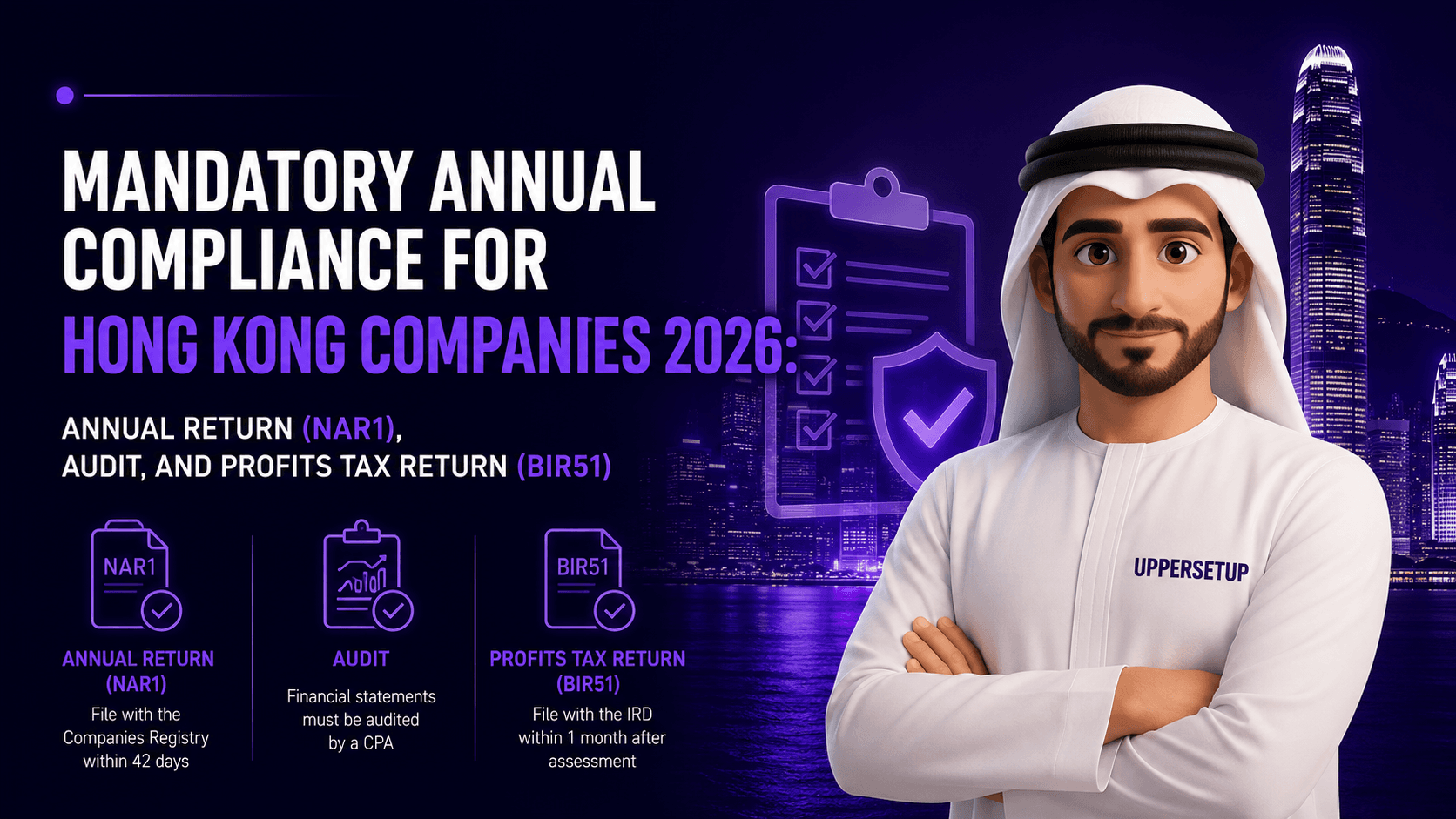
● Mandatory Annual Compliance for Hong Kong Companies 2026: NAR1, Audit and BIR51
● The Offshore Profits Claim in Hong Kong: How Territorial Taxation Works in 2026
● Closing a Hong Kong Company in 2026: Deregistration, Winding Up and the IRD Notice of No Objection
● Hong Kong + UAE: Dual Structure for International Business 2026
Disclaimer
This material is provided for information only and does not constitute legal, tax, financial, investment or consulting advice. Professional advice should be obtained on the specific facts, jurisdiction, entity status and current regulatory requirements before any decision is taken. Information is current as at August 2026.
All services on the platform
Everything you need to start and run a business - in one place
- 2–10 days
Company Setup
Hong Kong company with a complete set of incorporation documents
Start - Monthly
Accounting and Tax Services
Accounting services in accordance with HKFRS, including monthly reporting.
- 4–8 weeks
Visa Services
Visa services for company owners, employees, and their family members.
- 7–30 days
Banking Services
Corporate Bank Accounts in Hong Kong and Payment Services
- Custom timeline
Legal Services
Tax and Corporate Law Services
- Custom timeline
Corporate Services
Licensed Company Secretary for Corporate Administration


