






































































 International Free Zone Authority
Dubai CommerCity in 2026: the Complete Breakdown of Dubai’s E-Commerce Free Zone — DIEZA, Licences, VAT Designated Zone Status, QFZP, the Customs Platform and Decree-Law No. 14 of 2023
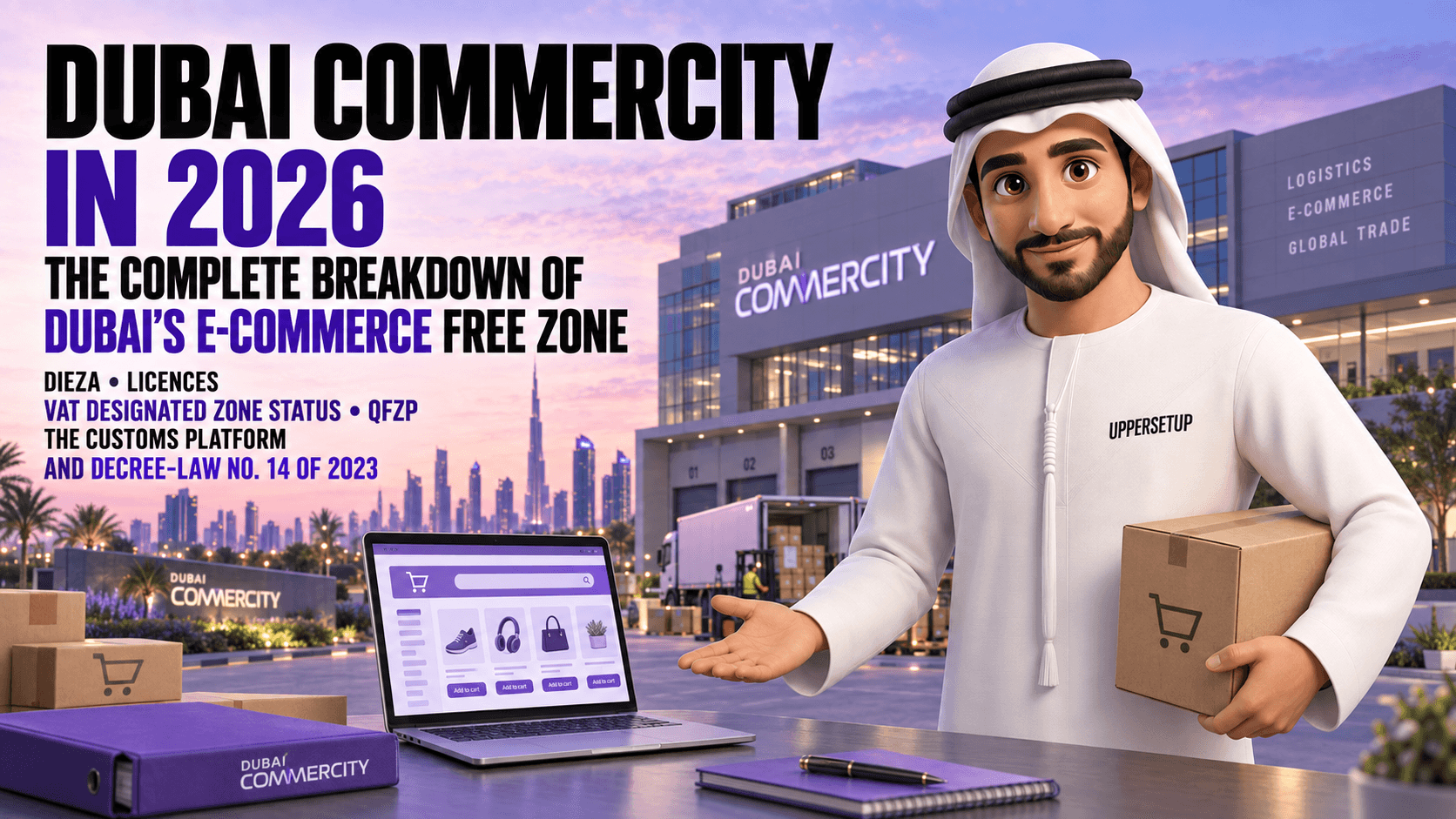
Dubai CommerCity (DCC) is a Dubai free zone built specifically for digital commerce: a joint venture between the Dubai Integrated Economic Zones Authority (DIEZA) and wasl Asset Management Group, located in Umm Ramool next to Dubai International Airport and forming part of the Dubai Integrated Economic Zones (DIEZ) as land plot No. 2150115. A company in DCC is registered under the DIEZA Implementing Regulations 2023 as an FZCO, a PLC or a branch, holds one of six licences (Trade, Service, Industrial, E-commerce, General Trading or Dual License with DET), and keeps its stock in the Business Cluster and the Logistics Cluster, both under customs control: for VAT purposes the zone has been on the list of Designated Zones as “CommerCity Dubai” since 1 January 2021. The decisive tax point in 2026 is that the 0 per cent corporate tax rate is available to a DCC company only as a Qualifying Free Zone Person (QFZP), and every sale to a natural person (B2C) is an Excluded Activity under Ministerial Decision No. 229 of 2025 — so the classic B2C marketplace or web-shop model in DCC pays 9 per cent, or relies on Small Business Relief up to AED 3,000,000 of revenue.
Key facts. First: DCC has no statute of its own — the zone exists under Article 4 of Dubai Law No. 16 of 2021 on DIEZA and Resolution No. 1 of 2022 of the DIEZA Chairman, which fixed its plot as No. 2150115; companies are registered under the DIEZA Implementing Regulations 2023, which expressly disapply Federal Decree-Law No. 32 of 2021 on Commercial Companies. Second: the zone is also a Designated Zone for VAT (the FTA list, row “CommerCity Dubai”, from 1 January 2021 under Cabinet Decision No. 34 of 2021) — but that status covers goods only: the place of supply of any service inside a Designated Zone is the UAE under Article 51(6) of the Executive Regulation. Third: Article 17 of Law No. 16 of 2021 promises licensed establishments a zero tax rate for 50 years from 1 January 2022, yet federal corporate tax under Decree-Law No. 47 of 2022 applies in the zone in full; 0 per cent comes only through the QFZP regime, which for e-commerce means, in practice, wholesale distribution from a Designated Zone backed by an ISRS 4400 report under FTA Decision No. 6 of 2026. Fourth: the zone publishes no licence or office tariff and no visa quota — every registration cost for DCC quoted in open sources is unconfirmed by an official document. Fifth: from 3 August 2026 Dubai Customs Notice No. 16/2026 exempts e-commerce consignments worth up to AED 1,000 from customs duty where they are cleared under the Notice No. 15/2021 procedures by companies registered with Dubai Customs and on the cross-border e-commerce platform, and from 13 December 2025 Cabinet Resolution No. 200 of 2025 imposes fines of up to AED 100,000 plus closure for breaches of Federal Decree-Law No. 14 of 2023 on e-commerce.
Key Parameters of Dubai CommerCity: Summary Table
|
Parameter |
Value |
Basis |
|
Legal status |
Free zone within the Dubai Integrated Economic Zones; land plot No. 2150115 |
Dubai Law No. 16 of 2021, Art. 4; Resolution No. 1 of 2022, Art. 2 |
|
Regulator and registry |
Dubai Integrated Economic Zones Authority (DIEZA) — a public authority wholly owned by the Investment Corporation of Dubai; the Registrar keeps the register under the DIEZA Implementing Regulations 2023 |
Law No. 16 of 2021, Art. 3; Regulations 2023 |
|
Founders and investment |
Joint venture of DIEZA (DAFZA at the time of the announcement) and wasl Asset Management Group; stated investment AED 3.2 billion (AED 2.7 billion in the 2017 announcement) |
dubaicommercity.ae; mediaoffice.ae, 18 April 2021; dafz.ae, 28 October 2017 |
|
Timeline |
Announced 28 October 2017; first phase opened 18 April 2021 |
dafz.ae; mediaoffice.ae |
|
Area |
2.1 million sq ft; the same 2017 release also states “427,000 square meters” — the two figures are incompatible (2.1 million sq ft ≈ 195,000 sq m) |
dafz.ae, 28 October 2017 |
|
Clusters |
Business Cluster — 13 office buildings, 108,000 sq m leasable; Logistics Cluster — 84 logistics units, 68,000 sq m; Social Cluster — restaurants, retail, galleries |
dafz.ae, 28 October 2017 |
|
Occupancy |
Business District ≈ 98 per cent, Logistics District 100 per cent (November 2025); 96 per cent across the three DIEZ zones (first half of 2026) |
Arabian Business, 16 November 2025; mediaoffice.ae, 17 August 2026 |
|
Entity types |
FZCO (1–50 shareholders), PLC, branch of a foreign or UAE company |
Regulations 2023, Reg 8; zone FAQ |
|
Applicable company law |
Regulations 2023; Federal Decree-Law No. 32 of 2021 on Commercial Companies does not apply |
Regulations 2023, Reg 3 |
|
Minimum capital |
FZCO — AED 1 under Reg 23.2; the zone’s website says “USD 273” (≈ AED 1,000); PLC — AED 250,000, at least 25 per cent paid up |
Regulations 2023, Reg 23; zone FAQ |
|
Licences |
Trade, Service, Industrial, E-commerce, General Trading, Dual License with DET; the FAQ additionally mentions a Freelance License |
dubaicommercity.ae/license-types; FAQ |
|
Activities |
Up to 20 activities from four industry groups; the base licence covers 3 activities from one group; the list follows the Department of Economy and Tourism (DET) classification |
zone FAQ |
|
Tariffs and visa quota |
No official price list and no visa quota published |
dubaicommercity.ae (checked 9 September 2026) |
|
VAT |
Designated Zone “CommerCity Dubai” — effective 1 January 2021; added by Cabinet Decision No. 34 of 2021 |
FTA list of 21 September 2021; Art. 51 of the Executive Regulation |
|
Corporate tax |
9 per cent federally; 0 per cent only for a QFZP under Art. 18 of Decree-Law No. 47 of 2022; distribution from a Designated Zone is a Qualifying Activity; transactions with natural persons are Excluded |
Cabinet Decision No. 100 of 2023; Ministerial Decision No. 229 of 2025 |
|
Additional QFZP reporting |
Audited financial statements (MD No. 84 of 2025); for distribution from a Designated Zone — an ISRS 4400 report within 30 days after the return deadline (Tax Periods from 1 January 2026) |
FTA Decision No. 6 of 2026 |
|
Customs |
Dubai Customs Cross-Border e-Commerce platform (launched 30 January 2020); CN No. 15/2021 — goods worth up to AED 30,000; CN No. 16/2026 — duty exemption for consignments up to AED 1,000 from 3 August 2026 |
dubaicustoms.gov.ae |
|
E-commerce law |
Federal Decree-Law No. 14 of 2023 (in force 16 September 2023) applies to free zone companies selling outside the zone; penalties — Cabinet Resolution No. 200 of 2025 (in force 13 December 2025) |
uaelegislation.gov.ae |
|
Mainland access |
DET branch, a branch “operating from the zone” (AED 10,000 a year) or a temporary permit (AED 5,000, up to 6 months) |
Executive Council Resolution No. 11 of 2025, Arts. 4, 12 |
|
DIEZ scale |
2025: revenue +19.4 per cent, companies +24.6 per cent, 106,359 employees; no DCC-only statistics are published |
mediaoffice.ae, 21 April 2026 |
What Dubai CommerCity Is and Who Owns It: DIEZA, wasl and the Three Clusters
Dubai CommerCity is a real-estate project and a licensing platform at the same time: a joint venture between the Dubai Integrated Economic Zones Authority and wasl Asset Management Group that builds and leases offices and warehouses, while DIEZA — a public authority of the Emirate of Dubai — licenses and registers the companies inside it. The project was announced on 28 October 2017 at the Dubai Airport Freezone Authority (DAFZA), in the presence of Sheikh Ahmed bin Saeed Al Maktoum, as the “first regional e-commerce free zone”, with an investment of AED 2.7 billion, a total area of 2.1 million sq ft and two construction phases of 50 per cent each (dafz.ae, 28 October 2017). The first phase opened on 18 April 2021: according to the Dubai Media Office, 470,000 sq ft came into operation, total investment had by then risen to AED 3.2 billion, 51 per cent of the first-phase warehouses had been leased before opening, and the first partners named were Hellmann, DHL Express, Magento and Redbox Digital (mediaoffice.ae, 18 April 2021). The DIEZ website records the zone’s establishment as April 2021 (diez.ae).
The area figures in official sources contradict each other, and that matters when quoting them. The DAFZA release of 28 October 2017 gives the total area as “2.1 million square feet (427,000 square meters)”. The two numbers are incompatible: 2.1 million sq ft is about 195,000 sq m, while 427,000 sq m is about 4.6 million sq ft. The DIEZ website in 2026 repeats only the 2.1 million sq ft figure. Author’s assessment: 2.1 million sq ft is the working number; 427,000 sq m is most likely the plot or gross built area, but no official document says so.
The three clusters were designed into the project from the start and survive in the zone’s current structure. Under the 2017 announcement the Business Cluster comprises 13 office buildings with 108,000 sq m of leasable area (136,000 sq m built up), the Logistics Cluster 84 logistics units with 68,000 sq m of leasable area (71,000 sq m built up), and the Social Cluster brings together restaurants, retail and galleries (dafz.ae). In 2026 the zone’s website offers Smart Desk, coworking, Fitted Office, Premium Offices and Shell and Core formats in the Business Cluster; Dedicated Warehouse, Third-Party Warehouse, Fulfilment Centre and Last Mile in the Logistics Cluster; and retail, restaurants, a food hall, kiosks and event venues in the Social Cluster (dubaicommercity.ae/our-facilities). The zone states that both the Business Cluster and the Logistics Cluster are “bonded zones”, that is, under customs control, which ties directly into the VAT Designated Zone status described below.
The zone’s owner changed in 2022 without a change of operator. Dubai Law No. 16 of 2021 abolished the stand-alone Dubai Airport Free Zone Authority (Article 33(a) repealed Law No. 25 of 2009) and created DIEZA — a public authority wholly owned by the Investment Corporation of Dubai (Article 3) — with Dubai Silicon Oasis, the Dubai Airport Free Zone and any zone designated by a Ruler’s resolution under its supervision (Article 4). Resolution No. 1 of 2022 of the DIEZA Chairman, dated 7 January 2022 and in force from 1 January 2022, approved the names, locations and boundaries of the four DIEZ free zones: Dubai International Airport Free Zone (plot 2210157), Dubai Silicon Oasis (plot 600-1137), Dubai CommerCity (plot 2150115) and DAFZA Industrial Park (plot 2480438) (dlp.dubai.gov.ae). That is why documents refer to the zone as “Dubai Commercity” (the Resolution’s spelling), “Dubai CommerCity” (the brand) and “CommerCity Dubai” (the FTA list of Designated Zones) — the same plot in every case. How the “parent” airport zone works is examined in DAFZA: the free zone at Dubai Airport, and the overall DIEZ architecture in Dubai Silicon Oasis and DIEZ in 2026.
The zone’s leadership in 2026. The Chairman of the Board of Dubai CommerCity is Dr Mohammed Al Zarooni, who is also Executive Chairman of DIEZ; the Director General is Amna Lootah; the Senior Vice President, Commercial is Mitch Bittermann; the Senior Vice President, Property Management and Supply Chain is Abdulrahman Shahin (styled “SVP Operations” in the May 2026 press release); and the Vice Presidents are Anisa Ali (Business Planning and Excellence) and Arjun Sarkar (Digital Ecosystem and Partnerships) (dubaicommercity.ae/about). The Chairman of DIEZ is Sheikh Ahmed bin Saeed Al Maktoum.
Statistics for the zone itself are published only in fragments; DIEZ-wide figures come regularly. DIEZ reported for 2025 a 19.4 per cent rise in revenue, a 17.8 per cent rise in net profit, a 24.6 per cent increase in registered companies and a workforce of 106,359 (+26.2 per cent) (mediaoffice.ae, 21 April 2026); for the first half of 2026 it announced 96 per cent occupancy across DAFZ, DSO and DCC together, a 13 per cent increase in companies and 24 per cent in staff (mediaoffice.ae, 17 August 2026). The DIEZ website shows 56,000+ registered companies and 106,000+ employees across all zones, whereas DCC’s own “About” page still cites 45,200+ DIEZA companies — a stale figure (diez.ae; dubaicommercity.ae/about). For DCC specifically, an interview with Abdulrahman Shahin in November 2025 gives Business District occupancy of about 98 per cent, Logistics District occupancy of 100 per cent, six new buildings under construction, a new fulfilment centre planned for the third quarter of 2026, and a 158 per cent rise in processed orders within a year after the introduction of robotic order handling (Arabian Business, 16 November 2025). Neither the zone nor DIEZ discloses the number of companies registered in DCC itself.
Author’s assessment: DCC is the only DIEZ zone built from scratch for a single industry, and its real competitive edge is infrastructural rather than fiscal: bonded warehouses beside the airport, integration with the customs platform, and a Social Cluster for showrooms. DCC’s tax regime is exactly that of DAFZ — both zones are on the Designated Zones list and both operate under the same DIEZA Implementing Regulations 2023. Choosing DCC over DAFZ makes sense when the business needs e-commerce-specific premises and the partner ecosystem, not when it expects a “special” tax status.
The Legal Framework of Dubai CommerCity: Which Acts Apply at Federal, Emirate and Zone Level
The legal regime of a Dubai CommerCity company is built from three tiers that must not be merged: UAE federal legislation (tax, e-commerce, employment, AML/CFT, immigration), the legislation of the Emirate of Dubai (the creation of DIEZA and of the zone itself, mainland access), and the instruments of DIEZA (company law, licensing, fees). No tier cancels another: the emirate law creates the zone and its incentives, but federal tax law applies to it directly, and DIEZA’s regulations operate only within the limits allowed by Dubai Law No. 16 of 2021.
|
Tier |
Instrument |
Issued / in force |
What it governs for a DCC company |
|
Federal |
Federal Decree-Law No. 47 of 2022 on the Taxation of Corporations and Businesses (as amended; Ministry of Finance consolidated text of January 2026) |
Issued 3 October 2022; applies to Tax Periods from 1 June 2023 |
The 9 per cent rate, the QFZP regime (Art. 18), registration, returns, penalties |
|
Federal |
Federal Decree-Law No. 8 of 2017 on VAT (as amended, most recently by Decree-Law No. 16 of 2025) and Cabinet Decision No. 52 of 2017 (the Executive Regulation, Art. 51 — Designated Zones) |
Issued 23 August 2017; in force 1 January 2018; the 2025 amendments from 1 January 2026 |
Designated Zone status, place of supply of goods and services, import VAT, Emirate-level e-commerce records (Art. 72) |
|
Federal |
Federal Decree-Law No. 14 of 2023 Concerning the Modern Technology-Based Trade |
Issued 4 September 2023; published 15 September 2023; in force 16 September 2023 |
Duties of e-commerce traders and platforms; applies to free zone companies selling outside the zone |
|
Federal |
Cabinet Resolution No. 200 of 2025 on administrative penalties for violations of Decree-Law No. 14 of 2023 |
Issued 27 November 2025; published 12 December 2025; in force 13 December 2025 |
11 categories of violation; penalties from a warning to AED 100,000 and closure |
|
Federal |
Federal Decree-Law No. 10 of 2025 on AML/CFT and Cabinet Resolution No. 134 of 2025 (Executive Regulations) |
Issued 30 September 2025; in force 14 October 2025; the Regulations issued 29 October 2025, in force 14 December 2025 |
Replaced Decree-Law No. 20 of 2018; DNFBP duties, goAML |
|
Federal |
Cabinet Decision No. 109 of 2023 on beneficial owner procedures and Cabinet Resolution No. 132 of 2023 on penalties |
Issued 6 November 2023; in force 16 November 2023; penalties from 15 December 2023 |
UBO register; declaration at registration and renewal |
|
Federal |
Federal Decree-Law No. 33 of 2021 on the Regulation of Employment Relationships |
Issued 20 September 2021; in force 2 February 2022 |
Employment contracts of zone staff; DIEZ has no employment code of its own |
|
Emirate of Dubai |
Law No. 16 of 2021 Establishing the Dubai Integrated Economic Zones Authority |
Issued 14 September 2021; in force 1 January 2022 (Art. 34) |
DIEZA’s status, the zones under it, customs exemption (Art. 16), the zero rate for 50 years (Art. 17), licensing (Art. 23) |
|
Emirate of Dubai |
Resolution No. 1 of 2022 of the DIEZA Chairman Approving the Names, Locations, Area and Boundaries of Free Zones |
Issued 7 January 2022; in force 1 January 2022 |
Dubai CommerCity — plot No. 2150115 |
|
Emirate of Dubai |
Law No. 6 of 2023 Establishing the Dubai Business Registration and Licensing Corporation; Decree No. 13 of 2024 Establishing the Unified Digital Window for Establishing Companies |
Issued 6 February 2023 and 1 March 2024 |
Centralised registration and licensing in the emirate; the Invest in Dubai platform |
|
Emirate of Dubai |
Executive Council Resolution No. 11 of 2025 Regulating the Conduct of Free Zone Establishments’ Activities in Dubai |
Issued 3 March 2025; in force on publication |
Three mainland mechanisms; fees of AED 10,000 and AED 5,000 |
|
Emirate of Dubai |
Law No. 15 of 2016 Concerning the Regulatory Legislation Issued by Free Zone and Special Development Zone Authorities |
Issued 1 November 2016; in force on publication in the Official Gazette (30 November 2016) |
DIEZA instruments are published on the authority’s website and are binding 30 days after publication unless they say otherwise |
|
Zone |
DIEZA Implementing Regulations 2023 |
In force on issuance (Reg 5); no date printed on the text |
Entity types, capital, register, UBO, audit, winding up; Decree-Law No. 32 of 2021 does not apply (Reg 3) |
|
Zone |
Zone terms, activity list, tariffs |
Published in part; no price list published |
Licence packages, leases, visas — on request |
The key conflict between the tiers is Article 17 of Dubai Law No. 16 of 2021. Its text provides that licensed establishments in the free zone and their employees “will be subject to zero (0) tax rate for fifty (50) years from the effective date of this Law”, renewable for the same period by a Ruler’s resolution (dlp.dubai.gov.ae). Federal Decree-Law No. 47 of 2022, adopted a year later, applies to every Taxable Person in the State, Free Zone Persons included, and gives them their own regime in Article 18: 0 per cent only for a Qualifying Free Zone Person, 9 per cent for everyone else and for non-qualifying income. Neither the Ministry of Finance nor the FTA treats emirate-level guarantees as a ground for exemption: a Free Zone Person must register, file a return and substantiate its QFZP status every year. Author’s assessment: Article 17 retains meaning for emirate-level taxes and charges, which Dubai does not levy, and for historical context, but it has no effect on federal corporate tax — the zone’s marketing formula “zero corporate or income tax” is legally inaccurate in 2026.
The practical consequence for e-commerce: of the three tiers, the “heaviest” for DCC is the federal one, and every new obligation between 2023 and 2026 arrived there. The e-commerce law (2023), corporate tax (2023), the new AML/CFT law (2025), penalties for e-commerce violations (December 2025), mandatory supplier verification before deducting input VAT (FTA Decision No. 13 of 2026, from 1 October 2026) and e-invoicing (from 1 January 2027 for the first wave) do not depend on which free zone a company is registered in. How the rules for choosing between a zone and the mainland have changed is set out in Free Zone or Mainland in the UAE (2026).
Which Entity Types Are Available in Dubai CommerCity: FZCO, PLC and Branch under the DIEZA Implementing Regulations 2023
The DIEZA Implementing Regulations 2023 are the company-law code of all four DIEZ zones, Dubai CommerCity included: 15 Parts and 117 regulations issued under Dubai Law No. 16 of 2021 and in force from the date of issuance (Reg 5). Regulation 3 provides expressly that Federal Decree-Law No. 32 of 2021 on Commercial Companies does not apply to a company or branch in the zone, and Regulation 4 repealed the earlier DAFZ Implementing Regulations 2021 and the Dubai Silicon Oasis regulations (dso.ae, PDF). No issue date is printed on the published text — this article calls it simply the “Regulations 2023”.
Regulation 8 allows three forms of presence. The first is the Free Zone Company (FZCO): a limited liability company which, according to the zone’s FAQ, may have from 1 to 50 shareholders, individual or corporate; the former FZE (single-shareholder) form is treated as an FZCO. The second is the Public Limited Company (PLC), with issued share capital of no less than AED 250,000, of which at least 25 per cent must be paid up (Reg 23.4). The third is a branch of a foreign or UAE company, registered under Regulation 19 without share capital of its own; a branch is not a separate legal person, and the parent is liable for its obligations. The author could not find the 50-shareholder ceiling in the text of the Regulations 2023 — the figure comes from the zone’s FAQ (dubaicommercity.ae/faq).
Minimum capital is the first divergence between the regulations and the zone’s practice. Regulation 23.2 reads: “An FZCO shall have a minimum Share capital of AED 1 (or any currency equivalent to AED 1)”. The Dubai CommerCity FAQ, however, requires a “minimum share capital of USD 273”, which corresponds to roughly AED 1,000. Author’s assessment: AED 1 is the legal minimum under the regulations and AED 1,000 is the administrative minimum the Registrar actually applies to DCC registrations; both figures are correct at their own level, and incorporation documents should follow the zone’s requirement, because the zone is the body that reviews the application. Neither figure is linked to a visa quota: the DIEZA regulations do not make the number of visas depend on capital.
Management and residence. Regulation 48.3 requires the company’s Manager to be a natural person resident in the UAE; it is the only residence requirement in the regulations — shareholders and directors may be non-residents. Regulation 22 obliges the company to complete and sign a declaration of ultimate beneficial owners and to submit it to the Registrar annually and at every licence renewal, and to notify any change in UBO details within 14 days (Reg 22.1–22.4); a UBO declaration at first registration is required by the zone’s own document list; the federal Cabinet Decision No. 109 of 2023, which reaches commercial free zones, applies in parallel. The federal UBO register and goAML requirements are described in The UAE UBO Register and goAML.
Accounts and audit. Regulations 65–72 (“Records, Accounts and Auditor”, “Financial Years”, “Accounts”, “Auditors Report on Company’s Annual Accounts” and so on) require the company to keep records, prepare annual accounts and obtain an auditor’s report from an auditor on the Registrar’s approved list. The filing deadline is not fixed in the text of the regulations — it is set administratively. For tax purposes the requirement is stricter: under Ministerial Decision No. 84 of 2025 audited financial statements are mandatory for every Qualifying Free Zone Person with no revenue threshold, and for everyone else above AED 50,000,000 of revenue; the detail is in Corporate Audit Requirements in the UAE 2026.
The licence as a condition of the company’s existence. Regulation 20.1 requires a valid licence to be maintained “at all times”, 20.2 confines activity to what the licence permits, 20.3–20.4 allow the Registrar to wind up a company or de-register a branch left without a licence, and 20.5 lets the Registrar vary the terms of a licence at any time in its discretion. Article 23(a) of Law No. 16 of 2021 mirrors this at emirate level: no person may conduct any activity in the free zone without a DIEZA licence.
Redomiciliation and termination. Regulations 98–99 allow a foreign company to continue into the zone with a certificate of continuation, and Regulations 100–101 allow a company to leave for another jurisdiction under a certificate of cancellation. On the federal side, Decree-Law No. 20 of 2025 inserted Article 15 bis into the Commercial Companies Law, permitting a company’s Trade Register entry to move between a free zone and the mainland while keeping its legal personality — but such a move ends Free Zone Person status and with it the right to 0 per cent. Regulation 105 provides three modes of winding up: by the Registrar, voluntarily and by court order; the closure procedure and its typical traps are described in Liquidating and Closing a UAE Company in 2026.
Which Licences Dubai CommerCity Issues and Which Activities Are Permitted
A Dubai CommerCity licence is DIEZA’s permission to carry on the activities listed in it from the territory of the zone; under Article 23(a) of Dubai Law No. 16 of 2021 no activity in the zone is possible without one, and under Regulation 20.2 a company may do only what its licence records. The zone’s “License Types” page lists six licences in the following terms (dubaicommercity.ae/license-types):
|
Licence |
The zone’s wording |
E-commerce model it fits |
|
Trade License |
“Allows the holder to engage in trading activities, including import, export, re-export, storage, and distribution of specified products” |
A web-shop with its own stock in the zone; wholesale distribution from a Designated Zone |
|
General Trading License |
“Permits businesses to engage in various activities, including import, export, re-export, storage, and distribution. It offers flexibility for trading across multiple industries” |
A multi-category retailer or trader not tied to one product group |
|
E-commerce License |
“Enables businesses to trade goods and services online, manage digital transactions, and streamline operations” |
A marketplace, a stockless online store, a D2C brand |
|
Service License |
“Permits the holder to carry out services specified in the license, such as consulting, advisory, and other professional services” |
Performance-marketing agencies, e-commerce platform developers, fulfilment operators (for the service element) |
|
Industrial License |
“Permits light manufacturing, packaging, and assembly within the free zone” |
Packaging, customisation and kitting in the zone’s warehouse |
|
Dual License with DET |
“Enables companies registered in Dubai CommerCity to apply for a Dubai Department of Economy and Tourism (DET) license without the need for physical office space” |
Mainland sales without leasing a second office — see the section on Resolution No. 11 of 2025 |
The zone’s FAQ and its licence page disagree on the list. The FAQ names five licences — E-commerce, Trade, Service, General Trading and a Freelance License — while the “License Types” page names six, without Freelance and with Industrial and Dual License added. Author’s assessment: a freelance permit exists in DCC as a separate zone product, but its terms (activities, cost, visas) are disclosed nowhere on the site, so its parameters cannot be confirmed from an official source. An applicant who needs the freelance format must request the terms from the zone in writing.
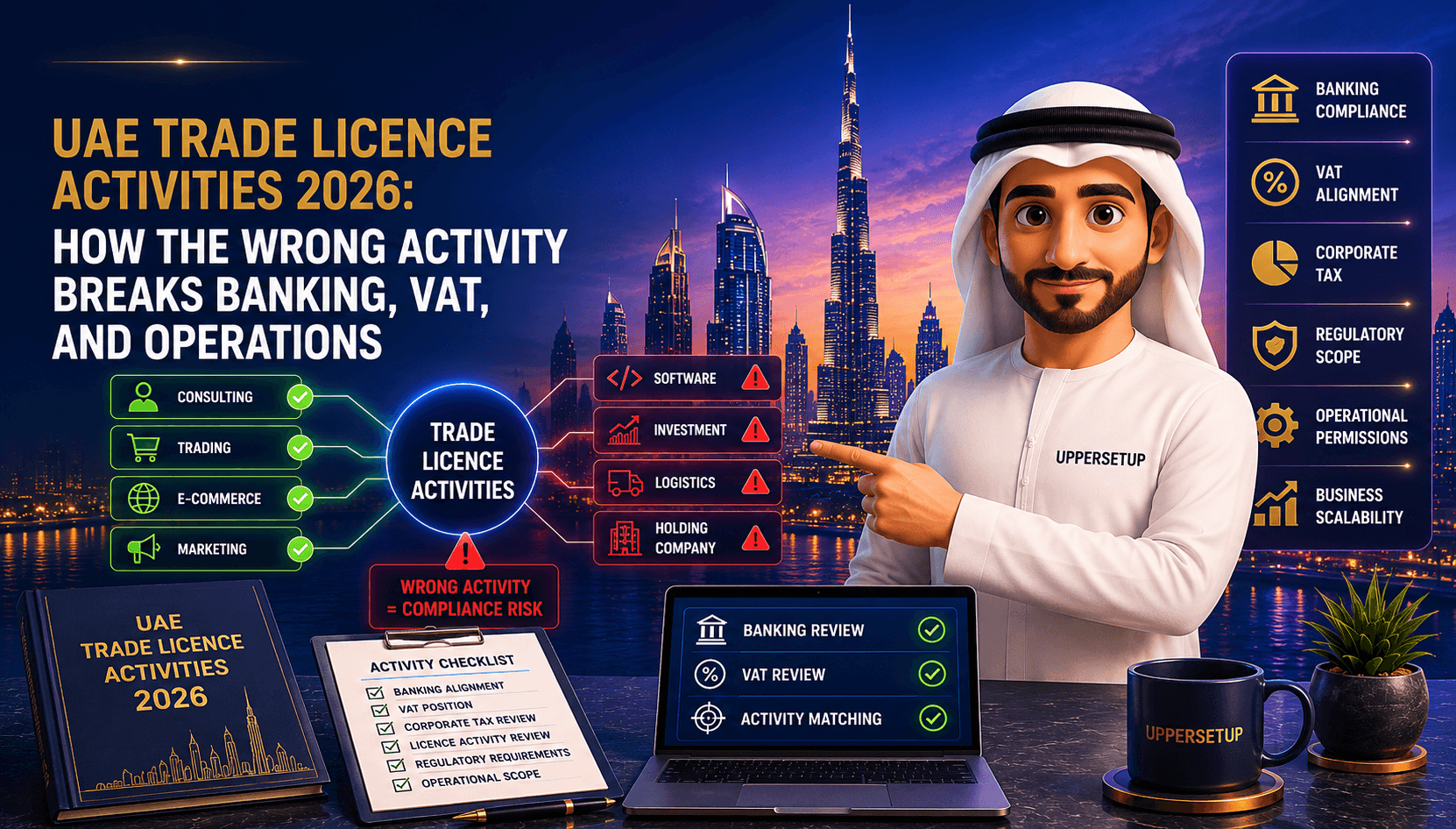
Activities: up to 20 from four groups. According to the FAQ, one licence may cover up to 20 activities from four different industry groups; the base licence includes three activities from one group, and further activities are added for a fee whose amount is unpublished. The zone states that its activity list follows the classification of Dubai’s Department of Economy and Tourism — the standard for DIEZ zones, which have no catalogue of their own, unlike TECOM or DMCC (dubaicommercity.ae/faq). In the UAE the activity code determines not only the licence but also bank account opening, VAT registration and the customs code — those dependencies are examined in UAE Trade Licence Activities 2026.
Premises are lease-only, but several units may sit on one licence. Offices and warehouses in DCC are not sold: the FAQ says plainly “Offices are available for lease only”. A single company may lease several premises — an office in the Business Cluster, a warehouse in the Logistics Cluster and a showroom in the Social Cluster — under one licence. The minimum floor area and its link to the number of visas are not stated on the site.
The registration procedure: seven steps and the UBO document list. The “Set up a business” page describes seven stages: initial consultation, selection of the licence type, document preparation, company registration, allocation of premises, visa processing and bank account opening (dubaicommercity.ae/set-up-a-business). Of the documents, only the beneficial-owner block is published: a UBO declaration, certified copies of each UBO’s passport or identity card, proof of residential address, a corporate structure chart, a copy of the shareholder register and the latest audited annual report. The “Initial approval documents” and “Registration Documents” lists are mentioned but not disclosed. No registration timeline is stated on the site.
Dubai CommerCity publishes no official tariff — and that is fundamental to any budget. The zone’s website carries no price list for licences, leases or visas; its licence comparison page compares the licences on nine features (business registration, tax benefits, intellectual property protection, virtual office services, customs and logistics services, 100 per cent foreign ownership, access to ports and airports, office space, educational and training facilities), but not on price. Any figure of the form “a DCC licence costs from AED X” found in open sources is unconfirmed by an official zone document, and no such figure is given in this article. A comparison of the officially published tariffs of other zones and the mainland from an e-commerce standpoint is collected in UAE E-Commerce Licence 2026.
DIEZ support measures of 2026 in force in DCC. On 9 April 2026 DIEZ announced a package of economic measures for companies in all three of its zones — DAFZ, DSO and Dubai CommerCity — effective immediately: stabilisation of rental rates on contract renewal; waiver of selected administrative fees, including late licence renewal penalties, “until conditions stabilise”; the option to pay rent in monthly instalments with the instalment fees waived; a three-month deferral of fees for shareholder amendments and for licence activity amendments; and a waiver of fees for company restructuring and authorised capital amendments (mediaoffice.ae, 9 April 2026). The announcement gives no end date for most measures, so their availability on the application date must be confirmed with the zone.
What matters when choosing between the Trade and E-commerce License. The zone’s wording shows that the warehouse model (import under customs control, storage, distribution) is described in the Trade and General Trading Licenses, while the E-commerce License is framed in terms of “trading online” and “digital transactions”. For a company that plans to hold stock in a bonded warehouse in the Logistics Cluster and use Designated Zone status, the decisive point is whether the licence carries the activities “import”, “storage” and “distribution” — without them neither a customs code nor the warehouse regime can be set up. Author’s assessment: the typical configuration for a D2C brand in DCC is a Trade License with an e-commerce activity added, not the other way round.
How a Dubai CommerCity Company Operates on the Mainland: the Dual License and Executive Council Resolution No. 11 of 2025
Dubai Executive Council Resolution No. 11 of 2025 Regulating the Conduct of Free Zone Establishments’ Activities in the Emirate of Dubai is the instrument that, for the first time, gave free zone companies — DCC included — three lawful ways to operate on the mainland without setting up a separate DET company. The Resolution was issued on 3 March 2025 and came into force on publication; it does not extend to DIFC financial establishments (dubaicommercity.ae, PDF; dlp.dubai.gov.ae). Before it, selling goods on the mainland from a free zone legally required either a local distributor or a full branch with mainland premises.
Article 4 of the Resolution establishes three mechanisms. The first is a branch licence in Dubai from the Department of Economy and Tourism with mainland premises — the classic branch of a free zone company. The second is a licence for a branch operating from the free zone: the company obtains DET permission for mainland activity without leasing a separate office outside the zone — this is the mechanism the zone markets as “Dual License with DET” with the wording “without the need for physical office space”. The third is a temporary permit for a specific mainland activity for up to six months. Under Article 12 the fee for the branch operating from the free zone is AED 10,000 a year and for the temporary permit AED 5,000; licences are issued for one year and are renewable. Article 3(b) requires separate financial records for mainland activity, and Article 13 gave companies already operating on the mainland one year to regularise their position, extendable by a further year (KPMG, overview of the Resolution).
|
Mechanism (Art. 4 of Resolution No. 11 of 2025) |
Mainland premises |
Fee (Art. 12) |
Term |
Who it suits in DCC |
|
DET branch licence |
Required |
DET tariff; the Resolution sets no fee |
1 year, renewable |
A retailer with its own mainland stores or showrooms |
|
Licence for a branch operating from the free zone (“Dual License with DET”) |
Not required |
AED 10,000 a year |
1 year, renewable |
A web-shop selling to UAE customers from its DCC warehouse |
|
Temporary activity permit |
Not required |
AED 5,000 |
Up to 6 months |
Pop-ups, seasonal trading, mainland exhibitions |
The tax consequence of the Dual License is counter-intuitive: a formalised mainland presence protects QFZP status, while an informal one destroys it. Under Article 5(1) of Cabinet Decision No. 100 of 2023, income attributable to a Domestic Permanent Establishment of a free zone company is taxed at 9 per cent — and a DET branch creates such an establishment. But Article 4 of the same Decision removes permanent-establishment income from both sides of the de minimis fraction, so a mainland branch does not “spoil” the 5 per cent non-qualifying threshold. If, instead, a DCC company sells on the mainland without a branch or permit — delivering goods from the zone’s warehouse straight to customers in Dubai, for example — the same revenue becomes non-qualifying income, enters the de minimis test and, once the threshold is breached, costs the company its 0 per cent rate for five Tax Periods. Author’s assessment: for e-commerce in DCC the question “do we need a Dual License” is first of all a tax question, not a licensing one. Exactly how free zone companies lose 0 per cent is examined in How Companies in Free Zones Lose 0 % Corporate Tax, and the requirements and cost of the mainland regime itself in Dubai Mainland: DET, Licences, Visa Quotas, Taxes.
VAT when operating through a branch. Designated Zone status attaches to territory, not to the company: goods taken out of the DCC warehouse to the mainland for sale through a branch or directly to a customer are an import into the State on which 5 per cent import VAT is paid (Article 50 of the VAT Law; Article 51(5)(c) of the Executive Regulation), and the subsequent mainland sale is taxed under the general rules. A branch does not create a separate VAT taxpayer — there is one registration per legal person.
What the Resolution does not do. It does not replace federal licences and permits (for example, registration with Dubai Customs or permits for regulated goods), it does not remove the obligations of an e-commerce trader under Decree-Law No. 14 of 2023, and it does not move the company to the mainland — the legal person remains a free zone resident governed by the DIEZA Implementing Regulations 2023.
What “Bonded Zone” Means in the Business and Logistics Clusters, and How Dubai CommerCity’s Logistics Work
A bonded zone is a territory under customs control in which foreign goods are stored without payment of customs duty or import VAT until they are released onto the UAE domestic market; in Dubai CommerCity that status is claimed for the Business Cluster and the Logistics Cluster, and its legal basis is Article 16 of Dubai Law No. 16 of 2021 together with the free zone regime of the GCC Common Customs Law. Article 16 provides: “Commodities brought into the Free Zone, or manufactured, produced, or developed therein, will be exempt from customs duties; and when exported outside of the UAE, no customs duties will be levied on these commodities” (dlp.dubai.gov.ae). Article 6 of the same law lists among DIEZA’s functions the management of security and customs controls and the regulation of goods import procedures, and the zone’s “About” page refers to an “onsite customs team” — a Dubai Customs post on the premises (dubaicommercity.ae/about).
“Bonded” and “Designated Zone” are not synonyms, even though in DCC they coincide territorially. The customs status of a free zone means duty suspension; Designated Zone status for VAT is a separate federal list — Cabinet Decision No. 59 of 2017 as amended — on which DCC appears as “CommerCity Dubai”. The condition in Article 51(1)(a) of the VAT Executive Regulation — “a specific fenced geographic area” with security measures and customs controls over the entry and exit of individuals and the movement of goods — is met precisely because of the bonded perimeter. A free zone without a customs perimeter (any TECOM zone, for instance) does not qualify for the Designated Zones list. The practical conclusion: the e-commerce warehouse model in DCC works because the zone is both “bonded” for customs and “designated” for VAT; losing either status — for example through a breach by the zone of the conditions in Article 51(2) — turns the warehouse into ordinary UAE territory.
Logistics Cluster infrastructure. Under the 2017 design data the cluster comprises 84 logistics units with 68,000 sq m of leasable area; the 2021 first phase opened 145,000 sq ft of logistics units, 51 per cent of which had been leased before opening (mediaoffice.ae, 18 April 2021). The zone offers four formats: Dedicated Warehouse (a unit assigned to one tenant), Third-Party Warehouse (a shared warehouse on a pay-as-you-go model), Fulfilment Centre (receiving, storage, picking and dispatch by the zone’s operator or a partner) and Last Mile (delivery to the customer) (dubaicommercity.ae/logistic-cluster). In November 2025 the zone reported 100 per cent occupancy of the Logistics District, the introduction of robotic order-processing systems with a 158 per cent rise in processed orders within a year, and plans to open a new fulfilment centre by the third quarter of 2026 (Arabian Business, 16 November 2025). The author found no official confirmation that the centre had actually opened by September 2026.
Integration with the customs platform. On 19 May 2026 Dubai CommerCity, Dubai Customs, Dubai Municipality and the logistics operator NAQEL Express announced an enhancement of the zone’s integration with the Dubai Customs cross-border e-commerce platform: a single digital chain for customs clearance, municipality product-safety approvals and end-to-end fulfilment (press release, Zawya, 19 May 2026). Dubai Customs remains the platform’s technical operator: it is the Cross-Border e-Commerce platform launched on 30 January 2020, whose rules are described in the customs section.
Business Cluster and Social Cluster. Office formats range from Smart Desk and coworking to Shell and Core for tenant fit-out; the buildings are stated to be LEED-certified. The Social Cluster — restaurants, a food hall, kiosks, retail and event venues — reached full operating capacity by November 2025 according to the zone; for an e-commerce brand it offers a showroom or pop-up next to the warehouse. The zone claims access to “around 3 billion consumers within five hours’ flight” — a marketing estimate with no normative source.
Author’s assessment: bonded status does not benefit every e-commerce model. It saves duty and VAT on goods that will be re-exported (sales into the Gulf, Africa, South Asia) or held for a long time before sale. For goods that go entirely to buyers inside the UAE, a bonded warehouse only defers the charge: on release of each consignment to the mainland the 5 per cent duty on the CIF value under Federal Law No. 19 of 2002 and 5 per cent import VAT fall due, and from 3 August 2026 small B2C consignments up to AED 1,000 are exempt from duty but not from VAT. Duty rates and exemptions are collected in Customs Duties in the UAE 2026.
Why Dubai CommerCity Is a VAT Designated Zone, and What That Status Gives (and Does Not Give)
A Designated Zone is a territory named in a Cabinet decision that also meets the conditions of Article 51(1) of the VAT Executive Regulation, and which for VAT purposes is treated as being outside the State — but only in relation to goods. The basis is Article 50 of Federal Decree-Law No. 8 of 2017: “A ‘Designated Zone’ that meets the conditions specified in the Executive Regulation of this Decree-Law shall be treated as being outside the State”; Article 51 of the Law allows goods to move between Designated Zones without tax becoming due, and Article 52 — as an exception — sets out when business inside such a zone is regarded as conducted in the UAE (FTA, consolidated text of the Law).
The FTA keeps the list on the basis of Cabinet Decision No. 59 of 2017 with five amendments. The FTA’s consolidated publication of 21 September 2021 cites the base decision (effective 1 January 2018) and the amending ones: Cabinet Decision No. 35 of 2018 (from 18 June 2018), No. 43 of 2019 (from 4 July 2019), No. 34 of 2021 (from 4 April 2021), No. 63 of 2021 (from 1 July 2021) and No. 81 of 2021 (from 12 September 2021). In that publication Dubai CommerCity appears as the row “CommerCity Dubai” with an effective date of 01/01/2021 and a reference to Cabinet Decision No. 34 of 2021; Dubai has nine rows, seven of them effective (FTA, list of Designated Zones). The list has not changed since September 2021.
Two caveats to the list that matter when quoting it. First: the texts of Cabinet Decision No. 59 of 2017 itself and of all five amending decisions are absent from the accessible official resources — the zone names are known from the FTA publication, not from the decisions, and must not be presented as quotations from them. Second: the FTA shows CommerCity’s effective date as 1 January 2021, whereas Cabinet Decision No. 34 of 2021 itself took effect on 4 April 2021 — the status was granted retroactively; this article gives the date as the FTA shows it.
The conditions of Article 51(1)–(2) of the Executive Regulation (Cabinet Decision No. 52 of 2017). A zone is treated as outside the State subject to the conditions that: (a) it is “a specific fenced geographic area” with security measures and customs controls monitoring the entry and exit of individuals and the movement of goods; (b) it has internal procedures for keeping, storing and processing goods; and (c) its operator complies with the procedures set by the FTA. Clause 2 adds that where a zone changes the manner of operating or breaches any condition on which it was listed, it is treated as if inside the State (FTA, consolidated Executive Regulation, September 2025). The FTA’s guide VATGDZ1 phrases the same requirements as four points, splitting sub-paragraph (a) in two, and adds that where part of a zone fails the conditions, the zone is “outside the State” only to the extent the conditions are met.
What the status gives. Goods brought from abroad into a DCC warehouse are not treated as imported into the UAE: Article 47(1)(b) of the Regulation expressly excludes from the concept of import goods “imported into a Designated Zone from a place outside the State” — no import VAT arises on entry into the zone. A movement of goods between two Designated Zones — between DCC and JAFZA, for example — is not taxed where the goods are not released, used or altered in transit and move under the customs suspension rules of the GCC Common Customs Law (Article 51(3)); the FTA may require a financial guarantee (Article 51(4)). A supply of goods within the zone to another person for resale is outside the scope of UAE VAT, because resale, under the FTA guide, is not consumption.
What the status does not give. Article 51(6) provides: “The place of supply of any Services is considered to be inside the State if the place of supply is in the Designated Zone”. Every service in DCC — fulfilment, warehouse logistics, website development, marketing, rent — is taxed under the general rules: normally at 5 per cent, and at 0 per cent on an export of services to a customer outside the State where Article 31 of the Regulation is satisfied (the recipient has no place of residence in the UAE and is present in the country for less than 30 days without a connection to the supply). Article 51(8) extends the same rule to water and energy, and Article 51(10) deems any person established or registered in a Designated Zone to have a place of residence in the State — so a DCC company must register for VAT once its taxable supplies exceed AED 375,000 (voluntarily from AED 187,500) on the ordinary basis.
The penalty for breaching the Designated Zone regime is the most expensive of the “warehouse” VAT penalties. The administrative penalties table (Cabinet Decision No. 40 of 2017 as amended by Decisions No. 49 of 2021, No. 108 of 2021 and No. 129 of 2025) provides, for failure to comply with the conditions and procedures for keeping goods in a Designated Zone or moving them to another Designated Zone, a penalty of the higher of AED 50,000 or 50 per cent of the tax chargeable on the goods (Ministry of Finance, consolidated text). The penalty attaches to procedure, not to non-payment: a stock-record breach on a consignment worth AED 200,000 (tax AED 10,000) costs the fixed AED 50,000. How VAT works overall, and how another Designated Zone applies the same rules, is set out in UAE VAT: The Complete Business Guide 2026 and JAFZA in 2026: Designated Zone Status.
How Sales from a Dubai CommerCity Warehouse Are Taxed for VAT: B2C inside the UAE, Exports and B2B between Zones
The place of supply of goods sold from a Designated Zone warehouse is governed by Article 51(5) of the Executive Regulation as amended by Cabinet Decision No. 88 of 2021, in force from 30 October 2021: as a general rule such a supply is treated as made inside the State, and only three exceptions take it outside the scope of UAE VAT. Clause 5 reads: “Where a supply of Goods is made within a Designated Zone to a Person to be consumed by him or another person, then the place of supply of these Goods shall be in the State except in any of the following cases: (a) the purpose was to incorporate the Goods into … another Good in the same Designated Zone and such Good is not consumed; (b) the Goods were delivered to a place outside the State, and the Supplier retains supporting commercial or official evidence proving that, and customs evidence proving that the Goods were removed from the Designated Zone; (c) the Goods were moved from the Designated Zone to a place inside the State, and the Supplier retains official evidence establishing that VAT had been applied on that import” (FTA, consolidated Regulation). The FTA’s Public Clarification VATP027 adds that “official evidence” means import documents issued by the Emirate customs department, for example stamped import declarations, and that where the conditions are not met the supply is standard-rated at 5 per cent in addition to import VAT (FTA, VATP027).
|
Sale scenario from DCC |
Place of supply of the goods |
What is paid |
Basis |
|
Export to a customer outside the UAE (including B2C to other countries) |
Outside the State, with commercial or official evidence of delivery and customs evidence of removal from the zone |
No UAE VAT; no duty (Art. 16 of Law No. 16 of 2021) |
Art. 51(5)(b) of the Regulation |
|
Delivery to a customer on the UAE mainland (B2C or B2B) |
Outside the State if the supplier retains official evidence that VAT was applied on the import; otherwise inside the State |
Import VAT of 5 per cent on the customs value plus duty (Art. 35 of the Law); without evidence, a further 5 per cent on the supply itself |
Art. 51(5)(c) of the Regulation; VATP027 |
|
Sale to another company inside DCC or another Designated Zone for resale |
Outside the scope of UAE VAT; movement between zones tax-free where the conditions are met |
Nothing, provided the goods are not released, used or altered; a financial guarantee may be required |
Arts. 51(3), (4) of the Regulation |
|
Sale to a company inside DCC for its own use (not resale) |
Inside the State |
5 per cent VAT under Art. 51(5); where tax was not paid, consumption by the owner is treated as an import under Art. 51(9)(a) |
Arts. 51(5), 51(9) of the Regulation |
|
Stock shortage in the warehouse |
— |
The goods are treated as imported into the State; 5 per cent VAT on the missing part |
Art. 51(9)(b) of the Regulation |
|
Fulfilment, delivery, marketing services and rent in the zone |
Inside the State |
5 per cent; 0 per cent on an export of services under Art. 31 |
Arts. 51(6), (8) of the Regulation |
|
Delivery supplied by the non-resident, unregistered seller of the goods through a third-party electronic platform |
Outside the State |
Not taxed; the non-resident need not register |
Art. 51(7) of the Regulation; VATP027 |
A worked example. A DCC company brings a consignment of electronics with a customs value of AED 100,000 into its bonded warehouse: on entry into the zone neither duty nor VAT is paid. On release of the whole consignment to the mainland under one declaration, 5 per cent duty — AED 5,000 — falls due under Federal Law No. 19 of 2002, and the import VAT base under Article 35 of the VAT Law is the customs value plus duty and excise: 5 per cent × (100,000 + 5,000) = AED 5,250. If the same consignment is split into B2C consignments of up to AED 1,000 each through the customs platform, from 3 August 2026 no duty is charged under Customs Notice No. 16/2026 and import VAT is 5 per cent × 100,000 = AED 5,000 — a saving of AED 5,250 on the original consignment. If instead the consignment is re-exported to customers in Saudi Arabia, neither UAE duty nor UAE VAT arises and the tax obligations move to the country of destination.
The key uncertainty of the B2C model is who acts as importer on delivery to the mainland. The Regulation and VATP027 require only that the supplier retain evidence that VAT was applied on the import; the clarification says expressly that the supplier need not be the importer. In practice two structures are possible. In the first, the customer (or a courier on the customer’s behalf) is the importer on the declaration, VAT and duty are paid on release, and the supplier’s supply stays outside the scope of VAT — the classic cross-border B2C model. In the second, the DCC company itself is the importer and, being VAT-registered with its customs code linked to its TRN, accounts for import VAT in its return under the reverse charge (Article 48 of the Law; Article 48(1) of the Regulation) — which raises the question whether it may deduct that VAT when its own supply is treated as “outside the State”. VATP027 does not address the point, and the 2018 guide VATGDZ1 predates the 2021 amendments. Author’s assessment: a structure in which the seller both treats its supply as out of scope and deducts the import VAT it paid leaves consumption in the UAE untaxed and is highly likely to be challenged by the FTA; the safe model — either customer-as-importer or charging 5 per cent on the supply where the seller imports — should be fixed in a written adviser’s opinion or a private clarification from the FTA before sales start. The mechanics of import, the customs code and import VAT recovery are examined in UAE Import, Customs and Import VAT in 2026.
Emirate-level records of e-commerce sales: the AED 100,000,000 threshold. Article 72(4) of the Regulation requires a Taxable Person whose taxable supplies through electronic commerce exceeded AED 100,000,000 in a calendar year to keep records proving the Emirate in which each supply is received; Article 72(5) defines electronic commerce as selling goods or services through electronic means, a platform, a social-media store or applications under criteria set by the Minister; and Article 72(6) fixes the application period — 18 months from the first Tax Period after 1 July 2023 for those over the threshold in 2022, and two years from the first Tax Period of the following calendar year for everyone else. The criteria are set by Ministerial Decision No. 26 of 2023 of 22 February 2023: the goods or services are listed on an electronic commerce medium, ordered through it regardless of the payment method, the goods are delivered to an address specified by the customer and not owned by the supplier, and services are provided with minimal or no human intervention (Ministry of Finance, MD 26/2023). A DCC company below the threshold has no such obligation, but every registrant still reports by Emirate in its VAT return under the general rules; UPPERSETUP sets up the VAT accounting of a warehouse and e-commerce model — including linking the customs code to the TRN and retaining the “official evidence” — as part of its accounting support for companies in the UAE.
Two 2026 innovations that reach every seller. Decree-Law No. 16 of 2025 inserted Article 54 bis into the VAT Law from 1 January 2026: the FTA refuses an input tax deduction where the supply was part of a tax-evasion chain and the Taxable Person knew it, and may refuse where the person should have known; FTA Decision No. 13 of 2026 sets, from 1 October 2026, mandatory supplier and supply verification procedures before deduction (with an exception for supplies below AED 10,000 where purchases from that supplier do not exceed AED 100,000 over 12 months). For an e-commerce company buying stock from many small suppliers, that means a documented check of every new counterparty. VAT penalties, voluntary disclosure and appeals are described in UAE Tax Penalties, Voluntary Disclosure and Appeals in 2026.
Corporate Tax: Can an E-Commerce Company in Dubai CommerCity Be a Qualifying Free Zone Person?
A Qualifying Free Zone Person (QFZP) is a free zone company which, under Article 18 of Federal Decree-Law No. 47 of 2022, pays 0 per cent on its Qualifying Income provided it simultaneously maintains adequate substance in the UAE, derives Qualifying Income, has not elected the general 9 per cent regime, complies with the arm’s length principle and transfer pricing documentation requirements (Articles 34 and 55) and meets the Minister’s conditions; under Article 3(2) of the Law a QFZP’s non-qualifying income is taxed at 9 per cent from the first dirham, with no AED 375,000 nil band. Three subordinate instruments define the regime: Cabinet Decision No. 100 of 2023 on Qualifying Income (issued 25 October 2023, applying from 1 June 2023), Ministerial Decision No. 229 of 2025 on Qualifying and Excluded Activities (issued 28 August 2025, applying from 1 June 2023, repealing MD No. 265 of 2023) and Ministerial Decision No. 84 of 2025 on audited financial statements (Ministry of Finance, MD 229/2025; Ministry of Finance, CD 100/2023).
The structure of Qualifying Income — the four paragraphs of Article 3(1) of Cabinet Decision No. 100 of 2023. (a) Income from transactions with another Free Zone Person, except from Excluded Activities; (b) income from transactions with a Non-Free Zone Person — only for Qualifying Activities that are not Excluded; (c) Qualifying Income from intellectual property; (d) any other income, provided the de minimis requirement is met. Income attributable to a domestic or foreign permanent establishment and income from immovable property are carved out of all four. The de minimis threshold is set by Article 3 of MD No. 229 of 2025: non-qualifying revenue must not exceed the lower of 5 per cent of total revenue or AED 5,000,000; breach of any condition costs the status from the beginning of the current Tax Period and for the four following ones (Article 5 of MD No. 229).
What follows for e-commerce — in one table.
|
Revenue model of a DCC company |
Characterisation under MD No. 229 of 2025 and CD No. 100 of 2023 |
Rate |
|
Wholesale distribution of goods from the DCC warehouse to corporate buyers in the UAE or abroad that resell or process the goods; goods for the UAE imported through a Designated Zone |
Qualifying Activity (l) — “distribution of goods or materials in or from a Designated Zone” |
0 per cent if all conditions are met and an ISRS 4400 report is in place |
|
Sales to natural persons (B2C) — in the UAE, in the Gulf or anywhere else |
Excluded Activity — Article 2(2)(a) of MD No. 229: “any transactions with natural persons”; exceptions only for ships, funds, wealth management and aircraft leasing |
Non-qualifying income; counts towards de minimis; above the threshold — 9 per cent on everything |
|
Sale of goods to another free zone company for its own use (not resale), where that company is the beneficial recipient |
Qualifying Income under Article 3(1)(a) regardless of activity |
0 per cent |
|
Marketplace commission from mainland or overseas sellers; platform and advertising services |
Not a Qualifying Activity; the counterparty is a Non-Free Zone Person |
Non-qualifying income |
|
Fulfilment services for third-party brands: storage and transport of goods without taking title |
Qualifying Activity (m) — logistics services; under Article 2(3) the definition is conjunctive — storage and transport together; warehousing alone does not qualify |
0 per cent |
|
Sales through a DET branch on the mainland |
Domestic permanent establishment income (Article 5 of CD No. 100) — outside Qualifying Income and outside the de minimis calculation (Article 4) |
9 per cent on the branch’s income; QFZP status is preserved |
|
Sub-letting commercial property in the zone to another Free Zone Person |
Qualifying Income (an exception from the Excluded Activities) |
0 per cent |
The practical result: a classic consumer web-shop or marketplace in Dubai CommerCity cannot be a QFZP, while 0 per cent is attainable for B2B distribution and 3PL fulfilment. The exclusion of transactions with natural persons is the most underrated rule in the regime: B2C revenue is not merely “non-qualifying” but expressly Excluded, and characterising the business as distribution from a Designated Zone does not rescue it, because paragraph (b) of Article 3(1) requires a Qualifying Activity “that is not an Excluded Activity”. For a B2C business with revenue up to AED 3,000,000 the working alternative is Small Business Relief: Ministerial Decision No. 73 of 2023, as amended by MD No. 131 of 2026 of 29 July 2026, extended the relief to Tax Periods ending on or before 31 December 2029, but its Article 3 excludes a QFZP — the company chooses one regime or the other. For a B2C business above the threshold the general regime applies: 0 per cent on the first AED 375,000 of taxable income and 9 per cent above it (Cabinet Decision No. 116 of 2022). The regime’s conditions are examined in detail in Qualifying Free Zone Person Regime in 2026 and UAE Corporate Tax 2026.
The conditions of qualifying distribution from a Designated Zone and the new 2026 report. Paragraph (l) of MD No. 229 applies on two conditions: goods entering the State are imported through a Designated Zone, and the buyer resells or processes the goods or is a public benefit entity. For Tax Periods beginning on or after 1 January 2026, FTA Decision No. 6 of 2026 of 2 June 2026 (published 14 July 2026) requires a QFZP engaged in distribution from a Designated Zone to obtain an agreed-upon-procedures report under ISRS 4400 from its financial statements auditor or another UAE-licensed auditor, confirming that customers resell the goods and that goods for the UAE were imported through a Designated Zone; the report is due within 30 days after the return filing deadline, and its absence means the conditions of Article 2(3) of MD No. 84 of 2025 are not met (FTA, Decision 6/2026). MD No. 84 of 2025 itself (issued 25 March 2025, applying to periods from 1 January 2025) requires audited financial statements from every QFZP with no revenue threshold and, in Article 2(3), obliges Designated Zone distributors to comply with the FTA’s additional procedures (Ministry of Finance, MD 84/2025).
Substance. Article 8 of Cabinet Decision No. 100 of 2023 requires the core income-generating activities to be undertaken in the free zone with adequate assets, an adequate number of qualified full-time employees and adequate operating expenditure; outsourcing is allowed to another person in a free zone or Designated Zone under the QFZP’s supervision. For a distributor in DCC that means the warehouse, the staff and the purchasing decisions must sit in the zone, not with a third-party 3PL on the mainland. Structuring for QFZP — separating B2B and B2C flows, testing de minimis and preparing the transfer pricing position — is part of UPPERSETUP’s legal and tax consulting.
Obligations regardless of status. Every DCC company registers in EmaraTax (the late-registration penalty is AED 10,000 under Cabinet Decision No. 75 of 2023 as amended by Cabinet Decision No. 10 of 2024), files a return within nine months of the end of the Tax Period (Article 53 of the Law) and confirms its regime election annually. Groups with consolidated revenue of EUR 750 million or more are subject to the 15 per cent Domestic Minimum Top-up Tax under Cabinet Decision No. 142 of 2024, computed at jurisdiction level — QFZP status gives no shelter from it. Notably, none of these federal instruments takes any account of the 50-year zero-rate promise in Article 17 of Dubai Law No. 16 of 2021.
Customs for E-Commerce in Dubai CommerCity: the Dubai Customs Platform, Notice No. 15/2021 and the AED 1,000 Threshold from 3 August 2026
The customs regime of a Dubai CommerCity company rests on three layers: the GCC Common Customs Law and federal instruments (the 5 per cent duty on CIF value under Federal Law No. 19 of 2002; the transfer of federal customs competences to the Federal Authority for Identity, Citizenship, Customs and Port Security by Decree-Law No. 14 of 2021), Dubai Customs’ emirate-level customs notices, and the free zone regime under Article 16 of Dubai Law No. 16 of 2021. The layer specific to e-commerce is the Dubai Customs Cross-Border e-Commerce platform and the two customs notices that govern it.
The platform. Dubai Customs officially launched its blockchain-based cross-border e-commerce platform on 30 January 2020 after a pilot in September 2019; the first phase automated export e-commerce transactions through couriers, the second covered imports, declaration consolidation, automated duty refunds and the onboarding of logistics companies (dubaicustoms.gov.ae, 30 January 2020). It is to this platform that Dubai CommerCity, Dubai Municipality and NAQEL Express were connected in May 2026.
|
Dubai Customs instrument |
Date |
Effective |
Content for a DCC company |
|
Customs Notice No. 15/2021 Concerning Customs Procedures for Cross-Border e-Commerce |
20 December 2021 |
On publication; superseded Notices No. 9/2021, No. 13/2021 and No. 14/2021 |
Definitions, platform registration, B2C and B2B declaration procedures, electronic archive |
|
Customs Notice No. 16/2026 amending Notice No. 15/2021 |
30 July 2026 |
3 August 2026 |
New wording of Art. 4 (duty exemption for goods up to AED 1,000, exclusions, B2C returns within 60 days) and Art. 11 (platform enrolment) |
Notice No. 15/2021: who registers and how. Article 1 defines “Companies” as commercial companies “including small & medium enterprises (SME), free zone companies, logistics companies, and customs warehouses registered with the Department that provide online retail and selling services for goods and products through e-Commerce channels”, “Platform” as the Dubai Customs Cross-Border e-Commerce Platform, and “Goods” as goods purchased or sold through e-commerce channels whose value does not exceed AED 30,000 (Dubai Customs, CN 15/2021, PDF). According to Deloitte’s digest, the notice requires companies to register on the platform, provides automated declaration processing through customer platforms for B2C transactions and manual e-commerce declarations via Dubai Trade for B2B, requires values to be declared at the price actually paid or payable, requires competent-authority approvals for restricted goods, requires declarations and invoices to be submitted electronically, and obliges the company to keep an approved e-archiving system with entry and exit records (Deloitte, GCC Indirect Tax Digest, 6 January 2022).
Notice No. 15/2021 is published by Dubai Customs as a scanned image without a text layer. The author read its first page (the preamble and Article 1 “Definitions”) visually; the content of the remaining articles is given from Deloitte’s digest as a Level 2 source. The earlier 2021 notices (including No. 13/2021, which is often quoted in commentary) have been superseded and are not in force in 2026 — they must not be cited.
Notice No. 16/2026: what changed from 3 August 2026. Article 1 of Notice No. 16/2026 restates Article 4 of Notice No. 15/2021 (issued 20 December 2021): “Goods and products with a value not exceeding AED 1,000 shall be exempt from customs duties” — goods in the sense of Notice No. 15/2021, that is, goods bought or sold through e-commerce channels and cleared by registered companies through the platform; the exemption does not extend to tobacco and tobacco products, electronic smoking devices, equipment and accessories, liquids containing nicotine, alcoholic beverages or food preparations containing alcohol. Returned B2C goods on which duty is proven to have been levied are exempt from duty if returned within 60 days of their exit. Article 2 restates Article 11 of Notice No. 15/2021: Client Happiness Management registers companies, adds their activities to the customer registration system and enrols companies on the platform, while Legal Affairs resolves disputes; the notice is signed by the Director General of Dubai Customs, Dr Abdulla Busenad (Dubai Customs, CN 16/2026, PDF). The AED 1,000 threshold concerns duty only: 5 per cent import VAT on such consignments remains.
General customs particulars. For any operation a DCC company obtains a client code (Business Code) from Dubai Customs: under the Dubai Customs Service Guide 2025 (version 9) registration costs AED 120, renewal AED 25, and validity equals that of the licence; the declaration fee ranges from AED 15 to AED 100 depending on the declaration type, plus the AED 20 Knowledge and Innovation fee; declarations are lodged through Mirsal 2 on Dubai Trade (Dubai Customs, Service Guide 2025). The zone’s “onsite customs team” speeds up clearance but does not remove the declaration: every movement of goods from the bonded warehouse to the mainland is a separate import declaration with duty and VAT, and every movement between Designated Zones is a transit under customs control.
Author’s assessment: the AED 1,000 threshold is the most significant customs change of 2026 for DCC, and it favours precisely the warehouse model. A brand holding stock in the zone’s bonded warehouse and dispatching consignments of up to AED 1,000 to UAE buyers through a platform-registered company pays only 5 per cent import VAT and no duty; a competitor that brought the same consignment into a mainland warehouse under one declaration paid 5 per cent duty on the whole consignment at once. On a consignment of AED 100,000 the difference is AED 5,250, as shown in the VAT section. How to choose the customs regime and recover import VAT is explained in UAE Import, Customs and Import VAT in 2026.
Does Federal Decree-Law No. 14 of 2023 on E-Commerce Apply to Dubai CommerCity Companies, and What Penalties Did Cabinet Resolution No. 200 of 2025 Set?
Federal Decree-Law No. 14 of 2023 Concerning the Modern Technology-Based Trade is the first UAE federal law to regulate e-commerce as such: it was issued on 4 September 2023, published in Official Gazette No. 759 of 15 September 2023 and, under Article 21, came into force on the day after publication — 16 September 2023(uaelegislation.gov.ae). The law applies to everyone trading in goods and services through “modern technology” in the State, and to free zones — under Article 2(1)(c) — “in any of the following two cases: 1. Provide or sell goods and services purchased through Modern Technology outside the geographical scope of the free zone. 2. The lack of legislation regulating Modern Technology-Based Trade in the free zone”; financial free zones are covered by paragraph (d). Article 2(2) excludes government procurement, platforms not engaged in trade, Central Bank digital currencies and licensed financial institutions and insurers.
For Dubai CommerCity both limbs of Article 2(1)(c) are satisfied at once. First, every e-commerce company in the zone sells to customers outside its geographical boundaries — otherwise it has no business. Second, the DIEZA Implementing Regulations 2023 contain no rules on e-commerce as an activity, so there is no “legislation regulating Modern Technology-Based Trade in the free zone” in DIEZ. Conclusion: Decree-Law No. 14 of 2023 applies to DCC companies in full, and Cabinet Resolution No. 200 of 2025 on penalties applies with it.
Trader obligations. Article 5 of the Decree-Law lists twelve obligations of a person trading by modern technological means: to have legal capacity; to fulfil the legal, regulatory, professional and technical requirements and conditions; to provide a technically safe environment meeting electronic security, cybersecurity and anti-hacking standards; to sell only goods and services permitted by law; to set the terms, conditions and details of every stage of the sale; to comply with the requirements on promotion and data exchange; not to act in a misleading manner or provide incorrect data; to issue detailed digital invoices; to observe competition protection rules; to maintain a business continuity plan; to supply information requested by the Ministry or the competent authorities; and to comply with the standards set by the Cabinet (uaelegislation.gov.ae, text). K&L Gates’ alert adds the consumer side of the law: contracts and advertising in Arabic or alongside Arabic, a ban on deceptive pricing practices and unfair terms, the consumer’s right to rate the seller and the payment gateway, and return and exchange rights (K&L Gates, alert of 23 January 2024). The law operates alongside Federal Law No. 15 of 2020 on Consumer Protection and its Executive Regulation, Cabinet Resolution No. 66 of 2023. Article 19 of the Decree-Law provides that the violations and administrative penalties are set in a separate instrument prepared by the Ministry in coordination with the competent authorities, without prejudice to sanctions under other laws; that instrument is Cabinet Resolution No. 200 of 2025.
Cabinet Resolution No. 200 of 2025. The Resolution on administrative penalties for violations of Decree-Law No. 14 of 2023 was issued on 27 November 2025, published in Official Gazette No. 813 of 12 December 2025 and came into force on 13 December 2025; Article 4 gives the offender 30 days to lodge a grievance with the Ministry, which must decide within 30 days, silence counting as rejection and the decision being final (uaelegislation.gov.ae). The annex to the Resolution sets out 11 categories of violation and four tiers of sanction — for the first, second, third and fourth occurrence; at the first tier every category except the first attracts a written warning with 15 days to rectify:
|
Violation |
1st occurrence |
2nd |
3rd |
4th |
|
Breach of digital identity verification requirements |
AED 2,000–10,000 |
AED 10,000–20,000 |
AED 20,000–40,000 + 20-day closure |
AED 40,000–100,000 + permanent closure |
|
Non-compliance with contract content requirements |
Warning |
AED 1,000–5,000 |
AED 5,000–20,000 + 20-day closure |
AED 20,000–100,000 + 40-day closure |
|
Breach of invoicing rules |
Warning |
AED 500–5,000 |
AED 5,000–10,000 |
AED 10,000–30,000 + 90-day closure |
|
Breach of rules on logistics fees |
Warning |
AED 500–2,000 |
AED 2,000–5,000 |
AED 5,000–10,000 |
|
Breach of rules on payment fees |
Warning |
AED 500–5,000 |
AED 5,000–10,000 |
AED 10,000–20,000 + 20-day closure |
|
Obstructing returns or replacements |
Warning |
AED 500–5,000 |
AED 5,000–10,000 + 20-day closure |
AED 10,000–20,000 + 20-day closure |
|
No complaint-handling mechanism |
Warning |
AED 2,000–5,000 |
AED 5,000–10,000 |
AED 10,000–20,000 + 20-day closure |
|
Breach of insurance requirements |
Warning |
AED 5,000–10,000 |
AED 10,000–20,000 |
AED 20,000–30,000 + 40-day closure |
|
Failure to provide information requested by the competent authority |
Warning |
AED 1,000–5,000 |
AED 5,000–10,000 + 20-day closure |
AED 10,000–20,000 + 30-day closure |
|
Non-cooperation with inspecting officers |
Warning |
AED 500–5,000 |
AED 5,000–10,000 + 20-day closure |
AED 10,000–20,000 + 30-day closure |
|
Other violations of the Decree-Law |
Warning |
AED 500–5,000 |
AED 5,000–10,000 + 20-day closure |
AED 10,000–20,000 + 30-day closure |
The most expensive line in the table is digital identity verification, and it is the only category where even the first breach is fined and the fourth is punished by permanent closure. For a marketplace or web-shop in DCC that means seller and buyer verification procedures (platform KYC) must be in place before launch, not after the first notice. Author’s assessment: together with the new AML/CFT requirements under Decree-Law No. 10 of 2025 and the FTA’s supplier verification rules from 1 October 2026, “identifying the counterparty” becomes a cross-cutting obligation of an e-commerce company on three independent grounds. The practical requirements for launching an online store — from the payment gateway to logistics — are collected in E-Commerce in the UAE: How to Launch a Business in 2026.
Who enforces. The “Ministry” in Article 1 of the Decree-Law is the Ministry of Economy (since 2025 the Ministry of Economy and Tourism), and the “competent authorities” are the federal and local bodies that issue approvals, licences and permits; for a DCC company that means two layers of supervision: DIEZA as the zone’s licensing authority and the federal regulator on the subject-matter of e-commerce. The penalties of Resolution No. 200 of 2025 do not replace sanctions under Consumer Protection Law No. 15 of 2020, the Personal Data Protection Law (Decree-Law No. 45 of 2021) or tax legislation — they are imposed in parallel. Drafting the terms of sale, the returns policy and the verification procedures to the requirements of Decree-Law No. 14 of 2023 is part of UPPERSETUP’s legal support for businesses in the UAE.
Comparison for E-Commerce: Dubai CommerCity, DAFZ, JAFZA, Dubai Silicon Oasis and Mainland DET
Comparing free zones for e-commerce makes sense only on verifiable features — legal basis, Designated Zone status, customs perimeter and the mainland-access mechanism; tariffs and visa quotas that are not officially published are left out of the table. The five venues are chosen because they are the ones an e-commerce business in Dubai usually chooses between: two DIEZ zones with identical company law (DCC and DAFZ), the port zone with the longest Designated Zone track record (JAFZA), a technology zone without a customs perimeter (DSO), and the mainland.
|
Criterion |
Dubai CommerCity |
DAFZ (Dubai Airport Free Zone) |
JAFZA (Jebel Ali Free Zone) |
Dubai Silicon Oasis |
Dubai mainland (DET) |
|
Legal basis |
Dubai Law No. 16 of 2021; Resolution No. 1 of 2022 (plot 2150115) |
Dubai Law No. 16 of 2021; Resolution No. 1 of 2022 (plot 2210157) |
Dubai’s own Jebel Ali Free Zone laws and the Jafza regulations |
Dubai Law No. 16 of 2021; Resolution No. 1 of 2022 (plot 600-1137) |
Federal Decree-Law No. 32 of 2021; Dubai Law No. 6 of 2023 |
|
Regulator and register |
DIEZA; DIEZA Implementing Regulations 2023 |
DIEZA; the same Regulations 2023 |
Jafza (DP World group) |
DIEZA; the same Regulations 2023; IFZA operates part of the register |
Department of Economy and Tourism |
|
VAT Designated Zone |
Yes — “CommerCity Dubai”, from 1 January 2021 |
Yes — “Dubai Airport Free Zone”, from 1 January 2018 |
Yes — “Jebel Ali Free Zone (North-South)”, from 1 January 2018 |
No — absent from the FTA list |
No |
|
Customs perimeter |
Bonded Business and Logistics Clusters; Dubai Customs post on site |
Bonded territory at the airport cargo terminal |
Bonded territory at Jebel Ali port |
No customs perimeter |
No |
|
Logistics anchor |
DXB airport (Umm Ramool); e-commerce fulfilment centres |
DXB airport (Cargo Village) |
Jebel Ali seaport; Al Maktoum International via the logistics corridor |
Technology park and residential district |
Any location in the emirate |
|
Entity types |
FZCO, PLC, branch |
FZCO, PLC, branch |
FZE, FZCO, PLC, branch, offshore company |
FZCO, PLC, branch |
LLC, PJSC, branch, sole establishment and other forms |
|
QFZP status available |
Yes; distribution from a Designated Zone is a Qualifying Activity |
Yes; as for DCC |
Yes; as for DCC |
Yes, but without Designated Zone distribution (not on the list) |
No — the regime is for Free Zone Persons only |
|
B2C sales and 0 per cent |
Excluded Activity (transactions with natural persons) |
Same |
Same |
Same |
General regime: 0 per cent to AED 375,000, 9 per cent above; Small Business Relief up to AED 3,000,000 |
|
Mainland access |
Resolution No. 11 of 2025: DET branch, “Dual License with DET” (AED 10,000 a year), temporary permit (AED 5,000) |
Resolution No. 11 of 2025 |
Resolution No. 11 of 2025 |
Resolution No. 11 of 2025 |
Not needed — the company is already on the mainland |
|
Specialisation |
Digital commerce and e-commerce logistics |
Aviation, logistics, trade, pharmaceuticals, IT |
Industry, trade, logistics, large distributors |
Technology, electronics, start-ups, R&D |
General |
|
Published tariffs |
No |
Partly, through packages |
Partly |
Partly |
Published by DET (individual fees) |
What in the table decides the choice. If the business model is B2B distribution or cross-border B2C with re-export, the candidates are only the three Designated Zones — DCC, DAFZ and JAFZA — and the choice between them comes down to the logistics anchor (air versus sea) and the premises formats. If the model is B2C inside the UAE without exports, Designated Zone status gives only a deferral of duty and VAT plus the AED 1,000 threshold for small consignments, and corporate tax in any zone and on the mainland will be 9 per cent (with Small Business Relief up to AED 3,000,000 in both cases); the deciding factors then become the visa quota, cost and the ability to sell directly on the mainland without a Dual License — and mainland DET often wins. Dubai Silicon Oasis is unsuitable for a warehouse-based e-commerce model because it has no customs perimeter, but suits platform, SaaS and marketplace companies that hold no stock of their own.
Author’s assessment: between DCC and DAFZ there is no difference in law — there is a difference in product. Both zones are governed by the same Regulations 2023, both are Designated Zones, both use the Resolution No. 11 of 2025 mechanism; DCC differs in that its premises are designed for fulfilment and last-mile and its ecosystem (the platform with Dubai Customs, payment and logistics partners, a Social Cluster for showrooms) is assembled around digital commerce. The neighbours in the table are examined in DAFZA: the free zone at Dubai Airport, JAFZA in 2026 and Dubai Silicon Oasis and DIEZ in 2026; the criteria for choosing a zone in general are in How to Choose the Right Free Zone for Business Registration.
Numeric Table: Capital, Fees, Thresholds and Penalties Confirmed by Official Sources
The table includes only the amounts and time limits confirmed by the text of a legal instrument, an official regulator publication or the zone’s own website; Dubai CommerCity’s tariffs for licences, leases and visas are not in it, because the zone does not publish them. Amounts are in UAE dirhams.
|
Indicator |
Value |
Basis |
|
Minimum FZCO share capital under the regulations |
AED 1 |
DIEZA Implementing Regulations 2023, Reg 23.2 |
|
Minimum FZCO capital required by the zone |
USD 273 (≈ AED 1,000) |
dubaicommercity.ae FAQ |
|
Minimum PLC capital |
AED 250,000, at least 25 per cent paid up |
Regulations 2023, Reg 23.4 |
|
Number of FZCO shareholders |
1 to 50 |
dubaicommercity.ae FAQ |
|
Activities on one licence |
Up to 20 from four groups; base licence — 3 from one group |
dubaicommercity.ae FAQ |
|
Time limit for notifying a change in UBO details |
14 days |
Regulations 2023, Reg 22 |
|
Fee for a licence for a branch operating from the free zone (“Dual License”) |
AED 10,000 a year |
Executive Council Resolution No. 11 of 2025, Art. 12 |
|
Fee for a temporary mainland activity permit |
AED 5,000; up to 6 months |
Resolution No. 11 of 2025, Arts. 4, 12 |
|
Dubai Customs client registration (Business Code) |
AED 120; renewal AED 25 |
Dubai Customs Service Guide 2025, v9 |
|
Dubai Customs declaration fee |
AED 15–100 depending on type + AED 20 (Knowledge and Innovation) |
Dubai Customs Service Guide 2025, v9 |
|
Customs duty rate |
5 per cent of CIF value |
Federal Law No. 19 of 2002, Art. 1 |
|
Duty-exemption threshold for e-commerce goods under the Notice No. 15/2021 procedures |
AED 1,000 from 3 August 2026; B2C returns within 60 days |
Customs Notice No. 16/2026 |
|
Upper value limit of “goods” under the e-commerce procedures |
AED 30,000 |
Customs Notice No. 15/2021, Art. 1 |
|
Mandatory VAT registration threshold |
AED 375,000; voluntary — AED 187,500 |
Federal Decree-Law No. 8 of 2017, Arts. 13, 17 |
|
VAT rate |
5 per cent |
Federal Decree-Law No. 8 of 2017, Art. 3 |
|
Threshold for Emirate-level e-commerce records |
AED 100,000,000 per calendar year |
Cabinet Decision No. 52 of 2017, Art. 72(4) |
|
Penalty for breaching the Designated Zone regime |
The higher of AED 50,000 or 50 per cent of the tax on the goods |
Cabinet Decision No. 40 of 2017 as amended, Table 3 |
|
Exception from supplier verification procedures |
Supplies below AED 10,000 where purchases from the supplier are ≤ AED 100,000 over 12 months; bank confirmation where those purchases exceed AED 375,000 |
FTA Decision No. 13 of 2026, Arts. 3, 6 |
|
Corporate tax rate |
0 per cent to AED 375,000 of taxable income, 9 per cent above; for a QFZP — 0 per cent on Qualifying Income and 9 per cent on the rest from the first dirham |
Decree-Law No. 47 of 2022, Art. 3; Cabinet Decision No. 116 of 2022 |
|
De minimis for a QFZP |
The lower of 5 per cent of revenue or AED 5,000,000 |
Ministerial Decision No. 229 of 2025, Art. 3 |
|
Loss of QFZP status |
The current period plus four subsequent periods |
Ministerial Decision No. 229 of 2025, Art. 5 |
|
Small Business Relief threshold |
AED 3,000,000 of revenue; periods ending by 31 December 2029 |
Ministerial Decision No. 73 of 2023 as amended by MD No. 131 of 2026 |
|
Audited financial statements |
Every QFZP with no threshold; others above AED 50,000,000 of revenue |
Ministerial Decision No. 84 of 2025, Art. 2 |
|
ISRS 4400 report for Designated Zone distribution |
Within 30 days after the return deadline; periods from 1 January 2026 |
FTA Decision No. 6 of 2026, Arts. 2, 5 |
|
Corporate tax return deadline |
9 months after the end of the Tax Period |
Decree-Law No. 47 of 2022, Art. 53 |
|
Penalty for late corporate tax registration |
AED 10,000 |
Cabinet Decision No. 75 of 2023 as amended by CD No. 10 of 2024 |
|
Domestic Minimum Top-up Tax threshold |
Consolidated group revenue of EUR 750 million or more; 15 per cent rate |
Cabinet Decision No. 142 of 2024 |
|
E-commerce law penalties |
From a warning to AED 100,000 and permanent closure |
Cabinet Resolution No. 200 of 2025 |
|
Time limit to contest an e-commerce penalty |
30 days |
Cabinet Resolution No. 200 of 2025, Art. 4 |
|
Zero rate under the emirate law |
50 years from 1 January 2022, renewable |
Dubai Law No. 16 of 2021, Art. 17 |
|
Project investment |
AED 2.7 billion (2017 announcement); AED 3.2 billion (2021 and the zone’s website) |
dafz.ae; mediaoffice.ae; dubaicommercity.ae |
|
Project area |
2.1 million sq ft; Business Cluster 108,000 sq m, Logistics Cluster 68,000 sq m leasable |
dafz.ae, 28 October 2017 |
|
Occupancy |
Business District ≈ 98 per cent, Logistics District 100 per cent (November 2025) |
Arabian Business, 16 November 2025 |
Launching an E-Commerce Company in Dubai CommerCity: 14 Steps from Business Model to First Return
The sequence runs from the tax model to the licence, not the other way round: in Dubai CommerCity the choice between B2B distribution and B2C sales predetermines QFZP status, the composition of the licence, the warehouse configuration and even who will be the importer on the customs declaration. Each step is tied to the instrument that requires it.
1. Define the revenue model and its characterisation under Ministerial Decision No. 229 of 2025. Separate the share of B2B distribution (qualifying), B2C sales (excluded), platform services (non-qualifying) and 3PL fulfilment (qualifying where storage and transport are combined). If B2C revenue will exceed the lower of 5 per cent or AED 5,000,000, QFZP status is unattainable and planning proceeds on 9 per cent or Small Business Relief.
2. Check whether a Designated Zone is needed at all. A warehouse model with re-export or B2B release to the mainland benefits from bonded status; a platform without stock does not. In the second case compare DCC with DSO and the mainland on cost and visas.
3. Choose the form: FZCO, PLC or branch. Under Regulation 8 of the Regulations 2023; note that the Manager must be a UAE resident (Reg 48.3) and that a branch has no capital or liability of its own.
4. Compose the licence. For the warehouse model — a Trade or General Trading License with the activities “import”, “storage” and “distribution” plus an added e-commerce activity; for a platform — an E-commerce or Service License; for packaging and kitting — an Industrial License. Check that every activity is on the DET list and needs no external approvals (cosmetics, supplements, electronics with radio modules, foodstuffs).
5. Request a written commercial offer from the zone. Because the tariffs are unpublished, fix the cost of the licence, lease, visa quota, deposits and validity periods in the zone’s offer before signing; clarify which minimum floor area gives which number of visas.
6. Prepare the UBO and constitutional documents. UBO declaration, certified passports of the beneficial owners, proof of address, structure chart, shareholder register, the parent’s latest audited accounts (for a branch and corporate shareholders) — per the zone’s list; declare capital of at least the zone’s requirement (USD 273 / AED 1,000) against the legal minimum of AED 1.
7. Complete registration and obtain the licence, then the establishment card and visas. Immigration procedures run under Federal Decree-Law No. 29 of 2021 and Cabinet Resolution No. 65 of 2022 through Dubai’s GDRFA; the quota depends on the leased area and is set by the zone.
8. Register with Dubai Customs and on the cross-border e-commerce platform. Obtain a Business Code (AED 120), apply for registration under Notice No. 15/2021 through Client Happiness Management, set up the electronic archive of goods entries and exits; without platform registration the exemption under Notice No. 16/2026 does not apply.
9. Register for VAT and link the customs code to the TRN. Registration is mandatory above AED 375,000 of taxable supplies (voluntary from AED 187,500); linking the Dubai Customs code to the TRN is what allows import VAT to be accounted for in the return under Article 48(1) of the Regulation rather than paid at the border.
10. Fix the B2C VAT model in writing. Decide who the importer is on delivery to the mainland — the customer or the company; set the procedure for retaining “official evidence” under Article 51(5)(c); where the company imports itself, obtain an adviser’s opinion or a private clarification from the FTA on deduction.
11. Register for corporate tax in EmaraTax within the deadline. The late penalty is AED 10,000; on registration choose the Tax Period and prepare transfer pricing documentation for related-party transactions (Articles 34 and 55 of the Law).
12. Implement the e-commerce law procedures before the site goes live. Digital identity verification, terms and conditions with the mandatory content in Arabic or with an Arabic version, invoices with the required particulars, disclosure of logistics and payment fees, a complaints mechanism, a returns policy, insurance where required — under Decree-Law No. 14 of 2023; check personal data processing under Decree-Law No. 45 of 2021.
13. Set up the AML framework. Under Decree-Law No. 10 of 2025 and Cabinet Resolution No. 134 of 2025 assess whether the activity is a DNFBP (for example, dealing in precious metals and stones with a cash threshold of AED 55,000), register in goAML where required, and appoint a responsible officer.
14. Build the first-year compliance calendar. Licence renewal and UBO declaration (annually), audit (mandatory for a QFZP), VAT returns (quarterly or monthly as the FTA decides), the corporate tax return (9 months after the period), the ISRS 4400 report (30 days after the return deadline — for Designated Zone distribution), supplier verification under FTA Decision No. 13 of 2026 (from 1 October 2026), and preparation for e-invoicing (first wave from 1 January 2027).
Author’s assessment: steps 1, 5 and 10 are the ones most often skipped, and they are the ones that decide the project’s economics. Without step 1 the company applies for QFZP with B2C revenue and loses the status for five periods; without step 5 the budget rests on unverified figures from open sources; without step 10 the first FTA audit turns “outside the scope of VAT” into 5 per cent plus penalties. The full step-by-step procedure for setting up a company in the UAE is in How to Set Up a Company in the UAE in 2026; support with registration in DCC and the other DIEZ zones is available through UPPERSETUP’s company registration service.
Typical Mistakes When Operating through Dubai CommerCity, and What They Cost
A typical Dubai CommerCity mistake is a decision taken on the strength of the zone’s marketing formula or an outdated commentary rather than the text of the instrument in force; the cost of each mistake below is expressed as a specific sanction or a lost relief.
Mistake 1. Taking “zero corporate or income tax” on the zone’s website to mean there is no corporate tax.Article 17 of Dubai Law No. 16 of 2021 does not displace federal Decree-Law No. 47 of 2022; a DCC company must register, file a return and either substantiate QFZP status or pay 9 per cent. Cost: AED 10,000 for late registration, plus penalties for non-filing and 9 per cent assessed for every missed period.
Mistake 2. Applying for QFZP status with B2C revenue. Transactions with natural persons are an Excluded Activity under Article 2(2)(a) of MD No. 229 of 2025; breaching de minimis (the lower of 5 per cent or AED 5,000,000) removes the status from the beginning of the period and for four more. Cost: 9 per cent on all taxable income for five Tax Periods, including qualifying B2B revenue, with no AED 375,000 nil band.
Mistake 3. Selling on the mainland from the zone’s warehouse without a Dual License or a temporary permit.Executive Council Resolution No. 11 of 2025 requires one of three mechanisms; informal mainland revenue becomes non-qualifying and enters de minimis, whereas the revenue of a formalised branch is excluded from it. Cost: loss of QFZP for five periods, against a lawful solution costing AED 10,000 a year.
Mistake 4. Treating a supply from the bonded warehouse to a UAE customer as “outside the scope of VAT” without evidence of import VAT paid. Article 51(5)(c) of the Regulation requires the supplier to retain official customs documents showing VAT was applied on the import; without them the supply is taxed at 5 per cent in addition to import VAT. Cost: 5 per cent of turnover retrospectively, a 14 per cent annual late-payment charge under Cabinet Decision No. 129 of 2025 and a fixed penalty where the shortfall is found before voluntary disclosure.
Mistake 5. Breaching the Designated Zone warehouse regime — keeping stock records with discrepancies, using goods for own purposes without a declaration. A shortage and own consumption count as an import (Article 51(9)), and failure to follow keeping and movement procedures is penalised separately. Cost: the higher of AED 50,000 or 50 per cent of the tax on the goods for each procedural breach, regardless of the amount underpaid.
Mistake 6. Launching a marketplace without digital identity verification procedures and terms containing the mandatory content. Cabinet Resolution No. 200 of 2025 penalises a verification breach from the first occurrence. Cost: AED 2,000–10,000 for the first breach, AED 40,000–100,000 plus permanent closure for the fourth; for non-compliant contract terms, up to AED 100,000 and a 40-day closure.
Mistake 7. Budgeting on “DCC licence cost” figures from open sources. The zone publishes no price list; the amounts in commentary are unconfirmed and often relate to packages of earlier years or to other DIEZ zones. Cost: a first-year budget deviation that cannot be contested, because no official price exists; the only protection is the zone’s written offer.
Mistake 8. Not registering on the cross-border e-commerce customs platform and losing the AED 1,000 exemption.Notice No. 16/2026 applies only to companies registered on the platform under Notice No. 15/2021. Cost: 5 per cent duty on every B2C consignment that could have been exempt — AED 50 on a consignment worth AED 1,000, AED 50,000 on 1,000 such consignments.
Mistake 9. Treating fulfilment services for zone clients as “outside VAT” because the zone is a Designated Zone.Article 51(6) of the Regulation expressly places the supply of any service in a Designated Zone inside the State. Cost: 5 per cent on service revenue retrospectively, plus late-payment charges and penalties.
Mistake 10. Not commissioning the ISRS 4400 report when distributing from a Designated Zone. From the 2026 periods FTA Decision No. 6 of 2026 makes the report a condition of qualifying distribution. Cost: the distribution conditions are treated as not met — and, in consequence, 0 per cent is lost for the current and four subsequent periods under Article 5 of MD No. 229.
Author’s assessment: mistakes 2, 3 and 10 share one feature — they cost not a one-off fine but five Tax Periods at 9 per cent. That is why structuring decisions in DCC should be taken before the first sale, not while preparing the first return. How free zone companies lose the relief in practice is examined in How Companies in Free Zones Lose 0 % Corporate Tax.
Who Dubai CommerCity Suits, and Who It Does Not
Dubai CommerCity suits a business for which the zone’s value lies in a bonded warehouse by the airport, Designated Zone status and e-commerce infrastructure; it does not suit a business looking for “zero tax” on B2C sales or the cheapest licence. Below are the profiles for which the choice is supported by the text of the instruments in force, and those for which it is supported only by marketing.
A good fit.
• A regional distributor or D2C brand with re-exports. Goods enter the bonded warehouse free of duty and VAT, are sold to B2B buyers in the UAE (through the Designated Zone) and to B2C buyers in Saudi Arabia, Qatar, Africa and South Asia; the B2B share produces Qualifying Income under paragraph (l) of MD No. 229 of 2025, and exports are free of UAE VAT under Article 51(5)(b) of the Regulation. The key condition is to keep B2C revenue within de minimis or move it into a separate company.
• A 3PL or fulfilment operator for third-party brands. Storage plus transport without taking title is a qualifying logistics activity (paragraph (m)); the services carry 5 per cent VAT (Article 51(6)), but the income qualifies for 0 per cent where substance is maintained.
• An online retailer with small B2C consignments into the UAE, prepared to pay 9 per cent. The duty exemption for consignments up to AED 1,000 from 3 August 2026 and bonded storage deliver operating savings, while corporate tax — 9 per cent, or Small Business Relief up to AED 3,000,000 of revenue — is the same as on the mainland. The choice is justified by logistics, not tax.
• A company that needs a “Dual License with DET” without a second office. The model: warehouse and office in the zone, a branch licence operating from the zone for AED 10,000 a year — for direct mainland sales while preserving QFZP on the B2B side.
• An international group opening a regional hub next to DAFZ. The single Regulations 2023 for DCC and DAFZ, tax-free movement of goods between Designated Zones (Article 51(3)) and a common regulator simplify a multi-entity structure.
Not a fit.
• A B2C marketplace or web-shop counting on 0 per cent. Transactions with natural persons are an Excluded Activity; QFZP is unattainable and 9 per cent is paid in any zone. For that model cost, visas and mainland access decide — and mainland DET or a zone with low published tariffs may prove better.
• A platform, SaaS business or agency without stock. The bonded warehouse and Designated Zone status go unused, and services are taxed under the general VAT rules in any case; zones without a customs perimeter (DSO, TECOM) offer the same tax result with different infrastructure.
• A business that needs a transparent fixed entry price. The absence of a published DCC price list makes the budget depend on an individual offer; zones with open tariffs give predictability.
• Trade in regulated goods without readiness for external permits. Cosmetics, supplements, foodstuffs, electronics with radio modules, tobacco and alcohol require permits from the Municipality, the Ministry of Health, the TDRA and other bodies; the AED 1,000 exemption does not extend to tobacco, nicotine or alcohol.
• A company planning to move to the mainland within a few years. A transfer under Article 15 bis of the Commercial Companies Law (Decree-Law No. 20 of 2025) or an exit under Regulations 100–101 ends Free Zone Person status — investment in bonded infrastructure will not pay back.
Author’s assessment: the right question when choosing DCC is not “how much tax will I save” but “how many consignments will I re-export and how many B2C consignments of up to AED 1,000 will I send within the UAE”. If the answer to both is “many”, the zone pays for itself through logistics; if the answer is “mostly high-value B2C inside the UAE”, there is no tax reason to choose DCC. A full review of the alternatives is in Overview of UAE Free Zones; for matching a zone to a specific model, see the UAE page on the UPPERSETUP website.
Visas, Staff, Banking and the Compliance Calendar of a Dubai CommerCity Company
Visas, employment and banking for a Dubai CommerCity company are governed not by the zone but by federal instruments: entry and residence by Federal Decree-Law No. 29 of 2021 and Cabinet Resolution No. 65 of 2022, employment by Federal Decree-Law No. 33 of 2021, AML/CFT by Federal Decree-Law No. 10 of 2025; the zone acts as sponsoring authority and intermediary but sets no rules of its own.
Visas. The zone lists “Visa Processing” as the sixth registration step and states that it assists with visas for the owner and employees, but publishes neither a visa quota nor its link to floor area — unlike, for example, the DDA districts, where the quota is officially tied to leased space. Residence visas are issued through Dubai’s GDRFA on the basis of the company’s establishment card; timings and fees follow the federal tariff in Cabinet Resolution No. 88 of 2022 and the zone’s own tariff, which is unpublished. The special regimes — the Golden Visa for investors and entrepreneurs, the Green Visa for freelancers and skilled professionals — are available to a DCC company’s staff on the ordinary federal terms. Author’s assessment: in negotiations with the zone the number of visas in the package should be fixed in writing together with the floor area, since no published formula exists.
Employment. DIEZ has no autonomous employment code, unlike DIFC and ADGM; the employment contracts of DCC staff are governed by Federal Decree-Law No. 33 of 2021 and its subordinate instruments — with probation of up to six months, fixed-term contracts, gratuity and the termination rules set by federal law. The company sponsors work visas through the zone; Emiratisation programmes, which apply to employers registered with MOHRE that have 20 or more staff, do not by their structure extend to a free zone company.
Bank account. Opening a corporate account is the seventh step of the zone’s procedure, but the decision is the bank’s under its own KYC rules based on federal AML/CFT legislation. In practice banks ask for the licence, articles, shareholder register, UBO declaration, lease, a description of the business model and proof of source of funds; from e-commerce companies, additionally, contracts with the payment gateway and marketplaces. Decree-Law No. 10 of 2025 (in force 14 October 2025) and Cabinet Resolution No. 134 of 2025 (in force 14 December 2025) replaced the former Decree-Law No. 20 of 2018; for companies dealing in precious metals and stones the cash threshold that brings them into the DNFBP category is AED 55,000.
E-invoicing. The federal e-invoicing system is being introduced in stages: under Ministerial Decision No. 66 of 2026 companies with revenue of AED 50,000,000 or more must appoint an accredited service provider by 30 October 2026, and the exchange of electronic invoices for the first wave starts on 1 January 2027; for an e-commerce company with a large volume of B2C invoices that is a separate IT project. The detail is in Mandatory Electronic Invoicing in the UAE.
|
Obligation |
Deadline |
Basis |
|
Licence renewal and UBO confirmation |
Annually; UBO changes within 14 days |
Regulations 2023, Regs 20, 22 |
|
Audit of annual accounts |
Annually; mandatory for a QFZP with no threshold |
Regulations 2023, Regs 65–72; MD No. 84 of 2025 |
|
VAT return |
Quarterly (or monthly as the FTA decides), within 28 days of the period end |
Decree-Law No. 8 of 2017; the Regulation |
|
Corporate tax registration |
Within the deadlines of FTA Decision No. 3 of 2024; new companies within three months of incorporation |
FTA Decision No. 3 of 2024 |
|
Corporate tax return |
9 months after the end of the Tax Period |
Decree-Law No. 47 of 2022, Art. 53 |
|
ISRS 4400 report (Designated Zone distribution) |
30 days after the return deadline; periods from 1 January 2026 |
FTA Decision No. 6 of 2026 |
|
Transfer pricing documentation |
Local and master file within 30 days of an FTA request; disclosure form with the return |
Decree-Law No. 47 of 2022, Art. 55 |
|
Supplier verification before deducting VAT |
From 1 October 2026; repeated every 12 months |
FTA Decision No. 13 of 2026 |
|
Customs platform registration and electronic archive |
Before the first e-commerce declaration; the archive continuously |
Notice No. 15/2021 |
|
Renewal of the Dubai Customs Business Code |
Together with the licence |
Dubai Customs Service Guide 2025 |
|
E-invoicing |
Provider appointed by 30 October 2026 (revenue ≥ AED 50,000,000); exchange from 1 January 2027 |
Ministerial Decision No. 66 of 2026 |
|
goAML registration (if a DNFBP) |
Before the relevant activity starts |
Decree-Law No. 10 of 2025; CR No. 134 of 2025 |
Author’s assessment: the compliance load of a DCC company in 2026 is set not by the zone but by three federal regulators — the FTA, the Ministry of Economy and Tourism, and Dubai Customs as the executor of federal customs law. The zone adds only two items — licence renewal with the UBO declaration and the audit under its regulations; everything else is the same for any Designated Zone in Dubai. Running that calendar — VAT and corporate tax returns, preparation for the audit and the ISRS 4400 report — is handled by UPPERSETUP’s accounting support.
FAQ: Dubai CommerCity in 2026
Is Dubai CommerCity a free zone or part of DAFZA?
Dubai CommerCity is a free zone in its own right within the Dubai Integrated Economic Zones: Article 4 of Dubai Law No. 16 of 2021 brings Dubai Silicon Oasis, the Dubai Airport Free Zone and any zone designated by a Ruler’s resolution under DIEZ, and Resolution No. 1 of 2022 of the DIEZA Chairman approved Dubai CommerCity as a separate zone on plot No. 2150115. DCC and DAFZ share one regulator and registrar — DIEZA — and one set of company rules — the DIEZA Implementing Regulations 2023 — but the licence is issued for the DCC zone specifically.
Is Dubai CommerCity a Designated Zone for VAT?
Yes. In the FTA’s consolidated list of 21 September 2021 the zone appears as “CommerCity Dubai” with an effective date of 1 January 2021 under Cabinet Decision No. 34 of 2021. The status covers goods only: under Article 51(6) of the Executive Regulation the place of supply of any service inside a Designated Zone is the UAE, and services are taxed under the general rules.
How much does a licence in Dubai CommerCity cost?
The zone publishes no price list for licences, leases or visas: its website refers to a “flexible pricing model” and packages on request. Any figure in open sources is unconfirmed by an official zone document; the cost is fixed only in DCC’s written commercial offer. The officially confirmed fees are AED 10,000 a year for the “Dual License with DET” and AED 5,000 for a temporary permit under Executive Council Resolution No. 11 of 2025. Since 9 April 2026 DIEZ has applied a support package across its three zones: rent stabilisation on renewal, waiver of late licence renewal penalties, monthly rent instalments without fees, and deferral of shareholder and activity amendment fees.
Does a Dubai CommerCity company pay 9 per cent corporate tax?
Yes, as a general rule: Federal Decree-Law No. 47 of 2022 applies to free zone companies. The 0 per cent rate is available only to a Qualifying Free Zone Person on Qualifying Income — for e-commerce that is chiefly wholesale distribution from a Designated Zone and logistics services; transactions with natural persons (B2C) are excluded from the Qualifying Activities under Ministerial Decision No. 229 of 2025. Article 17 of Dubai Law No. 16 of 2021 on a 50-year zero rate does not displace the federal tax.
Can a web-shop in DCC sell directly to customers in Dubai?
It can, with two caveats. Legally, mainland sales require one of the mechanisms of Executive Council Resolution No. 11 of 2025 — a DET branch, a licence for a branch operating from the zone (“Dual License with DET”, AED 10,000 a year) or a temporary permit (AED 5,000, up to 6 months). For tax, every delivery from the zone’s warehouse to the mainland is an import with 5 per cent duty (consignments up to AED 1,000 exempt from 3 August 2026) and 5 per cent import VAT, and B2C revenue gives no right to 0 per cent.
What minimum share capital is needed for a company in Dubai CommerCity?
Under Regulation 23.2 of the DIEZA Implementing Regulations 2023 the minimum FZCO capital is AED 1; the zone’s FAQ requires USD 273, about AED 1,000. For a PLC the regulations set AED 250,000 with at least 25 per cent paid up. A branch has no share capital.
What does the AED 1,000 exemption under Customs Notice No. 16/2026 give?
From 3 August 2026 goods worth up to AED 1,000, cleared under the Notice No. 15/2021 e-commerce procedures by companies registered with Dubai Customs and on the cross-border e-commerce platform, are exempt from the 5 per cent customs duty; tobacco, electronic smoking devices, nicotine liquids, alcohol and alcohol-containing foods are excluded. Returned B2C goods are relieved of duty if returned within 60 days, where duty was paid. Import VAT at 5 per cent remains.
Does the federal e-commerce law apply to a DCC company?
Yes. Article 2(1)(c) of Federal Decree-Law No. 14 of 2023 extends the law to free zone companies that sell outside the zone or whose zone has no e-commerce legislation of its own; both limbs are met for DCC. From 13 December 2025 Cabinet Resolution No. 200 of 2025 applies, with penalties from a warning to AED 100,000 and permanent closure.
Does a Dubai CommerCity company need an audit?
Regulations 65–72 of the DIEZA Implementing Regulations 2023 require annual accounts with a report from an auditor on the Registrar’s list. For tax purposes Ministerial Decision No. 84 of 2025 obliges every Qualifying Free Zone Person to hold audited financial statements with no revenue threshold, and everyone else above AED 50,000,000 of revenue; a Designated Zone distributor additionally files an ISRS 4400 report under FTA Decision No. 6 of 2026.
How does Dubai CommerCity differ from DAFZ for e-commerce?
There is no legal difference: the same DIEZA, the same Regulations 2023, both zones are Designated Zones, one mainland-access mechanism. The difference is in the product: DCC is designed for e-commerce (fulfilment centres, last mile, a Social Cluster for showrooms, integration with the customs platform), DAFZ for aviation logistics and trade at the airport cargo terminal.
How many companies are registered in Dubai CommerCity?
Neither the zone nor DIEZ publishes the number of companies in DCC itself. For DIEZ as a whole, diez.ae shows 56,000+ registered companies and 106,000+ employees; in 2025 the number of DIEZ companies grew by 24.6 per cent. For DCC only occupancy figures are known: about 98 per cent in the Business District and 100 per cent in the Logistics District as at November 2025.
Can a freelance permit be obtained in Dubai CommerCity?
The zone’s FAQ mentions a Freelance License among five licences, but the “License Types” page does not include it, and its terms — activities, cost, visas — are not disclosed on the site. The parameters of a DCC freelance permit are unconfirmed by an official source and must be requested from the zone directly.
Key Takeaways
First. Dubai CommerCity is not a jurisdiction of its own but a free zone within DIEZ: its legal basis is Article 4 of Dubai Law No. 16 of 2021 and Resolution No. 1 of 2022 of the DIEZA Chairman (plot No. 2150115), and its company law is the DIEZA Implementing Regulations 2023, shared with DAFZ and DSO; Federal Decree-Law No. 32 of 2021 does not apply to its companies.
Second. Designated Zone status (“CommerCity Dubai”, from 1 January 2021) works for goods only: entry into the bonded warehouse without duty or VAT, movement between zones without tax, export without UAE VAT; every service inside the zone is taxed under the general VAT rules by virtue of Article 51(6) of the Regulation.
Third. Corporate tax in the zone is federal: 9 per cent, with 0 per cent only for a QFZP; for e-commerce, wholesale distribution from a Designated Zone (with an ISRS 4400 report under FTA Decision No. 6 of 2026) and 3PL logistics qualify, while every B2C sale is excluded. Article 17 of Dubai Law No. 16 of 2021 on a 50-year zero rate does not displace the federal tax.
Fourth. Mainland sales require a mechanism under Executive Council Resolution No. 11 of 2025 — the “Dual License with DET” at AED 10,000 a year or a temporary permit at AED 5,000; a formalised branch preserves QFZP, informal sales destroy it.
Fifth. The customs framework for e-commerce is the Dubai Customs platform and Notice No. 15/2021 (goods up to AED 30,000), with a duty exemption for consignments up to AED 1,000 under Notice No. 16/2026 from 3 August 2026; the earlier 2021 notices have been superseded.
Sixth. Federal Decree-Law No. 14 of 2023 on e-commerce applies to DCC companies in full, and Cabinet Resolution No. 200 of 2025 punishes breaches from 13 December 2025 with fines of up to AED 100,000 and closure — above all for the absence of digital identity verification.
Seventh. The zone publishes no tariffs, visa quotas or company count; its area is stated inconsistently in official sources (2.1 million sq ft against 427,000 sq m), and the regulatory minimum capital (AED 1) diverges from the zone’s requirement (USD 273). Each of these discrepancies is a reason to fix terms in writing, not a reason to treat the zone as opaque.
Summary
Dubai CommerCity is a Dubai free zone for digital commerce, created as a joint venture between the Dubai Integrated Economic Zones Authority (DIEZA) and wasl Asset Management Group, announced on 28 October 2017 and opened on 18 April 2021 on plot No. 2150115 in Umm Ramool next to Dubai International Airport; its legal status is set by Article 4 of Dubai Law No. 16 of 2021 and Resolution No. 1 of 2022 of the DIEZA Chairman. Companies are registered under the DIEZA Implementing Regulations 2023 as an FZCO (minimum capital AED 1 under Regulation 23.2, USD 273 by the zone’s requirement), a PLC (AED 250,000) or a branch, and hold a Trade, Service, Industrial, E-commerce, General Trading or Dual License with DET licence; the zone’s tariffs are unpublished. For VAT the zone is on the Designated Zones list as “CommerCity Dubai” from 1 January 2021 under Cabinet Decision No. 34 of 2021, which frees the entry of goods into the bonded warehouse from import VAT and duty but, under Article 51(6) of the Executive Regulation, does not extend to services. Federal corporate tax under Decree-Law No. 47 of 2022 applies in full: 0 per cent goes only to a Qualifying Free Zone Person, for which distribution from a Designated Zone under paragraph (l) of Ministerial Decision No. 229 of 2025 is a Qualifying Activity backed by an ISRS 4400 report under FTA Decision No. 6 of 2026, while transactions with natural persons are excluded; Small Business Relief up to AED 3,000,000 has been extended to 2029. Mainland access is governed by Executive Council Resolution No. 11 of 2025 (AED 10,000 a year for a branch operating from the zone, AED 5,000 for a temporary permit). E-commerce customs procedures are set by Dubai Customs Notice No. 15/2021, and from 3 August 2026 Notice No. 16/2026 exempts e-commerce goods worth up to AED 1,000 from duty. Federal Decree-Law No. 14 of 2023 on e-commerce applies to the zone’s companies under Article 2(1)(c), and Cabinet Resolution No. 200 of 2025 sets, from 13 December 2025, fines of up to AED 100,000 and closure.
Sources
Legislation of the Emirate of Dubai
4. Executive Council Resolution No. (11) of 2025 — text on the Dubai CommerCity website
DIEZA and Dubai CommerCity instruments and publications
8. DIEZA Implementing Regulations 2023 — full text (PDF)
9. Dubai CommerCity — “Legislations” page
11. Dubai CommerCity — licence types
12. Dubai CommerCity — licence comparison
13. Dubai CommerCity — business set-up procedure
14. Dubai CommerCity — about the zone and leadership
15. Dubai CommerCity — facilities and premises formats
16. Dubai CommerCity — Logistics Cluster
17. Dubai Integrated Economic Zones — official website, figures and zone descriptions
UAE federal legislation
20. Ministerial Decision No. 229 of 2025 Regarding Qualifying Activities and Excluded Activities
21. Ministerial Decision No. 84 of 2025 on Audited Financial Statements
22. Ministerial Decision No. 131 of 2026 extending Small Business Relief
23. Cabinet Decision No. 75 of 2023 and its amendments on administrative penalties for corporate tax
24. Federal Decree-Law No. 8 of 2017 on VAT as amended — FTA consolidated text of 28 November 2025
26. UAE Ministry of Finance — on the VAT Law amendments by Decree-Law No. 16 of 2025 from 1 January 2026
30. Federal Decree-Law No. 14 of 2023 — full text
32. Federal Decree-Law No. 10 of 2025 on AML/CFT — text on the Dubai CommerCity website
33. Cabinet Resolution No. 134 of 2025 — Executive Regulations of Decree-Law No. 10 of 2025
34. Cabinet Decision No. 109 of 2023 on beneficial owner procedures
Federal Tax Authority (FTA)
36. List of Designated Zones for VAT purposes — FTA consolidated publication of 21 September 2021
37. VAT Guide VATGDZ1, “Designated Zones”
40. FTA Decision No. 13 of 2026 on verifying suppliers and supplies before deducting input tax
41. Corporate Tax Guide CTGFZP1, “Free Zone Persons”, May 2024
Dubai Customs
42. Launch of the Cross Border e-Commerce platform — Dubai Customs press release of 30 January 2020
43. Customs Notice No. 15/2021 Concerning Customs Procedures for Cross-Border e-Commerce (PDF, scan)
44. Customs Notice No. 16/2026 of 30 July 2026 — the AED 1,000 threshold from 3 August 2026
45. Dubai Customs Service Guide 2025, version 9 — registration and declaration fees
Official news
46. DAFZA: announcement of Dubai CommerCity as the first regional e-commerce free zone, 28 October 2017
47. Dubai Media Office: launch of the first phase of Dubai CommerCity, 18 April 2021
48. Dubai Media Office: DIEZ results for 2025, 21 April 2026
49. Dubai Media Office: DIEZ figures for the first half of 2026, 17 August 2026
Level 2 sources
51. KPMG: Dubai issues resolution enabling free zone companies to operate on the mainland
52. K&L Gates: update on UAE consumer protection and e-commerce laws, 23 January 2024
53. Deloitte: GCC Indirect Tax Weekly Digest of 6 January 2022 — Customs Notice No. 15/2021
54. Arabian Business: Dubai CommerCity plans new fulfilment centre in 2026, 16 November 2025
A note on sources and levels of confirmation. The texts of Dubai Law No. 16 of 2021, Resolution No. 1 of 2022, Executive Council Resolution No. 11 of 2025, the DIEZA Implementing Regulations 2023, Federal Decree-Laws No. 14 of 2023 and No. 10 of 2025, Cabinet Resolution No. 200 of 2025, the consolidated VAT Law and Executive Regulation, Cabinet Decision No. 100 of 2023, Ministerial Decisions No. 229 of 2025, No. 84 of 2025 and No. 26 of 2023, FTA Decision No. 6 of 2026 and Customs Notice No. 16/2026 were read directly from official publications; Articles 47, 51 and 72 of the Regulation were checked against the FTA text of 18 September 2025. Customs Notice No. 15/2021 is published as a scan: its preamble and Article 1 were read, and its remaining provisions are given from Deloitte’s digest. The texts of Cabinet Decision No. 59 of 2017 and the amending Designated Zones decisions are not accessible — the list’s contents are taken from the FTA publication. Dubai CommerCity’s tariffs for licences, leases and visas, its visa quota, registration timelines and the number of companies in the zone are unpublished and are not stated in this article. The zone’s area is stated inconsistently in official sources; the minimum capital under the regulations (AED 1) and under the zone’s requirement (USD 273) diverge. The occupancy and construction figures (Arabian Business) and the May 2026 partnership (press release via Zawya) are Level 2 sources not confirmed by a legal instrument. All links were checked on 9 September 2026.
Disclaimer
This material is for information purposes only and does not constitute legal, tax, financial, investment or consulting advice. Before taking any decision, individual professional advice must be obtained that takes into account the specific situation, jurisdiction, company status and current regulatory requirements.
Current as at September 2026.
All services on the platform
Everything you need to start and run a business - in one place
- 3–5 days
Company Setup
Mainland or Free Zone company with a complete set of incorporation documents
Start - Monthly
Accounting Services
Financial accounting and reporting in accordance with UAE requirements
Start - 1–2 weeks
Visa Services
Residence visas for shareholders, employees and family members
Start - 7–30 days
Banking Services
Corporate Bank Accounts in the UAE and Payment Services
Start - Custom timeline
Legal Services
Contracts, corporate amendments and legal support
Start


