










































































 International Free Zone Authority
Taxation of Digital Assets in Hong Kong in 2026: DIPN 39, Trading vs Capital and Section 14
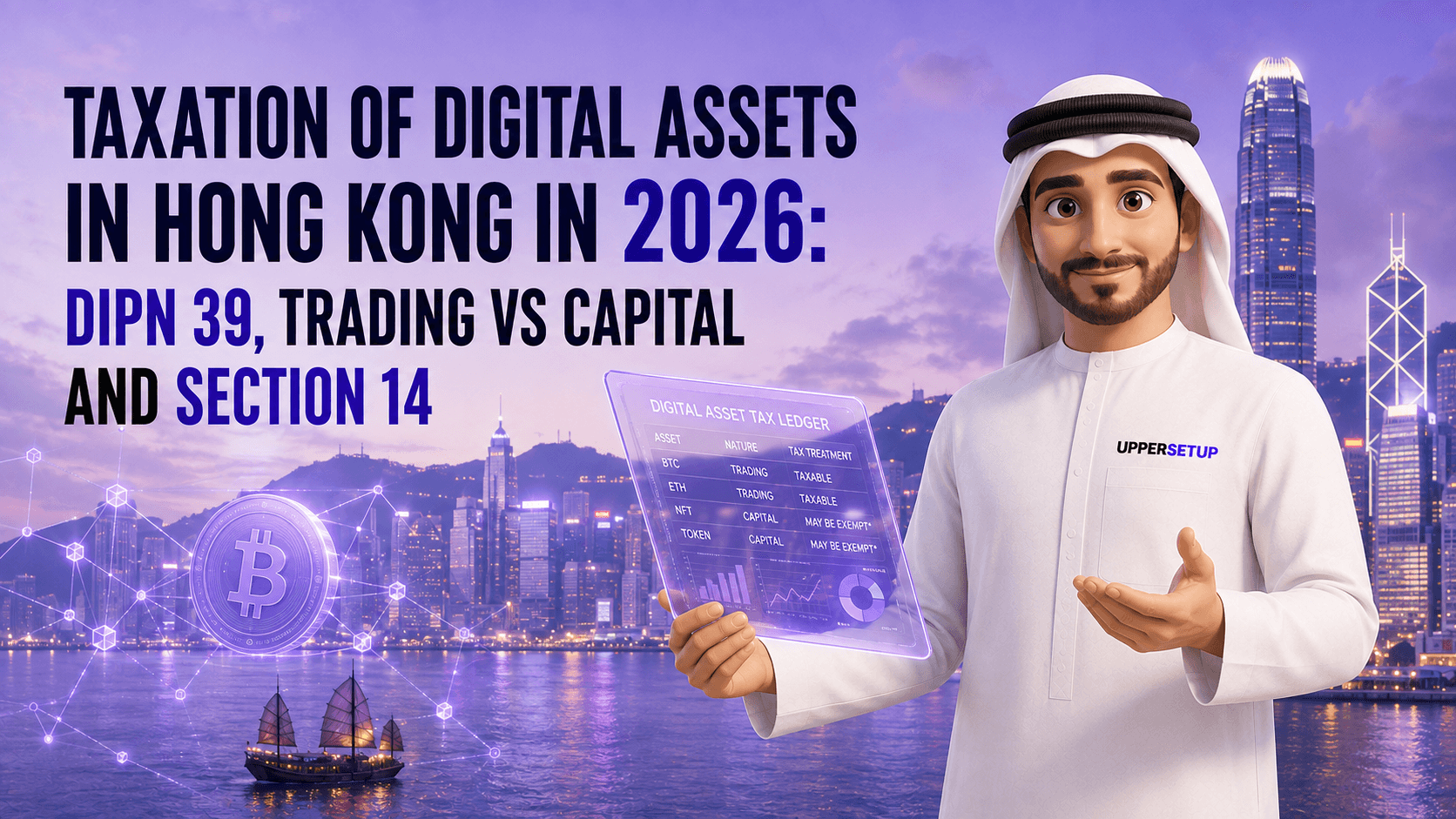
Hong Kong has no separate crypto tax and no digital-asset provisions in the Inland Revenue Ordinance. Profits from digital assets fall within profits tax under the ordinary machinery of section 14 of Cap. 112 where they are trading profits with a Hong Kong source; capital gains are not taxed at all. The only Inland Revenue Department guidance on the substance is DIPN 39 (Revised) of March 2020, which has not been updated since. The practical consequence is that everything turns on the line between trading stock and a capital asset, and that line is drawn by the intention at acquisition and by nine questions set out by the Court of Final Appeal.
The key risk. Paragraph 43 of DIPN 39 says, in terms: “Currently, there is no specific legislation or regulation for digital assets in Hong Kong.” That was true in March 2020 and is not true now: the licensing regime for virtual asset trading platforms has been in force since 1 June 2023 and the Stablecoins Ordinance (Cap. 656) since 1 August 2025. Hong Kong’s only digital-asset tax guidance rests on a description of a market that no longer exists.
|
Item |
Position |
Basis |
|
Separate crypto tax |
None |
Cap. 112 contains no digital-asset provisions |
|
Capital gains tax |
None |
s. 14(1) Cap. 112: “excluding profits arising from the sale of capital assets” |
|
Profits tax rate for a corporation |
8.25% on the first HK$2,000,000 and 16.5% above |
Schedule 8B to Cap. 112 |
|
Profits tax rate for an individual or partnership |
7.5% on the first HK$2,000,000 and 15% above |
Schedule 8A to Cap. 112 |
|
Operative IRD guidance |
DIPN 39 (Revised), March 2020, paragraphs 41–52 |
IRD official publication |
|
The trading-or-investment test |
Nine questions of McHugh NPJ |
Lee Yee Shing v CIR (2008) 11 HKCFAR 6, paragraph 60 |
|
Record retention |
Not less than 7 years |
s. 51C Cap. 112 |
|
Penalty for breach of s. 51C |
Level 6 — HK$100,000 |
s. 80(1A) Cap. 112 |
|
Stamp duty on payment tokens |
Does not arise |
“stock” in s. 2 Cap. 117 is a closed list |
|
Digital assets in Schedule 16C |
Absent as at September 2026 |
Schedule 16C, consolidated text as at 06.06.2025 |
|
Case law on crypto taxation |
None |
IRD Status of Tax Cases as at 31.07.2026 |
What is a digital asset as a matter of Hong Kong tax law?
The Inland Revenue Ordinance (Cap. 112) contains no definition of a digital asset, a virtual asset or a cryptocurrency. None of those terms appears in the charging provisions or in the Schedules relevant to digital assets, and the Ordinance nowhere defines them. The classification comes not from the tax statute but from Inland Revenue Department guidance and, for regulatory purposes, from the anti-money-laundering legislation.
The three categories of token in DIPN 39
Paragraph 42 of DIPN 39 divides digital tokens into three categories, and that division drives the tax outcome.
• Payment tokens are used as a means of payment for goods or services and encompass cryptocurrencies such as Bitcoin. They “do not provide the holder with any rights or access to goods or services”. Such tokens are not legal tender in Hong Kong but are regarded as virtual commodities.
• Security tokens provide the holder with particular interests and rights in a business: ownership interests, a debt due by the business, or an entitlement to a share of profits.
• Utility tokens give the holder access to particular goods or services typically provided on a blockchain platform, and the issuer normally commits to accepting the tokens as payment for those goods or services.
Paragraph 42 of DIPN 39 closes with a direct proposition: “Profits tax treatment of digital tokens would depend on their nature and use.” The name of the token, its ticker and its marketing description are irrelevant; what matters is the bundle of rights the token actually confers.
The AMLO definition of a virtual asset — and why it matters for tax
Section 53ZRA(1) of the Anti-Money Laundering and Counter-Terrorist Financing Ordinance (Cap. 615) contains the only operative statutory definition of a virtual asset in Hong Kong. A virtual asset is a cryptographically secured digital representation of value that is expressed as a unit of account or a store of economic value, that is used or intended to be used as a medium of exchange accepted by the public for payment for goods or services, discharge of a debt or investment, or that confers governance voting rights over such a digital representation of value, that can be transferred, stored or traded electronically, and that satisfies such other characteristics as the Commission prescribes.
Section 53ZRA(2) excludes five categories: a digital representation of value issued by a central bank or by the government of a jurisdiction; a limited purpose digital token; anything constituting securities or a futures contract; any float or SVF deposit of a stored value facility under Cap. 584; and anything with other characteristics prescribed by the Commission.
That definition is an anti-money-laundering definition, not a tax one, and Cap. 112 does not cross-refer to it. The 2026 bill on preferential tax regimes for funds would import it into the tax statute for the first time — see the section on funds below.
A terminological split that trips people up
Hong Kong’s government and regulators use two different terms. The legislation — AMLO, the Stablecoins Ordinance — says virtual asset. Policy documents and the Budget say digital asset. The FSTB consultations of June 2025 were framed around digital assets; the conclusions of December 2025 were framed around virtual assets. The tax guidance in DIPN 39 uses digital assets in the section heading and cryptocurrency within it.
For tax purposes the difference in label creates no difference in regime: DIPN 39 applies to the economic substance of the asset, not to the word used to describe it. The practical consequence for an adviser is to stop looking in the statute for a term that is not there and to classify the rights the token carries instead.
The legal framework as it stands in September 2026
The taxation of digital assets in Hong Kong rests on the general provisions of Cap. 112 and on a single departmental practice note; there is no digital-asset tax statute. What follows is an exhaustive list of the operative sources, separated by level, because conflating the tax layer with the regulatory layer is the most common error in published commentary on this subject.
The tax layer
|
Instrument |
What it governs |
Status as at September 2026 |
|
Inland Revenue Ordinance (Cap. 112), s. 14 |
The charge to profits tax and the capital-gains exclusion |
In force; s. 14 as at 05.07.2024 |
|
Cap. 112, Schedules 8A and 8B |
Two-tiered profits tax rates |
Added by Ordinance No. 13 of 2018, s. 11 |
|
Cap. 112, s. 15BA |
Moving an asset into and out of trading stock |
Added by Ordinance No. 27 of 2018, s. 13 |
|
Cap. 112, ss. 51C and 80(1A) |
Record keeping and the sanction for breach |
In force |
|
Cap. 112, Division 3A of Part 4 (ss. 15H–15S, including s. 15OA) |
The FSIE regime for foreign-sourced income |
Widened by Ordinance No. 32 of 2023 |
|
Cap. 112, Schedule 16C |
Classes of assets for the fund exemption |
Consolidated text as at 06.06.2025 |
|
Stamp Duty Ordinance (Cap. 117), s. 2 |
The definitions of “stock” and “Hong Kong stock” |
In force |
|
DIPN 39 (Revised) |
Digital economy, electronic commerce and digital assets |
Issued March 2020, never updated |
|
DIPN 21 (Revised) |
Locality of profits |
July 2012 revision |
The regulatory layer — not tax, but the reason DIPN 39 has aged
|
Instrument |
Enactment and commencement |
Subject |
|
AMLO (Amendment) Ordinance 2022, Ordinance No. 15 of 2022 |
Gazetted 16 December 2022; the platform licensing regime has applied since 1 June 2023 |
Licensing of virtual asset trading platforms |
|
Stablecoins Ordinance, Ordinance No. 17 of 2025 |
Passed 21 May 2025, gazetted 30 May 2025, commenced 1 August 2025 |
Licensing of fiat-referenced stablecoin issuers |
What is pending and is not yet law
Two bills bearing directly on digital assets were introduced into the Legislative Council in 2026 and, as at September 2026, neither has been passed.
• The Inland Revenue (Amendment) (Preferential Tax Regimes for Funds, Family-owned Investment Holding Vehicles and Carried Interest) Bill 2026 was gazetted on 12 June 2026 and given its first reading on 24 June 2026; a Bills Committee began its scrutiny on 8 July 2026 and had not completed it as at September 2026. It would add digital assets to Schedule 16C.
• The Inland Revenue (Amendment) (Crypto-Asset Reporting Framework and Amended Common Reporting Standard) Bill 2026 was gazetted on 22 May 2026. It would bring in CARF from 1 January 2027 and the amended CRS from 1 January 2028.
On the Legislative Council’s own bill-progress pages, the “Bill passage date” and “Ordinance gazetted” fields are blank for both. Any commentary describing these rules as current law is wrong.
Separately, no licensing regime for virtual asset dealing and custodian services has been enacted in Hong Kong. The FSTB consultations ran from 27 June to 29 August 2025 and the conclusions were published on 24 December 2025; the separate consultation on advisory and management services ran from 24 December 2025 to 23 January 2026 and its conclusions were published on 26 May 2026. As at September 2026 no bill has been introduced into the Legislative Council.
Section 14 of Cap. 112: three conditions and the capital-gains exclusion
Profits from digital assets are chargeable to profits tax only where the three conditions of section 14 of Cap. 112 are satisfied together. DIPN 39 sets them out at paragraph 9: the person must carry on a trade, profession or business in Hong Kong; the profits to be charged must be from that trade, profession or business carried on by the person in Hong Kong; and the profits must be “arising in or derived from” Hong Kong.
Section 14(1), in the version in force since 5 July 2024, charges tax “on every person carrying on a trade, profession or business in Hong Kong in respect of his assessable profits arising in or derived from Hong Kong for that year from such trade, profession or business (excluding profits arising from the sale of capital assets)”.
That parenthesis is the whole of Hong Kong’s treatment of capital gains. There is no separate capital gains tax; instead, profits from the sale of capital assets are excluded from the profits tax base. This is why, in Hong Kong, the question “trading stock or capital asset” is not a question of rate but a question of whether tax arises at all.
What each of the three conditions means for a holder of cryptocurrency
The first condition is carrying on a trade or business in Hong Kong. An individual who buys Bitcoin and holds it is generally not carrying on a business; it becomes trading once the activity reaches the degree of system and organisation described in paragraph 48 of DIPN 39. A Hong Kong-incorporated company will usually be carrying on business by virtue of what it does, but holding an asset is not by itself a business.
The second condition is that the profits come from that trade or business. Profits on an asset that never formed part of the trading operation are not profits “from such trade”, even where the person has some other Hong Kong business.
The third condition is a Hong Kong source. Hong Kong applies the territorial principle: profits sourced outside Hong Kong bear no profits tax even where earned by a Hong Kong company and even where they are trading profits. How source is determined for digital assets is the subject of a separate section below; the territorial principle is analysed in detail in our guide to territorial taxation and offshore status in Hong Kong.
The rates
For a corporation, profits tax is charged at 8.25% on the first HK$2,000,000 of assessable profits and 16.5% on the excess. The basis is paragraph 2(a) of Schedule 8B to Cap. 112, added by Ordinance No. 13 of 2018.
For an individual, a partnership and any other person that is not a corporation, the rates are 7.5% on the first HK$2,000,000 and 15% on the excess under paragraph 2 of Schedule 8A, with the threshold applying separately to each trade, profession or business.
Where a corporation is a partner in a partnership, the HK$2,000,000 threshold is multiplied by the ratio in which the corporation shares the profits or losses of the partnership during the basis period for the year of assessment concerned. The two-tiered rate is available to only one entity within a group of connected entities, and the election is made annually in the return.
Trading stock or capital asset: nine questions, not six badges
In Hong Kong the trading-or-investment question is decided by the nine questions formulated by McHugh NPJ at paragraph 60 of Lee Yee Shing v Commissioner of Inland Revenue, not by the classic six badges of trade. That is a material divergence from most published commentary, which transplants the 1955 United Kingdom list mechanically.
The classic six badges, and why they are not enough
The six badges come from the Final Report of the United Kingdom Royal Commission on the Taxation of Profits and Income of June 1955, Cmd 9474, paragraph 116: the subject matter of the realisation; the length of the period of ownership; the frequency of similar transactions; supplementary work on the property; the circumstances responsible for the realisation; and motive. Hong Kong has never adopted that six-item list, either by statute or in a decision of its highest court.
The nine questions in Lee Yee Shing — the operative Hong Kong test
Lee Yee Shing and Yeung Yuk Ching v Commissioner of Inland Revenue, FACV No. 14 of 2007, (2008) 11 HKCFAR 6, judgment of 31 January 2008. The Court of Final Appeal dismissed the taxpayers’ appeal: share losses were not deductible because there was no trade. At paragraph 60 McHugh NPJ listed the questions a court asks in deciding whether a trade exists: whether the taxpayer has frequently engaged in similar transactions; has held the asset for a lengthy period; has acquired an asset normally the subject of trading rather than investment; has bought large quantities; has sold for reasons that would not exist had there been an intention to resell at acquisition; has sought to add re-sale value by additions or repair; has expended time, money or effort on the sale beyond what would be expected of a non-trader; has conceded an actual intention to resell at a profit when the asset was acquired; and has purchased the asset for personal use or pleasure or for income.
That list is reproduced verbatim in Board of Review decision D2/24 and is the test Hong Kong Boards of Review actually apply.
Intention at the time of acquisition
Paragraph 57 of Lee Yee Shing adopts Lord Wilberforce’s formulation: “Trading requires an intention to trade; normally the question to be asked is whether this intention existed at the time of the acquisition of the asset.” The source is the House of Lords decision in Simmons (as liquidator of Lionel Simmons Properties Ltd) v Inland Revenue Commissioners [1980] 1 WLR 1196, (1980) 53 TC 461, where Lord Wilberforce also held that an asset cannot be both trading stock and a permanent investment at the same time, nor possess an indeterminate status.
At paragraph 59 McHugh NPJ adds the decisive qualification: “The intention to trade to which Lord Wilberforce referred is not subjective but objective… It is inferred from all the circumstances of the case.” Intention is established objectively and inferred from the circumstances, not taken from the taxpayer’s assertion.
The same line runs through Mortimer J’s judgment in All Best Wishes Limited v Commissioner of Inland Revenue (1992) 3 HKTC 750 at 771: “The intention of the taxpayer, at the time of acquisition, and at the time when he is holding the asset is undoubtedly of very great weight.” The stated intention is not decisive, and “actions speak louder than words” — the court looks at what was said and done before, at and after acquisition.
A sale does not by itself convert an investment into a trade
Commissioner of Inland Revenue v Church Body of the Hong Kong Sheng Kung Hui and Another, FACV No. 16 of 2015, (2016) 19 HKCFAR 54, judgment of 4 February 2016. The Commissioner’s appeal was dismissed. Tang PJ at paragraph 18: “An investment does not turn into trading stock because it is sold.” Fok PJ at paragraph 45: the question is one of fact and degree, answered on a consideration of all the circumstances.
On a change of intention, Tang PJ at paragraph 26 proposed the touchstone that the owner’s conduct must go beyond what a non-trader owner might have done in similar circumstances.
Finally, in Real Estate Investments (N.T.) Limited v Commissioner of Inland Revenue, FACV No. 3 of 2007, (2008) 11 HKCFAR 433, of 16 January 2008, the court confirmed at paragraph 38: “It is trite law that the nature of an asset (whether trading stock or capital asset) is to be ascertained from the intention of the acquirer at the time of acquisition.”
How the IRD applies those indicators to digital assets specifically
Paragraph 46 of DIPN 39 extends the badges of trade to digital assets in terms: “Well-established tax principles like the ‘badges of trade’ would continue to be applicable and the intention at the time of acquisition of the digital assets is always relevant to decide whether they are capital assets or trading stock.”
The same paragraph states the relieving rule: “If digital assets are bought (e.g. through ICO or exchange platform) for long-term investment purposes, any profits from disposal would not be chargeable to profits tax.” A digital asset acquired for long-term investment purposes produces no chargeable profit on disposal.
A separate test for whether a business is carried on at all
Paragraph 48 of DIPN 39 answers a different question from the badges: not “capital or trading stock” but “is a trade or business being carried on at all”. The answer is “a matter of fact and degree to be determined upon a consideration of all the circumstances”, and the Department names three relevant factors:
• the degree and frequency of the activity;
• the level of system or organisation — whether the activity is undertaken in a business-like manner;
• whether the activity is done for the purpose of making a profit.
Those three factors apply to buying and selling cryptocurrency, to exchanging cryptocurrency and to mining.
A practical evidence checklist
Because intention is established objectively, the evidential work is done before the transaction, not after a query lands from the IRD. The following items map directly onto the nine questions in Lee Yee Shing.
|
Evidence of investment character |
Evidence of trading character |
|
A long, unbroken holding period with no interim disposals |
High transaction frequency and short intervals between purchase and sale |
|
An acquisition decision minuted or documented in an investment memorandum before purchase |
Systematic use of trading terminals, bots and margin leverage |
|
Funding from own resources rather than borrowing taken for the trade |
Purchases funded by short-term borrowing |
|
No marketing or brokerage activity around the asset |
Time and money spent on selling beyond what would be expected of a non-trader |
|
A sale driven by an external cause — a liquidity need, a regulatory change |
A sale on hitting a target price set in advance by a strategy |
|
The asset carried as an investment in the financial statements under applicable standards |
The asset carried as inventories or as a financial instrument at fair value through profit or loss |
The accounting classification does not decide the tax question, but it is one of the objective circumstances from which intention is inferred. A divergence between the intention asserted and the accounting policy adopted is a classic trigger for an additional assessment.
What DIPN 39 does not address
A full-text check of DIPN 39 shows that the words staking, DeFi, NFT, lending, liquidity, validator and wallet do not appear in it. The Department has said nothing about staking rewards, yield in decentralised protocols, non-fungible tokens, crypto lending, or the price source to be used for valuation. Those questions are answered by applying general principles rather than a ready-made rule, which is precisely why an advance ruling is worth obtaining on them.
Section 15BA: the most expensive and least-known trap
Section 15BA of Cap. 112 fixes the tax consequences of an asset moving between capital status and trading stock by reference to open-market value on the date of the movement, whether or not there is a sale: a move out of trading stock is brought into account as a receipt and creates a charge, while a move into trading stock fixes the tax cost.The section was added by Ordinance No. 27 of 2018, s. 13, and barely features in published commentary on cryptocurrency, even though it is what turns a change of strategy into a taxable event.
What the section says
Section 15BA(1) defines trading stock as anything that “is sold in the ordinary course of trade” or would be so sold if it were mature or complete; the definition expressly covers both movable and immovable property.
Section 15BA(2): where trading stock is appropriated by the person for a non-trade purpose, the amount that the stock would have realised if sold in the open market at the time of the appropriation is brought into account as a receipt in computing the profits of the trade. The value of anything actually received is left out of account.
Section 15BA(3): where something belonging to the person that is not trading stock becomes trading stock, the cost of the stock is taken to be the amount it would have realised if sold in the open market at the time it became trading stock, and that cost is treated as incurred on the date of the change.
Sections 15BA(4) and 15BA(5) extend the same open-market principle to disposals of trading stock otherwise than in the course of trade and to acquisitions of trading stock otherwise than in the course of trade. Section 15BA(6) disapplies subsections (4) and (5) where section 15C applies.
What this means for a holder of cryptocurrency
Consider the ordinary sequence. A person acquires tokens as a long-term investment, holds them for several years, then begins trading the same portfolio actively.
Under section 15BA(3), the moment the asset becomes trading stock fixes its tax cost at the open-market price at that moment. All the appreciation before that point stays in the capital period and is not taxed. That is a favourable outcome — but only if the date of the change can be proved.
The reverse case is more dangerous. Under section 15BA(2), moving tokens out of a trading portfolio into long-term personal holding is treated as a receipt at open-market value, which creates a taxable profit with no sale and no cash proceeds. The tax has to be paid in money the transaction did not generate.
The practical consequence. A taxpayer who asserts that a portfolio moved from investment to trading, or the reverse, must be able to name the date of the change and prove the market value on that date. Where no such date exists, the Department will generally decline to split the holding periods and will assess the whole gain as trading profit.
How to document the change
Because section 15BA fixes the result to a specific moment, the evidence is built around it: a board minute for a company or a dated written resolution for an individual; a price extract for every affected asset on that date, naming the source; the reclassification recorded in the accounts in the same period; and subsequent conduct consistent with the new status asserted. The general record-keeping requirements are covered in the section on section 51C below and in our guide to mandatory annual compliance for Hong Kong companies.
Where are crypto profits sourced, and why “the exchange is offshore” fails
Paragraph 47 of DIPN 39 states in terms that the broad guiding principle applies to cryptocurrency transactions — the general source test, not any special rule. The Department puts it this way: it is necessary to ascertain the nature of the profits in question, the person’s relevant operations that produced them, and the place where those profit-generating operations were carried out.
Paragraph 14 of DIPN 39 adds that the Ordinance contains no comprehensive set of source rules, that the determination of source is “a practical, hard matter of fact”, and that DIPN 21 on the locality of profits “is equally applicable” where electronic commerce is involved.
Why the location of the server and the exchange does not settle it
Paragraph 17 of DIPN 39: although operations may be automated and carried out using a server located outside Hong Kong, “this fact does not, of itself, lead to the conclusion that the source of profits is located outside Hong Kong”. Automated operations are weighed against the core operations required to effect the transactions, which may be carried out within a physical office, including operations arising from the need to automate, manage and control the virtual shop-front or back-office. The Department concludes expressly that the location of the server alone does not determine the locality of the profits.
Paragraph 18 of DIPN 39 closes off the agency argument too: the term “agent” can refer to a natural or a legal person, “but does not include software or a server, no matter how advanced it is”. Nor can an internet service provider merely operating a server under a website hosting arrangement be regarded as an agent for this purpose.
The practical conclusion for a crypto trader is that opening an account with an exchange outside Hong Kong and the physical siting of its matching engine abroad do not move the source of the profits out of Hong Kong where the trading decisions are made in Hong Kong.
Which analogy applies: goods or securities?
This is where a substantive fork arises that most commentary skips over.
Paragraph 45 of DIPN 21 sets specific benchmarks for securities: for listed shares and other listed securities the source is the location of the stock exchange on which they are traded, and for an over-the-counter transaction the place where the contracts of purchase and sale are effected; for unlisted securities it is the place where the contracts of purchase and sale are effected.
A payment token, however, is a virtual commodity under paragraph 42(a) of DIPN 39, not a security. The benchmark in paragraph 45 of DIPN 21 therefore does not reach it on its own words. The closest applicable analogue is paragraph 23 of DIPN 21 on trading in goods: where both the contract of purchase and the contract of sale are effected in Hong Kong the profits are fully taxable; where both are effected outside Hong Kong no part is taxable; and where either is effected in Hong Kong the initial presumption is that the profits are fully taxable, with the issue then determined on the facts.
A token that is a security token, by contrast, does yield to analysis under paragraph 45 of DIPN 21, because on its rights the asset is a security. That is one more practical consequence of the classification in paragraph 42 of DIPN 39.
Be careful with the offshore claim. An offshore-source claim on cryptocurrency trading conducted from Hong Kong rarely succeeds: the trading decisions, the risk management, the custody keys and the staff are usually in the same place as the trader. We set out how such a claim is made and evidenced in our guide to the offshore profits claim in Hong Kong.
Token issuance and ICOs: capital for the issuer, or a prepayment for a service
The tax outcome of a token issue in the issuer’s hands is determined by the rights the token confers, not by the form of the issue. Paragraph 45 of DIPN 39: “It is the nature of the rights and obligations of the tokens, not the form in which the tokens are issued, that determine the tax treatment.”
Paragraph 44 of DIPN 39 describes the mechanics: an ICO is the issuance of new digital tokens by an issuer to subscribers in exchange for their cryptocurrency or fiat currency, typically accompanied by a white paper setting out the business proposal and the terms of the offering, including the rights conferred on holders. The operative sentence in paragraph 44 is this: “The substantive nature of the token itself will determine its classification and not the stated intention of the issuer.”
The Department’s two illustrations
Paragraph 45 gives two examples, and they produce opposite results.
Where the tokens represent equity or ownership interests in the issuer — that is, security tokens — the proceeds of the ICO are capital in nature, because the holders are given shareholders’ rights such as the right to receive a dividend. This is what the market calls a security token offering.
Where the tokens give holders a right to future benefits — for example an obligation on the issuer to supply a good or perform a service — the proceeds of the ICO are viewed as a prepayment for future goods or services. The timing of revenue recognition depends on the details of the issuer’s performance obligations and is determined in line with generally accepted accounting principles. Paragraph 45 closes by confirming that, subject to any specific exemptions, profits arising in or derived from Hong Kong from the ICO can be charged to profits tax under the general principles in section 14.
What follows in practice
The issuer of a utility token does not receive a non-taxable capital sum: it receives deferred revenue that is recognised as the performance obligations are met. Tax therefore arises not when the money is raised but on the delivery schedule, and the tax outcome is tied tightly to the revenue-recognition policy adopted.
The issuer of a security token, by contrast, receives a capital sum outside the charge to profits tax, but pays a regulatory price for it: paragraph 43 of DIPN 39 notes that where the tokens constitute “securities” as defined in the Securities and Futures Ordinance (Cap. 571), both the tokens and the activities involving them fall to be regulated by the Securities and Futures Commission. We map the SFC licensing perimeter in our guide to SFC licences types 1 to 9.
The drafting of the white paper has direct tax consequences. A promise of “access to the platform” creates a prepayment and taxable revenue. Conferring a right to a share of profits creates a capital receipt but is also very likely to create a security and a licensing obligation. The choice between those two constructions is made when the document is drafted, not when the return is filed.
Mixed and hybrid tokens
DIPN 39 does not address tokens combining features of more than one category — which in practice describes most modern issues. Because paragraph 42 of DIPN 39 ties the treatment to the nature and use of the token, a hybrid issue is best analysed by splitting the proceeds across the components of the rights conferred and supporting the allocation in the offering documentation. The Department has published no single allocation rule; this is an area where the adviser’s position should be recorded in writing before the issue, not after it.
Mining, airdrops and forks: what is covered and what is not
Paragraph 47 of DIPN 39 lists mining among the ordinary business activities involving cryptocurrency, alongside trading and exchange, and subjects the profits to the general rule: “Hong Kong sourced profits from cryptocurrency business activities are chargeable to profits tax.”
Whether a particular mining activity amounts to carrying on a trade or business is decided on the three factors in paragraph 48: degree and frequency, the level of system and organisation, and whether the activity is done for the purpose of making a profit. Occasional mining on a home computer and an industrial mining operation fall on opposite sides of that test.
Airdrops and forks — the Department’s narrow formulation
Paragraph 49 of DIPN 39 is conditional: “Certain events (e.g. airdrops and blockchain forks) may give rise to new cryptocurrencies. If cryptocurrencies are received in the course of a cryptocurrency business, the new cryptocurrencies are to be regarded as receipts of the business and would be assessed accordingly.”
The condition “if received in the course of a cryptocurrency business” is a limitation, not a rhetorical flourish. The Department does not say that an airdrop is always taxable; it says that an airdrop received in the course of a cryptocurrency business is a receipt of that business. An airdrop received by a holder who carries on no business does not fall within the formulation, and its treatment is governed by the general rules in section 14 — meaning that, absent a trade or business, no charge arises.
Paragraph 49 does not answer two consequential questions: at what value the receipt is recognised, and on what date. By analogy with paragraph 51, where the Department uses market value at the date of the transaction, the defensible position is market value on the date control of the token is obtained. There is no direct statement to that effect in DIPN 39; this is a position by analogy, not a confirmed rule.
What DIPN 39 does not address at all
A full-text check of the document confirms the absence of the following topics.
|
Activity |
Addressed in DIPN 39 |
How it is analysed without guidance |
|
Staking and validator rewards |
No |
General rules in s. 14: is there a business, source, timing of recognition |
|
Yield in DeFi protocols, liquidity mining |
No |
Nature of the receipt on its rights; s. 14 and s. 15 where a deeming provision bites |
|
Non-fungible tokens (NFTs) |
No |
Classification by rights, badges of trade, s. 15BA on a change of status |
|
Crypto lending and borrowing |
No |
Nature of the return; whether s. 15(1) reaches interest-like sums |
|
Wrapped and derivative tokens |
No |
Rights under the instrument; possible characterisation as securities under Cap. 571 |
|
The price source used for valuation |
No |
A consistent methodology, documented and applied uniformly |
The absence of guidance does not mean the absence of tax. It means the tax position is built by the taxpayer, documented in advance and defended on general principles. These are the areas where a dispute with the Department is most likely, and the mechanics of one are set out in our guide to disputing an IRD assessment.
Deductions for a mining or trading business
Where the activity is a business, the ordinary deduction rules apply: outgoings incurred in the production of chargeable profits are deductible, and expenditure of a capital nature is not. The symmetry here is absolute: a person asserting that gains are capital and therefore untaxed cannot at the same time deduct the related expenses, and a person deducting trading expenses is thereby conceding that the profits are trading profits. The deduction landscape is analysed in our guide to profits tax deductions and incentives in Hong Kong.
Cryptocurrency in business transactions and as employment income
Paragraph 51 of DIPN 39 sets the valuation rule for transactions: “The market value of the cryptocurrency accrued at the date of transaction should reflect the amount of sales and purchases.” The Department describes the case where a person carrying on a business accepts cryptocurrency as payment from customers or uses it to purchase goods.
The practical meaning is this: cryptocurrency used in settlement creates no separate tax regime — it is a form of consideration, and the amount of the sale or the purchase is its market value at the date of the transaction. A subsequent movement in price before conversion is a separate event, attaching to the asset the business now holds.
What happens after the payment is received
DIPN 39 does not describe the second stage explicitly, but the consequence follows from the general structure. A token received in payment enters the recipient’s balance sheet, and the gain or loss on it thereafter depends on whether that token is trading stock or a capital asset in the recipient’s hands. A company that converts received cryptocurrency into fiat immediately generally realises only a short-period exchange difference; a company that keeps it on the balance sheet takes on the classification question analysed above, and the potential application of section 15BA on any later change of intention.
Salary paid in cryptocurrency
Paragraph 52 of DIPN 39: employees, particularly those working in the digital asset sector, may receive remuneration in cryptocurrency, and “the same salaries tax treatment would apply to such income from employment even though it is paid in cryptocurrency”. The amount to be reported as the employee’s employment income is the market value of the cryptocurrency at the time of accrual.
Three practical consequences for an employer follow.
First, the employer’s reporting obligation does not change with the form of payment. A payment in tokens is reported in the employer’s return of remuneration in Hong Kong dollars at market value on the date of accrual.
Second, it is the time of accrual, not the moment the employee sells the token, that fixes the assessable amount. A later fall in price does not reduce the assessable income from the employment; it attaches to the asset the employee now holds personally.
Third, the employee acquires a second, separate asset with its own tax history. Its cost is the amount recognised as income, and the later outcome depends on whether the subsequent sale is the realisation of a capital asset or a trading transaction.
The general salaries tax rules, including the source rule and the 60-day rule, are analysed in our guide to salaries tax in Hong Kong.
Stablecoins do not change the analysis. Even a fiat-referenced stablecoin is not legal tender in Hong Kong; for the purposes of paragraphs 51 and 52 of DIPN 39 it remains a digital asset valued at market. The regulatory regime for issuers of such instruments has applied since 1 August 2025 and is analysed in our guide to the Hong Kong stablecoin issuer licence, but it creates no tax rules.
FSIE: how an offshore gain on digital assets becomes chargeable
The foreign-sourced income exemption regime in Division 3A of Part 4 of Cap. 112 can convert a gain on digital assets that is untaxed under the territorial principle into chargeable income, and it expressly reaches movable property. This is the most underrated provision in the whole subject, because it overrides both territoriality and the capital-gains exclusion at once.
Three definitions that decide the case
Section 15H of Cap. 112: “non-IP disposal gain means any gain or profit derived from the sale of property, but does not include IP disposal gains” — added by Ordinance No. 32 of 2023, s. 3.
In the same section: “property means any movable property or immovable property” — added by the same Ordinance No. 32 of 2023.
A digital asset is, on general principles, movable property: there is no Hong Kong tax authority on the point and the Inland Revenue Department’s FSIE guidance does not mention digital assets. On that basis a gain on the sale of a digital asset is a non-IP disposal gain and, where it arises outside Hong Kong, falls within the definition of specified foreign-sourced income.
The third definition sets the perimeter: “MNE entity … means a person that is, or acts for, an MNE group or an entity included in an MNE group”, and “MNE group means a group that includes at least one entity or permanent establishment that is not located or established in the jurisdiction of the ultimate parent entity of the group”. There is no revenue threshold in either definition. A group of two companies in two jurisdictions is already an MNE group.
The provision that switches off the capital-gains exclusion
Section 15I(1) of Cap. 112: specified foreign-sourced income “(a) is to be regarded as a receipt arising in or derived from Hong Kong for the basis period of the year of assessment during which the income is received in Hong Kong; and (b) is to be regarded as not arising from the sale of capital assets even if it so arises”.
Paragraph (b) is the key to the whole section. It directs that the income be treated as not arising from the sale of capital assets even where it does so arise. The argument “this was a capital gain” therefore fails inside FSIE by express statutory direction.
Section 15I(3) limits the reach: the subsection applies to specified foreign-sourced income received in Hong Kong by an MNE entity carrying on a trade, profession or business in Hong Kong and not otherwise chargeable under that Part. Section 15I(4) disapplies it where section 15 or section 15F applies to the sum.
Who is caught and who is not
An individual is not an MNE entity, so FSIE does not apply to one. A standalone Hong Kong company with no foreign related entities is likewise outside the perimeter.
A Hong Kong company forming part of a cross-border group is inside the perimeter, whatever the size of the group. For it, an offshore gain on digital assets escapes the charge only where the economic substance requirement is met. On the Inland Revenue Department’s own exceptions matrix the participation requirement reaches only dividends and equity interest disposal gains, and the nexus requirement only intellectual property income and gains on IP assets, so neither is available for a digital asset. The one further mechanism is intra-group transfer relief under section 15OA of Cap. 112, which defers rather than removes the charge where the asset is transferred between associated entities.
The hidden danger is the “received in Hong Kong” trigger. Section 15I(1)(a) attaches the charge to the basis period of the year in which the income is received in Hong Kong, not to the year of the sale. Remitting the proceeds of an old offshore disposal to a Hong Kong account years later can create a liability in the current year.
The IRD’s own page on the FSIE regime does not mention digital assets, virtual assets or cryptocurrencies once. It confirms that property means any movable or immovable property and that the regime was widened from 1 January 2024 to disposal gains other than equity interest disposal gains, but the application to digital assets has to be derived from the statute rather than from the guidance.
Funds, OFCs, LPFs and family offices: digital assets are not yet in Schedule 16C
As at September 2026, digital assets are not among the classes of assets specified in Schedule 16C to Cap. 112, so the fund exemption in section 20AN and the family-owned investment holding vehicle regime do not cover cryptocurrency transactions. This is the single most practically significant point for anyone planning to hold digital assets through a Hong Kong fund.
What Schedule 16C contains today
The operative version of Schedule 16C is the consolidated text as at 6 June 2025; it was last amended in substance by Ordinance No. 8 of 2023, s. 6. Its title is “Classes of Assets Specified for Transactions for Purposes of Sections 20AN and 20AO and Schedule 16E”. Part 1 lists eleven classes: securities; shares, stocks, debentures, loan stocks, funds, bonds or notes of a private company; futures contracts; foreign exchange contracts; deposits other than those made by way of a money-lending business; deposits made with a bank; certificates of deposit; exchange-traded commodities; foreign currencies; OTC derivative products; and an investee company’s shares co-invested by a partner fund and ITVFC under the ITVF Scheme.
The words “virtual asset” and “digital asset” do not appear anywhere in Schedule 16C as it stands.
What the 2026 Bill proposes
The Inland Revenue (Amendment) (Preferential Tax Regimes for Funds, Family-owned Investment Holding Vehicles and Carried Interest) Bill 2026, gazetted on 12 June 2026, would by clause 24(7) add six new classes to Part 1 of Schedule 16C after item 11: 12 Loans; 13 Immovable property situated outside Hong Kong; 14 Digital assets; 15 Emission allowance; 16 Emission derivatives; 17 Carbon credits.
The Bill also introduces a definition: “digital asset” (a) means a VA as defined by section 53ZRA(1) of AMLO Cap. 615; (b) includes a digital representation of value excluded from the definition of VA by operation of section 53ZRA(2)(a)(i) of that Ordinance; but (c) does not include a cryptographically secured digital representation of value that provides its holder with an interest in any underlying asset other than Hong Kong dollar or an asset of a class specified in Part 1 of that Schedule.
Three features of that definition deserve attention. First, it borrows the anti-money-laundering definition wholesale.Second, limb (b) deliberately brings back into the perimeter what AMLO excludes by section 53ZRA(2)(a)(i) — central bank digital currency. Third, limb (c) pushes out tokenised wrappers over assets that are not in Schedule 16C, so that tokenisation cannot widen the list through the back door.
The Legislative Council Brief ASST/3/1/5C(2026) of 10 June 2026 confirms the intention at paragraph 8: to expand the scope of qualifying investments to cover, among other things, digital assets, precious metals and specified commodities. The amendments would apply from a year of assessment commencing on or after 1 April 2025, with a transitional filing extension for the first year, 2025/26.
Status: not enacted
The Bill was gazetted on 12 June 2026, given its first reading on 24 June 2026 and considered by the House Committee on 26 June 2026; a Bills Committee began its scrutiny on 8 July 2026 and continued it through July and August 2026, the Inland Revenue Department issuing a separate clarification on the Bill on 12 August 2026. On the Legislative Council’s progress page the fields “Resumption of 2nd reading / 3rd reading”, “Bill passage date” and “Ordinance gazetted” are all blank. The Brief records the resumption of the second reading debate as “To be notified”.
The practical position today. A Hong Kong fund, OFC or LPF that trades digital assets does not obtain the section 20AN exemption in respect of that activity, because a digital asset is not an asset of a class specified in Schedule 16C. Planning on the strength of the Bill is possible but must be built as contingent: retroactive to 2025/26 if it passes, with a reserve if the text changes in committee.
Hong Kong fund structures are analysed in our guide to the OFC and the LPF, and the family office regime in our guide to the FIHV tax concession.
Stamp duty: why a payment token attracts none, and a tokenised share may
Stamp duty in Hong Kong is charged on the instruments listed in the Stamp Duty Ordinance (Cap. 117), and the transfer of a payment token falls within none of them. The reason is not the absence of a crypto-specific provision but the fact that the definition of “stock” is a closed list.
The closed list in section 2 of Cap. 117
Section 2 of Cap. 117: “stock” means any of the following investments: (a) any shares, stocks, debentures, loan stocks, funds, bonds or notes of or issued by any body, whether corporate or unincorporate, or any government or local government authority, or any other similar investment of any description; (b) any units under a unit trust scheme; (c) any right, option or interest in or in respect of any stock referred to in paragraph (a) or (b), other than any such right, option or interest under an employees’ share purchase or share option scheme. The list was replaced by Ordinance No. 36 of 1992, s. 2, and carries exclusions for loan capital, bills of exchange, promissory notes, certificates of deposit, Exchange Fund debt instruments and bonds issued under Cap. 61.
In the same section: “Hong Kong stock” means stock the transfer of which is required to be registered in Hong Kong.
How this works for tokens
Neither Bitcoin nor any other payment token is one of the listed investments: it is not issued by any body, it is not a unit under a unit trust scheme, and it confers no right or interest in respect of such an investment. No head of charge therefore arises.
A tokenised share or a security token conferring shareholders’ rights, by contrast, can fall within limb (a) or limb (c) of the definition. In that case the second question becomes decisive: is the transfer required to be registered in Hong Kong — that is, is the instrument Hong Kong stock? If it is, the ordinary rates on transfers of Hong Kong shares apply, as analysed in our guide to stamp duty on share transfers.
The presence of a blockchain is irrelevant to either question. What matters is the legal characterisation of the instrument and the place where the transfer must be registered.
The only official clarification on tokenisation
The Department has published an FAQ on the stamp duty waiver for exchange traded funds in which question 3 addresses the tokenised ETF directly. The answer is that the waiver applies. The FAQ defines a tokenised ETF as an ETF that has a tokenised class of shares or units represented digitally by tokens issued and recorded on a blockchain or distributed ledger technology platform, and extends the waiver to the sale, purchase or transfer of shares or units of all ETFs, including tokenised ones, taking place on licensed digital asset trading platforms or through other channels.
The FAQ page carries no date and was not accompanied by a press release, so its date of publication cannot be stated; it is cited here as an undated IRD FAQ. In substance it delivers the commitment made in Policy Statement 2.0 of 26 June 2025 to clarify “the stamp duty treatment for tokenised exchange traded funds (ETFs)”.
The limits of that clarification. The FAQ concerns ETFs and only ETFs. It says nothing about tokenised bonds, tokenised interests in funds that are not ETFs, NFTs, or transfers of payment tokens. Outside ETFs, the general analysis under section 2 of Cap. 117 governs.
Why there is no safe harbour for digital assets when there is one for shares
Hong Kong has built a mechanism of tax certainty for gains on the disposal of equity interests and has not extended it to digital assets. That is a deliberate legislative choice rather than a gap, and it explains why intention has to be proved on general principles for cryptocurrency.
What the Tax Certainty Enhancement Scheme is
The scheme was introduced by the Inland Revenue (Amendment) (Disposal Gain by Holder of Qualifying Equity Interests) Ordinance 2023, enacted on 15 December 2023, and applies to disposals occurring on or after 1 January 2024 for basis periods beginning on or after 1 April 2023.
It gives an unarguable characterisation of the gain as capital where the holding conditions are met. The investor must have held at least 15% of the equity interests in the investee entity continuously for 24 months immediately before the disposal. The threshold is measured individually or together with closely related entities.
The definition of an equity interest is an interest that carries rights to the profits, capital or reserves of the investee entity and is accounted for as equity in the books of the investee entity under applicable accounting principles.
The exclusions are: investors that are insurers; equity interests regarded as trading stock; and non-listed equity interests in property trading entities, property development entities and property holding entities where the value of the immovable property exceeds 50% of total assets — subject to limited relieving conditions, in particular for a property development entity that has used the developed property for its own business.
Neither digital nor virtual assets are mentioned in the scheme.
What this means in practice
|
Asset class |
Is there a certainty mechanism |
How capital character is proved |
|
Equity interests meeting the 15% and 24-month conditions |
Yes, the Tax Certainty Enhancement Scheme |
Meeting the quantitative conditions; intention need not be proved |
|
Equity interests not meeting the conditions |
No |
General rules: intention at acquisition, the nine Lee Yee Shing questions |
|
Digital assets of any kind |
No |
General rules: intention at acquisition, the nine Lee Yee Shing questions |
|
Immovable property |
No |
General rules and an extensive body of case law |
The asymmetry between shares and digital assets is the principal reason a crypto holder in Hong Kong cannot rely on holding period as a free-standing argument. A long holding period is only the second of the nine Lee Yee Shing questions, not a threshold with legal effect.
Can an advance ruling be obtained?
The Department issues advance rulings on the application of the Ordinance to a particular arrangement. A review of the IRD’s published advance ruling index shows that none of the 78 published cases concerns digital assets, cryptocurrency, virtual assets or tokenisation; the two most recent by number are Case 78 on a qualifying ship lessor and Case 77 on the Tax Certainty Enhancement Scheme itself.
The absence of published crypto rulings does not mean an application is impossible. It means no public body of practice has formed, and that an applicant should present a fully developed set of facts rather than rely on analogy with a published case.
Records, documentation and valuation: section 51C and what it costs
Paragraph 50 of DIPN 39 places an express obligation on persons engaging in cryptocurrency businesses to keep proper business records in relation to their cryptocurrency transactions in accordance with section 51C of Cap. 112.
What section 51C requires
Section 51C(1): every person carrying on a trade, profession or business in Hong Kong must keep sufficient records in English or Chinese of income and expenditure to enable the assessable profits of that trade, profession or business to be readily ascertained, and must retain those records for not less than 7 years after the completion of the transactions, acts or operations to which they relate.
Section 51C(3) defines “records” as including books of account, whether kept in a legible form or in a non-legible form by means of a computer or otherwise, recording receipts and payments or income and expenditure, together with vouchers, bank statements, invoices, receipts and other documents.
Section 51C(2) allows two exceptions: preservation is not required for records the Commissioner has specified need not be preserved, or for records of a corporation that has been dissolved.
The extended period for an MNE entity under section 15S
Section 15S of Cap. 112 modifies section 51C for a person belonging to a cross-border group that receives in Hong Kong specified foreign-sourced income to which section 15I(1) applies. Such a person must retain records of the transactions, acts or operations relating to that income at least until the later of two dates: the expiry of seven years after the completion of those transactions, or the expiry of seven years after the income is received, or is to be regarded as received, in Hong Kong. Section 15S(3) applies section 80 to a failure to comply with the requirement as so modified.
The practical consequence for a digital asset holder inside a cross-border group is that remitting old offshore proceeds to a Hong Kong account not only creates a current-year charge under section 15I(1)(a) but also restarts the seven-year retention clock on a transaction completed years earlier.
The sanction
Section 80(1A) of Cap. 112: a person who without reasonable excuse fails to comply with the requirements of section 51C commits an offence and is liable on conviction to a fine at level 6, and the court may order the person to do the act within a specified time. Level 6 under Schedule 8 to Cap. 221 is HK$100,000. The provision was added by Ordinance No. 48 of 1995, s. 11, and amended by Ordinance No. 4 of 2010, s. 13.
What to keep for digital assets specifically
The “sufficient records” requirement is functional: the records must allow the assessable profits to be readily ascertained. For digital assets that means a set that an exchange statement does not by itself constitute.
|
Item |
Why it is needed |
|
Date and time of each transaction with the time zone |
Fixing the price and the basis period |
|
Quantity and the exact identity of the asset, including network and contract |
Identifying the asset across forks and wrappers |
|
Hong Kong dollar value at the date of the transaction and the price source |
Giving effect to the rule in paragraph 51 of DIPN 39 |
|
Exchange, network and custodian fees |
Supporting deductions in a trading business |
|
Wallet addresses and proof of control |
Proving ownership and control |
|
A contemporaneous record of intention at acquisition |
Proving capital character against the nine questions |
|
A record of the date of any move into or out of trading stock |
Applying section 15BA |
|
Bank statements for fiat on-ramps and off-ramps |
Reconciling to the result reported |
Valuation methodology is a rule-free zone. DIPN 39 names no price source, sets no hierarchy of exchanges and says nothing about valuing illiquid tokens. The practical recommendation is to choose a methodology in advance, record it in writing, apply it uniformly across periods, and not change it without a documented reason. Switching price source between years is a classic trigger for questions on review.
Retention period and the assessment window
The seven-year retention period in section 51C should be read against the period during which the Department may raise an assessment. The practical consequence is that records must outlive not only the transaction but the whole period in which it can be questioned and, in a dispute, the time taken to resolve it. How such a dispute runs is set out in our guide to disputing an IRD assessment.
Reporting: the return, automatic exchange and CARF
Profits on digital assets are reported in the ordinary profits tax return; there is no separate crypto form. A company files BIR51, a partnership BIR52, and an individual carrying on business reports the result in the tax return for individuals; the mechanics and deadlines are set out in our guide to the Hong Kong profits tax return.
The key practical point is that the return contains no box in which a taxpayer declares that a gain is capital. The position is disclosed by how the result is presented in the attached financial statements and the tax computation, and it is defended with documents assembled in advance.
The Crypto-Asset Reporting Framework — what is coming
The Inland Revenue (Amendment) (Crypto-Asset Reporting Framework and Amended Common Reporting Standard) Bill 2026 was gazetted on 22 May 2026. According to the Inland Revenue Department, CARF is to apply from 1 January 2027 and the amended Common Reporting Standard from 1 January 2028.
As at September 2026 that Bill has not been enacted: in the Legislative Council Bills Database it carries neither an ordinance number nor an ordinance gazette date.
The measure was announced in the 2026-27 Budget. Paragraph 108 of the Budget Speech of 25 February 2026 is the Budget’s only digital-asset tax item: “We will amend the Inland Revenue Ordinance for implementing the Crypto-Asset Reporting Framework as well as the amended Common Reporting Standard by the Organisation for Economic Co-operation and Development (OECD) in the coming two years.” The same paragraph adds: “We will introduce an amendment bill in the first half of this year.”
What CARF means for a holder and for a business
CARF is a reporting regime, not a charging regime: it creates no tax and does not change the characterisation of a gain. It creates due diligence and annual reporting obligations for crypto-asset service providers, and the exchange of the resulting information between tax administrations.
The practical effect on a taxpayer is twofold. First, transaction data previously known only to an exchange will become available to tax administrations, including Hong Kong’s, which sharply raises the cost of any mismatch between the position reported and the taxpayer’s actual conduct. Second, preparing for CARF is the occasion to bring documentation for past periods into a state that will survive reconciliation, rather than constructing it after the first query arrives.
The general machinery of automatic exchange and its consequences for structures are analysed in our guide to CRS and automatic exchange of information.
There is no Hong Kong case law on crypto taxation
A check of the official sources as at September 2026 found no Board of Review decision and no court judgment on the taxation of digital assets.
The Inland Revenue Department’s Status of Tax Cases, stated as at 31 July 2026, lists nine cases under the Inland Revenue Ordinance, one estate duty case and six stamp duty cases; the issues are employment income and time apportionment, source of profits, deductibility of related-party payments, property dealing, capital or revenue character, intra-group stamp duty relief, out-of-time appeals and stamp duty refunds. None concerns cryptocurrency. The index of court judgments on appeals from Board of Review decisions covers 1996 to 2022, Volumes 10 to 36, and contains no crypto case either; published Board of Review decisions run to D6/24 to D9/24, decided in August and September 2024.
The practical consequence is that there is no Hong Kong precedent on digital assets to cite, and every position is built on general principles and on analogy with the share and property cases.
The regulatory backdrop: why paragraph 43 of DIPN 39 no longer describes reality
Hong Kong’s only digital-asset tax guidance asserts that there is no specific regulation of digital assets in Hong Kong; in the six years since it was issued, Hong Kong has built two full licensing regimes. This is not a quibble about wording: paragraph 43 of DIPN 39 uses the absence of regulation as a premise for its conclusion about when the Securities and Futures Commission’s jurisdiction is engaged.
What changed after March 2020
The Anti-Money Laundering and Counter-Terrorist Financing (Amendment) Ordinance 2022, Ordinance No. 15 of 2022, was gazetted on 16 December 2022, and the licensing regime for virtual asset trading platforms has applied since 1 June 2023. Under SFC Circular 23EC27 of 31 May 2023 the transitional arrangement had three limbs: a non-contravention period from 1 June 2023 to 31 May 2024; an application window from 1 June 2023 to 29 February 2024, failing which a platform had to close down its business by 31 May 2024; and a deemed-licence period beginning 1 June 2024 and running until the application is approved, withdrawn or refused. The deemed-licence period has no fixed expiry date — the common claim of a “12-month deemed licence” conflates it with the non-contravention period.
The Stablecoins Ordinance, Ordinance No. 17 of 2025, was passed on 21 May 2025, gazetted on 30 May 2025 and commenced on 1 August 2025 under a commencement notice gazetted on 6 June 2025.
The state of the market on the official registers
On the Securities and Futures Commission’s list, updated 29 May 2026, 13 virtual asset trading platforms are licensed in Hong Kong: OSL Exchange, HashKey Exchange, HKVAX, HKbitEX, Accumulus, DFX Labs, EX.IO, PantherTrade, YAX, Bullish, BGE, VDX and Bixin.com. Three further applicants are deemed to be licensed under the transitional arrangement: Foris DAX HK, Whalefin Markets and Flying Hippo Technologies. No platform appears on the closing-down list. The SFC’s digital-asset licensing perimeter is analysed in our guide to licensing virtual asset service providers in Hong Kong.
On the Hong Kong Monetary Authority’s register, two stablecoin issuers are licensed: Anchorpoint Financial Limited, licence FRS01, and The Hongkong and Shanghai Banking Corporation Limited, licence FRS02, both effective 10 April 2026. The register’s last revision date is 23 April 2026. In a reply to a Legislative Council question on 10 June 2026 the Government stated that 36 applications had been received in the initial application period.
What Hong Kong still does not have
No licensing regime for virtual asset dealing and custodian services has been enacted. The FSTB consultations ran from 27 June to 29 August 2025; the conclusions were published on 24 December 2025, drawing 101 submissions on dealing and 93 on custody. On the same day, 24 December 2025, a separate one-month consultation was launched on establishing distinct licensing regimes for virtual asset advisory and management service providers; it closed on 23 January 2026, and its conclusions, published on 26 May 2026 and drawing on 51 submissions, state the aim of introducing the relevant bill into the Legislative Council within the year. A check of the Legislative Council Bills Database in September 2026 found no bill with “Virtual” or “Digital” in its title.
The policy backdrop, and what is absent from it
The “Policy Statement 2.0 on the Development of Digital Assets in Hong Kong” was published on 26 June 2025 and is built around the LEAP framework: Legal and regulatory streamlining, Expanding the suite of tokenised products, Advancing use cases and cross-sectoral collaboration, People and partnership development. Its only tax commitment is “clarifying the stamp duty treatment for tokenised exchange traded funds (ETFs)”.
The Securities and Futures Commission’s ASPIRe roadmap, published on 19 February 2025, comprises five pillars — Access, Safeguards, Products, Infrastructure, Relationships — and 12 initiatives, and contains no tax item at all.
The 2026-27 Budget of 25 February 2026 commits to introducing a bill on licensing dealing and custodian services, promises guidelines clarifying that registers of debenture holders may be kept in the form of a distributed ledger, and carries a single tax item — CARF and the amended CRS. It contains no profits tax or stamp duty concession for digital assets.
The conclusion for a tax adviser. Hong Kong is building the regulatory perimeter for digital assets energetically and has barely moved the tax one. The only operative tax guidance is dated March 2020 and rests on a premise about the absence of regulation that is factually wrong. DIPN 39 should be relied on for its tax principles and not for its description of the market.
A step-by-step method for building a digital asset tax position
Step 1. Classify every token under paragraph 42 of DIPN 39
Split the portfolio into payment, security and utility tokens on the rights the token actually confers, not on its name. An error at this step propagates into every later one: a security token drags in the Cap. 571 regulatory perimeter, and a utility token creates taxable deferred revenue in the issuer’s hands.
Step 2. Decide whether a trade or business is being carried on at all
Apply the three factors in paragraph 48 of DIPN 39: the degree and frequency of the activity, the level of system and organisation, and whether it is done for the purpose of making a profit. The answer determines whether section 14 applies at all.
Step 3. Record the intention at acquisition, in writing and in advance
Prepare a dated investment memorandum or board minute before the purchase. Intention is established objectively under paragraph 59 of Lee Yee Shing and inferred from all the circumstances, so a document produced after a query from the Department weighs incomparably less than one produced before the transaction.
Step 4. Run the position through the nine Lee Yee Shing questions
For each of the nine questions in paragraph 60, record the answer and the supporting document. Questions whose answers are unfavourable call for an explanation, not for silence.
Step 5. Check whether any movement between capital and trading stock occurred
If the strategy changed, identify the date of the change and the open-market value on it. Sections 15BA(2) and 15BA(3) apply automatically, whether or not the taxpayer recorded the change in the accounts.
Step 6. Determine the source of the profits under the broad guiding principle
Identify the operations that produced the profits and the place where they were carried out. Keep paragraphs 17 and 18 of DIPN 39 in mind: the location of a server does not by itself determine source, and software or a server cannot be an agent.
Step 7. Test whether FSIE applies
If the Hong Kong person belongs to a cross-border group it is an MNE entity, and an offshore gain falls inside the Division 3A perimeter. Section 15I(1)(b) directs that such income be regarded as not arising from the sale of capital assets even if it so arises.
Step 8. Do not count on the fund exemption for cryptocurrency
A digital asset is not among the eleven classes in Schedule 16C as it stands. Planning through a fund, an OFC, an LPF or an FIHV gives no section 20AN exemption for digital assets today.
Step 9. Test stamp duty separately for each instrument
A payment token creates no head of charge. A tokenised share or a security token may be stock under section 2 of Cap. 117, and the question then becomes whether the instrument is Hong Kong stock.
Step 10. Build the accounting and valuation methodology before trading starts
Fix the price source, the approach to illiquid tokens, the recognition point and the reporting currency; record the methodology in writing and apply it uniformly. DIPN 39 prescribes neither a price source nor a hierarchy of exchanges.
Step 11. Comply with section 51C
Records are kept in English or Chinese, retained for not less than 7 years, and their sufficiency is judged functionally: do they allow the assessable profits to be readily ascertained? The sanction under section 80(1A) is a fine at level 6, HK$100,000.
Step 12. Prepare for CARF in advance
According to the Inland Revenue Department, CARF is to apply from 1 January 2027 and the amended CRS from 1 January 2028; the bill was gazetted on 22 May 2026 and has not been enacted. Put the documentation for past periods in order before, not after, data about your transactions starts reaching tax administrations.
Step 13. Consider an advance ruling for a non-standard transaction
There is no ready rule for staking, DeFi, NFTs or crypto lending, and none of the 78 published advance rulings concerns digital assets. An application is possible but requires a fully developed set of facts. The choice of structure and holding jurisdiction is analysed in our guide to the Hong Kong–UAE dual structure.
Common mistakes and what they cost
1. Assuming crypto is untaxed in Hong Kong
What happens. The absence of a capital gains tax is read as the absence of tax on cryptocurrency, and the profits are not reported at all.
What it costs. Where the activity meets the three factors in paragraph 48 of DIPN 39, the profits are trading profits taxed at up to 16.5% for a corporation or up to 15% for an individual, assessed across every affected period.
2. Documenting intention after the event
What happens. The investment memorandum is written after a query arrives from the Department.
What it costs. Under paragraph 59 of Lee Yee Shing intention is established objectively and inferred from all the circumstances; a document dated after the transaction is set against actual conduct and generally loses. The result is recharacterisation of the whole gain as trading profit.
3. Relying on holding period as a free-standing argument
What happens. The holder assumes that three years of ownership proves capital character by itself.
What it costs. Length of ownership is only the second of the nine questions in paragraph 60 of Lee Yee Shing. Hong Kong’s only quantitative safe harbour — the Tax Certainty Enhancement Scheme, with its 15% and 24-month conditions — applies to equity interests and not to digital assets.
4. Ignoring section 15BA on a change of strategy
What happens. A portfolio moves from investment to trading, or the reverse, without a recorded date or value.
What it costs. Under section 15BA(2) moving tokens out of trading stock is treated as a receipt at open-market value and creates tax with no sale and no cash. The reverse move under section 15BA(3) without a provable date denies the taxpayer the stepped-up cost and exposes the whole historic gain.
5. Believing an offshore exchange makes the profits offshore
What happens. The offshore claim is built on the location of the exchange or the server.
What it costs. Paragraph 17 of DIPN 39 states expressly that a server outside Hong Kong does not by itself put the source outside Hong Kong, and paragraph 18 rules out treating a server or software as an agent. A rejected offshore claim means a full assessment plus the cost of the dispute.
6. Confusing a regulatory licence with a tax concession
What happens. Holding a platform licence or a stablecoin issuer licence is treated as the basis for favourable tax treatment.
What it costs. Neither AMLO nor the Stablecoins Ordinance creates tax rules. The ASPIRe roadmap contains no tax item, and Policy Statement 2.0 contains one — on stamp duty for tokenised ETFs. Expecting a concession produces a wrong effective rate in the financial model.
7. Planning through a fund in reliance on Schedule 16C
What happens. Crypto assets are placed in an OFC, an LPF or an FIHV in expectation of the section 20AN exemption.
What it costs. A digital asset is not among the eleven classes of Schedule 16C in the consolidated text as at 6 June 2025. The 2026 Bill adding item 14, Digital assets, had not been enacted as at September 2026. The cost of establishing and running the structure is incurred without the intended tax effect.
8. Forgetting FSIE inside a cross-border group
What happens. A Hong Kong group company assumes an offshore gain escapes tax under the territorial principle.
What it costs. The definition of an MNE group carries no revenue threshold; section 15I(1)(b) switches off the capital-gains exclusion, and section 15I(1)(a) attaches the charge to the year the income is received in Hong Kong. Remitting old proceeds to a Hong Kong account can create a current-year liability.
9. Deducting expenses while claiming capital character
What happens. A company deducts fees, hardware and traders’ salaries while treating the gains as capital.
What it costs. The position is internally inconsistent and collapses at the first reconciliation. Deducting trading expenses concedes trading character, and capital expenditure is not deductible in any event.
10. Treating an exchange statement as sufficient records under section 51C
What happens. The accounting consists of a CSV export from an exchange account.
What it costs. Section 51C requires records that allow the assessable profits to be readily ascertained, and the sanction under section 80(1A) is a fine at level 6, HK$100,000. An exchange statement typically contains no Hong Kong dollar price source, no evidence of intention and no proof of wallet control.
11. Relying on paragraph 43 of DIPN 39 as a description of current regulation
What happens. Published commentary and internal memoranda repeat the statement that there is no specific regulation of digital assets in Hong Kong.
What it costs. The statement has been untrue since 1 June 2023. A memorandum repeating it in 2026 discredits the whole position in front of a regulator or a counterparty and reads, on due diligence, as a sign of stale analysis.
12. Assuming the 2026 bills are already in force
What happens. Planning is built on CARF, on the amended CRS or on digital assets in Schedule 16C as current law.
What it costs. Both bills — of 22 May 2026 and 12 June 2026 — remained unenacted as at September 2026, with neither an ordinance number nor an ordinance gazette date in the Legislative Council database. A structure built on an unenacted bill may never receive the intended treatment, or may receive it in an altered form.
Who Hong Kong suits, who it does not, and when to get professional review
Who it suits
Hong Kong suits a holder of digital assets whose position is genuinely investment-driven and can be proved by objective circumstances. Profits from the sale of a capital asset are excluded from the profits tax base by section 14(1) itself, and no capital gains tax exists.
• The long-term investor with no indicia of trading, who acquired on a documented decision and holds without systematic dealing.
• The operating business that accepts cryptocurrency in settlement and converts it immediately: the rule in paragraph 51 of DIPN 39 gives a clear and predictable measurement base.
• The security token issuer, for whom the issue proceeds are capital under paragraph 45(a) of DIPN 39 — provided it is prepared to carry the Cap. 571 regulatory perimeter.
• The digital-asset sector employer paying remuneration in tokens: paragraph 52 of DIPN 39 gives a clear valuation rule at market value on accrual.
• The group building a trading business with transparent Hong Kong substance, prepared to pay 8.25% and 16.5% and not resting its position on an offshore claim.
Who it does not suit
• The active trader expecting a nil rate. Systematic trading meets the three factors in paragraph 48 of DIPN 39 and the profits are taxed in full.
• The crypto fund counting on the section 20AN exemption. Digital assets are not in Schedule 16C as it stands.
• The holder whose only defence is that the exchange sits outside Hong Kong. Paragraphs 17 and 18 of DIPN 39 close that argument directly.
• The Hong Kong group company treating an offshore gain as untaxed. Section 15I(1)(b) switches off the capital-gains exclusion inside FSIE.
• The business unwilling to keep records to the section 51C standard. The requirement is not optional and the sanction is HK$100,000 under section 80(1A).
• The project whose economics depend on the 2026 bills passing. Neither had been enacted as at September 2026.
When professional review is needed
Take advice before the transaction, not after the Department’s query, in the following situations.
• The portfolio changes status between investment and trading — section 15BA applies and the outcome turns on the date and the valuation.
• A token issue is planned: the classification under paragraph 42 of DIPN 39 fixes both the tax result and the regulatory obligation.
• The activity involves staking, DeFi, NFTs or crypto lending — DIPN 39 does not cover them and no advance ruling on them has been published.
• The Hong Kong person belongs to a cross-border group and receives offshore income on digital assets.
• A structure with a fund, an OFC, an LPF or an FIHV is being built with digital assets in the portfolio.
• An offshore source is to be claimed for digital asset trading profits.
• It has to be decided whether a token is a security under Cap. 571, because both the tax result under paragraph 45 of DIPN 39 and the licensing obligation turn on it.
Next step. UPPERSETUP handles the incorporation and tax structuring of Hong Kong companies, funds and family offices, including digital asset positions: our Hong Kong services. Incorporation and the compliance that follows are covered in our guide to Hong Kong company registration.
Comparative tables: three holder statuses and three ways of holding
The tax outcome on a digital asset in Hong Kong is determined not by the asset but by the status of the holder and the way the asset is held. The three tables below reduce the operative rules to a form usable for a structuring decision.
Table 1. Three statuses of a holder of the same token
|
Feature |
Investor |
Trader |
Operating business |
|
Basis of charge |
s. 14(1): profits on the sale of a capital asset are excluded |
s. 14(1): trading profits are chargeable |
s. 14(1) plus the valuation rule in paragraph 51 of DIPN 39 |
|
Rate for a corporation |
No tax |
8.25% up to HK$2,000,000 and 16.5% above |
8.25% up to HK$2,000,000 and 16.5% above |
|
Rate for an individual |
No tax |
7.5% up to HK$2,000,000 and 15% above |
7.5% up to HK$2,000,000 and 15% above |
|
Deduction of expenses |
Not available |
Available for outgoings incurred in the production of chargeable profits |
Available |
|
What must be proved |
Intention at acquisition against the nine Lee Yee Shing questions |
Nothing on capital character; source and deductions still have to be proved |
That a business is carried on, plus source and deductions |
|
Section 15BA effect |
Cost fixed at open-market value on a move into trading stock |
Charge on a move into personal holding |
Arises on a reclassification of stock |
|
Section 51C obligation |
Arises only where a business exists |
Arises |
Arises |
|
FSIE relevance |
Only if the person is an MNE entity |
Only if the person is an MNE entity |
Only if the person is an MNE entity |
Table 2. Three ways of holding a digital asset
|
Item |
Individual holding directly |
Hong Kong company |
Fund, OFC, LPF or FIHV |
|
Rate where the character is trading |
7.5% and 15% under Schedule 8A |
8.25% and 16.5% under Schedule 8B |
The s. 20AN exemption is unavailable for digital assets |
|
Capital gains exclusion |
Yes, under s. 14(1) |
Yes, under s. 14(1) |
Yes, under s. 14(1), but not through the fund regime |
|
Falls within the FSIE perimeter |
No: an individual is not an MNE entity |
Yes, if part of a cross-border group |
Yes, if part of a cross-border group |
|
Holding-period safe harbour |
None |
None |
None |
|
Record-keeping requirements |
s. 51C where a business exists |
s. 51C plus audited financial statements |
s. 51C plus the regime requirements of the structure |
|
What changes if the 2026 Bill passes |
Nothing |
Nothing |
Item 14, Digital assets, enters Schedule 16C from 2025/26 |
Table 3. Certainty by asset class
|
Asset class |
Certainty mechanism |
Conditions |
In force |
|
Equity interests |
Tax Certainty Enhancement Scheme |
At least 15% held continuously for 24 months before disposal |
From 1 January 2024 |
|
Digital assets |
None |
Not applicable |
Not applicable |
|
Tokenised ETFs for stamp duty |
An undated Inland Revenue Department FAQ |
The instrument is an ETF with a tokenised class of shares or units |
Date of introduction not established |
|
Payment tokens for stamp duty |
No head of charge |
“Stock” in s. 2 of Cap. 117 is a closed list |
Permanently |
The single conclusion from the three tables is that Hong Kong offers a digital asset holder no mechanism giving quantitative certainty about the line between capital and trading. Certainty is created only by the taxpayer’s own documents and by the consistency of the conduct behind them.
Frequently asked questions
Is cryptocurrency taxed in Hong Kong?
Yes, where the activity amounts to a trade or business and the profits have a Hong Kong source. Hong Kong has no separate crypto tax: the ordinary profits tax charge in section 14 of Cap. 112 applies. Profits from the sale of a capital asset are excluded from the base by the words of section 14(1) itself.
Is there a capital gains tax on digital assets in Hong Kong?
No. Hong Kong has no capital gains tax, and section 14(1) of Cap. 112 excludes profits from the sale of capital assets from the profits tax base. Paragraph 46 of DIPN 39 confirms the point for digital assets: assets bought for long-term investment purposes produce no chargeable profit on disposal.
What is the tax rate on profits from trading cryptocurrency in Hong Kong?
For a corporation, 8.25% on the first HK$2,000,000 of assessable profits and 16.5% on the excess, under Schedule 8B to Cap. 112. For an individual, a partnership and any other person that is not a corporation, 7.5% on the first HK$2,000,000 and 15% on the excess, under Schedule 8A.
How do I prove that cryptocurrency was bought as an investment?
Intention is established objectively and inferred from all the circumstances of the case — paragraph 59 of Lee Yee Shing v CIR. What works is dated documents created before the transaction, the absence of systematic dealing, funding from own resources and a consistent accounting classification. An assertion made after the Department’s query weighs incomparably less.
How long must a digital asset be held for the gain to be capital?
No period produces an automatic result. Length of ownership is the second of the nine questions in paragraph 60 of Lee Yee Shing, not a threshold. Hong Kong’s only quantitative certainty mechanism applies to equity interests — the Tax Certainty Enhancement Scheme, requiring at least 15% held continuously for 24 months — and it does not extend to digital assets.
Is cryptocurrency mining taxed in Hong Kong?
Yes, where it amounts to carrying on a trade or business and the profits have a Hong Kong source. Paragraph 47 of DIPN 39 lists mining among the ordinary business activities involving cryptocurrency, alongside trading and exchange. Whether a business exists is decided on the three factors in paragraph 48: degree and frequency, level of system and organisation, and profit purpose.
Do I pay tax on an airdrop in Hong Kong?
Paragraph 49 of DIPN 39 states that if cryptocurrencies are received in the course of a cryptocurrency business, the new cryptocurrencies are to be regarded as receipts of that business. The words “in the course of a cryptocurrency business” are a limitation: an airdrop received by a person carrying on no business does not fall within the formulation.
How is salary paid in cryptocurrency taxed?
Paragraph 52 of DIPN 39: the same salaries tax treatment applies as to ordinary remuneration, and the amount of the employee’s income is the market value of the cryptocurrency at the time of accrual. The form of payment changes neither the tax treatment nor the employer’s reporting obligations.
Does stamp duty arise on a transfer of cryptocurrency in Hong Kong?
No. The definition of “stock” in section 2 of the Stamp Duty Ordinance (Cap. 117) is a closed list of investments, and a payment token falls within none of them. A tokenised share or a security token conferring shareholders’ rights may, by contrast, be stock, and the question then becomes whether the instrument is Hong Kong stock.
Can a Hong Kong fund trade digital assets tax-free?
As at September 2026, no. The fund exemption in section 20AN of Cap. 112 applies to transactions in assets of the classes specified in Schedule 16C, and digital assets are not among the eleven classes of the operative version. The Bill of 12 June 2026 would add item 14, Digital assets, but it has not been enacted.
Are the profits offshore if the crypto exchange is outside Hong Kong?
Not by that fact alone. Paragraph 17 of DIPN 39 states expressly that siting a server outside Hong Kong does not of itself lead to the conclusion that the source is offshore, and paragraph 18 rules out treating software or a server as an agent. Source is determined by the operations that produced the profits and where they were carried out.
Is there Hong Kong guidance on the taxation of staking, DeFi and NFTs?
No. A full-text check of DIPN 39 shows that the words staking, DeFi, NFT and lending do not appear in it, and none of the 78 published Inland Revenue Department advance rulings concerns digital assets. The position is built on the general principles of section 14 and documented in advance.
What is CARF and when does it start in Hong Kong?
The Crypto-Asset Reporting Framework is the OECD’s reporting regime for crypto-assets. According to the Inland Revenue Department it is to apply from 1 January 2027, with the amended Common Reporting Standard from 1 January 2028. The implementing bill was gazetted on 22 May 2026 and had not been enacted as at September 2026.
How long must records of digital asset transactions be kept?
Not less than seven years after the completion of the transactions, acts or operations to which they relate — section 51C(1) of Cap. 112. Paragraph 50 of DIPN 39 applies that requirement expressly to cryptocurrency transactions. The sanction for breach under section 80(1A) is a fine at level 6, that is HK$100,000.
Key takeaways
1. Hong Kong has no separate crypto tax, and Cap. 112 contains no digital-asset provisions; the general charge in section 14 applies.
2. Profits from the sale of a capital asset are excluded from the profits tax base by the words of section 14(1), so the trading-or-investment question decides not the rate but whether tax arises at all.
3. The only tax guidance is DIPN 39 (Revised) of March 2020, and its paragraph 43 on the absence of digital-asset regulation has been factually out of date since 1 June 2023.
4. The Hong Kong test is the nine questions of McHugh NPJ at paragraph 60 of Lee Yee Shing, not the classic six badges of trade of 1955.
5. Intention is established objectively and inferred from all the circumstances; a document created after a query performs badly.
6. Section 15BA measures the movement between capital and trading stock at open-market value — on a move out of trading stock tax arises with no sale and no cash proceeds, and on a move into trading stock the market value becomes the tax cost.
7. The location of the server and of the exchange does not determine source, and a server or software cannot be an agent — paragraphs 17 and 18 of DIPN 39.
8. FSIE switches off the capital-gains exclusion for an MNE entity: section 15I(1)(b) directs that the income be regarded as not arising from the sale of capital assets even if it so arises.
9. Digital assets are absent from the eleven classes of Schedule 16C, so the section 20AN fund exemption does not reach cryptocurrency today.
10. The only certainty mechanism applies to equity interests — 15% and 24 months under the Tax Certainty Enhancement Scheme; it has not been extended to digital assets.
11. No stamp duty arises on payment tokens, because “stock” in section 2 of Cap. 117 is a closed list; the tokenised ETF has the benefit of a waiver under an undated Departmental FAQ.
12. Neither of the two 2026 bills — on CARF and on funds — had been enacted as at September 2026, so planning built on them must be contingent.
Summary
Hong Kong has no separate crypto tax and no digital-asset provisions in the Inland Revenue Ordinance (Cap. 112). Profits on digital assets fall within profits tax under section 14, which requires three conditions to be met together — carrying on a trade, profession or business in Hong Kong, profits from that activity, and a Hong Kong source — and expressly excludes profits from the sale of capital assets. The rates are 8.25% on the first HK$2,000,000 and 16.5% above for a corporation under Schedule 8B, and 7.5% and 15% for other persons under Schedule 8A. The only guidance is DIPN 39 (Revised) of March 2020, whose paragraphs 41 to 52 divide tokens into payment, security and utility tokens, treat payment tokens as virtual commodities, apply the badges of trade and the intention at acquisition, list trading, exchange and mining as business activities, treat airdrops and forks as receipts only where received in the course of a cryptocurrency business, require records under section 51C, value transactions and remuneration at market value, and say nothing about staking, DeFi, NFTs or crypto lending. The Hong Kong trading test is the nine questions of McHugh NPJ at paragraph 60 of Lee Yee Shing and Yeung Yuk Ching v CIR, FACV No. 14 of 2007, (2008) 11 HKCFAR 6, not the six United Kingdom badges of 1955, and intention is established objectively. Section 15BA taxes the movement of an asset between capital status and trading stock at open-market value on the date of the movement. Within FSIE, section 15I(1)(b) directs that specified foreign-sourced income be regarded as not arising from the sale of capital assets even where it does so arise, and the definition of an MNE group carries no revenue threshold. Schedule 16C in the consolidated text as at 6 June 2025 lists eleven classes of assets and does not include digital assets, so the section 20AN fund exemption does not reach them; the Bill of 12 June 2026 would add item 14, Digital assets, from 2025/26 but had not been enacted as at September 2026. No stamp duty arises on payment tokens, because “stock” in section 2 of Cap. 117 is a closed list. The only certainty mechanism, the Tax Certainty Enhancement Scheme with its 15% and 24-month conditions, applies to equity interests alone. As at September 2026 there is no Board of Review decision and no court judgment in Hong Kong on the taxation of digital assets, and none of the 78 published advance rulings concerns the subject. On the regulatory side there were 13 licensed virtual asset trading platforms and three deemed-licensed applicants as at 29 May 2026, two licensed stablecoin issuers from 10 April 2026, and CARF is to apply from 1 January 2027 under a bill gazetted on 22 May 2026 and not yet enacted.
Sources
1. Inland Revenue Ordinance (Cap. 112), section 14 — Hong Kong e-Legislation
2. Cap. 112, Schedule 8A — two-tiered rates for persons other than corporations
3. Cap. 112, Schedule 8B — two-tiered rates for corporations
4. Cap. 112, section 15BA — changes in trading stock
5. Cap. 112, section 15H — FSIE definitions
6. Cap. 112, section 15I — foreign-sourced income regarded as Hong Kong sourced
7. Cap. 112, Schedule 16C — classes of assets for the fund exemption
8. Cap. 112, section 51C — business records to be kept
9. Cap. 112, section 80 — penalties, including subsection (1A)
10. Stamp Duty Ordinance (Cap. 117), section 2 — “stock” and “Hong Kong stock”
11. AMLO (Cap. 615), section 53ZRA — meaning of virtual asset
12. Stablecoins Ordinance (Cap. 656)
13. DIPN 39 (Revised) — Digital Economy, Electronic Commerce and Digital Assets, March 2020 — Inland Revenue Department
14. DIPN 21 (Revised) — Locality of Profits
15. Index of Departmental Interpretation and Practice Notes
16. IRD — foreign-sourced income exemption regime
17. IRD — Tax Certainty Enhancement Scheme
18. IRD — FAQ on stamp duty exemption for exchange traded funds
20. IRD — index of Advance Ruling Cases
21. IRD — the 2026 CARF and amended CRS bill
22. Text of the Preferential Tax Regimes for Funds, FIHVs and Carried Interest Bill 2026
23. Legislative Council Brief ASST/3/1/5C(2026) of 10 June 2026
24. Legislative Council bill progress page
25. Press release on the gazettal of the funds bill, 12 June 2026
26. Press release on the CARF bill, 20 May 2026
27. Lee Yee Shing and Yeung Yuk Ching v CIR, FACV No. 14 of 2007
28. Real Estate Investments (N.T.) Ltd v CIR, FACV No. 3 of 2007
29. CIR v Church Body of the Hong Kong Sheng Kung Hui, FACV No. 16 of 2015
30. Board of Review decision D2/24 — the nine Lee Yee Shing questions verbatim
31. Board of Review decision D83/98 — the passage from All Best Wishes Ltd v CIR
32. Index of court judgments on appeals from Board of Review decisions
33. SFC — lists of virtual asset trading platforms
34. SFC — the ASPIRe roadmap, 19 February 2025
35. HKMA — register of licensed stablecoin issuers
36. Stablecoins Ordinance commencement notice, 6 June 2025
37. Policy Statement 2.0 on the Development of Digital Assets in Hong Kong, 26 June 2025
39. Consultation conclusions on dealing and custodian services, 24 December 2025
40. Consultation conclusions on advisory and management services, 26 May 2026
41. Government reply to a Legislative Council question on stablecoins, 10 June 2026
42. Cap. 112, section 15S — records to be kept where foreign-sourced income is received
43. IRD — clarification on the funds preferential regimes bill, 12 August 2026
All links were checked as at the date of publication. Statutory texts are cited from Hong Kong e-Legislation, guidance and indexes from the Inland Revenue Department website, and judgments from the Board of Review archive on info.gov.hk.
Disclaimer
This material is provided for information purposes only and does not constitute legal, tax, financial, investment or consulting advice. Before taking any decision, obtain individual professional advice tailored to the specific situation, jurisdiction, company status and the regulators’ current requirements.
Date of publication: September 2026.
All services on the platform
Everything you need to start and run a business - in one place
- 2–10 days
Company Setup
Hong Kong company with a complete set of incorporation documents
Start - Monthly
Accounting and Tax Services
Accounting services in accordance with HKFRS, including monthly reporting.
- 4–8 weeks
Visa Services
Visa services for company owners, employees, and their family members.
- 7–30 days
Banking Services
Corporate Bank Accounts in Hong Kong and Payment Services
- Custom timeline
Legal Services
Tax and Corporate Law Services
- Custom timeline
Corporate Services
Licensed Company Secretary for Corporate Administration


