








 International Free Zone Authority
Hong Kong Patent Box 2026: the 5% Rate on IP Income, Two-Tiered Rates and the FSIE Regime for Holding Companies
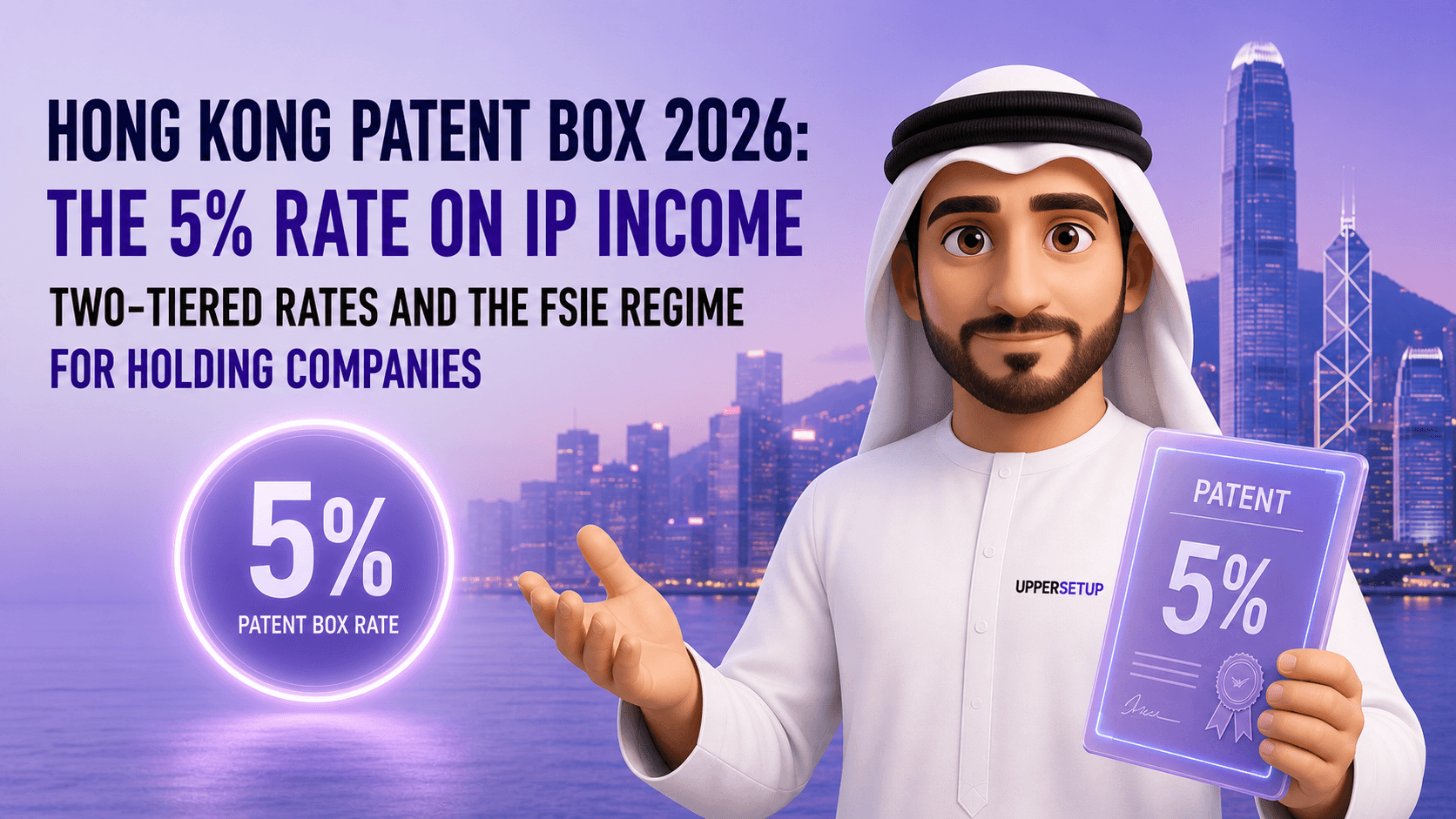
Three separate regimes drive the effective profits tax rate of a Hong Kong company that earns from intellectual property and from passive income. The patent box gives 5% on the concessionary portion of IP income. The two-tiered profits tax rates give 8.25% on the first HKD 2,000,000 of assessable profits and 16.5% above. FSIE is not a relief at all: it deems specified foreign-sourced dividends, interest, IP income and disposal gains received in Hong Kong by a member of an MNE group to be Hong Kong sourced unless an exception is met.
⚠ The constraint that reshapes the whole calculation. Under section 14(5) of the Inland Revenue Ordinance, a taxpayer that has made an election for the patent box under section 4 of Schedule 17FD does not qualify for the two-tiered profits tax rates. The election is irrevocable and carries into every subsequent year of assessment. These are not two reliefs that stack — they are alternatives, and the arithmetic has to be done before the election is filed.
Three regimes and how they interact
The regimes answer different questions and bite at different points in the computation. Two-tiered rates are a general rate relief on Hong Kong profits. The patent box is a concessionary rate for a narrow class of Hong Kong-sourced IP income. FSIE is an expansion of the base: it pulls foreign passive income back in where the company lacks sufficient economic presence.
The patent box applies only to profits sourced in Hong Kong. Foreign-sourced income falls under the FSIE regime rather than the 5% concessionary rate.
For a holding structure that produces three distinct questions. First, is the income Hong Kong sourced. Second, if it is foreign and received in Hong Kong, does an FSIE exception apply. Third, if it is Hong Kong sourced IP income, is the 5% rate worth surrendering the two-tiered rates. The territorial source logic is covered in The Offshore Profits Claim in Hong Kong.
The legal framework in force in 2026
|
Instrument |
Enacted / effective |
Scope |
|
Inland Revenue (Amendment) (Taxation on Specified Foreign-sourced Income) Ordinance 2022 |
Enacted 23 December 2022, effective from 1 January 2023 |
FSIE regime for dividends, interest, IP income and equity interest disposal gains |
|
Inland Revenue (Amendment) (Taxation on Foreign-sourced Disposal Gains) Ordinance 2023 |
Enacted 8 December 2023, effective from 1 January 2024 |
Extends FSIE to disposal gains on all types of property and introduces intra-group transfer relief |
|
Inland Revenue (Amendment) (Tax Concessions for Intellectual Property Income) Ordinance 2024 |
Enacted 5 July 2024, applies to years of assessment beginning on or after 1 April 2023 |
The patent box regime, Schedule 17FD to the Inland Revenue Ordinance |
|
Inland Revenue Ordinance (Cap. 112) |
Current version |
Section 14(5) — patent box and two-tiered rates are mutually exclusive; sections 15H to 15OA — FSIE mechanics |
The patent box operates retrospectively: it was enacted on 5 July 2024 but applies to years of assessment beginning on or after 1 April 2023, that is from the year of assessment 2023/24.
The three regimes compared
|
Parameter |
Patent box |
Two-tiered rates |
FSIE |
|
Legal character |
Concessionary rate |
Default rate relief |
Expansion of the tax base |
|
Source of income |
Hong Kong only |
Hong Kong only |
Foreign income received in Hong Kong |
|
Rate |
5% on the concessionary portion |
8.25% on the first HKD 2,000,000, then 16.5% |
16.5% where no exception is met |
|
Who can use it |
An eligible person with qualifying IP |
Everyone except non-nominated connected entities |
Mandatory for MNE group members |
|
Election required |
Yes — in writing and irrevocable |
No — applies by default |
No — applies automatically |
|
Key condition |
R&D fraction and, from 5 July 2026, a local patent |
Nomination of one company in the group |
Economic substance, participation or nexus |
|
Compatibility |
Excludes the two-tiered rates |
Excluded by a patent box election |
Runs alongside both |
The table shows the essential point: the patent box and the two-tiered rates compete with each other, while FSIE competes with neither — it operates on a different set of income and engages regardless of the election made.
Two-tiered profits tax rates: 8.25% and 16.5%
The two-tiered regime lowers the rate on the first slice of profits and applies by default to every entity chargeable to profits tax in Hong Kong, except those with a connected entity that has been nominated for the rates.
For corporations, the first HKD 2,000,000 of assessable profits is taxed at 8.25% — half the rate specified in Schedule 8 to the Inland Revenue Ordinance — and profits above that at 16.5%.
For unincorporated businesses, mostly partnerships and sole proprietorships, the rates are 7.5% on the first HKD 2,000,000 and 15% above.
The group restriction is decisive. Where an entity has one or more connected entities at the end of its basis period, the two-tiered rates apply only to the nominated one. The saving on the lower tier is HKD 165,000 a year for a corporation, and because the nomination is made each year of assessment it is worth giving to whichever group company expects the highest profits.
A one-off reduction of profits tax for the year of assessment 2025/26 of 100%, capped at HKD 3,000 per case, applies. The enabling legislation was passed by the Legislative Council and gazetted on 22 May 2026.
The ceiling applies to each business rather than to a group in aggregate, and the reduction is given automatically in the final assessment — no separate application is needed. Provisional tax remains payable on time: amounts paid are applied against the final tax for 2025/26 and the provisional tax for 2026/27, with any excess refunded.
The patent box: who gets 5% and on what
The patent box gives a concessionary rate of 5% on the concessionary portion of assessable profits derived from eligible IP income. Three conditions must hold together: the taxpayer is an eligible person, it derives eligible IP income from an eligible intellectual property, and an election has been made in respect of that property.
An eligible person is a person entitled to derive eligible IP income from an eligible intellectual property. It need not be the owner: a licensee that sub-licenses the property to another person qualifies, provided it has incurred eligible R&D expenditure in respect of that property.
Eligible intellectual property is defined in section 1(1) of Schedule 17FD and covers three categories, each of which must be generated from an R&D activity: an eligible patent, an eligible plant variety right, and a copyright subsisting in software under the Copyright Ordinance (Cap. 528) or under the law of any place outside Hong Kong.
⚠ Trade marks and other marketing-related IP are outside the regime. The patent box follows the OECD approach, under which only patents and assets functionally equivalent to patents — legally protected and subject to a similar approval and registration process — can qualify. Hong Kong took a more liberal line by including patent and plant variety right applications, and patents granted outside Hong Kong.
What counts as eligible IP income
Four categories qualify, and the third is routinely overlooked.
• income from an eligible intellectual property in respect of the exhibition or use of, or a right to exhibit or use, the property, whether in or outside Hong Kong;
• income from the imparting of, or undertaking to impart, knowledge directly or indirectly connected with the use of the property;
• income from the sale of an eligible intellectual property;
• embedded IP income — where the price of a sale of a product or service includes an amount attributable to an eligible intellectual property, the portion of the sale income that, on a just and reasonable basis, is attributable to the value of that property;
• amounts of insurance, damages or compensation derived in relation to an eligible intellectual property.
For embedded IP income, the income attributed to the eligible intellectual property must be calculated in the way that best secures consistency with the requirements and guidance in the OECD rules as defined in section 7(3) of Schedule 17FD.
For manufacturers and software businesses the practical point is that the regime is not confined to licensors living on royalties. A company selling a product with patented technology inside it can carve out the share of revenue attributable to the IP — but the carve-out has to follow the OECD rules, not internal management logic.
The R&D fraction: how the concessionary portion is computed
The concessionary portion is determined by the nexus approach, the OECD minimum standard under BEPS Action 5. The relief is proportionate to the share of the taxpayer's own R&D spend in the total cost of developing the asset.
The R&D fraction is calculated as F = EE × 130% / (EE + NE) and capped at 100%, where EE is the eligible R&D expenditure incurred in respect of the relevant intellectual property and NE is the non-eligible expenditure in respect of the same property.
The concessionary portion is calculated as P = I × F, where I is the assessable profits from the eligible IP income and F is the applicable R&D fraction.
How expenditure splits between EE and NE drives the entire result.
|
Who carried out the R&D activity |
Classification |
|
The eligible person itself |
EE — eligible |
|
A non-associated person on behalf of the eligible person |
EE — eligible |
|
An associated Hong Kong resident person, in Hong Kong |
EE — eligible |
|
An associated Hong Kong resident person, outside Hong Kong |
NE — non-eligible |
|
An associated non-Hong Kong resident person |
NE — non-eligible |
|
Acquisition of the IP itself, or rights in it, from another person |
NE — non-eligible |
EE excludes interest payments, payments for land or buildings or for any alteration, addition or extension to a building, and any expenditure incurred to obtain the eligible intellectual property or any right in it from another person. NE excludes interest payments and payments for land and buildings.
⚠ The economics are deliberate: the more R&D is outsourced to associated foreign group companies, or the more expensively the IP itself was bought in, the smaller the share of profit that reaches the 5% rate. The 130% uplift partly compensates for outsourcing to unrelated contractors — but not for outsourcing within the group and outside Hong Kong.
A transitional measure allowed EE and overall expenditure to be computed on a three-year rolling average. That transitional period covered the basis periods for the years of assessment 2023/24 to 2025/26 and has now ended, so a full R&D fraction computation is required going forward.
Businesses that relied on the simplified computation therefore need per-asset expenditure tracking in place from the year of assessment 2026/27. Setting up that record-keeping is work for UPPERSETUP accounting services.
The election mechanism and why the decision is permanent
An election is made in respect of a specific eligible intellectual property and has three defining features.
• the election must be made in writing;
• once made, it applies to the year of assessment for which it is made and to all subsequent years — no annual election is required;
• the election is irrevocable.
Special rules apply to patent applications. Where an election is made in respect of an eligible patent that is a patent application, it is treated as also made in respect of patents granted pursuant to that application and in respect of divisional applications and the patents granted on them.
5 July 2026: the local patent requirement is now live
A further requirement took effect on 5 July 2026 and changes the position for new filings. It is tied to the "specified date" — the expiry of 24 months after the commencement date of the Amendment Ordinance.
The specified date is 5 July 2026.
For an eligible patent that is not a standard patent (O), a standard patent (O) application, a short-term patent or a short-term patent application, and whose date of filing falls on or after the specified date, an election is not valid unless there is a corresponding local patent as defined in section 6(3) and (4) of Schedule 17FD.
The equivalent applies to an eligible plant variety right that is neither a grant nor an application as defined by section 2 of Cap. 490, with a date of filing on or after the specified date: the election is invalid without a corresponding local plant variety right.
⚠ For international groups the consequence is direct: from 5 July 2026 a foreign patent application alone is no longer enough to enter the Hong Kong patent box. Filings made from that date need parallel local protection in Hong Kong. Filings made before 5 July 2026 are unaffected — which means one company can hold two generations of patent portfolio on two different sets of rules.
Mapping which assets in a portfolio fall on which side of that line is work for UPPERSETUP legal services.
When the concession is withdrawn — and what happens to earlier years
The concession is withdrawn on the occurrence of specified circumstances, and the consequences reach backwards as well as forwards.
• an eligible patent that is a patent is unconditionally revoked;
• an eligible patent that is a patent application is abandoned, refused or withdrawn;
• an eligible plant variety right that is a right is cancelled or no longer subsists;
• an eligible plant variety right that is an application lapses, is declined or withdrawn, or no longer subsists;
• for an eligible patent or plant variety right with a date of filing on or after the specified date, the conditions in section 19 of Schedule 17FD are not met.
Where such a circumstance occurs, all concessionary portions of assessable profits for which the concession was granted in preceding years of assessment are treated as trading receipts of the eligible person for the year in which the circumstance occurs, with credit for tax already charged at the concessionary rate.
In substance the withdrawal is a clawback: years of accumulated benefit return to the tax base in a single year. Where the probability of a patent application being refused is material, that is a distinct factor in deciding whether to enter the regime at all.
Patent box compliance obligations
• report the eligible IP income in the profits tax return and the designated form for the year of assessment in which the income accrues;
• notify the Commissioner in writing of chargeability to profits tax within 4 months after the end of the basis period of the year in which a withdrawal circumstance occurs, where no return has been issued for that year;
• retain records of transactions, acts and operations relating to the eligible IP income at least until the later of 7 years after their completion or 7 years after making the election under section 4 of Schedule 17FD.
Patent box versus two-tiered rates: doing the arithmetic
Section 14(5) of the Inland Revenue Ordinance excludes the two-tiered rates for anyone electing into the patent box, so the decision is a comparison of two scenarios over a horizon rather than a single year.
Without the patent box, a corporation pays 8.25% on the first HKD 2,000,000 and 16.5% above; the maximum benefit of the two-tiered rates is fixed at HKD 165,000 a year. With the patent box, the concessionary portion of IP income is taxed at 5% and all other profits at 16.5% with no lower tier.
The patent box beats the two-tiered rates once the saving from the 16.5% to 5% differential on the concessionary portion exceeds HKD 165,000 — that is, once the concessionary portion of IP profits exceeds roughly HKD 1,435,000 a year.
That figure is the author's arithmetic from the rates rather than a statutory rule: it ignores one-off budget reductions, the effect of the connected-entity nomination and the allocation of expenditure. Where a group nomination is in play, only one company can use the two-tiered rates in any event, so the comparison looks quite different for the other group members.
⚠ Irrevocability makes the mistake a long one. A company with a growing IP portfolio may sit below the break-even point today and well above it in two years, and there is no way back once the election is filed. The model should be built on a forecast, not on the current year's numbers.
FSIE: what is in scope and who is caught
The FSIE regime deems certain foreign-sourced income to be Hong Kong sourced and chargeable to profits tax where it is received in Hong Kong by a member of an MNE group and no applicable exception is met.
In scope: from 1 January 2023 — interest, dividends, IP income and equity interest disposal gains; from 1 January 2024 — disposal gains on any other property.
"Property" is read very widely: movable and immovable property within the meaning of section 3 of the Interpretation and General Clauses Ordinance (Cap. 1). The 2023 extension removed the earlier confinement to equity interests.
The regime applies only to members of MNE groups. An MNE entity is a person that is, or acts for, an MNE group or an entity included in one; an MNE group is a group including at least one entity or permanent establishment not located or established in the jurisdiction of the group's ultimate parent entity.
For structuring, the implication is sharp: a purely Hong Kong group with no foreign members is outside FSIE altogether. The moment a single foreign entity or an overseas permanent establishment enters the structure, the regime engages — irrespective of revenue or asset size.
Carve-outs exist for regulated financial entities — authorized insurers, authorized institutions under the Banking Ordinance and entities licensed under Part V of the Securities and Futures Ordinance — for income derived from or incidental to their regulated business, and for traders in respect of non-IP disposal gains derived from or incidental to their trading business.
When foreign income is "received in Hong Kong"
The moment of receipt fixes the year of charge, so it has its own statutory test.
Foreign-sourced income is regarded as received in Hong Kong when it is remitted to, transmitted or brought into Hong Kong; when it is used to satisfy a debt incurred in respect of a trade, profession or business carried on in Hong Kong; or when it is used to buy movable property that is then brought into Hong Kong — in which case receipt occurs when the property is brought in.
The third limb is the least obvious. Buying equipment abroad out of foreign dividends and then shipping it to Hong Kong is a taxable event, even though no money ever reached a Hong Kong account.
Foreign income is exempt if the relevant exception is satisfied in the year of assessment in which the income accrues. If every exception fails, the income is charged in the year of assessment in which it is received in Hong Kong.
The economic substance requirement: holdings versus everyone else
The economic substance requirement applies to foreign interest, dividends and non-IP disposal gains, and the test differs depending on whether the company is a pure equity-holding entity.
A pure equity-holding entity is an MNE entity that only holds equity interests in other entities and earns dividends, equity interest disposal gains and income incidental to acquiring, holding or selling those interests.
For a pure equity-holding entity the test is reduced: it must satisfy every applicable registration and filing requirement under the Companies (Winding Up and Miscellaneous Provisions) Ordinance (Cap. 32), the Limited Partnerships Ordinance (Cap. 37), the Business Registration Ordinance (Cap. 310) and the Companies Ordinance (Cap. 622), and have adequate human resources and premises in Hong Kong for its specified economic activities — holding and managing its equity participations.
A non-pure equity-holding entity must employ an adequate number of employees with the necessary qualifications and incur an adequate amount of operating expenditure in Hong Kong. Its specified economic activities are making the necessary strategic decisions on assets acquired, held or disposed of, and managing and bearing the principal risks on those assets.
No minimum thresholds are prescribed for "adequacy": each case turns on its facts. Relevant factors include the average number of employees given the nature and level of activity, whether they are full or part time, whether their qualifications match the activities, the quantitative and qualitative aspects of management and administration, and whether office premises are used and adequate.
Outsourcing of specified economic activities is permitted, including to group entities, on five conditions: the activities are carried out by the outsourced entity in Hong Kong; the MNE entity exercises adequate monitoring and control; the outsourced entity is generally expected to charge a fee subject to transfer pricing rules; its qualified headcount and operating expenditure in Hong Kong are commensurate with the level of activity; and there is no double counting where it serves more than one MNE entity.
Responsibility for the accuracy of the information reported about the outsourced entity's resources stays with the MNE entity. An advance ruling on compliance with the economic substance requirement can be obtained from the Commissioner.
The participation requirement: the holding company's alternative
For foreign dividends and equity interest disposal gains the participation requirement offers an alternative to the substance test, allowing exemption without building out substance.
The participation requirement is met where the MNE entity is a Hong Kong resident person, or a non-resident with a Hong Kong permanent establishment to which the income is attributable, and has continuously held not less than 5% of the equity interests in the investee entity for not less than 12 months immediately before the income accrues.
Three anti-abuse rules qualify the exemption.
Switch-over rule: the exemption applies only where the disposal gain, or the dividend or the underlying profits out of which it is paid, is subject to a tax of substantially the same nature as profits tax in a foreign jurisdiction at an applicable rate of at least 15%.
The applicable rate is generally the headline rate — the highest corporate tax rate of the jurisdiction — not the effective rate on the particular income. That produces counter-intuitive outcomes: a dividend taxed at 10% withholding in a jurisdiction with a 20% headline rate satisfies the condition, while a dividend fully exempt in the same jurisdiction does not, because no tax was actually charged.
Where the participation requirement is met but the subject-to-tax condition fails, relief switches from full exemption to a tax credit: the income remains chargeable in Hong Kong with a deduction for foreign tax paid on the income and the underlying profits.
The anti-hybrid mismatch rule denies exemption to the extent the dividend is deductible for the investee entity. The main purpose rule allows the Commissioner to deny exemption where obtaining a tax benefit was one of the main purposes of an arrangement — it need not be the sole or dominant purpose.
The nexus requirement in FSIE: a second R&D fraction
Foreign-sourced qualifying IP income has its own test — the nexus requirement — built on the same OECD approach as the patent box but with a different list of qualifying IP.
Qualifying intellectual property for FSIE means a patent granted under the Patents Ordinance (Cap. 514), a patent application under Cap. 514, a copyright subsisting in software under the Copyright Ordinance (Cap. 528), or any of those granted, made or subsisting under the law of any place outside Hong Kong.
⚠ Two regimes, two lists. Plant variety rights qualify in the patent box but not in FSIE. A conclusion reached under one regime cannot be carried across to the other, even though the R&D fraction formula is identical: F = QE × 130% / (QE + NE), capped at 100%.
The FSIE transitional periods for the three-year rolling average have ended: for qualifying general IP income, from 1 January 2023 to the last day of the basis period for the year of assessment 2024/25; for qualifying IP disposal gains, from 1 January 2024 to the last day of the basis period for 2025/26.
A separate rule covers patent applications: where an excepted portion escaped tax through the nexus requirement and the application is later withdrawn, abandoned or refused, that portion is treated as foreign income received in Hong Kong in the later year and becomes chargeable.
Intra-group transfer relief: deferral on internal transfers
Since 1 January 2024 disposal gains benefit from a deferral where property is transferred between associated entities.
Relief applies on four conditions: the selling entity receives a disposal gain in Hong Kong; the sale is an intra-group transfer; the property is acquired by an acquiring entity; and both entities are chargeable to profits tax at the time of the sale.
The effect is that the seller is treated as having sold at a no gain, no loss consideration, and the buyer is treated as having acquired at the same cost and on the same date, stepping into the seller's shoes for deductions, capital allowances, tax credit claims and compliance with the participation or nexus requirement.
Entities are associated where one has at least 75% direct or indirect beneficial interest in the other, or is entitled to exercise or control at least 75% of the voting rights, or where a third entity holds such an interest in both.
The relief ceases to apply if, within 2 years after the sale, either entity ceases to be chargeable to profits tax in Hong Kong or the two entities cease to be associated.
The Tax Certainty Enhancement Scheme: the adjacent regime for holdings
A fourth regime sits alongside the three above for holding structures: the tax certainty enhancement scheme for onshore gains on the disposal of equity interests. It answers a question FSIE does not — whether a Hong Kong-sourced gain on selling a shareholding is taxable where it is capital in nature.
The scheme was introduced by the Inland Revenue (Amendment) (Disposal Gain by Holder of Qualifying Equity Interests) Ordinance 2023, enacted on 15 December 2023, and applies to onshore disposal gains on disposals occurring on or after 1 January 2024 that accrue in the basis period for the year of assessment 2023/24 or later.
Where the conditions are met, the onshore disposal gain is regarded as capital in nature and is not chargeable to profits tax, and no "badges of trade" analysis is required.
The equity holding conditions are that the investor entity held at least 15% of the equity interests in the investee entity throughout a continuous period of 24 months immediately before the disposal.
The scheme applies to investee entities regardless of whether they are Hong Kong resident, where they are incorporated, or whether they are listed. An investor entity may be a legal entity or a structure that keeps separate financial accounts, including partnerships, trusts and funds; natural persons are excluded.
⚠ The intersection with FSIE removes a common misconception. Foreign-sourced disposal gains deemed to be onshore under section 15I(1) of the Inland Revenue Ordinance are not eligible for the scheme. All offshore disposal gains, whether revenue or capital in nature, stay within the FSIE perimeter. The scheme works only on gains that were Hong Kong sourced to begin with.
An exception caters for disposals in tranches: where the equity holding conditions are met on one tranche, later disposals remain within the scheme even if the conditions are not met, subject to a 24-month restriction running from the disposal of the tranche that last met them. A first in, first out basis applies.
Certain categories are excluded, including those connected with property trading. Testing the scheme against a specific transaction and documenting the position is work for UPPERSETUP legal services.
FSIE obligations and double taxation relief
An MNE entity within FSIE must report the foreign income in the return and designated form for the year of accrual, report the chargeable amount for the year of receipt in Hong Kong, notify the Commissioner of chargeability within 4 months of the end of the basis period of the year of receipt, notify the withdrawal, abandonment or refusal of a patent application within the same period, and keep records for at least 7 years.
Double taxation relief is available whether or not the foreign territory has a comprehensive double taxation arrangement with Hong Kong, capped at the lower of the foreign tax paid and the profits tax that would have been payable on the same income.
For dividends, credit covers not only the tax on the dividend itself but the foreign tax on the investee's underlying profits, provided at least 10% of the equity interests were held at distribution. A non-resident MNE entity may instead deduct the foreign tax under section 16(1)(ca).
Per-asset expenditure tracking, the R&D fraction computation, the designated forms accompanying the return and the economic substance file are handled by UPPERSETUP accounting services.
As at August 2026 the FSIE regime rests on two instruments — the 2022 and 2023 Amendment Ordinances; no later amending ordinance has changed its architecture.
A nine-step plan for holding and IP structures
• Step 1. Establish whether the company is in an MNE group. If it is not, FSIE does not apply and the work reduces to source and the patent box versus two-tiered choice.
• Step 2. Classify income by source. Hong Kong-sourced IP income is patent box territory; foreign passive income is FSIE territory.
• Step 3. Test the FSIE exceptions: economic substance for interest, dividends and non-IP disposal gains; the participation requirement as an alternative for dividends and equity gains; the nexus requirement for IP income.
• Step 4. For a pure equity-holding entity, apply the reduced test and, where resources are thin, consider outsourcing against all five conditions.
• Step 5. Run the switch-over rule jurisdiction by jurisdiction: a headline rate of at least 15% and actual taxation of the income or the underlying profits.
• Step 6. Compute the R&D fraction and the concessionary portion for Hong Kong-sourced IP income, allocating expenditure between EE and NE.
• Step 7. Compare the patent box against the two-tiered rates over several years, allowing for irrevocability and the group nomination.
• Step 8. Check the local patent requirement for filings dated on or after 5 July 2026.
• Step 9. Build the records: per-asset expenditure tracking and seven-year retention.
Where the structure is still being designed, the economics are cheaper to build in at incorporation: see Hong Kong Company Registration, with the corporate side handled by UPPERSETUP company registration services.
Common mistakes and what they cost
• Treating the patent box and two-tiered rates as compatible. Section 14(5) excludes the two-tiered rates for anyone electing into the patent box, and the error surfaces only after an irrevocable election has been filed.
• Applying the patent box to foreign income. The regime covers Hong Kong-sourced profits only; foreign IP income runs on FSIE rules with a different list of qualifying IP.
• Carrying FSIE conclusions into the patent box. Plant variety rights qualify in the patent box but not in FSIE, despite the identical R&D fraction formula.
• Still using the three-year rolling average. The transitional periods have ended — after 2025/26 in the patent box, and after 2024/25 and 2025/26 respectively for FSIE general IP income and IP disposal gains.
• Ignoring the 5 July 2026 specified date. For filings dated on or after that date an election is invalid without a corresponding local patent or local plant variety right.
• Assuming that buying IP increases the relief. Expenditure on acquiring the IP or rights in it is NE and reduces the R&D fraction, shrinking the profit taxed at 5%.
• Relying on a headline rate without checking actual taxation. A dividend fully exempt in a jurisdiction with a 20% headline rate fails the switch-over rule, because no tax was in fact charged.
• Forgetting the third limb of "received in Hong Kong". Buying movable property with foreign income and bringing it into Hong Kong constitutes receipt at the moment the property is brought in.
Which regime suits whom, and when to take advice
The patent box is aimed at companies conducting their own R&D in Hong Kong and earning material Hong Kong-sourced income from patents, software or plant variety rights. The higher the share of own and local development spend, the closer the R&D fraction sits to 100% and the greater the benefit.
The two-tiered rates remain optimal for companies with moderate profits and a small share of IP income: the fixed HKD 165,000 saving arrives with no additional substance or record-keeping demands.
FSIE is not a choice but a mandatory perimeter for any Hong Kong company inside an MNE group. For a pure equity-holding entity the live question is adequacy of resources and the mechanics of outsourcing; for an operating company it is strategic decision-making and risk management in Hong Kong.
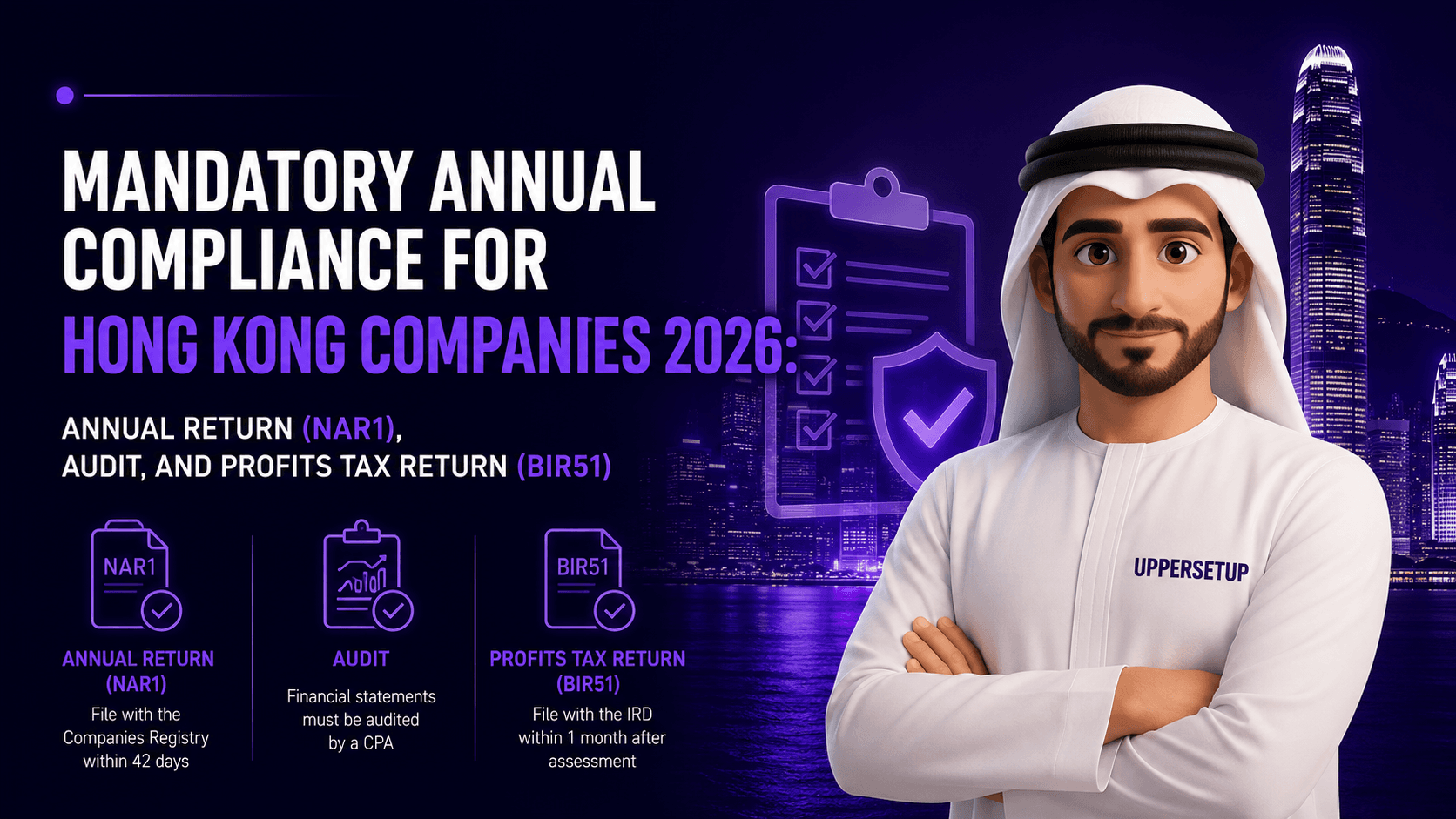
Specialist review is warranted in five situations: preparing an irrevocable patent box election; holding a patent portfolio partly filed after 5 July 2026; running a holding company with foreign dividends from low- or zero-tax jurisdictions; outsourcing specified economic activities within the group; and intra-group property transfers, where relief can be lost inside the two-year window. The annual reporting cycle is set out in Mandatory Annual Compliance for Hong Kong Companies 2026.
Frequently asked questions
What rate applies under the Hong Kong patent box?
Five per cent on the concessionary portion of assessable profits derived from eligible IP income. The concessionary portion is P = I × F, where F is the R&D fraction, capped at 100%.
Can the patent box and the two-tiered profits tax rates be used together?
No. Under section 14(5) of the Inland Revenue Ordinance a person who has elected under section 4 of Schedule 17FD does not qualify for the two-tiered rates, and the election is irrevocable.
Which intellectual property qualifies for the Hong Kong patent box?
An eligible patent, an eligible plant variety right, and a copyright subsisting in software under Cap. 528 or foreign law, provided the property is generated from an R&D activity. Trade marks and other marketing-related IP do not qualify.
What changed on 5 July 2026?
That is the specified date — the expiry of 24 months after the Amendment Ordinance came into operation. For eligible patents and plant variety rights with a date of filing on or after that date, an election is invalid unless there is a corresponding local patent or local plant variety right in Hong Kong.
Which companies fall within the FSIE regime?
Only members of MNE groups — groups including at least one entity or permanent establishment outside the jurisdiction of the ultimate parent. Revenue and asset size are irrelevant.
What exceptions are available to a holding company on foreign dividends?
Either the economic substance requirement or the participation requirement — continuous holding of not less than 5% of equity interests for not less than 12 months immediately before the income accrues. The participation exemption is qualified by the switch-over rule at 15%, the anti-hybrid mismatch rule and the main purpose rule.
When is foreign income treated as received in Hong Kong?
When it is remitted, transmitted or brought into Hong Kong; when it is used to satisfy a debt incurred in respect of a Hong Kong business; or when it is used to buy movable property that is then brought into Hong Kong, at the moment the property arrives.
Is the three-year rolling average still available for the R&D fraction?
No, the transitional periods have ended. In the patent box the transitional period covered the years of assessment 2023/24 to 2025/26; in FSIE it ran to the last day of the basis period for 2024/25 for general IP income and for 2025/26 for IP disposal gains.
Key takeaways
• The patent box gives 5% on the concessionary portion of Hong Kong-sourced IP income, under the Inland Revenue (Amendment) (Tax Concessions for Intellectual Property Income) Ordinance 2024, enacted 5 July 2024 and applying from the year of assessment 2023/24.
• Two-tiered rates: 8.25% on the first HKD 2,000,000 and 16.5% above for corporations; 7.5% and 15% for unincorporated businesses; within a group of connected entities only the nominated one qualifies.
• Electing into the patent box is irrevocable and removes the two-tiered rates under section 14(5).
• R&D fraction = EE × 130% / (EE + NE), capped at 100%; outsourcing to associated persons outside Hong Kong and buying in IP both count as NE.
• From 5 July 2026 new filings need a corresponding local patent or local plant variety right in Hong Kong.
• Withdrawal of the concession returns all accumulated concessionary portions to the tax base in the year the circumstance occurs.
• FSIE covers interest, dividends, IP income and equity disposal gains from 1 January 2023 and all other disposal gains from 1 January 2024, and applies only to MNE group members.
• Exceptions: economic substance, participation requirement (5% and 12 months, with the 15% switch-over rule), nexus requirement and intra-group transfer relief (75% and a two-year window).
• Records are kept for at least 7 years, and the Commissioner is notified within 4 months of the end of the basis period.
• Adjacent regime: under the tax certainty enhancement scheme an onshore equity disposal gain is treated as capital where at least 15% was held continuously for 24 months; foreign-sourced disposal gains are excluded and remain within FSIE.
Summary
Hong Kong's patent box regime was introduced by the Inland Revenue (Amendment) (Tax Concessions for Intellectual Property Income) Ordinance 2024, enacted on 5 July 2024, and applies to years of assessment beginning on or after 1 April 2023. The concessionary rate is 5% on the concessionary portion of assessable profits from eligible IP income, computed as P = I × F where the R&D fraction F = EE × 130% / (EE + NE), capped at 100%. Eligible intellectual property covers eligible patents, eligible plant variety rights and copyright subsisting in software generated from an R&D activity; trade marks do not qualify. The election is made in writing, applies to all subsequent years of assessment and is irrevocable, and under section 14(5) of the Inland Revenue Ordinance it removes entitlement to the two-tiered profits tax rates of 8.25% on the first HKD 2,000,000 and 16.5% above for corporations, and 7.5% and 15% for unincorporated businesses. From 5 July 2026 — the specified date, being 24 months after the Ordinance came into operation — an election in respect of an eligible patent or plant variety right with a date of filing on or after that date is invalid without a corresponding local patent or local plant variety right. The FSIE regime, introduced by the Inland Revenue (Amendment) (Taxation on Specified Foreign-sourced Income) Ordinance 2022 with effect from 1 January 2023 and extended by the Inland Revenue (Amendment) (Taxation on Foreign-sourced Disposal Gains) Ordinance 2023 from 1 January 2024, applies only to members of MNE groups and covers foreign interest, dividends, IP income and disposal gains on any property. Exemption depends on the economic substance requirement, the participation requirement (at least 5% of equity interests held continuously for at least 12 months, subject to a switch-over rule requiring an applicable rate of at least 15%), the nexus requirement for IP income, or intra-group transfer relief where the entities hold at least 75% interests and remain associated for two years. Records must be kept for at least 7 years and the Commissioner notified within 4 months of the end of the basis period.
Sources
• Inland Revenue Department — Tax Concessions for Intellectual Property Income: Patent Box Regime
• Inland Revenue Department — illustrative examples on the patent box regime
• Inland Revenue Department — Foreign-sourced Income Exemption
• Inland Revenue Department — FAQ on the two-tiered profits tax rates regime
• Inland Revenue Department — FAQ on the FSIE regime
• Inland Revenue Department — advance ruling on the economic substance requirement
• Inland Revenue Department — 2026-27 Budget: Tax Measures
• Inland Revenue Department — FAQ on the 2026-27 Budget tax measures
• Inland Revenue Department — FAQ on the Tax Certainty Enhancement Scheme
• OECD — Countering Harmful Tax Practices More Effectively, Action 5: 2015 Final Report
• Hong Kong Government press release on the gazetting of the patent box Ordinance, 5 July 2024
Disclaimer
This material is for informational purposes only and does not constitute legal, tax, financial, investment or consulting advice. Before making decisions, obtain individual professional advice taking account of your specific circumstances, jurisdiction, company status and current regulatory requirements. Information is accurate as of August 2026.
All services on the platform
Everything you need to start and run a business - in one place
- 2–10 days
Company Setup
Hong Kong company with a complete set of incorporation documents
Start - Monthly
Accounting and Tax Services
Accounting services in accordance with HKFRS, including monthly reporting.
- 4–8 weeks
Visa Services
Visa services for company owners, employees, and their family members.
- 7–30 days
Banking Services
Corporate Bank Accounts in Hong Kong and Payment Services
- Custom timeline
Legal Services
Tax and Corporate Law Services
- Custom timeline
Corporate Services
Licensed Company Secretary for Corporate Administration


