
































































































































































 International Free Zone Authority
UAE Corporate Tax 2026: Rates, QFZP, Small Business Relief, Deadlines and Penalties — The Complete Guide

🔴 CRITICAL DEADLINE: 30 September 2026 — last day to file the corporate tax return and make payment for companies with a January–December 2025 financial year. Less than 4 months remaining. Filing and payment are a single obligation — you cannot file without paying.
🔴 NEW FROM 14 APRIL 2026: Cabinet Decision No. 129 of 2025 fully restructured the penalty framework. The late payment penalty is now 14% per annum — replacing the previous daily structure. Late registration penalty waiver: available if the first return is filed within 7 months of the end of the first tax period.
1. What Is UAE Corporate Tax and Who Does It Affect
Corporate tax (CT) is a federal tax on profits of legal entities and natural persons from business activities in the UAE, introduced by Federal Decree-Law No. 47 of 2022. In force from 1 June 2023. For the first time in UAE history, a direct profits tax applies to the vast majority of commercial entities.
Who must pay
• All UAE mainland companies — LLC, Free Establishment, Branch, and others.
• All free zone companies — regardless of emirate or free zone type. A free zone does not provide automatic CT exemption.
• Foreign companies with a permanent establishment in the UAE.
• Natural persons (freelancers, sole traders) with business turnover above AED 1 million per year — from 1 March 2024.
Who is exempt
• Government entities and state-owned enterprises — Cabinet Decision No. 55 of 2025.
• Qualifying public benefit organisations — Cabinet Decision No. 37 of 2023.
• Investment funds meeting FTA Decision No. 8 of 2025 conditions.
• Extractive industries (oil, gas) — governed by emirate-level decrees, not Federal DL No. 47/2022.
⚠ Registration is mandatory for everyone — including companies that earned nothing and pay 0% tax. An unregistered company receives an AED 10,000 fine automatically, regardless of profit.
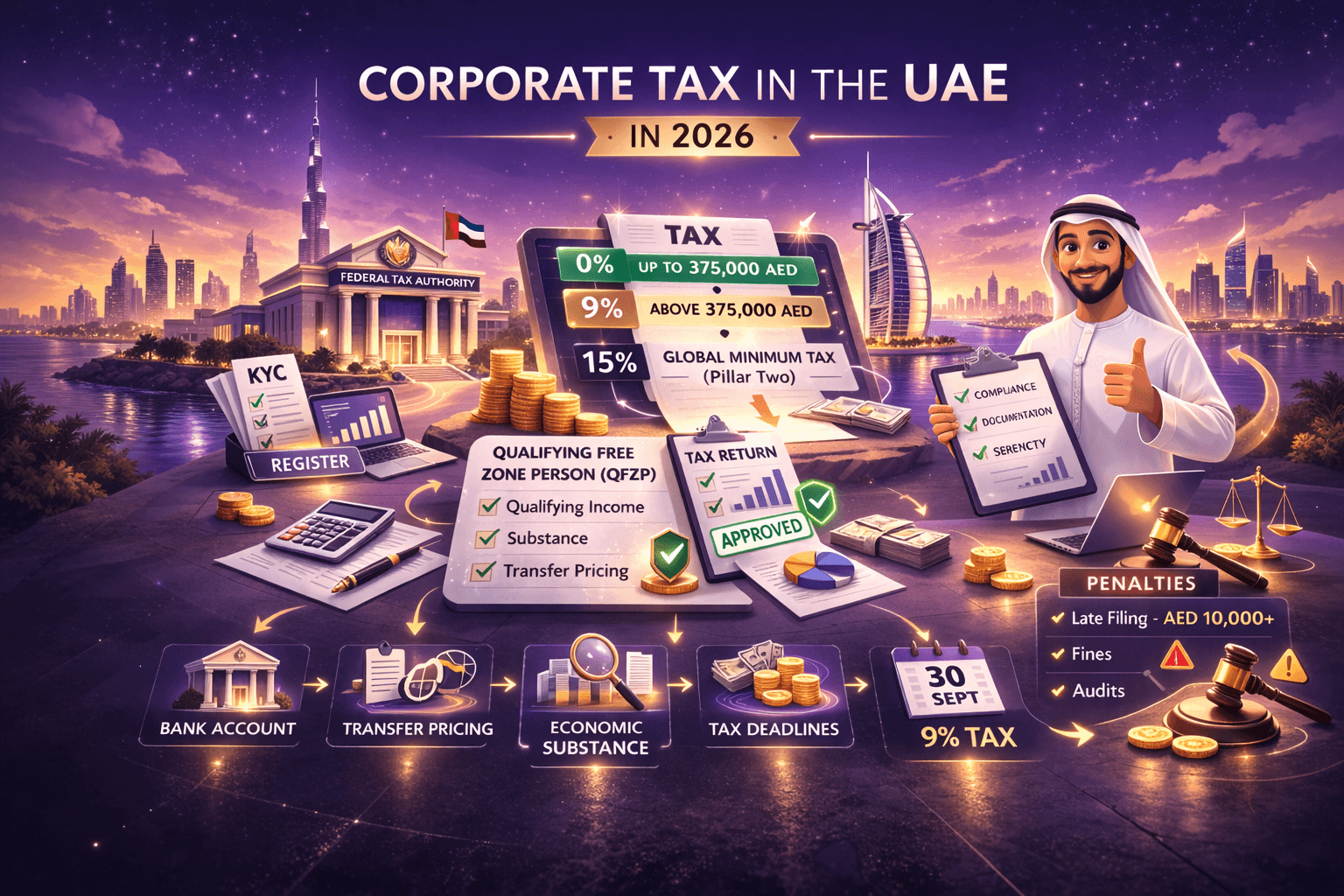
2. Corporate Tax Rates
|
Taxable income |
CT rate |
Who pays |
Note |
|
Up to AED 375,000 inclusive |
0% |
Everyone: mainland, free zone, natural persons, freelancers |
Zero threshold applies to all taxable persons automatically |
|
Above AED 375,000 |
9% |
Taxable Persons — mainland and free zone (not meeting QFZP) |
9% applies only to the excess, not to total income |
|
Qualifying Free Zone Person (QFZP): qualifying income |
0% |
Free zone companies meeting all 5 QFZP conditions |
Qualifying Income per the updated list: Ministerial Decision No. 229 of 2025 |
|
QFZP: non-qualifying income |
9% |
Free zone on breach of de minimis rule |
If non-qualifying income > 5% of revenue or AED 5 million — all income taxed at 9% |
|
Extractive industries (oil, gas) |
Special regime |
Per emirate-level decrees |
Outside the standard Federal DL No. 47/2022 regime |
|
Qualifying investment funds |
0% |
If meeting FTA Decision No. 8 of 2025 conditions |
Active election + conditions compliance required |
Important nuance: 9% does not apply to total income
Many entrepreneurs incorrectly assume that with income of AED 500,000 they will pay 9% on AED 500,000. This is wrong. The structure is: the first AED 375,000 is taxed at 0%. Only the amount above AED 375,000 is taxed at 9%.
Example: income AED 500,000. Tax = (500,000 − 375,000) × 9% = 125,000 × 9% = AED 11,250.
Need help registering a company for UAE corporate tax? UPPERSETUP company registration →
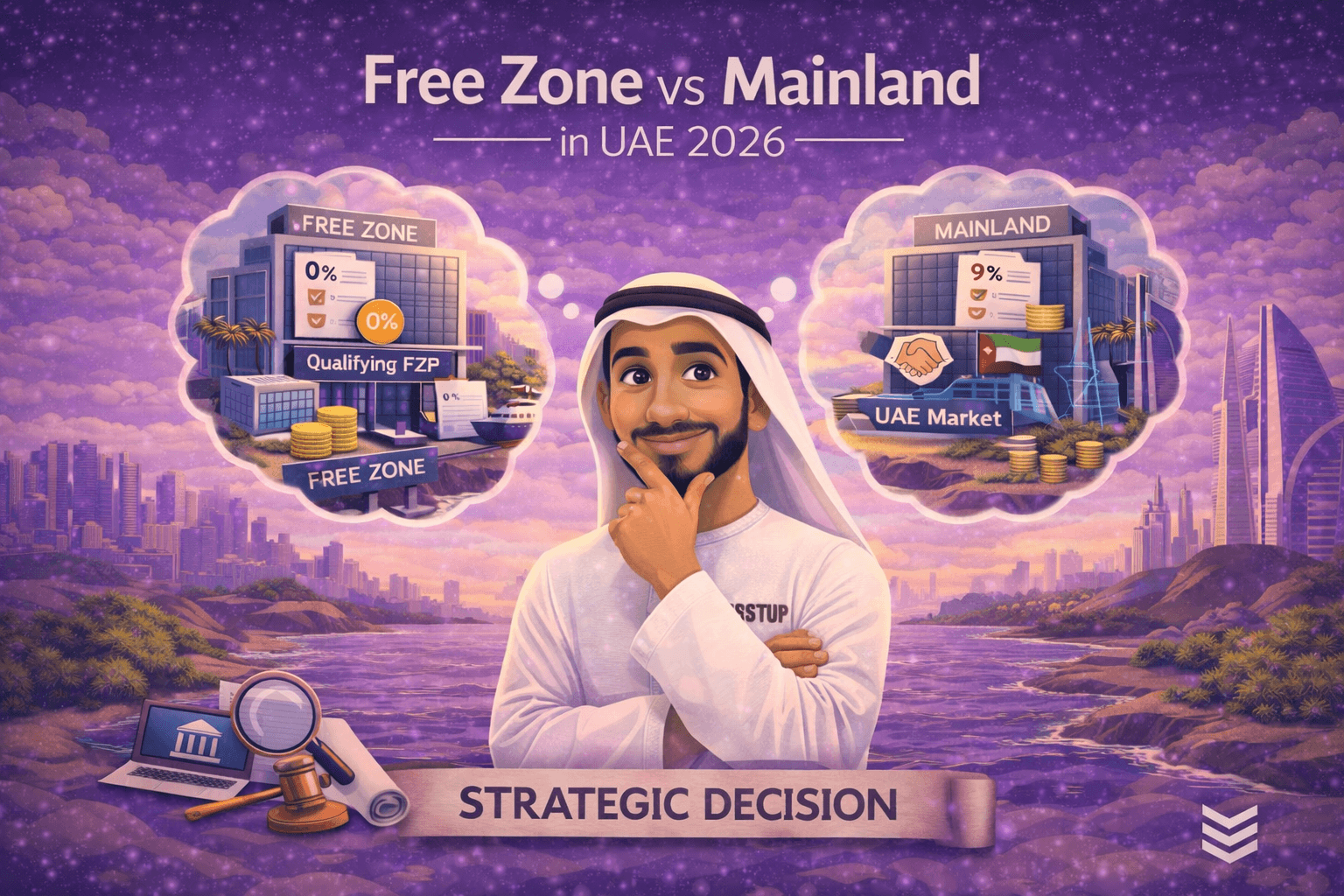
3. QFZP: Who Pays 0% in a Free Zone
QFZP (Qualifying Free Zone Person) is the status entitling a company to pay 0% corporate tax on qualifying income. The status is not granted automatically. Each tax period, the company must independently verify compliance with all 5 conditions and declare the status in its return.
|
Condition |
Content |
Common violations |
|
1. Adequate economic substance in the UAE |
Real staff, operating expenditure, management decisions made in the UAE. A registered office with no personnel is insufficient |
Nominee directors; employees working from abroad; costs borne by a foreign parent structure |
|
2. Qualifying income only |
Income received from: (a) other free zone entities; (b) foreign clients; (c) qualifying activities with mainland clients under specific conditions. List updated by Ministerial Decision No. 229 of 2025 |
Treating mainland-client revenue as qualifying without checking the list; mixing income streams without segregation |
|
3. De minimis: non-qualifying income threshold |
Non-qualifying income must not exceed 5% of total revenue or AED 5 million — whichever is lower |
Passive income (bank interest, non-free-zone property rent, insurance recoveries) not classified as non-qualifying — incorrectly |
|
4. No excluded activities (Excluded Activities) |
Certain activities are explicitly excluded from the QFZP regime, including: transactions with UAE mainland natural persons; certain financial services for UAE residents; IP income under specific conditions |
Violation occurs without monitoring client base composition (UAE mainland vs. foreign) |
|
5. Does not elect Small Business Relief in the same tax period |
QFZP and SBR are mutually exclusive in the same tax period |
Electing both simultaneously — a systemic error |
De minimis: the main trap for free zone businesses
De minimis is the non-qualifying income threshold rule. If non-qualifying income exceeds 5% of total revenue or AED 5 million (whichever is lower) — the company loses QFZP status for the entire tax period. This means: 9% tax on all income, including previously qualifying income.
Example: a free zone company generated revenue of AED 10,000,000. Of this, AED 600,000 came from retail sales to UAE mainland consumers (excluded activity). De minimis threshold: 5% of AED 10 million = AED 500,000. Actual non-qualifying: AED 600,000 > AED 500,000 → QFZP status lost → 9% on all income.
4. Qualifying Activities: Updated 2025 List
The list of qualifying and excluded activities was updated by Ministerial Decision No. 229 of 2025 (August 2025), which replaced Ministerial Decision No. 265 of 2023. Most articles written before September 2025 contain the outdated list.
|
Activity |
Status under Ministerial Decision No. 229 of 2025 |
Note |
|
Manufacturing and processing of goods |
✅ Qualifying |
Including chemicals and by-products (new from 2025) |
|
Trading goods with other free zone entities |
✅ Qualifying |
Only if buyer is a free zone entity or foreign client |
|
Services for free zone and foreign clients |
✅ Qualifying |
Professional, advisory, IT, financial, and other services |
|
Headquarter services to related parties |
✅ Qualifying |
Strict substance requirements |
|
Reinsurance |
✅ Qualifying |
Added by Ministerial Decision No. 229 of 2025 |
|
Carbon credits / renewable energy certificates |
✅ Qualifying |
New under Ministerial Decision No. 229 of 2025 |
|
Treasury and financing services within a group |
✅ Qualifying (expanded) |
Expanded scope from 2025 |
|
Retail sales to UAE mainland end consumers |
❌ Excluded |
Transactions with UAE mainland natural persons — excluded activity |
|
Insurance for UAE mainland individuals |
❌ Excluded |
Standard insurance products for UAE residents |
|
Banking services without a special licence |
❌ Excluded |
Without CBUAE/DFSA/FSRA licence |
⚠ Qualifying activity status is a necessary but not sufficient condition. The company must also pass the substance test (Condition 1) and de minimis test (Condition 3). Only the combination of all five conditions grants the right to 0% QFZP.
5. Small Business Relief (SBR): 0% Rate for Small Businesses
Small Business Relief is a regime allowing companies with revenue up to AED 3 million per year to declare zero taxable income and pay 0% corporate tax, without needing to meet QFZP requirements.
Key SBR parameters
• Revenue threshold: no more than AED 3,000,000 in the current tax period AND in all previous tax periods (Ministerial Decision No. 73 of 2023). Critical: once a company exceeds AED 3 million in any tax period — SBR becomes permanently unavailable.
• Threshold is measured against total revenue — not net profit.
• The regime is voluntary: SBR does not apply automatically; it must be actively elected in the return.
• Available for tax periods ending no later than 31 December 2026. This is a transitional measure.
• Incompatible with QFZP in the same tax period: SBR and QFZP status cannot be elected simultaneously.
• Under SBR, the company is still required to register and file a return on time. Important: by electing SBR, the company forfeits the right to carry forward any tax losses and disallowed net interest expenditure from that period. If the company anticipates losses in 2025–2026, run the trade-off calculation before electing SBR.
🔴 SBR is only available until 31 December 2026. If your financial year ends on 31 December 2026 — this is the last tax period in which SBR is available. From 2027, small businesses calculate tax under the standard regime (0% up to AED 375,000, 9% above).
⚠ SBR does not protect against the registration obligation. A company with AED 500,000 in revenue applies SBR and pays 0%, but must still be registered with the FTA and file a return. An unregistered company receives an AED 10,000 fine — regardless of SBR.
6. Deadlines: Table by Financial Year
|
Financial year |
First tax period |
Filing and payment deadline |
Status as of June 2026 |
|
1 Jan – 31 Dec |
1 Jan 2024 – 31 Dec 2024 |
30 September 2025 |
Already passed — should have been filed |
|
1 Jan – 31 Dec |
1 Jan 2025 – 31 Dec 2025 |
30 September 2026 🔴 |
CURRENT DEADLINE — 3 months remaining |
|
1 Apr – 31 Mar |
1 Apr 2025 – 31 Mar 2026 |
31 December 2026 |
Upcoming |
|
1 Jul – 30 Jun |
1 Jul 2025 – 30 Jun 2026 |
31 March 2027 |
Upcoming |
|
First registered from 1 March 2024 |
Within 3 months of registration date |
9 months from end of first period |
Individual; verify with FTA |
The nine-month rule
The return and payment must be submitted/transferred within 9 months from the end of the tax period. This rule applies to all taxpayers regardless of company type. No automatic extensions. The FTA does not grant deferrals on request.
Filing and payment — a single obligation
Submitting the return and paying the tax are one and the same action. You cannot file a return and pay later. You cannot pay without filing. Both must be completed by the deadline through the EmaraTax portal (eservices.tax.gov.ae).
Need help with tax compliance in the UAE? UPPERSETUP tax services →
7. Penalties: Complete Table 2026
|
Violation |
Penalty / sanction |
Legal basis |
Waiver / relief |
|
Late registration |
AED 10,000 (flat) |
Cabinet Decision No. 10 of 2024 |
Waiver: if the first return is filed within 7 months of the end of the first tax period, the penalty is cancelled (FTA official) |
|
Late filing of return |
AED 500/month for the first 12 months; AED 1,000/month from the 13th month |
Federal Decree-Law No. 47/2022; Cabinet Decision No. 75/2023 |
No grace period. Accrues from the first day after the deadline |
|
Late payment of tax |
14% per annum on the unpaid amount (Cabinet Decision No. 129 of 2025, from 14 April 2026) |
Cabinet Decision No. 129 of 2025 |
Replaces the previous daily penalty structure. No cap — interest accumulates until full payment |
|
Error in return (voluntary disclosure) |
AED 500 for a first offence (reduced by Cabinet Decision No. 129/2025) |
Cabinet Decision No. 129/2025 |
Disclosure BEFORE FTA audit is significantly cheaper than FTA discovery |
|
Error discovered by FTA during audit |
15% of underpaid tax amount + monthly interest |
Federal Decree-Law No. 47/2022, Art. 77 |
No waiver. Voluntary disclosure after an audit notice — too late |
|
Failure to provide documents on FTA request |
AED 1,000 for initial request; AED 10,000 on repeat |
Cabinet Decision No. 75/2023 |
— |
The AED 10,000 waiver: how to use it
The FTA officially launched an initiative to cancel the late registration penalty. Condition: file the first return (or Annual Declaration) within 7 months of the end of the first tax period. If the condition is met, AED 10,000 is cancelled automatically; if already paid — apply for a refund through EmaraTax.
✅ If you are not registered and have not filed returns — register on EmaraTax immediately and submit all overdue returns. Use the waiver. This is significantly cheaper than waiting for an FTA audit.
8. Registration: Who, When, and How
Who must register
• Mainland companies: all, regardless of profit.
• Free zone companies: all, including QFZP companies paying 0% tax.
• Foreign companies with a permanent establishment in the UAE.
• Freelancers and sole traders with turnover >AED 1 million per year: deadline 31 March 2026 (for those reaching the threshold in 2024).
Registration timelines
• Companies registered before 1 March 2024: should have registered per the FTA Decision No. 3 of 2024 schedule (May–December 2024, depending on licence issuance month).
• Companies registered from 1 March 2024: 3 months from the date of company registration.
• Late registrants: registration is still possible via EmaraTax; the AED 10,000 penalty applies automatically, but the waiver may cancel it if conditions are met.
How to register
• Log in to EmaraTax (eservices.tax.gov.ae) via UAE Pass or login credentials.
• Select "Corporate Tax Registration".
• Enter company details: type, financial year, business activities.
• Receive the Tax Registration Number (TRN) — immediately or within a few working days.
9. Calculating Taxable Income
Starting point: accounting profit
The taxable base is calculated from IFRS (International Financial Reporting Standards) accounting profit with subsequent adjustments. Companies with annual revenue below AED 50 million that elect SBR may use simplified accounting standards.
Non-deductible expenses
• Entertainment expenses: only 50% is deductible.
• Fines, penalties, and sanctions: not deductible.
• Contributions unrelated to business activity: not deductible.
• Payments to related parties: only if arm's length conditions are met (transfer pricing).
Transfer pricing rules
Transactions between Related Parties must be conducted at market prices (arm's length principle). The FTA may adjust taxable income if prices deviate from market conditions. Group companies are advised to maintain Transfer Pricing documentation.
10. Practical Use Cases
Case 1: Mainland LLC, revenue AED 800,000
The company does not meet the SBR threshold (revenue > AED 3 million — no; actually AED 800K < AED 3M → SBR is available). If SBR is elected and actively declared: 0% tax. If SBR is not elected, standard calculation: 0% on AED 375,000; 9% on AED 425,000 = AED 38,250 in tax. Registration and filing are mandatory regardless.
Case 2: Free zone company (IFZA), revenue AED 5,000,000, all clients foreign
The company claims QFZP status. Verification: substance — present (staff, office, management in UAE); all revenue from foreign clients — qualifying income; non-qualifying income = 0 < 5% → de minimis satisfied; activity (consulting) — on the qualifying list; SBR not applied. Result: 0% corporate tax. Return — mandatory.
Case 3: Free zone company (Shams), revenue AED 2,500,000 — elects SBR
Revenue ≤ AED 3 million. Company actively elects SBR in the return. Taxable income: AED 0. Tax: AED 0. Important: SBR must be elected in the return — it is not assumed automatically. Return — mandatory.
Case 4: Free zone company — de minimis breach
Revenue AED 6,000,000. Of this, AED 400,000 from retail sales to UAE mainland consumers. De minimis threshold: 5% of AED 6 million = AED 300,000. Actual non-qualifying: AED 400,000 > AED 300,000 → QFZP status lost → 9% on all income above AED 375,000. Tax = (6,000,000 − 375,000) × 9% = AED 506,250.
11. Checklist: What to Do Before 30 September 2026
• Confirm the company is registered with the FTA (EmaraTax). If not — register immediately.
• Close the 2025 financial statements under IFRS.
• Conduct an audit (if required: revenue >AED 50 million, or DMCC/IFZA and other free zones with mandatory audit).
• Classify all income: qualifying vs. non-qualifying (for free zone companies).
• Verify QFZP compliance for 2025 — all 5 conditions.
• Calculate taxable income with adjustments (non-deductible expenses, TP).
• Determine: SBR (revenue ≤ AED 3 million?) or standard regime?
• Complete and submit the return via EmaraTax by 30 September 2026.
• Pay the tax simultaneously with filing.
• Retain all documentation: financial statements, TP documentation, substance evidence — minimum 7 years.
Sources
• FTA — Corporate Tax Legislation (tax.gov.ae)
• FTA — EmaraTax: registration and return filing (eservices.tax.gov.ae)
• Cabinet Decision No. 10 of 2024 — AED 10,000 late registration penalty (tax.gov.ae)
• FTA Decision No. 8 of 2025 — Qualifying Investment Funds (tax.gov.ae)
• Gulf News — UAE Corporate Tax 2026 compliance updates (gulfnews.com)
• Khaleej Times — UAE Corporate Tax deadlines and QFZP 2026 (khaleejtimes.com)
Disclaimer
This article is provided for informational purposes only and does not constitute tax, legal, or professional advice. UAE tax legislation continues to evolve: regulations, FTA decisions, interpretations, and enforcement practice may change. Information is accurate as of May-June 2026. Before making any corporate tax decisions, readers are advised to consult a qualified FTA-registered tax adviser and refer to primary sources at tax.gov.ae. UPPERSETUP accepts no liability for actions taken solely in reliance on this material.
Read more on the topic

Emiratisation 2026: The Complete Employer Guide — Quotas, Penalties, Nafis, and the 30 June Deadline
Stamp Duty on Share Transfers in Hong Kong 2026: Rates, Net-Asset Valuation, Deadlines and Penalties
VAT in Kazakhstan 2026: Registration, the 10,000 MCI Threshold, the 16% Rate, e-Invoices and Refunds
All services on the platform
Everything you need to start and run a business - in one place
- 3–5 days
Company Setup
Mainland or Free Zone company with a complete set of incorporation documents
Start - Monthly
Accounting Services
Financial accounting and reporting in accordance with UAE requirements
Start - 1–2 weeks
Visa Services
Residence visas for shareholders, employees and family members
Start - 7–30 days
Banking Services
Corporate Bank Accounts in the UAE and Payment Services
Start - Custom timeline
Legal Services
Contracts, corporate amendments and legal support
Start


