

































































































 International Free Zone Authority
UAE Family Foundation 2026: Tax Transparency Under Article 17 of the Corporate Tax Law
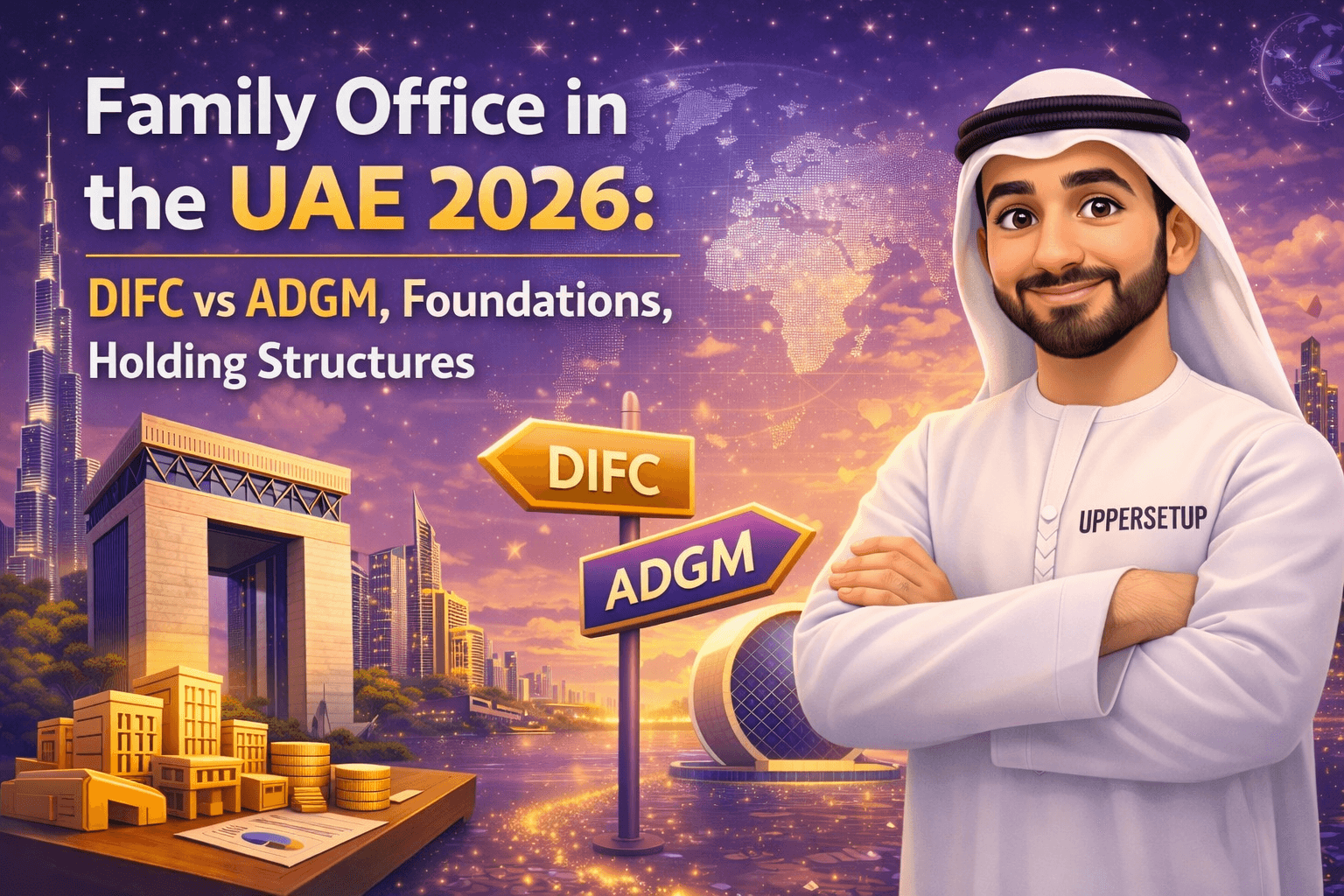
A Family Foundation in the UAE is not a distinct legal entity type — it is a tax status. Article 17 of Federal Decree-Law No. 47 of 2022 (the Corporate Tax Law) allows a foundation, trust, or similar entity to obtain Unincorporated Partnership status — fiscal transparency under which income is taxed in the hands of the beneficiaries rather than at the level of the structure itself. Trusts without separate legal personality (such as DIFC/ADGM trusts) are automatically transparent. Foundations with separate legal personality (DIFC Foundation, ADGM Foundation, RAK ICC Foundation) must apply to the Federal Tax Authority (FTA) and obtain approval. For individual beneficiaries, personal investment and real estate income is generally outside Corporate Tax regardless of the foundation’s own transparency status.
⚠ Key restriction under Article 17(1)(c): the foundation must not carry on any activity that would constitute a Business under Cabinet Decision No. 49 of 2023 if conducted directly by the founder or beneficiary. Any active commercial activity within the structure takes it outside the transparency regime entirely.
1. The Legal Basis
The base provision is Article 17 of Federal Decree-Law No. 47 of 2022 on the Taxation of Corporations and Businesses. On 18 November 2024, the UAE Ministry of Finance issued Ministerial Decision No. 261 of 2024 on Unincorporated Partnerships, Foreign Partnerships and Family Foundations, replacing the earlier Ministerial Decision No. 127 of 2023 and effective retroactively from 1 June 2023.
On 27 May 2025, the Federal Tax Authority (FTA) published an official, though not legally binding, guide: the Corporate Tax Guide on Taxation of Family Foundations (CTGFF1), with detailed worked examples. On 19 September 2025, the FTA issued Public Clarification CTP008 on the Corporate Tax Treatment of Family Wealth Management Structures — extending the rules to holding companies, SPVs, and family offices (Single/Multi-Family Office).
⚠ Family Foundation is a tax term, not a legal entity type. The foundation must be established under the relevant civil (non-tax) legislation of the chosen jurisdiction — the DIFC Foundations Law No. 3 of 2018, the ADGM Foundations Regulations 2017, or the RAK ICC Foundations Regulations 2019 — and separately apply for tax transparency under Article 17.
Need help structuring family wealth in the UAE? UPPERSETUP corporate services →
2. Who Gets Automatic Transparency and Who Must Apply
|
Structure type |
Default tax status |
Action required |
|
Trust (DIFC/ADGM, no separate legal personality) |
Automatically transparent |
None — no application needed |
|
Foundation (DIFC/ADGM/RAK ICC, separate legal personality) |
Taxable person by default |
Apply to the FTA for transparency under Article 17 |
|
SPV/holding company, 100% owned by a transparent Foundation |
Taxable person unless application is made |
Separate application under MD 261/2024, subject to Article 17(1) |
|
LLC (mainland or free zone) |
Not recognised as a “similar entity” at all |
Can only apply as a 100%-owned subsidiary of a transparent Foundation, not on its own |
|
Single/Multi-Family Office (SFO/MFO) |
Taxable person, 9% rate above AED 375,000 |
May qualify for the 0% QFZP regime if regulated by the DFSA/FSRA/UAE Central Bank and providing genuine services |
The decisive factor is separate legal personality. A trust is not, by its nature, a standalone legal entity: assets are held by the trustee for the benefit of beneficiaries, and the FTA automatically recognises such a structure as transparent without a formal application. A Foundation is a separate legal entity, so it is taxable by default and must independently apply for Unincorporated Partnership status.
⚠ An LLC is explicitly NOT recognised as a “similar entity” to a foundation or trust — Public Clarification CTP008 settles this question definitively. An LLC can only achieve transparency as a wholly owned subsidiary of an already-transparent Foundation, through a separate application under Ministerial Decision No. 261 of 2024 — never on its own.
3. The Five Conditions of Article 17(1)
|
Article 17(1) condition |
Content |
|
(a) Principal activity condition |
Principal activity is managing assets and receiving benefits from them (e.g., buying/selling shares, bonds, or real estate to generate income for beneficiaries) |
|
(b) Beneficiary condition |
Beneficiaries are identified or identifiable natural persons (including unborn children) and/or Qualifying Public Benefit Entities |
|
(c) No Business Activity condition |
Does not carry on activity that would constitute a Business under Cabinet Decision No. 49 of 2023 if conducted directly by the founder/beneficiary |
|
(d) No tax avoidance condition |
Not established with the main purpose of obtaining a tax advantage |
|
(e) Distribution condition |
The income share belonging to such a beneficiary must be distributed within 6 months of the end of the tax period |
All five conditions must be satisfied simultaneously. Particular attention should be paid to condition (e): if a Qualifying Public Benefit Entity (a charitable organisation) is among the beneficiaries, the income share due to it must be distributed within 6 months of the end of the tax period — otherwise the condition is treated as unmet for the entire foundation.
4. Multi-Tier Structures and the “Break-the-Chain” Effect
Ministerial Decision No. 261 of 2024 extended Article 17 to subsidiary structures: an SPV or holding company wholly owned by an already-transparent foundation (directly or through an uninterrupted chain of similarly transparent entities) may make its own application for Unincorporated Partnership status, provided it independently meets the conditions of Article 17(1).
⚠ The “break-the-chain” effect, confirmed by Public Clarification CTP008: every link in the chain must meet the Article 17 conditions and engage solely in passive investment activity. If even one link breaches the conditions (for example, by conducting an active business), everything below it in the chain becomes taxable — transparency does not automatically pass down through a problem link.
5. Taxation of Beneficiaries
For UAE-resident individuals, income from personal investments (dividends, capital gains, interest) and real estate (rental or sale not requiring a licence) is outside Corporate Tax altogether — regardless of whether it is received directly or through a transparent structure. This means most passive Family Foundations end up paying no Corporate Tax at either the structure level or the beneficiary level.
✅ Income attributable to a Qualifying Public Benefit Entity beneficiary is treated as if it would not have been taxable had that entity received it directly — a rule that protects charitable distributions from inadvertent taxation through the foundation structure.
6. Family Offices: A Separate Tax Regime
A Single Family Office (SFO) and a Multi-Family Office (MFO) are not a Family Foundation — they are a distinct category, directly addressed in Public Clarification CTP008. Offices that do not meet the transparency conditions are subject to Corporate Tax at the standard 9% rate on income above AED 375,000.
ℹ An alternative is Qualifying Free Zone Person (QFZP) status, with a 0% rate on qualifying income, if the SFO/MFO is established in a free zone, regulated by a competent authority (the DFSA, FSRA, or UAE Central Bank), and provides genuine regulated wealth management services. The FTA explicitly stresses that merely holding a licence is insufficient — actual regulated activity is required.
7. Step-by-Step Action Plan
1. Determine whether the structure is a trust (automatic transparency) or a foundation with separate legal personality (application required).
2. Verify compliance with all five conditions of Article 17(1), including the absence of active business activity.
3. Register for Corporate Tax via EmaraTax — a prerequisite for applying for transparency.
4. Submit the Unincorporated Partnership application before the end of the relevant tax period.
5. For multi-tier structures, file a separate application for each link in the chain (SPV, holding company) that is to obtain transparency.
6. Check whether a Qualifying Public Benefit Entity is among the beneficiaries, and plan the distribution within 6 months of the end of the tax period in advance.
7. File the annual confirmation of continued compliance within 9 months of the end of each tax period.
8. Who This Fits
• Families with passive wealth — real estate, portfolio investments, stakes in operating companies. This profile benefits most from transparency — no tax arises at either the foundation or beneficiary level.
• Structures with a long-term succession objective. DIFC/ADGM/RAK ICC foundations provide an internationally recognised legal framework for transferring assets across generations.
9. Who This Does Not Fit
• Structures conducting active commercial activity. Any licensed business within the foundation breaches Article 17(1)(c) and removes the entire structure from the transparency regime.
• LLCs seeking Family Foundation status independently. An LLC is not recognised as a “similar entity” — the only route is through wholly owned subsidiary status under a transparent foundation.
FAQ
Does a DIFC trust need to apply for transparency?
No. Trusts without separate legal personality are automatically recognised as transparent provided they meet the Article 17 conditions — no formal application is required.
Can an LLC obtain Family Foundation status?
Not on its own. An LLC is explicitly not recognised as a “similar entity” to a foundation or trust. However, an LLC wholly owned by an already-transparent Foundation may file a separate application under Ministerial Decision No. 261 of 2024.
Is an individual beneficiary taxed on income from the foundation?
Generally not. Personal investment and real estate income is outside Corporate Tax for UAE-resident individuals, regardless of whether it is received directly or through a transparent structure. Exception: where a beneficiary conducts their own business or business activity in the UAE generating income exceeding AED 1 million in a calendar year, that excess is taxable for the individual under Corporate Tax regardless of whether it flows through the foundation or directly. The threshold is set by Cabinet Decision No. 49 of 2023.
What happens if a subsidiary of the foundation starts conducting business?
The “break-the-chain” effect applies: that entity and everything below it in the ownership chain becomes taxable. The transparency of the parent foundation is not itself reversed, but it does not pass through the problem link.
Key Takeaways
• Family Foundation is a tax status under Article 17, not a legal entity type.
• Trusts without legal personality are automatically transparent; foundations (DIFC/ADGM/RAK ICC) require an FTA application.
• An LLC is not recognised as a “similar entity” on its own — only as a wholly owned subsidiary of a transparent foundation.
• All five Article 17(1) conditions must be met simultaneously, including the ban on active business.
• The “break-the-chain” effect: a breach at one link makes everything below it taxable.
• SFO/MFO is a separate regime: 9% above AED 375,000, or 0% under QFZP with genuine regulation.
Summary
A Family Foundation in the UAE is a tax status under Article 17 of Federal Decree-Law No. 47 of 2022 (the Corporate Tax Law), allowing a foundation, trust, or similar entity to obtain Unincorporated Partnership status — fiscal transparency under which income is taxed at the beneficiary level rather than at the structure level. Trusts without separate legal personality (such as DIFC/ADGM trusts) are automatically transparent. Foundations with separate legal personality (DIFC Foundation, ADGM Foundation, RAK ICC Foundation) must apply to the Federal Tax Authority and obtain approval, under Ministerial Decision No. 261 of 2024 (issued 18 November 2024, effective retroactively from 1 June 2023). Public Clarification CTP008 (19 September 2025) confirms that an LLC is not recognised as a “similar entity” on its own. Individual resident beneficiaries are not taxed on personal investment or real estate income, regardless of the structure’s transparency status. Single/Multi-Family Offices are taxed at 9% above AED 375,000 unless they meet QFZP conditions.
Sources
• Ministry of Finance UAE — official Corporate Tax legislation register (mof.gov.ae)
• Federal Tax Authority — FTA Decision No. 16 of 2023 on Registration Requirements for Unincorporated Partnerships, official source (tax.gov.ae)
Disclaimer
This material is for informational purposes only and does not constitute legal, tax, financial, investment, or consulting advice. Before making any decisions, obtain individual professional advice tailored to your family's specific structure, jurisdiction, and current FTA requirements. Information is accurate as of June 2026.
Read more on the topic
Emiratisation 2026: The Complete Employer Guide — Quotas, Penalties, Nafis, and the 30 June Deadline
Stamp Duty on Share Transfers in Hong Kong 2026: Rates, Net-Asset Valuation, Deadlines and Penalties
All services on the platform
Everything you need to start and run a business - in one place
- 3–5 days
Company Setup
Mainland or Free Zone company with a complete set of incorporation documents
Start - Monthly
Accounting Services
Financial accounting and reporting in accordance with UAE requirements
Start - 1–2 weeks
Visa Services
Residence visas for shareholders, employees and family members
Start - 7–30 days
Banking Services
Corporate Bank Accounts in the UAE and Payment Services
Start - Custom timeline
Legal Services
Contracts, corporate amendments and legal support
Start


