





































































































































 International Free Zone Authority
Qualifying Free Zone Person Regime in 2026: Conditions for Applying the Zero Corporate Tax Rate in the United Arab Emirates

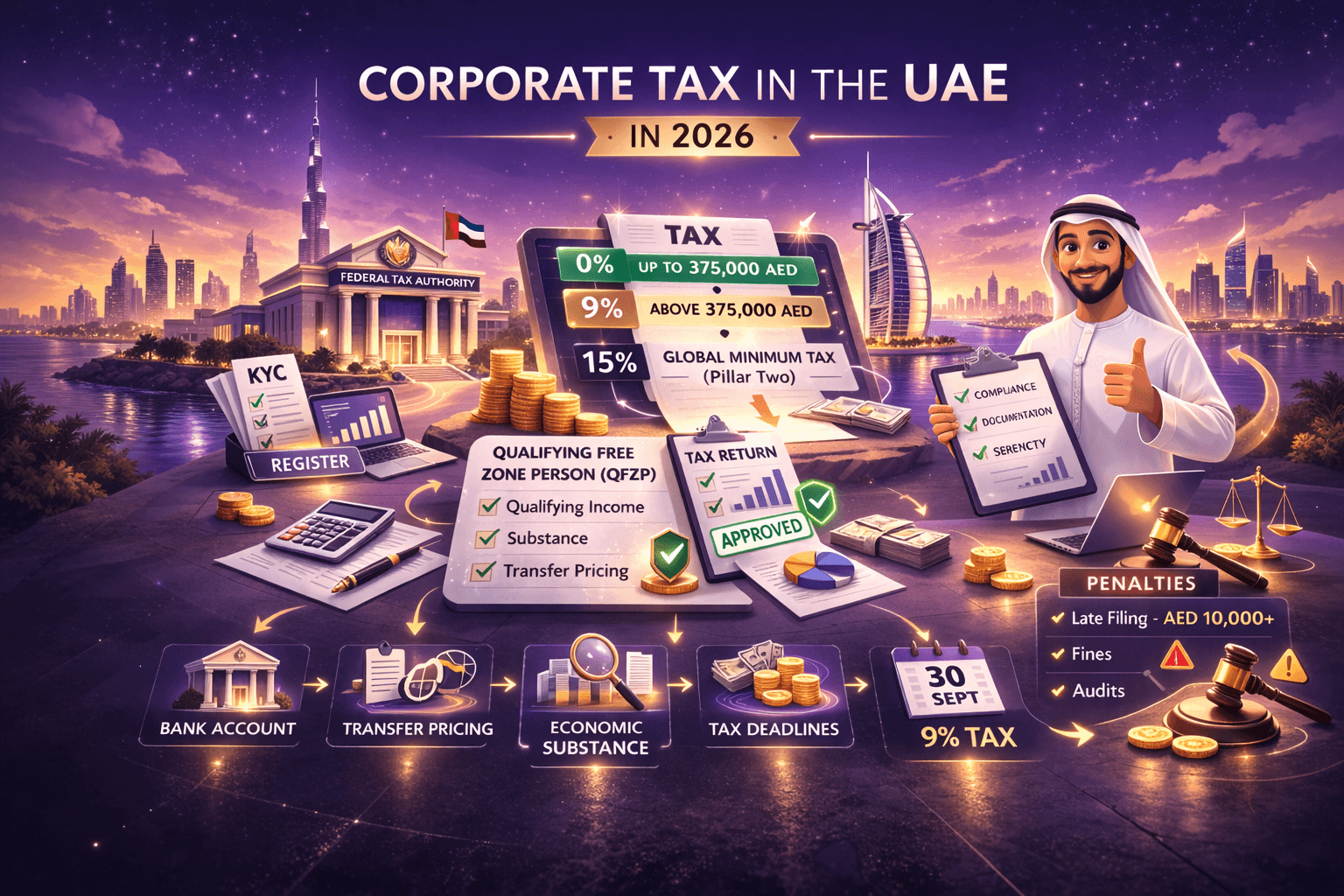
With the introduction of corporate tax in the United Arab Emirates, the general rate for most companies has been set at nine percent. At the same time, the legislation provides for the possibility of applying a zero percent rate to qualifying income of companies established in free economic zones.
This concerns the status of a Qualifying Free Zone Person.
However, registration of a company in a free zone does not in itself mean automatic application of the zero rate. The regime is governed by Federal Decree-Law No. 47 of 2022, ministerial decisions, and official guidance issued by the Federal Tax Authority. Its application requires annual confirmation of compliance with the established criteria.
1. Conditions for Recognition as a Qualifying Free Zone Person
In order to apply the zero corporate tax rate, a company must simultaneously satisfy the following requirements:
-
The company must be registered in a recognized free economic zone.
-
The company must carry out qualifying activities.
-
The company must earn qualifying income.
-
The company must comply with the de minimis rule regarding non-qualifying income.
-
The company must apply the arm’s length principle in transactions with related parties.
-
The company must not have elected to apply the standard corporate tax regime.
Failure to meet any of these conditions results in loss of status for the relevant tax period.
2. Qualifying Income: Structure and Classification Risks
Qualifying income is the income to which the zero rate may be applied.
It may include:
-
transactions with other free zone companies;
-
certain trading and distribution activities;
-
export of goods and services outside the United Arab Emirates;
-
specific categories of services defined by regulation.
Income derived from transactions with mainland companies is, in most cases, not considered qualifying income.
The principal risk arises at the stage of income classification.
Calculation Example
A free zone company earns:
-
Twenty-two million dirhams from exports and transactions within free zones.
-
Three million dirhams from mainland clients.
Total income amounts to twenty-five million dirhams.
Compliance with the de minimis rule must therefore be assessed.
3. The De Minimis Rule
The threshold is determined as the lower of:
-
Five percent of total income.
-
Five million dirhams.
If total income is twenty-five million dirhams, five percent equals one million two hundred fifty thousand dirhams.
If non-qualifying income exceeds this amount, the status is lost in full.
It is important to emphasize that the tax applies to the entire taxable profit, not merely to the excess amount.
4. Financial Consequences of Loss of Status
If the company’s taxable profit amounts to ten million dirhams, upon loss of status the tax liability will be:
Ten million dirhams multiplied by nine percent — nine hundred thousand dirhams.
Even a relatively small excess over the threshold may result in significant tax exposure.
5. Transfer Pricing in Free Zone Companies
Free zone companies are required to comply with the arm’s length principle.
This applies to:
-
loans between related companies;
-
interest charges;
-
royalty payments;
-
management services;
-
intra-group trading.
Where statutory thresholds are exceeded, transfer pricing documentation must be prepared.
Non-compliance may result in profit adjustments and subsequent tax consequences.
6. Economic Substance and Actual Activity
Registration in a free zone does not eliminate the need to demonstrate actual economic activity.
The following are assessed:
-
where decisions are made;
-
whether management personnel are located in the United Arab Emirates;
-
whether the licensed activity corresponds to actual operations;
-
whether appropriate operational infrastructure exists.
Lack of economic substance may affect the tax treatment of the structure.
7. Administrative Liability and Penalties
7.1 Incorrect Application of the Zero Rate
If a company improperly applies the zero rate, the Federal Tax Authority may:
-
reassess tax at the nine percent rate;
-
impose administrative penalties;
-
apply late payment interest.
7.2 Breach of the De Minimis Rule
Where non-qualifying income exceeds the permitted threshold:
-
status is lost;
-
the standard rate applies;
-
penalties for incorrect filing may be imposed.
7.3 Transfer Pricing Non-Compliance
Failure to prepare required documentation or failure to apply the arm’s length principle may result in:
-
profit adjustments;
-
penalties for failure to submit documentation;
-
additional tax assessments.
7.4 Late Filing and Reporting Violations
Failure to register, file tax returns, or retain documentation within statutory deadlines may result in fixed administrative penalties.
8. Comparison of the Qualifying Free Zone Person Regime and the Standard Regime
|
Indicator |
Qualifying Free Zone Person |
Standard Regime |
|---|---|---|
|
Tax rate |
Zero percent on qualifying income |
Nine percent on taxable profit |
|
Mainland income |
Restricted by de minimis rule |
Taxed at nine percent |
|
Transfer pricing |
Mandatory |
Mandatory |
|
Risk of loss of regime |
Yes, annual assessment |
No |
|
Predictability of tax burden |
Dependent on income structure |
High |
|
Administrative complexity |
Elevated |
Moderate |
9. Practical Evaluation of the Choice of Regime
The Qualifying Free Zone Person regime is appropriate where:
-
export operations predominate;
-
transactions are mainly with other free zone companies;
-
mainland income is limited;
-
management structure is located in the United Arab Emirates.
The standard corporate tax regime provides greater predictability where income streams are mixed.
The choice requires financial modeling and analysis of the business model.
10. Conclusion
The zero corporate tax rate for free zone companies in 2026 remains available, but its application is subject to strict compliance with statutory criteria.
Qualifying Free Zone Person status is not a formal label attached to registration, but an annually tested compliance position based on income structure, transfer pricing adherence, and economic substance.
The decision to apply the regime must be grounded in financial calculations, client structure analysis, and tax risk assessment.
Read more on the topic

Emiratisation 2026: The Complete Employer Guide — Quotas, Penalties, Nafis, and the 30 June Deadline
VAT in Kazakhstan 2026: Registration, the 10,000 MCI Threshold, the 16% Rate, e-Invoices and Refunds
All services on the platform
Everything you need to start and run a business - in one place
- 3–5 days
Company Setup
Mainland or Free Zone company with a complete set of incorporation documents
Start - Monthly
Accounting Services
Financial accounting and reporting in accordance with UAE requirements
Start - 1–2 weeks
Visa Services
Residence visas for shareholders, employees and family members
Start - 7–30 days
Banking Services
Corporate Bank Accounts in the UAE and Payment Services
Start - Custom timeline
Legal Services
Contracts, corporate amendments and legal support
Start


