

















































































































































 International Free Zone Authority
UAE R&D Tax Credit 2026: Up to 50% Credit on Qualifying R&D Expenditure
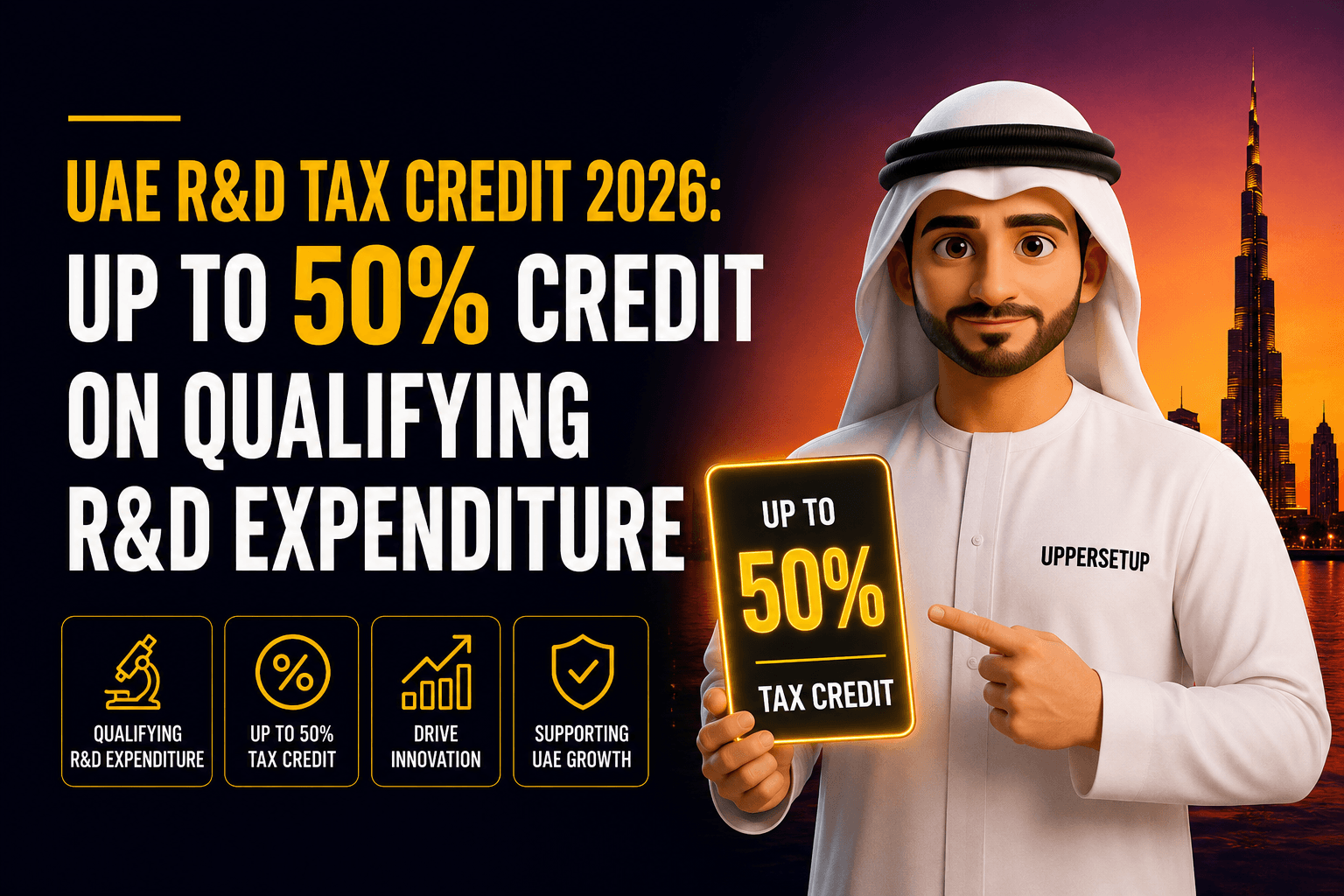
The R&D Tax Credit is a non-refundable UAE tax credit on qualifying research and development expenditure, introduced by Cabinet Decision No. 215 of 2025 and Ministerial Decision No. 24 of 2026, applicable for tax periods beginning on or after 1 January 2026. The credit rate is tiered: 15%, 35%, and 50%, depending on both the level of R&D expenditure and the average number of staff dedicated to R&D. The maximum credit is AED 2 million per tax period (50% of the maximum qualifying expenditure of AED 5 million). The credit is applied against Corporate Tax liability and, where applicable, Top-up Tax (DMTT).
⚠ Mandatory condition: pre-approval for each project from the Emirates Research and Development Council, obtained before expenditure begins. Expenditure incurred before approval is not automatically recognised. As of May 2026, the Council’s operational application portal has not yet launched. Approval is valid for one year only and cannot be obtained retrospectively.
1. The Legal Basis
Cabinet Decision No. 215 of 2025 on the Research and Development Tax Credit was published on 31 December 2025, establishing the framework of the regime. On 18 March 2026, the Ministry of Finance issued Ministerial Decision No. 24 of 2026, giving the regime its operational mechanics: rates, thresholds, qualifying expenditure categories, and anti-abuse provisions.
The statutory basis is Federal Decree-Law No. 28 of 2025, an amendment to Federal Decree-Law No. 47 of 2022 (the Corporate Tax Law), inserting a new Article 49bis. Importantly: Article 49bis does not itself introduce the R&D credit — it is a general mechanism for refunding excess tax credits that may arise from any future Cabinet Decision incentives (such as the forthcoming High-Value Employment Tax Credit). Cabinet Decision No. 215 of 2025 makes use of this mechanism specifically for the R&D credit.
⚠ The Ministry of Finance describes the current regime as "Phase 1" and has indicated a possible Phase 2 in future — potentially including refundability and an expanded range of qualifying expenditure — based on insights gathered from Phase 1.
Need help assessing eligibility and preparing a Council application? UPPERSETUP tax and corporate services →
2. Who Is Eligible
|
Criterion |
Requirement |
|
Taxpayer status |
UAE Taxable Person (juridical person or foreign entity with a UAE PE), subject to Corporate Tax and/or Top-up Tax |
|
Small Business Relief claimants (Art. 21) |
Excluded |
|
Qualifying Free Zone Persons |
Permitted but with additional conditions — generally must be subject to the 9% Corporate Tax rate or Top-up Tax on the relevant R&D-linked income |
|
Minimum project spend |
AED 500,000 per project (excluding the 30% staff cost uplift) |
|
Pre-approval |
Mandatory from the Emirates Research and Development Council for each project |
⚠ Critical nuance: formal eligibility as a QFZP is not the same as being able to actually use the credit. A free zone company operating entirely at 0% Corporate Tax and outside DMTT scope generally cannot utilise the credit under Phase 1 — there is simply no tax liability to offset it against.
Five conditions for qualifying R&D activity
Under Ministerial Decision No. 24 of 2026, an activity within an R&D project is treated as qualifying only if it meets all five conditions: novel (aimed at producing new findings), creative (involving original concepts or hypotheses), uncertain (the outcome is not known in advance), systematic (following a plan and budget), and transferable or reproducible (results can be applied or replicated elsewhere). The legislation explicitly references the OECD Frascati Manual 2015 as the interpretive framework — the same international standard underpinning R&D incentive regimes in other major jurisdictions, including the UK. R&D in social sciences, humanities, or the arts is excluded, as is any activity conducted outside the UAE regardless of funding source.
3. Rates: The Tiered 15/35/50% System
|
Rate |
Expenditure band |
Average R&D Staff required |
|
15% |
First AED 1 million |
≥ 2 employees |
|
35% |
Above AED 1m up to AED 2m |
≥ 6 employees |
|
50% |
Above AED 2m up to AED 5m |
≥ 14 employees |
Both thresholds — expenditure and staff count — must be met simultaneously. If expenditure exceeds AED 2 million but the team has only 8 staff (below the 14-staff threshold), the rate drops to the highest tier where both conditions are jointly satisfied — in this case, 35%.
✅ The 30% uplift on R&D staff costs: payroll expenditure on R&D personnel is increased by 30% when computing Qualifying R&D Expenditure (QRE). AED 2 million in actual payroll spend adds AED 600,000 to QRE — a meaningful advantage over outsourcing or cost-sharing outside the UAE.
ℹ A separate mechanism: an Externally Provided Worker (EPW) is an individual who is not a director or employee of the qualifying entity, works through a staff provider or as an independent contractor, but is physically based in the UAE and works under the direct supervision and control of the qualifying entity. EPW costs can also receive the 30% uplift like ordinary staff costs (Article 8(9), Ministerial Decision No. 24 of 2026) — unlike subcontracting fees, which do not benefit from the uplift. Distinguishing subcontractors from EPWs matters for an accurate claim.
4. Qualifying Expenditure
• Spend within a single project must be at least AED 500,000.
• Expenditure must relate exclusively to qualifying activity — where mixed-purpose, only the R&D-attributable portion counts.
• Excludes expenditure funded by grants, and expenditure already benefiting from another tax incentive or relief.
• IMPORTANT: intra-group subcontracting (within the same Tax Group) is expressly excluded from the regime. Subcontracting outside the tax group qualifies if priced at arm’s length; for related parties outside the group, only if the subcontractor maintains audited financial statements.
• Payments under intra-group cost-sharing arrangements (CCAs) qualify only if arm’s-length priced and proportionate to the UAE entity’s expected share of benefit from the arrangement.
⚠ UAE R&D credit eligibility attaches to the entity performing the work, not the entity owning the resulting IP — aligning with the OECD DEMPE framework when refinancing international R&D structures.
5. Using the Credit: Flexibility and Limits
• Non-refundable: Phase 1 does not provide a cash payout — only an offset against tax already calculated.
• Unused balances carry forward indefinitely if current-period tax is insufficient for a full offset.
• Credit transfer within a qualifying tax group is possible, subject to strict conditions.
⚠ Claw-back: if, within 5 years of the last claim, an entity ceases to be a Taxable Person or becomes a Qualifying Free Zone Person, the credit must be repaid with penalties. Groups planning a free zone move or restructuring should factor this in well in advance.
6. Pre-Approval and Documentation
1. Submit a pre-approval application to the Emirates Research and Development Council for each project before expenditure begins.
2. Maintain technical documentation: written and electronic records of objectives, methodologies, and findings.
3. Retain records for at least 7 years following the relevant tax period.
4. Verify intra-group calculations and subcontracting against the arm’s-length principle — a mandatory condition for recognising the expense.
5. File the credit claim together with the Corporate Tax or Top-up Tax return.
7. Relevant for Large Groups: The DMTT Connection
The non-refundable design was a deliberate choice: the Ministry of Finance has indicated this reduces the risk of distorting the Pillar Two effective tax rate calculation for large groups. For groups within DMTT scope, the credit is classified as a Non-Qualified Refundable Tax Credit (NQRTC) — it reduces Adjusted Covered Taxes and directly affects the UAE ETR calculation under DMTT. This matters for modelling groups whose UAE ETR sits close to the 15% threshold.
ℹ Under the OECD’s Side-by-Side package, a Substance-based Tax Incentives Safe Harbour (SBTI SH) has been proposed that could give such credits a "zero-impact" treatment for GloBE purposes — but this remains OECD guidance only and has not yet been formally adopted into UAE law as of June 2026.
8. Who This Fits
• Startups and tech teams with genuine R&D operations in the UAE. Teams closer to the higher staffing tiers (≥6–14 employees) benefit most.
• Product-development companies (AI, fintech, biotech, hardware). Real spend on code, prototypes, and research is easy to document.
• Large groups modelling ETR under Pillar Two. The credit should be modelled jointly with the DMTT assessment.
9. Who This Does Not Fit
• Businesses on Small Business Relief. Excluded from the regime by the express text of the regulation.
• Companies with project spend below AED 500,000. Below the minimum expenditure threshold.
• R&D funded by grants or already benefiting from another incentive. Double-dipping on the same expenditure is not permitted. Capital expenditure on equipment is currently outside the scope of the regime. However, capitalised internally generated intangible assets (under IAS 38) may still qualify in the same categories as if they had been expensed directly.
10. When Professional Verification Is Essential
This is a high-compliance regime: mandatory pre-approval, strict UAE-nexus rules, anti-abuse provisions, 7-year record retention, and claw-back risk. Engaging a tax advisor before the first application to the Council is strongly recommended, particularly for intra-group R&D structures or membership in a large multinational group.
FAQ
Can free zone companies claim the R&D credit?
Yes, but not automatically. Qualifying Free Zone Persons are permitted, subject to additional conditions, generally tied to whether the relevant income is taxed at the 9% rate or under Top-up Tax.
What happens to the credit if tax is insufficient for a full offset?
The unused balance carries forward to future tax periods indefinitely. The credit is non-refundable — it cannot be paid out in cash.
Is approval required for each project separately?
Yes. Pre-approval from the Emirates Research and Development Council is required at the level of each individual R&D project.
Will the credit become refundable in future?
Possibly. The Ministry describes the current regime as "Phase 1" and has indicated that refundability may be considered for Phase 2. A practical nuance: the AED 5 million cap sits at Ministerial Decision level — the lowest tier of the UAE legislative hierarchy. This means the cap could potentially be raised quickly in future without amending the primary statute.
Key Takeaways
• R&D Tax Credit: Cabinet Decision No. 215 of 2025 + Ministerial Decision No. 24 of 2026, effective 1 January 2026.
• Tiered rates of 15/35/50%, depending jointly on expenditure and staff count.
• Maximum credit: AED 2 million. Minimum project spend: AED 500,000.
• Mandatory pre-approval from the Council before expenditure begins.
• Non-refundable but carries forward indefinitely; offsets Corporate Tax or DMTT.
• Claw-back applies for 5 years after the last claim.
Summary
The UAE R&D Tax Credit is a non-refundable tax credit on qualifying research and development expenditure, introduced by Cabinet Decision No. 215 of 2025 and Ministerial Decision No. 24 of 2026, effective for tax periods beginning on or after 1 January 2026. The credit rate is tiered: 15% on the first AED 1 million of expenditure (with an average of at least 2 R&D staff), 35% on the portion from AED 1–2 million (at least 6 staff), and 50% on the portion from AED 2–5 million (at least 14 staff). The maximum credit is AED 2 million per tax period. The minimum qualifying project spend is AED 500,000. Pre-approval from the Emirates Research and Development Council is mandatory for each project. The credit is non-refundable, carries forward indefinitely, and offsets Corporate Tax and, where applicable, Top-up Tax (DMTT) liabilities.
Sources
• u.ae — Official UAE Government Portal: Tax incentives for innovation-driven businesses (u.ae)
• EY — UAE issues Research and Development Tax Credit legislation (2026) (ey.com)
• Grant Thornton UAE — Tax Alert: UAE introduces R&D Tax Credit regime (April 2026) (grantthornton.ae)
• PwC — UAE Research & Development Tax Credit (March 2026) (pwc.com)
Disclaimer
This material is for informational purposes only and does not constitute legal, tax, financial, investment, or consulting advice. Before making any decisions, obtain individual professional advice tailored to your company's specific R&D activity, structure, and current regulatory requirements. Information is accurate as of June 2026.
Read more on the topic
Emiratisation 2026: The Complete Employer Guide — Quotas, Penalties, Nafis, and the 30 June Deadline
Stamp Duty on Share Transfers in Hong Kong 2026: Rates, Net-Asset Valuation, Deadlines and Penalties
VAT in Kazakhstan 2026: Registration, the 10,000 MCI Threshold, the 16% Rate, e-Invoices and Refunds
All services on the platform
Everything you need to start and run a business - in one place
- 3–5 days
Company Setup
Mainland or Free Zone company with a complete set of incorporation documents
Start - Monthly
Accounting Services
Financial accounting and reporting in accordance with UAE requirements
Start - 1–2 weeks
Visa Services
Residence visas for shareholders, employees and family members
Start - 7–30 days
Banking Services
Corporate Bank Accounts in the UAE and Payment Services
Start - Custom timeline
Legal Services
Contracts, corporate amendments and legal support
Start


