
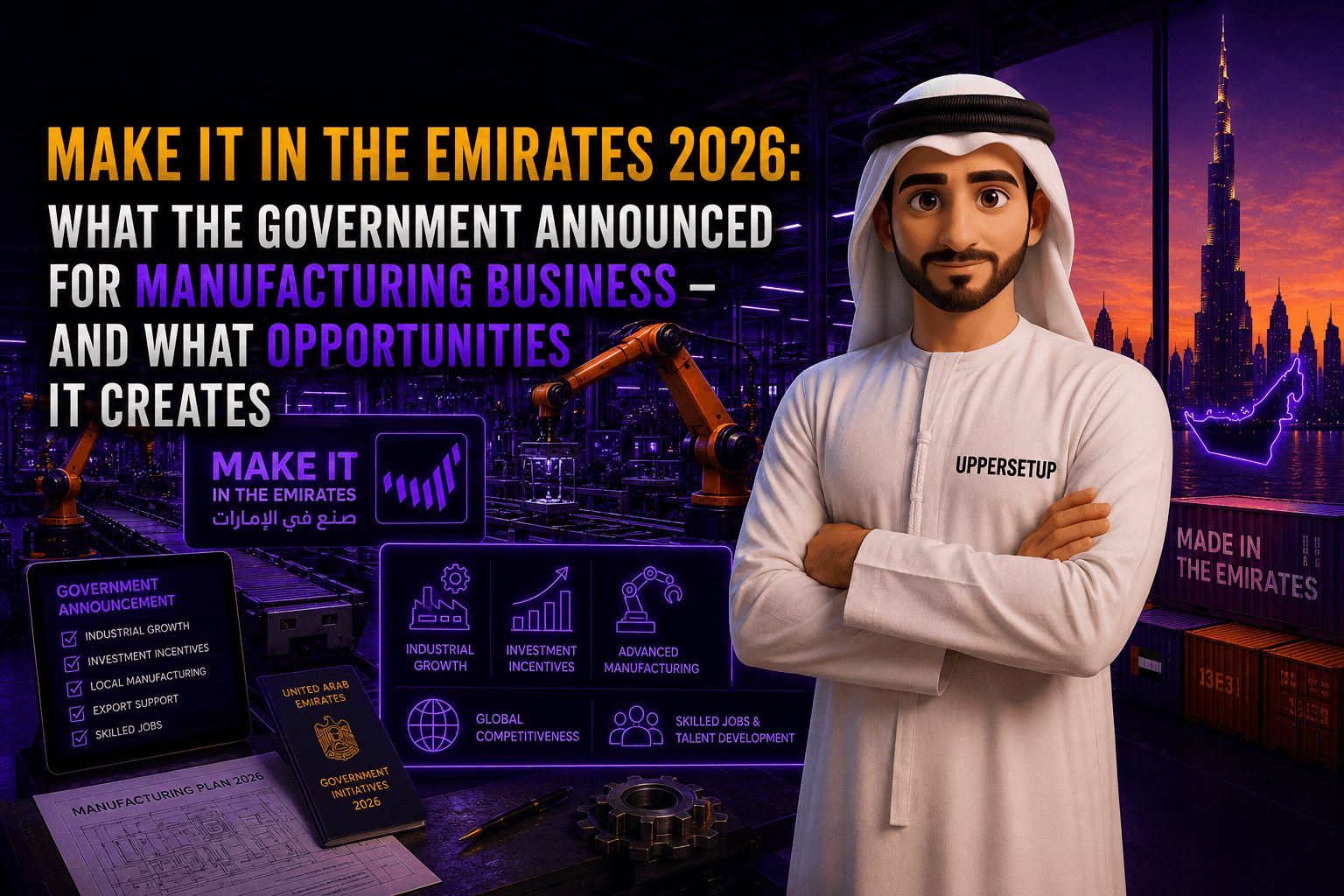
Make it in the Emirates 2026: What the Government Announced for Manufacturing Business — and What Opportunities It Creates
May 20, 2026
Introduction. The Forum That Makes Announcements, Not Just Panels
From 4 to 7 May 2026, Abu Dhabi hosted the fifth and largest edition of the Make it in the Emirates (MIITE 2026) forum. 88,000 square metres of exhibition space at ADNEC Centre. 1,245 exhibiting participants. 12 priority industries. More than 120,000 expected visitors.
The forum's theme — 'Advanced Industry. Emerging Stronger' — is not a random tagline: just days before the event, the UAE Cabinet approved a package of initiatives that materially change the operating conditions for manufacturing business in the UAE. MIITE served as the moment of public announcement, but the decisions themselves had already been taken at government level.
For a foreign entrepreneur planning a manufacturing business in the UAE, MIITE 2026 is not a news story — it is a map of opportunities: which sectors the government is prepared to finance, which supply chains have open positions, and through which programmes entry is available. That is precisely what this article examines.
Part I. Context: Five Years of Operation 300bn and What Has Changed
In 2021, the UAE launched Operation 300bn — an industrial strategy aimed at increasing the manufacturing sector's contribution to GDP from AED 133 billion to AED 300 billion by 2031. Five years on, at MIITE 2026, Minister of Industry and Advanced Technology Dr Sultan Al Jaber announced the interim results.
Key indicators as of May 2026:
— Industrial sector contribution to the economy: reached AED 200 billion — a 70% increase since 2021;
— Industrial exports: grew to AED 262 billion, including AED 92 billion classified as advanced industrial exports;
— ICV Programme: more than AED 473 billion redirected into the national economy since the In-Country Value programme's launch;
— Trade agreements: 36 active agreements providing the UAE with access to international markets.
Al Jaber at the MIITE 2026 opening: "Those who manufacture, own their decisions. Those who build, own their future. And those who combine both… secure their sovereignty and resilience."
Part II. Three Key MIITE 2026 Announcements for Manufacturing Business
2.1. AED 1 Billion — National Industrial Resilience Fund
The National Industrial Resilience Fund, capitalised at AED 1 billion (USD 272 million), was approved by the UAE Cabinet prior to MIITE 2026. This is not a fund for large corporations — its direct target audience includes SMEs in priority sectors.
Priority industries for funding from the fund:
— Primary metals (steel, aluminium, and others);
— Mechanical, electrical, and chemical manufacturing;
— Pharmaceuticals and active pharmaceutical ingredients (APIs);
— Medical equipment and supplies;
— Construction materials and components;
— Advanced technology and Industry 4.0 manufacturing.
The fund operates through three functions: supporting production localisation in strategic sectors; building strategic stockpiles for food, medicine, and industrial components; financing business continuity for manufacturers in government supply chains.
Disbursement channel: through the Emirates Development Bank (EDB), which has been assigned a target approval volume of up to AED 9 billion in 2026. EDB is the key channel for SMEs in national priority sectors.
2.2. AED 180 Billion — Government Procurement Localisation Target
This is the headline figure of MIITE 2026 in terms of strategic impact. The UAE government has established a target: over the next five years, to procure AED 180 billion worth of products and services from local producers rather than through imports. This means that for every AED 180 of government procurement that previously went to foreign suppliers, a demand will now be directed to manufacturers operating inside the UAE.
For context: the closest regional precedent is Saudi Arabia's IKTVA (In-Kingdom Total Value Add) programme at Aramco, which requires 75% of procurement spending to be retained within the Kingdom. The UAE is applying a similar logic more broadly: across all federal government entities and all companies in which the government holds a stake of at least 25%, directly or indirectly.
Practical consequence for entrepreneurs: a manufacturer or processor registered in the UAE and producing goods from the priority list of 5,000 products gains direct access to government demand that the state has committed to redirect to the domestic market.
2.3. ICV Programme Expansion and Mandatory Coverage
The ICV (In-Country Value Programme) — the in-country value programme previously applied primarily in the oil and gas and government procurement sectors — underwent a fundamental change announced at MIITE 2026: from an incentive-based tool, ICV is transforming into a mandatory mechanism for a substantially broader range of participants.
New mandatory ICV participants:
— All federal government entities when conducting procurement;
— All companies with a direct or indirect government stake of at least 25% — this covers dozens of major holdings, state corporations, and mixed-capital companies across the country.
For suppliers to these entities, this means: absence of an ICV certificate = loss of access to federal contracts. This is not a hypothetical risk — it is a direct commercial consequence of the new rules.
An ICV certificate is issued by an accredited auditor using a methodology that accounts for: local workforce proportion (Emiratisation); value of purchases from local suppliers; volume of production in the UAE; investment in R&D on UAE territory; contribution to national talent development.
Part III. ADNOC Initiatives: Five Pathways Into the Supply Chain
ADNOC — the UAE's largest state energy holding — launched its own Industrial Resilience Program at MIITE 2026, consisting of five initiatives. For manufacturers targeting the UAE oil and gas supply chain, this is a direct operational pathway.
Five Initiatives of the ADNOC Industrial Resilience Program
1. Enhanced ICV model — transition from one-size-fits-all methodology to differentiated procurement strategies that account for investment value, manufacturing depth, and workforce development. Producers with high local content receive a structural competitive advantage.
2. Local+ — targeted sourcing policy: ADNOC EPC contractors are required to source from an approved list of national manufacturing companies in defined critical categories, provided they are commercially competitive and technically qualified. This creates guaranteed demand for certified local manufacturers.
3. ICV+ — a top-up on ICV credit for purchases from local manufacturers. Contractors buying from national suppliers receive a higher ICV score, improving their position in ADNOC tenders. This creates a market incentive for contractors to prefer local supply over overseas purchasing.
4. ADNOC Multiplier — a tool enabling national manufacturers to increase the share of locally produced content in their final products, helping them achieve higher ICV scores and greater competitiveness in government tenders.
5. Registration in 'Make it with ADNOC' — a mobile application and platform at supplierhub.adnoc.ae/make-it-in-the-emirates listing more than 150 priority industrial products for local production: drilling equipment, process chemicals, valves, oil country tubular goods (OCTG), and others. Registering in the system is the first step toward approved supplier status.
ADNOC's overall localisation target: to locally manufacture AED 90 billion (USD 24.5 billion) worth of products by 2030. AED 80 billion in local manufacturing agreements have already been signed. ADNOC's partners have invested AED 4.5 billion in new factories and manufacturing capabilities. Over the next five years, ADNOC will direct AED 220 billion into the UAE economy through the ICV programme.
Part IV. Emirates Growth Fund and the National Champions Program: Capital for Industrial SMEs
The Emirates Growth Fund (EGF) — the UAE's flagship growth equity investor — was launched by Dr Al Jaber at MIITE 2025 and served as Exclusive Growth Capital Partner at MIITE 2026. The fund is backed by Emirates Development Bank and focuses on four sectors:
— Manufacturing;
— Food and agriculture;
— Healthcare;
— Advanced technology.
At MIITE 2026, EGF jointly with MoIAT and MOET (Ministry of Economy and Tourism) launched the National Champions Program (NCP) — a trilateral initiative for the systematic scaling of the UAE's most capable industrial SMEs. The programme's objective: to identify, scale, and integrate the country's best industrial companies into national supply chains at the ADNOC and government procurement level.
In parallel, EGF signed a strategic industrial resilience agreement with MoIAT and ADNOC under the ICV programme: EGF aligns its investment activity with national supply chain priorities — enabling local industrial suppliers to scale, integrate into ADNOC's supply chain, and contribute to the localisation of critical industrial capabilities.
Examples of EGF portfolio companies in manufacturing sectors: CarniStore (scaling the UAE's premium protein supply chain) and Tarmeem (strengthening domestic healthcare infrastructure).
Part V. How to Enter the UAE Manufacturing Ecosystem: A Practical Action Map
MIITE 2026 is a government signal to the market. Translating it into a concrete action plan involves the following sequence.
1. Check whether your product is on the list of 5,000. The government announced plans to localise production of approximately 5,000 products in the UAE. The current ADNOC list is at supplierhub.adnoc.ae/make-it-in-the-emirates. For other government demand — the MoIAT registry. If your product appears on these lists, structured government demand for its domestic production exists.
2. Select the right industrial zone. Several specialised industrial zones are available for manufacturing in the UAE:
— Khalifa Industrial Zone Abu Dhabi (KIZAD) — direct access to Khalifa Port; integrated with ADNOC infrastructure; supports petrochemicals, metalworking, logistics;
— Dubai Industrial City (DIC) — Dubai's largest integrated industrial zone; 6 sectors (food, automotive, construction, chemicals, machinery, pharmaceuticals);
— RAKEZ (Ras Al Khaimah Economic Zone) — 33 million sq. m of land; 40,000+ companies; 6 specialised industrial zones; non-free zone structure (Global Product) for direct UAE market access;
— JAFZA (Jebel Ali Free Zone) — access to the Middle East's largest container port; ideal for trading and distribution manufacturing structures;
— Abu Dhabi Industrial Zone (ADIZ) — part of the Abu Dhabi Industrial Strategy; supports ADNOC supplier companies.
3. Obtain an ICV certificate. Without an ICV certificate — no access to federal tenders and tenders from companies with government participation ≥ 25%. The certificate is issued by an accredited auditor (list available on the MoIAT website). Timeline: 4–8 weeks from submission of a complete documentation package. For newly established companies — ICV can be applied for from the first year of operations.
4. Register in supplier databases. For ADNOC — portals.adnoc.ae (Supplier Registration Portal). For government procurement — via MoIAT and the relevant federal authorities. Registration provides access to tender notifications and the Local+ priority product databases.
5. Explore financing through EDB and EGF. Emirates Development Bank (EDB) — lending to SMEs in priority industrial sectors; AED 9 billion approval target in 2026. Emirates Growth Fund (EGF) — growth capital for manufacturing, food, healthcare, and technology SMEs; integration into the National Champions Program opens access to the ADNOC supply chain. Both instruments require a UAE trade licence and an operational structure.
Part VI. Tax and Regulatory Context for Manufacturing Companies in the UAE
The registration of a manufacturing company falls under the general corporate tax regime established by Federal Decree-Law No. 47 of 2022:
— 0% on profit up to AED 375,000;
— 9% on profit above AED 375,000;
— Manufacturing companies in free zones (KIZAD, JAFZA, RAKEZ, DIC) can theoretically qualify for QFZP status when conditions are met. Importantly, the manufacture of goods in a free zone is a qualifying activity under Ministerial Decision No. 229 of 2025 — creating a genuine pathway to the 0% rate on income from manufacturing activities.
Additional regulatory context:
— Emiratisation: manufacturing companies with 50+ employees in regulated sectors must meet Emiratisation quotas; the Emiratisation proportion of the workforce directly affects the ICV score;
— WPS (Wage Protection System): mandatory for all companies hiring employees in the UAE;
— ESMA (Emirates Authority for Standardization and Metrology): quality and conformity standards for industrial products; mandatory certification for certain product categories before UAE market sale.
Part VII. Four Sectors with the Strongest Government Support at MIITE 2026
Dr Al Jaber at MIITE 2026 explicitly identified four priority sectors for support programmes:
|
Sector |
Government programme |
Specific products/competencies |
Key partners |
|
Pharmaceuticals and MedTech |
National Industrial Resilience Fund, MoIAT |
APIs, medical equipment, consumables |
EDB, EGF, MoIAT |
|
Advanced manufacturing + AI |
Operation 300bn, ICV Programme |
Industry 4.0, robotics, autonomous systems |
ADNOC, Boeing, Siemens, Mubadala |
|
Aerospace and defence |
Specialised ADNOC tenders |
Defence components, aviation parts |
Mubadala, government entities |
|
Clean energy and sustainable materials |
National Industrial Resilience Fund |
Petrochemicals, renewable components, construction materials |
ADNOC, TA'ZIZ, KIZAD |
Conclusion. MIITE 2026 Is Not a Trade Fair. It Is the Architecture of a Market.
Make it in the Emirates 2026 is not another exhibition with branded stands. It is the moment when the UAE government publicly announces which sectors, at what volumes, and on what terms it is prepared to finance, procure from, and support over the next five years.
AED 1 billion into the National Industrial Resilience Fund. AED 180 billion in procurement localisation. AED 220 billion from ADNOC through ICV over five years. ICV now mandatory for all federal entities and state companies. National Champions Program for industrial SMEs. These are concrete, already UAE Cabinet-approved instruments — not statements of intent.
For an entrepreneur with manufacturing competence in any of the priority sectors — from pharmaceuticals to metalworking, from construction materials to industrial electronics — the window of opportunity in the UAE is now wider than at any point in the past five years.
The UPPERSETUP platform helps manufacturing companies build the right structure for operating in the UAE — from selecting an industrial zone and registering the operating legal entity to obtaining an ICV certificate and opening a corporate bank account.
Sources: Business Today ME (6 May 2026); ADNOC Official Press Release (4 May 2026); The National (4–5 May 2026); Arabian Business (29 April 2026); mediaoffice.abudhabi.ae; Zawya (6 May 2026). All data confirmed from primary official sources. This material is for informational purposes only.
Subscribe to our newsletter
Receive expert materials and special offers in the field of company setup and support, citizenship and residence permit for investment. Once a week without spam.
Comprehensive Services for Your Business
Accounting Services
A key element of successful business management. Competent accounting support ensures compliance with local regulations, optimizes taxes, and enhances financial transparency.

Company Registration
The foundation of your business success. A seamless registration process tailored to UAE regulations helps you launch your venture with confidence and efficiency.

Bank Account Opening
An essential step for smooth business operations. Expert guidance ensures hassle-free bank account setup, meeting all compliance requirements for your business needs.

Tax Support
Stay ahead with professional tax solutions. Comprehensive support ensures compliance with UAE tax laws, optimizes financial planning, and avoids unnecessary risks.

Residency Visa Services
Your gateway to living and working in the UAE. Expert guidance ensures smooth processing of residency visas, compliance with regulations, and timely approvals for individuals and their families.

Legal Advisory
Navigate business challenges with confidence. Professional legal advice ensures compliance, protects your interests, and empowers informed decision-making for your business.