




































































 International Free Zone Authority
Bankruptcy and rehabilitation of legal entities in Kazakhstan in 2026: three procedures, six ranks and the reform of 21 October
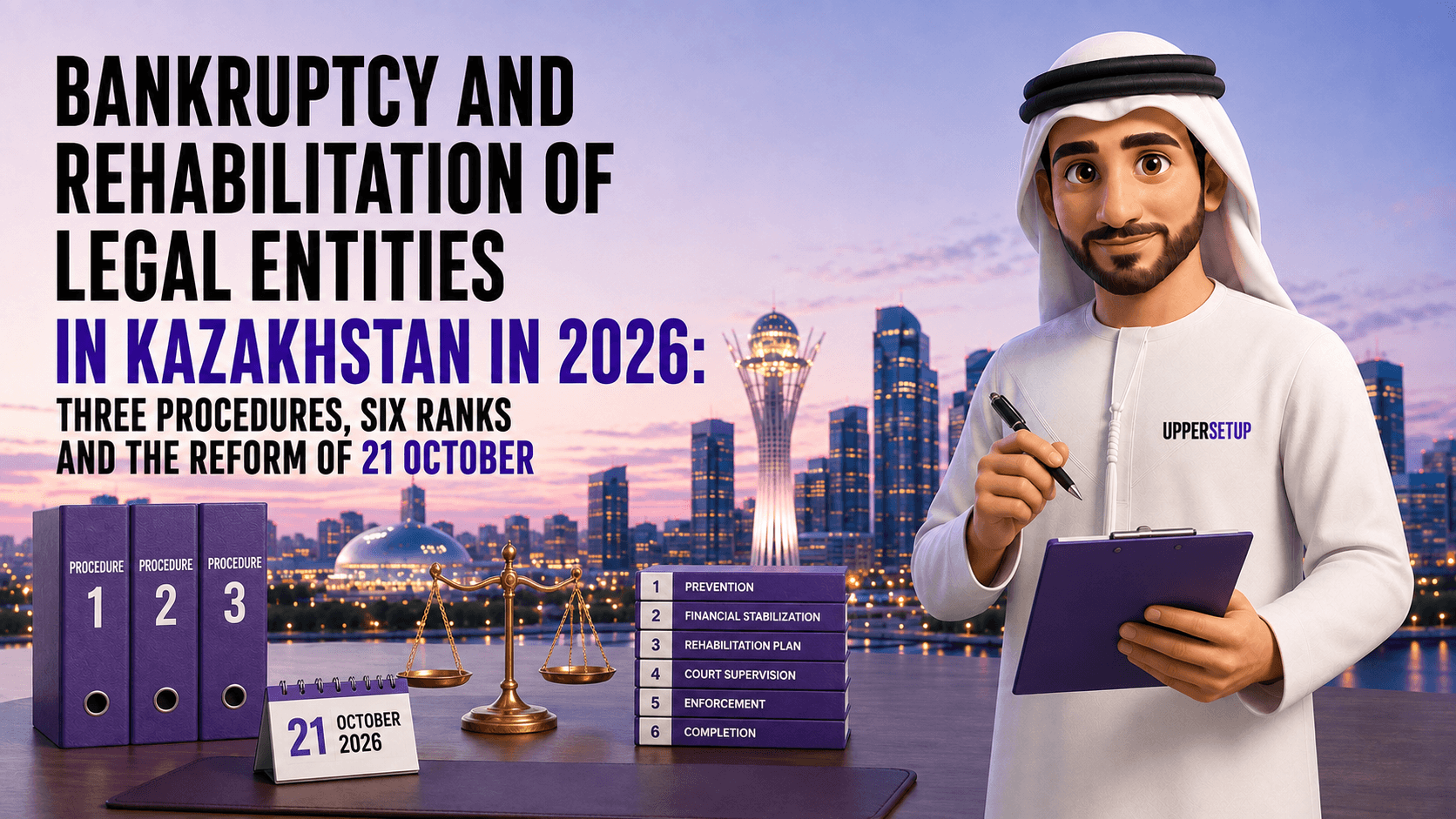
Insolvency and the restoration of solvency of a legal entity in Kazakhstan are governed by a single statute — the Law of the Republic of Kazakhstan of 7 March 2014 No. 176-V “On Rehabilitation and Bankruptcy” — which provides three court procedures: debt restructuring, rehabilitation and bankruptcy, plus a separate route for liquidating a debtor without opening a bankruptcy procedure. All cases are heard by the specialised inter-district economic courts, and the competent authority is the State Revenue Committee of the Ministry of Finance. None of the procedures is out of court: the accelerated rehabilitation procedure that many surveys still describe was removed from the statute in December 2019.
The date that matters. On 21 October 2026 a block of twenty-eight amendments to Law No. 176-V, made by Law No. 352-VIII of 23 July 2026, comes into force. The amending law was published in Egemen Qazaqstan and Kazakhstanskaya Pravda on 21 August 2026 and takes effect on the expiry of sixty calendar days after the day of first official publication. The changes reach the administrator’s remuneration, the composition of administrative expenses, the register of creditors’ claims, sale of assets by direct sale, the requirements applying to administrators, and the grounds for terminating rehabilitation. A company that files in September and obtains its court ruling in November will run the procedure under the new text.
|
Item |
Position |
Basis |
|
Principal statute |
Law No. 176-V of 7 March 2014 “On Rehabilitation and Bankruptcy” |
in force as amended to September 2026 |
|
Court procedures |
three: debt restructuring, rehabilitation, bankruptcy |
arts. 5, 5-1, chapters 2-1, 5, 6 |
|
Out-of-court rehabilitation |
none — chapter 3 was removed |
Law No. 290-VI of 27 December 2019 |
|
Court |
specialised inter-district economic courts of the oblasts and of Almaty, Astana and Shymkent |
Supreme Court Normative Resolution No. 2 of 02.11.2023, para. 2 |
|
Competent authority |
State Revenue Committee of the Ministry of Finance of the Republic of Kazakhstan |
art. 15 |
|
Ground for a debtor’s own bankruptcy petition |
sustained insolvency — liabilities exceed the value of the assets |
art. 5(1) |
|
Ground for a creditor’s petition |
an unperformed monetary obligation evidenced by a court act, an enforcement document or an acknowledgement of the debt |
art. 5(2) |
|
Monetary threshold for a creditor’s petition |
none |
art. 5(2) as replaced by 290-VI |
|
Ground for rehabilitation |
temporary insolvency: 3 months for social claims, 4 months for the rest |
art. 5-1(1) |
|
Duration of the bankruptcy procedure |
nine months, extendable to two years, capped at five years |
art. 84(1) |
|
Term of a restructuring agreement |
no more than three years |
art. 28-3(2) |
|
Ranks of distribution |
six |
art. 100 |
|
Administrative expenses |
met ahead of all ranks |
art. 100(1) |
|
Transaction claw-back period |
three years before the case is opened |
art. 7(1) |
|
Subsidiary liability |
on a finding of deliberate bankruptcy; joint and several where two or more persons are found guilty |
art. 6 |
|
Criminal liability for deliberate bankruptcy |
a fine of up to 3,000 MCI or up to 3 years’ imprisonment |
art. 238 of the Criminal Code |
|
“False bankruptcy” |
decriminalised and de-penalised |
art. 240 of the Criminal Code and art. 183 of the Administrative Code removed by Law 290-VI |
|
MCI for 2026 |
4,325 tenge; minimum wage 85,000 tenge |
Law No. 239-VIII of 8 December 2025 |
Three procedures and one liquidation: the map of the regime
Law No. 176-V provides four distinct routes, and the choice between them is dictated not by what the debtor wants but by which insolvency test the debtor meets and who files the petition. They must not be blurred: each route has its own initiator, its own ground, its own time limit and its own consequences.
|
Route |
Who may initiate |
Ground |
Duration |
Outcome |
|
Debt restructuring(chapter 2-1) |
the debtor only |
temporary insolvency |
agreement for no more than three years |
an agreement with all creditors, approved by the court |
|
Rehabilitation(chapter 5) |
the debtor or a creditor, exceptthe tax and customs creditor, a state body and a legal entity with state participation |
temporary insolvency |
fixed by the court; a single extension of no more than six months (two years for defined categories) |
restored solvency, or a move into bankruptcy |
|
Bankruptcy(chapter 6) |
the debtor, a creditor, the prosecutor, the rehabilitation manager |
sustained insolvency (debtor) or an unperformed obligation (creditor) |
nine months, extendable to two years, capped at five years |
liquidation of the debtor and removal from the register |
|
Liquidation without a bankruptcy procedure(chapter 7) |
the tax and customs creditor, or the debtor itself |
an absent debtor, or the combination of circumstances in art. 114(3) |
conducted by the competent authority |
removal from the register with no bankruptcy proceedings |
Restructuring: the only procedure the debtor alone can start
The debt restructuring procedure is opened solely on the debtor’s application — an application by anyone else cannot be granted. That is stated expressly in paragraph 3 of Normative Resolution No. 2 of the Supreme Court of the Republic of Kazakhstan of 2 November 2023.
The entry condition is temporary insolvency and the absence of any rehabilitation or bankruptcy case already opened by a court. The court considers the application within ten working days and either applies the procedure or refuses; the only grounds for refusal are the debtor’s failure to produce documents evidencing temporary insolvency, or an existing case.
A repeat application is blocked for one year — from the date a ruling refusing approval of the agreement takes effect, or from the end of the two-month window for concluding it if no agreement was signed.
Rehabilitation: recovery under the control of the creditors and the court
Rehabilitation is available only through the court. There has been no out-of-court variant in the statute since 2019.
From 2026 it carries an important restriction: rehabilitation does not apply where the debtor has no creditors other than the creditor for taxes and other obligatory payments to the budget. That sentence was written into article 63 by the Law of the Republic of Kazakhstan of 16 January 2026 No. 259-VIII, and it is aimed at sham rehabilitations whose only purpose is to freeze the collection of tax arrears.
A separate restriction on who may apply sits in article 38(1): the tax and customs creditor, a state body and a legal entity with state participation cannot initiate rehabilitation — they can initiate only bankruptcy.
Bankruptcy: a liquidating procedure with six ranks
Bankruptcy in Kazakhstan is liquidating in nature: it ends with the debtor being struck from the state register of legal entities. A move back into rehabilitation is possible under article 95-1, but it is the exception, not the rule.
Liquidation without bankruptcy: the route for empty companies
Liquidation of a debtor without opening a bankruptcy procedure applies in two cases: where the debtor is absent, or where the combination of circumstances in article 114(3) is present. This is not a simplified bankruptcy but a regime of its own: the procedure is run not by a bankruptcy manager but by the competent authority under article 118-1.
The boundary with voluntary liquidation under the Civil Code matters. Where the assets of a legal entity in respect of which a liquidation decision has been taken are insufficient to satisfy creditors, the liquidation commission is obliged to apply to the court to have that entity declared bankrupt — a mandatory direction in article 4(4) of the Law. Ordinary, solvent liquidation is covered separately in the guide to liquidating an LLP in Kazakhstan.
The legal base: which instruments actually govern bankruptcy in Kazakhstan
The framework has four circuits: the special statute, the procedural and civil circuit, the liability circuit, and the subordinate-regulation circuit. None absorbs the others, and a status in one confers no status in another.
|
Instrument |
Date and status |
What it governs for bankruptcy |
|
Law of the RK No. 176-V “On Rehabilitation and Bankruptcy” |
adopted 7 March 2014; in force as amended |
all three procedures, liquidation without bankruptcy, the status of the administrator, the ranking of claims |
|
Law No. 290-VI of 27 December 2019 |
the pivotal reform: removed chapter 3, article 104, article 240 of the Criminal Code and article 183 of the Administrative Code, and renamed the procedure |
the present architecture of the statute is the work of this act |
|
Law No. 259-VIII of 16 January 2026 |
in force from 19 March 2026; part of it from 1 May 2026 |
bars rehabilitation where the tax creditor is the only creditor; digital financial assets in the second rank |
|
Law No. 352-VIII of 23 July 2026 |
published 21 August 2026; the bankruptcy block (art. 1, para. 21) comes into force 21 October 2026; separate paragraphs of art. 1 take effect on publication, from 30 June 2026 and from 1 January 2027 |
twenty-eight changes: the administrator, administrative expenses, the register, direct sales |
|
Civil Code of the RK |
in force |
art. 49(1) (liquidation), arts. 44(2) and 44(3) (subsidiary liability), art. 357 |
|
Civil Procedure Code of the RK |
in force |
jurisdiction and the general rules of civil procedure; the procedures themselves are heard as special proceedings, while suits brought by the manager are heard as ordinary actions (art. 3(2) of the Law; para. 2 of Supreme Court Normative Resolution No. 2) |
|
Entrepreneurial Code of the RK |
in force |
general provisions on state control and on business entities |
|
Criminal Code of the RK No. 226-V |
in force |
arts. 237, 238, 239; art. 240 has been removed |
|
Code of the RK on Administrative Offences No. 235-V |
in force |
arts. 176, 177, 179, 180, 181, 182; art. 183 has been removed |
|
Supreme Court Normative Resolution No. 2 of 02.11.2023 |
in force from 16 November 2023 |
how the courts read the statute; replaced Resolution No. 5 of 02.10.2015 |
|
Law No. 239-VIII of 8 December 2025 on the republican budget for 2026–2028 |
applies from 1 January 2026 |
MCI of 4,325 tenge and a minimum wage of 85,000 tenge — the base for fines and computations |
What is missing from that list
Kazakhstan has no separate insolvency code, no out-of-court rehabilitation for legal entities, and no cross-border regime based on the UNCITRAL Model Law. Each of those absences is a fact in its own right and bears on structuring.
Article 2(2) of the Law contains its only conflict-of-laws rule: where a ratified international treaty lays down different rules, the treaty prevails. There is no chapter on cross-border insolvency, and recognition of a foreign proceeding in Kazakhstan has no statutory procedure.
Who falls outside the Law
Law No. 176-V does not apply to state-owned (treasury) enterprises and institutions, accumulative pension funds, banks or insurance (reinsurance) organisations. That is stated in article 3(1) and confirmed in paragraph 1 of the Supreme Court’s Normative Resolution.
The mechanics for financial institutions are different: where a court declares a bank, an insurance (reinsurance) organisation or an accumulative pension fund bankrupt, its liquidation proceeds under the banking, insurance and pension legislation, not under Law No. 176-V.
The Law separately allows special rules for grain-receiving enterprises and natural monopolies, whose particulars may be set by other legislation.
Companies registered in the Astana International Financial Centre live under AIFC law rather than Law No. 176-V; the choice between those two regimes is covered separately in the comparison of the AIFC and an LLP inside Kazakhstan.
Who may and who must apply to the court: two different insolvency tests
The Law draws a line between two tests, and which one is met decides which procedure is available: sustained insolvency leads to bankruptcy, temporary insolvency to rehabilitation or restructuring. Conflating the two is the commonest error in descriptions of the Kazakh regime.
Sustained insolvency: a balance-sheet test
The ground on which a debtor may petition for its own bankruptcy is sustained insolvency. The definition, verbatim: insolvency is sustained where the debtor’s liabilities exceed the value of its assets on the date the application is filed with the court and at the beginning of the year in which it is filed, and also at the beginning of the preceding year where the debtor files in the first quarter of a calendar year.
Note the construction: this is a balance-sheet test, not a liquidity test. A company whose assets exceed its liabilities but which has no cash for current payments is not in sustained insolvency and cannot initiate its own bankruptcy — its route runs through rehabilitation or restructuring.
The second feature is a double — and in the first quarter a triple — measuring date. An application filed in February requires liabilities to exceed assets on three dates: the filing date, 1 January of the current year and 1 January of the previous year. A company that became insolvent in December cannot initiate its own bankruptcy in the first quarter of the following year.
Temporary insolvency: a test of delay
Insolvency is temporary where, on the date of filing, at least one of two circumstances exists — and both are expressed in periods of delay, not in amounts.
The first circumstance is three months. Obligations remain unperformed for three months from the date they fell due, in respect of compensation for harm to life and health, maintenance payments, wages, compensation under employment contracts, social contributions to the State Social Insurance Fund, mandatory pension and mandatory occupational pension contributions, contributions to mandatory social health insurance, and remuneration to authors for employee inventions, utility models and industrial designs.
The second circumstance is four months. Obligations to other creditors remain unperformed for four months from the date they fell due.
The practical consequence worth understanding before filing: the three-month clock on wages and social payments runs out before the four-month clock on commercial debt. A company three months behind on payroll already meets the temporary insolvency test even if every supplier has been paid. What those payments consist of, and how they are computed, is covered in the guide to employer payroll taxes and contributions in Kazakhstan.
A duty, not only a right
In the cases laid down by the Law, the debtor is obliged to apply to the court to be declared bankrupt. Article 4(3) says so directly.
The most consequential of those cases sits in article 4(4): where the assets of a legal entity in respect of which a liquidation decision has been taken under article 49(1) of the Civil Code are insufficient to satisfy creditors, the liquidation commission is obliged to apply to the court to have that entity declared bankrupt. Continuing a voluntary liquidation in that situation is not an option.
Who signs the application
On accepting an application the court checks, against the applicant’s constituent documents, whether it has been signed by the proper person or organ. That is the requirement in paragraph 9 of Supreme Court Normative Resolution No. 2. An own-bankruptcy application signed by the director without a members’ resolution, where the charter reserves the question to the general meeting, is returned.
The threshold that no longer exists: how much must be owed before a creditor can file
There is no monetary threshold for a creditor’s bankruptcy petition in the current text of Law No. 176-V. Article 5(2), as replaced by Law No. 290-VI of 27 December 2019, states the ground qualitatively, not quantitatively.
Verbatim: the ground for a creditor’s application is “an unperformed monetary obligation of the debtor to the creditor on the basis of a court act that has entered into legal force, or an enforcement document for the recovery of money from the debtor, or an acknowledgement of the debt by the debtor”.
This is the most widely repeated stale figure in Russian-language surveys of Kazakh insolvency. Thresholds of 100 and 150 monthly calculation indices existed in the former text of article 5 and were removed by the 2019 reform when the whole article was rewritten. Material quoting an MCI threshold today is describing law that ceased to exist more than six years ago.
What the creditor actually needs
The statutory requirement is procedural rather than quantitative, and it offers three alternatives:
• a court act that has entered into legal force ordering recovery of money from the debtor;
• an enforcement document for the recovery of money from the debtor;
• an acknowledgement of the debt by the debtor.
The practical consequence for a creditor: the route into bankruptcy runs through the ordinary courts or through obtaining a written acknowledgement, not directly from an unpaid invoice. A creditor holding an overdue reconciliation statement signed by the debtor is in a better procedural position than a creditor owed more but holding nothing.
A special regime for the tax and customs creditor
The ground for an application by the tax and customs creditor is the debtor’s failure to pay after all compulsory recovery measures have been taken in the manner prescribed by the tax and customs legislation. That is the separate second part of article 5(2).
There is no threshold here either, but there is a precondition: the state revenue body must first exhaust its enforcement measures. What those measures are and in what order they are applied is the subject of a separate guide to desk control, tax audits and appeals in Kazakhstan.
The practical point for a debtor is that a bankruptcy petition from the tax authority is almost never the first signal.A full recovery cycle precedes it, and every stage of that cycle leaves a documentary trail from which the remaining time can be estimated.
Bars on repeat applications
The Law blocks repeat applications with three different periods, and they are best held together:
|
Situation |
Period of the bar |
Basis |
|
Refusal to apply rehabilitation, or a ruling terminating it |
two years from the date the act took effect — a rehabilitation application is returned |
art. 48(1-1) |
|
A debtor’s own bankruptcy application after a refusal to apply the bankruptcy procedure or a ruling terminating it |
one year |
art. 48(1-1) |
|
Refusal to approve a restructuring agreement, or expiry of the window for concluding it |
one year |
art. 28-1(2) |
The two-year rehabilitation bar is the harshest restriction in the whole Law, and it applies automatically: the court returns the application without considering its merits. A company whose rehabilitation has been terminated loses access to rehabilitation for two years and is left with bankruptcy or restructuring only.
Debt restructuring: the most underrated instrument in the Law
Debt restructuring is the only route in Law No. 176-V that leaves management in place, appoints no administrator and does not lead to liquidation: the debtor keeps control and has two months to agree a schedule with every creditor. It was inserted by Law No. 290-VI of 27 December 2019 in place of the former “insolvency settlement procedure” — the name changed, chapter 2-1 stayed.
How the procedure starts
A debtor may resolve to restructure its debt on becoming temporarily insolvent, provided no rehabilitation or bankruptcy case has been opened by a court. It applies to the court, attaching documents evidencing temporary insolvency, and notifies its creditors at the same time.
Within ten working days of accepting the application the court makes one of two decisions: to apply the procedure or to refuse. The list of refusal grounds is closed and short: failure to produce documents evidencing temporary insolvency, or an existing rehabilitation or bankruptcy case.
The most important restriction sits not in the Law but in paragraph 3 of Supreme Court Normative Resolution No. 2: the restructuring procedure is not applied to a debtor in respect of claims by individuals for harm to life or health, for wages and severance compensation, or where the debtor has arrears of social contributions to the State Social Insurance Fund, of mandatory and mandatory professional pension contributions, of contributions to compulsory social health insurance, or of royalties under authors’ contracts. The consequence is paradoxical: the very arrears that produce temporary insolvency after only three months under article 5-1(1)(1) shut the door to restructuring. A company with unpaid wages goes into rehabilitation, not restructuring.
That brevity matters: the court does not assess the economic soundness of the plan, the realism of recovery or the debtor’s good faith at the entry point. It checks two formal facts, and no more.
The consequences of applying the procedure
Three consequences follow from the date of the court’s decision to apply the restructuring procedure, and they are listed exhaustively.
• The accrual of penalties (fines, late-payment interest) on every category of the debtor’s debt ceases. Note the verb: it ceases, it is not suspended.
• Creditors are barred from petitioning for the debtor’s bankruptcy while the agreement is being concluded.
• The debtor is barred from entering into any transaction disposing of its property.
The third consequence is the most underrated, and it determines whether the procedure fits at all. A blanket bar on disposals means the company cannot sell a non-core asset to pay creditors, cannot hand over equipment in settlement of a debt, and cannot reorganise. Restructuring suits a business that intends to pay out of operating cash flow, and is a poor fit for a business whose plan depends on selling assets.
Two moments have to be kept apart here. From the date of the court’s decision applying the procedure, only penalties (fines, late-payment interest) stop — remuneration (interest) on loans keeps accruing. But from the day the ruling approving the agreement takes legal effect, article 28-5 stops the accrual both of penalties and of remuneration (interest) across every category of the debtor’s debt, lifts all restrictions imposed by state bodies on the debtor’s accounts, and halts enforcement of earlier court judgments and arbitral awards. Between those two dates lie up to two months in which contractual interest runs; if no agreement is concluded, it is not written off.
Article 28-4(9) adds a protection that is easily missed: a creditor may not petition for the debtor’s bankruptcy at any time during the term of the agreement, so long as the debtor observes its conditions. That is wider than the “while the agreement is being concluded” bar in the list of consequences.
The restructuring agreement
Within two months of the court’s decision taking legal effect the debtor must conclude a debt restructuring agreement with all creditors. “All” is literal here: chapter 2-1 contains no mechanism for binding a dissenting minority by a majority vote, of the kind familiar from offshore and European regimes.
The agreement is concluded for no more than three years and must set out its terms and the manner, means and timing of performance of the debtor’s obligations.
A state body as a party to the agreement
Where one of the creditors is a state body, the agreement may be concluded on terms deferring payment of the debt owed to that body for no more than three years from approval of the agreement. That is article 28-3(2-1).
Tax arrears are settled in such an agreement only against security: a pledge of the debtor’s property and/or a third party’s property, or a bank guarantee. The requirements for the pledged asset are strict: it must be liquid, insured against loss or damage, and its market value must be not less than the amount of the tax arrears.
The Law expressly excludes life-support facilities, and electrical, thermal and other forms of energy, from what may be pledged. A production company whose principal asset is energy infrastructure cannot secure its tax debt on that asset.
How restructuring differs from rehabilitation
The key difference lies in management: restructuring has no interim administrator, no rehabilitation manager and no creditors’ meeting acting as a decision-making organ over the debtor. The debtor negotiates and signs for itself. That makes the procedure cheaper and faster, but denies it rehabilitation’s central advantage — the ability to impose a plan on a dissenting creditor by majority decision.
Rehabilitation: the time limits, the plan and three classes of financial stability
Rehabilitation is the only court route in Kazakhstan that allows the legal entity to survive, and entry to it is governed by the opinion on the debtor’s financial stability prepared by the interim administrator. The court decides, but it decides on the three-class scale set by articles 49 and 49-1.
Three classes of financial stability
The opinion of the interim administrator or interim manager reaches one of three conclusions, and each corresponds to a class.
|
Class |
The conclusion |
Procedural consequence |
|
Class I — financially stable |
for the interim manager, the bankruptcy petition is unfounded; for the interim administrator, the rehabilitation petition is unfounded |
the court refuses whichever petition is before it (articles 58 and 59) |
|
Class II — exposed to the risk of bankruptcy but capable of recovery |
for the interim manager, no grounds for bankruptcy but grounds for rehabilitation; for the interim administrator, grounds for rehabilitation |
in a bankruptcy case the court refuses to declare bankruptcy (article 58(1)); in a rehabilitation case it applies the rehabilitation procedure (article 59(1)) |
|
Class III — financially unstable |
there are grounds to declare bankruptcy |
the court declares bankruptcy; rehabilitation is possible only with the consent of the creditors’ meeting |
The method of computing the ratios and setting the class boundaries is fixed by the competent authority, not by the Law itself: article 49-1 supplies only the frame and delegates the methodology to subordinate regulation.
The practical point for a debtor: the financial stability opinion is not a formality but the decisive document in the case. A company placed in Class III obtains rehabilitation only if it persuades the creditors’ meeting; a Class II company obtains it on the court’s own decision.
When no opinion is prepared
No financial stability opinion is prepared in two cases, and both change the shape of the case.
The first: the debtor has no creditors other than the applicant. That rule does not apply where the applicant is the tax and customs creditor, or a creditor whose enforcement document was returned under sub-paragraph 2) of article 48(1) of the Law “On Enforcement Proceedings and the Status of Court Enforcement Officers”.
The second: the debtor has not given the interim manager access to its accounting records. The interim manager then draws up a statement that the opinion cannot be prepared — paragraph 15 of Supreme Court Normative Resolution No. 2 confirms this expressly.
Refusing access to the documents does not block the procedure — it deprives the debtor of the only document capable of proving its solvency.
The time limits in rehabilitation
The duration of the rehabilitation procedure is fixed by the court when it approves the rehabilitation plan, and runs from the date that ruling takes legal effect. The Law puts no figure on the procedure itself, but article 73(3) sets the outer boundary: the rehabilitation plan may not run for more than five years.
One extension is available, of no more than six months, on the application of the rehabilitation manager with the consent of the creditors’ meeting.
For defined categories of debtor the maximum extension is two years, again only once: natural monopolies; organisations and individual entrepreneurs of major strategic importance to the economy, or capable of affecting the life and health of citizens, national security or the environment; and city-forming legal entities.
The procedural trap that costs companies their extension: the application is filed twenty working days before the term expires, and missing that deadline is itself a ground for refusing the extension. Article 64, parts three and four, says so directly. A day’s delay ends the right to an extension whatever the merits of the plan.
The court’s decision applying rehabilitation
The decision must contain five mandatory directions: that rehabilitation is applied; that the interim administrator’s powers cease; who manages the debtor until the plan is approved; that the debtor is to submit a rehabilitation plan agreed with the creditors’ meeting no later than three months from the date the decision takes legal effect; and that the consequences of the procedure take effect.
The three-month deadline for the plan is rehabilitation’s second hard procedural cut-off. Failure to submit it obliges the rehabilitation manager to apply to the court to terminate the procedure under article 82(2).
Who decides: the creditors’ meeting, the committee and the rule of one tenge, one vote
Creditor votes in the Kazakh procedure are counted by amount: the administrator fixes each creditor’s number of votes on the principle of “one tenge of claim, one vote”. The wording of article 26(3) is literal, and it drives the whole political mechanics of the procedure.
Quorum and the decision threshold
A creditors’ meeting is quorate where the creditors taking part, including those voting in absentia, hold more than fifty per cent of the total votes of creditors entitled to vote.
A reconvened meeting is quorate on twenty-five per cent of the votes — provided the creditors were duly notified of the time and place.
Decisions are taken by a majority of the votes of the creditors taking part in the meeting, not by a majority of the total votes — save in the cases in articles 26-1 and 26-2 (approval of the rehabilitation plan and of amendments to it) and article 99(6), where a direct sale requires all unsatisfied creditors to attend and a unanimous decision. The difference is material: at a reconvened meeting a decision can be carried by votes amounting to a little over twelve per cent of all claims.
A provision often missed: where the meeting is quorate, deferring an item on the agenda is not permitted. Delay tactics built on demanding an adjournment do not work in the Kazakh procedure.
What does not count as a vote
Penalties (fines, late-payment interest), losses in the form of lost profit, and other proprietary and financial sanctions are excluded when the number of votes is computed — subject to the two exceptions in article 26(3): they do count where the claims of all voting creditors have been satisfied in full, and where the register consists exclusively of such sanction claims by order of the court. A creditor with a small principal and a large accrued penalty has almost no influence on the procedure — even though its claim sits in the register and is met in the fifth rank.
The special regime for the rehabilitation plan
Approval of the rehabilitation plan is counted in two classes separately, and it is the only place in the Law where class-based creditor mechanics apply.
Quorum: participation by creditors whose interests the plan affects, holding more than fifty per cent of the votes of creditors of the second and fourth ranks — separately for each rank.
The plan is approved where a majority of the votes of second-rank creditors and a majority of the votes of fourth-rank creditors are cast in favour, both at once. If either or both conditions fail, the plan is not approved.
The practical consequence: secured creditors (the second rank) hold a veto over the rehabilitation plan. No majority of unsecured fourth-rank creditors overrides it. Rehabilitation in Kazakhstan without the consent of the pledgee bank is not possible.
The creditors’ committee
The creditors’ committee is formed and approved by the creditors’ meeting, and its minimum membership is three. It includes one creditor from each group of homogeneous creditors.
Where the minimum-membership requirement cannot be met, the creditors’ meeting itself exercises the committee’s powers. That matters in small procedures: the committee is not a mandatory organ where creditors are few.
A creditor that forms no group of homogeneous creditors because no other creditor holds an identical claim may be included in the committee.
Who manages the debtor in rehabilitation
The debtor in rehabilitation is managed either by the debtor itself, through the organ authorised by the owner or the participant, or by the rehabilitation manager — and the creditors’ meeting makes that choice.
Where the first creditors’ meeting resolves to place management with a rehabilitation manager, that meeting also selects the candidate from among the persons whose notifications are entered in the register of notifications of persons entitled to act as administrators.
This is the defining difference between rehabilitation and bankruptcy: in rehabilitation retaining the incumbent management is legally possible, but it depends on the creditors’ will, not on the participants’.
Terminating rehabilitation and moving into bankruptcy
Rehabilitation is terminated on an application to the court, and article 82 distributes the grounds among four persons — the rehabilitation manager (on a creditors’ resolution and without one), the owner or participant of the debtor, and the creditor itself; in addition, the procedure terminates automatically where the court refuses to approve the plan. Only one of the grounds signifies success. They must be told apart, because the ground decides whether the company falls under the two-year bar on a new rehabilitation.
The grounds for termination
On a resolution of the creditors’ meeting, the rehabilitation manager applies to the court to terminate the procedure in two cases:
• the object of the rehabilitation has been achieved — the only successful ground;
• the aggregate monetary obligations of the debtor arising after the rehabilitation was applied have exceeded twenty per cent of the total creditor indebtedness as at the date the court decided to apply the procedure.
The twenty per cent ceiling is not self-executing: it gives the creditors’ meeting the right to direct the manager to apply to the court (article 82(1)(2)), and the owner of the property or the founder the right to apply on its own account (article 82(3)(3)). That twenty per cent ceiling on new obligations is the most underrated figure in rehabilitation. A company that keeps trading accrues new obligations naturally; on entry debt of one billion tenge, two hundred million of new obligations ends the procedure. The limit in effect fixes the maximum scale of trading permitted inside rehabilitation.
The rehabilitation manager applies to terminate without any resolution of the creditors’ meeting in two further cases: where the creditors’ meeting does not approve the plan, and where the debtor fails to submit a plan within the three-month window.
The participant’s right to terminate
The owner of the property, the founder or the participant of the debtor may apply to the court to terminate rehabilitation in three cases: where there is evidence of harm to its interests from implementation of the plan; where there is evidence of harm to its interests from the acts or omissions of the person managing the debtor in the procedure; and where the same twenty per cent of new obligations is exceeded.
This is the only mechanism in the Law giving a participant procedural leverage against the creditors’ meeting. It is rarely used, but it exists.
The creditor’s right to terminate
A creditor may apply to the court to terminate rehabilitation on its own account in three cases (article 82(4)): where implementation of the plan harms its proprietary interests; where the acts or omissions of the rehabilitation manager harm those interests; and where notice of a creditors’ meeting was improperly given.
From 21 October 2026 a fourth ground joins them — failure to perform the repayment schedule for more than three months (sub-paragraph 19) of paragraph 21 of article 1 of Law No. 352-VIII). At the same time a new article 82(6) will require the applicant to include in the application a request that the debtor be declared bankrupt — on the grounds in article 82(1), first part, sub-paragraph 2), and in article 82(2), (3) and (4).
Separately: a court ruling refusing to approve the rehabilitation plan terminates the procedure by itself — article 82(5), with no application needed.
The consequence for a second rehabilitation
A court ruling terminating rehabilitation triggers a two-year bar: an application for rehabilitation filed before two years have run from the date that ruling took legal effect is returned by the court. The rule sits in article 48(1-1) and is applied formally, without regard to why the procedure ended.
Note the asymmetry: a successful rehabilitation and a failed one lead to the same two-year bar, because both are recorded in a ruling terminating the procedure. A company that leaves rehabilitation early having paid every creditor is formally caught by the same block.
The move into bankruptcy
The move from rehabilitation into bankruptcy is governed by article 83, and the reverse move by article 95-1. Both directions exist, but they are not symmetrical: the move into bankruptcy is the typical outcome of an unsuccessful rehabilitation, whereas returning from bankruptcy into rehabilitation requires conditions of its own.
The claw-back period is measured differently on that move, and it is one of the most practically significant details in the Law. Where bankruptcy is applied as a result of the termination of rehabilitation, the three-year claw-back period runs from the date the court’s decision applying rehabilitation took legal effect, not from the date the bankruptcy case was opened.
The consequence: a failed rehabilitation does not reset the suspect period but fixes it at an earlier date — transactions entered into in the three years before the company went into rehabilitation remain challengeable after the move into bankruptcy.
The bankruptcy procedure: nine months, two years and a five-year ceiling
The bankruptcy procedure runs for nine months and may be extended by the creditors’ meeting to two years; on a second extension the total must not exceed five years. Article 84(1) puts a number on the duration of the liquidation procedure; parallel numeric limits sit in article 73(3) (a rehabilitation plan may not run for more than five years), article 28-3(2) (a restructuring agreement, no more than three years) and article 64 (extension of rehabilitation).
Who pays for a procedure that drags
The detail that turns the five-year ceiling into a working constraint: on a second extension, the bankruptcy manager’s basic remuneration and the other administrative expenses accrued after the second extension are paid out of the funds of the creditors who voted for it, in proportion to their claims.
That is an unusual construction for a post-Soviet regime: the statute puts the cost of delay on those who voted for it. A creditor who supports a second extension hoping for an additional recovery finances the procedure from its own pocket if that recovery does not materialise.
Time runs from the day the court’s decision declaring the debtor bankrupt takes legal effect, not from the filing date and not from the opening of the case.
The stages of the procedure
|
Stage |
Who acts |
Key time limit |
|
Opening the case |
the court |
the ruling is made no later than five working days after the application arrives |
|
Collecting information and the financial stability opinion |
the interim manager |
the opinion no later than ten working days after the ruling opening the case |
|
Declaration of bankruptcy |
the court |
a decision informed by a Class III financial stability opinion |
|
Building the register of claims |
the bankruptcy manager |
claims are filed within one month of publication of the announcement |
|
Inventory and valuation |
the bankruptcy manager, the valuer |
valuation of pledged property within twenty working days of the manager’s appointment |
|
Sale of assets |
the bankruptcy manager |
electronic auction, or direct sale under the sale plan |
|
Distribution to creditors |
the bankruptcy manager |
through the six ranks of article 100 |
|
Final report and completion |
the bankruptcy manager, the court |
liquidation is complete once the entry is made in the register |
The consequences of a bankruptcy declaration
Seven consequences follow from the day the court declares the debtor bankrupt, and article 87(1) lists them exhaustively.
The first and hardest: the owner of the property, the founders (participants) and all organs of the legal entity are barred from using or disposing of the assets and from discharging obligations. Paying a particular creditor after that date is unlawful whatever the intention.
The second: all the bankrupt’s debt obligations are treated as having fallen due. The entire debt becomes current at once.
The third: the accrual both of penalties and of remuneration (interest) on loans ceases across every category of the bankrupt’s debt. The difference from restructuring is one of timing: in bankruptcy interest stops with the decision declaring bankruptcy, in restructuring only from the day the court approves the agreement under article 28-5.
The fourth: property disputes involving the bankrupt that are before the courts are terminated, unless judgment in them has taken legal effect. Paragraph 12 of Supreme Court Normative Resolution No. 2 confirms this expressly.
The fifth: claims may be brought against the bankrupt only within the bankruptcy procedure — save for claims to enforce third-party guarantees and suretyships, and enforcement against collateral where the pledgor is a third party.
The sixth: on the administrator’s application, accompanied by a copy of the court’s decision, every restriction and encumbrance over the bankrupt’s property — collection orders, attachments and the rest — is lifted, without any decision by the bodies that imposed them.
The seventh: new attachments may be imposed only in claims to set a transaction aside and to vindicate property from another’s unlawful possession.
What happens to uncompleted transactions
Property of the bankrupt not delivered to the acquirer as at the date of the ruling opening the bankruptcy procedure is brought into the estate, and the would-be acquirer files its claim within the procedure. Goods paid for but not received become an unsecured fourth-rank claim.
The administrator: who runs the procedure and what it costs
An administrator in Kazakhstan holds neither an office nor a licence but a notification status: the right to run procedures belongs to an individual who has filed a notice of commencement of activity with the competent authority and been entered in the register of notifications. “Administrator” is a generic term in the Law: it covers the interim administrator, the rehabilitation manager, the interim manager and the bankruptcy manager.
Who may become an administrator
An administrator may be an individual meeting the requirements of article 12(2), or a professional accountant. The second limb is often missed: a professional accountant acquires administrator status without having to satisfy the list in article 12(2).
The requirements for an individual are closed:
• higher education in law, economics and business;
• at least three consecutive years’ experience in legal, economic, accounting, financial, audit or control-and-audit work;
• not being registered with organisations providing mental health care;
• no unspent or unexpunged criminal conviction;
• not having been declared by a court to lack or to have limited legal capacity.
An administrator’s powers cannot be transferred to another person, with three exceptions: article 78(2) (sanation — rescue), article 118-1 (liquidation without bankruptcy by the competent authority) and the Law “On Shared Participation in Housing Construction”.
An affiliated person cannot be appointed administrator. That is a separate rule in article 12(5), checked by the court and by the competent authority.
Remuneration: the regulator sets the floor
The basic remuneration of the interim administrator and the interim manager is paid out of the funds of the debtor or of the creditor that filed the application, and its amount is fixed by an agreement that cannot fall below the minimum set by the competent authority.
The agreement on the exercise of those powers is concluded before the application is filed with the court and takes effect on the day the ruling opening the case is made. That is a procedural requirement rather than a formality: a creditor filing without such an agreement risks having the application returned.
A creditor that has paid the basic remuneration is reimbursed out of the debtor’s assets where rehabilitation or bankruptcy is applied.
The debtor or the creditor may set the interim administrator’s or interim manager’s remuneration above the floor— for those two the Law imposes no ceiling.
For the bankruptcy manager article 13(2) fixes both a floor and a ceiling, and the creditors’ meeting sets the actual figure between them. The same paragraph builds in an anti-drift mechanism: the basic remuneration falls to seventy-five per cent from the month following the month in which the procedure passed nine months, and to fifty per cent once it passes two years.
A special regime where the state is the applicant
Where the applicant is the tax and customs creditor, a state body or a legal entity with state participation, the interim manager’s remuneration is paid at the level of the regulator’s floor — by one of two routes, depending on whether the circumstances in article 110(2) are established during the procedure.
The practical consequence: procedures initiated by the state are run at the bottom of the fee scale, and that bears directly on how thoroughly the administrator works to build the estate.
The administrator’s liability
The Code on Administrative Offences contains a separate offence for each administrator role: article 177 for the interim manager, article 179 for the bankruptcy manager, article 180 for the interim administrator and article 181 for the rehabilitation manager.
The sanctions in article 179 show the scale: failure to carry out the inventory or to present the inventory report to the creditors’ committee — a fine of thirty monthly calculation indices; failure to secure and control the bankrupt’s property — thirty MCI; failure to sue for recovery of receivables — fifteen MCI.
At the 2026 MCI of 4,325 tenge, thirty MCI is 129,750 tenge. The amount is modest in itself, but article 12 provides for removal of the administrator’s notification from the register as a free-standing consequence of systematic breaches — an incomparably heavier sanction.
The register of creditors’ claims and the one-month window that decides everything
Creditors file their claims within one month of publication of the announcement on the procedure for filing, and missing that window moves the claim into the sixth — the last — rank. It is the most expensive procedural error a creditor can make in the Kazakh procedure.
How the announcement is published
The interim administrator sends the competent authority an announcement of the opening of the case and of the procedure for filing claims within two working days of the case being opened, and the competent authority must post it on its internet resource within two working days of receipt.
Where the debtor has an internet resource of its own, publication there is mandatory.
In a rehabilitation case the court additionally publishes notice of the opening of the proceedings in periodicals distributed throughout the Republic of Kazakhstan and in the administrative-territorial unit where the debtor is located — within no more than five working days, and at the debtor’s expense (article 50(2)). In a bankruptcy case there is no such publication: there the only count runs from the announcement on the competent authority’s website, and the month runs from the announcement on the procedure for filing claims.
The practical consequence for a creditor: what has to be monitored is the competent authority’s internet resource, not only the press. It is the announcement posted there that starts the month.
What happens to a late claim
A claim filed after the one-month window is entered in the sixth rank of the register. The sixth rank is the last; it is reached only after the penalties and fines of the fifth rank have been dealt with.
There is an exception by type of claim: claims for compensation of harm to life or health, for maintenance, for wages and compensation with their social payments, and for authors’ remuneration for employee inventions, utility models and industrial designs do not fall into the sixth rank. Those claims keep the first rank whenever they are filed.
Late creditors lose the right to vote at the creditors’ meeting until the claims filed within the month have been satisfied in full. The rule appears in article 90(5) and in article 72(3) — so it operates in bankruptcy and in rehabilitation alike.
The practical point: missing the month costs the creditor not only its rank but its voice. It takes no part in choosing the manager, has no influence on the sale plan and does not vote on extending the procedure.
What the claim must contain
A creditor’s claim must state the amount claimed, showing the principal separately, together with the other particulars required by article 72(2) and article 90(3).
Stating the principal separately is not a formality: the number of votes depends on it. Penalties, fines, late-payment interest and lost profit are excluded from the vote count, so a claim submitted as a single figure with no breakdown risks being counted against the creditor’s interest.
The starting point changes on 21 October 2026
From 21 October 2026 the first part of article 90(1) changes the moment from which the bankruptcy manager builds the register: the words “the manager’s appointment” are replaced by “the ruling opening the bankruptcy case”. The change is made by sub-paragraph 22) of paragraph 21 of article 1 of Law No. 352-VIII.
The point of the amendment is practical: the register starts to be built earlier — from the ruling opening the case rather than from the manager’s appointment. For a creditor that means the register work begins several weeks sooner than under the current text.
The order of distribution: six ranks and the expenses that come before them
The bankrupt’s estate is distributed through six ranks, and administrative and court expenses are met outside the ranking — ahead of the first. The five-rank scheme still reproduced in many surveys is out of date: the sixth rank is created by article 100(7) and was introduced by Law No. 290-VI of 27 December 2019, while article 107-1, added by the same act, only fixes the pro rata method of distribution inside it.
|
Rank |
What is satisfied |
Provision |
|
Outside the ranking |
administrative and court expenses: the administrators’ basic remuneration, the fees of specialists engaged, the pay of persons employed under employment contracts where the obligation arose after the case was opened; taxes and other obligatory payments for periods following the period in which bankruptcy was declared |
art. 100(1) |
|
First |
compensation for harm to life or health; maintenance; wages and employee compensation together with social contributions, mandatory and occupational pension contributions and social health insurance contributions; authors’ remuneration for employee inventions, utility models and industrial designs |
art. 100(2) |
|
Second |
secured creditors’ claims in the cases in art. 104-1(7); claims arising from a loan taken by the bankruptcy manager during the procedure; claims of a clearing organisation acting as central counterparty; claims of creditors in respect of digital financial assets secured by a pledge |
art. 100(3) |
|
Third |
tax arrears and arrears of customs payments, special, anti-dumping and countervailing duties and interest |
art. 100(4) |
|
Fourth |
other creditors under civil-law and other obligations; the balance under the third paragraph of art. 104-1(6); claims under authors’ contracts not within the first rank; claims arising from a transaction being set aside and property restored |
art. 100(5) |
|
Fifth |
compensation of losses and recovery of penalties (fines, late-payment interest); wages and compensation under arts. 102(5) and 102(6) |
art. 100(6) |
|
Sixth |
claims filed after the one-month window — except claims that are first-rank by type |
art. 100(7) |
Each rank is met only after the previous one is met in full
The claims of each rank are satisfied after the claims of the previous rank have been satisfied in full — unless article 101 itself provides otherwise. There are two exceptions: a late first-rank claim filed before distributions are complete is entered in the first rank and suspends all payments until it is entered (article 101(4)); and claims arising from a loan taken by the bankruptcy manager during the procedure rank behind the “old” second-rank creditors (article 101(5)). Within a rank, where assets are insufficient, claims are met pro rata to the amounts entered in the register.
With the creditor’s consent, a claim may be satisfied by any means not contrary to law, including transfer of property in kind.
What is new in the second rank from 1 May 2026
Claims of creditors in respect of digital financial assets secured by a pledge were brought into the second rank by the Law of the Republic of Kazakhstan of 16 January 2026 No. 259-VIII, which took effect in this part on 1 May 2026.
This is the first express reference to digital assets in Kazakh insolvency legislation, and it places a secured creditor in a digital financial asset alongside an ordinary pledgee. The regulatory perimeter of the assets themselves is covered separately in the guide to digital assets and mining in Kazakhstan.
Note the matching provision: article 104-1(9) takes creditors in digital financial assets out of the mechanism for taking pledged property in kind. They get the second rank, but not the right to take the collateral itself.
Administrative expenses: what is in and what is not
Administrative expenses comprise the administrators’ basic remuneration, the fees of specialists engaged, and the pay of persons employed under employment contracts where the obligation arose after the bankruptcy case was opened.
They also include taxes and other obligatory payments computed by the debtor or assessed by the state revenue body for tax periods following the period in which the decision declaring bankruptcy took legal effect. Current taxes inside the procedure are expenses outside the ranking, not third-rank claims.
A provision creditors should know: money received into the estate through enforcement of a judgment imposing subsidiary liability on a founder or officer is applied to satisfy creditors’ claims, and administrative expenses may not be met out of that money. A recovery from a controlling person goes to creditors in full.
Administrative expenses may not be paid without a decision of the creditors’ committee — the bankruptcy manager reports monthly, the committee tests the expenses for justification and approves the amount payable.
Secured creditors: why article 104 no longer exists and what replaced it
Article 104, “Satisfaction of the claims of secured creditors”, was removed from Law No. 176-V by Law No. 290-VI of 27 December 2019, and the whole mechanism for a secured creditor now sits in article 104-1. Material citing article 104 as live law is describing a provision repealed more than six years ago.
The logic of article 104-1: an offer to take the collateral comes first
The current construction is built around the secured creditor’s right to take the pledged property in kind, not around a right to the proceeds of its sale.
The sequence is tightly timetabled:
|
Step |
Who |
Time limit |
|
Notice inviting price offers for valuing the pledged property |
interim manager → competent authority |
no later than ten working daysafter the ruling opening the case |
|
Posting the notice on the internet resource |
competent authority |
two working days from receipt |
|
Valuation of the pledged property by the valuer chosen by the first creditors’ meeting |
bankruptcy manager |
twenty working days from appointment |
|
Sending the valuation to the secured creditor by registered post with an offer to take the property in kind |
bankruptcy manager |
two working days from receipt of the valuation |
|
Payment by the secured creditor of the expenses and the wage claims |
secured creditor |
no later than one month from the notice of acceptance |
|
Transfer of the pledged property |
bankruptcy manager |
five working days from payment |
The price of entry: what the secured creditor must pay before taking the collateral
A secured creditor who agrees to take the pledged property in kind must, before taking it, discharge the administrative expenses of valuing and maintaining the property and the first-rank wage claims — provided the debtor has no other property from which to meet them.
Wage claims are met up to the statutory minimum wage for a period of no more than three months, and in any event not exceeding fifteen per cent of the appraised value of the pledged property.
At the 2026 minimum wage of 85,000 tenge, three months for one employee is 255,000 tenge, and the overall cap on this payment is fifteen per cent of the appraised value of the collateral. The double limit — by period and by share of value — protects the secured creditor from having the collateral consumed by wage claims.
What happens to the difference
Where the appraised value of the pledged property, less the wage claims discharged, exceeds the secured creditor’s claim, the creditor transfers the difference into the estate within one month of the property being handed over.
Where it is less, the secured creditor’s claim in the amount of the shortfall is entered in the register and satisfied in the fourth rank. The unsecured balance of a secured creditor ranks with ordinary trade creditors — and behind the third-rank tax debt.
That is the structural fact of the Kazakh regime for a lender: the under-secured part of the claim is subordinated to taxes.
When the second rank applies
The secured creditor’s claim is satisfied under article 103 — that is, in the second rank — in the three cases listed in article 104-1(7): refusal to take the property in kind; failure to answer the manager’s offer within the prescribed period; and failure to discharge in full the administrative expenses and wage claims.
The practical point: a secured creditor’s silence does not cost it the second rank, but it does cost it the collateral.Refusal is a deliberate choice of money over the asset.
The secured creditor must hand the title documents for the pledged property to the bankruptcy manager within three working days of any of those three cases arising.
Syndicated lending
In a syndicated loan the agent bank gives consent to take the property in kind, accompanied by a resolution of the syndicate members whose funding shares total not less than two-thirds of the overall funding. The property is transferred to the syndicate members in shared ownership in proportion to their secured claims.
The estate, valuation and sale: electronic auction and direct sales
The bankrupt’s assets are sold by the bankruptcy manager through an electronic auction in accordance with the sale plan, or by the direct sale method, and the procedure for the auction and its organiser are determined by the competent authority. Article 99(1) provides two and only two means of realisation.
What forms part of the estate
The estate comprises the bankrupt’s property, including property not shown in its financial records where documents confirming the debtor’s title exist, and including rights of claim — receivables.
The bankrupt’s rights of permanent and long-term temporary land use are separately included in the cases provided by the land legislation.
The personal property of a bankrupt individual entrepreneur, the property of the participants of a general partnership, a limited partnership and a partnership with additional liability, and of the members of a production cooperative, is brought into the estate and accounted for separately — it can be reached where the bankrupt’s own property is insufficient.
No such rule exists for a participant in an ordinary LLP: the liability of a participant in a limited liability partnership remains limited, and the only route to that participant’s property runs through subsidiary liability for deliberate bankruptcy.
What the estate does not include
Excluded from the estate are the material assets of the state material reserve and the segregated assets securing the obligations of a special financial company in project financing and securing the bonds of a special financial company in securitisation.
Segregated assets are the most developed but not the only ring-fencing mechanism: article 96(4) removes eleven categories from the estate. They include the funds of subsoil users’ liquidation funds, property forming part of a public-private partnership facility, the financial instruments of a clearing participant, the object of a lease (except where the creditors’ meeting resolves on early buy-out), and the security payment made under a master financial agreement.
The sale plan
The sale plan is drawn up by the bankruptcy manager on the basis of the inventory and valuation of the estate and of the creditors’ committee’s decision to put the assets to electronic auction at book value.
The manager must prepare and present the sale plan to the creditors’ committee within the period the committee itself sets. The Law fixes no period — the committee does.
Assets restricted in circulation are sold at a closed electronic auction, in which only persons entitled to acquire such assets may participate.
What happens to unsold assets
Assets offered for sale but left unsold under the sale plan are to be transferred, with their consent, to the creditors of the relevant rank who have not been satisfied in full — into shared ownership at the starting price.
The operative words are “with their consent”: the Law provides no compulsory transfer of unsaleable assets to creditors. A refusal leaves the assets in the estate until the procedure ends.
Direct sales, and what changes on 21 October 2026
The direct sale method is already in article 99(1), and article 99(6) sets the quorum for the meeting (all unsatisfied creditors must attend) and requires the terms, the buyer and the contract period to be settled unanimously; the sale of an enterprise as a whole is governed by article 99-1. What the Law lacks is a subordinate procedure for conducting direct sales.
From 21 October 2026 the second part of article 99(1) is extended by the words “and also the procedure for its realisation by the direct sale method” — giving the competent authority an express power to regulate direct sales in subordinate legislation. The change is made by sub-paragraph 24) of paragraph 21 of article 1 of Law No. 352-VIII.
At the same time sub-paragraph 10) of article 89(2) is extended by the words “and/or, by decision of the creditors’ meeting, by the direct sale method” — putting the bankruptcy manager’s power to sell directly on an express footing.
The administrator’s new account from 21 October 2026
From the same date article 99 gains a provision on a dedicated current account: to receive the proceeds of sale of the debtor’s assets the administrator opens an account in the administrator’s own name with a second-tier bank, giving the bank consent to disclose the movements on that account at the request of the state revenue body.
The second half of the new provision solves a long-standing problem: money in such an account is not the administrator’s property and/or income and cannot pass to the administrator’s heirs. Until this amendment the status of funds in an administrator’s account had no statutory answer. The practical side of opening and running accounts is covered separately in the guide to opening a bank account in Kazakhstan.
Setting transactions aside: three years, six grounds and ten working days to sue
A debtor’s transactions are set aside where they were entered into within three years before the rehabilitation and/or bankruptcy case was opened, on the grounds provided by the civil legislation and by Law No. 176-V itself.The three-year period is one of the longest in the region, and it runs from the opening of the case, not from the declaration of bankruptcy.
Six special grounds
Beyond the Civil Code grounds, article 7 establishes six free-standing grounds of invalidity, and they need to be known as a list rather than as a general formula.
|
Ground |
The wording of article 7(2) |
Period |
|
1) transaction at an undervalue |
the price and/or other terms differ materially, to the debtor’s detriment, from those of comparable transactions |
three years |
|
2) acting beyond capacity |
the transaction is inconsistent with the debtor’s activity as limited by law or by its constituent documents, or was entered into in breach of the competence fixed by the charter |
three years |
|
3) gratuitous or undervalue transfer |
property was transferred, including into temporary use, gratuitously or at a materially detrimental price, or without grounds and to the detriment of creditors |
three years |
|
4) preference |
the transaction gave preferential satisfaction to some creditors over others |
six monthsbefore the case was opened |
|
5) gift |
contracts gifting the debtor’s property that differ materially from transactions concluded in the year before the case was opened |
three years |
|
6) sham |
a transaction entered into without intent to create the corresponding legal consequences, to the detriment of creditors |
three years |
Note ground 4): the preference period is six months, not three years. It is the only ground with a shortened period, and it states that period in its own text. Paying one supplier seven months before the case was opened is not challengeable on this ground.
A duty on the administrator, not a discretion
On identifying transactions entered into in the circumstances of article 7(1) and 7(2), the administrator is obliged — including at the request of a creditor that identified the transaction — to apply to the court within ten working days of identification to have them set aside.
Two elements of that provision work in a creditor’s favour. First, it is a duty and not a discretion; inaction by the administrator is an administrative offence. Second, a creditor may trigger the challenge by request without being the claimant — it finds the transaction, the administrator goes to court.
The ten-day period runs from the day the transaction is identified, not the day it was entered into, which makes it elastic in practice: the date of identification is the date the administrator received the relevant documents.
The consequences of setting a transaction aside
Where a transaction is set aside, the defendant must return the property received into the estate. The defendant’s own claim arising from that return is entered in the register and satisfied in the fourth rank — sub-paragraph 3) of article 100(5) says so expressly.
The practical sense of that rule: a counterparty stripped of the asset is not left with both the asset and the money gone, but it holds an unsecured claim ranking behind taxes.
Three safe harbours to know before suing
Article 7(7) removes three categories of transaction from the reach of the article altogether: project financing and securitisation transactions; transactions concluded on a stock exchange trading system by open bidding; and transactions entered into by the debtor in the ordinary course of business on terms not materially different from those of comparable transactions of the debtor over the three years before the case was opened.
The third safe harbour is the defendant’s principal argument, which is why comparability of terms has to be proved with documents rather than asserted. Article 7(8) further disapplies sub-paragraphs 1) to 4) of article 7(2) to transactions under a master financial agreement, save in five expressly listed cases.
The starting point shifts on a move out of rehabilitation
Where bankruptcy is applied as a result of the termination of rehabilitation, the three-year period runs from the date the court’s decision applying rehabilitation took legal effect. That is the second part of article 7(1), and it materially widens the suspect period in long cases.
The mechanics in an example: rehabilitation applied in March 2024, terminated in May 2026, bankruptcy opened in June 2026. Transactions from March 2021 remain challengeable — not from June 2023.
What changes on 21 October 2026
From 21 October 2026 the administrator’s time to apply to the court increases from ten working days to one month — sub-paragraph 2) of paragraph 21 of article 1 of Law No. 352-VIII replaces “ten working days” with “one month” in article 7(3).
It is one of the few changes in the reform that expressly relaxes the regime for the administrator, and it reflects the practical impossibility of preparing a challenge to a complex transaction in two calendar weeks.
Subsidiary liability: three doors to a participant’s assets, not one
A founder, participant or officer answers to creditors out of personal assets on three independent grounds, and only one of them requires a finding of deliberate bankruptcy. The common assertion that subsidiary liability in Kazakhstan is available only after a guilty finding is wrong: it describes article 6 of Law No. 176-V and ignores article 11(4) and article 7(6).
The first ground: deliberate bankruptcy (article 6)
A founder (participant) and an officer found guilty of deliberate bankruptcy in administrative-offence proceedings or in criminal proceedings bear subsidiary liability to creditors out of their own property. Article 6(1) sets this ground; the amount is fixed by article 96(3).
On this ground a prior finding is mandatory, but it is not confined to a criminal conviction. Paragraph 26 of Supreme Court Normative Resolution No. 2 states expressly that claims are also to be heard on the basis of a decision of the criminal prosecution body terminating the case on a non-exculpatory ground — that is, where no conviction was ever entered.
Article 44(2) of the Civil Code confirms the baseline: the founder or participant of a legal entity does not answer for its obligations except in the cases provided by legislative acts.
The second ground: breach of the debtor’s duties (article 11(4))
For breach of sub-paragraphs 1), 2), 7) and 8) of article 11(2), where the debtor’s property is insufficient, an officer bears subsidiary liability in the amount of the bankrupt’s obligations to creditors left unsatisfied at the end of the bankruptcy procedure. This ground requires no conviction and no administrative-offence decision at all.
The four breaches that open this door are narrowly defined: failure to file for the company’s own bankruptcy once liquidation has been resolved on and the assets are insufficient; failure to give the court and the administrator information on the company’s financial and business activity within three working days; failure to hand the interim manager the constituent documents, seals, accounting records and assets within the statutory periods; and failure to give the interim manager access to the accounting records.
The measure here is fundamentally different from article 6: it is the whole unpaid debt, not damage established by a court. For a creditor this is usually the stronger ground, and it does not turn on whether a criminal case was ever opened.
From 21 October 2026 article 11(4) is extended by the words “, and also to the unpaid basic remuneration of the bankruptcy manager for no more than three months” — sub-paragraph 4) of paragraph 21 of article 1 of Law No. 352-VIII. The officer’s liability grows to cover the manager’s fee, capped at three months.
The third ground: the decision to dispose of assets (article 7(6))
Where the original acquirer cannot make good the value of the property, the person who took the decision to dispose of the debtor’s property is made subsidiarily liable by the court. This ground operates inside the claw-back machinery and requires neither a conviction nor proof of deliberate bankruptcy.
The measure of liability under article 6
The amount claimed in a subsidiary liability action under article 6 equals the damage established by the court act on the basis of which the person was found guilty of deliberate bankruptcy. Article 96(3) fixes that figure rigidly.
It is not the amount of unpaid creditor claims and not the size of the estate — it is the damage established by the criminal or administrative court. The gap between those figures can be large, and it cuts both ways.
Where two or more persons are found guilty, their liability is joint and several.
From 21 October 2026 the wording of article 96(3) changes: “administrative or criminal court proceedings” becomes “criminal court proceedings or administrative proceedings”. This is not a reordering of words: the administrative limb ceases to require a court proceeding at all.
Who sues, and when
The bankruptcy manager must apply to the court for subsidiary liability within ten working days of the court act imposing liability taking legal effect. It is a duty, not a right.
That ten-day period is not preclusive: its expiry neither defeats the claim nor deprives the administrator of the right to sue. Paragraph 26 of Supreme Court Normative Resolution No. 2 says so expressly.
A creditor may bring the claim itself once the bankruptcy procedure has been completed. The rule closes the gap where the finding arrives after the procedure is over and there is no manager. Where the state revenue body is the debtor’s only creditor, the right to recover the damage belongs to it.
Article 357(1) of the Civil Code adds a procedural condition: before a claim is made against a person bearing subsidiary liability, the claim must first be made against the principal debtor.
Where the recovered money goes
Money received into the estate through enforcement of a judgment imposing subsidiary liability is applied to satisfy creditors’ claims, and administrative expenses may not be met out of that money.
The rule sits in article 100(1) and protects creditors from a situation in which a recovery from a controlling person is absorbed by the manager’s fee.
How it works in practice
On State Revenue Committee data reproduced by the business press in January and June 2026, more than 160 businesspeople were implicated in deliberate bankruptcy over 2024–2025, more than 120 administrative proceedings and more than 44 criminal cases were opened, and more than 12 court acts imposing personal liability were made in 2025.
The status of those figures needs stating: they were published by business media citing the State Revenue Committee, not in an official statistical release, and should be attributed that way. No consolidated official statistics on the number of rehabilitations and bankruptcies of legal entities for 2024–2026 could be found in the public domain: the State Revenue Committee publishes named “Lists of insolvent debtors” for 2024–2026 but does not aggregate them.
Criminal and administrative liability — and what was abolished
“False bankruptcy” is no longer an offence in Kazakhstan: article 240 of the Criminal Code and article 183 of the Code on Administrative Offences were both removed by the same instrument — Law No. 290-VI of 27 December 2019. Material describing false bankruptcy as a live offence is reproducing law repealed more than six years ago.
The criminal offences in force
|
Criminal Code art. |
The offence |
Sanction |
|
237, part 1 |
Unlawful acts in rehabilitation and bankruptcy: concealment of property or of information about it, transfer of property into other possession, disposal or destruction, and concealment, destruction or falsification of accounting records, causing major damage. The persons caught are the individual entrepreneur, the founder (participant), a person performing managerial functions, an officer, and the interim, bankruptcy or rehabilitation manager itself |
a fine of up to 2,000 MCI, or corrective labour, or up to 600 hours’ community service, or restriction or deprivation of liberty for up to 2 years, with disqualification for up to 3 years |
|
237, part 2 |
Unlawful satisfaction of the claims of particular creditors, knowingly to the detriment of others, causing major damage; the same persons are caught |
the same sanction as under part 1 |
|
238, part 1 |
Deliberate bankruptcy: acts of a founder (participant), officer, a person performing managerial functions in a commercial or other organisation, or an individual entrepreneur in personal interests or the interests of others, to evade obligations by disposing of or concealing property within three years before the bankruptcy declaration, causing major damage |
a fine of up to 3,000 MCI, or corrective labour, or up to 800 hours’ community service, or restriction or deprivation of liberty for up to 3 years, with disqualification for up to 3 years |
|
239, part 1 |
Driving into insolvency: the same acts, leading to insolvency and causing major damage |
a fine of up to 200 MCI, or corrective labour, or up to 120 hours’ community service, or arrest for up to 40 days, with disqualification for up to 3 years |
|
239, part 2 |
Deliberate acts or omissions of a senior officer of a financial organisation, a banking or insurance holding or a major participant, leading to insolvency that results in the compulsory liquidation of the financial organisation or in a bank being classified as insolvent |
restriction or deprivation of liberty for three to seven years with confiscation of property, with disqualification for a term from five years up to a lifetime ban |
|
240 |
False bankruptcy |
removed by the Law of 27.12.2019 No. 290-VI |
Three years is the same length as in article 7 of Law No. 176-V, but the two windows run from different dates.Article 238 of the Criminal Code counts back from the bankruptcy declaration, article 7 from the opening of the case. The criminal window is therefore shifted forward by the interval between the two, and a transaction inside one perimeter can fall outside the other. In practice this rarely bites: a charge under article 238 is usually built on the same transactions the administrator is challenging.
At the 2026 MCI of 4,325 tenge the maximum fine under article 238 is 12,975,000 tenge.
Part 2 of article 238 separately punishes senior officers of financial organisations, banking and insurance holdings, their major participants and the managers of such participants’ governing bodies, where the act caused major damage to the financial organisation or holding. The additional penalty is disqualification for a term from five years up to a lifetime ban on holding the position of senior officer of a financial organisation and on being its major participant. The lifetime ban is the ceiling of the range, not an automatic consequence.
Part 3 of article 239 was removed by Law No. 292-VI of 27 December 2019 — a different act from the one that abolished false bankruptcy. The two laws share a date and are easily confused.
The administrative offences in force
|
Administrative Code art. |
The offence |
Sanction |
|
176 |
Unlawful acts in the rehabilitation and bankruptcy of legal entities and individual entrepreneurs, where they do not amount to a criminal offence |
part 1 — a fine of 200 MCI on an individual; part 2 (unlawful satisfaction of particular creditors) — 150 MCI on an individual, 350 MCI on a small business, 600 MCI on a medium business and 2,000 MCI on a large business |
|
177 |
Breach of the legislation by the interim manager |
varies by limb of the offence |
|
179 |
Breach of the legislation by the bankruptcy manager |
30 MCI for failing to carry out the inventory; 30 MCI for failing to secure the property; 15 MCI for failing to sue for receivables |
|
180 |
Breach of the legislation by the interim administrator |
varies by limb of the offence |
|
181 |
Breach of the legislation by the rehabilitation manager |
varies by limb of the offence |
|
182 |
Deliberate bankruptcy, where the acts do not amount to a criminal offence |
200 MCI on an individual, 400 MCI on a legal entity |
|
183 |
False bankruptcy |
removed by the Law of 27.12.2019 No. 290-VI |
The link that matters: administrative and criminal liability for deliberate bankruptcy are divided by the presence of major damage. Article 182 of the Administrative Code applies only where the act does not amount to a criminal offence; article 238 of the Criminal Code requires major damage.
For subsidiary liability the two routes are equivalent: article 6 of Law No. 176-V speaks of a finding of guilt “in administrative or criminal proceedings”. An administrative fine of 400 MCI opens the door to a controlling person’s personal assets just as a conviction does. From 21 October 2026 the wording of article 96(3) becomes “criminal court proceedings or administrative proceedings”, and the administrative limb ceases to require a court proceeding at all.
Part 2 of article 182: bankruptcy of a citizen
Part 2 of article 182 separately punishes the deliberate bankruptcy of a citizen — acts committed within three years before the date of the bankruptcy declaration to evade obligations by disposing of or concealing property after the date those obligations arose — with a fine of 200 MCI. That offence belongs to the personal insolvency regime and does not apply to legal entities.
The settlement agreement: an exit from bankruptcy at any stage
A settlement agreement may be concluded at any stage of the bankruptcy procedure, and the court’s approval terminates the procedure and renders the decision declaring the debtor bankrupt unenforceable. Chapter 6-1 of Law No. 176-V is the most underrated way out of the liquidation scenario.
Who signs
On the creditors’ side, the decision to conclude a settlement agreement is taken by the creditors’ meeting. On the bankrupt’s side it is taken by the individual entrepreneur, the owner of the property or the organ it authorises, the founder (participant) of the legal entity — and the bankruptcy manager.
Third parties may take part: they assume the rights and obligations provided by the settlement. That is the statutory footing for the structure in which an investor pays off the bankrupt’s debt in exchange for assets or equity.
Note who signs on the debtor’s side: the bankruptcy manager is named alongside the participant. No settlement is concluded without the manager’s signature, which makes the manager’s position decisive.
Court approval and its effects
The settlement is approved by the court; on approval the court issues a ruling stating that the bankruptcy procedure is terminated and the decision declaring the debtor bankrupt is not to be enforced.
The settlement takes effect from the date the approving ruling takes effect and binds the debtor, the creditors and any third parties participating in it.
Unilateral withdrawal from a settlement that has taken effect is not permitted. That is the express rule in article 112-1(5).
A special regime for a state body
The conditions on which a state body may enter into a settlement agreement are set out in a separate article, 112-3.A state creditor is not automatically bound by the ordinary majority rule of the creditors’ meeting — its participation is regulated separately.
Refusal of approval, and rescission
The grounds for refusing to approve a settlement and their consequences are in article 112-6, rescission and its consequences in article 112-7, and the consequences of setting aside the approving ruling in article 112-9.
What matters in practice is that the Law provides for a return to the bankruptcy procedure where the ruling is set aside or the settlement rescinded. A settlement agreement is not an irreversible exit: non-performance returns the debtor to the liquidation scenario.
When a settlement works better than rehabilitation
The principal advantage of a settlement over rehabilitation is the absence of the two-year bar on reapplying. The two-year block in article 48(1-1) attaches to a ruling terminating rehabilitation and to a decision refusing to apply it; a ruling approving a settlement agreement triggers no such block.
The second advantage is that there is no requirement to approve a plan across two creditor classes. A settlement is approved by the creditors’ meeting in the ordinary way under article 26 — by a majority of those participating — whereas a rehabilitation plan requires simultaneous majorities in the second and fourth ranks.
The third is time. Rehabilitation is confined to the period the court sets, with a single extension; a settlement carries no statutory limit on how long performance may take.
One qualification has to be made honestly: a settlement agreement is concluded after the debtor has already been declared bankrupt, that is after all the consequences of article 87 have taken effect — the powers of the management organs have ceased, encumbrances have been lifted and remuneration (interest) on loans has stopped accruing. It is not an alternative to entering the procedure but a way out of it.
Liquidation without a bankruptcy procedure: the route for empty companies
Liquidation of a debtor without opening a bankruptcy procedure applies in two cases: where the debtor is absent, or where the combination of circumstances in article 114(3) is present. It is neither a simplified bankruptcy nor an alternative to voluntary liquidation, but a regime of its own in chapter 7.
Who applies to the court
Only two persons may apply for liquidation without a bankruptcy procedure: the tax and customs creditor, where the debtor is absent, and the debtor itself, where the combination of circumstances in article 114(3) exists.
An ordinary trade creditor cannot use this route. Only rehabilitation and bankruptcy are open to it.
Three conditions for the tax authority
The ground for an application by the tax and customs creditor is a combination of three circumstances — every one of them mandatory.
• The location of the debtor, and of its founders (participants) and officers, cannot be established over six consecutive months, recorded in a document in the form and manner set by the competent authority.
• For three years before the application the debtor owned no property and had no receivables.
• For three years before the application the debtor entered into no transactions capable of being set aside on the grounds provided by the Law and by other statutes.
The second and third conditions explain the economics of the regime: it is designed for companies where there is nothing to collect and nothing to challenge. Any property, any receivable or any suspect transaction within the three-year period takes the debtor out of this route and into ordinary bankruptcy.
The six-month “location cannot be established” test reaches not only the company but its founders and officers. A director reachable at the registered address blocks this ground even for a wholly abandoned company.
Six conditions for the debtor itself
A debtor may seek liquidation without a bankruptcy procedure only where all six circumstances in article 114(3) are present: its debt to creditors does not exceed 2,500 times the monthly calculation index (10,812,500 tenge at the 2026 MCI of 4,325 tenge); for three years before filing it had no property of its own and no receivables; it entered into no potentially voidable transactions; it made no payments or money transfers through its bank accounts or cash desk; it was not included in lists for tax or customs audits or other forms of control; and at the date of filing no pre-trial investigation is under way against its founder (participant) or officer for a criminal offence connected with the debtor’s activity.
Note the point that is usually missed: a reachable director does not block this route — the six-month test belongs only to the “absent debtor” ground. An empty company with a reachable manager goes through article 114(3), not through bankruptcy.
Who runs the procedure
The manner in which the competent authority conducts liquidation without a bankruptcy procedure is set by article 118-1, and this is the only case in which an administrator’s powers are exercised by a state body rather than a private individual.
Two practical consequences follow. First, the procedure generates no administrative expense for a manager’s fee. Second, its speed and thoroughness depend on the authority’s workload rather than on an administrator’s economic interest.
What changes on 21 October 2026
From 21 October 2026 the time for the competent authority to file the final report and the liquidation balance sheet with the court increases from two to five working days from the date they are agreed with the creditors’ meeting — article 118-1(2), sub-paragraph 3), as amended by sub-paragraph 28) of paragraph 21 of article 1 of Law No. 352-VIII.
The other deadline in article 118-1(2), sub-paragraph 1), is unchanged: the notice of liquidation and of the procedure for filing claims is posted on the competent authority’s website within two working days of the court’s decision.
The boundary with voluntary liquidation
Voluntary liquidation under the Civil Code and liquidation without a bankruptcy procedure are different regimes with different entry points. Voluntary liquidation is available to a solvent company and is conducted by a liquidation commission; the chapter 7 regime is available only on the two grounds in article 113 and is conducted by the competent authority or initiated by the tax creditor.
If, during a voluntary liquidation, it emerges that the assets are insufficient to pay creditors, the liquidation commission must apply to the court to have the entity declared bankrupt — not for liquidation without a bankruptcy procedure. Ordinary liquidation, including settlements with employees and tax deregistration, is covered in the guide to liquidating an LLP in Kazakhstan, and the obligations owed to employees on cessation in the guide to employment contracts and dismissal.
What changes on 21 October 2026: the twenty-eight amendments in Law No. 352-VIII
Law No. 352-VIII of 23 July 2026 makes twenty-eight changes to Law No. 176-V, and they all come into force together — on the expiry of sixty calendar days after the day of first official publication, that is on 21 October 2026. The three exceptions to that general date, listed in article 2(1) of the amending law, do not touch the bankruptcy block: they concern paragraphs 13, 14, 20, 25, 30 and 31 of article 1. The amending law was published in Egemen Qazaqstan No. 157 (31388) and Kazakhstanskaya Pravda No. 157 (30786) on 21 August 2026, and in the Reference Control Bank of Regulatory Legal Acts in electronic form on 25 August 2026.
Its full title is “On amendments and additions to certain legislative acts of the Republic of Kazakhstan on the improvement and digitalisation of the financial market, bankruptcy, and the assessment of state bodies”. The bankruptcy block is paragraph 21 of article 1.
The complete list of changes
|
No. |
Provision of Law No. 176-V |
Substance of the change |
|
1 |
art. 1, sub-para. 4) |
the definition of administrative expenses is removed from the definitions article |
|
2 |
art. 7(3) |
the administrator’s time to apply to set transactions aside: ten working days → one month |
|
3 |
art. 10(4), sub-para. 9) |
one category of information is removed from the confidentiality regime |
|
4 |
art. 11(4) |
the subsidiary liability of the debtor’s officer extends also to the unpaid basic remuneration of the bankruptcy manager for no more than three months |
|
5 |
art. 12 |
only citizens of the Republic of Kazakhstan may act as administrators; the grounds for removal are widened; a new paragraph 7-1 allows the competent authority to remove an interim manager; loss of citizenship becomes a ground for removal from the register |
|
6 |
art. 13 |
the word “special” is removed from paragraph 4 in relation to the account; remuneration may be paid to the rehabilitation manager and out of own funds |
|
7 |
art. 17 |
preventive control is replaced by desk control established by the competent authority |
|
8 |
art. 18 |
heading and text throughout: “preventive control without a visit” → “desk control”; paragraph 6 removed |
|
9 |
art. 24(1), second part |
the meeting to remove a manager is convened by the creditors’ committee or the initiating creditor |
|
10 |
art. 26 |
creditors without voting rights vote once the voting creditors have been satisfied in full (new fifth part of para. 4); the minutes are handed over by the convener of the meeting (fifth part of para. 5) |
|
11 |
art. 28(1) |
the quorum for a creditors’ committee meeting — two thirds of the members, counting those attending in person and online by videoconference |
|
12 |
art. 41(2), first part |
the debtor’s application must contain consent to the collection and processing, including transfer to third parties, of data and information constituting a legally protected secret (new sub-para. 5-2)) |
|
13 |
art. 42(2), sub-para. 2) |
financial statements are filed for the three preceding years instead of as at the start of the year |
|
14 |
art. 45(3) |
a creditor’s application for rehabilitation must include a copy of the agreement on the exercise of the interim administrator’s powers (the equivalent rule for a bankruptcy petition is already in force under art. 45(1)) |
|
15 |
art. 71(3) |
the rehabilitation manager performs tax and customs obligations on the debtor’s behalf and hands over documents and seals within three working days of termination |
|
16 |
art. 72(3) |
a late claim in rehabilitation goes to the sixth rank, except the secured part, which goes to the second |
|
17 |
art. 73 |
the rehabilitation plan is also agreed with the territorial body of the National Security Committee; where a tax creditor participates, the plan must provide for repayment in equal instalments; paragraph 8 removed |
|
18 |
art. 77(2) |
obligations falling due during rehabilitation are performed under the plan, with civil-law liability for non-performance |
|
19 |
art. 82 |
a new ground on which a creditor may apply to terminate rehabilitation — failure to meet the repayment schedule for more than three months (new sub-para. 4) of para. 4); a new para. 6 requires the applicant also to seek a declaration of bankruptcy |
|
20 |
art. 84(2), sub-para. 2) |
the ground for extension becomes pending enforcement proceedings in the bankrupt’s favour and/or unsold assets |
|
21 |
art. 89(2) |
direct sales by resolution of the creditors’ meeting; the meeting on extension is convened twenty working days in advance; tax obligations performed on the debtor’s behalf |
|
22 |
art. 90 |
the register is built from the ruling opening the case, not from the manager’s appointment; a late claim goes to the sixth rank, except the secured part, which goes to the second where the pledged asset is in the estate |
|
23 |
art. 96(3) |
“administrative or criminal court proceedings” → “criminal court proceedings or administrative proceedings” — the administrative limb ceases to require a court proceeding |
|
24 |
art. 99(1) |
the competent authority sets the procedure for realisation by direct sale; the administrator opens a current account in the administrator’s own name; money in it is not the administrator’s property and/or income and cannot pass to the administrator’s heirs |
|
25 |
art. 100(1) |
the composition of administrative expenses is rewritten and narrowed; where the bankrupt has no property, administrative expenses are five minimum wages |
|
26 |
art. 104-1(4) |
the secured creditor additionally discharges the taxes assessed on the transfer of the pledged property |
|
27 |
art. 110(1) |
the final report is filed no later than ten working days after it is agreed |
|
28 |
art. 118-1(2), sub-para. 3) |
“two” → “five” |
Three changes that alter the economics of the procedure
The first is a fixed administrative expense where there are no assets. The new fifth part of article 100(1): “Where the bankrupt has no property, administrative expenses amount to five minimum wages established by the law on the republican budget for the relevant financial year.” At the 2026 minimum wage of 85,000 tenge that is 425,000 tenge.For the first time the statute puts a number on the cost of an empty bankruptcy.
The second is a new composition of administrative expenses. The second part of article 100(1) is restated: “Administrative expenses comprise the administrator’s basic remuneration, the costs of guarding and controlling the property, of valuing and realising it, and of banking services in relation to the particular bankrupt.” Compare the current text, which lists the administrators’ remuneration, the fees of specialists engaged and employees’ pay: the list is rewritten, not extended.
The third is a widening of the officer’s subsidiary liability. Article 11(4) is extended by the words “, and also to the unpaid basic remuneration of the bankruptcy manager for no more than three months”. This is not a ranking rule: an officer of the debtor who has breached sub-paragraphs 1), 2), 7) and 8) of article 11(2) now answers out of personal assets for the bankruptcy manager’s unpaid basic remuneration as well, capped at three months.
The change that alters rehabilitation tactics
A new sub-paragraph 4) of article 82(4) makes failure to meet the repayment schedule for more than three months a ground for terminating rehabilitation — and the ground belongs to the creditor, because article 82(4) lists the grounds on which a creditor may apply. Until 21 October 2026 falling behind the schedule is not in itself a ground for termination.
At the same time a new article 82(6) requires the person applying to terminate rehabilitation on most grounds to include in the application a request that the debtor be declared bankrupt. Terminating rehabilitation ceases to be a neutral procedural event and becomes the entry to liquidation.
For a debtor that means that after 21 October 2026 a three-month slip against an approved schedule leads not to a revised plan but to bankruptcy.
The tax circuit: why the tax authority is the strongest creditor in the procedure
The tax and customs creditor occupies a special position in the Kazakh procedure: it has its own ground for filing, its own regime for settlement agreements, the third rank ahead of every unsecured creditor and — since 2026 — the ability to block rehabilitation by the mere fact of being the only creditor.
Five privileges of the tax creditor
The first is a ground for filing of its own. An ordinary creditor needs a court act in force, an enforcement document or an acknowledgement of debt; the tax authority needs only non-payment after all compulsory recovery measures have been taken.
The second is the third rank. Tax arrears and arrears of customs payments, special, anti-dumping and countervailing duties and interest are paid ahead of every creditor under civil-law obligations, including the unsecured balance of a secured creditor’s claim.
The third is that current taxes are met ahead of all ranks. Taxes and other obligatory payments computed by the debtor in its tax returns or assessed by the state revenue body on audit for tax periods following the period of the bankruptcy declaration are administrative expenses, and are therefore met before the first rank.
The fourth is the bar on rehabilitation where the tax creditor stands alone. Article 63, as amended by Law No. 259-VIII of 16 January 2026: rehabilitation does not apply where the debtor has no creditors other than the creditor for taxes and other obligatory payments to the budget.
The fifth is the bar on initiating rehabilitation. Article 38(1) excludes the tax and customs creditor, a state body and a legal entity with state participation from those who may open a rehabilitation case. A state creditor can move a debtor only towards liquidation.
Securing tax debt in a restructuring
In a restructuring agreement tax arrears are settled only against a pledge of liquid, insured property whose market value is not less than the amount of the arrears, or against a bank guarantee. The three-year cap on the deferral from approval of the agreement applies at the same time.
Life-support facilities, and electrical, thermal and other forms of energy, cannot be the subject of such a pledge.
New duties on managers from 21 October 2026
From 21 October 2026 both the rehabilitation manager and the bankruptcy manager acquire an express duty to perform, on the debtor’s behalf, obligations under the tax and customs legislation of the Republic of Kazakhstan— the new sub-paragraph 14-1) of article 71(3) and the new sub-paragraph 24-2) of article 89(2).
Before this amendment the Law imposed no statutory duty on a manager to maintain the debtor’s tax reporting, and the question was answered through general powers. The amendment closes a gap that had frequently left current tax obligations unperformed inside a procedure.
At the same time the new third part of article 73(2) provides that where a tax and customs creditor participates in the rehabilitation, the plan must provide for repayment of the debt in equal instalments over the approved schedule. Restructuring tax debt on a back-loaded schedule or with a large final payment will not be possible after 21 October 2026.
Tax on the transfer of collateral
From 21 October 2026 a secured creditor taking pledged property in kind additionally discharges the taxes assessed on the transfer of that property to the pledgee — sub-paragraph 26) of paragraph 21 of article 1 of Law No. 352-VIII extends the first part of article 104-1(4).
The practical effect for a lender: the price of entry to the collateral rises by the tax component of the transfer. The economics of taking security in kind after 21 October 2026 have to be recalculated.
What happens to tax arrears at the end of the procedure
Liquidation of a bankrupt is complete, and the bankrupt ceases to exist, once the entry is made in the state register of legal entities, and the striking-off orders are sent to the court, to the competent authority and to the state revenue body at the bankrupt’s location. Unpaid tax arrears of a liquidated debtor end with the debtor — but only once the procedure has been properly completed.
The general tax perimeter of a Kazakh company, including the computation and payment of obligatory payments, is covered in a separate guide to Kazakhstan’s tax system in 2026, and the financial reporting requirements that feed the application in the guide to mandatory audit and financial reporting.
A step-by-step algorithm: what a debtor does and what a creditor does
The sequence in the Kazakh procedure is set not by strategy but by time limits, most of which are preclusive — but not all: paragraph 26 of Supreme Court Normative Resolution No. 2 has held that the ten-day period in article 6(2) for a subsidiary liability claim is not preclusive. Two routes follow: one for a debtor assessing its own insolvency, one for a creditor that is not being paid.
The debtor’s route
Step 1. Establish which insolvency test is met. The balance-sheet test of sustained insolvency opens the way to the debtor’s own bankruptcy; the three- or four-month delay test opens rehabilitation and restructuring. The check is run against the financial statements on three measuring dates where the application is filed in the first quarter.
Step 2. Check the blocking periods. Two years after a decision refusing rehabilitation or a ruling terminating it; one year after a court act refusing the bankruptcy procedure or a ruling terminating it; one year after a failed restructuring agreement. All three apply formally — the court returns the application without considering the merits.
Step 3. Choose the procedure. Restructuring where the plan rests on operating cash flow and no asset has to be sold. Rehabilitation where a moratorium is needed and a plan has to be imposed by majority, and where the secured creditor agrees. Bankruptcy where recovery is impossible and the object is an orderly liquidation.
Step 4. Sign the agreement with the administrator before filing. The agreement on the exercise of the interim administrator’s or interim manager’s powers is concluded before the application goes to court and takes effect on the day the ruling opening the case is made. The remuneration cannot fall below the regulator’s floor.
Step 5. Assemble the documents. Article 42 sets out what must be attached; from 21 October 2026 the financial statements are filed for the three preceding years, not as at the start of the year of filing. The application itself must, from the same date, contain consent to the collection and processing, including transfer to third parties, of data and information constituting a legally protected secret — the new sub-paragraph 5-2) of the first part of article 41(2), not an annex to the application.
Step 6. Check who signs. The court checks against the constituent documents whether the proper organ signed the application. Where the charter reserves the question to the general meeting, a members’ resolution is essential.
Step 7. Give the interim manager access to the accounting records. Refusing does not block the procedure, but it deprives the debtor of the financial stability opinion — the only document capable of proving Class I or Class II status. More importantly, it is one of the four breaches of sub-paragraphs 1), 2), 7) and 8) of article 11(2) for which an officer answers to creditors subsidiarily, where the assets are insufficient, in the amount of the whole unpaid debt— with no connection to deliberate bankruptcy at all.
Step 8. In rehabilitation, meet the three months for the plan and the twenty working days for the extension application. Both are preclusive; missing the second is by itself a ground for refusing the extension.
The creditor’s route
Step 1. Obtain the procedural ground. A court act in force, an enforcement document, or a written acknowledgement of the debt by the debtor. Without one of the three a creditor’s application is not accepted — the amount is irrelevant.
Step 2. Sign the agreement with the administrator. A creditor’s petition to have the debtor declared bankrupt must already today be accompanied by a copy of the agreement on the exercise of the interim manager’s powers — the second part of article 45(1). The exception: the tax and customs creditor, a state body and a legal entity with state participation conclude no such agreement. From 21 October 2026 the same requirement extends to a creditor’s application for rehabilitation — it must be accompanied by a copy of the agreement on the exercise of the interim administrator’s powers (the new second part of article 45(3)).
Step 3. Monitor the competent authority’s internet resource. The one-month window for filing a claim runs from the announcement posted there, not from the press publication.
Step 4. File within the month, separating principal from sanctions. Being late moves the claim to the sixth rank and removes the vote until those who filed in time have been paid in full. From 21 October 2026 that rule is written expressly into article 90(5) and article 72(3), but with a new exception: a secured creditor’s claim, to the extent it is secured, goes into the second rank where the pledged asset is in the estate. Penalties and lost profit are excluded from the vote count, so a single undifferentiated figure reduces the creditor’s influence.
Step 5. Get onto the creditors’ committee. The committee approves the amounts of administrative expenses (article 100-1(2)), approves the plan of measures for conducting the procedure and the plan for selling the property (article 94, sub-paragraphs 3) and 8)), resolves on putting assets to auction, and exercises operational control over the bankruptcy manager. Its minimum size is three; with fewer creditors the meeting exercises its powers.
Step 6. Review three years of transactions — and six months separately. A creditor that identifies a transaction may request the administrator to act, and the administrator is then obliged to go to court. Preference is challengeable only in the six months before the case was opened.
Step 7. If secured, answer the manager’s offer. Silence within the prescribed period forfeits the right to take the collateral in kind; the second rank survives.
Step 8. Assess the prospects of subsidiary liability — on all three grounds, not article 6 alone. Article 6 needs a court act imposing criminal or administrative liability for deliberate bankruptcy, or a decision of the criminal prosecution body terminating the case on a non-exculpatory ground, and the claim equals the damage established. Article 11(4) needs no such act at all, and the claim equals the whole unpaid debt — usually the stronger ground. The third is article 7(6), against the person who took the decision to dispose of the assets.
Step 9. Think hard about a second extension. Voting for a second extension means the manager’s remuneration and the administrative expenses accruing after the period of the second extension has expired are paid by the creditors who voted for it, pro rata to their claims.
Common mistakes and what they cost
Mistakes in the Kazakh procedures are almost always procedural rather than strategic: the price is measured in a lost rank, a lost vote, or two lost years of access to rehabilitation. Eight of the most frequent follow.
Mistake 1. Relying on an MCI threshold for a creditor’s petition
There is no threshold. Article 5(2) in its 2019 text requires a court act, an enforcement document or an acknowledgement of the debt — and says nothing about an amount.
The error costs both sides. A creditor with a large but unproven debt wastes time preparing an application that will not be accepted. A debtor assuming small creditors “will not reach the threshold” is met with a petition from a creditor holding a proven claim of a few hundred thousand tenge.
Mistake 2. Assuming the accelerated rehabilitation procedure is available
Chapter 3, “Accelerated rehabilitation procedure”, was removed from the Law by Law No. 290-VI of 27 December 2019. An out-of-court agreement with part of the creditor body, approved by a court on an expedited basis, no longer exists in Kazakh law.
The error costs months. A company planning an accelerated rehabilitation on the strength of an out-of-date survey enters negotiations with no procedural footing and discovers that nothing exists between full court rehabilitation and restructuring.
Mistake 3. Missing the one-month window to file a claim
A claim filed more than a month after publication of the announcement goes to the sixth rank and costs the creditor its vote until those who filed on time have been paid in full.
The error costs the recovery almost entirely. The sixth rank is reached after the fifth-rank penalties and fines; in the great majority of procedures it is never reached. And the creditor takes no part in choosing the manager or approving the sale plan.
Mistake 4. Filing a claim as a single figure with no principal breakdown
A claim must state the amount with the principal, remuneration (interest), penalties and other sanctions shown separately — article 90(3), sub-paragraph 1) in bankruptcy and article 72(2), sub-paragraph 1) in rehabilitation.Sanctions are excluded from the vote count (article 26(3), third part) — save in two cases: where the claims of all voting creditors have been satisfied in full, and where the register consists exclusively of sanction claims by order of the court.
The error costs influence, not money. The claim stays in the register, but a creditor whose sanctions are half the total gets half the votes it expected and may fail to reach the creditors’ committee.
Mistake 5. Applying for rehabilitation without the secured creditor on side
A rehabilitation plan is approved only where a majority of second-rank votes and a majority of fourth-rank votes are cast in favour at the same time. Second-rank secured creditors hold a veto.
The error costs two years. Failure to approve the plan obliges the rehabilitation manager to apply to terminate the procedure, and the terminating ruling triggers the two-year bar on a fresh rehabilitation application. One failed attempt closes the rehabilitation route for two years; debt restructuring remains available.
Mistake 6. Not tracking the twenty per cent ceiling on new obligations in rehabilitation
Where the aggregate monetary obligations arising after rehabilitation was applied exceed twenty per cent of the total creditor indebtedness as at the date of the court’s decision, the creditors’ meeting may direct the manager to apply to the court to terminate (article 82(1)(2)), and the owner of the property or the founder may apply on its own account (article 82(3)(3)). The procedure does not terminate automatically: either a resolution of the meeting or an application by the founder is needed.
The error ends a rehabilitation on a technicality while the plan is being performed exactly as approved. The ceiling is measured against the debt on entry, not the current debt: a successful rehabilitation that reduces the debt also narrows the permitted volume of new trading liabilities.
Mistake 7. Paying a “friendly” creditor before filing
A transaction entered into within six months before the case was opened that gave preferential satisfaction to some creditors over others is challengeable under sub-paragraph 4) of article 7(2).
The error costs the asset and adds criminal risk. The property returns to the estate and the counterparty’s claim goes to the fourth rank. The same acts also constitute the offence in part 2 of article 176 of the Code on Administrative Offences (unlawful satisfaction of particular creditors — up to 2,000 MCI for a large business) and, where the damage is major, part 2 of article 237 of the Criminal Code.
Mistake 8. Treating “false bankruptcy” as a live offence
Article 240 of the Criminal Code and article 183 of the Code on Administrative Offences were removed by Law No. 290-VI of 27 December 2019.
The error misprices the risk in both directions. A creditor building strategy on the threat of liability for false bankruptcy is threatening an offence that does not exist. A debtor worried about that article is underestimating the real exposure — article 238 on deliberate bankruptcy, where the sanction is three times higher and the three-year look-back matches the civil claw-back in length (though it is counted from the bankruptcy declaration, not from the opening of the case).
|
Mistake |
The provision that prevents it |
The point at which it is still free to fix |
|
Relying on a monetary threshold |
art. 5(2) |
before the application is drafted |
|
Betting on accelerated rehabilitation |
chapter 3 (removed) |
when the procedure is chosen |
|
Missing the one-month window |
art. 90(3), art. 72(2) |
before the month from publication runs out |
|
A claim with no principal breakdown |
art. 90(3), sub-para. 1) and art. 72(2), sub-para. 1); art. 26(3), third part, on excluding sanctions from votes |
before the claim goes to the administrator |
|
Rehabilitation without the pledgee’s consent |
art. 26-1 |
before the application is filed |
|
Twenty per cent of new obligations |
art. 82(1), sub-para. 2) and art. 82(3), sub-para. 3) |
monthly, during the procedure |
|
Preferential payment |
art. 7(2), sub-para. 4) |
before the payment is made — it cannot be undone after the event |
|
Betting on “false bankruptcy” |
arts. 240 CC and 183 CAO (removed) |
when the risk is assessed, before negotiations begin |
Which procedure suits whom, which does not, and when professional review is required
The choice of procedure in Kazakhstan turns on three variables: the composition of the creditor body, the presence of security, and the source of the money that will pay creditors. Three profiles follow, and a list of situations where deciding alone is not an option.
Whom debt restructuring suits
A company with operating cash flow whose arrears are temporary and which does not need to sell assets. The procedure leaves management in place, stops penalties accruing and protects against bankruptcy petitions while the negotiation runs.
A company with a small and identified creditor body, because the agreement must be concluded with all of them — chapter 2-1 has no mechanism for binding a dissenting minority.
It does not suit a company whose plan depends on selling an asset: from the date of the court’s decision the debtor is barred from entering into any transaction disposing of property.
Treat loan interest with care: from the date of the court’s decision applying the procedure only penalties, late-payment interest and fines stop (article 28-2, sub-paragraph 1)); remuneration (interest) stops accruing only from the day the ruling approving the agreement takes effect (article 28-5, sub-paragraph 1)). Up to two months lie between those dates, in which interest runs; if no agreement is concluded, it is not written off.
Whom rehabilitation suits
A company with a working business, the support of its secured creditor, and a plan deliverable within the period the court sets. Rehabilitation is the only route that allows a plan to be imposed on a dissenting minority, and the only one that preserves the legal entity beyond the moratorium.
Natural monopolies and companies with strategic or city-forming status, for which the maximum extension is two years rather than six months.
It does not suit a company whose only creditor is the tax authority: article 63 in its current text (Law No. 290-VI as amended by Law No. 259-VIII of 16 January 2026) prohibits it expressly.
It does not suit a company whose secured creditor is against it: without a majority of second-rank votes the plan is not approved, and non-approval leads to termination and the two-year bar.
It does not suit a company that will build up trading liabilities quickly after entering the procedure: exceeding the twenty per cent ceiling on new obligations entitles the creditors’ meeting and the founder to seek termination regardless of performance against the schedule (article 82(1), sub-para. 2) and article 82(3), sub-para. 3)).
Whom bankruptcy suits
A company that cannot be rescued, and creditors who need an orderly realisation of assets under the supervision of a creditors’ committee. Bankruptcy delivers what voluntary liquidation does not: the lifting of every encumbrance, a stay on enforcement, a three-year claw-back mechanism and a route to subsidiary liability.
It does not suit as a way of “closing a company quickly”: article 84(1) sets the procedure at nine months, extendable by the creditors’ meeting to two years and capped at five. Formally it can end earlier, on approval of the final report — but with assets in the estate nine months is not achievable in practice.
It does suit a company with no assets and a reachable manager — but as liquidation without a bankruptcy procedure, not as bankruptcy: besides the absent-debtor route (article 113, sub-para. 1), which requires that the location of the company and of its founders and officers cannot be established for six consecutive months), the Law gives the debtor a route of its own — article 113, sub-para. 2) with article 114(3). That, not bankruptcy, is normally what an empty company with a reachable director needs.
When professional review is mandatory
|
Situation |
What is reviewed |
Why it cannot be settled unaided |
|
The approach of 21 October 2026 |
which text of the Law will govern the procedure |
twenty-eight provisions change at once; the date is fixed by the progress of the case, not by the filing date |
|
Secured creditors in the mix |
the veto under art. 26-1 and the computation under art. 104-1 |
an error leads to the two-year bar on rehabilitation |
|
Transactions in the three years before filing |
challengeability on the six grounds in art. 7 |
preference is measured over six months, the rest over three years |
|
The tax authority as the only creditor |
whether rehabilitation is available at all |
art. 63 in its current text closes the route entirely |
|
A planned subsidiary liability claim |
which of the three grounds applies: art. 6, art. 11(4) or art. 7(6) |
art. 6 needs a prior finding, art. 11(4) does not — and there the measure is the whole unpaid debt |
|
A group with intra-group debt |
the administrator’s affiliation and the challengeability of intra-group transactions |
an affiliated person cannot be administrator; intra-group settlements fall within sub-paras 1), 3) and 4) of art. 7(2) |
|
A foreign participant or foreign assets |
the absence of a cross-border regime |
the Law has no chapter on cross-border insolvency; recognition of a foreign proceeding has no statutory procedure |
|
A company in the AIFC |
the applicable law |
Law No. 176-V contains no provision on the AIFC; the AIFC regime rests on its own constitutional statute |
The general rule: the closer the date to 21 October 2026, the more important it becomes to establish which text will govern the procedure — because twenty-eight provisions change at a stroke, with no transitional provisions for cases already opened.
If you are assessing the insolvency of a Kazakh company or preparing a claim against a debtor — start with a review of the structure and the jurisdiction: the choice of procedure, the time limits and the ranking all depend on the composition of the creditor body and on whether security exists, and they should be settled before the first document reaches the court.
Frequently asked questions
How much must be owed before a creditor can file for bankruptcy in Kazakhstan? None. The current text of Law No. 176-V contains no monetary threshold. Article 5(2) requires that the monetary obligation be unperformed and evidenced by a court act in force, an enforcement document for the recovery of money, or an acknowledgement of the debt by the debtor. The monetary thresholds that existed in the text of Law No. 176-V before 2020 were removed by Law No. 290-VI of 27 December 2019, which restated article 5 in full.
How long does the bankruptcy of a legal entity take in Kazakhstan? Nine months as a general rule. The creditors’ meeting may extend it to two years, and on a second extension the total must not exceed five years. Where a second extension is granted, the bankruptcy manager’s remuneration and the other administrative expenses accruing after the period of the second extension has expired are paid by the creditors who voted for the extension, pro rata to their claims.
Can a deal be done with creditors out of court? No. All three procedures in Law No. 176-V are court procedures, and the out-of-court accelerated rehabilitation procedure was removed from the statute by Law No. 290-VI of 27 December 2019. The closest thing to an out-of-court route is debt restructuring: the court decides to apply it, but the debtor negotiates and signs the agreement with creditors itself, with no administrator.
Where do tax arrears rank in a bankruptcy? Third. They are paid after the first rank (harm to life and health, maintenance, wages with their social payments) and the second rank (secured creditors in the cases in article 104-1(7) and those equated with them), but ahead of every creditor under civil-law obligations. Current taxes for periods after the bankruptcy declaration are administrative expenses and are met outside the ranking altogether.
What happens if a creditor misses the one-month window to file its claim? The claim goes into the sixth — the last — rank, and the creditor loses its vote at the creditors’ meeting until the claims filed in time have been satisfied in full. An exception is made for claims for harm to life and health, maintenance, wages with their social payments, and authors’ remuneration for employee inventions, utility models and industrial designs: these keep the first rank whenever they are filed.
Can a founder of an LLP be made liable for the company’s debts? Yes, and there are three grounds, not one. Under article 6(1), where a founder (participant) or an officer is found guilty of deliberate bankruptcy in administrative-offence or criminal proceedings; the claim equals the damage established by that act. Paragraph 26 of Supreme Court Normative Resolution No. 2 adds that a claim is also heard on the basis of a decision of the criminal prosecution body terminating the case on a non-exculpatory ground. Under article 11(4) an officer answers for breach of sub-paragraphs 1), 2), 7) and 8) of article 11(2) in the amount of the whole unpaid debt — with no conviction at all. The third ground is article 7(6), against the person who took the decision to dispose of the assets.
Is false bankruptcy a criminal offence in Kazakhstan? No. Article 240 of the Criminal Code and article 183 of the Code on Administrative Offences were removed by Law No. 290-VI of 27 December 2019. What remains in force is article 237 (unlawful acts in rehabilitation and bankruptcy), article 238 (deliberate bankruptcy) and article 239 (driving into insolvency) of the Criminal Code.
Which transactions can be set aside in a bankruptcy, and over what period? Transactions in the three years before the case was opened, on the six grounds in article 7 — except preferential satisfaction of particular creditors, which is challengeable only over six months. Where bankruptcy follows the termination of a rehabilitation, the three years run from the date the decision applying rehabilitation took legal effect, not from the opening of the bankruptcy case.
What changes in Kazakhstan’s bankruptcy law in October 2026? On 21 October 2026 twenty-eight amendments made by Law No. 352-VIII of 23 July 2026 come into force. Among the most significant: administrative expenses are fixed at five minimum wages where the bankrupt has no property; failure to meet the repayment schedule for more than three months becomes a ground on which a creditor may seek termination of rehabilitation; the administrator’s time to challenge transactions rises from ten working days to one month; only citizens of the Republic of Kazakhstan may act as administrators, and loss of citizenship becomes a ground for striking the administrator from the register; and the quorum of a creditors’ committee meeting counts members attending online by videoconference.
Key takeaways
• The instrument in force is Law No. 176-V of 7 March 2014 “On Rehabilitation and Bankruptcy”, and the present architecture of the regime was built by Law No. 290-VI of 27 December 2019. That act removed the accelerated rehabilitation procedure, removed article 104, abolished the false bankruptcy offences and rewrote the grounds for applying to court.
• There are three procedures — debt restructuring, rehabilitation and bankruptcy — plus a separate route for liquidation without a bankruptcy procedure. There are no out-of-court variants.
• There is no monetary threshold for a creditor’s petition — what is needed is a court act in force, an enforcement document or an acknowledgement of the debt.
• Sustained insolvency is a balance-sheet test; temporary insolvency is a delay test of three months for social debts and four months for the rest.
• Bankruptcy runs nine months, extendable to two years and capped at five, and after a second extension the cost falls on the creditors who voted for it.
• There are six ranks, administrative expenses are met outside the ranking, and tax arrears sit third — ahead of every unsecured creditor.
• Filing a claim one day late moves it to the sixth rank and costs the creditor its vote.
• Article 104 has been removed: the secured creditor mechanism lives in article 104-1 and is built around taking the collateral in kind. The under-secured balance falls into the fourth rank — behind taxes.
• A rehabilitation plan requires simultaneous majorities in the second and fourth ranks, so a secured creditor holds a veto.
• Subsidiary liability under article 6 is available only after a court act finding deliberate bankruptcy has taken effect (or a decision terminating the case on a non-exculpatory ground), and is measured by the damage that act establishes. Article 11(4) provides a separate route — the officer’s liability for breach of sub-paragraphs 1), 2), 7) and 8) of article 11(2), measured by the obligations left unsatisfied at the end of the procedure, with no conviction required; article 7(6) is the third.
• False bankruptcy was decriminalised and de-penalised in 2019; the live offences are articles 237, 238 and 239 of the Criminal Code and articles 176, 177 and 179–182 of the Code on Administrative Offences (article 176-1 concerns the bankruptcy of individuals and is outside this guide).
• On 21 October 2026 twenty-eight amendments made by Law No. 352-VIII of 23 July 2026 come into force— from a fixed five minimum wages of administrative expense where there are no assets to a new ground for terminating rehabilitation on a three-month slip against the schedule.
Summary
Bankruptcy and rehabilitation of legal entities in Kazakhstan are governed by Law No. 176-V of 7 March 2014 “On Rehabilitation and Bankruptcy”, whose present architecture was created by Law No. 290-VI of 27 December 2019. The statute provides three court procedures — debt restructuring, rehabilitation and bankruptcy — and a separate route for liquidating a debtor without opening a bankruptcy procedure; the out-of-court accelerated rehabilitation was removed in 2019. Cases are heard by the specialised inter-district economic courts, and the competent authority is the State Revenue Committee of the Ministry of Finance. A debtor petitions for its own bankruptcy on sustained insolvency (a balance-sheet test), and for rehabilitation or restructuring on temporary insolvency (three months’ delay on social obligations, four months on the rest); there is no monetary threshold for a creditor’s petition, which requires a court act, an enforcement document or an acknowledgement of the debt. Bankruptcy runs nine months, extendable to two years with a five-year ceiling; a restructuring agreement runs no more than three years; and rehabilitation may be extended once by up to six months, or by up to two years for strategic and city-forming debtors. The estate is distributed through six ranks, administrative expenses are met outside the ranking, tax arrears take the third rank, and claims filed after the one-month window take the sixth. Transactions are challengeable for three years before the case is opened on the six grounds in article 7, and preferences for six months. Subsidiary liability of a founder or officer arises on three independent grounds: under article 6, after a finding of deliberate bankruptcy; under article 11(4), for breach of the debtor’s duties, with no conviction and measured by the whole unpaid debt; and under article 7(6); false bankruptcy ceased to be an offence in 2019. From 21 October 2026 twenty-eight amendments made by Law No. 352-VIII of 23 July 2026 come into force, including administrative expenses fixed at five minimum wages (425,000 tenge at the 2026 minimum wage of 85,000 tenge) where the bankrupt has no property.
Sources
Primary sources — legislation, the Supreme Court’s normative resolution and official publications.
1. Law No. 176-V of 7 March 2014 “On Rehabilitation and Bankruptcy” — Adilet legal information system, Ministry of Justice of the RK
2. Law No. 352-VIII of 23 July 2026 (the bankruptcy block is paragraph 21 of article 1)
3. Law No. 259-VIII of 16 January 2026
4. Law No. 256-VIII of 9 January 2026 — terminological amendments to Law No. 176-V
5. Law No. 290-VI of 27 December 2019
6. Normative Resolution of the Supreme Court of the RK of 2 November 2023 No. 2
7. Civil Code of the Republic of Kazakhstan (General Part)
8. Civil Procedure Code of the Republic of Kazakhstan
9. Entrepreneurial Code of the Republic of Kazakhstan
10. Criminal Code of the Republic of Kazakhstan of 3 July 2014 No. 226-V
11. Code of the Republic of Kazakhstan on Administrative Offences of 5 July 2014 No. 235-V
13. Law No. 239-VIII of 8 December 2025 “On the republican budget for 2026–2028”
15. List of persons entitled to act as administrators — State Revenue Committee
16. Supreme Court of the Republic of Kazakhstan
17. Business Ready 2025 — World Bank
Disclaimer
This material is provided for information only and does not constitute legal, tax, financial, investment or consulting advice. Before taking any decision you must obtain individual professional advice that takes into account the specific situation, the jurisdiction, the status of the company and the current requirements of the regulators.
Date of publication: September 2026.
All services on the platform
Everything you need to start and run a business - in one place
- 2–10 days
Company Setup
Kazakhstan company with a complete set of incorporation documents
Start - Monthly
Accounting Services
Accounting and Tax Compliance, Reporting, and Support in Accordance with Kazakhstan Requirements
- 4–8 weeks
Immigration Services
Visas, Work Permits
- 7–30 days
Banking Services
Corporate Bank Accounts in Kazakhstan and Payment Services
- Custom timeline
Permits and Licenses
Business Licenses and Activity Permits
- Custom timeline
Legal Services
Corporate Documents, Contracts, Compliance, Licensing, and Company Structure Changes


