



















































 International Free Zone Authority
Opening a Bank Account in Kazakhstan for a Foreign Company and a Non-Resident: The 2026 Guide
A foreign company can open an account with a Kazakhstan bank without establishing a local legal entity, branch or representative office. To do so, the foreign legal entity must be placed on tax registration with the state revenue authorities and obtain a Business Identification Number (BIN), while its director or authorised representative must obtain an Individual Identification Number (IIN).
What sets Kazakhstan apart from most jurisdictions in the region is that account opening is governed by three independent layers of law at once: banking (the Rules on opening, maintaining and closing customer bank accounts), tax (registration of a non-resident) and currency (account regime, repatriation, contract registration numbers). These layers do not align, and each defines "non-resident" in its own way.
Opening a bank account in Kazakhstan is in itself a ground for placing a foreign legal entity on tax registration in the Republic of Kazakhstan. The mechanics are set out in Article 95 of the Tax Code (Law of the Republic of Kazakhstan No. 214-VIII of 18 July 2025), in force since 1 January 2026.
The real risk sits in bank compliance, not in the statute. Kazakhstan law does not prohibit non-resident accounts, but bank requirements for non-resident clients have tightened steadily since 2025. Resolution No. 96 of the Agency for Regulation and Development of the Financial Market, dated 31 December 2024, capped the validity of payment cards issued to non-residents at twelve calendar months and lowered the card count at which a holder is treated as suspicious for money-laundering purposes from ten cards at one bank to five. Structuring on the basis of 2022–2023 practice no longer works.
1. The Legal Framework
Four groups of instruments govern the opening and operation of a non-resident bank account in Kazakhstan, and none substitutes for another.
• Banking layer. Resolution of the Management Board of the National Bank of the Republic of Kazakhstan No. 207 of 31 August 2016 approving the Rules on opening, maintaining and closing customer bank accounts (registered with the Ministry of Justice on 15 November 2016 under No. 14422). The Rules set out account types, the document list for each client category and the format of the signature and seal specimen document. They apply as amended by National Bank Management Board resolutions No. 53 of 25 August 2025, No. 94 of 17 December 2025 (parts of which took effect on 1 January 2026) and No. 111 of 31 December 2025.
• Tax layer. The Code of the Republic of Kazakhstan on Taxes and Other Obligatory Payments to the Budget — Law No. 214-VIII of 18 July 2025, in force from 1 January 2026. Article 95 governs the registration of a non-resident legal entity, Article 96 its deregistration. Until 1 January 2026 the equivalent provisions sat in Articles 76 and 77 of the Tax Code of 25 December 2017.
• Currency layer. The Law of the Republic of Kazakhstan on Currency Regulation and Currency Control of 2 July 2018, together with the Rules on Currency Operations and the Rules on Monitoring Currency Operations approved by National Bank Management Board resolutions of 30 March 2019.
• Compliance layer. The Law on Combating the Legalisation (Laundering) of Criminally Obtained Income, the Financing of Terrorism and the Financing of the Proliferation of Weapons of Mass Destruction of 28 August 2009; the Requirements for Internal Control Rules for second-tier banks, branches of non-resident banks and the National Postal Operator, approved by Resolution No. 18 of 22 March 2020 of the Management Board of the Agency of the Republic of Kazakhstan for Regulation and Development of the Financial Market; and Resolution No. 96 of the same Agency of 31 December 2024.
An inconsistency in the regulator’s own materials, worth noting. As at the date of writing, the State Revenue Committee’s official page on the registration of non-resident legal entities still refers to Articles 76 and 77 of the Tax Code of 25 December 2017. Those articles ceased to apply on 1 January 2026: the corresponding provisions now sit in Articles 95 and 96 of the Tax Code as enacted by Law No. 214-VIII. The procedure itself has not changed in substance, but filings should cite the articles in force.
2. Three Different Definitions of "Non-Resident"
Kazakhstan law has no single concept of a non-resident. Three separate definitions matter for account opening, and the same entity can be a non-resident under one law and a resident under another.
• Corporate tax residence. A Kazakhstan tax resident is not only an entity incorporated under Kazakhstan law but also a company incorporated abroad whose place of effective management is located in Kazakhstan. A foreign company whose management bodies in fact operate from Almaty or Astana may qualify as a Kazakhstan tax resident regardless of its place of incorporation.
• Currency residence. Currency regulation is built on the residence of the person carrying out the operation and on the currency of that operation. The requirement to obtain a registration number for capital-movement contracts applies to contracts to which residents are parties — excluding authorised banks and branches or representative offices of foreign organisations.
• Bank client category. Paragraph 26 of Rules No. 207 divides clients into categories, each with its own document list. The decisive split runs between subparagraph 3) — resident legal entities, their branches and representative offices, and non-resident legal entities operating in Kazakhstan through a branch or representative office — and subparagraph 4), which covers non-resident legal entities without a branch or representative office.
The bank client category is determined by the country of incorporation and the entity’s status under Kazakhstan law, not by the nationality of the signatory or the origin of the capital. A limited liability partnership registered in Kazakhstan by a foreign founder is serviced as a resident client.
A branch of a foreign company sits in between, and this is easily missed. For the purposes of Rules No. 207, a non-resident legal entity operating through a branch or representative office falls under subparagraph 3) of paragraph 26 — the same category as Kazakhstan legal entities, with the same document list. For currency law purposes, by contrast, branches and representative offices of foreign organisations are excluded from the contract registration requirement alongside authorised banks. The same branch is therefore serviced "as a resident" in the banking procedure while not being a resident in the currency one.
Under paragraph 3 of Rules No. 207, bank accounts are divided into current, savings and correspondent accounts and are opened both in tenge and in foreign currency. A non-resident legal entity may open a current account (subparagraph 4) of paragraph 26) and a savings account (subparagraph 4) of paragraph 32); the document lists for the two are practically identical.
3. Four Routes to a Kazakhstan Bank Account
Foreign businesses have four structurally different ways to obtain an account in Kazakhstan. They differ less in the difficulty of opening than in the tax and currency regime that follows.
|
Route |
Prerequisites |
Status for currency control |
When it makes sense |
|
Account in the name of the foreign legal entity |
IIN for the director or representative; tax registration of the non-resident and a BIN |
Non-resident |
One-off or limited settlements with Kazakhstan counterparties, tender participation, receiving revenue without establishing a presence |
|
Limited liability partnership (LLP) registered in Kazakhstan |
Company registration; the BIN is assigned automatically on incorporation |
Resident |
Operating business, hiring staff, regular settlements, access to the full range of banking products |
|
Branch or representative office of a foreign company |
Registration of the branch or representative office; BIN |
Non-resident for currency law purposes |
Presence without a separate legal entity, project work, representative functions |
|
Participant of the Astana International Financial Centre (AIFC) |
AIFC registration; account with an AIFC bank or with a second-tier bank |
Determined separately by the applicable regime |
Financial, investment and holding structures oriented to English law |
The most frequent structuring error is opening an account in the name of the foreign entity to save the cost of registering an LLP, only to discover that every currency operation and payment runs through a heavier regime and that part of the banking product range — including acquiring and payroll projects — is unavailable.
For the incorporation route, Rules No. 207 provide a dedicated instrument: paragraphs 40 to 45 require the bank to open a temporary savings account (conditional deposit) in tenge for a newly formed legal entity so that its charter capital can be paid up. After state registration the bank opens an ordinary current account; if registration does not proceed, the bank returns the funds to the founders and closes the temporary account.
4. Step One: an IIN for the Director or Representative
The Individual Identification Number of a foreign individual is the first link in the chain. Without an IIN the person is not identifiable in the National Register of Identification Numbers or in Kazakhstan state information systems, and therefore cannot file the registration application for the foreign company or sign banking documents.
An IIN is assigned to an individual once and does not change. Assignment of an IIN to a foreign national is provided free of charge by the state revenue authorities, and the registration certificate is available in the personal cabinet on the e-government portal.
An IIN is equally required where the account is opened in the name of a non-resident individual. Under Rules No. 207 an identity document is sufficient for a non-resident individual to open a current account, but bank practice goes further: the bank additionally performs customer due diligence under the anti-money-laundering law.
5. Step Two: a BIN for the Foreign Legal Entity
The Business Identification Number of a foreign company is assigned by the tax authorities upon tax registration. Unlike a Kazakhstan legal entity, which receives a BIN automatically on incorporation, a foreign company must apply.
Registration is effected on the basis of a tax application filed with the state revenue authorities. The State Revenue Committee accepts such applications from non-resident legal entities through the service centres of the state revenue authorities.
Grounds for registration that do not involve a branch
The Tax Code lists several independent grounds on which a foreign legal entity is placed on tax registration in Kazakhstan without opening a branch or representative office. Opening accounts with Kazakhstan banks is one of them, and in practice it is the simplest and most common basis on which a foreign company is registered as a Kazakhstan taxpayer.
• Opening accounts with second-tier banks of Kazakhstan.
• Operating through a permanent establishment without opening a branch or representative office.
• Operating through a dependent agent treated as a permanent establishment of the non-resident.
• Acquiring or disposing of property, participation interests and shares that trigger Kazakhstan tax obligations.
• Entering into a joint activity agreement with a Kazakhstan resident.
• Having the place of effective management of the foreign legal entity located in Kazakhstan.
Tax registration and a permanent establishment are not the same thing. Registration triggered by opening an account does not in itself create a permanent establishment and does not bring the foreign company’s worldwide profit within Kazakhstan tax. Permanent establishment criteria are set out separately in the Tax Code and turn on the nature and duration of activity, not on the existence of an account. That said, an account gives the tax authorities a far clearer view of the company’s Kazakhstan operations.
6. Documents and Legalisation
The document set is assembled twice and for different recipients: first for the tax authority on registration, then for the bank. These are two different lists, and conflating them is a common cause of unnecessary legalisation spend.
What the bank requires under Rules No. 207
The list a bank must obtain from a non-resident legal entity to open a current account is set out in subparagraph 4) of paragraph 26 of Rules No. 207 and consists of only three items.
1. A signature specimen document prepared under paragraph 1 of Chapter 3 of the Rules, or documents evidencing the authority of the non-resident entity’s representatives to operate the account and containing their signature specimens, provided those documents are notarised and/or legalised and/or apostilled.
2. An original or notarised copy of an extract from the commercial register, or another document of a similar nature identifying the authority that registered the non-resident legal entity, the registration number and the date and place of registration — with a notarised translation into Kazakh or Russian and, where necessary, legalised or apostilled.
3. A copy of the identity document of the person or persons authorised to sign payment documents in accordance with the signature specimen document.
The charter and home-country tax registration are not on that list. Subparagraph 4) of paragraph 26 does not call for them. The charter, formation resolution, director appointment order and evidence of tax registration in the country of incorporation are what the tax authority needs to assign a BIN — not what the bank needs to open an account. Where a bank asks for them anyway, that is its own customer due diligence requirement rather than a rule of Rules No. 207, and the scope of such a request can and should be discussed.
Legalisation or apostille of the commercial register extract is expressed conditionally — "where necessary". What is unconditional is different: a notarised translation into Kazakh or Russian. For documents evidencing representatives’ authority the standard is stricter — they must be notarised and/or legalised and/or apostilled.
Kazakhstan is a party to the 1961 Hague Convention, so an apostille suffices for documents from member states and consular legalisation is required for others. For states with which Kazakhstan has legal assistance treaties, neither apostille nor legalisation may be required — applicability must be checked against the specific treaty.
What the tax authority requires to assign a BIN
• Constitutional documents of the foreign legal entity — charter, resolution or minutes on formation, and the resolution or order appointing the director.
• Evidence of state registration in the country of incorporation showing the registration number.
• Evidence of tax registration in the country of incorporation showing the tax registration number, where one exists.
• Identity documents of the director, and a power of attorney for the representative where the application is not filed by the director.
The company seal point that surfaces late
The third part of paragraph 46 of Rules No. 207 expressly extends the signature specimen form without a seal impression (Appendix 4 to the Rules) to non-resident legal entities that have no seal under the law of their home country. An English, US or Cypriot company having no seal is not an obstacle and does not require a seal to be made specially for the Kazakhstan bank.
Document shelf life is an underrated cause of delay. Banks typically accept a commercial register extract only within a limited window from its date of issue, commonly a few months. If the apostille and translation were prepared for the tax authority several months before the bank approach, the extract may be stale by the time it reaches the bank and the legalisation cycle must be repeated. Sequence the tax and banking stages so that they run back to back.
7. Bank Compliance: What Is Assessed and Why Applications Fail
An account is opened only after the bank has applied due diligence measures to the client, its representatives and its ultimate beneficial owners. That is a direct requirement of paragraph 10 of Rules No. 207, which refers to Article 5 of the anti-money-laundering law and to the Requirements for Internal Control Rules approved by Resolution No. 18 of 22 March 2020 of the Management Board of the Agency for Regulation and Development of the Financial Market.
Refusal is not a matter of free discretion: paragraph 25 of Rules No. 207 sets out an exhaustive list of grounds — subparagraph 19) of paragraph 2 of Article 55 of the Tax Code, paragraph 1 of Article 13 of the anti-money-laundering law, paragraph 2 of Article 27 of the Law on Payments and Payment Systems, failure to submit the documents required by the Rules, or the transaction between client and bank not being concluded.
The practical consequence cuts both ways. The bank cannot refuse arbitrarily and must rely on one of the listed grounds. Equally, the ground of "failure to submit the documents required by the Rules", taken together with the anti-money-laundering ground under Article 13, covers almost any situation in which a bank is not satisfied with a client profile. The depth of review is higher for non-resident clients than for residents, and higher again for clients from higher-risk jurisdictions.
What the bank looks at first
• Transparency of the ownership structure and the ability to identify ultimate beneficial owners. Multi-tier holdings with nominee shareholders and trust elements materially extend the review.
• The economic logic of the company’s connection to Kazakhstan. The bank expects an answer to why settlements run through Kazakhstan: local counterparties, contracts, tender documentation, hiring plans.
• Source of funds and expected account turnover, and whether the stated turnover matches the scale of the business.
• The sanctions profile of the company, its participants and its counterparties, including secondary sanctions exposure on flows involving certain jurisdictions.
• Absence of pass-through indicators — incoming funds immediately transferred onward without economic substance in Kazakhstan.
A refusal by one bank is not a formal bar to approaching another, but it is recorded in internal procedures and complicates subsequent applications. It is worth pre-clearing the client profile with the bank before filing rather than applying blind.
8. Is a Personal Visit Required?
The personal presence requirement flows from paragraph 53 of Rules No. 207 rather than from bank practice: an authorised officer of the bank confirms the authenticity of the signatures entered in the signature specimen document in the personal presence of those signatories. There is an express exception, and it is what makes a remote route possible.
Where a non-resident legal entity submits documents evidencing its representatives’ authority to operate the account with the right to sign payment documents, signature authenticity is confirmed by notarisation or by apostille (legalisation) of those documents. In that case the Rules do not require the signatory to attend the bank in person.
The remote channel within the Rules is not open to everyone, however. The second part of paragraph 16 permits opening second and subsequent accounts at the same bank remotely without submitting documents only for a client that is a resident of the Republic of Kazakhstan. Paragraphs 29-2 and 35-1, which waive the identity document on remote opening, are likewise addressed to resident individuals alone. Remote establishment of business relations is itself governed by the Requirements for Customer Due Diligence on Remote Establishment of Business Relations approved by National Bank Management Board Resolution No. 140 of 29 June 2018.
The net position: remote opening of a corporate account by a non-resident is not prohibited and is enabled by notarising or apostilling the authority documents, but a non-resident enjoys none of the remote-opening concessions the Rules grant residents, and acceptance of such a file remains the bank’s decision.
The remote channel for non-residents is narrowing, not widening. During 2025 the National Bank and the Agency for Regulation and Development of the Financial Market publicly announced a further package of measures for higher-risk non-resident clients: a ban on establishing business relationships and issuing cards remotely or through a representative, two-factor identification using biometrics against the passport photograph, a "one card per person" control, verification of the lawfulness of presence in the country, and enhanced transaction monitoring during the first three months after card issue. These were reported as announced regulatory plans; their final legal status and scope should be verified against the Agency’s acts in force.
The position differs for the Kazakhstan LLP route: where the entity is registered online, the account can be opened on a simplified basis because the client is a resident and is identified through state information systems.
9. The Currency Regime of the Account
Kazakhstan currency law does not prohibit non-residents from holding tenge and foreign currency accounts, but it allocates currency-control duties according to the residence of the party to the operation.
The requirement to obtain a registration number for capital-movement currency contracts applies to contracts to which residents of the Republic of Kazakhstan are parties, excluding authorised banks and branches or representative offices of foreign organisations. This follows from paragraph 1 of Article 14 of the Law on Currency Regulation and Currency Control.
The practical consequence: in dealings between a foreign company and a Kazakhstan counterparty, the duty to register the contract and to comply with the repatriation requirement generally sits with the Kazakhstan side. The foreign company nonetheless bears the consequence indirectly — the bank will not process the payment until the counterparty has completed its procedures.
A currency obligation also blocks the exit from the bank. Subparagraph 2) of paragraph 76 of Rules No. 207 prohibits closing a bank account while obligations remain outstanding under a currency contract providing for export or import. The exceptions are liquidation or reorganisation of the corporate client and cases provided for by anti-money-laundering legislation and ratified international treaties. An unclosed export or import transaction keeps the account — and all the reporting attached to it — alive.
10. Currency Control Thresholds: USD 500,000, USD 50,000 and USD 10,000
|
Threshold |
What it applies to |
What is triggered |
|
Above USD 500,000 equivalent |
Capital-movement currency contracts between residents and non-residents: financial loans, investments, securities and derivative transactions, joint activity, acquisition of real estate, acquisition of intellectual property rights, transactions with brokers and dealers, trust management, trusts, gratuitous transfer of currency values |
A capital-movement contract registration number is required. Contracts in which no amount is stated as at the date of signing or entry into force are also subject to registration |
|
Above USD 50,000 equivalent |
Export or import currency contracts |
Repatriation compliance is monitored by authorised banks and territorial branches of the National Bank; such contracts are subject to registration. No registration number is required for contracts with non-residents that do not involve movement of goods across the Kazakhstan border |
|
From USD 50,000 equivalent |
All currency operations carried out, including on client instructions |
Authorised banks notify the National Bank through regular reporting |
|
Up to USD 10,000 equivalent |
Transfers by an individual under a currency operation within, from and into Kazakhstan |
The transfer is permitted without opening or using an account with an authorised bank, in the cases established by paragraph 4 of Article 7 of the Law on Currency Regulation and Currency Control |
The USD 500,000 threshold applies to capital-movement contracts, while the USD 50,000 threshold applies to export and import contracts and to bank reporting. The two are not interchangeable: a USD 200,000 loan agreement needs no capital-movement registration number, yet the payment under it will still appear in the bank’s regular reporting.
11. Payment Card Restrictions for Non-Resident Individuals
Under Resolution No. 96 of the Agency for Regulation and Development of the Financial Market of the Republic of Kazakhstan, dated 31 December 2024, payment cards issued to non-residents of Kazakhstan have a validity period of no more than twelve calendar months.
The same resolution lowered the card count at which a holder is treated as suspicious for money-laundering and terrorist-financing risk purposes from ten cards at one bank to five. An exception applies to supplementary cards issued in the name of children and to credit cards used for the disbursement and repayment of bank loans.
The twelve-month cap does not apply uniformly to all non-residents. According to business media reporting, the rule does not extend to cards issued to entrepreneurs, diplomatic staff and investors. That refinement comes from secondary sources rather than the text of the resolution and should be checked against the Agency’s act in force before any decision is taken.
The validity cap does not apply directly to a corporate account of a foreign legal entity, since it concerns payment cards of non-resident individuals. Business cards issued against a corporate account in the name of a foreign director should nonetheless be discussed with the bank separately.
12. Tax Consequences of Opening the Account
Opening an account starts the tax registration clock but does not create a tax charge by itself. Keeping the two effects apart is essential for planning.
• Tax registration. A foreign legal entity opening a Kazakhstan bank account is placed on tax registration and receives a BIN. From that point the company is visible to the tax authorities as a Kazakhstan taxpayer and must comply with the associated procedures, including deregistration once the grounds cease (Article 96 of the Tax Code).
• Withholding tax. Kazakhstan-source income of a foreign company is subject to corporate income tax withheld at source by the Kazakhstan tax agent. The presence or absence of a Kazakhstan account does not affect that obligation; what matters is the applicable double taxation treaty and proof of tax residence.
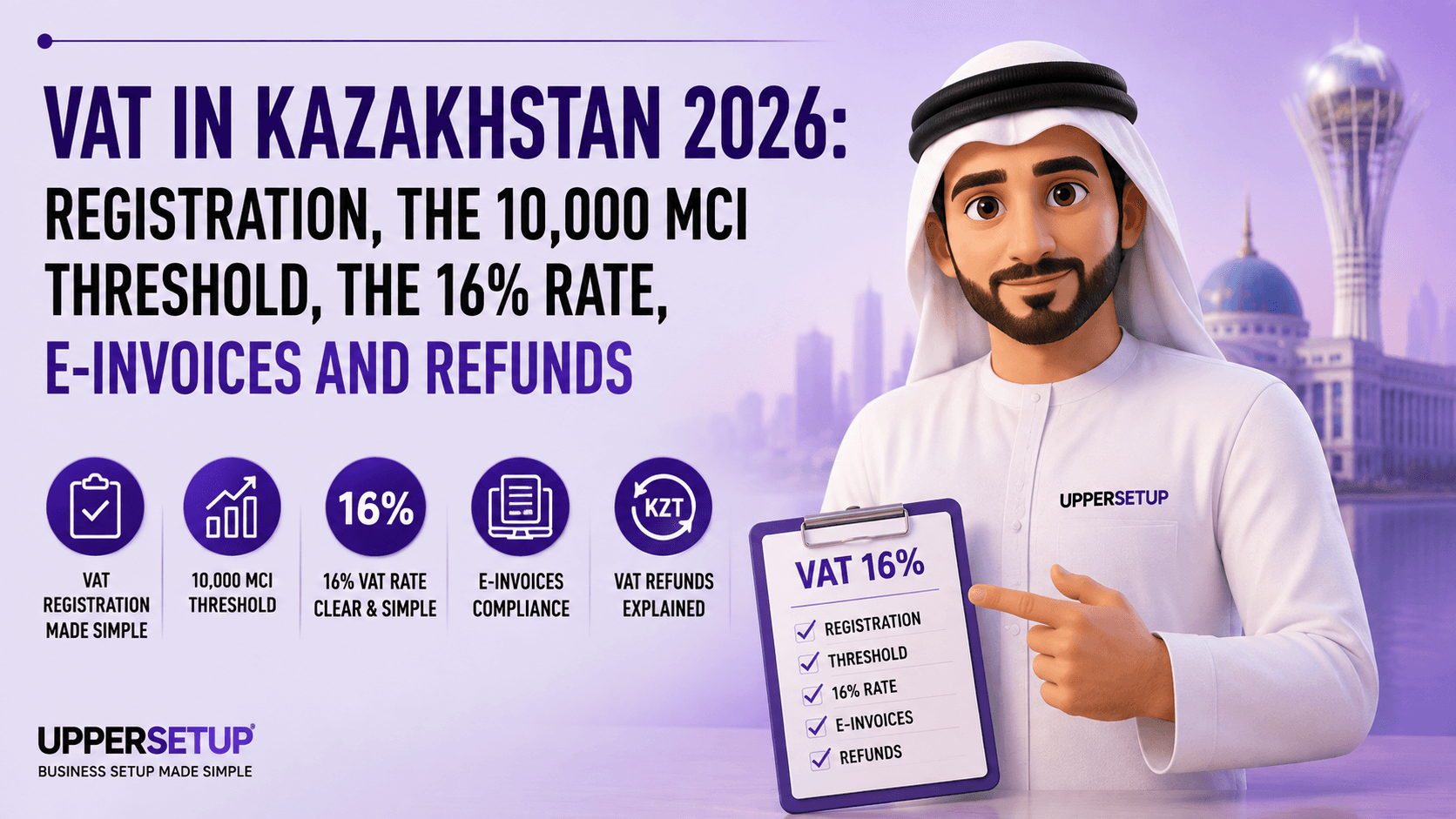
• Value added tax. From 1 January 2026 the mandatory VAT registration threshold was reduced to 10,000 monthly calculation indices, half the 20,000-index threshold that applied in 2025. The tenge equivalent depends on the monthly calculation index set for the relevant year by the law on the republican budget.
The tax application for mandatory VAT registration must be filed no later than five working days after the turnover threshold is exceeded.
The bank reports the account to the tax authorities automatically
On opening a client bank account the bank notifies the state revenue authorities in the manner, cases and time limits set out in subparagraph 1) of paragraph 2 of Article 55 of the Tax Code. The same duty applies on closing an account. Both paragraphs of Rules No. 207 — 24 and 77 — are in the wording of National Bank Management Board Resolution No. 94 of 17 December 2025 and took effect on 1 January 2026.
Article 55 of the Tax Code as enacted by Law No. 214-VIII is headed "Interaction of the tax authority with banking organisations" and consolidates banks’ information-exchange duties. The practical point for an account holder: the tax authorities learn of the account through the bank rather than through any client filing, and they learn of it in every case.
13. Exchange of Tax Information
Kazakhstan participates in the international automatic exchange of financial account information. Financial institutions apply due diligence procedures to identify reportable accounts and pass information to the tax authorities for onward transmission to foreign tax administrations.
The mechanism starts at account opening: under paragraph 21 of Rules No. 207 the bank establishes the tax residence of an individual client on the basis of information supplied by that client, in accordance with paragraph 5 of Article 5 of the anti-money-laundering law. The residence the client declares is the address to which information is later sent.
What this means for the account holder. A Kazakhstan account is not a confidentiality tool. Information on an account held by a Kazakhstan tax non-resident is likely to reach the holder’s country of tax residence through automatic exchange. The current list of partner jurisdictions and the reporting periods should be checked against up-to-date OECD and State Revenue Committee materials, since the partner list changes.
14. Timelines and Costs
|
Stage |
Indicative timing |
State fee |
|
Assignment of an IIN to a foreign individual |
Typically one working day from application |
Provided free of charge |
|
Tax registration of the foreign legal entity and BIN assignment |
Depends on completeness of the file; filed through the service centres of the state revenue authorities |
No state duty is charged for tax registration |
|
Apostille or consular legalisation in the country of incorporation |
From several days to several weeks depending on the jurisdiction |
Per the tariffs of the country of incorporation |
|
Notarised translation into Kazakh or Russian |
Usually several working days |
Per notary and translation agency tariffs |
|
Bank compliance review and account opening |
From several days to several weeks depending on the client profile |
Per the bank’s tariffs |
Bank timelines and tariffs are deliberately left unquantified. Charges for opening and maintaining non-resident accounts differ between second-tier banks and are revised by each bank independently. Publishing averaged figures without reference to a specific bank’s official tariff schedule would present an estimate as a fact.
15. Common Mistakes
Mistake 1. Treating the BIN as sufficient for account opening
A BIN confirms tax registration; it does not replace the bank’s compliance process. Companies frequently obtain a BIN and then face refusal because of an opaque ownership structure or the absence of an economic link to Kazakhstan. The cost: the time and expense of legalisation are spent, no account is opened, and the company is already on the Kazakhstan tax register and must go through deregistration.
Mistake 2. Legalising documents well in advance
Commercial register extracts have a limited shelf life in the bank’s eyes. Applicants who legalise the full set months before approaching the bank often have to repeat the apostille and notarised translation cycle. The cost: duplicated legalisation and translation spend, plus a delay equal to the time needed to obtain fresh documents from the foreign register.
Mistake 3. Choosing the foreign-entity account over a Kazakhstan LLP without doing the maths
An account in the name of the foreign company looks cheaper because no entity registration is needed. But the client remains a non-resident, with a heavier currency regime, a narrower banking product range, higher compliance friction on every operation and no practical ability to hire staff. The cost: within months the company registers an LLP anyway and repeats the entire process, having paid for both.
Mistake 4. Ignoring currency thresholds when structuring the deal
A loan or investment agreement with a Kazakhstan resident above USD 500,000 requires a capital-movement contract registration number. Contracts that state no amount as at the date of signing are equally caught — an "amount to be agreed in addenda" construction does not escape the requirement. The cost: the bank halts the payment pending the registration number while commercial deadlines continue to run. A separate consequence: under subparagraph 2) of paragraph 76 of Rules No. 207 the account cannot be closed while obligations remain outstanding under an export or import currency contract.
Mistake 5. Planning card usage on pre-2025 practice
Non-resident payment cards are valid for no more than twelve calendar months, and card counts are monitored. The model of issuing a card and using it from abroad for several years no longer works. The cost: the card expires while the holder is outside Kazakhstan, and reissue may require a personal visit.
Mistake 6. Treating a Kazakhstan account as a confidentiality tool
Kazakhstan participates in automatic exchange of financial information and banks are required to identify ultimate beneficial owners. The cost: tax consequences arise in the holder’s country of residence in any event, but without advance planning they arrive together with penalties for late disclosure.
16. Who the Route Suits
Good fit
• Companies with genuine Kazakhstan counterparties. Contracts, tender documentation or a verifiable trade flow are the strongest arguments in the compliance dialogue.
• Businesses building a Central Asian presence. Kazakhstan offers access to the Eurasian Economic Union market and settlement infrastructure in tenge, roubles, dollars and yuan.
• Groups prepared to register an LLP. Resident status radically simplifies both the currency regime and banking service.
• Financial and holding projects considering the AIFC. The Astana International Financial Centre operates a separate legal regime oriented to English law and institutional participants.
Poor fit
• Projects with no economic link to Kazakhstan. If the only answer to "why Kazakhstan" is "accounts are easier to open here", refusal is likely.
• Pass-through arrangements. Funds arriving and immediately moving on without local substance is a classic trigger for refusal and subsequent account closure.
• Owners with opaque structures. Nominee holders and chains that do not disclose the ultimate beneficiary make account opening close to impossible.
• Anyone seeking confidentiality. Automatic exchange of information puts that objective out of reach.
17. Step-by-Step Process
4. Choose the route: an account in the name of the foreign entity, a Kazakhstan LLP, a branch, or an AIFC structure. Decide on the basis of the intended currency regime and product range, not opening cost alone.
5. Pre-clear the client profile with the chosen bank before starting legalisation: country of incorporation, activity, ownership structure, expected turnover, principal counterparties.
6. Obtain an IIN for the director or authorised representative.
7. Assemble the corporate file: constitutional documents, evidence of state registration, evidence of tax registration in the country of incorporation, appointment documents for the director.
8. Apostille or legalise the documents and arrange notarised translation into Kazakh or Russian, having first checked whether a legal assistance treaty removes the legalisation requirement.
9. File the tax application for registration with the state revenue authorities and obtain the registration certificate bearing the BIN.
10. Prepare the signature and seal specimen document to the requirements of Rules No. 207.
11. Complete the bank compliance process: questionnaires, disclosure of ultimate beneficial owners, evidence of source of funds, justification of the economic link to Kazakhstan.
12. Open the account and obtain details and remote banking access.
13. Before the first significant transaction, check whether the contract with the Kazakhstan counterparty requires a capital-movement or export/import registration number and agree with the counterparty where that duty sits.
14. Establish an ongoing process: monitoring the VAT threshold, refreshing documents held by the bank, and tracking card validity dates.
18. Frequently Asked Questions
Can a foreign company open an account in Kazakhstan without a branch?
Yes. Opening accounts with Kazakhstan second-tier banks is an independent ground for placing a foreign legal entity on tax registration. No branch, representative office or subsidiary is required.
Is a BIN required to open an account for a foreign company?
Yes. A foreign legal entity needs a Business Identification Number, assigned by the state revenue authorities on tax registration. Unlike a Kazakhstan entity, a foreign company does not receive a BIN automatically.
Is a personal visit to Kazakhstan required?
Under the general rule in paragraph 53 of Rules No. 207 an authorised bank officer confirms signature authenticity in the personal presence of the signatories. An express exception applies to non-resident legal entities: authenticity is confirmed by notarisation or apostille (legalisation) of the documents evidencing representatives’ authority, and in that case the Rules do not require attendance in person. The remote-opening concessions in paragraphs 16, 29-2 and 35-1 are addressed to residents only, and the bank makes the final decision on accepting a remote file.
How long does it take?
IIN assignment usually takes one working day. Most of the elapsed time goes to apostille or consular legalisation in the country of incorporation, notarised translation, and the bank compliance review, which for non-resident clients runs from several days to several weeks depending on profile.
What currency restrictions apply to a non-resident account?
There is no direct restriction on non-residents holding tenge or foreign currency accounts. Thresholds apply: capital-movement contracts between residents and non-residents above USD 500,000 require a registration number, export and import contracts above USD 50,000 fall under repatriation control, and banks report all currency operations from USD 50,000 to the National Bank through regular reporting.
Why might a Kazakhstan bank refuse a non-resident?
The most common reasons are an opaque ownership structure and inability to identify the ultimate beneficial owner, absence of an economic link to Kazakhstan, pass-through indicators, the sanctions profile of the company or its counterparties, and a mismatch between stated turnover and the scale of the business.
Foreign-entity account or a Kazakhstan LLP?
The foreign-entity account is cheaper at entry but preserves non-resident status with a heavier currency regime and a narrower product range. An LLP registered in Kazakhstan is serviced as a resident client with the full product range. For regular operating activity the LLP is usually the more practical answer.
Is a non-resident’s card validity limited?
Yes. Payment cards issued to non-residents of Kazakhstan are valid for no more than twelve calendar months under Resolution No. 96 of the Agency for Regulation and Development of the Financial Market of 31 December 2024.
19. Key Takeaways
• A foreign company can open a Kazakhstan account without a branch, representative office or subsidiary.
• Opening an account is an independent ground for tax registration; the mechanics sit in Article 95 of the Tax Code in force from 1 January 2026.
• The sequence is fixed: IIN for the signatory, then BIN for the company, then the account.
• The banking list under subparagraph 4) of paragraph 26 of Rules No. 207 has three items: a signature specimen document or authority documents, a commercial register extract, and a copy of the signatory’s identity document. The charter and home-country tax registration are for the tax authority, not the bank.
• A notarised translation into Kazakh or Russian is mandatory; legalisation or apostille of the register extract is required only where necessary.
• Registration triggered by an account does not by itself create a permanent establishment.
• Currency thresholds: above USD 500,000 for capital-movement contracts, above USD 50,000 for export and import contracts, from USD 50,000 for bank reporting, up to USD 10,000 for individual transfers without an account.
• Non-resident payment cards are valid for up to twelve calendar months; the suspicion threshold on card count fell from ten to five per bank.
• From 1 January 2026 the mandatory VAT registration threshold is 10,000 monthly calculation indices.
• Refusal is possible only on the grounds listed in paragraph 25 of Rules No. 207, but those grounds cover almost any case: economic substance and ownership transparency outweigh formal completeness of the file.
• The bank notifies the state revenue authorities of both the opening and the closing of an account under subparagraph 1) of paragraph 2 of Article 55 of the Tax Code.
20. Summary
A foreign company may open a bank account in Kazakhstan without establishing a branch, representative office or subsidiary. The steps are: obtain an Individual Identification Number (IIN) for the director or authorised representative; place the foreign legal entity on tax registration with the state revenue authorities and obtain a Business Identification Number (BIN); submit to the bank the documents listed in subparagraph 4) of paragraph 26 of the Rules on opening, maintaining and closing customer bank accounts approved by Resolution of the Management Board of the National Bank of the Republic of Kazakhstan No. 207 of 31 August 2016 — a signature specimen document or notarised, legalised or apostilled documents evidencing representatives’ authority, an original or notarised copy of a commercial register extract with a notarised translation into Kazakh or Russian, and a copy of the signatory’s identity document; and complete customer due diligence under paragraph 10 of the Rules. Opening accounts with Kazakhstan second-tier banks is an independent ground for tax registration of a non-resident, governed by Article 95 of the Tax Code (Law No. 214-VIII of 18 July 2025) in force from 1 January 2026. Registration alone does not create a permanent establishment. The bank notifies the state revenue authorities of the opening and closing of the account under subparagraph 1) of paragraph 2 of Article 55 of the Tax Code, and refusal to open an account is permitted only on the grounds listed in paragraph 25 of Rules No. 207. Currency control operates on thresholds: a capital-movement contract registration number is required above USD 500,000; export and import contracts above USD 50,000 fall under repatriation control; authorised banks report all currency operations from USD 50,000 to the National Bank; and an individual may transfer up to USD 10,000 without opening an account. Payment cards issued to non-residents are valid for no more than twelve calendar months under Resolution No. 96 of the Agency for Regulation and Development of the Financial Market of 31 December 2024, which also lowered the suspicion threshold on card holdings from ten to five cards per bank. From 1 January 2026 the mandatory VAT registration threshold is 10,000 monthly calculation indices, down from 20,000 in 2025.
21. Sources
Tier 1 — primary sources and official guidance
• Rules on Currency Operations in the Republic of Kazakhstan — Adilet
• Rules on Monitoring Currency Operations in the Republic of Kazakhstan — Adilet
• National Bank of Kazakhstan — Currency operations: thresholds and contract registration requirements
• National Bank of Kazakhstan — Monitoring of currency operations
• State Revenue Committee — Key Tax Code changes from 1 January 2026 on the taxation of non-residents
Tier 2 — business media and professional commentary
• Interfax — Kazakhstan caps non-resident payment card validity at 12 months (ARDFM Resolution No. 96)
• RBC — Kazakhstan plans further tightening of card issuance to non-residents
• Delovoy Kazakhstan — Non-resident cards: validity cut to one year
Related UPPERSETUP analysis
• Hong Kong + UAE: Dual Structure for International Business 2026
• Redomiciliation to the UAE in 2026: ADGM, DIFC and Federal Decree-Law No. 20 of 2025
• UAE Offshore Companies 2026: RAK ICC, JAFZA and Ajman
Planning settlements through Kazakhstan? UPPERSETUP supports projects in Kazakhstan, the UAE and Hong Kong: choosing between a foreign-entity account, a Kazakhstan LLP and an AIFC structure, obtaining the IIN and BIN, preparing and legalising the document set, pre-clearing the client profile with the bank and guiding the compliance process. Discuss your project with UPPERSETUP
Disclaimer
This material is provided for informational purposes only and does not constitute legal, tax, financial, investment or consulting advice. Before making any decision, obtain individual professional advice reflecting your specific circumstances, jurisdiction, company status and current regulatory requirements. Information is current as of August 2026.
All services on the platform
Everything you need to start and run a business - in one place
- 2–10 days
Company Setup
Kazakhstan company with a complete set of incorporation documents
Start - Monthly
Accounting Services
Accounting and Tax Compliance, Reporting, and Support in Accordance with Kazakhstan Requirements
- 4–8 weeks
Immigration Services
Visas, Work Permits
- 7–30 days
Banking Services
Corporate Bank Accounts in Kazakhstan and Payment Services
- Custom timeline
Permits and Licenses
Business Licenses and Activity Permits
- Custom timeline
Legal Services
Corporate Documents, Contracts, Compliance, Licensing, and Company Structure Changes


