





































 International Free Zone Authority
Kazakhstan Residence Permits in 2026: The Permanent-Residence Pilot, the “Altyn Visa” and Digital Nomad Residency
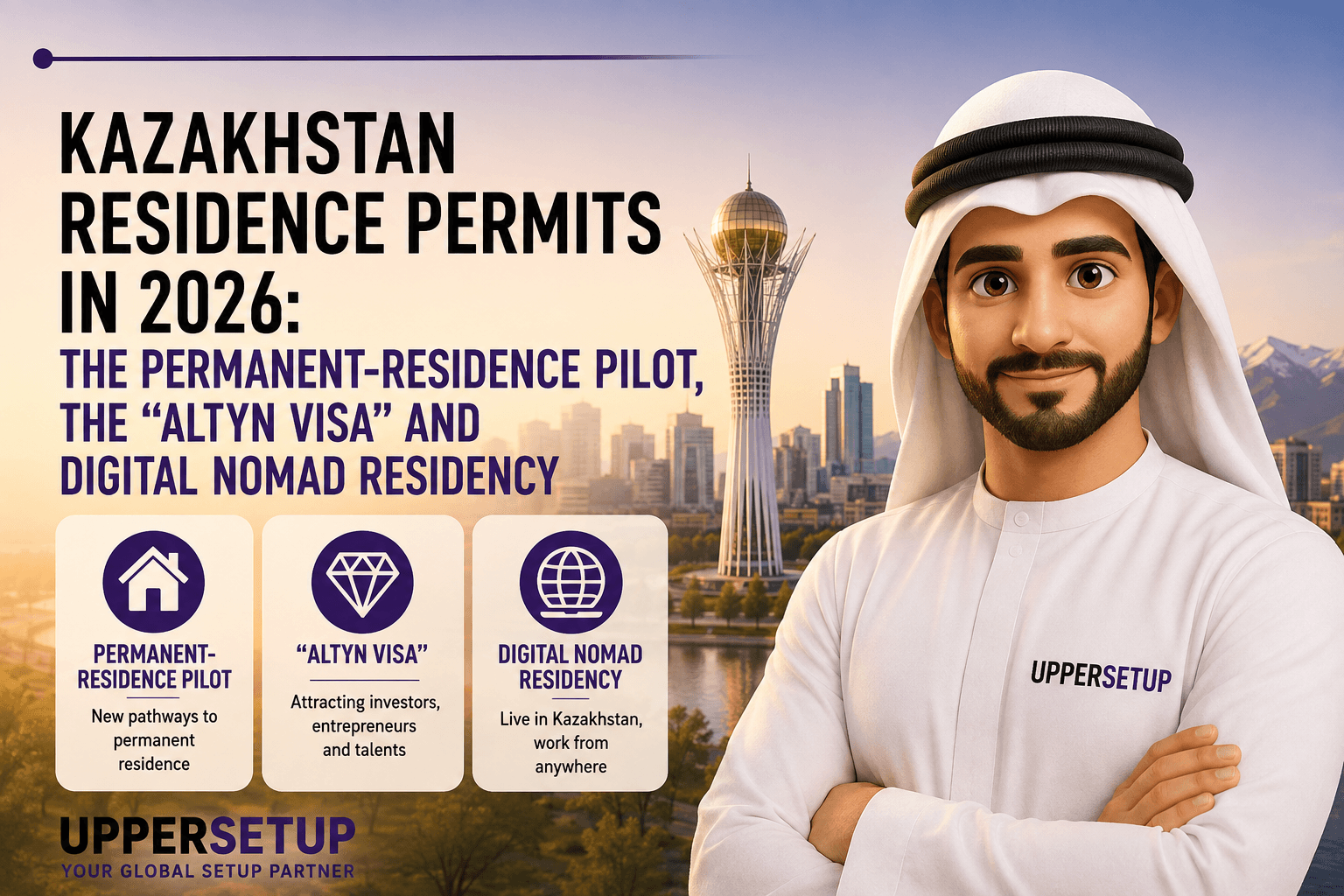
A Kazakhstan permanent residence permit is issued by the internal affairs bodies for an indefinite term, but since February 2026 most applicants pass through a pilot project that scores immigration potential: the pass mark is 600 points and the sum to be shown in a bank account is 1,320 MCI. The “Altyn Visa” that has dominated coverage since the spring of 2026 does not exist in law as at the date of publication: it is a task set by Presidential decree, to be created by 31 December 2026. Digital Nomad Residency is not a visa at all — it is a separate pilot that issues the same permanent residence permit to IT specialists through Astana Hub. The real fork is not which visa looks best but what status you end up holding: a visa, a temporary residence permit, or a permanent residence permit.
Important. Three things that are routinely conflated, and what each mistake costs. First: the Altyn Visa does not yet exist. Decree of the President of the Republic of Kazakhstan of 25 April 2026 No. 1242 instructed the Government to introduce it by 31 December 2026; as at August 2026 there is no procedure, no form, no issuing authority, and not one such visa has been granted. The “USD 300,000 for 10 years” figure that circulates alongside the name belongs to the existing A6 investor visa and appears in Annex 1 to the Rules on issuing visas, not in the decree. Second: a residence permit does not by itself make you a Kazakh tax resident.Article 222 of Tax Code No. 214-VIII frames the centre-of-vital-interests test as three conditions that must be satisfied simultaneously, and the residence permit is only the first of them. Third: currency residency attaches automatically and immediately. Article 1(3) of Law No. 167-VI expressly treats foreigners permanently residing in Kazakhstan on the basis of a permanent residence permit as residents. Tax residency and currency residency diverge in Kazakhstan — and the divergence works against anyone planning a paper-only status.
The Legal Framework: Four Layers That Must Not Be Mixed
The subject is governed by four independent layers: migration statutes, subordinate ministerial acts, tax law, and the currency and social layer. The statutes say who is eligible; the Ministry of Internal Affairs orders set the procedure and the amounts; the Tax Code sets the duties and the consequences; currency and social legislation govern what follows once the status is held.
The migration layer:
• Law of the Republic of Kazakhstan of 22 July 2011 No. 477-IV “On Population Migration” — Article 7(applying for a permanent residence permit), Article 49 (grounds for refusal and annulment). Article 16 on the immigration quota was repealed by the Law of 10 December 2013 No. 153-V, so no numerical quota has applied to ordinary permanent residence for more than twelve years.
• Law of the Republic of Kazakhstan of 19 June 1995 No. 2337 “On the Legal Status of Foreigners” — Article 4 (who counts as permanently resident, and the delegation to the Ministry of Internal Affairs of the solvency requirement), Article 6 (labour rights).
• Law of the Republic of Kazakhstan of 20 December 1991 No. 1017-XII “On Citizenship of the Republic of Kazakhstan” — Article 3 (non-recognition of a second citizenship), Article 16 (conditions for naturalisation), Article 21 (loss of citizenship), Article 38 (computation of the period of residence in the republic).
• Resolution of the Government of the Republic of Kazakhstan of 15 December 2025 No. 1081 approving the Concept of Migration Policy of the Republic of Kazakhstan to 2030 — the policy frame within which the 2026 pilots sit.
• Decree of the President of the Republic of Kazakhstan of 25 April 2026 No. 1242 “On measures to improve migration policy in order to create favourable conditions for attracting highly qualified specialists, foreign investors and entrepreneurs”.
The subordinate layer — this is where every figure and deadline actually lives:
• Order of the Minister of Internal Affairs of 4 December 2015 No. 992 approving the Rules on issuing temporary and permanent residence permits to foreign nationals and stateless persons, registered with the Ministry of Justice on 20 January 2016 under No. 12880. The version in force was introduced by Order of the Minister of Internal Affairs of 29 June 2026 No. 454, effective from 14 July 2026.
• Order of the Minister of Internal Affairs of 30 June 2023 No. 531 approving the Rules on proving solvency during a stay in Kazakhstan, registered on 1 July 2023 under No. 33001. Restated in a new edition by Order of the acting Minister of Internal Affairs of 7 July 2026 No. 479, effective 26 July 2026.
• Joint order of the acting Minister of Foreign Affairs of 24 November 2016 No. 11-1-2/555 and the Minister of Internal Affairs of 28 November 2016 No. 1100 approving the Rules on invitations and visas, registered on 15 December 2016 under No. 14531. Wholly restated by joint order of 31 October 2024 No. 11-1-4/612, then amended on 3 October 2025 (Nos. 11-1-4/584 and 749) and on 5–6 February 2026 (Nos. 11-1-4/71 and 72). The version used here is the consolidation as at 10 March 2026.
• Joint order of the Minister of Labour and Social Protection of the Population of 30 January 2026 No. 41, the Minister of Internal Affairs of 30 January 2026 No. 60 and the Deputy Prime Minister – Minister of Artificial Intelligence and Digital Development of 30 January 2026 No. 47 — the pilot project for issuing permanent residence permits and conferring kandas status. Amended by joint order of 10 April 2026 Nos. 131, 263 and 100/NQ.
• Joint order of the Minister of Internal Affairs of 24 April 2026 No. 301 and the Deputy Prime Minister – Minister of Artificial Intelligence and Digital Development of 6 May 2026 No. 241/NQ — the Digital Nomad Residency pilot. Its predecessor, the joint order of 6 January 2025 Nos. 1/NQ and 7, ran until 31 December 2025.
The tax layer:
• Tax Code of the Republic of Kazakhstan of 18 July 2025 No. 214-VIII, in force from 1 January 2026, replacing the Code of 25 December 2017 No. 120-VI. Author’s assessment: any publication that still cites Article 217 or Article 630 of Code No. 120-VI on individual residency is working from a repealed provision.The key articles here are 222 (individual resident), 417–418 (income and property declaration), 422–424 (assets and liabilities declaration), and 666 and 667 (state duty).
• Law of the Republic of Kazakhstan of 8 December 2025 No. 239-VIII on the republican budget for 2026–2028, Article 7(4): the MCI from 1 January 2026 is 4,325 tenge, the minimum wage is 85,000 tenge and the subsistence minimum is 50,851 tenge.
The currency and social layer:
• Law of the Republic of Kazakhstan of 2 July 2018 No. 167-VI “On Currency Regulation and Currency Control” — Article 1(3) (who is a resident), Article 9 (repatriation on export or import), Article 15 (reporting by authorised banks), Article 16 (monitoring of accounts with foreign banks).
• Social Code of the Republic of Kazakhstan of 20 April 2023 No. 224-VII — Article 196 (entitlement to pension provision), Article 248 (who pays mandatory pension contributions).
• Law of the Republic of Kazakhstan of 16 November 2015 No. 405-V on compulsory social health insurance— Article 2(2).
• Land Code of the Republic of Kazakhstan, Article 23 — land restrictions applying to foreigners.
A note on source access. The official portal adilet.zan.kz is closed to automated access, including through a browser. Every statutory quotation in this article is taken from the legal databases prg.kz (Paragraph), zakon.uchet.kz, zakon.mybuh.kz, kodeksy-kz.com, continent-online.com and base.spinform.ru, and from the official portals egov.kz, aifc.kz, eresidency.gov.kz and qaztourism.kz; the source list names the database and the version date for each citation. The text of Decree No. 1242 is available on the legal databases only in preview mode: the title and paragraphs 1 and 2 are readable, while the signature block carrying the commencement date sits behind a paywall, and the decree does not appear in the public list of legal acts on akorda.kz. This article therefore makes no statement about the date on which the decree entered into force.
Visa, Temporary Residence Permit and Permanent Residence Permit: What Separates Them
A visa confers the right to enter and stay for its validity period; a temporary residence permit ties a foreigner to a specific purpose of stay inside the country; a permanent residence permit is issued for an indefinite term and makes its holder permanently resident within the meaning of Article 4 of Law No. 2337. The residence card is not a separate status at all — it is the document that identifies the holder of a permanent residence permit.
The distinction between the permission and the document has a direct price tag, and it is constantly missed. State duty on the permanent residence permit itself is charged under Article 666(5) of the Tax Code; the duty for producing the residence card is charged separately under Article 667(3)(2).
|
Status |
What it is |
Term |
Issued by |
|
Visa |
Permission to enter and stay |
From 90 days to 10 years by category |
Kazakh diplomatic missions or territorial police bodies |
|
Temporary residence permit |
Permission to reside inside the country for a defined purpose |
For the duration of that purpose |
Territorial police bodies |
|
Permanent residence permit |
Permission to reside permanently |
Indefinite, ends only on annulment |
Internal affairs bodies |
|
Residence card |
A document, not a status |
Issued to the holder of a permanent residence permit |
Internal affairs bodies |
A permanent residence permit can only be applied for from one of five positions, and Article 7 of Law No. 477-IV lists them exhaustively. The provision as in force reads:
“Foreigners and stateless persons temporarily present in the Republic of Kazakhstan on a permanent residence visa, on an investor multiple-entry visa issued at the petition of the authorised investment body, on a visa issued under the list of in-demand professions for obtaining a permanent residence permit, approved by the authorised body on population migration, or who have arrived from states that have concluded visa-free entry and stay agreements with the Republic of Kazakhstan, or who hold refugee status in the Republic of Kazakhstan, and also ethnic Kazakhs regardless of the category of visa issued to them, apply to the internal affairs bodies for a permanent residence permit.”
The same paragraph caps the bridge between filing and decision at ninety calendar days — and what is issued is either a visa or a temporary residence permit, one or the other, not both.
“Immigrants who have applied, in the manner established by the legislation of the Republic of Kazakhstan, for a permanent residence permit are issued a visa or a temporary residence permit for the period required to consider the application, but for no more than ninety calendar days.”
Author’s assessment: the ninety-day ceiling and the forty-five-day decision period sit together less comfortably than they look. The forty-five calendar days run from submission of a complete package. If the package is returned for completion the clock restarts, while the ninety-day bridge keeps running. That is where most cases of an applicant having to exit and re-enter come from.
There is no numerical quota on ordinary permanent residence. Article 16 of Law No. 477-IV, which set the immigration quota for oralmans, was repealed by the Law of 10 December 2013 No. 153-V. What survives is the regional intake quota for kandas and resettlers, which has nothing to do with an ordinary foreign applicant. For 2026 it was approved by Order of the acting Minister of Labour and Social Protection of the Population of 12 December 2025 No. 401 at 8,278 persons, of whom 3,381 are kandas and 4,897 are resettlers. The practical difference between personal status and corporate form inside Kazakhstan is covered in An LLP in Kazakhstan for Foreigners 2026.
The “Altyn Visa”: What Was Actually Signed, and Why You Cannot Get One
As at August 2026 the Altyn Visa does not exist as a legal instrument: it is a task set for the Government by Decree of the President of the Republic of Kazakhstan of 25 April 2026 No. 1242, with a deadline of 31 December 2026. No procedure, no conditions, no form and no issuing authority have been established, and no Altyn Visa has been issued.
The decree’s full official title is longer than the one usually quoted: “On measures to improve migration policy in order to create favourable conditions for attracting highly qualified specialists, foreign investors and entrepreneurs”.
Paragraph 1 sets out four key directions of migration policy:
“a shift from a predominantly permit-and-quota model to an incentive-based model of migration policy…; the creation of a competitive residency regime for long-term residence and activity by foreign nationals…; the simplification and digitalisation of immigration procedures, including on a one-stop-shop basis; the positioning of Kazakhstan as a regional hub…”
Paragraph 2 gives the Government a single deadline and lists the content of the reform:
“The Government of the Republic of Kazakhstan shall, by 31 December 2026, ensure the implementation of a reform to improve the investment climate and attract foreign highly qualified specialists, comprising: 1) simplification of the conditions of entry and stay of foreign nationals in the territory of the Republic of Kazakhstan by unifying the following existing visas…”
The three visas to be unified are named in the decree itself: a business visa “for investors, entrepreneurs, members of boards of directors and persons engaged to work in the system of public administration”; a qualified worker visa “for specialists holding a job offer meeting the established criteria as to salary level and vacancy profile, and also for scientific and medical workers, figures in culture and the arts, graduates of leading foreign higher education institutions, and specialists in in-demand professions under a list approved by the Government of the Republic of Kazakhstan”; and a temporary worker visa “for employment within specific investment projects approved by the Government of the Republic of Kazakhstan”.
The Altyn Visa paragraph itself — paragraph 2(2) — builds qualification on time served on a prior visa, not on an amount invested:
“2) the introduction of the ‘Altyn Visa’, with legislative regulation of the procedure and conditions for obtaining it by participants of the investment tax residency programme of the Astana International Financial Centre…, by business visa holders — after the first month of stay, by qualified worker visa holders — after six months, save for IT specialists, for whom the period is one month, and by temporary worker visa holders — after one year;”
The preferences are listed in paragraph 2(3):
“3) the granting to Altyn Visa holders of the following preferences: exemption from individual income tax and from property and land taxes; exemption from universal declaration of income and property; access to state and financial services on an equal footing with citizens of the Republic of Kazakhstan;”
|
Route to the Altyn Visa under Decree No. 1242 |
Waiting period required |
|
Participant of the AIFC investment tax residency programme |
No waiting period |
|
Business visa holder |
After the first month of stay |
|
Qualified worker visa holder |
Six months |
|
Qualified worker visa holder who is an IT specialist |
One month |
|
Temporary worker visa holder |
One year |
Author’s assessment: the architecture of the decree means the Altyn Visa is designed as an upgrade point, not an entry point. None of the five routes lets an applicant enter it directly from abroad: one of the unified visas, or participation in the AIFC programme, must come first. That is a fundamental departure from the classic golden visa, where the investment is itself the qualifying ground.
What the decree does not contain matters more than what it does. The text is silent on the investment amount, the qualifying asset classes, the visa’s term, any requirement to maintain the investment, the issuing authority, the fee, family members’ rights and the route to citizenship. All of that must appear in legislation by 31 December 2026, and until then any specific figure attributed to the Altyn Visa has no source in law.
On the “USD 300,000 for 10 years” pair that circulates with the name. Those two values belong to the existing A6 investor visa and appear in Annex 1 to the Rules on issuing visas: “foreign businesspeople who have invested more than USD 300 thousand in the economy of the Republic of Kazakhstan” — multiple-entry, up to 10 years. Category A6 long predates Decree No. 1242. Author’s assessment: substituting the A6 parameters into the still-empty Altyn Visa frame is the single most common factual error on this subject in 2026.
The reported reduction of the AIFC presence requirement from 90 days to 30 days does not appear in the readable text of the decree. The decree mentions the AIFC only as the investment tax residency programme. Article 222(2) of the Tax Code still sets ninety calendar days for an AIFC investment resident as at the date of publication, and the AIFC’s own guidance gives the same figure. Reliability caveat: the thirty-day threshold could not be confirmed against the normative text, against official AIFC material, or against any traceable original press report. It is recorded here as an unconfirmed claim — neither law nor a report with an established source.
What Actually Works Instead: The A5 and A6 Visas and the AIFC Programme
Until the Altyn Visa is created, an investor has three genuinely operative routes: the A6 investor visa, the A5 investor visa, and the investment tax residency programme of the Astana International Financial Centre. These are different instruments with different thresholds, and only the last of them produces a tax effect.
Category A6 has two tiers, and the ten-year term attaches only to the second. Annex 1 to the Rules on issuing visas carries two rows for A6: one multiple-entry up to 5 years, and one for “foreign businesspeople who have invested more than USD 300 thousand in the economy of the Republic of Kazakhstan”, multiple-entry up to 10 years. The statutory wording is “more than 300 thousand”, not “not less than”: an investment of exactly USD 300,000 does not meet the condition.
A6 is issued consularly. Paragraph 24 of the Rules places A6 among the categories issued by diplomatic missions, and does not include it either in the list of visas issued by territorial police bodies or in the list of single-entry electronic visas.
Category A5 is the investor visa extendable to three years, and to five years for AIFC investment residents and their family members. Paragraph 51(1) of the Rules:
“‘A5’ — on the petition of the inviting party and written confirmation from the authorised investment body of the Republic of Kazakhstan, or on the petition of the AIFC Administration. The visa is extended for a term of up to 3 (three) years. For AIFC investment residents and their family members the visa is extended for a term of up to 5 (five) years.”
The AIFC Investment Tax Residency Programme is the only one of the three that changes the presence threshold for tax purposes. Its legal basis lies in AIFC acting law rather than in general Kazakh legislation. The conditions, per the AIFC’s own guidance:
|
AIFC Investment Tax Residency Programme parameter |
Value |
|
Investment threshold — shares, capital stakes, units in AIFC funds, AIX-listed securities and share capital of companies under AIFC Acting Law |
USD 60,000 |
|
Investment threshold — digital assets through licensed providers |
USD 150,000, added on 13 August 2026 |
|
Requirement to maintain the investment |
For the whole validity of the certificate |
|
What is granted |
An A5 investor visa and a temporary residence permit for 5 years, for the investor and immediate family |
|
Presence required for tax residency |
90 calendar days a year instead of the general 183 |
|
Fee — main applicant |
USD 7,750 (excluding VAT) |
|
Fee — applicant plus spouse |
USD 11,375 |
|
Annual tax residency fee |
7,000 MCI |
|
Age |
18 and over |
|
Restriction on prior status |
Neither a Kazakh tax resident nor a Kazakh citizen during the preceding 20 years — two separate conditions |
The ninety-day threshold for an AIFC investment resident is fixed in the Tax Code itself, not only in AIFC acts.Article 222(2)(2) of Code No. 214-VIII defines permanent presence as being in the country for “not less than ninety calendar days (including days of arrival and departure) for an AIFC investment resident in accordance with the conditions established by the Constitutional Law of the Republic of Kazakhstan on the Astana International Financial Centre”.
Author’s assessment: comparing the thresholds exposes a gap that is rarely spelled out. Entry to the AIFC programme starts at USD 60,000, while the A6 visa requires more than USD 300,000 — five times as much — and delivers no tax effect whatsoever. An investor chasing a “golden visa for 300 thousand” is buying visa duration, not a tax regime. The choice between corporate vehicles inside the country is covered in AIFC or LLP: Choosing a Jurisdiction Inside Kazakhstan.
A separate, non-migration instrument is e-Residency. The eresidency.gov.kz platform has been operating since 1 January 2026 and issues a “digital identifier for remote access to the financial and business services of the Republic of Kazakhstan” to persons over 18. The status lasts 12 months and must be renewed; the stated price is USD 120 a year, but the platform itself labels this a temporary promotional price and notes that registering through a partner bank’s app may carry a different one.
The exclusions are drawn more precisely than “nationals of sanctioned states”, and the difference matters. Refusal follows for persons on the UN, EU, OFAC, HM Treasury, SECO and Kazakh Financial Monitoring Agency lists; for residents and citizens of FATF blacklist jurisdictions — the DPRK, Iran and Myanmar are named; and for politically exposed persons from sanctioned jurisdictions and their close associates. “Nationals of sanctioned states” is inaccurate as a summary: Russian citizens who are not on a sanctions list may apply, subject to enhanced due diligence.
What e-Residency does not do is stated on the platform itself. The digital identifier and the IIN are “issued for use exclusively in the electronic environment”, “are not a document identifying a citizen of the Republic of Kazakhstan” and “confer no right of entry, residence or tax residency”. From the FAQ: “eResidency is not a visa, a residence permit or citizenship — there is no need to come to Kazakhstan.” It cannot be equated with residency, and it does not ease a visa, temporary or permanent residence application.
Digital Nomad Residency Is a Permanent-Residence Pilot, Not a Visa
Digital Nomad Residency is a pilot project for delivering the state service “Issuing permanent residence permits to foreigners and stateless persons in the Republic of Kazakhstan” to specialists in information and communication services; what the applicant receives at the end is a permanent residence permit, not a visa. Screening is carried out by Astana Hub — the autonomous cluster fund “Park of Innovative Technologies”.
The first pilot ran until 31 December 2025 — joint order of the Minister of Digital Development, Innovation and Aerospace Industry of 6 January 2025 No. 1/NQ and the Minister of Internal Affairs of 6 January 2025 No. 7: “This joint order enters into force after the day of its first official publication and operates until 31 December 2025.”
The pilot now in force was approved by joint order of the Minister of Internal Affairs of 24 April 2026 No. 301 and the Deputy Prime Minister – Minister of Artificial Intelligence and Digital Development of 6 May 2026 No. 241/NQ, and runs until 31 December 2026. Paragraph 9: “This joint order enters into force after the day of its official publication and operates until 31 December 2026.”
The gap between the two pilots ran to almost five months, and it can be measured exactly. The first pilot expired on 31 December 2025. The second was officially published on 25 May 2026 and, since it enters into force “after the day of official publication”, took effect on 26 May 2026. No pilot was therefore in force from 1 January to 25 May 2026 inclusive — four months and twenty-five days. Author’s assessment: the same cliff edge is programmed for the end of 2026 — the order runs only to 31 December 2026, and unless a successor is signed and published in advance, the gap will repeat.
The procedure under the order in force has two stages.
|
Stage and paragraph |
Content |
|
Paragraph 5 |
“An employee of the autonomous cluster fund carries out the initial screening” of the applicant’s status and profile |
|
Paragraph 7 |
“The next verification stage is conducted by way of a video interview” |
|
Paragraph 15 |
National security clearance — 25 calendar days inside the overall period |
|
Paragraph 16 |
“The overall period for considering the application and issuing a decision is 45 (forty-five) calendar days” |
|
Paragraph 19 |
A preliminary decision “whose validity period is 30 (thirty) calendar days”; failure to appear within it annuls the decision and bars re-application for one year |
|
Throughout the text |
Geography — the cities of Astana and Almaty |
The order contains no income threshold. Searching the text for “income”, “salary”, “MCI” and “dollars” returns nothing. Selection runs instead through a supporting letter confirming that the applicant matches the in-demand professions list approved by Order of the Minister of Labour and Social Protection of the Population of 20 February 2023 No. 49 — the same list that waives the 1,320 MCI solvency requirement under the general procedure. Author’s assessment: this is the defining difference from the B12-1 visa, where a figure of USD 3,000 a month is quoted. The pilot selects on profession and qualification, not on earnings.
The package and the internal deadlines are specific. The application is filed on astanahub.com with a passport valid for more than 180 calendar days, a diploma where one exists, a portfolio, a CV, a motivation letter, an upskilling certificate, a photograph and a criminal record document. Astana Hub screening takes 2 working days, followed by the video interview, after which the sectoral ministry signs the supporting letter with an electronic digital signature. After arrival: the form 028/u medical certificate, fingerprint registration and a notarised housing contract for not less than 180 calendar days; verification by the State Corporation takes 1 working day and by the migration service 3 working days.
The thirty-day validity of the preliminary decision is the most underrated detail in the whole design. An applicant holding preliminary approval must enter the country and complete the in-person stage within thirty calendar days, or the decision lapses. The cost of missing it is running the entire procedure again from the start.
The statistics show that it is residency, not nomadism, that is in demand.
|
Date |
Digital Nomad Residency figure |
Source |
|
26 June 2025 |
152 applications from 21 countries, permits issued: zero |
Ministry of Digital Development |
|
10 September 2025 |
over 270 applications from 20 countries, the first permit issued |
Central Communications Service under the President |
|
18 April 2026 |
over 700 applications from 30 countries, more than 120 specialists granted official status |
Astana Hub |
|
10 June 2026 |
over 1,100 enquiries, more than 600 applicants issued the supporting letter and processing plastic cards |
Astana Hub |
The “600” figure must not be read as “600 permits issued”, and the difference matters. The verbatim statement by the head of Astana Hub’s participant support office is that more than 600 applicants “have received the supporting letter and are processing the plastic card”. That letter is the first of three stages: confirmation that the applicant matches the in-demand professions list, followed by the preliminary decision with national security clearance, and only then the permit itself. The April figure confirms the reading: 120 statuses granted in April against 600 supporting letters in June are two different stages, not a fivefold rise in approvals.
On Astana Hub’s account, most applicants are nationals of EAEU states — Russia, Belarus, Kyrgyzstan and Uzbekistan — plus Türkiye and the United States, and the country’s shortage of IT specialists is put at roughly 50,000 people.
Author’s assessment: the gap between the programme’s launch and its current state reflects the removal of technical barriers, not a change in its appeal. As at June 2025, 152 applications had produced no permits at all; the criticism of that period concerned failures in the digital pipeline and a requirement to hold a Kazakh individual identification number obtainable only inside the country. The programme started working when the procedure was made to run end to end, not when the entry conditions were relaxed.
The Neo Nomad Visa (B12-1) and the Digital Nomad Visa (B9-1) Are Different Categories
The Neo Nomad Visa and the Digital Nomad Visa are not two names for one programme but two separate visa categories in the Rules on issuing visas: B12-1 and B9-1 respectively. They are constantly treated as one, which produces wrong expectations about both rights and route.
Both categories are named in the Rules under exactly these labels — “B12-1 Neo Nomad Visa” and “B9-1 Digital Nomad Visa” — so the marketing names are fixed in the normative text rather than attached to it afterwards.
B12-1 is a multiple-entry visa of up to one year for remote workers earning abroad. Annex 1 to the Rules describes the holders as “persons working remotely and having a permanent income from foreign sources”. The provision names no income figure at all. Paragraph 51(6) of the Rules governs its extension:
“‘B12-1’ (multiple-entry up to 1 year) — on the applicant’s petition, for a term of no more than 1 (one) year;”
Family members are covered expressly: paragraph 34 of the Rules extends visa issuance to family members and dependants of holders of categories A1–A6, B7, B10 and B12-1.
B9-1 is a separate category, and the Rules describe it by profession and by destination status rather than by income. Annex 1 reads: “persons holding in-demand professions who are travelling to the Republic of Kazakhstan to obtain a permanent residence permit”. That matters: B9-1 is not a “freelancer visa” but the entry ticket to the permanent-residence route via the in-demand professions list — the same list that removes the 1,320 MCI solvency requirement. Paragraph 24 of the Rules lists B9-1 both among the visas issued by the territorial police bodies of the Ministry of Internal Affairs and among the single-entry electronic visas.
Where the USD 3,000 figure sits, and what status it has. Searching the full text of the Rules in the consolidation as at 10 March 2026 for “3 000”, “3000”, “income” and “monthly” returns nothing: the normative text contains no threshold. The figure is not rumour, however: the official page of the national company Kazakh Tourism requires a bank statement evidencing “a stable monthly income above USD 3,000”, and the same figure was given at a Ministry of Foreign Affairs briefing in February 2025. The correct characterisation is that this is an administrative documentary requirement set at the level of state guidance, not a condition fixed in the Rules on issuing visas. There is no basis at all for attaching the same threshold to the B9-1 visa.
On the official description published by the national company Kazakh Tourism, the Neo Nomad Visa was introduced on 18 November 2024; income is evidenced by bank statements for the preceding six months, alongside a tax return from the country of nationality, a criminal record certificate and medical insurance covering the whole visa period; applications are filed through Kazakh diplomatic missions; processing takes up to five working days; nationals of 48 states need no invitation; and family members receive visas coterminous with the principal’s. The same source states expressly that this visa does not permit employment in Kazakhstan.
|
Feature |
B12-1 Neo Nomad Visa |
B9-1 Digital Nomad Visa |
|
What it is |
A visa for remote workers with foreign-source income |
An in-demand-professions visa — the route to a permanent residence permit |
|
Term |
Multiple-entry up to 1 year |
Single-entry electronic up to 1 year; multiple-entry up to 1 year through territorial police bodies |
|
Extension |
Paragraph 51(6): no more than 1 year |
Under the general rules |
|
Income threshold in the normative text |
None (USD 3,000 is a ministry statement) |
None |
|
Employment in Kazakhstan |
Not permitted |
— |
|
Family members |
Covered by paragraph 34 of the Rules |
Not expressly named in paragraph 34 |
|
Electronic issuance |
— |
Yes, paragraph 24 of the Rules |
Author’s assessment: the practical value of B12-1 and B9-1 has fallen short of expectations, and the numbers show it. On Ministry of Internal Affairs figures reported in May 2026, the B9-1 visa drew 11 applications and produced 9 visas, while the B12-1 visa drew and produced 77, with no refusals under either. By contrast, the Digital Nomad Residency pilot had collected more than 1,100 applications by June 2026. A ratio of roughly 86 to 1,100 says that demand is for settled status, not for a one-year visa.
The reason demand runs to residency rather than to visas lies in the bundle of rights. The B12-1 visa permits no employment, leads nowhere in terms of permanent status, and requires annual renewal. A permanent residence permit is indefinite, removes the work-permit question entirely, and opens compulsory social health insurance. For a comparable administrative effort the outcomes are not comparable at all.
The Points-Based Permanent-Residence Pilot: 600 Points and the KAZTEST
Since 14 February 2026 the issuing of permanent residence permits and the conferral of kandas status have run through a pilot project involving a Kazakh-language test, a questionnaire and an automated scoring of immigration potential; the minimum pass mark is 600 points. The legal basis is the joint order of the Minister of Labour and Social Protection of the Population of 30 January 2026 No. 41, the Minister of Internal Affairs of 30 January 2026 No. 60 and the Deputy Prime Minister – Minister of Artificial Intelligence and Digital Development of 30 January 2026 No. 47.
The commencement date is 14 February 2026, and the discrepancy with the date of 13 February is explained by the commencement formula. The order was published in the Reference Control Bank of normative legal acts on 13 February 2026, and enters into force “after the day of its official publication” — that is, on 14 February 2026. The pilot runs until 31 December 2026.
The pilot does not reach everyone. The Rules expressly exclude from their scope foreigners arriving “for the purpose of carrying out labour activity, business immigration, investor and tourist activity, obtaining education, or on humanitarian and political grounds”.
Paragraphs 28 and 29 are in the wording of the joint order of 10 April 2026, which entered into force on the day of signature. The source note to paragraph 29 in the consolidated text reads: “Paragraph 29 — in the wording of the joint order of the Minister of Labour and Social Protection of the Population of 10.04.2026 No. 131, the Deputy Prime Minister – Minister of Artificial Intelligence and Digital Development of 10.04.2026 No. 100/NQ and the Minister of Internal Affairs of 10.04.2026 No. 263 (enters into force on the day of signature and operates until 31.12.2026)”. The practical consequence: the “400 points” figure found in February–March 2026 coverage belongs to the original text and does not reflect the provision in force.
The scoring formula and the pass mark are set out verbatim in paragraph 29:
“Points under the system of criteria-based assessment of immigration potential are calculated by the formula: Total score = (DI + EL + LP + KE + FE + PC) × Hc + AC… The minimum pass mark under the system of criteria-based assessment of immigration potential is not less than 600 points.”
|
Symbol in the formula |
Criterion (paragraph 28) |
Maximum points |
|
DI |
Demographic indicator |
110 |
|
EL |
Level of education |
150 |
|
LP |
Language proficiency, 240 in total, of which Kazakh |
120 |
|
LP |
Russian |
60 |
|
LP |
English |
60 |
|
KE |
Study and work experience in the Republic of Kazakhstan |
80 |
|
FE |
Study and work experience in other countries |
80 |
|
PC |
Adaptability indicators of professional competencies |
80 |
|
AC |
Additional indicators and conditions |
200 |
|
Hc |
Health coefficient |
From 0 to 1 — a multiplier, not an addend |
Author’s assessment: the health coefficient is the harshest element of the formula precisely because it multiplies. It multiplies the sum of six criteria rather than being added to it; at a value of zero the whole block collapses and only the additional-conditions score survives, capped at 200 points — well short of the 600 required. The formula’s maximum is 940 points, so the pass mark sits at roughly 64% of the ceiling.
The Kazakh-language requirement is expressed as a percentage, not as a level. Paragraph 4 of the Rules: “Testing under the KAZTEST system on knowledge of the Kazakh language by immigrants arriving for permanent residence in the Republic of Kazakhstan, including for the conferral of kandas status, is conducted through the KAZTEST digital system in online format.” The threshold is 70% in each section; registration is through app.testcenter.kz; the format is 60 questions in 1 hour 10 minutes.
The retake rule is set out verbatim in paragraph 7 of Annex 1:
“Where a result below the threshold indicator (70%) is obtained… the opportunity is provided to retake the test no more than twice within 30 (thirty) calendar days.”
Reliability caveat: the order contains no “A1” level. Searching the text for “A1” in both Latin and Cyrillic returns nothing — the requirement is expressed as a threshold percentage, not on the CEFR scale. The formulation “Kazakh at A1 level” appears in explanatory material and in the press but has no normative support.
The decision period changed during the pilot itself, which matters when reading earlier coverage. The original text of the order of 30 January 2026 set “no more than 29 (twenty-nine) working days”. The joint order of 10 April 2026 Nos. 131, 263 and 100/NQ, published on 17 April 2026, replaced that period: “The period for delivery of the state service from the submission of the package of required documents is 45 (forty-five) calendar days.”
Screening by law enforcement and national security bodies takes 20 working days under paragraph 17 of the Rules. Author’s assessment: twenty working days is close to a calendar month, so within a forty-five calendar day overall period the screening consumes most of the timeline.
The financial requirement in the pilot is expressed in MCI, not in tenge. Paragraph 5(4) as amended requires “a document confirming solvency (with funds in a bank account of not less than 1,320 MCI for the period of consideration of the application)”. At the 2026 MCI of 4,325 tenge that is 5,709,000 tenge.
For kandas the pilot introduces a hard territorial condition. Verbatim: “Kandas status is conferred only on mandatory resettlement to the settlement regions determined by the Government of the Republic of Kazakhstan, for a term of 5 (five) years with no right of extension.”
Reliability caveat on exemptions from the points assessment. Public commentary states that holders of B9-1 and B12-1 visas, specialists in scarce professions, refugees and persons renewing an existing permit are exempt from the points assessment. Searching the text of the order for “B9-1”, “B12-1”, “not subject to”, “without undergoing”, “exempt” and “refugee” returns nothing. The only exclusion found is the scope exclusion quoted above, which is not the same thing in law. The claim is recorded as unverified.
The Ordinary Route: Documents, Timelines and Fees as at 14 July 2026
A permanent residence permit is processed under the Rules approved by Order of the Minister of Internal Affairs of 4 December 2015 No. 992; the decision period is 45 calendar days from submission of a complete package. The version in force was introduced by Order of the Minister of Internal Affairs of 29 June 2026 No. 454, which takes effect ten calendar days after the day of first official publication; the consolidated texts on the legal databases date the version in force to 14 July 2026.
The forty-five-day period was not changed. Annex 7 to the Rules (the permanent residence service standard), row 5: “From submission of the package of required documents — 45 (forty-five) calendar days.”
A temporary residence permit, by contrast, is now decided in one working day. Annex 2, row 5: “From the day of submission of the package of required documents to the service provider, to the State Corporation, or through the portal — 1 (one) working day.”
Beware a common substitution. Reports that “residence permit processing has been cut to one working day” concern the temporary permit, not the permanent one. For a permanent residence permit the period is unchanged at 45 calendar days. In the same way, the age-sixteen rule in the Rules is framed for the temporary permit: “For the purpose of obtaining the temporary residence permit state service, immigrants who have reached the age of 16 in the territory of the Republic of Kazakhstan apply at their place of registration to the territorial police bodies, or through the State Corporation, or through the portal.”
The full document list under Annex 7 to the Rules:
|
No. |
Document |
|
1 |
Application in the prescribed form |
|
2 |
Copy and original of the foreign passport or stateless person’s document valid for more than 180 calendar dayson the date of filing |
|
3 |
Proof of solvency under Order No. 531, or a document establishing an exemption under Article 49(4) of Law No. 477-IV |
|
4 |
Criminal record document (or certificate of none) from the state of citizenship and/or permanent residence — excepting refugees in Kazakhstan and ethnic Kazakhs who are PRC nationals, unless a treaty provides otherwise |
|
5 |
Notarised consent of a child aged 14 to 18 to permanent residence in Kazakhstan |
|
6 |
Notarised contract with a natural or legal person, or a notarised statement providing accommodation and permanent registration for at least 180 calendar days |
|
7 |
Medical certificate in form 028/u under Order of the Minister of Health of 30 September 2011 No. 664 (registration No. 7274) |
|
8 |
One photograph, 35×45 mm |
|
9 |
Proof of payment of the state duty |
|
10 |
For persons on the in-demand professions list, the relevant confirmation (the list is approved by Order of the Minister of Labour and Social Protection of the Population of 20 February 2023 No. 49) |
Three of these documents share a 180-calendar-day shelf life. Verbatim: “The validity period of the documents specified in subparagraphs 3), 4) and 7) shall be no more than 180 calendar days” — that is, the solvency proof, the criminal record document and the medical certificate.
Author’s assessment: the 180-day window and the 45-day decision period create a trap that is almost never written about. Legalisation of a foreign criminal record certificate, apostille and notarised translation routinely take two to three months. Start there, and by the time of filing less of the 180 days may remain than the decision itself takes. The correct order is accommodation and proof of solvency inside the country first, certificates second — not the other way round.
There are two state payments, and they are distinct.
|
Payment |
Provision |
Rate |
In tenge at MCI 4,325 |
|
For issuing the permanent residence permit |
Tax Code No. 214-VIII, Article 666(5) |
4 MCI |
17,300 tenge |
|
For issuing the residence card of a foreign national |
Tax Code No. 214-VIII, Article 667(3)(2) (“Rates of state duty for notarial and other actions”) |
0.2 MCI |
865 tenge |
|
For processing documents on acquisition of citizenship |
Tax Code, Article 666 |
1 MCI |
4,325 tenge |
Author’s assessment: the total state duty for entering the status is 18,165 tenge — under fifty US dollars. What makes the status expensive is not the duty but the requirement to hold 1,320 MCI in an account and the cost of legalising documents.
Grounds for refusal and for annulment sit in a single article. Article 49 of Law No. 477-IV is headed “Grounds for refusing to issue or for annulling a permanent residence permit in the Republic of Kazakhstan for foreigners and stateless persons” and opens: “A permanent residence permit in the Republic of Kazakhstan shall be refused to foreigners and stateless persons, or a previously issued permit shall be annulled.” One list governs both entry and exit — that is its defining feature.
A refusal is appealable, and issuance without a positive clearance from the national security bodies is prohibited.The article further provides that subparagraphs 13) and 14-1) do not apply to ethnic Kazakhs and their family members, to stateless persons recognised as such for want of identity documents or on a 1974-model USSR passport, or to women covered by the Convention on the Nationality of Married Women; subparagraph 15) does not apply to persons lacking legal capacity.
A note on numbering. Article 49 contains hyphenated inserted subparagraphs (3-1, 9-1, 10-1, 13-2, 14-1, 14-2), so its highest number is 17 while the actual count of operative subparagraphs is 23. Subparagraph 13-1 was deleted by the Law of 24 November 2015 No. 421-V. Cite the real subparagraph numbers rather than a sequential count: solvency is subparagraph 4) and the 183-day rule is subparagraph 13).
How Much Money You Must Show: 1,320 MCI, and Who Is Exempt
An applicant for a permanent residence permit must evidence funds in a bank account of not less than 1,320 times the monthly calculation index — 5,709,000 tenge at the 2026 MCI of 4,325 tenge. The threshold is set not by statute but by subordinate act: the law delegated both the procedure and the amount to the Ministry of Internal Affairs.
The delegating provision is the second part of Article 4 of Law No. 2337:
“A mandatory condition for granting a permanent residence permit in the Republic of Kazakhstan is confirmation by the person seeking such a permit — save for ethnic Kazakhs, persons born in or formerly holding the citizenship of the Republic of Kazakhstan or of the Kazakh Soviet Socialist Republic, and persons entitled to acquire citizenship of the Republic of Kazakhstan under a simplified procedure on the basis of ratified international treaties, and their family members arriving together or separately, and foreigners holding in-demand professions… — of their solvency in the manner and in the amounts determined by the Ministry of Internal Affairs of the Republic of Kazakhstan.”
The threshold itself sits in paragraph 2 of the Rules approved by Order of the Minister of Internal Affairs of 30 June 2023 No. 531 (registered with the Ministry of Justice on 1 July 2023 under No. 33001):
“…a document (certificate) of a bank resident in the Republic of Kazakhstan or of a branch of a non-resident bank, signed by an authorised officer of the bank, as to the presence of funds in a bank account (accounts) in an amount equal to or exceeding the equivalent of one thousand three hundred and twenty times the calculation index established by the law on the republican budget for the relevant financial year as at the date of filing the application for permission to remain for permanent residence.”
The MCI applied is that of the financial year in which the application is filed, not of the year of decision. That follows directly from the wording quoted and disposes of the question of what happens when filing falls in December and the decision in January.
From 26 July 2026 new Rules apply, approved by Order of the acting Minister of Internal Affairs of 7 July 2026 No. 479. The 1,320 MCI figure is unchanged under the new Rules. What they add is an authenticity check on the certificate: the internal affairs bodies send a query to the issuing bank, and this is done only with the applicant’s consent. Reliability caveat: a formal declaration that Order No. 531 has ceased to have effect could not be confirmed on the accessible legal databases — the consolidated texts still show it as in force. This article therefore speaks of new Rules replacing the earlier ones, not of a formal repeal.
|
Solvency requirement parameter |
Value |
|
Amount |
1,320 MCI |
|
In tenge at the 2026 MCI of 4,325 |
5,709,000 tenge |
|
Which MCI applies |
The one set by the budget law as at the date of filing |
|
Evidence |
Certificate of a Kazakh resident bank or of a branch of a non-resident bank, signed by an authorised bank officer |
|
Validity of the certificate |
No more than 180 calendar days |
|
Verification |
Query to the bank by the internal affairs bodies with the applicant’s consent |
The exempt categories sit not in these Rules but in Article 49(4) of Law No. 477-IV, and the Rules cross-refer to it expressly. Exempt are: ethnic Kazakhs; former compatriots born in or formerly holding the citizenship of the Kazakh SSR or the Republic of Kazakhstan; persons entitled to simplified naturalisation under ratified international treaties, and their family members; and foreigners holding in-demand professions on the list approved by the authorised body on population migration.
Author’s assessment: the in-demand professions list is the most underrated way of avoiding the solvency requirement altogether. It is approved by order of the Minister of Labour and Social Protection of the Population (currently that of 20 February 2023 No. 49, as amended; version of 12 June 2026) and simultaneously grounds a separate visa category under Article 7 of Law No. 477-IV. For a specialist on the list the 1,320 MCI requirement falls away entirely rather than being reduced.
Reliability caveat. The claim that every family member aged 16 or over must evidence the sum separately found no support in normative text: the Rules under Order No. 531 consist of three operative paragraphs and say nothing about family members or age, and the document list in Annex 7 to Rules No. 992 contains no separate rule for family members. It is recorded here as practice described on the state services portal, not as law.
Opening a Kazakh bank account is a separate hurdle, and it is better cleared before filing than alongside it. The general logic of the banking layer is covered in Opening a Bank Account in Kazakhstan.
Does a Residence Permit Make You a Kazakh Tax Resident?
No: a residence permit does not by itself create tax residency. Article 222 of Tax Code No. 214-VIII treats an individual as a resident in two cases — permanent presence in Kazakhstan, or a centre of vital interests in Kazakhstan — and the residence permit features only as one of three conditions of the second test, all of which must hold simultaneously.
Article 222(1) sets two independent grounds:
“An individual is recognised as a resident in the cases of: 1) permanent presence in the Republic of Kazakhstan; 2) having a centre of vital interests in the Republic of Kazakhstan.”
Article 222(2) defines permanent presence and introduces the special AIFC threshold:
“Permanent presence in the Republic of Kazakhstan for a tax period means the individual being in the Republic of Kazakhstan, in any consecutive twelve-month period ending in that tax period, for: 1) not less than one hundred and eighty-three calendar days (including days of arrival and departure); 2) not less than ninety calendar days (including days of arrival and departure) for an AIFC investment resident…”
Article 222(3) is the source of the confusion, and its operative words come first:
“The centre of vital interests is located in the Republic of Kazakhstan where the following conditions are satisfied simultaneously: 1) the individual holds citizenship of the Republic of Kazakhstan or a residence permission in the Republic of Kazakhstan, or a residence card; 2) the spouse and/or close relatives of the individual reside in the Republic of Kazakhstan (where such exist); 3) there is immovable property in the Republic of Kazakhstan owned or otherwise held by the individual and/or the spouse and/or close relatives, available at any time for their accommodation…”
|
Residency test under Article 222 |
What is required |
Is the residence permit alone enough |
|
Permanent presence, paragraph 2(1) |
183 calendar days in any consecutive 12-month period |
Not applicable — days are counted, not status |
|
Permanent presence, paragraph 2(2) |
90 calendar days for an AIFC investment resident |
Not applicable |
|
Centre of vital interests, paragraph 3 |
Citizenship or a residence permit, and a spouse or close relatives residing in Kazakhstan, and immovable property available for accommodation |
No — the residence permit is only the first of three simultaneous conditions |
Author’s assessment: paragraph 3 has a built-in softener that is simultaneously a trap, and it repays careful reading. Subparagraph 2 is qualified “(where such exist)”: if the applicant has neither a spouse nor close relatives, that condition falls away — and the test reduces to the remaining two. The practical consequence is that a single residence-permit holder who has accommodation available in Kazakhstan satisfies the centre-of-vital-interests test and becomes a tax resident without ever reaching 183 days. The only person the test does not reach is one with neither family in Kazakhstan nor available accommodation; such a person can become a resident only by counting days under paragraph 2. Note too that subparagraph 1 is itself disjunctive: citizenship, or a residence permission, or a residence card — any one of the three suffices. And that is where the central paradox of the subject appears, examined below: keeping the permit requires living in the country for at least 183 days a year — precisely the threshold that makes a person a tax resident.
Article 222(4) adds six categories treated as residents regardless of time spent in the country — persons seconded on state service and their families; crews of vehicles owned by Kazakh persons operating regular international routes; military and civilian personnel of Kazakh military formations abroad; persons working on facilities in Kazakh ownership abroad, including concessions; persons who have gone abroad for study, internship or treatment, for that period; and teachers and researchers abroad, for that period. These provisions extend only to Kazakh citizens and to persons who have applied for citizenship or for permission to reside permanently.
Universal Declaration: Which Form Catches a Residence-Permit Holder
A permanent residence permit holder who has become a tax resident is caught by the income and property declaration on form 270.00, but on the literal text is not caught by the assets and liabilities declaration on form 250.00, which is addressed to adult citizens. The distinction is built into the wording of the two articles and is one of the most practically significant details on this subject.
Article 417 of the Tax Code opens by referring to residents, with no citizenship qualifier:
“Unless otherwise established by the second part of this paragraph, the income and property declaration shall be submitted by individuals who are residents meeting, during the reporting tax period, any one of the following conditions:”
|
Condition in Article 417 |
Threshold |
In tenge at MCI 4,325 |
|
Subparagraph 4) — funds in foreign bank accounts outside Kazakhstan as at 31 December |
1,000 MCI |
4,325,000 tenge |
|
Subparagraph 6) — acquisition of property during the period, in Kazakhstan and/or abroad, by aggregate value |
20,000 MCI |
86,500,000 tenge |
|
Subparagraph 8) — income under Article 363(1), including abroad, excluding employment income taxed at source that is the sole source |
8,500 MCI |
36,762,500 tenge |
|
Subparagraph 9) — income in the form of dividends, including abroad |
230,000 MCI |
994,750,000 tenge |
The thresholds in subparagraphs 6, 8 and 9 are measured at the MCI in force on 31 December of the reporting tax period. The obligations under subparagraphs 5) and 6) do not apply to persons who file the assets and liabilities declaration under Article 422 for the current period.
Article 422 is addressed to a different class of person, and the text shows it:
“2) adult citizens who are residents of the Republic of Kazakhstan, where they own (or have a claim to) the following property outside the Republic of Kazakhstan: … funds in foreign bank accounts in an amount exceeding, across all deposits in aggregate, 1,000 times the monthly calculation index in force on 31 December of the reporting tax period…”
The first subparagraph of Article 422(2) operates regardless of citizenship — it covers persons obliged to file such a declaration under the Constitutional Law on Elections and under the laws on combating corruption, on banks and banking, on insurance activity and on the securities market.
Both declarations are due by 15 September. The income and property declaration is submitted under Article 418 “at the place of residence (stay) no later than 15 September of the year following the reporting calendar year”; the assets and liabilities declaration is submitted under Article 424 “at the place of residence (stay) by 15 September of the current year”.
Article 422(4) takes out of the assets and liabilities declaration the staff of accredited diplomatic and equivalent missions, consular posts and international organisations, and family members living with them.
Author’s assessment, with the confidence level stated openly. The same 1,000 MCI foreign-account trigger appears both in Article 417(1)(4) and in Article 422(2)(2), but with different personal scopes: “individuals who are residents” against “adult citizens who are residents”. The asymmetry is in the text itself, not an artefact of reading. That said, no State Revenue Committee guidance on applying Article 422 to foreign nationals holding a residence permit could be found under Code No. 214-VIII. The safe formulation is that form 270.00 does reach a resident residence-permit holder, while form 250.00 reaches them only through the special-law limb in subparagraph 1 of paragraph 2. Confirm the practice with the State Revenue Committee before filing. The corporate side of the reporting machinery is covered in Withholding Tax in Kazakhstan 2026.
Currency Residency Attaches Immediately: The Central Asymmetry
A foreigner who obtains a permanent residence permit becomes a Kazakh currency resident automatically and immediately — with no day count and no further conditions. The provision is direct, and it stands in contrast to the three-limb tax test.
Article 1(3) of Law No. 167-VI:
“residents of the Republic of Kazakhstan… are: citizens of the Republic of Kazakhstan; foreigners and stateless persons permanently residing in the Republic of Kazakhstan on the basis of a permanent residence permit in the Republic of Kazakhstan; legal entities… established in accordance with the legislation of the Republic of Kazakhstan…”
|
Type of residency |
Basis |
When it attaches |
|
Currency |
Article 1(3) of Law No. 167-VI |
On issue of the permit, automatically |
|
Tax |
Article 222 of Tax Code No. 214-VIII |
Only on 183 days of presence, or on the three simultaneous centre-of-vital-interests conditions |
Author’s assessment: this is the most practically significant asymmetry in the subject. A person can simultaneously be a Kazakh currency resident and a Kazakh tax non-resident. The plan of “taking the residence permit without becoming a tax resident” is legally possible, but it does not avoid the currency perimeter, which switches on at once.
What currency residency means for an individual in practice — and, more importantly, what it does not mean.
The repatriation requirement does not reach a private individual. The heading of Article 9 of Law No. 167-VI is dispositive in itself: “Requirement to repatriate national and/or foreign currency on export or import.” Paragraph 2 ties the obligation to the periods “provided for by the currency contract on export or import”. The provision is triggered by an export or import currency contract, not by an individual’s status.
An individual has no duty to notify the National Bank about accounts with foreign banks. Article 16, “Monitoring of accounts with foreign banks and international financial organisations”, addresses paragraph 1 exclusively to legal entities:
“A resident legal entity (other than a bank and a branch or representative office of a foreign organisation) shall notify the National Bank of the Republic of Kazakhstan of the opening of an account with a foreign bank or international financial organisation for the assignment of a registration number to it…”
Reporting on currency transactions falls on the banks, not on their clients. Article 15: “Notification and/or submission of information on currency transactions carried out, including on clients’ instructions, shall be effected by authorised banks in the form of reports sent to the National Bank.” The individual’s role here is that of a client: on a payment or transfer at or above the threshold value, they supply the bank with the particulars of the currency contract.
Article 8 confirms the overall architecture: residents open accounts with foreign banks in the cases provided for by the Law, subject to Article 16, while residents and non-residents open accounts with authorised banks inside Kazakhstan without restriction.
An important separation of two different obligations over the same subject matter. The absence of a currency-law notification about foreign accounts does not remove the tax obligation: Article 417(1)(4) of the Tax Code requires an individual resident to file the income and property declaration where the balance in foreign bank accounts exceeds 1,000 MCI as at 31 December. These are two independent provisions in two different statutes, and the second one does apply to a residence-permit holder who has become a tax resident.
Author’s assessment: the widespread claim that “a Kazakh residence permit means reporting your foreign accounts to the National Bank” has no normative support. The duty lies on legal entities. Reporting is indeed required — but to the state revenue bodies, in a tax return, and not to the National Bank. The corporate currency perimeter, with contract registration numbers and thresholds, is covered separately in Currency Control in Kazakhstan 2026.
What the Permit Delivers: Work, Pension, Healthcare, Land
A permanently residing foreigner is placed on the same footing as a Kazakh citizen in employment relations: no foreign-labour permit is required, and the holder does not consume any part of the foreign-labour quota. Article 6 of Law No. 2337 is direct:
“Foreigners permanently residing in the Republic of Kazakhstan have, in employment relations, the same rights and bear the same obligations as citizens of the Republic of Kazakhstan.”
The only surviving restriction concerns posts and activities that statute reserves to citizens. The same article provides that temporarily present foreigners may be private entrepreneurs but only through a legal entity — so without a residence permit sole-trader status is unavailable.
Entitlement to pension provision is extended expressly to permanently residing foreigners. Article 196(1) of Social Code No. 224-VII:
“Citizens of the Republic of Kazakhstan, and also foreign nationals and stateless persons permanently residing in the territory of the Republic of Kazakhstan, unless otherwise provided by the laws of the Republic of Kazakhstan and by ratified international treaties, are entitled to pension provision in the form of: 1) the state basic pension payment; 2) old-age pension payments; 3) long-service pension payments; 4) pension payments from the unified accumulative pension fund; 5) pension payments from a voluntary accumulative pension fund; 6) insurance payments from insurance organisations under pension annuity contracts.”
Those liable for mandatory pension contributions are defined by activity, with no citizenship qualifier — Article 248(2) of the Social Code names employees, persons in other paid work, and persons earning under civil-law contracts, with the agent withholding and remitting. A qualification on Article 248(4): where contributions are self-paid there is a test, but it is a residence test rather than a citizenship one — subparagraphs 2 and 3 are addressed to “individuals permanently residing in the territory of the Republic of Kazakhstan”. The combined effect of Articles 196 and 248 is that a permanently residing foreigner sits inside the pension system on the same terms as a citizen.
Article 196(1) was tested in the Constitutional Court in May 2026 and survived. Normative Resolution No. 79-NP of 18 May 2026 held it constitutional on an interpretation under which the permanent-residence requirement does not apply to a citizen of Kazakhstan claiming the basic pension payment and the old-age payment. For foreigners and stateless persons the permanent-residence requirement remains — the Court said so expressly. In practice nothing changed for a residence-permit holder, and the residence condition is now tied even more firmly to that status. The structure of payroll withholdings is set out in Employer Payroll Taxes and Contributions in Kazakhstan 2026.
Compulsory social health insurance extends to permanently residing foreigners on the same footing as citizens.Article 2(2) of Law No. 405-V:
“Foreigners and stateless persons permanently residing in the territory of the Republic of Kazakhstan, and also kandas, enjoy the rights and bear the obligations in the compulsory social health insurance system on an equal footing with citizens of the Republic of Kazakhstan, unless otherwise provided by this Law.”
On land, however, the residence permit delivers nothing: the Land Code restrictions turn on citizenship, not on residence status. Article 23 of the Land Code:
“Land plots may be held in the private ownership of foreigners, stateless persons and foreign (non-state) legal entities for the purposes specified in paragraph 3 of this article, with the exception of land intended for agricultural production and afforestation.” “Land plots situated in the border zone of the State Border of the Republic of Kazakhstan may not be held in the ownership of foreigners or stateless persons…”
The bar reaches leasehold as well as ownership. Article 37 of the Land Code allocates agricultural land for peasant and farm holdings only to citizens of Kazakhstan, and for agricultural production only to “non-state legal entities of the Republic of Kazakhstan without foreign participation”. In practice the restriction cannot be routed around through a lease or through a company with a foreign shareholder.
The border strip is treated separately and more strictly. Article 23(1-1) excludes private ownership and temporary land use in the border strip altogether, while Article 23(4) bars ownership in the border zone to foreigners, stateless persons, Kazakh citizens married to them, foreign legal entities and Kazakh legal entities with foreign participation.
Author’s assessment: this is the most common disappointment among permit holders. Apartments, houses and commercial premises are available; land designated for agricultural production and afforestation, and plots in the border strip and border zone, are not — and obtaining a residence permit changes nothing here. The only route is citizenship. The present wording of Article 23 was settled by the Law of 13 May 2021 No. 39-VII, which converted the 2016 moratorium into a permanent prohibition; the article was not amended in 2025 or 2026.
The individual identification number is assigned on issue of the residence card. On the state services portal’s explanation, the IIN is “a unique combination of 12 digits”; for foreigners and stateless persons it is assigned on issue of the residence card or the stateless person’s identity document; the legal basis is the Law of 12 January 2007 No. 223 on national registers of identification numbers. Older residence cards without a printed IIN must be reissued through the internal affairs bodies.
How the Status Is Lost, and When Citizenship Becomes Possible
A permanent residence permit is annulled if its holder resides in Kazakhstan for fewer than 183 calendar days in any consecutive twelve-month period from the date the permit was issued. Article 49(13) of Law No. 477-IV, verbatim:
“13) persons who have obtained a permanent residence permit and who reside in the territory of the Republic of Kazakhstan for fewer than one hundred and eighty-three calendar days within any consecutive twelve-month period from the date of issue of the permanent residence permit, save in the cases provided for by Article 38 of the Law of the Republic of Kazakhstan ‘On Citizenship of the Republic of Kazakhstan’;”
Here lies the central paradox of the whole subject, and both halves of it are confirmed from primary text.The migration rule requires at least 183 days a year on pain of annulment. The tax rule — Article 222(2)(1) of the Tax Code — makes 183 days in any consecutive twelve-month period the trigger for tax residency. Anyone who conscientiously satisfies the condition for keeping the status thereby satisfies the condition for tax residency. The proposition “take a Kazakh residence permit and stay a tax non-resident” defeats itself over any sustained horizon — not because the permit creates residency, but because the presence needed to keep it does.
The ground for annulment on unproven solvency is subparagraph 4) of the same article, with the same list of exemptions that applies on entry.
Five years of permanent residence is the condition for naturalisation. Article 16(1) of Law No. 1017-XII: citizenship may be granted to “persons permanently residing in the territory of the Republic of Kazakhstan on lawful grounds for not less than five years, or married to citizens of the Republic of Kazakhstan for not less than three years”.
Kazakhstan does not recognise a second citizenship. Article 3 of Law No. 1017-XII: “A citizen of the Republic of Kazakhstan shall not be recognised as holding the citizenship of another state.” Article 21 treats the acquisition of another state’s citizenship as a ground for loss of Kazakh citizenship; the same list covers entry into foreign military, police, security or justice service, citizenship obtained on forged documents, use of another state’s documents after acquiring Kazakh citizenship, and participation in foreign armed conflicts or in extremist or terrorist activity abroad.
Author’s assessment: for a permit holder this creates a fork with an irreversible branch. The route from residence permit to citizenship requires renouncing the previous citizenship. For anyone to whom renunciation is unacceptable, the permanent residence permit is not an intermediate step but the destination — and it should be planned as one.
Comparing the Four Routes: What to Choose in 2026
Of the four routes under discussion, three actually operate, and only two of them lead to a permanent residence permit.
|
Feature |
PR pilot (points-based) |
Digital Nomad Residency |
B12-1 visa Neo Nomad |
“Altyn Visa” |
|
Legal status as at August 2026 |
In force to 31.12.2026 |
In force to 31.12.2026 |
In force |
Not created; to be introduced by 31.12.2026 |
|
What the applicant receives |
A permanent residence permit |
A permanent residence permit |
A visa |
Undetermined |
|
Principal act |
Joint order Nos. 41 / 60 / 47 of 30.01.2026 |
Joint order No. 301 of 24.04.2026 and No. 241/NQ of 06.05.2026 |
Rules on issuing visas, reg. No. 14531 |
Presidential decree of 25.04.2026 No. 1242 |
|
Who it is for |
Immigrants for permanent residence and kandas |
Specialists in information and communication services |
Remote workers with foreign-source income |
Investors and qualified personnel |
|
Language test |
KAZTEST, 70% per section |
None |
None |
Undetermined |
|
Points assessment |
Not less than 600 points |
None |
None |
Undetermined |
|
Financial requirement |
1,320 MCI in an account |
Absent from the order |
USD 3,000 a month — a ministry statement, not law |
Undetermined |
|
Geography |
Settlement regions under the amended text |
Astana and Almaty only |
Nationwide |
Undetermined |
|
Decision period |
45 calendar days(previously 29 working days) |
45 calendar days |
Up to 5 working days |
Undetermined |
|
Right to work |
Full, on a par with citizens |
Full, on a par with citizens |
None |
Undetermined |
|
Route to citizenship |
Yes, after 5 years |
Yes, after 5 years |
No |
Undetermined |
A separate table for the money, because the figures come from four different acts.
|
Payment or threshold |
Provision |
Value |
In tenge at MCI 4,325 |
|
Solvency proof for permanent residence |
MIA Order No. 531, paragraph 2 |
1,320 MCI |
5,709,000 |
|
State duty on the permanent residence permit |
Tax Code, Article 666(5) |
4 MCI |
17,300 |
|
State duty on the residence card |
Tax Code, Article 667(3)(2) |
0.2 MCI |
865 |
|
Duty on processing citizenship documents |
Tax Code, Article 666 |
1 MCI |
4,325 |
|
Foreign-account declaration threshold |
Tax Code, Article 417(1)(4) |
1,000 MCI |
4,325,000 |
|
Property-acquisition declaration threshold |
Tax Code, Article 417(1)(6) |
20,000 MCI |
86,500,000 |
|
Investment under the A6 visa |
Rules on issuing visas, Annex 1 |
more than USD 300,000 |
— |
|
Entry to the AIFC investment tax residency programme |
AIFC acts |
USD 60,000 (securities) / USD 150,000 (digital assets) |
— |
|
AIFC programme fee, main applicant |
AIFC acts |
USD 7,750 |
— |
|
e-Residency |
eresidency.gov.kz |
USD 120 a year |
— |
How Many Foreigners Actually Hold Kazakh Residence Permits
On Ministry of Internal Affairs figures as at 1 March 2026, 241,000 foreigners hold a permanent residence permit in Kazakhstan and 63,000 hold a temporary residence permit. Reliability caveat: these figures are taken from a Tengrinews report of 19 March 2026 citing the Ministry of Internal Affairs; no publication by the ministry itself or by the Bureau of National Statistics carrying them could be found — the Bureau publishes demography but not the stock of residence permits.
|
Indicator as at 1 March 2026 |
Value |
|
Foreigners holding a permanent residence permit |
241,000 |
|
Of whom Russian citizens |
97,500 (40.4%) |
|
Foreigners holding a temporary residence permit |
63,000 |
|
Of whom Russian citizens |
9,600 |
|
Russian citizens granted permanent residence over 2024–2026 |
19,000 |
Author’s assessment: these are stock figures, not annual flow, and they must not be mixed with the output of the new programmes. Against 241,000 permits in force, the combined result of all three new routes — 86 visas and roughly 600 Digital Nomad Residency supporting letters — amounts to fractions of a percent. The 2026 reform changes the composition and the filters at the gate, not the scale.
The direction of the reform is two-sided, and it is worth saying so plainly. Decree No. 1242 and the Altyn Visa liberalise entry in intent and will not take effect before the end of 2026. The permanent-residence pilot, with its KAZTEST, its 600 points, its national security screening and its five-year territorial condition for kandas, tightens entry and is operating now. Liberalisation has been announced; tightening is what is running.
Step-by-Step: Obtaining a Permanent Residence Permit
The sequence below is ordered so that the 180-day validity of the supporting documents does not expire before the decision is made.
1. Identify your route under Article 7 of Law No. 477-IV. An application is possible only on a permanent residence visa, an investor multiple-entry visa, a visa under the in-demand professions list, arrival from a visa-free state, refugee status, or ethnic Kazakh origin. Outside these six positions no application can be made at all.
2. Check whether you fall within the in-demand professions list (Order of the Minister of Labour and Social Protection of the Population of 20 February 2023 No. 49). Falling within it removes the 1,320 MCI requirement entirely.
3. If you are an IT specialist, evaluate the Digital Nomad Residency route as an alternative to the general procedure: it leads to the same permit, but through Astana Hub and without the points assessment.
4. Register for and sit the KAZTEST through app.testcenter.kz. The threshold is 70% in each section; the format is 60 questions in 1 hour 10 minutes; retakes are limited to two within 30 calendar days.
5. Complete the questionnaire on migration.enbek.kz and obtain the automated score. The pass mark is not less than 600 points.
6. Open a Kazakh bank account and ensure a balance of not less than 1,320 MCI. Obtain the bank certificate after the other documents are close to ready: its validity is 180 calendar days.
7. Obtain the criminal record document from the state of citizenship and/or permanent residence, legalise it and have it notarially translated. Validity is 180 calendar days.
8. Arrange accommodation: a notarised contract, or a notarised statement providing accommodation and permanent registration for at least 180 calendar days.
9. Undergo the medical examination and obtain the form 028/u certificate under Order of the Minister of Health of 30 September 2011 No. 664.
10. Pay the 4 MCI state duty on the permanent residence permit.
11. File the package. The 45 calendar days run from this point; the law enforcement and national security screening takes 20 working days within that period.
12. Attend the interview at the employment centre or the diplomatic mission and obtain the notice of passing the criteria assessment.
13. Complete fingerprint registration.
14. Collect the permit and obtain the residence card, paying the separate 0.2 MCI duty. The IIN is assigned on issue of the residence card.
15. Start your own presence counter. From the date the permit is issued the 183-day rule under Article 49(13) begins to run — and so does the tax residency counter under Article 222 of the Tax Code.
The Digital Nomad Residency route runs differently: Astana Hub verifies status and profile, a video interview follows, the overall decision period is 45 calendar days, and the preliminary decision is valid for 30 calendar days, within which the applicant must enter and complete the in-person stage in Astana or Almaty.
Common Mistakes and What They Cost
Mistake 1. Treating the Altyn Visa as an operative instrument and planning around it. As at August 2026 it is a task in Decree No. 1242 with a deadline of 31 December 2026, not a legal institution: there is no procedure, no conditions and no issuing authority. Cost: months spent waiting for a procedure that does not exist, and missed windows on the routes that do work — the A6 visa, the AIFC programme and the permanent-residence pilot.
Mistake 2. Transplanting the A6 parameters onto the Altyn Visa. The “USD 300,000 and 10 years” pair sits in Annex 1 to the Rules on issuing visas in relation to category A6 and is absent from Decree No. 1242. Cost: an investment sized to deliver neither a tax effect nor the announced preferences, when entry to the AIFC programme starts at USD 60,000 — five times less.
Mistake 3. Assuming the residence permit alone makes you a tax resident. Article 222(3) of the Tax Code requires three conditions to hold simultaneously, and the permit is only the first. Cost runs both ways: some pay Kazakh tax they do not owe, while others count on a tax residency certificate for a double tax treaty and are refused because the centre-of-vital-interests conditions are not met.
Mistake 4. Assuming the permit carries no currency consequences. Article 1(3) of Law No. 167-VI brings a permanent residence permit holder into the class of currency residents immediately. Cost: transactions and transfers executed on the assumption of non-resident status fall under a different currency regime, and the bank applies a different set of procedures to the client.
Mistake 5. Planning a residence permit without relocation. Article 49(13) annuls the permit where residence falls below 183 calendar days in any consecutive twelve-month period. Cost: loss of the status and of everything invested in it — and annulment runs on the same list of grounds that governs entry.
Mistake 6. Starting the document gathering with the criminal record certificate. Legalisation, apostille and notarised translation take weeks, while the document is valid for 180 calendar days, 45 of which go on the decision itself. Cost: the certificate expiring mid-decision and the whole package having to be collected again from abroad.
Mistake 7. Working to “29 working days” or to “400 points”. Both belong to the original text of the pilot: the period was replaced with 45 calendar days by the joint order of 10 April 2026, and the pass mark in paragraph 29 is not less than 600. Cost: a plan built on softer parameters than the ones in force, and a points failure on a profile that looked comfortably sufficient.
Mistake 8. Underestimating the health coefficient in the scoring formula. It multiplies the sum of six criteria rather than being added to it: at zero, only the additional-conditions score survives, capped at 200 points, and the 600 threshold becomes unreachable. Cost: refusal despite strong scores on education and languages.
Mistake 9. Counting on buying agricultural land once the permit is in hand. Article 23 of the Land Code bars foreigners from owning agricultural and forestry land and plots in the border zone, and the bar turns on citizenship, not on residence status. Cost: a collapsed transaction and non-recoverable costs of preparing it.
Mistake 10. Missing the 30-day window of the preliminary decision under Digital Nomad Residency. The preliminary decision is valid for 30 calendar days, within which the applicant must enter and complete the in-person stage in Astana or Almaty. Cost: annulment of the decision and running the whole procedure again, including the Astana Hub screening and the video interview.
Mistake 11. Treating the B12-1 visa as a path to residency or to work in Kazakhstan. On the official description it confers no right of employment and does not lead to a permanent residence permit. Cost: a year spent on a status that has to be restarted on a different route.
Mistake 12. Planning to keep the previous citizenship on naturalisation. Article 3 of Law No. 1017-XII does not recognise a second citizenship for a Kazakh citizen, and Article 21 treats acquiring a foreign citizenship as a ground for losing the Kazakh one. Cost: an irreversible choice made without appreciating that it is irreversible.
Who It Suits, Who It Does Not, and When to Take Advice
A Kazakh permanent residence permit suits people who genuinely move their centre of life to the country, and suits badly anyone counting on a paper status. The 183-day rule makes the second scenario unstable by construction.
Who it suits:
• IT specialists and people on the in-demand professions list. The Digital Nomad Residency route requires neither a points assessment nor proof of income; being on the in-demand professions list removes the 1,320 MCI requirement.
• People already living and working in Kazakhstan. The permit removes the foreign-labour permit question and opens compulsory social health insurance and the pension system.
• Nationals of visa-free states, who enter the procedure directly under Article 7 without a prior visa.
• Ethnic Kazakhs and former compatriots, for whom the solvency requirement is waived.
• Families planning naturalisation after five years and prepared to renounce their previous citizenship.
Who it does not suit:
• Anyone unwilling to spend 183 days a year in the country. Article 49(13) annuls the permit, and no compensating circumstance is provided for other than the Article 38 carve-out under the Citizenship Law.
• Investors looking for a golden visa in the classic sense. The Altyn Visa does not exist, and the operative A5 and A6 visas deliver neither a tax effect nor permanent status.
• Anyone for whom renouncing the previous citizenship is unacceptable, if the goal is citizenship itself: Kazakhstan does not recognise a second citizenship.
• Buyers of agricultural land: the bar turns on citizenship and the permit does not lift it.
• Anyone hoping to retain tax non-resident status while living in the country long term.
When professional review is needed:
• Where the applicant has tax obligations in another jurisdiction. Where the centre of vital interests lies is decided under both systems at once and under the applicable double tax treaty, not under Article 222 alone.
• Where kandas status is involved. The five-year territorial condition with no right of extension, and the expanded list of grounds for stripping the status, need separate analysis.
• On the application of Article 422 of the Tax Code to a foreign national — on the literal text it addresses adult citizens, no State Revenue Committee guidance under the new Code could be found, and the practice should be confirmed before filing.
• On participation in the AIFC investment tax residency programme, where the condition of not having been a Kazakh tax resident during the preceding 20 years can close the door retrospectively.
• Where there is any history of administrative or criminal proceedings — Article 49 contains 23 grounds for refusal and annulment, some of which reach events within the preceding year.
Frequently Asked Questions
Does the Altyn Visa exist, and can it be obtained now?
No. As at August 2026 the Altyn Visa exists only as a task for the Government in the Decree of the President of the Republic of Kazakhstan of 25 April 2026 No. 1242, with a deadline of 31 December 2026. The procedure, conditions, term, issuing authority and fee have not been established, and no such visa has been issued. The closest operative analogue on the investment route is the A6 visa for those who have invested more than USD 300,000, multiple-entry up to 10 years; entry to the AIFC investment tax residency programme starts at USD 60,000.
How much money must be shown in an account for a Kazakh residence permit?
1,320 MCI — that is, 5,709,000 tenge at the 2026 MCI of 4,325 tenge. It is evidenced by a certificate from a Kazakh resident bank or a branch of a non-resident bank, and the MCI applied is the one set by the budget law as at the date of filing. Exempt are ethnic Kazakhs, former compatriots, persons entitled to simplified naturalisation under international treaties and their family members, and holders of in-demand professions on the Ministry of Labour and Social Protection list.
Does a residence permit make you a Kazakh tax resident?
Not by itself. Under Article 222(3) of Tax Code No. 214-VIII the centre of vital interests is in Kazakhstan only where three conditions hold simultaneously: citizenship, or a residence permission or residence card; a spouse or close relatives residing in Kazakhstan where such exist; and immovable property available for accommodation. The spouse-and-relatives condition is qualified “where such exist”: where there are none it falls away, so for a single applicant a residence permit together with available accommodation is enough. The second independent route is 183 calendar daysof presence in any consecutive twelve-month period, or 90 days for an AIFC investment resident.
How many days a year must be spent in Kazakhstan to keep the permit?
Not fewer than 183 calendar days within any consecutive twelve-month period from the date the permit was issued— Article 49(13) of Law No. 477-IV, save in the cases under Article 38 of the Law on Citizenship. That same threshold simultaneously makes a person a tax resident under Article 222(2)(1) of the Tax Code.
What does a Kazakh residence permit cost?
Two separate duties: 4 MCI (17,300 tenge) for issuing the permanent residence permit under Article 666(5) of the Tax Code, and 0.2 MCI (865 tenge) for issuing the residence card itself under Article 667(3)(2). That is 18,165 tenge in total. The real cost lies not in the duty but in proving solvency and legalising documents.
How long does a permanent residence application take?
45 calendar days from submission of a complete package of documents. Within that period, screening by law enforcement and national security bodies takes 20 working days. The original text of the pilot of 30 January 2026 set 29 working days; the period was replaced by the joint order of 10 April 2026.
Is a Kazakh language exam required, and at what level?
Yes, for applicants who fall within the pilot project: the KAZTEST in online format with a threshold of 70% in each section. The format is 60 questions in 1 hour 10 minutes, registration is through app.testcenter.kz, and retakes are limited to two within 30 calendar days. The phrase “A1 level” does not appear in the text of the order: the requirement is expressed as a percentage, not on the CEFR scale.
What is the pass mark in the points system?
Not less than 600 points under paragraph 29 of the pilot Rules. The formula is Total score = (DI + EL + LP + KE + FE + PC) × Hc + AC, where Hc is the health coefficient from 0 to 1 operating as a multiplier. The formula’s maximum is 940 points.
How does Digital Nomad Residency differ from the Neo Nomad Visa?
Digital Nomad Residency is a pilot issuing permanent residence permits to specialists in information and communication services through Astana Hub, operating only in Astana and Almaty, with no income threshold. The Neo Nomad Visa is a category B12-1 visa, multiple-entry up to one year and extendable by a further year, which confers no right of employment in Kazakhstan and leads to no permanent status. The Digital Nomad Visa is a third, separate category, B9-1, described in the Rules as a visa for persons holding in-demand professions travelling to obtain a permanent residence permit.
Can a permit holder work without a foreign-labour permit?
Yes. Article 6 of Law No. 2337: permanently residing foreigners “have, in employment relations, the same rights and bear the same obligations as citizens of the Republic of Kazakhstan”. The only restriction concerns posts and activities that statute reserves to citizens.
Is there a duty to notify the National Bank about foreign accounts?
No. Article 16(1) of Law No. 167-VI addresses resident legal entities; Article 15 places currency transaction reporting on authorised banks. The tax obligation remains, however: Article 417(1)(4) of the Tax Code requires an income and property declaration where the balance in foreign bank accounts exceeds 1,000 MCI as at 31 December.
After how many years can citizenship be applied for, and is the previous one kept?
After five years of lawful permanent residence, or three years of marriage to a Kazakh citizen — Article 16(1) of Law No. 1017-XII. The previous citizenship is not kept: Article 3 of the same Law does not recognise another state’s citizenship for a Kazakh citizen, and Article 21 treats acquiring a foreign citizenship as a ground for losing the Kazakh one.
Key Takeaways
• The Altyn Visa has not been created. The Presidential decree of 25 April 2026 No. 1242 instructed its introduction by 31 December 2026; the amount, the term, the issuing authority and family members’ rights are absent from the decree.
• Qualification for the Altyn Visa runs through time served on a prior visa, not through an investment: one month on a business visa, six months on a qualified worker visa, one month for IT specialists, one year on a temporary worker visa; AIFC programme participants qualify with no waiting period.
• The “USD 300,000 and 10 years” pair belongs to the second tier of the A6 visa, not to the Altyn Visa, and sits in Annex 1 to the Rules on issuing visas; the wording is “more than 300 thousand”, not “not less than”.
• Entry to the AIFC investment tax residency programme starts at USD 60,000 and reduces the presence threshold to 90 days under Article 222(2)(2) of the Tax Code.
• Since 14 February 2026 the points-based permanent-residence pilot has been in force: the pass mark is 600, the KAZTEST threshold is 70% per section, solvency is 1,320 MCI, and the decision period is 45 calendar days(29 working days in the original text).
• Digital Nomad Residency is a permanent-residence pilot, not a visa, operates only in Astana and Almaty, sets no income threshold, and by June 2026 had drawn more than 1,100 enquiries, of which over 600 had reached the supporting-letter stage; the gap between the two pilots ran to four months and twenty-five days.
• The Neo Nomad Visa is B12-1 and the Digital Nomad Visa is B9-1; both are named in the Rules under those labels, but they are different categories: B12-1 is for persons working remotely with a permanent income from foreign sources, B9-1 for persons holding in-demand professions travelling to obtain a permanent residence permit. The USD 3,000 threshold does not appear in the normative text.
• The state duties are 4 MCI for the permit and 0.2 MCI for the card — 18,165 tenge in total at the 2026 MCI.
• A residence permit does not create tax residency by itself: Article 222(3) requires three conditions to hold simultaneously — but the spouse-and-relatives condition is qualified “where such exist” and falls away when there are none, so a residence permit plus available accommodation is already enough.
• Currency residency attaches automatically under Article 1(3) of Law No. 167-VI — the central asymmetry of the status.
• The 183-day rule cuts both ways: it is required to keep the permit under Article 49(13) and it simultaneously creates tax residency under Article 222(2)(1).
• Citizenship comes after five years of permanent residence or three years of marriage, and requires renouncing the previous citizenship.
Sammary
A Kazakhstan permanent residence permit is issued by the internal affairs bodies for an indefinite term under Article 7 of the Law of 22 July 2011 No. 477-IV on population migration to six categories of applicant: holders of a permanent residence visa, of an investor multiple-entry visa, or of a visa under the in-demand professions list; arrivals from visa-free states; refugees; and ethnic Kazakhs — with a visa or temporary residence permit issued for the period of consideration for no more than ninety calendar days. The procedure sits in the Rules approved by Order of the Minister of Internal Affairs of 4 December 2015 No. 992 (registration No. 12880) as amended by Order of 29 June 2026 No. 454 in force from 14 July 2026: the decision period for a permanent permit is 45 calendar days and for a temporary permit one working day, and the solvency proof, the criminal record document and the form 028/u medical certificate are each valid for no more than 180 calendar days. Solvency is evidenced by not less than 1,320 MCI in a Kazakh bank account under Order of the Minister of Internal Affairs of 30 June 2023 No. 531 (registration No. 33001) as restated by Order of 7 July 2026 No. 479 — 5,709,000 tenge at the 2026 MCI of 4,325 tenge — with ethnic Kazakhs, former compatriots, persons entitled to simplified naturalisation under international treaties together with their family members, and holders of in-demand professions all exempt. The state duty is 4 MCI for the permit under Article 666(5) of Tax Code No. 214-VIII and 0.2 MCI for the residence card under Article 667(3)(2), being 18,165 tenge in total. From 14 February 2026 until 31 December 2026 a pilot project operates under the joint order of 30 January 2026 Nos. 41, 60 and 47 as amended by the joint order of 10 April 2026 Nos. 131, 263 and 100/NQ: an online KAZTEST with a 70% threshold per section, a questionnaire on migration.enbek.kz, an automated score under the formula “Total score = (DI + EL + LP + KE + FE + PC) × Hc + AC” with a minimum pass mark of 600 against a maximum of 940, screening by the internal affairs and national security bodies over 20 working days, an interview, and an overall period of 45 calendar days; kandas status is conferred only on resettlement to regions determined by the Government for five years with no right of extension. Digital Nomad Residency is a separate pilot issuing the same permit to specialists in information and communication services under the joint order of the Minister of Internal Affairs of 24 April 2026 No. 301 and the Deputy Prime Minister – Minister of Artificial Intelligence and Digital Development of 6 May 2026 No. 241/NQ, running until 31 December 2026 in Astana and Almaty only: initial screening by Astana Hub, a video interview, 45 calendar days to a decision and 30 calendar days of validity for the preliminary decision, with no income threshold; the preceding pilot under the joint order of 6 January 2025 Nos. 1/NQ and 7 expired on 31 December 2025, while the current one was published on 25 May 2026 and took effect on 26 May 2026, leaving a gap of four months and twenty-five days. The Neo Nomad Visa is category B12-1, for persons working remotely with a permanent income from foreign sources, multiple-entry up to one year and extendable by a further year under paragraph 51(6) of the Rules on issuing visas (registration No. 14531), conferring no right of employment; the Digital Nomad Visa is the separate category B9-1, for persons holding in-demand professions travelling to obtain a permanent residence permit, available as a single-entry electronic visa; the USD 3,000 monthly threshold does not appear in the Rules and traces to a Ministry of Foreign Affairs briefing. The Altyn Visa under the Presidential decree of 25 April 2026 No. 1242 had not been created as at August 2026 and is to be introduced by 31 December 2026; qualification is envisaged through participation in the AIFC investment tax residency programme or through one month on a business visa, six months on a qualified worker visa with one month for IT specialists, and one year on a temporary worker visa, with the stated preferences being exemption from individual income tax and from property and land taxes, exemption from universal declaration, and access to state and financial services on a par with citizens. A residence permit does not create tax residency by itself: Article 222(3) of the Tax Code requires three centre-of-vital-interests conditions to hold simultaneously, whereas Article 1(3) of the Law of 2 July 2018 No. 167-VI makes a permit holder a currency resident at once; meanwhile Article 49(13) of Law No. 477-IV annuls the permit where residence falls below 183 calendar days in any consecutive twelve-month period — the same threshold that creates tax residency under Article 222(2)(1). On Ministry of Internal Affairs figures as at 1 March 2026, 241,000 foreigners hold a permanent residence permit, of whom 97,500 are Russian citizens, and 63,000 hold a temporary residence permit. Citizenship becomes available after five years of permanent residence or three years of marriage to a Kazakh citizen under Article 16(1) of the Law of 20 December 1991 No. 1017-XII, while Article 3 does not recognise another state’s citizenship for a Kazakh citizen.
Planning a move to Kazakhstan, or weighing a visa against permanent status? UPPERSETUP’s specialists can assess the route with its tax and currency consequences in view, and register a company where that makes sense. Related reading: Permanent Establishment of a Non-Resident in Kazakhstan 2026 and Dividends and Profit Repatriation from a Kazakh LLP in 2026.
Sources
Migration and related legislation
2. Law No. 477-IV, Article 7 — applying for a permanent residence permit (kodeksy-kz.com)
3. Law No. 477-IV, Article 49 — grounds for refusal and annulment (kodeksy-kz.com)
4. Law No. 477-IV, Article 16 — repealed by the Law of 10 December 2013 No. 153-V (kodeksy-kz.com)
6. Law No. 2337, Article 6 — labour rights of permanently residing foreigners (kodeksy-kz.com)
8. Law No. 1017-XII — consolidated text (Paragraph)
9. Law No. 1017-XII, Article 21 — loss of citizenship (kodeksy-kz.com)
11. Decree of the President of 25 April 2026 No. 1242 — mirror copy (Continent Online)
Subordinate acts and pilot projects
15. Order No. 992 — text showing the Ministry of Justice registration line (zakon.mybuh.kz)
18. Order No. 531 — text as restated by the Order of 7 July 2026 No. 479 (Paragraph)
20. Rules on issuing visas — version history as at 10 March 2026 (zakon.uchet.kz)
21. Rules on issuing visas — text of the annexes (zakon.mybuh.kz)
24. Joint order of 10 April 2026 Nos. 131, 263 and 100/NQ amending the pilot project (zakon.uchet.kz)
25. Digital Nomad Residency pilot — joint order of 6 January 2025 Nos. 1/NQ and 7 (zakon.uchet.kz)
27. Digital Nomad Residency 2026 pilot — text on a legal database, status “in force” (zakon.uchet.kz)
28. Digital Nomad Residency 2026 pilot — mirror copy (zakon.mybuh.kz)
29. Kazinform — the pilot taking effect on 26 May 2026
30. Intake quota for kandas and resettlers for 2026 — Order of 12 December 2025 No. 401 (Paragraph)
32. Rules on issuing visas — Annex 1 with the A5, A6, B9-1 and B12-1 categories (zakon.mybuh.kz)
Tax legislation
33. Tax Code of the Republic of Kazakhstan of 18 July 2025 No. 214-VIII — consolidated text (Paragraph)
34. Tax Code No. 214-VIII, Article 222 “Individual resident” (kodeksy-kz.com)
35. Article 222 — mirror copy (pavlodar.com)
36. Article 222 — mirror copy (zakonpravo.kz)
37. Article 417 “Income and property declaration” (kodeksy-kz.com)
38. Article 418 — filing deadline for the income and property declaration (kodeksy-kz.com)
39. Article 422 “Assets and liabilities declaration” (kodeksy-kz.com)
40. Article 424 — filing deadline for the assets and liabilities declaration (kodeksy-kz.com)
41. Article 666 — state duty rates, including 4 MCI for a permanent residence permit (kodeksy-kz.com)
42. Article 666 — mirror copy (pavlodar.com)
43. Tax Code No. 214-VIII — text including Article 667 on the residence card duty (zakon.mybuh.kz)
45. State Revenue Committee — universal declaration in 2026
Currency, social and land legislation
47. Law No. 167-VI — mirror copy (zakon.uchet.kz)
48. Social Code of the Republic of Kazakhstan of 20 April 2023 No. 224-VII, Article 196 (Paragraph)
49. Social Code No. 224-VII, Article 248 — payers of mandatory pension contributions (kodeksy-kz.com)
52. Law No. 405-V — mirror copy (zakon.uchet.kz)
Official portals and programmes
55. E-government portal — proof of solvency by foreigners
56. E-government portal — the individual identification number
57. E-government portal — classification of Kazakhstan visas
58. AIFC — Investment Tax Residency Programme: thresholds, fees and conditions
59. AIFC — digital assets added to the programme’s list of instruments, 13 August 2026
60. Kazakh Tourism — official description of the Neo Nomad Visa
61. e-Residency of the Republic of Kazakhstan — official portal
62. Astana Hub — materials on Digital Nomad Residency
Official statements and statistics
64. Khabar 24 — Astana Hub on more than 1,100 applications and over 600 approvals, 10 June 2026
66. Orda.kz — Ministry of Internal Affairs data on B9-1 and B12-1 visas issued, May 2026
67. Orda.kz — on the state of Digital Nomad Residency as at June 2025
68. Zakon.kz — report on the signing of the decree on improving migration policy, 30 April 2026
69. Zakon.kz — the Altyn Visa: state of preparation as at 22 May 2026
71. Kazinform — launch of the pilot on permanent residence permits and kandas status, 16 February 2026
72. Kazinform — launch of the online procedure in Kostanay region, 2 April 2026
74. DKNews — on the launch of e-Residency, 13 January 2026
75. Official site of the President of the Republic of Kazakhstan — legal acts section
This material is provided for information purposes only and does not constitute legal, tax, financial, investment or consulting advice. Before taking any decision, obtain individual professional advice that takes account of the specific situation, jurisdiction, company status and the regulators’ requirements in force.
Content current as at: August 2026.
All services on the platform
Everything you need to start and run a business - in one place
- 2–10 days
Company Setup
Kazakhstan company with a complete set of incorporation documents
Start - Monthly
Accounting Services
Accounting and Tax Compliance, Reporting, and Support in Accordance with Kazakhstan Requirements
- 4–8 weeks
Immigration Services
Visas, Work Permits
- 7–30 days
Banking Services
Corporate Bank Accounts in Kazakhstan and Payment Services
- Custom timeline
Permits and Licenses
Business Licenses and Activity Permits
- Custom timeline
Legal Services
Corporate Documents, Contracts, Compliance, Licensing, and Company Structure Changes


