























































































 International Free Zone Authority
VAT on Imports from the EAEU into Kazakhstan in 2026: Form 328.00, the 16% Rate and the New Rules
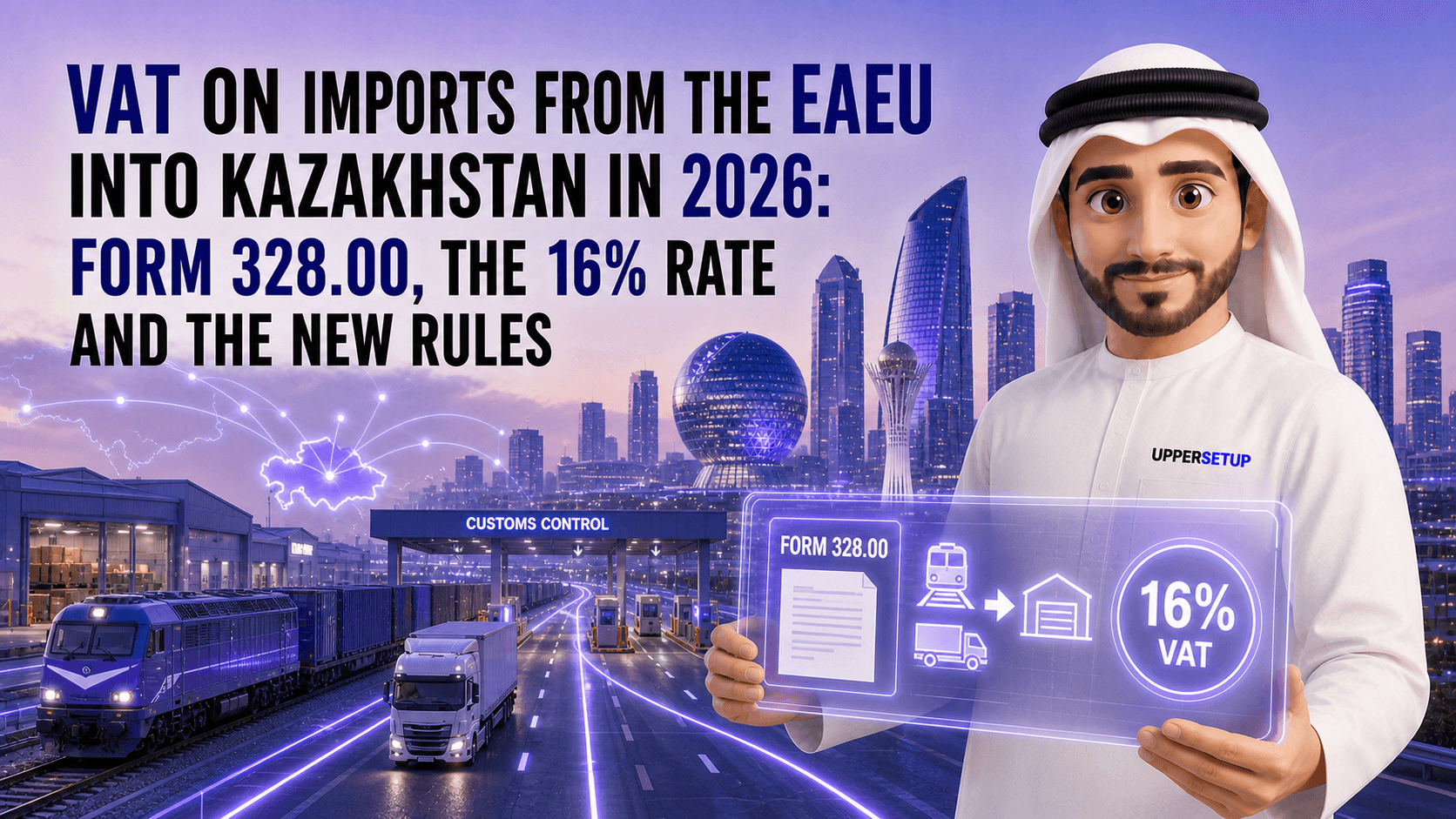
VAT on goods brought into Kazakhstan from an EAEU member state is paid by the importer, not the supplier, and it is paid whether or not the importer is registered for VAT. The standard rate from 1 January 2026 is 16%. The only tax form the importer files is the application on the importation of goods and the payment of indirect taxes — form 328.00. Both the form and the payment fall due on the same date: no later than the 20th of the month following the month in which the goods were taken onto the books.
⚠️ Form 320.00 no longer exists. The declaration on indirect taxes on imported goods was abolished back in 2019, and the new Tax Code No. 214-VIII does not mention it once. Commentary requiring “320.00 to be filed alongside 328.00” describes a regime that is not in force. At the same time, a note in article 278 of the Code of Administrative Offences still refers to a “declaration on indirect taxes” — a legislative remnant, not a live obligation.
Key parameters of EAEU import VAT in 2026
|
Parameter |
Value |
|
Standard VAT rate |
16% — article 503(1) of Tax Code No. 214-VIII |
|
Reduced rate on imported medicines and medical devices |
5% in 2026, 10% from 1 January 2027 — article 503(2) |
|
Reporting form |
328.00, “Application on the importation of goods and the payment of indirect taxes”, version 10, revision 121 of 30.12.2025 |
|
Filing deadline for form 328.00 |
no later than the 20th of the month following the tax period |
|
VAT payment deadline |
no later than the 20th of the month following the tax period |
|
Tax period |
the calendar month in which the goods are taken onto the books |
|
Confirmation by the tax authority |
3 working days where the form is filed electronically only; 10 working dayswhere it is filed on paper and electronically |
|
Curing defects after a reasoned refusal |
15 calendar days from receipt of the refusal |
|
VAT registration threshold |
10,000 MCI = KZT 43,250,000 in 2026 |
|
Monthly calculation index (MCI) for 2026 |
KZT 4,325 |
|
Late payment interest |
1.25 × the National Bank base rate for each day of delay; 0.65 × for a horizontal monitoring participant |
|
Consignment note (SNT) on EAEU import |
issued before the goods cross the State border of Kazakhstan |
EAEU import VAT and customs import VAT are two different machines. On imports from third countries the tax is administered by the customs authorities and paid on customs declaration. On imports from within the EAEU there is no customs declaration at all: the tax is administered by the tax authorities, and the entire procedure is built around form 328.00 and the tax authority’s mark on it.
This guide works through the supranational and domestic layers, the rate and its exceptions, the taxable base together with the new minimum price level mechanism, how and where form 328.00 is filed, recovery of import VAT, exemptions, the offset method, the obligation to issue a consignment note through the Virtual Warehouse module, withdrawal and correction of the application, and administrative liability. For the VAT regime as a whole, see VAT in Kazakhstan 2026: registration, the 10,000 MCI threshold and the 16% rate.
The normative base: two layers of regulation
EAEU import VAT is governed on two layers at once — supranational and domestic — and the subject matter is divided strictly between them. The supranational layer fixes the principle, the confirmation machinery and the exchange of information between tax authorities. The domestic layer fixes the rate, the class of taxpayers, the exemptions, the reporting form and the penalties.
|
Instrument / provision |
Layer |
Subject matter |
|
Treaty on the Eurasian Economic Union of 29 May 2014, articles 71 and 72 |
Supranational |
The destination principle; the bar on taxing imports above the domestic rate |
|
Annex No. 18 to the Treaty — Protocol on the procedure for levying indirect taxes, Section III (paragraphs 13–27) |
Supranational |
How indirect taxes are levied on import: the base, the date of taking onto the books, the 20th-of-the-month deadline, the document list, the amended application |
|
Supranational |
The form of the application on importation, the rules for completing it, electronic exchange between tax authorities |
|
|
Tax Code of Kazakhstan No. 214-VIII of 18 July 2025, chapter 52 (articles 511–533) |
Domestic |
Taxpayers, object, base, exemptions, recovery, calculation and payment, withdrawal and correction of the application |
|
Tax Code No. 214-VIII, article 481 |
Domestic |
The date VAT is taken into recovery, including on EAEU imports |
|
Tax Code No. 214-VIII, article 503 |
Domestic |
VAT rates: 16% and the reduced rates |
|
Tax Code No. 214-VIII, articles 99 and 101 |
Domestic |
The VAT registration threshold and procedure |
|
Tax Code No. 214-VIII, articles 5, 84 and 85 |
Domestic |
Late payment interest: rate, accrual, exclusions |
|
Tax Code No. 214-VIII, article 179 |
Domestic |
The duty to issue a consignment note on import from the EAEU |
|
Order of the Minister of Finance of 28 October 2025 No. 628, Ministry of Justice No. 37237 |
Domestic |
Form 328.00, the rules for filing it, the public service, the withdrawal rules, the forms of reasoned refusal and of notification |
|
Order of the Acting Minister of Finance of 3 November 2025 No. 662, Ministry of Justice No. 37332 |
Domestic |
Rules on exempting EAEU imports from VAT |
|
Order of the Acting Minister of Finance of 31 October 2025 No. 658, Ministry of Justice No. 37326 |
Domestic |
The List of certain types of goods to which a minimum price level applies, and the Rules for determining it; as amended by Order No. 414 of 18 June 2026 |
|
Order of the Acting Minister of Finance of 31 October 2025 No. 657, Ministry of Justice No. 37317 |
Domestic |
The list of goods subject to consignment notes, the forms, the rules for issuing them and their document flow |
|
Order of the Minister of Finance of 12 November 2025 No. 695, Ministry of Justice No. 37390 |
Domestic |
Tax reporting forms with completion notes and the rules for filing them |
|
Code of Administrative Offences No. 235-V of 5 July 2014, articles 269, 272, 275, 278, 283-1 |
Domestic |
Liability |
|
Law of 8 December 2025 No. 239-VIII “On the Republican Budget for 2026–2028”, article 7 |
Domestic |
The MCI for 2026 — KZT 4,325 |
Article 72 of the EAEU Treaty: why the rate is exactly 16%
Article 72(1) states the principle: “Indirect taxes in mutual trade in goods shall be levied on the destination principle, providing for the application of a zero rate of value added tax and/or exemption from excise duties on the export of goods, and for their taxation with indirect taxes on import.”
Article 72(4) hands administration to the tax authorities rather than customs — but with a proviso that matters for excisable goods: “On the import of goods into the territory of one member state from the territory of another member state, indirect taxes shall be levied by the tax authorities of the member state into whose territory the goods are imported, unless otherwise established by the legislation of that member state in respect of goods subject to marking with excise stamps (accounting and control marks, signs).”
Article 72(5) is the provision from which the rate follows: “Rates of indirect taxes in mutual trade on the import of goods into the territory of a member state shall not exceed the rates of indirect taxes applied to similar goods on their sale within the territory of that member state.”
The Treaty therefore does not set the rate — it only forbids exceeding the domestic one. The rate itself is set by paragraph 17 of Annex No. 18: “The amounts of indirect taxes payable on goods imported into the territory of one member state from the territory of another member state shall be calculated by the taxpayer at the tax rates established by the legislation of the member state into whose territory the goods have been imported.”
Amendments to the Tax Code in 2026: what was touched and what was not
Tax Code No. 214-VIII was amended by Law of the Republic of Kazakhstan No. 308-VIII of 11 June 2026, “On amendments to the Tax Code of the Republic of Kazakhstan”, brought into force on 1 July 2026. The amendments are editorial and terminological, and fall into two parts: blanket “throughout the text” substitutions, and targeted changes to individual articles.
The blanket substitutions touched the word “иностранец” (replaced by “иностранный гражданин”), the word “тенге” (replaced by the Kazakh spelling “теңге”) and the designations of the capital and cities of republican significance.
⚠️ The “тенге” → “теңге” substitution formally changed the text of chapter 52 as well — notably article 511(1), which deals with converting values expressed in foreign currency. It does not affect the substance, but strictly speaking chapter 52 cannot be said to be entirely untouched.
No article governing EAEU imports was changed in substance by that law. In the consolidated text of the Code, the targeted footnotes citing Law No. 308-VIII sit at articles 23, 55, 56, 332, 335, 370, 664, 665, 668, 670, 672 and 677. Articles 99, 179, 447, 479, 503, 509, 512, 516, 518, 525, 526, 528, 529, 530, 532 and 533 carry no article-level amendment footnote — they operate in the text enacted on 18 July 2025, subject to the blanket terminological substitution.
No law has amended the Code since 1 July 2026. The consolidated text as at 24 August 2026 carries a single amendment footnote, to Law No. 308-VIII.
⚠️ A caution about legal database mirrors. The adilet.zan.kz portal is closed to automated access, and most accessible mirrors do not state the date to which their text is updated. Whether a provision has been amended should be checked against a version expressly marked “as amended to 1 July 2026” and carrying footnotes citing the amending laws. Texts without footnotes may reproduce the enactment-date version.
Who pays VAT on imports from the EAEU
The taxpayer is the person bringing the goods into Kazakhstan, and that status arises from the act of importation itself rather than from registration. This is the structural difference from domestic supplies.
Article 512 of Tax Code No. 214-VIII identifies two independent classes of EAEU VAT payer:
1) the persons named in article 447(1)(1) — those registered for VAT;
2) persons importing goods into Kazakhstan from the territory of EAEU member states, namely:
|
Category |
Qualification in article 512 |
|
A resident legal entity |
No qualification |
|
A structural subdivision of a resident legal entity |
Where it is a party to the contract; or by decision of the legal entity where the contract makes the subdivision the recipient of the goods |
|
A non-resident legal entity operating through a permanent establishment without opening a structural subdivision |
Registered as a taxpayer with the Kazakh tax authorities |
|
A non-resident legal entity operating through a structural subdivision |
No qualification |
|
A non-resident legal entity operating without forming a permanent establishment |
No qualification |
|
Trust managers |
Importing goods in the course of activity under trust management agreements |
|
Diplomatic and equivalent missions, consular posts |
Including their staff and family members |
|
Persons in private practice |
Notaries, court enforcement officers, advocates, mediators — importing for the purposes of that practice |
|
An individual importing goods for the purposes of entrepreneurial activity |
“The criteria for classifying goods as imported for the purposes of entrepreneurial activity shall be established by the authorised body” |
Sub-paragraphs 1) and 2) of article 512 are alternative and independent. Sub-paragraph 2) contains no reference whatever to registration. The duty to compute EAEU import VAT, declare it on form 328.00 and pay it therefore arises whether or not the importer is registered for VAT.
The rule extends to special regime taxpayers. Article 99(3) expressly removes from the class of persons required to register for VAT a taxpayer applying a special tax regime, a person in private practice, a structural subdivision of a resident legal entity, a state institution and an individual. None of those exclusions relieves anyone of EAEU import VAT.
⚠️ The Code contains no express words “irrespective of registration”. The rule follows from the architecture of articles 447 and 512, which place registered payers and importers in separate sub-paragraphs, and is reinforced by paragraph 13 of Annex No. 18 to the EAEU Treaty, which expressly covers taxpayers applying special tax regimes. It should be stated as a conclusion drawn from the scheme of the provisions, not as a quotation.
The asymmetry most often overlooked
The duty to pay import VAT falls on every importer; the right to recover it belongs only to the registered. Article 480(1) defines the recoverable amount as that recognised as such by “a recipient of goods, works or services that is a value added tax payer registered in the taxpayer database”.
The practical consequence: an unregistered importer — an LLP on the simplified declaration, say — pays the 16% into the budget and carries it into the cost of the goods. A registered importer pays the same 16% and recovers it. On an identical purchase price out of Russia or Belarus, the difference in effective tax burden between those two importers is exactly 16% of the value of the consignment.
That consideration frequently outweighs the benefit of a special tax regime — the comparison is worked through in our guide to Kazakhstan’s special tax regimes 2026.
Imports under commission and agency contracts
Article 529 places the duty to compute and remit import VAT on the commission agent or attorney bringing in the goods: “Where goods are imported into the territory of the Republic of Kazakhstan by a commission agent (attorney) under commission (agency) contracts, the obligation to calculate and remit to the budget the value added tax on the imported goods rests with the commission agent (attorney).”
From there the machinery runs against intuition. The import VAT paid by the commission agent is not recoverable by the commission agent — the Code says so directly: “Value added tax on imported goods paid by the commission agent (attorney) on importing goods into the territory of the Republic of Kazakhstan shall not be taken into recovery by the commission agent (attorney).”
Recovery belongs to the buyer, and it rests on two documents at once: the commission agent’s invoice bearing the supplier status “commission agent” (“attorney”), and a copy of the application on importation carrying the tax authority’s mark. The invoice must state the number and date of the application, and the import VAT must be shown as a separate line.
The date of the taxable import under a commission arrangement is the date the commission agent takes the goods onto the books, and for that purpose “the date of the primary document drawn up by the principal (mandator) in favour of the commission agent (attorney) confirming the transfer of the goods”.
If you are still choosing a form of presence in Kazakhstan for an import business, the options are compared in our guide to the LLP (TOO) in Kazakhstan for foreigners.
The 16% rate and its exceptions
The standard VAT rate in Kazakhstan from 1 January 2026 is 16%, and it applies both to taxable turnover and to taxable imports. Article 503(1) of Tax Code No. 214-VIII: “Unless otherwise established by this article, the value added tax rate shall be 16 per cent and shall apply to the amount of taxable turnover and taxable import.”
|
Category |
Rate in 2026 |
Rate from 2027 |
Applies to imports |
|
General rule |
16% |
16% |
Yes |
|
Medicines |
5% |
10% |
Yes — the provision expressly says “on sale and import” |
|
Medical devices, their components, technical assistive (compensatory) devices |
5% |
10% |
Yes |
|
Medical services |
5% |
10% |
Not applicable — a service, not goods |
|
Domestic periodical printed publications |
10% |
10% |
No — the provision is tied to “turnover on sale” only |
|
Turnover listed in chapter 47 of the Code |
0% |
0% |
Not applicable — export and equivalent turnover |
Article 503(2) is drafted as a calendar ladder: “The value added tax rate shall be, from 1 January 2026, 5 per cent, and from 1 January 2027, 10 per cent.” So in 2026 medicines and medical devices are imported at 5%, and from 1 January 2027 that rate doubles to 10%.
Two carve-outs are made from the reduced rate on medicines, each by cross-reference: article 474(28) and article 479(1)(17). The second matters in practice: article 479(1)(17) covers medicines within the guaranteed volume of free medical care and compulsory medical insurance, and for the treatment of orphan and socially significant diseases, the import of which is exempt from VAT entirely rather than taxed at 5%.
⚠️ The proposition that “all EAEU imports are taxed at 16%” is inaccurate. Medicines and medical devices carry 5% in 2026, and part of the medicines range is exempt altogether. The list of medicines and medical devices attracting the reduced rate is approved by the Government.
How the rate reaches form 328.00
Chapter 52 of the Code contains no rate provision of its own. Article 530(1) refers back to the general regime: “Unless otherwise established by this article, the procedure for calculating and paying value added tax in the EAEU shall be determined in accordance with chapter 51 of this Code” — and article 503 sits in chapter 51. On form 328.00 itself the VAT rate goes in column 18 of section 1, and where an exemption applies the word “льгота” (relief) is entered in that column instead.
How the taxable base is determined
The base for EAEU import VAT is the value of the goods acquired, determined by the transaction price — not a customs value. There is no customs value on an EAEU import, because there is no customs declaration.
Article 518(1): “The amount of the taxable import of goods, including goods that are the result of works performed under a contract for their manufacture, shall be determined on the basis of the value of the goods acquired.”
Article 518(2) introduces the pricing principle: “The principle of determining the price for tax purposes means determining the value of the goods acquired on the basis of the transaction price payable for the goods in accordance with the terms of the contract.”
The supranational basis for that principle is paragraph 18 of Annex No. 18 to the EAEU Treaty: “To ensure that indirect taxes are paid in full, the legislation of the member state regulating the principles of determining the price for tax purposes may be applied.” It is that provision that allows Kazakhstan to operate both the pricing principle and the minimum price level mechanism without breaching its Union obligations.
The decisive rule on a composite contract price is set out in two mirror-image sentences:
• where the value of the goods and the other costs are stated separately in the contract — “the amount of the taxable import shall be exclusively the value of the goods acquired”;
• where they are not stated separately — “the amount of the taxable import shall be the transaction price stated in the contract”.
The practical consequence: the drafting of the contract determines the base directly. Where carriage, insurance and packaging are broken out as separate lines, they fall outside the base. Where the contract names a single global figure, that entire figure becomes the base, logistics included. At 16%, careless drafting on a KZT 10,000,000 contract carrying KZT 1,500,000 of transport costs KZT 240,000 in tax that need not have been paid.
Currency conversion
The conversion rule is not in article 518 — it sits in article 511, which governs the whole of chapter 52. Article 511(1): “For the purposes of this chapter, the value of goods, works and services in foreign currency shall be converted into tenge at the official exchange rate set on the date of the turnover on the sale of goods, works or services, or of the taxable import.”
The supranational rule is drafted the same way. Paragraph 14 of Annex No. 18 to the EAEU Treaty: “For the purposes of determining the tax base, the value of goods… expressed in foreign currency shall be converted into national currency at the rate of the national (central) bank of the member state on the date the goods are taken onto the books.”
⚠️ There is a statute-versus-subordinate-instrument conflict here that is worth knowing about. Article 511 of the Code and paragraph 14 of Annex No. 18 both speak of the rate on the date of the taxable import, that is, on the date the goods are taken onto the books. The completion notes to form 328.00 require column 8 to carry the rate preceding that date. The divergence is explained by the official rate set by the National Bank on a given day taking effect the following day — but on the wording it is a divergence between the Code and the form’s notes. In practice: complete column 8 per the notes, since that is what the form’s validation checks accept, but test the tax base against the article 511 rule.
What else does and does not enter the base
|
Situation |
How the base is determined |
Provision |
|
Ordinary sale and purchase |
The value of the goods acquired at the transaction price |
art. 518(1)–(2) |
|
Excisable goods |
Calculated excise duties are included in the VAT base |
art. 518(3) |
|
Barter and loans in kind |
The contract price; failing that, the price in the shipping documents; failing that, the price in the accounting records |
art. 518(4) |
|
Products of processing of tolling raw materials |
The value of the processing works, including excise on excisable processed products |
art. 518(5) |
|
Leasing with transfer of title |
The portion of the value of the leased asset falling due on the date under article 516(3), excluding the finance charge |
art. 518(6) |
|
Adjustment by the tax authority |
“The tax authorities… shall have the right to adjust the amount of the taxable import in the manner determined by the authorised body, and/or having regard to the requirements of the legislation of the Republic of Kazakhstan on transfer pricing” |
art. 518(7) |
|
Price increase after the month of taking onto the books |
The base is adjusted accordingly |
art. 518(8) |
|
Temporary import followed by re-export without change of properties |
Not a taxable import — but only under leases of movable property and vehicles, and for exhibitions and fairs; it does not extend to vehicles used to supply international carriage services; and if such goods are sold, or remain in Kazakhstan for more than two years, the importation becomes a taxable import |
art. 514(5) |
The minimum price level: a new anti-undervaluation mechanism
Tax Code No. 214-VIII introduced a minimum price level mechanism that did not exist under the previous Code. It is built into article 518(2) — inside the very provision that determines the import tax base — and it operates automatically, without a tax audit.
The construction has three elements.
First: the list and the methodology. “The minimum price level shall be determined by the authorised body in respect of goods included in the list of certain types of goods to which the minimum price level applies, in accordance with the procedure for determining the minimum price level. The list of certain types of goods to which the minimum price level applies, and the procedure for determining the minimum price level, shall be approved by the authorised body in agreement with the authorised body in the field of trade regulation.”
Second: a self-assessment duty. “Where the declared value of an imported good included in the list of certain types of goods to which the minimum price level applies is below the established minimum price level, the taxpayer shall be obliged to pay tax on the difference between those amounts at the rate established by article 503(1) of this Code, within the period provided for by article 530 of this Code.”
Third: the consequence of non-compliance. “Where the tax authority identifies a taxpayer’s failure to comply with the requirement… the amount of the difference between the minimum price level and the declared value of the imported good… shall be charged to the personal account in accordance with the procedure for maintaining the personal account.”
|
Element |
Content |
|
Scope |
Only goods on a list approved by the authorised body in agreement with the trade regulation body |
|
What is compared |
The declared value of the imported good against the established minimum price level |
|
What is charged |
Tax on the difference between the minimum level and the declared value |
|
At what rate |
The article 503(1) rate — that is, 16%, not a reduced rate |
|
By when |
Within the article 530 period — that is, by the 20th of the following month |
|
Who applies it |
The taxpayer itself — the tax authority charges the difference to the personal account only on failure to comply |
Three features distinguish this from an ordinary reassessment.
First, the duty sits with the taxpayer, not the inspector. The provision is drafted as a self-standing obligation — “the taxpayer shall be obliged to pay tax on the difference”. The tax authority acts only where non-compliance is identified.
Second, the rate is fixed at 16%. The provision cross-refers specifically to article 503(1), not to article 503 as a whole. The difference on a listed good is therefore taxed at the standard rate; the reduced rates in paragraph 2 do not follow it across.
Third, the charge goes straight to the personal account. This is not the outcome of an audit with a report and a notice, but an entry on the personal account under the personal account maintenance rules.
The list is in force, and has already been widened
The List of certain types of goods to which a minimum price level applies, and the Rules for determining the minimum price level, are enacted by Order of the Acting Minister of Finance of the Republic of Kazakhstan of 31 October 2025 No. 658, registered with the Ministry of Justice on 3 November 2025 under No. 37326 and in force from 1 January 2026. The order is made “in accordance with paragraph 2 of article 518 of the Tax Code of the Republic of Kazakhstan” and enacts two annexes: annex 1, the List itself, and annex 2, the Rules for determining the minimum price level.
The List has already been amended. By Order of the Minister of Finance of 18 June 2026 No. 414, “On amending the order of the Acting Minister of Finance of the Republic of Kazakhstan of 31 October 2025 No. 658”, registered with the Ministry of Justice on 22 June 2026 and in force from 6 July 2026, the List was restated in a new edition.
|
Parameter |
Value |
|
Original edition of the List |
In force from 1 January 2026, Order No. 658 |
|
Current edition of the List |
In force from 6 July 2026, Order No. 414 |
|
Section 1 of the List |
Goods produced in the territory of Kazakhstan — 76 items |
|
Section 2 of the List |
Goods not produced in the territory of Kazakhstan — 13 items |
|
Total items |
89 EAEU commodity codes |
|
How goods are identified |
By EAEU commodity code alone |
⚠️ The mechanism is live, and its reach widened materially on 6 July 2026. An importer must check the commodity code of every imported item against the current edition of the List, and the minimum levels themselves against the value current for the quarter: the Rules for determining the minimum price level contemplate levels being set periodically, so a check against a six-month-old edition offers no protection.
What this means for contract drafting. Understating the contract price with an EAEU supplier is a familiar way of reducing import VAT, precisely because there is no customs valuation control here at all. The minimum price level mechanism closes that gap, and closes it at the level of the statute rather than subordinate legislation: the list is approved by order, but the duty to top up the tax is imposed by the Code.
An import contract also sits inside the currency perimeter alongside the tax one: contract registration numbers and the repatriation requirement are covered in currency control in Kazakhstan 2026.
The date of taking onto the books: when the obligation arises
The import VAT obligation attaches neither to the date the border is crossed nor to the date the supplier is paid, but to the date the goods are taken onto the books. That date determines the tax period, the exchange rate and, in consequence, the deadline for form 328.00.
Article 516(2): “Unless otherwise established by this article, the date of the taxable import shall be the date on which the taxpayer takes the imported goods onto its books.”
The Code then defines that date through two alternatives:
1) “the earliest of the dates of recognition (recording) of such goods in the accounting records in accordance with international financial reporting standards and/or the requirements of the legislation of the Republic of Kazakhstan on accounting and financial reporting”;
2) the date the goods are brought into the territory of the Republic of Kazakhstan.
A third paragraph closes the rule, and it inverts the intuition: “Where the taxpayer has both of the dates specified in sub-paragraphs 1) and 2) of part two of this paragraph, the date the imported goods are taken onto the books shall be the later of those dates.”
In other words, “the earliest of” in sub-paragraph 1) governs only the dates of recognition within the accounting records. As between accounting recognition and the date of physical importation, the choice falls on the later of the two.
The practical consequence. Goods that crossed the border on 28 March and were recognised in the books on 2 April are taken onto the books on 2 April, not 28 March: the tax period is April, and form 328.00 and payment fall due on 20 May. The reverse case works the same way: goods recognised in the books on the supplier’s documents on 28 March and physically imported on 2 April also give 2 April.
|
Event |
Does it affect the date of taking onto the books? |
|
Crossing the Kazakh border |
Yes — as one of the two alternatives; where both dates exist, the later prevails |
|
Recording the goods in the accounts |
Yes — as the earliest date of recognition |
|
Paying the supplier |
No |
|
Receiving the supplier’s invoice |
No |
|
The tax authority’s mark on form 328.00 |
No — a subsequent event |
|
Issuing the consignment note |
No — the note is issued earlier, before the border is crossed |
The tax period is a calendar month. Article 530(6): “The tax period for calculating and paying indirect taxes on the import of goods… shall be the calendar month in which such imported goods are taken onto the books or in which the payment date provided for by the leasing contract falls. Performance of the tax obligation within the tax period is permitted.”
That last sentence allows early payment without waiting for the 20th of the following month. But early payment does not accelerate the right to recover the tax — as set out below.
Form 328.00: what it is and what enacted it
Form 328.00, the “Application on the importation of goods and the payment of indirect taxes”, is the only tax form an EAEU importer files, and at the same time the document on which the exporter in the other member state substantiates its zero rate. That dual function is the key to the whole procedure.
The form is enacted by Order of the Minister of Finance of the Republic of Kazakhstan of 28 October 2025 No. 628, registered with the Ministry of Justice on 28 October 2025 under No. 37237 and brought into force on 1 January 2026.
The order is made “in accordance with part four of paragraph 4 of article 49, part three of paragraph 3 of article 115, paragraph 7 of article 530, paragraph 6 of article 532 and paragraph 5 of article 549 of the Tax Code of the Republic of Kazakhstan and with sub-paragraph 1) of article 10 of the Law of the Republic of Kazakhstan ‘On Public Services’”. The order carries nine annexes in total: eight that enact instruments and a ninth listing what is repealed.
|
No. |
What is enacted |
|
1 |
Form 328.00 with notes on its completion |
|
2 |
Rules on filing the tax report “Application on the importation of goods and the payment of indirect taxes (form 328.00)” |
|
3 |
Rules on providing the public service “Acceptance of an application on the importation of goods and the payment of indirect taxes” |
|
4 |
Rules on withdrawing an application on the importation of goods and the payment of indirect taxes |
|
5 |
The form of the application to withdraw the tax report |
|
6 |
Rules on confirmation by the state revenue authorities of payment of VAT and excise by affixing a mark or issuing a reasoned refusal |
|
7 |
The form of reasoned refusal to confirm payment of indirect taxes |
|
8 |
The form of notification confirming payment of indirect taxes |
Order No. 628 repealed three instruments, and all three are procedural rather than form-creating: Order of the Minister of Finance of 6 February 2018 No. 133 approving the Rules on withdrawing an application on importation (Ministry of Justice No. 16414); sub-paragraph 2) of paragraph 1 of the Order of 31 March 2021 No. 276 (Ministry of Justice No. 22468); and the Order of 4 May 2021 No. 425 approving the Rules on confirming payment of VAT and excise (Ministry of Justice No. 22690).
⚠️ Order No. 628 did not repeal “the previous order on form 328.00”. It consolidated the form and three procedural blocks into a single instrument. Commentary saying otherwise misstates the chain of instruments.
The current template, published by the State Revenue Committee on its page of tax reporting forms for 2026, is version 10, revision 121, dated 30 December 2025.
Form 320.00 does not exist
The declaration on indirect taxes on imported goods (form 320.00) has been abolished and is not filed in 2026. The State Revenue Committee published a notice headed “Filing of form 320.00, the ‘Declaration on indirect taxes on imported goods’, is abolished” as long ago as 14 March 2019.
Three independent confirmations that the form is still gone:
1. The list of tax reporting forms for 2026 on the State Revenue Committee’s site does not include form 320.00.
2. Order of the Minister of Finance of 12 November 2025 No. 695, which enacts the tax reporting forms for 2026 together with the rules for filing them, contains no occurrence of “320.00” at all, nor of the phrase “indirect taxes”.
3. Chapter 52 of Tax Code No. 214-VIII does not use the concept of a “declaration on indirect taxes”. Article 530(2) requires only the application on importation, with supporting documents attached.
⚠️ A remnant that causes confusion. Note 2 to article 278 of the Code of Administrative Offences still provides that where a person is penalised for understating indirect taxes in an application on importation, “such person shall not be separately liable to administrative penalty for understating those amounts of indirect taxes in the declaration on indirect taxes on imported goods”. That is a reference to an abolished form, surviving because the tidy-up of the Code of Administrative Offences was never completed. Its presence there does not revive any duty to file form 320.00.
Where the idea of two forms comes from in the first place. Paragraph 20 of Annex No. 18 to the EAEU Treaty speaks of a tax declaration: “The taxpayer shall be obliged to submit to the tax authority the relevant tax declaration in the form established by the legislation of the member state… no later than the 20th of the month following the month in which the imported goods were taken onto the books” — with the application on importation listed first among the documents accompanying it. The Union rule therefore contemplates a declaration plus an application, and Russia and Belarus have kept that structure. Kazakhstan took advantage of the fact that the form of the declaration is set by domestic law and abolished it, leaving only the application. That is why the procedure looks different on the counterparty’s side of an EAEU transaction.
The same unfinished tidy-up shows elsewhere in that Code. Note 4 to article 278 cross-refers to “article 742(3)” and “article 297” of the Code “On taxes and other obligatory payments to the budget” — the numbering of the former Tax Code No. 120-VI, not the current No. 214-VIII.
The structure of form 328.00 and who completes what
The application consists of three sections and an annex. Paragraph 2 of the completion notes: “The Application consists of three sections and an annex thereto, intended to record in detail information on the importation of goods and on the calculation of the tax obligation. The first and third sections of the Application and the annex thereto shall be completed by the taxpayer; the second section, by the state revenue authority.”
|
Part of the form |
Completed by |
Content |
|
Section 1 |
The taxpayer |
Details of seller and buyer, of the contract, of the goods, and the computation of the tax obligation (columns 1–20); lines 01–07 |
|
Section 2 |
The state revenue authority |
The mark confirming payment of indirect taxes, exemption or another manner of discharge |
|
Section 3 |
The taxpayer |
Three special cases; lines 08–12 |
|
Annex |
The taxpayer |
Completed “where more than three persons take part in the supply of the goods” |
⚠️ The annex is completed by the taxpayer, not the tax authority, and the threshold is more than three persons, not more than two. Both details are routinely stated incorrectly.
Section 3 covers three situations (paragraph 9 of the notes): the seller’s turnover on the sale is not an object of indirect taxation because the place of supply is not the territory of the seller’s member state; the sale is made to the buyer through a commission agent, attorney or agent; and goods are imported from one member state into another under a contract with a taxpayer of a state that is not an EAEU member.
The form also carries three “X” tick-boxes — for a leasing contract, a tolling processing contract, and a contract for the acquisition of goods from an individual who is not a sole trader.
The columns of section 1 of form 328.00
Section 1 of form 328.00 has twenty columns, and the content of columns 2 to 20 is expressly described in the completion notes. The notes themselves begin at the second column (“in column 2 — the name of the goods…”); column 1, the sequence number, is not described there because it needs no explanation. An error in any of the substantive columns is the standard ground for a reasoned refusal to affix the tax authority’s mark.
|
Column |
What goes in it |
|
1 |
Sequence number |
|
2 |
Name of the goods — per the invoice or the transport (shipping) documents |
|
3 |
The ten-digit commodity code under the EAEU Commodity Nomenclature of Foreign Economic Activity |
|
4 |
Unit of measurement |
|
5 |
Quantity of goods |
|
6 |
Value of the goods (works) |
|
7 |
Currency code |
|
8 |
The tenge rate against the currency set by the National Bank of Kazakhstan preceding the date the imported goods were taken onto the books |
|
9 |
The series and number of the transport (shipping) document |
|
10 |
The date of the transport (shipping) document |
|
11 |
The invoice number |
|
12 |
The invoice date |
|
13 |
The date the goods were taken onto the books |
|
14 |
The excise tax base for excisable goods |
|
15 |
The VAT base in tenge — determined under article 518 and including the excise amount from column 19 |
|
16 |
The fixed (specific) excise rate; where relief applies, the word “льгота” |
|
17 |
The ad valorem excise rate — a dash is entered |
|
18 |
The VAT rate; where relief applies, the word “льгота” |
|
19 |
The excise amount |
|
20 |
The VAT amount |
Three details are most often filled in wrongly.
First, the series and number belong to the transport document, not the invoice. The transport document takes a series and number (column 9) and a date (column 10). The invoice takes only a number (column 11) and a date (column 12). There is no “invoice series” anywhere on the form.
Second, the exchange rate is the one preceding the date of taking onto the books, not the rate on that date. The completion notes say so expressly. The supranational rule in paragraph 14 of Annex No. 18 speaks of the rate “on the date the goods are taken onto the books” — the divergence is explained by the National Bank setting a rate that takes effect the following day.
Third, excise enters the VAT base. Column 15 is computed inclusive of the excise from column 19. For excisable goods out of the EAEU — alcohol, tobacco products, petroleum products — this means VAT is computed on a figure that has already been grossed up by excise.
⚠️ Form 328.00 has no column relating to e-invoices or the Virtual Warehouse. A full-text check of Order No. 628 returns no occurrence of “ЭСФ”, “electronic invoice”, “virtual” or “warehouse”. The form uses the concept of an invoice without tying it to the electronic invoicing system. The link between 328.00 and the e-invoice system is organisational, not normative.
How and where form 328.00 is filed
Form 328.00 is filed with the tax authority at the taxpayer’s location or place of residence in one of two modes: on paper and electronically together, or electronically only. Article 530(2) leaves no third option: filing on paper alone, without the electronic form, is not permitted.
Filing channels
Paragraph 3 of the Rules on providing the public service (annex 3 to Order No. 628) lists four channels:
|
Channel |
Detail |
|
Through the service provider |
That is, directly with the state revenue authority |
|
Through the “Government for Citizens” State Corporation |
The public service centres |
|
Through the “electronic government” web portal |
egov.kz |
|
Through informatisation facilities, including the mobile applications of second-tier banks, and the “Taxpayer’s Cabinet” web application |
knp.kgd.gov.kz |
Second-tier bank mobile applications are named in the order expressly — a full filing channel in its own right, not a convenience.
The public service rules also provide for applying through a postal or other communications organisation — that route remains available, though electronic channels have displaced it in practice.
⚠️ The order gives the Taxpayer’s Cabinet address as knp.kgd.gov.kz. The variant “cabinet.kgd.gov.kz” appears nowhere in the order. The SONO client application is likewise not named in Order No. 628, even though the State Revenue Committee publishes its 2026 form templates for SONO.
When the paper copy is mandatory
Four paper copies are not always required — only in two cases. Article 530(3):
1) “by persons importing into the territory of the Republic of Kazakhstan from the territory of EAEU member states goods with exemption from payment of value added tax under article 525(2) of this Code and/or with payment of value added tax by the offset method under article 509 of this Code”;
2) “by a taxpayer where amendments and additions are made to the application on the importation of goods and the payment of indirect taxes provided for by article 533(2) of this Code”.
In every other case the electronic form alone suffices. That brings two separate advantages.
The first — no documents need be attached. Article 530(4): “Where an application on the importation of goods and the payment of indirect taxes is filed electronically only, the documents specified in sub-paragraphs 1) to 7) of part two of paragraph 2 of this article shall not be filed.”
The second — confirmation arrives three times faster. Three working days against ten.
What happens to the paper copies
Paragraph 12 of the completion notes: “Where the Application is filed on paper, one copy remains with the state revenue authority and three copies are returned to the taxpayer bearing the state revenue authority’s mark as to payment of the indirect taxes (exemption or another manner of payment) in section 2 of the Application. The taxpayer shall then send two copies of the Application bearing the state revenue authority’s mark to the taxpayer of the member state from whose territory the goods were exported.”
This is the mechanism by which the counterparty substantiates its export. A supplier in Russia, Belarus, Armenia or Kyrgyzstan receives two marked copies from the Kazakh buyer and uses them to substantiate its own zero rate. Where the filing is electronic, the same function is performed by the exchange between tax authorities under the Protocol of 11 December 2009.
⚠️ What this means for supplier negotiations. The Kazakh importer’s duty to hand over copies of the application is a supranational rule (paragraph 6 of the completion rules, annex 2 to the Protocol of 11 December 2009), not a contractual term. But the supplier’s zero rate depends on its performance, so suppliers frequently write a delivery deadline and a penalty for delay into the contract. Such terms are valid and enforceable like any other.
Documents attached to the application
Where form 328.00 is filed on paper and electronically, seven groups of documents listed in article 530(2) of the Tax Code accompany it. Where it is filed electronically only, they are not filed at all.
|
No. |
Document |
Qualification in the provision |
|
1 |
A bank statement confirming actual payment of the indirect taxes, and/or another payment document |
Or documents confirming exemption from VAT, having regard to article 525 |
|
2 |
Shipping and/or other documents confirming movement of the goods from one EAEU member state into Kazakhstan |
Not filed where, for particular modes of movement, no such document is required |
|
3 |
Invoices drawn up on shipment under the law of the EAEU member state |
Where that state’s law requires no invoice, or where the goods were acquired from a taxpayer of a non-EAEU state, another seller’s document confirming the value is filed instead |
|
4 |
The contracts under which the goods were acquired |
For leasing — leasing contracts; for loans in kind — loan contracts; contracts for the manufacture of goods; tolling processing contracts |
|
5 |
An information notice |
For multi-party supply chains |
|
6 |
Commission, mandate and agency contracts |
Where the transaction is so structured |
|
7 |
Contracts for commission supplies |
— |
The first item carries two exceptions written into the provision itself. The bank statement and payment documents are not filed “where another manner of paying value added tax applies”, nor “where there is an overpayment on the personal accounts for value added tax on imported goods which is to be offset against forthcoming payments” — provided the taxpayer has not applied to offset those amounts against other taxes or to refund them to its bank account.
For leasing, the document deadline tracks the lease payment rather than the general date: they are filed “by the deadline for the lease payment provided for by the leasing contract falling within the reporting tax period”.
The tax authority’s mark: deadlines and refusal
The tax authority’s mark on form 328.00 is what the entire procedure exists to produce. Without it there is no recovery of import VAT, and the exporting counterparty cannot substantiate its zero rate.
|
Filing mode |
Confirmation deadline |
Form of confirmation |
Refusal deadline |
|
Electronically only |
3 working days from receipt of the application |
An electronic notification confirming payment of the indirect taxes |
3 working days, reasoned refusal in electronic form |
|
On paper and electronically |
10 working days from receipt of the paper application |
A mark on the application itself |
10 working days, reasoned refusal on paper |
Article 530(7): “For applications filed on paper and in electronic form, confirmation of payment of value added tax shall be made by the tax authority within ten working days from the date the paper application is received, by affixing the appropriate mark on that application. For applications filed under paragraph 4 of this article, confirmation of payment of value added tax shall be made by the tax authority within three working days from the date the application is received in electronic form by sending the taxpayer a notification confirming payment of the indirect taxes in electronic form.”
⚠️ The three-day period applies not to any electronic filing but only to a filing “under paragraph 4” — that is, electronically only. Where the taxpayer has filed both a paper copy and an electronic file — mandatory for exemptions under article 525(2) and for the offset method under article 509 — the ten-day period applies.
Fifteen calendar days follow a reasoned refusal. Article 530(9): “In the cases specified in paragraph 8 of this article, the taxpayer shall be obliged to file with the tax authority an application on the importation of goods and the payment of indirect taxes with the defects cured, within fifteen calendar days of receipt of the reasoned refusal.”
Note the nature of that period. The fifteen days run from receipt of the refusal, not from the 20th. If the refusal arrives on, say, the 25th, the resubmission is due by the 9th of the following month — already outside the general deadline. Missing the original deadline is not thereby forgiven: interest runs from the statutory payment date, not from the date the defects are cured.
The forms of reasoned refusal and of confirming notification are enacted separately, as annexes 7 and 8 to Order No. 628.
Recovering import VAT: when the right arises
The date of recovery is fixed by a provision of its own — article 481, “Date of taking value added tax into recovery” — and its rule has two limbs: the date of payment into the budget, but not earlier than the 20th of the month following the tax period.
Article 481(2)(2): the recoverable tax is accounted for in the tax period in which falls “the date of payment into the budget, including by way of offsets under articles 122 and 123 of this Code, but not earlier than the 20th of the month following the tax period determined by article 530(6) of this Code for which that tax was calculated — on the import of goods from the territory of an EAEU member state”.
The rule cuts both ways. Paying early does not accelerate recovery: the floor is the 20th of the month following the month the goods were taken onto the books. Paying late defers it: tax on a September import paid in November is recovered in November, not October.
The second paragraph of article 526(2) confirms the link to the period of payment: amounts of tax paid in the current tax period are recoverable in the current tax period.
Article 526(1): “Unless otherwise established by this article, value added tax shall be taken into recovery in the manner determined by chapter 49 of this Code.”
Article 526(2): “On the import of goods into the territory of the Republic of Kazakhstan from the territory of EAEU member states, the amount of value added tax on the imported goods paid in the established manner into the budget of the Republic of Kazakhstan, within the limits of the calculated and/or assessed amounts, shall be taken into recovery.”
The words “within the limits of the calculated and/or assessed amounts” cap the recovery. An overpayment of import VAT is not recoverable — it remains an overpayment on the personal account and, as article 530(2) indicates, may be offset against forthcoming import VAT liabilities.
The document supporting recovery is named in article 480(7)(1): “in the case of the import of goods — the goods declaration… or the application(s) on the importation of goods and the payment of indirect taxes, but not exceeding the amount of tax paid into the budget of the Republic of Kazakhstan and not subject to refund”.
Article 480(9) forecloses double recovery: “Where several grounds exist for taking amounts of value added tax into recovery… the amount of value added tax shall be taken into recovery once, on the earliest ground.”
Who cannot recover
Article 480(1) defines the recoverable amount as that recognised as such by a recipient of goods, works or services “that is a value added tax payer registered in the taxpayer database, … where they are used or will be used for the purposes of taxable turnover on sale”.
Two cumulative conditions therefore govern recovery: VAT registration and use of the goods for taxable turnover. An unregistered importer fails the first; an importer bringing goods in for exempt activity fails the second.
⚠️ Paying early does not bring recovery forward. Article 530(6) permits the tax obligation to be discharged within the tax period, but article 481(2)(2) sets a hard floor at the 20th of the month following the tax period. VAT paid on the 5th of the month of importation cannot be recovered that month.
Where import VAT sits in the wider Kazakh tax structure is set out in our overview of Kazakhstan’s tax system 2026.
Exemptions from VAT on EAEU imports
The list of exempt EAEU imports is built on a cross-reference: article 525 does not itself enumerate the goods but points to article 479. Article 525(2): “The import of the following goods shall be exempt from value added tax: 1) those provided for by sub-paragraphs 1), 2), 4) to 8) and 10) to 18) of paragraph 1 of article 479 of this Code. The procedure for exempting from value added tax the import of goods within the EAEU referred to in this sub-paragraph shall be determined by the authorised body.”
|
Article 479(1) sub-para |
What is exempt |
Evidential condition |
|
1) |
Banknotes and coins of national and foreign currency (other than those of cultural or historical value), and securities |
— |
|
2) |
Raw materials for producing banknotes, imported by the National Bank and its organisations |
National Bank confirmation of the intended use |
|
4) |
Goods for the official use of diplomatic and equivalent missions and consular posts, and for the personal use of their staff and family members |
Confirmation of importation by the mission or consular post |
|
5) |
Goods placed under a customs procedure providing for exemption from taxes |
Customs declaration |
|
6) |
Space objects and ground space infrastructure equipment |
Confirmation by the authorised body for space activity |
|
7) |
Investment gold imported by the National Bank, a second-tier bank or a professional securities market participant |
— |
|
8) |
Objects of religious purpose imported by registered religious associations |
The list and the criteria for it are approved by the Government |
|
10) |
Unprocessed precious metals, precious metal scrap and waste, and raw materials containing precious metals |
Import by a person on the list of precious metal producers; used exclusively in producing refined gold for sale to the National Bank |
|
11) |
Goods imported by Astana Hub participants |
Three cumulative conditions, including inclusion in a list approved by the authorised body for informatisation |
|
12) |
Goods imported by an operator in the field of official development assistance |
Under an official development assistance programme |
|
13) |
Goods other than excisable ones imported as humanitarian aid |
Three documents, including the sender’s document identifying the goods as humanitarian aid |
|
14) |
Goods other than excisable ones imported through the channels of states, governments or international organisations for charitable assistance or technical assistance |
Four documents, including a copy of the technical assistance project |
|
15) |
Goods imported using grant funds from states, governments and international organisations |
Four documents, including confirmation by the grant beneficiary |
|
16) |
Technological equipment, components and spare parts under a solid minerals processing agreement |
Three cumulative conditions; exemption for the term of the agreement but no more than five years from its registration |
|
17) |
Medicines within the guaranteed volume of free medical care and compulsory medical insurance, and for treating orphan and socially significant diseases |
The list and the manner of applying the exemption are set by the Government |
|
18) |
Fuel and lubricants used by an aircraft in performing an air carriage |
— |
Two sub-paragraphs of article 479 are outside the cross-reference. Sub-paragraph 3) — individuals’ goods within duty-free allowances — does not apply on an EAEU import, because there is no customs declaration. Sub-paragraph 9) — raw materials and components for vehicles and agricultural machinery in a free warehouse — is reproduced separately, in article 525(2)(3).
Beyond the cross-reference, article 525 carries three exemptions of its own, and the article runs to five paragraphs.
Article 525(2)(2) — warranty servicing: goods “imported under warranty servicing provided for by the contract”. The evidence is the contract providing for warranty servicing, the shipping documents, and a claim and a defect reportconfirmed by the parties to the contract.
Article 525(2)(3) — raw materials and components in vehicles and agricultural machinery placed under the free warehouse procedure or the free customs zone of the “Qyzyljar” special economic zone. This is not a reproduction of article 479(1)(9) but a narrower provision with conditions of its own.
Article 525(4) — the finance charge on a lease: “The finance charge paid by a lessee that is a taxpayer of the Republic of Kazakhstan to a lessor of another EAEU member state under a leasing contract shall be exempt from value added tax.” The provision matters in practice: it confirms that only the capital element of the leased asset enters the taxable import, not the interest element of the payment.
Article 525(5) — the special investment contract: a legal entity that has concluded a special investment contract with the authorised body designated by the Government may apply the VAT exemption on the import of goods forming part of finished products manufactured in a special economic zone or free warehouse, subject to the stated conditions.
How the exemption is applied
The procedure is set by Order of the Acting Minister of Finance of 3 November 2025 No. 662, “On approving the Rules on exempting from value added tax the import of goods within the Eurasian Economic Union”, registered with the Ministry of Justice on 3 November 2025 under No. 37332 and in force from 1 January 2026.
The order is made “in accordance with part two of sub-paragraph 1) of paragraph 2 of article 525 of the Tax Code of the Republic of Kazakhstan”. Paragraph 2 of the Rules: “The import of goods into the territory of the Republic of Kazakhstan from the territory of EAEU member states shall be exempt from value added tax upon filing an application on the importation of goods and the payment of indirect taxes with the state revenue authority, together with the relevant documents provided for by these Rules.”
⚠️ The exemption does not remove the duty to file form 328.00 — on the contrary, it is delivered through that form. But the exemption pushes the filing into the “heavy” mode: article 530(3) requires four paper copies plus the electronic form, so neither the relief from attaching documents nor the three-day confirmation period applies. In column 18 the word “льгота” replaces the rate.
Use for a different purpose
The exemption is conditional on the intended use, and departing from that purpose brings the tax back. The closing paragraph of article 479(1): “The goods referred to in this paragraph shall be used for the purposes in respect of which the exemption from value added tax was granted. Where such goods are used for other purposes, value added tax on the imported goods shall be payable with interest accruing from the deadline established for payment of the tax on imported goods at the time of their importation.”
Article 525(3) contains the parallel EAEU rule: “Where goods previously imported into the territory of the Republic of Kazakhstan are used for purposes other than those in connection with which… the exemption from import value added tax was granted, value added tax on the import of such goods shall be payable on the last date of the period established by this Code for payment of value added tax on the importation of the goods.”
The practical point: interest is computed retrospectively, from the deadline that fell in the month of import, not from the date the goods were misapplied. Where the breach surfaces two years later, two years of interest have accrued.
The offset method: importing without actually paying VAT
Article 509 of Tax Code No. 214-VIII is devoted exclusively to EAEU imports — as its full title makes clear: “Payment of value added tax on goods imported into the territory of the Republic of Kazakhstan from the territory of EAEU member states by the offset method”. The mechanism allows goods to be imported without any VAT actually being paid into the budget, the tax being shown simultaneously as charged and as recovered.
The key limitation on eligibility: the offset method is open only to “value added tax payers specified in sub-paragraph 1) of paragraph 1 of article 447 of this Code” — that is, only to persons registered for VAT. An importer on a special regime cannot use it.
Nine categories of goods
|
No. |
Goods |
|
1 |
Equipment |
|
2 |
Agricultural machinery |
|
3 |
Road freight rolling stock |
|
4 |
Helicopters and aircraft |
|
5 |
Sea-going vessels |
|
6 |
Railway locomotives and wagons |
|
7 |
Spare parts for the goods in sub-paragraphs 2)–6) |
|
8 |
Breeding animals and artificial insemination equipment |
|
9 |
Live cattle |
The list of specific goods and the procedure for compiling it are approved by the Government of Kazakhstan. The inclusion criterion is stated in the provision itself: “goods whose production does not exist in the territory of the Republic of Kazakhstan shall be included in that list”. For breeding animals and live cattle the criterion differs: goods “which do not cover the needs of the Republic of Kazakhstan”.
Three conditions of use
Article 509(2) permits the offset method for goods brought in by a registered VAT payer:
1) “not intended for onward sale or for transfer under an international financial lease”; 2) “for the purpose of transfer under a financial lease, other than an international financial lease”; 3) spare parts (sub-paragraph 7) “used in the production of agricultural machinery included in the list established by the authorised body for agro-industrial development in agreement with the central authorised body for state planning and the authorised body”.
The mandatory holding period and its breach
Where the article 509(2) conditions are breached during the mandatory holding period, VAT becomes payable with interest running from the deadline set for paying VAT on the importation of goods.
|
Category of goods |
Mandatory holding period |
|
Imported goods (other than poultry) |
Five years from the date of importation into Kazakhstan |
|
Poultry |
18 months from the date of importation |
Three situations do not count as a breach, and the provision lists them expressly:
• forced slaughter of breeding animals and live cattle, sale of the resulting meat and meat products, and loss (death) within natural wastage norms — the slaughter procedure and the norms being approved by the authorised body for agro-industrial development;
• deregistration for VAT after the date the imported goods were taken onto the books;
• disposal (write-off) of the goods following an accident, wreck or malfunction, supported by a document confirming that they cannot be restored.
The second exception matters in practice. A company that imported equipment under the offset method and later deregistered for VAT does not lose the relief — provided the deregistration came after the date the goods were taken onto the books.
How the offset method appears in the returns
The offset method is not computed on form 328.00. Article 509(5): “The amount of value added tax paid by the offset method shall be shown in the value added tax return simultaneously as charged and as recovered” — that is, on form 300.00, not 328.00.
Form 328.00 goes into the “heavy” mode under the offset method. Article 530(3) expressly lists the offset method among the cases requiring four paper copies plus the electronic form. In addition, article 509(3) requires the taxpayer to file together with the application on importation: the documents under article 530(2) and “documents describing the main technical and commercial characteristics of the goods, enabling the goods to be classified to a specific commodity sub-heading of the EAEU Commodity Nomenclature of Foreign Economic Activity” and, where necessary, “photographs, drawings, blueprints, product passports, samples, specimens of the goods and other documents”.
Article 509(4) preserves excise: “The importation of the goods specified in paragraph 1 of this article shall be effected without actual payment of value added tax, provided that excise duties on excisable goods are paid in the established manner.” The offset method removes the actual VAT payment, not the excise.
Article 509(6) adds a companion relief: “Turnover on the sale of the goods specified in paragraph 1 of this article, on which value added tax has been paid by the offset method, shall on transfer under a financial lease be exempt from value added tax.”
Article 509(7) extends the mechanism to leasing: the article also applies to goods imported under leasing contracts “in respect of the amount of value added tax attributable to the lease payment provided for by the leasing contract, excluding the finance charge”.
⚠️ The offset method is neither a deferral nor an instalment plan. No tax is paid at all, but the condition remains five years of the intended use. Selling the equipment three years after importation restores the tax in full, with three years of interest. On equipment worth KZT 100,000,000 that is KZT 16,000,000 of tax plus interest accrued at 1.25 times the National Bank base rate for every day.
Consignment notes and the Virtual Warehouse: the duty people discover at the border
On import from the EAEU into Kazakhstan the consignment note is issued before the goods cross the State border, and it is a free-standing obligation with no connection to the form 328.00 deadline. A breach surfaces at the crossing point, not a month later on desk review.
Article 179(2) of Tax Code No. 214-VIII: “The obligation to issue consignment notes for goods arises within the following periods: … 2) on the importation of goods into the territory of the Republic of Kazakhstan from the territory of EAEU member states — before the State border of the Republic of Kazakhstan is crossed.”
The subordinate instrument in force is Order of the Acting Minister of Finance of 31 October 2025 No. 657, registered with the Ministry of Justice on 31 October 2025 under No. 37317 and in force from 1 January 2026. Paragraph 1 of the order enacts four annexes: the List of goods subject to consignment notes; the Rules on issuing consignment notes and their document flow; the form of the consignment note; and the printed form used for road transit carriage. Paragraph 2 repeals the instruments listed in annex 5 — the order therefore has five annexes in total.
Order No. 657 repealed thirteen instruments, listed in its annex 5. The principal one is the Order of the First Deputy Prime Minister — Minister of Finance of 26 December 2019 No. 1424 (Ministry of Justice No. 19784); the remainder are the instruments that amended it between 2020 and 2025, including Orders No. 379 of 13.04.2020, No. 615 of 19.06.2020, No. 1006 of 14.10.2020, No. 253 of 26.03.2021, No. 401 of 13.04.2022 and individual paragraphs of orders from 2021 to 2025, down to paragraph 2 of the Order of 20.06.2025 No. 312.
⚠️ Commentary citing Order No. 1424 of 26 December 2019 as current is reproducing a repealed instrument.
The key point: on EAEU imports the note covers all goods
This is the most underappreciated feature of the regime. Paragraph 14 of the Rules lists the cases in which a consignment note is required, and the sub-paragraphs for domestic movement cross-refer to the List of goods, while the sub-paragraph for EAEU imports does not:
“14. A consignment note shall be issued: 1) on the movement, sale and/or shipment within the territory of the Republic of Kazakhstan of the goods specified in rows 1, 2, 3, 4, 5 and 6 of the List of goods; 2) on the sale within the territory of the Republic of Kazakhstan of the goods specified in row 7 of the List of goods; 3) on the importation of goods into the territory of the Republic of Kazakhstan from the territory of EAEU member states, other than the importation of goods in a passenger vehicle whose maximum permitted load capacity does not exceed 2.5 (two thousand five hundred) tonnes; …”
The consequence: the duty to issue a consignment note on an EAEU import arises for any goods, whether or not they appear on the List.
⚠️ A drafting defect in the passenger-vehicle carve-out itself. The Rules speak of a load capacity “not exceeding 2.5 (two thousand five hundred) tonnes”: the figure and the words spelling it out do not agree — 2.5 tonnes is 2,500 kilograms, not two thousand five hundred tonnes. This is a drafting defect in the order, not an error of reproduction. In substance the threshold is 2.5 tonnes.
When a consignment note is nevertheless not required
There is more than one exception, and they sit in paragraph 15 rather than paragraph 14. Beyond the carve-out inside paragraph 14 for importation in a passenger vehicle up to 2.5 tonnes, paragraph 15 takes the following outside the duty:
|
Case under paragraph 15 of the Rules |
Comment |
|
Retail sales settled in cash, by payment card or by electronic money |
A general exception, unconnected with importation |
|
Retail sales of fuel at filling stations |
— |
|
Importation from non-EAEU states, and from EAEU member states through trunk pipelines and/or power transmission lines |
Directly relevant to imports |
|
Returnable packaging |
With qualifications |
|
Movement of goods within a single person between premises at one address |
— |
|
Importation from EAEU member states where the place of commencement of carriage is the territory of a non-EAEU state |
The transit scenario |
|
Importation from EAEU member states of goods for the personal use of individuals |
Draws the line between household and business importation |
⚠️ The claim that “the only exception is a passenger vehicle up to 2.5 tonnes” is wrong. It describes only the carve-out inside paragraph 14(3) and ignores the free-standing list of exceptions in paragraph 15.
The Virtual Warehouse
The Virtual Warehouse is a module of the electronic invoicing information system. Paragraph 3(2) of the Rules: “the virtual warehouse is a module of the electronic invoices information system… intended to ensure the automatic operation of the goods traceability mechanism”.
Paragraph 7 of the Rules sets the procedure: “A consignment note shall be issued electronically in the e-invoice system, save in the case specified in paragraph 43 of these Rules, where it is to be issued on paper. A consignment note shall be issued by the supplier (on importation, by the recipient) in the prescribed form… through the ‘Virtual Warehouse’ module. For the goods specified in rows 8 and 9 of the List of goods, a consignment note shall be issued without using the ‘Virtual Warehouse’ module.”
On import the note is issued by the recipient, not the supplier — an express parenthesis that inverts the usual logic: on domestic movement the consignor issues it.
Paragraph 9 of the Rules: “On the importation of goods into the territory of the Republic of Kazakhstan, the consignment note shall be made out in national currency or in the currency stated in the invoice.”
The closing part of paragraph 16 of the Rules describes the border mark: “On the importation of goods into the territory of the Republic of Kazakhstan from the territory of EAEU member states, or the exportation of goods… by road vehicle or aircraft, an officer of the state revenue authority shall confirm the fact that the State border of the Republic of Kazakhstan has been crossed by affixing the appropriate mark on the consignment note.”
Paragraph 17 governs something different — the recipient’s duty to confirm or reject the note: “The recipient of a consignment note shall, within 10 (ten) calendar days of the note being registered in the e-invoice system, submit through that system the confirmed or rejected note, signed with an electronic digital signature.”
⚠️ The ten-day confirmation window is a free-standing obligation that is routinely overlooked. It is tied neither to the pre-border issuance deadline nor to the 20th-of-the-month deadline for form 328.00, and missing it breaks the traceability chain.
The legal basis of Order No. 657 is wider than the Tax Code. Its preamble cites not only article 179(3) of the Code but also the “Law of the Republic of Kazakhstan ‘On ratification of the Agreement on the mechanism for tracing goods imported into the customs territory of the Eurasian Economic Union’” — the consignment note system is the domestic implementation of the Union’s traceability mechanism.
How the consignment note relates to form 328.00
There is no direct normative link between the consignment note and form 328.00. They are two independent obligations with different deadlines, different addressees and different penalties.
|
Parameter |
Consignment note |
Form 328.00 |
|
Legal basis |
Article 179 of the Code, Order No. 657 |
Article 530 of the Code, Order No. 628 |
|
Who issues it on import |
The recipient |
The importing taxpayer |
|
Deadline |
Before the Kazakh border is crossed |
By the 20th of the following month |
|
Channel |
The “Virtual Warehouse” module of the e-invoice system |
knp.kgd.gov.kz, egov.kz, public service centres, bank applications |
|
Penalty |
Article 283-1 of the Code of Administrative Offences: 5–30 MCI for failure to file or late filing; 20–200 MCI for failure to issue at all |
Article 272 (warning) and article 278 (understatement) |
An indirect link does exist. Article 530(2)(2) requires “shipping and/or other documents confirming the movement of the goods” to accompany the application on importation, and paragraph 2 of the Rules under Order No. 657 defines the consignment note both as a shipping document for controlling the movement of goods and as a primary accounting document. That is the correct way to state the relationship — the note is one of the shipping documents, not something that flows automatically into form 328.00.
Our detailed analysis of the electronic invoicing system and the Virtual Warehouse module is in E-invoices and the Virtual Warehouse in Kazakhstan in 2026.
Withdrawing the application: four grounds and three methods
Article 532 of Tax Code No. 214-VIII provides two routes to withdrawal — self-initiated and by tax application — and three methods of executing it. They must not be conflated: the choice of method determines what happens on the personal account.
Article 532(1): “An application on the importation of goods and the payment of indirect taxes shall be withdrawn from the tax authorities by the taxpayer on its own initiative, or on the basis of a tax application to withdraw a tax report filed by the taxpayer with the tax authority at its location (place of residence).”
When withdrawal is self-initiated
Article 532(2): “Withdrawal of an application on the importation of goods and the payment of indirect taxes shall be effected by the taxpayer on its own initiative where amendments and additions are made to information previously stated in the application… that do not affect the amount of the tax base for calculating the indirect taxes.”
When a tax application is required
Article 532(3) lists three cases:
1) “erroneous filing of an application on the importation of goods and the payment of indirect taxes”; 2) “establishment by the tax authority of the fact that no import of goods took place”; 3) “amendments and additions to information… that affect the amount of the tax base for calculating the indirect taxes, including in the cases provided for by paragraphs 2 and 3 of article 533”.
The provision defines erroneous filing itself: “an application on the importation of goods and the payment of indirect taxes shall be regarded as erroneously filed where this Code imposes no obligation to file such an application”.
The three methods of withdrawal
|
Method |
When it applies |
What happens on the personal account |
|
Deletion |
For applications filed erroneously; for goods returned in full for defective quality and/or completeness; where the tax authority establishes that no import took place |
The application is deleted from the central node of the tax reporting receipt and processing system |
|
Replacement |
Amendments and additions are made by withdrawing the earlier application and simultaneously filing a new one |
The amounts in the withdrawn application are reversed, and the data of the new application are then recorded |
|
Modification |
The application was sent to a tax authority other than the one at the taxpayer’s location (place of residence) |
Reversal followed by recording with the stated amendments |
The reversal is performed by the tax authority at the place of registration — the provision says so expressly for the replacement and modification methods.
When amendments are barred
Article 532(5) bars not withdrawal as such but the making of amendments and additions — the provision reads: “A taxpayer shall not be permitted to make amendments and additions to an application on the importation of goods and the payment of indirect taxes.” Withdrawal by the deletion method (erroneous filing, a full return of the goods, an established absence of importation) falls outside that wording. Two barred periods:
1) “of the audited tax period — during comprehensive audits and thematic audits of value added tax and excise duties named in the audit order”; 2) “of the appealed tax period — during the period for filing and considering an appealagainst a notice of audit results, taking into account any restored appeal period, in respect of the value added tax and excise duties named in the appeal”.
⚠️ Article 532 sets no calendar deadline for withdrawal at all. It sets only the barred periods. Commentary quoting a “withdrawal deadline” is not drawing on the text of the provision.
The withdrawal procedure is detailed in Order No. 628 — annex 4, together with the form of the withdrawal application (annex 5).
Adjusting VAT on returned goods
Article 533 governs one case — the return of goods for defective quality and/or completeness — and the answer turns on whether the return happened before or after the end of the month of importation.
|
Situation |
What to do |
|
Partial or full return before the end of the month in which the goods were imported |
“Information on such goods shall not be included in the application on the importation of goods and the payment of indirect taxes” — the returned goods simply never reach form 328.00 |
|
Partial return after the end of the month of importation |
“Information on such goods shall be included in the application on the importation of goods and the payment of indirect taxes filed in place of the withdrawn application” — withdrawal by the replacement method |
|
Full return after the end of the month of importation |
The application “shall be withdrawn by the deletion method” |
The documents evidencing the return (article 533(4)) form a closed list of four:
1. “a claim agreed between the exporting taxpayer and the importing taxpayer, stating the quantity of imported goods to be returned for defective quality and/or completeness”;
2. “acceptance and transfer acts (where the returned goods are not transported)”;
3. “transport (shipping) documents (where the returned goods are transported)”;
4. “destruction acts (where the goods are destroyed)”.
Copies of those documents “shall be filed with the tax authority on paper together with the documents provided for by sub-paragraphs 1) to 7) of part two of paragraph 2 of article 530”.
⚠️ A cross-reference defect in the Code itself. Article 533(3) refers to “sub-paragraph 1) of paragraph 3 of article 532”, whereas the deletion method sits in paragraph 4, sub-paragraph 1) of article 532; article 532(3) is the list of cases requiring a tax application. The discrepancy is confirmed by comparing the Russian and Kazakh texts on independent mirrors and is a drafting defect, not a mirror’s error. In substance the provision points to article 532(4)(1).
What is not taxed: loss and spoilage
Article 533(5) takes two situations outside the charge:
1) “loss of goods sustained by the taxpayer within the natural wastage norms established by the legislation of the Republic of Kazakhstan”; 2) “spoilage of goods arising from natural and man-made emergencies”.
The Code then defines both: “loss of goods means an event resulting in the destruction or loss of the goods. Spoilage of goods means deterioration of all or particular qualities (properties) of the goods, as a result of which those goods cannot be used for the purposes of taxable turnover.”
Loss in excess of natural wastage norms is not taken outside the charge.
Price increases are governed elsewhere, not by article 533
Article 533 contains no “change of price” case. An increase in the price of imported goods after the month they were taken onto the books is governed by two other provisions:
Article 518(8): “Where the parties to the contract increase the price of imported goods after the end of the month in which those goods were taken onto the books, the amount of the taxable import shall be adjusted accordingly.”
Article 530(10): the application on importation is filed in electronic form “no later than the 20th of the month following the month in which the parties to the contract changed the price of the imported goods”. VAT is payable within the same period under article 530(5).
The mechanics of recording the adjustment are set by the completion notes to form 328.00. The form carries the entry “Adjustment of the values of the indicators stated in the application registered with the tax authority dated ’’ _ 20__ No. __“, with the previous values carried across into columns 2, 3, 4, 5, 7, 8, 9, 10, 11, 12, 13, 16, 17 and 18, and columns 6, 14, 15, 19 and 20 showing the difference between the amended and the previous values.
Liability: which provisions of the Code of Administrative Offences apply
There is no separate provision of the Code of Administrative Offences devoted to EAEU import breaches. The EAEU specifics are built into two existing provisions — articles 278 and 275 — and the second of these carries the heaviest sanction in the whole area.
The numbering of the Code of Administrative Offences did not change when the new Tax Code No. 214-VIII was enacted. Articles 269, 272, 275 and 278 keep their numbers and sit in chapter 16, “Administrative offences in the field of taxation”.
|
Provision |
Offence |
Sanction |
|
272(1) |
Failure to file a tax report on time |
A warning |
|
272(2) |
The same, repeated within a year of a penalty being imposed |
15 MCI — individuals; 30 MCI — private notaries, court enforcement officers, advocates, small businesses, non-profits; 45 MCI — medium businesses; 70 MCI — large businesses |
|
278(1) |
Understating tax in a declaration, computation, or an application on the importation of goods and the payment of indirect taxes |
10 MCI — individuals; 20% of the assessed tax — private notaries, court enforcement officers, advocates, small businesses, non-profits; 50% — medium businesses; 80% — large businesses |
|
275(1) |
Concealing objects of taxation, which is deemed to include failing to take EAEU-imported goods onto the books |
200% of the tax payable on the concealed object |
|
275(2) |
The same, repeated within a year |
300% of the tax on the concealed object |
|
275(5) |
Carrying on turnover during a period of non-registration for VAT |
15% of the turnover during the period of non-registration |
|
269(3) |
Missing the deadline for filing a tax application to register for VAT |
50 MCI = KZT 216,250 in 2026 |
|
283-1(1) |
Failure to file, or late filing of, a consignment note |
5 MCI — individuals; 10 MCI — small businesses and non-profits; 20 MCI — medium businesses; 30 MCI — large businesses |
|
283-1(5) |
Failure to issue a consignment note, and turnover in certain petroleum products or biofuel, or turnover and movement of ethyl alcohol or alcoholic products, without a note |
20 MCI — individuals; 50 MCI — small businesses; 100 MCI — medium businesses; 200 MCI — large businesses. Confiscation reaches only the ethyl alcohol, alcoholic products, certain petroleum products and biofuel that are the subject of the offence, and the income and money obtained through it |
A first late form 328.00 attracts no fine
Article 272(1): “Failure to file a tax report with the state revenue authority within the period established by the laws of the Republic of Kazakhstan shall entail a warning.” A fine arises only on a repeat offence within a year of a penalty being imposed.
That differs materially from the widespread assumption of an immediate fine for a late form 328.00. A fine will indeed follow — but not under article 272 and not for lateness as such. It will come under article 278 if the lateness was accompanied by understatement, or under article 275 if the goods were never taken onto the books at all.
⚠️ A reading trap in article 278(1). The sanction for individuals is expressed in MCI — 10 MCI. For every other class of person it is expressed as a percentage of the assessed tax: 20%, 50% and 80%. The syntax misleads, because the words “twenty… fifty… eighty” attach to “per cent of the assessed amount of taxes”, not to MCI. Misreading it understates the exposure of a large business by orders of magnitude.
The heaviest sanction: note 1 to article 275
Note 1 to article 275: “For the purposes of part one of this article, concealment of objects of taxation shall also be taken to mean a taxpayer’s failure to take onto its books goods imported into the territory of the Republic of Kazakhstan from the territory of Eurasian Economic Union member states.”
What this means in practice. An importer that brought goods in from Russia and did not record them — and therefore filed no form 328.00 and paid no VAT — has not committed a “failure to file” attracting a warning under article 272. It has committed concealment of an object of taxation, carrying a fine of 200% of the tax, rising to 300% on a repeat within a year.
The arithmetic on a KZT 20,000,000 consignment: VAT at 16% is KZT 3,200,000; the article 275(1) fine is KZT 6,400,000; on a repeat, KZT 9,600,000. Plus the tax itself and interest. A first offence therefore costs KZT 9,600,000 before interest — 48% of the value of the consignment.
Note 2 to article 278: the bar on double liability
Note 2 to article 278: “For the purposes of part one of this article, where a person is subject to administrative liability for understating amounts of indirect taxes in an application on the importation of goods and the payment of indirect taxes, that person shall not be separately liable to administrative penalty for understating those amounts of indirect taxes in the declaration on indirect taxes on imported goods.”
As noted earlier, the reference to a declaration on indirect taxes is a remnant of the abolished form 320.00. The principle of single liability for a single understatement nonetheless holds.
Amendments to the Code of Administrative Offences in 2025–2026
|
Provision |
Amendments |
Effect |
|
272 |
No amendments in 2025–2026; the most recent are Laws No. 412-V of 18.11.2015 and No. 122-VI of 25.12.2017 |
The text operates as before |
|
269 |
No amendments in 2025–2026; the most recent are Laws No. 479-V of 29.03.2016 and No. 127-VI of 28.12.2017 |
The text operates as before |
|
278 |
Amended by Law No. 155-VIII of 10.01.2025. The general rule in article 2 of that Law is commencement sixty calendar days after first official publication, that is 18 March 2025 |
The current text already reflects that amendment |
|
275 |
Amended by Law No. 155-VIII of 10.01.2025, but in force only from 1 January 2027 |
The former text operates throughout 2026 |
⚠️ Article 275 gains a new part on 1 January 2027 — but not in the part that concerns imports. Law No. 155-VIII of 10 January 2025 inserts a new part 3-1 into article 275, dealing with a mismatch between officials’ expenditure and their income. Parts 1, 2 and 5 and note 1 on failing to take EAEU-imported goods onto the books are untouched: the 200% and 300% figures continue to apply after 1 January 2027.
Interest on late payment
The rate of late payment interest in Tax Code No. 214-VIII sits not in the interest provision but in the definitions article 5, and is tied not to a refinancing rate but to the National Bank base rate. The term “refinancing rate” does not appear in the new Code at all.
Article 5(2): “interest — sums of money calculated at a multiple of the base rate of the National Bank of the Republic of Kazakhstan in force on each day of delay, and accrued on: the amount of tax and payment to the budget not paid by the taxpayer (tax agent) on time… beginning on the day following the deadline for performing the tax payment obligation, and including the day of payment into the budget.”
The multiple is set in the same provision:
|
Class of taxpayer |
Multiple of the base rate |
|
Horizontal monitoring participant |
0.65 |
|
Other taxpayers (tax agents) |
1.25 |
The 0.65 concession for horizontal monitoring participants is new to Code No. 214-VIII; the previous Code had no equivalent.
The base rate of the National Bank of Kazakhstan as at August 2026 is 16.75% per annum, with a corridor of 15.75–17.75%. The decision was announced on 24 July 2026, but the rate was set with effect from 27 July 2026 — that is the date shown in the National Bank’s official table.
|
Date the rate takes effect |
Rate |
Corridor |
|
26 January 2026 |
18.00% |
17.00–19.00% |
|
10 March 2026 |
18.00% |
17.00–19.00% |
|
27 April 2026 |
18.00% |
17.00–19.00% |
|
8 June 2026 |
17.00% |
16.00–18.00% |
|
27 July 2026 |
16.75% |
15.75–17.75% |
⚠️ The next base rate decision is announced on 4 September 2026, followed by 23 October and 4 December 2026. The interest calculations below are pegged to 16.75% and must be recomputed after each decision.
Interest at the current rate:
|
Measure |
Ordinary taxpayer |
Horizontal monitoring participant |
|
Annual interest rate |
1.25 × 16.75% = 20.9375% |
0.65 × 16.75% = 10.8875% |
|
Daily rate |
≈ 0.0574% |
≈ 0.0298% |
Interest accrues independently of other measures. Article 85(1): “Interest shall be accrued irrespective of the application of other methods of securing performance, enforcement measures and other measures of liability for breach of the tax legislation of the Republic of Kazakhstan.”
Article 85(3) lists nine cases in which interest does not accrue, among them “during a declared state of emergency and/or a declared emergency situation”.
Interest is classified as a method of securing performance of the tax obligation. Article 84(3) names five such methods: accrual of interest; suspension of debit operations; restriction on disposing of property; suspension of the issuance of electronic invoices; and restriction of access to internet resources and internet platforms.
⚠️ Suspension of e-invoice issuance is the most damaging measure for an importer. Unable to issue an electronic invoice, the company can neither sell the goods it has imported nor issue a consignment note through the Virtual Warehouse module for the next consignment. A few hundred thousand tenge of import VAT arrears can halt the whole business.
Where the same EAEU supplier also provides services or transfers rights, a separate withholding agent perimeter applies — it is covered in withholding tax in Kazakhstan 2026.
EAEU imports and the VAT registration threshold
EAEU import VAT does not count towards the turnover that triggers compulsory VAT registration — but the act of importing makes the company a VAT payer regardless of the threshold. The two rules run in parallel and are frequently conflated.
The threshold for 2026 is KZT 43,250,000. Article 99(4)(2): “the turnover threshold is turnover equal to 10,000 times the monthly calculation index in force on 1 January of the relevant financial year”. The MCI for 2026 is set at KZT 4,325 by article 7 of Law No. 239-VIII of 8 December 2025 “On the Republican Budget for 2026–2028”. Hence 10,000 × 4,325 = KZT 43,250,000.
Article 101(1): “Taxpayers whose turnover exceeds the turnover threshold during a calendar year and in the cases provided for by this article shall be subject to compulsory registration as a taxpayer.”
Article 99(3) names five categories not subject to registration at all: a state institution; a structural subdivision of a resident legal entity; a person in private practice; a taxpayer applying a special tax regime; and an individual.
|
Situation |
Must pay EAEU import VAT |
May recover it |
|
An LLP on the general regime, registered for VAT |
Yes |
Yes |
|
An LLP on the simplified declaration, turnover below the threshold |
Yes |
No |
|
A sole trader on a special regime |
Yes |
No |
|
An individual importing goods for entrepreneurial activity |
Yes — expressly named in article 512 |
No |
|
A structural subdivision of a resident legal entity that is a party to the contract |
Yes |
Depends on the legal entity’s own registration |
|
An individual importing goods for personal use |
No — outside article 512 |
Not applicable |
⚠️ The criteria for classifying goods as imported for entrepreneurial purposes are set by the authorised body. Article 512 expressly refers the point out to a subordinate instrument, and without it the line between personal and business importation is a matter of judgement. An individual regularly bringing goods in from Russia or Kyrgyzstan in commercial quantities should assume the business import regime applies.
VAT registration is covered separately in VAT in Kazakhstan 2026: registration and the 10,000 MCI threshold, and the comparison of regimes in our guide to special tax regimes.
A step-by-step algorithm: from contract to recovery
Step 1. Check how the price is drafted in the contract. If carriage, insurance, packaging and other costs are to stay outside the tax base, they must be broken out in the contract as separate amounts. A single global transaction price enters the base in full under article 518(2).
Step 2. Check the commodity code against the minimum price List. The List is enacted by Order No. 658 of 31 October 2025 and operates in the edition set by Order No. 414 of 18 June 2026 — 89 items in two sections. If your goods are on it, a declared value below the minimum level triggers a self-assessed duty to top up the tax on the difference at 16%, within the article 530 deadline.
Step 3. Issue the consignment note before the border is crossed. It is issued by the recipient, through the Virtual Warehouse module of the e-invoice system, in national currency or in the invoice currency. Check the paragraph 15 exceptions — pipelines and power lines, transit beginning outside the EAEU, goods for personal use — as well as the passenger-vehicle carve-out up to 2.5 tonnes. At the border an officer of the state revenue authority will mark the note to confirm the crossing. Watch paragraph 17 separately: the recipient must confirm or reject the note in the e-invoice system within 10 calendar days of its registration.
Step 4. Fix the date of taking onto the books. It is the earliest of the dates the goods are recognised in the accounts, or the date they enter Kazakhstan, and where both exist, the later of the two. The tax period runs from that date; the exchange rate follows the rule set out below.
Step 5. Determine the rate. The general rule is 16%. For medicines and medical devices in 2026 it is 5%; part of the medicines range is exempt outright under article 479(1)(17).
Step 6. Choose the filing mode. Electronic only — where there is no exemption, no offset method and no amendment: no documents are attached, and confirmation comes in 3 working days. Four paper copies plus the electronic form — where there is an exemption under article 525(2), the offset method under article 509, or an amendment under article 533(2): confirmation takes 10 working days.
Step 7. Complete form 328.00. Check column 3 (the ten-digit commodity code), column 8 (the rate preceding the date of taking onto the books), column 9 (the series and number of the transport document), columns 11–12 (the invoice number and date), column 15 (the base inclusive of excise) and column 18 (the rate or the word “льгота”). Where more than three persons take part in the supply, complete the annex.
Step 8. Pay the VAT and file the application by the 20th of the month following the month the goods were taken onto the books. Early payment is permitted but does not bring recovery forward.
Step 9. Wait for the tax authority’s mark or notification. On an electronic filing, a confirming notification within 3 working days; on a paper filing, a mark in section 2 within 10 working days. On a reasoned refusal, cure the defects within 15 calendar days of receiving it.
Step 10. Pass the confirmation to your counterparty. On a paper filing, send the supplier two copies of the marked application — the supplier substantiates its zero rate on them. On an electronic filing the confirmation travels through the inter-authority exchange channel.
Step 11. Recover the tax — in the period in which payment fell due. The application on importation is the supporting document; recovery is taken once, on the earliest ground, and only within the limits of the calculated and assessed amounts. An importer not registered for VAT recovers nothing.
Step 12. On a return or a price change, follow the right route. A return before the end of the month of importation — the goods never enter the form. A partial return afterwards — withdrawal by replacement. A full return afterwards — withdrawal by deletion. A price increase — a fresh electronic application by the 20th of the month following the month the price changed.
Common mistakes and what each one costs
Mistake 1. Assuming only VAT-registered persons pay import VAT. Article 512(2) makes every EAEU importer a taxpayer, including a special regime taxpayer and an individual importing for business purposes. Cost: failing to take the goods onto the books is treated under note 1 to article 275 of the Code of Administrative Offences as concealment of an object of taxation — a fine of 200% of the tax, rising to 300% on a repeat within a year, plus the tax and interest. On a KZT 20,000,000 consignment that is a KZT 6,400,000 fine on a first offence.
Mistake 2. Filing a “declaration on indirect taxes, form 320.00”. The form has not existed since 2019: it is absent from the 2026 list of forms, from Order No. 695 and from chapter 52 of the Code. Cost: no direct loss, but time is spent on a non-existent form while attention is drawn away from the real obligation, form 328.00. The remnant reference to that declaration in note 2 to article 278 creates no duty.
Mistake 3. Stating a single global contract price inclusive of carriage. Article 518(2) separates two cases expressly: costs stated separately stay outside the base; costs not broken out enter it in full. Cost: on a KZT 10,000,000 contract of which KZT 1,500,000 is transport, failing to break the costs out costs KZT 240,000 of unnecessary VAT on every such shipment. Across twelve shipments a year, KZT 2,880,000.
Mistake 4. Using the exchange rate on the date the goods are taken onto the books. The completion notes to form 328.00 require the rate preceding that date. Cost: with a volatile tenge a one-day gap distorts the base, and a discrepancy between the taxpayer’s figures and the tax authority’s is a ground for a reasoned refusal to affix the mark. Without the mark there is no recovery for the importer and no zero rate for the supplier.
Mistake 5. Recovering import VAT in the month of importation. Article 481(2)(2) ties recovery to the date of payment into the budget, but not earlier than the 20th of the month following the article 530(6) tax period. Paying early does not accelerate recovery; paying late defers it. Cost: overstating recovery in the VAT return for the month of importation is an understatement of tax under article 278(1) — 20%, 50% or 80% of the assessed amount depending on the class of person.
Mistake 6. Not issuing a consignment note on import, relying on the List of goods. Paragraph 14(3) of the Rules under Order No. 657 makes no reference to the List: on an EAEU import the note covers any goods, subject to the paragraph 15 exceptions and the passenger-vehicle carve-out up to 2.5 tonnes. Cost: failure to issue a note under article 283-1(5) runs from 20 MCI for an individual to 200 MCI for a large business — KZT 865,000 in 2026. Confiscation under that provision reaches not any goods but only ethyl alcohol, alcoholic products, certain petroleum products and biofuel, together with the income and money obtained through the offence. The breach surfaces at the border, and the consignment stops there.
Mistake 7. Filing the application on paper without the electronic form. Article 530(2) allows only two modes: paper and electronic, or electronic alone. Cost: the application is not treated as filed, the 20th passes, and any subsequent understatement attracts article 278.
Mistake 8. Expecting three-day confirmation on a filing that includes a paper copy. The three-day period applies only to a filing “under paragraph 4” — electronic only. Where an exemption under article 525(2) or the offset method under article 509 applies, paper is mandatory and the period is ten working days. Cost: missed commitments to a counterparty that needs the marked copies to substantiate its zero rate.
Mistake 9. Selling equipment imported under the offset method before five years are up. The mandatory holding period is five years (18 months for poultry), and breaching it restores the tax with interest from the deadline set for paying VAT on importation. Cost: on equipment worth KZT 100,000,000 that is KZT 16,000,000 of tax plus interest at 20.9375% per annum for the whole period since importation. Over three years the interest alone exceeds KZT 10,000,000.
Mistake 10. Withdrawing the application by the wrong method. Deletion applies to erroneously filed applications and to a full return of goods; replacement to amendments affecting the base; modification to filing with the wrong tax authority. Cost: with the wrong method the reversal on the personal account either does not happen or happens incorrectly, and amendments and additions to the application are then barred during a comprehensive or thematic audit and during an appeal (article 532(5)).
Mistake 11. Ignoring the fifteen-day period after a reasoned refusal. Fifteen calendar days run from receipt of the refusal, not from the 20th, and often expire beyond the general deadline. Cost: interest runs from the statutory payment date, not from the date the defects are cured, so it accrues throughout the review.
Mistake 12. Using exempt goods for another purpose. Article 525(3) restores the tax “on the last date of the period established by this Code for payment of value added tax on the importation of the goods”. Cost: interest is computed retrospectively from the month of importation. Where the breach surfaces two years later, two years of interest have run — roughly 42% of the tax at the current base rate.
Who this suits, and when professional review is essential
Who can manage without help
• Companies with regular, homogeneous shipments from a single EAEU supplier, registered for VAT, with no exemptions and no offset method: electronic-only filing, no documents attached, confirmation in three working days.
• Importers of goods carrying neither excise, nor a reduced rate, nor a minimum price level.
• Companies that already run consignment notes through the Virtual Warehouse module for domestic movements.
Who this route does not suit
• Sole traders and LLPs on special tax regimes importing regularly: they pay 16% with no right of recovery. The economics of such imports need recalculating before, not after, electing a special regime.
• Individuals importing in commercial quantities: the criteria for business importation are set by the authorised body, and until they appear the line is a matter of judgement.
• Companies with no access to the Virtual Warehouse module: without a consignment note the consignment cannot lawfully cross the border.
When professional review is essential
First. On imports of excisable goods — alcohol, tobacco products, petroleum products. Excise enters the VAT base (column 15 is computed inclusive of column 19), so an error in the excise computation automatically distorts the VAT.
Second. Where the offset method is used. The five-year holding period, the three carve-outs from breach and the requirement to supply technical documentation supporting the commodity classification make the mechanism error-prone, and the cost of an error is a multiple of the value of the equipment.
Third. Where an article 525 exemption is claimed. Each ground carries its own evidential set, and use for another purpose restores the tax with retrospective interest.
Fourth. On multi-party supplies — where more than three persons take part in the supply, or the sale runs through a commission agent, attorney or agent. Section 3 and the annex to the application must be completed, and the end buyer’s recovery depends on the accuracy of the commission agent’s invoice and on receiving a marked copy of the application.
Fifth. On receiving a reasoned refusal. Fifteen calendar days is a short window, and interest continues to accrue from the original date throughout.
Sixth. When structuring supplies between related parties inside the EAEU. Three mechanisms operate at once here: the minimum price level under article 518(2), the pricing principle in the same paragraph, and the tax authority’s express power under article 518(7) to adjust the amount of the taxable import “in the manner determined by the authorised body, and/or having regard to the requirements of the legislation of the Republic of Kazakhstan on transfer pricing”.
Frequently Asked Questions
Who pays VAT when goods are brought into Kazakhstan from Russia?
The Kazakh importer pays, not the Russian supplier. The Russian supplier applies a zero rate on export, and the duty to compute and pay tax at 16% falls on the recipient of the goods in Kazakhstan. The basis is article 72 of the EAEU Treaty and article 512 of Tax Code No. 214-VIII.
By what date must form 328.00 be filed and the VAT paid?
Both the application and the payment fall on the same date — no later than the 20th of the month following the month in which the imported goods were taken onto the books. This is set by article 530(2) and (5) of the Tax Code and by paragraphs 19 and 20 of Annex No. 18 to the EAEU Treaty.
Is VAT payable on EAEU imports if the company is not registered for VAT?
Yes. Article 512(2) of the Tax Code makes any person importing goods from EAEU member states a taxpayer, irrespective of registration. But the right to recover that tax under article 480(1) belongs only to a registered VAT payer — an unregistered importer carries the tax into the cost of the goods.
Must a form 320.00 declaration be filed alongside form 328.00?
No. Form 320.00, the “Declaration on indirect taxes on imported goods”, has been abolished — the State Revenue Committee announced this on 14 March 2019. It is absent from the 2026 list of tax reporting forms, it is not mentioned in Order of the Minister of Finance No. 695 of 12 November 2025, and chapter 52 of the Tax Code requires only the application on importation.
What VAT rate applies to imported medicines from the EAEU in 2026?
5 per cent. Article 503(2) of the Tax Code sets a rate of 5% from 1 January 2026 and 10% from 1 January 2027 for medicines and medical devices, and the provision expressly extends to imports. Some medicines — those within the guaranteed volume of free medical care and compulsory medical insurance, and for treating orphan and socially significant diseases — are exempt from VAT entirely under article 479(1)(17).
What happens if form 328.00 is filed late?
A first instance of lateness attracts a warning under article 272(1) of the Code of Administrative Offences, not a fine. A fine of 15 to 70 MCI arises only on a repeat within a year. However, where the goods were never taken onto the books at all, note 1 to article 275 applies: that is concealment of an object of taxation, carrying a fine of 200% of the tax, rising to 300% on a repeat.
How is the taxable base computed on an EAEU import?
On the value of the goods acquired, determined by the transaction price under the terms of the contract (article 518(1)–(2)). There is no customs value here, because there is no customs declaration. Where the value of the goods and other costs are stated separately in the contract, only the value of the goods forms the base; where they are not separated, the whole transaction price does.
What exchange rate is used on form 328.00?
The tenge rate against the relevant currency set by the National Bank of Kazakhstan and preceding the date the imported goods were taken onto the books. It goes in column 8 of section 1. The supranational basis is paragraph 14 of Annex No. 18 to the EAEU Treaty.
Is a consignment note required on import from the EAEU?
Yes, and it is issued by the recipient before the State border of Kazakhstan is crossed, through the Virtual Warehouse module of the electronic invoicing system. The duty covers any goods, not only those on the List: paragraph 14(3) of the Rules under Order of the Acting Minister of Finance No. 657 of 31 October 2025 makes no reference to the List. The exceptions sit in paragraph 15 of the same Rules — among them importation through trunk pipelines and power transmission lines, importation where carriage began outside the EAEU, and goods for the personal use of individuals; paragraph 14 separately carves out importation in a passenger vehicle up to 2.5 tonnes.
How long does the tax authority take to mark the application on importation?
Three working days where the application is filed electronically only — a notification confirming payment is then issued. Ten working days where it is filed on paper and electronically — the mark is then affixed in section 2 of the application. The periods are set by article 530(7).
When can import VAT be recovered?
In the tax period in which the date of payment into the budget falls, but not earlier than the 20th of the month following the tax period — as article 481(2)(2) of the Tax Code puts it. Early payment does not accelerate recovery, and late payment defers it to the period of actual payment. The supporting document is the application on the importation of goods and the payment of indirect taxes (article 480(7)(1)).
How is an application on importation withdrawn if it was filed in error?
By a tax application to withdraw a tax report, filed with the tax authority at the taxpayer’s location. An erroneously filed application is withdrawn by the deletion method — from the central node of the tax reporting receipt and processing system. An application is regarded as erroneously filed where the Code imposes no obligation to file it (article 532(3)–(4)).
What interest accrues on late payment of import VAT?
Interest is calculated at a multiple of the National Bank base rate in force on each day of delay: 1.25 for ordinary taxpayers and 0.65 for horizontal monitoring participants (article 5(2) of the Tax Code). At the base rate of 16.75% effective from 27 July 2026, that is 20.9375% per annum for an ordinary taxpayer. The next base rate decision is announced on 4 September 2026, after which the calculation must be revisited.
Key takeaways
EAEU import VAT is administered by the tax authorities, not customs. There is no customs declaration and no customs value here at all — there is an application on importation, a tax authority mark, and an exchange of information between the tax administrations of the member states.
The taxpayer is any EAEU importer, including a special regime taxpayer and an individual importing for business purposes. Only a person registered for VAT, however, can recover the tax.
The rate is 16% as a general rule, 5% on medicines and medical devices in 2026, and 10% on those same goods from 1 January 2027. Part of the medicines range is exempt from VAT entirely.
There is one form — 328.00, enacted by Order of the Minister of Finance of 28 October 2025 No. 628 (Ministry of Justice No. 37237), in force from 1 January 2026. The current template is version 10, revision 121 of 30 December 2025. Form 320.00 has not existed since 2019.
The application and the payment are both due by the 20th of the month following the month the goods were taken onto the books. The tax period is a calendar month. Early payment is permitted but does not bring recovery forward.
Electronic filing brings two advantages: no documents are attached to the application, and confirmation arrives in three working days instead of ten. Four paper copies are mandatory only where an exemption applies, where the offset method is used, and where the application is being amended.
The drafting of the contract price determines the taxable base. Costs broken out separately in the contract stay outside the base; costs not broken out enter it in full.
The new minimum price level mechanism in article 518(2) creates a self-standing duty to top up the tax on the difference at 16% where the declared value of listed goods falls below the established minimum. The List is enacted by Order No. 658 of 31 October 2025 and, from 6 July 2026, operates in the edition set by Order No. 414 — 89 items in two sections.
On EAEU imports the consignment note is issued by the recipient before the border is crossed, and it covers any goods — not only those on the List.
The heaviest sanction attaches not to a late form but to failing to take the goods onto the books: note 1 to article 275 of the Code of Administrative Offences equates that with concealment of an object of taxation, at 200% of the tax and 300% on a repeat.
Interest runs at 1.25 times the National Bank base rate for every day of delay — 20.9375% per annum at the 16.75% rate effective from 27 July 2026. For horizontal monitoring participants the multiple is 0.65. The next rate decision comes on 4 September 2026.
Summary
VAT on goods imported into Kazakhstan from EAEU member states in 2026 is paid by the importer at the rate of 16% set by article 503(1) of Tax Code of the Republic of Kazakhstan No. 214-VIII of 18 July 2025, in force from 1 January 2026. For medicines and medical devices article 503(2) sets 5% in 2026 and 10% from 1 January 2027. The only tax form is the application on the importation of goods and the payment of indirect taxes (form 328.00), enacted by Order of the Minister of Finance of 28 October 2025 No. 628, registered with the Ministry of Justice on 28 October 2025 under No. 37237; the current template is version 10, revision 121 of 30 December 2025. The declaration on indirect taxes on imported goods (form 320.00) was abolished in 2019 and is not filed in 2026. The application is filed and the tax paid no later than the 20th of the month following the month the goods were taken onto the books; the tax period is a calendar month. Where the form is filed electronically only, supporting documents are not attached and the tax authority confirms payment within three working days; where it is filed in four paper copies and electronically the period is ten working days, and a reasoned refusal gives fifteen calendar days to cure the defects. The taxable base is the value of the goods acquired under article 518(1)–(2), currency is converted at the National Bank rate preceding the date the goods were taken onto the books, and for goods on the minimum price level list the taxpayer must top up the tax on the difference. The importer is any person bringing goods in from the EAEU, including taxpayers on special tax regimes, but only a registered VAT payer has the right of recovery under article 480(1). The consignment note is issued by the recipient before the State border is crossed, through the Virtual Warehouse module, under Order of the Acting Minister of Finance of 31 October 2025 No. 657. Liability arises under article 272 of the Code of Administrative Offences (a warning for a first failure to file), article 278 (understatement — from 10 MCI to 80% of the assessed tax) and article 275 (failure to take the goods onto the books is equated with concealment of an object of taxation — 200% of the tax, 300% on a repeat); interest runs at 1.25 times the National Bank base rate, which has been 16.75% since 27 July 2026. The monthly calculation index for 2026 is KZT 4,325 and the VAT registration threshold is KZT 43,250,000.
If you are building an EAEU import operation and want the tax accounting set up correctly from the first shipment, choose your structure and jurisdiction with UPPERSETUP, and for ongoing support see UPPERSETUP accounting services. Country-level information is collected on our Kazakhstan page.
Sources
Supranational layer — Eurasian Economic Union instruments
1. Treaty on the Eurasian Economic Union of 29 May 2014 — articles 71 and 72; the official consolidated text as amended is available as a PDF on the Eurasian Economic Commission portal.
2. Annex No. 18 to the EAEU Treaty — Protocol on the procedure for levying indirect taxes and the mechanism for controlling their payment on the export and import of goods, the performance of works and the supply of services— Section III, paragraphs 13–27.
3. Protocol on the exchange of information in electronic form between the tax authorities of the EAEU member states on the amounts of indirect taxes paid, of 11 December 2009 — Annex 1 (the form of the application on importation), Annex 2 (the completion rules), Annex 3 (exchange format requirements).
Legislation of the Republic of Kazakhstan
4. Tax Code of the Republic of Kazakhstan of 18 July 2025 No. 214-VIII — consolidated text as amended to 1 July 2026. Articles 5, 84, 85, 99, 101, 179, 447, 474, 479, 480, 503, 509, 511–533.
5. Article 481 — the date VAT is taken into recovery.
7. Article 511 — general provisions of chapter 52, its priority and currency conversion.
8. Article 514 — turnover on sale and taxable import.
9. Article 516 — the date of the taxable import.
10. Article 518 — determining the amount of the taxable import.
11. Article 525 — turnover and imports exempt from VAT in the EAEU.
12. Article 526 — recovery of VAT in the EAEU.
13. Article 528 — determining the VAT payer on the import of goods.
14. Article 529 — calculating VAT on imports under commission (agency) contracts.
15. Article 530 — calculating and paying VAT on the import of goods in the EAEU.
17. Article 533 — adjusting amounts of VAT paid on the import of goods.
18. Code of the Republic of Kazakhstan on Administrative Offences of 5 July 2014 No. 235-V — articles 269, 272, 275, 278, 283-1.
19. Law of the Republic of Kazakhstan of 8 December 2025 No. 239-VIII “On the Republican Budget for 2026–2028”— article 7, the monthly calculation index of KZT 4,325.
Subordinate instruments of the Ministry of Finance of Kazakhstan
20. Order of the Minister of Finance of 28 October 2025 No. 628, “On certain matters relating to the tax report ‘Application on the importation of goods and the payment of indirect taxes’ (form 328.00)” — Ministry of Justice No. 37237 of 28.10.2025, in force from 01.01.2026; text on alta.ru.
21. Order of the Acting Minister of Finance of 31 October 2025 No. 657 approving the List of goods subject to consignment notes, the forms, and the Rules on issuing consignment notes — Ministry of Justice No. 37317 of 31.10.2025, in force from 01.01.2026; text on alta.ru.
22. Order of the Acting Minister of Finance of 31 October 2025 No. 658, “On approving the List of certain types of goods to which a minimum price level applies, and the Rules for determining the minimum price level” — Ministry of Justice No. 37326 of 03.11.2025, in force from 01.01.2026; text on alta.ru.
23. Order of the Minister of Finance of 18 June 2026 No. 414 amending Order No. 658 — Ministry of Justice 22.06.2026, in force from 06.07.2026; the List is restated with 76 items in section 1 and 13 items in section 2.
24. Order of the Acting Minister of Finance of 3 November 2025 No. 662, “On approving the Rules on exempting from value added tax the import of goods within the Eurasian Economic Union” — Ministry of Justice No. 37332 of 03.11.2025, in force from 01.01.2026; text on alta.ru.
25. Order of the Minister of Finance of 12 November 2025 No. 695, “On approving the tax reporting forms with completion notes and the Rules for filing them” — Ministry of Justice No. 37390 of 12.11.2025, in force from 01.01.2026.
State Revenue Committee of the Ministry of Finance of Kazakhstan
26. Tax reporting forms for 2026 — the form 328.00 template, version 10, revision 121 of 30.12.2025.
28. Official website of the State Revenue Committee.
National Bank of the Republic of Kazakhstan
29. Press release on the reduction of the base rate to 16.75%, 24 July 2026.
30. National Bank press release feed.
31. Base rate decision schedule and the table of rates in force — the 16.75% rate takes effect from 27 July 2026; the next decision comes on 4 September 2026.
A note on sources and access limitations. The adilet.zan.kz portal, Kazakhstan’s official legal information system for normative acts, is closed to automated access. Statutory texts were therefore taken from legal database mirrors — zakon.uchet.kz, zakon.mybuh.kz, pavlodar.com, kodeksy-kz.com and alta.ru — with at least two independent mirrors used for every load-bearing provision.
Whether a provision had been amended was checked separately, and not on any mirror indiscriminately. The pavlodar.com portal serves full article texts but carries no footnotes citing amending instruments, and states expressly that it publishes the text as at the date it was added to the database — as an amendment-tracking tool it is unfit for purpose. Amendment checking was done on the consolidated texts at zakon.uchet.kz and zakon.mybuh.kz, which do carry footnotes citing the amending laws; the latter is updated to 24 August 2026. No accounting or consultancy marketing blogs, accounting software vendors, 1C partners or aggregators were used as sources.
One item is expressly flagged as not confirmed against a published instrument in force: the criteria for classifying goods imported by an individual as imported for entrepreneurial purposes — article 512 of the Tax Code refers this out to a subordinate instrument, which could not be located. It is not presented in this guide as a rule in force.
Date-sensitive figures. The National Bank base rate and the interest calculations built on it are current as at 27 July 2026; the next rate decision is announced on 4 September 2026. The List of certain types of goods carrying a minimum price level operates in the edition in force from 6 July 2026, and the minimum levels themselves are set periodically and must be checked for the relevant period.
Disclaimer
This material is provided for information purposes only and does not constitute legal, tax, financial, investment or consulting advice. Before making any decision, obtain individual professional advice addressing your specific circumstances, jurisdiction, corporate status and the regulators’ current requirements.
Publication date: August 2026.
All services on the platform
Everything you need to start and run a business - in one place
- 2–10 days
Company Setup
Kazakhstan company with a complete set of incorporation documents
Start - Monthly
Accounting Services
Accounting and Tax Compliance, Reporting, and Support in Accordance with Kazakhstan Requirements
- 4–8 weeks
Immigration Services
Visas, Work Permits
- 7–30 days
Banking Services
Corporate Bank Accounts in Kazakhstan and Payment Services
- Custom timeline
Permits and Licenses
Business Licenses and Activity Permits
- Custom timeline
Legal Services
Corporate Documents, Contracts, Compliance, Licensing, and Company Structure Changes


