









































































































 International Free Zone Authority
UAE Excise Tax 2026: the Tiered Volumetric Model on Sweetened Drinks and the New Minimum Price for Vape Liquids
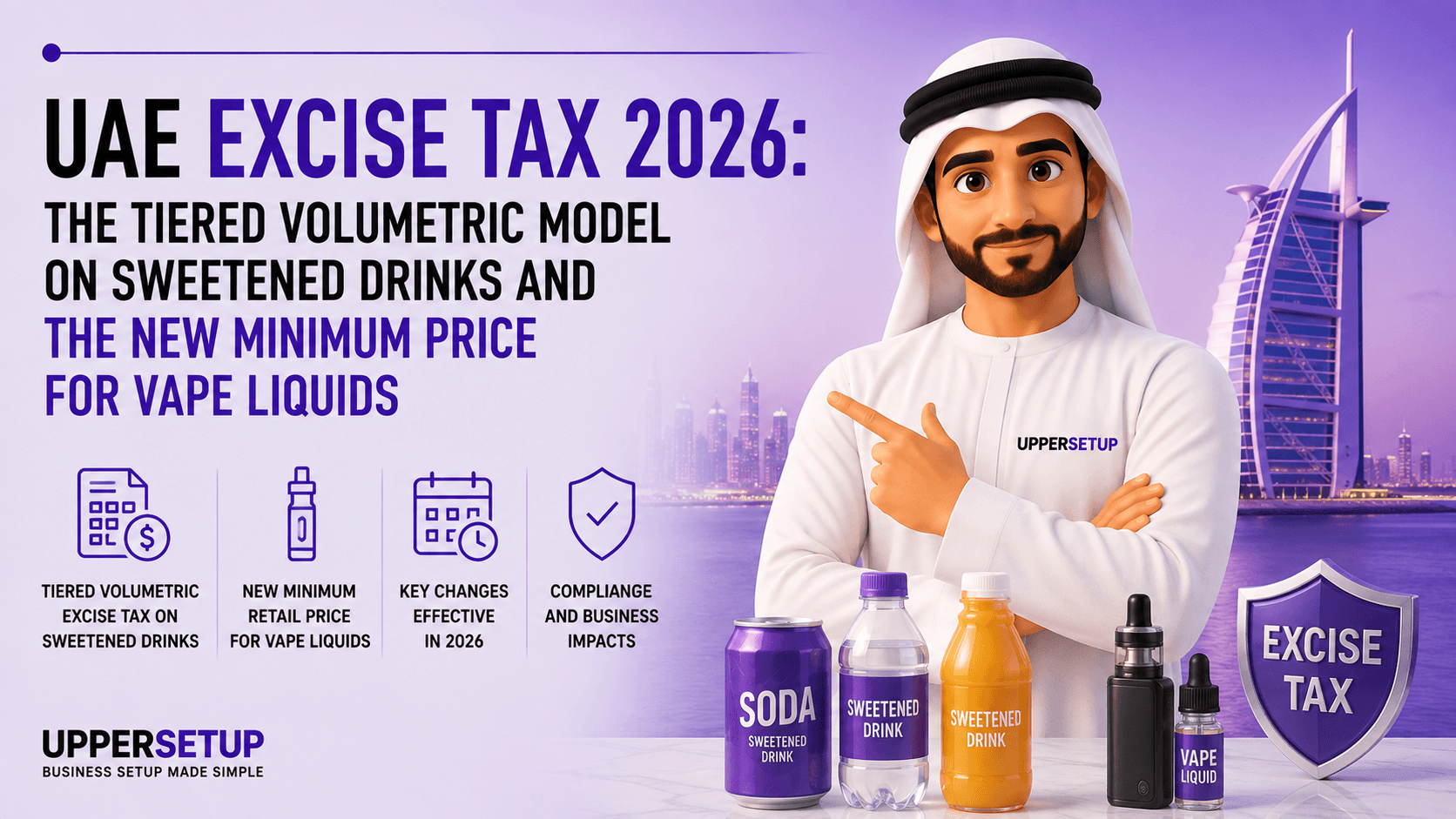
From 1 January 2026 UAE excise tax on sweetened drinks is charged as an amount per litre rather than a percentage of price, and that amount turns on the sugar content per 100 millilitres. The former flat 50 per cent of the excise price is gone. The new regime sits in Cabinet Decision No. 197 of 2025, issued on 27 November 2025.
Three tiers: less than 5 grams of sugar or other sweeteners per 100 ml — AED 0 per litre; 5 grams or more but less than 8 grams — AED 0.79 per litre; 8 grams or more — AED 1.09 per litre. Drinks containing only artificial sweeteners, or artificial sweeteners and less than 5 grams of sugar per 100 ml, are also at AED 0 per litre.
A second change was announced on 6 August 2026 and takes effect in three weeks. The Ministry of Finance announced the issuance of a decision on the minimum excise price for tobacco products and liquids used in electronic smoking devices and tools. For liquids a minimum excise price of AED 1 per millilitre is introduced, with the decision entering into force on 1 September 2026. A minimum excise price is the minimum value used to calculate the tax regardless of what the product actually sells for; it is not a minimum retail price. The existing minimum excise price for cigarettes, water pipe tobacco and ready-to-use tobacco products is unchanged.
What follows sets out the full rate table from Decision No. 197, the definition of a sweetened drink and the closed list of exclusions, how sugar is computed for concentrates and powders, the excise price mechanics, the conformity certificate requirement, and the default rule under which a missing laboratory report means the top tier.
1. The Legal Framework: Four Layers
• Federal Decree-Law No. 7 of 2017 on Excise Tax, as amended. The base statute taxing goods regarded as harmful to health or the environment. It is this instrument — Federal Decree by Law No. (7) of 2017 Regarding Excise Tax — that the preamble to Decision No. 197 itself cites. Federal Decree-Law No. 19 of 2022 refined the procedural elements.
• The amendments to Article 3 of the Law. On professional analysis, the Cabinet, on the Minister of Finance’s recommendation, sets rates either as a percentage of the excise price or as a fixed amount per unit of measurement. The percentage is capped at 200 per cent of the excise price and the specific rate at AED 100 per unit of measurement. That amendment is what made a per-litre charge possible.
• Cabinet Decision No. 197 of 2025. On excise goods, the tax rates or amounts imposed on them, and the methods of calculating the excise price. Issued on 27 November 2025 and effective from 1 January 2026. It replaced Cabinet Decision No. 52 of 2019 on excise goods and their applicable rates, together with its subsequent amendments including Cabinet Decision No. 99 of 2025.
• Federal Tax Authority decisions and clarifications. Following Decision No. 197 the Authority issued Decisions No. 10 and No. 11 of 2025 and Public Clarification EXTP013 on implementing the tiered volumetric model for sweetened drinks — covering the mechanism for calculating sugar and other sweeteners and the additional cases and controls for deducting excise tax. The earlier clarification EXTP012 was published on 11 September 2025.
There is a discrepancy in how the base statute is cited, and it is worth recording. The Ministry of Finance press release describes the Decision as being in line with "the recent amendments to Federal Decree-Law No. (7) of 2025 on Excise Tax", and that wording has been reproduced verbatim across business media and legal commentary. The preamble to Decision No. 197 itself, however, cites Federal Decree by Law No. (7) of 2017 Regarding Excise Tax. The operative base statute should be taken as the 2017 law as amended; the specific 2025 amending instrument should be verified separately rather than the press release wording being repeated as the name of the law in force.
The precise dates on the Ministry of Finance’s own publications: Decision No. 197 of 2025 was issued on 27 November 2025 and applies from 1 January 2026; the Decision it replaced, No. 52 of 2019, was last amended by Decision No. 99 of 2025, issued on 12 August 2025 and effective from 9 September 2025.
Decision No. 197 cannot be read apart from the Authority’s clarifications. The Decision sets the rates and definitions; Decisions No. 10 and No. 11 and Clarification EXTP013 set the computation and deduction mechanics. Most disputes arise not from the text of the law but from the gap between those layers: the product is classified correctly while the sugar computation for a concentrate, or the deduction position, is not.
2. The Full Rate Table from 1 January 2026
|
No. |
Excise good |
Rate or amount |
|
1 |
Tobacco and tobacco products — goods under Chapter 24 of the GCC Common Customs Tariff, including electrically heated cigarettes; products intended exclusively for smoking cessation are excluded |
100 per cent |
|
2 |
Liquids used in electronic smoking devices and tools |
100 per cent |
|
3 |
Electronic smoking devices and tools |
100 per cent |
|
4 |
Energy drinks |
100 per cent |
|
5 |
Sweetened drinks containing 5 grams or more but less than 8 grams of sugar or other sweeteners per 100 ml |
AED 0.79 per litre |
|
6 |
Sweetened drinks containing 8 grams or more of sugar or other sweeteners per 100 ml |
AED 1.09 per litre |
|
7 |
Sweetened drinks containing less than 5 grams of sugar or other sweeteners per 100 ml |
AED 0 per litre |
|
8 |
Sweetened drinks containing only artificial sweeteners, or artificial sweeteners and less than 5 grams of sugar or other sweeteners per 100 ml |
AED 0 per litre |
Carbonated drinks have disappeared as a separate category. Under the previous list they were a standalone line at 50 per cent. Decision No. 197 has no such line: a carbonated drink is taxed purely on sugar content, like any other sweetened drink. For a producer of sugar-free sparkling water that is a move from 50 per cent to nil.
A nil rate is not the same as falling outside the regime. Lines 7 and 8 remain excise goods charged at AED 0 per litre: the registration, filing and sugar-content substantiation duties continue. Exclusion from the definition of a sweetened drink is a different construct, and it is covered below.
3. What Changed: the Old Regime Against the New
|
Parameter |
Through 31 December 2025 |
From 1 January 2026 |
|
Governing instrument on rates |
Cabinet Decision No. 52 of 2019 as amended, including by No. 99 of 2025 |
Cabinet Decision No. 197 of 2025 |
|
Model for sweetened drinks |
Ad valorem: 50 per cent of the excise price |
Volumetric: an amount per litre by sugar content |
|
What drives the tax |
The price of the product |
Volume and sugar content per 100 ml |
|
Carbonated drinks |
A standalone category at 50 per cent |
No separate category; taxed on sugar content |
|
A sugar-free drink |
Taxed as a sweetened or carbonated drink |
AED 0 per litre, but still an excise good |
|
Substantiating composition |
No direct tax effect |
The laboratory report sets the tier; without it, the top rate |
|
Certification |
Not required for excise purposes |
Emirates Conformity Certificate through the Ministry of Industry and Advanced Technology |
|
Energy drinks |
100 per cent |
100 per cent — unchanged |
|
Liquids for electronic smoking devices |
100 per cent |
100 per cent; from 1 September 2026 a minimum excise price of AED 1 per millilitre |
The change of model inverts the pricing logic. Under an ad valorem rate the tax rose with the price: an expensive drink paid more than a cheap one of identical composition. Under a volumetric model price is irrelevant — a premium drink and a discounter’s drink pay the same where the sugar content matches. For the premium segment that is a reduction; for the cheap mass segment, an increase.
4. What Counts as a Sweetened Drink
On the Federal Tax Authority’s formulation, a sweetened drink is a product to which a source of sugar, artificial sweeteners or other sweeteners is added and which is intended for consumption as a drink. Form is irrelevant: the definition catches ready-to-drink beverages as well as concentrates, powders, gels and extracts.
Decision No. 197 does not leave the meaning of sugar to the parties: for its purposes sugar is defined by reference to Standard No. 148 issued by the GCC Standardization Organization under the title "Sugar", together with any subsequent and related standard specifications. Artificial sweeteners are likewise defined by reference to a standard identified in the Decision.
The operative word is "added". Where a drink contains only naturally occurring sugar and neither sugar nor other sweeteners have been added, excise does not apply. But where something was added — honey or syrup, for instance — the whole sugar content counts towards the total, naturally occurring sugar included. A natural juice with no additions and the same juice with a spoon of sugar sit in fundamentally different regimes.
5. What Is Excluded from the Definition
Decision No. 197 expressly takes a range of products outside the definition of a sweetened drink regardless of sugar content.
• Ready-to-drink beverages containing at least 75 per cent milk or milk substitutes.
• Baby formula, follow-up formula and baby food.
• Beverages for special dietary needs or medical uses.
• Beverages prepared in restaurants and similar establishments and served to end consumers in open, unsealed containers for direct consumption.
• Beverages or concentrates with added sugar or sweeteners prepared by individuals for personal or non-commercial use.
Alcoholic beverages are expressly excluded from the definitions of both energy drinks and sweetened drinks.
The restaurant exclusion works only where the container is open. A drink prepared on the premises and served in an open cup falls outside excise. The same drink bottled in a hermetically sealed container and put on a shelf is an ordinary sweetened drink with the full set of duties. The line runs through the sealing of the container and the immediacy of consumption, not through where the drink was made.
6. Concentrates, Powders, Gels and Extracts
For concentrates, powders, gels and extracts that meet the definition of a sweetened drink, sugar content is determined by reference to the final ready-to-drink product, following the producer’s mixing guidelines. Where no such guidelines exist, the Federal Tax Authority determines the method of calculation.
The mixing instruction becomes a tax document. The dilution ratio drives the tier directly: the same powder at different recommended dosages produces different sugar content per 100 ml of the finished drink. Having no instruction hands the choice of method to the Authority, which means losing control of the computation. The instruction should be documented before the product data is filed.
Concentrates, powders, gels and extracts from which an energy drink is prepared are taxed at 100 per cent — they follow the energy drink category rather than the volumetric model. The excise price of concentrates, powders, gels and extracts is calculated in accordance with the mechanism specified by the Minister.
7. Energy Drinks Stayed on the Old Model
The Federal Tax Authority stated it directly: energy drinks continue to be taxed under the existing method — 100 per cent of the excise price — and are not brought within the tiered volumetric model.
Classification as an energy drink turns on how the product is marketed, not on its ingredient list alone. A drink promoted as an energy product and containing stimulant substances qualifies even where the words "energy drink" appear nowhere on the label.
The gap between the two models creates an incentive to reclassify — and a risk. The difference between 100 per cent of the excise price and AED 1.09 per litre is enormous in absolute terms. The temptation to reclassify an energy drink as a sweetened one is obvious, but the marketing-based test makes any such reclassification checkable against promotional material rather than composition alone.
8. How the Excise Price Is Calculated for 100 Per Cent Goods
The excise price is the higher of two figures: the price published by the Federal Tax Authority in a standard price list, and the designated retail sales price less the tax included in it.
The designated retail sales price is the recommended selling price identified by the importer or producer, excluding VAT, or the average market retail price. For goods taxed at 100 per cent, the tax component is calculated as half of the designated retail sales price.
For sweetened drinks the excise price mechanics are irrelevant: the tax is tied to volume and sugar content, not to price. That is precisely the point of moving from an ad valorem model to a volumetric one — the tax no longer depends on whether the drink is expensive or cheap.
9. The Minimum Excise Price on Vape Liquids from 1 September 2026
On 6 August 2026 the Ministry of Finance announced the issuance of a decision on the minimum excise price for tobacco products and liquids used in electronic smoking devices and tools. For liquids a minimum excise price of AED 1 per millilitre is introduced. The decision enters into force on 1 September 2026.
The existing minimum excise price continues to apply to cigarettes, water pipe tobacco, ready-to-use tobacco products and similar goods. The 100 per cent excise rate on all tobacco products within the regime is unchanged — the decision touches only the minimum value from which the tax is computed.
A minimum excise price and a minimum retail price are different things. A minimum excise price is the minimum value used to calculate the tax regardless of the actual selling price. A minimum retail price is the lowest amount a consumer can pay in a shop. The first addresses the tax base, the second the consumer market. The practical consequence for the budget segment: a liquid selling below the implied threshold will be taxed as though it cost AED 1 per millilitre.
The Ministry links the measure expressly to limiting practices that may affect the effective implementation of excise tax and to ensuring the consistent application of unified standards across all categories of tobacco and electronic smoking products.
10. The Conformity Certificate and Laboratory Reports
From 1 January 2026 all producers, importers and stockpilers of sweetened drinks must obtain the Emirates Conformity Certificate for Sugar and Sweeteners Content in Beverages (for Excise Tax purposes) through the official website of the Ministry of Industry and Advanced Technology.
To support the new model the Federal Tax Authority launched a dedicated service for registering sweetened drinks on the EmaraTax platform.
The default rule turns a missing document into the maximum rate. Decision No. 197 sets out what the Authority does where a taxable person fails to submit the required laboratory reports or supporting documentation: on the Ministry of Finance’s explanation, the beverage is initially taxed under the highest sugar tier, with adjustment once the correct laboratory report is provided. The text of the Decision frames it more broadly: where a person fails to provide the documents within the timeframe specified by the Authority, the Authority may treat the product as an excise good subject to the provisions of the Decree-Law until they are provided. By default, therefore, a drink without documentation is treated as high-sugar and taxed at AED 1.09 per litre — including a drink with no sugar at all.
Laboratory reports have stopped being supporting documents and become the basis of classification. Measurement precision now carries a direct price: a product at 5.01 grams per 100 ml sits a tier above one at 4.99 grams.
One further practical point: Decision No. 197 governs not only the rates but also the Federal Tax Authority’s procedures for classifying products, including their addition to the official price list. Classifying a given SKU is an administrative act of the Authority rather than a self-assessment by the taxable person, and challenging it runs through the ordinary route.
11. Working It Through: a Numerical Example
Take a consignment of 10,000 bottles of 0.5 litre each — 5,000 litres in total.
|
Sugar per 100 ml |
Rate |
Excise on 5,000 litres |
|
4.9 grams |
AED 0 per litre |
AED 0 |
|
5.1 grams |
AED 0.79 per litre |
AED 3,950 |
|
7.9 grams |
AED 0.79 per litre |
AED 3,950 |
|
8.1 grams |
AED 1.09 per litre |
AED 5,450 |
|
No documentation filed |
AED 1.09 per litre under the default rule |
AED 5,450 whatever the actual content |
The economics of reformulation are computed on these figures, not on percentages. Cutting sugar from 8.1 to 7.9 grams per 100 ml saves AED 1,500 on every 5,000 litres — for a recipe difference of two tenths of a gram. Across a line running hundreds of thousands of litres a year, that becomes an argument for reformulating rather than passing the tax into price.
The moment the liability arises deserves separate attention. Excise is paid once — on import, on production, or on release from a designated zone, and by a stockpiler. Onward movement through the distribution chain creates no further tax: a retail outlet buying from a UAE distributor that has paid the excise does not pay again.
The practical consequence for an importer: classification and documentation must be ready before the consignment arrives, not after. Goods arriving without a conformity certificate and laboratory report fall under the default rule and are taxed at the top rate at a point when nothing can be changed without going through a revision.
Why the thresholds sit at 5 and 8 grams
The 5 and 8 gram per 100 millilitre thresholds create three bands, and the gaps between them are uneven. Moving from the nil band to the middle one costs AED 0.79 per litre; moving from the middle to the top costs only AED 0.30. The economic signal is strongest at the 5 gram line: that is where reformulation pays best.
For a line typically running at around 10 to 11 grams per 100 millilitres — the level of most traditional carbonated drinks — cutting to 7.9 grams saves AED 0.30 per litre, while cutting to 4.9 grams saves AED 1.09 per litre. The second target demands a deeper reformulation, but the gain is 3.6 times larger.
The nil band does not remove the paperwork, and that changes the calculation. A company that cuts sugar to zero saves the tax entirely but still bears the cost of laboratory measurement, the conformity certificate and product registration. The economics of reformulation are the rate differential less the fixed compliance costs, which do not vary by band.
12. Who Must Register
The obligation falls on three categories: producers of excise goods, importers, and stockpilers.
A restaurant buying excise goods from a UAE distributor that has already paid the excise need not register: excise is paid once, at import or production. Sweetened drinks served in open, unsealed containers directly to customers on the premises are in any event outside excise as excluded from the definition.
Decision No. 197 separately provides that tax paid on the excise goods it specifies cannot be treated as deductible tax under Article 16 of the Decree-Law. The conditions and additional cases for deduction are dealt with in the Authority’s Decisions No. 10 and No. 11 of 2025.
Finally, the interaction with VAT is worth recording. Excise forms part of the base for VAT: value added tax is computed on a price that already includes the excise. Reducing excise by moving into a lower band therefore has a double effect — both the excise itself and the VAT derived from it come down.
13. The Enforcement Environment
The Federal Tax Authority reported 176,000 market inspection visits in 2025, up 89 per cent year on year. The move to a volumetric model coincided with a step-up in enforcement activity rather than preceding it.
The logic of an inspection changes under a volumetric model. Under an ad valorem rate the dispute was mainly about price — whether the excise price and the designated retail sales price had been correctly established. Under a volumetric model the subject of dispute becomes the composition of the product, a laboratory-measurable quantity.
The evidence base has shifted from commercial documents to laboratory ones. A position used to be defended with price lists, invoices and market price data. The principal evidence is now an accredited sugar measurement for each SKU and, for concentrates, the mixing instruction. If that data cannot be produced quickly and at product level, the position is weak even where the tax paid is broadly correct.
The practical consequence for record-keeping: laboratory reports and conformity certificates must be held against the SKU and the consignment, not as a single company-level bundle. Inspections run by product, not by legal entity.
14. Transitional Questions on Stock
The switch from 31 December 2025 to 1 January 2026 raised the question of goods on which excise had already been paid at the former 50 per cent rate but which remained unsold at the transition date.
On industry analysis, the Ministry of Finance proposed legislative amendments permitting a partial deduction of previously paid excise on inventory where the new model produces a lower liability. That mechanism comes from professional sources rather than from the text of the Decision as read, and should be verified against Federal Tax Authority Decisions No. 10 and No. 11 of 2025, which deal precisely with the additional cases and controls for deducting excise tax.
Decision No. 197 itself contains a deduction restriction. It states expressly that tax paid on the excise goods it specifies cannot be treated as deductible tax under Article 16 of the Decree-Law. The general deduction mechanism therefore does not apply automatically to those lines, and any refund or credit position must rest on a specific ground in Decisions No. 10 and No. 11.
15. Common Mistakes
Mistake 1. Treating a nil rate as an exemption from duties
Lines 7 and 8 of the table are sweetened drinks at AED 0 per litre, not goods outside the regime. Registration, filing and sugar-content substantiation all continue. The cost: the company does not register the product, believing it untaxed, and the default rule classifies it in the top tier at the first inspection.
Mistake 2. Not obtaining the laboratory report in time
Where the required reports or supporting documents are not submitted, the tax is applied according to the highest sugar content category. The cost: a zero-sugar drink is taxed at AED 1.09 per litre until an approved report is filed, and the overpayment comes back only through revision.
Mistake 3. Relying on labelling instead of laboratory measurement
A "low sugar" marketing claim and a nutrition panel do not replace accredited measurement. The cost: a product honestly presented as low-sugar under consumer law lands in the middle or top tier on the tax measurement, and the discrepancy surfaces on inspection.
Mistake 4. Not documenting the concentrate’s mixing instruction
For concentrates, powders, gels and extracts the sugar is computed on the finished drink following the producer’s guidelines; absent those, the Authority sets the method. The cost: the producer loses control of the computation and receives a tier it did not determine.
Mistake 5. Reclassifying an energy drink as a sweetened one
Energy drinks stayed at 100 per cent and outside the volumetric model, and classification turns on positioning rather than composition alone. The cost: the reclassification is checkable against marketing material, and the difference between 100 per cent and a per-litre amount is recovered with penalties.
Mistake 6. Reading the restaurant exclusion more widely than it goes
The exclusion covers drinks served in open, unsealed containers for direct consumption. The cost: the same drink in a sealed bottle for takeaway is an ordinary sweetened drink, and an establishment that starts bottling becomes a producer of excise goods with every attendant duty.
16. Who Is Affected and What to Do
Directly affected
• Beverage producers. Laboratory measurement of every SKU, the conformity certificate, and — where values sit near a threshold — an assessment of the reformulation economics.
• Importers. The same requirements, plus aligning supplier documentation with the Ministry of Industry and Advanced Technology requirements before the consignment arrives.
• Stockpilers. Registration and filing in respect of stocks of excise goods acquired without excise having been paid.
• Sellers of liquids for electronic smoking devices. From 1 September 2026 the tax is computed on no less than AED 1 per millilitre, which changes the economics of the budget segment.
Indirectly affected
• Restaurants and coffee shops. Drinks in open containers fall outside the definition, but bottling in sealed packaging moves the establishment into the producer category.
• Retail chains. Relative prices shift on the shelf: sugar-free sparkling water moves from 50 per cent to nil while high-sugar lines become dearer.
17. Step-by-Step
1. List every SKU that falls within the definition of a sweetened drink, concentrates, powders, gels and extracts included.
2. Test each SKU against the exclusions: at least 75 per cent milk or milk substitutes, baby formula and baby food, special dietary and medical beverages, drinks in open containers.
3. Establish for each SKU whether sugar or other sweeteners were added: with no addition and only naturally occurring sugar, excise does not apply.
4. Send samples to an accredited laboratory and obtain a measurement of total sugar and sweetener content per 100 ml of the ready-to-drink product.
5. For concentrates and powders, document the mixing instruction — the computation depends on it.
6. Obtain the Emirates Conformity Certificate through the Ministry of Industry and Advanced Technology website.
7. Register the products through the sweetened drinks registration service on the EmaraTax platform.
8. For SKUs sitting near 5 or 8 grams, compute the reformulation economics: the steps between tiers are AED 0.79 and AED 0.30 per litre respectively.
9. Check whether any SKU falls into the energy drink category on the positioning test: those stay at 100 per cent.
10. For liquids used in electronic smoking devices, recompute the tax exposure on a minimum excise price of AED 1 per millilitre from 1 September 2026.
11. Set up storage of laboratory reports and certificates so they can be produced item by item: without them the top rate applies.
18. Frequently Asked Questions
What excise rates apply to sweetened drinks in the UAE from 2026?
Less than 5 grams of sugar or other sweeteners per 100 ml — AED 0 per litre; 5 grams or more but less than 8 grams — AED 0.79 per litre; 8 grams or more — AED 1.09 per litre. Drinks with only artificial sweeteners, or with artificial sweeteners and less than 5 grams of sugar, are at AED 0 per litre.
Which instrument introduced the volumetric model?
Cabinet Decision No. 197 of 2025 on excise goods, the tax rates or amounts imposed on them and the methods of calculating the excise price, issued on 27 November 2025 and effective from 1 January 2026. It replaced Cabinet Decision No. 52 of 2019 together with its subsequent amendments, including Cabinet Decision No. 99 of 2025.
Are natural juices without added sugar taxed?
No. Where a drink contains only naturally occurring sugar and neither sugar nor other sweeteners have been added, excise does not apply. But where something was added, the whole sugar content counts towards the total, naturally occurring sugar included.
What happens if the laboratory report is not submitted?
The tax is applied according to the highest sugar content category, that is AED 1.09 per litre, and may later be revised on submission of an approved laboratory report.
Did the rates on energy drinks change?
No. Energy drinks continue to be taxed at 100 per cent of the excise price and are not within the volumetric model. Concentrates, powders, gels and extracts used to prepare energy drinks are likewise taxed at 100 per cent.
What is the minimum excise price on vape liquids?
On 6 August 2026 the Ministry of Finance announced a decision introducing a minimum excise price of AED 1 per millilitre for liquids used in electronic smoking devices and tools, effective 1 September 2026. It is the minimum value used to calculate the tax regardless of the actual selling price, not a minimum retail price.
Are drinks prepared in a coffee shop within excise?
Beverages prepared in restaurants and similar establishments and served to end consumers in open, unsealed containers for direct consumption are excluded from the definition of a sweetened drink. Bottling the same drink in sealed packaging removes the exclusion.
19. Key Takeaways
• The volumetric model was introduced by Cabinet Decision No. 197 of 2025, issued on 27 November 2025, and applies from 1 January 2026.
• The Decision’s preamble cites Federal Decree by Law No. 7 of 2017; the Federal Decree-Law No. 7 of 2025 wording from the Ministry of Finance press release has spread through commentary and needs separate verification.
• Sugar is defined by reference to Standard No. 148 of the GCC Standardization Organization.
• The Decision replaced Cabinet Decision No. 52 of 2019 with all its amendments, including Cabinet Decision No. 99 of 2025.
• The tiers: under 5 g — AED 0 per litre; 5 g to under 8 g — AED 0.79; 8 g and above — AED 1.09 per litre.
• The former flat 50 per cent on sweetened drinks applied through 31 December 2025.
• Carbonated drinks are no longer a separate category and are taxed on sugar content.
• Energy drinks stayed at 100 per cent and outside the volumetric model.
• Total sugar and sweetener content counts, but only where something was added; naturally occurring sugar alone with no addition creates no excise.
• For concentrates and powders sugar is computed on the finished drink per the producer’s guidelines; absent those, the Authority sets the method.
• Excluded: at least 75 per cent milk or substitutes, baby formula and baby food, special dietary and medical beverages, drinks in open unsealed containers, and products made for personal use; alcohol is excluded from both categories.
• Without a laboratory report the top rate applies, subject to later revision.
• The Emirates Conformity Certificate is obtained through the Ministry of Industry and Advanced Technology; products are registered through EmaraTax.
• From 1 September 2026 a minimum excise price of AED 1 per millilitre applies to liquids used in electronic smoking devices; the 100 per cent rate on tobacco is unchanged.
20. Summary
From 1 January 2026 UAE excise tax on sweetened drinks is computed on a tiered volumetric model: an amount per litre driven by the sugar and other sweetener content per 100 millilitres. The regime sits in Cabinet Decision No. 197 of 2025 on excise goods, the tax rates or amounts imposed on them and the methods of calculating the excise price, issued on 27 November 2025; it replaced Cabinet Decision No. 52 of 2019 together with its subsequent amendments, including Cabinet Decision No. 99 of 2025, and was made under Federal Decree-Law No. 7 of 2017 on Excise Tax as amended, including by Federal Decree-Law No. 7 of 2025. The rates are: tobacco and tobacco products 100 per cent; liquids used in electronic smoking devices 100 per cent; electronic smoking devices and tools 100 per cent; energy drinks 100 per cent; sweetened drinks with 5 grams or more but less than 8 grams per 100 ml at AED 0.79 per litre; 8 grams or more at AED 1.09 per litre; less than 5 grams at AED 0 per litre; and drinks with only artificial sweeteners, or artificial sweeteners and less than 5 grams of sugar, at AED 0 per litre. The former flat 50 per cent applied through 31 December 2025, and carbonated drinks ceased to be a separate category. A sweetened drink is a product to which a source of sugar, artificial sweeteners or other sweeteners is added and which is intended for consumption as a drink, whether ready-to-drink or as a concentrate, powder, gel or extract; where an addition was made the total includes naturally occurring sugar, and where no addition was made excise does not apply. Excluded from the definition are beverages containing at least 75 per cent milk or milk substitutes, baby formula, follow-up formula and baby food, beverages for special dietary or medical needs, beverages prepared in restaurants and served in open unsealed containers for direct consumption, and products prepared by individuals for personal use; alcoholic beverages are excluded from both the energy drink and sweetened drink definitions. For concentrates, powders, gels and extracts sugar is determined by reference to the final ready-to-drink product following the producer’s mixing guidelines, and absent those the Federal Tax Authority determines the method. Where the required laboratory reports or supporting documents are not submitted, the tax is applied according to the highest sugar content category and may be revised on submission of an approved report. From 1 January 2026 producers, importers and stockpilers must obtain the Emirates Conformity Certificate for Sugar and Sweeteners Content in Beverages through the Ministry of Industry and Advanced Technology, and products are registered through a dedicated service on the EmaraTax platform. The Federal Tax Authority issued Decisions No. 10 and No. 11 of 2025 and Public Clarification EXTP013, supplementing the earlier EXTP012 of 11 September 2025. Separately, on 6 August 2026 the Ministry of Finance announced a decision introducing a minimum excise price of AED 1 per millilitre for liquids used in electronic smoking devices and tools with effect from 1 September 2026; the existing minimum excise price for cigarettes, water pipe tobacco and ready-to-use tobacco products is retained and the 100 per cent rate on tobacco products is unchanged.
21. Sources
Tier 1 — the regulator and primary documents
• UAE Ministry of Finance — Federal Decree-Law No. 7 of 2017 on Excise Tax and its amendments (PDF)
Tier 2 — professional commentary
• KPMG — UAE: Changes to excise tax rates for sweetened drinks
• RVG Chartered Accountants — Federal Decree-Law No. 7 of 2025: the Article 3 amendments and rate caps
Related UPPERSETUP analysis
• UAE VAT: The Complete Business Guide 2026
• UAE E-Commerce Licence 2026: Types, Costs, Mainland vs Free Zone
• UAE Trade Licence Activities 2026: How the Wrong Activity Breaks Banking, VAT and Operations
• Mandatory Electronic Invoicing in the UAE: Why 2026 Became the Point of No Return
Dealing in beverages or electronic smoking products in the UAE? UPPERSETUP supports tax compliance across the UAE, Kazakhstan and Hong Kong: classifying the range under Decision No. 197, testing products against the exclusions, arranging laboratory measurement and the conformity certificate, registering products on EmaraTax and modelling the reformulation economics for borderline SKUs. Discuss your project with UPPERSETUP
Disclaimer
This material is provided for informational purposes only and does not constitute legal, tax, financial, investment or consulting advice. The classification of a specific product depends on its composition, form and positioning and requires laboratory substantiation. Obtain individual professional advice before acting. Information is current as of 7 August 2026.
Read more on the topic
Emiratisation 2026: The Complete Employer Guide — Quotas, Penalties, Nafis, and the 30 June Deadline
Stamp Duty on Share Transfers in Hong Kong 2026: Rates, Net-Asset Valuation, Deadlines and Penalties
All services on the platform
Everything you need to start and run a business - in one place
- 3–5 days
Company Setup
Mainland or Free Zone company with a complete set of incorporation documents
Start - Monthly
Accounting Services
Financial accounting and reporting in accordance with UAE requirements
Start - 1–2 weeks
Visa Services
Residence visas for shareholders, employees and family members
Start - 7–30 days
Banking Services
Corporate Bank Accounts in the UAE and Payment Services
Start - Custom timeline
Legal Services
Contracts, corporate amendments and legal support
Start


