












































































































 International Free Zone Authority
Mandatory Electronic Invoicing in the UAE: Why 2026 became the point of no Return for business
Introduction
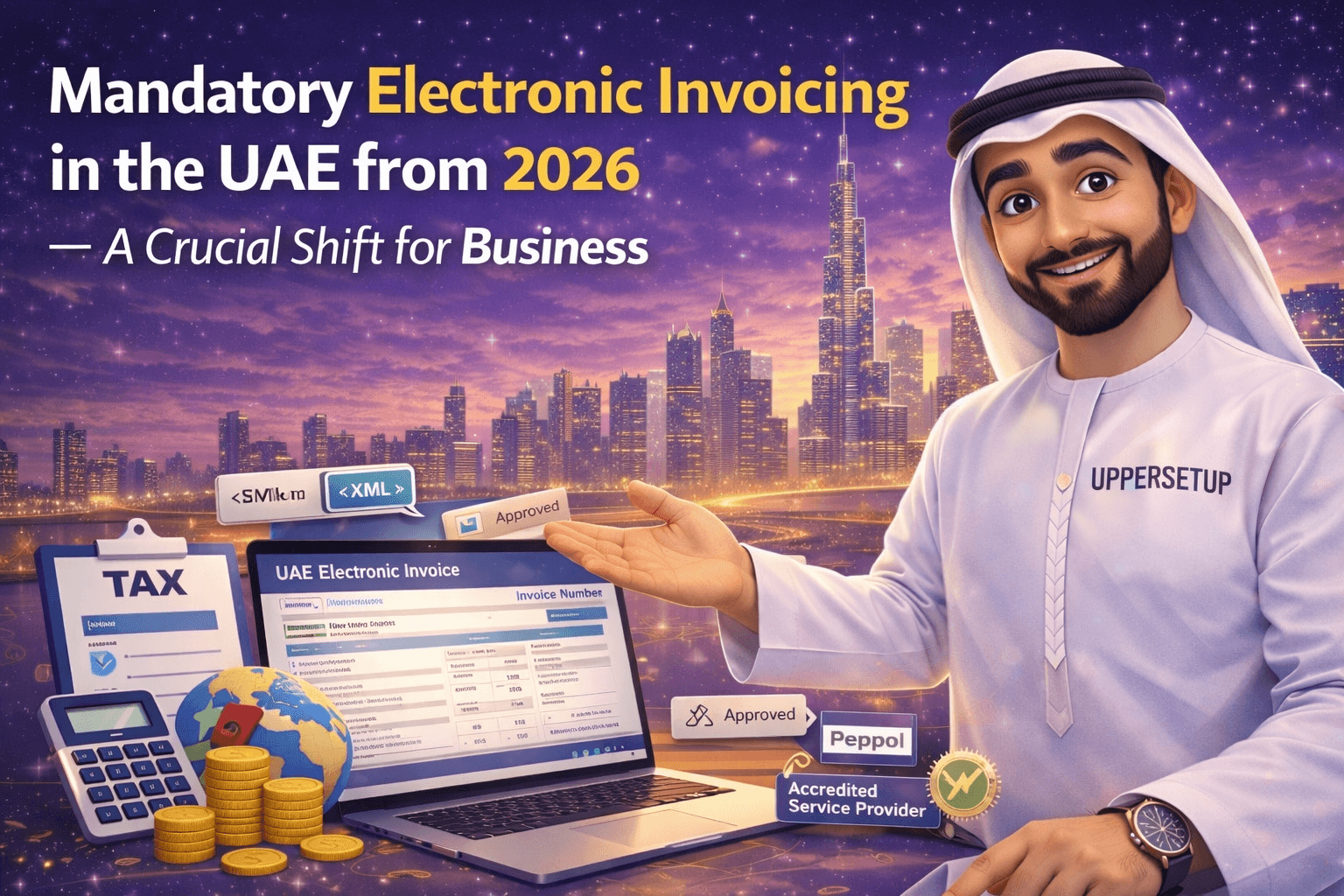
The most underestimated tax and technological topic in the UAE as of April 2026 is not a new tax rate, but mandatory electronic invoicing. Formally, the market still often perceives electronic invoicing as a future digital option, but from a legal perspective this is no longer a hypothesis, but a structured regulatory system: the Ministry of Finance has issued Ministerial Decision No. 243 of 2025 on the electronic invoicing system itself, Ministerial Decision No. 244 of 2025 on phased implementation, Ministerial Decision No. 64 of 2025 on the criteria and accreditation of service providers, and in February 2026 — the official UAE Electronic Invoicing Guidelines, requirements for mandatory fields and separate recommendations for selecting an accredited service provider. The Ministry of Finance portal explicitly states that this portal is the official source of information on electronic invoicing in the UAE.
The key shift is that the UAE is building not just a format of an “electronic PDF”, but a regulated model of exchange and reporting based on structured invoice data. The Ministry of Finance directly defines an electronic invoice as an invoice that is issued, transmitted and received in a structured electronic format ensuring automated processing, and separately emphasizes that PDF, Word, scans, images and email are not considered electronic invoices. This means that for business it is not the external appearance of the invoice that changes, but the entire architecture of document flow, tax control, data exchange and internal IT logic.
That is why 2026 is a turning point. The mandatory first phase of implementation will begin from 1 January 2027 for part of the business, but decisions, budget, architecture of the corporate accounting system, selection of the provider and data logic must be formed already now. This is a rare case where the legal deadline is in the future, but the managerial point of no return is already in the present.
1. What electronic invoicing in the UAE actually is — and why the market still often misunderstands it
The most common mistake is to consider that electronic invoicing in the UAE means “sending an invoice electronically”. This is incorrect. According to the official position of the Ministry of Finance, an electronic invoice is not any electronic document, but specifically an invoice issued, transmitted and received through the electronic invoicing system in a structured electronic format suitable for automated and electronic processing. The Ministry of Finance separately states that PDF, Word, scans and email are not electronic invoices.
This fundamentally changes the legal and operational nature of the invoice. In the traditional model, a document may be electronic by medium, but still remain “human-readable” and poorly suitable for automated verification. In the electronic invoicing model of the UAE, the invoice becomes an element of a machine-readable tax and operational infrastructure. Its task is not only to confirm the transaction, but also to ensure standardized exchange, automated checks, transmission of tax data and potential integration with subsequent reporting. The Ministry of Finance directly links the electronic invoicing programme with digitalisation, efficiency, minimisation of VAT leakage, formation of public policy and security.
Therefore, it is more accurate to say not “the UAE introduces electronic invoices”, but “the UAE builds a regulated digital layer over commercial and tax document flow”. This is where the real scale of the reform lies.
2. Regulatory framework: what electronic invoicing in the UAE is legally based on
As of April 2026, the regulatory framework of electronic invoicing in the UAE has already been established and consists of several levels.
The basic framework is contained in Federal Decree-Law No. 28 of 2022 on Tax Procedures, on the basis of which subordinate legislation on electronic invoicing has been adopted. Electronic invoicing as a system of obligations and scope is established in Ministerial Decision No. 243 of 2025 on the Electronic Invoicing System. The timelines and phases of mandatory implementation are set out in Ministerial Decision No. 244 of 2025 on the Implementation of the Electronic Invoicing System. The criteria for admission and accreditation of service providers are regulated by Ministerial Decision No. 64 of 2025. In addition, Cabinet Decision No. 106 of 2025 on violations and administrative penalties applies, as well as the UAE Electronic Invoicing Guidelines dated 23 February 2026, the document on mandatory fields, and official recommendations of the Ministry of Finance on the selection of an accredited service provider. All these documents are published on the official portal of the Ministry of Finance in the electronic invoicing section.
From the perspective of legal technique, this is already a mature regime, not a project at the discussion stage. Moreover, the Ministry of Finance has not limited itself only to laws and timelines, but has immediately issued operational clarifications, mandatory data fields and practical recommendations for implementation. This is an important signal: the state expects not abstract “readiness”, but concrete practical preparation of business for integration.
3. On whom electronic invoicing applies: the circle of obligated persons is broader than many think
Ministerial Decision No. 243 of 2025 establishes that the electronic invoicing system applies to any person conducting business in the State, in respect of each business transaction, unless the person or the transaction itself is explicitly excluded under Article 4.
In the document on mandatory fields, the Ministry of Finance separately emphasizes that electronic invoicing is mandatory for any person conducting business in the UAE, regardless of VAT registration status, unless such person or transaction is excluded.
This is one of the most important and underestimated aspects. The market often mentally associates electronic invoicing only with VAT-registered persons. However, official documents indicate otherwise: the obligation is determined not only by VAT registration, but by whether a person conducts business in the UAE and falls within the system scope. The Guidelines explicitly state that if a person falls within the scope of electronic invoicing but is not required to register for any tax, that person must still register with the Federal Tax Authority to obtain a Tax Identification Number. The Ministry of Finance further clarifies that for most already registered taxpayers, the Tax Identification Number corresponds to the first 10 digits of the Tax Registration Number.
Legally, this means that a company cannot rely on the simple argument that “we are not VAT registered, therefore electronic invoicing does not apply to us”. Such a conclusion may be incorrect. For certain businesses, the key factor is not VAT status, but the existence of business transactions within scope.
4. Which transactions fall under electronic invoicing and which do not
According to the official model of the Ministry of Finance, transactions that primarily fall within the scope include business-to-business transactions and business-to-government transactions. The Guidelines provide a table indicating that business-to-business and business-to-government transactions fall within the system, whereas business-to-consumer transactions do not fall within scope. The Ministry of Finance also separately states that supplies to or from natural persons who do not conduct business fall outside the scope, even if an invoicing agent is used.
Ministerial Decision No. 244 of 2025 explicitly establishes that business-to-consumer transactions do not fall within the electronic invoicing system, and persons engaged exclusively in such transactions are not subject to the mandatory regime at this stage.
However, there is an important practical nuance. If a company does not operate exclusively in the business-to-consumer segment but also has even a partial flow of business-to-business or business-to-government transactions, its obligation must be analyzed more precisely. The “fully out of scope” position applies only to those who genuinely operate exclusively in the consumer segment. For mixed models, the analysis becomes significantly more complex.
5. Exemptions: they are limited, and reliance on them without detailed analysis is risky
Article 4 of Ministerial Decision No. 243 of 2025 lists exempt transactions. These include activities of government authorities acting in a sovereign capacity where they do not compete with the private sector, international passenger air transport where an electronic ticket is issued, certain ancillary aviation services where an electronic supporting document is issued, international air cargo transport where an air waybill is used, but only for a period of 24 months from the system’s effective date, as well as certain financial services that are exempt from VAT or subject to a zero rate in accordance with Article 42 of the VAT Executive Regulation.
This is a critically important section because certain industries may incorrectly assume that since their transactions are already documented electronically in another format, they are entirely outside the scope of the new system. However, the UAE regulatory framework treats exemptions narrowly and specifically. Exemptions must be interpreted strictly. This is particularly important for aviation and financial services: operating in such a sector does not automatically exempt all transactions from electronic invoicing obligations.
The main practical risk of exemptions is that they often create a false sense of security. In reality, an exemption may apply only to a specific type of transaction, a specific document, or a limited period.
6. Voluntary adoption is possible — but it creates obligations
The legislation allows voluntary use of the system before the mandatory phase. Article 4(3) of Ministerial Decision No. 243 of 2025 explicitly states that a person may voluntarily issue, transmit, exchange and report electronic invoices and electronic credit notes. However, once a person opts in, the provisions of the decision and related legislation become binding, except for those related to administrative penalties. Cabinet Decision No. 106 of 2025 confirms that penalties do not apply during voluntary adoption.
For business, this creates a dual situation. On one hand, voluntary adoption is a strong preparation mechanism. On the other hand, it is not a “test mode”: real compliance is required. Therefore, voluntary implementation is advisable only for businesses that have already conducted a readiness assessment and understand their data and processes.
7. Implementation timeline: when electronic invoicing becomes mandatory
The timeline is established by Ministerial Decision No. 244 of 2025 and is no longer subject to uncertainty.
If a person’s revenue is equal to or exceeds AED 50,000,000, an accredited service provider must be appointed by 31 July 2026 and the system must be implemented by 1 January 2027. If revenue is below AED 50,000,000, the accredited service provider must be appointed by 31 March 2027 and implementation must be completed by 1 July 2027. For government entities, implementation is required by 1 October 2027.
Legally, this means that there is no single deadline, but multiple. From a management perspective, however, the more important conclusion is that there are effectively two deadlines: one for selecting and contracting an accredited service provider, and another for full system implementation. Many businesses focus only on the final implementation date and overlook the obligation to appoint a provider in advance, although this step defines the entire integration architecture.
8. Why 2026 is already critical, even if the mandatory deadline is still ahead
Formally, many companies are not yet in breach of the law if they have not implemented electronic invoicing as of April 2026. However, practically, 2026 is already a critical year for three reasons.
First, the regulatory framework is complete, and the Ministry of Finance has issued not only legal acts but also operational Guidelines, mandatory data fields and recommendations. The argument “we were waiting for details” is no longer valid.
Second, selecting an accredited service provider is not a simple procurement task. It defines system compatibility, integration with ERP, data formats, routing logic, Peppol interaction, security and operational support. The Ministry of Finance has published guidance on selecting providers and a list of pre-approved providers, while emphasizing that final accreditation is granted under Article 16 of Ministerial Decision No. 64 of 2025.
Third, electronic invoicing affects multiple functions: finance, tax, procurement, legal, IT, master data and treasury. Delays are usually caused not by lack of regulation, but by underestimation of the transformation scope.
9. System architecture: decentralized model based on Peppol
The Ministry of Finance confirms that the UAE adopts a decentralized continuous transaction control and exchange model. The process is as follows: the supplier submits invoice data to its accredited service provider, the provider validates and converts the invoice into the UAE structured XML format, then transmits it to the buyer’s provider, while reporting data is simultaneously sent to the Federal Tax Authority. Status confirmations are generated throughout the process.
This is a key structural feature. The UAE is not building a centralized upload system but a regulated exchange infrastructure through accredited intermediaries. For businesses, this means that selecting a service provider is equivalent to selecting a core infrastructure partner.
10. Why electronic invoicing is primarily a data issue rather than just an invoicing issue
The Ministry of Finance has issued a separate document titled UAE Electronic Invoice Mandatory Fields, which in itself is indicative. The state regulates not only the fact of issuing an electronic invoice, but also the mandatory composition of fields and data. At the same time, the Guidelines state that an electronic invoice and an electronic credit note must contain all data fields and elements prescribed by the Ministry of Finance.
This means that the weakest point for most companies will not be the invoice template, but the quality of data: customer data, supplier data, beneficial owner logic, VAT treatment, transaction classification, references, timelines, structured identifiers and the consistency of data sources within ERP systems, customer relationship systems and accounting frameworks. When the system moves from document-based representation to structured mandatory fields, any inconsistency in master data, classification or manual overrides becomes a compliance risk.
That is why electronic invoicing in the UAE cannot be delegated solely to accounting. It is a cross-functional project involving tax, finance, ERP architecture, legal structuring, procurement and operations.
11. VAT groups: one of the most important and unexpected risk areas
One of the most important elements of the UAE Electronic Invoicing Guidelines is the clarification regarding VAT groups. The document explicitly states that transactions between members of the same VAT group fall within the scope of the system and are not excluded merely because they are intra-group. At the same time, the Ministry of Finance and the Federal Tax Authority recognize the complexity of such flows and provide a transitional relief period of 24 months starting from 1 January 2027, during which electronic invoicing requirements do not need to be implemented for intra-group transactions. However, the Guidelines clearly state that this relief affects only the timing of compliance and does not remove such transactions from scope. After the expiration of the relief period, full compliance will be required.
For large groups, this is one of the most underestimated aspects of the reform. Many corporate structures historically relied on simplified internal settlements or accounting entries. Under electronic invoicing, such models become less sustainable. Even a temporary relief period is not an exemption but a deferral.
12. Investment holding companies and “passive” entities: the position is not straightforward
The Guidelines separately address investment holding companies. If a company’s income consists exclusively of passive income and it does not conduct business transactions, it may fall outside the scope of electronic invoicing. However, if such a company begins to recharge operating costs or other amounts to third parties or related entities, such recharges are considered business transactions, and the company becomes subject to electronic invoicing requirements.
This clarification is critical for structures traditionally considered non-operational. The key question is not the label of the entity, but whether it performs transactions that fall within scope.
13. Non-residents: incorrect to assume automatic exclusion
The Guidelines also clarify the position of non-resident entities. If a non-resident entity without a place of establishment in the UAE is required to issue tax invoices under VAT legislation, such invoices must be issued in the form of electronic invoices.
Therefore, the absence of incorporation in the UAE does not automatically exclude an entity from the system. The determining factor is the obligation to issue invoices under VAT rules.
14. Self-billing, preliminary invoices and special scenarios: areas of elevated risk
The Guidelines confirm that self-billing remains possible, but becomes more complex in an electronic environment. Self-billing of electronic tax invoices requires that the buyer is already within the electronic invoicing system. It is also limited to VAT purposes and does not apply to non-VAT registered suppliers. The Ministry of Finance emphasizes that once a supplier falls within the mandatory regime, self-billing arrangements must also comply.
Additionally, the Guidelines state that preliminary invoices do not constitute a separate category of electronic invoice. This requires reconsideration of business models that rely heavily on pro forma or preliminary documentation.
15. Free zones and beneficial ownership: increased transparency requirements
The Guidelines indicate that specific considerations apply to transactions involving free zone entities. Where a free zone entity is involved, additional data may be required, including information on the beneficial owner. The Ministry of Finance defines the beneficial owner as the person who ultimately uses or benefits from the supply.
This introduces a higher level of transparency, particularly for complex structures where contractual parties and economic beneficiaries differ.
16. Interaction with VAT: electronic invoicing complements, not replaces, VAT obligations
The Guidelines clearly state that electronic invoicing requirements differ from VAT invoice requirements. Electronic invoicing does not remove the obligation to issue VAT invoices or credit notes. However, where electronic invoicing applies, VAT invoices must be issued in electronic format.
This demonstrates that electronic invoicing is not an additional layer, but a new form of fulfilling existing VAT documentation obligations.
17. Transformation of VAT control
The Ministry of Finance links electronic invoicing with improved VAT compliance, reduced leakage and enhanced reporting. The system enables transmission of invoice data to the Federal Tax Authority, potentially allowing pre-population of VAT returns and faster refund processing.
This represents a shift in tax control: from periodic reporting to continuous data-based validation.
18. Accredited Service Provider: a strategic rather than technical choice
Under Ministerial Decision No. 64 of 2025, service providers must be accredited. The Ministry of Finance publishes a list of pre-approved providers, but final accreditation is granted according to regulatory procedures.
Choosing a provider is not a purely technical decision. It defines system architecture, integration capability, operational stability and long-term compliance capacity.
19. Penalties
Cabinet Decision No. 106 of 2025 establishes administrative penalties. These include AED 5,000 per month for failure to implement electronic invoicing, AED 100 per invoice for delays up to AED 5,000 per month, and AED 1,000 per day for failure to report system issues or update provider information.
However, penalties represent only part of the risk. Operational disruptions and compliance failures may have significantly higher impact.
20. Legacy systems risk
Companies relying on fragmented systems, manual processes and unstructured data face higher implementation risk. Electronic invoicing requires stable, structured and consistent data flows.
Without proper system readiness, implementation becomes a stress test of the entire financial function.
21. Required actions
Businesses must undertake:
– Scope assessment
– Entity mapping
– Data readiness analysis
– Selection of accredited service provider
– Governance model establishment
Only after these steps can implementation begin.
22. Strategic conclusion
Electronic invoicing in the UAE is not merely digitalisation, but a transformation of tax administration into a data-driven model. It introduces a regulated infrastructure for structured data exchange, reporting and validation.
Conclusion
The most relevant tax topic in the UAE today is electronic invoicing. The regulatory framework is already established, guidelines are issued, timelines are defined, penalties are in place and the provider ecosystem is forming.
The key question is no longer whether electronic invoicing will be implemented, but which businesses are prepared.
Read more on the topic
Emiratisation 2026: The Complete Employer Guide — Quotas, Penalties, Nafis, and the 30 June Deadline

Stamp Duty on Share Transfers in Hong Kong 2026: Rates, Net-Asset Valuation, Deadlines and Penalties
VAT in Kazakhstan 2026: Registration, the 10,000 MCI Threshold, the 16% Rate, e-Invoices and Refunds
All services on the platform
Everything you need to start and run a business - in one place
- 3–5 days
Company Setup
Mainland or Free Zone company with a complete set of incorporation documents
Start - Monthly
Accounting Services
Financial accounting and reporting in accordance with UAE requirements
Start - 1–2 weeks
Visa Services
Residence visas for shareholders, employees and family members
Start - 7–30 days
Banking Services
Corporate Bank Accounts in the UAE and Payment Services
Start - Custom timeline
Legal Services
Contracts, corporate amendments and legal support
Start


