

































































































































































 International Free Zone Authority
Customs Duties in the UAE 2026: Rates, Exemptions, and the Free Zone Regime

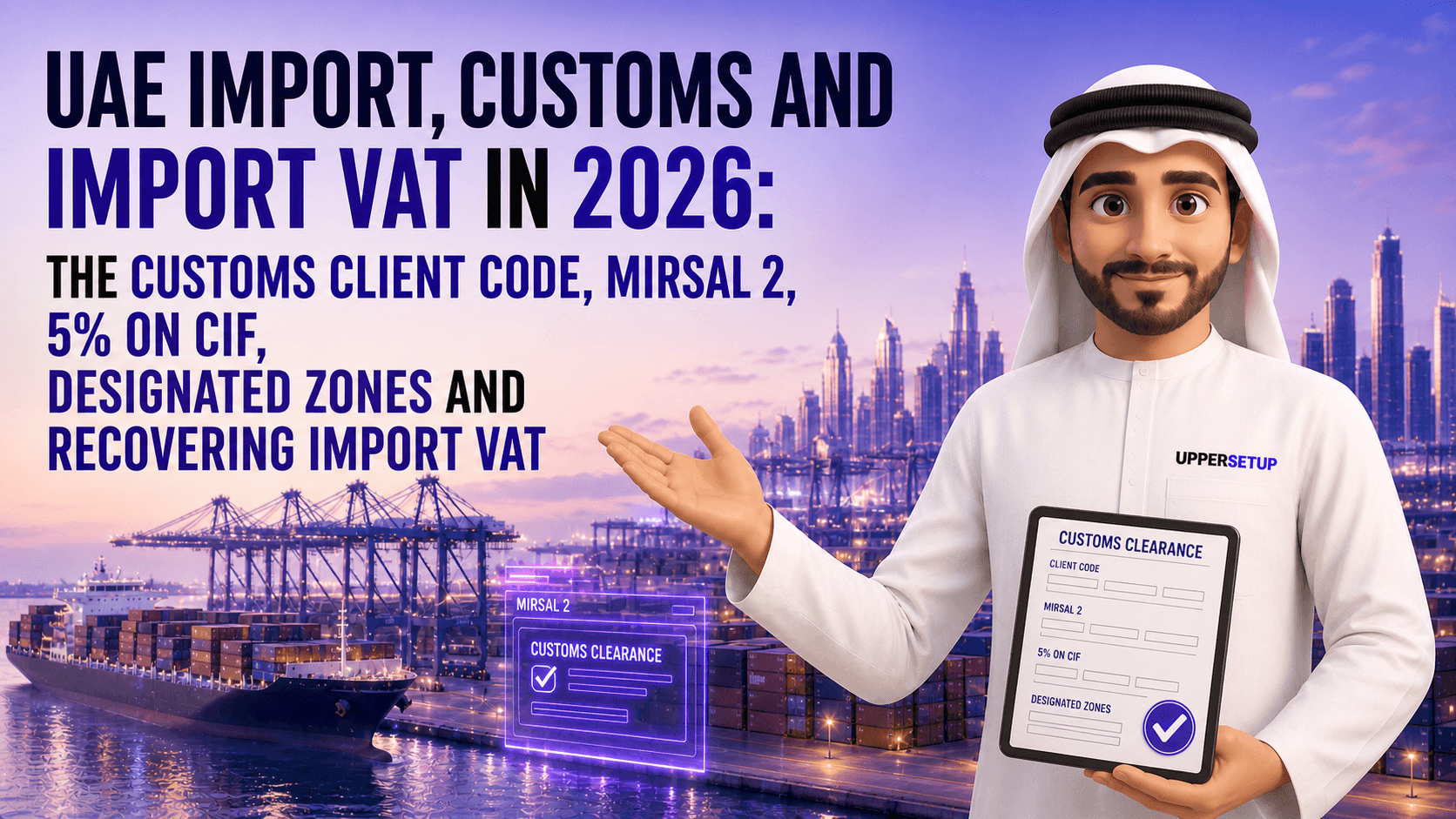
The standard UAE customs duty is 5% of a good’s customs value, calculated on a CIF basis (cost of the goods plus insurance plus freight), and applies to most goods imported from outside the GCC Customs Union.
The current rate was set by Federal Law No. (19) of 2002 Concerning the Customs Duty payable on goods and materials imported from outside the Customs Union to the GCC Countries, which raised the duty from 4% to 5% effective 1 January 2003.
Goods brought into a UAE free zone and remaining within its boundaries are not subject to customs duty; the duty is charged only when the goods move to the UAE mainland.
Alongside the federal law setting the duty rate, the UAE applies the regional Common Customs Law of the GCC States, which establishes a unified valuation methodology and Harmonized System (HS) code classification.
⚠ VAT Designated Zone status (Cabinet Decision No. 59 of 2017) and customs duty exemption for goods within a free zone are different regimes that do not automatically coincide: the former concerns VAT, the latter concerns customs duty. Holding one status does not guarantee the other applies.
1. The Legal Basis
UAE customs regulation operates on two levels — federal (the duty rate itself) and regional (a unified methodology within the GCC).
Federal Law No. (19) of 2002 expressly provides that “customs duties shall be lifted by the rates from (4%) to (5%)... applied on all foreign goods and commodities imported from outside the Customs Federation of the countries of Gulf Cooperation Council (GCC) as of January 1st, 2003” — a verbatim quote from the law’s primary text. The official legislation metadata page on uaelegislation.gov.ae lists the law’s own Effective Date as 31 December 2002 (Issued 25 December 2002) — one day earlier than the date stated in the text as the date the new rate itself applies. The law likely took effect on 31 December, with the specific new-rate provision starting from the beginning of the following calendar year, but this has not been independently confirmed during a repeat verification pass — the one-day discrepancy is disclosed honestly rather than concealed.
The Common Customs Law of the GCC States sets the methodology for determining customs value, rules for classifying goods, and the list of goods prohibited or restricted from import, uniform across all GCC Customs Union member states.
Need help structuring import-export activity in the UAE? UPPERSETUP company registration services →
2. How Customs Duty Is Calculated
A good’s customs value in the UAE is determined on a CIF basis — the combined value of the goods, insurance, and freight at the time of arrival at the destination port.
Per Dubai Customs’ official FAQ section, the customs value for goods imported into Dubai is based on CIF per the Common Customs Law of GCC States and its implementing rules; the foreign currency exchange rate at the time the customs declaration is submitted is used in the calculation.
ℹ For a shipment with a CIF value of, say, AED 100,000, the standard customs duty would be AED 5,000 — the calculation applies to the combined value including freight and insurance, not just the price of the goods themselves.
3. Rates by Goods Category
|
Goods category |
Duty rate |
|
Standard rate (most goods) |
5% of the CIF value |
|
Alcohol |
50% of the CIF value |
|
Cigarettes and tobacco products |
100% (ad valorem or a specific rate on value/weight, whichever is higher) |
|
Certain goods under anti-dumping duties (car batteries, ceramic/porcelain tiles, hydraulic cement) |
Up to 67.5% of the CIF value, depending on the HS code and country of origin |
|
Goods within a free zone not crossing into the mainland |
No duty charged while the goods remain within the zone |
⚠ Anti-dumping duties are not applied as a general rule but to specific goods categories and countries of origin — their existence and rate must be checked individually against the HS code, not assumed from the standard 5% rate.
4. HS Code Classification
The applicable duty rate is determined by the good’s Harmonized System (HS) code — the international classification system used to precisely determine the tariff category.
⚠ An HS code classification error is one of the most common causes of a duty reassessment, penalties, or shipment delays at customs; the correct classification is determined by the good’s characteristics, not the importer’s intent to minimise duty.
5. Free Zones and Customs Exemption
Goods brought directly into a UAE free zone and remaining within its physical boundaries are generally not subject to customs duty — but this is not equivalent to a full exemption of the business from customs regulation.
Duty is charged at the standard rate at the point the goods move from the free zone to the UAE mainland for sale or domestic consumption.
✅ Companies registered in free zones and conducting exclusively re-export (importing with subsequent export outside the UAE without release into free circulation domestically) generally bear no customs burden on that goods flow — exact conditions depend on the specific transaction and require confirmation from the customs authority.
6. Registering with the Customs Authority
A company conducting foreign trade activity in the UAE must register with the customs department of the relevant emirate, specifying the type of business.
Upon registration, the company is issued a unique identification code tied to the validity of its trade licence; this code is used when filing customs declarations.
7. Comparing the Applicable Regimes
|
Regime |
What it governs |
Level |
|
Federal Law No. 19 of 2002 |
The customs duty rate on goods imported from outside the GCC Customs Union |
Federal |
|
Common Customs Law of the GCC States |
Unified valuation methodology (CIF), goods classification, the list of prohibited/restricted goods |
Regional (GCC) |
|
VAT Designated Zones (Cabinet Decision No. 59 of 2017) |
A special VAT regime for goods transactions between zones holding that status |
Federal, separate from customs duty |
The key practical error is conflating these three regimes in a single decision: holding VAT Designated Zone status does not automatically mean customs exemption, and customs exemption within a zone does not mean exemption from VAT for certain transactions.
8. Step-by-Step Process for an Importer
1. Determine the exact HS code for the imported goods — this determines the applicable duty rate and any special requirements.
2. Calculate the customs value on a CIF basis, including the goods’ value, insurance, and freight to the port of arrival.
3. Register the company with the customs department of the relevant emirate, if not already registered.
4. Check whether the goods fall under higher rates (alcohol, tobacco) or anti-dumping duties for the specific HS code and country of origin.
5. Assess applicable exemptions: goods remaining within a free zone, re-export, or eligible relief categories (medical equipment, educational materials).
6. Prepare the full document package: commercial invoice, packing list, bill of lading, certificate of origin, and applicable permits.
7. File the customs declaration and pay the applicable duty before the goods are released into free circulation.
9. Common Mistakes
• Assuming goods in a free zone are entirely exempt from customs regulation. The exemption applies only while the goods remain within the zone — the standard duty applies once they move to the mainland.
• Conflating VAT Designated Zone status with customs duty exemption. These are two different regimes governed by different instruments — the statuses do not automatically coincide.
• Misclassifying goods under an HS code in an attempt to reduce the duty rate. Incorrect classification leads to duty reassessment, penalties, and shipment delays — the correct code is determined by the goods’ characteristics, not the desired rate.
• Not checking anti-dumping duty applicability for a specific goods category and country of origin. Certain categories (car batteries, ceramic tiles, hydraulic cement) can attract duties up to 67.5% instead of the standard 5% — easy to miss if relying only on the general rule.
10. Who Structuring Through a Free Zone Fits
• Companies specialising in re-export without releasing goods into free circulation within the UAE. This model benefits most from the free zone customs exemption.
• Companies conducting warehousing and logistics activity with subsequent distribution outside the UAE. Deferring duty until the goods are actually brought to the mainland provides working-capital flexibility.
11. Who This Does Not Fit
• Companies importing goods exclusively for sale on the UAE mainland. The free zone customs exemption does not remove the duty obligation once the goods actually move to the mainland — the benefit of structuring through a zone is limited in this case.
• Companies trading goods subject to anti-dumping duties, without prior legal review. The standard 5% rate does not reflect the actual tax burden for such categories.
12. When Professional Verification Is Essential
Self-assessment is worth supplementing with specialist advice when: classifying a non-standard good under an HS code; structuring goods flow through a free zone in reliance on customs exemption; and checking anti-dumping duty applicability for a specific goods category and country of origin.
FAQ
What is the standard customs duty rate in the UAE?
5% of the good’s customs value on a CIF basis, set by Federal Law No. 19 of 2002.
Is duty charged on goods that remain within a free zone?
No, as long as the goods physically remain within the free zone; duty is charged when they move to the UAE mainland.
What duty applies to alcohol and tobacco?
50% on alcohol and 100% on cigarettes and tobacco products — substantially higher than the standard 5% rate.
What determines the applicable duty rate for a specific good?
The good’s Harmonized System (HS) classification code — this determines the tariff category and applicable rate.
Key Takeaways
• The standard customs duty rate is 5% of the CIF value, set by Federal Law No. 19 of 2002 effective 1 January 2003.
• Alcohol is charged at 50%, cigarettes and tobacco at 100%.
• Certain goods under anti-dumping duties can be charged up to 67.5%.
• Goods within a free zone are not subject to duty until they cross into the mainland.
• VAT Designated Zone status and customs exemption are different regimes that do not automatically coincide.
• The applicable rate is determined by the goods’ HS code, not the importer’s intent.
Summary
The standard UAE customs duty is 5% of a good’s customs value on a CIF basis, set by Federal Law No. (19) of 2002 Concerning the Customs Duty, which raised the rate from 4% to 5% effective 1 January 2003. The duty applies to goods imported from outside the GCC Customs Union. Alcohol is charged at 50%, cigarettes and tobacco products at 100%; certain goods categories (car batteries, ceramic tiles, hydraulic cement) can attract anti-dumping duties up to 67.5% of the CIF value depending on the HS code and country of origin. Goods brought into a UAE free zone and remaining within its physical boundaries are not subject to customs duty; duty is charged once goods move to the mainland. The Common Customs Law of the GCC States sets a unified valuation methodology and HS code classification applicable across all GCC Customs Union member states.
Sources
• The Official Portal of the UAE Government — Customs clearance, official page (u.ae)
• Dubai Customs — Frequently Asked Questions, official section (dubaicustoms.gov.ae)
• PwC Tax Summaries — United Arab Emirates: Corporate — Other taxes (taxsummaries.pwc.com)
Disclaimer
This material is for informational purposes only and does not constitute legal, tax, financial, investment, or consulting advice. Tariff classification and applicable reliefs require individual verification for the specific goods category — obtain consultation with a customs broker or directly with UAE Customs. Information is accurate as of July 2026.
All services on the platform
Everything you need to start and run a business - in one place
- 3–5 days
Company Setup
Mainland or Free Zone company with a complete set of incorporation documents
Start - Monthly
Accounting Services
Financial accounting and reporting in accordance with UAE requirements
Start - 1–2 weeks
Visa Services
Residence visas for shareholders, employees and family members
Start - 7–30 days
Banking Services
Corporate Bank Accounts in the UAE and Payment Services
Start - Custom timeline
Legal Services
Contracts, corporate amendments and legal support
Start


