































































































 International Free Zone Authority
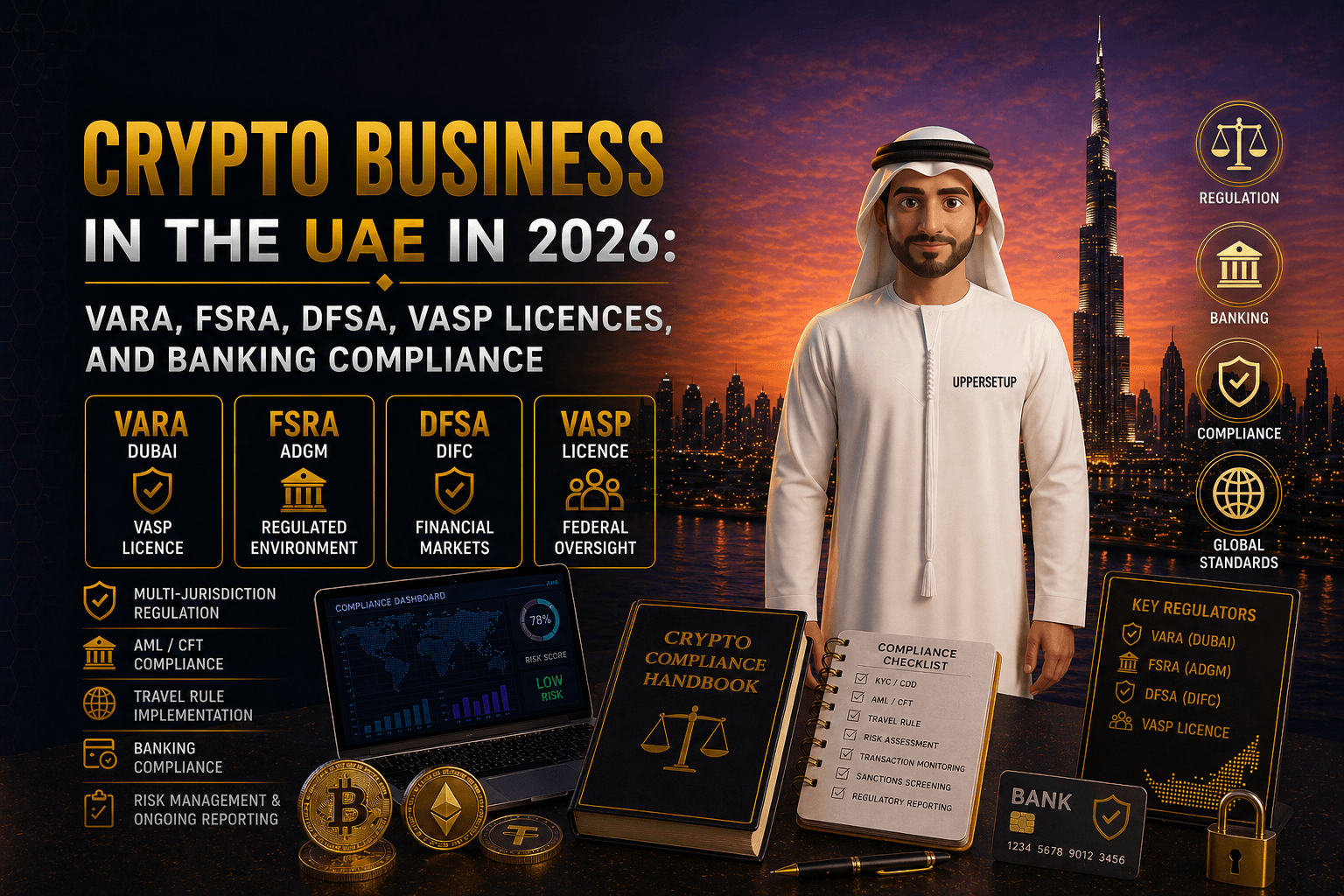
Crypto Business in the UAE in 2026: VARA, FSRA, DFSA, VASP Licences, and Banking Compliance
Introduction. Why the UAE Is the Most Mature Crypto Jurisdiction of 2026
The UAE occupies a unique position in the global virtual asset regulatory landscape. It is the only country in the world to have established a dedicated regulatory authority exclusively for virtual assets — VARA in Dubai — as early as 2022, long before most jurisdictions had begun drafting any coherent rules.
By 2026, the UAE's regulatory architecture for virtual assets had acquired a three-tier structure: the federal level (the Capital Markets Authority, CMA — formerly the Securities and Commodities Authority, SCA — and the Central Bank of the UAE), the emirate level (VARA for Dubai, CMA for other emirates), and the financial free zone level (FSRA in ADGM, DFSA in DIFC). Each of these regulators has its own licensing requirements, its own regulatory instruments, and its own target audience.
Failure to understand this architecture is the most common mistake of entrepreneurs planning to open a crypto company in the UAE: they try to pick the 'best regulator' instead of first defining their business model, target audience, and asset types — and only then selecting the appropriate jurisdiction.
This article is a systematic breakdown of the regulatory landscape, licence categories, capital requirements, AML obligations, and banking compliance for crypto companies in the UAE in 2026.
Part I. Regulatory Architecture: Who Is Responsible for What
1.1. Federal Level: CMA and the Central Bank of the UAE
Cabinet Resolution No. 111 of 2022 (published 15 December 2022, effective 14 January 2023) established the federal legal foundation for regulating virtual assets in the UAE. This instrument designated the Capital Markets Authority (CMA) — previously the Securities and Commodities Authority (SCA) — as the principal federal regulator of virtual assets, with authority to delegate its powers to local licensing authorities including VARA.
In August 2025, the CMA and VARA signed a cooperation agreement establishing a mutual licence recognitionmechanism: a VASP licensed by VARA in Dubai may by default serve clients across the entire UAE with CMA registration, without re-licensing. VASPs wishing to operate in emirates outside Dubai are licensed by the CMA directly.
The Central Bank of the UAE (CBUAE) regulates payment tokens — stablecoins and other virtual assets used as a means of payment. The relevant regulatory basis is the Payment Token Services Regulation (PTSR) issued by the Central Bank. Companies wishing to issue or accept payment tokens in the UAE fall under its jurisdiction.
1.2. VARA: Dubai's Virtual Asset Regulator
The Virtual Assets Regulatory Authority (VARA) was established by Dubai Law No. 4 of 2022 Regulating Virtual Assets in the Emirate of Dubai. VARA is the world's first dedicated regulator exclusively for virtual assets. Jurisdiction: the entire emirate of Dubai, including all free zones and mainland, excluding the DIFC.
On 7 February 2023, VARA issued its Virtual Assets and Related Activities Regulations 2023 — a comprehensive regulatory framework covering all VASP activity categories. On 19 May 2025, VARA Rulebook V2.0 came into force, replacing previous versions and introducing new market abuse standards as well as a separate Virtual Asset Issuance Rulebook.
VARA operates as a sovereign regulator acting within the federal mandate of the CMA, with its own normative rulebooks, licensing procedures, and enforcement powers.
1.3. FSRA: ADGM's Virtual Asset Regulator
The Financial Services Regulatory Authority (FSRA) regulates virtual asset activities in the Abu Dhabi Global Market (ADGM) — Abu Dhabi's financial free zone with its own legal system based on English common law. The FSRA was one of the first regulators in the world to license virtual asset trading platforms as Multilateral Trading Facilities (MTF).
In June 2025, the FSRA introduced the updated Financial Services and Markets (Amendment No. 1) Regulations 2025:
— An activity-based fee structure for virtual asset service providers was introduced;
— Minimum capital requirements for custodians were raised to AED 5 million;
— Product intervention powers were expanded;
— An express prohibition was introduced on privacy tokens, algorithmic stablecoins, and assets that obstruct transaction tracing;
— In September 2025, the FSRA published a consultation paper on regulating virtual asset staking of client funds — feedback is under review.
Only Accepted Virtual Assets (AVAs) — assets assessed by the FSRA against technical, compliance, and risk requirements — may be used in regulated activities within ADGM. Bitcoin, Ethereum, and certain regulated stablecoins are on the AVA list. Privacy tokens and algorithmic stablecoins are prohibited.
1.4. DFSA: DIFC's Virtual Asset Regulator
The Dubai Financial Services Authority (DFSA) regulates virtual asset activities in the Dubai International Financial Centre (DIFC). The DIFC, like ADGM, is a financial free zone with its own English common law-based legal system and is outside VARA's jurisdiction.
The DFSA uses the Investment Token as the primary classification for digital assets with security-like characteristics. It applies requirements comparable to the FSRA, but oriented towards financial market infrastructure. DIFC is suitable for companies focused on institutional clients and working with structured financial products.
Part II. VARA: Seven Licence Categories and the Licensing Procedure
2.1. VARA's Seven Licensed Activity Categories
VARA licences the following virtual asset activities:
Table: VARA Activity Types and Capital Requirements (2026)
|
Activity Type |
Minimum Capital (USD) |
|
Advisory Services |
27,300 (AED 100,000) |
|
Broker-Dealer Services |
109,000 or 15% of fixed annual overheads |
|
Custody Services |
218,000 or 15% of fixed annual overheads |
|
Exchange Services |
218,000 or 15% of fixed annual overheads |
|
Lending & Borrowing Services |
136,300 (AED 500,000) or 25% of fixed annual overheads |
|
VA Management & Investment Services |
109,000 or 15% of fixed annual overheads |
|
Transfer & Settlement Services |
218,000 or 15% of fixed annual overheads |
Source: VARA Rulebook V2.0, 2025. The higher of the two values applies.
In addition to the above, VARA Rulebook V2.0 introduced the Sponsored VASP regime — a new model allowing operators to function under the oversight of a licensed Regulated Sponsor with limited authority and strict sponsor supervision. This lowers the entry threshold for smaller companies, but does not waive compliance requirements.
Proprietary virtual asset trading (own account, no client funds): a VASP licence is not required, but where the 30-day rolling trading volume exceeds USD 250 million, registration with VARA is mandatory. For smaller volume trading, an NOC (No Objection Certificate) from VARA is sufficient.
2.2. VARA's Two-Stage Licensing Procedure
VARA licensing consists of two sequential stages. The typical timeline from IDQ submission to receipt of a full licence is 4–7 months, depending on complexity and the number of activities applied for.
Stage 1 — Initial Approval:
1. Submission of the Initial Disclosure Questionnaire (IDQ) — through the relevant free zone authority or DET (for mainland companies). Together with the IDQ, a Regulatory Business Plan is submitted — a detailed document describing business activities, governance structure, risk management policies, and revenue model;
2. Payment of initial registration fees;
3. VARA review of operational readiness, governance structure, and compliance framework.
Stage 2 — Full VASP Licence:
1. Confirmation of fulfilment of all requirements — office, staff, technology infrastructure;
2. Appointment of mandatory officers: MLRO (Money Laundering Reporting Officer), Compliance Officer, Chief Executive Officer — all with experience meeting VARA's fit and proper requirements;
3. Submission and approval of compliance policies: AML/CFT, KYC, transaction monitoring, Travel Rule;
4. Demonstration of technology infrastructure — transaction monitoring systems, on-chain and off-chain signals, sanctions screening;
5. Receipt of the full VASP licence from VARA.
Physical presence requirement: VARA requires all licensees to have a genuinely leased or owned office in Dubai. A virtual address is not accepted. The company must be incorporated in Dubai (through DET or a Dubai free zone, excluding DIFC) in one of the corporate forms approved by VARA.
Part III. AML/CFT Requirements for VASPs in the UAE in 2026
With the adoption of Federal Decree-Law No. 10 of 2025 (effective 14 October 2025), virtual asset service providers were expressly and comprehensively brought within the perimeter of AML/CFT obligated entities — on par with banks and Designated Non-Financial Businesses and Professions (DNFBPs). This is the most significant development for crypto companies in the UAE in 2025.
3.1. What Changed for VASPs After Federal Decree-Law No. 10 of 2025
— VASPs received statutory recognition as a distinct category of regulated entities, with the full scope of preventive obligations: Customer Due Diligence (CDD), transaction monitoring, and direct reporting to the Financial Intelligence Unit (FIU);
— Conducting virtual asset activities without a licence or registration with the competent authority is now a criminal offence under Article 20 of the law; maximum punishment includes imprisonment;
— Prohibition on full-anonymity tokens: no UAE VASP may execute transfers of tokens that ensure complete anonymity and obstruct tracing by competent authorities;
— Maximum administrative fine for legal entities: AED 100 million;
— The FIU received expanded powers to freeze assets, including crypto assets, without prior notice.
Cabinet Resolution No. 134 of 2025 (the Executive Regulations to the new AML Law, published 15 November 2025, effective 14 December 2025) for the first time expressly brought VASPs within the scope of the Executive Regulations. Key distinction from banks: the threshold for mandatory client verification (CDD) for VASPs is AED 3,500 per single or linked transaction (for banks — AED 55,000 for individual transactions and AED 3,500 for occasional wire transfers).
3.2. The Virtual Assets Travel Rule
The Travel Rule — FATF Recommendation 16 — requires VASPs to transmit originator and beneficiary information alongside virtual asset transfers. In the UAE, the Travel Rule for virtual assets was introduced by the CBUAE and incorporated into VARA's Compliance and Risk Management Rulebook.
Threshold: USD 1,000 (approximately AED 3,672) — per single or linked transaction.
Travel Rule requirements:
— The originating VASP must collect: full name of the originator, account number or wallet address, physical address or identification number (passport/ID), country, full name of the beneficiary, beneficiary wallet address;
— The receiving VASP must verify the received information and screen against sanctions lists;
— Transfers to/from unhosted wallets above the threshold: the VASP must collect a customer self-declaration regarding source of funds and purpose of transfer, and apply enhanced due diligence;
— VASPs must use a technically compliant Travel Rule solution — several approved vendors are available (Sygna Bridge, Notabene, Shyft, and others).
3.3. Operational AML Requirements for VASPs
Regardless of regulator (VARA, FSRA, DFSA, CMA), all UAE VASPs are required to:
1. Appoint a MLRO (Money Laundering Reporting Officer) — an individual bearing legal responsibility for the company's AML/CFT compliance and acting as the primary point of contact with the FIU;
2. Develop and implement an AML/CFT programme including: client risk assessment, CDD/EDD procedures, real-time transaction monitoring, sanctions screening policy;
3. File STRs (Suspicious Transaction Reports) through the goAML platform — the UAE FIU's system. Failure to file an STR is a separate offence;
4. Screen in real time against UN sanctions lists, UAE targeted financial sanctions lists, and OFAC and EU databases (for companies with international operations);
5. Integrate on-chain analytics (blockchain analytics) — transaction monitoring at the blockchain level to identify addresses linked to fraud, sanctioned parties, or dark markets. VARA Rulebook V2.0 expressly requires VASPs to combine on-chain and off-chain signals into a single unified client behaviour analysis system;
6. Maintain documentation of all KYC decisions, transaction monitoring actions, and STRs for a minimum of 5 years.
Part IV. Corporate Bank Account for a Crypto Company in the UAE: The Reality of 2026
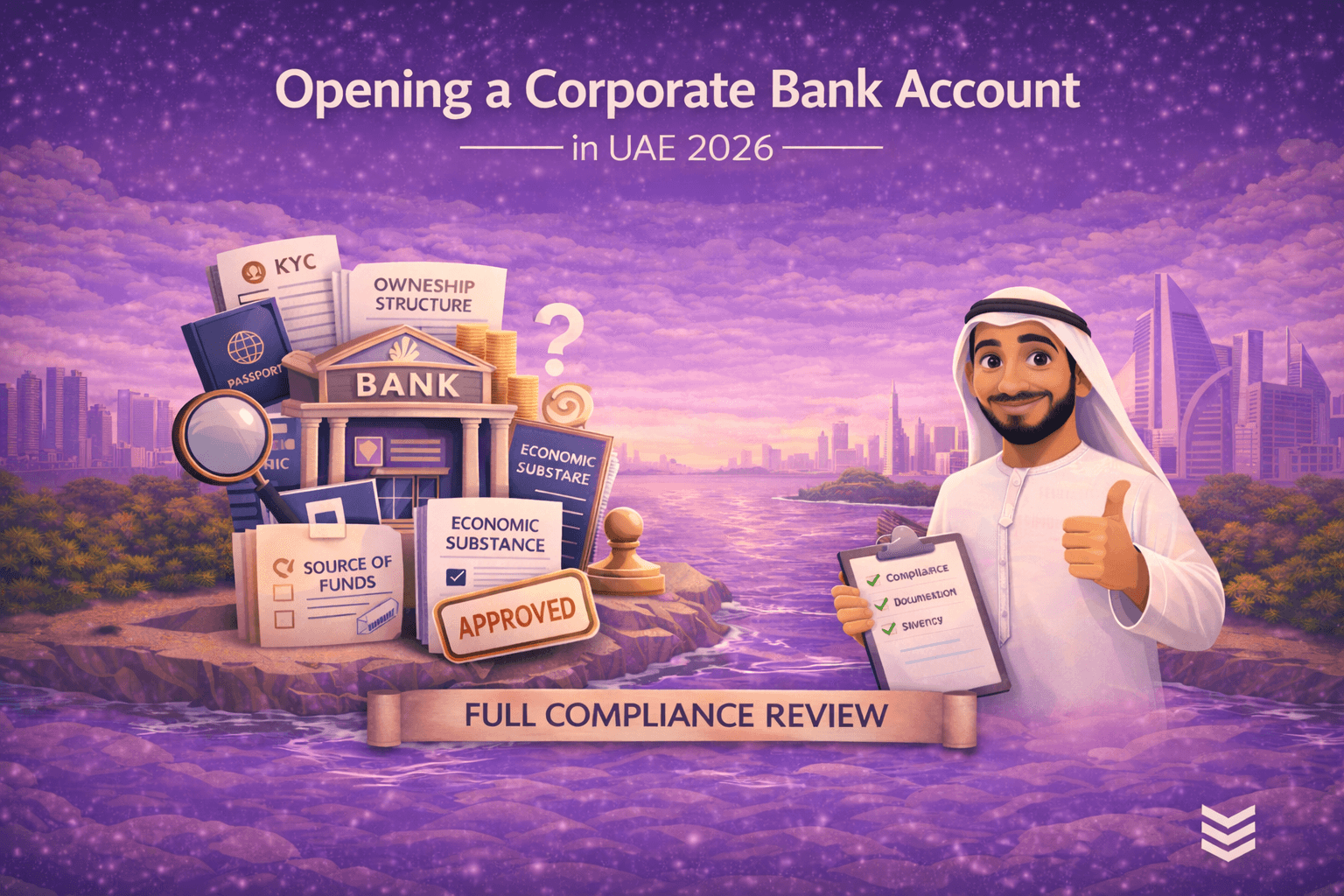
Opening a corporate bank account is the most painful operational stage for crypto companies even with a valid VARA or FSRA licence. This is not accidental: UAE banks are operating under simultaneous pressure from new AML legislation and the active phase of the FATF mutual evaluation.
4.1. Why Banks Refuse Crypto Companies — Even Licensed Ones
Having a VARA or FSRA licence is a necessary but not sufficient condition for opening a bank account. Banks evaluate not only regulatory status but also:
— Nature of transactions: the bank must be able to track and explain to regulators every incoming and outgoing payment. Mixed fiat/crypto turnover without clear procedures raises immediate questions;
— Client base: if your clients are retail crypto investors from high-risk jurisdictions, the bank treats this as concentrated risk;
— Transaction volume: crypto companies typically have high transaction volumes with a non-standard risk profile;
— Reputational risk: banks do not wish to be associated with a business that may attract regulatory public attention.
4.2. Financial Institutions Open to Working with Licensed VASPs
As of 2026, the following financial institutions work with VASPs where a licence is held:
— Zand Bank — the UAE's first fully digital bank, specialising in corporate and crypto-native clients. Accepts VARA- and FSRA-licensed VASPs. Supports multi-currency accounts and integration with cryptocurrency operations;
— Wio Bank — a CBUAE-licensed digital bank with partnership programmes with certain free zones. Reviews licensed VASP applications depending on their activity profile;
— Emirates Islamic Bank and certain traditional banks — review applications from licensed VASPs with established operational history and a transparent client base on an individual basis;
— Banks within ADGM and DIFC — traditionally more open to virtual asset-related financial services where the relevant FSRA or DFSA licence is held.
4.3. What the Bank Checks for a Crypto Company
In addition to standard corporate KYC (licence, MOA, UBO, director passports, source of funds), crypto companies face a specific additional review block:
— Copy of the valid VARA/FSRA/DFSA/CMA licence listing permitted activities;
— Company AML/CFT policy — including Travel Rule procedures;
— Description of technology infrastructure: which blockchains are supported, which on-chain analytics tools are used;
— List of served jurisdictions: banks pay particular attention to US clients (FATCA), sanctioned countries, or FATF high-risk jurisdictions;
— Policy on retail versus institutional clients: banks are considerably more receptive to B2B-oriented VASPs;
— Policy on unhosted wallets: banks apply heightened caution to companies without strict procedures for unhosted wallet transactions.
4.4. Practical Recommendations
Before visiting the bank: prepare a complete AML documentation package — not generic statements but specific policies with procedural detail. The bank's compliance officer will ask technical questions about your transaction monitoring system, Travel Rule solution, and screening procedures.
Priority sequence: obtain the licence first → develop a full AML framework → then approach the bank. Crypto companies attempting to open an account before licensing invariably receive refusals.
Consider alternatives: for international fiat settlements, a number of licensed VASPs use Electronic Money Institutions (EMIs) with European licences in combination with a UAE corporate account. This requires separate legal analysis but is permissible.
Part V. Comparison of Regulatory Pathways: VARA vs ADGM FSRA vs DIFC DFSA vs CMA
UAE Virtual Asset Regulator Comparison Table
|
Parameter |
VARA (Dubai) |
FSRA (ADGM) |
DFSA (DIFC) |
CMA (Federal) |
|
Jurisdiction |
Dubai (excl. DIFC) |
ADGM, Abu Dhabi |
DIFC, Dubai |
All emirates excl. DIFC/ADGM |
|
Legal basis |
Dubai Law No. 4 of 2022 |
English common law, FSMR |
English common law, DIFC Laws |
Cabinet Resolution 111/2022 |
|
Target audience |
Retail and institutional |
Primarily institutional |
Institutional |
All UAE excl. FFZs |
|
Min. capital |
USD 27–409k by activity type |
AED 5 million+ for custodians |
By activity type |
By activity type |
|
Permitted assets |
BTC, ETH and others (excl. full-anon) |
AVAs per FSRA list only |
Investment Tokens per DFSA list |
Per CMA classification |
|
Timeline |
4–7 months |
3–6 months |
3–6 months |
4–8 months |
|
Privacy tokens |
Prohibited |
Prohibited |
Prohibited |
Prohibited |
When to choose VARA: the business model targets retail and professional clients in Dubai; a broad asset range is required; maximum operational detail in the regulatory framework is needed.
When to choose FSRA/ADGM: the priority is institutional clients, asset management, funds; an English common law legal system is required; reputation for attracting international investors matters.
When to choose DFSA/DIFC: the priority is financial infrastructure, trading platforms, investment products with tokenised securities; access to the DIFC ecosystem is required.
Part VI. Corporate Tax for Crypto Companies in the UAE
Licensed VASPs in the UAE are subject to the general corporate tax regime under Federal Decree-Law No. 47 of 2022: 0% on profits up to AED 375,000 and 9% on profits above this threshold.
Free zone specifics: crypto companies in free zones can theoretically qualify for QFZP status and the 0% rate, however most crypto activities (exchange, custody, lending) are not on the qualifying activities list in MD No. 229 of 2025. Fund management services — which appear on the qualifying list — means that crypto fund managers with an FSRA licence operating in an ADGM free zone can potentially qualify for QFZP status if all conditions are met. For exchange and custodial operations, the standard 9% rate applies.
Important: crypto companies with revenue up to AED 3 million are eligible for Small Business Relief until 31 December 2026 — provided they are not QFZPs and are not members of an MNE group.
Part VII. Typical Mistakes When Launching a Crypto Business in the UAE
Mistake 1. Attempting to Operate Without a Licence 'While the Process Is Ongoing'
Under Article 20 of Federal Decree-Law No. 10 of 2025, unlicensed VASP activity is a criminal offence. A 'soft launch' before obtaining a licence is not entrepreneurial flexibility — it is criminal liability.
Mistake 2. Choosing a Regulator Without Analysing the Business Model
VARA, FSRA, and DFSA have different permitted asset lists, different capital requirements, and different target audiences. Choosing the 'cheapest' regulator without matching it to the business model leads in 90% of cases to the need for re-licensing.
Mistake 3. Underestimating AML Infrastructure
VARA and FSRA expect real AML infrastructure from licensees — not template policies, but functioning systems: on-chain analytics, a Travel Rule solution, a working real-time transaction monitoring system. Cosmetic compliance is exposed at the first regulatory inspection.
Mistake 4. Approaching the Bank Before Licensing
UAE banks do not open accounts for crypto companies without a valid VARA/FSRA/DFSA/CMA licence. Any attempt to open an account before this stage creates a refusal record visible to other banks upon verification.
Mistake 5. Ignoring the Privacy Token Prohibition
Monero, Zcash, and similar tokens with fully anonymous transactions are prohibited for operations in all UAE jurisdictions. Supporting these assets in products or on a platform triggers immediate regulatory consequences.
Conclusion. The UAE Is Not an Offshore for Crypto. It Is a Regulated Market.
The mistaken belief that the UAE is an 'easy jurisdiction' for crypto business proves costly. The UAE has built the most detailed and demanding regulatory architecture for virtual assets in the world. This attracts serious players — and filters out those seeking regulatory arbitrage.
The correct sequence of actions:
1. Define the business model — activity types, assets, client base, target markets;
2. Select the regulator — VARA, FSRA, DFSA, or CMA based on business parameters;
3. Build AML infrastructure — MLRO, policies, monitoring systems, Travel Rule solution;
4. Complete licensing — IDQ, Regulatory Business Plan, VASP Licence;
5. Open a bank account — with a full AML documentation package and licence in hand;
6. Launch operations with continuous compliance with VARA/FSRA and FTA requirements.
The UPPERSETUP platform helps entrepreneurs navigate the first steps of this path — from jurisdiction selection and operating entity registration to banking compliance preparation.
This material is for informational purposes only and does not constitute legal advice. All regulatory references are current as of April 2026. Before making decisions, consultation with a lawyer specialising in UAE virtual asset regulation is recommended.
All services on the platform
Everything you need to start and run a business - in one place
- 3–5 days
Company Setup
Mainland or Free Zone company with a complete set of incorporation documents
Start - Monthly
Accounting Services
Financial accounting and reporting in accordance with UAE requirements
Start - 1–2 weeks
Visa Services
Residence visas for shareholders, employees and family members
Start - 7–30 days
Banking Services
Corporate Bank Accounts in the UAE and Payment Services
Start - Custom timeline
Legal Services
Contracts, corporate amendments and legal support
Start


