






























































































 International Free Zone Authority
UAE Tourist Identity: CBUAE, ICP and ADCB Launch Digital Bank Account Opening for Non-Residents — What This Actually Means
Introduction. The First Step Toward a New Model: Arrive in the UAE — Already in the Financial System
On 30 April 2026, the Central Bank of the UAE (CBUAE), the Federal Authority for Identity, Citizenship, Customs and Port Security (ICP), and Abu Dhabi Commercial Bank (ADCB) announced the launch of digital bank account opening services through the 'Tourist Identity' initiative.
The news instantly swept the region's leading media: Khaleej Times, Gulf News, Emirates 24/7, WAM (UAE's official news agency), and Economy Middle East. It also immediately generated a wave of interpretations — ranging from measured to hyperbolic.
So let us begin with what this is not, before examining what it is.
This does not mean that UAE bank accounts are now available to all tourists without restriction. This does not mean that a tourist receives the same functionality as a resident with an Emirates ID. This does not mean that KYC and AML requirements have disappeared or become a formality.
What it does mean — and this matters — is that the UAE has taken the first official systemic step toward a model in which a tourist, from the moment of arrival, acquires a verified digital identity and through it gains access to basic banking services. For now, through one bank. For now, within one initiative. But this is systemic logic, not a one-off experiment.
Part I. What Was Actually Announced: Details of the Official Release
The official CBUAE press release, published simultaneously on the CBUAE website (centralbank.ae) and distributed by WAM, contains the following specific statements:
Initiative Participants
— CBUAE (Central Bank of the UAE) — the regulator providing the legal and regulatory framework for the initiative in the context of the UAEKYC Framework and account opening requirements;
— ICP (Federal Authority for Identity, Citizenship, Customs and Port Security) — the authority issuing the Tourist Identity and providing biometric verification through facial recognition and AI technologies;
— ADCB (Abu Dhabi Commercial Bank) — the first participating bank, which has integrated its mobile platform with ICP to accept the Tourist Identity as the basis for account opening.
What Was Launched
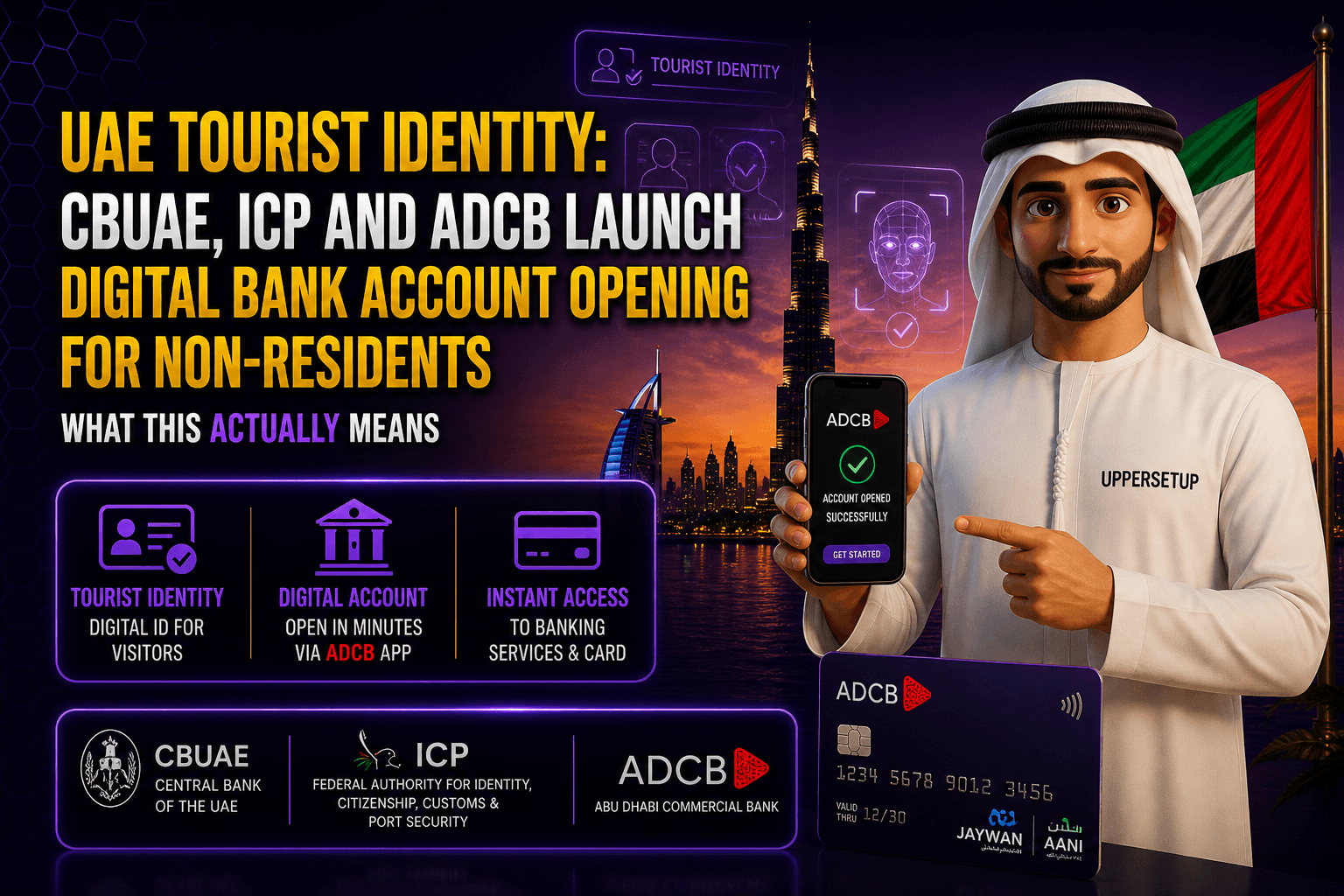
— The ability for non-resident visitors to open digital bank accounts through the ADCB app using a Tourist Identity;
— The process takes minutes and is entirely contactless — without a branch visit or paper documents;
— After account opening, immediate access to essential banking services is available, including a digital debit cardfor instant use;
— The account is integrated with the UAE's national payment infrastructure: the Jaywan national payment scheme and the Aani instant payment platform.
How Tourist Identity Works
A Tourist Identity is a digital identification that ICP creates for tourists upon arrival in the UAE. The system is built on advanced biometric verification and artificial intelligence. Key elements:
— Biometrics and facial recognition — personal identity verification using existing ICP entry data (passport control records biometrics at entry);
— No physical documents required — the Tourist Identity allows tourists to access services across various economic sectors without presenting original documents;
— Integration with the banking platform — through an API connection between ICP and the ADCB mobile application, the Tourist Identity becomes the foundation for KYC when opening an account.
Saif Humaid Al Dhaheri, CBUAE Assistant Governor for Banking Operations: "The initiative contributes to delivering an integrated and secure banking experience for visitors from the moment they arrive in the UAE."
Major General Suhail Juma Al Khaili, ICP Acting Director General of Citizenship: "The system enables seamless and efficient access to a wide range of services and improves the overall visitor experience."
Part II. What This Is Not: Four Critical Clarifications
To avoid building incorrect expectations, the boundaries of the initiative must be clearly defined. Each of the four clarifications is fundamental.
Clarification 1. This Is ADCB for Now — Not the Entire UAE Banking System
The official release explicitly identifies ADCB as the sole participating bank in the first phase of the initiative. The formulation used by ADCB Group CEO Ala'a Eraiqat — "ADCB's participation in this phase" — directly indicates a phased rollout.
This means that tourists who are not ADCB clients or do not wish to become ADCB clients remain outside the initiative's perimeter for now. Other UAE banks — Emirates NBD, FAB, Mashreq, RAKBANK — may join in subsequent phases, but at launch only ADCB participates.
For comparison: if the United Kingdom announced that tourists could open a digital account through Barclays, this would not mean that Lloyds, HSBC, and NatWest automatically followed. Systemic reach is built gradually.
Clarification 2. This Is a Digital Account for Visitors — Not a Full Resident Account
The standard ADCB current account for individuals continues to require: a valid UAE residence visa, an Emirates ID, and confirmation of income source (salary certificate or statement). This is a requirement of the official ADCB Rulebook and the CBUAE regulatory framework — the Tourist Identity initiative does not change it.
The account opened for tourists is a digital account with limited functionality, designed for basic payment needs during the visit: paying for purchases and services via a debit card, transfers through Aani, transactions through Jaywan. This is fundamentally different from an account that allows receiving a salary, holding significant funds, accessing credit products, or conducting business transactions.
An important historical note: non-residents were previously able to open certain UAE bank accounts, but the process required extensive documentation. The new model replaces paper-based documentation with official digital identification — this is an evolution of the mechanism, not the creation of a fundamentally new account category.
Clarification 3. KYC and AML Have Not Disappeared — They Have Been Moved Into Digital Verification
No regulatory norm in the UAE has been repealed. The CBUAE Rulebook (Account Opening, section 3.20) continues to apply: licensed financial institutions must ensure bank account opening is completed within 3 business days where the applicant presents a low money laundering and terrorist financing risk and standard customer due diligence documentation is satisfactory.
What has changed: the form and speed of KYC execution. Traditional KYC required physical documents, a personal visit, and manual processing. The Tourist Identity moves personal identity verification into the digital space — biometric data collected by ICP at the border crossing becomes the basis for CDD (Customer Due Diligence) when opening a bank account under a regulator-approved mechanism.
This is consistent with the architecture of the UAE KYC Platform — the centralised client verification platform developed by the CBUAE, which allows financial institutions to use government-verified data for KYC compliance. The Tourist Identity is a logical extension of this platform to the category of visitors.
It should also be noted: transaction limits on tourist digital accounts are likely conservative. The official release does not disclose specific amounts, but regulatory logic suggests that for an account opened without a full resident KYC package, limits will be cautious — as is standard global practice for non-resident digital accounts.
Clarification 4. Not All Tourists Automatically Receive a Tourist Identity
The official release states that the Tourist Identity is 'provided to visitors upon arrival in the UAE' — however, specific coverage conditions (all arrivals or specific categories, dependence on nationality, requirement for a dedicated application) are not detailed in public materials. Based on ICP's architecture, the Tourist Identity is formed using biometric data collected at passport control — meaning it covers tourists entering through official border points, but implementation details require clarification.
Part III. What This Is: The Strategic Significance of the Initiative
Having defined what the initiative is not, its real significance can be assessed objectively — which, properly understood, is genuinely substantial.
The First Official Mechanism: Tourist → Digital Identity → Bank
Prior to 30 April 2026, no official government-bank mechanism existed in the UAE allowing a tourist to open a bank account directly through the national identification system. Certain banks accepted non-residents with appropriate documentation and risk profiles — but this was each bank's individual decision, not part of state infrastructure.
The Tourist Identity initiative creates a fundamentally new architecture: the state verifies the tourist's identity → transmits verified data to the bank → the bank opens an account. This is a division of labour between state KYC and bank onboarding that represents a global leading standard (analogous systems operate in Estonia, Singapore, and Finland in the context of eID).
Strengthening the Cashless Economy and Digital Payments Strategy
The UAE is systematically moving toward a cashless economy. The official digital payments strategy targets a reduction in the share of cash transactions and an expansion in the reach of the Jaywan and Aani payment infrastructure. Tourist flows to the UAE exceed 20 million visitors per year (Dubai alone closed 2024 with a record 17.15 million tourists). A significant portion of this flow continues to use cash or foreign cards, creating conversion losses and limiting the reach of local payment infrastructure.
The Tourist Identity shifts this balance: a tourist, within hours of arriving in the UAE, becomes a participant in the local payment system, using Jaywan infrastructure and Aani transfers. This directly strengthens the cashless economy and expands the reach of the national payment system.
Enhancing the Competitiveness of Tourism Infrastructure
ADCB Group CEO Ala'a Eraiqat explicitly called the initiative an element of "future-ready financial models" that enhance the UAE's attractiveness as a global tourism destination. No other competing regional tourism hub — Saudi Arabia, Qatar, Bahrain — has launched a comparable mechanism at the level of state-bank integration. This is a competitive advantage in the race for tourist flows.
A New Infrastructure Logic for Future Expansion
The most important aspect of this initiative is not what happens today but what it creates as an infrastructural precedent. The Tourist Identity as a verified digital identity for non-residents can be expanded far beyond a bank account: vehicle rental, access to healthcare services, government services, insurance. The ICP + private sector integration is not a one-off experiment — it is the construction of a national digital identification infrastructure whose architecture is clearly designed for scale.
Part IV. The Regulatory Context: UAE KYC Framework and Legal Basis
Understanding the initiative is impossible without understanding the regulatory context in which it operates.
UAE KYC Platform and UAEKYC Framework
The UAE KYC Platform was launched by the CBUAE in 2021 as a centralised client verification infrastructure allowing financial institutions to use data already verified by government authorities for KYC compliance. This eliminates duplicated verification and reduces onboarding barriers while maintaining regulatory standards.
The Tourist Identity initiative is a logical extension of this architecture to the category of non-residents: ICP verifies identity at entry → this verification becomes adequate grounds for CDD in opening a bank account under a regulator-approved mechanism.
CBUAE Rulebook: Account Opening
Section 3.20 of the CBUAE Rulebook (Account Opening) establishes that banks must ensure account opening within 3 business days for customers assessed as low AML/CFT risk with satisfactory standard CDD documentation. The Tourist Identity through ICP is precisely a mechanism that satisfies the CDD standard for the category of non-residents with a low risk profile (tourists with a verified passport and biometrics).
Federal Decree-Law No. 10 of 2025 (AML)
The federal anti-money laundering law adopted in October 2025, effective 14 October 2025, expressly provides for the use of technological solutions for KYC compliance. The Tourist Identity fully fits this framework: ICP's biometric verification constitutes a form of digital identification recognised as adequate by the state regulator.
Part V. What This Means for Different Stakeholder Categories
Practical Implications of the Tourist Identity Initiative by Category
|
Category |
What Changes |
What Remains Unchanged |
|
Tourists in the UAE |
Can open a digital ADCB account via Tourist Identity in minutes; digital debit card immediately available |
Full resident current account still requires Emirates ID and residency visa |
|
Non-resident entrepreneurs |
Potentially — a simplified path to basic banking during business visits before incorporation |
Corporate account and business banking still require a trade licence and residency |
|
UAE banks |
ADCB gains first-mover advantage in tourist onboarding; competitors may join in subsequent phases |
KYC/AML obligations unchanged; transaction limits on tourist accounts remain conservative |
|
Regulator (CBUAE) |
New financial inclusion mechanism for non-residents; expanded reach of Jaywan/Aani |
Prudential supervision and AML requirements remain fully in force |
|
UAE tourism industry |
Tourists integrated into local payment infrastructure from first hours; reduced cash use |
Traditional payment tools (foreign cards) continue to be accepted |
Part VI. Global Context: Where Similar Models Already Exist
Integrating state digital identification with bank onboarding is a global trend that the UAE is implementing in its own version.
— Estonia (e-Residency): foreign entrepreneurs receive a digital e-Resident identification and through it can establish companies and open bank accounts. Key difference: e-Residency is a deliberate entrepreneurial choice; the Tourist Identity is automatic identification for any arriving tourist;
— Singapore (MyInfo): a state digital verification system that allows financial institutions to automatically receive government-verified client data. ADCB + Tourist Identity is a conceptually analogous model for the UAE context;
— Finland, Sweden (BankID): bank ID as a public-private identification infrastructure — a mature analogue of what the UAE is building in the tourism context.
The distinguishing feature of the UAE model: the integration extends beyond residents, as in most analogues, to include temporary visitors. This broadens the reach of digital identification substantially, while also complicating KYC risk management — precisely why limited functionality on the tourist account is a sensible first step.
Conclusion. This Is Not a 'Banking Amnesty for Tourists'. It Is the First Brick of New Infrastructure.
Correctly interpreting the Tourist Identity initiative requires avoiding two extremes: underestimating it ('just one bank, limited functionality') and hyperbole ('now any tourist is like a resident').
The real significance lies in between and is strategic: the UAE has taken the first official systemic step toward an architecture in which a tourist, from the moment of arrival, becomes part of the country's financial system through a verified digital identity. This changes the logic of the model: previously, including a non-resident in the financial system began with acquiring resident documents. Now — it begins at the border crossing.
For entrepreneurs who frequently visit the UAE on business, this creates the first official opportunity to have a basic UAE bank account without completing a full corporate or resident onboarding — which is particularly relevant at the stage of exploring the market before making a registration decision.
The UPPERSETUP platform helps entrepreneurs take the next step after a tourist introduction to the UAE: company registration, residence visa, and opening a full corporate bank account.
Sources: Official CBUAE press release (centralbank.ae, 30 April 2026); WAM (UAE official news agency); Khaleej Times, Gulf News, Emirates 24/7, Economy Middle East (30 April 2026); CBUAE Rulebook, Account Opening, section 3.20; Federal Decree-Law No. 10 of 2025. This material is for informational purposes only.
All services on the platform
Everything you need to start and run a business - in one place
- 3–5 days
Company Setup
Mainland or Free Zone company with a complete set of incorporation documents
Start - Monthly
Accounting Services
Financial accounting and reporting in accordance with UAE requirements
Start - 1–2 weeks
Visa Services
Residence visas for shareholders, employees and family members
Start - 7–30 days
Banking Services
Corporate Bank Accounts in the UAE and Payment Services
Start - Custom timeline
Legal Services
Contracts, corporate amendments and legal support
Start


